Thursday, October 29, 2020

Have You Ever Felt Embarrassed To Be A White Man?

>


In her exhaustive essay for the NY Times this week, Win or Lose, It’s Donald Trump’s Republican Party, Elaina Plott writes a lot about how down-ballot Republicans in red districts are abandoning most of what their party has traditionally stood for to send one over-arching message: "I stand for Trump-- a vote for me is a vote for Señor T." These candidates say they think that what makes Trump different from other Republicans is that he's willing "to go to extremes" to pursue and defend what he believes in. One candidate for commissioner in Manatee County, Florida used this image on his Facebook page, adding "2020 IS NO LONGER REPUBLICAN VS. DEMOCRAT. IT’S FREEDOM VERSUS TYRANNY." He doesn't even have an opponent. (Ironically, many Democrats agree with his assessment of what the 2020 election is all about.)


"The panic and excitement attending Donald Trump," wrote Plott, "have always shared an assumption: that his election marked a profound break with the American politics that came before it. During his inaugural address, as he surveyed the national landscape of 'American carnage,' Trump himself invoked the advent of 'a historic movement the likes of which the world has never seen before.' In the years and events that followed-- the endless soap opera of the White House, the forceful separation of children from their families at the border, the pandemic, Trump’s refusal to permit even a passing interest in a peaceful transfer of power-- it seemed increasingly clear that the world never had.

But for all the attention paid to what Trump represents in American politics, the most salient feature of his ascent within the Republican Party might be what he doesn’t represent... Trump’s takeover... has been as one-dimensional as it has been total. In the space of one term, the president has co-opted virtually every power center in the Republican Party, from its congressional caucuses to its state parties, its think tanks to its political action committees. But though he has disassembled much of the old order, he has built very little in its place. 'You end up with this weird paradox where he stands to haunt the G.O.P. for many years to come, but on the substance it’s like he was never even there,' said Liam Donovan, a Republican strategist."

A self-absorbed Trump has brought the crazies and proud racists and sociopaths out into the open. He has made it ok to be an open bigot and hate-monger.
During Trump’s presidency, his party has become host to new species of fringe figures. Laura Loomer, a self-identified #ProudIslamophobe and erstwhile Infowars contributor who has been banned from Twitter and Facebook, earned presidential praise-- and a campaign-trail cameo from Trump’s daughter-in-law, Lara Trump-- for winning her Florida congressional district’s Republican primary in August. There is also Marjorie Taylor Greene, the party’s current nominee in the race for Georgia’s 14th district, whose embrace of the QAnon conspiracy theory and litany of racist, Islamophobic and anti-Semitic statements didn’t dissuade Trump from calling her a “future Republican star,” or Representative Kevin McCarthy, the Republicans’ leader in the House, from pledging to give her committee assignments should she win in November.

But Trump’s influence is also reflected, in a more pedestrian but equally revealing way... [transposing] Trumplike signifiers onto otherwise utterly conventional suburban Republican platforms. Republican voters are essentially the same people who voted Republican before Trump; the party’s politicians are still mostly the same people, hiring mostly the same strategists. But their relationships to the party now flow through a single man, one who has never offered a clear vision for his political program beyond his immediate aggrandizement. Whether Trump wins or loses in November, no one else in the party’s official ranks seems to have one, either.

...As it turned out, Trump wasn’t especially interested in running on Ryan’s “bold conservative policy agenda.” “Put a Stop to Executive Overreach” may have been a Better Way, but Trump believed the people-- his people-- would be more galvanized by a ban on all Muslim travel to the United States, which he first proposed the month before. (“Offensive and unconstitutional,” Mike Pence, then the governor of Indiana, tweeted of the ban at the time.) “It’s the party’s party,” Reince Priebus, the Republican National Committee chairman, nevertheless repeatedly insisted through the summer of 2016. “The party defines the party.”

It was as though Priebus and others believed the G.O.P. to be some cosmic body animated by a logic undisclosed to humankind, rather than a collection of overgrown college politicos who worked in a building opposite a restaurant called Tortilla Coast and who had lost the popular vote in five of the last six presidential elections-- in other words, an institution ripe for hijacking. Paul Ryan announced his retirement 15 months into Trump’s presidency (“We are with you Paul!” Trump tweeted shortly thereafter). Kevin McCarthy, then the House majority leader, told reporters about how his wife gave him an autographed copy of “The Art of the Deal” in the late 1980s while they were dating. Priebus went to the White House with Trump as the new president’s chief of staff, only to learn via Twitter six months into the job that he had been replaced. (“We accomplished a lot together and I am proud of him!” Trump said.) The R.N.C. is now run by Ronna Romney McDaniel, Mitt Romney’s niece, who dropped the “Romney” from her name in apparent deference to Trump. As the newly inaugurated vice president, Mike Pence applauded Trump’s early executive order banning half the world’s Shiite Muslims from entering the country.

This June, as Trump prepared for his second convention as the Republican presidential nominee, the party’s leaders decided to dispense with the fuss of a new platform altogether and simply readopted the 2016 platform. Never mind that the document contained some three dozen condemnations of the “current president” and “current administration” and “current occupant” of the White House; and never mind that it expressed full support for Puerto Rico’s statehood, which Trump had called an “absolute no.” Officials did, however, manage to draft a new preface: “The Republican Party,” it proclaimed, “has and will continue to enthusiastically support the president’s America-first agenda.” In Priebus’s parlance, the party had defined the party.

[Note: the Democratic Party establishment takes the exact same position-- it's their party-- and has sued to uphold the concept when grassroots Democrats have challenged at the ballot box.]

That this is no longer Paul Ryan’s party is clear. What Trump has turned it into, though, is less so. Republican lawmakers and officials now reflexively tout their proximity to Trump-- like the “100 percent Trump voting record” that Senator Kelly Loeffler of Georgia claims in a recent ad. They reference “Trumpism” casually and constantly and accede that it will in some way dictate the future of the party. But they can’t seem to agree on what it actually is. “The party right now is just Trump, right?” said one senior Senate G.O.P. aide. “So when you take him out of it, what do we have left?”

...“It’s national populism and identity-politics Republicanism,” Representative Justin Amash told me, and “it’s here to stay for a while.” It was early October, and Amash, who has represented Michigan in Congress since 2011, was sitting-- maskless, but across the room-- in his Capitol Hill office. Amash was a founding member of the House Freedom Caucus, a group of conservative Republican hard-liners, most of whom identified with the Tea Party movement, who came together out of frustration with the party’s congressional leadership boxing out the rank-and-file during the legislative process. The caucus became a right-wing media darling after one of its members, a backbencher from North Carolina named Mark Meadows, filed a motion to oust Boehner from the speakership in the summer of 2015. The vote on that motion never happened; Boehner announced his retirement that fall. But by then, the group had built out its ranks enough to thwart any piece of legislation in the Republican-led House.

“The main purpose of the Freedom Caucus was to open up the process and ensure all voices could be heard,” Amash told me. But its members were best known as trenchant conservative ideologues, preaching austerity and refusing to cede ground on social issues. During the 2016 presidential primary, its members were broadly, if obliquely, critical of Trump: “We need someone who will restore greatness to America, not as a talking point or a punchline, but someone who wants to restore constitutional values,” Representative Andy Harris of Maryland said after he endorsed Ben Carson. Others blamed the G.O.P. establishment for not doing more to stop Trump’s rise.

While the establishment transitioned with relative ease to the onset of Trump’s presidency, the Freedom Caucus, for a time, seemed to represent a potential thorn in its side. Many of the new administration’s policy ambitions-- trade protectionism, a trillion-dollar infrastructure bill-- were direct affronts to the stated values of the Tea Party crowd. “The conservatives are going to go crazy,” Stephen K. Bannon, chief executive of Trump’s campaign and an incoming White House adviser, crowed in a postelection interview.

It was common in the Freedom Caucus’s weekly meetings for members to mock Trump; “I can’t believe he’s only been bankrupt that many times,” one of its members quipped, according to Amash. In March 2017, the group’s unwillingness to fall behind Ryan’s first stab at an Obamacare replacement-- which they rejected both for its substance and the closed-door process by which it was written-- prompted Trump to excoriate its members on Twitter. “The Freedom Caucus will hurt the entire Republican agenda if they don’t get on the team, & fast,” the president raged. “We must fight them, & Dems, in 2018!”

Mo Brooks, a Freedom Caucus member from Alabama, was among Trump’s harshest critics during the primary, castigating Trump as a “notorious flip-flopper” with “huge character flaws” whose presidency would ultimately make his base regret voting for him. Brooks had cast his own ballot for Trump grudgingly: “You have to decide who is the lesser of the two evils,” he told a group of Duke University students at the time,“and then vote accordingly.”

There was still plenty to be unhappy about in Trump’s first year, like the health care debacle and Trump’s publicly excoriating-- “waterboarding,” in Brooks’s words-- Brooks’s fellow Alabamian Jeff Sessions, then Trump’s attorney general, for his recusal from the investigation into Russia’s meddling in the 2016 election. But Brooks found there was a lot more to like. “On border security, the president has been spot on,” he told me. He went on: “The president showed he would take the public-policy stances that, by and large, are supported by conservatives, and those who believe in the foundational principles that have combined to make America the greatest nation in world history.”

Brooks’s transformation is instructive insofar as he doesn’t see it as a transformation at all. The true conservatives hadn’t changed, Brooks insisted; Trump just surprised everyone by governing a lot like one. By 2018, Bannon was out, and by November the party’s leaders had major tax cuts and a slew of new conservative judges to show for their acquiescence. On the “moral value side of the coin,” Brooks said, “President Trump has been strongly pro-life.” On the economy, Trump “has fought hard for free enterprise, which is premised on freedom and liberty, and against socialism.” And after years of railing against the constitutional abomination of Barack Obama’s governing by pen, the Freedom Caucus members found that executive orders weren’t so bad when you liked what was in them, such as regulatory relief for companies in defiance of Obamacare’s contraception mandate. “I am fine with executive orders that do the right thing,” Brooks told me.

“I wish we had done better with deficit and debt,” Brooks allowed. But when pressed on this and other ways Trump had fallen short on either his own promises or longstanding conservative priorities in general, he invoked the same villains he might have in the Freedom Caucus’s heyday: special-interest groups and irresponsible party leaders. He’d been in meetings, he said, where he heard the president “expressing dissatisfaction with these huge deficits,” which, under Trump, have achieved record proportions. (And in any event, the former Freedom Caucus chairman Jim Jordan insisted to me recently, Trump is “going to focus on that in his second term.”) As for health care, Trump backed “Paul Ryan’s proposal to expand socialized medicine” only because he received “bad advice” from the “liberal wing” of the party (by which he meant Ryan and McCarthy). “Fortunately, Donald Trump, after listening to our conservative arguments, was persuaded that we were right, and our liberal wing was wrong,” he said. “That’s the mark of leadership. As you get information, you should change as that information requires. And President Trump did.”

Trump’s resolve to confirm Brett Kavanaugh to the Supreme Court in October 2018, Amash says, dulled the remaining criticisms of the president in the Freedom Caucus-- and the midterm elections a month later all but extinguished them. The Democrats’ rout of the Republicans in the 2018 House races was unequivocally tied to Trump’s unpopularity-- according to exit polls, 90 percent of voters who disapproved of him voted for the other party in their local House race. But that fate fell upon pro- and anti-Trump Republicans alike.

At the same time, Republican primary voters’ devotion to Trump was such that even in the Senate, candidates who had criticized or otherwise distanced themselves from the president, like Dean Heller of Nevada, struggled to make it to the general election, backpedaling their criticisms and holding their breath until Trump’s blessing finally came via Twitter. Raúl Labrador, a founder of the Freedom Caucus, had all but nabbed Trump’s endorsement in the Republican primary for governor of Idaho when supporters of his main opponent, Brad Little, packaged together clips of Labrador bashing Trump in 2016 and delivered them to the West Wing. Today Labrador is back in the private sector. Little is now governor of Idaho.

All told, 26 congressional Republicans-- some moderates, others facing stiff odds in the general election-- decided to retire from politics in 2018, the party’s second-highest number in more than 40 years. “Republicans tried to steer clear of Donald Trump a little bit in that election,” Amash said. “They tried to avoid him as a topic. And they weren’t successful. And Donald Trump came back after that and said, ‘I told you so.’”

Some caucus members, meanwhile, seemed entranced by the proximity to power that loyalty afforded them. Mark Meadows, who became the Freedom Caucus chairman in January 2017, liked making a show of his ever-more-frequent phone calls with the president and liked ensconcing himself on weeknights in the lobby of the Trump International Hotel, the favored Washington haunt of Trump’s coterie of advisers and hangers-on. And as Trump proved ever more willing to attack his colleagues in the Freedom Caucus, Meadows seemed ever more willing to let him.

In 2018, Representative Mark Sanford, a Freedom Caucus member from South Carolina and a vocal Trump critic, lost a primary in which Trump endorsed his opponent. Later, Trump visited a House Republican conference meeting and proceeded to ridicule Sanford. Meadows did not come to his colleague’s defense. “It was a betrayal and an abandonment of someone who is part of our family,” Amash said. It was the only moment during our interview that he betrayed a sense of anger over the past four years. (Meadows declined to comment for this article.)

It was shortly after that that Amash gave his final speech to the group he helped start. “At some point, I didn’t feel like the Freedom Caucus was really producing what we had founded it for-- precisely to push back on things like Donald Trump taking full control of government, you know, using the executive branch as a legislative branch, or Congress not doing its job as an oversight body,” he said. The caucus’s about face, he argues, is a useful way to grasp the extent of Trump’s takeover of the party. Such a takeover was not inevitable, he insists; the Freedom Caucus’s early willingness to stand up to Trump seemed to offer the hope of maintaining healthy debate and disagreement among Republicans under his presidency. “I was not even the fiercest critic, compared to some of the others,” he recalled of those early days.

In 2019, Amash left the G.O.P. to become an Independent. Earlier this year, he switched his party affiliation again to become the first Libertarian member of Congress, and after briefly considering and rejecting a third-party presidential candidacy this spring, he decided not to run for re-election. “Everything is about personalities now,” he told me. Trump didn’t start that trend, he pointed out, but he certainly accelerated it. “You can see changes in some of the senators, too-- the way they are now trolling people on Twitter. This sort of disparaging of the left is different; it’s materially different from what we saw before Donald Trump."


Congressional Republicans who have left the fold in the Trump years invariably attest to the private discomfort of their friends and former colleagues on Capitol Hill who remain in good standing with the president. “A healthy percentage of them want Trump to lose,” Jeff Flake, the former senator and congressman from Arizona and one of the 2018 cycle’s many Republican retirees, told me. “There are no illusions about where the party is going under Trumpism. This is a dead end. This is a demographic cul-de-sac. My colleagues know it. And they had higher aspirations, nearly all of them, than to approve the president’s executive calendar.” The fact that these private expressions of despair have stayed private cannot be pinned on rabid primary voters alone. Ultimately, a great many in the party have quite enjoyed their time on the Trump train-- as Mark Meadows, who is now Trump’s chief of staff, could attest. Yet for all the attention paid to loyalty as an ordering principle in today’s Republican Party, it’s not entirely clear what dividends it will pay in Trump’s absence.

...The idea that conventional Republicans like Pence and Haley can repackage themselves through Trump loyalty fails to reckon with the desire of many Trump voters to genuinely overturn the party’s status quo.


...On an evening in October, I drove to Johnstown, Pa., for one of the final rallies of Trump’s re-election campaign. On the edge of a parking lot outside a fire station a mile or so from the rally venue, I found dozens of people, huddled under blankets and Gap hoodies, holding their phones aloft. They were almost all white, many of them men and women in their 50s and 60s, others young families with children. A minute or two later, Air Force One sliced through the black sky. Its drone muffled the whoops and hollers that followed. These weren’t rallygoers, it turned out: They just wanted to see the plane.

“He has his base so energized,” Jeff Link, 65, told me, his cheeks flushed from the cold. “Look, we came just to get a mile away from him!”

Link and three friends had driven from a couple of towns over for this moment. What did Trumpism mean to them? I asked. “It means for the people,” Susan Datsko said. “We are for the people.”

“America first, absolutely,” Charlotte McFadden echoed. A retired nurse and lifelong Republican, she went on to describe the us-versus-them posture that Trump, to her, so revolutionarily embodied: “We have got to stop trying to save everybody in the world. Americans are very, very generous people. But we’re getting crushed. We just want people to come the right way; we welcome them just like our ancestors were welcomed. And we can’t help anybody if we can’t even help our own people. You have to help yourself before you can help others.”

Maybe others in the party before believed this, too; what made Trump special to them was his willingness to say it. “Not to be rude,” Rick Datsko said, “but the past Republicans never had any balls. They never stood up for Republicans. Look at Romney: Obama chewed him up.”

“We all understand he’s a little crude,” Link said.

“But crude is OK!” Datsko interjected.

Link went on: “We knew that he had no halo on his head,” he said. “We’re all like that a little bit. So we kind of identified with that. We understood.”

They struggled to articulate precisely what they wanted from the party whenever the post-Trump era commenced. Just more of this. “The same thing,” Datsko said.

“To continue along the same lines,” McFadden agreed. To perpetuate the euphoria coursing through still more parking lots nearby, the merchandise truck catering to “THE SILENT MAJORITY,” the expletive-laden T-shirts, the dozens of Trump flags whipping in the wind.

Still, an inchoate anxiety lurked behind the mania, a fleeting cognizance that for all their demands of more, nothing could ever match this. Even the thought of four more years brought its own strange layer of distress. Because if Trump wins, as Mark Matney explained to me, he can never run for president again. What happens, then, when it’s all over?

“My scary thought,” Matney said, “is where do we find another one like him?”


In his NY Times column Monday, Trump’s army of angry white men, Charles Blow boiled down this election to a simple question: "How did this country elect Donald Trump and does it have the collective constitution to admit the error and reverse it?" He wrote about an ugly truth most people would rather not focus on: "Trump is the president of the United States because a majority of white people in this country wanted him to be. Perhaps some supported him despite his obvious flaws, but others undoubtedly saw those flaws as laudable attributes. For the latter, Trump’s racism was welcome in the coven... [W]hite men prefer Trump over Biden 57% to 36%. Most white women support Biden, which is a reversal from the last election, when a plurality voted for Trump. The white racist, sexist, xenophobic patriarchy and all those who benefit from or aspire to it are in a battle with the rest of us, for not only the present in this country but also the future of it. The Republican Party, which is now without question the Party of Trump, has become a structural reflection of him. They see their majorities slipping and the country turning brown with a quickness, and they are becoming more tribal, more rash, more devious, just like him."
Trump’s base of mostly white men, mostly without a college degree, see him as the ambassador of their anger, one who ministers to their fear, consoles their losses and champions their victimhood. Trump is the angry white man leading the battle charge for angry white men.

The most optimistic among us see the Trump era as some sort of momentary insanity, half of the nation under the spell of a conjurer. They believe that the country can be reunited and this period forgotten.

I am not one of those people. I believe what political scientist Thomas Schaller told Bloomberg columnist Francis Wilkinson in 2018: “I think we’re at the beginning of a soft civil war.” If 2018 was the beginning of it, it is now well underway.

Trump is building an army of the aggrieved in plain sight.

It is an army with its own mercenaries, people Trump doesn’t have to personally direct, but ones he has absolutely refused to condemn.

When it comes to the former Ku Klux Klan leader David Duke, the young neo-Nazis who marched in Charlottesville and the far-right fight club the Proud Boys, Trump finds a way to avoid a full-throated condemnation, often feigning ignorance.

“I don’t know anything about David Duke,” Trump said when he ran in 2016. That of course was a lie. In fact, Trump is heir to Duke’s legacy.

In 1991, when Duke ran unsuccessfully to be governor of Louisiana but received a majority of the white vote in the state, Trump told CNN’s Larry King, “I hate seeing what it represents, but I guess it just shows there’s a lot of hostility in this country. There’s a tremendous amount of hostility in the United States.”

King responded, “Anger?”

Then Trump explained: “It’s anger. I mean, that’s an anger vote. People are angry about what’s happened. People are angry about the jobs.”

It is that very anger that Trump harnessed to win the presidency: anger over racial displacement disguised as economic anxiety.

Trump has bottled defiance and sold the serum to his acolytes and henchmen. He is fighting for white power and white heritage-- he mourns the loss of “beautiful” monuments to racists while attacking racial sensitivity training. He is fighting to keep out foreigners, unless they are from countries like Norway, an overwhelmingly white country. He is fighting for people to be foolish, like not wearing a mask in the middle of a global pandemic caused by an airborne virus.

Trump is fighting for these people and they will continue to fight for him. Trump knows that. And he keeps them angry because he needs them angry. There is a strong chance that Trump won’t win the coming election, but there is also a strong chance that he will win a majority of white men.

The question then is how an angry Trump and those angry men will react to defeat and humiliation.


Labels: , , , , , ,

Wednesday, October 07, 2020

Essential Trumpism Defined: "There Is An Upside To Ignorance And A Downside To Knowledge"

>


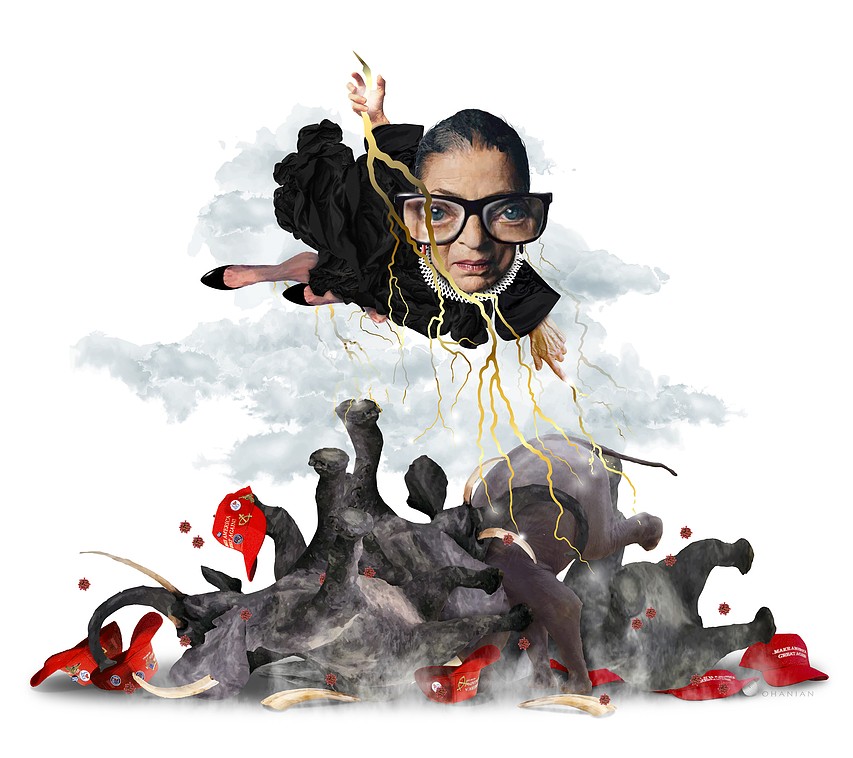
Justice Is Served by Nancy Ohanian

The new CNN poll was a doozy. Trump continues sinking as more and more voters tune in to what's at stake and what kind of a organized crime-based presidency he's been running. Among likely voters, Trump's at an even lower point than he was before the debate-- 41% to Biden's 57%. On every issue voters say they are using to decide for whom to cast their ballots, Trump trails:
Handling the pandemic- 59-38%
Health care- 59-39%
Racial inequality- 62-36%
Supreme Court nominations- 57-41%
Crime and safety- 55-43%
Handling the economy- 50-48%
Ability to unite the country- 61-33%
Personal honest and trustworthiness- 58-33%
Cares about people like you- 58-38%
Clear plan to solve the country's problems- 55-39%
Keep Americans safe- 55-43%


Republicans may still be saying that things can change over the next month-- even the most dull-witted of Beltway prognosticators have stopped with that lame line-- but there is every indication that all changes are worse for Trump and worse for his Republican enablers. AND... over 3 million people have already voted. And Registered Democrats are out-voting Republicans significantly in swing states Florida, Iowa, North Carolina, Pennsylvania and in Nebraska's 2nd congressional district (one of only two congressional districts that awards an electoral vote). Monday and Tuesday tens of millions of California voters-- all California voters-- received their mail-in-ballots. States-- North Carolina among them (where mail in ballot requests are up by 9 times-- are already reporting that the number of ballot requests and returns are setting records.

Although Democrats account for just 36% of registered voters, over 50% of returned absentee ballots are coming from Democrats. Republicans account for 30% of registered voters and just about 17% of absentee ballots are coming from them.

Washington Post book critic Carlos Lozada put all this into some context at The Atlantic yesterday: The Chaos Chronicles-- "COVID-19 craziness. Toddler tantrums. Unnerved staffers. What the lunacy in the Trump White House reveals about the degradation of America’s democratic values." He's read over 150 books on the Trump era, "trying to keep pace with the intellectuals, journalists, insiders, partisans, and activists grappling with the turmoil it has wrought. Among all the dissections of the white working class, debates over immigration, and polemics on the fate of American democracy, perhaps the most popular subgenre has been the Chaos Chronicles-- those books that document the actions of the president and his aides, and reconstruct the major controversies of the Trump White House."
Reading through the Chaos Chronicles, we learn that Trump and a White House staffer sat in the president’s study and compiled a list of enemies serving in his administration. We discover that Trump mused about building a moat with alligators at the southern border to fend off immigrants. (Yes, alligators. And yes, a moat.) We realize that senior aides steal sensitive documents off the president’s desk, hoping he will forget about them (which he does). We are told that multiple senior officials almost quit at the same time (but didn’t). We learn that Trump and the North Korean dictator, Kim Jong Un, exchanged letters so gushing that a reporter deemed them “almost romantic” in their prose. (“I’m the only one he smiles with,” Trump told Bob Woodward of his pen pal, in Rage.) And we watch as the president struggles to read portions of the Constitution out loud, stumbling over the words and complaining that they sound-- metaphor alert!-- like a foreign language to him.

I believe it. I believe all of it and more. That’s the trouble with writing about the Trump White House, and reading about it too: The lunacy is appalling yet unsurprising, wholly unpresidential yet entirely on-brand. The president’s COVID-19 diagnosis and hospitalization last weekend are a perfect distillation of Trumpian chaos, packed with misinformation and contradiction, national-security risks and constitutional implications, and all with the man himself commanding every last speck of attention. When he needs oxygen, so do we. When his temperature rises, the nation’s does too.

...Trump, of course, has loathed the Chaos Chronicles since the beginning. “I turn on the TV, open the newspapers, and I see stories of chaos-- chaos,” the president complained during a White House news conference less than a month into his term. “Yet it is the exact opposite. This administration is running like a fine-tuned machine.” No, it is the exact opposite of the exact opposite; on this score, the scribes of the Trump era are more credible than the president. So Trump goes on Twitter tirades about these books, only boosting their sales and confirming their narratives. For publishers, a Trump tweetstorm is a key marketing objective.

Yet White House chaos is not the full story, and it should certainly not be the main story. While well-sourced reports and insider memoirs provide a vital historical record, the books that tell us what the chaos means and why it matters are most needed, even if not always the most memorable. When the fire dies out and the fury subsides, what is the true American carnage wrought by and in the Trump White House? If these volumes are any indication, it is the decline of America’s preparedness for truly complex crises-- ones that can’t be intimidated on Twitter, wished away as “fake news,” or redrawn with a Sharpie. It is the remaking, to lasting detriment, of the limits and powers of the American presidency, and the degrading of our expectations for-- and devotion to-- public service. And it is the erosion not of personal decorum or policy process, though there is plenty of that, but of the democratic values to which the country should aspire.

In the Chaos Chronicles calendar, July 20, 2017, is circled in red. That morning was the infamous briefing in “the Tank,” a high-level Pentagon affair with Cabinet secretaries, top White House advisers, and the commander in chief himself, the most dramatized and dissected meeting of the Trump presidency. Think of President John F. Kennedy’s Executive Committee sessions during the Cuban missile crisis-- but instead of worrying about Nikita Khrushchev and Fidel Castro, the assembled advisers are freaking out about their own guy.

At this gathering, Defense Secretary James Mattis, Secretary of State Rex Tillerson, and the economic adviser Gary Cohn-- some of Trump’s so-called adults in the room, all long since departed from the administration-- hope to tutor the president on the benefits of international alliances and military deployments. The attempt backfires spectacularly, not because their arguments are invalid but because Trump’s beliefs about how the world works have been set for decades, and winning the White House by campaigning on them did little to change his mind.

Some of the best-known and best-selling books on the Trump White House, such as Woodward’s Fear and Philip Rucker and Carol Leonnig’s A Very Stable Genius, capture the scene with cinematic sweep and detail. Woodward devotes nine pages to the Pentagon meeting; Rucker and Leonnig go to 11. The former Mattis speechwriter Guy Snodgrass, who witnessed the briefing from an adjoining room, spends more than a chapter on it in Holding the Line. In his memoir, Team of Vipers, the former Trump communications aide Cliff Sims describes the president’s mood when he returned to the White House that day. (Spoiler: Trump was psyched.) The day’s meeting provided the kind of scene that strokes the erogenous zones of every political junkie. Generals! The president! Cursing! A clash of worldviews!

...Together, the various accounts offer an almost running transcript of the briefing. Trump derides NATO as worthless, free trade as a scam, and Afghanistan as a “loser war,” Rucker and Leonnig report. “You’re all losers. You don’t know how to win anymore,” he tells the assembled officials, who include the four-star Mattis and the chairman of the Joint Chiefs of Staff. “I wouldn’t go to war with you people,” Trump adds. Tillerson is the only official who comes off well in this scene in A Very Stable Genius, challenging the president’s suggestion that U.S. troops should defend allies only if those countries pay up. (After the meeting, the secretary of state delivers the sound bite heard round the world, dismissing Trump as a “fucking moron.”) Woodward recounts how the president both trashes the notion of a new strategy for the war in Afghanistan (“You don’t need a strategy to kill people,” Trump reasons) and counters Cohn’s point that trade deficits can be good for the economy (“I don’t want to hear that. It’s all bullshit!”).

In Fear, the meeting is summed up in classic Woodwardian style, with a written summary by an unnamed official who spoke with people in attendance: “It seems clear that many of the president’s senior advisers, especially those in the national security realm, are extremely concerned with his erratic nature, his relative ignorance, his inability to learn, as well as what they consider his dangerous views.”

In other words, they feared what they already knew: They feared the very habits and impulses that had prompted them to hold the briefing in the first place. Trump is who they thought he was.

Multiple other people attended the meeting, including Vice President Mike Pence and the senior White House adviser Jared Kushner, and the accounts reflect various sources and perspectives. Even so, many of the Chaos Chronicles showcase the point of view of Steve Bannon, the ex–Breitbart News honcho who served as chief executive of the Trump campaign, the candidate’s nationalist muse, and, later, White House strategist. Bannon’s inner monologue sets up key moments in the meeting and helps guide the story. In Woodward’s account: “This is going to be fun, Bannon thought, as Mattis made the case that the organizing principles of the past were still workable and necessary.” When Tillerson argues that postwar alliances have kept international peace for decades, readers of Fear learn that “it was more of the old world order to Bannon: expensive, limitless engagements.” In A Very Stable Genius, Bannon’s musings are saucier: “Oh, baby, this is going to be fucking wild,” he thinks as the festivities kick off.

When Trump returns to the White House, he and Bannon exult over their performance. “Steve, Steve, that was spectacular,” the president says, according to Sims’s Team of Vipers. “We had them on the ropes. Rex didn’t have any idea what to say.” Bannon dismisses Tillerson as “totally establishment in his thinking,” and the president latches onto the phrase, as though it is some brilliant new formulation. “That’s the perfect way to put it: completely and totally establishment,” Trump responds. That moment showed Bannon “at the height of his power,” Sims writes.


The next month, Bannon would be out, fired by the new White House chief of staff, John Kelly. But much of the most dramatic material in the Chaos Chronicles transpires when Bannon still held sway with both the president and the journalists covering him. Far more than in any other volume, Bannon is the spirit animal of Wolff ’s Fire and Fury, which cites him so often that the book has a “by Steve Bannon, as told to Michael Wolff ” vibe. (One irony: Wolff whiffs on the Tank meeting, even writing about inconsequential happenings on the same day.) “Interactions with Bannon often had an almost cinematic quality to them, as if he were playing out a part for a camera in the corner capturing his every utterance,” Sims writes in Team of Vipers. He’s right. Books need stories, and Bannon may have been the most influential narrator of the early Trump era.

The trope of the genius campaign adviser is ingrained in Washington journalism, Joshua Green notes in Devil’s Bargain, his best seller on the Trump-Bannon relationship that came out in the summer of 2017, when Bannon’s star was at its brightest. Bannon deliberately cultivated the image of a big thinker, Green writes, one who was “able to make sense of the world and divine where it was heading.” In addition, he was a talented storyteller “in the Irish comic tradition,” Green notes, and candidate Trump fell for the grift. “He loved how Bannon, an avid reader of history and military biographies, fitted Trump’s outsider campaign into the broader sweep of history.”

The bargain at the heart of Green’s account is that Bannon’s hard-right nationalism and Breitbart hordes would ally with Trump’s grievance politics to win the White House-- at which point the new administration would enact an anti-trade, anti-immigrant, anti-interventionist agenda. (In a delightful aside, Woodward notes that when Bannon instructed the future president on populism, his student was enthusiastic, if a bit hazy on the specifics: “That’s what I am, a popularist,” Trump responded.) Yet Bannon’s nationalist revolution was inseparable from his own exalted self-perception. “Bannon thought he was an action figure who had been stuck in a hermetically sealed package for decades until Trump finally freed him and brought him to life,” Sims writes. “I couldn’t help but appreciate anyone who had the stones to be that grandiose.”

...Several contributors to the Chaos Chronicles offer one overriding concept to explain the president-- a single analytic lens through which his actions are explained and magnified. It is a reductionist exercise, often more clever than useful. But it is useful when it uncovers patterns in Trump’s behavior. Trump the mobster. Trump the tantrum-throwing toddler.

James Comey, the former FBI director and author of A Higher Loyalty: Truth, Lies, and Leadership, will forever be a central character of this time. He certainly deserves it. Comey was the first to inform Trump of the existence of the sketchy Russia dossier. (The president-elect responded by asking, rhetorically, if he seemed like the kind of guy who needs to hire prostitutes.) Comey’s sacking led to the appointment of a special counsel to investigate Russia’s election interference. And thanks to the lawman’s compulsion to write memos on his conversations with Trump, Comey’s private exchanges with the president are legend. (I’m surprised that I Need Loyalty is not the title of yet another Chaos Chronicle.) The new Showtime miniseries The Comey Rule, starring Jeff Daniels in the title role and based on Comey’s memoir, doesn’t hurt either.


...While Comey echoes standard criticisms of Trump-- he is “unethical, untethered to truth and institutional values,” and his leadership is “transactional, ego driven, and about personal loyalty”-- his views are rooted not just in his own dealings with the president but in his memories of his years battling Mafia families as the U.S. attorney in Manhattan. “As I found myself thrust into the Trump orbit, I once again was having flashbacks to my earlier career as a prosecutor against the Mob,” he explains. “The silent circle of assent. The boss in complete control. The loyalty oaths. The us-versus-them worldview. The lying about all things.” Ethical leaders, Comey argues, don’t need to yell, inspire fear, or issue threats. “Ethical leaders never ask for loyalty. Those leading through fear-- like a Cosa Nostra boss-- require personal loyalty.” Others closer to the president, such as his disgraced former personal lawyer and fixer, Michael Cohen, succumbed to Trump’s demands for loyalty even while understanding the manipulation involved. Trump “talks like a mob boss,” Cohen writes in Disloyal, “using language carefully calibrated to convey his desires and demands, while at the same time employing deliberate indirection to insulate himself.” Cohen, who likens his teen years to those of the young Henry Hill character in the wise-guys classic Goodfellas, enjoyed no such insulation, which is why he wrote parts of his memoir from prison.

Daniel W. Drezner sees Trump not as a mobster but as a toddler, a comparison that is more amusing but also more alarming. Drezner, a professor of international politics at Tufts University, is best known in the Trump years as the keeper of a Twitter thread noting every time a Trump official or ally is cited in the press likening the president to a child. (As of this writing, he has passed 1,800 instances.)

It may be the funniest of the Chaos Chronicles, but The Toddler in Chief also outlines the risks of having a president with childlike traits, such as poor impulse control, defiant ignorance, a short attention span, temper tantrums, and a constant need for more screen time. Opportunistic advisers exploit his emotions to their advantage. He doubles down on mistakes just to avoid admitting them. He makes major decisions-- withdrawing forces from Syria, shutting down the government-- largely on impulse. Officials briefing him on key issues are hesitant to present findings that contradict Trump’s off-the-cuff positions. The result is a president “operating the executive branch like a bumper car, without any sense of peril,” Drezner writes. “The driver is not getting any better at his job. He is just getting more confident that there is no risk to what he is doing.”


That sense of peril may have been heightened in recent days, when not just the president and first lady but also multiple White House staffers, Republican senators, and even Trump’s campaign manager tested positive for COVID-19, just days after Trump mocked former Vice President Joe Biden in their debate for wearing his mask so often. But anyone anticipating that Trump’s public downplaying of the coronavirus will shift should remember that toddlers hate to admit they were ever wrong. The Toddler in Chief was completed before the outbreak went global, but Drezner still manages to anticipate something like it, even fleetingly. “Based on Trump’s behavior as cataloged in this book,” he writes, “the idea of Trump coping with a true crisis-- a terrorist attack, a global pandemic, a great power clash with China-- is truly frightening.”

Even more frightening? Such crises are not mutually exclusive.

For all the president’s blather about a nefarious deep state, his contempt for the deep-seated expertise of the federal government could prove most damaging. “If you want to preserve your personal immunity to the hard problems, it’s better never to really understand those problems,” Michael Lewis explains in The Fifth Risk, published in 2018.

That may be one of the most urgent books of the Trump years. Reading it in the middle of a presidency obsessed with alleged bureaucratic machinations feels subversive, almost countercultural; in the middle of a pandemic, the book feels downright prophetic. Lewis has written a love letter to America’s federal workforce, the researchers and the scientists and the data geeks too easily ignored until a crisis proves their value. “We don’t really celebrate the accomplishments of government employees,” Lewis writes. “They exist in our society to take the blame.” He wants to give them credit.

The Fifth Risk recounts the disastrous transition between the 2016 election and Trump’s inauguration. An outgoing administration is required by law to help the new crew prepare to run things, so Obama officials spent months readying detailed briefings for their successors, whomever they would be. Except Trump was not interested in such planning. “You and I are so smart that we can leave the victory party two hours early and do the transition ourselves,” he told former New Jersey Governor Chris Christie, who was originally tasked with the nominal transition effort.

Lewis took it upon himself to do what so many Trump officials didn’t: He interviewed former Obama officials from the Departments of Agriculture, Commerce, and Energy and asked what they would have told their successors if they’d had the chance. What he found is a government that manages risks so large that no one person or company could ever handle them. The former chief risk officer at the Department of Energy ticks down the five problems that keep him up at night: a nuclear-weapons accident. North Korea. Iran. The vulnerability of the electrical grid. And fifth is faulty “project management,” what Lewis describes as the dangerous habit of patching up long-term problems with short-term solutions. Imagine The Big Short, but instead of Wall Street, it’s Washington.


Lewis lists some of the fast-moving, inevitable dangers that any president must consider, including pandemics, hurricanes, and terrorist attacks. (Yes, pandemics are first on his list.) But many risks are longer-term and therefore easily ignored. “It is delaying repairs to a tunnel filled with lethal waste until, one day, it collapses,” Lewis cautions. “It is the aging workforce of the DOE-- which is no longer attracting young people, as it once did-- that one day loses track of a nuclear bomb. It is the ceding of technical and scientific leadership to China. It is the innovation that never occurs, and the knowledge that is never created, because you have ceased to lay the groundwork for it. It is what you never learned that might have saved you.”

In Lewis’s telling, such risks are not just a matter of laziness or ineptitude, but deliberate neglect and avoidance. “There is an upside to ignorance, and a downside to knowledge,” Lewis writes, explaining Trump’s approach. “Knowledge makes life messier. It makes it a bit more difficult for a person who wishes to shrink the world to a worldview.”

As the Chaos Chronicles make clear, a global health and economic crisis such as the pandemic only magnifies Trump’s shortcomings. It demands that a leader rely on science and data, work across bureaucracies and agencies, communicate clearly and credibly with the public, and demonstrate basic empathy with Americans, who suffer regardless of their party, the color of their state, or the words on their hats. Instead, the president behaves as he always does, and believes what he wants to believe, whether on the origins and duration of the pandemic or the proper means to fight it. In Fear, an exasperated Gary Cohn asks the president about his beliefs on tariffs and trade. “Why do you have these views?” the economic adviser demands. Trump’s answer: “I just do. I’ve had these views for 30 years.” Similarly, Trump instinctively regarded the virus as a border-security problem, an immigration problem, a China problem, a messaging problem. He shrinks the world to a worldview.

“The office of the presidency depends on a measure of civic virtue,” Susan Hennessey and Benjamin Wittes argue in Unmaking the Presidency, published early this year. Traditionally, presidents are expected to promote shared values, serve as role models, and put service to the nation above service to self. They are expected to follow the law, or at least to speak and act as if they mean to. In Trump, the authors write, America instead has a leader whose life and presidency embody “an ongoing rejection of civic virtue.” Trump has made his presidency an extension of his campaign rallies, “a presidency that elevates the expressive and personal dimensions of the office over everything else.” It is the presidency as vanity plate, as zinger, as pinned tweet.

This notion of the “expressive presidency” is at the heart of Hennessey and Wittes’s book. In chapter after chapter, the authors contrast the norms that have grown around U.S. presidential behavior over the centuries-- involving ethics, honesty, organization, rhetoric, and deference to the rule of law-- with Trump’s gleeful violations of them. The president directs policy, hires and fires officials, and addresses the nation all with one eye on his own interests and the other on the passions of his core supporters. The result is a presidency “in which the institutional office and the personality of its occupant are almost entirely merged—merged in their interests, in their impulses, in their finances, and in their public character,” Hennessey and Wittes write. This reminds me of a moment in Disloyal, when Cohen is walking with Trump through the atrium of Trump Tower, and they’re suddenly mobbed by gawking tourists seeking photographs, autographs, and thrills. Trump winks at Cohen and whispers, “This is what Trump is all about.”

And it is what this presidency has been all about too. All the traditional functions of the office, its management roles, the execution of laws, and the “expectation of ethical conduct, truthfulness, and service,” as Hennessey and Wittes put it, have been downgraded, subsumed into spectacle surrounding the man. And Trump basically dares Congress, the courts, and the voters to do anything about it.

His musings about not respecting the outcome of the November election are another instance of the expressive presidency in action; he talks as though the legitimacy of the election is up to him, as if, in our system, it is his choice to make. “The ideas are mine,” Trump tells Woodward in Rage, when the reporter asks him how he decides on particular policies or positions. “Want to know something? Everything’s mine. You know, everything is mine.”

The irony is that governing in this way undercuts the effectiveness of the chief executive. Trump pays a price for announcing the withdrawal of forces from Syria so precipitously; for a travel ban that cannot pass muster in the courts; for simply tweeting out, without consultation, his decision that transgender Americans cannot serve in the armed forces. And the nation pays a dear price when Trump treats the pandemic as another opportunity for personal expression, misleading the public about the risks (“We have it totally under control”), the availability of testing (“Anybody that needs a test, gets a test”), the likely duration (“One day, it’s like a miracle-- it will disappear”), and its true impact (“It affects virtually nobody”). His decisions on when and how to reopen the economy seem guided more by electoral concerns than public-health considerations, and his outlandish televised briefings early in the crisis-- a mix of wish fulfillment, untruth, and score-settling-- seemed to embody the expressive presidency.

That is the point: Coherence and effectiveness don’t matter. Trump appears captivated by the theatrical, made-for-TV aspects of his job, such as press confrontations and campaign rallies. In Rage, when Woodward asks him for insight into his 2018 summit with Kim Jong Un, Trump cannot get past his obsession with the media throng. “You know, it was the most cameras... They had a thing set up for the media the likes of which you have never seen.” He constantly manufactures high-ratings moments, sometimes with disastrous consequences, as when police and National Guard members violently cleared anti-racism protesters out of Washington’s Lafayette Square just so Trump could stroll from the White House to St. John’s Episcopal Church and hold aloft a Bible for the cameras. In Trump’s vision, “the presidency is emphatically not about the successful management of bureaucracies or the implementation of policy objectives,” Hennessey and Wittes explain. “It is about the showmanship and flamboyance of the person and about entertaining and captivating audiences.”


What many of the Chaos Chronicles share is a preoccupation with the man at the middle of it all, an obsessive focus that probably appeals to this most self-centered of chief executives. No surprise that many books of the Trump era borrow his phrases for their title-- Fire and Fury, A Very Stable Genius, American Carnage, and more. (I’m waiting for a book on Trump’s rhetoric called The Best Words.) So much else is happening in this administration that gets lost in the Trump glare, material that is scattered throughout the Chaos Chronicles themselves.

One constant running through several of these books, for instance, is the astounding mix of arrogance and misjudgment displayed by Jared Kushner-- on immigration policy, Comey’s firing, the government shutdown, and much more. His misfires in the White House, including his inexplicable efforts to manage the response to the pandemic, merit book-length investigations. And Steve Bannon, too, could prove far less noteworthy for his nationalist huff-and-puff than for his calls to “deconstruct the administrative state,” as he liked to put it, just before the country, battling for its life and livelihood, would require the services of a competent and agile state more than ever. Woodward’s Fear and Rage both serve as indictments of the adults-in-the-room argument, the illusion that some of the experienced hands serving in the Trump administration-- whether Gary Cohn, Dan Coats, or James Mattis-- could settle him down. John Bolton’s The Room Where It Happened, written by one ostensible adult, reads like an exercise in score-settling, particularly aimed at Mattis. By coming off less as a national security adviser and more as a caustic observer of the lesser minds surrounding him, Bolton also undercuts the adults-in-the-room narrative. He was, at most, adulting in the room.

There is one more entry in the Chaos Chronicles, one that, despite its appendixes and footnotes, its legalese and double negatives, and its river of black-ink redactions, has become a unique cultural artifact of our time, spawning T-shirts and buttons and memes and podcasts and poetry and graphic-novel editions: Special Counsel Robert Mueller’s report.

It has its own made-for-television moments. “This is the end of my presidency,” Trump moans when he learns of Mueller’s appointment. “I’m fucked.” There’s the contrast between the president’s public bluster, evident in his Twitter rants, and his private diffidence, embodied in Trump’s lawyerly written responses to Mueller’s queries, full of “I do not recall” and “I have no recollection.” There is the inevitable Nixonian reference, as when White House Counsel Don McGahn refuses the president’s request to instruct the deputy attorney general to dismiss Mueller, because McGahn worries about unleashing a new Saturday Night Massacre.

In its portrayal of the Trump campaign and White House, the Mueller report reminds me of several of the Chaos Chronicles. The incompetence, disorganization, and self-interest evoke Fire and Fury. The Mob-like mentality of the Trump team, with the president delegating dirty assignments to outside players, is reminiscent of Comey’s and Cohen’s accounts. And the Mueller report almost feels like a dozen anonymous New York Times op-eds from the internal White House resistance strung together, except far more detailed, and signed.

In Rage, Woodward rightly criticizes the report’s most memorable and controversial passage-- “While this report does not conclude that the president committed a crime, it also does not exonerate him,” Mueller & Co. wrote-- calling it “one of the most confusing lines in the history of high-profile investigations.” Yet even its formal and stilted writing can be effective. “An improper motive can render an actor’s conduct criminal even when the conduct would otherwise be lawful and within the actor’s authority,” the report explains, an understated but powerful refutation of the argument that the president can do whatever he wants and for whatever reason as long as he technically has the right to do it. The report recognizes Trump’s habit of committing wildly inappropriate acts-- such as discouraging the cooperation of witnesses-- right out in the open, a tendency that has perplexed journalists used to revealing misdeeds that lurk in the shadows. “That circumstance is unusual, but no principle of law excludes public acts from the reach of the obstruction laws,” the report explains. “If the likely effect of public acts is to influence witnesses or alter their testimony, the harm to the justice system’s integrity is the same.” It might even be worse, because the openness of the offense seems to excuse its occurrence. If it’s out in the open, how bad can it be?

Of course, the report’s authority and scope have limits. The report documents Russia’s “sweeping and systematic” interference in the 2016 election, for instance, but does not really reveal the impact of that interference. An omniscient narrator-- “the Office”-- is an essential player, but the special counsel’s own actions and impressions are largely absent. And though the report offers a devastating, point-by-point portrayal of the president’s efforts to interfere in the investigation against him, Mueller does stop short of declaring criminality. Not because, as the attorney general initially implied, he was simply unable to make up his mind. Part of his reasoning, Mueller explains in the report, was that “a federal criminal accusation against a sitting President would place burdens on the President’s capacity to govern and potentially preempt constitutional processes for addressing presidential misconduct.” Constitutional processes. That’s a nice euphemism for the impeachment remedy. There are multiple ironies in the fate of the Mueller report. First is that, after so much investigation and expectation, after a damning 448-page trail of bread crumbs showing a path forward for Congress, the ultimate articles of impeachment against President Trump reflected none of the report’s findings or efforts. Second, as the Chaos Chronicles show, is that those “burdens on the President’s capacity to govern” have been overwhelmingly self-imposed. And third is that several recent entries in the Chaos Chronicles have come together in a backlash against the special counsel, one in which Mueller’s sense of honor, rectitude, and restraint are held against him.

In Trumpocalypse, the Atlantic writer David Frum criticizes the “upright and conservative Mueller” for always doing things by the book, even if “the book contained no chapter describing anything like a Trump presidency.” In A Very Stable Genius, Rucker and Leonnig conclude that Mueller “fumbled the moment,” in particular when his team inexplicably declined the opportunity to weigh in preemptively on Attorney General William Barr’s public characterization of the investigation’s findings. In True Crimes and Misdemeanors, Jeffrey Toobin writes that Mueller’s “code of personal honor … was both his greatest strength and his greatest weakness,” and that “to enforce the law, [Mueller] felt he had to comply with it-- in a manner consistent with his own fastidious values.”

When he was first appointed to the role, Mueller was hailed as a man of integrity, a dedicated lawman who would ferret out the truth. The expectations of him were enormous, especially from those who imagined that he would provide clear evidence of the president’s malfeasance. But when Mueller did not meet those expectations, his personal and professional qualities were suddenly deemed passé, relics of a “vanishing world,” Toobin writes. Mueller, he explains, “had come of age in a different era in American justice and American life, when modesty and self-effacement were ascendant values.”

There is no clearer or sadder affirmation of our new civic ethos. Narcissism and self-aggrandizement are now ascendant, integrity is old-fashioned, and chaos and crisis are the new standard-- not a hindrance to power but its purpose and protection.

That is what Trump is all about too.


Labels: ,

Sunday, May 27, 2018

Escaping Trump, Escaping Trumpism... Is It Possible?

>


Ted's right-- both on this tragic and shameful, heart-breaking specific and in a more general way. Everything in Trumpworld is sheer bullshit. Friday, Masha Gessen, writing for the New Yorker asserted, rather than questioned, that In the Trump Era, we are losing the ability to distinguish reality from vacuum. Never mind his and his odious regime-- does morality even apply to his supporters? Author of the award-winning book, The Future Is History: How Totalitarianism Reclaimed Russia, she asked how is one to maintain sanity, decency, and a measure of moral courage?

Decent members of the Administration-- is that a thing?-- and congressional Republicans have to ask themselves what is "the best way to try to save the country from Donald Trump: by staying close to him, or by walking away... Is the possibility of moderating the damage done by this Administration worth sacrificing one’s moral principles? Should one protect one’s individual integrity by sacrificing the chance to moderate damage done by this Administration? We can’t possibly know." And what about the rets of us?
The overstimulation of the age of Trump, meanwhile, makes us lose track of time and whatever small sense humans normally have of themselves in history. We forget what happened a month ago. If we look away for a day, we miss news that seems momentous to others-- only to be forgotten, too, in a week. Living in a shared reality with our fellow-citizens is an endless triathlon of reading, talking, and panicking. It creates the worst possible frame of mind for answering vexing moral questions, especially ones that require a choice between two desperately unsatisfying options.

Thinking morally about the Trump era requires a different temporal frame. It requires a look at the present through the prism of the future. There will come a time after Trump, and we need to consider how we will enter it. What are we going to take with us into that time-- what kind of politics, language, and culture? How will we recover from years of policy (if you can call it that) being made by tweet? How will we reclaim simple and essential words? Most important, how will we restart a political conversation? Political discourse was in crisis before Trump-- no wonder Americans of all stripes have become accustomed to using the words “politics” and “political” to denote substance-free transactions in the electoral arena. But, under Trump, it is nearing complete destruction.

Consider the last month’s worth of conversation about Trump and North Korea. Forgetting the President’s “little rocket man” remarks and building on months of denial that Trump had brought the world as close to the brink of nuclear annihilation as it has ever been, politicians, bureaucrats, policy wonks, and journalists have been speaking as though Trump were engaged in actual negotiations with Kim Jong Un. Some deliriously joined him in contemplating the prospect of a Nobel Peace Prize. The voices of a few experts who dared say that nothing had been accomplished yet and expressed doubt that the summit would actually occur were quickly drowned out. The ritual of analysis and anticipation that normally accrues to diplomacy was accruing instead to Trump’s flailing gestures, in the same way that the normal rituals of punditry have accrued to Trump’s tweets, harangues, and inconsistencies, all of which are the opposite of politics. On Friday, the Times’ morning podcast, The Daily, offered up a thoughtful analysis of Trump’s summit-cancelling missive, which was written in the language of a sulking, lovelorn seventh grader. But no sooner was the podcast posted than Trump told the media that he might hold the summit after all.

We are losing the habit, and perhaps the capability, of distinguishing reality from vacuum. This is disorienting in the present and disastrous for the future-- it is the one factor that will make post-Trumpian recovery, when it comes, so difficult. We must pose a bigger question than whether Administration members or congressional Republicans should stay or go, for it’s not only Trump’s appointees or fellow party members who are implicated in the daily insults and damage to our perceptions. We should be asking what each one of us can do to assert a fact-based reality at any given time. The great French thinker and activist Simone Weil had a prescription that she wrote down in her journal in 1933: “Never react to an evil in such a way as to augment it.” A few days later, she added, “Refuse to be an accomplice. Don’t lie-- don’t keep your eyes shut.”

Throughout the twentieth century, writers and thinkers who faced reality-destroying regimes kept producing similar recipes. “Live not by lies,” the Russian dissident novelist Aleksandr Solzhenitsyn wrote. The Czech dissident playwright and future President Václav Havel pondered the predicament of living, unquestioningly, “inside the lie”-- and the uncanny power of stepping outside of it. In our case, stepping outside the lie means refusing-- stubbornly, consistently, incrementally-- to lend credence to the opposite of politics, the opposite of diplomacy, and the opposite of sanity. That would require thinking, reading, and speaking critically: not treating an outburst as though it were politics, a tantrum as though it were diplomacy, and a delusion as though it were aspiration. The good news is that this is not an entirely impossible task.
Among the 40 Republicans retiring (or resigning) from Congress since the advent of Señor Trumpanzee, some are attempting to win higher office-- so far most of them have failed-- and others have been caught up in various scandals, but most just want to get away from Trump. CNN sat down and talked to 3 of them-- Ryan Costello (R-PA), Ileana Ros Lehtinen (R-FL) and Jee Flake (R-AZ). Costello probably wouldn't be retiring at age 41 if his district didn't flip from a PVI of R+2 to D+2. He's a moderate and in a non-wave year could probably have win it-- but not in a wave year. Dull establishment Democrat who will add absolutely nothing to Congress, Chrissy Houlahan, is heavily favored to win. Ryan told CNN that he feels "increasingly, that if you're a member of Congress, they assume that you're not good. They assume that you're not telling the truth. No matter what you do, someone's out there locked and loaded to say something disparaging, false, mean, in an attempt to have other people not like you... No matter what I say or do, I feel all I do is answer questions about Donald Trump rather than health insurance or tax policy. I think it's a very challenging political environment, and when you add on top of that just the demands from a work-family balance, I just felt it was best for me to take stock in my life and have eight months to decide what I'm going to do next rather than, potentially, six weeks." Hillary won his district by a couple of points; under the new boundaries it would have been 10 points.

Ros-Lehtinen's Miami district is the bluest in the country held by a Republican. The PVI is R+5 and Hillary demolished Trump, 58.5% to 38.9%, his worst score in a Republican-held district. Regardless of what she wants to tell herself, Debbie Wasserman Schultz could no longer protect her and the writing was on the wall. She's mortified by Trump's boorishness but is reluctant to say so publicly. Her voting record speaks for itself. She votes with Trump 68.6% of the time, far less than any other Republican in the House other than North Carolina's completely independent ex-Democrat Walter Jones (53.8%).

And then there's Arizona hard core conservative senator Republican Jeff Flake who seems to agree with Trump on a lot-- though not all-- of policy and detests him as a person. "Our debt," he told CNN has increased massively; we're no longer the party of free trade. We've become a party of anger and resentment, and that is not the optimistic vision that I cut my teeth on as a Republican listening to Ronald Reagan or George H.W. Bush or others."

Alan Grayson, who spends a lot more time than many of the candidates and incumbents warning about Trump, mentioned that "We’re roughly at the end of Niemoller’s first couplet":
First they came for the Socialists, and I did not speak out
Because I was not a Socialist.
Then they came for the Trade Unionists, and I did not speak out— 
Because I was not a Trade Unionist.
Then they came for the Jews, and I did not speak out— 
Because I was not a Jew.
Then they came for me—and there was no one left to speak for me.
"Real life," he added, "is starting to resemble Radio Free Albemuth," Philip K. Dick's dystopian missive set in a society in which a tyrant has been elected president.

Let's look at Long Island Congressman, Peter King, a conservative in a moderate district who keeps going back and forth on Trump. One day he's saying Trump is "not fit to be president morally or intellectually" and then he's saying he's still supporting him. Peter King may not be as much of a crackpot as the Iowa King-- but he's still a real crackpot. You see this tweet from yesterday?


King's progressive Democratic opponent, Suffolk County legislature chief executive DuWayne Gregory didn't miss the not so subtle racism: "Congressman Peter King is trying so hard to attach himself to Donald Trump that he may need a surgeon to separate himself. To equate silent protestors with Nazis that killed millions of Jews and other Europeans illustrates how out of touch Peter King really is. We desperately need change in Washington when the leaders there do not know the difference between peaceful protesters and mass murderers."

Are we slipping into a dystopian society? Are we there already? Will we make it through to the other side? Will we be OK? Tom Guild is in one of those seats-- in the middle of Oklahoma-- that the DCCC is ignoring. He's probably better off without their interference. He's way too independent-minded and progressive for them. He certainly understands the dystopian society Trump and his enablers are creating in our country. This is what he told me about it yesterday:
Bob Corker is a corporate right wing US Senator from Tennessee, who is in a strong continuous bear hug with the Chamber of Commerce. We disagree on so many things and on so many levels. However, he has had a few moments of clarity commenting on the tragedy of Donald Trump in his role as the POTUS. Corker described the White House as an adult daycare center in a moment of clarity. He then got battered by Trumpists in Tennessee and elsewhere and faded back into the woodwork and rejoined others in the tragic cast of an upcoming book, Profiles in Cowardice. He voted for the Trump anti-working people, anti-middle class, that has blown a huge hole in the deficit and for debt, pro-corporate, and pro-billionaire tax cuts. He has recently resembled more of a rubber stamp for the Donald, instead of a cry in the wilderness expressing anguish regarding 45’s demeanor, dishonesty, and dysfunction.

The GOP establishment is dead. If not deceased, it might as well be dead. They have rolled over for every lie, scheme, policy, attack on American traditions and institutions, and disingenuous dishonest diabolical disaster Trump has rolled out. If they had acted like this in 1974, Richard Nixon (or his progeny) would still be president-for-life and the American Republic would have been dead long ago.

Since the Republicans won’t (with a few exceptions occasionally) stand up for principle or even insist on honesty, that leaves it to the rest of us. There are far too many non-Republicans who are on an ethics-free vacation and not only won’t stand up, but rarely speak out for fear that the Donaldistas will vote them out of office. Or they fear the vicious sleazy presidential tweet that might come their way.

Special Counsel Robert Mueller has the guts of a government mule and possesses an amazing work ethic and all the right scruples, but he could be quickly sacked without notice. Without the moral authority of a report from Mueller, taking the Trumpists out will be difficult. It would then have to happen election by election and incrementally. The Needle and the Damage Done by the time that struggle ends could result in permanent scar tissue and a severe weakening of America’s constitutional republic.

We can speak up. We can act reasonably and within our legal and constitutional framework. We can resist the constant dishonesty and destruction visited on our cherished country and our constitutional traditions. As Garth Brooks sings in The Dance, if we knew how it all would end, we’d miss the dance. We may survive the dance. America may survive. I’m an optimist and put the odds of survival and repairing the Needle and the Damage Done at 53-47%. Predicting the future is a mighty hazardous occupation. For the sake of all that we cherish and hold dear, I hope the hell I’m right!

Labels: , , , , , , , ,

Friday, October 20, 2017

Even Dubya Recognizes A Dangerous Charlatan When He Sees One! Trump's Stature

>


Sam Jammal had a fantastic idea about how to use George W. Bush's denunciation of Trumpism against Ed Royce, the rubber stamp Orange County incumbent whose seat he's contesting. And I think most any Democratic challenger could use the same idea. I know Sam well enough to know he wouldn't even mind.


So here's the full text of the speech that someone wrote for Bush to read yesterday. It was such a relief for Washington Post conservative columnist Jennifer Rubin who was hired to give a right-wing perspective on the universe and spends all her time lately denouncing Señor Trumpanzee. Yesterday she blared, proudly, This is what a president sounds like! Yeah, yeah... "Former president George W. Bush gave a speech today-- a bookend, if you will, to Sen. John McCain’s (R-AZ) address early in the week upon accepting the Liberty Medal. Bush spoke in a tone and with substance so different from what we have become acclimatized to hearing that his address has provoked a huge, bipartisan thumbs-up, as though the country collectively could say, 'Oh, that is what a president is supposed to sound like!'"


Bush surely had President Trump in mind when he addressed conspiracy theories, nativism, incivility and more, but I think it’s safe to say his intended audience was the moribund GOP. We have now seen the party he used to lead decline into passivity and pure partisanship, again and again enabling Trump rather than rallying to American principles and looking to the c0mmon good. We’ve seen Republicans eschew governance in favor of divisive sloganeering. One president like Trump is bad enough; the acceptance of his inhumanity by one of the major parties is a tragedy and national emergency.

...Every Republican who endorsed Trump, turns a blind eye to his unfitness, or excuses his heinous language and conduct should feel shame upon hearing those words.


Bush’s recommendation is simple but hardly simplistic: “We need to recall and recover our own identity. Americans have a great advantage: To renew our country, we only need to remember our values.” He’s talking to you, Republicans, who’ve forgotten what he rightly calls the American creed:
Our identity as a nation-- unlike many other nations-- is not determined by geography or ethnicity, by soil or blood. Being an American involves the embrace of high ideals and civic responsibility. We become the heirs of Thomas Jefferson by accepting the ideal of human dignity found in the Declaration of Independence. We become the heirs of James Madison by understanding the genius and values of the U.S. Constitution. We become the heirs of Martin Luther King, Jr., by recognizing one another not by the color of their skin, but by the content of their character.

This means that people of every race, religion, and ethnicity can be fully and equally American. It means that bigotry or white supremacy in any form is blasphemy against the American creed.


There is nothing in his four basic recommendations-- hardening our defenses against external threats to democracy, maintaining U.S. leadership in the world, strengthening democratic citizenship and “call[ing] on the major institutions of our democracy, public and private, to consciously and urgently attend to the problem of declining trust”-- that Democrats of good faith should dispute. They’ll have differences in specifics (When should we intervene internationally? Which electoral reforms do we need?) but that is understandable and healthy.

What is critical is that Bush has identified precisely the issues that must be addressed if we are to stave off Trump and Trumpism. Democrats, including ex-presidents, would be foolish not to embrace Bush’s agenda and where possible work together. After all, we are all Americans who embrace the “ideal of human dignity found in the Declaration of Independence . . .  [and] the genius and values of the U.S. Constitution” as well as the commitment to equal rights and justice for all Americans. It’s the current president who doesn’t get it, but there is a solution (several, actually) for that as well.
Bush sees Trump as a threat to American democracy. Why do so many Republicans in Congress claim to not see that threat? Bush says "bigotry seems emboldened." How come he sees it but California congressional Republicans like Ed Royce, Darrell Issa, David Valadao, Mimi Walters, Steve Knight, Jeff Denham and Dana Rohrabacher don't. Why is that? Why?


UPDATE: Bannon Denigrates Bush-- California Republicans Cheer


Friday night, Bannon gave the keynote address at the California Republican Party convention in Anaheim. He depicted Bush as bumbling and inept, faulting him for presiding over a "destructive" presidency during his time in the White House. Bannon said Bush had embarrassed himself and didn’t know what he was talking about.

Labels: , , ,