Wednesday, May 13, 2020

Let’s Vote For Fair Courts In 2020

>


-by Marge Baker,
Executive Vice President,
People for the American Way


Even after two months into a national health and economic crisis, Donald Trump and his Republican cronies in the Senate have continued their assault on our federal courts. And while Americans from every walk of life are dealing with the devastating health and economic impact of this pandemic, Senate Republicans are quietly processing more of Trump’s judicial nominees.

People For the American Way has led the charge against Trump’s dangerous judicial nominees since he took office. And in the lead up to the 2020 presidential election, PFAW’s Vote the Courts 2020 campaign has focused on two goals: encouraging presidential candidates to prioritize the importance of the courts in their campaigns and holding senators who vote for Trump’s dangerous troubling judicial nominees accountable for those votes.

Vote the Courts 2020 strives to educate the public about the role that federal judges play in their daily lives-- whether they have access to affordable health care; whether their rights as workers are protected; whether they have the ability to vote and have that vote counted; whether they can be free from discrimination; whether they will have clean air to breathe and clean water to drink. The list is endless and not at all abstract.

During the primary season, we encouraged candidates to address the importance of the courts and share the kinds of judges and justices they would nominate to the bench as president.  Even amid the once-crowded field of contenders, more than a dozen Democratic candidates responded to our call.

Following the campaign launch, PFAW co-sponsored a presidential candidate forum in Iowa that focused on the importance of democracy reform and the courts, where five former candidates spoke in greater detail about their plans to restore balance to our courts.

This issue has become especially salient to progressives in the Trump era: Polling has shown that Democratic voters outrank Republican voters on whether the courts are a reason to support their party’s presidential candidate. In the coming months before Election Day, there is ample opportunity to continue to highlight the importance of fair-minded judges.

And this is relevant not just to the presidency, but also to the senators that vote on these nominees. That’s why another prominent facet of the Vote the Courts 2020 campaign is holding Senators Martha McSally, Cory Gardner, Thom Tillis, Joni Ernst, Susan Collins and David Perdue accountable for their votes to confirm Trump’s dangerous nominees. Working with partners and allies in Arizona, Colorado, Georgia, Iowa, Maine and North Carolina, we are highlighting senators’ votes to confirm extreme Trump judges who are hostile to health care, reproductive rights, a healthy environment, democracy and voting rights, and the social safety net through videos, op-eds, and activist toolkits.


In the coming months, we will continue to grow our accountability work, as the same poll cited above also indicates that Democratic voters care more about their senators’ judicial confirmation votes than do Republican voters when weighing their support for a candidate.

Our ability to create products that are integral to our Vote the Court 2020 campaign depends on the work of our stellar legal research team.  In particular, both our Confirmed Judges, Confirmed Fears blog series and web tool provide the information we are using to tie Trump judges’ rulings and dissents to the impact they have on issues critical to our daily lives.

After three and a half years, Trump and his Republican enablers have reshaped our federal judiciary by packing our courts with ultra-conservative judges who give them the green light to enact their extreme agenda. In fact, most Trump appointees are white men who are young enough to spend decades in their lifetime positions on the bench. Long after he vacates office, the damage he has done will endure.

Our rights and liberties-- our right to accessible, affordable health care; our right to make decisions about our bodies; our right to cast a ballot that counts; our right to clean air and water, and more-- are all on the line on Election Day. We need to fight for fair courts, and for judges who understand equality and justice for all of us.

Labels: , , , , ,

Saturday, January 11, 2020

Where Will Trump Judges Get Their Law Clerks-- From Unaccredited Religious Schools?

>


Any-- every-- sack of dog poop Trump sends over to Moscow Mitch as a judicial nominee has been rammed through the Senate and confirmed, sometimes with votes from the 2 or 3 Trump-friendly Democrats, Joe Manchin (WV), Doug Jones (AL) and Kyrsten Sinema (AZ). When even these three vote NO, you know the sack of dog poop Moscow Mitch is hawking includes a lot of dog diarrhea. This week's example was Eleni Maria Roumel, whose filibuster was broken and who was then confirmed by the Senate 51-47, even Manchin, Jones and Sinema fighting confirmation. Roumel is another right-wing Federalist Society hack serving as deputy counsel for Pence. And now she's a judge. What's too be done with all these unqualified and extremist judges when Trump is gone?

That's going the haunt the country for at least another couple of decades. Although... former Orlando congressman, Alan Grayson, an attorney by profession and a phenomenal historian by vocation, told me that "The last time that a party tried to pack the judiciary with incompetent hacks this badly was during the John Adams Administration. And the first thing-- literally, the first thing-- that the Jefferson Administration did was to wipe out all the Circuit Courts that Adams had created. A 'lifetime appointment' does not outlast the position to which one is appointed. The other option would be to increase the number of judges, and fill the new slots. Under Newton’s Third Law of Political Motion, for every action, there is an equal and opposite reaction."

Meanwhile, the Boston Globe's Deirdre Ferandes reported Thursday night that Harvard Law graduates are almost entirely avoiding taking positions in their offices. "Used to be," she wrote, "that the promise of earning a sterling line on a resume and connections to stars of the legal profession was enough to lure Harvard law students to federal clerkships. But recently, when Harvard Law School was urging its students to apply to work for one of President Trump’s newly appointed judges, it felt the need to offer further incentives: 'Next to Lake Tahoe and great skiing!' the job alert read. But that apparently wasn’t enough. Two days later, in mid-December, the law school again nudged its students to apply for clerkships with federal judges, noting that some judges, including two Trump appointees, had received no Harvard applications-- calling them 'wasted opportunities.'"

As Trump reshapes the federal judiciary with staunch conservatives and controversial picks, some Harvard Law School students appear to be thinking twice about applying for clerk jobs with them, and passing up what are generally considered plum positions.

“Five or 10 years ago, people would be in a rush to apply,” said Emma Janger, 26, a third-year law student at Harvard and the cofounder of the People’s Parity Project, a law student activist group focused on combating harassment and discrimination. Janger said students will generally clerk for judges whose legal expertise and experience they respect-- even if they disagree politically. But some recent appointees have been outspoken opponents of gay rights, antiabortion stalwarts, and deemed “not qualified” by the American Bar Association, she said.

“It doesn’t need to be 100 percent ideological alignment,” Janger said, but some students oppose the idea of working for judges with such strident views and want more out of their clerkship than to burnish their resume.

“Students recognize that prestige isn’t all that they are leaving law school with. There are other values that are more important,” she said.

But some legal scholars worry that the reluctance of students at one of the nation’s premier law schools to clerk for Trump-appointed judges, first reported by Bloomberg Law, could further polarize the legal profession and do the country more harm than good.

The expectation is that judges and their clerks will act and make decisions based on the law, not in the interest of ideology or political party, said Charles Fried, a Harvard constitutional law professor and former solicitor general in the Reagan administration.

“If the only people who will clerk for a Trump-nominated judge are the people who voted for Trump, it will drive things to further extremes,” Fried said. “It’s odd and self-defeating.”

Judges without strong experience who may be too ideologically driven need smart law clerks who will offer different perspectives, he said.

For law students, clerking for a federal or even state judge has traditionally been a way to fast-track their careers and boost their salaries. Nearly 90 of Harvard’s 570 graduates in 2018 had federal clerkships. Students apply months or even years ahead for the competitive, one-year positions.

But in December, after the Senate confirmed several new judges, Harvard indicated that some of them, including Douglas Cole in Ohio, Sarah Pitlyk in Missouri, Patrick Bumatay in California, and Lawrence VanDyke in Nevada, were still seeking clerk applications from the university. John Wiley, a California state court judge appointed by that state’s Democrats, was also looking for clerks, Harvard officials told students.

VanDyke and Bumatay were appointed to the Ninth Circuit, which handles cases in the busy western United States, and clerkships there are considered among the most prestigious.

“Any Harvard applicants are likely to get serious consideration,” the university’s internal career blog for students and alumni noted.

Harvard Law School officials declined to comment on whether fewer students were applying for clerk positions with recent Trump appointees or whether other factors could be involved.

“We work to share available clerkship opportunities with our students, confident they will apply for the ones that best suit their interests and needs,” said Mark Weber, assistant dean for career services at Harvard Law School in a statement. “We understand that different judges appeal to different applicants for different reasons.”

But as more Trump judges take the bench-- he has already overseen the confirmation of 50 appellate court judges, more than any president in recent memory at this point in his term-- law school students who are gay or have had abortions may have serious conflicts working with judges who have been vocally opposed to those issues, Leah Litman, a law professor at the University of Michigan who previously clerked for Supreme Court Justice Anthony Kennedy, wrote recently in a blog post.

Harvard students are in a much more fortunate position than students at lower-ranked law schools who may not be able to pick and choose their clerkships, she wrote.

“If some students are exercising that privilege to stand up for themselves or others, they should be applauded, not chastised,” Litman wrote.

Many of Trump’s nominations have ties to the Federalist Society, the influential conservative legal group

VanDyke and Pitlyk have also received rare “non-qualified” ratings from the bar association.

After interviewing dozens of people, the bar association wrote in a letter to the Senate that VanDyke, a Harvard Law School graduate and an editor of the Harvard Law Review, was “arrogant, lazy, an ideologue, and lacking in knowledge of the day-to-day practice including procedural rules.” The group also said some of those interviewed raised concerns about whether VanDyke would be fair to gays and lesbians.

In a tearful confirmation hearing, VanDyke said he believed that all people were “created in the image of God, and they should all be treated with dignity and respect.”

The bar association criticized Pitlyk’s lack of trial experience, and reproductive rights advocates blasted her stands against surrogacy and in favor of treating embryos as humans.

Nancy Gertner, a retired Massachusetts federal judge who teaches at Harvard, said neither the president nor students should have narrow slates of judges that they are willing to consider.

“You can’t be in a position to say there has to be an orthodoxy to become a judge or work for a judge,” Gertner said.

But deciding who to clerk for is a complicated decision, she added.

Judges and their clerks develop close working relationships, said Gertner, who attends reunions with some of her clerks and gets notified when they have children.

Eli Nachmany, a first year Harvard law student who worked on the Trump campaign and in the administration, said he too is more likely to want to work with a judge who shares his philosophy. Fortunately, many of those judges were nominated by Trump, have been approved by the Senate, and are now on the bench, he said.

“If certain students want to cut their nose to spite their face and take a pass on these eminently qualified, highly distinguished jurists, that just means more clerkship opportunities for other students who appreciate the opportunity to work for and learn from the judges in question,” Nachmany said.
After Alan Grayson graduated from Harvard Law, and before he ever thought of running for Congress, he wound up working with Ruth Bader Ginsberg, and, somewhat incongruously, Antonin Scalia, when they were both on the DC Circuit just before they were appointed to the Supreme Court. Grayson felt he was a professional who had a job to do-- writing opinions for the judges (and, in Scalia's case, orders)-- no matter what their ideology. He once mentioned to me that on his last day, Scalia told him that in the future Alan would be a conservative. Alan laughed and asked him why he thought so. "Oh, you'll be fat and happy someday." Alan hasn't gained much weight and he's still as ardently progressive as he ever was. RIP, Antonin Scalia-- wrong... as usual.


Labels: , , ,

Friday, May 03, 2019

Trump's Impact On America Will Live On Long After Trump Is Food For The Worms

>


Yesterday we looked at an essay by Dave Denison on Biden-- Status Quo Joe-- which notes that "It would be hard to find a more out-of-step-with-the-times candidate than Joe Biden. In a moment when two of the most important movements at the heart of the Democratic coalition-- the Black Lives Matter protests and the #MeToo upsurge-- suggest the need for someone with a strong record on racial justice and respect for women, up stands Joe Biden... to lead a party that needs the energies of activist women and that is always in danger of telling activist youth they have no real place in Democratic Party politics, unless they fall in line and follow instructions. At the same time, the Associated Press published an article by Emily Swanson and Nicholas Riccardi on a poll finding that the country hungers for change. Change, of course, means different things-- radically different things-- to different people.

What most voters seem to agree on-- certainly almost all Democratic voters and most independent voters-- is that they want change from Trump. But what about fundamental, systemic change to the way government works? That's what Bernie is basing his campaign on-- and what Biden, pointedly, is not. "Status Quo Joe" fits the candidate. "Status Quo Ante Joe," is more awkward but also more accurate. From the very beginning, he has been the 2020 candidate who envisions a "Return to Normalcy"-- the Warren G. Harding of contemporary politics. In 1920, the Warren G. Harding/Calvin Coolidge ticket beat the James Cox/Franklin Roosevelt ticket in a rout-- 16,144,093 (60.3%) to 9,139,661 (34.1%). The electoral college vote-- 404 to 127-- was a nightmare. Basically, the Democrats won the Solid South and nothing else. Today Coolidge is universally recognized as one of the three worst presidents in American history.

Swanson and Riccardi looked at new polling data from the University of Chicago Harris School for Public Policy and The Associated Press-NORC Center for Public Affairs Research, which "shows that 54% of Americans think the system needs major changes." 61% of Democrats and 52% of Republicans say they want "big changes." The survey found that "Those who are most critical of the way government handles issues they think it should be dealing with are most likely to want changes, with 65% saying they desire major changes and 18% seeking a completely different system of government... [T]he poll shows that close to 3 in 10 Americans say the government can’t work well no matter who is elected, with that view more common among Republicans (38%) than Democrats (16%)."


In 2016, Trump's call to drain the swamp was one of his most popular lines of attack. Yet his Regime has certainly turned out to be the swampiest and most corrupt since James Buchanan's. Last month, Rewire News published a piece-- The Republican Takeover of the Federal Courts Should Terrify You-- that predicts that Trump's fetid swamp will last long after his political corpse is left to rot on the trash heap of history. "Trump has already appointed two Supreme Court justices—though one of those appointments was rightfully Obama’s—along with a fifth of the sitting circuit court of appeals judges. Now, Republicans have set their sights on the district courts. There are more than 100 vacancies left, and monied interests are champing at the bit to handpick Trump’s nominations to fill them. At the beginning of the month, McConnell invoked the “nuclear option” to permanently limit the amount of time senators can debate most nominees from 30 hours to just two. The change doesn’t apply to Supreme Court nominees or circuit court nominees but will allow Republicans to advance district court nominees at lightning speed. And the result will likely be disastrous for progressive causes."

The systemic change that this unqualified, mostly young, appointees have in mind, is not what most Americans mean when they say they want change.
Alliance for Justice, a progressive judicial advocacy group, analyzed the devastating impact Trump has already had on the federal judiciary in a recent report. It’s terrifying. Most of Trump’s picks are white men committed to the destruction of federal agencies, the disenfranchisement of people of color and other reliably Democratic voters, the rollback of consumers’ right to hold corporations accountable when they harm people, and the decimation of civil and human rights-- including the right to abortion care. And many of them are incompetent: In fact, Trump has nominated more judges deemed “unqualified” by the American Bar Association than any other president at this stage in their administration... As of April 1, 2019, more than 75 percent of Trump’s nominees were men and more than 90 percent were white. By contrast, 58 percent of Obama’s nominees were men, and 64 percent were white.

Trump has appointed around a third of the judges on the conservative Fifth, Seventh, and Eighth Circuits. He’s on the verge of flipping the reliably liberal Ninth Circuit. The Third and 11th Circuits were both majority-Democrat until Trump. Now the majority of the judges on the Third Circuit are Republican; the Eleventh Circuit is evenly split between Democrats and Republicans.

You may be thinking to yourself, “So what? It is expected that Republicans will appoint conservative jurists, while Democrats will appoint more liberal jurists.”


The problem isn’t just that Trump is appointing conservative judges. It’s that he’s appointing conservative judges who are handpicked and vetted by the Federalist Society, which Meagan Hatcher-Mays describes as “a shadowy conservative group that mobilized in the years after the Supreme Court’s historic decision in Roe v. Wade.”

“The organization grooms law students to become hardliner anti-choice judges who oppose reproductive rights and the social safety net but support wholesale deregulation and unfettered personhood rights for corporations,” Hatcher-Mays continues. “These are not neutral judges who ‘follow the law’ or umpires who call ‘balls and strikes,’ as they frequently claim in their confirmation hearings. They are partisan hacks who are hand-selected by billionaires to stand in the way of progress.”

In other words, these are judges who oppose progressive values as a matter of principle. There’s no adherence to the rule of law, only adherence to the monied interests that control the appointment process.

The Sixth Circuit Court of Appeals is a perfect example of Trump’s effect on the courts. Once considered a center-right circuit, the Sixth Circuit has, thanks to Trump appointments, swung hard in the conservative direction. The Sixth Circuit is the court that recently ruled in Planned Parenthood of Greater Ohio v. Hodges that the state of Ohio could refuse to provide public money to Planned Parenthood to pay for health-care programs unrelated to abortion.

The district court blocked the law in August 2016. A three-judge panel of the Sixth Circuit upheld that ruling in April 2018. But on March 12 of this year, the full court ruled 11-6 to reverse it-- with Trump appointees providing four of those 11 votes.

Writing for the majority, George W. Bush appointee Jeffrey Sutton ruled, remarkably, that abortion providers do not have a due process right to perform abortions, ignoring that the rights of abortion providers are and have always been derivative of the rights of their patients. (A pregnant person’s due process right to an abortion means nothing if there’s no provider to perform it, and courts have repeatedly recognized that.) Trump appointees Amul Thapar, John K. Bush, John B. Nalbandian, and Joan Larsen, of course, sided with the majority. Eric Murphy, who was not yet installed on the court, would almost surely have sided with the majority; after all, as Ohio’s attorney general, he argued before the Sixth Circuit on behalf of the law. Chad Readler, confirmed on March 6, would have undoubtedly done the same.

And earlier this month, Trump loyalist John K. Bush wrote the decision reversing a lower court ruling blocking Kentucky’s forced ultrasound law, HB 2. The reasoning behind Bush’s decision is so garbled that Judge Bernice Bouie Donald declared, “I dissent!” Not “I respectfully dissent,” which is usually how judges phrase their dissents as a matter of decorum. Just “I dissent!” Exclamation mark.

But it hasn’t stopped there. Trump’s appointees to the Sixth Circuit have advanced regressive right-wing arguments and causes in multiple respects.

Eric Murphy derided Sonia Sotomayor’s epic dissent in Utah v. Strieff, according to an Alliance for Justice nominee report. In that dissent, Sotomayor connected the Court’s ruling-- that the discovery of a warrant for an unpaid parking ticket will forgive a police officer’s violations of a person’s Fourth Amendment rights-- to larger issues regarding overpolicing of communities of color. Murphy criticized Sotomayor for focusing too much on racial justice, according to the report, and noted that the defendant in the case was white. He also defended in a brief to the Supreme Court Ohio’s prohibition on same-sex marriage in Obergefell v. Hodges, and joined an amicus brief backing the Gloucester County School Board in Gavin Grimm’s lawsuit challenging his high school’s policy prohibiting him from using the bathroom that aligns with his gender identity.

Chad Readler, meanwhile, argued in favor of some of the Trump administration’s worst policies when he was acting head of the U.S. Department of Justice Civil Division: He defended the administration’s efforts to prohibit undocumented pregnant minors from obtaining abortion care; Trump’s child separation policy and the indefinite detention of migrant children; the denial of food and showers for detained migrants; and Trump’s transgender military ban. If all that’s not bad enough, he has also written in favor of the death penalty for 16- and 17-year old children.

John K. Bush-- who wrote the decision upholding Kentucky’s ultrasound law-- has compared abortion to slavery (abortion is nothing like slavery); has criticized the State Department for its decision to modify passport application forms to account for same-sex parents; and has cited websites on his blog that have promoted conspiracy theories about Obama being born in Africa.

Joan Larsen has voiced her objection to Lawrence v. Texas (the landmark case striking down sodomy laws) and criticized the DOJ for not defending the constitutionality of the Defense of Marriage Act. John B. Nalbandian defended Indiana’s discriminatory voter ID law in an amicus brief to the Supreme Court and acted to restrict voting rights in Ohio. And Amul Thapar rejected a worker’s same-sex harassment and retaliation claims, arguing that the victim must be required to produce “credible evidence” of the harasser’s sexual orientation.

The Sixth Circuit should serve as an indicator of what’s to come for the federal district courts.

McConnell is seemingly on a mission to reshape the judiciary for a generation. He’s already moving quickly: At the end of Obama’s first two years, the Senate Judiciary Committee had confirmed two Supreme Court justices and 16 appellate judges. By the end of Trump’s first two years, after McConnell famously refused to allow a vote on Merrick Garland-- Obama’s pick to replace Antonin Scalia-- the committee confirmed Neil Gorsuch to take Scalia’s place and then Brett Kavanaugh in a confirmation process that was fraught with irregularities. As for appellate judges, the committee had confirmed 30 loyalists by the end of Trump’s first two years. As of April 1, that number has risen to 37.

Even if Trump only lasts one term, the damage he has done to the federal judiciary is practically irreversible. These judges, many of whom are young and wildly unqualified, have been appointed to the bench for life barring an extremely rare impeachment. Unlike many of the regressive policies that Trump has implemented via executive order, these appointments cannot be otherwise undone. And that’s something we will have to live with for a generation.
If this country has ever needed fundamental systemic change of the kind Bernie Sanders has been calling for for many decades, that time is now... as Mitch McConnell and the Trump Regime set in cement their reactionary agenda. The last thing America needs now is some dumbfuck status quo careerist singing "Happy Days Are Here Again."


Labels: , , ,

Sunday, September 02, 2018

The Most Criminally-Oriented U.S. "President"-- An Illegitimate One, At That-- Is Being Allowed To Pack The Courts With Rubbish Nominees

>


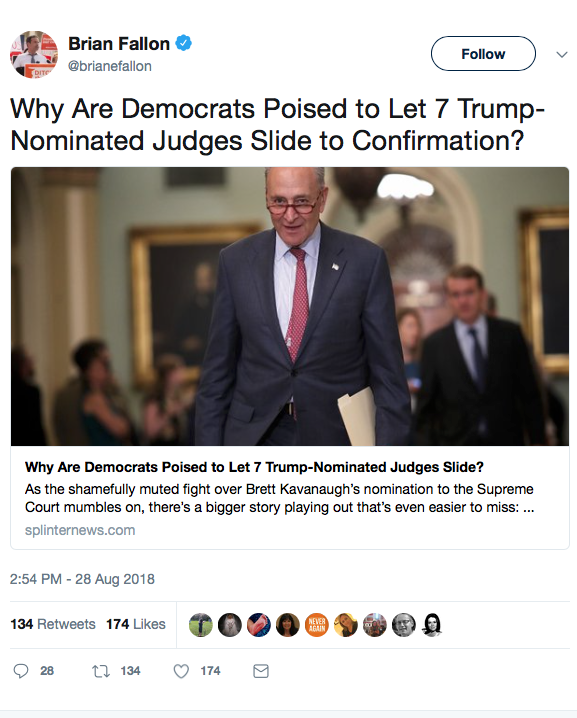
Brain Fallon's in his mid-30s and he's been the picture of an up-and-comg establishment Democrat for a decade. Even before he graduated from Harvard, he had worked as a press aide in the doomed 2004 Kerry-Edwards campaign. Two years later he was the press secretary for Bob Menendez's Senate race and then went to work as the spokesman for Chuck Schumer and his Senate Democratic Policy and Communications Center. In 2013 Eric Holder hired him as the head of DOJ's public affairs department and, naturally, in 2015 he was the Hillary campaign's national press secretary. Since that collapsed he's been a CNN commentator. He's half of the Katie Beirne/Brian Fallon DC power couple.

In July, Fallon penned a short OpEd for USAToday, Demand Justice: Saving Courts From Donald Trump about a new organization he founded on May, Demand Justice, of which he is executive director. "With a lot of hard work," he wrote, "we might one day succeed in restoring a majority of progressive justices to the Supreme Court, and then have a chance to overturn the Citizens United decision. But we will never achieve the type of reform we seek so long as progressives continue to sit on our hands and cede the playing field to right-wing groups."

His new role has led to some surprising tweets, like the one up top and these in the last couple of days:


Last week Fallon told Bloomberg News that "Mitch McConnell is in the middle of stealing the federal courts for conservatives, and Democrats continue to bring a butter knife to a gunfight. Democrats should be resisting Trump's judge picks at every turn, not agreeing to fast track, as happened this week. It is hard to think of a more pathetic surrender heading into the Kavanaugh hearings"

Let's listen to this segment from Ian Masters' August 30 radio program, an interview with Lisa Graves, formerly the Chief Counsel for Nominations on the Senate Judiciary Committee under Senator Patrick Leahy and as Deputy Assistant Attorney General in the Department of Justice during the Clinton Administration. She agrees that there has never been, at least in recent years, a "more secretive, corrupt and troubling process" than in the Kavanaugh nomination and confirmation process. "What's the incentive to fast-track a number of other Trump nominees? What did the Democratic leadership get out of that at this point? It's further packing the courts. I'm not sure that the negotiating strategy makes any sense at all and certainly this idea that you've got to protect Joe Manchin at all costs or that you've got to protect Heidi Heitkamp at all costs, even to the detriment of the future of jurisprudence, the future of judicial rulings of the United States for decades to come, just doesn't make any sense at all on any ordinary person's calculus. The courts are more important than some seat in West Virginia, quite frankly... If Democrats like Joe Manchin were actually talking about the issues-- about what's really happening in America and how Trump is screwing everyone over and how this nomination would further screw people over by putting another corporatist on the court, then maybe he wouldn't be having such a hard time."

Masters: "My understanding is that the real problem is Schumer himself, along with Senator Feinstein. They have made the calculus that fighting Kavanaugh and revealing what they know about him [he's a womanizer with a drinking and gambling problem, not just a car-pooling dad] will backfire on the vulnerable Democratic senators-- Heidi Heitkamp, Joe Manchin and Claire McCaskill. They're apparently willing to let Kavanaugh go through. Schumer, I think, is a total disgrace, the last person who should be the mijority leader of the Democrats. And apparently Feinstein is so mad at the Democratic Left because of how she's been treated here in California-- and hasn't gotten the endorsement of the California Democratic Party... So she's going to stick it to the progressive political left by supporting Kavanaugh."

Would it be any different if, instead of a sleepy conservative like Feinstein, we had an actual dynamic progressive in the Senate representing California? I asked Kevin de León, who has been endorsed by the state Democratic Party over Feinstein for the Senate seat, how he sees the battle to stop Kavanaugh. "Senate Democratic leadership," he told me today, "is wasting its time demanding documents from Chuck Grassley and agreeing to confirm Trump judicial nominees-- instead of rounding up 'No' votes from its own caucus. It’s time for Senator Feinstein and Senator Schumer to stop playing polite, country-club politics with a Supreme Court nominee who represents one of the greatest threats to a woman’s right to choose in our lifetime. California’s senior Senator made the grave mistake of opening the door for Kavanaugh’s confirmation once before. Given the mathematical challenge before us, and all that is at stake, we do not have the luxury of waging this fight from the sidelines. That’s why I’m calling on Senator Feinstein to leverage the power of her seniority to make sure Senate Democrats are committed to unanimously rejecting the President’s nominee."

Labels: , , , , , ,

Saturday, August 11, 2018

Is Kavanaugh Really THAT Bad? Even Worse Than That!

>

Brett Kavanaugh by Nancy Ohanian

I suspect there are a lot of voters, particularly Democratic voters, who shrug when someone talks about confirming a judge nominated by a president. Sure, a judge nominated by a Republican president isn't going to be as good as a judge nominated by a Democratic president, but the Republicans won and they get to pick the judges. Right? How bad could it be? We lived through Reagan's judges and Nixon's judges and Bush judges. And what a ruckus was raised over them all! Why bust a gut over Brett Kavanaugh? Did that other one Trump put on there Supreme Court, Neil Gorsuch, that terrible?

Yeah, Gorsuch is terrible. Kavanaugh is worse. Many of us feel uncomfortable that Kavanaugh thinks presidents-- or Republican presidents-- are above the law. That's why Trump picked him, of course... and why savages like Devin Nunes (R-CA) and Cathy McMorris Rodgers (R-WA) are willing to put off the impeachment of Rod Rosenstein until after the Senate confirms Kavanaugh. How is he worse? Count the ways. No, wait-- my old friend Jesse Lee already did. "Our rigged political system," he wrote Thursday, "supposedly under siege from all sides, is about to reach the height of its power: locking in control of the Supreme Court for a generation with one of its own shifting the balance. The son of a D.C. lobbyist family, a notorious leaker at the heart of the Ken Starr investigation, a career political operative in legal clothing, will be rammed onto the court while Republican senators keep his damning 'paper trail' covered up." Yes, that's Brett Kavanaugh he's describing.
You can almost hear the champagne corks ready to pop on K Street in a collective toast to President Donald Trump.


What you don’t hear is a lot of speculation about the intricacies of Brett Kavanaugh’s judicial philosophy and where that might lead. Because we all know the answers-- he’s spent his life fighting for partisan and big corporate agendas, and he’s been nominated to push that agenda on the court.

On the most profound issues facing all of us, Kavanaugh was chosen precisely because he comes with a guarantee to override the will of the people. His mission is to accomplish what the rigged system couldn’t hope to achieve through the legitimate democratic process.

On gutting and overturning Roe v. Wade, the fix is in. From the beginning, Kavanaugh has forged a career designed for this moment, saying all the right code words to reassure the right-wing lobbying groups dedicated to overturning Roe, paying homage to the dissent against the decision giving women the right to control their own bodies, while being just careful enough to let Republican senators play kabuki theater and pretend his position is mysterious. But there’s no mystery; the decisions are already rigged.

In fact the movement to overturn Roe, from the efforts by the Heritage Foundation to Jerry Falwell Jr., made a bargain: They would defend Trump through every imaginable moral and ethical disgrace, so long as he promised to choose from their pre-approved list of potential Supreme Court nominees who they knew would make the rulings they wanted. Out of that corrupt bargain sprang Kavanaugh’s name-- see if you can find a single one of those lobbying groups complaining now.

On gutting and repealing the Affordable Care Act and health care protections, the fix is in there, too. The manufacturing of cynical political lawsuits to dismantle the ACA has become a cottage industry for Washington-based Republicans and their major donors, and the rigged system has churned out judges they know will play along with the game.

The Trump administration, having failed in humiliating fashion to repeal the ACA in Congress last summer, has already corruptly gone along with a hack political lawsuit to eliminate protections for pre-existing conditions, and Kavanaugh was chosen to finish the job. No serious legal commentator thinks the lawsuit is remotely legitimate, but no serious legal commentator really has any doubt that Kavanaugh would rubber stamp it either.

Kavanaugh wasn’t nominated to apply his intellect and conscience to weighing the merits of these arguments, he was nominated to push the rigged system’s agenda. Protections for people with pre-existing conditions will likely be one of the first things that Americans cherish to go on the chopping block, but it won’t be the last.

In general, you’d be hard-pressed to find a single person in America who thinks corporations have too little power, and working people have too much. Well, search no more. Before many working Americans even learned of Kavanaugh’s nomination, the Trump White House had blasted out a one-page sales pitch to every major corporate lobbying firm in Washington, citing the 75 times Kavanaugh had sided with big corporations. The obvious suggestion was that they could count on him to do so every time going forward.

It was their pitch for those big corporations and big polluters to pony up for TV ads supporting Kavanaugh’s nomination, and it paid off. Millions of dollars in ads are being aired in a swing state near you as we speak.


Kavanaugh has seemed to revel in crusading for the rights of corporations to abuse their workers. His dissent in the case stemming from the deaths of trainers at SeaWorld reads like a man planting a flag for big corporate immunity. Even in this horrendous circumstance, he would hold that government has no business telling corporations what to do.

It won’t end there, either. With the courts brushing Trump back from immigration policies so inhumane that they shame our country, Kavanaugh auditioned for the president by trying to force a young immigrant woman to carry her pregnancy against her will.

And as Trump and Republicans look to disenfranchise voters of color by the millions, through blatant voter suppression and partisan gerrymandering, nobody wonders whether those efforts will get Kavanaugh’s enthusiastic approval.

Then, of course, there is the most spectacular rigging of justice of all.

We have a president whose entire family and campaign are under investigation for what would be one of the greatest betrayals of our country in history, who wants to appoint his own deciding judge to sort out the constitutional crisis he’s wrought. A president who obstructs justice out in the open, who has declared himself above the law countless times and chooses a nominee who not only agrees, but has taken the appalling position that President Richard Nixon should have been able to shield the Watergate tapes from the Department of Justice.

Far too few have seriously considered the consequences of a scenario, all too possible in the months ahead, in which Kavanaugh could be the deciding vote to shield Trump from criminal accountability and deem him above the law. Faith in our democracy would crater at home, to say nothing of abroad. They’d say our system is rigged, a sham, and what argument would we muster back?

Goal ThermometerMeanwhile, if confirmed, Kavanaugh’s job for the next 40 years will be to ensure that the rigged system continues to abet those same special interests he has spent a career serving, who put him on their precious list, and who are running the ad campaign to push through his Senate confirmation.

There’s one silver lining to all this, though. As of now, we still have a right for women to control their own bodies. We still have health care protections for every American as they make their way through life. We still have a shot for one worker to get justice against even the biggest multinational corporation. And we still have a country of laws, not of Trump. It’s not completely rigged just yet.

Republican senators say that nobody really cares, that they can’t hear you. So pick up the phone, get out in the streets, get down to their offices, and speak loudly so they can’t miss it.

Labels: , ,

Wednesday, August 08, 2018

Is Trump Leading Us Right Into A Constitutional Crisis? In This Case, Are Republican Presidents Above The Law?

>


Yesterday, CNN reported something that most of us already knew-- that Trump picked Brett Kavanaugh for the Supreme Court because Kavanaugh has asserted that presidents are basically above the law. Manu Raju: "[I]n 2013 [Kavanaugh] asserted that it's a 'traditional exercise' of presidential power to ignore laws the White House views as unconstitutional, as he defended the controversial practice of signing statements prevalent in George W. Bush's White House.
The comments could put a renewed focus on Kavanaugh's time serving as White House staff secretary, who had a role in coordinating Bush's statements accompanying legislation he signed into law. Critics contend that the Bush White House abused the use of signing statements to ignore laws passed by Congress, though Bush and his allies said such statements were no different than the practices of other administrations.

Democrats have demanded full access to documents from Kavanaugh's tenure as staff secretary from 2003-2006 as part of his Supreme Court vetting process, citing in part his role over the Bush signing statements. But Senate Judiciary Chairman Chuck Grassley, an Iowa Republican, has rejected those demands, saying they are irrelevant to his nomination and a Democratic attempt to drag out the vetting process, which already includes hundreds of thousands of pages from other aspects of his career.

In 2013, Kavanaugh was speaking at Case Western Reserve Law School in Ohio when he was asked about signing statements, with the questioner noting that critics say that presidents can issue them to ignore provisions in laws they don't like.

In response, Kavanaugh said that injured parties can take their grievances to court if they believe the president is not following the law-- and that Congress can push back as well.

And Kavanaugh noted that if a president signs a bill "and says these certain provisions in here are unconstitutional, and we're not going to follow those provisions, that is a traditional exercise of power by Presidents."

In a legal opinion that same year, Kavanaugh took a similar position, saying that the president can't ignore the law "simply because of policy objections"-- and that the White House must abide by the law "unless the President has a constitutional objection" to the issue at hand.

"If the President has a constitutional objection to a statutory mandate or prohibition, the President may decline to follow the law unless and until a final Court order dictates otherwise," Kavanaugh wrote in the August 13, 2013, opinion. He made a similar argument in a 2011 dissenting opinion.
Meanwhile, Greg Sargent, writing for the Washington Post told his readers to  get ready for this nightmare scenario involving Trump, Mueller, and Brett Kavanaugh, based on a premise that two of the DC's biggest stories "are on track to collide with one another in spectacular fashion." One is the elusive Trump-Mueller session and the other is the confirmation of Kavanaugh. "Giuliani," he wrote, "who is supposedly Trump’s lawyer, is preparing a letter to Mueller that will largely reject the Special Counsel’s latest suggested terms for an interview. Giuliani claims Trump’s team has 'real reluctance' about Trump facing any questions about potential obstruction of justice. While it’s very possible something will be worked out, it’s also possible that, in the end, Trump may decide against sitting for an interview... If Trump declines an interview, Mueller will probably hit him with a subpoena to appear before the grand jury, as he has privately threatened to do. But on ABC’s This Week, another Trump lawyer, Jay Sekulow, flatly stated that if this happened, Trump’s team will fight it all the way to the top."
What this means is that, in advance of Kavanaugh’s hearing, we may already know that Kavanaugh could end up being the deciding vote on the question of whether a president (Trump) can be compelled to testify to a grand jury. Now, it is possible that the current court could rule on such a matter sooner (the eight justices might deadlock, defaulting to a lower court). But it’s also perfectly plausible, depending on how long Trump’s team takes to make a decision and what happens in the courts after, that this could be headed for a showdown in front of a high court with Kavanaugh on it.

Kavanaugh’s expansive views of executive power and privilege have been widely debated. Kavanaugh argued in 2009 that “we should not burden a sitting president” with “criminal investigations.” Kavanaugh’s suggested remedy was Congress passing a law to preclude this, so he doesn’t necessarily think presidents are constitutionally protected from such probes. He has also said that the decision forcing Richard Nixon to turn over the Watergate tapes might have been “wrongly decided,” but he has also hailed it as a great moment in judicial history, in which the courts “were not cowed and enforced the law.”

We don’t really know for sure what Kavanaugh believes on these matters. But Democrats and liberal groups such as the Center for American Progress have suggested Trump may have picked him precisely because of his possible tendency towards deferring to executive privilege, which they have argued is grounds for him to recuse himself from any decisions involving Trump and the Mueller probe.

But if we learn that Trump is being subpoenaed for an interview against his will, this would suddenly invest the question of what Kavanaugh really believes on these issues-- and whether Kavanaugh will recuse himself-- with practical urgency and immediacy. We will know before Kavanaugh’s hearing that he may soon be ruling on such a matter-- in particular, the question of whether Trump can be compelled to testify.

Democrats from Trump states, such as Joe Donnelly, are remaining noncommittal on Kavanaugh pending their customary sit-down meeting with him. But if the above scenario starts to develop, they will-- and should-- face added pressure to drill down on these matters in their face-to-face interviews.

"Sekulow’s comments make clear that the question of whether a sitting president must be responsive to a subpoena may not be a hypothetical for very much longer,” Brian Fallon, the executive director of Demand Justice, which is leading the fight against Kavanaugh, told me. “Kavanaugh owes his appointment to the man who may soon be a party in a case coming before the Supreme Court. Plus Kavanaugh has already expressed strong views on whether a sitting president should be able to be ensnared in criminal proceedings.”


“If this showdown materializes in the middle of the confirmation battle, it will catapult Kavanaugh’s expansive views on presidential power to the front burner,” Fallon continued. “At the very least, Kavanaugh ought to be forced to commit to recusing himself from any matter arising out of Mueller’s probe.”

It is unlikely that Kavanaugh will pledge to recuse himself during his hearing. It is also likely that he will try to avoid offering sufficient insight into his views of executive privilege to gauge how he might rule on a Mueller subpoena or any other Mueller-related matter, such as whether a president can pardon himself or his cronies or shut down a Department of Justice investigation into himself, which the president’s lawyers claim he has the power to do.

The nightmare scenario

So we may soon face a situation in which a president whose campaign is under investigation for collaboration with a hostile foreign power’s sabotaging of our democracy-- and who has gone to enormous lengths to both scuttle that investigation and to publicly vindicate that foreign power-- is seeking to avoid questioning on these matters, with the help of the justice he just appointed, possibly (given what we know about Trump) in part for this very reason.

...[I]f Kavanaugh does not pledge recusal or shed sufficient light on his views, Senators are not obliged to confirm him. Indeed, you’d think this would present them with what should be a very difficult situation. It should become harder for any self-respecting red state Democrat to support him. Heck, this scenario might even get a bit uncomfortable for vulnerable Republicans, since they are facing a midterm which will likely turn heavily on voters’ desire for a check on an out-of-control president.

Labels: , , , ,

Saturday, July 14, 2018

Al Franken Has Some Questions For Brett Kavanaugh-- File Under "If Only"

>


Are we better off that that that effing hypocritical idiot Kirsten Gillibrand got her scalp by pushing Al Franken out of the Senate? Nancy Pelosi didn't say boo-- nor did Gillibrand fro that matter-- when it came out that Tony Cárdenas, (D-CA) had far, far more serious sex allegations lodged against him by a girl who was 16 when he raped her. He's still in Congress, still laundering corporate bribes into the Congressional Hispanic Caucus' BOLD PAC. And Franken? On the sidelines. Thanks a lot, Senator Gillibrand.

Earlier today, Franken took to Facebook to suggest what his former colleagues should ask Trumpist judge Brett Kavanaugh when they consider confirming Putin's illegitimate "president's" latest nominee. Franken has 25 specific, strategic questions. Trump owes Gillibrand big-time that Franken won't have the opportunity to be cross-examining Kavanaugh with them. The Democrats on the Judiciary Committee are a mixed bag, from the conservative and comatose, like ranking member Dianne Feinstein and Chris Coons (D-DE) to a couple of live wires like Sheldon Whitehouse (D-RI), Dick Durbin (D-IL), Richard Blumenthal (D-CT) and Kamala Harris (D-CA). None of them is a substitute for Franken but... we'll see if any of them land any punches.
When Judge Brett Kavanaugh appears before the Senate Judiciary Committee, Senators will have an opportunity to examine his record, his judicial philosophy, and his qualifications for a lifetime appointment to the Supreme Court.

I wish I could be there. Because I have some questions I’d love to see him answer.

1. Judge Kavanaugh, welcome. I’d like to start with a series of yes or no questions. The first one is a gimme. Do you think it’s proper for judges to make determinations based on their ideological preconceptions or their personal biases?

He’ll say no, of course.

2. Good. Would you agree that judges should make determinations based on their understanding of the facts?

3. And would you agree that it’s important for a judge to obtain a full and fair understanding of the facts before making a determination?

This is all pretty standard stuff. Then, however, I’d turn to an issue that’s received a bit of attention-- but not nearly enough.

4. When you were introduced by President Trump, you spoke to the American people for the very first time as a nominee for the Supreme Court. That is a very important moment in this process, wouldn’t you agree?

5. And one of the very first things that came out of your mouth as a nominee for the Supreme Court was the following assertion: “No president has ever consulted more widely, or talked with more people from more backgrounds, to seek input about a Supreme Court nomination.” Did I quote you correctly?

This claim, of course, was not just false, but ridiculous. The Washington Post’s Aaron Blake (a Minnesota native) called it “a thoroughly inauspicious way to begin your application to the nation’s highest court, where you will be deciding the merits of the country’s most important legal and factual claims.”

It would be only fair to give Kavanaugh a chance to retract that weirdly specific bit of bullshit.

6. Do you stand by those words today? Yes or no?

If he says that he doesn’t, I’d skip down to Question 22. But, if he won’t take it back, I’d want to pin him down.

7. I just want to be clear. You are under oath today, correct?

8. So, today, you are telling the American people-- under oath-- that it is your determination that “[n]o president has ever consulted more widely, or talked with more people from more backgrounds, to seek input about a Supreme Court nomination.”

9. And that determination-- it wouldn’t be based on your ideological preconceptions, would it?

10. And it’s not based on any personal bias, is it?

11. No, of course not. That would be improper. Instead, it is based on your understanding of the facts, right?

12. Was it a “full and fair” understanding of the facts?

Again, if he decided here to fold his hand and admit that he was full of it, I’d skip down to Question 22. But if not, I’d continue with…

13. Great. Judge Kavanaugh, are you aware that there have been 162 nominations to the Supreme Court over the past 229 years?

14. And do you have a full and fair understanding of the circumstances surrounding each nomination?

Of course he doesn’t.

15. Of course you don’t. So, in actuality, your statement at that press conference did not reflect a full and fair understanding of the facts-- isn’t that right?

16. This was one of the very first public statements you made to the American people as a nominee for the Supreme Court. A factual assertion you have repeated here under oath. And it did not meet your standard for how a judge should make determinations about issues of national importance.

17. Let me ask you about some widely-reported facts. Are you aware of the widely-reported fact that President Trump selected you from a list of 25 jurists provided by the conservative Federalist Society?

18. Are you aware of any other case in which a President has selected a nominee from a list provided to him by a partisan advocacy group?

19. Are you aware of the widely-reported fact that President Trump spent just two weeks mulling over his selection-- whereas, for example, President Obama spent roughly a month before making each of his two Supreme Court nominations?

20. Let me ask you this. Are you aware of any facts that support your assertion that-- and I’ll quote it again--“No president has ever consulted more widely, or talked with more people from more backgrounds, to seek input about a Supreme Court nomination”?

21. And yet, you still believe that your assertion was based on a full and fair understanding of the facts?

Then I’d try to sum it up.

22. Judge Kavanaugh, do you believe that intellectual honesty and a scrupulous adherence to the facts are important characteristics in a Supreme Court Justice?

23: And would you say that you displayed those characteristics to your own satisfaction when you made in your very first public remarks (and reiterated here today under oath) your assertion that, “No president has ever consulted more widely, or talked with more people from more backgrounds, to seek input about a Supreme Court nomination?”

By the way: Once I had him pinned down on his ridiculous lie, I’d ask where it came from.

24: Let me ask you about something else. Did President Trump, or anyone in his administration, have any input on your remarks at that press conference?

25: Did President Trump, or anyone in his administration, instruct, ask, or suggest that you make that assertion?

I know this might seem like a long chase. Senators have a lot of ground they want to cover in these hearings: health care, choice, net neutrality, and a long list of incredibly important issues on which Kavanaugh has been, and would continue to be, terrible. After all, he was chosen through a shoddy, disgraceful process overseen by the Federalist Society and the Heritage Foundation.

And, of course, Kavanaugh is a smart guy. He and his team no doubt know that his easily provable lie is a potential problem, and I’m sure they’re workshopping answers at this very moment.

But pinning him down on this is important, for a couple of reasons.

First of all, it was exactly the kind of lie that has been plaguing our discourse for a generation, the kind that has become prevalent under the Trump administration. It’s just a totally made-up assertion that is exactly the opposite of the truth, flowing out of the mouth of a committed partisan who doesn’t care that it’s false. And if you’re sick of people doing that and getting away with it, at some point someone is going to have to start using a prominent stage to bust these lies. If they go unchallenged, then why would any of these guys stop lying, ever?

More to the point: This episode is a perfect illustration of what the conservative movement has been doing to the Supreme Court nomination and confirmation process specifically, and the judicial system generally, for a generation now.

In theory, judges are supposed to be above partisan politics. They don’t make law, they interpret it. They don’t create the strike zone, they just call balls and strikes. You know the routine.

The truth is, for the last generation, conservatives have politicized the Court, and the courts. Kavanaugh is the very model of a young, arch-conservative judge who has been groomed for moments like this one precisely because conservative activists know that he will issue expansive, activist rulings to further their agenda. He has spent his whole career carefully cultivating a reputation as a serious and thoughtful legal scholar-- but he wouldn’t have been on that list if he weren’t committed to the right-wing cause.

That’s why it’s critical to recognize that the very first thing he did as a Supreme Court nominee was to parrot a false, partisan talking point. Of course that’s what he did. Advancing the goals of the Republican Party and the conservative movement is what he’s there to do.

When the Kavanaugh nomination was announced, I saw a lot of statements from Senators saying they looked forward to carefully evaluating his credentials and asking him questions about his judicial philosophy. But anyone who ignores the obvious fact that this nomination, and the judicial nomination process in general, has become a partisan exercise for Republicans is just playing along with the farce.

Instead, we ought to be having a real conversation about what conservatives have done to the principle of judicial independence-- and what progressives can do to correct it. I can think of no better example of the problem than Brett Kavanaugh’s nomination and the bizarre lie he uttered moments after it was made official. And I can think of no better opportunity to start turning the tide than Kavanaugh’s confirmation hearing-- even if it means going down a rabbit hole for a few uncomfortable minutes.
If I remember correctly, Gillibrand was a corporate attorney before she got into Congress. I wonder if she has any questions she'd like to ask Judge Kavanaugh. I doubt it.

Labels: , , ,

Wednesday, July 04, 2018

The Deal With The Devil Is Paying Off For Evangelical Voters

>


Did you watch Meet The Press Sunday? The highlight was Alexandria Ocasio-Cortez but Chuck Todd had another interesting guest as well, Maria Canwell, a standard issue Democrat from Washington (state and DC). Cantell had a warning for senators in regard to Trump's not-as-yet named replacement for Anthony Kennedy. "My colleagues," she said, "on both sides of the aisle know that this vote could be one of the key votes of their entire career. If they vote for somebody who's going to change precedent, it could be a career-ending move."

Remember, during his hate-filled campaign, Trump repeatedly said he would appoint nominees who would overturn Roe v. Wade, one of the top reasons over 80% of evangelicals voted for him and still support him, despite his obvious personal flaws.

On CNN yesterday, Susan Collins (R-ME) said she wouldn't support anyone who is against the Roe v. Wade. How will she know? By remembering what Trump said during the campaign? "I would not support a nominee who demonstrated hostility to Roe v. Wade because that would mean to me that their judicial philosophy did not include a respect for established decisions, established law."

CNN's top legal analyst, Jeffrey Toobin, also writes for the New Yorker and this week, he explained how How Trump's Supreme Court Pick Could Undo Kennedy's Legacy, although I think Kennedy already did that by retiring before the midterms. A conservative, Kennedy was considered the swing vote on the court because he departed from right-wing orthodoxy on some key issues: gay rights, affirmative action, the death penalty, and, in Toobin's opinion, "most notably, abortion rights. In the 1992 case of Planned Parenthood v. Casey, Kennedy voted to uphold Roe v. Wade, and he remained a reluctant but steady advocate for maintaining the precedent."


The whole purpose of Trump’s Supreme Court selection process has been to eliminate the possibility of nominating someone who might commit Kennedy’s perfidies of moderation. The activists from the Federalist Society and the Heritage Foundation who supplied the President’s list of twenty-five prospective nominees are determined to tear down the monuments, on select issues, that Kennedy has built. Their labors have already produced one soaring success, in the confirmation, last year, of Neil Gorsuch. His extremism has exceeded that of his predecessor Antonin Scalia and equalled that of his colleague Clarence Thomas, the Justice with whom he has voted most often.

Yet it’s far from certain that the public wants the kinds of rulings that a brazen conservative majority would produce. So the nominee and his or her supporters will avoid spelling out the implications of this judicial philosophy. As with Gorsuch, the nominee will be supported with meaningless buzz phrases: he or she will be opposed to “legislating from the bench” and in favor of “judicial restraint.” Like Gorsuch, the nominee will rely on airy generalities rather than on specific examples. It’s all the more important, then, to articulate in plain English what, if such a nominee is confirmed, a new majority will do.

It will overrule Roe v. Wade, allowing states to ban abortions and to criminally prosecute any physicians and nurses who perform them. It will allow shopkeepers, restaurateurs, and hotel owners to refuse service to gay customers on religious grounds. It will guarantee that fewer African-American and Latino students attend élite universities. It will approve laws designed to hinder voting rights. It will sanction execution by grotesque means. It will invoke the Second Amendment to prohibit states from engaging in gun control, including the regulation of machine guns and bump stocks.


And these are just the issues that draw the most attention. In many respects, the most important right-wing agenda item for the judiciary is the undermining of the regulatory state. In the rush of conservative rulings at the end of this term, one of the most important received relatively little notice. In Janus v. afscme, a 5–4 majority (including Kennedy) said that public employees who receive the benefits of union-negotiated contracts can excuse themselves from paying union dues. In doing so, the Justices overruled a Supreme Court precedent that, as it happens, was nearly as old as Roe v. Wade. (Chief Justice John Roberts, who has made much of his reverence for stare decisis, joined in the trashing of this precedent, and will likely join his colleagues in rejecting more of them.) The decision not only cripples public-sector unions-- itself a cherished conservative goal-- but does so, oddly enough, on First Amendment grounds. The majority said that forcing government workers to pay dues violates their right to free speech. But, as Justice Elena Kagan wrote in a dissent, this is “weaponizing the First Amendment, in a way that unleashes judges, now and in the future, to intervene in economic and regulatory policy.” She added, “Speech is everywhere-- a part of every human activity (employment, health care, securities trading, you name it). For that reason, almost all economic and regulatory policy affects or touches speech. So the majority’s road runs long.”

Anthony Kennedy didn’t spend his entire career on that road, and there is, in his best opinions, the kind of decency and empathy that characterized many of the moderate Republicans who once dominated the Court, such as Justices Potter Stewart, Harry Blackmun, and Sandra Day O’Connor. Kennedy’s words at the conclusion of the Obergefell opinion deserve to be his judicial epitaph. “It would misunderstand these men and women to say they disrespect the idea of marriage,” he wrote. “Their plea is that they do respect it, respect it so deeply that they seek to find its fulfillment for themselves. Their hope is not to be condemned to live in loneliness, excluded from one of civilization’s oldest institutions. They ask for equal dignity in the eyes of the law. The Constitution grants them that right.” But the Constitution grants only those rights that the Supreme Court says it grants, and a new majority can and will bestow those rights, and take them away, in chilling new ways.


Snopes: "A June 2018 news report accurately described the controversial reality of children facing deportation proceedings without legal representation."

Labels: , , , , , ,