Friday, March 31, 2017

Full Scale Civil War Breaks Out In The GOP-- But Are Trumpy-the-Clown's Threats Credible?

>


Congressional Republicans have supposedly been afraid of Trump attacking them in tweets for months. And this week, he went for it. He called out the Freedom Caucus and tweeted "we must fight them" and tweeted twice specifically against Tea Party leaders Mark Meadows, Jim Jordan and Raul Labrador. Earlier, it came out that OMB Director Mick Mulvaney, a former South Carolina congressman, personally delivered a threat from Trump to Mark Sanford that Señor Trumpanzee was actually hoping Sanford would vote No on TrumpCare so that Trump would have an excuse to recruit and back a primary opponent against him in 2018.
Against the backdrop of crumbling negotiations over the GOP bill to repeal and replace the Affordable Care Act, President Donald Trump said last week he wanted to oust incumbent U.S. Rep. Mark Sanford in 2018.

The South Carolina Republican told the Post and Courier that Trump chose to convey this message through an intermediary: White House budget chief Mick Mulvaney, a former member of the S.C. congressional delegation, co-founder of the House Freedom Caucus and a friend.

"'The president asked me to look you square in the eyes and to say that he hoped that you voted ‘no’ on this bill so he could run (a primary challenger) against you in 2018,'" Sanford said Mulvaney told him.

He added that Mulvaney made it clear he did not want to deliver the message but did so at Trump's insistence.

"I’ve never had anyone, over my time in politics, put it to me as directly as that," Sanford said, perhaps understating just how monumental it is for a sitting president to openly go after members of his own party.
Back in February we noted that Sanford would probably be better off keeping the increasingly unpopular Trump at a distance anyway. Today we see even the oafish Hannity has sided with the Freedom Caucus over Trump! And in the fever swamps of the fringe right, when you've lost Sean Hannity...

The 4 members of Congress Trump chose to single out are all pretty well-respected hard-core conservatives, and his move was not a very popular move among Republicans in Congress-- or among hard-core ideologues in the far right grassroots. We'll come back to that in a moment. First, though, let's look at how serious Meadows, Jordan, Labrador and Sanford have to take Trump's overt threats. Let's overlook, for a moment, that Trump has failed miserably in every single Republican primary contest he's gotten involved in and that his preferred candidates have all lost. (Right now the Trump candidate in the GA-06 primary, Bruce LeVell, is polling at 0.6%.)

Fact of the matter is that Trump won all 4 congressional districts of the congressmen he threatened-- and pretty strongly... but not as strongly as the congressmen won the same districts on the same day!
ID-01- Trump- 63.7%, Labrador- 68.0%
NC-11- Trump- 63.2%, Meadows- 64.2%
OH- 04- Trump- 64.3%, Jordan- 68.1%
SC-01- Trump- 53.5%, Sanford- 58.6%
Mark Meckler, a co-founder of the Tea Party Patriots, was interviewed by The Hill and he made it clear which side he's on: "The man who promised to 'Drain the Swamp' now appears to be the 'Creature from the Black Lagoon.' He is now on the side of the swamp monsters."
Meckler and others on the right have warned that Trump risked losing his grassroots base by whipping support for the healthcare bill.

Many conservatives have so far directed their anger at Ryan and GOP leadership, who they say misled the president on the legislation.

But Trump’s attack on the Freedom Caucus could open up a rift with grassroots conservatives, who have defended the president against criticism over his support for the bill.
Chris Gandolfo, writing for Conservative Review, also took the side of the Freedom Caucus and against Trump's attacks. He wrote that "Though the Freedom Caucus is under assault from all sides, some of its members who have spoken to the media or made public statements are standing strong-- insisting that they are willing to work with President Trump to keep the GOP’s promise to repeal Obamacare. The media has used the failure of the American Health Care Act-- Republican leadership’s phony repeal bill-- as an excuse to attack conservatives in Congress. The Tea Party members of the Freedom Caucus, who opposed the legislation on grounds that it would not improve the American health insurance market, have been labeled 'hardliners' who are unwilling to 'compromise' or 'get things done.'... 'The Freedom Caucus is trying to change Washington. This bill keeps Washington the same, plain and simple,' Rep. Jordan said on Fox News Thursday."


Liberty News Now was even harsher towards the GOP Establishment, into which they're lumping Trumpy-the-Clown. "For those who praised the selfless actions of the Freedom Caucus," wrote Shane Cory, "Trump’s tweet was a shot heard round the nation. Trump is vowing to defeat the leaders who stopped him from passing a $1.4 trillion bill that would raise insurance costs and create yet another entitlement program. The threat is directed at Virginia’s Dave Brat who threw out Establishment icon Eric Cantor. The threat is directed at Texas’ principled Louie Gohmert and the most conservative member of Congress, TEA Party favorite, Ken Buck. To put this in perspective, if you take a look at the Heritage Foundation’s Congressional Scorecard, the President of the United States just vowed to defeat eight of the ten highest-rated conservatives and libertarians in Congress. While threatening members of the Freedom Caucus who hold ratings 90% or higher with Heritage, President Trump strongly stands by Speaker Paul Ryan who holds a pathetic lifetime score of 58%. Paul Ryan is closer to Elizabeth Warren than he is to Dave Brat according to the Scorecard. And Donald Trump wants us to defeat our only principled members of Congress in 2018? Something is simply twisted in Trump World, or we were twisted to trust him."

Or both. And it won't be too long before Trump is going to need the Freedom Caucus members he's been alienating to save him from impeachment. Later we'll talk more about this poll that came out this morning:


Labels: , , ,

Tuesday, August 16, 2016

Trumpanzee Or No Trumpanzee, Congressional Republicans Have A Very Bloody Civil War To Fight

>

Right-wing grifters Ann Couler and Paul Nehlen. Add Sarah Palin and Phyllis Schlafly and you come up with a mighty 16%

My favorite unheralded story over the weekend was about how the Trumpist nut Paul Ryan defeated last week, Paul Nehlen, is starting a SuperPAC to harass anti-Trump Republicans, Citizens Revolt PAC. According to Fox News, "A Nehlen aide said the political action committee is a grassroots effort with the primary objectives of electing a Republican president and putting those who would work against the Republican nominee on notice. 'Any political leader who would work against Donald Trump is working for Hillary Clinton,' the aide said."
“We are absolutely going to make sure Paul Ryan is being held accountable to the people,” Nehlen told FoxNews.com on Saturday. "You’ll be hearing from me shortly … like in less than week.”

A Ryan spokesman declined to comment for that story.

The Nehlen aide said the PAC aims to raise into the seven figures and “spend every available dime on communications and ground operations in key swing states in an effort to elect Donald Trump."

Said Nehlen: "Millions of hard-working Americans have had enough of the Clinton dynasty, and they've had enough of career politicians colluding to keep outsiders like Donald Trump … out of power."

According to a report in the Washington Post, "A senior GOP aide familiar with Wisconsin politics wrote in an email: 'Voters in Southern Wisconsin soundly rejected Paul Nehlen on Tuesday. His new endeavor will likely produce the same result as Nehlen's gimmicky campaign, meaning it will exist primarily to enrich himself and his consultants under the specious claims of advancing true conservative reforms.'" That's especially funny in light of the Politico confessional over the weekend by Paul Jossey about how his and other right wing greedy super PACs drained the Tea Party movement with endless pleas for money to support 'conservative' candidates-- while instead using the money to enrich themselves. He asserted that "the Tea Party movement is pretty much dead now, but it didn’t die a natural death. It was murdered-- and it was an inside job... [having] degenerated into a form of pyramid scheme that transferred tens of millions of dollars from rural, poorer Southerners and Midwesterners to bicoastal political operatives." Ah... the story of the modern Republican Party and the brainwashed morons who believe in it. It kind of sounds like a right-wing version of the DCCC:
What began as an organic, policy-driven grass-roots movement was drained of its vitality and resources by national political action committees that dunned the movement’s true believers endlessly for money to support its candidates and causes. The PACs used that money first to enrich themselves and their vendors and then deployed most of the rest to search for more “prospects.” In Tea Party world, that meant mostly older, technologically unsavvy people willing to divulge personal information through “petitions”-- which only made them prey to further attempts to lighten their wallets for what they believed was a good cause. While the solicitations continue, the audience has greatly diminished because of a lack of policy results and changing political winds.

...Republicans inside the Beltway reacted to the burgeoning Tea Party with glee but uncertainty about how to channel the grass-roots energy usually reserved for the left. A small group of supposedly conservative lawyers and consultants saw something different: dollar signs. The PACs found anger at the Republican Party sells very well. The campaigns they ran would be headlined “Boot John Boehner," or “Drop a Truth Bomb on Kevin McCarthy.” And after Boehner was in fact booted and McCarthy bombed in his bid to succeed him, it was naturally time to “Fire Paul Ryan." The selling is always urgent: “Stop what you’re doing” “This can’t wait.” One active solicitor is the Tea Party Leadership Fund, which received $6.7 million from 2013 to mid-2015, overwhelmingly from small donors. A typical solicitation from the TPLF read: “Your immediate contribution could be the most important financial investment you will make to help return America to greatness.” But, according to an investigation by Politico, 87 percent of that “investment” went to overhead; only $910,000 of the $6.7 million raised was used to support political candidates. If the prospect signs a “petition,” typically a solicitation of his or her personal information is recorded and a new screen immediately appears asking for money. Vendors pass the information around in “list swaps” and “revenue shares” ad infinitum.

...For 18 months ending in 2013, I worked for one of these consultants, Dan Backer, who has served as treasurer for dozens of PACs, many now defunct, through his law and consulting firm. I thus benefited from the Tea Party’s fleecing.

...According to Federal Election Commission reports between 80 to 90 percent, and sometimes all the money these PACs get is swallowed in fees and poured into more prospecting. For example, conservative activist Larry Ward created Constitutional Rights PAC. He also runs Political Media, a communications firm. The New York Times reviewed Constitutional Rights’ filings and found: “Mr. Ward’s PAC spends every dollar it gets on consultants, mailings and fund-raising-- making no donations to candidates.” Ward justified the arrangement by saying Political Media discounts solicitations on behalf of Constitutional Rights.

Let that sink in. Ward takes his PAC’s money and redistributes it to his company and other vendors for more messaging and solicitations, but suggests critics should rest easy since the PAC gets a discount on Political Media’s normal rate. Constitutional Rights PAC may be extreme but it’s hardly an outlier.

...The PACs keep cash flowing by trolling the news for supposed apostasy. The government botches the rescue of employees in a foreign embassy? “Stand with us for Benghazi!” A bunch of kids are murdered in Connecticut? “Help us defend your Second Amendment rights!” “Sign our petition!”

Another favorite tactic is the “Draft Committee.” Pick a popular figure then start a committee to “draft” him or her to run for office. TPLF “drafted” Sarah Palin for Senate in Alaska and Backer “drafted” Newt Gingrich for Senate in Virginia. After I left his firm, Backer “drafted” new Texas resident Allen West for Senate in Florida. None of these candidates were remotely interested or associated with the effort, and in fact could not be by law. But there were signatures to collect and donations to request. (As a litigator, I rarely participated in the conduct described here. I nonetheless knew these schemes paid most of my salary.)
Yesterday, Politico followed up with a feature by Elena Schneider, The GOP Establishment strikes back about how the Chamber of Commerce wing of the Republican Party has declared a quiet-- but nonetheless ruthless and brutal war against the far right grassroots. As we said two weeks ago, Tim Huelskamp's primary defeat-- something engineered by Paul Ryan and Kevin McCarthy-- was revenge and warning-- and possible because of the moribund condition of the drained Tea Party. Ryan's wing of the party "is going on offense, pushing back hard against candidates backed by the hardline conservative House Freedom Caucus, including defeated GOP Rep. Tim Huelskamp-- setting the stage for a titanic intra-Republican fight during the next Congress."
A collection of Republican donors and operatives loosely organized around several super PACs decided this summer to adopt newly aggressive tactics against GOP “obstructionists”-- or as John Hart, a former aide to ex-Sen. Tom Coburn, calls them: “Rebels In Name Only”-- after years of growing tea-party influence in Republican primaries and the halls of Congress.

...“The establishment’s position was always... [focused] in competitive seats, in situations where we believed [a different] candidate gave us a strategic advantage. It was never ideological. But now you’re seeing more and more activity in these safe seats,” said Brian O. Walsh, a GOP strategist and former National Republican Congressional Committee political director involved in these efforts.

“It’s like when you have a health problem,” Walsh continued. “First, you try to ignore it, see if it gets better. Then you try to treat it with meds. Now you just have to radiate it.”

That message comes at the end of the 2016 primary season but just a few months before a new Congress has to govern with a new president. The groups hope to show that 2018 primaries could be on the horizon if conservative rebels stand in the way of congressional Republicans’ legislative strategy.

“You have to get beyond saying only ‘no.’ You have to be effective. You have to propose solutions and govern,” said Rob Engstrom, the political director for the U.S. Chamber of Commerce, who noted that his group has backed House Freedom Caucus members in the past.

To “non-governing” members, “we want to put you on notice,” said a spokesman for Strong Leadership for America PAC, a new group that plans to focus on Republican and Democratic primaries, founded by donors who generally support the “No Labels” effort, which targeted Huelskamp with its first half-million dollars.

Conservatives in the House, used to playing offense, say they are under siege.

“Absolutely, we’re being targeted, absolutely,” said Arizona Rep. Paul Gosar, a House Freedom Caucus member who’s seen a group called Right Way PAC drop $211,000 on negative radio ads and mailers (and promise more to come) ahead of his late-August primary. “Over and over again [this year], you see the same thing with them. Look, the Freedom Caucus hasn’t challenged anyone who’s a sitting member. We’ve only played in open seats, but isn’t that interesting that K Street and Wall Street are playing against members?

“This isn’t a game for this year, but a game for next year. This isn’t just a short game, this is a long game,” said Gosar, who’s still expected to win his primary. “There’s no stopping them.”

On this, Gosar and one of the new establishment-oriented PACs agree.

“This is a long game,” the Strong Leadership for America spokesman said. “Kansas was just one race, and it doesn't fundamentally change anything, but if we scale it up over time, we can fundamentally change the dynamic [in Washington]."

Huelskamp’s loss in Kansas and the result in an open Georgia race the week before, where small-town Mayor Drew Ferguson defeated a Freedom Caucus-endorsed state senator, Mike Crane, represented a sharp and expensive turnaround from some earlier 2016 primaries.

Candidates backed by the conservative Club for Growth held an Indiana open seat and even captured former House Speaker John Boehner’s open district, a huge symbolic victory delivered in spite of some spending by Right Way Initiative, a nonprofit affiliated with the super PAC of the same name.

ESAFund and its sister nonprofit Ending Spending, which has a long primary-spending track record dating back to 2010, weighed in again heavily this summer. The group has backed hard-line conservatives like Sen. Ted Cruz and South Carolina Rep. Mick Mulvaney in the past, and its principal goals include eliminating earmark projects, “reducing the size, scope and cost of government” and “electing a governing majority,” said PAC President Brian Baker.

“The key thing to understand is that we support only strong, principled fiscal conservatives with a plan to do just that-- and grandstanders need not apply,” Baker said. “We have a long track record of engaging in both primary and general elections to support or oppose candidates to achieve our goals.”

Rep. Jim Jordan, the Freedom Caucus chairman, sees things differently.

“Let’s make one thing clear, Washington special-interest groups poured money into these races against conservatives to stack the deck next year in favor of their agenda of comprehensive immigration reform, reauthorizing the Export-Import Bank, and raising the debt ceiling without making substantial cuts to spending,” Jordan said in a statement. “In these cases they were successful, but I believe the American people will speak out against this Washington-centric agenda going forward.”

...“The establishment has decided to gear up bigger, better and earlier, pouring in a lot of money,” said Sachtleben, who also pointed to two more Club-backed candidates in Florida and Arizona, races that will be decided later this month. “There’s a strong effort to undo any progress conservatives have made, and it’s going to take an effort to match that and overcome. It’s going to take a conservative response that’s already looking at 2018 and that needs to get serious, to get new seats and take back seats.”

That makes two sides ready to brawl in 2018.

Right Way Initiative and its super PAC also “intends to be a factor for a long time in deep red districts where one of the candidate choices represents constructive conservatism,” said Dan Flynn, a spokesman for the group who was involved in strategizing Huelskamp’s defeat in Kansas.
My friend at the RNC said he didn't know much more about this than what's appeared in print already. He did say, however, that they'd never be able to do this is the DCCC was "nimble" or prepared for "out of the box challenges." He told me this morning that his team feels "confident that the DCCC isn't capable of taking advantage of" a Republican civil war. "I never thought Pelosi could find someone stupider and less capable than Steve Israel. I think she managed to though."

There are no candidates on this list of Bernie-backers who the DCCC is eager to see win in November. These are the men and women we should be helping-- proven and potential leaders like Pramila Jayapal (WA), Tim Canova (FL), Zephyr Teachout (NY), Alina Valdes (FL) and Tom Wakely (TX).


Goal Thermometer

Labels: , , ,

Saturday, August 06, 2016

A Guest Post From Jesse Myerson: The Political Revolution: Where From Here?

>


Beyond Bernie, What?

Since mid-April, when Hillary Clinton handily won the New York primary, variations on that question have animated discussions all over the country among activists, Sen. Sanders’ detractors as well as his supporters, who recognize that his run’s successes present an opportunity. Attending that opportunity, however, comes a burden. The political terrain opened up by social movements over the last five years demands the formation of a politicized constituency to inhabit it, and the Sanders campaign hinted at such a project’s near-term viability.

Developing a strategy for electing a socialist government is now an urgent matter.

Not that implementing that strategy should take priority. Any chance the left has of obtaining power is premised foremost on groundwork that must continue to be done outside the electoral sphere: labor and community organizing, base-building, political education, mass spectacle, direct action, grassroots leadership development, and so forth. Even if the left were to achieve electoral success, it would be fleeting and unsustainable, if we’d abandoned political groundwork to attain it.

Still, the reverse is also true: we risk losing the political ground we’ve been gaining if we don’t undertake an effort to populate it. Unfortunately, existing institutional avenues for achieving left electoral success are woefully deficient.

The Problem with Socialist Parties

In Parliamentary systems that operate on the principle of proportional representation, the leftist electoral strategy is simple: join or start a party and campaign on its line. If you only manage to get 2% of the vote, you are awarded 2% of the representation. If you get a plurality of the vote, you get to try to form a government.

A First-Past-The-Post system like ours strongly discourages this approach. Here, whoever wins an election, whether in a squeaker or a blowout, gets 100% of the representation. No representation whatsoever is awarded a loser, whether their campaign mobilized no voters or 49.9% of them.

In certain races in leftist pockets of the country, such as Socialist Alternative member Kshama Sawant’s Seattle City Council district, a leftist party may be able to pull a majority, and in such cases it should. Scaling up to national or even statewide races, though, it runs a risk that parties in a Parliamentary system don’t have to worry about: throwing the election to the right. If Socialist Alternative were to increase its share of the vote and begin running in more ideologically diverse electorates, the likely result would be increasing right wing majorities in government. The electoral odds confronting third parties do not generally admit of present success in gubernatorial, senatorial or presidential contests.

For organizer Waleed Shahid, the impediment posed by the winner-take-all approach is counteracted by an advantage US parties have over their Parliamentary counterparts. Whereas in proportional representation systems “parties develop candidate-lists up and down the ballot from school board to parliament,” here “candidates can theoretically gather the required number of signatures on an official party form and be placed on a ballot in a primary election.” An insurgent faction of “Sanders Democrats” could take on the party elite, leaving the Democratic Party to serve “a purely administrative function to foster electoral functions of the state, rather than a programmatic or disciplinary role.”

It is tempting to consider this option in the wake of Donald Trump’s populist conquest of the majority of the Republican establishment, its prominent politicians and major institutional constituents. What is a US political party anyhow, Trump’s success challenges us to ask, but a group of people who can be defeated through collective action?

Shahid proposes a new “party” which takes the form of a faction within the Democratic Party, like a left Tea Party. Such a form might maintain “its own accountability mechanisms, membership models, and decision making structures” without sacrificing “the existing tools of the major party’s administrative machinery: primaries, ballot access, petitions, conventions, and the party line vote used by an increasing number of voters.”

Not everyone is on board with this strategy.

The Problem with the Democratic Party

Shortly after the New Hampshire primary, Michelle Alexander, author of The New Jim Crow, made a peculiar political endorsement. She forcefully condemned Hillary Clinton, but declined to endorse Bernie Sanders, preferring instead to endorse the idea of a political revolution. Why promote a candidate’s catchphrase and not the candidate himself? Because of his ballot line: “it would be easier,” according to Alexander, “to build a new party than to save the Democratic Party from itself.”

Paul Heidelman, a proponent of the strategy of splitting completely from the Democratic Party, invites us to consider the socialist effort in the 1960s-70s at party realignment. Bayard Rustin, Michael Harrington and others advanced a strategy of expelling the Dixiecrat faction of the New Deal coalition, thinking this would liberate the Democratic Party to pursue social democracy. In the end, though they managed to shed the South, the Democrats did not become more socialist.

In predicting otherwise, Heidelman argues, Rustin and Harrington ignored the essential core of the Democratic Party: its funding base. Since the Great Depression, the Democratic coalition included those segments of the capitalist class most easily able to absorb the tighter labor markets the New Deal sought: capital-intensive and multi-national firms, like oil companies and international commercial banks. These interests were only induced to go along with the program because the alternative seemed to be mass insurgency, courtesy of a militant labor movement. When, a generation later, the oil sector threatened to abandon the Democratic Party, the counter-threat of working-class insurgency had dwindled, setting the stage for the the Carter Administration’s energetic pivot rightward, toward deregulation, austerity, and militarism.

Even if Sanders had been elected President, he would still be the titular head of a party whose major funding centers, and therefore whose major politicians, would be hostile to his agenda. The Sanders campaign’s small-dollar fundraising success was a marvel to behold, but normal Democrats don’t put up those numbers, so the party is, for the moment, still beholden to its moneyed interests. “Should he become president,” wrote Alexander, “he would also become part of what he has otherwise derided as ‘the establishment.’” Indeed, as tantalizing as Trump’s example of party-conquest may be, his prospects of advancing his agenda through a ruling coalition remain dubious.

There is also a more mundane reason for the left to want distance from the Democratic Party than its unreliability as a champion of working class interests: it is bedeviled by deep unpopularity. The latest from Gallup indicates that although the Party’s favorability rating has risen “slightly” since its historic low of 36% in November 2014, “both parties remain unpopular relative to their historical performance.” It is sensible to suppose that the unusually high degree to which Sanders is not a Democrat boosted his Democratic candidacy.

In the interest of its program and its political prospects, the left should seek a greater degree of independence from the Democrats than Shahid’s Progressive-Caucus-but-better offers.

The Problem with the Working Families Party

The Working Families Party is supposed to provide just such a vehicle. To be sure, it is the best attempt we currently have at operating within-and-without the Democratic Party. Through its shrewd use of fusion voting, WFP became a major force in New York politics and has expanded to nine states and is implementing a “pipeline project” to make politicians of grassroots leaders. However, as Shahid, a WFP organizer, writes, “Neither the WFP nor a prior, important effort to similarly challenge the two-party system --  Rebuild the Dream--  have generated the kind of momentum and mass participation of the Tea Party.”

For obvious reasons, the burden cannot fall to Shahid to give an account of why this should be.

As recently as 2013, the WFP was showing signs of powerful ascendency. A wave election swept Bill de Blasio and other WFP-nurtured politicians into office in New York City, defeating a powerful business-friendly Democrat who early on was considered the inevitable victor. The New York Times declared “A New Era for Progressives.” Here was a model capable of electing governments farther left than normal Democrats.

But only a year later, the model collapsed. For months leading up to its 2014 convention, the WFP searched for a viable progressive challenger to Andrew Cuomo. The Governor was a perfect WFP Primary election target, despised by liberals not only for his plutocrat-friendly policies but his tacit support for throwing the Senate to the Republicans, via the “Independent Democratic Conference”-- a group of four State Senators who, elected as Democrats, promptly turned coat.

At last, shortly before the convention, a solid candidate emerged in the figure of anti-monopoly law professor Zephyr Teachout, now a candidate for Congress. Despite the raucous ovations she garnered at from grassroots members at the convention, the party endorsed Cuomo, upon the prevailing of the executive leadership of the state’s largest union, 1199SEIU--  and Mayor de Blasio. Wisely, Cuomo did not show up in person to the convention, remotely delivering a speech that outlined his concessions, above all that he would restore to New Yorkers the Democratic majority they had elected by reigning the IDC back.

Party members who had boo’d through the video knew what was coming. They very next morning, Cuomo revealed his level commitment to the deal: “It’s very simple at these political conventions: you either win or you lose. Uh, and I won.” Not only did he win, he won ugly, sinking millions of dollars into a fake “Women’s Equality Party” designed to resemble and thus siphon votes away from WFP in the general election. Moreover, he convinced 1199SEIU and other unions that had supported him to cease paying WFP dues. As for the IDC, its leader, Bronx Sen. Jeffrey Klein wasted no words: “Nothing changes.” Voters justly knocked WFP down one ballot line for four years.

Ironically, Heinelman’s injunction to socialists that we ought to beware of funders is apt not only when the funders are organized capital, but even when they are organized labor. Union leaders, after all, represent the interests of a specific membership, not the working class writ large. If you have to deal with the governor for the sake of your members’ livelihoods, you don’t think he can be beaten, and you know he’s a vindictive demon, you, and thus the party you anchor, are at his mercy.

So the WFP is changing models. New chapters are staring up in states like Wisconsin and Nevada. Fusion voting is not an option in those states, so the WFP exists not as a ballot line, but as something closer to what Shahid calls for, an organization within the Democratic coalition. I am not privy to the party’s finances, but it appears to be in the unenviable “Do More With Less” mode.

If reliance on labor unions for funding is a liability, albeit a smaller one than reliance on capital, political independence will have to be driven substantially by small dollar donations. Here is where even the WFP’s new model provokes doubt. The type of exuberant small-dollar fundraising Sanders has accomplished requires something WFP lacks and the Tea Party had: an emotional connection with a mass of people.

Shahid points out that the Tea Party’s decentralized, open-source structure facilitated the kind of mass rallies and listening-session shout-downs that propelled 2010’s far-right electoral insurgency. I share his regard for decentralization, and admire many of the strategies advocated by the Momentum model of organizing (with which Shahid is affiliated) for achieving it. The Sanders campaign shows, though, that if there is energy around a project, it decentralizes spontaneously. People who were inspired to participate in the Sanders “movement moment” formed their own outfits, chapters, and networks, which become a sort of “Greater Campaign Area”--  People For Bernie, Labor for Bernie, Bernie Sanders’ Dank Meme Stash, and so forth. If an open source structure provides a conduit for left political power, it is the emotional connection with a mass of people which provides the propulsion.

Resonant iconography is critical to fostering emotional connection. In a presidential campaign, the iconography inevitably revolves around a single icon: the candidate, who can symbolize many things to many people. In the absence of a candidate, though, iconography formation demands a more deliberate approach. The Tea Party claimed a historical lineage, which had a widely resonant iconography built in--  imagery, sounds, and dramatizations that inherently bespoke an appeal to insurgency, with the strong value of liberty from tyrannical government at its core.

If the Working Families Party has a symbolic logo, much less an animal to compete with a donkey and elephant, or any other type of mascot, symbol, anthem, costume, custom, ritual, ceremony, idiolect, etc.--  it is unknown to this long time WFP supporter. The name itself limits the appeal of the party: not only are there millions of people who don’t identify primarily as workers, there are millions more who don’t identify as families. An iconography revolving around a candidate or an historical event admits of mass, diverse emotional investment, and thus decentralized funding; it is not at all clear that an iconography-less Working Families Party does.

The Problem With The Tea Party

Though there is much to admire about the swiftness with which the Tea Party insurgency was able to advance a political program (however odious the program itself), it is easy to overstate the desirability of replicating its model.

Its chief deficiency was that it happened in a single wave. The Summer 2009 shout-downs may have propelled a crop of politicians embracing the Tea Party iconography into office in 2010 in sufficient numbers to impose a ruthless program of austerity, but by 2012, notwithstanding Ted Cruz’ attainment of a Senate seat, the Tea Party label all but ceased to be a force at the ballot box. If the left is going to implement a socialist program, it will need a sustained effort that builds on its own success in cycle after cycle.

To this end, the Tea Party lacked some crucial attributes: a coherent political critique, transformative vision and understandable program. Its critique took the form of a freewheeling, seething opposition to social welfare broadly and President Obama singularly. Its vision, freedom from Big Goverment, was never especially vivid, and it thus was never able to articulate a program capable of achieving it--  policies to overhaul, institutions to erect or abolish, etc. That the 2010 insurgency was able to yield severe budget cuts and the defeat of the proposed Public Option component of Obamacare was no mean feat, but these policy outcomes were also already GOP priorities. That is, “Tea Partiers” were, from a policy perspective, like mainstream Republicans, only more so.

A wave of sentiment provoking a political lurch rightward followed by an erosion of power is nothing like the sustained, transformative change the left seeks. The Tea Party was effectively too open source, lacking a central pillar capable of sustaining the decentralized insurgency. If the left replicated its model, we would wind up assisting the realization of the liberal agenda--  regulated access to market-based services--  rather than advancing our own program of guaranteed economic rights, directly provided by the public sector.

A Strategy for Political Independence

I’d like to offer a strategy for political independence, not as a blueprint, but as a provocation for discussion. I think it may be viable in the main, and that we may have a considerable amount of the necessary infrastructure already in place.

The strategy revolves not around a party but a national inter-partisan slate (and, once elected, caucus). Candidates could run for office at any level, but to achieve the greatest national significance with the smallest voting bodies, it might be wise to focus on the US House. They would share a core message, a basic program, and an explicit affiliation with one another under a common banner, maybe even with shared campaign ads. To maximize its degree of independence from any party’s funding base, the caucus should fastidiously maintain a diversity of parties-- perhaps there could be a bylaw stipulating that no more than 20% of a given slate’s candidates would appear on the same ballot line. A given slate might feature primarily Independents, some Greens in areas where local chapters are strong, some from socialist parties, some people running on the Working Families line, and a deliberately small number of Democrats.

For unity as its own entity, the slate/caucus would require a broad vision, a program for achieving it, a stated commitment to values/principles, and, critically, an iconography which resonates with these. Much of this may already exist in embryo.

The “divest-invest” framework has attracted social movements from climate justice to the Movement for Black Lives, and the Sanders campaign occasionally employed it, conceptually if not by name. It is capable of linking the diverse interests of social movements into a narratively coherent critique, vision, and program. Broadly speaking, the left wants to divest from prisons, policing, border enforcement, war, energy extraction, and the surveillance state, and invest in guaranteeing everyone the essentials for a dignified life: healthful food, comfortable housing, quality healthcare, student-centered/directed education, meaningful work, leisure time to build family, community, and culture, and the energy and communications tools required to do it.

The call to divest from the enforcement regime and invest in people’s livelihoods articulates commitments to freedom and dignity. To these, a third pillar might be added in commitment to democracy: unconditional universal enfranchisement, public election funding, a much more decisive system of participatory budgeting, federal standardization of election procedure, and so forth. Freedom, dignity, democracy. Divest-invest-enfranchise. Make love, not war, and power to the people.


In addition to this program, which is adaptable to local circumstances and priorities in every community in the country, the caucus could unite around a set of values/principles. Two closely related examples come to mind that pervade social movement spaces and the young activists propelling the Sanders campaign.

The first is “targeted universalism,” characterized by a devotion to the interests of the people who live farthest on the losing ends of various hierarchies, double standards, and violent relations-- the “margins of the margins.” Without this anchor, universalism is often carried adrift by the prevailing currents of bigotry. It tends to become abstract: “All lives matter.” The slate should demonstrate this commitment not just by enshrining it officially in its documents, but by realizing it in the figures it elevates to “party” leadership.

The second is what movements tend to call “accountability” and Sanders supporters tend to call “integrity.” His demonstrated inability to be bought by, and indeed his hostility toward, wealthy interests clearly ignited Sanders’ popularity and fundraising.

To bind the program and principles, a unified iconography is necessary. I am nowhere near capable of offering up a comprehensive scheme in this division, but for my own part, I am a fan of birds. A great deal of the symbology already employed by youth-led social movements and the ones from which they derive inspiration is already about freedom and dreams. What could signify those more vividly than birds? Birds mean renewal, birds mean grace. As Bernie Sanders pointed out when he summoned one to his lectern in Oregon, birds mean peace. “Hope is the thing with feathers.” Flocks of birds operate as a collective mass, following rotating leadership. Birds have vision wide enough to survey all the terrain visible from the sky but sharp enough to peer down at particular areas of focus. My two cents.

With these points of unity in place, a diverse slate of candidates might successfully organize as a left political faction, independent of any one party or funding center. Eventually, when powerful enough, it might become a party in its own right, seeking a ballot line and full realignment resembling what the Republicans achieved in the mid-19th Century.

Problems With The Strategy

I look forward to being alerted to many problems with my idea that I can’t see. One that I can is, as always, the funding question. A pool of small-dollar donations is ideal for political independence, and I hope the form I propose would be well-suited to generating one, but even a large pool would be unlikely to be able to truly sustain a major political operation by itself. If the caucus were to grow in scale, it would likely need to think of other sources for funds. Might union reform caucuses be able to shoulder some burden? A politicized federation of co-ops, land trusts, and other “new economy” institutions and organizations? What could a left formation produce that people might want to buy-- music, fashion, software, or something else millennials are good at?

Strategic discussions about leftist political operation will become increasingly vital in our newest “new normal.” I hope this essay will prove useful in provoking more of them, and that critics of what I’ve written will not be shy about identifying its deficiencies. And I hope that, if anyone reading is already busy building something like what I’ve outlined, they’ll let me know how I can be useful.

Labels: , , ,

Tuesday, October 20, 2015

Are You Watching The Republican Party Disintegrate Before Our Eyes?

>


That interview Ted Cruz did with Chuck Todd made it pretty clear how intensely the Texas neo-fascist hates the traditional establishment politicians in his own party. And this week, in an interview with CNBC's John Harwood, a very frustrated Rand Paul actually called for fellow Republicans in Congress to resign if they can't accept his radical crackpot flat tax agenda.
HARWOOD: Talk about tax policy for a second. You're for a flat tax. Critics say: 'regressive, would add to the deficit.' What have we seen in the last generation that makes us think a flat tax is achievable?

PAUL: I've done three five-year budgets that balance with significant tax cuts. So not only would I cut money that goes into government, and I've had critics on the conservative side say, "Well, government would be $3 trillion short." Well, let's cut government. I want a much smaller government. I want a federal government that does a lot less in Washington. And we send most of that power back to the states, into the private economy.


The majority of Republicans want revenue-neutral tax reform. And I tell people, "If that's what we're for, I'm going home." Because that means half the country will pay more, half the country will pay less. And the net effect is zero. They want to simplify taxes. But they don't actually want to lower the burden and make government smaller.

It won't happen with the same people. So what you have to have is a wave of new people. In 2010, there were, like, 80 some odd new congressmen. only if I were the nominee and win the presidency, only if someone who is dramatically willing to change government, to stand up to big government and actually change it, if that person were elected, that means that a majority of the public wants that.

HARWOOD: So you need Mitch McConnell, John Cornyn, John Boehner, Kevin McCarthy-- you need those people out of there, and a whole new group?

PAUL: I think that turnover's a good idea. I've been in favor of term limits since I began. People get beaten down by the system. And the longer people are here, the less likely they will be involved in change. There's enormous amount of inertia.
Is the Republican Party self-destructing right before our eyes-- or are they on a healthy path to renewal and regeneration? And, if so, at what cost-- to the party, the career politicians that lead it and to the nation itself? Right-wing South Carolina loon Mick Mulvaney, called it creative destruction.
“People think we are supporting Webster because he’s the most conservative,” Mulvaney told the Daily Signal. “But the man has a centrist voting record. We are looking for creative destruction in how the House operates. And we don’t care who takes the lead on doing that.”

This idea of creative destruction was echoed by Sen. Mike Lee, R-Utah, who chairs the conservative Senate Steering Committee. He argued in a Federalist op-ed that what matters is “not who the next speaker is but what the next speaker does.” He called for “open source policy innovation” that decentralizes power in Congress and opens the legislative process to new ideas.

According to a document leaked to Politico, and confirmed by the Daily Signal, the proposed reforms include opening up the process of committee selection, allowing committee chairmen more control, and creating more transparency in the way bills are brought to the floor. They also want a return of the “Hastert rule,” which requires a majority of Republicans to support any bill brought to a floor vote.

“We want to change it from being the speaker’s House back to the people’s House,” said Matt Salmon, a Freedom Caucus founder from Arizona. “In the last 20 years, it became the speaker’s House, because the speaker has incredible power, where they and their staff determine the legislation, what’s in it, and what amendments are involved.”

Between their inability to elect a House Speaker to their Deep Bench turning into a frightening clown car right in front of the public, the Republicans have gone so far off the deep end that the newest ABC News/Washington Post poll is showing Obama with his first positive approval rating in 2 years (51%) which contrasts to a 24% approval rating for Republicans in Congress (11 points lower than the Democratic Party congressmembers approval).
GOP differences over the next House speaker are not being well received: Just 29 percent of Americans see this as “healthy debate,” while 59 percent see it as “a sign of dysfunction” among House Republicans. Even among self-identified Republicans, more than four in 10 see the leadership battle as a sign of dysfunction within their party. That rises to 59 percent among independents and 72 percent of Democrats.

Among those who see the disagreement as dysfunctional, only 15 percent approve of the House Republicans’ overall job performance. That compares with 40 percent approval-- better, but still well under half-- among those who see it as healthy debate.

The GOP’s fractious situation is evident in its weaker in-party ratings. While only 31 percent of Democrats disapprove of the Democrats in Congress, 51 percent of Republicans disapprove of the Republicans in Congress. Similarly, in ideological terms, just 39 percent of liberals rate the Democrats negatively, while 64 percent of conservatives disapprove of the Republicans.


Vanderbilt University Law Professor Ed Rubin asserted at Salon yesterday that the extremists inside the GOP-- the various Tea Party factions-- hate the Republican Party and the country and want them both to fail. "Instead of showing that they have a better way to govern," he wrote, the Tea Party crackpots "are trying to stop the existing government from functioning. They want it to fail. They hated the effort to rescue the American economy after the 2008 recession and only intensified their dislike when that effort succeeded. They oppose any regulatory program to combat global warming, but rather than favoring market-based alternatives or technological remedies, they simply refuse to deal with the issue by declaring it a hoax. They don’t like the regulatory aspects of Obamacare, but they have no alternative to offer. When they couldn’t overturn the program by constitutional means, their solution was to try to block passage of the entire federal budget, which not only would have created administrative chaos in the country, but wrecked our national credit and our public finance system.

Freedom Caucus candidate for Speaker, Taliban Dan Webster

"Now they have demonstrated that they even don’t want their own political party to govern. They don’t want the Republicans to be in a position where they can advance constructive alternatives to Democratic policies. They don’t want it to be able to propose legislation that will carry out its program. If the Republicans won’t commit themselves to the Tea Party program, which is to stop American government from functioning, then the Tea Party will try to stop the Republican Party from functioning. In other words, they are a disloyal opposition. They don’t understand what American democracy is all about and what has made it work so well. That’s the real reason why the name the chose for themselves is the wrong one. The original Tea Partiers were American patriots; the current Tea Party is the opposite."

And I guess that explains this chart from the ABC/Washington Post poll cited early/ It shows that Republicans overall are very enthusiastic about the Republicans in Congress but on the far right of the party, the disdain for Republican congressmembers.


Labels: , , , , ,

Wednesday, June 03, 2015

How Mainstream Is Bernie Sanders?

>

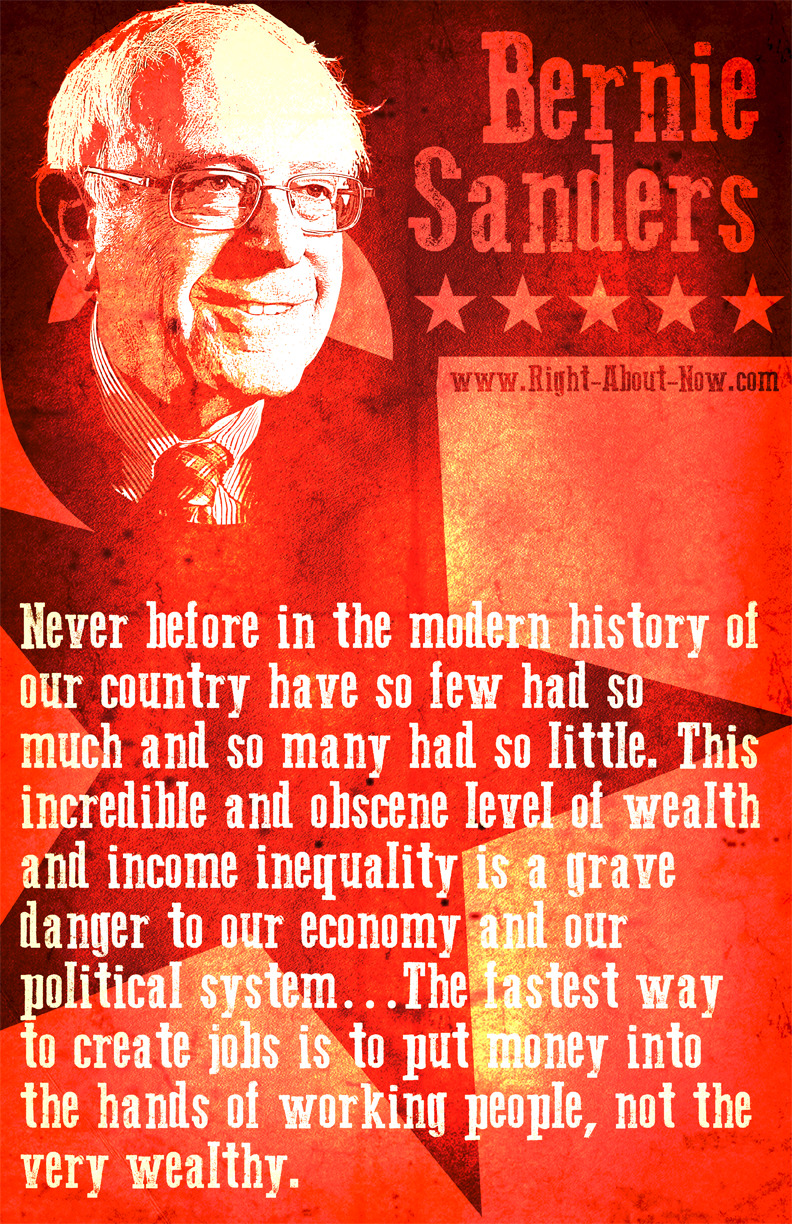
Bernie Sanders, making the One Percent wish he were gone (image source; image artist; more images here)

by Gaius Publius

How mainstream is Bernie Sanders? This question will come up a lot as Sanders gains traction in Iowa and elsewhere. The charge will be that a "socialist" is too far to the left for American voters.

Buried in the question is an assumption — that the "mainstream" opinions of those asking the questions and funding the campaigns (the billionaires and their millionaire employees in the media) are also the mainstream opinions of the American voters. That assumption could not be more wrong.

It's clear that Bernie Sanders, with his message of reversing economic inequality, is to the left of the Chuck Todds and Wolf Blitzers of the world. But where does he stand with respect to the people? I'll offer two data points of my own, then turn the stage over to Juan Cole.

First, 87% of Republicans want TPP (widely seen as "the next NAFTA") to fail, for a large variety of reasons, from executive overreach to job loss to loss of sovereignty. Even the new Reuters/Ipsos poll, which TPP proponents are touting, shows Americans solidly against TPP-type deals when American jobs are at stake.

About that poll, Public Citizen reports:
Today’s Reuters/Ipsos poll finds that a majority of the U.S. public “support[s] new trade deals to promote the sale of U.S. goods overseas.”  This is not surprising.  Who would be opposed to trade deals framed as simply boosting sales of U.S. goods?  (Never mind that exports of U.S. goods have actually grown slower, not faster, under existing U.S. trade deals.)

The poll did not ask whether respondents “support new trade deals that could offshore U.S. manufacturing jobs.”  We do not need to rely on hypotheticals to guess how the U.S. public would respond to this question. Just three weeks ago, another Ipsos poll stated: “International trade agreements increase Americans’ access to foreign-made goods and products but at the risk of American jobs being lost. What would you say is more important...?”

Eighty-four percent of the U.S. public said that “protecting American manufacturing jobs” is more important than “getting Americans access to more products.” Based on Ipsos' own polling, if today’s Reuters/Ipsos poll had presented not just the claimed upsides of trade deals, but the documented downsides, the results likely would have been quite different.

The same Ipsos poll from earlier this month also asked, “If the Obama administration supports an international trade agreement that does not specifically prohibit currency manipulation, do you think the United States Congress should support or oppose that trade deal?”

Seventy-three percent of the U.S. public said that Congress should oppose any trade agreement that does not prohibit currency manipulation. The TPP, of course, fits that bill. The Obama administration has repeatedly dismissed Congress' bipartisan, bicameral demand for the TPP to include binding disciplines against currency manipulation.

Today’s Reuters/Ipsos poll did not address this fact about the TPP. ...
Second, I challenge you to find one Tea Party voter who approves of the Wall Street bailout. Not a Koch- or Wall Street-bought Tea Party office-holder; a Tea Party voter. There are no good words on the right for that atrocity.

Juan Cole makes the same point I do above, that One-Percenters have no use for Sanders' policy proposals:
How Mainstream is Bernie Sanders?

Sen. Bernie Sanders, the presidential candidate for the Democratic nomination, has trouble being taken seriously by the corporate media, what with him being a democratic socialist and all.

If you go to Google News and put in his name, you get headlines about him being nothing more than a protest candidate, or having “odd views,” or promoting “dark age economics.”

But Sanders’s positions are quite mainstream from the point of view of the stances of the American public in general. Of course, the 1%, for whom and by whom most mainstream media report, are appalled and would like to depict him as an outlier.
In Cole's view (and mine), Sanders is "mainstream" on a variety of issues. For example, the wealth gap:
Sanders is scathing on the increasing wealth gap, whereby the rich have scooped up most of the increase in our national wealth in the past twenty years. The average wage of the average worker in real terms is only a little better than in 1970; the poor are actually poorer; but the wealth of the top earners has increased several times over.

Some 63% of Americans agree that the current distribution of wealth is unfair. And in a Gallup poll done earlier this month, a majority, 52%, think that government taxation on the rich should be used to reduce the wealth gap. This percentage is historically high, having been only 45% in 1998. But there seems to be a shift going on, because Gallup got the 52% proportion in answer to the question on taxing the rich both in April and again in May of this year....
On getting money out of politics:
Sanders wants to get big money out of politics.

A majority of Americans oppose the Supreme Court “Citizens United” ruling, one of a number of such rulings that have increased the ability of the super-wealthy to influence politics. A good half of Americans support federally financed political campaigns so as to level the playing field.

On this issue, Bernie Sanders is the most mainstream of all the candidates. The others are in a part of the political spectrum that by the polling represents a tiny lunatic fringe, in opposing significant campaign finance reform.
On student debt:
Some 79% of Americans believe that education beyond high school is not affordable for everyone. And some 57% of people under 30 believe student debt is a problem for youth.
On global warming and climate change:
According to a very recent Yale/Gallup poll, Some 71% of Americans believe global warming is occurring, and 57% are sure that human activity (emitting greenhouse gases like carbon dioxide) is causing it, while another 12 percent think the warming is at least partly human-caused. That’s 69% who blame human beings wholly or in part.
And reinforcing my point that like Warren, Sanders could easily pick up votes from traditional Republicans in the general election:
Even among Republicans, 48% say that they are more likely to vote for a candidate who wants to fight climate change.
It would be hard to find an economic issue on which Sanders is not squarely in the mainstream of bipartisan voter thinking.

Is Sanders Too Mainstream for the One Percent?

I've argued before that Sanders' biggest problem may not be that his views are unpopular — his biggest threat is because he's too popular with ordinary people. Sanders as a dismissible "fringe" candidate is acceptable, even desirable for the One Percent that funds and feeds off our elections.

Dismissible fringe candidates foster the illusion of choice. But actual populists are a danger to the world of insiders who scratch each other's well-moneyed backs. Even though the New York Times has recently broken radio silence on the Sanders campaign, I still look for the billionaire-owned media to do everything it can to tank the one candidate running against billionaire ownership of the country.

GP


Labels: , , , ,

Sunday, November 09, 2014

How Deep Will The Divide Be Between Corporate Republicans And For-Profit Republicans? And Between Real Democrats And ConservaDems?

>


It's long but Alan Minsky did a thorough biopsy of the tumor debilitating the Beltway Democrats. He starts by acknowledging what the mainstream media won't-- that the shellacking last Tuesday was a debacle for the Blue Dogs and New Dems who make up the Republican wing of the Democratic Party, what Minsky calls "the centrist Clinton/Obama Democratic Party." His premise is that their misery is an opportunity for normal, non-Beltway, non-careerist, progressive, grassroots Democrats. And that opportunity is what the Goldwaterites seized after they disaster in 1965 and what the Tea Party seized in 2009.
[I]f real left progressives are going to try to take center stage in the Democratic Party by mobilizing a mass movement of supporters, they need to put forward a compelling, realistic vision for a more prosperous, freer and socially just America-- one that can be captured in language as simple as Reagan’s (minus the demagoguery) and that is backed up by rock-solid public policy proposals.

The key to winning the hearts and minds of Americans is to address their primary concerns and anxieties, and do so in a way that paints a promising vision for the immediate future. There’s no mystery about the source of the greatest anxiety: Neoliberal capitalism has placed the vast majority of the population in an economically precarious position. The question is: How do we make this country work for everyone?

This is not as hard as it sounds. Once again, we start with a winning hand. America remains the richest country in the world with assets far beyond any nation in history. The problem is with the distribution of these riches. One of the priorities of a modern political party should be to scour the earth for the best strategies for social, economic organization.

It is no secret that the social democracies of Western Europe (and, in a manner, the U.S. after Franklin Delano Roosevelt’s presidency) represent a public policy blueprint for the most prosperous, equitable, healthy, well-educated, peaceful modern technological societies on record. Applying the logic and specifics of these programs to contemporary America would not only rectify the endemic pathologies that afflict the country (poverty, mass incarceration, mal-education, poor health), but given the wealth of the 21st century United States, it would outstrip the performance of any previous country. In short, we could have an America with little or no poverty and a huge prosperous middle class with a market-driven economy that remains as vibrant as it is today-- and social democracies do wonderful things like offer more vacation time and free health care.

We all know the right-wing media machine would create a cacophony about the horrors of Big Government, but if you list the components of what a left progressive platform might look like, it’s clear that many of the policies would have majority support:
Social Security funded for the next century (with the possibility of expanding it) by raising the cap on income levels contributing into the system, while maintaining a cap on payments

A single payer (Medicare for all) health system

Free public education through college

A sharp increase in the national minimum wage and two weeks of paid vacation for all workers

Rapid citizenship for immigrant workers and their families

Ending the war on drugs and decriminalization

Ending government spying

Sane gun laws

Support for a woman’s right to choose and equal pay legislation

Reform of the justice system so that it applies equally to all people

Invest in green energy and take the lead in combating global warming globally

Shift foreign policy to support people and not every region’s 1 percent

As for funding fiscal policy, there’s no need for making income tax levels more progressive (since the change in Social Security achieves that already)-- but, in accordance with Capital in the Twenty-First Century author Thomas Piketty, raise the rate on capital gains. Also bring corporate taxes back in to line with pre-Reagan era levels by both closing loopholes and raising the tax rate on profits.

And finally, a program dear to my late father’s (economist Hyman Minsky) heart-- an employer of last resort (ELR) program, like Roosevelt’s Civilian Conservation Corps, in which the government would hire every unemployed person who wants to work at a daily wage that would extrapolate to an annual living wage. (This is probably too radical a proposal for many members of the current CPC, but not for some.) And if not this ambitious plan, a basic national income. I think ELR would work much better and also make a real contribution to elements of the economy that the market addresses inadequately; and it can be organized so that localities have control over ELR projects. ELR’s possibilities for transforming society are immense, but either ELR or a basic income program would conquer poverty like nothing we’ve seen in our lives and empower workers who would no longer fear leaving wretched jobs.

If the tax increases on the wealthy and corporations aren’t enough to cover the costs, there’s a bloated military budget to shrink.
A program like this would take America off of its neoliberal course. It directly addresses the fears and anxieties of a precarious, under-compensated citizenry, and it’s no more radical than the approach espoused by the greatest Democrat of the 20th century, FDR.


And the other side of the coin... well we saw it today when the Republican extremist wing was ranting and raving about mass deportation, shutting down the government again, repealing the Affordable Care Act and sandbagging Loretta Lynch, Obama's Attorney General nominee. Other than die-hard Confederate secessionists, Republicans are well aware that is exactly what the public does not want to see. In Sunday's NY Times Jeremy Peters gave everyone a nice look at the Republican Party civil war that's already flaring up again. "As most Republicans were taking a victory lap the morning after the elections," he wrote, "a group of conservatives huddled anxiously in a conference room not far from Capitol Hill and agreed that now is the time for confrontation, not compromise and conciliation." He didn't really mean "conservatives" like Mitch McConnell, John Cornyn and John Thune in the Senate and John Boehner, Kevin McCarthy and Paul Ryan in the House. But The Times doesn't allow its writers to use words like fascists or neo-fascists to describe Republican Party elected officials who are fascists or neo-fascists-- like Ted Cruz, Ron Johnson, Joni Ernst and Mike Lee, and the whole sick menagerie from the lunatic fringe they just elected to House seats. They have to call them "conservatives," just like actual conservatives. To distinguish, Peters tried referring to the fascists as "the party’s activist wing" and the actual conservatives as "establishment Republicans." The former apparently fears the latter, who have discouraged the kind of impeachment and lynching talk that works so well back home on the local Hate Talk Radio shows with no ratings, are "being too timid with Obama."
“If the new Republican leadership in the Senate is only talking about what they can’t do, that’s going to be very demoralizing,” said Thomas J. Fitton, president of Judicial Watch, a conservative advocacy group that convenes a regular gathering called Groundswell. Any sense of triumph at its meeting last week was fleeting.

“I think the members of the leadership need to decide what they’re willing to shut down the government over,” Mr. Fitton said.

Establishment Republicans, who had vowed to thwart the Tea Party, succeeded in electing new lawmakers who are, for the most part, less rebellious. And when the new Congress convenes in January, the Republican leaders who will take the reins will be mainly in the mold of conservatives who have tried to keep the Tea Party in check.

But they have not crushed the movement’s spirit.

As Republicans on Capitol Hill transition from being the opposition party to being one that has to show it can govern, a powerful tension is emerging: how to move forward with an agenda that challenges the president without self-destructing.

Some conservatives believe that the threat of another shutdown is their strongest leverage to demand concessions on the health care law and to stop the president from carrying out immigration reform through executive order. Yet their leadership has dismissed the idea as a suicide mission that could squander the recent gains.

One thing that will prove popular among the base is a commitment by Senator Mitch McConnell, the presumptive new majority leader, to bring up a bill that would ban abortions after 20 weeks of pregnancy, which he is expected to do next year.

Whether the party can reconcile more demands of its base with the will of its leadership could determine how enduring the Republican Senate majority will be. The crop of senators up for re-election in 2016 includes those elected in the first Tea Party wave of 2010. And in a sign of what is at stake, even some of them are sounding notes of compromise and caution that would have been unthinkable at the height of the right’s resurgence.

“I understand the frustrations of the conservative base; I am one of them,” said Senator Ron Johnson of Wisconsin, one of the original class of Tea Party-inspired senators. “I also recognize reality.”

“We’re not going to pass the entire conservative agenda tomorrow. We can certainly lay it out,” Mr. Johnson added. “Let’s start with the things we can pass. Doesn’t that make more sense?”

But in a stark reminder of the difficulties Republican leaders will face from within their own ranks, other lawmakers popular with the Tea Party base are saying the fight is on.

As votes were still being counted on election night Tuesday, Senator Ted Cruz of Texas said Republicans could still work through Congress to dismantle the Affordable Care Act-- even though the president is guaranteed to veto anything Congress passes that undermines it. “After winning a historic majority, it is incumbent on us to honor promises and do everything humanly possible to stop Obamacare,” Mr. Cruz said in an interview.

Some Republican senators rejected that outright. “There are intelligent things to do, and there are some not-so-intelligent things to do,” said Senator Orrin G. Hatch of Utah. “And one of the first things we should do is find some areas of common ground with our Democrat friends.”

Tea Party conservatives, many of whom argue that the government shutdown last year was a sound strategy, said they were baffled by remarks after the election by Mr. McConnell that the Senate under his control would prioritize policies that Republicans knew Democrats would also support.

...Any perception that Mr. McConnell is not sufficiently committed to repealing the health care law, despite his running hard against it in his own re-election campaign, would renew the same fissures among Republicans that preceded the government shutdown.

“That would cause a civil war inside the Republican Party,” said Richard Viguerie, a longtime conservative activist, referring to anything the party’s base saw as a halfhearted attempt at repeal. “There’s almost zero trust between the base and the Republican leaders.”

No one did more to demoralize Tea Party candidates and conservative agitators than Mr. McConnell, who vowed to “crush” every Republican primary challenger. (He did; none defeated an incumbent senator.) He also blacklisted Republicans who worked with groups supporting insurgents.

Privately, McConnell aides say they are less concerned these days about the impact of senators like Mr. Cruz, whom they describe as an “army of one.” Mr. McConnell believes his standing with conservative voters is solid. And he has the votes to prove it. He won his own primary over a Tea Party conservative, 60 percent to 35 percent. An NBC News/Marist College poll showed him beating his main primary opponent 53 percent to 33 percent among Tea Party voters.

He and his allies dismiss their Tea Party opponents as “for-profit conservatives” because of the fund-raising they do in the name of purifying the Republican brand.

“The for-profit wing of the Republican Party will always have a voice, but after this last election, they don’t have much credibility,” said Scott Reed, the U.S. Chamber of Commerce’s senior political strategist. “I’m not sure many folks will listen to it much longer. Governing still matters, and the good news is, everybody who was elected is into governing.”

Most of the Republicans just elected to the Senate appear to be team players. Cory Gardner of Colorado, Shelley Moore Capito of West Virginia and Steve Daines of Montana are all low-key members of Congress. Thom Tillis of North Carolina is the speaker of the State House and a favorite of the party establishment.

Still, Tea Party conservatives are a formidable voting bloc. Mr. McConnell will have to negotiate an especially cautious balance between their demands and those of the senators in his conference who are contemplating running for president in 2016, and so need the support of the party’s base. With no one is this more fraught than Mr. McConnell’s fellow Kentuckian, Senator Rand Paul. Mr. Paul and his advisers say that they recognize Tea Party supporters helped deliver the Senate for the Republicans, and that the party ignores them at its peril.

“They showed up,” said Doug Stafford, a senior adviser to Mr. Paul. “You can’t look at the turnout models, the polling pre-election and the results, and not think that conservatives showed up for this. They did.”

Labels: , , , ,