"When fascism comes to America, it will be wrapped in the flag and carrying the cross."
-- Sinclair Lewis
Sunday, November 06, 2011
Sunday Classics: Finally we reach Act III of "Tannhäuser"
>
Daniel Barenboim conducts the Staatskapelle Berlin in the Prelude to Act III of Tannhäuser (from their June 2001 Teldec recording of the complete opera, from which we've heard a number of excerpts earlier in this series). Don't we always try to listen to the way our "target" material starts? Tip: The portion of this prelude that particularly concerns us begins about 5:37. [audio link]
"The heart wants what it wants."-- Woody Allen
by Ken
After our dalliance in the Song Contest of Act II of Tannhäuser and our circle-back to the second scene of Act I, you were probably thinking -- or maybe just hoping -- we would never make it to Act III. Nevertheless, here we are. In fact, in Friday night's preview we not only made it to Wolfram von Eschenbach's Evening Star song but heard the whole of our work unit today: from the Act III Prelude up to the unexpected return of Tannhäuser from his pilgrimage to Rome seeking absolution from the Pope for his naughty behavior.
When the Act III curtain rises, we're back in the setting we first saw when Tannhäuser chose to bail out of the Venusberg in Act I: the mountain-and-valley landscape in Thuringia where the Shepherd waved the pilgrims off in the springtime on their long trans-Alpine trek to Rome to seek absolution from the Pope. Subsequently we heard Tannhäuser being reunited with his friend Wolfram von Eschenbach and the rest of his fellow Minnesingers. It's fall now, and Wolfram is watching over Elisabeth, who is maintaining a vigil for the pilgrims' return, hoping that Tannhäuser will be among them.
As I mentioned in Friday's preview, when he was one of the baritones we heard singing the Evening Star romance, among our Wolframs today we have a "new" one, the lovely lyric baritone Gerhard Hüsch, and we're putting him to work right away. In this very gradual performance, it's especially easy to spotlight two phrases: "Dies ist ihr Frage" (around 2:32) and "Ihr Heil'gen, lasst erfüllt es sehen" (2:47).
WAGNER: Tannhäuser and the Song Contest at the Wartburg: Act III, Wolfram, "Wohl wusst' ich hier sie im Gebet zu finden"
I knew well I would find her here in prayer, as I so often find her when, down from the wooded heights, I stray in the valley alone. The death he dealt her buried deep in her heart in searing smart, she prays for his salvation day and night -- oh, eternal might of holy love! She awaits the return of the pilgrims from Rome. The leaves are falling already; their return is imminent. Will he come back with the pardoned? [2:32] This is her question, this is her prayer. [2:47] You saints in heaven, may she see it consummated! Though the wound remain unhealed, oh, that relief, at least, might be granted her!
Gerhard Hüsch (b), Wolfram von Eschenbach; Berlin State Opera Orchestra, Hans Udo Müller, cond. EMI, recorded August 1936 [audio link]
Part 1: What if Wagner had called it Wolfram von Eschenbach and the Song Contest at the Wartburg? Act II and the Song Contest "Sneak" preview and main post
Part 2: Continuing our look at Tannhäuser from the vantage point of Wolfram von Eschenbach -- Circling back to Act I Preview and main post
Part 3: Finally we reach Act III -- Wolfram's vigil over Elisabeth Preview and main post
Sunday Classics preview: Finally we're back where we started in Act III of "Tannhäuser"
>
YouTube poster Pamilearner plays an abridged version of Charles de Janon's guitar transcription of "O du mein holder Abendstern." [UPDATE: Much as I love Bill Moyers, I don't know how he slipped in here. The clip was right originally, and here it is again.]
by Ken
We began the first preview of our Tannhäuser series by hearing where we were going to wind up in this week's concluding third part: at Wolfram von Eschenbach's grim death watch over his beloved Elisabeth and the beautiful romance in which he prays for the release of her tormented soul. Then in part 1 we focused on the Song Contest of Act II, before harking back to Act I in part 2.
So after the click-through we're going to start tonight's preview in the same place, then make a mighty leap -- well, back to the same place.
Part 1: What if Wagner had called it Wolfram von Eschenbach and the Song Contest at the Wartburg? Act II and the Song Contest "Sneak" preview and main post
Part 2: Continuing our look at Tannhäuser from the vantage point of Wolfram von Eschenbach -- Circling back to Act I Preview and main post
Part 3: Finally we reach Act III -- Wolfram's vigil over Elisabeth Preview and main post
Sunday Classics: Continuing our look at "Tannhäuser" from the vantage point of Wolfram von Eschenbach
>
The real-life Wolfram von Eschenbach -- yes, there was a real-life Wolfram von Eschenbach, pictured here in the Codex Manesse -- would play an even larger role in Wagner's life, as author of an epic Parzival. Walther von Stolzing, the young hero of another of Wagner's later operas, Die Meistersinger, could tell us that there was also a real-life Walther von der Vogelweide, the young knight's professed musical teacher.
by Ken
In the first part of this series of (eventually) three devoted to the second of Wagner's ten mature operas, Tannhäuser, I set about looking at it from the vantage point of the hero's best friend, Wolfram von Eschenbach (the baritone). As I promised in Friday night's preview of this second part, we're moving backward from Act II to Act I.
I like to think that with the little bit of poking around we've already done so far, it's already been possible to get a feeling for the strength of the bond of friendship between the two leading Singers in Landgraf Hermann's Thuringian Minnesinger stable, Heinrich Tannhäuser and Wolfram von Eschenbach, despite the considerable differences in their personalities and outlooks.
WHILE WOLFRAM UPHOLDS CONVENTIONAL VALUES, TANNHÄUSER IS THE OUTSIDER, THE REBEL TRUTH-SEEKER
In the conventional formulation, Tannhäuser is the man who accepts no received wisdom, who rejects taboos and insists instead in experiencing the forbidden experiences for himself -- to the point of abandoning his community for the seductive lures of residence in the Venusberg with the goddess of love herself. And, again in the conventional formulation, Wolfram is the conventional-minded goody two-shoes, a man who deservedly stands in the shadow of his bolder, more creative, utterly uncompromising friend. Is it any wonder that the lovely young Elisabeth, the fairest maid in all Thuringia, unhesitatingly gives her heart to Tannhäuser rather than Wolfram?
I don't doubt that this is where Wagner's sympathies lay, that he created Tannhäuser as a repository for and expression of what he regarded as his own damn-the-consequences commitment to (his idea of) wisdom and truth. The only thing is, if you pay any attention to the opera, to the text and especially the music, that isn't the story it's telling, and I believe it's because of what is for me Wagner's most important quality as an artist after his musical genius and literary-dramatic talent: his largely uncompromising sense of artistic truth. In the Song Contest, Tannhäuser sneers at Wolfram's contest song, his explanation of the essence of love, which Tannhäuser considers hopelessly intellectual and theoretical. But what we see in the story is almost the opposite: Tannhäuser in thrall to theoretical ideas, while Wolfram is the one who deals with reality, who's always there for the people who matter to him, who's left to pick up the pieces whenever Tannhäuser betrays the woman they both love, and who in the end is always there for Tannhäuser himself.
Last week we heard the beginning of the Act II scene between Tannhäuser and Elisabeth following his return from the long absence that to all his friends remains unexplained, and heard that it's Wolfram who promotes the reunion between his friend and the woman they both love, even knowing that it spells an end to his romantic hopes. In Friday night's preview, backing up to Act I, we heard the music with which Tannhäuser is returned from the Venusberg to his old stomping ground in Thuringia and by chance immediately meets up with his erstwhile comrades. We got only as far as hearing that among those comrades the one who recognizes the initially unidentified stranger is Wolfram, and in this scene it's Wolfram who at every step pleads his friend's case, and finally overcomes his seemingly immovable resolve not to remain.
At the center is a "set piece" that like nearly all of Wolfram's music is of simply extraordinary beauty. As we'll hear in the click-through, Wolfram has to ask the Landgraf's permission to share this information with Tannhäuser. We're going to hear a bunch of Wolframs deliver it, in fuller versions of the scene, but this time I thought we'd jump to our champion Wolfram, the great Wagnerian "heroic baritone" Friedrich Schorr -- and also hear the 1936 companion recording to the 1935 "Blick' ich umher" we heard Friday night from the great baritone Heinrich Schlusnus.
WAGNER: Tannhäuser: Act I, Wolfram, "Als du in kühnem Sange"
WOLFRAM: When you strove with us in blithe song, sometimes victorious against our lays, anon defeated through our art, one prze there was that you alone succeeded in winning. Was it by magic or by pure might that you achieved the miracle or captivating the most virtuous of maids by your singing filled with joy and sorrow? For, when, in haughtiness, you left us, her heart closed to our song; we saw her cheeks grow pale, she ever shunned our circle. Oh, return, you valiant Singer, let not your song be far from ours. Let her no longer be absent from our festivals, let her star shine on us once more!
Friedrich Schorr (b), Wolfram von Eschenbach; orchestra. HMV, recorded in London, 1930 [audio link]
Heinrich Schlusnus (b), Wolfram von Eschenbach; Berlin State Opera Orchestra, Clemens Krauss, cond. EMI, recorded 1936 [audio link]
Part 1: What if Wagner had called it Wolfram von Eschenbach and the Song Contest at the Wartburg? Act II and the Song Contest "Sneak" preview and main post
Part 2: Continuing our look at Tannhäuser from the vantage point of Wolfram von Eschenbach -- Circling back to Act I Preview and main post
Part 3: Finally we reach Act III -- Wolfram's vigil over Elisabeth Preview and main post
Sunday Classics preview: Wagner sends amazing sounds reverberating around that valley in Thuringia
>
With the Wartburg, setting for the Song Contest of Act II of Wagner's Tannhäuser and the Song Contest at the Wartburg, seen on the mountaintop in the distance, this is something like the setting for Scene 2 of Act I -- but note Wagner's stage direction below. It's important for appreciating the intersection of the elements he brings together in this scene.
TRANSFORMATIONS NOS. 1 AND 2: From the Venusberg to the Thuringian valley, from the Shepherd's song to the Pilgrims' chorus
After an extended scene in which the goddess of love tries to persuade TANNHÄUSER to remain with her in the Venusberg, or Mount of Venus, and losing her grip finally tells him he can return to her for his salvation, he breaks free, declaring that his salvation lies elsewhere.
TANNHÄUSER: My salvation lies in Mary!
TANNHÄUSER, who has not left his position, suddenly finds himself transported to a beautiful valley. Blue sky, bright sunshine. To the right, in the background, the Wartburg. Through an opening in the valley on the left can be seen the Hörselberg. To the right, from halfway up the valley a mountain path leads from the direction of the Wartburg toward the foreground, where it then diverges to the side. In the same foreground is a shrine to the Virgin Mary, led up to by a slight rocky ledge. From the heights on the left is heard the sound of sheep bells. On a high rock sits a young shepherd with his pipe, looking toward the valley.
THE SHEPHERD: Dame Holda came forth from the mountain to roam through field and meadow; my ear caught a sound there so sweet, my eye longed to behold. [He plays.] There I dreamt many a sweet dream, and my eyes had scarcely opened when there the sun shone warm. May, May had come! Now I gaily play my pipe. May is here, the lovely May!
[From the direction of the Wartburg, a band of pilgrims approaches, singing. THE SHEPHERD plays his pipe.] OLDER PILGRIMS: To Thee do I journey, Lord Jesus Christ, for Thou art the pilgrims' hope! Praise be to thee, Virgin sweet and pure. Grant that our pilgrimage may prove propitious! [THE SHEPHERD, hearing the song, stops playing his pipe and listens thoughtfully.] Alas, the burden of my sins weighs me down. I can endure it no longer; I will know neither sleep nor rest therefore and gladly choose toil and vexation. At the sublime feast of clemency and grace I will atone for my sins in humility; blessed is he who truly belives: he shall be saved through penitence and repentance. THE SHEPHERD [as the pilgrims have reached the heights opposite him, calls out to them, waving his cap, loudly]: Good luck! Good luck for Rome! Pray for my poor soul!
Wolfgang Windgassen (t), Tannhäuser; Else-Margrete Gardelli (s), the Shepherd; Bayreuth Festival (1962) Chorus and Orchestra, Wolfgang Sawallisch, cond. Philips, recorded live, 1962 [audio link] Klaus König (t), Tannhäuser; Gabriele Sima (s), the Shepherd; Bavarian Radio Chorus, Bavarian Radio Symphony Orchestra, Bernard Haitink, cond. EMI, recorded January 1985 [audio link]
by Ken
For once there may be some advantage in our only being able to hear, rather than see and hear, because somuch of this transformation, or rather series of transformations, between the scenes of Act I of Wagner's Tannhäuser and the Song Contest at the Wartburg is imagined in sound. Oh, Wagner cared a great deal about the stage transformations too, but the aural ones may be easier to get right.
To back up for a moment, two weeks ago we had the first part (preview here and main post here) of what I explained would be a three-part series in which we're taking a selective listen to the piece from the vantage point of Thuringia's No. 2 Minnesinger (i.e., singer of love), Wolfram von Eschenbach. In those posts we plunged right into Act II for the Song Contest itself, focusing on Wolfram's contest song. This week we back up to Act I and hear how the No. 1 Singer, Tannhäuser himself, made his dramatic return just in time for the contest. If works of art aren't meant to be taken personally, I can't imagine what the point of them might be. And for each of Wagner's ten mature operas I've spent my share of time reflecting Why I Especially Love This Piece.
At the moment we're preparing for the second of three installments devoted to listening to the third of those ten operas, Tannhäuser and the Song Contest at the Wartburg, from the somewhat unorthodox vantage point of the the second-most-esteemed of the Minnesänger (singers of love), Wolfram von Eschenbach. We plunged right into Act II and the Song Contest itself, focusing specifically on Wolfram's contest song. This week we back up to Act I and hear how the No. 1 Singer, Heinrich Tannhäuser came to be reunited with his fellow Singers after his long and mysterious absence from Thuringia.
And for once there is some real advantage to being forced to just listen, because in Act I of Tannhäuser Wagner performs a series of the most astonishing landscape paintings -- in fact, transformations -- ever done in music. And in the transformation from the Venusberg to the Thuringian valleyscape Wagner accomplished one of the supreme transformations in music, which he proceeded to refine with a series of further soundscapes he sent ricocheting around that valley.
Before we proceed, you might want to take another listen to the sequence above: the transformation from the Venusberg to the piping Shepherd's song, and then the introduction of the pilgrim's chorus advancing from the Wartburg at the rear of the stage to the mountaintop shrine to the Virgin in the foreground.
Part 1: What if Wagner had called it Wolfram von Eschenbach and the Song Contest at the Wartburg? Act II and the Song Contest "Sneak" preview and main post
Part 2: Continuing our look at Tannhäuser from the vantage point of Wolfram von Eschenbach -- Circling back to Act I Preview and main post
Part 3: Finally we reach Act III -- Wolfram's vigil over Elisabeth Preview and main post
Sunday Classics: What if Wagner had called it "Wolfram von Eschenbach and the Song Contest at the Wartburg"?
>
The Wartburg, overlooking Eisenach in Thuringia, housed the ruling landgraves of Thuringia until the mid-15th century.
by Ken
As I indicated in Friday night's "sneak peek" preview, we're easing into Wagner's Tannhäuser, the second of his ten mature operas, but we're going to be looking at it from what I think is an unusual perspective, that of the hero's fellow minnesinger and best friend, Wolfram von Eschenbach.
Bearing in mind that the opera's proper title is Tannhäuser und der Sangkrieg auf dem Wartburg -- Tannhäuser and the Song Contest at the Wartburg ("a castle situated on a 1230-foot precipice to the southwest of, and overlooking the town of Eisenach, in the state of Thuringia, Germany"), we're going to begin this eventual three-part series with a more or less direct assault on the Song Contest, in Act II. The minnesingers (properly speaking, Minnesänger) of 12th-to-14th-century Germany took their name from their reason for existence: celebration of Minne, love. Besides Tannhäuser and Wolfram, we encounter four other minnesingers, whom we'll actually be hearing in the next part of this series -- they all have solo parts, but they also function as an indivduated chorus, clearly a dry run for Wagner's eventual Mastersingers of Nuremberg.
In Wagner's evocation of Thuringian society the singers are, clearly, highly esteemed; the song contests being great events. Clearly the title character was the one who interested Wagner most was obviously Tannhäuser, a free spirit who loves being the center of his community's attention but chafes under its rules. He has to see everything for himself, try everything for himself, make his own determinations. It's not hard to see why Wagner thought the guy was aces -- clearly reminded him of someone he thought he knew well. The relationship between Tannhäuser and Wolfram
I'm trying something audacious: plunging right into Wolfram's contest song. As we'll see in the click-through, when we take a fuller look at the scene, the order of contestants is determined randomly, but it's appropriate and satisfying that it's Wolfram who first rises to the Landgraf's challenge to explain "the true essence of love."
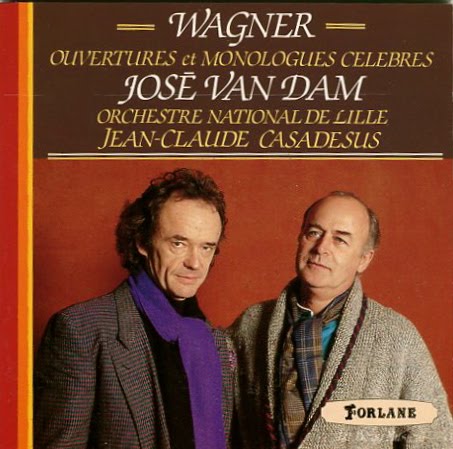
Friday night we heard the Belgian bass-baritone José van Dam singing Wolfram's gorgeous evening-star song from Act III, our eventual destination in the final part of this series. From that same Wagner CD we hear Wolfram's contest song.
ABOUT THE "AUDIO LINKS" (NEW! NEW! NEW!)
If you're not having any trouble getting the post's audio clips to play, you can ignore these links. But if you do have trouble with a clip, there's a chance that the link to the onsite posting will enable you to hear, assuming I've gotten the clip right. (One one level I think of the clips as a new opportunity to screw stuff up.)
WAGNER: Tannhäuser: Act II, Wolfram, "Blick' ich umher in diesem edlen Kreise" ("When I look around this noble circle")
WOLFRAM: When I look around this noble circle, what a sublime spectacle makes my heart glow! So many heroes, valiant, upright and judicious, a forest of proud oaks, magnificent, fresh and green. And ladies I behold, charming and virtuous, a richly-perfumed garland of lovely blooms. My glance becomes enraptured at the sight, my song mute in face of such radiant loveliness. I lift my eyes up yonder to one star which stands fast in the firmament and dazzles me: my spirit draws comfort from that distance, my soul devoutly sinks in prayer. And behold! Before me a miraculous spring appears, which my spirit glimpses, filled with wonder! From it, it draws bliss, rich in grace, through which, ineffably, it revives my heart. And never would I sully this fount, nor taint the spring in wanton mood: I would practise myself in devotion, sacrificing, gladly shed my heart's last drop of blood. You noble ones may gather from these words how I do apprehend love's purest essence to be! [He sits down.]
José van Dam, bass-baritone; Orchestre National de Lille, Jean-Claude Casadesus, cond. Forlane, recorded 1990 [audio link]
Beyond the sheer gorgeousness of this free-form music, I'm overwhelmed by the nobility, sensitivity, imagination. What the Wagner "experts" rarely comment on is the deep artistic honesty of his observation of his characters, which made it possible for him to create in Wolfram, a character whom he clearly regarded as second banana to Tannhäuser, someone of such richness and dimension, thanks in good part to the staggering beauty of nearly all of his music. (Sometimes I have to wonder whether the Wagner "experts" actually ever listen to the music.)
To strike a more festive note before clicking through, let's retreat to a more obvious starting point: the gathering of the guests for the Song Contest, picking up at the first sound of the trumpets announcing to the Landgraf the arrival of "the nobles of my lands" (we have full English texts in the click-through; for now, just think "joy" and "joyful," with the occasional "hail" thrown in), in a rousing, even breathless live performance from the 1962 Bayreuth Festival.
Tannhäuser: Act II, Landgraf, "Schon nahen sich die Edlen meiner Lande" ("Already the nobles of my land are nearing") . . . Entry of the Guests, "Freudig begrüssen wir die edle Halle" ("Joyfully we greet the noble hall")
Josef Greindl (bs), Landgraf Hermann; Bayreuth Festival (1962) Chorus and Orchestra, Wolfgang Sawallisch, cond. Philips, recorded live, 1962 [audio link]
Part 1: What if Wagner had called it Wolfram von Eschenbach and the Song Contest at the Wartburg? Act II and the Song Contest "Sneak" preview and main post
Part 2: Continuing our look at Tannhäuser from the vantage point of Wolfram von Eschenbach -- Circling back to Act I Preview and main post
Part 3: Finally we reach Act III -- Wolfram's vigil over Elisabeth Preview and main post
Sunday Classics preview: Sneaking up on "Tannhäuser"
>
by Ken
Yes, we're sneaking up on Wagner's Tannhäuser, which we're going to be looking at, or rather listening to, from what I think is a fairly unusual perspective: that of the baritone, Wolfram von Eschenbach. It's going to take us three "go"s to get through the project (not to worry, operaphobes, they won't be consecutive).
For tonight's preview we're going to do something we often do: start at the beginning, with the Overture segue-ing into the "Venusberg Music" of the opening scene. For a change of pace I thought I'd start with a performance of Franz Liszt's piano arrangement of the Overture which I happen to have readily available, but I'm not all that enthusiastic about it (this isn't Liszt in "play" mode but in "enabling music lovers who don't have access to an orchestral performance but who play the piano to enjoy the music" mode, and the pianist is, shall we say, not a favorite of mine). So we're going to hear it (what the heck, I've already made the audio file), but one thing Sunday Classics isn't supposed to be about is me dishing out music I'm not enthusiastic about.
So I've switched gears, and before the click-through we're instead going to get a taste of where we're headed -- probably the best-known vocal music in the opera, Wolfram's Act III song to the evening star, in a performance by bass-baritone José van Dam which I can be wildly enthusiastic about.
One of the things about Wagner's characterization of Wolfram, who occupies the role that in Hollywood might be called "leading man's best friend," is that an astounding proportion of it is staggeringly, life-alteringly gorgeous, and probably none of it more immediately obviously so than the evening-star song. We're going to be talking more about it (boy, are we going to be talking more about it), but for now we're just going to hear it, in a performance by bass-baritone José van Dam (who finally retired only last year, not long before his 70th birthday) which I can be wildly enthusiastic about.
I suppose I should say this much: that the song is sung by Wolfram in utter hopelessness at his inability to provide any comfort to the woman he loves, Elisabeth, who could care less about him, so hopelessly absorbed is she in the seemingly lost-to-decent-folk Tannhäuser. At this point Wolfram has good reason to believe, from close personal observation, that Elisabeth isn't long for this vale of tears.
WAGNER: Tannhäuser: Act III, Wolfram, "Wie Todesahnung Dämmrung deckt die Lande" . . . "O du mein holder Abendstern"
Like a portent of death, twilight shrouds the earth and envelops the valley in its sable robe; the soul that yearns for those heights dreads to take its dark and awful flight. There you shine, o fairest of the stars, and shed your light from afar; your friendly beam penetrates the twilight gloom and points the way out from the valley.
O you my fair evening star, I always greeted you gladly; from a heart that never betrayed its faith, greet her if she passes by you, if she soars above this mortal vale to become a blessed angel in heaven.
-- translation mostly from the Terfel-Abbado-DG booklet
José van Dam, bass-baritone; Orchestre National de Lille, Jean-Claude Casadesus, cond. Forlane, recorded October 1990 [audio link]
Part 1: What if Wagner had called it Wolfram von Eschenbach and the Song Contest at the Wartburg? Act II and the Song Contest "Sneak" preview and main post
Part 2: Continuing our look at Tannhäuser from the vantage point of Wolfram von Eschenbach -- Circling back to Act I Preview and main post
Part 3: Finally we reach Act III -- Wolfram's vigil over Elisabeth Preview and main post
[11/6/2011] Finally we reach Act III of "Tannhäuser" (continued)
>
WAGNER: Tannhäuser: Act III, Wolfram, "Wie Todesahnung Dämmrung deckt die Lande" . . . "O du mein holder Abendstern"
Like a presentiment of death, twilight covers the land and shrouds the valley in sombre raiment; the soul that yearns for heaven's heights is fearful before its flight through night and horror. There thou shinest, oh loveliest of stars! Thy sweet light thou dost send into the far-off distance, thy dear beam pierces the evening twilight, and, in friendly fashion, thou dost point the way out of the valley.
Oh thou, my gracious evening star, how gladly have I always greeted thee; from a heart that she never betrayed salute her as she passes by thee, as she soars from this earthly vale, to become a blessed angel yonder.
I. HAVE I GIVEN THE IMPRESSION THAT IT WAS THE EVENING STAR SONG WE WERE ANGLING TOWARD?
Well, it isn't. By the time Wolfram reaches "O du mein holder Abendstern," what seem to me the really important things that happen in this scene have already happened. Hint: In the video performance by Romanian baritone Dan Iordachescu and and in the two upcoming recordings below by Wolframs we've been tracking, listen particularly to the "Wie Todesahnung" recitative.
(Need I add that once again among all our Evening Song singers Friedrich Schorr seems to me the cream of the crop?)
Willi Domgraf-Fassbänder (b), Wolfram von Eschenbach; orchestra. HMV, recorded 1931 [audio link] Friedrich Schorr (b), Wolfram von Eschenbach; Berlin State Opera Orchestra, Leo Blech, cond. HMV, recorded September 1927 [audio link]
II. LET'S RE-COVER SOME EARLIER TURF BY HEARING GERHARD HÜSCH SING SOME OF OUR EARLIER BITS
And this week we're going to hear them in the right order! We start with the solo in which, with the consent of Landgraf Hermann, Wolfram ratchets up his attempt to persuade Tannhäuser to remain with them by telling him of the effect his absence has had on the Landgraf's niece Elisabeth.
Act I, Wolfram, "Als du in kühnem Sange"
When you strove with us in blithe song, sometimes victorious against our lays, anon defeated through our art, one prize there was that you alone succeeded in winning. Was it by magic or by pure might that you achieved the miracle or captivating the most virtuous of maids by your singing filled with joy and sorrow? For, when, in haughtiness, you left us, her heart closed to our song; we saw her cheeks grow pale, she ever shunned our circle. Oh, return, you valiant Singer, let not your song be far from ours. Let her no longer be absent from our festivals, let her star shine on us once more!
Gerhard Hüsch (b), Wolfram von Eschenbach; Berlin State Opera Orchestra, Hans Udo Müller, cond. EMI, recorded August 1936 [audio link]
Now we hear Wolfram's beautiful entry in the Song Contest of Act II, where the knight-minstrels are charged by the Landgraf with explaining the essence of love.
Act II, Wolfram, "Blick' ich umher in diesem edlen Kreise"
When I look around this noble circle, what a sublime spectacle makes my heart glow! So many heroes, valiant, upright and judicious, a forest of proud oaks, magnificent, fresh and green. And ladies I behold, charming and virtuous, a richly-perfumed garland of lovely blooms. My glance becomes enraptured at the sight, my song mute in face of such radiant loveliness. I lift my eyes up yonder to one star which stands fast in the firmament and dazzles me: my spirit draws comfort from that distance, my soul devoutly sinks in prayer. And behold! Before me a miraculous spring appears, which my spirit glimpses, filled with wonder! From it, it draws bliss, rich in grace, through which, ineffably, it revives my heart. And never would I sully this fount, nor taint the spring in wanton mood: I would practise myself in devotion, sacrificing, gladly shed my heart's last drop of blood. You noble ones may gather from these words how I do apprehend love's purest essence to be! [He sits down.]
Gerhard Hüsch (b), Wolfram von Eschenbach; Berlin State Opera Orchestra, Hans Udo Müller, cond. EMI, recorded August 1936 [audio link]
PERHAPS NOW WE MIGHT ALSO FILL SOME OF THE GAP . . .
. . . we left in Act II, when the Song Contest goes horribly wrong, as Tannhäuser derides his fellow Singers' musings on love and lets slip the secret of his erotic dalliance with the goddess Venus. Amid the general horror, I'm sorry to have to report, Wolfram joins in and shows that he's capable of being a sanctimonious schmuck. (By uncanny coincidence this enables us to hear the one excerpt we haven't heard yet which Heinrich Schlusnus recorded in 1935-36.)
Act II, Wolfram, "O Himmel, lass dich jetzt erflehen"
O heaven, be moved now by my entreaty! Grant my song the gift of divine inspiration! Let me see sin banished from this noble and unpollucted circle! To thee, sublime love, that hast penetrated in angelic beauty deep into my heart, may my song ring out inspired! Thou dost approach like a messenger of God, I follow thee from the fair distance -- thou leadest thus into the lands where thy star ever shineth.
Heinrich Schlusnus (b), Wolfram von Eschenbach; Berlin State Opera Orchestra, Clemens Krauss, cond. EMI, recorded 1936 [audio link]
III. BY ACT III, WOLFRAM HAS REGAINED HIS BEARINGS, AND HERE FOR ME IS THE SCENE'S DRAMATIC HEART
First let's hear Wolfram's curtain-rise "vigil" solo again, but this 78 recording, by taking a less lugubrious tempo than the Hüsch one and springing for both a chorus and a soprano soloist, takes us an important step deeper into Act III. Again, note in particular those gorgeous phrases of Wolfram "Dies ist ihr Fragen" and "Ihr Heil'gen, lasst erfüllt es sehen!," as he contemplates the devastating effect on Elisabeth should Tannhäuser not be among the Pope-blessed returning pilgrims.
Act III, Wolfram, "Wohl wusst' ich hier sie im Gebet zu finden" . . . The Older Pilgrims, "Beglückt darf nun dich" . . . Elisabeth, "Dies ist ihr Sang"
WOLFRAM: I knew well I would find her here in prayer, as I so often find her when, down from the wooded heights, I stray in the valley alone. The death he dealt her buried deep in her heart in searing smart, she prays for his salvation day and night -- oh, eternal might of holy love! She awaits the return of the pilgrims from Rome. The leaves are falling already; their return is imminent. Will he come back with the pardoned? This is her question, this is her prayer. You saints in heaven, may she see it consummated! Though the wound remain unhealed, oh, that relief, at least, might be granted her! THE OLDER PILGRIMS [from great distance slowly nearing the stage]: Blest, I may now look on thee, oh, my native land, and gladly greet thy pleasant pastures; now I lay my pilgrim's staff aside to rest, because, faithful to God, I have completed my pilgrimage! ELISABETH [rises, listening to the song]: That is their song! It is they! They are returning home! You saints in heaven, show me now my task, that I may fulfill it worthily! WOLFRAM: It is the pilgrims. It is the pious lay that tells of the salvation of pardon received! Oh heaven, strengthen now her heart to meet the crucial moment of her life! THE OLDER PILGRIMS [constantly nearer the stage]: Through penance and repentance I have propitiated the Lord, whom my heart serves, who crowns my repentance with blessing, the Lord to whom my song goes up! [Here the pilgrims reach the front of the stage.] The salvation of pardon is granted the penitent, in days to come he will walk in the peace of the blessed! Hell and death do not appall him, therefore will I praise God my life long. [The pilgrims have already turned away from the foreground, and steadily grow more distant.] Hallelujah! Hallelujah in eternity!
["Dies ist ihr Frage" at 1:32; "Ihr Heil'gen, lasst erfüllt es sehen" at 1:47]Willi Domgraf-Fassbänder (b), Wolfram von Eschenbach; Käte Heidersbach (s), Elisabeth; chorus and orchestra. HMV, recorded 1931 [audio link]
WE COULD MAKE FUN OF YOUTUBE COMMENTERS ALL DAY . . .
. . . but I keep thinking of one who referred to Wolfram's "O du mein holder Abendstern" a "serenade," saying it's the only Wagner "aria" he can listen to repeatedly. Somehow "serenade" doesn't seem quite the way to describe a plea to the Evening Star to shepherd the soul of this about-to-die woman, and yet, and yet . . . there's something here.
I would argue that Wolfram's romance, ineffably beautiful as it is, represents the culmination of an emotional-temperature-lowering dramatic arc. As I've suggested, the "Wie Todesahnung" recitative seems to me more loaded dramatically. Now I'm suggesting that Wolfram's act-opening vigil potentially still more fraught. It helps when the singer finds a more creative -- and paradoxically simpler -- dramatic solution than the sing-songy, manufactured-emotion approach taken by most baritones, and now we're going to hear two proper performances of this part of the scene, picking up with that final section of the Act III Prelude we highlighted in our post-opening performance. And here I'm going to award a perhaps surprising "win" to Eberhard Wächter, who understands the virtue of simplicity -- especially when he can sing the music so beautifully. (Honorable mention here to Dietrich Fischer-Dieskau; see below. It undoubtedly helps both that there's no Friedrich Schorr recording to set this one against.)
["Dies ist ihr Frage" at 2:11 of track 2; "Ihr Heil'gen, lasst erfüllt es sehen" at 2:23]Heinrich Schlusnus (b), Wolfram von Eschenbach; Trude Eipperle (s), Elisabeth; Hessian Radio Chorus and Orchestra, Kurt Schröder, cond. Broadcast performance, 1950 [audio link] ["Dies ist ihr Frage" at 2:00 of track 2; "Ihr Heil'gen, lasst erfüllt es sehen" at 2:11]Eberhard Wächter (b), Wolfram von Eschenbach; Anja Silja (s), Elisabeth; Bayreuth Festival (1962) Chorus and Orchestra, Wolfgang Sawallisch, cond. Philips, recorded live, 1962 [audio link]
IV. IT SEEMS TO ME THAT A COUPLE OF OLD SUNDAY CLASSICS DISCUSSIONS ARE CONVERGING HERE
(1) Remember when we listened to the opening of Act III of Wagner's Tristan und Isolde?
Amid the Wagner commentators' prevailing nuttiness, I don't think many listeners would expect to think of music like the opening scene of Act III of Tristan und Isolde as among his most powerful. In this March 2010 post we heard a number of performances of the Prelude and the opening of the scene, but this one remains my favorite. (Another Shepherd, note! And our Kurwenal should be, um, familiar!)
[W]e're going a bit [beyond the Prelude] into Act III, to include the lovely little scene between Kurwenal and the Shepherd and the awakening of the unconscious Tristan. Again, you'll find German and English texts at http://www.rwagner.net/libretti/tristan/e-tristan-a3s1.html.
WAGNER: Tristan und Isolde: Act III, Prelude and opening scene Erwin Wohlfahrt (t), the Shepherd; Eberhard Wächter (b), Kurwenal; Wolfgang Windgassen (t), Tristan; Bayreuth Festival Orchestra, Karl Böhm, cond. DG, recorded live, 1966
This isn't the first time we've contemplated a recitative that packs a potentially bigger emotional wallop than the musical set piece it sets up. I think of this January 2011 post.
When I wrote about the vicar Dr. Daly's first song in Gilbert and Sullivan's The Sorcerer, I suggested that while the ballad itself, "Time was when love and I were well-acquainted," is quite lovely, it's the introductory recitative, "The air is filled with amatory numbers," that really gets to me, that rises to the level of musical magic. I would say the same thing about Anna's remembrance of her dead husband in The King and I. While the song proper, "Hello, young lovers," is just fine, and became justly famous, the emotional dynamite is in the introduction, or verse, or recitative -- however composer Richard Rodgers thought of it.
RODGERS AND HAMMERSTEIN: The King and I: Act I, Anna, "When I think of Tom" . . . "Hello, young lovers"
When I think of Tom, I think about a night when the earth smelled of summer and the sky was streaked with white, and the soft mist of England was sleeping on a hill. I remember this, and I always will.
There are new lovers now on the same silent hill, looking on the same blue sea. And I know Tom and I are a part of them all -- and they're all a part of Tom and me. . . .
Valerie Masterson (s), Anna; National Symphony Orchestra, John Owen Edwards, cond. Jay, recorded July 1994
V. AT LAST WE REACH THE EVENING STAR SONG -- AFTER ELISABETH BEHAVES (I THINK) PRETTY APPALLINGLY
We're skipping over Elisabeth's prayer to the Virgin, pleading to be taken forthwith from this earth (you can hear it quite nicely sung below in the two "complete" performances of our half-act), leaving us just one hurdle to cross before arriving at Wolfram's "Wie Todesahnung" recitative and Evening Star song. It's one I've often had trouble forgiving: her response when Wolfram breaks his silent vigil to ask if he mightn't accompany her. Basically she stiff-arms him like a burly running back rebuffing a would-be tackler.
Come on, folks, isn't it obvious that the lady has made a lousy romantic choice? And then not to permit Wolfram to provide even this minimal expression of support? Sorry, I don't buy this business in the stage direction of her assuring him by her gestures that she thanks him from her heart for his faithful affection blahblahblah. In her defense, however, there is one pretty potent mitigating factor: It wasn't her idea that he fall in love with her, and from what we've seen, there seems little reason to imagine that she has ever given him the slightest encouragement.
Act III, Wolfram, "Elisabeth, dürft' ich dich nicht geleiten?" . . . "Wie Todesahnung Dämmrung deckt die Lande" . . . "O du mein holder Abendstern"
[ELISABETH remains for a long time in devout rapture; as she rises slowly she perceives WOLFRAM, who is approaching to speak to her. She entreats him, by a gesture, not to speak to her.] WOLFRAM: Elisabeth, might I not accompany you? [ELISABETH assures him, by her gestures, that she thanks him from her heart for his faithful affection, but that her path leads to heaven, where she has a lofty duty to fulfill; he must therefore let her go alone and must not follow her. She ascends half-way up the height and gradually disappears along the footpath leading to the Wartburg, after her form has long been visible in the distance. WOLFRAM, who has followed ELISABETH with his eyes, sits down and begins to play his harp.] WOLFRAM: Like a presentiment of death, twilight covers the land . . .
Heinrich Schlusnus (b), Wolfram von Eschenbach; Hessian Radio Chorus and Orchestra, Kurt Schröder, cond. Broadcast performance, 1950 [audio link] Eberhard Wächter (b), Wolfram von Eschenbach; Bayreuth Festival (1962) Chorus and Orchestra, Wolfgang Sawallisch, cond. Philips, recorded live, 1962 [audio link]
VI. FINALLY, I THOUGHT WE'D HEAR THIS WHOLE FIRST HALF OF ACT III, THEN HEAR IT AGAIN
First we'll hear what has sort of turned out to be our go-to Tannhäuser recording in this Wolfram-centric look at the opera, the 1960 Konwitschny-EMI with Dietrich Fischer-Dieskau as Wolfram and Elisabeth Grümmer as Elisabeth. (Our stopping point will keep us from hearing the Tannhäuser, Hans Hopf, though as I noted previously, given the level of the so-called competition over these last several decades he doesn't sound nearly as bad as he ought to.) Once again, Fischer-Dieskau's baritone is higher and lighter than I'd like to hear in the role, but on returning to the performance after a while, I've been surprised at how much I not only respect but even enjoy this really professional piece of work.
Then I wanted to include a Wolfram who gave me a fair amount of pleasure at several Met Tannhäusers, so I've made an audio file from my LPs of the sometimes interesting but more often problematic Haitink-EMI recording, with the surprising casting of Lucia Popp as Elisabeth, and I have to say she delivers a pretty decent "Allmächt'ge Jungfrau."
Act III, Prelude through "O du mein holder Abendstern"
My original plan was to include the full texts, but that would have made an already enormous post look even impossibly enormous. So let's just plug our one gap, framing Elisabeth's "Allmächt'ge Jungfrau, hör mein Flehen!." But first let's listen again to Milton Cross's 1960 Act III plot synopsis, which we heard Friday night before hearing that performance of our half-act with Hermann Prey as Wolfram and Leonie Rysanek as Elisabeth, Georg Solti conducting. (Of course this also reminds us what happens in the remaining half-act.)
WOLFRAM: I knew well I would find her here in prayer . . .
[ELISABETH, from her elevated vantage point, has been looking among the proceeding pilgrims for TANNHÄUSER. The singing steadily dies away. The sun goes down.] ELISABETH [in a pained but peaceful state]: He has not returned! THE OLDER PILGRIMS [becoming ever more distant and finally disappearing in the valley opening]: Blest, I may now look on thee, oh, my native land, and gladly greet thy pleasant pastures; now I lay my pilgrim's staff aside to rest. [The Pilgrims' voices die away little by little in the distance.] ELISABETH [with great solemnity sinking to one knee]: Almighty Virgin, hear my prayer! I cry to thee, All-glorious! Let me perish in the dust before thee, oh, take me from this earth! Make me, pure and angel-like, enter into my blessed realm! If ever, engrossed in foolish fancies, my heart did stray from thee, if ever a sinful longing, a worldly yearning did spring up within me, I wrestled then beneath a thousand smarts, to kill it in my heart! But if I could not atone for every fault - yet receive me of thy grace, that, as a worthy maid, I may draw near thee in humble greeting, only to implore the richest favor of thy mercy for his sin! [She remains for a long time in devout rapture; as she rises slowly she pereives WOLFRAM, who is approaching to speak to her. She entreats him, by a gesture, not to speak to her.] WOLFRAM: Elisabeth, might I not accompany you? . . .
WOLFRAM: Like a presentiment of death, twilight covers the land . . .
Dietrich Fischer-Dieskau (b), Wolfram von Eschenbach; Elisabeth Grümmer (s), Elisabeth; Chorus and Orchestra of the Berlin State Opera, Franz Konwitschny, cond. EMI, recorded Oct. 17-21, 1960 [audio link] Bernd Weikl (b), Wolfram von Eschenbach; Lucia Popp (s), Elisabeth; Bavarian Radio Chorus and Symphony Orchestra, Bernard Haitink, cond. EMI, recorded January 1985 [audio link]

 Daniel Barenboim conducts the Staatskapelle Berlin in the Prelude to Act III of Tannhäuser (from their June 2001 Teldec recording of the complete opera, from which we've heard a number of excerpts earlier in this series). Don't we always try to listen to the way our "target" material starts? Tip: The portion of this prelude that particularly concerns us begins about 5:37. [audio link]