Monday, November 02, 2020

Trump Will Lose Tomorrow-- And It Won't Be Close

>


Red America by Nancy Ohanian

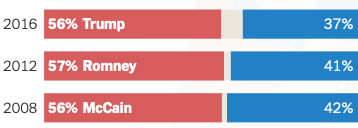
The foundation to any Republican presidential victory is Texas. Bottom line: if Trump loses Texas and its 38 electoral votes tomorrow, game over. But he's not likely to lose the state. It's still just too red. But the fact that Trump looks so weak in recent polls-- ahead of a nothing like Biden by just 2.3 points according to the most recent Real Clear Politics average-- is a testament to what a disastrous presidency he's presided over. And while those weak numbers may not deny Trump Texas' 38 electoral votes, they may well presage half a dozen or more GOP congressional losses in "safe" red districts. It's likely that TX-10 (McCaul), TX-21 (Roy), TX-22 (Olson), TX-23 (Hurd), TX-24 (Marchant), TX-25 (Williams) could all flip blue tomorrow.

Over the weekend, one of the Mike Siegel campaigners told me that 366,000 people had already voted early in TX-10, more people than had ever voted in an election in that district totally. Black voters, Asian voters, first-time voters and young voters all set new participation records. (301,200 voters participated in the TX-10 congressional race in 2018.) Siegel is expecting a big turnout tomorrow as well. Big turnouts are not what Republicans encourage. And those new voters and young voters and voters of color are not who Trump is trying to appeal to now.

In fact, Toluse Olorunnipa and Josh Dawsey reported for the Washington Post that Trump's madcap super-spreader rallies are focusing exclusively on his base of uneducated white racists. They wrote about episodes likely to turn off swing voters but enthuse his beloved "poorly educated," noting that in a frenzied burst of campaigning in the last days of the presidential race, Señor Trumpanzee has "accused doctors of fabricating coronavirus deaths for money, pantomimed a physical fight with Democratic rival Joe Biden, mocked a Fox News host for wearing a mask and celebrated his supporters for using pickup trucks to ambush a Biden campaign bus on a Texas highway... [H]is closing message is a classic display of the kind of red meat tailored specifically to animate his most faithful supporters. Convinced that it’s too late to change the minds of voters who are not yet sold on Trump, the president’s advisers are intensely focused on turning out those who are. Trump’s decision to forgo a broad, unifying closing message and instead double down on appealing to a narrow but enthusiastic slice of the electorate is a gamble. Whether it pays off or becomes a cautionary tale will not be known until the polls close Tuesday and the votes are counted."

It doesn't look good for Trump. His polling numbers are falling and COVID-19 infections are rising, particularly ones that are tied specifically to his super-spreader rallies, which caused at least 700 deaths, not counting Herman Cain. Yesterday 71,321 new cases were reported, bringing the U.S. total to 9,473,911-- as well as 399 new reported deaths for a total of 236,471. Swing states, many with Republican governors and or legislatures who have followed Trump's anti-science line, are being hammered. Yesterday's swing state new cases (with number of cases per million residents):
Texas +4,193 (33,140 cases per million residents)
Florida +4,865 (37,593 cases per million residents)
Wisconsin +3,493 (39,307 cases per million residents)
Ohio +3,319 (18,738 cases per million residents)
Iowa +2,394 (41,320 cases per million residents)
Minnesota +2,200 (26,717 cases per million residents)
North Carolina +2,057 (26,382 cases per million residents)
Pennsylvania +1,684 (16,755 cases per million residents)
Arizona +1,527 (34,000 cases per million residents)
Georgia +1,192 (34,093 cases per million residents)


Trump is in his own fantasy world though, gaslighting his rallies 'til the very end. He spread COVID to his Pennsylvania supporters in 4 rallies on Saturday. The first was on Newton where he told the crowd, "A great red wave is forming. As sure as we’re here together, that wave is forming. And they see it, they see it on all sides and there’s not a thing they can do about it."
In front of large crowds that defied public health guidelines in the middle of a pandemic, Trump offered a defiant closing message about the forces he battled during his first term, claiming that his willingness to fight them is one reason he deserves a second term.

“We did not come this far and fight this hard only to surrender our country back to the Washington swamp,” Trump said Friday in Waterford Township, Mich.

That event kicked off a four-day stretch of rallies taking him to Pennsylvania, Minnesota, Iowa, North Carolina, Georgia, Florida and Wisconsin. By the time he holds his final rally in Grand Rapids, Mich., on Monday night, Trump will have given his stump speech to tens of thousands of potential voters.

The president’s allies say he is smart to make a bet on rallying his troops at this stage of the campaign, with few undecided voters left and more to be gained from juicing turnout than from winning converts.

“The weekend before election, you’re not changing minds,” said Bryan Lanza, an adviser on Trump’s 2016 campaign and transition. “You’re not IDing supporters, you’re just turning them out. That’s where we are. Persuasion is done. He’s got to turn out what’s there.”

Trump is under more pressure to turn out his base voters in the last days of the race due to the unprecedented partisan split between Americans who vote early and those voting on Election Day.

More than 90 million Americans have already voted early or by absentee ballot, according to data maintained by the U.S. Elections Project, a nonpartisan early-voting tracker. Democrats have an edge over Republicans in several swing states, and Trump has explicitly told his supporters to cast their votes in person on Tuesday.

...The president’s strategy carries risks. His embrace of the conspiracy theories spread by his most ardent supporters about the coronavirus pandemic has driven away potential supporters, according to polls.

Trump has increasingly used his rallies to promote misinformation about the deadly virus, downplaying it and bemoaning the fact that it continues to dominate news coverage. He has told supporters that the country was “rounding the turn” on the virus even as the case count soars to record levels, and claimed without evidence that a vaccine has been held up until after the election due to politics. On Friday, he mocked Fox News host Laura Ingraham for wearing a mask to his crowded Michigan rally.

“No way!” he said from the stage. “She’s wearing a mask? She’s being very politically correct!”

During the same rally, Trump made the baseless accusation that doctors are inflating the number of patients who died of covid-19 to “get more money.”

“Now they’ll say, ‘Oh that’s terrible what he said,’ but that’s true,” Trump said of his false allegation. “It’s like $2,000 more, so you get more money.”

The American Medical Association called the claim “malicious, outrageous, and completely misguided” in a statement Friday, without naming Trump.

Trump’s conspiratorial approach to the pandemic comes as the number of Americans dying each day has begun to increase, along with the rising caseload and hospitalizations.

More than 230,000 Americans have died of covid-19, and more than 9 million have been infected.

...[H]e has veered away from his prepared remarks to offer controversial running commentary to his supporters. He has fed off crowds chanting “Lock him up!” about Biden and “Superman!” about him. Shortly before his fourth rally of the day in Pennsylvania on Saturday, Trump tweeted a video of several of his supporters forming an intimidating vehicle caravan around a Biden campaign bus as it attempted to drive down a Texas highway.

“I LOVE TEXAS!” the president wrote.
On Saturday, Keith Collins, Trip Gabriel and Stephanie Saul took NY Times readers on a trip into the 20 Arizona, Florida, Michigan, North Carolina, Pennsylvania and Wisconsin counties across the country where they claim, inaccurately, that the battle for their states' electoral votes are fiercest. Let's follow along anyway:

Miami-Dade, FL-- A Democratic stronghold, it is not a county Mr. Trump would hope to win. But this majority-Hispanic county was a disappointment for Democrats in 2018, especially in heavily Cuban-American precincts. Younger Cuban voters have started identifying as Trump Republican here.


Disappointment in 2018? The Democrats targeted 2 congressional seats in Miami-Dade and won both. Gillum won with 59.9% and Nelson won with 60.6%

Pinellas County, FL-- Perhaps the biggest swing county in the state, which backed Mr. Trump after twice backing Barack Obama, it is a Florida microcosm: solid Democrats in St. Petersburg and Midwestern retirees elsewhere.

2018 was good for Dems in Pinellas-- Gillum won with 50.7%, Nelson won with 52.6% and Charlie Crist was reelected with 57.6%

Osceola County, FL-- Part of the greater Orlando area, it is increasingly Hispanic. Conservative retirees have been joined by hundreds of thousands of Puerto Ricans, who did not register in expected numbers to give Democrats an advantage in 2018, and so far, are lagging behind other groups in early voting.

Osceola was another good county for Dems in 2018-- Gillum 58.4%, Nelson 59.7%, and it performed for mediocre Rep. Darren Soto D+26. It would have been way more interesting to include Polk County  

Union County, NC-- In 2016, Mr. Trump easily won this suburban Republican bastion near Charlotte. Republicans remain dominant, but signs of disaffection with the president, along with an upswing in “unaffiliated” voters, give Democrats hope they can trim Mr. Trump’s margin.

Union is one of those counties where Republicans routinely steal votes

Wake County, NC-- One of the nation’s fastest-growing counties, Wake has shifted steadily leftward over the past 20 years, supporting Hillary Clinton in 2016 by more than 100,000 votes. An influx of out-of-staters since then stands to boost the Democrats even more, potentially offsetting high Republican numbers in rural areas.


Robeson County, NC-- A former Democratic stronghold, this economically depressed county went for Mr. Trump in 2016. The prize will likely go to the candidate most popular among the Lumbee Indians, the county’s largest group. Mr. Trump held a rally here in October, and both campaigns pledged to support the tribe’s quest for federal recognition.

Robeson delivered for Democrat Dan McCready in 2018 (D+15)

Westmoreland County, PA-- Typical of other counties where Mr. Trump outperformed with white working-class voters four years ago, this area near Pittsburgh is where he must win even bigger margins to counter a likely Democratic surge in the suburbs.

Hillary screwed the pooch but 2 years later Tom Wolf took 46.4% and Bob Casey took 43.9%-- which is all Biden needs to do there and in places like it to be sure of winning Pennsylvania

Chester County, PA-- Democrats must continue their 2018 midterm surge in this suburban Philadelphia county, especially with college-educated women, or Mr. Trump could carry Pennsylvania again.

In 2018 Dems all did better than Hillary had-- Casey drew 59.2%, Wolf took 61.3% and the county performed as a D+18 for Democrat Chrissy Houlahan 

Erie County, PA-- One of three counties in the state that Mr. Trump flipped in 2016, its mix of a working-class post-industrial economy and rural towns makes it “the oracle of Pennsylvania,” in the words of a Democratic strategist.

Erie Co. regretted going for Trump in 2016 and made up for it 2 years later-- Bob Casey 55.7%, Tom Wolf 59.8 and the county is the biggest one in PA-16 and performed at a D+20 level for Democrat Ron DiNicola

Philadelphia County, PA
-- The big question here is whether Mr. Biden can re-energize Black voters-- Democrats’ core supporters-- after Hillary Clinton’s lackluster showing in 2016. Mr. Biden will have to boost the numbers to counter Mr. Trump’s margins with rural white voters. The Trump campaign has taken on aggressive tactics, like videotaping voters at ballot drop boxes.


Macomb County, MI-- Heavily unionized and mostly white, the state’s third largest county has picked the statewide winner in the last seven elections for governor and president.

In 2018 Stabenow did 8 points better than Hillary and Whitmer did slightly better than Stabenow. The county performed at a D+19 level for Andy Levin

Oakland County, MI-- Once solidly Republican, it is a more affluent neighbor of Macomb County and has been trending Democratic. It is a prime example of the changes that are taking place in many of the nation’s suburbs. In 2018, it gave Gov. Gretchen Whitmer the biggest margin for a Democrat in 20 years.

Oakland was good for all the Dems running in 2018 and will be for Biden tomorrow

Kent County, MI-- This traditional Republican stronghold-- home to Grand Rapids, where President Gerald Ford was raised-- has moved away from the Republican Party in the Trump era.

Mentioning Ford is the most hawkish possible thing to say about Kent. He served from 1949 to 1973-- 100% irrelevant. Maybe they should have mentioned current Rep. Justin Amash. Stabenow and Whitmer both won the county in 2018

Brown County, WI-- Among the top counties that will decide the state’s winner is the home of vote-rich Green Bay. It’s a swing county that in 2018 voted for the Republican candidate for governor, Scott Walker, and the Democrat for Senate, Tammy Baldwin. Mr. Trump won blowout margins here compared with Mitt Romney in 2012.


Waukesha County, WI-- It is the largest of Milwaukee’s suburban counties. Long a Republican stronghold, the county underperformed for Mr. Trump in 2016. Mr. Biden has forged inroads here, but it’s not clear how deep they are.

Don't get excited; Biden has not forged any inroads in Waukesha. The writers had nothing so say so they made it up

Dane County, WI-- This is home to the University of Wisconsin-Madison, and it’s where Democrats surged in an April 2020 race for the State Supreme Court. Nearly as many votes were cast here as in Milwaukee County, even though Dane has less than 60 percent of Milwaukee’s population. Heavy turnout in early voting suggests Mr. Biden is claiming those votes.


Grant County, WI-- Emblematic of southwest Wisconsin, it is one of the state’s swingiest regions, where weak partisan identity saw voters shift from Mr. Obama to Mr. Trump.

In 2018 it swung back blue-- Tony Evers beat Scott Walker by about a point and Tammy Baldwin beta her GOP opponent by 9 points

Maricopa County, AZ-- Home to Phoenix and more than 60 percent of the state’s electorate, it is Arizona’s most important county. It went narrowly for Mr. Trump in 2016, but two years later supported a Democrat, Kyrsten Sinema, for senator. The question is whether the county’s changing demographics will tip the state to a Democratic president for the first time since 1996.


Pima County, AZ-- The home of Tucson, Democrats typically run up the score here.


Pinal County, AZ-- The state’s third-largest county is a Republican redoubt. Mr. Trump will have to turn out enough rural white voters to help protect the 3.5-point margin he won the state with in 2016.


Labels: , , , , , , , , , , ,

Sunday, October 18, 2020

Best Bets For November 3: Mike Siegel (TX-10)

>


Behind the scenes Republican operative gave up on winning back the House early in the campaign. Lately they're realizing that even the "easy" wins are beyond their grasp. They should be able to take back seats from Blue Dogs in deep red districts like SC-01 (R+10), UT-04 (R+13), OK-05 (R+), NY-22 (R+6), MN-07 (R+12), VA-07 (R+6), respectively Joe Cunningham, Ben McAdams, Kendra Horn, Anthony Brindisi, Collin Peterson and Abigail Spanberger, half dozen of the worst incumbents from the Republican wing of the Democratic Party. Their records are unabashedly opposed to everything Democratic voters want. But this is another one of those "any blue will do" years.

Now that Republican operatives have come to realize that the White House and their Senate majority are gone too, they are also seeing something even more scary than not being able to take back seats like the 6 listed above. And that's losing more deep-red districts like them that the DCCC didn't even target.

Here's how that works: the DCCC now routinely destroys progressive candidates when they try to run in primaries in "winnable" district primaries. In "impossible" districts they rarely bother-- or only make a half-assed attempt. In a tsunami year like this one, suddenly some of those "impossible" districts become very winnable. Progressive candidates like Julie Oliver (TX-25, R+11), Adam Christensen (FL-03, R+9), Audrey Denney (CA-01, R+11), Nate McMurray (NY-27, R+11), Liam O'Mara (CA-42, R+9), J.D. Scholten (IA-04, R+11) and Mike Siegel (TX-10, R+9) are all the kinds of progressives the DCCC would normally try to sabotage-- but in districts like those? Why bother?

Goal ThermometerWinning in the relatively close districts, the top DCCC targets-- like in NY-24 (D+3), NJ-02 (R+1), TX-23 (R+1), PA-01 (R+1), NY-02 (R+3), IL-13 (R+3), and MN-08 (R+4) aren't that big a deal. Republicans will shrug those losses off. It isn't going to make them reexamine what Trump and other neo-fascists have done to their party. But when "safe" GOP incumbents in deep red districts like Roger Williams (TX-25), Doug LaMalfa (CA-01), Ken Calvert (CA-42) and Michael McCaul (TX-10) start losing their seats... that's when it's time for talks about existentialism and for a general party shakeup. If Brian Fitzpatrick loses, it doesn't mean much; if Michael McCaul does... scores of Republican incumbents know they are no longer safe. But can McCaul lose? Two polls show him and Mike Siegel within the margin of error and with all the momentum belonging to Siegel. Dan Solomon did a deep dive for the Texas Monthly last week-- Can a Bernie-Style Democrat Unseat Longtime Republican Representative Michael McCaul in TX-10? And, believe me, that prospect scares the Democratic establishment every single bit as much as it scares the Republican establishment... which is a lot.

"Redistricting did a number on TX-10," wrote Solomon. "It was one of several districts redrawn in 2003 to dilute Democratic-voting Austinites by dividing them among multiple districts dominated by GOP-leaning voters in rural parts of the state (see also: TX-17, TX-21, and TX-25). The Tenth now includes a tiny sliver of Travis County, where Austin is located, as well as parts of Harris County, home of Houston, and stretches through the rural areas between those two cities. The dynamics of the Tenth have flipped: in 2004, after Doggett was redistricted out of TX-10, Democrats declined to put up a challenger to Republican Michael McCaul, who’s held the seat ever since. Democrats have run in the Tenth since then, but for most of McCaul’s tenure, their presence on the ballot barely registered in the ultra-red district. But in 2018, Mike Siegel, running as a progressive Democrat, came within 4.3 points of unseating McCaul. In 2020, Siegel won the Democratic primary again, setting up a rematch of one of 2018’s more surprisingly competitive races."
[McCaul] has cast votes with the current president more than 95 percent of the time, including on the border wall and the Trump tax cuts. He also found himself at the center of the mask-wearing debate earlier this month after Trump tested positive for COVID, when photos and video surfaced of him going without a face mask on a United Airlines flight. (McCaul claimed the mask fell off while he was sleeping, though subsequent video indicates he didn’t wear it while awake, either.) McCaul, whose father-in-law is the founder and former chairman of radio and advertising giant Clear Channel Communications, is one of the richest members of Congress, with a net worth estimated at $113 million. He’s also well funded, having raised more than $2.5 million this cycle, $1.3 million of which he had on hand at of the end of the year’s second quarter.

Many of the Democrats looking to flip traditionally red districts in Texas are running as moderates and trying to court conservative suburban voters who may feel alienated by the Trump-era GOP. Not Mike Siegel, a labor lawyer and former public school teacher, whose platform touts issues including the Green New Deal, racial justice, and Medicare for all. Siegel is also focused on labor reform-- especially ending “at-will” employment, which allows workers to be fired for any (or no) reason-- and dramatically reshaping U.S. housing policy amid the COVID-19 pandemic. He boasts a trio of high-profile endorsements from former Democratic presidential candidates-- Elizabeth Warren, Bernie Sanders, and Beto O’Rourke-- as well as those of prominent national organizations including the AFL-CIO and Planned Parenthood, and a slew of local politicians, organizations, and newspapers (including the Houston Chronicle).

Siegel has raised $900,000 according to his most recent FEC filing. It’s money he’s been spending at a steady clip: just $164,000 remained as cash on hand at the end of Q2.

The Tenth is changing. Mitt Romney won the district by twenty points in 2012, Trump won by nine points in 2016, and Ted Cruz lost by two-tenths of a percent in 2018. Much of this change has been driven by growth in the urban parts of the district over the last decade, a trend that seems to have kept up after Siegel’s close loss in the 2018 contest: in the last two years, Travis County has added more than 70,000 new voters, while Harris County has added 111,360 to its rolls. (Not every newly registered voter in either county lives in TX-10, of course, but enough of them do to identify the district as one that’s rapidly changing.)

Siegel won Austin by a huge margin in 2018, while McCaul won over voters in the Houston suburbs that year by a narrower (but still comfortable) amount. The rural middle part of the district, meanwhile, also favored McCaul—but 2018 Libertarian party candidate Mike Ryan pulled a whopping 8 percent of the vote outside of Harris and Travis Counties. Siegel could win this year if he runs up the numbers in Austin, keeps it closer in the Houston suburbs, and if the Libertarian on the ballot, Roy Eriksen, can pull votes from McCaul outside of the two cities. (The possibility that third-party candidates could have an impact on close House races led the Texas GOP to sue to keep 44 Libertarians off the ballot earlier this year, though they lost the suit.)

...If Austin turns out in big numbers, and the Houston suburbs prove receptive to a Democrat in the Alexandria Ocasio-Cortez mold, Siegel could win.
Austin is turning out in large numbers... unprecedented large numbers. Conservative prognosticators who have written off Siegel's chance to flip this district may be in for a huge shock a week from tomorrow. And if you want to help, you can click on the Blue America congressional thermometer above or just hit this Turning Texas Blue link. Electing conservative Democrats of the DCCC ilk accomplishes nothing for the American people-- no reform, no systemic change of any kind. Electing men and women like Mike Siegel and Julie Oliver in Texas... that's what makes the Democratic Party worthwhile and a legitimate vehicle for working families. This cycle, it is only by electing candidates like Siegel and Oliver that can cause a genuine GOP reexamination of what kind of sewer they have slipped into over the past few decades.


Labels: , , , ,

Wednesday, October 14, 2020

Flipping A Red District In The Middle Of Texas-- While Donald Debuts For The Village People

>


This ad the Sunrise Movement just released to assist Mike Siegel win TX-10 from Trump appendage Michael McCaul, is going to be part of the visual history of the 2020 election-- and one of the best ads of the year. The brand new polling released yesterday show Mike and McCaul tied. Hopefully the Sunrise Movement ad will help enthuse more voters to get out and support Mike. Although... Travis County, the biggest in Mike's district, doesn't need much more enthusiasm than it already has. According to the Austin American Statesman out the more than 850,000 eligible voters in the county, 97% of them are registered to vote. A little context:
In 2016, Trump's share of the Travis County vote was 27.4%
In 2018, Ted Cruz's share of the Travis County vote was 24.6%
In 2018, Greg Abbott's share of the Travis County vote was 30.4%
In 2018, the Travis County portion of TX-10 gave Mike Siegel a gigantic landslide-- D+44
In 2018, the Travis County portion of TX-25 also gave Julie Oliver a big fat landslide-- D+30
Goal ThermometerLast go-round, without the kind of name recognition he has now, Siegel pulled between 72 and 73% of the Travis County vote. He is expected to do far better this time. In fact, private polling shows him neck and neck with McCaul in Bastrop County and significantly increasing his share of the vote in Harris and Waller counties. Now all the momentum is with Siegel. The newest poll shows him leading 94-0 among Democrats while McCaul leads 93-2 among Republicans. The most important number though is among Independents, a cohort that has supported McCaul in the past but now backs Siegel by a phenomenal 54-28%.

Yesterday, the first day of early voting in Texas, found gigantic lines in Travis County, with people willing to wait for long periods of time-- mostly to register their disapproval of Trump and his enablers. But don't let anyone tell you Trump doesn't have enthusiasm working for him too. This week at an airplane hangar in a small town in the middle of Florida, Trump fans were rockin' the house. Watch:


In 1978, when the Village People released Cruisin', Trump was 32, a NYC club rat whose after-dark headquarters was often Studio 54, where he was seen hob-sobbing with crooked local politicians, minor celebrities, hookers, drug dealers and, most of all, mobsters. Now a smash hit among the MAGA crowd, "YMCA," the double-entendre single from the album, was more than just the theme song for Trump's favorite disco. It was also the theme song for the gay movement of the 1970s. Nice to see that the 300 pound Trump, a very picture of lack of physical grace-- and still sick with COVID-- remembers how to shake his lard ass to the gayest song ever written (even though he was always seriously on the make and never actually danced at the disco).


Labels: , , , , , , , ,

Sunday, October 11, 2020

Mike And Julie, The Key To Winning Back Texas

>


Republicans have controlled Texas for too long and have grown comfortable enough to overlook arrogance and embrace corruption. It's time for them to be put out to pasture. Many Texas voters-- particularly in the suburbs and exurbs around Dallas-Ft Worth, Houston, Austin and San Antonio-- are sick of Trump and giving up on his enablers. And whether Biden wins the state's 38 electoral votes or not, Texas is likely to flip as many as half a dozen congressional seats and possibly the state House as well.

Today, as the election barrels towards a denouement, we want to focus on the two most important congressional candidates running in Texas, Mike Siegel (TX-10) and Julie Oliver (TX-25), each in a gerrymandered district carved out of Travis County (Austin) and meant to dilute the votes of Austin Democrats by including rural and suburban counties that were GOP safe zones when the districts were drawn. Those safe zones are no longer safe and both Siegel and Oliver made tremendous headway against the GOP incumbents in 2018. Each is back to finish the job in November.

And each is polling so strongly that a reluctant DCCC-- never eager to endorse outright progressives in "red" districts-- was forced to add both Siegel and Oliver to their Red to Blue list this month. This morning, Siegel told us how clearly he understands the stakes. "When I beat Michael McCaul on November 3," he said, "it will send shockwaves through the political establishment. I'm running hard on the Green New Deal, to create millions of jobs while addressing climate change and the legacy of environmental racism. And when I defeat one of the wealthiest members of Congress, a person who has more money personally invested in oil and gas than any person in the House or Senate, in a district specifically gerrymandered to protect him (because his father-in-law is a media empire billionaire), and in a district that contains numerous fossil fuel concerns in the Houston "oil patch"-- that victory will make history. It will help to dispel this idea that to flip a red seat you need to be 'moderate.' It will show that progressive policies like the Green New Deal are winning issues BECAUSE they are bold, because they meet the scale of the crises we face. This victory will be about more than one seat, it will be about the movement.


Siegel, a civil rights attorney and a life-long union guy, is all about solidarity. He was quick to turn the conversation towards his neighbor and fellow-progressive. "And the same goes for my compatriot Julie Oliver. She is probably the most articulate House challenger right now when it comes to Medicare for All. Because of her personal story and her family's struggles with health care companies, and also because of her work as a lawyer with intricate knowledge of health insurance and spending, she is the perfect advocate for a national, comprehensive, single-payer healthcare system. And her opponent is a caricature of a wealthy, bigoted, out-of-touch Texas Republican. Who would you rather have as a representative, a grifting car salesman or a healthcare advocate and mom who is unafraid to knock every door in her 13-county district, who has fought for Medicare for All even when it wasn't universally popular, and who continues to lead on the most important issue during a national health crisis? I'll take Julie, thank you very much!"

He concluded that "The two of us-- staunch progressives who have built powerful campaigns that are even winning support from the political establishment-- have the opportunity to change the narrative of Texas politics. We can help usher in a new wave of progressivism in the South. As Bernie's recent town hall said, 'As Texas goes, so does America.' So let's make that real-- and win in November!"

Goal ThermometerPlease consider contributing what you can to both Mike Siegel and Julie Oliver by clicking on the Blue America 2020 Texas thermometer on the right. Julie told us that "As the mother of a kid with pre-existing conditions and as someone with 20 years of experience in the healthcare industry, I understand exactly how the healthcare industry has failed Texans, how we can fund it more equitably and responsibly, and how our own Republican members of Congress worked to undermine care for millions of Americans. Both Roger Williams and Mike's Republican opponent Michael McCaul have voted more than 50 times to take healthcare from millions of Americans, including cancer patients, sick children, the elderly, and people with disabilities right here in Texas. They've voted at least ten times to end protections for people with pre-existing conditions, like the one my son has. So for me--just as it is for hundreds of thousands of people here in our district whose healthcare is threatened by our own Congressman--this was deeply personal."

As much about solidarity as Siegel, she said that "both Mike and I believe that real change is never top-down-- it is built and informed by Texas communities. That is why both of us have run such organizing-first, grassroots campaigns, with an emphasis on coalition building, working in solidarity with communities that the political status quo has ignored for too long-- whether that's blue collar Texans who haven't seen a pay increase; those who are being priced out of their own communities due to the soaring costs of healthcare, tuition, and housing; or the communities in Texas most severely impacted by climate change. And the natural byproduct of actually showing up and listening to the people that Congress is supposed to serve-- not corporations, not DC elites-- is that we're rooting out corruption and ending the era of pay-for-play politics. Both Mike and I are political outsiders. I'm confident that neither of us can be arm-twisted behind closed doors, and we're not afraid to stand up to corrupt politicians and special interests. For too long, career politicians like Roger Williams and Michael McCaul have taken advantage of hardworking families while they use their office to enrich themselves. And it's time for real, positive change for Texas."


Last week, one of Texas' sharpest reporters, Abby Livingston, wrote that another Texas congressional candidate-- neither a real progressive nor a conservative but more of a moderate-- Wendy Davis, who was slaughtered in her 2014 in her high-profile run for governor, was thinking a lot about why she lost by 20 points but 4 years later Beto O'Rourke lost by just 2.5 points in his statewide race against Ted Cruz. Livingston wrote that Davis figured it out: in "2018 there was a robust lineup of Democratic candidates down ballot running for the U.S. House, the state Legislature and other local campaigns. That wasn’t the case in 2014. Those candidates knocked on doors, raised money, showed up to Rotary Club meetings and de-stigmatized Democrats in once-hostile territory. Some even won. Davis said those down-ballot races were key to O’Rourke’s performance." Beto agrees.

Livingston's point is that Biden's fate in Texas next month "could rest on the backs of dozens of mostly obscure Democratic candidates who are competing for legislative and congressional seats in the suburbs that have been strongly Republican... And with more national and local money pouring into those down-ballot races, political experts say that could have a major effect upstream on the ballot. 'Normally, House and down-ballot candidates are desperate for presidential investment,' said Amy Walter, a political analyst at the Cook Political Report. 'In this case, I think that all the money being poured into suburban [congressional districts] and battleground state [legislative] districts could help boost Biden.'"


Labels: , , , , , , ,

Friday, October 02, 2020

Many Republican Candidates Are Paralyzed With Fear-- Fear Of Normal Voters On The One Hand And Fear Of Trump And His Element On The Other

>


Trump isn't dead yet and hasn't used his COVID diagnosis as an excuse for backing out of the race. He insists otherwise, but he was hurt badly by Tuesday's debate. This is very typical post-debate polling coverage: "Trump hurt himself more than his rival with Tuesday night's theatrics in what's been called the worst U.S. presidential debate in history."


Now, try to imagine the "Fake News" tantrum the criminally, clinically insane Donald must have thrown Wednesday night when he saw Gabe Sherman's Vanity Fair report, "The Family Is Worried Brad Will Start Talking": TrumpWorld Panics Over Debate Fiasco As Campaign Turmoil Mounts. It sounds pretty dire: "Over three days, the New York Times dropped a tax bombshell, Florida cops cuffed Brad Parscale, and the president just couldn’t help himself onstage. 'Trump didn’t win over any voters,' said a prominent Republican, 'and he pissed off a lot of people.'"

Sherman asserts that while the campaign is still assessing the political damage from the debate, particularly Trump's "refusal to condemn white supremacists," the Orange blot "didn't win over any voters, and he pissed off a lot of people."

Worse yet, "Republicans are resigned to the fact that Trump is unlikely-- or unwilling-- to course-correct. 'Trump thinks he won. He didn’t,' said another Republican with ties to the campaign. 'But does anyone have the balls to tell him that? No. They’d be fired.'"
Trump doesn’t accept the consensus that the debate was a disaster because, sources said, he was unabashedly himself. “The thing about the debate is people got to see why no one that has any integrity can work for Trump. This is what Trump is like in the Oval Office every day. It’s why [John] Kelly left. It’s why [Jim] Mattis quit,” said the prominent Republican. “Trump doesn’t let anyone else speak. He really doesn’t care what you have to say. He demeans people. He talks over them. And everyone around him thinks it’s getting worse.”

Inside Trumpworld there’s a view that the past week is an inflection point in the campaign. It started on Sunday night with the bombshell New York Times report that Trump paid just $750 in federal income taxes in 2016 and 2017. “For Trump the Times story was worse than losing reelection,” said the second Republican. “If you had told Donald back in 2015 that his tax returns would be exposed and he’d have all these investigations, I guarantee you he wouldn’t have run.”

As the Times story lit up cable news and Twitter, news broke that Trump’s former campaign manager Brad Parscale had been taken into custody outside his Ft. Lauderdale home and hospitalized after threatening to commit suicide and allegedly beating his wife days prior. Police body camera footage showing an officer brutally tackling a shirtless, 6’8” Parscale to the pavement instantly became a visual metaphor for the chaos engulfing the Trump campaign. One campaign adviser I spoke with was shocked by the amount of force the police used to subdue and cuff Parscale. “If Brad had been Black, there would be riots all over the country,” the source said. (In fact, police have killed unarmed Black men in far less hostile situations.)

Parscale’s public meltdown happened while he is reportedly under investigation for stealing from the Trump campaign and the RNC. According to the source close to the campaign, the Trump family is worried that Parscale could turn on them and cooperate with law enforcement about possible campaign finance violations. “The family is worried Brad will start talking,” the source said.
And the shit show is just getting started... for Republicans who have earned-- and continue to earn-- every bit of it. Writing for the Washington Post, Robert Costa and Matt Viser reported that the aftermath of the debate "triggered a reckoning among Republicans on Wednesday about the incumbent’s incendiary remarks on white supremacy and his baseless claims of electoral fraud, with GOP officials privately expressing alarm about the fallout with key voters." Republican elected officials, though, were muted, tepid and largely non-existent "reflecting how the GOP remains convinced that an alliance with Trump and his voters is crucial for its survival. But hewing too close to him is also seen as a mistake by some Republicans, particularly for those who wish to court moderates and independent voters."

Utterly out-of-touch, brow furrowed, Susan Collins, who is losing her reelection bid to an uninspiring moderate Democrat, made the probably-fatal error of telling reporters that "There was fault on both sides. The interrupting on both sides, the name-calling was very unbecoming for a presidential debate." When pressed, she admitted it was "a mistake" for Donald to not condemn the Proud Boys and his other white supremicist supporters.

Tim Scott (R-SC) is the only black Republican in the Senate. (He was appointed.) He say Trump "misspoke" and "should correct it. If he doesn’t correct it, I guess he didn’t misspeak." That was about as close to a rebuke Donald got from a Republican senator-- and Scott isn't up for reelection in November. Donald's post-debate attempt at a "correction" was to lie to the media and claim he doesn't know who the Proud Boys are. "I mean, you’ll have to give me a definition, because I really don’t know who they are. I can only say they have to stand down. Let law enforcement do their work." Yeah, so I guess he didn't misspeak.
Trump’s comments did little to encourage Republicans about the political turbulence they face in the final stretch of the campaign as Trump seizes on matters of race and urban unrest and unfounded allegations of voter fraud.

“This election is drifting toward what feels like a blowout [victory for Biden], and there needs to be some type of event that changes that. The debate was a chance to change the direction, and while it might be too early to be seen, there is no real reason to believe it was a game-changer,” said Brendan Buck, a former top adviser to the past two Republican House speakers, Paul Ryan of Wisconsin and John Boehner of Ohio.

Former senator Jeff Flake (R-AZ), a Trump critic who stays in touch with former colleagues, said the private alarm in Senate GOP circles “is palpable.”

“People are voting already, so they know it’s going to be tough to put forward a new narrative,” Flake said. “They’re more than a little worried because it feels like even if you go in a different direction, it’d be too little, too late. That’s devastating.”

Polling shows the GOP Senate majority at risk with strongholds in the Deep South, such as South Carolina and Georgia, highly competitive. A Quinnipiac University poll released Wednesday shows Sen. Lindsey Graham (R-SC) and former South Carolina Democratic Party chairman Jaime Harrison tied as Graham seeks a fourth term in the Senate.

One veteran Republican Senate strategist, who spoke on the condition of anonymity because they are working on a Senate campaign, said, “We’re all kind of prepared to be responsible for our own performances and our own words. You’re not going to see anybody say it was a bad performance, but they’ll consider it like Trump’s really crazy tweets. They’ll say, ‘That’s not my kind of campaign, didn’t really see it.’”

The strategist added that several campaigns are already deliberating on how to address Proud Boys questions at upcoming Senate debates and are trying to figure out how to deflect the issue and shift to more favorable topics.

At the Capitol on Wednesday, where Senate Republicans are working swiftly to confirm Trump’s Supreme Court nominee, Amy Coney Barrett, reactions ranged from venting about the debate to sidestepping challenges to Trump.

“It was awful,” Sen. Lisa Murkowski (R-AK) told reporters, while Sen. Ben Sasse (R-NE) offered a descriptive expletive.

“I was actually watching the Yankees,” said Sen. Mike Rounds (R-SD). When asked if he was disturbed by Trump’s response to the Proud Boys question, Rounds said, “He should have been very clear,” whether talking about “far-left” groups or “far-right” groups.

Sen. Thom Tillis (R-NC), who is in a difficult reelection race, said of Trump’s handling of the Proud Boys question: “I’ll leave it to the president. I know he’s not racist. I’m sure he doesn’t approve of their activities.”
Like Collins, Tillis is being challenged by an uninspiring moderate-to-conservative establishment Democrat and, like Collins, Tillis is losing his reelection bid. The Real Clear Politics polling average shows Cunningham ahead by a daunting 6 points. And the most recent poll, by YouGov for CBS News, sounds like a death knell for Tillis. Cunningham is beating him 48% to 38%-- ten points!

And right on cue, Sabato's Crystal Ball stepped a little closer to reality-- just a little-- in its predictions for November. Cory Gardner hasn't had a shot for reelection for over a year and Sabato's outfit seems to have almost figured it out, moving its rating from "leans Democratic" to "likely Democratic." On November 4th they will move it to "safe Democratic." They seem to be recognizing that Al Gross is going to beat Trumpist coward Dan Sullivan in Alaska, moving Sullivan's reelection bid from "likely Republican" to "lean Republican." And in House races they made 12 changes-- all but one in favor of Democratic candidates. And the one was just a reflection of Sabato's unwillingness to understand what the nature of a wave is when even shit candidates like worthless New Dem T.J. Cox, are swept across the finish line by voters who want to see the enemy-- this year Republicans-- vanquished.


Goal ThermometerSabato shows 30 Republican-held seats on the verge of flipping-- and that includes career-ending defeats for 18 House Republican incumbents. Blue America House candidates most likely to win next month-- according to Sabato's predictions-- are Jon Hoadley (MI-06), Kara Eastman (NE-02), Dana Balter (NY-24) and Mike Siegel (TX-10). The only Democrats Sabato sees in actual jeopardy are half a dozen Blue Dogs and New Dems: T.J. Cox (CA), Debbie Mucarsel-Powell (FL), Collin Peterson (MN), Anthony Brindisi (NY), Max Rose (NY) and Kendra Horn (OK), the last 4 of whom the Democratic Party would be much better off without. My suggestion to people who want their contributions to go to candidates on the verge of winning-- and just using Sabato's criteria-- but who need that extra little push: click on the Blue America 2020 congressional thermometer on the right and give $10 each to Kara Eastman, Mike Siegel and Jon Hoadley. BONUS: here's Mike Siegel speaking at an online Bernie congressional fundraiser Wednesday evening:


Labels: , , , , , , , ,

Monday, September 28, 2020

A Duty To The Country? To The American People? To History? To Your Own Conscience?

>


Like by Nancy Ohanian

Everyone has to make those decisions for him- or herself. If you've heard me on Nicole Sander's or David Feldman's shows recently, you've probably heard me talking about A French Village, and about how each of us may have to decide where we are on a spectrum that goes from enthusiastic collaboration with fascism to violent resistance to it, just as the characters in the TV series were forced to. History Professor Walter Moss noted that Americans, "never having lived under military occupation by a hostile foreign power... have little appreciation for how complex everyday life could become under such conditions. Although most people would like to think that they would resist the Nazi invaders and not cooperate with them in any way, the reality for occupied peoples-- under the Germans and other occupiers-- was usually much more varied. FV depicts this well. Some collaborated; some cooperated partly; only a small minority engaged in active resistance."

It becomes even more nuanced, of course, when it isn't a foreign occupation but a fascist coup we have to decide how to position ourselves for or against. It hasn't come to that yet... but for many ex-Trump staffers, there is a decision they have to make now... or not make. AP reporter Jill Colvin wrote yesterday that "With just weeks left before the Nov. 3 election, now is the moment of truth for current and former Trump administration officials debating whether they, too, should step forward and join the chorus of Republican voices trying to persuade on-the-fence voters to help deny Trump a second term." After all, according to former chief of staff at the Department of Homeland Security, Miles Taylor, Trump was routinely asking aides to break the law, using his former agency for explicitly political purposes, and wanting to maim and shoot migrants trying to cross the southern border. Taylor said that "Those who witnessed the president’s unfitness for office up close have a moral obligation to share their assessment with the electorate."
Other prominent “formers” have spoken out independently-- or are considering it.

Former national security adviser John Bolton wrote a scathing book in which he said Trump “saw conspiracies behind rocks, and remained stunningly uninformed” on how to run the government. Former Defense Secretary Jim Mattis broke a self-imposed vow of silence in June with an op-ed slamming Trump’s response to racial justice protests. He and former director of national intelligence Dan Coats also were quoted extensively in a new book by journalist Bob Woodward calling Trump dangerous and unfit for office.

But Mattis and Coats, like former White House chief of staff John Kelly and former national security adviser H.R. McMaster, have refrained from more explicit condemnations, often citing a “duty of silence” or a long tradition of military officials staying out of politics, according to people who’ve spoken with them.

Efforts to draw them out are ongoing. While former Homeland Security Secretary Kirstjen Nielsen appears disinclined to step forward, there are hopes that former Secretary of State Rex Tillerson might be persuaded to comment and that Coats might be urged to say more. And Kelly, a retired four-star general, is said to be on the fence and torn about the decision.

“I think that he loves his country and he wants to do what’s best for the country,” said Neumann, who served as Kelly’s deputy chief of staff at DHS and is hopeful he’ll speak out, even as others don’t think it will happen.

Officials like Kelly, with long careers and hefty pensions, would seem to have less to lose by doing so than more junior staffers like Olivia Troye, a former counterterrorism adviser to Vice President Mike Pence who last week joined the campaign against Trump and said she’d be voting for Biden.

In a video and interviews, Troye has accused Trump of mishandling the coronavirus and being more concerned about his reelection prospects than saving lives. The White House punched back with an aggressive attack campaign aimed at discrediting her through a barrage of statements, interviews and denunciations from the lectern in the White House briefing room.

“These are not profiles in courage, but these are profiles in cowardice,” White House press secretary Kayleigh McEnany said of Troye and Taylor, dismissing them as part of a “fringe club of, quote, ‘Never Trumpers’ who are desperate for relevancy.”

Taylor said it was clear the White House was “coming after” those who speak out as a warning to others who are considering doing likewise.

“The White House knows if they show this is a very costly thing to do they will scare people from going forward,” he said.

He added that while more people are still considering coming forward, the White House tactics have worked to some extent-- dissuading one senior official who had been on the cusp of speaking out.

Rick Wilson, a longtime Republican strategist who co-founded the anti-Trump Lincoln Project, stressed that time is running out.

“There will be a cottage industry when Trump is out of office of people who say, ‘Oh, I fought from the inside, I fought the good fight, I kept so many bad things from happening.’” he said. “It doesn’t matter. There’s only one moment in time where it matters. And that’s now.”


...Anthony Scaramucci, who turned against the president last year after a short stint as White House communications director, has also been in discussions with those on the fence and is using every channel he can find to spread his message, including a new anti-Trump documentary.

“We have to keep the pressure on, and so for me it’s a multimedia approach. It’s radio, it’s podcasts, it’s Twitter, it’s television and it’s movies,” he said. “As a citizen all I’ve tried to do is provide a surgeon general’s warning... This guy is a threat to the institutions of democracy, and I worked for him and I think it’s important to send a signal to other people,” he said, that it’s OK to speak out.
And a lot is going to fall on Biden's shoulders, shoulder's I'm afraid not up to the task. In his NY Times OpEd yesterday, How To Debate Someone Who Lies, psychiatrist Richard Friedman offered Biden some advice: "Don’t waste your time fact-checking the president. If you attempt to counter every falsehood or distortion that Mr. Trump serves up, you will cede control of the debate. And, by trying to correct him, you will paradoxically strengthen the misinformation rather than undermine it. (Research shows that trying to correct a falsehood with truth can backfire by reinforcing the original lie.) Instead, Mr. Biden should use more powerful weapons that will put Mr. Trump on the defensive-- and also tell the audience that the president is a dishonest narrator. The first weapon may be the most effective: humor and ridicule. A derisive joke can defuse tense and outrageous situations. In 2007, for example, protesters dressed as clowns confronted a 'white power' march in Charlotte, N.C., holding signs that read 'wife power' and throwing white flour in the air. It made the white nationalists look ridiculous and avoided a violent confrontation, which would have served the interests of the racists."

I doubt Biden would dare, but he should only refer to Trump as "Donald," which drives him up the wall and would cause a complete crackup tomorrow night.


Trump Biden Debate by Nancy Ohanian


Last night I was talking with Mike Siegel, the progressive working to replace Trump ally Michael McCaul in a gerrymandered central Texas district. Defeating Trumpist enablers like McCaul is what's going to make all the difference in 2021. Mike told me his team is "this close to defeating one of the wealthiest and most reactionary members of Congress because we are running a people-powered, populist campaign that speaks to the needs of the people in this moment of overlapping crises. We are fighting for universal health care during a pandemic, a Green New Deal in response to massive unemployment and climate disasters, a renewed Voting Rights Act to battle massive voter suppression, and other programs to guarantee equality, dignity and justice for all. This poll will help us raise additional resources and win new sources of support, all in support of a transformational movement to flip a seat and usher in a new era of representation that is close to the ground and responsive to the people."

YES!!! We're in! Please contribute to Mike's campaign here. But how does Mike know he's close to beating McCaul? Once you leave Austin, it's a pretty red district. He shared a polling memo with me and said it was ok to run it on DWT. These are the key findings-- and from a relatively conservative sample of voters:
The TX-10 rematch between Mike Siegel and Michael McCaul is very close as we head into the final 5 weeks of the 2020 election. There has been notable movement in the race since our previous poll conducted at the beginning of August. Siegel has gained 4 points during these past 7 weeks, and now trails McCaul 45 to 43 percent (with Libertarian Roy Eriksen receiving 6 percent). The 2-point gap also reflects a narrowing of the 2018 result when McCaul won by 4 points, and Siegel is well-positioned to continue making gains as voters engage and the statewide environment further improves for Joe Biden.

The movement in the Congressional race is consistent with movement taking place at the top of the ticket in this rapidly changing district. In fact, TX-10 is a reflection of what is happening around the country as voters of color and college educated voters are forming a powerful Democratic coalition that is transforming districts that have been held for years by Republicans and are now becoming Democratic. While Obama lost the district by 21 points to Romney in 2012, Clinton cut that margin to 9 points against Trump in 2016, and O’Rourke tied against Cruz in 2018. In our latest poll, Biden is tied with Trump and has gained 4 points since August.

The following findings are based on a survey of 400 registered voters who are likely to cast ballots in the November election. The survey was conducted September 21-September 24, 2020 with live dialers to both landlines and cell phones, and is subject to a margin of error of +/- 4.9 percentage points at the 95 percent confidence interval.

Key Findings:
The political environment has improved for Democrats over the past 7 weeks, and the Presidential and House races are shifting toward Biden and Siegel. Biden gained 4 points in his race with Trump, and Siegel gained 4 points in his race with McCaul. Biden is now tied with Trump in the district, and Siegel is down by 2 points against McCaul (45 to 43 percent).
Siegel’s coalition reflects the power of the political and demographic changes in the district. TX-10 has a very diverse electorate that is comprised of white (69 percent), Hispanic (13 percent), African American (11 percent), and AAPI voters (3 percent). Siegel is winning by large margins among voters of color, as well as with white college educated voters.
• College educated: Siegel 48 / McCaul 42
• College educated women: Siegel 57 / McCaul 35
• Voters of color: Siegel 60 / McCaul 26
• Independents: Siegel 46 / McCaul 36
Siegel demonstrates his durability by maintaining positive favorability amid McCaul launching television and digital ads attacking him. Siegel has a +6 favorability rating (32 percent favorable / 26 percent unfavorable), which is particularly notable given the advertising on broadcast television that McCaul has run against him prior to Siegel launching his own television campaign. Siegel entered this race with high name ID for a challenger, which has helped him sustain his strength against McCaul’s efforts.
The bottom line: this is a very close race, and real movement is taking place in a state undergoing profound political change. The survey shows that healthcare remains a very powerful issue, just as it had been in 2018 when two Texas districts flipped to Democrats and several others – such the Siegel-McCaul race – were decided by only a few points. McCaul is particularly vulnerable on his votes to repeal the Affordable Care Act, and voters express strong opposition to his healthcare positions that continue in the middle of this pandemic. Once again, Siegel is in a neck-and-neck race with McCaul-- and this time with a stronger wind at his back-- and TX-10 is a serious pick-up opportunity for Democrats.


As Rich Benjamin reminded Intercept readers yesterday "In order to win this presidential contest, liberals need to accept that Trump supporters do not care if he were to scrap millions of mail-in votes or to welcome, and even solicit, Russian interference for his cause. Not only do some Trump supporters understand that he is an autocrat who will cheat the rules to stay in power, that’s precisely what they like about him. The left should understand that many Trump supporters inherently believe that they would fare better under an autocratic system of white supremacy than under a multiracial democracy... Questioning all that fervent, widespread Trump support would force them to question how their neighbor, their cousin, their uncle, their co-worker, their favorite vendor is complicit to a regime that prioritizes their well-being and social privilege as white people, second only to Trump’s greed. To acknowledge your aunt’s or your own complicity in Trump’s nationalist autocracy might make you feel accountable for what this country is. And that accountability to the problem damns you to an accountability to the solution... Wealth redistribution to the top, privatization, extreme incoming inequality, and ruling kleptocracy: Such are the hallmarks of this regime’s totalitarian capitalism, one that exploits catastrophe to further undercut a fair economy, a robust middle class, and truly representative democracy."


Labels: , , , , ,

Friday, September 25, 2020

Will Women-- Including Rural Women-- In Red States Break Away From Their Menfolk On November 3rd And Save The Country From The Authoritarianism The Men Crave?

>


New polling by YouGov for The Economist suggests a bigger swing away from Trump in rural America than in the suburbs. The magazine reported that Democrats are doing less badly among rural voters We'll get to that in a second. But first let me give you a little background on Howard County, Iowa (no relation). It's in the northeast part of the state, hard up on the Minnesota border, with a dwindling population of around 9,000. It's 99% white and the median family income is around $43,000. The closest thing to a city is Cresco (less than 4,000 people). In 2016 Bernie won the Democratic caucuses with 215 votes (54%) and Trump won the Republican caucuses with 112 votes (30.5%). The county had gone for Obama in 2008 and 2012 but flipped hard against Hillary in 2016-- 2,611 (57.9%) to 1,674 (37.1%). That's a 41% swing, othe worst in Iowa and one of the worst in the country.

The county "is populated by older, white, religious, non-college-educated and often disaffected voters, including many independents. This is the sort of place where diversity means people are descended from both Norwegians and Germans."

Neil Shaffer, the county GOP chair expects another big victory "over 60%, " he told The Economist. The Democratic county chair, Laura Hubka told them she "hopes to contain her side’s loss. If Democrats limit rural pain but stir enthusiasm in cities, notably Des Moines, Mr Biden might eke out a statewide victory, as Mr Obama twice did." Iowa's Senate race is even more promising for the Democratic challenger, Theresa Greenfield. The Real Clear Politics polling average shows her up 2.6% over Trumpist incumbent Joni Ernst, and all the most recent polls show her winning. On Tuesday, Monmouth's turnout models showed Greenfield up over Ernst by 3 points on a high turnout election and winning by one point in a low turnout election.

The Economist's point, though, is that "Democrats can take heart" because polling shows "rural voters everywhere have cooled a bit" on the Orange Menace. "He still has a 14-point lead in rural places, but that is well short of his 22-point advantage four years ago. Commentators seem not to have noticed that Mr Biden has so far gained a bigger swing in rural places than he has in the suburbs. Polling by YouGov for The Economist also shows he is doing better than Hillary Clinton managed among the elderly. And among non-college-educated whites, Mr Biden has managed a ten-point gain over Mrs Clinton."

Yesterday, NY Times reporters Alexander Burns and Jonathan Martin looked at 3 states that Siena polled for them-- Georgia, Iowa and Texas and concluded that Donald is on the defensive in those three red states that he carried in 2016. Their polling shows him losing Iowa and struggling in Georgia and Texas. Why? "Trump," they wrote, "continues to face a wall of opposition from women that has also endangered his party’s control of the Senate... A yawning gender gap in all three states is working in Mr. Biden’s favor, with the former vice president making inroads into conservative territory with strong support from women. In Iowa, where Mr. Biden is ahead of Mr. Trump, 45 percent to 42 percent, he is up among women by 14 percentage points. Men favor Mr. Trump by eight points. In Georgia, where the two candidates are tied at 45 percent, Mr. Biden leads among women by 10 points. Mr. Trump is ahead with men by a similar margin of 11 percentage points. Mr. Trump’s large advantage among men in Texas is enough to give him a small advantage there, 46 percent to 43 percent. Men prefer the president to his Democratic challenger by 16 points, while women favor Mr. Biden by an eight-point margin."
The lopsided gender dynamics of the presidential contest extend to Senate races in Iowa, Georgia and Texas, with Republican incumbents facing strong challenges from Democratic candidates favored heavily by women. The gender gap is pronounced even in Iowa, where both Senate candidates are women. The Democratic challenger, Theresa Greenfield, has a two-point lead over Senator Joni Ernst and an 11-point advantage with women.

...The Senate races in the three states also highlight the same forces that are propelling Mr. Biden’s candidacy. Democrats currently appear to have a good shot of achieving a 50-50 split in the Senate, but in order to win an outright majority they would have to push deeper into Republican-leaning states.

The party may have its best chance of such a pickup in Iowa, where Ms. Greenfield, the Democrat, is capturing 42 percent of the vote to 40 percent for Ms. Ernst, a dangerously low number for an incumbent this late in the race.

In addition to leading among women, Ms. Greenfield is ahead by 10 points among voters older than 65, a group that Ms. Ernst won overwhelmingly when she captured her seat six years ago.

In Georgia, where there are two Senate races on the ballot, Republicans appear better positioned but are still facing highly competitive campaigns. David Perdue is currently winning 41 percent, while his Democratic rival, Jon Ossoff, is taking 38 percent. Sixteen percent of Georgia voters said they were undecided, including a significant number of African-Americans, who historically side overwhelmingly with Democrats.

The state’s other Senate race, to fill the unexpired term of former Senator Johnny Isakson, is even more uncertain. Senator Kelly Loeffler, the Republican appointed to replace Mr. Isakson, is in a multicandidate race with a host of other contenders. If nobody gets 50 percent, the top two vote-getters would advance to a January runoff, which could prove pivotal in a narrowly divided Senate.

Ms. Loeffler is winning 23 percent of the vote right now, while her nearest Republican rival, Representative Doug Collins, is garnering 19 percent. The top Democratic vote-getter is the Rev. Raphael Warnock, who’s also taking 19 percent of the vote. The highest vote share in the race, however, is not currently residing with any candidate: 27 percent of Georgians said they were undecided in the race.

Both Ms. Loeffler and Mr. Collins have tied themselves closely to Mr. Trump in the hope of gaining a decisive advantage with conservatives in the first round of voting. But in a runoff, either of them would be confronting a rising population of younger people and Black and Latino voters who reject the president.

...The Texas Senate race appears to be the best bet for Republicans among the three states. Senator John Cornyn, who’s seeking a fourth term, is winning 42 percent of the vote, while M.J. Hegar, the Democrat, is taking 37 percent.

Still, that a long-serving official such as Mr. Cornyn is not more firmly in control of the race illustrates the increasingly competitive nature of Texas elections and the G.O.P.’s struggles with suburban voters. Mr. Cornyn’s advantage is powered almost entirely by rural voters: he’s trailing significantly among those who live in cities and has just a two-point advantage with suburbanites, 17 percent of whom said they were still undecided.

A significant danger looming for Texas Republicans is that Mr. Trump’s hard-line immigration policies are increasingly out of step with where the state is today, and where it is heading.

Three-quarters of the state’s voters support a pathway to citizenship for illegal immigrants currently living in the country, including 98 percent of Texans under 30. Just 20 percent of Texans over all opposed such a process.

Texans were closely split on Mr. Trump’s proposal for a border wall. But opposition to such a wall is overwhelming among younger voters and significant among independents and those living in the state’s cities and suburbs.
In Texas, Heger may be a lost cause but there are at least half a dozen Republican-held congressional districts that aren't. Two of the likeliest to be flipped are partially in Austin, TX-10 (Michael McCaul's seat) and TX-25 (Roger Williams' seat). The Democrats running are both stellar progressives: Mike Siegel and Julie Oliver. Earlier Siegel told me that "Texas women turned the Texas 10th from a 'safe Republican' seat to a national battleground district during my 2018 campaign, and Texas women will help me finish the job in 2020. My core platform is based on service to the community, building on my 21 years of service as a public school teacher and civil rights lawyer. In a district with many retired teachers, especially in the rural areas, this resonates-- folks see me as someone who will protect our safety net and restore common decency. My advocacy against voter suppression and family separation policies also means a lot to Texas women, many of whom take their civic engagement and Christian values seriously."

Goal ThermometerMike continued, saying that "Most importantly, I think, is my willingness to show up and listen, and to be a healer instead of a divider, is what will carry us to victory. The Republican incumbent in the Texas 10th, Michael McCaul, is currently running ads that use racial tropes and demonize the Black Lives Matter movement. He highlights a rural law enforcement official with a demonstrated history of racist public statements. Meanwhile, I'm married to a Nigerian-American woman who is a veterinarian and business owner, and we are raising two children of mixed heritage. We represent the new Texas-- one that is a land of opportunity but also diverse and progressive-- and that image resonates with many women. While the Republicans yearn to look back to Nixonian politics of the 1960s, we are showing a path forward, a Texas where we respect and take care of each other. Through these messages we are building a broad movement. And I'm confident we will prevail."

Please consider helping Mike and Julie prevail by clicking on the Turning Texas Blue thermometer above and splitting a contribution between them.


Labels: , , , , , , ,