Friday, November 06, 2020

The Fat Lady Is Singing But Trump Refuses To Hear Her

>


Although Twitter hid Trump's 2:22 AM brain fart-- "Some or all of the content shared in this Tweet is disputed and might be misleading about an election or other civic process"-- it isn't hard for anyone to access: "I easily WIN the Presidency of the United States with LEGAL VOTES CAST. The OBSERVERS were not allowed, in any way, shape, or form, to do their job and therefore, votes accepted during this period must be determined to be ILLEGAL VOTES. U.S. Supreme Court should decide!"


This morning Axios' Jonathan Swan was writing that "Senior White House and Trump campaign officials are complaining bitterly about poor internal communication, blaming colleagues, pondering what jobs they might try to get next year, and lashing out at their new enemy: Fox News. Aides told Axios they're dreading the prospect of Fox calling Pennsylvania for Joe Biden, which could make the conservative network the first to give Biden 270 electoral votes. A Trump campaign official said the internal view was that it's essential to keep the race 'optically' alive, and that if Fox were to call it, it would severely harm their efforts to support President Trump's (false) claims that he'd already won."

He reported that, "The incandescent anger at Fox within Trumpworld is hard to overstate." They're still furious that Fox called Arizona for Biden and have been unsuccessfully trying to get Fox to rescind the call ever since. And there was some gallows humor:
A senior administration official said: "When Bush had this issue they tapped arguably the pre-eminent statesman of his generation, James Baker, to spearhead their legal and PR efforts, to great effect. ... We rolled out Rudy Giuliani, Corey Lewandowski and Pam Bondi. You can draw your own conclusions."
Maybe that's because Trump's inner circle has been busy revving up violence. This morning Tony Romm and Isaac Stanley-Becker reported at the Washington Post that last night a Republican campaign firm, OpnSesame, run by Gary Coby, the digital director for Trump’s 2020 campaign, sent unmarked texts urging supporters in Philly area to attack the city's voting counting center:
ALERT: Radical Liberals & Dems are trying to steal this election from Trump! We need YOU! Show your support at the corner of 12th St. & Arch St. in Philadelphia.
Gary Coby wants to take his unfortunate existence out on America

Two two reporters wrote that "The text messages reflect the Trump campaign’s heightened efforts to harness digital channels, and sow distrust about the 2020 election’s results, as Biden approaches the threshold needed to win the race. The campaign has sent millions of emails and texts in recent days that similarly claim without evidence that Democrats are trying to steal the election, including a new blast of text messages late Thursday asking for donations to help Trump initiate legal challenges in key battleground states... The tactics illustrate potential vulnerabilities in the country’s communications systems, exposing the extent to which a wide array of sophisticated actors can use tools, including text messages, to spread falsehoods or stoke fear with little public oversight. Earlier this week, Americans nationwide were bombarded with unidentifiable robocalls telling them to “stay home,” a campaign some feared might deter people from casting their votes. On Election Day, officials in Michigan warned local voters about another slew of robocalls and texts that seemed to discourage voting."


The texts to Philadelphia numbers only instructed people to show up at the site where ballot tabulation was occurring. By baselessly raising the specter of electoral theft, however, they fit a pattern of messaging by the president, his children, top campaign aides and their allies in right-wing media. The rallying cry they settled on was #stopthesteal, which they pushed on Twitter, Facebook and other social media in an effort to spark nationwide street protests over counts that showed Trump trailing Biden.

The efforts, via text and online channels, were aimed specifically at vote-counting centers. A Facebook group called “STOP THE STEAL”-- sponsored by the co-founder of Women for Trump, among others-- promoted a slew of events aimed at delegitimizing the count.

The group gained 360,000 members before Facebook took it offline Thursday. “The group was organized around the delegitimization of the election process, and we saw worrying calls for violence from some members of the group,” said a Facebook spokesman, Andy Stone.
A few Republicans-- very few-- are beginning to speak up about Trump's tactics and baseless claims of fraud and vote theft. Senator Ben Sasse (R-NE) said that "If the president’s legal team has real evidence, they need to present it immediately to both the public and the courts. In the meantime, all legal votes need to be counted." Susan Collins (R-ME) went a little further: "States have the authority to determine the specific rules of elections. Every valid vote under a state’s law should be counted. Allegations of irregularities can be adjudicated by the courts. We must all respect the outcome of elections." Rep. Adam Kinzinger (R-IL) told Trump to STFU, stop whining and take his complaints to court and demanded he "STOP Spreading debunked misinformation... This is getting insane." Senator Pat Toomey (R-PA) spoke for most Americans, regardless of party, when he said said that Trump's bullshit is "very hard to watch" and that his allegations "are just not substantiated."

Unless Alaska flips, this is probably the final 2020 election map

Mitt Romney (R-UT) said Señor Trumpanzee"is wrong to say that the election was rigged, corrupt or stolen-- doing so damages the cause of freedom here and around the world, weakens the institutions that lie at the foundation of the Republic, and recklessly inflames destruction and dangerous passions."

Miss McConnell doesn't want to get any of the blame if the violent Trumpists start rioting. He tweeted this out early this morning:


House minority leader Kevin McCarthy (R-CA), on the other hand, ever the faithful Trump lapdog, ran to Fox to claim that "Trump won this election... So everyone who is listening, do not be silent about this. We cannot allow this to happen before our very eyes."

President-elect Byeden will address the nation tonight.

And let's give the ghost of John McCain the last word: "I prefer people who don't lose reelections." Or Green Day:


Labels: , ,

Sunday, May 03, 2020

Time For Some Good Ole '60's-Era Hallucinations?

>


I never understood why, but one of my nicknames in college was "Tripmaster. I only took something like 65 or 75 trips. I had friends who took tons more. I never thought of it as anything beyond a journey into my spiritual side but now Paul Tullis wrote about a medical aspect relevant to the age of pandemics. And, I guarantee you, this coronavirus won't be the last, whether it was made in a lab-- now viewed as likely-- or not. He reminds his readers that "Switzerland is the only place in the world where use of psychedelics in limited cases-- as medicine-- is allowed... That would be for cluster headaches, based on research being done at Matthhias Liechti’s institution, the University Hospital of Basel. Though LSD has been illegal in the U.S. (and, effectively, everywhere else) since 1970, Liechti and a few others, in Basel and at the University of Zurich Psychiatric Hospital, have since the 1990s been ­quietly researching how psychedelics act on the brain, looking at LSD specifically since 2012. And that is why New York–based MindMed is working in Basel. "In March it became the first among several psychedelic pharmaceutical companies to go public, listing on Canada’s NEO exchange. You are not hallucinating: Psychedelic drugs, demonized by politicians, prosecutors, doctors, parents, and virtually everyone else for the last 50 years, are showing remarkable promise as a treatment for a host of significant health conditions, including depression, PTSD, addiction, inflammation, and more." But not specifically COVID-19.
Venture capital is rushing in. [Billionaire Trump crony] Peter Thiel’s Breakthrough Ventures, and Able Partners, an investor in Gwyneth Paltrow’s wellness brand, Goop, are behind a London-based company that has patented a formulation of psilocybin, the active ingredient in magic mushrooms, for use with treatment-resistant depression. The evidence for psychedelics as medicine far exceeds the evidence for CBD, a compound in marijuana that companies are selling, based on basically nothing, to relieve ills ranging from Parkinson’s to Crohn’s diseases.


Liechti hopes to collaborate with MindMed soon to test whether sub-perceptual doses of LSD are an effective treatment for ADHD in adults-- and there is actually some indication that it might work. “We’re using chemicals to enhance neuronal connectivity in the brain, opening different parts of the brain to talk to each other,” Freeman says.

...MindMed is also working on a compound derived from ibogaine, a psychedelic that comes from the bark of a tree that grows in central Africa, to treat opioid addiction. Ibogaine was extolled by the late banking heir and Bitcoin billionaire Matthew Mellon, ex-­husband of Jimmy Choo co-founder Tamara Mellon; he said it cured him of his opioid addiction.

Meanwhile ketamine, which at certain doses is used as a general anesthetic for children (and as a club drug by slightly older children), is already available by prescription for-- treatment-­resistant depression. MDMA (aka ecstasy or molly) has been used illegally in psychotherapy for decades, but it can now legally be given to select patients with PTSD outside a clinical trial-- even though it’s still a DEA Schedule I drug “with no currently accepted medical use.”

...Compass Pathways, the London company testing whether psilocybin helps with ­treatment-­resistant depression, seems to be on the brink of something too. “The best available evidence” of whether it works, or whether previous studies conducted without a control group taking a placebo were a fluke, “will come from this study,” says Metten Somers, a psychiatrist who runs one of the trial’s 21 sites, at University Medical Center–Utrecht in the Netherlands.

...In 1953, British author Aldous Huxley took mescaline, a compound that occurs in peyote and other cacti and has effects similar to those of LSD, and he described his experience as overwhelmingly positive. Two years later Manhattan banker and mushroom fanatic R. Gordon Wasson traveled to Oaxaca, Mexico, having heard reports from a Harvard ethnobotanist of a species that caused “visions.” He wrote up his experience in Life magazine.


Reading reports that sounded similar to descriptions by the severely mentally ill of what was going on in their minds, researchers began to wonder if what drove mental disorders was chemistry—a question that eventually led to the development of Prozac and other antidepressants, which have helped millions. By 1961 researchers at Stanford and other universities were studying the effects of LSD and mescaline on healthy volunteers under permits from the FDA.

Could these compounds be the key to unlocking the mysteries of psychosis? Sandoz supplied LSD to researchers all over the U.S., from Maryland to California, and Hofmann would go on to identify psilocybin as the active ingredient in magic mushrooms and synthesize it.

But psychedelics would quickly spill out of academic and institutional control. In 1960, LSD started showing up as a street drug. The same year, Harvard psychologist Timothy Leary and Beat poet Allen Ginsberg took mushrooms together. Leary and a colleague (Richard Alpert, aka Ram Dass) began to evangelize about psychedelics and their potential to expand human consciousness.


As hundreds of thousands of young people decided to see for themselves, media reports, many of them false, started telling horror stories about kids who had taken the drugs and ended up in hospitals, or dead. In 1966, Sandoz withdrew its supply from scientists, and the FDA ordered 60 psychedelic researchers to halt their work. The first wave of psychedelic research came to an abrupt end nearly everywhere. California banned LSD that year, and the federal government followed in 1970.

...When scientists started looking at psychedelics, it was for insights into the mechanisms of mental illness, but they soon discovered that the substances could also be cures. Psychedelics had been studied as treatments for alcoholism, depression, anxiety, and OCD, among other conditions. Though not well designed by today’s standards, many early studies showed impressive results.

Moreover, there appeared to be no such thing as a lethal dose-- something that cannot be said even about many over-the-counter medications. People who freaked out and went to a hospital after taking too much acid walked out several hours later. Wellness guru Andrew Weil, volunteering at the Haight-Ashbury Free Clinic in 1968, developed a protocol for San Franciscans on bad trips: Leave them alone.

...[I]n light of the fact that the latest class of psychiatric drugs, a category that includes Prozac, are ineffective in 30 percent of the patients who take them, and rates of serious mental illness and suicide are climbing, it will be hard, as the data accumulates, for the FDA to deny patients access to psychedelics-- whatever middle-aged guys are selling on the Santa Cruz wharf.

“When I was a resident, if someone had told me there could be a treatment you could take once and immediately feel better from severe depression,” Woolley says, “I would have said that’s impossible.”
Why bring this up now? Depression. I don't get that and "cabin fever" hasn't been a problem for me during this pandemic. But it seems to be a big problem for millions of Americans. I wonder if we'' ever see them tripping their brains out and listening to-- well even to early Ted Nugent-- instead of running around dressed as terrorists with assault weapons.


Labels: , , ,

Tuesday, December 10, 2019

How We Were Led Down The Garden Path From Herat To Kandahar To Kabul To Mazar-i-Sharif

>


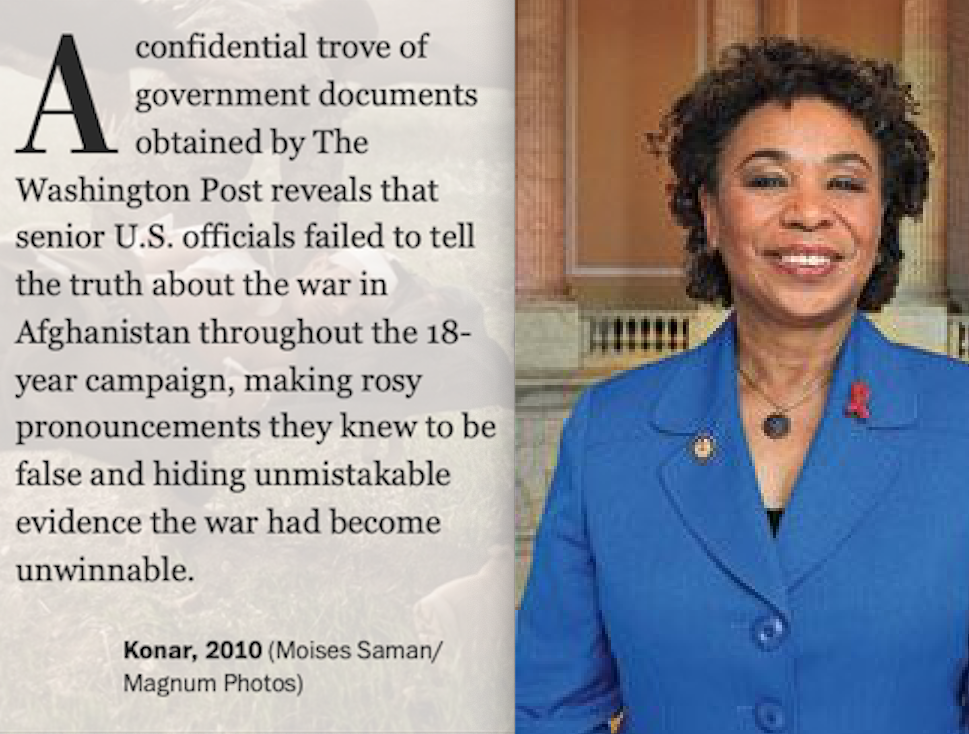
Craig Whitlock broke the story-- At War With The Truth-- The Afghanistan Papers-- in the Washington Post... and it's a doozy. I imagine Barbara Lee, the only member of the House to vote against attacking Afghanistan, is walking around with a big smile on her face today. Admiral Mike Franken (Ret) is a progressive Democrat running for Joni Ernst's Senate seat in Iowa. I asked him about the Afghanistan Papers since he was active duty for much of the war. "For many decades an unfortunate characteristic of American foreign policy has been to substitute a comprehensive approach with the Department of Defense, solely. Poor strategic direction, poor definition of end-state, poor coordination with allies, and even poorer understanding of regional cultures gives us Operation Enduring Freedom, et.al. We should insist on better leadership both in the White House and in Congress."


"In the interviews," wrote Whitlock of the more than 2,000 pages of interviews and memos about the secret history of a war still chugging along, "more than 400 insiders offered unrestrained criticism of what went wrong in Afghanistan and how the United States became mired in nearly two decades of warfare. With a bluntness rarely expressed in public, the interviews lay bare pent-up complaints, frustrations and confessions, along with second-guessing and backbiting."
“We were devoid of a fundamental understanding of Afghanistan-- we didn’t know what we were doing,” Douglas Lute, a three-star Army general who served as the White House’s Afghan war czar during the Bush and Obama administrations, told government interviewers in 2015. He added: “What are we trying to do here? We didn’t have the foggiest notion of what we were undertaking.”

“If the American people knew the magnitude of this dysfunction... 2,400 lives lost,” Lute added, blaming the deaths of U.S. military personnel on bureaucratic breakdowns among Congress, the Pentagon and the State Department. “Who will say this was in vain?”

Since 2001, more than 775,000 U.S. troops have deployed to Afghanistan, many repeatedly. Of those, 2,300 died there and 20,589 were wounded in action, according to Defense Department figures.

The interviews, through an extensive array of voices, bring into sharp relief the core failings of the war that persist to this day. They underscore how three presidents-- George W. Bush, Barack Obama and Donald Trump-- and their military commanders have been unable to deliver on their promises to prevail in Afghanistan.

With most speaking on the assumption that their remarks would not become public, U.S. officials acknowledged that their warfighting strategies were fatally flawed and that Washington wasted enormous sums of money trying to remake Afghanistan into a modern nation.

The interviews also highlight the U.S. government’s botched attempts to curtail runaway corruption, build a competent Afghan army and police force, and put a dent in Afghanistan’s thriving opium trade.

The U.S. government has not carried out a comprehensive accounting of how much it has spent on the war in Afghanistan, but the costs are staggering.

Since 2001, the Defense Department, State Department and U.S. Agency for International Development have spent or appropriated between $934 billion and $978 billion, according to an inflation-adjusted estimate calculated by Neta Crawford, a political science professor and co-director of the Costs of War Project at Brown University.

Those figures do not include money spent by other agencies such as the CIA and the Department of Veterans Affairs, which is responsible for medical care for wounded veterans.

“What did we get for this $1 trillion effort? Was it worth $1 trillion?” Jeffrey Eggers, a retired Navy SEAL and White House staffer for Bush and Obama, told government interviewers. He added, “After the killing of Osama bin Laden, I said that Osama was probably laughing in his watery grave considering how much we have spent on Afghanistan.”

The documents also contradict a long chorus of public statements from U.S. presidents, military commanders and diplomats who assured Americans year after year that they were making progress in Afghanistan and the war was worth fighting.

Several of those interviewed described explicit and sustained efforts by the U.S. government to deliberately mislead the public. They said it was common at military headquarters in Kabul-- and at the White House-- to distort statistics to make it appear the United States was winning the war when that was not the case.

“Every data point was altered to present the best picture possible,” Bob Crowley, an Army colonel who served as a senior counterinsurgency adviser to U.S. military commanders in 2013 and 2014, told government interviewers. “Surveys, for instance, were totally unreliable but reinforced that everything we were doing was right and we became a self-licking ice cream cone.”

John Sopko, the head of the federal agency that conducted the interviews, acknowledged to The Post that the documents show “the American people have constantly been lied to.”

The interviews are the byproduct of a project led by Sopko’s agency, the Office of the Special Inspector General for Afghanistan Reconstruction. Known as SIGAR, the agency was created by Congress in 2008 to investigate waste and fraud in the war zone.

In 2014, at Sopko’s direction, SIGAR departed from its usual mission of performing audits and launched a side venture. Titled “Lessons Learned,” the $11 million project was meant to diagnose policy failures in Afghanistan so the United States would not repeat the mistakes the next time it invaded a country or tried to rebuild a shattered one.

The Lessons Learned staff interviewed more than 600 people with firsthand experience in the war. Most were Americans, but SIGAR analysts also traveled to London, Brussels and Berlin to interview NATO allies. In addition, they interviewed about 20 Afghan officials, discussing reconstruction and development programs.

Drawing partly on the interviews, as well as other government records and statistics, SIGAR has published seven Lessons Learned reports since 2016 that highlight problems in Afghanistan and recommend changes to stabilize the country.

But the reports, written in dense bureaucratic prose and focused on an alphabet soup of government initiatives, left out the harshest and most frank criticisms from the interviews.

“We found the stabilization strategy and the programs used to achieve it were not properly tailored to the Afghan context, and successes in stabilizing Afghan districts rarely lasted longer than the physical presence of coalition troops and civilians,” read the introduction to one report released in May 2018.

The reports also omitted the names of more than 90 percent of the people who were interviewed for the project. While a few officials agreed to speak on the record to SIGAR, the agency said it promised anonymity to everyone else it interviewed to avoid controversy over politically sensitive matters.

Under the Freedom of Information Act, The Post began seeking Lessons Learned interview records in August 2016. SIGAR refused, arguing that the documents were privileged and that the public had no right to see them.

The Post had to sue SIGAR in federal court-- twice-- to compel it to release the documents.

The agency eventually disclosed more than 2,000 pages of unpublished notes and transcripts from 428 of the interviews, as well as several audio recordings.

The documents identify 62 of the people who were interviewed, but SIGAR blacked out the names of 366 others. In legal briefs, the agency contended that those individuals should be seen as whistleblowers and informants who might face humiliation, harassment, retaliation or physical harm if their names became public.

By cross-referencing dates and other details from the documents, The Post independently identified 33 other people who were interviewed, including several former ambassadors, generals and White House officials.

The Post has asked a federal judge to force SIGAR to disclose the names of everyone else interviewed, arguing that the public has a right to know which officials criticized the war and asserted that the government had misled the American people. The Post also argued the officials were not whistleblowers or informants, because they were not interviewed as part of an investigation.

A decision by Judge Amy Berman Jackson of the U.S. District Court in Washington has been pending since late September.

The Post is publishing the documents now, instead of waiting for a final ruling, to inform the public while the Trump administration is negotiating with the Taliban and considering whether to withdraw the 13,000 U.S. troops who remain in Afghanistan.

The Post attempted to contact for comment everyone whom it was able to identify as having given an interview to SIGAR. Their responses are compiled in a separate article.

Sopko, the inspector general, told The Post that he did not suppress the blistering criticisms and doubts about the war that officials raised in the Lessons Learned interviews. He said it took his office three years to release the records because he has a small staff and because other federal agencies had to review the documents to prevent government secrets from being disclosed.

“We didn’t sit on it,” he said. “We’re firm believers in openness and transparency, but we’ve got to follow the law... I think of any inspector general, I’ve probably been the most forthcoming on information.”

The interview records are raw and unedited, and SIGAR’s Lessons Learned staff did not stitch them into a unified narrative. But they are packed with tough judgments from people who shaped or carried out U.S. policy in Afghanistan.

“We don’t invade poor countries to make them rich,” James Dobbins, a former senior U.S. diplomat who served as a special envoy to Afghanistan under Bush and Obama, told government interviewers. “We don’t invade authoritarian countries to make them democratic. We invade violent countries to make them peaceful and we clearly failed in Afghanistan.”

To augment the Lessons Learned interviews, The Post obtained hundreds of pages of previously classified memos about the Afghan war that were dictated by Defense Secretary Donald H. Rumsfeld between 2001 and 2006.

Dubbed “snowflakes” by Rumsfeld and his staff, the memos are brief instructions or comments that the Pentagon boss dictated to his underlings, often several times a day.

Rumsfeld made a select number of his snowflakes public in 2011, posting them online in conjunction with his memoir, “Known and Unknown.” But most of his snowflake collection-- an estimated 59,000 pages-- remained secret.

In 2017, in response to a FOIA lawsuit filed by the National Security Archive, a nonprofit research institute based at George Washington University, the Defense Department began reviewing and releasing the remainder of Rumsfeld’s snowflakes on a rolling basis. The Archive shared them with The Post.

Together, the SIGAR interviews and the Rumsfeld memos pertaining to Afghanistan constitute a secret history of the war and an unsparing appraisal of 18 years of conflict.

Worded in Rumsfeld’s brusque style, many of the snowflakes foreshadow problems that continue to haunt the U.S. military more than a decade later.

“I may be impatient. In fact I know I’m a bit impatient,” Rumsfeld wrote in one memo to several generals and senior aides. “We are never going to get the U.S. military out of Afghanistan unless we take care to see that there is something going on that will provide the stability that will be necessary for us to leave.”

“Help!” he wrote.

The memo was dated April 17, 2002-- six months after the war started.

With their forthright descriptions of how the United States became stuck in a faraway war, as well as the government’s determination to conceal them from the public, the cache of Lessons Learned interviews broadly resembles the Pentagon Papers, the Defense Department’s top-secret history of the Vietnam War.

When they were leaked in 1971, the Pentagon Papers caused a sensation by revealing the government had long misled the public about how the United States came to be embroiled in Vietnam.

Bound into 47 volumes, the 7,000-page study was based entirely on internal government documents-- diplomatic cables, decision-making memos, intelligence reports. To preserve secrecy, Defense Secretary Robert McNamara issued an order prohibiting the authors from interviewing anyone.

SIGAR’s Lessons Learned project faced no such restrictions. Staffers carried out the interviews between 2014 and 2018, mostly with officials who served during the Bush and Obama years.

About 30 of the interview records are transcribed, word-for-word accounts. The rest are typed summaries of conversations: pages of notes and quotes from people with different vantage points in the conflict, from provincial outposts to the highest circles of power.

Some of the interviews are inexplicably short. The interview record with John Allen, the Marine general who commanded U.S. and NATO forces in Afghanistan from 2011 to 2013, consists of five paragraphs.

In contrast, other influential figures, including former U.S. ambassador Ryan Crocker, sat for two interviews that yielded 95 transcribed pages.

Unlike the Pentagon Papers, none of the Lessons Learned documents were originally classified as a government secret. Once The Post pushed to make them public, however, other federal agencies intervened and classified some material after the fact.

The State Department, for instance, asserted that releasing portions of certain interviews could jeopardize negotiations with the Taliban to end the war. The Defense Department and Drug Enforcement Administration also classified some interview excerpts.

The Lessons Learned interviews contain few revelations about military operations. But running throughout are torrents of criticism that refute the official narrative of the war, from its earliest days through the start of the Trump administration.

At the outset, for instance, the U.S. invasion of Afghanistan had a clear, stated objective-- to retaliate against al-Qaeda and prevent a repeat of the Sept. 11, 2001, attacks.

Yet the interviews show that as the war dragged on, the goals and mission kept changing and a lack of faith in the U.S. strategy took root inside the Pentagon, the White House and the State Department.

Fundamental disagreements went unresolved. Some U.S. officials wanted to use the war to turn Afghanistan into a democracy. Others wanted to transform Afghan culture and elevate women’s rights. Still others wanted to reshape the regional balance of power among Pakistan, India, Iran and Russia.

“With the AfPak strategy there was a present under the Christmas tree for everyone,” an unidentified U.S. official told government interviewers in 2015. “By the time you were finished you had so many priorities and aspirations it was like no strategy at all."

The Lessons Learned interviews also reveal how U.S. military commanders struggled to articulate who they were fighting, let alone why.

Was al-Qaeda the enemy, or the Taliban? Was Pakistan a friend or an adversary? What about the Islamic State and the bewildering array of foreign jihadists, let alone the warlords on the CIA’s payroll? According to the documents, the U.S. government never settled on an answer.

As a result, in the field, U.S. troops often couldn’t tell friend from foe.

“They thought I was going to come to them with a map to show them where the good guys and bad guys live,” an unnamed former adviser to an Army Special Forces team told government interviewers in 2017. “It took several conversations for them to understand that I did not have that information in my hands. At first, they just kept asking: ‘But who are the bad guys, where are they?’”


The view wasn’t any clearer from the Pentagon.

“I have no visibility into who the bad guys are,” Rumsfeld complained in a Sept. 8, 2003, snowflake. “We are woefully deficient in human intelligence.”

As commanders in chief, Bush, Obama and Trump all promised the public the same thing. They would avoid falling into the trap of “nation-building” in Afghanistan.

On that score, the presidents failed miserably. The United States has allocated more than $133 billion to build up Afghanistan-- more than it spent, adjusted for inflation, to revive the whole of Western Europe with the Marshall Plan after World War II.

The Lessons Learned interviews show the grandiose nation-building project was marred from the start.

U.S. officials tried to create-- from scratch-- a democratic government in Kabul modeled after their own in Washington. It was a foreign concept to the Afghans, who were accustomed to tribalism, monarchism, communism and Islamic law.

“Our policy was to create a strong central government which was idiotic because Afghanistan does not have a history of a strong central government,” an unidentified former State Department official told government interviewers in 2015. “The timeframe for creating a strong central government is 100 years, which we didn’t have.”

Meanwhile, the United States flooded the fragile country with far more aid than it could possibly absorb.

During the peak of the fighting, from 2009 to 2012, U.S. lawmakers and military commanders believed the more they spent on schools, bridges, canals and other civil-works projects, the faster security would improve. Aid workers told government interviewers it was a colossal misjudgment, akin to pumping kerosene on a dying campfire just to keep the flame alive.

One unnamed executive with the U.S. Agency for International Development (USAID), guessed that 90 percent of what they spent was overkill: “We lost objectivity. We were given money, told to spend it and we did, without reason.”

Many aid workers blamed Congress for what they saw as a mindless rush to spend.

One unidentified contractor told government interviewers he was expected to dole out $3 million daily for projects in a single Afghan district roughly the size of a U.S. county. He once asked a visiting congressman whether the lawmaker could responsibly spend that kind of money back home: “He said hell no. ‘Well, sir, that’s what you just obligated us to spend and I’m doing it for communities that live in mud huts with no windows.’”

The gusher of aid that Washington spent on Afghanistan also gave rise to historic levels of corruption.

In public, U.S. officials insisted they had no tolerance for graft. But in the Lessons Learned interviews, they admitted the U.S. government looked the other way while Afghan power brokers-- allies of Washington-- plundered with impunity.

Christopher Kolenda, an Army colonel who deployed to Afghanistan several times and advised three U.S. generals in charge of the war, said that the Afghan government led by President Hamid Karzai had “self-organized into a kleptocracy” by 2006-- and that U.S. officials failed to recognize the lethal threat it posed to their strategy.

“I like to use a cancer analogy,” Kolenda told government interviewers. “Petty corruption is like skin cancer; there are ways to deal with it and you’ll probably be just fine. Corruption within the ministries, higher level, is like colon cancer; it’s worse, but if you catch it in time, you’re probably ok. Kleptocracy, however, is like brain cancer; it’s fatal.”

By allowing corruption to fester, U.S. officials told interviewers, they helped destroy the popular legitimacy of the wobbly Afghan government they were fighting to prop up. With judges and police chiefs and bureaucrats extorting bribes, many Afghans soured on democracy and turned to the Taliban to enforce order.

“Our biggest single project, sadly and inadvertently, of course, may have been the development of mass corruption,” Crocker, who served as the top U.S. diplomat in Kabul in 2002 and again from 2011 to 2012, told government interviewers. He added, “Once it gets to the level I saw, when I was out there, it’s somewhere between unbelievably hard and outright impossible to fix it.”

Year after year, U.S. generals have said in public they are making steady progress on the central plank of their strategy: to train a robust Afghan army and national police force that can defend the country without foreign help.

In the Lessons Learned interviews, however, U.S. military trainers described the Afghan security forces as incompetent, unmotivated and rife with deserters. They also accused Afghan commanders of pocketing salaries-- paid by U.S. taxpayers-- for tens of thousands of “ghost soldiers.”

None expressed confidence that the Afghan army and police could ever fend off, much less defeat, the Taliban on their own. More than 60,000 members of Afghan security forces have been killed, a casualty rate that U.S. commanders have called unsustainable.

One unidentified U.S. soldier said Special Forces teams “hated” the Afghan police whom they trained and worked with, calling them "awful-- the bottom of the barrel in the country that is already at the bottom of the barrel.”

A U.S. military officer estimated that one-third of police recruits were “drug addicts or Taliban.” Yet another called them “stealing fools” who looted so much fuel from U.S. bases that they perpetually smelled of gasoline.

“Thinking we could build the military that fast and that well was insane,” an unnamed senior USAID official told government interviewers.

Meanwhile, as U.S. hopes for the Afghan security forces failed to materialize, Afghanistan became the world’s leading source of a growing scourge: opium.

The United States has spent about $9 billion to fight the problem over the past 18 years, but Afghan farmers are cultivating more opium poppies than ever. Last year, Afghanistan was responsible for 82 percent of global opium production, according to the United Nations Office on Drugs and Crime.

In the Lessons Learned interviews, former officials said almost everything they did to constrain opium farming backfired.

“We stated that our goal is to establish a ‘flourishing market economy,’” said Douglas Lute, the White House’s Afghan war czar from 2007 to 2013. “I thought we should have specified a flourishing drug trade-- this is the only part of the market that’s working.”

From the beginning, Washington never really figured out how to incorporate a war on drugs into its war against al-Qaeda. By 2006, U.S. officials feared that narco-traffickers had become stronger than the Afghan government and that money from the drug trade was powering the insurgency.

No single agency or country was in charge of the Afghan drug strategy for the entirety of the war, so the State Department, the DEA, the U.S. military, NATO allies and the Afghan government butted heads constantly.

“It was a dog’s breakfast with no chance of working,” an unnamed former senior British official told government interviewers.

The agencies and allies made things worse by embracing a dysfunctional muddle of programs, according to the interviews.

At first, Afghan poppy farmers were paid by the British to destroy their crops-- which only encouraged them to grow more the next season. Later, the U.S. government eradicated poppy fields without compensation-- which only infuriated farmers and encouraged them to side with the Taliban.

“It was sad to see so many people behave so stupidly,” one U.S. official told government interviewers.

The specter of Vietnam has hovered over Afghanistan from the start.

On Oct. 11, 2001, a few days after the United States started bombing the Taliban, a reporter asked Bush: “Can you avoid being drawn into a Vietnam-like quagmire in Afghanistan?”

“We learned some very important lessons in Vietnam,” Bush replied confidently. “People often ask me, ‘How long will this last?’ This particular battlefront will last as long as it takes to bring al-Qaeda to justice. It may happen tomorrow, it may happen a month from now, it may take a year or two. But we will prevail.”

In those early days, other U.S. leaders mocked the notion that the nightmare of Vietnam might repeat itself in Afghanistan.

“All together now-- quagmire!” Rumsfeld joked at a news conference on Nov. 27, 2001.

But throughout the Afghan war, documents show that U.S. military officials have resorted to an old tactic from Vietnam-- manipulating public opinion.

In news conferences and other public appearances, those in charge of the war have followed the same talking points for 18 years. No matter how the war is going-- and especially when it is going badly-- they emphasize how they are making progress.

For example, some snowflakes that Rumsfeld released with his memoir show he had received a string of unusually dire warnings from the war zone in 2006.

After returning from a fact-finding mission to Afghanistan, Barry McCaffrey, a retired Army general, reported the Taliban had made an impressive comeback and predicted that “we will encounter some very unpleasant surprises in the coming 24 months.”

“The Afghan national leadership are collectively terrified that we will tip-toe out of Afghanistan in the coming few years-- leaving NATO holding the bag-- and the whole thing will collapse again into mayhem,” McCaffrey wrote in June 2006.

Two months later, Marin Strmecki, a civilian adviser to Rumsfeld, gave the Pentagon chief a classified, 40-page report loaded with more bad news. It said “enormous popular discontent is building” against the Afghan government because of its corruption and incompetence. It also said that the Taliban was growing stronger, thanks to support from Pakistan, a U.S. ally.

Yet with Rumsfeld’s personal blessing, the Pentagon buried the bleak warnings and told the public a very different story.

In October 2006, Rumsfeld’s speechwriters delivered a paper titled “Afghanistan: Five Years Later.” Brimming with optimism, it highlighted more than 50 promising facts and figures, from the number of Afghan women trained in “improved poultry management” (more than 19,000) to the “average speed on most roads” (up 300 percent).

“Five years on, there is a multitude of good news,” it read. “While it has become fashionable in some circles to call Afghanistan a forgotten war, or to say the United States has lost its focus, the facts belie the myths.”

Rumsfeld thought it was brilliant.

“This paper,” he wrote in a memo, “is an excellent piece. How do we use it? Should it be an article? An Op-ed piece? A handout? A press briefing? All of the above? I think it ought to get it to a lot of people.”

His staffers made sure it did. They circulated a version to reporters and posted it on Pentagon websites.

Since then, U.S. generals have almost always preached that the war is progressing well, no matter the reality on the battlefield.

“We’re making some steady progress,” Maj. Gen. Jeffrey Schloesser, commander of the 101st Airborne Division, told reporters in September 2008, even as he and other U.S. commanders in Kabul were urgently requesting reinforcements to cope with a rising tide of Taliban fighters.

Two years later, as the casualty rate among U.S. and NATO troops climbed to another high, Army Lt. Gen. David Rodriguez held a news conference in Kabul.

“First, we are steadily making deliberate progress,” he said.

In March 2011, during congressional hearings, skeptical lawmakers pelted Army Gen. David H. Petraeus, the commander of U.S. and NATO forces in Afghanistan, with doubts that the U.S. strategy was working.

“The past eight months have seen important but hard-fought progress,” Petraeus responded.

One year later, during a visit to Afghanistan, Defense Secretary Leon Panetta stuck to the same script-- even though he had just personally dodged a suicide attack.

“The campaign, as I’ve pointed out before, I think has made significant progress,” Panetta told reporters.

In July 2016, after a surge in Taliban attacks on major cities, Army Gen. John W. Nicholson Jr., the commander of U.S. forces in Afghanistan at the time, repeated the refrain.

“We are seeing some progress,” he told reporters.

During Vietnam, U.S. military commanders relied on dubious measurements to persuade Americans that they were winning.

Most notoriously, the Pentagon highlighted “body counts,” or the number of enemy fighters killed, and inflated the figures as a measurement of success.

In Afghanistan, with occasional exceptions, the U.S. military has generally avoided publicizing body counts. But the Lessons Learned interviews contain numerous admissions that the government routinely touted statistics that officials knew were distorted, spurious or downright false.


A person identified only as a senior National Security Council official said there was constant pressure from the Obama White House and Pentagon to produce figures to show the troop surge of 2009 to 2011 was working, despite hard evidence to the contrary.

“It was impossible to create good metrics. We tried using troop numbers trained, violence levels, control of territory and none of it painted an accurate picture,” the senior NSC official told government interviewers in 2016. “The metrics were always manipulated for the duration of the war.”

Even when casualty counts and other figures looked bad, the senior NSC official said, the White House and Pentagon would spin them to the point of absurdity. Suicide bombings in Kabul were portrayed as a sign of the Taliban’s desperation, that the insurgents were too weak to engage in direct combat. Meanwhile, a rise in U.S. troop deaths was cited as proof that American forces were taking the fight to the enemy.

“It was their explanations,” the senior NSC official said. “For example, attacks are getting worse? ‘That’s because there are more targets for them to fire at, so more attacks are a false indicator of instability.’ Then, three months later, attacks are still getting worse? ‘It’s because the Taliban are getting desperate, so it’s actually an indicator that we’re winning.’”

“And this went on and on for two reasons,” the senior NSC official said, “to make everyone involved look good, and to make it look like the troops and resources were having the kind of effect where removing them would cause the country to deteriorate.”

In other field reports sent up the chain of command, military officers and diplomats took the same line. Regardless of conditions on the ground, they claimed they were making progress.

“From the ambassadors down to the low level, [they all say] we are doing a great job,” Michael Flynn, a retired three-star Army general, told government interviewers in 2015. “Really? So if we are doing such a great job, why does it feel like we are losing?”

Upon arrival in Afghanistan, U.S. Army brigade and battalion commanders were given the same basic mission: to protect the population and defeat the enemy, according to Flynn, who served multiple tours in Afghanistan as an intelligence officer.

“So they all went in for whatever their rotation was, nine months or six months, and were given that mission, accepted that mission and executed that mission,” said Flynn, who later briefly served as Trump’s national security adviser, lost his job in a scandal and was convicted of lying to the FBI. “Then they all said, when they left, they accomplished that mission. Every single commander. Not one commander is going to leave Afghanistan... and say, ‘You know what, we didn’t accomplish our mission.’”

He added: “So the next guy that shows up finds it [their area] screwed up... and then they come back and go, ‘Man this is really bad.’”

Bob Crowley, the retired Army colonel who served as a counterinsurgency adviser in Afghanistan in 2013 and 2014, told government interviewers that “truth was rarely welcome” at military headquarters in Kabul.

“Bad news was often stifled,” he said. “There was more freedom to share bad news if it was small-- we’re running over kids with our MRAPs [armored vehicles]-- because those things could be changed with policy directives. But when we tried to air larger strategic concerns about the willingness, capacity or corruption of the Afghan government, it was clear it wasn’t welcome.”

John Garofano, a Naval War College strategist who advised Marines in Helmand province in 2011, said military officials in the field devoted an inordinate amount of resources to churning out color-coded charts that heralded positive results.

“They had a really expensive machine that would print the really large pieces of paper like in a print shop,” he told government interviewers. “There would be a caveat that these are not actually scientific figures, or this is not a scientific process behind this.”

But Garofano said nobody dared to question whether the charts and numbers were credible or meaningful.

“There was not a willingness to answer questions such as, what is the meaning of this number of schools that you have built? How has that progressed you towards your goal?” he said. “How do you show this as evidence of success and not just evidence of effort or evidence of just doing a good thing?”

Other senior officials said they placed great importance on one statistic in particular, albeit one the U.S. government rarely likes to discuss in public.

“I do think the key benchmark is the one I’ve suggested, which is how many Afghans are getting killed,” James Dobbins, the former U.S. diplomat, told a Senate panel in 2009. “If the number’s going up, you’re losing. If the number’s going down, you’re winning. It’s as simple as that.”

Last year, 3,804 Afghan civilians were killed in the war, according to the United Nations.

That is the most in one year since the United Nations began tracking casualties a decade ago.


That was part 1. Part 2 is Stranded Without A Strategy: Bush and Obama had polar-opposite plans to win the war. Both were destined to fail. Part 3 is Built To Fail: Despite vows the U.S. wouldn’t get mired in “nation-building,” it’s wasted billions doing just that. Part 4 is Consumed By Corruption: The U.S. flooded the country with money-- then turned a blind eye to the graft it fueled. Part 5 is Unguarded Nation: Afghan security forces, despite years of training, were dogged by incompetence and corruption. Part 6 is Overwhelmed By Opium: The U.S. war on drugs in Afghanistan has imploded at nearly every turn.

Before he was elected to Congress, Alan Grayson was the first attorney to take a case to trial against war profiteers in Iraq and win, after the Bush Administration declined to prosecute the case. Once in Congress, it was one of the most anti-war members and attempted to get the U.S. to withdraw from Afghanistan every time he had the opportunity. "It’s always that way," he told me after reading the report in The Post. "Remember the Maine. The Tonkin Gulf Resolution. Weapons of Mass Destruction. It’s been 75 years since we had an honest war." 


Labels: , ,

Wednesday, November 20, 2019

Doctors Look At Trump... Oy

>


Trump made a sudden, unscheduled visit to Walter Reed Hospital last weekend. He looked sick and on death's door as he climbed into the White House SUV. Even though he still isn't dead, Chuck Todd and his Meet The Press team reported yesterday that 8 weeks of impeachment, with one bombshell revelation after another, has taken a toll on Trump. He's tweeting more than usual and crazier and more inflammatorily than usual and he's lying more than usual. And in the middle of it all, he's lost both legislative chambers in Virginia and the governors' mansions in two super-red states-- Kentucky and Louisiana-- races which he made sure would be all about him. "What the impeachment inquiry has done is produce the worst version of Trump-- the tweeting, the dissembling, the changing explanations... he can’t compartmentalize," wrote Todd. He's going to die like a dog, maybe soon. I absolutely hope his carcass will be food for worms soon, very soon. Stephen Colbert claims he doesn't want Trump to leave the White House feet first; he wants to see him leave handcuffs first. As you can see below, Twitter agrees with Colbert, not with me:


A few days ago, another doctor, psychologist, psychoanalyst and former Johns Hopkins University Medical School professor John Gartner, was interviewed by Salon reporter Chauncey DeVega on Trump’s mental state and the likelihood that impeachment will force the president to act out in even more dangerous and unpredictable ways. "Gartner," wrote DeVega, "also explains the ways that Trump’s malignant narcissism manifests itself through sadistic pleasure, which may even be sexual in nature. Gartner also considers what will happen to Trump’s followers and their 'fascist fever' when Trump is eventually no longer president of the United States."
DeVega: If Donald Trump were your patient, how would you evaluate his behavior over the last year or so? Is Donald Trump's behavior devolving, as predicted by the medical literature?

Gartner: Yes, but in ways that I think are even more ominous than when we spoke almost a year ago. Trump is a malignant narcissist. Erich Fromm, the noted psychoanalyst who studied Nazi Germany-- and the person who introduced the diagnosis of “narcissism”-- explained that in such personalities their grandiosity, their narcissism, their paranoia, conspiracy theories, sociopathy, criminal behavior and sadism all go into overdrive when they get power. Those traits are also inflamed when a narcissist is challenged or attacked.

And there is a feedback loop as well, where because they're gaining power-- which inflames their narcissism and their paranoia and their freedom to act on their criminal impulses-- of course that means there will be opposition and resistance to them. Narcissists like Donald Trump then demonize and try to brutalize and invalidate anyone who does not kiss his ring. Trump has systematically eliminated every single guardrail on his power and behavior in the White House.

There is literally nobody, not one person, who can tell him “no” right now, intervene against him. But there is another element to Trump’s dangerous behavior that we should be paying very close attention to. I believe that Donald Trump is having a hypomanic episode.

Many reporters and journalists have described Trump’s recent behavior as manic. Concerned observers highlight Trump’s tweets, which have greatly increased in number.

A hypomanic episode is not the same as a manic episode. “Manic” is only partially accurate in describing Donald Trump because when somebody is manic, they think they're Jesus Christ, which means they are psychotic and usually end up in the psychiatric hospital. But when someone's hypomanic, they become more agitated, more energized, more impulsive. They act out more aggressively with poorer judgment. A hypomanic person does not listen to anybody. They do not delay their activity. They do not accept feedback from anybody else.

This means that a hypomanic person can act quickly, impulsively and urgently, with poor judgment, in ways that will have predictably catastrophic consequences. A person with that temperament can, in moments of stress, devolve into something that is a psychiatric disorder. Essentially, everything gets accelerated for the worst. This is what we are now seeing with Donald Trump. When this will really become an even greater crisis-- a crescendo in his dangerous behavior-- is when Donald Trump starts making catastrophic moves internationally. He could start a war.

DeVega: Trump’s speech after the Delta Force commandos killed al-Baghdadi, the ISIS leader, was utterly unpresidential. It was crass and disturbing. He was truly in his element.

Gartner: Note Trump’s lies and grandiosity. Of course, he claims that he destroyed ISIS. He has said things such as "I'm the chosen one." It is malignant narcissism and grandiosity, which has become more extreme.


It is very alarming that Trump’s dysfunctional behavior is getting worse-- even by earlier standards, which were very alarming. For example, Trump made a catastrophic decision to impulsively withdraw the U.S. military from Syria which leaves the Kurds to face genocide. He literally picked up the phone, talked to the president of Turkey, and without consulting or informing even one human being in his own administration, literally at 3:00 a.m. and called the military and said, "Start withdrawing from Syria." That is a manic style of decision-making. It did start a war. There is always that narrative about a president’s leadership and the 3 a.m. phone call about a global crisis as the test of his leadership. Well, in this case Donald Trump is the crisis. He is the 3 a.m. phone call.

DeVega: What do we do in a moment where it is the president of the United States who is the greatest danger to the nation and the world?

Gartner: It's not that Donald Trump is the greatest danger to the world, but that he is so much more erratic and desperate, and more driven now to act out in destructive ways to feel powerful.

DeVega: Donald Trump was booed during the World Series. The same thing happened when he went to Madison Square Garden to attend a UFC event. During the baseball game Trump looked like a man about to explode in rage and tears. In such a moment, how does a malignant narcissist such as Donald Trump resolve the obvious public scorn, when he imagines himself as being universally loved?

Gartner: Reality has always been fluid for Donald Trump. Erich Fromm said that malignant narcissists live on the boundary between sanity and insanity. This is a state almost akin to being in the middle between psychosis and neurosis. Because Donald Trump is such an inveterate liar and con man, the American people and the world do not know if Trump is just trying to con everybody or if he actually believes the crazy conspiracy theories that he touts, or crazy grandiose things such as the claim that he won the popular vote, or that he is cheered instead of being booed at public events.

I believe that Donald Trump may just be lying and at other times he may be delusional. It shifts back and forth. People who have this level of severe personality disorder must psychologically project everything bad outward. They can never be to blame. They're always the victim. Someone else is always to blame. They can't own up to the bad things that they're doing, so they must externalize the blame. People like Trump end up accusing other people of the very thing within themselves that they cannot tolerate or acknowledge.

DeVega: At his rallies and other events Trump often claims that the Democrats don't respect the Constitution: "They're traitors, they're treasonous. The Democrats have conducted a coup.” Does Trump actually believe that, or is that all outward projection of his own internalized guilt?

Gartner: Donald Trump is incapable of feeling guilt, shame or remorse. But Trump does project externally onto others what he knows is within himself. Sometimes it's unconscious, though, so Trump is not aware that he's projecting. Donald Trump does not feel any compunction about lying. Donald Trump cannot tolerate anything negative about himself, therefore he needs to experience it as coming from the outside where he is the innocent victim.

DeVega: Several weeks ago, Trump publicly said that his wife, Melania, would not be willing to take a bullet for him. Was that a moment of honesty about their relationship?

Gartner: Donald Trump is a person who really is incapable of thinking of relationships as being anything but transactional. I don't believe that Trump has a single human being in the world who actually feels affection for him or likes him and where he in turn returns the favor. There's no human being that Donald Trump likes, unless they are helping Trump or doing something useful for him at a given moment. But the minute that person stops being useful, they cease to exist to Donald Trump.


If you look at malignant narcissistic leaders such as Hitler, Stalin, Mao, Saddam Hussein and others, they all act in that way. Unless you are a slavish toady, such personalities will eventually see you as an enemy. This is what we've seen with Trump’s systematic purging of people in the White House. Anyone who does not put the Great Leader above all other things-- in this case, above American democracy-- is purged. And that is how you get a totalitarian state.

DeVega: Trump has really normalized deviance. At one of his recent rallies he even pretended to have an orgasm on stage while re-enacting a sex act. There is a deeply libidinal connection between Donald Trump and his cult members. This is an aspect of fascism which is little understood by the general public and most in the news media.

Gartner: Trump experiences great pleasure from sadism. One of the four components of narcissism is sadism, getting pleasure-- maybe even sexual pleasure-- from degrading, humiliating and harming your enemies.

DeVega: What about Trump’s threats of both explicit and implied lethal violence against the Democrats, the whistleblower and other people who dare to oppose him?

Gartner: What would Trump be like if he didn't have the restraints from the remnants of the United States Constitution or the Democrats in the House of Representatives? We have to wonder how many immigrants would be in concentration camps right now. How many FBI agents and Democrats and journalists would be in jail?


Donald Trump would not mind seeing some journalists killed. I don't think Trump sees the deaths of journalists as a bad thing. In totalitarian states like Russia, journalists are killed and the opposition is jailed. The courts are used to put people in jail for “corruption” when they dare to challenge the real corruption of the state. Donald Trump would be as bad as any of the other totalitarian leaders throughout history if he had the chance and the unrestricted power.

DeVega: The New York Times has analyzed approximately 11,000 of Trump’s tweets. Reading them as a mental health professional, what do Trump’s tweets reveal?

Gartner: The most frequent use of Trump’s tweets is to attack people. There's almost a manic level to Trump’s rage. The other most common category was self-praise. Trump is a malignant narcissist. He's shamelessly grandiose. Trump’s paranoia is inflamed and all these behaviors and traits are getting dramatically worse because he's destabilized.

DeVega: When Trump looks in the mirror, what do you think he sees?

Gartner: I think that Donald Trump sees a god. I believe that Donald Trump sees someone who's the greatest president in history.

DeVega: All that boasting seems to suggest he is very weak inside.

Gartner: Absolutely. Donald Trump is an empty shell of a human being. That is what he is manically trying to overcome with all this grandiosity. Deep down inside, Donald Trump is a very empty and sad person. His attempt to compensate is that Donald Trump is going to beat the world to death to prove that he really is triumphant. I believe that Donald Trump’s whole life is about a battle to be dominant and to crush his enemies. That is what gets him off. It excites him. The problem with people like Donald Trump is that there is no limit to the amount of destruction they are willing to create.

DeVega: Donald Trump is likely going to be impeached in the House and then acquitted by the Republican-controlled Senate. What comes next? I am deeply concerned that the impeachment process will end with Trump feeling vindicated and free to act even more like a demagogue and a tyrant.

Gartner: One of the most ominous recent developments is that Trump is telling the Republican senators who will vote on his impeachment that he will give them money. The fact that other than Sen. Mitt Romney, no senior Republicans have spoken against him. Trump’s already got the fix in with the swing-state senators. Trump is ready to take his behavior to the next horrible level. Trump already realizes, "They're not going to stop me."

DeVega: How will Trump’s supporters in his political cult react if he is removed from office or otherwise forced out? And how will Trump’s behavior continue to worsen?

Gartner: The fever breaks when the malignant narcissistic leader is removed. After Hitler, the Germans were fine. They weren't intrinsically bad people. It was like a fever that was being led by this madman. Some people were more susceptible to it than others and then it took over the society.

I think the thing to keep our eyes on now is that the rate and the volume of Trump’s dysfunction are accelerating. We're actually entering a period where Donald Trump is like a rocket taking off. The rate and the extremism of Trump’s madness is escalating. His acting out is escalating. America and the world are in an escalating crisis right now in terms of Trump’s mental health.


Labels: ,