Saturday, February 19, 2011

Reminder: There are still two concerts left in the St. Petersburg Quartet's historic Shostakovich-Beethoven cycle in Brooklyn

>
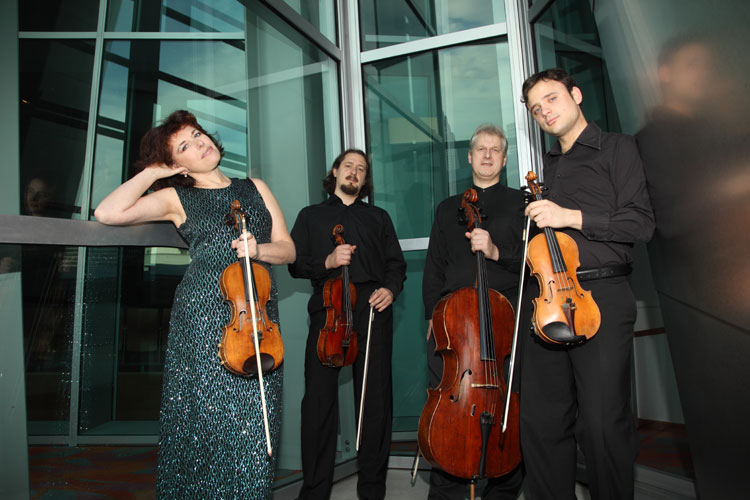
The St. Petersburg Quartet: unflappably poised and probing founding first violinist Alla Aranovskaya, violist Boris Vayner (with the quartet since 2005, and an ear-opener in last night's performance of the Shostakovich 13th Quartet), rock-solid founding cellist Leonid Shukayev, and a shorter-haired version of unreasonably adorable second violinist Evgeny Zvonnikov (with the quartet since 2010). Last night's concert was "one of the great concerts of my (alarmingly long) concertgoing experience."

by Ken

I should have tried harder to squeeze into yesterday's schedule a reminder about the weekend event I previewed last weekend: the second half of the St. Petersburg String Quartet's six-concert series of the complete Shostakovich quartets accompanied by selected mid-to-late Beethoven quartets. Obviously my regular 6pm PT post would have been too late to remind anyone about last night's concert, so I put off any reminder to today. And then, instead of writing this post for the 10am PT slot, I opted instead for more fulminating on the right-wing hooligans now running amok in the nation's statehouses and in the U.S. House of Representatives. Like my fulminating is going to do anything about it!

In the event that my I thereby deprived anyone of the opportunity to get to last night's concert, or of the time to plan to attend tonight's, which features one of the more attractive-looking programs, I apologize, because last night's was one of the great concerts of my (alarmingly long) concertgoing experience. I'm inclined now to take off the hypotheticals and question marks I've been using in describing the St. Petersburg as possibly the foremost string quartet before the public today. Not only do I know of no current quartet that can do what these folks did last night, but I don't know of any quartet of any era that could have surpassed it.

I really enjoyed the two concerts I attended out of the first three, January 21-23. (I missed the Friday night but got to the Saturday night and Sunday afternoon.) But I'm not sure the quartet was necessarily at its very best. For one thing, it was frigidly cold. At Bargemusic, on Brooklyn's East River waterfront at Fulton Ferry Landing, you really are on a real live barge in the East River, with windows on the performers' end opening onto the lower Manhattan skyline. Even though the barge itself seemed gratifyingly well heated, I'm not sure how warm it was at the performers' windowed end, and getting there through the deep freeze can't have been easy on either body or mind. And I can't say that the audience turnout was exactly overwhelming, especially when you consider the stature of these performers. (Is this what happens, even in the supposedly aesthetically sensitive classical-music world, when you don't have a high-powered PR machine behind you? I suspect so.)

Of course it may be that my concentration too was off, but in any case, admirable as all of the performances were, I at least didn't feel totally engaged until the final work on each of the programs I heard: the glorious Shostakovich Third Quartet on Saturday, Beethoven's Op. 59, No. 3 on Sunday. Last night, however, I felt gripped from the opening bars of another of my most-loved quartets, the Shostakovich Sixth (one of the pieces we previewed and heard in its entirety last Sunday), and that concentration and intensity remained unflagging through four exceedingly concentrated and intense works. The St. Petersburg not only got full artistic value for all four but made several of them sound approachable in a way I've never experienced before.

I have to say, for example, that I've never quite been on board with the widespread popularity of the Shostakovich Eighth Quartet, which for a lot of music-lovers has been the one Shostakovich quartet they knew. And it's not because the work seems to me "too easy," as often happens when there's one work out of bunch singled out for popularity. Much as I've respected the piece, with its rather gnarly, contentious quality it has always seemed to me a harder sell than any number of other Shostakovich quartets, like the Third and Sixth, and maybe the First and Second and Ninth. But last night the St. Petersburg set the piece out in a way that made it overwhelmingly gripping and moving for me, and left me eager to go back and listen to it some more.

The same was true of the relatively short 13th Quartet (roughly 20 minutes), which has generally seemed to me a beautiful but unwelcomingly wintry piece. Without flinching at its melancholy depths, the St. Petersburg made the whole piece emotionally gripping, with a generous assist from a secret weapon: current violist Boris Vayner.

The Shostakovich 13th Quartet is dedicated to Vadim Borisovsky, the original violist of the Beethoven Quartet, with which the composer had a close bond -- inexplicably close to me, in that I've never gotten much of a message from the Beethoven Quartet's records over a long period of time. Nevertheless, Shostakovich eventually devoted a quartet to each of the four original members, and not surprisingly there embedded special "prizes" for the dedicatees. The 13th Quartet has some simply haunting viola solos, which must be a dream for the player to play, but they also carry a lot of pressure: not just that they're extremely exposed, but that they require the player to deliver. I certainly had no complaints about Vayner's utterly musical playing in the first two and a half concerts I heard, but in the Shostakovich 13th he floored me. Credit the composer with creating those opportunities, but it's up to the performer to deliver, and did Vayner ever!
From the St. Petersburg's Dec. 2000- Jan. 2001 recording of the Shostakovich 13th Quartet, the final minutes are played by violist Alexei Koptev and cellist Leonid Shukayev with violinists Alla Aranovskaya and Ilya Teplyakov.

I have to say that the St. Petersburg has shown excellent taste in violists. In their Shostakovich recordings we had the pleasure of encountering three violists: Andrei Dogadin, Konstantin Kats, and Alexei Koptev, all first-rate. I'm very curious now to go back to the recording of the 13th Quartet, with Koptev. I suspect it's going to give me more pleasure than ever before, because in the cases of both the Eighth Quartet, a piece I've heard a lot, and the 13th, a piece I've heard a fair amount, last night's performances taught me an enormous amount about how to listen to them. (I just noticed, by the way, that Hyperion has gathered the St. Petersburg Shostakovich quartet cycle, including the Piano Trio and Piano Quintet, which I've described repeatedly as one of the great projects in recording history, and which I labored to collect in single-disc form, in a handy box.)

Coming off the haunting intensity of the St. Petersburg's Shostakovich 13th Quartet, not just violist Vayner but the whole quartet seemed to find i Beethoven's Op. 95 something of a cleansing release. For Beethoven the "little" Op. 95 -- it's conspicuously more compact than the earlier "middle" Beethoven quartets, the three of Op. 59 and the majestic "Harp," Op. 74 -- seems to have been an exercise in "writing small." But Beethoven wasn't much for "thinking small," and those nestled smaller works in all media tend to be not so much shorter as more concentrated and focused than their more expansive brethren. Op. 95 is a protean, constantly evolving piece that evokes none other than Shostakovich; it occurred to me that Shostakovich must have taken it very much to heart. The fast tempos of the outer movements were bracing without being excessive, and in slower motion the St. Petersburg players seemed simply to glow. While loving the Beethoven performance, I kept wondering whether it would have had quite this level of physical energy if it hadn't come right after the Shostakovich 13th.

It will be fascinating tonight to hear the St. Petersburg tackle Beethoven's next quartet, the E-flat major, Op. 127, written after a quartet hiatus of more than a decade and jumping the gap from "middle" to "late" Beethoven. It's a piece I love particularly, for its bold streak of extroversion (from the grand opening, you would never guess that we were in such a string-improbable key as E-flat major, which basically nullifies the vibrant sound of the instruments' open strings). Also on tonight's program is the searingly beautiful 14th Quartet, the other work we previewed last Sunday, and the Tenth Quartet. Tomorrow afternoon we hear three late Shostakovich quartets, Nos. 11, 12, and 15, plus Beethoven's ferociously monumental Grosse Fuge, the original finale of the quartet that followed Op. 127, Op. 130, which even the composer was persuaded was perhaps too much for both performers and listeners. (I always find it fascinating to hear the wildly differnet direction he went in in composing a replacement finale for Op. 130.)

For information about the concerts you can check the Bargemusic website. You can make reservations by e-mail, or just show up before the concert, when all ticket sales are done. Considering the caliber of the music and the performers, not to mention the chance to see them perform in this intimate and informal setting, the asking price is a steal -- and for students ($15) a downright giveaway.


The Adagio of Shostakovich's Tenth Quartet is played here by violinists Neil Gopal and Yuichiro Sakai, violist Curtis Rainey, and cellist Melanie Ellison, at Quartet Program (West) this past July. The Tenth Quartet is on tonight's St. Petersburg Quartet program at Bargemusic.
#

Labels: ,

Sunday, February 13, 2011

Sunday Classics: Sampling the world of Shostakovich's string quartets with Nos. 6 and 14

>


The American Quartet plays the opening movement of Shostakovich's Third Quartet.

by Ken

As I've been mentioning in Friday night's and last night's previews, next weekend the St. Petersburg Quartet, possibly the finest string quartet in the game today, complete's a six-concert series at Brooklyn's Bargemusic with the final three concerts of a series called "Celebrating the Complete Shostakovich and Late Beethoven String Quartets," which will encompass all 15 Shostakovich quartets with a Beethoven quartet included in each program (in the case of the first three programs, which took place last month, the three quartets of Beethoven's Op. 59, the Rasumovsky quartets).

The link is far from far-fetched. Both individually and as a body of work, the Shostakovich quartets do inevitably recall the only comparable body of music. And there's excellent precedent for the link generally. Before conductor Kurt Masur assumed the music directorship of the New York Philharmonic, with his longtime orchestra the Leipzig Gewandhaus Orchestra he put together a Beethoven-Shostakovich festival for which carefully chosen orchestral works were paired (Shostakovich himself was approached for his approval, and was enthusiastic to the point of wanting to participate in the works pairings) for audiences that were initially grudging but became increasingly enthusiastic. The concerts began selling out, and the whole series had to be repeated. This was one of the many things Masur had hoped to do in New York but was told by management, "You can't do that here." The most he was allowed to do was one such program a season, which defeated the whole purpose, both artistically and commercially.

We've focused so far on Shostakovich's Fourth Quartet, a pivotal work in that it was written in the wake of his second denunciation by the Stalin regime, in 1948. One obvious effect was to leave a man of an already nervous disposition convinced, understandably, that he was a door knock away from death. Another relatively obvious effect was that he began composing almost entirely for himself, knowing how poor performance prospects were for the foreseeable future. Perhaps less obvious was a new emphasis on chamber music. He had come relatively late to the string quartet, not composing his first until 1938, when he turned 32, and the Second and Third Quartets didn't follow until 1944 and 1946. Now it seemed the perfect repository for the artistic matter of most personal importance to him, and it would remain that way until his death in 1975.

Even when he resumed composing actively in more public forms, Shostakovich maintained a careful control of the kind of content that went into them. This has led many commentators to claim that publicly he became a stooge of the Soviet regime, but this is because those commentators are morons -- either unequipped with ears or brains or for some reason not using them. Obvious examples: the "patriotic" symphonies, Nos. 11 and 12, which provide musical representations of the revolutions that preceded "the" Russian Revolution, in 1905 and 1911. "Irony" would be the wrong word, but clearly -- if you're listening carefully, more carefully than the composer expected the cultural bureaucracy would be listening -- among the subjects they consider is what sorts of popular attitudes and responses were built into those experiences.

But in the quartet, Shostakovich was limited only by his imagination. By 1956, the year of those Moldavian performances we celebrated of the then-still-banned Fourth Quartet (meanwhile he had composed a Fifth), the regime had relaxed somewhat, and in this partial thaw he composed an almost-sunny work, the Sixth Quartet, which is the first we're going to be hearing today. After that the political situation periodically worsened and improved, and the composer's own health deteriorated sharply, increasing the generally dark outlook of the quartets. Our other quartet today, the 14th (1972-73) is at once a dark and brooding but luminously beautiful piece.

THE ST. PETERSBURG QUARTET AT BARGEMUSIC
Fulton Ferry Landing, Brooklyn

Friday, February 18 • 8 pm
SHOSTAKOVICH: Quartets: No. 6, Op. 101; No. 8, Op. 110; No. 13, Op. 138
BEETHOVEN: Quartet No. 11 in F minor, Op. 95

Saturday, February 19 • 8 pm
SHOSTAKOVICH: Quartets: No. 10, Op. 118; No. 14, Op. 142
BEETHOVEN: Quartet No. 12 in E-flat, Op. 127

Sunday, February 20 • 3 pm
SHOSTAKOVICH: Quartets: No. 11, Op. 122; No. 12, Op. 133; No. 15, Op.144
BEETHOVEN: Grosse Fuge, Op. 133

Note: Listings are of the works included on each program, not the order of performance. Ms. Aranovskaya will tell us about that at the start of each concert.

St. Petersburg Quartet: Alla Aranovskaya and Evgeny Zvonnikov, violins; Boris Vayner, viola; Leonid Shukaev, cello
[Note: First violinist Aranovskaya and cellist Shukaev have been with the quartet since its founding in 1985. The "middle positions" have turned over several times. Violist Vayner joined the quartet in 2005, second violinist Zvonnikov in 2010.]

each concert: $35 ($30 senior, $15 student)

FOR OUR SAMPLING OF THE SHOSTAKOVICH
QUARTETS NOS. 6 AND 14, CLICK HERE.

#

Labels: , ,

Saturday, February 12, 2011

Sunday Classics preview: Remembering an impromptu encore performance of the Shostakovich 4th String Quartet

>

After its aborted earlier attempt at a recording of the 15 Shostakovich string quartets for Sony, the St. Petersburg Quartet began its eventually completed traversal for Hyperion -- one of the great projects in recording history -- in 1999 with this coupling of the Quartets Nos. 4, 6, and 8.

by Ken

We began last night's Shostakovich string quartet preview with the final two and a half minutes of the Fourth Quartet as played by the Emerson Quartet, and I should perhaps have made explicit that this wasn't intended as an endorsement. It so happened that in preparation for these pieces I had just listened to the Emerson's performance of the Fourth Quartet, and while it's certainly not bad, it's like most contemporary quartets' encounters with the Shostakovich 15 -- you get the feeling that the performers are trying each of these pieces on for size, making something of the parts that happen to fit them and muddling through the rest. It happened, though, that those final minutes of the Fourth Quartet fit the Emerson very nicely indeed, and so when I decided to extract just the conclusion of the piece, it seemed natural to go with what I would account a lovely performance . . . of those few minutes. (In a moment we're going to hear another performance of just this bit which I think demonstrates how much is missing even from this "good" bit of Emersonia.)

The ensemble we heard play the whole of the Fourth Quartet was one of the 20th century's supreme string quartets, and for a lot of decades in my view the uncontestedly supreme interpreters of the Shostakovich, the original Borodin Quartet, which is to say from its founding at the Moscow Conservatory in the late 1940 up to the emigration to the U.S. of first violinist Rostislav Dubinsky (and the apparently simultaneous retirement due to ill health of his virtual nemesis in the quartet, second violinist Yaroslav Alexandrov) in 1975. The nearest approach to the Borodin's achievement with the 13 Shostakovich quartets it was able to record before Dubinsky's departure was the Shostakovich Quartet's 1978-88 traversal, at least until the St. Petersburg's in 1999-2003. The performances are very different from the original Borodin's but have in common with that great antecedent the ability to encompass the staggering array of kinds of music that occur in "the 15" and to make them all its own.

As I mentioned last night, we're currently at the midpoint of a unique musical event in New York: a performance of all 15 Shostakovich quartets, with a middle or late Beethoven quartet included on each of the six programs, at Bargemusic, at Brooklyn's Fulton Ferry Landing. Still to come next weekend, February 18-20, are Shostakovich's Nos. 6, 8, and 13 plus Beethoven's Op. 95 on Friday night; Shostakovich's Nos. 10 and 14 plus Beethoven's Op. 127 on Saturday night; and Shostakovich's Nos. 11, 12, and 15 plus Beethoven's Grosse Fuge on Sunday afternoon.

Tomorrow I'll offer some quick images of two of these works, Nos. 6 and 14. For tonight we continue remembering that remarkable night in 1956 when the original Borodin Quartet, assigned to perform at a "Russian music" festival in Modavia, gave two performances of the then-banned-in-Russia No. 4.

Last night I shared Rostislav Dubinsky's recollection of the official performance, including his description of the response of the composer, seated in the front row, to hearing this music, which had been written in 1949 in the wake of his second denunciation by the Stalin regime, in 1948. The piece had had to wait till December 1953, eight months after Stalin's death, for its public premiere, and afterward remained on the government's "forbidden" list.

I can't resist offering once again the haunting final minutes of the Fourth Quartet, this time as performed by the St. Petersburg Quartet -- at least as beautiful as the Emerson's, but with a great many other things happening as well -- along with Dubinsky's description of the conclusion of the "official" performance in Moldavia.


The final pianissimo, like a last sigh, flew off into the hall and returned to us a barely audible echo. We tried to prolong the silence, but the audience interfered. Destroying the fragile world of brief truth, uncertain applause broke out in the hall. We rose slowly, bowed to Shostakovich, and left the stage. The applause died without gaining strength.

After the concert the Borodin Quartet members received thanks for the music from composer Nikolai Peyko, who informed them that "Dmitri Dmitreivich [i.e., Shostakovich] was very moved by your playing," and asked if they might dine together. Naturally they asked if Shostakovich might join them. But Shostakovich had already been invited to a sort of cultural "state dinner" with much of the Moscow contingent, including the minister Schepalin.

FOR MORE ON THAT DINNER IN MOLDAVIA, AND AN
IMPROMPTU ENCORE OF THE 4TH QUARTET, CLICK HERE.

#

Labels: , , ,

Friday, February 11, 2011

Sunday Classics preview: What did it take to get a string quartet banned in Soviet Russia? Meet Shostakovich's 4th

>


The final two and a half minutes of the Shostakovich Fourth Quartet (1949), played by the Emerson Quartet
The final pianissimo, like a last sigh, flew off into the hall and returned to us a barely audible echo. We tried to prolong the silence, but the audience interfered. Destroying the fragile world of brief truth, uncertain applause broke out in the hall. We rose slowly, bowed to Shostakovich, and left the stage. The applause died without gaining strength.
-- Rostislav Dubinsky, first violinist of the original
Borodin Quartet, about a performance of the
Shostakovich Fourth Quartet in Moldavia, 1956

by Ken

The simple answer to the question I've posed in the post heading above is, in the case of Shostakovich's Quartet No. 4, a ringing blanket denunciation of the composer

Next weekend, February 18-20 (Friday and Saturday nights at 8, Sunday afternoon at 3), New Yorkers have access to a musical event of almost impossible-to-overstate importance: the second and concluding round of three concerts by the St. Petersburg String Quartet presenting all 15 of the string quartets of Dmitri Shostakovich, paired with a middle or late Beethoven quartet on each program. The first three concerts took place a couple of weeks ago. It takes a lot to get me to shell out $35 for a concert (it's only $30 for seniors, and $15 for students), and for me to do it twice in one weekend is almost unheard of. At that, I'm kind of sorry I missed the opening concert on the Friday night. What got me schlepping to Brooklyn in particularly frigid January weather, to Bargemusic's barge in the East River at the Fulton Ferry Landing, was the realization that $35 is actually a bargain when you're talking about:

* programs packing this much music of this much quality,

* performed by what may be the finest string quartet before the public today,

* playing in such an intimate space.

We'll be talking more about the remaining programs in tomorrow night's preview and Sunday's main post. Meanwhile, here's the Bargemusic schedule. You can phone or e-mail for reservations, but all actual ticket-buying is done at the door before each concert.

On Sunday we're going to preview two of the Shostakovich quartets still to come in the St. Petersburg series, No. 6 (Friday night the 18th) and No. 14 (Saturday night the 19th). In the previews, perhaps perversely, we're going to concern ourselves with one that's already been played, No. 4. It's still not one of the best-known or -loved of the Shostakovich quartets, but it seems to me a splendidly "typical" specimen of "the 15," written at one of the darkest moments of the composer's life: in the wake of his second full-scale denunciation by the Stalinist regime, in 1948. It wasn't performed publicly until December 1953, eight months after Stalin's death, and even then it was banned from performance for several more years.

In our previews, we're honoring an early performance of the Shostakovich Fourth Quartet, or rather two performances -- one public and formal, the other neither of these things -- on the same night, in the culturally remote Soviet precinct of Moldavia, in 1956.


FOR MORE ON THAT STRANGE NIGHT IN 1956, AND
TO HEAR THE WHOLE FOURTH QUARTET, CLICK HERE.

#

Labels: , ,

Thursday, February 13, 2003

[2/13/2011] Sampling the world of Shostakovich's string quartets with Nos. 6 and 14 (continued)

>


The Fitzwilliam Quartet plays the central Adagio of the Shostakovich 14th Quartet.


SHOSTAKOVICH'S QUARTET NO. 6

I'm not going to say much about the Sixth Quartet, except to encourage you to listen to how many different kinds of music it embodies, shifting and transforming constantly. (I always think of Haydn, the classical composer who "developed" his musical materials most compulsively, never waiting for the formal "development" section of a sonata-form movement.) This is also the challenge of the performers: to fully embrace and realize each moment.

Here's the generally jolly first movement.

Quartet No. 6 in G, Op. 101: i. Allegretto
Borodin Quartet (Rostislav Dubinsky and Yaroslav Alexandrov, violins; Dmitri Shebalin, viola; Valentin Berlinsky, cello). Melodiya/Chandos, recorded in the early '60s

Here's the second movement -- a little waltz!

Quartet No. 6 in G, Op. 101: ii. Moderato con moto
Borodin Quartet

Here's the suitably more reflective, and distinctly darker-character slow movement.

Quartet No. 6 in G, Op. 101: iii. Lento
Borodin Quartet

Where would you expect the piece to go from here?

Quartet No. 6 in G, Op. 101: iv. Lento; Allegretto
Borodin Quartet


THE COMPLETE SIXTH QUARTET

SHOSTAKOVICH: Quartet No. 6 in G, Op. 101:
i. Allegretto
ii. Moderato con moto
iii. Lento
iv. Lento; Allegretto


St. Petersburg Quartet (Alla Aranovskaya and Ilya Teplyakov, violins; Konstantin Kats, viola; Leonid Shukaev, cello). Hyperion, recorded April 1999


SHOSTAKOVICH'S QUARTET NO. 14

The 14th Quartet is a large, generally dark and introspective piece, whose three movements -- performed without interruption -- are strikingly close in length and weight. Overall pacing of individual performances may vary, but the proportions tend to remain more or less constant. Our three performances time out:

Glinka Quartet -- 8:54, 9:06. and 8:32
Shostakovich Quartet -- 8:44, 9:39, 8:22
St. Petersburg Quartet -- 9:09, 10:01, 9:14

Here's the first minute and a half or so of the first movement, establishing the brooding, spiky mood, rising from the quartet's sonic depths to its heights and dropping back down again. Our excerpt performances are by the Moscow-based Glinka Quartet, which was founded in 1964 and, like the original Borodin, was split in half by emigration, in this case of the bottom half, violist Alexander Galkovsky and cellist Alexander Korchagin emigrating separately to the Netherlands in 1978 (later forming a New Glinka Quartet). Left-behind second violinist Sergei Pishchugin quickly found a new home with the Shostakovich Quartet.

1st movement opening
Glinka Quartet (Alexander Arenkov and Sergei Pishchugin, violins; Misha Geller, viola; Dmitri Ferschman, cello). Praga, Czech radio broadcast, 1976

Now we hear the last minute and a half or so of the movement, which has undergone a distinct alteration in mood. We start at roughly 8:07 of the movement. Note in particular what happens at 0:13 of our little excerpt.

1st movement conclusion, "The Theme"
Glinka Quartet

Here's the complete first movement:

Quartet No. 14 in F-sharp, Op. 142: i. Allegretto
Shostakovich Quartet (Andrei Shishlov and Sergei Pishchugin, violins; Alexander Galkovsky, viola; Alexander Korchagin, cello). Melodiya/Olympia, recorded 1988

2nd movement opening
Glinka Quartet

We pick up not quite halfway through the movement, at 3:44, and hear a distinct change in mood, segue-ing into a lushly lyrical major-key moment at 0:35 of our excerpt -- and then, at 1:10, what do we suddenly hear?

2nd movement, "The Theme"
Glinka Quartet

Here's the complete second movement:

SHOSTAKOVICH: Quartet No. 14 in F-sharp, Op. 142: ii. Adagio
Shostakovich Quartet

The third movement plunges us into a new sound world, one that -- as usual with Shostakovich -- is immediately transforming itself.

3rd movement opening
Glinka Quartet

Now we pick up at 5:20 of the movement, and continue to the end. And what do we hear at 0:43 and 0:54?

3rd movement, "The Theme"
Glinka Quartet

And here's the complete third movement:

Quartet No. 14 in F-sharp, Op. 142: iii. Allegretto; Adagio
Shostakovich Quartet


THE COMPLETE 14TH QUARTET

Quartet No. 14 in F-sharp, Op. 142:
i. Allegretto . . . ii. Adagio . . . iii. Allegretto; Adagio

St. Petersburg Quartet (Alla Aranovskaya and Ilya Teplyakov, violins; Alexei Koptev, viola; Leonid Shukaev, cello). Hyperion, recorded December 2002-January 2003


RETURN TO THE BEGINNING OF THE POST
#

Labels: , ,

Wednesday, February 12, 2003

[2/12/2011] Preview: Remembering an impromptu encore performance of the Shostakovich 4th String Quartet (continued)

>

Only the first 13 Shostakovich quartets had been available to the original Borodin Quartet at the time first violinist Rostislav Dubinsky emigrated from the Soviet Union to the U.S., in 1975.


WE HAVE THE DINNER GUESTS IN THE HOTEL
RESTAURANT FOR THEIR POST-CONCERT DO


Not surprisingly for a gathering of Russians (and other Soviets), there was a lot of drinking -- a lot of drinking. The gathering was interrupted by the reappearance of an unsavory leather-jacketed man who had earlier been thrown out of the restaurant.
He came up to the table, looked everyone over, as if deciding whom to address, stopped at Shostakovich, and drawled, with a Ukrainian accent, "Russian people! Would you let me sit with you a little at the same table?"

The waiters looked into the room, ready to throw him out at the first sign from us.

"Of course, of course," said Shostakovich hurriedly. "Sit down with us at the same, so to speak, table."

The man was offered a chair and a glass of wine.

"Thank you for not scorning an ordinary man," he said, and raised his glass in the air. "To the Russian people!" he shouted, draining his glass in one breath and looking around triumphantly.

Conversation at the table had stopped. Our guest evidently felt that he had impressed the "Russian people," because he reached for the bottle, poured for himself, and suddenly, imitating a Jewish accent, began in an unpleasant voice, "Abram! What front did you fight on? The Tashkent line? And how much did your medals cost? And how much did you sell them for?"

"What filth!" Shostakovich shuddered. He reached for the vodka bottle. Seizing it and pouring with trembling hands, he spilled vodka on the tablecloth.

There was a heavy silence around the table. How often, in the presence of rudeness, cultured people are petrified! [Composer Nikolai] Peyko [the person who had invited the quartet out to post-concert dinner], however, marched right up to the man, who stood up, sensing no good. Next to him, the skinny Peyko seemed like a little boy. Looking the intruder in the face, Peyko said very distinctly, "You, it turns out, are shit!"

The man gasped in surprise. "What?"

"Shit!" Peyko repeated firmly. "We welcomed you to the table as a man, and you . . . Get out!" he shouted.

In Dubinsky's telling it took five waiters to drag the man out of the restaurant.
I glanced around carefully. Not counting Berlinsky [who, for the record, was half-Jewish], I was probably the only Jew at the table! But around me were the kind of Russians who, at the least hint of anti-Semitism, are mortally offended, both for the Russian nation and for Russian culture.

Everything was quiet. People were trying not to look at one another. I felt there was a way to save the evening and, without thinking, I said, "What if we bring our instruments and play Dmitri Dmitrievich's quartet one more time?"

Everyone spoke together.

"Please do . . ."

"A wonderful idea!"

"What do you think, Dmitri Dmitrievich?"

"Well, why not? Go on, of course, very good . . . Let's play it once more . . . "

"I can't play," said [cellist Valentin] Berlinsky. "I'm drunk."

"That doesn't matter," answered Shostakovich. "That's, you know, even better . . . "

"I'm drunk, too," said [violist Dmitri] Shebalin. "But I'm a sportsman!"

"Bravo, bravo!"

Dubinsky asks "Nikolai Ivanovich" Peyko, the composer who first proposed dining with the Borodin members, to help him fetch their instruments "while my colleagues have one more drink for courage." But second violinist Yaroslav Alexandrov, with whom Dubinsky had the most difficult relationship of his quartet colleagues, intervened, offering to come with Dubinsky instead of Peyko. He wasn't really trying to be helpful.
We left the restaurant and headed for the elevator.

"Let's take the stairs," suggested Alexandrov. "I want to tell you something."

We climbed up one flight.

"Well, I could refuse to play now," he began uncertainly.

"What do you mean?"

"You don't have the right to propose a concert without the agreement of the whole quartet."

"You saw the situation, and Shostakovich's face, when that thug . . ."

"True. There was no time to discuss it, so you shouldn't have suggested anything."

"Everyone was so glad."

"That's their business. But I've warned you. Today I'll play, but it's the last time. Remember!"

"I will," I said.

We each took two instruments and two music stands and headed downstairs without speaking. Four chairs were already waiting for us in a corner of the room. I opened my case, got out the violin, checked the tuning . . . And suddenly I felt an unusual lightness and freedom in both hands. What was it? Surely not a glass or two of wine? If so, then such a creative path threatened to become extremely dangerous.

And the quartet prepared to play. We're going to hear the individual movements played both by the Borodin (the same performance we heard last night) and by the St. Petersburg Quartet.
I looked at my colleagues. Alexandrov was tensely tuning his instrument and probably cursing me. Shebalin and Berlinsky had clearly drunk to excess, and it showed. The former wisely did not try to tune his instrument, but repeated that he was a "sportsman," while the latter's hands were visibly uncoordinated. He tried his solo from the second movement, and at one point his fingers turned up on one string while his bow was on another. He laughed and turned to Shostakovich.

"Dmitri Dmitrievich, forgive me if something is not just so . . ."

"Everything will be 'so,' don't worry, everything will be 'so' . . ."
SHOSTAKOVICH: Quartet No. 4 in D, Op. 83:
i. Allegretto

Borodin Quartet St. Petersburg Quartet
We began to play. In the first movement there were problems. Someone was always late, and it proved impossible to lead the quartet; instead, it was led by whoever played the slowest.
SHOSTAKOVICH: Quartet No. 4 in D, Op. 83:
ii. Andantino

Borodin Quartet St. Petersburg Quartet
The second movement went better. A peculiar, drunkenly rhythmical balance, from which it was dangerous to diverge, had settled in the music. We played fairly successfully up to the recapitulation, where the initial melancholy melody reappeared. Several voices began to sing along with us. . .

It really means something if people sing Shostakovich's music!
SHOSTAKOVICH: Quartet No. 4 in D, Op. 83:
iii. Scherzo: Allegretto

Borodin Quartet St. Petersburg Quartet
They sang along again in the scherzo, which we played in the manner of a street gang's song. With the discordant voices there appeared a particular musical effect, which would be impossible to write into a quartet score. This seemed to please Shostakovich, because he also started singing . . .

This was unexpected and even frightening. I never heard Shostakovich sing before or after that evening.
SHOSTAKOVICH: Quartet No. 4 in D, Op. 83:
iv. Allegretto

Borodin Quartet St. Petersburg Quartet
Gradually the quartet got used to the drunkenness, and by the "Jewish" finale we were all playing confidently. After the incident with the man in the black leather jacket, it rang out in a somewhat different key.

There was neither applause nor praise, only the long silence that is so necessary after such music, until at last Peyko said, "We have to drink. And right away!"

Around the table people stirred; there was the sound of pouring liquid and the clink of glasses.

I put my violin in its case and furtively watched our vice minister. I saw his frozen stare and his forehead covered with sweat. It was clearer than ever, to him and to all of us, why this music had been banned, and not very understandable why they had suddenly permitted it. Schepalin rose decisively from the table. "Dmitri Dmitrievich," he said to Shostakovich, "it's already late, and tomorrow we have an important meeting early in the morning. I think it's time we got some rest."

"Yes, yes, it's already late and time to go, time to go," Shostakovich hurriedly repeated, also standing up. "My gratitude to the quartet. It's time for us . . . And the quartet . . . Thanks very much. You see, it's late already, and early tomorrow morning . . . "

Schepalin headed for the door, and Shostakovich hastened after him.

"We still have to drink," said Peyko, and in a sort of frenzy added, "To Shostakovich!"

Nothing better could be suggested now. We all raised our glasses and held them in the air, until the mystical link between Shostakovich and the wine became tangible . . .

THE COMPLETE SHOSTAKOVICH FOURTH QUARTET

SHOSTAKOVICH: Quartet No. 4 in D, Op. 83

i. Allegretto
ii. Andantino
iii. Scherzo: Allegretto . . . iv. Allegretto


Borodin Quaret (Rostislav Dubinsky and Yaroslav Alexandrov, violins; Dmitri Shebalin, viola; Valentin Berlinsky, cello). Melodiya/Chandos, recorded in the early '60s
St. Petersburg Quartet (Alla Aranovskaya and Ilya Teplyakov, violins; Konstantin Kats, viola; Leonid Shukaev, cello). Hyperion, recorded April 1999


IN TOMORROW'S SUNDAY CLASSICS POST

As promised, we sample Shostakovich's Sixth and 14th Quartets.


RETURN TO THE BEGINNING OF THE POST
#

Labels: , , ,