Monday, March 09, 2015

Will Congress Fix The Voting Rights Act? Oh, Sure-- And They'll Perfect Obamacare The Same Day

>

George W Bush signs the 2006 Voting Rights Act renewal

In July 2006 George W. Bush signed a bill to renew the Voting Rights Act. Earlier that same month it had passed the House 390-33. All 33 NO votes were right-wing Republicans. More than a few of them are still in the House and one, Nathan Deal (R-GA), is now the governor of his state. These 14 racists are still Members of Congress:
Joe Barton (R-TX)
Mike Conaway (R-TX)
Virginia Foxx (R-NC)
Trent Franks (R-AZ)
Scott Garrett (R-NJ)
Jeb Hensarling (R-TX)
Sam Johnson (R-TX)
Steve King (R-IA)
Patrick McHenry (R-NC)
Tom Price (R-GA)
Dana Rohrabacher (R-CA)
Ed Royce (R-CA)
Mac Thornberry (R-TX)
Lynn Westmoreland (R-GA)
Earlier in the day, the House voted down racist amendments by Charlie Norwood (R-GA), Louie Gohmert (R-TX), Steve King (R-IA) and Lynn Westmoreland (R-GA) that would have served to strip voting equality from minorities. A majority of Republicans supported all but Norwood's amendment, which would have revised the formula in section 4 that determines which States and jurisdictions are covered under section 5 of the Act. King's amendment had the most support. It was aimed at striking down provisions in law requiring bilingual ballots in jurisdictions with large numbers of bilingual voters. King says English proficiency should be proven before anyone is ever allowed to vote. It failed 185 to 238, with 181 Republicans voting with King and only 44 voting against it. 4 Blue Dogs voted with the Confederates-- John Barrow (GA), Gene Taylor (MS), Tim Holden (PA), all subsequently defeated at the polls, and Collin Peterson (MN), one of the last reactionary Blue Dogs still hanging on to a seat in the House.

Among the GOP racists who backed King on that amendment are some of today's most powerful congressional Republicans, including now-Senators Roy Blunt (MO), John Boozman (AR), Jerry Moran (KS) and Roger Wicker (MS), and Paul Ryan (WI), John Mica (FL), Michael McCaul (TX), Darrell Issa (CA), Fred Upton (MI), and John Kline (MN)-- plus the same cast of characters who voted against the overall renewal.

Saturday, President Obama asked Congress to get to work fixing what the Supreme Court broke in 2013 in the Voting Rights Act. That's not going to happen-- not while the Republicans have such a firm grip on the House and the Confederates have such a firm grip on the GOP. There were more than a few Republicans in Selma for the commemoration over the weekend. And, yes, even KKK sympathizer Jeff Sessions was at the event-- although he made it clear he's not voting to allow more minorities to get equal voting rights. "I think we’ve had so much improved voting rights in Alabama that the Court was probably correct [to strike down part of the Voting Rights Act]."

Labels: , ,

Sunday, March 08, 2015

Racists Are Still Trying To Prevent Minorities From Voting-- And Doing Well For Their Efforts

>


Above is a 10-minute highlights video of President Obama's speech yesterday at the Selma 50-year anniversary memorial. The White House has also released the entire two hour and thirteen minute speech. After the speech, the President and his family led the march-- which included 100 Members of Congress and former President George W. Bush and his wife, Laura-- across the infamous Edmund Pettus Bridge, named for a Confederate general and later KKK Grand Dragon and Alabama senator.

If Rudy Giuliani was listening, he must have been confused to hear President Obama paint a soaring and idealistic picture of the hopeful America he loves. Obama: "We gather here to honor the courage of ordinary Americans willing to endure billy clubs and the chastening rod; tear gas and the trampling hoof; men and women who despite the gush of blood and splintered bone would stay true to their North Star and keep marching toward justice... We have to recognize that one day’s commemoration, no matter how special, is not enough. If Selma taught us anything, it’s that our work is never done. Our march is not yet finished."


Ari Berman's report in The Nation was... less optimistic and meant to keep Americans focused on the harsh reality that "the right to vote is currently under the most sustained attack since the passage of the Voting Rights Act." Many states controlled by Republicans are going to great efforts to prevent minorities from equal access to the ballot box, particularly Wisconsin, Arizona, Texas, Alabama, Mississippi, the Carolinas, the Dakotas and Iowa.
In 2011 and 2012, 180 new voting restrictions were introduced in forty-one states, with new laws adopted in nineteen states that made it harder to vote, according to the Brennan Center for Justice. Many of these laws were blocked in court in 2012, but a year later the Supreme Court gutted the VRA, dealing a devastating blow to voting rights. As a result, twenty-one states had new restrictions in place in 2014.

...Thanks to the Supreme Court’s Shelby County v. Holder decision, states with the worst histories of voting discrimination, like Alabama, no longer have to approve their voting changes with the federal government. The Southern states that were previously subject to “precelarence” have been particularly aggressive in curbing voting rights.

...Texas’s voter ID law, the strictest in the country, was blocked in 2012 under the VRA. But immediately after the Shelby decision, Texas officials announced it would go into effect. The law was blocked again in 2014 as an “unconstitutional poll tax,” but the US Court of Appeals for the Fifth Circuit overruled the court’s decision and approved the law for 2014, which the Supreme Court affirmed.

A month after Shelby, North Carolina passed the most sweeping voting restrictions in the country-- requiring strict voter ID, cutting early voting, ending same-day registration and curtailing virtually every reform that made it easier to vote. A preliminary injunction against key provisions of the law was rejected by the courts.

As North Carolina shows, the restrictions go well beyond voter ID. Alabama required proof of citizenship for voter registration. Florida cut early voting, shut down voter registration drives and disenfranchised ex-felons. Georgia drastically reduced the number of early voting days and is poised to cut it again. Local jurisdictions like Augusta, Georgia, and Pasadena, Texas, have changed their election structures to make it harder for minority candidates to be elected.

This trend is getting worse in 2015. In the first few weeks of this year, forty new voting restrictions were introduced in seventeen states. That number will grow as state legislatures consider proposed legislation. Nevada, New Mexico and Missouri are among the states moving to pass voter-ID laws. “It’s surprising and remarkable that in 2015 we’re fighting over the same thing we fought over 50 years ago—the right to vote,” says Wendy Weiser of the Brennan Center.

What can be done to combat the attack on voting rights? I suggested a few ideas in “How to Protect the Vote,” from aggressively enforcing the remaining provisions of the VRA to passing electoral reform to ratifying a constitutional amendment guaranteeing the right to vote.

The best starting point would be for Congress to revise and restore Section 4 of the VRA, the formula determining which states have to approve voting changes with the federal government. The Voting Rights Amendment Act of 2014 would place the worst actors under federal supervision and serve as a deterrent to other states toying with voting discrimination.

This KKK billboard can be seen from the Edmund Pettus Bridge today

The legislation has bipartisan support in the House but has thus far gone nowhere, even though Congress recently unanimously passed a resolution awarding the Congressional Gold Medal to the Selma marchers and 100 members of Congress will visit Selma on a civil rights pilgrimage led by John Lewis.

The Selma anniversary offers lawmakers a prime opportunity to move from symbolism to substance. Congresswoman Terri Sewell of Selma recently told me: “My hope is that the bipartisan efforts we’ve made will move people to recommit themselves to restore the teeth back into the Voting Rights Act. Gold medals are great-- I think it’s long overdue and much deserved that the foot soldiers are going to finally get their place in history, but the biggest tribute that we can give to those foot soldiers is fully restoring the Voting Rights Act.”

One day they'll probably name a bridge for Jefferson Beauregard Sessions too

Labels: , ,

Monday, January 19, 2015

Selma Songs And More Music for MLK Today

>


by Denise Sullivan

You can thank Stevie Wonder for the move toward making today a federal holiday, and it all started with the song “Happy Birthday," from his album, Hotter Than July.


The idea to honor the birthday of slain civil rights leader Martin Luther King, Jr. with his own national observance was first mooted by Rep. John Conyers in 1968, but the collection of millions of citizen signatures from city to city was Wonder's doing (along with that of his tour mate, Gil Scott-Heron). Taking to the road for 41 days at the end of 1980 to promote his album and the idea of a national day in honor of King, Wonder originally had Bob Marley in mind to accompany him on the road but the singer had taken ill for the final time. In his place, Gil Scott-Heron filled the bill with his own repertoire of politically-charged, poetic songs, and a personal connection which he writes about it in great detail in his brilliant memoir, The Last Holiday. In a horrible twist of fate, at the concert's Oakland tour stop, the musicians, including their local guest Carlos Santana, learned John Lennon, had been fatally shot and Wonder had the unfortunate job of delivering the news to the the crowd that another man of peace had died by violence.

North Carolina's Jesse Helms was first to oppose the day; John McCain voted against it. Three years later, Congress passed the law signed by President Ronald Reagan declaring the day for MLK but it would take years, more activist effort, more songs, and more applied pressure for the idea to catch on and the day to become a reality (most notoriously, New Hampshire was last to party, finally observing in 1999).


While we are the subject of white male disregard for black lives, last week's slight of Selma by the largely white Academy Awards nominating committee was yet another demonstration of how hopelessly out of touch most arts and cultural organizations and institutions (Grammy, Rock and Roll Hall of Fame) are with the realities of the people they are supposedly serving. In addition to being a gorgeously rendered and directed film by Ava DuVernay, beautifully acted by the entire cast of ensemble players and in particular David Oyelowo as Dr. King, the film's release couldn't be timelier given the ongoing nationwide protests against police violence in the present, in addition to the continued endangerment of the very voting rights that people died to have written into law by President Johnson in 1965.


Mercifully, the film was recognized in the category of Best Picture, which it is, and for its theme, Glory by John Legend and Common. Its score by jazz pianist Jason Moran is light-touched and in tune with the times. But the actual pieces of music of the Civil Rights Era were the film's musical highlights for me. Incidental appearances of songs by the Soul Stirrers, Staple Singers and the Impressions' anthem, "Keep on Pushing," swelled in all the right places, not too much to be obtrusive and usually just enough.


But if you want to hear the most moving piece of music of all, wait until the final credits roll: A medley of "This Little Light of Mine/Which Side Are You On?/Freedom Now Chant and Come By Here (Kumbaya)" sung by civil rights workers at the mass for one of their own, Jimmie Lee Jackson, is a revelation. Jackson's police shooting is what sparked the march across the Edmund Pettus Bridge in the first place. The track is taken from a full album on Smithsonian Folkways titled Freedom Songs: Selma, Alabama. Some of the other traditional gospel pieces on the recording like "Steal Away" and "Nobody Knows the Trouble I've Seen," are led by the Rev. Hosea Williams (played in Selma by the always fabulous actor/activist, Wendall Pierce). But the marching songs are most vital: they are mobile, spirited, and ultimately free. These songs were built to travel the distance from slavery and incarceration to freedom, and that's why you can still hear them being sung today. In fact, right now, across the country there are King Day calls to action by young people organized to end police violence. And 50 years later, the song and the question remain the same: Which Side Are You On?

Denise Sullivan is the author of Keep on Pushing: Black Power Music From Blues to Hip Hop.


UPDATE: A Little Politics

Reagan opposed the bill to make Martin Luther King's birthday a national holiday but he signed it when it passed the House with a veto-proof margin, 338-90 on August 2, 1983. Not many of the opponents are still in Congress, but these are the last 4 survivors:
Richard Shelby (D-AL)- switched parties and is now a Republican
John McCain (R-AZ)
Hal Rogers (R-KY)
Jim Sensenbrenner (R-WI)
In the Senate, the 7 racists who voted for Jesse Helm's amendment to prohibit the holiday are all dead or were long ago forced out of government.


UPDATE From Melody Siegler

Denise's wonderful post (above) reminded me of a YouTube that I found a while back, and one that I think is a profound statement of the vision of Martin Luther King, Jr.


Labels: , , ,

Tuesday, January 06, 2015

Selma “Bloody Sunday” and Judgement at Nuremberg

>


-by Melody Siegler

Last week I wrote a piece for DWT, celebrating my congressman, John Lewis. It drew an intriguing comment: “ABC interrupted the airing of Judgement at Nuremberg to report on the event in Selma. Interesting fact.” I wanted to know more. And, there was more. Barbara Harris Combs spoke about this in her book From Selma to Montgomery to Freedom: The Long March to Freedom:
Arguably, ABC News had the most influence. The network interrupted the end of its Sunday night movie to show part of the assault. Coverage came at the end of the film Judgment at Nuremberg, which outlined atrocities committed bythe Nazis in World War II. Judgement at Nuremberg showed how Germans had ignored or acquieced to the horrors going on around them. Many people viewing the coverage of Bloody Sunday thought they were still watching Nazi Germany. The cautionary words at the end of the film seemed themselves a call to action.
Judgement at Nuremberg had been released on December 1961, and drew wide attention. It won two Oscars in 1962 and the film received many other awards and nominations, but did matter how the “film industry” responded? Yes, I think it does, because the best of films can capture events that the “everyman” had only thought about in a vague unfocused way. Films equal popular culture, and can vivdly capture ideas and messages that the public at large may now be willing to think about more deeply.

What of the concidence of the timing between ABC showing Judgement at Nuremberg, then to be interrupted near the end by a news bulletin from Selma, and then ABC following up after with additional reporting? Up top is one riveting view, via youtube.
Mark Gerstein-- former high school history teacher and Wexler Oral History Project volunteeri- recalls how ABC News interrupted the Sunday night movie Judgment At Nuremberg to show images of the brutal beating of civil rights marchers in Selma, Alabama. He discusses how the juxtaposition of images of the Holocaust with the realities of the Jim Crow South helped create sympathy for the 1965 voting rights campaign.
Going back to the quote from Barbara Harris Combs-- “The cautionary words at the end of the film seemed themselves a call to action.” I can only imagine that she was referencing this part of the movie: Judgment at Nuremberg: the verdict:


But, you don’t need to watch the YouTube, because the text of the verdict is available here. This is the essence:
Judge Dan Haywood Delivers Decision of the Court

Judge Haywood: The trial conducted before this Tribunal began over eight months ago. The record of evidence is more than ten thousand pages long, and final arguments of counsel have been concluded.

Simple murders and atrocities do not constitute the gravamen of the charges in this indictment. Rather, the charge is that of conscious participation in a nationwide, government organized system of cruelty and injustice in violation of every moral and legal principle known to all civilized nations. The Tribunal has carefully studied the record and found therein abundant evidence to support beyond a reasonable doubt the charges against these defendants.

...There are those in our own country too who today speak of the "protection of country"-- of "survival." A decision must be made in the life of every nation at the very moment when the grasp of the enemy is at its throat. Then, it seems that the only way to survive is to use the means of the enemy, to rest survival upon what is expedient-- to look the other way.

Well, the answer to that is "survival as what?" A country isn't a rock. It's not an extension of one's self. It's what it stands for. It's what it stands for when standing for something is the most difficult!

Before the people of the world, let it now be noted that here, in our decision, this is what we stand for: justice, truth, and the value of a single human being.
Yes, I think these are the “cautionary words” that Barbara Harris Combs was referring to. And, if indeed the juxaposition of ABC’s showing of Judgment at Nuremberg and the events of “Bloody Sunday”, shifted the conscious of Americans, I would hope the words above were what did it.

Labels: , , ,

Friday, January 02, 2015

A Celebration Of John Lewis, Civil Rights Leader Extraordinare

>


-by Melody Siegler,
constituent

Who is John Lewis?  Easy answer: he’s my congressman- the GA-05 district.  DWT readers may find my experience shocking (or not)-- but a lot people I know one way or the other from around the country don’t actually know the name of their congressman. And, if I say (rather proudly) “mine is John Lewis” that simply doesn’t register. For those of you who might wish to inform clueless friends, here’s a very very brief rundown:

John Robert Lewis:  Born in rural Alabama in 1940, town of Troy.  At age 18, March 1958, meets MLK Jr. Lewis had written to King in Montgomery Alabama, asking for his help. King sent him a round trip Greyhound bus ticket from Troy to Mongomery, so that they could meet. Attended the American Baptist Theological Seminary in Nashville, Tennessee, where he learned about nonviolent protest and helped to organize sit-ins at segregated lunch counters. In 1960, Lewis became one of the 13 original Freedom Riders. In 1963 he was elected chairman of the Student Nonviolent Coordinating Committee (SNCC), and was one its founding members. Lewis was one of the organizers of the historic 1963 March on Washington. At age 23, Lewis was youngest of the 10 speakers.

  Fast forward to 1965, Selma, and Bloody Sunday, as summarized here:
In 1965, at the height of the modern civil rights movement, activists organized a march for voting rights, from Selma, Alabama, to Montgomery, the state capital. On March 7, some 600 people assembled at a downtown church, knelt briefly in prayer, and began walking silently, two-by-two through the city streets.  With Hosea Williams of the Southern Christian Leadership Conference (SCLC) leading the demonstration, and John Lewis, Chairman of the Student Nonviolent Coordinating Committee (SNCC), at his side, the marchers were stopped as they were leaving Selma, at the end of the Edmund Pettus Bridge, by some 150 Alabama state troopers, sheriff ’s deputies, and possemen, who ordered the demonstrators to disperse. One minute and five seconds after a two-minute warning was announced, the troops advanced, wielding clubs, bullwhips, and tear gas. John Lewis, who suffered a skull fracture, was one of fifty-eight people treated for injuries at the local hospital. The day is remembered in history as “Bloody Sunday.”


“Two Minute Warning,” photograph by Spider Martin, March 7, 1965
(John Lewis stands next to Hosea Williams at the front)


With Hosea Williams of the Southern Christian Leadership Conference (SCLC) leading the demonstration, and John Lewis, Chairman of the Student Nonviolent Coordinating Committee (SNCC), at his side, the marchers were stopped as they were leaving Selma, at the end of the Edmund Pettus Bridge, by some 150 Alabama state troopers, sheriff ’s deputies, and possemen, who ordered the demonstrators to disperse.

One minute and five seconds after a two-minute warning was announced, the troops advanced, wielding clubs, bullwhips, and tear gas. John Lewis, who suffered a skull fracture, was one of fifty-eight people treated for injuries at the local hospital. The day is remembered in history as “Bloody Sunday.”


John Lewis (in the foreground) being beaten by state troopers, March 7, 1965
Note that he is wearing the same coat as in photo above.


But, above are just stills. These two youtube give a more visually graphic account:

Part of the narrative for the first YouTube:  MLK Jr. on events leading up to Bloody Sunday:  “He (Jimmy Lee Jackson) was murdered (shot at point blank range) by the irresponsibility of every politician from Governors on down who have fed his constituents a stale bread of hatred the spoiled meat of racism.”

A hellish scene of police brutality and chaos.


This second YouTube shows more graphically the hellish scene.  Througout the following you can identify John Lewis in his raincoat, wearing his backpack, and next to him Hosea Williams, wearing a dark overcoat.


Fast forward even more: 1968, Lewis continues his work to enfranchise minorities. 1970, he becames director of the Voter Education Project  and during his tenure, the VEP helped to register millions of minority voters. In 1981, Lewis wins a seat on the Atlanta City Council. In 1986, he is elected to the House of Representatives, and is such as of this day. He is the only serving member of the “Big Six” of the Civil Rights Movement. This is his website:

For those of you who know the “legend” of John Lewis, but don’t yet have a sense of this man, an interview on The Colbert Report in 2012 will give some clues.  Okay, so this is a spoiler, but pay attention to how he gracefully conveys his story, gracefully plays the “straight man” for Colbert, and how he manages to flummox Colbert at the end.

What got me started on this post?  Howie has talked about the movie Selma, as the second part of a post about Marches.

I haven’t yet seen the movie, but I wondered if John Lewis had commented on it. He has.

Variety  (The Show Biz daily) posted an interview with John Lewis-- this is part of the text.  
Rep. John Lewis (D-Ga.), who helped lead the 1965 voting rights march in Selma, Ala. said, that …(the movie) Selma is “long overdue.”  Lewis continues:  “The movie is good timing with what is going on in Ferguson, and I was so pleased to see in the movie there was a mention of Ferguson… It was said to another generation, and maybe future generations, that through the peaceful non-violent action you can bring about change.”

In the movie, Lewis and Williams lead the marchers across the bridge, only to be stopped as they see a flank of state troopers, holding billy clubs and other weapons, blocking their way on the other side of the Alabama River. Williams asks Lewis, “Can you swim?”

Lewis says that is what actually happened at that moment.

“Even today I don’t know how to swim … But as we cross the bridge on Bloody Sunday, I think Hosea thought there was a possibility we could be going overboard, or something could happen that we could jump in the water. But I preferred taking my chances by just walking straight ahead, and that is what I did.”

Of watching the movie’s re-creation of the Bloody Sunday march, Lewis says, “It was not just hard to go back there [and watch it on screen], but [it was hard] seeing, reliving what happened to the women and children, and hearing people crying out for help. I thought the movie did a good job in capturing the essence of what happened and how it happened… It was long overdue. It was time for it to be on the bigscreen.”

The accuracy of the movie was so exact, Lewis says, that he wants to tell the actor who played him, Stephan James, that “I want my backpack, I want my trenchcoat.” That’s because Lewis is preparing to go to Selma in March for the 50th anniversary commemoration.
Thank you, John Lewis. I am proud to have you as my congressional representative.


Elephant in the room, 2015

Labels: , ,

Tuesday, December 30, 2014

Before The Selma March Massacre There Was B. Bumble & The Stingers And... Tchaikovosky

>


With apologies to Ken-- and in recognition of all the work he's done to make sure everyone at DWT knows everything there is to know about The Nutcracker-- I wanted to mention something not many people do remember about the score to that 1892 ballet. First though, by way of a little refresher, this is a performance by the Cologne New Philharmonic Orchestra under the direction of Volker Hartung, filmed in Hamburg, February 1, 2009.


Officially Tchaikovsky's Nutcracker Suite op.71a, it is better known in America as the March of the Toy Soldiers. And there was a 1962 version, "Nut Rocker," by Los Angeles-based session musicians calling themselves B. Bumble & The Stingers (which included the great drummer Earl Palmer whose work you might recognize from albums by Neil Young, Frank Sinatra, Bonnie Raitt, Randy Newman, Sam Cooke, the Beach Boys, Bobby Darin, Tim Buckley and dozens of others). The single went to #23 in the U.S. and #1 in the U.K. Emerson, Lake and Palmer recorded a somewhat overblown version a decade later in 1972, although here they are, in all their glory, live in Switzerland in 1970, doing the song after their first album was released:


In between B. Bumble & The Stingers' version and Emerson, Lake and Palmer's cover, a different march was gripping Americans-- 3 marches that attempted to go from Selma to Montgomery, Alabama in March 1965. The ferocity of the police brutality against the peaceful, non-violent marchers by the racist and fascist beasts led to a national feeling of disgust towards the vicious thugs still dominating The South and, soon after, to the passage of the Civil Rights Act of 1965, apparently not something LBJ was eager to get behind. Listen to him and Alabama's sick, racist governor, George Wallace, discussing the march on the phone:


I was a college freshman during this period and the impact on my soul was tremendous and existential. I still can't not cry when I watch depictions of that march. Everyone I know who has seen Selma is raving about it:


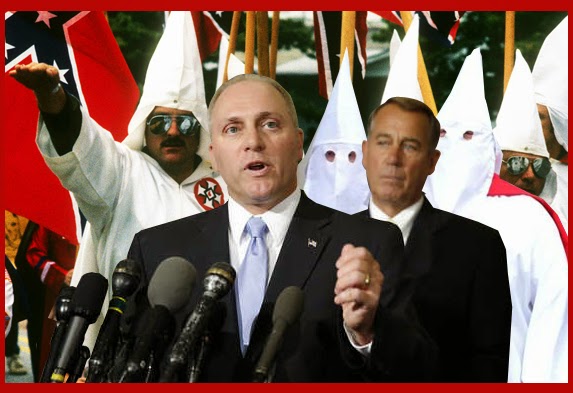
By the way, Louisiana's racist Republican congressman, Steve Scalise, Boehner's Majority Whip, is not accused of forgetting whether or not he spoke at a gay rights convention or of wandering into a conclave advocating economic justice for all Americans. David Duke, whose organization Scalise addressed, was a well-known Republican politician who ran for statewide and local office and served as the state Rep for the Metairie area, near where Scalise lived, an area he later served in the state legislature himself. While there, Duke distinguished himself by espousing neo-Nazi ideology on the floor of the legislature and selling copies of Mein Kampf in the state Capitol. There is no one in Louisiana who didn't know this at the time. And no one who didn't know Duke was the Grand Wizard of the KKK or what the KKK was advocating for blacks, Latinos and Jews. It was on TV, radio and on the front pages of the newspapers. Today, the third-ranking Republican in Congress, Scalise doesn't have what it takes to admit he was wrong and promise to mend his racist ways.

Boehner solemnly accepts Scalise's excuse that he thought he was addressing a bedsheet manufacturers' convention

Labels: , , , , ,