Monday, January 29, 2018

Bad News For Republicans In North Carolina Who Count On Election Fraud

>


This trailer for Dirty Money, the Netflix documentary, isn't what this post is specifically about. On the other hand, I'd guess that 70-80% of the posts at DWT are tied to the subject matter of the documentary. The trailer is about 2 minutes long; watch it and you'll see what I mean.Hint is a couple of lines from Matt Taibbi: "When these companies become so important, when they're a member of a class that is not jailable..." That makes people really angry-- and they could respond worse than just putting the crooks in jail, as billionaire Nick Hanauer explained in a TED Talk a few years ago.

The Netflix series starts off with a con by Volkswagen. Episode 2 begins with payday lenders. Our elected officials let these crooks fleece us-- and it's not just corrupt Republicans. They are more than a few corrupt Democrats as well. Talk about congressional crooks who took massive bribes from the payday lending industry and you can't tell the full story-- which features GOP con men like Kevin Yoder (KS), Jeb Hensarling (TX) and Pete Sessions (TX)-- without looking at shady self-servers like Debbie Wasserman Schultz, Patrick Murphy and Alcee Hastings-- an that';s just the Floridians who belong in prison!

One of the reasons congressmembers can get away with this kind of thing is because of safe seats created by partisan gerrymandering. In fact, when she was in the Florida state Senate, Wasserman Schultz agreed to support giving the Republicans a couple iff extra seats that were unmerited in return for Republican support for her drawing a highly gerrymandered congressional seat for herself! Last week I was delighted to read a post by Mark Stern at Slate, North Carolina Supreme Court Strikes Down GOP Attempt to Control Elections Board. This is something different from the anti-gerrymandering rulings that have been coming down lately, but it is extremely important for North Carolina Democrats and independents. Friday North Carolina's Supreme Court, in a 4-3 ruling, "struck down a Republican-sponsored measure stripping Democratic Gov. Roy Cooper of his ability to regulate the state’s elections." The ruling ensures Cooper will be able to restore voting rights for North Carolinians in time for the 2018 election, something driving Republicans crazy.
Following Cooper’s election in November 2016, the GOP-dominated General Assembly passed a series of bills weakening the governorship and concentrating power in the legislature. The centerpiece of this effort was a radical overhaul of the board of elections. Previously, the board had five members, with three from the governor’s party. Under former Republican Gov. Pat McCrory, the body authorized a dramatic rollback of early voting and a reduction in polling places, particularly in minority-heavy communities. Cooper planned to reverse these policies. But before he could, the legislature restructured the board, creating a new group with eight appointees, four Democratic and four Republican. The practical effect would be near-constant gridlock.

Cooper sued, and a state court blocked the measure in March. But the legislature promptly tweaked the law and passed it again. (Due to litigation, however, the eight-person board never actually assembled.) Once again, Cooper filed suit, alleging that the overhaul violated the North Carolina constitution.

A majority of the state Supreme Court-- all four of its Democratic justices-- agreed with Cooper. In his opinion for the court, Justice Sam J. Ervin explained that the fundamental flaw in the act was its infringement upon the separation of powers. The North Carolina constitution contains an unusually robust separation-of-powers clause, requiring the legislative, executive, and judicial branches to be “forever separate and distinct from each other.” It also directs the governor to “take care that the laws be faithfully executed.” In a previous decision, the court ruled that these provisions preserve the governor’s control over boards within the executive branch, including the appointment of commissioners.

The new elections board, Ervin noted, plainly runs afoul of this rule. Under the law, the governor must select four Republican commissioners from a list devised by GOP legislative leaders. Yet the board is an executive branch agency over which Cooper is constitutionally empowered to exercise significant control. Ervin thus concluded that, in creating the board, the legislature had overstepped its constitutional boundaries and encroached upon the governor’s. To remedy this problem, Ervin held that the legislature must allow the governor to appoint a majority of commissioners from his own party to the state board.

Friday’s decision did not hand Cooper an absolute victory. The court declined to strike down measures that gave Republicans some administrative control over the state board and that equally divided county boards between Democrats and Republicans. Instead, the court adopted a wait-and-see approach: It held that these laws could violate separation of powers, but postponed final judgment until the state board’s configuration is brought in line with the constitution. Cooper will likely challenge these rules separately in the near future.

For now, the state Supreme Court’s ruling is a qualified success for the governor-- and, much more importantly, a victory for North Carolina voters. Once Democrats take control, the new elections board can repeal McCrory’s disenfranchisement policies and protect access to the ballot for all North Carolinians. The state won’t have truly fair elections until the legislature is forced to redraw its politically and racially gerrymandered districts. But Friday’s ruling is an important step forward in the state’s fight for the franchise.
The likeliest progressive to be favorably impacted by the ruling is Jenny Marshall, who is running against notorious GOP bigot Virginia Foxx. Late last night she told me that "North Carolinians across the state have been relying on the courts to intervene on the behalf of democracy and their rights to vote. Since gaining power over the North Carolina General Assembly, the GOP have hurled assault after assault that would disenfranchise voters and ensure their power grab continues. I have personally witnessed my local board of elections meetings where the GOP majority ignored the needs of the people in regards to accessible voting locations and restricted hours and days of early voting locations. They would not even consider opening a previously used polling location on the campus of Winston Salem State University, a historically black university despite the community outcry. Their only aim was to suppress the minority millennial vote. The GOP even made it so that anyone could challenge and ultimately eliminate your vote. As a Democratic party poll worker, we were warned to watch for people who sought to challenge and intimidate voters from casting their ballot. I made sure I had the voter protection number ready to assist people who were refused access to the ballot box as I worked open to close that election day. While we still have partisan gerrymandering and a run amok legislature, having a state board of elections restored to the purview of Governor Cooper means the people of North Carolina win. Democracy wins."

Labels: , , , ,

Tuesday, May 23, 2017

U.S. Supreme Court Rules Against North Carolina GOP Racists Who Control The State Legislature

>


The Republican-dominated North Carolina legislature has given Governor Roy Cooper every reason in the world for him to want to do them some harm. The House has 74 Republicans, 45 Democrats and an independent and the Senate has 35 Republicans and 16 Democrats. Yesterday, after the 5-3 U.S. Supreme Court decision affirming that the Republicans in the legislature are a pack of racist animals who should immediately lined up against a wall and shot-- not blindfolds and no cigarettes-- Cooper pointed out that "for the second time in two weeks, the Supreme Court ruled that Republican legislative leaders broke the law. Today's ruling showed they tried to rig elections by drawing unconstitutional districts that discriminated against African Americans." Except they didn't try; they did it. In 2012 Obama won North Carolina 2,270,395 (50%) to 2,178,391 (48%). And this year Señor Trumpanzee beat Hillary 2,362,631 (49.8%) to 2,189,316 (46.2%). So let's say it's a 50/50 state.

But the state's 13 congressional districts have been drawn in such a way to create 3 Democratic districts and 10 Republican districts. A fair redraw would result in one party winning 6 and the other winning 7. Gerrymandering has been very pernicious in North Carolina. I was kidding about the firing squad for the Republican state legislators. With no punishment, there is no reason for them-- or other monsters like them around the country-- to alter their behavior. "Their gerrymandered electoral maps and their bogus voter access law-- both struck down by the Supreme Court-- have the same goal: To win elections at all costs," continued Cooper. "Being able to hold free and fair elections is a pillar of our democracy, and today's ruling is a big step in the fight for fairer districts... [W]e must continue to work to ensure that all of us have an equal shot at the ballot box." The Republican legislators won't. What do they have to lose. Maybe even if just one in ten were randomly pulled out and shot they would change their behavior. Maybe. It's worth a try. After all the Supreme Court ruled that they had used drawn on their racism to violate the Constitution. That sounds like a serious offense, no?

The NY Times' Adam Liptak reported that "The court rejected arguments from state lawmakers that their purpose in drawing the maps was not racial discrimination but partisan advantage."
The decision was the court’s latest attempt to solve a constitutional puzzle: how to disentangle the roles of race and partisanship when black voters overwhelmingly favor Democrats. The difference matters because the Supreme Court has said that only racial gerrymandering is constitutionally suspect.

Election law experts said the ruling would make it easier to challenge voting districts based partly on partisan affiliations and partly on race.

“This will lead to many more successful racial gerrymandering cases in the American South and elsewhere,” said Richard L. Hasen, a law professor at the University of California, Irvine.

Democrats welcomed the ruling.

“This is a watershed moment in the fight to end racial gerrymandering,” Eric H. Holder Jr., the former attorney general and the chairman of the National Democratic Redistricting Committee, said in a statement. “North Carolina’s maps were among the worst racial gerrymanders in the nation.”

Conservatives complained that the Supreme Court had succeeded only in making the law murkier.

“The Supreme Court says race can be a factor in redistricting, but not the predominant factor, a rule that is so vague, so broad and so lacking in a definable legal standard that it is not really a rule at all,” Hans von Spakovsky, a lawyer with the Heritage Foundation, said in a statement.

The ruling on Monday was the second Supreme Court victory for North Carolina Democrats this month. Last Monday, the justices declined to hear an appeal of a decision that had struck down parts of a restrictive North Carolina voting law that, among other things, tightened voter identification requirements and cut back on early voting.

A federal appeals court had ruled that the restrictions were an unconstitutional effort to “target African-Americans with almost surgical precision.”

...In defending the new district lines for District 12, state lawmakers said they had meant to secure a partisan advantage for Republicans, a lawful goal. But Justice Kagan said race could predominate even if legislators had mixed motives.

“The sorting of voters on the grounds of their race remains suspect even if race is meant to function as a proxy for other (including political) characteristics,” she wrote, in a passage that some election law experts said would make it easier to challenge asserted racial gerrymanders.

In a concurrence, Justice Thomas said he agreed that the trial court had not committed a clear error in finding that “race was North Carolina’s predominant motive in drawing the district.”
Goal Thermometer So far, Blue America has endorsed two candidates for Congress in North Carolina, Matt Coffay who is running for the western district currently held by Freedom Caucus chairman, Mark Meadows, and Jenny Marshall, the 5th District candidate for the seat Virginia Foxx occupies. Last night Jenny told us that she's "very pleased with the decision handed down by the Supreme Court today. The GOP and their ploy to gerrymander groups of voters by race was defeated. While the decision is a step in the right direction, we still do not have a clear indication as to what the next steps will be for state and congressional races that were won under gerrymandered districts. In 2016 they redrew congressional districts in North Carolina. The new 5th district moved more blue, but most of the districts remained heavily gerrymandered. Not surprisingly the outcome of the election remained the same at 10 Republicans and 3 Democrats. While we cannot blame gerrymandering for all the results of these congressional races, we must demand that gerrymandering by both parties end and that non partisan commissions be tasked with the job of drawing our district lines fairly to all.

This morning we spoke with Matt Coffay. He told us "It's hard to say at this point how this ruling will impact North Carolina for 2018. However, it's clear that there's now a groundswell of both public and judicial support when it comes to ending gerrymandering. The irony with this case is that the plaintiffs didn't claim they were innocent of gerrymandering: instead, they claimed they had politically (as opposed to racially) gerrymandered the districts; which, up until now, has been legally acceptable. Fortunately, the Wisconsin decision regarding political gerrymandering gives me hope that legal precedent is also beginning to swing in the direction of making political gerrymandering illegal. I truly believe that with enough public awareness and pressure, we can put an end to this despicable, undemocratic practice once and for all. It's time we stopped letting politicians pick their voters, and instead let voters pick their politicians."

Labels: , , , , , ,

Saturday, January 07, 2017

Paul Ryan Embraces Republican Overreach, Jeopardizing GOP House Majority

>


Whether Putin placed him in the White House or not, Trump— or Pence— is the president. And Schumer’s brilliant strategy of nominating unelectable corporate shills backed by Wall Street to ride into Senate seats on Hillary’s coattails in Pennsylvania, Iowa, Florida and Ohio means the GOP will control the Senate for at the very least 4 more years. That leaves one task to put the breaks on Trump— the 2018 House elections. Blue America is busy finding good candidates but reality of winning back the House is at least partially dependent on two other factors: Trump failing as miserably in governing as he has in the transition and in Cabinet-building and the Republican-backed Congress overreaching enough to infuriate the American public. I’m not a betting man, but I would bet on that whole mess happening— in spades.

This week, for example, CNN reported that Ryan is so cocksure of his ability to take healthcare away from 20 million Americans that he decided to gratuitously toss defunding Planned Parenthood into the mix. This is a big mistake, one that puts his whole project in danger. “A push by Republican congressional leaders,” explained the CNN report, “to defund Planned Parenthood could threaten passage of their top-priority legislation to repeal Obamacare because of opposition to the anti-abortion provision by two key GOP senators.” Since then at least two more Republicans are indicated discomfort with the repeal without replacing + Planned Parenthood defunding strategy.
House Speaker Paul Ryan announced Thursday that Republicans will move to strip all federal funding for Planned Parenthood as part of the process they are using early this year to dismantle Obamacare.

Congressional Republicans have tried for years to zero out all federal funding for Planned Parenthood because the group provides abortion services. The fight over Obamacare helped trigger a 16-day government shutdown in 2013, and Democrats and President Barack Obama insisted any Planned Parenthood provision targeting the group be removed from a bill to fund federal agencies.

The decision to add the controversial Planned Parenthood language, which is opposed by most Democrats, could have a major impact on getting the Affordable Care Act repeal legislation through the Senate because supporters need the backing of at least 50 of their 52 members and two pro-choice senators, Susan Collins of Maine and Lisa Murkowski of Alaska, won't commit to approving the bill with the Planned Parenthood provision in it.

Further complicating matters for Senate GOP leaders is Sen. Rand Paul, R-Kentucky, who announced this week he plans to vote against the Obamacare repeal legislation because the underlying budget measure it is attached to doesn't balance and adds to the deficit. If Murkowski, Collins and Paul all voted against the budget bill, it would be enough to torpedo the Obamacare repeal legislation.

"I'm going to wait and see what happens," Collins told reporters, indicating she thinks it's too early to decide how she will vote on the bill. "Obviously, I'm not happy to hear the speaker wants to include defunding of Planned Parenthood, an extremely controversial issue in the package."

Murkowski's told reporters Tuesday she was still weighing the issue. In 2015, she joined Collins in voting for an amendment to strip Planned Parenthood funding out of a budget bill that would have also repealed much of Obamacare. But Murkowski ultimately backed the repeal measure even though it had the anti-Planned Parenthood provision, which Obama ultimately vetoed.

"At this point and time, I have not been involved in a sit down with colleagues about specifics of reconciliation. So it's tough for me to speculate or engage in any conjecture," Murkowski said earlier this week. "We're going to be having a lot of discussions about that probably as soon as this week."

When asked her position Thursday, Murkowski's spokeswoman Karina Petersen said, the senator "is concerned about defunding Planned Parenthood as she is a longtime support of Planned Parenthood and has opposed broadly defunding the organization."

Republicans could drop the Planned Parenthood measure, but doing so could spark anger from the right-flank of their party and potentially make it harder to defund the organization at a later date.

Senate Majority Whip John Cornyn, the No. 2 Republican in his chamber, said "that's certainly where I am" when asked if he wanted to include defunding of the organization into the repeal measure. But he noted "that's place we start" and that nothing has "finally been decided yet."

"While we would like to have all 52 senators, if we have a vice president in the chair, that gives us a little bit of flexibility on reconciliation," Cornyn said Thursday, referencing the ability of the vice president to break Senate ties.

The vast majority of federal money that Planned Parenthood does receive funds preventive health care, birth control, pregnancy tests, and other women's health care services. Democrats also point out that much of the money the group received is through the Medicaid program, which reimburses health care clinics that provide care to those covered by the federal program.

Under the long-standing "Hyde amendment" that is attached to annual funding bills, no federal money is allowed to go to programs that include abortion services, unless they are needed to preserve the life of the mother or are caused by rape.

Democrats immediately denounced the news that Republicans again were working to bar future federal funds for Planned Parenthood.

"This is a priority for the Republicans," said House Minority Leader Nancy Pelosi Thursday afternoon. "So I just would like to speak individually to women across America: this is about respect for you, for your judgment about your personal decisions in terms of your reproductive needs, the size and timing of your family or the rest, not to be determined by the insurance company or by the Republican ideological right-wing caucus in the House of Representatives. So this is a very important occasion where we're pointing out very specifically what repeal of the (Affordable Care Act) will mean to woman."

Cecile Richards, president of Planned Parenthood Action Fund, told CNN's Erin Burnett on OutFront Thursday that "concerned" women have lobbied against the move throughout the day.
Yesterday other Republican senators seemed shaky on repeal, including far right tea bagger Tom Cotton (R-AR). And Bob Corker (R-TN) said he’s not sold on the Republican plan to repeal Obamacare without a replacement.
Repeal and delay is the party leadership's attempt to deal with several competing political realities. The first is that they've promised up and down that at the first possible chance they'd repeal the law. ("I'm sorry, I know that much of the repeal piece is about making a political point, much of the repeal piece is about drawing a line in the sand," Corker admitted.) The second is that you can't just strip 20 million some-odd people of health insurance coverage and call it a day – you need to come up with your own "terrific" alternative, to borrow Donald Trump's phrasing, that won't reverse the enormous gains in covering the uninsured that have been made under Obamacare. But the third hard reality is that seven years and countless our plan is just weeks away promises later, the GOP still hasn't produced an actual alternative. Mostly because they can’t.

Hence repeal and delay – get points for repealing but punt the actual implementation three or more years down the road to give the party more time to, really, seriously, come up with a plan. In the meantime, Corker said, "it's become standard Republican orthodoxy" that low-income Americans will continue to receive some sort of help buying health insurance while we transition from the awful Obamacare system to the glorious GOP replacement where just as many people are insured but at less cost thanks to unicorn magic.

But repealing now without an actual replacement plan in place brings with it a host of problems, including the possibility of chaos in the insurance industry and, as a political matter, Republicans suddenly owning whatever goes wrong in health care. That's why Corker's not alone in his skepticism – GOP senators like Tom Cotton of Arkansas, Susan Collins of Maine and Rand Paul of Kentucky have also questioned the wisdom of the plan.

Corker pointed out another hard reality, this one budgetary. The repeal currently being pushed involves budget reconciliation, which cannot be filibustered. But that means that it's not a full repeal – they can repeal the tax side of the law but not the regulatory side. And if helping low-income Americans buy health insurance is now a given for the GOP, well that costs money. "Right now on the track we're on, the repeal process is going to repeal all revenues but keep in place the subsidies for three years," he noted. "What you're doing [then is] you're taking $116 billion by our calculations and just throwing it into a mud puddle by continuing subsidies without revenues."

Oh yeah, that's right, repealing Obamacare would balloon the budget deficit.

Corker, for one, thinks that ballooning deficits are a bad thing. Most of his colleagues at least theoretically agree, though as Robert's 10th rule of politics states, a party's dedication to fiscal responsibility is inversely proportional to its political power. One party in charge at both ends of Pennsylvania Avenue tend not to care so much about deficits.

…[I]f repeal and replace has become repeal and delay, which could become repeal in name only, what's to become of Obamacare? Corker held out the prospect of basically making it a repeal in name only (RINO!) not through punting but tweaking. He said that if only Democrats would be willing to come to the table maybe a compromise could be hammered out in three areas: getting rid of the individual and corporate mandates, adjusting the list of essential benefits and giving governors more flexibility with Medicaid. "If you looked at those three things, that would be monumental as it relates to causing what has occurred to work," he said.

His bemoaning Democrats' refusing to compromise about Obamacare is rich. Corker's party has been the one holding a hard line where any solution short of full-stop-repeal has been denounced as caving in to tyranny. Democrats, starting with President Barack Obama, have repeatedly said that the law has problems which can be fixed only to have the GOP reply in near-unison that the only acceptable fix is repeal. I can't say whether it's even possible for a compromise to be reached on those three areas, but pointing to specific problems is a distinct step away from dismissing the entire law as an unfixable mess is an evolution.

Maybe the realities of governing will lead more GOPers to start making that distinction. Maybe – though it's probably not likely in today's Washington – "repeal" will end up being reform instead.
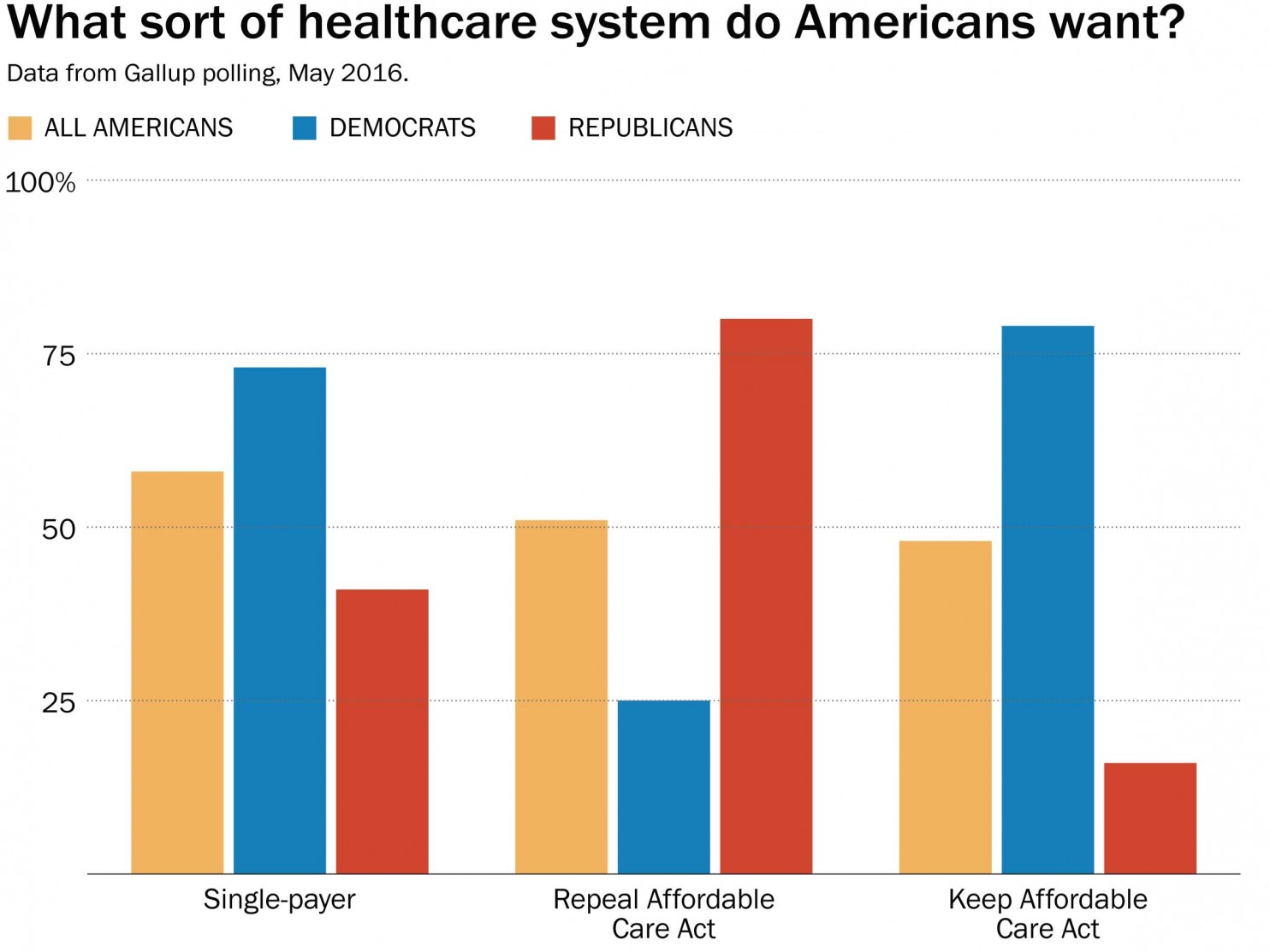
What do most Americans want? Medicare for all, of course, as a Gallup poll found in May.
Well over half of Americans want to replace Obamacare with a single-payer system. That figure, amazingly, includes 41 percent of Republicans and Republican-leaning independents — even though the wording of the question specifies that the program would be "federally funded." (Mind you, more than half of Republicans oppose the idea.)… Fifty-nine percent of Democrats support the idea of both keeping the ACA and replacing it with a single-payer program. Asked to pick between the two, though, that group favors single-payer by a 2-to-1 margin.


And, by the way, Roy Cooper, less than a week since becoming governor of North Carolina, announced that he’s putting through Medicaid expansion that will grant as many as 650,000 poor North Carolinians health insurance under Obamacare. It will pump around $3 or $4 billion in federal money into the state and will immensely improve North Carolinian’s healthcare, especially in rural areas. The radical right Republican-controlled legislature is already talking about impeaching him for it.

And now Trump has undercut Ryan, McConnell and Pence to say he doesn't back a repeal without a replacement


Labels: , , , , , , , ,

Friday, April 22, 2016

What Do Voters In North Carolina Want?

>

Not these two

Elon University released a general election poll that should make Democrats sit up and take notice. Short version of the hypothetical North Carolina match-ups:
Hillary beats Trump- 45.1% to 38.9%
Bernie beats Trump- 50.8% to 37.7%

Cruz beats Hillary- 43.8% to 41.2%
Bernie beats Cruz- 49.3% to 38.8%
Democrats have to be crazy to ignore independents (over 40% of the general election electorate) by nominating Hillary Cruz, who independents just hate, not just in North Carolina, but everywhere. There is some good news for Democrats in other sections of the poll. First of all, Attorney General Roy Cooper (D) is increasing his lead over GOP bigot, Governor Pat McCrory. Cooper is now leading McCrory 48.2-41.5% in the gubernatorial race, probably because independents are embarrassed over the anti-gay legislation and the backlash from around the country. A plurality of North Carolina voters approve of marriage equality.

In the Senate race, Deborah Ross (D) is closing in on incumbent Richard Burr (R). He now leads her 36.9-32.7% with lots of independent voters still undecided, although as North Carolina voters start identifying Burr as obstructing President Obama's supreme Court nomination of Merrick Garland. Burr's approval rating is only 29%-- with a 41% disapproval rating. They report that "This is the lowest approval rating ever recorded by the Elon Poll, either among registered voters or residents of North Carolina. Although Burr has served as U.S. Senator since 2005, twenty-nine percent of registered voters still said they didn't know or were unsure of the Senator's performance."

A couple of other bits worth keeping in mind start with massive disapproval of Congress 80.8% to just 8.7% who approve. The state legislature isn't faring too well, either. His disapproval is 48.7%, while just 31.3% approve. This could be a good year for Democrats to take back a couple of districts in North Carolina but the DCCC has written the state off entirely and isn't backing a single candidate, although Robert Pittenger, Patrick McHenry, George Holding, Mark Walker and Renee Ellmers could all be vulnerable with Bernie on top of the Democratic ticket and with Trump or Cruz on top of the Republican ticket. Obviously, if the Republicans run a relatively normal candidate and the Democrats are foolish enough to run Clinton, the Democrats would have no chance to take back any congressional seats.

Labels: , , , ,

Thursday, January 22, 2009

Burr Looking Very Vulnerable In 2010 North Carolina Re-Election Bid But Dems Could Hand Him The Seat By Nominating Heath Shuler

>

Shuler: mediocre quarterback/worse congressman

I'm not going to say Heath Shuler is the worst member of the Democratic House caucus; but I will say that there isn't anyone worse than this reactionary Know Nothing from western North Carolina. When Rahm Emanuel invented him Shuler wasn't especially a Democrat or a Republican-- just a self-serving Know Nothing being courted by Tennessee Republicans and North Carolina Democrats. He claims he likes North Carolina more than Tennessee... so he wound up a Democrat-- and one of the two worst of Rahm Emanuel's pro-war/pro-corporate/anti-choice recruits from 2006, the other being registration-switcher/serial adulterer, now defeated Tim Mahoney from Florida, like Shuler, a Democrat in name only who delighted in crossing the aisle on core issues and voting with the GOP.

Shuler represents North Carolina's mountainous, Republican-leaning 11th CD (PVI is R+7), where McCain beat Obama 52-47% but where Shuler was re-elected with 62% of the vote (after winning his first race against blatantly corrupt bankster Charlie Taylor in 2006 with 54%). Shuler isn't the kind of Democrat who will help bring his constituents over to the Democratic Party. We've been watching Eric Massa, the newly elected Democrat from a Republican district in upstate New York, explaining his every vote to constituents and helping them to understand why Democratic Party positions on equality in the workplace for women, healthcare for needy children, strict regulations of how banks can spend TARP money will all help make America-- and their own lives-- better. That isn't the kind of legislator Heath Shuler is. Instead he rails against immigrants, incites hatred and fear and pushes his own egocentric, basically apartisan, political career. Progressives in North Carolina now fear that Shuler will wind up as the Democrats' candidate for the U.S. Senate seat held by a weak and unliked incumbent, Richard Burr, in 2010.

Last week Shuler, who is among the half dozen Democrats most likely to vote with Republicans on core substantive issues before Congress, was elected whip of the Big Business-oriented/working family unfriendly Blue Dogs. He is the Democrats version of the bigoted, anti-immigrant loon Tom Tancredo and, in fact, they worked on a xenophobic bill together. Last week I met with one of the candidates running for chair of North Carolina's Democratic Party. He told me that Shuler is pushing himself forward for Burr's seat. Yesterday Public Policy Polling released a new survey accessing Shuler's chances to unseat Burr.

Burr's approval rating is miserable and is indicative of a senator likely to become an ex-senator ("languishing in the 30s"). Only 33% of North Carolinians approve of the job he's been doing; compared to 44% who approved at the just-defeated Elizabeth Dole in January, 2008. Still, in a hypothetical match-up against Shuler, Burr comes out on top-- 39-28%. "Shuler is not very well known across the state, with 21% of voters holding a favorable opinion and 21% viewing him unfavorably." Shuler is well-liked where he is better known (basically, in his own congressional district) and he is banking on winning over lowland North Carolinians by fearmongering and demagoguing on right-wing/talk radio "issues." His anti-immigrant SAVE Act, made him a favorite of CNN's resident bigot Lou Dobbs. Last week he was apologetic in an interview with his hometown paper about a fundraiser Bill Clinton is doing for him to help finance his Senate aspirations.
U.S. Rep. Heath Shuler says he and former President Bill Clinton became friends during the 2008 election, and the public should not read anything into a fundraiser Clinton is holding for him Jan. 26.

“We went to church together,” Shuler said. “You get to know someone throughout a campaign. He wanted to help me... I wouldn’t read anything into it.”

Shuler is intent on stirring up hatred of Hispanics to ride into the Senate and it's repulsive that Bill Clinton is supporting him on this. He plans to try to re-introduce his anti-immigrant legislation as soon as he can, although he knows it isn't likely to go anywhere-- other than to build up his own name recognition. He acknowledges that most of the country and all of the responsible elected officials are more concerned with fixing the nation's economy than in stirring up hatred against Hispanics, his own specialty. I don’t think it would have mattered who won the election, McCain or Obama," Shuler told the interviewer. "They both have different views on immigration than the people of our district.”

Shuler's DC roommates don't. He lives with a bunch of radical right, lunatic fringe, neo-Confederate obstructionists-- Jim DeMint (R-SC), Tom Coburn (R-OK) and Zach Wamp (R-TN).

Keep in mind that Democrats won big in North Carolina in November-- but not that big. Obama took the state, but only by 1% in a 50-49% squeaker. Kay Hagan did beat Dole pretty well (53%) and Bev Perdue wound up winning the governor's seat, again with 50% of the vote. Every Democratic incumbent congressman was re-elected with over 60% of the vote-- something that can't be said of Republican incumbents, In fact one entrenched Republican incumbent, Robin Hayes, only managed to win 45% of the vote and was ousted by progressive social studies teacher Larry Kissell. Can they take out Burr? He seems very vulnerable, especially if he joins up with the Senate obstructionists who would rather see America fail than Obama succeed. North Carolina voters will not put up with that-- something that makes them very different from South Carolina voters.

The Democrat who won the most votes statewide in 2008 was Attorney General Roy Cooper and polling shows that he would be a far stronger candidate against Burr than Shuler would be, beating him 39-34%. State Rep. Grier Martin (Raleigh) is a rising star and is generally thought of as someone who would give Burr a real run for his money.

But what if Shuler is the candidate? Will progressives and moderate Democrats vote for a Know Nothing reactionary extremist? It will be interesting watching Shuler try to appeal to the Republican base this year by moving further and further right, while Burr moves towards the center in the hope of winning over moderates and independents. Burr has a lot of room for improvement; he's been in the dozen most radical right members of the Senate.


UPDATE: BUT IF BURR IS "VULNERABLE," EVEN REPUBLICANS THINK BUNNING IS AMONG THE WALKING DEAD

Kentucky lunatic fringe wingnut, Jim Bunning, who has been suffering from an advanced state of dementia for at least 5 years-- and was unable to campaign in 2004 and was for a time rumored to be dead-- is being urged by Kentucky and national Republicans to retire at the end of this term and let someone from the party run who has a chance to win, the implication being that Bunning has no chance to win.

Terrible polling numbers, trouble raising money, the old rumors that he's already actually dead, and his inability to debate or even campaign have combined with his obstructionist posture to make it highly unlikely that he could be returned to the Senate. He's one of a small group of reactionary extremists who have been clear that they would rather see America fail than Obama succeed and, like North Carolina voters, Kentucky voters are unlikely to buy into that way of thinking.

And as long as we're on the topic of knee-jerk obstructionists, when the Senate Finance Committee approved Timothy Geithner's confirmation as Treasury Secretary 18-5 this morning Bunning was one of the 5 voting "no," the other 4 being rightists John Ensign (R-NV), Jon Kyl (R-AZ), Charles Grassley (R-IA), and Pat Roberts (R-KS).

Labels: , , , , , , , ,