Monday, December 03, 2018

Another Criminal Dies

>

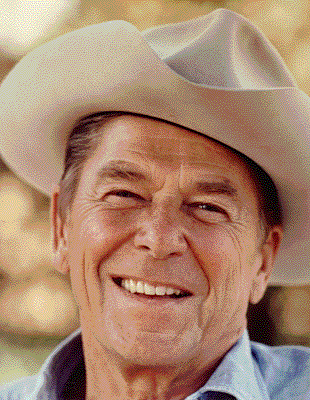
Ronald Reagan and George H.W. Bush in 1985

by Gaius Publius

George H.W. Bush's life is a testament to the notion that public service is a noble, joyous calling. And he did tremendous good along the journey.
     —Former president Barack Obama

Rosalynn and I are deeply saddened by the death of former President George H.W. Bush. His administration was marked by grace, civility, and social conscience.
     —Former president Jimmy Carter

Scouring the Web for comments on the death of George H.W. Bush turns up quite a bit of praise from luminaries as widely disparate as the Dalai Lama, Ellen DeGeneres and CIA director Gina Haspel. Mohammed bin Salman paid a visit to Bush senior and was welcomed warmly, spawning this tweet from the former president:


From lesser lights to greater, from murderers to comedians, the praise continues. 

As usual, the network of those who run the world we merely inhabit have nothing but respect for each other. And why not? They may pick each other off from time to time (both Saddam Hussein and Moamar Khaddafi, were once in high favor), but over the long haul, keeping each member of the ruling circle in a reverential spotlight keeps them all — keeps the circle itself — in reverence as well. Since they operate as a system, the system is honored each time its members, no matter how deadly, are honored as well. And the system sees that the system is always honored.

That's why Bernie Sanders and his new progressive colleagues in the House are so hated. They want to take that system apart. It's why Nancy Pelosi surrendered to the No Labels-financed "Problem Solvers" caucus rather than to those same new progressives and their agenda. The tiny system of people that run the world supports the tiny system of people that run the world, and always will.

For a truer perspective on who those people are and what they do, let's look not to the system's predictable, fawning self-praise, but at less propagandistic comments on the passing of one of its members, former CIA director, former vice president, and former president George H.W. Bush, a man who stood at the center of American power for most of his long adult life.

Again, this is just a sample of those comments on a sample of that life. A true deep dive into his sordid history would take a book.

George H.W. Bush, the CIA and a Case of State-Sponsored Terrorism

To pick just a single incident, this is from the late Robert Parry, writing in 2000 at Consortium News:
In early fall of 1976, after a Chilean government assassin had killed a Chilean dissident and an American woman with a car bomb in Washington, D.C., George H.W. Bush’s CIA leaked a false report clearing Chile’s military dictatorship and pointing the FBI in the wrong direction.

The bogus CIA assessment, spread through Newsweek magazine and other U.S. media outlets, was planted despite CIA’s now admitted awareness at the time that Chile was participating in Operation Condor, a cross-border campaign targeting political dissidents, and the CIA’s own suspicions that the Chilean junta was behind the terrorist bombing in Washington.

In a 21-page report to Congress on Sept. 18, 2000, the CIA officially acknowledged for the first time that the mastermind of the terrorist attack, Chilean intelligence chief Manuel Contreras, was a paid asset of the CIA.

The CIA report was issued almost 24 years to the day after the murders of former Chilean diplomat Orlando Letelier and American co-worker Ronni Moffitt, who died on Sept. 21, 1976, when a remote-controlled bomb ripped apart Letelier’s car as they drove down Massachusetts Avenue, a stately section of Washington known as Embassy Row.
A foreign diplomat and a U.S. citizen are murdered in DC on Embassy Row. The deed is planned by Manuel Contreras, a CIA asset who was also simultaneously intelligence chief for the Pinochet government of Chile. And George H.W. Bush, as head of the CIA, performs the cover-up, going so far as to plant false stories among media assets (sorry, CIA-friendly journalists) in places like Newsweek, and going so far as to mislead the FBI in its own investigation.

This is the man Jimmy Carter praised for "grace, civility, and social conscience." Saying a man complicit in murder is gracious is like saying a mafia don is good to his family and kind to old people and animals. Bill Clinton's praise of Bush, "From the moment I met him ... I was struck by the kindness he showed to Chelsea, by his innate and genuine decency, and by his devotion to Barbara, his children, and their growing brood," strikes just this note.

In the same article the word "assessment" appears, a word so enamored of the anti-Trump forces these days. Parry writes:
[T]he CIA – then under CIA Director George H.W. Bush – leaked for public consumption an assessment clearing the Chilean government’s feared intelligence service, DINA, which was then run by Contreras.
Bush "leaked for public consumption" an "assessment" knowingly filled with lies. The CIA has leaked many lying, secret "assessments" for public consumption; it's what they do. If we weren't so desperate to get rid of Donald Trump — and believe me, security-state people like George H.W. Bush are eagerly on board with that effort — we'd be nervous about what a leaked CIA assessment that immediately cast a shadow on an elected president, within a month of his election no less, might augur.

Does the concept of an American Praetorian Guard concern you? It does me.

George H.W. Bush and the Theft of the 1980 Election

The big enchilada in the George H.W. Bush story is the theft of the 1980 election and its aftermath, the Iran-Contra payoff and cover-up. The bones of the story, the original "October Surprise," go like this.

In 1980, when the Iranian hostage crisis was raging and Reagan and Bush were running against incumbent Jimmy Carter for the Oval Office, former CIA director Bush, future CIA director William Casey and others met at least three times with Iranian officials, including a meeting in Paris on October 19, and struck a deal with the Iranian government to extend the holding of 52 American hostages until after the election, thus denying Carter a diplomatic victory (and by the way, extending the suffering of those hostages).

In exchange, Bush and Casey promised that the Reagan administration would secretly sell arms to Iran through a cutout, Israel. Iran had just become involved in a major war with Iraq at the time and was desperate for arms.

Of course, because the arms sales were secret, the Reagan administration had money on its hands it had not gotten from Congress, and it decided to spend that money propping up the Contras, a brutal right-wing resistance army fighting the socialist (of course) Sandinistas in Nicaragua.

It's the secret support of the Contras (a name taken from the Spanish for counter-revolution), which was expressly forbidden by Congress in 1985 under the third Boland Amendment, that caused the story to unravel. The contra money was found, the Iranian arms sales were found, and the 1980 Reagan-Iran hostage deal was both widely suspected and widely feared.

Why feared? If a U.S. president had committed what many would call treason to gain office, what would the effect on the American people be? Would they ever trust elections — or worse, their leaders — again? Proof of Reagan and Bush's act was potentially destabilizing as, say, proof that elements of the CIA had murdered John Kennedy would have been.

Nixon and Treason

The U.S. had in fact faced this problem before — proof that a candidate had committed treason with a foreign government — when outgoing president Lyndon Johnson uncovered similar deeds ("treason" to use Johnson's word) by Richard Nixon during the 1968 presidential campaign, and declined to act on it, save to tell Senate minority leader Everett Dirksen to tell Richard Nixon to "cut it out," or words to that effect.

Proof of Nixon's treason didn't emerge until 2008, when the tape of the phone call itself was released and the accusation was later confirmed by conservative writer George Will. By then, of course, the whole affair was old news, something from the last generation's history, and could be reliably assumed to be ignored.

So here. Proof of every part of the October Surprise–Iran-Contra story emerged, though proof of the meeting between Bush, Casey and the Iranians in Paris was predictably contravened by a "secret alibi," yet that story is now widely and predictably ignored by all who praise him. 

Robert Parry and the October Surprise

Robert Parry was the primary reporter investigating the October Surprise connection to the breaking Iran-Contra story (emphasis added):
Though there were early rumors about a secret Republican deal with Iran, the October Surprise mystery didn’t gain much traction until the exposure of secret Iran-Contra arms shipments approved by Reagan to Iran in 1985-86. Suddenly, the notion that Reagan and his Vice President George H.W. Bush would lie about covert dealings with Iran didn’t seem so preposterous.

Essentially, the October Surprise question was whether Reagan’s secret contacts with Iran dated back to Campaign 1980, as a growing number of witnesses — from inside the governments of Iran, Israel, France and the United States — were alleging.

However, when Congress finally agreed to look into the October Surprise case in 1991-92, Republicans were determined to circle the wagons around the then-sitting President George H.W. Bush, who was facing a tough reelection fight against Democrat Bill Clinton.

Rather than welcome any truth-seeking, the Republicans and their media allies went on the attack claiming that the October Surprise case was a baseless “conspiracy theory.”
Elites "circling the wagons" to protect elites, even treasonous ones, is the theme of this piece. Eventually, Democrats and the media shied away from the story, leaving Parry essentially alone with his investigation (links in original):
Parry ... received the George Polk Award for National Reporting in 1984 for his work with the Associated Press on Iran-Contra, where he broke the story that the Central Intelligence Agency had provided an assassination manual to the Nicaraguan Contras (Psychological Operations in Guerrilla Warfare). In mid-1985 he wrote the first article on Oliver North's involvement in the affair, and, together with Brian Barger, in late 1985 he broke the CIA and Contras cocaine trafficking in the US scandal, helping to spark Senator John Kerry's interest in investigating Iran-Contra. The Associated Press had refused to publish the drug trafficking story, and only relented when its Spanish-language newswire service accidentally published a translation. Barger and Parry continued to press their investigation of North even as most of the media declined to follow it up, eventually publishing a story in mid-1986, based on 24 sources, which led to a Congressional committee asking questions of North. After North denied the allegations, Barger was pushed out of the Associated Press, and Parry was unable to publish any further follow-ups to the story until after Eugene Hasenfus' plane (Corporate Air Services HPF821) was shot down in Nicaragua in October 1986. After finding out that his boss had been "conferring with [Oliver] North on a regular basis", Parry left AP in 1987 to join Newsweek, which he left in 1990.

In August 1990, PBS' Frontline asked Parry to work on the October Surprise conspiracy theory, leading to Parry making several documentaries for the program, broadcast in 1991 and 1992. He continued to pursue it after a Congressional investigation had concluded the story was untrue, turning his Frontline research into a book published in 1993, and in 1994 he unearthed "a treasure-trove of government documents" supporting the theory, "showing that the [Congressional] task force suppressed incriminating CIA testimony and excluded evidence of big-money links between wealthy Republicans and Carter's Iranian intermediary, Cyrus Hashemi". In 1996, Salon wrote about his work on the theory, saying that "his continuing quest to unearth the facts of the alleged October Surprise has made him persona non grata among those who worship at the altar of conventional wisdom."
But this is not a piece about Robert Parry. It's a piece about George H.W. Bush.

Was George Bush in Paris in October 1980?

Evidence points to the presence of the future vice-president in Paris for the October meeting. Among others, the pilot of the plane that conveyed the participants places him there:
Russbacher [the pilot] states that Bush, while in Paris, met with Hashemi Rafsanjani, the second in command to the Ayatollah and now the president of Iran, and Adnan Khashoggi, a Saudi Arabian businessman who was extremely powerful. Arrangements were apparently made to pay Iran $40 million to delay the release of hostages in order to thwart President Jimmy Carter's re-election bid. The $40 million was the beginning of terms that created the Iran-Contra scandal that is now being reopened by Congress.

Russbacher is concerned for his life, but feels that the other pilots will now come forward in a new Congressional investigation.
From the article, Russbacher was also "a member of the Office of Naval Intelligence and worked with the Central Intelligence Agency." Now note this:
[Russbacher] indicates that there is a growing division within the Central Intelligence Agency. "There is no one higher than the CIA, but there are groups within the company (term used by insiders for the CIA) that are very, very strong. And the group or clique that I belonged to, in my opinion, was probably the strongest but there are other factions that are at war with themselves," Russbacher states."You have these groups that are answerable to no one. Well, they are answerable to one man, on top, and he doesn't seem to care how the problems are resolved, just as long as they are taken care of." The man Russbacher is referring to is President Bush.
The only contrary evidence that Bush was not in Paris on October 19, the date in question, was a "secret alibi witness" whose name wasn't released until 2011, after the witness was safely dead. Secret witnesses, of course, can't be interviewed and their evidence tested by the press. 

In 1992, when the story was raging, Bush publicly and angrily demanded that he be cleared. "Bowing to those pressures ... Rep. Lee Hamilton, D-Indiana, chairman of the House investigative task force, agreed to a curious bargain in which he and a few senior investigators were shown the destination of Bush’s supposed afternoon trip on Oct. 19, 1980, but with the proviso that they never interview anyone who was there or disclose any names. So, without verifying Bush’s alibi, the House task force cleared Bush of going to Paris."

Note the role of a Democrat in covering for Bush.

The "secret alibi witness" was, of course, a Bush family friend who had worked many times with Bush and had in fact been saved by Bush when the Watergate scandal threatened to take him down. More on this part of the story can be found here: "Taking a Bush Secret to the Grave".

So whom do you trust? Ex-CIA chief George H.W. Bush and the witness whose name he worked for decades to keep secret, or the rest of the evidence to the contrary? Elites assert the former in public statements, whatever they privately believe. The rest of us move on with our lives. Thus does the system that rules us retain its power.

Bush's Sins Are Many

Bush's sins are many and great. As head of the CIA in the late 1970s, he "actively supported Operation Condor operations and right-wing military dictatorships in Latin America." This means he was an accomplice to a great many murders. In the 1980 election campaign, he committed treason against the U.S. constitution by treating with an enemy and interfering with the negotiations of the elected president.

As president, he betrayed the trust of Mikhail Gorbachev, promising that after the unification of Germany, NATO would not move "one inch forward." NATO has since moved several inches forward...


...so much so that Trump's questioning of NATO during the 2016 campaign counts as one of his own great sins. War with Russia is the course we're on today, and this is one of the causes, that U.S. leaders have wanted this conflict to continue since the Soviet Union fell. Elites protecting elites.

In 1990, the Bush administration led Saddam Hussein, a U.S. ally, to believe that it wouldn't interfere if Iraq punished Kuwait for "slant-drilling" and other offenses by invading Kuwait. Before the Iraqi invasion, April Glaspie, U.S. ambassador to Iraq, told Saddam Hussein, "We have no opinion on the Arab-Arab conflicts, like your border disagreement with Kuwait." Saddam invaded Kuwait. Then the U.S. invaded Iraq.

The strongest impetus for signing the NAFTA treaty prior to 1992 was George H.W. Bush, after which Bill Clinton campaigned for, and ultimately passed the treaty as well. 

In 1992, outgoing President Bush pardoned those in his inner circle who were convicted of crimes in the Iran-Contra scandal. All this with no mention of the vile Willie Horton campaign ads, or the vile elevation of Clarence Thomas to the U.S. Supreme Court.

For all this he is much honored. And every honor he is accorded as a public figure honors the criminals and murderers who hold power over a globalized establishment. Keep this in mind the next time your own favorite elected says of a similar person, "Too bad he died. He was a good man."

GP
 

Labels: , , , , , , , ,

Thursday, June 29, 2017

"So Much of the Story Is Still Hidden From View"

>

Start at 2:25. Chris Hayes to Democratic Rep. Eric Swalwell: "How long are you allowed to go before you retroactively file as a foreign agent?" Note Swalwell's carefully phrased non-answers, as well as Hayes' seeming failure to know that not registering is a very common practice. (If video doesn't play in your browser, go here and listen, again starting at 2:25.)

by Gaius Publius

"And most pitiful of all that I heard was the voice of the daughter of Priam, of Cassandra"
—Homer, The Odyssey, Book 11

PRIAM: What noise, what shriek is this?
TROILUS: 'Tis our mad sister; I do know her voice. ...
It is Cassandra.
—Shakespeare, Troilus and Cressida, Act II, scene 2

"I'll be your Cassandra this week."
—Yours truly

So much of this story is hidden from view, and so much of the past has to be erased to conform to what's presently painted as true. 

Example of the latter: Did you remember that Robert Mueller and Bush's FBI were behind the highly suspicious (and likely covered-up) 2001 anthrax investigation — Robert Mueller, today's man of absolute integrity? Did you remember that James Comey was the man behind the destruction of the mind of Jose Padilla, just so that Bush could have a terrorist he could point to having caught — James Comey, today's man of doing always what's right? If you forgot all that in the rush to canonize them, don't count on the media to remind you — they have another purpose.

Yes, I'll be your Cassandra this week, the one destined not to be believed. To what do I refer? Read on.

How Many Foreign Agents Register as Foreign Agents? A Number Far Smaller Than "All"

Today let's look at one of the original sins pointed to by those trying to take down Trump, leaving entirely aside whether Trump needs taking down (which he does). That sin — Michael Flynn and Paul Manafort's failing to register as "foreign agents" (of Turkey and Ukraine, respectively, not Russia) until very much after the fact.

See the Chris Hayes video at the top for Hayes' question to Rep. Eric Swalwell about that. Hayes to Swalwell: "How long are you allowed to go before you retroactively file as a foreign agent?" What Swalwell should have answered: "Almost forever by modern American practice."

Jonathan Marshall, writing at investigative journalist Robert Parry's Consortium News, has this to say about the current crop of unregistered foreign agents (my emphasis throughout):
The Open Secret of Foreign Lobbying

The alleged hacking of the Hillary Clinton campaign’s emails and the numerous contacts of Donald Trump’s circle with Russian officials, oligarchs and mobsters have triggered any number of investigations into Moscow’s alleged efforts to influence the 2016 election and the new administration....

In contrast, as journalist Robert Parry recently noted, American politicians and the media have been notably silent about other examples of foreign interference in U.S. national politics. In part that’s because supporters of more successful foreign pressure groups have enough clout to downplay or deny their very existence. In part it’s also because America’s political system is so riddled with big money that jaded insiders rarely question the status quo of influence peddling by other nations.
The subject of his discussion is the 1938 Foreign Agents Registration Act (FARA). Under the Act, failure to properly register carries a penalty of up to five years in prison and $10,000 in fines. Marshall notes that while the influence of foreign agents was of great national concern during World War I and World War II, very little is done today to require or enforce FARA registration:
Since the end of World War II, however, enforcement of the Foreign Agents Registration Act has been notably lax. Its effectiveness has been stymied by political resistance from lobby supporters as well as by the law’s many loopholes — including Justice Department’s admission that FARA “does not authorize the government to inspect records of those not registered under the Act.”

A 2016 audit by the inspector general of the Department of Justice determined that half of FARA registrations and 62 percent of initial registrations were filed late, and 15 percent of registrants simply stopped filing for periods of six months or more. It also determined that the Department of Justice brought only seven criminal cases under FARA from 1966 to 2015, and filed no civil injunctions since 1991.
The result — almost no one registers who doesn't want to.

Here's Russia-savvy Matt Taibbi, who is looking at the whole Russia-Trump investigation and wonders what's being investigated. Note his comments about FARA at the end of this quote:
When James Comey was fired ... I didn't know what to think, because so much of this story is still hidden from view.

Certainly firing an FBI director who has announced the existence of an investigation targeting your campaign is going to be improper in almost every case. And in his post-firing rants about tapes and loyalty, President Trump validated every criticism of him as an impetuous, unstable, unfit executive who additionally is ignorant of the law and lunges for authoritarian solutions in a crisis.

But it's our job in the media to be bothered by little details, and the strange timeline of the Trump-Russia investigation qualifies as a conspicuous loose end.

[So] What exactly is the FBI investigating? Why was it kept secret from other intelligence chiefs, if that's what happened? That matters, if we're trying to gauge what happened last week.

Is it a FARA (Foreign Agent Registration Act) case involving former National Security Adviser Michael Flynn or a lower-level knucklehead like Carter Page?

Since FARA is violated more or less daily in Washington and largely ignored by authorities unless it involves someone without political connections (an awful lot of important people in Washington who appear to be making fortunes lobbying for foreign countries are merely engaged in "litigation support," if you ask them), it would be somewhat anticlimactic to find out that this was the alleged crime underlying our current white-hot constitutional crisis.

Is it something more serious than a FARA case, like money-laundering for instance, involving someone higher up in the Trump campaign? That would indeed be disturbing, and it would surely be improper – possibly even impeachable, depending upon what exactly happened behind the scenes – for Trump to get in the way of such a case playing itself out.

But even a case like that would be very different from espionage and treason. Gutting a money-laundering case involving a campaign staffer would be more like garden-variety corruption than the cloak-and-dagger nightmares currently consuming the popular imagination.
Sticking narrowly with FARA for the moment, if this were just a FARA case, it would be more than "somewhat anticlimactic to find out that this was the alleged crime underlying our current white-hot constitutional crisis." It would be, not to put to fine a point on it, highly indicative that something else is going on, that other hands are involved, just as the highly suspicious circumstances around the takedown of Eliot Spitzer indicate the presence of other hands and other actors.

My best guess, for what it's worth, is that Trump-Russia will devolve into a money-laundering case, and if it does, Trump will likely survive it, since so many others in the big money world do the same thing. But let's stick with unregistered foreign agents a bit longer.

John McCain, Randy Scheuneman and the Nation of Georgia

Do you remember the 2008 story about McCain advisor Randy Scheunemann, who claimed he no longer represented the nation of Georgia while advising the McCain campaign, even though his small (two-person) firm still retained their business?

And all this while McCain himself was trying to gin up a war between Georgia and Russia that he would benefit from politically:
In the current [2008] crisis, President Mikheil Saakashvili of Georgia fell into a Soviet trap by moving troops into the disputed territory of South Ossetia and raining artillery and rocket fire on the South Ossetian capital city of Tskhinvali, with a still undetermined loss of civilian life. As in 1956, the Soviets responded with overwhelming force and additional loss of life. Once again the United States could offer only words, not concrete aid to the Georgians.

It is difficult to believe that, like the Hungarians in 1956, the Georgians in 2008 could have taken such action without believing that they could expect support from the United States. Secretary of State Condoleezza Rice denies that the Bush administration was the agent provocateur in Georgia. To the contrary, a State Department source said that she explicitly warned President Saakashvili in July to avoid provoking Russia.

If this information is correct, then, by inference, John McCain emerges as the most likely suspect as agent provocateur. First, McCain had a unique and privileged pipeline to President Saakashvili (shown to the right in the photo to the right). McCain’s top foreign policy advisor, Randy Scheunemann, was a partner in a two-man firm that served as a paid lobbyist for the Georgian government. Scheunemann continued receiving compensation from the firm until the McCain campaign imposed new restrictions on lobbyists in mid-May. Scheunemann reportedly helped arrange a telephone conversation between McCain and Saakashvili on April 17 of this year, while he was still being paid by Georgia.,,,

McCain has benefited politically from the crisis in Georgia. ... McCain’s swift and belligerent response to the Soviet actions in Georgia has bolstered his shaky standing with the right-wing of the Republican Party. McCain has also used the Georgian situation to assert his credentials as the hardened warrior ready to do battle against a resurgent Russia. He has pointedly contrasted his foreign policy experience with that of his Democratic opponent Barack Obama. Since the crisis erupted, McCain has focused like a laser on Georgia, to great effect. According to a Quinnipiac University National Poll released on August 19 he has gained four points on Obama since their last poll in mid-July and leads his rival by a two to one margin as the candidate best qualified to deal with Russia.
Was Scheunemann a paid lobbyist for Georgia at the time of these events? He says no. Others aren't so sure:
Melanie Sloan of Citizens for Responsibility and Ethics in Washington, a liberal-leaning watchdog group, said Scheunemann still has a conflict of interest because his small firm continues to represent foreign clients. The records that show Scheunemann ceased representing foreign countries as of March 1 also show his partner, Michael Mitchell, remains registered to represent the three nations. Mitchell said Tuesday that Scheunemann no longer has any role with Orion Strategies but declined to say whether Scheunemann still is receiving income or profits from the firm.
If almost no one registers under FARA who doesn't want to, what's the crime if Flynn didn't register? The answer seems to be, because he's Trump appointee Michael Flynn, and FARA is a stick his enemies can beat him with, while they're looking for something better.

The fact that FARA is a stick almost no one is beaten with, matters not at all, it seems. Not to Democratic politicians and appointees; and not to many journalists either.

An Investigation in Search of a Crime

Questioning the Michael Flynn investigation leads us (and Matt Taibbi) down a further rabbit hole, which includes two questions: what's being investigated, and how did this investigation start?

Short answer to the first question — no one knows, since unlike the Watergate break-in, this whole effort didn't start with a crime that needed investigating. It seems to have started with an investigation (how to get rid of Trump) in search of a crime. And one that still hasn't found evidence of one.

Journalist Robert Parry, who himself was a key Iran-Contra investigator, makes the same point:
In Watergate, five burglars were caught inside the DNC offices on June 17, 1972, as they sought to plant more bugs on Democratic phones. (An earlier break-in in May had installed two bugs, but one didn’t work.) Nixon then proceeded to mount a cover-up of his 1972 campaign’s role in funding the break-in and other abuses of power.

In Iran-Contra, Reagan secretly authorized weapons sales to Iran, which was then designated a terrorist state, without informing Congress, a violation of the Arms Export Control Act. He also kept Congress in the dark about his belated signing of a related intelligence “finding.” And the creation of slush funds to finance the Nicaraguan Contras represented an evasion of the U.S. Constitution.

There was also the attendant Iran-Contra cover-up mounted both by the Reagan White House and later the George H.W. Bush White House, which culminated in Bush’s Christmas Eve 1992 pardons of six Iran-Contra defendants as special prosecutor Lawrence Walsh was zeroing in on possible indictment of Bush for withholding evidence.

By contrast, Russia-gate has been a “scandal” in search of a specific crime. President Barack Obama’s intelligence chieftains have alleged – without presenting any clear evidence – that the Russian government hacked into the emails of the Democratic National Committee and of Hillary Clinton’s campaign chairman John Podesta and released those emails via WikiLeaks and other Internet sites. (The Russians and WikiLeaks have both denied the accusations.)

The DNC emails revealed that senior Democrats did not maintain their required independence regarding the primaries by seeking to hurt Sen. Bernie Sanders and help Clinton. The Podesta emails pulled back the curtain on Clinton’s paid speeches to Wall Street banks and on pay-to-play features of the Clinton Foundation.

Hacking into personal computers is a crime, but the U.S. government has yet to bring any formal charges against specific individuals supposedly responsible for the hacking of the Democratic emails. There also has been no evidence that Donald Trump’s campaign colluded with Russians in the hacking.

Lacking any precise evidence of this cyber-crime or of a conspiracy between Russia and the Trump campaign, Obama’s Justice Department holdovers and now special prosecutor Robert Mueller have sought to build “process crimes,” around false statements to investigators and possible obstruction of justice.
I've yet to see actual evidence of an underlying crime — lots of smoke, which is fine as a starting point, but no fire, even after months of looking (and months of official leaking about every damning thing in sight). This makes the current investigation strongly reminiscent of the Whitewater investigation, another case of Alice (sorry, Ken Starr) jumping into every hole she could find looking for a route to Wonderland. Ken Starr finally found one, perjury about a blow job. Will Mueller find something more incriminating? He's still looking too.

Note that none of this means Trump doesn't deserve getting rid of. It just means that how he's gotten rid of matters. (As you ponder this, consider what you think would be fair to do to a Democratic president. I guarantee what happens to Trump will be repeated.)

What Was the Sally Yates Accusation Against Flynn Really About?

Short answer to the second question of my two "further rabbit hole" questions — How did this investigation start? — may be the Sally Yates accusation that Flynn was someone who could be blackmailed.

Here's Parry on that (same link):
In the case of retired Lt. Gen. Michael Flynn, Trump’s first national security adviser, acting Attorney General Sally Yates used the archaic Logan Act of 1799 to create a predicate for the FBI to interrogate Flynn about a Dec. 29, 2016 conversation with Russian Ambassador Sergey Kislyak, i.e., after Trump’s election but before the Inauguration.

Green Party leader Jill Stein and retired Lt. General Michael Flynn attending a dinner marking the RT network’s 10-year anniversary in Moscow, December 2015, sitting at the same table as Russian President Vladimir Putin.

The Logan Act, which has never resulted in a prosecution in 218 years, was enacted during the period of the Alien and Sedition Acts to bar private citizens from negotiating on their own with foreign governments. It was never intended to apply to a national security adviser of an elected President, albeit before he was sworn in.

But it became the predicate for the FBI interrogation — and the FBI agents were armed with a transcript of the intercepted Kislyak-Flynn phone call so they could catch Flynn on any gaps in his recollection, which might have been made even hazier because he was on vacation in the Dominican Republic when Kislyak called.

Yates also concocted a bizarre argument that the discrepancies between Flynn’s account of the call and the transcript left him open to Russian blackmail although how that would work – since the Russians surely assumed that Kislyak’s calls would be monitored by U.S. intelligence and thus offered them no leverage with Flynn – was never explained.

Still, Flynn’s failure to recount the phone call precisely and the controversy stirred up around it became the basis for an obstruction of justice investigation of Flynn and led to President Trump’s firing Flynn on Feb. 13.
Do I need, Cassandra-like, to say this again? None of this means that Trump doesn't deserve getting rid of. It just means that how he's gotten rid of matters.

"So Much of the Story Is Still Hidden From View"

I'm not taking Robert Parry as the final word on this, but he's one word on this, and his word isn't nothing. If we were looking down rabbit holes for the source of this investigation, for where all this anti-Trump action started, I don't think Yates' concerns are where it begins.

I think this story starts well before Trump took office, a rabbit hole I don't want to jump into yet, but one with John Brennan's and James Clapper's fingerprints — Obama's CIA director, Obama's DNI — all over it. Models of honesty all.

What's down that hole? Who knows.

What I do know is that Manafort and Flynn not registering as foreign agents puts them squarely in the mainstream of Washington political practice. The fact that these are suddenly crimes of the century makes me just a tad suspicious that, in Matt Taibbi's words, "so much of this story is still hidden from view."

I warned you — I'll be your Cassandra this week.

Cassandra not doing so well (that's her on the right; source)

I know this is falling on many deaf ears. Nevertheless, consider yourself well warned. Don't be surprised when what becomes suddenly unhidden isn't at all what anyone thought it would be. Or wanted.

GP
 

Labels: , , , , , , , , , , , ,

Saturday, June 11, 2011

The Media Has Always Been And Will Always Be Liberal-- Just Ask Any Republican

>


It was probably apparent to astute observers since the day Obama was elected that the Republican Party would do their worst in trying to delegitimize him and to even go so far as to punish America for electing him, all in the service of recapturing the government for their never changing fascist agenda. From day one Kyl, the #2 man in the Senate Republican caucus, said they would block his nominees, while Jim DeMint started off the year by talking about "breaking him" and bringing on his "Waterloo." Meanwhile, the GOP's top communications force, Rush Limbaugh, has only gotten more hysterical and more extreme since his "I want him to fail" fit at the beginning of his term. Wednesday we tried to demonstrate how driving up the unemployment rate has been Republican Party policy since Obama became president. Thursday Robert Parry did a brilliant analysis of Republican strategy over at AlterNet. The whole thing is very much worth reading (which is why I provided the link) but below are some takeaways:
Modern Republicans have a simple approach to politics when they are not in the White House: Make America as ungovernable as possible by using almost any means available, from challenging the legitimacy of opponents to spreading lies and disinformation to sabotaging the economy.

Over the past four decades or so, the Republicans have simply not played by the old give-and-take rules of politics. Indeed, if one were to step back and assess this Republican approach, what you would see is something akin to how the CIA has destabilized target countries, especially those that seek to organize themselves in defiance of capitalist orthodoxy.

...Obviously, given the wealth of the American elites, the relative proportion of the propaganda funding is derived more domestically in the United States than it would be in a place like Chile (or some other unfortunate Third World country that has gotten on Washington’s bad side).

But the concept remains the same: Control as much as possible what the population gets to see and hear; create chaos for your opponent’s government, economically and politically; blame if for the mess; and establish in the minds of the voters that their only way out is to submit, that the pain will stop once your side is back in power.

Today’s Republicans have fully embraced this concept of political warfare, whereas the Democrats generally have tried to play by the old rules, acquiescing when Republicans are in office with the goal of “making government work,” even if the Republicans are setting the agenda.

Unlike the Democrats and the Left, the Republicans and the Right have prepared themselves for this battle, almost as if they are following a CIA training manual. They have invested tens of billions of dollars in a propaganda infrastructure that operates 24/7, year-round, to spot and exploit missteps by political enemies.

Parry is only just beginning and, again, I urge you to read his entire post. I just want to add that the right-wing control of the media is something they've been perfecting since the ruling elites were stung by the muckrakers in the early 1900s. As we saw last month, the robber barons simply got together at bought enough of the media to control the conventional wisdom from then on. It's worse than ever now. Glen Yeadon has a subchapter in his book, The Nazi Hydra in America called "The Press Sells Out To The Nazis," and while it certainly did, I want to draw on some of his research that emphasizes how the Republicans have used the media to further they far right political agenda (rather than Hitler's, which is well documented by Yeadon). In the 1930s, with only 3 or 4 exceptions "all the large newspaper columnists and radio commentators were right wing reactionaries... The 1930s media was overtly pro-fascist, especially the major chains of newspapers. Hearst admired Mussolini and even paid him to write articles for his upstart United Press wire services. Mussolini was paid $1,750 per article an amount that would be the equivalent of about $17,000 today. The articles were poorly written by Margherita Sarfatti, Mussolini's mistress." Hearst tried to get Hitler as well. How different is it today? Do you watch Fox News? Or even Meet The Press?
The situation remains unchanged in the 21st Century. The columnists and the radio mouthpieces are almost fully hard right in their views. ... Today the media is even more consolidated than the media in the 1940s, less than ten corporations control over eighty percent of the airwaves and press. The Republicans have repeated the lie that the media is biased to the left so many times that many people buy into it-- even though the reverse is true. ... In the sixty years that have followed WWII the Republican Party and the far right wing extremists have adopted the philosophy at the heart of fascism, corporate rule. It is the basis for the intense hatred of unions and working people. In the entire eight years of the Reagan administration the minimum wage was not raised once although inflation still raged through the early 80s.

What does the video below have to do with the stuff above? Use your imagination

Labels: , , , ,

Sunday, September 19, 2010

From an eyewitness to history: "This country just can't deal with reality any more"

>


"Though lying is not foreign to U.S. politics and media, telling the truth has always been a fundamental American value, one that is vital to democracy. The great task of restoring the Republic must include honest efforts to dig out recent history's ground truth."
-- Robert Parry, in the blogpost "This Country

by Ken

Lately it seems I"m writing every other day about the apparently finalized divorce of a significant chunk of the American electorate from reality. So, with a caveat I'll register below, I heartily commend this piece by veteran Washington journalist Robert Parry on Alternet.

Parry, who's been on the Washington beat since 1977 (his bio notes that he "broke many of the Iran-Contra stories in the 1980s for the Associated Press and Newsweek"), says he's --
had a front-row seat to this sad devolution of American reason. As the process advanced, I have at times felt like a Cassandra trying to warn others about the risks of abandoning fact and rationality in favor of propaganda of whatever stripe.

Here's how he frames the issue:
As Election Day 2010 approaches -- as the United States wallows in the swamps of war, recession and environmental degradation -- the consequences of the nation's three-decade-old decoupling from reality are becoming painfully obvious.


Yet, despite the danger, the nation can't seem to move in a positive direction, as if the suctioning effect of endless spin, half-truths and lies holds the populace in place, a force that grows ever more powerful like quicksand sucking the country deeper into the muck -- to waist deep, then neck deep.


Trapped in the mud, millions of Americans are complaining about their loss of economic status, their sense of powerlessness, their nation's decline. But instead of examining how the country stumbled into this morass, many still choose not to face reality.


Instead of seeking paths to the firmer ground of a reality-based world, people from different parts of the political spectrum have decided to embrace unreality even more, either cynically as a way to delegitimize a political opponent or because they've simply become addicted to the crazy.

Parry pays appropriate tribute to the delusionally (or deceptively) grass-roots teabaggers, whose madness, he says,
is aided and abetted by a now fully formed right-wing media apparatus that can popularize any false narrative (like Islam planning to conquer Christian America as represented by the building of an Islamic community center near Ground Zero).


The Right sees an advantage in spreading even the nuttiest of smears against President Barack Obama. So you have right-wing author Dinesh D'Souza and former House Speaker Newt Gingrich concocting a toxic brew of racist nonsense about Obama somehow channeling the anti-colonialism of his late Kenyan father.


"Incredibly, the U.S. is being ruled according to the dreams of a Luo tribesman of the 1950s," D'Souza wrote in Forbes. "This philandering, inebriated African socialist, who raged against the world for denying him the realization of his anticolonial ambitions, is now setting the nation's agenda through the reincarnation of his dreams in his son."


"Incredibly, indeed," Parry writes, pointing out that the apparent evidence is the title, Dreams of My Father, that Obama gave to "his touching story about his youth." The book, he notes, "focused on the absence of his father from his life." It appears that the crackpots and liars of the Far, Far Right have gone beyond judging books by their covers; they now imagine they've digested the book based on their own venomously addle-pated misreading of the title.

Of course D'Souza has made quite a career out of just this sort of flagrant misrepresentation. Really the only question is whether he's a moron, simply too stupid to know that not a word that comes out of his mouth or his word processor is true, or he's just a garden-variety right-wing liar. (Are the choices really mutually exclusive?)

"In a less crazy time," Parry writes, "one might have expected D'Souza's claptrap to be denounced by politicians across the political spectrum, but that is not the time we live in." Instead, we have Newt Gingrich "prais[ing] D'Souza's racist psycho-babble as the 'most profound insight I have read in the last six years about Barack Obama,' adding that D'Souza unlocked the mystery of who Obama is by addressing his 'Kenyan, anticolonial behavior,'" and claiming that he and D'Souza are "unmasking Obama who has 'played a wonderful con, as a result of which he is now president.'"


Gingrich's role in this doesn't surprise Parry, who says he's watched him --
since he was a freshman congressman in 1979, when I was a congressional correspondent for the Associated Press. Though I have met many politicians in my career and know they can be an egotistical bunch, Gingrich's burning ambition -- his readiness to do whatever was necessary -- stood out even then.


Unlike many other congressional Republicans of the time, Gingrich cared little for constructive governance but a great deal for political gamesmanship. He was already plotting his route to national power and was ready to use whatever tactics would advance his personal and ideological cause.

But to understand how we got where we are now, we have to back further, he says.
America's decoupling from reality -- and its disappearance into the swamp of unreality -- began in earnest with the rise of actor and ad pitchman Ronald Reagan, who crafted a host of get-something-for-nothing policies that appealed to a nation that was struggling to adjust to a more complex world.

Reagan promised that tax cuts tilted to the rich would generate more revenue and eliminate the federal debt; that this money also could finance a massive military buildup which would frighten America's enemies and restore national prestige; that freeing corporations from government regulations and from powerful unions would herald a new day of prosperity; that the country could turn its back on alternative energy and simply drill for more oil; that whites no longer had to feel guilty about the plight of blacks; that traditional "values" -- i.e. rejection of the "counter-culture" -- would bring back the good old days when men were men and women were women.


Despite the appeal of Reagan's message to many Americans, it was essentially an invitation to repudiate reality. . . .

He draws up a bill of particulars on Reagan: thumbing his nose at his predecessor jimmy Carter's warning to develop sources of renewable energy, the campaigns "to break unions and to free corporations from many government regulations," muscling the CIA to exaggerate the threat posed by the already-declining Soviet Union (and whom did his hand-picked director of Central Intelligence, William Casey, find to ensure "the scariest intelligence estimates possible" but "a young CIA careerist named Robert Gates"? hmm, that name seems to ring a bell), and unleashing the fledgling neocon intellectuals to misrepresent and outright lie in the lovable way they've been doing ever since.
These techniques proved very successful, in large part, because many senior executives at leading news outlets -- from the AP where general manager Keith Fuller was a Reagan enthusiast to the New York Times where executive editor Abe Rosenthal was himself a neocon -- sided with the propagandists against their own journalists

Meanwhile, the American Right began building its own media infrastructure with wealthy foundations footing the bills for a host of political magazines. Far-right religious cult leader Sun Myung Moon poured billions of mysterious dollars into the Washington Times and other media operations.


By contrast, the American Left mostly under-funded or even de-funded its scattered media outlets. Some, like Ramparts, were shuttered, while other formerly left-of-center publications, such as The New Republic and The Atlantic, changed hands to neocon and conservative owners.

Parry traces this unholy brew through the right-wing propaganda assaults of the Clinton years, with some personal history of confronting right-wing propagandists with reality which would be funny if . . . well, if it were funny, and then into the glory years -- for reality deniers -- the G. W. Bush regime. It's a masterful job, and I'm not foolish enough to attempt to encapsule it.

The one point with which I take issue with Parry is a diversion that smacks of the old "on the one hand, on the other hand" journalistic cliché in which he seems to suggest that the Left has joined in promoting unreality, charging "some on the Left" with "giv[ing] the neocons a taste of their own disinformation medicine," by claiming that Chimpy the Prez "let 9/11 happen," rather than being basically incompetent.

I'm not saying these "9/11 truthers" didn't exist, but even Parry acknowledges that it was a "small group," and what is this doing being passed off as some sort of counterpart of the right-wing assault on reality? For that matter, without going so far as to suggest that Chimpy "let 9/11 happen," I think even the most disinterested observer has to acknowledge that the Bush family had deep ties with the Saudis, and that some mighty strange things happened involving friendly Saudi nationals in the immediate aftermath of 9/11, which could stand some explaining.

Nevertheless, wiith the election of Obama to the presidency, Parry seems to me back on incontrovertible ground. Again, I'm not going to preempt the excellent case he lays out. He summarizes: "The Right's media power has enabled the Republicans to portray Obama as some un-American 'other,' while the GOP has little fear that its spreading of racist-tinged conspiracy theories will hurt the party's election chances." He pays rightful tribute to David Frum, who has -- incredibly, to those of us familiar with his earlier career as a right-wing hack -- become a rare voice of sanity in right-wing ranks, on his way to the conclusion:
Despite some internal GOP critics like Frum, the Republican Party clearly feels that it has a winning formula, using such psychological warfare to exploit a confused and embittered electorate. That confidence will be tested on Nov. 2, although if most prognosticators are correct, the Republicans have good reason to feel confident.


Whatever happens on Election Day, the longer-term challenge will be to rebuild an old-fashioned commitment to fact and reason within both American journalism and the broader political system.


Though lying is not foreign to U.S. politics and media, telling the truth has always been a fundamental American value, one that is vital to democracy.


The great task of restoring the Republic must include honest efforts to dig out recent history's ground truth, which can then be used to build a path out of the disinformation swamp and onto the dry land of rational political discourse
#

Labels: , , , ,