Friday, February 24, 2017

Overreach Can Be A Two-Way Street

>


Two things are likely to kill the House Republicans in the 2018 midterms: Trump and overreach by Ryan and his team. And the worst possible GOP overreach will be-- as you've probably been noticing of you've watched the news on the town halls around the country-- health care. If the far right fringe of the House Rep[ublicans-- and by far right fringe, we mean something between 65% to 80% at this point-- pushes the party to repeal the Affordable Care Act without a satisfactory replacement and tampers with Medicaid and Medicare in the directions Paul Ryan has been pushing for years, they will lose their majority no matter how lame and incompetent-- something everyone takes for granted-- the DCCC is this cycle.

It's already apparent in the grassroots resistance movement. And polling, even in deep red states like South Carolina and Texas looks bad for Trump. This new poll of GA-06 special election voters augers well for Jon Ossoff:


And The Economist/YouGov poll released yesterday is more catastrophric news for the Regime. People don't like the direction Trump and his team are moving the country:
•- on the wrong track- 51%
• it's everyone for themselves- 60%
• US will be less respected internationally after 4 years of Trump- 42%
• US will be less safe from terrorism after 4 years of Trump- 31%
• uneasy about Trump's ability to handle Russia- 49%
• Trump White House in chaos- 49%
• Trump is dishonest & untrustworthy- 49%
• Trump is unqualified to be president- 50%
• Trump will get us into a war- 51%
The same poll also shows that a plurality of Americans are ready to blame the Republicans for whatever Congress does wrong. And the Trump regime's whole "Russia thing" ain't health care but it is something Americans are concerned about. Voters don't like or trust Putin and are concerned with Trump and Trump's team's coziness with him. Democrats have been attempting to get a non-partisan investigation of Trump's ties to Russia, including his business conflicts of interest. Ryan plans to have his Judiciary Committee stooge, Bob Goodlatte (R-VA), kill that next week. I wonder what voters in Kenosha and Racine would think of that if they ever found out, which is very unlikely.
Seeking to avoid a full House vote on the so-called “resolution of inquiry”-- a roll call that would be particularly embarrassing and divisive for the right-- Republicans will send proposal by Rep. Jerry Nadler (D-NY) to the House Judiciary Committee for a panel vote on Tuesday, two Democratic sources said. The GOP-controlled committee is expected to kill the resolution... [T]he Tuesday vote will come just a few hours before Trump will give his first address to Congress. Indeed, Democrats are fuming that Republicans are trying to bury the panel vote by scheduling it on a busy news day.

Resolutions of inquiry are rare in Congress and privileged, meaning lawmakers can circumvent leadership and force action on the floor if they’re ignored for 14 legislative days.

The resolutions can force presidents and agencies to give Congress private records. Nadler’s, for example, demands that Attorney General Jeff Sessions hand over to the Hill “any document, record, memo, correspondence or other communication” pertaining to “criminal or counterintelligence investigations” related to Trump, White House staff or his business.

Democrats have blasted Trump for failing to make a clean break from his real estate empire, accusing him of being vulnerable to conflicts of interest. They also are suspicious of his campaign’s relationship with Russia. U.S. intelligence agencies have concluded that top Russian officials orchestrated interference into the 2016 presidential election on Trump’s behalf.

The mark-up will likely prove awkward for Judiciary Committee Republicans who will have to block the resolution. Judiciary member and Oversight Committee Chairman Jason Chaffetz (R-Utah) just last week, for instance, faced sharp questions from constituents who accused him of steering the Oversight panel's agenda to protect Trump.

Though Chaffetz pointed to a letter he wrote around that time, calling out Trump counselor Kellyanne Conway for pitching Ivanka Trump’s fashion line during a televised interview at the White House, there’s little doubt Democrats would use the Judiciary vote against him.

Richard Eskow had some very, very cautious advice for progressives dealing with Putin-Gate and the Trump-Russia ties. Acknowledging that Putin and Trump are oligarchs who favor kleptocracy as a form of government and that both Trump and Tillerson have done business in Russia, he sets forth 11 principles about how to talk about the ugliness effectively. Some of it is incontrovertible-- "Whatever you call it, recognize that the 'deep state' is not your friend-- and some of it, alas, is less so. Here's a summary:
1. Don’t get ahead of the facts.

I don’t know yet whether Russia’s government interfered in the U.S. presidential election or not. Neither do you.

2. Don’t Putin-bait.

3. Don’t spread inaccurate or poorly sourced news.

A Clinton campaign official incorrectly said that some of the WikiLeaks emails were forged. That claim was repeated by Reid and several other prominent figures. Another inaccurate story in the Washington Post claimed that Russians had hacked into the U.S. power grid through a Vermont utility’s computer system. (The Post later retracted the report.) And a post-election poll showed that 50 percent of Hillary Clinton voters wrongly believed that Russians had hacked American voting machines.

MTV News correspondent Jamil Smith tweeted that one of Trump’s compliments for Vladimir Putin was “borderline treasonous.” But Article 3, Section 3 of the Constitution defines treason quite clearly. It requires a state of war. Was Trump’s comment disturbing? Yes. Treasonous? No.

Do Democrats really want to start charging their political opponents with treason?

4. Don’t believe everything you’re told.

There are a number of unanswered questions, challenges and technical flaws regarding reports that Russians hacked the Democratic National Committee.

5. Be wary of labels slapped on media outlets.

That wouldn’t matter if the report itself was solid, but it isn’t. It’s a surprisingly slipshod piece of work that devolves in places into a thinly disguised attack on the American left, using Russia’s RT network as a springboard for condemning coverage of the Occupy movement, fracking, and “Wall Street greed.”

Those claims are undercut by the fact that RT has been heavily critical of the Republican Party for years. Its most visible political commentators are personalities like Ed Schultz and Thom Hartmann who have worked for progressive media outlets.

6. Don’t be hyperpartisan-- or hypocritical-- regarding national security.

Recently, Trump National Security Adviser Michael Flynn was forced to resign after a series of well-timed leaks showed that he had apparently concealed a conversation with the Russian Ambassador from Vice President Mike Pence.

Flynn was a horrible person, and his bigotry toward Islam would have made us less safe. But unanswered questions remain: Did Flynn break the law? If so, shouldn’t he be prosecuted? Have the leakers held back any information that might have helped him? Why, as Bloomberg national security columnist Eli Lake notes, were so many national security precedents broken in Flynn’s case? You can’t celebrate the leaks that brought Flynn down without also supporting Edward Snowden, who also performed an important public service.

7. Whatever you call it, recognize that the “deep state” is not your friend.

8. Don’t trade long-term harm for short-term political gain.

That’s why it’s shortsighted for Democratic commentators to make comments like this one, from Talking Points Memo founder and blogger Josh Marshall: “Let’s hope there’s a deep state, and if there is that they have their shit together.”

9. Remember, you could be next.

The current leak campaign against Trump offers a glimpse into the playbook that might be used against a future progressive president, if she or he dares to move against the military-industrial complex.

Recent Democratic presidents, including Bill Clinton and Barack Obama, supported many of the national security state’s ambitious military and budgetary ventures. But a new wave of progressives lacks that enthusiasm.

10. Keep in mind that we need to work with Russia.

Nobody benefits from escalating tensions with Russia (except the aforementioned financial interests). Russia continues to wield considerable influence in the Middle East, and it still commands the largest stockpile of nuclear weapons outside the United States. We will need to keep talking to Russia, come what may.

We can condemn Putin’s tactics and still understand that we need to negotiate with him.

11. Fight oligarchy, not each other.

These Russia claims may turn out to be true or they may turn on the ones who are peddling them. It’s like the saying goes: sometimes you eat the bear, and sometimes the bear eats you.

Labels: , , , , , ,

Sunday, January 22, 2017

There's Only One Way To Stop-- Or At Least Slow Down-- Trump: Win Back The House In 2018

>


Thanks to the basic map of seats up and to the gross and venal incompetence of Chuck Schumer, the Senate is a lost cause until, at least, 2020. Democrats will be playing defense-- not just trying to reelect progressives like Bernie Sanders (VT), Elizabeth Warren (MA), Mazie Hirono (HI) Sherrod Brown (OH) and Tammy Baldwin (WI), but also defending the seats of undeserving conservative collaborators like Joe Donnelly (IN), Joe Manchin (WV), Heidi Heitkamp (ND), Jon Tester (MT), Claire McCaskill (MO) and Tim Kaine (VA). The only plausible Democratic pickup opportunity is in Nevada, where Dean Heller sill be up for reelection. The best the Democrats could do-- in the unlikely event that the Republicans are so hated by then that the Democrats can win all their tough races in red state and win Nevada is a 51-49 split... with the GOP still ahead. And even that outcome is so unlikely as to be nearly impossible.

The House is an entirely different matter. The Democrats need a net of 24 seats. Traditional voter patterns would predict a sharp turn away from even a normal Republican president in his first midterm. And Trump is far from normal. Add to that mix the already demonstrated overreach of Republicans hell-bent on turning around the gains for working Americans from the Great Society and New Deal eras.

Goal Thermometer In George W. Bush's 2006 midterm, the Republicans lost 30 seats-- and Nancy Pelosi replaced Denny Hastert (currently residing in a federal penitentiary) as Speaker. Two years later, the Republicans, still paying for the disgust voters felt towards Bush, defeated 21 more Republicans-- that's 30 + 21. Can that be replicated in 2018/2020. Absolutely. Start here. And let's spend the next 20 months standing up to Ryan and Trump and recruiting solid progressives to run against weak right-wing sociopaths like Darrell Issa (R-CA), Jeff Denham (R-CA), Steve Knight (R-CA), David Valadao (R-CA), Ed Royce (R-CA), Dana Rohrabacher (R-CA), Mike Coffman (R-CO), Ileana Ros-Lehtinen (R-FL), Carlos Curbelo (R-FL), Mario Diaz-Balart (R-FL), Ron DeSantis (R-FL), Tom Rooney (R-FL), Vern Buchanan (R-FL), Peter Roskam (R-IL), Mike Bost (R-IL), Rodney Davis (R-IL), Randy Hultgren (R-IL), Rod Blum (R-IA), David Long (R-IA), Steve King (R-IA), Bruce Poliquin (R-ME), Fred Upton (R-MI), Mike Bishop (R-MI), Tim Walberg (R-MI), David Trott (R-MI), Jason Lewis (R-MN), Erik Paulsen (R-MN), Mark Amodei (R-NV), Tom MacArthur (R-NJ), Leonard Lance (R-NJ), Frank LoBiondo (R-NJ), Steve Pearce (R-NM), John Katko (R-NY), Lee Zeldin (R-NY), Peter King (R-NY), Dan Donovan (R-NY), Elise Stefanik (R-NY), John Faso (R-NY), Claudia Tenney (R-NY), Tom Reed (R-NY), Mike Turner (R-OH), David Joyce (R-OH), Steve Chabot (R-OH), Jim Renacci (R-OH), Ryan Costello (R-PA), Brian Fitzpatrick (R-PA), Pat Meehan (R-PA), Charlie Dent (R-PA), Lloyd Smucker (R-PA), John Culberson (R-TX), Lamar Smith (R-TX), Mike McCaul (R-TX), Will Hurd (R-TX), Barbara Comstock (R-VA), Tom Garrett (R-VA), Scott Taylor (R-VA), Dave Reichert (R-WA), Jaime Herrera Beutler (R-WA), Sean Duffy (R-WI), Mike Gallagher (R-WI) and last and far from least, Paul Ryan (R-WI).

That should be the 2 year goal-- at least 30 in 2018 and the rest in 2020. Can it be done? Absolutely, although the DCCC will make it much harder. Yesterday, writing for The Guardian, Molly Crabapple set the table-- with a cake. "Trump," she wrote, "is now our president, and no savior will stand between America and its mess. Best case scenario, the most powerful man in the world is a New York Berlusconi. At worst? Picture an elderly, vindictive trust fund brat, surrounded by kleptocrats, racists and pucker-faced spawnlings, his toy box stuffed with spy tools and death machines, the likes of which prior despots could never have imagined. It takes both skill and luck to bake a FailCake as bad as this, and you’ve got to do the prep work for years. Start with a racist celebrity liar. Soak him in media attention. Plunk him into the electoral college, a system engineered to empower slave states at the expense of densely populated cities, then subtract section four of the Voting Rights Act and add in a dash of discriminatory voter ID laws in crucial states. Next, bake upon the ashes of neoliberalism. Shred in Hillary Clinton, victim of misogyny and her husband’s scandals, who also represents everything cowardly, venal and bland about the old order. Smother the whole mess in resentment-- some economic woe, some racism, some hatred of women, some deserved loathing for our political class. Sprinkle with 'oh fuck it.'... In the new world, Hillary Clinton, the realistic, electable candidate, is neither, and institutions meant to keep populists out of power collapse like old soufflés."
Trump may have lost by nearly 3m votes, but this election is a verdict on the status quo. To win, politicians must offer more radical dreams. These can be Trumpian con-jobs, or the humane democratic socialism of Bernie Sanders.

In four years, if the Democrats become an actual party for the working class, one that campaigns in all 50 states, fights voter suppression, doesn’t court a mythical White Working Class by kicking the brown, black and queer people who still have its back, if it runs candidates who talk in real words, not Goldman Sachs platitudes, and if it fights Trump till the bloody dawn … maybe it has a shot.

To do this, Democrats must learn from their prior sins. The party will be fighting a president they themselves empowered. The Democratic Clinton built mass incarceration, and the Democratic Obama administration championed assassination by drone. The deportations, the torture, the surveillance, the crony capitalism are all part of a system created by Democrats as much as Republicans, all reinforced by adult, bipartisan voices in respectable, badly cut suits.


Trump’s promise? Things will get harrowingly, epically worse. Instead of merely rendering Muslims to secret prisons, he’ll do something “a hell of a lot worse than waterboarding” to them beneath a gold Trump marquee. You thought mass surveillance was bad? Wait until he dips into the NSA server farms, then tweets out his critics’ sex tapes. Or cheers on hate crimes before rallies of capped fanboys. Or classes protesters as terrorists. He’ll be yuge. But the man couldn’t do it without the infrastructure bequeathed to him by past administrations. Trump is not a builder. Not of skyscrapers, and not of gulags. He just makes money licensing his name.

If you want real resistance, look to the people who fought, and are still fighting, this infrastructure. Indigenous activists. Radical lawyers. Prison solidarity networks. Abortion funds. Churches converted into sanctuary spaces. Anarchists who hold noise demonstrations outside of jails in the freezing January night, so humans inside know they are not forgotten.

These groups are even more vital because Trump is not alone. His presidency is the showiest example of a global love affair with fascism; soft rich boy he may be, but he’s a bloated pea in the Duterte, Erdoğan, Putin, Modi pod.

In a chaotic world, many people want two things-- identity and Daddy. They long for a leader who promises not just to keep them safe, fed and emotionally validated, but to accomplish these things by punishing an imagined Other-- the impure, foreign, unreal source of all the homeland’s humiliations.

Depending on the country, this Other may be black, Kurdish, Mexican, gay; dancing at a nightclub, doing drugs or wearing a hijab. She may be an impoverished refugee or a decadent urbanite, but she is always looking down her nose at the decent, demagogue-supporting majority. She’s always laughing.

Of course, that silent majority doesn’t exist, and neither does that Other. They’re stock figures in an authoritarian’s playbook, substitutes for solutions in our complex, impure, interwoven world. Economic justice is just the first step to beating fascists, orange-colored or otherwise.

We need to fight for each other, every last one of us. Not to “tolerate,” like one tolerates painful shoes, but to proudly say that this world belongs to all of us, and that we’re not going anywhere. Ethno-nationalists are escaping from neoliberalism’s cracks, just as they crawled forth from the rot of 19th century empires, singing the same false and bloody tune. On the page, and in the streets, we must write a better story.

We have four years.
She's right, except for one thing: we have two years, not four, not if there's going to be anything left in four.

Labels: , , , , ,

Tuesday, January 17, 2017

What Is Making Trump So Unpopular So Fast-- His Demeanor? Or Is It The Dire Threat Of Republican Health Care?

>


Polls that came out this morning from CNN and the Washington Post both show that buyers' remorse over Trump is already rampant. CNN's showed that when Trump is inaugurated Friday-- it won't just be ticket scalpers who are suffering. His approval is 40%-- the lowest of any recent president and 44 points below Obama's." Trump, wounded, flipped out this morning and claimed the polls are rigged against him. CNN reports that "approval ratings for Trump's handling of the transition are more than 20 points below those for any of his three most recent predecessors. Obama took the oath in 2009 with an 84% approval rating, 67% approved of Clinton's transition as of late December 1992 and 61% approved of George W. Bush's transition just before he took office in January 2001. Trump's wobbly handling of the presidential transition has left most Americans with growing doubts that the President-elect will be able to handle the job. About 53% say Trump's statements and actions since Election Day have made them less confident in his ability to handle the presidency." 53% of Americans have an unfavorable view of Trump according to CNN and the Post shows the unfavorable number at 54%.

The Republican threat to the healthcare system is just one factor, though probably a very big one. The report from the Congressional Budget Office (CBO) today detailed how repealing portions of the Affordable Care Act would affect health insurance coverage and premiums.
The number of people who are uninsured would increase by 18 million in the first new plan year following enactment of the bill. Later, after the elimination of the ACA’s expansion of Medicaid eligibility and of subsidies for insurance purchased through the ACA marketplaces, that number would increase to 27 million, and then to 32 million in 2026.

Premiums in the nongroup market (for individual policies purchased through the marketplaces or directly from insurers) would increase by 20 percent to 25 percent—relative to projections under current law—in the first new plan year following enactment. The increase would reach about 50 percent in the year following the elimination of the Medicaid expansion and the marketplace subsidies, and premiums would about double by 2026.

32 million people losing health insurance? This is what we've meant when we talked about Ryan and the Republicans overreaching to the point of allowing even an inept and incompetent DCCC to sweep to victory in 2018. Yesterday, in a little-noticed piece at Politico, Trump, Price and Hill GOP at odds on Obamacare, by Burgess Everett, one gets the idea that Trump is starting to realize he should never have let Pence (and Ryan) talk him into picking anti-healthcare fanatic Tom Price as Secretary of Health and Human Services and as the point man for revamping the healthcare system. It's going to be a catastrophe on every level. "[T]he two men," wrote Everett, "have articulated wildly divergent visions for what comes next-- and that's making it hard for Hill Republicans to figure out where to start on a coherent replacement plan once Obamacare is gone. Over the weekend, Trump said he wants to substantially expand coverage once Price is confirmed as Health and Human Services secretary-- 'insurance for everybody' as he put it to the Washington Post. But as a House member and former chairman of the House Budget Committee, the Georgia Republican wrote one of the most conservative visions for health care, although his plan never included universal coverage as a stated goal."
GOP lawmakers, including Price, stress they are less concerned about matching Obamacare's coverage gains, which drove the nation's uninsured rate to a historic low of 9 percent. They would rather people have access to affordable insurance only if they want it, hoping to avoid Obamacare's individual mandate.

But Trump indicated that he wants his plan to match Obamacare, if not exceed it, when it comes to expanding health care coverage. One of the chief GOP criticisms of Obamacare is that while it expanded insurance coverage, high deductibles and narrow networks reduced actual access to doctors and hospitals.

...Though Republicans said very broad discussions with Price about Obamacare are already underway, those discussions come amid a tug-of-war between the House, Senate and incoming administration over where to start. That discussion was further jolted by Trump's comments that suggested he wanted to eliminate a health system where "if you can't pay for [insurance], you don't get it."

A number of GOP senators want Price to explore executive orders that can be made to change Obamacare and winnow down essential health benefits required in insurance plans before they forge ahead on an a broader alternative. And when they do, it's the preference of many senators to seek a middle ground between Price's right-leaning plan and Trump's goal of expanding access to health care.

With a supermajority required in the Senate to pass a new healthcare law, Republicans in the upper chamber say they are in the driver’s seat to begin writing a replacement. Most of the Republican health care plans-- including Price’s-- have similarities such as incentives to buy insurance and the ability to sell insurance across state lines. But there’s also recognition that the GOP is going to have to come a lot closer to the middle to get any Democrats on board.
Right now, Price is bogged down with ethics problems for having brought stock in a company just before introducing legislation that drove the price of shares up. Tomorrow he's likely to prefer talking about the ethicals problems than the actual nuts and bolts of the healthcare proposal he wrote when he appears before the Senate Health Committee. (Actually he may not be testifying at all tomorrow. This afternoon Senators Warren, Franken and Baldwin asked Committee Chair Lamar Alexander to postpone the hearing until after Price's questionable stock trading is resolved. Maybe Trump is breathing a sigh of relief.) Price's plan focuses on giving tax credits to people who buy health insurance, a way of helping the middle class, while drastically reducing assistance to low-income Americans, who will see their subsidies reduced or eliminated. He is eager to eliminate the Medicaid expansion that has helped millions of families get health coverage, something that is even freaking out Republican governors who see Medicaid expansion working in their states. Under Obamacare insurance companies are prohibitted from charging older customers more than 3 times what they charge younger people. Price's plan eliminates that, which will result in far higher premiums for the elderly. How many more House seats will that mean for Democrats?

Have you noticed that Trump has never allowed himself to be photographed with Tom Price?

Labels: , , ,

Saturday, January 07, 2017

Paul Ryan Embraces Republican Overreach, Jeopardizing GOP House Majority

>


Whether Putin placed him in the White House or not, Trump— or Pence— is the president. And Schumer’s brilliant strategy of nominating unelectable corporate shills backed by Wall Street to ride into Senate seats on Hillary’s coattails in Pennsylvania, Iowa, Florida and Ohio means the GOP will control the Senate for at the very least 4 more years. That leaves one task to put the breaks on Trump— the 2018 House elections. Blue America is busy finding good candidates but reality of winning back the House is at least partially dependent on two other factors: Trump failing as miserably in governing as he has in the transition and in Cabinet-building and the Republican-backed Congress overreaching enough to infuriate the American public. I’m not a betting man, but I would bet on that whole mess happening— in spades.

This week, for example, CNN reported that Ryan is so cocksure of his ability to take healthcare away from 20 million Americans that he decided to gratuitously toss defunding Planned Parenthood into the mix. This is a big mistake, one that puts his whole project in danger. “A push by Republican congressional leaders,” explained the CNN report, “to defund Planned Parenthood could threaten passage of their top-priority legislation to repeal Obamacare because of opposition to the anti-abortion provision by two key GOP senators.” Since then at least two more Republicans are indicated discomfort with the repeal without replacing + Planned Parenthood defunding strategy.
House Speaker Paul Ryan announced Thursday that Republicans will move to strip all federal funding for Planned Parenthood as part of the process they are using early this year to dismantle Obamacare.

Congressional Republicans have tried for years to zero out all federal funding for Planned Parenthood because the group provides abortion services. The fight over Obamacare helped trigger a 16-day government shutdown in 2013, and Democrats and President Barack Obama insisted any Planned Parenthood provision targeting the group be removed from a bill to fund federal agencies.

The decision to add the controversial Planned Parenthood language, which is opposed by most Democrats, could have a major impact on getting the Affordable Care Act repeal legislation through the Senate because supporters need the backing of at least 50 of their 52 members and two pro-choice senators, Susan Collins of Maine and Lisa Murkowski of Alaska, won't commit to approving the bill with the Planned Parenthood provision in it.

Further complicating matters for Senate GOP leaders is Sen. Rand Paul, R-Kentucky, who announced this week he plans to vote against the Obamacare repeal legislation because the underlying budget measure it is attached to doesn't balance and adds to the deficit. If Murkowski, Collins and Paul all voted against the budget bill, it would be enough to torpedo the Obamacare repeal legislation.

"I'm going to wait and see what happens," Collins told reporters, indicating she thinks it's too early to decide how she will vote on the bill. "Obviously, I'm not happy to hear the speaker wants to include defunding of Planned Parenthood, an extremely controversial issue in the package."

Murkowski's told reporters Tuesday she was still weighing the issue. In 2015, she joined Collins in voting for an amendment to strip Planned Parenthood funding out of a budget bill that would have also repealed much of Obamacare. But Murkowski ultimately backed the repeal measure even though it had the anti-Planned Parenthood provision, which Obama ultimately vetoed.

"At this point and time, I have not been involved in a sit down with colleagues about specifics of reconciliation. So it's tough for me to speculate or engage in any conjecture," Murkowski said earlier this week. "We're going to be having a lot of discussions about that probably as soon as this week."

When asked her position Thursday, Murkowski's spokeswoman Karina Petersen said, the senator "is concerned about defunding Planned Parenthood as she is a longtime support of Planned Parenthood and has opposed broadly defunding the organization."

Republicans could drop the Planned Parenthood measure, but doing so could spark anger from the right-flank of their party and potentially make it harder to defund the organization at a later date.

Senate Majority Whip John Cornyn, the No. 2 Republican in his chamber, said "that's certainly where I am" when asked if he wanted to include defunding of the organization into the repeal measure. But he noted "that's place we start" and that nothing has "finally been decided yet."

"While we would like to have all 52 senators, if we have a vice president in the chair, that gives us a little bit of flexibility on reconciliation," Cornyn said Thursday, referencing the ability of the vice president to break Senate ties.

The vast majority of federal money that Planned Parenthood does receive funds preventive health care, birth control, pregnancy tests, and other women's health care services. Democrats also point out that much of the money the group received is through the Medicaid program, which reimburses health care clinics that provide care to those covered by the federal program.

Under the long-standing "Hyde amendment" that is attached to annual funding bills, no federal money is allowed to go to programs that include abortion services, unless they are needed to preserve the life of the mother or are caused by rape.

Democrats immediately denounced the news that Republicans again were working to bar future federal funds for Planned Parenthood.

"This is a priority for the Republicans," said House Minority Leader Nancy Pelosi Thursday afternoon. "So I just would like to speak individually to women across America: this is about respect for you, for your judgment about your personal decisions in terms of your reproductive needs, the size and timing of your family or the rest, not to be determined by the insurance company or by the Republican ideological right-wing caucus in the House of Representatives. So this is a very important occasion where we're pointing out very specifically what repeal of the (Affordable Care Act) will mean to woman."

Cecile Richards, president of Planned Parenthood Action Fund, told CNN's Erin Burnett on OutFront Thursday that "concerned" women have lobbied against the move throughout the day.
Yesterday other Republican senators seemed shaky on repeal, including far right tea bagger Tom Cotton (R-AR). And Bob Corker (R-TN) said he’s not sold on the Republican plan to repeal Obamacare without a replacement.
Repeal and delay is the party leadership's attempt to deal with several competing political realities. The first is that they've promised up and down that at the first possible chance they'd repeal the law. ("I'm sorry, I know that much of the repeal piece is about making a political point, much of the repeal piece is about drawing a line in the sand," Corker admitted.) The second is that you can't just strip 20 million some-odd people of health insurance coverage and call it a day – you need to come up with your own "terrific" alternative, to borrow Donald Trump's phrasing, that won't reverse the enormous gains in covering the uninsured that have been made under Obamacare. But the third hard reality is that seven years and countless our plan is just weeks away promises later, the GOP still hasn't produced an actual alternative. Mostly because they can’t.

Hence repeal and delay – get points for repealing but punt the actual implementation three or more years down the road to give the party more time to, really, seriously, come up with a plan. In the meantime, Corker said, "it's become standard Republican orthodoxy" that low-income Americans will continue to receive some sort of help buying health insurance while we transition from the awful Obamacare system to the glorious GOP replacement where just as many people are insured but at less cost thanks to unicorn magic.

But repealing now without an actual replacement plan in place brings with it a host of problems, including the possibility of chaos in the insurance industry and, as a political matter, Republicans suddenly owning whatever goes wrong in health care. That's why Corker's not alone in his skepticism – GOP senators like Tom Cotton of Arkansas, Susan Collins of Maine and Rand Paul of Kentucky have also questioned the wisdom of the plan.

Corker pointed out another hard reality, this one budgetary. The repeal currently being pushed involves budget reconciliation, which cannot be filibustered. But that means that it's not a full repeal – they can repeal the tax side of the law but not the regulatory side. And if helping low-income Americans buy health insurance is now a given for the GOP, well that costs money. "Right now on the track we're on, the repeal process is going to repeal all revenues but keep in place the subsidies for three years," he noted. "What you're doing [then is] you're taking $116 billion by our calculations and just throwing it into a mud puddle by continuing subsidies without revenues."

Oh yeah, that's right, repealing Obamacare would balloon the budget deficit.

Corker, for one, thinks that ballooning deficits are a bad thing. Most of his colleagues at least theoretically agree, though as Robert's 10th rule of politics states, a party's dedication to fiscal responsibility is inversely proportional to its political power. One party in charge at both ends of Pennsylvania Avenue tend not to care so much about deficits.

…[I]f repeal and replace has become repeal and delay, which could become repeal in name only, what's to become of Obamacare? Corker held out the prospect of basically making it a repeal in name only (RINO!) not through punting but tweaking. He said that if only Democrats would be willing to come to the table maybe a compromise could be hammered out in three areas: getting rid of the individual and corporate mandates, adjusting the list of essential benefits and giving governors more flexibility with Medicaid. "If you looked at those three things, that would be monumental as it relates to causing what has occurred to work," he said.

His bemoaning Democrats' refusing to compromise about Obamacare is rich. Corker's party has been the one holding a hard line where any solution short of full-stop-repeal has been denounced as caving in to tyranny. Democrats, starting with President Barack Obama, have repeatedly said that the law has problems which can be fixed only to have the GOP reply in near-unison that the only acceptable fix is repeal. I can't say whether it's even possible for a compromise to be reached on those three areas, but pointing to specific problems is a distinct step away from dismissing the entire law as an unfixable mess is an evolution.

Maybe the realities of governing will lead more GOPers to start making that distinction. Maybe – though it's probably not likely in today's Washington – "repeal" will end up being reform instead.
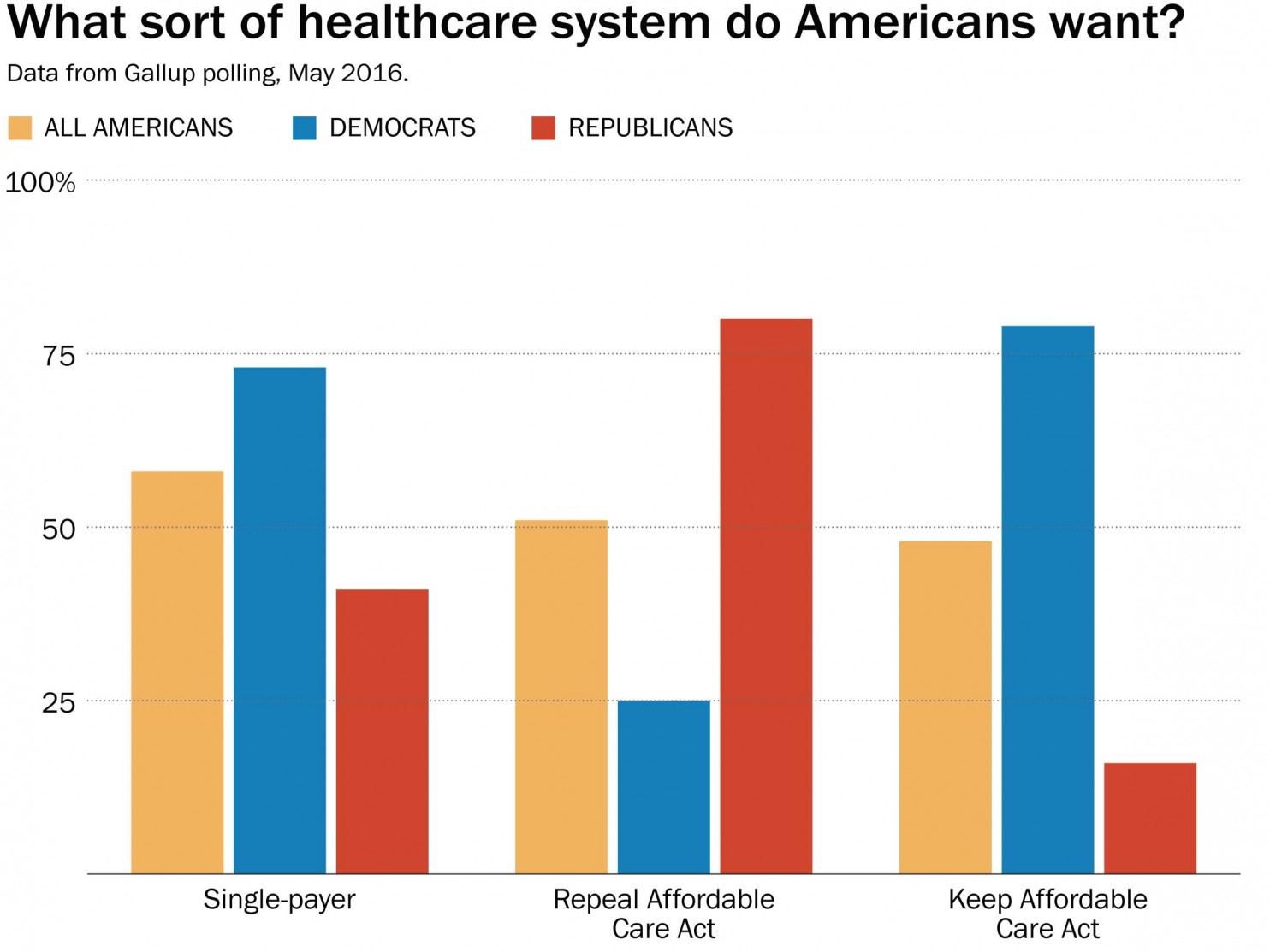
What do most Americans want? Medicare for all, of course, as a Gallup poll found in May.
Well over half of Americans want to replace Obamacare with a single-payer system. That figure, amazingly, includes 41 percent of Republicans and Republican-leaning independents — even though the wording of the question specifies that the program would be "federally funded." (Mind you, more than half of Republicans oppose the idea.)… Fifty-nine percent of Democrats support the idea of both keeping the ACA and replacing it with a single-payer program. Asked to pick between the two, though, that group favors single-payer by a 2-to-1 margin.


And, by the way, Roy Cooper, less than a week since becoming governor of North Carolina, announced that he’s putting through Medicaid expansion that will grant as many as 650,000 poor North Carolinians health insurance under Obamacare. It will pump around $3 or $4 billion in federal money into the state and will immensely improve North Carolinian’s healthcare, especially in rural areas. The radical right Republican-controlled legislature is already talking about impeaching him for it.

And now Trump has undercut Ryan, McConnell and Pence to say he doesn't back a repeal without a replacement


Labels: , , , , , , , ,

Tuesday, January 03, 2017

The Public CAN Defeat Republican Overreach— And Slapped Them Down With A Mighty Hand Today

>


Republican radicals, puffed up with a perception of absolute power, decided to stick a thumb in the eye of the public and pass an amendment by right-wing extremist Bob Goodlatte (R-VA, strongly rumored to be a worried pedophile) gutting the Office of Congressional Ethics. In a Republican caucus meeting Goodlatte’s outrageous amendment passed 119-74, despite warnings from Paul Ryan that it would backfire in their faces and make them look… well, like exactly how they are, the most most corrupt gang of crooks on the planet. DWT was one of dozens of blogs and news sources that rang the alarm bell Monday night.

Goodlatte had hoped to sneak the rules change through when no one was looking. The GOP passed it internally in the dead of night. But the public backlash was enormous. Even Trump, who was initially enthusiastic about destroying the ethics office, according to his spokesman, felt compelled to tweet this afternoon that the timing was bad. With 74 Republicans opposed, Goodlatte would have needed the Blue Dogs and New Dems to vote with the GOP majority. Pelosi went to work denying them Democratic support and the GOP, realizing they just didn’t have to votes from the the Republican wing of the Democratic Party— let alone the public support— pulled the amendment. His own internal GOP support started crumbling as Zephyr Teachout’s public whip count showed tremendous reluctance from Republicans who had voted for the amendment in their secret caucus to admit publicly they backed it. Most Republicans said their either opposed their own amendment they had supported the night before or said they were unsure or refused too answer. The only congress members still on board when McCarthy finally had the amendment killed were hard core extremists Pete Olson (R-TX), Marsha Blackburn (R-TN), Chris Collins (R-NY), Blake Farenthold (R-TX), Bill Flores (R-TX), Vicky Hartzler (R-MO), Martha Roby (R-AL), Harold Rogers (R-KY), Mia Love (R-UT) and, of course, Goodlatte himself. They were joined by a few with extreme vulnerabilities when it comes to corruption, like Carlos Curbelo (R-FL), Ileana Ros Lehtinen (R-FL) and Peter Roskam (R-IL) but not even the most corrupt Democrats who wanted to see the amendment passed were willing to commit to voting for it, not even serial bribe takers like New Dems honchos, Jim Himes (CT) and Joe Crowley (NY).


Republicans say they were undone by the media exposing their plans to the public. Congressional switchboards were flooded with calls which were running 99-1 in opposition. One crooked extremist, Dave Brat (R-VA), a crony of Goodlatte’s, admitted why he changed his vote. "Part of it is the headlines were we were backing off on ethics. So that’s not a good headline when it comes to messaging.”

Lisa Gilbert, director, Public Citizen’s Congress Watch division, issued a statement celebrating that “Public outrage over House Republican’s appalling, secretive midnight actions to embolden corruption and congressional profiteering in the coming congress has forced the House GOP to reverse course. The OCE has proven invaluable to congress and the public by opening up the ethics process. Not only should it stay as is, it should be given more statutory authority and subpoena power. The Office of Congressional Ethics was created to bring accountability to a broken House ethics system. Before the creation of the office, the House Ethics Committee was a black box of inaction. The office has brought transparency and action to a moribund process and received nothing but praise from those watching the congressional ethics system. It’s great that public pressure forced this reversal, but the readiness of the House Caucus to pursue this action is a profoundly troubling signal of what we should expect in the years to come.”

Ted Lieu (D-CA), who has been fighting for stronger ethics rules and more transparency issued a statement after public pressure forced the Republicans to back down.
While House Republicans have backed down from their disgraceful plan to gut the independent House Ethics Committee, all Americans should steel themselves for this kind of failed leadership from Speaker Ryan and company in 2017.

Swift and righteous public outcry may have forced House Republicans to back down on their mission to govern with almost no ethics oversight, but Speaker Ryan is still hell bent on repealing the ACA (thereby throwing 20 million plus Americans into health care crisis), gutting Wall Street regulations and shredding the Social Security / Medicare guarantee for our nation’s seniors.

Today, Democrats and the American people joined together to thwart the House GOP’s first disgraceful scheme in the first few hours of 2017.  Going forward, my fellow Democrats and I will fight House Republican special-interest-inspired attempts to move America backward.  My fellow Democrats and I will match failing Republican leadership with innovative ideas to grow our economy, expand health security and strengthen Social Security and Medicare for every American family.


And Jerry Nadler, the ranking Democrat on the House Judiciary Committee— Goodlatte’s counterpart, slammed the GOP on the House floor:
Mr. Speaker, I rise in strong opposition to H. Res. 5, the Republican rules package. As Republicans prepare to control all levers of government, their first course of action was to shield Members of Congress from independent ethics oversight, and to block free speech on the House floor. This is an assault on democracy, and a dangerous way to begin a new Congress.

Fortunately, after a groundswell of opposition, they have withdrawn their outrageous proposal to gut the Office of Congressional Ethics, which would have removed its independence and severely limited its power.  Our democracy rests on the consent of the governed. It can only truly function if the American people make their voices heard and hold their elected representatives responsible when they act in a manner that is contrary to their beliefs. It is a testament to the grassroots in this country that the Republicans were forced to reverse course. I hope the American people will continue to demand open and honest government as we face the many challenges ahead.

Unfortunately, this resolution still includes an equally troubling provision – a gag rule that imposes steep fines on any Member who records proceedings on the House floor, and prohibits certain conduct deemed to be “disorderly and disruptive.” This is obviously in response to last year's Democratic sit-in protesting the Republican refusal to allow debate on legislation to protect Americans from the epidemic of gun violence. After the Republican Leadership shut off C-SPAN cameras, resourceful Democratic Members used social media to broadcast the protest so that the public could hear its elected representatives demand that the House, at long last, consider reasonable gun safety legislation.

The lesson Republicans drew from this protest, however, was not that Americans should be protected from the scourge of gun violence.  It was that Members who stand up and say "Enough is enough" should be punished for taking extraordinary measures to make sure their voices are heard. That is an outrage!

This is the People’s House. It is supposed to foster free speech and free expression, as protected by the First Amendment and the Speech and Debate clause of the Constitution. This provision would have a chilling effect on speech, and would punish Members who ensure that the public has access to floor proceedings.

The initial draft of this resolution would have done all this without any due process whatsoever. Although it has now been amended to include some limited right of appeal to the Ethics Committee, this provision is still constitutionally dubious, at best.

I find it ironic that, in the same week that we read the Constitution on the House floor, we are taking up a resolution that is so at odds with some of the Constitution’s most cherished principles. As we prepare to inaugurate a President who will be violating the Constitution’s emoluments clause from the day he is sworn in, I would hope that this House would be more faithful to our founding values.

I urge a no vote on this resolution.


The public and the media are going to have to remain vigilant and united during the age of Trump, especially while the Republicans maintain control of both Houses of Congress— something we should work diligently to correct in 2018. Looking at Republican statements now, it appears almost no one voted for Goodlatte's amendment instead of 119 of them. What cowardly, deceitful sneaks they are!


Labels: , , , ,

Tuesday, December 13, 2016

The Republicans Are Already Selling Out Trump's Voters-- But Can The Democrats Capitalize On That?

>


Sunday we talked about how Trump allowed congressional Republicans to walk all over working class voters, inserting their ideological extremism-- that he doesn't share-- into legislation hurting retired coal miners' health insurance programs. Earlier this morning we talked about the need for Trump to stand up to Ryan (and Pence and Price) as they begin dismantling the social safety net in regard to health care for people insured through Obamacare and Medicare.

Working class voters who decided they wanted change enough to take a chance with Trump are getting the shitty end of the stick from extremist Republicans he seems unable or unwilling to stand up to. Aside from Ryan and the congressional Republicans, we're seeing ideological overreach on the state level as well. Take Ohio. Trump won the state's 18 electoral votes by a big margin-- 2,771,984 (52.1%) to 2,317,001 (43.5%). He won 81 of Ohio's 88 counties, including 9 won by Obama in 2012. Unless these 5 turnarounds were the result of Russian hacking, they are absolutely stunning:
• Ashtabula: Obama- 55%, Trump- 57%
• Trumbull: Obama- 60%, Trump- 51%
• Sandusky: Obama- 50%, Trump- 58%
• Erie: Obama- 55%, Trump- 53%
• Ottawa: Obama - 51%, Trump- 57%
Those are blue collar, pre-identity politics Democratic heartland counties. And at the same time the Democratic Party conservative Senate candidate-- forced on Democratic voters by Schumer and utterly clueless party elders-- Ted Strickland was just pulverized in a state where he not too long ago served as governor, losing to Rob Portman 3,048,467 (58.3%) to 1,929,873 (36.9%). He only won 4 counties-- and none very convincingly.

Of the 16 state Senate seats up, Democrats won 2 and the GOP won 14. The entire state House was contested and the Republicans won 66 seats, exactly double the Democrats 33, a 6 seat gain for the Republicans at the Democrats' expense. Trump didn't lead the party. Portman had 276,483 more votes than Trump and there were no Trump coattails anywhere. But Ohio Republicans feel empowered by the GOP sweep. They immediately passed an extremist and clearly unconstitutional anti-Choice bill. And, as Kris Maher reported for Wall Street Journal readers last week, the GOP legislators went wild, passing a bill to block local governments from passing ordinances raising the minimum wage in their jurisdictions.

The Ohio Republicans claims minimum wage workers should be happy with the five cent an hour raise they're already getting January 1 when the state's minimum goes from $8.10/hour to $8.15/hour. That's right in line with the attitude of the virulently anti-minimum wage/anti-union/anti-worker slob that Trump picked yo be Secretary of Labor, Andy Puzder (an Ohio anti-Choice fanatic) who contributed $332,000 to Trump's election campaign.
An Ohio limit could have an immediate effect on Cleveland, where residents are set to vote in May on whether to increase the local minimum wage to $12 an hour in 2018, and to $15 an hour within three years after that.

Brad Miller, an Ohio House Republican spokesman, said lawmakers are confident that the governor will sign the measure. He said some lawmakers were concerned about the effects on businesses if Cleveland and other municipalities were to raise their minimum wages.

“The concern is that if you increase costs on employers it makes it more difficult for them to create jobs and to help people in the long run,” Mr. Miller said.

About 22 states have adopted wage pre-emption laws in recent years, according to the National Employment Law Project, which backs higher minimum wages. That has sparked legal challenges in Alabama and Missouri to block the limits on cities and local governments and ballot initiatives to raise the minimum wage.

In November, voters in Arizona, Colorado and Maine approved minimum wage increases up to $12 an hour by 2020, and voters in Washington state approved a minimum-wage increase up to $13.50 an hour by 2020.

“Ballot initiatives that raised the minimum wage received more votes than either of the presidential candidates, and many conservative-leaning counties voted for President-elect Trump but also to raise the minimum wage,” said Paul Sonn, general counsel at the National Employment Law Project.

He said he believes that if the Ohio measure becomes law, advocates for a minimum-wage increase will try to put a statewide raise on the ballot in 2018.
Trump may not give a damn about the anti-choice legislation but bill aimed directly at making life harder for working families is something he may have to pay a little attention to. 2018 isn't that far away and even in one of the 3 or 4 most grotesquely gerrymandered states, there are half a dozen congressional seats that could swing back to the Democrats if voters start feeling betrayed by Trump. Forgetting for a moment that the DCCC will probably recruit useless conservative candidates with no message for working class voters, it would be possible for competitively-financed progressive Democrats to beat Steve Chabot, David Joyce, Jim Renacci, Pat Tiberi, Mike Turner and Bob Gibbs in a wave election year. But are the Democrats open to learning from their mistakes? That's a very open question.

House Dems voted to hold on to Pelosi and even though they technically forced her to give up the right to choose the DCCC chair, they voted for her incompetent loser choice anyway, Ben Ray Lujan who was carefully trained-- even programmed-- by Steve Israel to do everything required to lose, lose and lose some more. Keith Ellison, co-chair of the Congressional Progressive Caucus is running for the DNC chair on this platform: "Democrats win when we harness the power of everyday people and fight for the issues they care about. It is not enough for Democrats to ask for voters' support every two years. We must be with them through every lost paycheck, every tuition hike, and every time they are the victim of a hate crime. When voters know what Democrats stand for, we can improve the lives of all Americans."


Labels: , , , ,