Tuesday, August 25, 2020

How Much Better Off Would The Country Be If The Two Establishment Parties Just Disappeared?

>


Apparently George Washington was both prescient and correct when he warned, in his "farewell address" (1796), that political parties serve "always to distract the public councils and enfeeble the public administration. It agitates the community with ill-founded jealousies and false alarms, kindles the animosity of one part against another, foments occasionally riot and insurrection."

The Founders made a big mistake, though-- still not corrected all these years later-- in not including the choice "none of the above"-- in all elections. The country's politics would likely be a lot different-- and probably not worse.


Yesterday we had Washington's prescient on full display on day one of The Trump Show, a "convention" with no platform, just a shameful and repulsive pledge of allegiance to a cult of personality presidency. In effect, this is the 2020 Republican Party platform:
WHEREAS, The RNC enthusiastically supports President Trump and continues to reject the policy positions of the Obama-Biden Administration, as well as those espoused by the Democratic National Committee today; therefore, be it

RESOLVED, That the Republican Party has and will continue to enthusiastically support the President’s America-first agenda;

RESOVLVED, That the 2020 Republican National Convention will adjourn without adopting a new platform until the 2024 Republican National Convention;

RESOLVED, That the 2020 Republican National Convention calls on the media to engage in accurate and unbiased reporting, especially as it relates to the strong support of the RNC for President Trump and his Administration; and

RESOLVED, That any motion to amend the 2016 Platform or to adopt a new platform, including any motion to suspend the procedures that will allow doing so, will be ruled out of order.
Although no sitting Republican members of Congress have the guts to stand up to the Nazification of the GOP, yesterday Fox News reported that that a couple dozen ex members of Congress have endorsed Biden. Three are conservative former senators: Jeff Flake (AZ), John Warner (VA) and Gordon Humphrey (NH). And former members of the House include:
Steve Bartlett (TX)
Bill Clinger (PA)
Tom Coleman (MO)
Charlie Dent (PA)
Charles Djou (HI)
Mickey Edwards (OK)
Wayne Gilchrest (MD)
Jim Greenwood (PA)
Bob Inglis (SC)
Jim Kolbe (AZ)
Steve Kuykendall (CA)
Ray LaHood (IL)
Jim Leach (IA)
Connie Morella (MD)
Mike Parker (MS)
Jack Quinn (NY)
Claudine Schneider (RI)
Chris Shays (CT)
Peter Smith (VT)
Alan Steelman (TX)
Bill Whitehurst (VA)
Dick Zimmer (NJ)
Jim Walsh (NY)
Former Staten Island Republican Congresswoman Susan Molinari spoke at the Democratic Convention last week and also endorsed Biden. Lookin' good for Biden, right? Yeah, I guess. Trump is down by about 10 points in the new CBS/YouGov poll. But-- look again-- independent voters seem to have drifted back in Trump's direction-- and that should be very worrying.


What did you make of the video up top? As someone who supports clean government, abhors corruption and doesn't believe in voting for lesser evils, there's nothing on earth that would get me to ever vote for Biden (let alone Trump), but I'm not trying to dissuade anyone from following their own conscience and telling themselves that getting rid of Trump-- the existential threat-- and then "dealing with" the lesser threat once Biden is in the White House, is paramount. Best of luck with that, kids.

This was an encouraging MI-06 poll result yesterday. Hoadley is a progressive state Rep and Upton is a hereditary multimillionaire and Trump enabler:


I posted it on Twitter and one wag replied: When is Biden going to endorse Upton, something he did in 2018, helping the conservative Republican win against a progressive Democrat.

Have you read about the People's Party convention coming up next Sunday, August 30? Speakers include Cornel West, Nina Turner, Jimmy Dore, Ryan Knight, Marianne Williamson and Mike Gravel. I won't argue with this and wish them all the best and will do what I can to help support them in my own small way. I mean doesn't this sound good?
Our vision is a major new progressive populist party that will deliver what regular people take for granted in so many other countries: single-payer health care, free public college, money out of politics, an infrastructure jobs program, a $15 minimum wage, financial regulations, and more.

We need actual representation in our government. A majority of people in the US don’t feel represented by either the Democratic or Republican parties. We’ve watched these parties turn their backs on us to answer every call of the billionaires and donors. Overwhelming numbers of Americans understand these parties cannot be salvaged. Polls show that almost two out of three Americans are now calling for a major new party.  It’s time to build the party we’re looking for-- one that brings us all together.

When the pandemic hit, the Democrats and Republicans spent trillions of dollars bailing out Wall Street while leaving tens of millions of people unable to afford food and housing. Movement for a People’s Party, along with our partner organizations, led more than fifty rallies, on two different Saturdays in July, to let members of Congress know: “Do the right thing, help the people, or we will evict you from office!”

The Movement for a People’s Party continues to stand in solidarity with the communities whose pain and struggle have been deeply exacerbated these past few months.
At Too Much Information yesterday, David Sirota went after Rahm Emanuel and the corrupt Republican wing the Democratic Party he represents. "Progressives," wrote Sirota, "are told to keep quiet until after the election-- meanwhile, corporate Dems are blasting out divisive ideological messages that could demoralize Democratic voters and depress turnout... [A]t the very moment many good progressives are blunting their criticism and making clear that defeating Trump is of utmost importance, Corporate Democrats aren’t being asked to wait or hold their tongues. In fact, they are doing the opposite: Rahm Emanuel-- who has been advising Biden-- just went on television to show that the corporate wing of the party is intent on using the stretch run of the Most Important Election Of Our Lifetime™ not to doggedly focus on actually winning the election, but to instead try to predetermine post-election policy outcomes. Emanuel and his ilk depict themselves as evincing a non-ideological “just win, baby” attitude. But they are most decidedly pushing a very clear corporate ideology-- and they are doing so in dangerously divisive ways that could depress the big turnout that’s desperately needed to defeat Trump."


Emanuel was exulting in the defeat of popular progressive agenda items: "[T]here’s no new Green Deal, there’s no Medicare For All, probably the single two topics that were discussed the most. That’s not even in the platform."
Emanuel also isn’t just some random blowhard pundit spewing a corporate line. The Chicago Tribune in May reported that “Emanuel is having regular conversations with presumptive Democratic presidential nominee Joe Biden and his top advisers about economic policy."


So when Emanuel is refusing to self-censor in the name of “unity” and making these kinds of divisive declarations that stomp on progressive voters, he’s speaking from a position of real power. And he’s not just tweeting these comments, which could depress voter enthusiasm. He’s making them to a giant national television audience.

Corporate Democrats Are Not Holding Their Tongues

Now sure, you could try to write off Emanuel’s rhetoric as just the anomalous bloviations of notorious super-villain who pushed NAFTA and anti-immigration policies and who famously called progressives “f-ing retarded.” But sorry, this isn’t a one-off-- this is part of a larger pattern over the last few weeks and months.

As progressives are told to keep quiet, Democratic Party officials engineered a convention light on policy proposals, but one that gave prime convention speaking slots to the anti-climate-science, anti-union former Republican Gov. John Kasich of Ohio and to Colin Powell, who lied America into a war that killed hundreds of thousands of people. In his CNBC interview, Emanuel said “this will be the year of the Biden Republican”-- and he noted that promoting these figures was designed to help Biden deliberately send an anti-progressive message to voters because “John Kasich and Colin Powell don’t exactly endorse (or) support big-P progressive policies.”

This is the kind of move that is potentially disillusioning for Democratic voters who were previously told that a Democratic victory isn’t just a return to status quo-- but a step forward in strengthening the movements for climate action, worker rights and a more sane foreign policy.

Similarly, as progressives are told to shut the hell up, Democratic aides on Capitol Hill leaked word that the party’s lawmakers may immediately replay the 2009 debacle and block a public health insurance option after the election-- a move that is potentially demotivating for millions of Americans currently losing their private health insurance.

As progressives are told to mute themselves, Team Biden last week publicly signaled that a new Democratic president might prioritize deficit reduction and budget austerity in the middle of an economic crisis-- a move that is potentially deflating for millions of voters who have previously been told that President Biden’s agenda makes him the next FDR.

As progressives are told to keep quiet, Biden’s campaign leaks to Politico that the transition team building Biden’s prospective administration is being advised by Wall Street pal Larry Summers and former corporate super-lobbyist Steve Richetti.

And as progressives are told to muzzle themselves, Corporate Democrats went scorched earth and spent $15 million to intervene in primaries, stymie progressive Democratic candidates and tilt intraparty contests to business-friendly candidates. Meanwhile, House Speaker Nancy Pelosi works to unseat Democratic Sen. Ed Markey, one of the Senate’s few progressive lawmakers, and to crush a spirited primary challenge to Rep. Richard Neal, who has used his committee chairmanship to block even modest health care reforms.

‘Hold the line. Win. Lead.’

Clearly, this is a coordinated campaign by the right-wing of the Democratic Party to prioritize its policy goals above everything-- even motivating core Democratic voters to turnout in record numbers during the general election.

The best response to such an onslaught isn’t to ignore it or succumb to dishonest unity-themed demands for silence and fealty. After all, the folks making those demands don’t actually want unity-- they are aiming for corporate victory at all costs, even if waging a war for that intraparty win could depress enthusiasm for the Democratic ticket.

The smarter response is to follow the lead of Democratic Rep. Alexandria Ocasio-Cortez, who last week pushed back against the Corporate Democrats’ attempt to resurrect GOP-style austerity politics. Rather than just sitting there and staying silent, she declared that if the party wins in November, it must make “massive investment in our country or it will fall apart. This is not a joke. To adopt GOP deficit-hawking now, when millions of lives are at stake, is utterly irresponsible. Hold the line. Win. Lead.”

The brilliance of this kind of response is that it accomplishes two objectives: It stands up for a real change, and it reassures Democratic voters that there are at least some people who are serious about going to Washington and fighting for what the party purports to believe in.

Put another way, it fortifies the progressive agenda and it helps energize Democratic voters to turn out, because it casts the election not just as a meaningless charade that won’t matter after November because everyone will sell out anyway. It instead depicts the election as an event with high stakes beyond Trump-- a turning point that can create new policies that will actually matter in people’s lived experience.

This is how you avoid the 1988-Dukakis-collapse debacle and motivate the big turnout that can defeat Trump.

You don’t tell voters that “nothing would fundamentally change.”

You don’t blast out a story about how the Democratic presidential nominee told his Wall Street donors that he isn’t proposing new legislation to change corporate behavior.

You don’t turn your party convention into a pageant for Republican icons.

You don’t have the disgraced-mayor-turned-Wall-Street guy advise your presidential candidate-- or have him go on Corporate America’s favorite television station during a health care emergency and a climate crisis to effectively laugh at progressives who are pushing Medicare for All and a Green New Deal.


To paraphrase one of the best tweets in history, you don’t try to turn the election into a centrist rally for the idea that better things aren’t possible-- and you sure as hell don’t ask progressives to shut up.

You instead focus intently on telling your party’s voters how the election will materially improve their lives.

Of course, the Democratic Party machine and the Biden campaign aren’t really interested in doing that right now. They want to run an anti-Trump campaign, and nothing else.

In light of that, progressives shouldn’t unilaterally disarm and stay silent when Corporate Democrats are getting bolder and more brazen about using this pre-election period to push their depressing, better-things-aren’t-possible policy agenda.

Staying quiet in the face of that pablum doesn’t help. The real way to help boost turnout and energize voters is for progressives to push back against the corporate propaganda and make clear that-- whether the establishment likes it or not-- this election can and will offer the opportunity to achieve something even bigger than just getting rid of Trump.


Labels: , , , , , , ,

Sunday, August 16, 2020

Rahm Emanuel-- Still Trying To Turn The Democratic Party Into A Vehicle For Big Finance And Neoliberalism

>


In an OpEd for the Wall Street Journal on Saturday, Rahm Emanuel celebrated the idea of "Biden Republicans," basically conservative GOP voters who have had enough of Trump and are eager to vote him out of office by electing Joe Biden who was long bragged about being the most conservative Democrat in the Senate. "This year," he wrote, "Democrats have an opportunity to chisel off a demographic that will come to be known as 'Biden Republicans.' The question is whether Democrats will let these voters migrate back to the GOP after November, or whether our party will become their permanent safe harbor... Democrats have the chance to achieve a generational transformation. Beyond broadening the coalition to include moderate voters who oppose President Trump, we could deepen our base by turning disaffected Republicans into Democrats. Voters in places that were once beyond our reach-- suburban parts of Maricopa County, Arizona; Mecklenburg County, North Carolina; and Bucks County, Pennsylvania, for example-- are open to conversion."

What's a Democrat? Is it someone who supports a set of shared progressive values or is it someone willing to support-- with votes and cash-- Team Blue, Inc? That's where normal Democrats part company with party hacks and Wall Street whores like Emanuel. His claim to fame-- aside from twisting enough Democratic congressional arms for Bill Clinton to get NAFTA passed-- was, as DCCC chair, when in 2006, the Democrats captured 30 seats. That's part of Emanuel's legend-- although few people talk about how all of the conservatives he recruited, first voted with the GOP on issue after issue and were subsequently either defeated or forced to retire once they saw polls showing they would be defeated. None remained in Congress.

I was looking for a link to use citing my assertion and found this-- which I never knew existed-- on Wikipedia: "Emanuel had 'aggressively recruited right-leaning candidates, frequently military veterans, including former Republicans.' Many of the Representatives that Rahm had recruited, such as Heath Shuler, ending up [voted] against important Obama Administration priorities, like economic stimulus, banking reform, and health care.' Howie Klein has suggested that Emanuel's congressional campaign strategy was short-sighted, as it 'contributed to the massive G.O.P. majorities we have now, the biggest since the nineteen-twenties' when the Democrats lost control of the House in the 2010 mid-term elections."


Elizabeth Warren was once a Republican-- well into adulthood, as a matter of fact-- and switched parties... but not just a partisan designation at the board of elections, which would certainly be good enough for Emanuel, Warren, as you know, is pro-choice, pro-worker and comes down firmly on the side of Main Street rather than Wall Street. She isn't a bigot or a racist and when she came to the Democratic Party, she didn't bring all the baggage with her that appalls most Democrats, though not Rahmish Democrats from the growing Republican wing of the Democratic Party-- the Blue Dogs and the New Dems. And most of the Democrats-- oh, I don't know... 90% of them, who have migrated over to the Democratic Party have brought their old conservative perspectives. That's the problem.

And that's why, unlike the DCCC, Blue America supports progressives not generic Democrats. We're working hard to help primary winners like Kara Eastman, Mike Siegel, Liam O'Mara and Jon Hoadley, who defeated Emanuel-oriented candidates in districts held by Republicans, flip those seats from red to blue.

Goal ThermometerAn Emanuel-protégée, Cheri Bustos-- a Blue Dog/New Dem from Illinois-- has Emanuel's old job at the DCCC. Will she cut the progressives off before the election the way he did? We'll see. But right now I want to urge you to go to the Blue America 2020 congressional ActBlue page, by clicking on the thermometer on the right, and contributing what you can to these men and women-- each of whom is aware that they can only win by appealing to cross-over voters-- independents and moderate Republicans, not hard-core Trump voters who already have their candidates... real Republicans, like Donald J. Bacon, Trump appendage in Omaha, who Kara Eastman is currently leading in the polls, not by going the Republican-lite way but by talking with her neighbors about solving real problems that plague their lives. This morning, Kara told me that she believes "you show you are standing for Main Street over Wall Street by advocating for those crucial pocketbook issues every day: health care, economic fairness, and tax equity. But change won’t happen in DC if the same Washington lobbyists continue to set the agenda. This is why I came out of the gate rejecting all corporate PAC contributions. This has never been a popular position for entrenched interests; but, the more of us that stand up, the more they will back down and come around. You can’t just check off a box, you have to be vocal, visible and very hard-working."

"The way we win as Democrats," top Texas House candidate Mike Siegel told me today, "is to show every community that we will fight for them. This is how this plays in my district, which is perceived as conservative (R+9) but in reality is more dynamic, and certainly very winnable. Michael McCaul has voted to cut healthcare 46 times-- during a pandemic, while rural hospitals close-- while I am fighting for universal healthcare (Medicare for All), so you never have to think twice about seeing a doctor, getting a COVID test, picking up a prescription. McCaul calls this 'socialism' but the voters can see-- I’m fighting for their lives, while McCaul sees them as a profit center. Climate is another key issue. While the rural and Houston-side voters may not understand what we mean by a 'Green New Deal,' each element of this policy is popular. Voters like a national jobs program-- especially in this economic crisis we are in. They like environmental protection-- they want to stop the coal plant and fracking that’s poisoning the air and water. And they want to stop climate change, which has caused five '500 year' flood events in Houston in the last five years. 

"McCaul," he continued, "represents the corruption of our democracy. Taking $60K from Big Pharma while stopping the government from negotiating drug prices. Investing more of his own money in Oil and Gas than any member of Congress-- while refusing to support the most basic transitional steps to a renewable economy. By drawing these contrasts-- by showing I am unbought and unbossed, fighting for the people not corporations-- I can build a truly big tent. One that is not simply left versus right, but bottom versus top. And once we win this race-- and show not only that progressives can win primaries, that we can also flip seats red to blue-- we will give more fuel to this fire, and advance the movement to build a more equitable society."

Labels: , , , , ,

Tuesday, June 02, 2020

For The Working Class, The Democratic Party Is Still A Bit Better Than The GOP

>


In 2018, the DCCC successfully perpetrated the myth of the Blue Wave. That kind of p.r. is part of their job. The problem is, they believed it. And the results reinforced that mightily. There were 41 seats that flipped from red to blue. In 2016, the House Dems hadn't done badly. Even with an apparent Trump victory, they had managed to flip 6 seats and they increased their national congressional vote margin by 2.5%. In 2018, though, House Democratic candidates won 60,572,245 (53.4%) to 50,861,970 (44.8), as the GOP share of the vote plummeted 4.3%. The Dems increased their swing by 5.4%. That's a wave. But a Blue Wave? I've never thought so.

The DCCC recruited a huge pile of worthless garbage candidates with nothing to offer other than not being Republicans-- even if some of them actually were Republicans who were trying to rebrand themselves as Democrats (like Harley Rouda and Gil Cisneros in Orange County). Voters were ready to punish Trump for his first two years of excruciatingly bad governance. But he wasn't on the ballot... and they took stout on GOP congressional incumbents and on Republicans candidates. Dozens of Republicans sensed what was headed their way and retired before the election, including incumbents whose seats were ready to flip (and, in fact, did flip: Ed Royce (CA), Darrell Issa (CA), Ileana Ros-Lehtinen (FL), Lynn Jenkins (KS), Dave Trott (MI), Frank LoBiondo (NJ), Rodney Frelinghuysen (NJ), Steve Pearce (NM), Ryan Costello (PA), Pat Meehan (PA), Charlie Dent (PA), Bill Shuster (PA), and Dave Reichert (WA).

Then 30 Republican incumbents lost their reelection runs including notable Republicans Pete Sessions (TX, former head of the NRCC), Dana Rohrabacher (CA & Moscow), Dave Brat (VA), Barbara Comstock (VA), John Culberson (TX), Erik Paulsen (MN), Rod Blum (IA), Pete Roskam (IL), Mike Coffman (CO) and Steve Knight (CA). None of them had good opponents. In fact, almost no red to blue flips were by good Democrats. Those flips were anti-Republican flips... anti-Trump voters. There was a wave alright... but it was an anti-red wave, not a blue wave.

Yesterday, writing for the Washington Post, Mike DeBonis surveyed the lay of the land in terms of the upcoming House elections and concluded 2020 isn't going to be a good year for the GOP. He has no idea how bad it's going to be though, as anti-red wave II is gathering strength. The seat the NRCC wants to point to to frame the election is CA-25, the L.A./Ventura County seat the Steve Knight lost to weird New Dem Katie Hill in 2018 and was just won by a Republican in a special election. Hill had been forced to resign in a twisted and lurid sex scandal and the DCCC immediately recruited the worst possible candidate to replace her-- another worthless conservative, barely a Democrat, who was meant to remind voters of... Katie Hill, who most voters wanted to forget about. She was as unfit for office as Hill had been-- and the voters knew it and, despite it being a blue district with a Democratic registration advantage, the Republican won. DeBonis wrote that "When Republican Mike Garcia won a Southern California special election in May-- reclaiming a district Democrats had flipped only 18 months prior-- he gave the House GOP its most encouraging piece of political news since President Trump was sworn into office. The good news might end there. While Trump, Minority Leader Kevin McCarthy (R-CA) and other GOP leaders have heralded Garcia’s May 12 win as proof that they can win the House majority this year, many other indicators suggest that it will be exceedingly difficult to unwind Democrats’ 17-seat majority come November."

Yeah... and someone should explain to DeBonis that the GOP is more likely to lose 17 seats than to pick up a net of even one! That will be in his October column about the elections though. Now, it's just the Inside the Beltway metrics... "Vulnerable Democratic incumbents have massively outraised their Republican challengers, national GOP groups have yet to show the ability to make up the fundraising gap, and in several key districts, some of the party’s most coveted recruits have opted not to run. Public opinion polls, meanwhile, indicate a Democratic advantage on the congressional ballot in line with what the party enjoyed in 2018, ahead of their sweeping national gains." He is happy to admit this is all Inside-the-Beltway palaver: "Multiple nonpartisan forecasters, in fact, have worsened their outlook for House Republicans in recent weeks, arguing that those structural disadvantages, plus national political head winds for Republicans, will limit GOP House gains-- and potentially allow for further Democratic pickups." I question the use of the word "sincerely" by Gonzales below:
“Republicans sincerely believe that 2018 was a high-water mark for Democrats, that it is just not possible that Democrats can improve on their 2018 performance, and I don’t know that that’s true,” said Nathan L. Gonzales, editor and publisher of Inside Elections, who recently declared the California result an “outlier” and predicted that the November election would leave the House “close to the status quo” with no more than five seats changing hands between parties.

GOP leaders see the math differently. Garcia’s win, they argue, shows that Republicans can be competitive in the suburban battlegrounds where Democrats built their majority two years ago-- on top of the 30 Democratic-held districts where Trump won in 2016.

“If we can win in the Los Angeles suburbs, we can win anywhere and everywhere we need to win in the fall,” said Rep. Tom Emmer (R-MN), chairman of the National Republican Congressional Committee (NRCC), citing 43 Democratic seats with a heavier GOP tilt than Garcia’s.
Democrats didn't turn out for the special election. Among other things, Latinos, who make up a big part of the Democratic coalition in CA-25, were confused because the Republican was named Garcia and the Democrat was named Smith. And in the third of the district that lies in the Antelope Valley, she was disliked anyway for her support of putting homeless people in her Assembly district on a bus with a one way ticket to... the Antelope Valley. So they abstained. As horrible as Smith is-- and she's about as bad as a DCCC recruitment can be-- she'll probably win in November in the anti-GOP wave that catches Garcia.
Democrats and nonpartisan analysts are quick to quibble with that arithmetic-- starting with the size of the mountain Republicans have to climb. While the gap is now 17 seats, the margin is certain to be wider. A court-ordered mid-cycle redistricting in North Carolina created two additional safe Democratic seats in that state, and the retirement of GOP Rep. Will Hurd has opened a prime Democratic pickup opportunity in South Texas.

Meanwhile, Democrats are eyeing potential gains elsewhere, including suburban districts outside Dallas and Houston where GOP incumbents are retiring, as well as near-misses from 2018 in central Illinois, southern Minnesota and suburban Atlanta.

That means Republicans may have to flip three or more Democratic seats before they even begin to cut into the current majority, and they face serious head winds in doing so. The most easily quantifiable obstacle is money: More than two dozen Democrats have raised more than $2.5 million each, easily lapping their Republican challengers in all but a few cases.

Data compiled by the Cook Political Report’s David Wasserman found that, as of March, in the 55 top races targeted by the NRCC, the median Democratic incumbent had raised more than six times what the median leading Republican challenger had raised. And that was before the coronavirus pandemic upended political fundraising, making it more difficult for those behind to catch up. Wasserman declared the GOP’s path to the majority as “slim to non-existent” earlier this month.

Outside Republican groups such as the NRCC and the Congressional Leadership Fund are likely to raise tens of millions of dollars to supplement individual campaigns, but those groups have also been trailing their counterparts at the Democratic Congressional Campaign Committee (DCCC) and the House Majority PAC.

Republicans have heavily touted star recruits in several districts-- starting with Garcia, a former Navy fighter pilot, son of immigrants and first-time political candidate who skillfully positioned himself as a fresh alternative to his Democratic opponent, state lawmaker Christy Smith. Wesley Hunt, an African American former Army officer, is challenging freshman Rep. Lizzie Fletcher in Texas, and Michelle Steel, a Korean American county official, is running against Rep. Harley Rouda in Orange County, Calif.

“A record number of women running, a record number of minority candidates, 240-some military veterans-- these are people with great résumés, and the vast majority of them don’t have voting records,” Emmer said. “It’s basically the Democrats’ 2018 playbook that we’re using.”

But some of those diversity gains have been offset by setbacks elsewhere. Democrats were delighted when GOP voters nominated Jim Oberweis, a conservative former state senator, over two women to face Rep. Lauren Underwood in an exurban Chicago district Trump won by four points. And just this month, party officials moved to distance themselves from Ted Howze, the Republican facing Rep. Josh Harder in a competitive central California district, after Politico reported on racially offensive Internet postings made under Howze’s name [by Howze].

And on Tuesday, forecasters are closely watching the outcome of the GOP primary in Iowa’s 4th District, where Rep. Steve King is facing a strong intraparty challenge after making racially offensive comments, prompting Republicans to strip him of his committee assignments. A King win, forecasters agree, would leave the seat vulnerable to Democrat J.D. Scholten, who came within three points of beating King in 2018.

Meanwhile, Republicans are likely to go into November with less-than-ideal candidates in several other races. In New York’s 19th Congressional District, which Trump won by seven points in 2016, no credible GOP candidate has emerged to challenge freshman Rep. Antonio Delgado (D). In Michigan, top potential Republican candidates failed to challenge Reps. Elissa Slotkin, who has raised $3.7 million to defend a district Trump previously won by seven points, and Haley Stevens, who has raised $2.5 million in a district Trump won by four.

The difficulties for Republicans have been on display in Utah’s 4th Congressional District, centered on Salt Lake City, where Trump won by seven points in 2016. It leaped to the top of GOP target lists after Democrat Ben McAdams beat GOP Rep. Mia Love in 2018. The NRCC initially backed popular state Sen. Dan Hemmert, who quickly raised more than $400,000. But Hemmert backed out weeks later, citing the demands of a high-profile campaign.

“It’s not the right time. I don’t know what to say,” he told the Salt Lake Tribune in December.

McAdams, meanwhile, has raised $2.8 million for his reelection campaign and had $2.2 million left to spend as of early April. The best-funded Republican candidate, state Rep. Kim Coleman, had about $115,000 in the bank at the same point.

Meanwhile, it’s unclear if potential GOP attacks against McAdams-- highlighting his vote for Trump’s impeachment or tying him to far-left Democratic figures-- will even resonate in a post-pandemic political environment. McAdams, who recently emerged from a bout with the coronavirus, said Thursday he was focused on helping his constituents and not getting caught up in partisan politicking.

“One thing I have going for me is that I work harder than anybody else in the race, and I think a lot of people who were looking at the race knew that it was going to be hard to outwork me,” he said Thursday.

While there is anecdotal evidence that presidential-year turnout will improve for Republicans with Trump on the ticket, there is little sign that public opinion about control of Congress has shifted since 2018. Democrats won the national House vote in 2018 by about eight points; a Monmouth poll released this month gave them a 10-point lead nationally, and other recent “generic ballot” polls have been in a similar range.

Hopes of outsize GOP gains largely rest on Trump’s ability to keep the pandemic at bay and recover his political standing in the coming months, giving him the ability to drag underfunded candidates across the finish line on Nov. 3.

“President Trump won most of the seats that are on the battlefield now-- all he has to do is win them again,” said Rep. Steve Stivers (R-OH), a former NRCC chairman. “And so I don’t know if he’ll match his performance from 2016, but if he does, we win the majority.”

But Rep. Cheri Bustos (D-IL), chairwoman of the DCCC, expressed complete confidence in an interview Wednesday, calling Garcia’s win “not a sign of anything” and predicting that Smith would best Garcia in the higher-turnout November election.

Bustos pointed to her party’s fundraising advantage, GOP recruiting woes and a proven Democratic message on health care-- “I’d much rather be the party of health care than the party of drinking bleach,” she said, referring to Trump’s recent musings about injecting disinfectant-- as underpinning that confidence.

“It’s literally failure and failure after failure for them, whether it’s the money, the messaging or the mobilization,” Bustos said. “By every measurement, I feel really good six months out.”
Cheri & Rahm
Cheri Bustos feels good-- all those shit candidates she's recruited seem just like her and the other worthless, hated neo-liberals who have turned the Democratic party into a sewer that only exists because it's slightly less odious and toxic than the Republican Party. When I first met Ari Rabin-Have he was working for Harry Reid, although he soon migrated towards Bernie. Over the weekend he wrote a piece for Jacobin, Coronavirus’s Devastation Has Been Made Far Worse by Years of Democrats’ Neoliberal Policies, which should help anyone understand why the Cheri Bustos/Pelosi/Hoyer wing of the party is leading the Democrats down the road to disaster. [Prediction in January, 2023, there will be a Republican Speaker of the House again.] "Coronavirus," he wrote, "isn’t only exposing Donald Trump’s incompetence. The crisis is laying bare the consequences of the neoliberal economic agenda corporate Democrats have been pushing for decades." He explained how "Instead of examining the very real pain felt by workers in our economy over decades... the upper echelons of Democratic Party economic policymaking... hide behind broad macro numbers and use them to avoid confronting the economic hardship caused by the very systems they helped create."
Manufacturing workers watched as their jobs were outsourced in the aftermath of NAFTA and other bad trade treaties, while leaders in the Democratic Party either ignored their plight, claimed we were trading low-wage jobs for higher-wage ones, or falsely promoted the promise of programs like the Trade Adjustment Assistance which never lived up to the hype.

Factories closed, communities were gutted, and good jobs were nowhere to be found. Yet the economic thought leaders in the Democratic Party continued to paint rosy economic scenarios... A certain set of Democratic policymakers and strategists would like to pretend that the only thing exposed by the COVID-19 pandemic is the utter incompetence of Donald Trump. What they would like to ignore is that the crisis we are in has laid bare the consequences of the neoliberal economic agenda [Jason] Furman and his ideological allies have been pushing for decades.

They fought mercilessly in 2019 for a health care system where insurance coverage was tied to employment. In the 1990s they scaled back welfare programs. They pushed policies that tied educational advancement to personal debt and an international trade system whose supply chain is over-reliant on foreign manufacturing, in particular in China.

Each of these steps were taken under the advisement of wonderfully written economic studies claiming broad economic benefits for the country. In truth the opposite occurred, and the economic pain of the current crisis has been magnified because of them.

Earlier this month, the Biden campaign was promoting the notion of an “FDR-size presidency” under the rationale that the Democratic nominee needs to meet this moment. For centrist policymakers this was the threat they thought had been defeated in the primary.

Furman, on the other hand, wrote an op-ed in the Wall Street Journal in early March making his case for a “big coronavirus stimulus.” Big to Furman amounted to a laughably small $350 billion program.

Furman is not worried that Trump’s campaign will successfully be able to sell an economic miracle. Instead he and other centrist policymakers’ greater fear is that the economic conditions of the Great Depression would steer the Biden campaign and administration toward bolder economic policies. While thus far there is little evidence of this, even deploying progressive rhetoric is too much for the centrist establishment.

Furman’s former boss, Obama White House chief of staff Rahm Emanuel, who has been privately advising the Biden campaign, explained this to David Axelrod on his podcast this week. “The moment may call for it, and I’m a big believer in never allowing a crisis to go to waste, but the whole primary was a couple people in our party talking about a revolution and a couple people in our party talking more reform than revolution,” he said. “And what Biden is now saying is, ‘Well, the post-COVID world requires a revolution,’ and I’m surprised, because he did not win on the revolution model. He won on the reform model.”

Emanuel continued, “I’m not sure revolution is going to be reassuring to Southfield, Michigan; Bloomfield, Michigan; the suburbs out of Milwaukee; the suburbs in Phoenix.”

Axelrod replied that Biden’s policies should be “packaged as pragmatic answers to the crisis.”

Cheri & Debbie
The notion that people who are out of work, without health care and not knowing how they are going to put food on the table, are not seeking help but instead political pragmatism is ludicrous. It is yet another example of centrists ignoring economic pain because they fundamentally support a politics where “nothing will fundamentally change.” This is what they were promised by Joe Biden’s campaign. But if they acknowledge that the economic fallout from the coronavirus could lead to a second Great Depression, then the logical policy response is a second New Deal, and that promise would be broken.

Instead Furman suggests a Democratic response fundamentally based on accepting a false reality. He knows that Donald Trump will campaign saying he has built the greatest economy in American history. Regardless of data, the president was always going to make that claim, and Fox News and his other propaganda organs would dutifully tout that party line.

That is how fearful the centrist establishment is of progressive policy change. They would rather ignore the real pain of working people and cower to the phony economic posturing of Donald Trump than confront corporate power.

Labels: , , , , , , , , ,

Thursday, April 23, 2020

Trading Away Lives For Economic Well-Being... But Whose Lives?

>

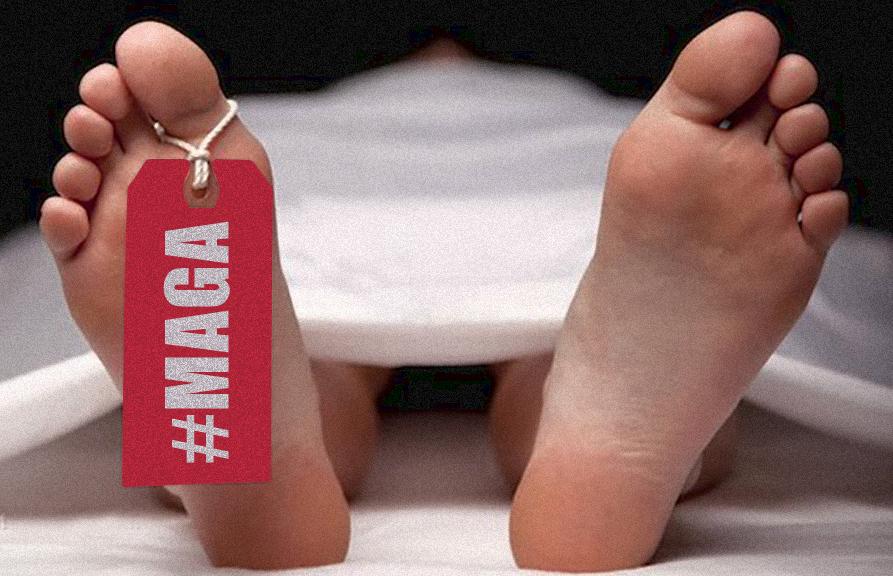
MAGA by Chip Proser

Many people woke up this morning and read Peter Bakers' NY Times column, The Cold Calculations America’s Leaders Will Have to Make Before Reopening in the context of Georgia's crackpot governor's decision to start reopening mostly businesses catering to and operated by minorities. First the numbers: Georgia's confirmed case-load increased by 846 from Tuesday to Wednesday to bring the state's total to 21,512. Georgia is now over 2,000 cases per million people. That's bad and has been getting worse everyday. And that's a manifestation of a steepening curve, not a flattening curve. "How many deaths," asked Baker, "are acceptable to reopen the country before the coronavirus is completely eradicated? 'One is too many,' President Trump insists, a politically safe formulation that any leader would instinctively articulate." Kemp might add that 'one white death is too many but let's see what opening up does in black communities because, who cares.'"

The politically safe formulation made by Trump is unrelated to his reopen-soon approach. "Nor for that matter will it be the bottom line for even those governors who want to go slower. Until there is a vaccine or a cure for the coronavirus, the macabre truth is that any plan to begin restoring public life invariably means trading away some lives. The question is how far will leaders go to keep it to a minimum. Some of the more provocative voices on the political right say that with tens of millions of Americans out of work and businesses collapsing, some people must be sacrificed for the greater good of restoring the economy quickly. To many, that sounds unthinkable, but less inflammatory experts and policymakers also acknowledge that there are enormous costs to keeping so much of the work force idle, with many of the unemployed struggling to pay for food, shelter or medical care for other health challenges."

Kemp was the first to act-- and Trump both praised him on a private call to America's most racist governor while castigating him-- wink, wink-- publicly.


Baker went on that "the nation’s leaders are left with the excruciating dilemma of figuring out how to balance life and livelihood on a scale unseen in generations. 'Every governor in the nation is asking that,' Gov. Gretchen Whitmer of Michigan, where 2,700 have died and more than 1 million have lost jobs, said this week. 'There’s no such thing as zero risk in the world in which we’re living. But we know that not taking measures to control the spread means that’s going to translate into lives lost.'" Kemp-- opening barber shops, hair and nails salons first-- sees it as an opportunity for a mini-genocide... or at least some ethnic cleansing of voters who opposed him politically.
With no cure available for the coronavirus and no vaccine likely for another year or more, governors in hard-hit states are seeking ways to minimize the number of additional deaths by staging and structuring any reopening. Time and testing are key, according to public health experts. The longer a quarantine can be extended the better, they say, and the more testing made available, the easier it would be to properly calibrate a reopening and respond to any new outbreak.

Pushing to restore business sooner rather than later, Mr. Trump has dismissed waiting until comprehensive testing provides a better map of where the infection has spread. Instead, the federal government’s guidelines envision “sentinel surveillance” testing of vulnerable places like nursing homes and inner-city health centers, while gradually reopening businesses, schools and other venues in stages with precautions like masks, gloves and social distancing.

All of which could mitigate future infections but would not halt them. The reason the death toll projection may be closer to 60,000 rather than the 2 million of one estimate was because society largely shut down. One recent study said that the 60,000 deaths would have been 6,000 had quarantine measures been imposed just two weeks earlier. So easing measures means the death toll will go up even with safeguards.

But remaining closed is not without a cost either. In just four weeks, a staggering 22 million Americans have lost their jobs, the equivalent of the entire labor force of 23 states.

The question divides not only the nation but even families. Rahm Emanuel, the former mayor of Chicago and White House chief of staff, and his brother, Dr. Ezekiel J. Emanuel, a prominent medical ethicist and vice provost of global initiatives at the University of Pennsylvania, have engaged in a running quarrel about how soon society should reopen.

Rahm Emanuel considers it untenable to keep most of the country closed until the virus is completely under control, while Ezekiel Emanuel maintains that the pandemic is too much of a threat to rush back to life as usual.

...The trade-offs have stirred angry exchanges since the start of the lockdowns. Lt. Gov. Dan Patrick of Texas, who is 70, said last month that older people like himself should be ready to risk death to save the economy for their grandchildren, comments he defended on Fox News on Monday night. In a separate appearance on Fox last week, Dr. Mehmet Oz, the television host, cited a study to argue that reopening schools “may only cost us 2 to 3 percent in terms of total mortality,” calling it “a trade-off some folks would consider.” After a backlash, he said he “misspoke” and expressed regret that he “confused and upset people.”


...Government makes money-versus-lives trade-offs all the time. When a regulatory agency weighs a new safety rule, it measures the cost to industry or consumers against the gain by assigning a dollar value to each life that might be saved. If a new rule costs billions of dollars but would only prevent a few dozen deaths, it likely would not be adopted-- even though someone would die as a result.

The idea that the government translates life to dollars and cents may sound bloodless but it is not unusual. A White House report from 2017, for instance, estimated the cost of 41,000 deaths attributed to opioid overdoses in 2015 at $431.7 billion, an average of $10.5 million per person.

By that calculation, the 60,000 deaths projected from the coronavirus would be valued at $631.8 billion-- while the roughly 2 million lives theoretically saved by lockdowns would be worth about $21 trillion, or nearly eight times the $2.7 trillion in relief spending brokered by Congress and Treasury Secretary Steven Mnuchin.

But James H. Stock, a Harvard economist who served on President Barack Obama’s Council of Economic Advisers, said this crisis goes beyond such ordinary calculations because a shuttered economy represents an almost existential threat to the very idea of America.

“We really have to be talking not just about our reduction in consumption in the short run but what this is going to be doing to the economy and the republic in the long run,” he said. “It’s those big issues that we’ve been afraid to talk about. A year of this and we would just see an unrecognizable transformation of what America would look like coming out of it.”

Stephen Moore, a conservative economist who serves on Mr. Trump’s reopening committee, said those advocating restarting the economy are caricatured as putting profits over lives.

“I reject this idea that the people who are for keeping the economy shut down are the angels because they’re the ones who care about human life,” said Mr. Moore, who has coordinated with lockdown protesters. “What about the poverty? What about the suicides? What about the child abuse cases and the alcoholism and the drug overdoses and the depression and all of the negative effects to health and well-being that are associated with an economy in recession?”

Studies show that depression, drug use and suicides spike during economic hardship, including after the last recession, and the all-consuming focus of the medical system on the coronavirus in certain areas has delayed other medical care. Yet that might be offset by falling violent crime, car crashes, workplace accidents and air pollution. Vehicle collisions in California decreased by half after its stay-at-home order went into effect while murder and air pollution are each down 25 percent in New York City.

Some scholars argue that reopening too quickly would actually hurt the economy, particularly if it resulted in a second wave that destroyed public confidence. A study of the 1918 influenza pandemic found that cities that closed schools and banned public gatherings earlier and kept them shut longer not only had fewer deaths but emerged better economically.

Governor Murphy said resuming public life would not succeed if people did not feel certain that the virus had been contained. Indeed, 76 percent of Americans said social distancing should continue as long as needed to curb the virus even if it meant continued damage to the economy, according to a new poll by Politico and Morning Consult, while just 14 percent favored an end to restrictions to stimulate the economy even if it meant spreading the virus.

“If you opened every restaurant in New Jersey tomorrow, I don’t think anybody would show up,” Governor Murphy said. “It’s not like we’re holding back some pent-up demand. I don’t blame them-- there are folks out there who are frustrated, who have cabin fever, who want to break free. So do I, by the way. But I think folks also want to have confidence that they’re not going to get sick and die.”


We'll see what happens on Monday, when Georgia does open up restaurants, "even as many public health experts warn that the approach could trigger a new outbreak. Trump’s top health advisers have repeatedly criticized Kemp’s strategy. Fauci-- who didn't address the racist nature of Kemp's moves: "There is a danger of a rebound. Going ahead and leapfrogging into phases where you should not be, I would advise him, as a health official and a physician, not to do that."
Georgia Democrats, who strongly opposed Kemp’s pandemic policies, quickly highlighted the rift between the president and the governor.


“You know it’s a serious failure when Donald Trump, whose failed leadership is responsible for how badly this crisis is hitting America, distances himself from his crony Brian Kemp, who is endlessly determined to make this crisis as painful as possible for Georgians,” said Nikema Williams, chairwoman of the state Democratic Party.

...The governor has come under increasing pressure from local leaders, particularly in dense urban areas, who are upset that his statewide order barred them from enacting more severe restrictions.

“We need to, as government leaders, step up and give people an incentive to stay home,” said Atlanta Mayor Keisha Lance Bottoms. “But there’s nothing essential about going to a bowling alley in the middle of a pandemic.”

The governor also faced criticism from members of the state coronavirus task force he formed to help guide his response strategy who are upset they were left in the dark by his decision to roll back restrictions.

  Kemp defended his policy on a conference call Wednesday with U.S. Sen. Kelly Loeffler, one of his top allies, saying that efforts to contain the coronavirus were paying off.

  “I know this is a different world. But we have to continue living in it for a few more weeks, or possibly just a few more months,” he said. “There are a lot of people financially hurting, and we’ve got to do our best to help them out.”

It was a surprising turnaround for the president. A day earlier, Trump expressed confidence in Kemp’s response even as federal health officials took a different tack.

Dr. Deborah Birx, the federal coronavirus response coordinator, seemed to endorse calls by local Georgia officials who have urged residents to stay home despite Kemp’s directive.

  “I believe people in Atlanta would understand if their cases are not going down, they need to continue to do everything we said: social distancing, washing your hands, wearing a mask in public,” said Birx. 

Labels: , , , , , ,

Friday, August 16, 2019

There Have Been Times, Historically Speaking, When Crooked Politicians Went To Prison

>

So far Emanuel has not been arrested

The other day I was doing some research for a post about Mark Sanford and wandered onto an old (2014) City Paper piece, America's Worst Politicians. this was back in our innocence, before Putin decided who would sit in the Oval Office. Some I knew and some I didn't but there were some definite standouts besides Sanford. Illinois is a very sleazy state so it must have been hard to choose only two. One, obviously was Blowhard Chicago Mayor Rahm Emanuel, a write up by Mick Dumke of the Chicago Reader. How do you do this in paragraphs rather than in volumes?
Even toward the end of his 22-year mayoral reign, when he started selling off pieces of the city to hide its escalating financial woes, Richard M. Daley had broad support in Chicago. Sure, he was a tyrannical, thin-skinned jerk who doled out jobs and contracts to his friends, but he was the people's tyrannical, thin-skinned jerk who doled out jobs and contracts to his friends. His successor, Rahm Emanuel, is simply a jerk.

At least that's how he's seen by lots of Chicagoans after his first three years in office. In a recent poll commissioned by the Chicago Sun-Times, Emanuel had the support of a meager 29 percent of city voters.

The mayor and his allies stress he's made "tough choices" to get the city back on track, starting with restoring fiscal discipline. It's certainly true he's shuttered mental health clinics, raised water fees, privatized city jobs, laid off teachers, and closed schools-- four dozen of them at once. At the same time, he's poured millions of additional dollars into non-unionized, privately run charter schools.

But it's not only what he's done; it's also how he's done it. Emanuel is widely seen as an outsider who uses Chicago as a backdrop for his broader political ambitions. Though he appears regularly in city neighborhoods for news conferences, his daily meeting schedule is filled with millionaire corporate leaders and investors, earning him the nickname "Mayor 1%" (and inspiring a book of that name by journalist Kari Lydersen). He jets regularly to Washington to maintain his national image-- yet he also has a knack for avoiding the spotlight at home when it's especially hot, such as the time he was on a ski vacation when the school-closings list was released.

Still, Emanuel remains a formidable politician. He already has more than $7 million in his campaign coffers and is prepared to raise millions more before he's up for election next February. Rahm may not be loved, but he's unlikely to go down unless some high-profile candidate runs against him, and so far, that special someone hasn't jumped into the race.
And number two wasn't hard to find-- just another from the "blowhard category," this one written up very succinctly by Keegan Hamilton, Donald J. Trumpanzee:
Though the Donald isn't technically a politician (he has never held office), he routinely threatens to run for president and perpetually inserts himself into the national political debate. From stoking conspiracy theories by offering a $5 million bounty for President Obama's birth certificate to calling the 2012 election "a sham and a travesty," Trump is the ultimate political troll.

The reality TV star and real estate magnate recently toyed with the idea of running as the GOP candidate for governor of New York before removing himself from the race. And he has donated millions to candidates from both parties over the years. While his political ambitions may be as absurd as his comb-over, Trump is a master at exploiting the media to generate semi-serious discussion of fringy ideas that would normally be dismissed out of hand.

At various times, Trump has suggested repealing campaign contribution limits, imposing a 25 percent tariff on all Chinese goods, and building a "triple-layered fence" and flying Predator drones along the Mexican border.

Trump's sideshow routine has become tiresome for some reporters (BuzzFeed's McKay Coppins compared the experience of covering the Donald's short-lived 2014 gubernatorial campaign to "donning a network-branded parka during a snowstorm and shouting into the camera about a predictable phenomenon"), but many major news outlets still find the act irresistible for the ratings and page views. And that begs the question: Who's dumber, Donald Trump or the journalists who keep feeding the troll?
Ahhh... the good old days, when he was just a target of derision. Hard to top Trump, but I really wanted to find a public official who subsequently went to prison. It wasn't that hard to find: T for Texas. The gentleman, a former U.S. congressman was sentenced to serve ten years in prison on November 7, 2018 and ordered to pay $1,014,718.51 in restitution, to be followed by three years of supervised release. Right now he is incarcerated at a medical facility of the Federal Bureau of Prisons in Fort Worth. Not enough hints? Joe Tone wrote up Steve Stockman for the Dallas Observer.
There will soon come a day when Steve Stockman, the U.S. representative for the 36th District of Texas, will depart his Washington, D.C. office for the last time and fly home to southeast Texas, never to return to the city he so loathes. He probably won't fire a celebratory bullet through the Capitol dome, but he'll probably give it some consideration. Because Stockman, if nothing else, is the congressman of the gun.

It began in 1995, during the first year of his initial, short-lived stint in Congress, when he wrote in Guns and Ammo that the Clinton administration had orchestrated the siege on David Koresh's Waco compound "to prove the need for a ban on so-called 'assault weapons.'" Oddly, Stockman's political career quickly fizzled: He lost his next election. But he resurfaced in 2012 a totally unchanged man.

Less than a month after the 2012 Sandy Hook shootings, he introduced the Safe Schools Act, which would have repealed federal laws keeping guns away from schools. He then vowed to pursue the impeachment of Barack Obama after the president issued minor executive orders seeking more gun control, which Stockman called "an existential threat to this nation."

Occasionally, and memorably, he has exerted himself, to fight climate change, sex education, and, in February 2013, the Violence Against Women Act, which provides protection to gay and transgender people. "This is helping the liberals, this is horrible. Unbelievable," Stockman said. "What really bothers-- it's called a women's act, but then they have men dressed up as women, they count that. Change-gender, or whatever. How is that-- how is that a woman?"

It's this rhetorical flair that journalists will miss come next January, when Stockman, after recent failed bids for the Senate and his House seat, departs Washington again, likely for good this time. The gun lobby might miss him too, but only until it gets its strings attached to the new guy.
And that reminds me... Dan Alexander wrote up the net worth of all the candidates, many of them notorious crooks, who are running for president this cycle. Here they are-- in order of "net worth"... starting with the most corrupt man in the history of U.S. politics:
Señor Trumpanzee- $3.1 billion-- inheritance + decades of criminal activities
Tom Steyer- $1.6 billion-- hedge fund operator
John Delaney- $200 million-- Wall Street crook who took advantage of desperately sick people
Michael Bennet- $15 million-- factotum for crooked Republican Philip Anschutz who built an empire in oil, railroads, telecom, real estate and entertainment
Elizabeth Warren- $12 million-- writing books, investing
Status Quo Joe- $9 million-- criminal and unethical activities
Kamala Harris- $6 million-- criminal husband
Joe Sestak- $6 million-- investing
Beto- $4 million-- married rich
de Blasio- $2.5 million-- investing in NY real estate
Bernie- $2.5 million-- writing books
Jay Inslee- $2 million-- ?
Amy Klobuchar- $2 million-- ?
Cory Booker- $1.5 million-- investing
Steve Bullock- $1.5 million-- landlord
Marianne Williamson- $1.5 million-- writing books, investing
Kirsten Gillibrand- $1 million-- ?
Seth Moulton- $1 million-- investing
Andrew Yang- $1 million-- tech start-ups
Julian Castro- $700,000-- investments
Tulsi- $500,000-- cryptocurrency investments
Tim Ryan- $500,000-- never had a job in his life
Mayo Pete- $100,000-- McKinsey

This graphic shows how many billionaires are supporting each of the 2020 Democratic presidential candidates. Do you think support from a bunch of billionaires signifies something about a candidate? 

Bernie- zero

Labels: , ,