Saturday, March 14, 2020

Saturday Morning COVID-19 Update: Dazed, Confused and Kushner

>


The NY Times reported yesterday that between "160 million and 214 million people in the U.S. could be infected over the course of the epidemic [and] as many as 200,000 to 1.7 million people could die." The U.S. has 925,000 hospital beds but between 2.4 million and 21 million Americans could require hospitalization. The solution? Jared Kushner? It could be worse... Don, Jr.? Eric, Barron?

A friend of mine was Jared Kushner's private tutor when he was in high school. She told me he was a C Student and she worked to turn him into a B student. Although she failed-- she was astounded when he was accepted by Harvard, as was the entire faculty at the Frisch School in Paramus, New Jersey. A few years later, in 2006, Daniel Golden wrote a book, The Price of Admission-- about how the rich buy their under-achieving children’s way into elite universities with massive, tax-deductible donations-- that just happened to focus, in part, on her student. Jared's dad, a Trump crony and notoriously crooked New Jersey real estate developer destined for prison, Charles Kushner, had pledged $2.5 million to Harvard in 1998-- resulting in two unqualified songs, Jared and Joshua being admitted to the nation's most prestigious university. That was how C student Jared-- who my friend says was actually a moron with virtually no capacity for intellectual endeavor-- got into Harvard, something that greatly impressed-- and still impresses-- his father-in-law, Señor Trumpanzee, whose own family finagled his way into Wharton Business School, which is affiliated with the University of Pennsylvania-- a lesser Ivy League school-- after he flunked out of Fordham.

In his book, Golden quoted a former Frisch School official about Jared: "There was no way anybody in the administrative office of the school thought he would on the merits get into Harvard. His GPA did not warrant it, his SAT scores did not warrant it. We thought for sure, there was no way this was going to happen. Then, lo and behold, Jared was accepted. It was a little bit disappointing because there were at the time other kids we thought should really get in on the merits, and they did not." Golden has no doubt that Harvard had an unspoken policy of "easing its standards" for the offspring of generous donors.


Did you watch the horrific speech Trump tried reading from a teleprompter on Wednesday? It was written by the dynamic team of Jared and White House Nazi Stephen Miller. Yesterday, Phil Rucker, Ashley Parker and Josh Dawsey, writing about the disastrous speech, noted that Trump ad-libbed a bit and "his errors triggered a market meltdown, panicked travelers overseas and crystallized for his critics just how dangerously he has fumbled his management of the coronavirus." They wrote that "Even Trump-- a man practically allergic to admitting mistakes-- knew he’d screwed up by declaring Wednesday night that his ban on travel from Europe would include cargo and trade, and acknowledged as much to aides in the Oval Office as soon as he’d finished speaking, according to one senior administration official and a second person, both with knowledge of the episode." Jared and other White House staffers went to work to immediately correct Trump's fuck-ups over trade and the status of Americans currently in Europe.

But Jared's and Miller's 10 minute speech itself, wrote The Post team "reflected not only [Trump's] handling of the coronavirus crisis but, in some ways, much of his presidency. It was riddled with errors, nationalist and xenophobic in tone, limited in its empathy, and boastful of both his own decisions and the supremacy of the nation he leads. Futures for the Dow Jones industrial average fell in real time with virtually each word Trump uttered, signaling a lack of confidence among investors that he had control of the crisis and previewing another bloodbath once the markets opened Thursday morning."
Trump-- who believed that by giving the speech he would appear in command and that his remarks would reassure financial markets and the country-- was in “an unusually foul mood” and sounded at times “apoplectic” on Thursday as he watched stocks tumble and digested widespread criticism of his speech, according to a former senior administration official briefed on his private conversations.

...Ben Rhodes, who served as a senior White House aide and helped former president Barack Obama script and manage his responses to numerous crises, predicted that Wednesday night’s address will stand as “the moment people associate with the fact that Donald Trump failed the biggest test of his presidency.”

“I think we’ll look back on this as a defining moment of the Trump presidency because it speaks to larger concerns that people already had about Trump-- that he can’t tell the truth, that he doesn’t value expertise, that he doesn’t take the presidency seriously enough,” Rhodes said.

As often is the case after Trump gives a major speech, his Republican allies offered a chorus of praise on television and social media for his “fantastic speech” and “decisive actions” and “unique strength.”

Inside the White House, however, aides and advisers privately acknowledged that Trump failed to accomplish the primary goal of his speech-- reassuring the nation-- and described it as disappointing and far from his best performance.

Trump’s speech contained at least two errors and a significant omission. He said the travel ban would apply to cargo; it did not. He said health insurance companies would waive patients’ co-payments for coronavirus testing and treatment; industry officials later clarified that they would waive payments for testing only. And he did not fully explain the details of his travel restrictions, leaving out the fact that U.S. citizens would be exempt.

The president’s remarks were devoid of much substantive information on other matters. Trump provided no update for citizens on the spread of the virus, nor on the availability and results of testing.

Public health experts have said testing citizens for the coronavirus is essential for identifying new cases and limiting its spread, but the nation has experienced a chronic shortage of test kits after weeks of missteps by the government. Trump devoted only two short sentences to the topic, and they were vague: “Testing and testing capabilities are expanding rapidly, day by day. We are moving very quickly.”

Stylistically, the president himself seemed ill at ease in the formal setting, offering a labored, monotone delivery from behind the Resolute Desk, twiddling his thumbs and even, in moments, struggling to read words on the teleprompter. One senior administration official said Trump’s heart was not in the speech.

“It was jolting,” said Julian Zelizer, a presidential historian at Princeton University. “People are naturally scared. People want to see a leader who has a commanding presence. In some ways, the country is worse off after a message like that.”

The speech itself was rushed. After weeks of playing down the coronavirus’s threat to the United States, Trump was reluctant to appreciate the full scope of the crisis on his hands. But with the markets in free fall, he decided early Wednesday that he wanted to give the televised speech that night, administration officials said. This startled some of his aides and set off a frantic scramble to arrange airtime on television networks, iron out logistics for his delivery and prepare a draft of what he would say, the officials said.

“This was a real missed opportunity to not just have a couple of sentences in there about how other people need to put partisanship aside and come together, but to really show it,” the former senior administration official said, noting that Trump could have sought to rise above the politics of the moment to convey a sense of unity and common purpose.

“The speech almost writes itself in a way,” this person added. “It can be kind of formulaic. It’s not rocket science.”


The speech was largely written by Kushner and senior policy adviser Stephen Miller, who were still making tweaks to the text until moments before Trump delivered it, according to people familiar with the process. Thirty minutes before Trump appeared live on camera, a final draft of his remarks still had not circulated widely within the White House, one of those people said. And senior health experts in the administration did not review a final draft of the remarks, according to a senior administration official.

While Kushner and Miller crafted the remarks, a coterie of other officials were involved in the process and joined Trump in the Oval Office to watch his delivery. One person with knowledge of the speech said they included Vice President Pence, Ivanka Trump, Treasury Secretary Steven Mnuchin, Health and Human Services Secretary Alex Azar, and a sizable group of White House aides: Christopher Liddell, Eric Ueland, Dan Scavino, Hogan Gidley, Judd Deere, John McEntee, Anthony Ornato and Nick Luna.

Some officials faulted the rushed timeline for the messy speech, which they said could have been delivered even sooner, as it became clear the virus was well on its way to becoming a global pandemic-- a designation the World Health Organization officially bestowed upon the coronavirus Wednesday.

“Everyone usually gets [Trump] where he needs to be within a couple of days,” one official said. “The problem is we don’t have a couple of days.”

Kushner only recently became involved with the administration’s virus response, beginning to attend meetings in his capacity as a senior adviser, according to officials, but inserted himself more fully as he became increasingly convinced that more tangible action was needed. He supported Trump’s decision to ban most travel from Europe for 30 days and has pushed for further concrete steps, some of which are expected to be announced in the coming days, officials said.

There was some frustration among other White House aides at the sudden involvement by Kushner, who they viewed as simply parachuting in and whose vast portfolio-- including Middle East peace negotiations, immigration and the reelection campaign-- has been the subject of mockery in some circles.
Yesterday, after being beaten up by members of Congress from both parties, the regime announced what Trump should have said on Wednesday, namely that they are working to speed testing. Maybe in another week or two they'll actually mention social distancing too.

Still, the L.A. Times reported that "Despite mounting pleas from California and other states, the Trump administration isn’t allowing states to use Medicaid more freely to respond to the coronavirus crisis by expanding medical services. In previous emergencies, including the 9/11 terrorist attacks, Hurricane Katrina and the H1N1 flu outbreak, both Republican and Democratic administrations loosened Medicaid rules to empower states to meet surging needs. But months into the current global disease outbreak, the White House and senior federal health officials haven’t taken the necessary steps to give states simple pathways to fully leverage the mammoth safety net program to prevent a wider epidemic.

The New York Times' Peter Baker and Maggie Haberman latest was pretty much inevitable: The President As Bystander: Trump Struggles To Unify A Nation On Edge. "School superintendents, sports commissioners, college presidents, governors and business owners have taken it upon themselves to shut down much of American life without clear guidance from the president." Trump, they wrote "has been more follower than leader... For weeks, he resisted telling Americans to cancel or stay away from large gatherings, reluctant even on Thursday to call off his own campaign rallies even as he grudgingly acknowledged he would probably have to. Instead, it fell to Dr. Anthony S. Fauci, the government’s most famous scientist, to say publicly what the president would not, leading the nation’s basketball, hockey, soccer and baseball leagues in just 24 hours to suspend play and call off tournaments... Beyond travel limits and wash-your-hands reminders, Mr. Trump has left it to others to set the course in combating the pandemic and has indicated he was in no rush to take further action."
Among the advisers who share the president’s more jaundiced view is his son-in-law, Jared Kushner, who considers the problem more about public psychology than a health reality, according to people who have spoken with him. Mr. Kushner has gotten more involved in the response in recent days, according to three White House advisers. A person close to Mr. Kushner said his views were being misinterpreted, and that he was focused on trying to find answers to the most immediate measures to mitigate the virus’s spread.

...“Real leadership in this crisis is going to have to come from governors, from public health officials and from institutional leaders,” Rod Dreher wrote on the American Conservative's website. “We saw tonight that even when Trump is trying to be on his best behavior, he just doesn’t have much of a clue about the nature of the crisis, or how it can best be fought.”

...Republicans close to the White House privately laid blame at the feet of Mr. Kushner. A person close to Mr. Kushner described that as unfair, saying that he was merely helping out and that it becomes easier to blame him when things are difficult. And in any case, a partial travel ban on Europe was a bold move that may have been bound to rattle the markets rather than calm them no matter what.


Labels: , , , ,

Monday, February 03, 2020

I Cheat All The Time At Golf, Taxes, Wives, Elections And Bathroom Scales-- I'm Not 239 Pounds; I'm 475 Pounds... I Cut The Funding To The CDC, So This Wang Chung Virus Is Really Going To Be Bad

>


The SNL fantasy trial was good for a laugh, but there is genuine and deep concern among many who have seen the damage Putin-- and Moscow Mitch-- have been able to do to American democracy on the cheap. Philip Rucker attempted to give the true nature of the disaster voice in a report on how Trump's acquittal-- as illegitimate as his presidency-- will change the institution of the presidency, perhaps forever. Republicans might quibble, at least in public, with how Rucker began his report. "The evidence of President Trump’s actions to pressure Ukraine was never in serious dispute. After a systematic presentation of the facts of the case, even some Senate Republicans concluded that what he did was wrong. But neither was the verdict of Trump’s impeachment trial ever in doubt. The Senate’s jurors are scheduled to etch an almost-certain acquittal into the historical record on Wednesday. The impending judgment that the president’s actions do not warrant his removal from office serves as a testament to Washington’s extraordinary partisan divide and to Trump’s uncontested hold on the Republican base. The expected acquittal also has profound and long-term ramifications for America’s institutions and the balance of power between the executive and legislative branches, according to numerous historians and legal experts. In effect, they say, the Senate is lowering the bar for permissible conduct for future presidents." Or at least for presidents of the same same party that controls a Senate that Moscow Mitch has shamelessly turned into a shrivelled appendage of the Executive Branch.

Keep the results from the national polling NBC and the Wall Street Journal released yesterday, namely that majorities of voters believe that Trump abused his power (52-41%) and obstructed Congress (53-37%) and that Trump is trailing the major Democratic presidential candidates in hypothetical matchups for the general election. According to this poll, Biden leads Trump by 6%, Bernie leads him by 4%, Warren by 3% and even Mayo Pete is ahead of him by 1%. And in the generic battle for Congress, Democrats lead Republicans by 6 points (49-43%).
“It’s a dispiriting moment for an American system that in many ways was founded on the insight that, because humankind is frail and fallen and fallible, no one branch of government can have too much power,” said Jon Meacham, an American historian and author. “The president’s party, instead of being a check on an individual’s impulses and ambitions, has become an instrument of them.”

Since the moment House Democrats opened their impeachment inquiry last September, Trump has projected a sense of persecution and self-pity. He called the effort a coup to overthrow him and defraud the results of the 2016 election.


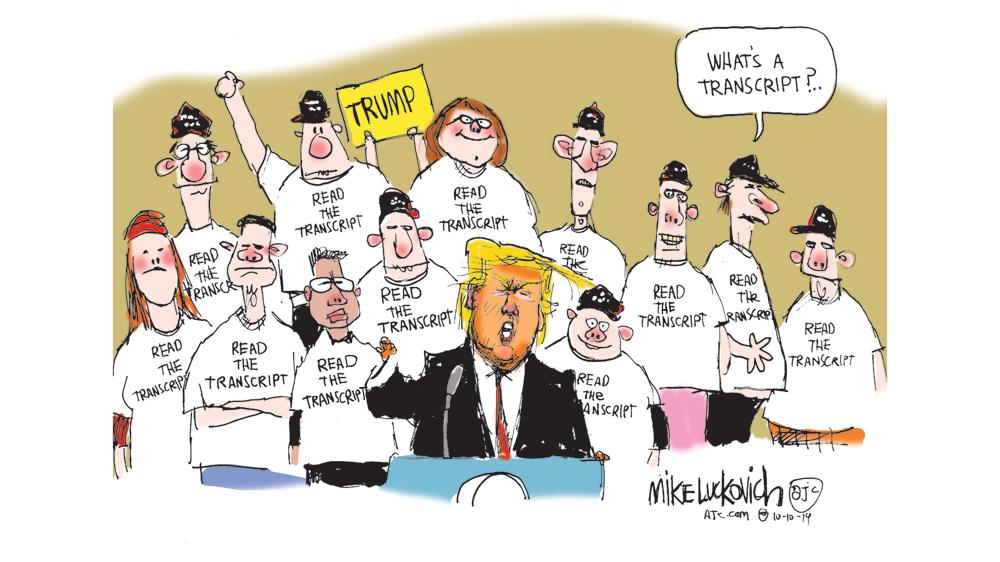
Again and again, Trump proclaimed on Twitter, “READ THE TRANSCRIPT!”-- though the notes from his July 25 call with Ukrainian President Volodymyr Zelensky did not seem to exonerate him. Rather, the notes made plain Trump’s scheme to get Ukraine to open an investigation into former vice president Joe Biden and his son Hunter Biden.

With Trump commanding such exceptionally high approval ratings among Republican voters, however, even senators who acknowledged his actions were wrong voted Friday to block new evidence in the trial and pave the way for acquittal.

One of Democrats’ great hopes to permit fresh testimony from firsthand witnesses, including former national security adviser John Bolton, had been Sen. Lamar Alexander (R-TN), a self-described institutionalist who is retiring and would not have to face the wrath of the GOP’s pro-Trump base.
Yes, one of the Democrats' great hopes... but hopes for what? There were never going to be 20 Republican flips to actually convict Trump. He could hand the deed to Alaska over to Putin in the middle of Fifth Avenue and Dan Sullivan would vote to commend him while Lisa Murkowski just looks on... confused. The Democrats' approach was never really to perform the impossible miracle of persuading the Senate to convict Trump. It was always to persuade the American people Trump shouldn't be reelected in November-- and that neither should the members of his party who backed him. We'll know if they succeeded not on Wednesday, but on election day, 2020. Remember, when Lamar Alexander admitted that Trump’s actions were "inappropriate" and had "already been proven" by House impeachment managers, and that there was "no need for more evidence," he really was helping the Democrats do the job they had set out to do. "Let the people decide," he said.


“This impeachment was a fait accompli at all times,” said Bill Whalen, a fellow at the conservative Hoover Institution at Stanford University. “You talk to congressional Republicans and there’s a feeling that the president is being persecuted, that impeachment was a conviction in search of a crime.”

William A. Galston, chair of the Brookings Institution’s Governance Studies Program, said acquittal “was not only perfectly predictable, but in my judgment, completely inevitable.”

“The United States political scene is as deeply polarized along partisan lines as it has been for at least a century,” Galston added. Noting Trump’s high ratings among Republican voters, he said, “It would take a very brave Republican indeed to break ranks with the president under these circumstances.”

This is not the first instance in which Trump has skirted penalties for wielding the powers of his office for personal or political gain. Former special counsel Robert S. Mueller III found that the president repeatedly worked to block or thwart the Russia investigation, acts to obstruct justice that would have prompted charges were he not a sitting president. But Trump sidestepped any punishment then, just as he appears to now with Ukraine.


One of the president’s lawyers, Alan Dershowitz, proffered a sweeping argument on the floor of the Senate last week that Trump using the powers of his office to pressure Ukraine to open a corruption investigation into the Bidens was not impeachable or illegal because it was done in pursuit of his reelection.

“If a president does something which he believes will help him get elected in the public interest, that cannot be the kind of quid pro quo that results in impeachment,” Dershowitz said during the trial.

In the face of stinging criticism from constitutional scholars and legal experts, Dershowitz said later on Twitter that his comments were being mischaracterized. “A president seeking re-election cannot do anything he wants,” Dershowitz wrote. “He is not above the law.”

Still, Dershowitz’s argument was persuasive for some Republican senators looking for arguments with which to defend Trump irrespective of what the evidence showed.

“Let’s say it’s true, okay? Dershowitz last night explained that if you’re looking at it from a constitutional point of view, that that is not something that is impeachable,” Sen. Mike Braun (R-IN) told reporters.

Timothy Naftali, a historian at New York University and former director of the Richard Nixon Presidential Library and Museum, said the arguments advanced on Trump’s behalf in the Senate trial could have lasting consequences for the future of presidential power.

“The Republicans have embraced a theory that permits future abuses of power,” Naftali said. “The outcome of acquittal was predictable... but I’m afraid that this process in the Senate is more enabling of an abusive president than expected.”

The nation’s founders gave Congress oversight responsibilities and powers of impeachment as a check on the executive. Yet, with this week’s likely acquittal of Trump, Meacham argues, the Senate instead has become a tool in the president’s perpetuation of his own power.

“It is not hyperbolic to say that the Republican Party treats Donald Trump more like a king than a president,” Meacham said. “That was a central and consuming anxiety of the framers. It is a remarkable thing to watch the party of Lincoln and Eisenhower and Reagan and the Bushes become an instrument of Donald Trump’s. That’s a massive historical story.”


Late Saturday night, also writing for The Post, Seung Min Kim and Rachael Bade reported how the impeachment trial has solidified Mitt Romney's outlier status among Senate Republicans and how Moscow Mitch was able to manipulate the Republican caucus on behalf of tactics set in the White House for goals set in Moscow. "In the end," the two reporters wrote, "McConnell held his conference together, arguing that witnesses would drag the trial out for weeks and delay other Senate work. Several Republicans acknowledged that the president did use nearly $400 million in military aid to Ukraine as leverage to benefit himself politically, calling it inappropriate, but argued it wasn’t grounds to oust him from office." In the end it was 100% about electoral politics.
Unlike other issues in the Senate, there were no substantive attempts to broker a bipartisan agreement that would cool tensions, ensuring that the impeachment proceedings began-- and ended-- as a near-partisan exercise.

“It has just been a lot harder over the last two weeks to have conversations with Republican friends,” said Sen. Chris Murphy (D-CT). “The mood in that room is super tense and super heavy.”

Democrats heavily pressured vulnerable Senate Republicans up for reelection this fall, driving a message declaring any trial without witnesses would be a “coverup.” But GOP senators and aides were confident that voters were paying little attention based on a survey conducted by the National Republican Senatorial Committee, the official campaign arm of Senate Republicans.


“You know, Iowans right now-- honest to God-- they want us to get this thing over with,” said Sen. Joni Ernst (R-IA). “They’re like, ‘Why aren’t you doing the business of the American public?’”

In a closed-door party meeting in McConnell’s suite of offices-- where GOP senators have held some of their most consequential strategy sessions-- it was those precise swing-state Republicans like Sens. Cory Gardner (R-CO) and Thom Tillis (R-NC) who said they were prepared to just move on to a final vote without calling additional witnesses.

That was after Bolton’s blockbuster allegation, laid out in an unpublished manuscript of his book as reported by the New York Times, that Trump directly tied the holdup of aid to Ukraine to the political investigations.

The Times report rocked the GOP conference and made Romney believe it increased the likelihood that more Republicans would join in his effort to call Bolton. At a Jan. 27 lunch, Sens. Patrick J. Toomey (R-PA) and Bill Cassidy (R-LA) spoke up about a witness trade, appearing to briefly consider the notion. Romney joined them, making a forceful argument that they had a duty as senators to hear all the relevant evidence.
Moscow Mitch prevailed and today Republican senators are trying to defend their votes to not call witnesses. On Meet the Press yesterday, Lamar Alexander, who-- remember-- is retiring, said Trump's behavior may have been bad but was still not impeachable. Alexander: "I think he shouldn’t have done it. I think it was wrong. Inappropriate was the way I’d say-- improper, crossing the line."

Iowa imbecilic senator, Joni Ernst, who is, rightfully, one of the most vulnerable incumbents in the Senate and who yesterday called for Congress to start impeachment proceedings against Biden immediately if he's elected, was a guest on State of the Union, said that while the call to pressure the president of Ukraine was "Maybe not the perfect call" and that Trump should have used the Department of Justice to talk with him about corruption, she was still planning to vote for acquittal. As if she ever considered voting otherwise! The Senate will be a far better place without Jimi Ernst.


Labels: , , , ,

Saturday, January 18, 2020

Trump's Love-Hate-- Mostly Hate-- Relationship With The U.S. Military

>


Yesterday, the Washington Post ran a long and fascinating excerpt from A Very Stable Genius, the about-to-be-released (Tuesday) new book by Post reporters Phil Rucker and Carol Leonnig. The excerpt is really good and you'll enjoy reading it, especially in light of Trump's own relationship with the military. Remember, Trump was a draft-dodging chicken hawk who has been extremely disrespectful to the military over the years and has, since becoming "president," endlessly tried using and manipulating the military for his own purposes and personal aggrandizement.

There is no more sacred room for military officers than 2E924 of the Pentagon, a windowless and secure vault where the Joint Chiefs of Staff meet regularly to wrestle with classified matters. Its more common name is “the Tank.” The Tank resembles a small corporate boardroom, with a gleaming golden oak table, leather swivel armchairs and other mid-century stylings. Inside its walls, flag officers observe a reverence and decorum for the wrenching decisions that have been made there.

Hanging prominently on one of the walls is The Peacemakers, a painting that depicts an 1865 Civil War strategy session with President Abraham Lincoln and his three service chiefs-- Lieutenant General Ulysses S. Grant, Major General William Tecumseh Sherman, and Rear Admiral David Dixon Porter. One hundred fifty-​­two years after Lincoln hatched plans to preserve the Union, President Trump’s advisers staged an intervention inside the Tank to try to preserve the world order.

By that point, six months into his administration, Secretary of Defense Jim Mattis, Director of the National Economic Council Gary Cohn, and Secretary of State Rex Tillerson had grown alarmed by gaping holes in Trump’s knowledge of history, especially the key alliances forged following World War II. Trump had dismissed allies as worthless, cozied up to authoritarian regimes in Russia and elsewhere, and advocated withdrawing troops from strategic outposts and active theaters alike.

Trump organized his unorthodox worldview under the simplistic banner of “America First,” but Mattis, Tillerson, and Cohn feared his proposals were rash, barely considered, and a danger to America’s superpower standing. They also felt that many of Trump’s impulsive ideas stemmed from his lack of familiarity with U.S. history and, even, where countries were located. To have a useful discussion with him, the trio agreed, they had to create a basic knowledge, a shared language.

So on July 20, 2017, Mattis invited Trump to the Tank for what he, Tillerson, and Cohn had carefully organized as a tailored tutorial. What happened inside the Tank that day crystallized the commander in chief’s berating, derisive and dismissive manner, foreshadowing decisions such as the one earlier this month that brought the United States to the brink of war with Iran. The Tank meeting was a turning point in Trump’s presidency. Rather than getting him to appreciate America’s traditional role and alliances, Trump began to tune out and eventually push away the experts who believed their duty was to protect the country by restraining his more dangerous impulses.

The episode has been documented numerous times, but subsequent reporting reveals a more complete picture of the moment and the chilling effect Trump’s comments and hostility had on the nation’s military and national security leadership.

Just before 10 a.m. on a scorching summer Thursday, Trump arrived at the Pentagon. He stepped out of his motorcade, walked along a corridor with portraits honoring former chairmen of the Joint Chiefs, and stepped inside the Tank. The uniformed officers greeted their commander in chief. Chairman of the Joint Chiefs General Joseph F. Dunford Jr. sat in the seat of honor midway down the table, because this was his room, and Trump sat at the head of the table facing a projection screen. Mattis and the newly confirmed deputy defense secretary, Patrick Shanahan, sat to the president’s left, with Vice President Pence and Tillerson to his right. Down the table sat the leaders of the military branches, along with Cohn and Treasury Secretary Steven Mnuchin. White House chief strategist Stephen K. Bannon was in the outer ring of chairs with other staff, taking his seat just behind Mattis and directly in Trump’s line of sight.


Mattis, Cohn, and Tillerson and their aides decided to use maps, graphics, and charts to tutor the president, figuring they would help keep him from getting bored. Mattis opened with a slide show punctuated by lots of dollar signs. Mattis devised a strategy to use terms the impatient president, schooled in real estate, would appreciate to impress upon him the value of U.S. investments abroad. He sought to explain why U.S. troops were deployed in so many regions and why America’s safety hinged on a complex web of trade deals, alliances, and bases across the globe.

An opening line flashed on the screen, setting the tone: “The post-war international rules-based order is the greatest gift of the greatest generation.” Mattis then gave a 20-minute briefing on the power of the NATO alliance to stabilize Europe and keep the United States safe. Bannon thought to himself, “Not good. Trump is not going to like that one bit.” The internationalist language Mattis was using was a trigger for Trump.

“Oh, baby, this is going to be fucking wild,” Bannon thought. “If you stood up and threatened to shoot [Trump], he couldn’t say ‘postwar rules-based international order.’ It’s just not the way he thinks.”

For the next 90 minutes, Mattis, Tillerson, and Cohn took turns trying to emphasize their points, pointing to their charts and diagrams. They showed where U.S. personnel were positioned, at military bases, CIA stations, and embassies, and how U.S. deployments fended off the threats of terror cells, nuclear blasts, and destabilizing enemies in places including Afghanistan, Iran, Iraq, the Korea Peninsula, and Syria. Cohn spoke for about 20 minutes about the value of free trade with America’s allies, emphasizing how he saw each trade agreement working together as part of an overall structure to solidify U.S. economic and national security.

Trump appeared peeved by the schoolhouse vibe but also allergic to the dynamic of his advisers talking at him. His ricocheting attention span led him to repeatedly interrupt the lesson. He heard an adviser say a word or phrase and then seized on that to interject with his take. For instance, the word “base” prompted him to launch in to say how “crazy” and “stupid” it was to pay for bases in some countries.

Trump’s first complaint was to repeat what he had vented about to his national security adviser months earlier: South Korea should pay for a $10 billion missile defense system that the United States built for it. The system was designed to shoot down any short- and medium-range ballistic missiles from North Korea to protect South Korea and American troops stationed there. But Trump argued that the South Koreans should pay for it, proposing that the administration pull U.S. troops out of the region or bill the South Koreans for their protection.

“We should charge them rent,” Trump said of South Korea. “We should make them pay for our soldiers. We should make money off of everything.”

Trump proceeded to explain that NATO, too, was worthless. U.S. generals were letting the allied member countries get away with murder, he said, and they owed the United States a lot of money after not living up to their promise of paying their dues.

“They’re in arrears,” Trump said, reverting to the language of real estate. He lifted both his arms at his sides in frustration. Then he scolded top officials for the untold millions of dollars he believed they had let slip through their fingers by allowing allies to avoid their obligations.

“We are owed money you haven’t been collecting!” Trump told them. “You would totally go bankrupt if you had to run your own business.”

Mattis wasn’t trying to convince the president of anything, only to explain and provide facts. Now things were devolving quickly. The general tried to calmly explain to the president that he was not quite right. The NATO allies didn’t owe the United States back rent, he said. The truth was more complicated. NATO had a nonbinding goal that members should pay at least 2 percent of their gross domestic product on their defenses. Only five of the countries currently met that goal, but it wasn’t as if they were shorting the United States on the bill.

More broadly, Mattis argued, the NATO alliance was not serving only to protect western Europe. It protected America, too. “This is what keeps us safe,” Mattis said. Cohn tried to explain to Trump that he needed to see the value of the trade deals. “These are commitments that help keep us safe,” Cohn said.

Bannon interjected. “Stop, stop, stop,” he said. “All you guys talk about all these great things, they’re all our partners, I want you to name me now one country and one company that’s going to have his back.”

Trump then repeated a threat he’d made countless times before. He wanted out of the Iran nuclear deal that President Obama had struck in 2015, which called for Iran to reduce its uranium stockpile and cut its nuclear program.

“It’s the worst deal in history!” Trump declared.

“Well, actually . . .,” Tillerson interjected.

“I don’t want to hear it,” Trump said, cutting off the secretary of state before he could explain some of the benefits of the agreement. “They’re cheating. They’re building. We’re getting out of it. I keep telling you, I keep giving you time, and you keep delaying me. I want out of it.”

Before they could debate the Iran deal, Trump erupted to revive another frequent complaint: the war in Afghanistan, which was now America’s longest war. He demanded an explanation for why the United States hadn’t won in Afghanistan yet, now 16 years after the nation began fighting there in the wake of the 9/11 terrorist attacks. Trump unleashed his disdain, calling Afghanistan a “loser war.” That phrase hung in the air and disgusted not only the military leaders at the table but also the men and women in uniform sitting along the back wall behind their principals. They all were sworn to obey their commander in chief’s commands, and here he was calling the war they had been fighting a loser war.

“You’re all losers,” Trump said. “You don’t know how to win anymore.”

Trump questioned why the United States couldn’t get some oil as payment for the troops stationed in the Persian Gulf. “We spent $7 trillion; they’re ripping us off,” Trump boomed. “Where is the fucking oil?”

Trump seemed to be speaking up for the voters who elected him, and several attendees thought they heard Bannon in Trump’s words. Bannon had been trying to persuade Trump to withdraw forces by telling him, “The American people are saying we can’t spend a trillion dollars a year on this. We just can’t. It’s going to bankrupt us.”


“And not just that, the deplorables don’t want their kids in the South China Sea at the 38th parallel or in Syria, in Afghanistan, in perpetuity,” Bannon would add, invoking Hillary Clinton’s infamous “basket of deplorables” reference to Trump supporters.

Trump mused about removing General John Nicholson, the U.S. commander in charge of troops in Afghanistan. “I don’t think he knows how to win,” the president said, impugning Nicholson, who was not present at the meeting.

Dunford tried to come to Nicholson’s defense, but the mild-mannered general struggled to convey his points to the irascible president.

“Mr. President, that’s just not . . .,” Dunford started. “We’ve been under different orders.”

Dunford sought to explain that he hadn’t been charged with annihilating the enemy in Afghanistan but was instead following a strategy started by the Obama administration to gradually reduce the military presence in the country in hopes of training locals to maintain a stable government so that eventually the United States could pull out. Trump shot back in more plain language.

“I want to win,” he said. “We don’t win any wars anymore . . . We spend $7 trillion, everybody else got the oil and we’re not winning anymore.”

Trump by now was in one of his rages. He was so angry that he wasn’t taking many breaths. All morning, he had been coarse and cavalier, but the next several things he bellowed went beyond that description. They stunned nearly everyone in the room, and some vowed that they would never repeat them. Indeed, they have not been reported until now.

“I wouldn’t go to war with you people,” Trump told the assembled brass.

Addressing the room, the commander in chief barked, “You’re a bunch of dopes and babies.”

For a president known for verbiage he euphemistically called “locker room talk,” this was the gravest insult he could have delivered to these people, in this sacred space. The flag officers in the room were shocked. Some staff began looking down at their papers, rearranging folders, almost wishing themselves out of the room. A few considered walking out. They tried not to reveal their revulsion on their faces, but questions raced through their minds. “How does the commander in chief say that?” one thought. “What would our worst adversaries think if they knew he said this?”


This was a president who had been labeled a “draft dodger” for avoiding service in the Vietnam War under questionable circumstances. Trump was a young man born of privilege and in seemingly perfect health: six feet two inches with a muscular build and a flawless medical record. He played several sports, including football. Then, in 1968 at age 22, he obtained a diagnosis of bone spurs in his heels that exempted him from military service just as the United States was drafting men his age to fulfill massive troop deployments to Vietnam.

Tillerson in particular was stunned by Trump’s diatribe and began visibly seething. For too many minutes, others in the room noticed, he had been staring straight, dumbfounded, at Mattis, who was speechless, his head bowed down toward the table. Tillerson thought to himself, “Gosh darn it, Jim, say something. Why aren’t you saying something?”

But, as he would later tell close aides, Tillerson realized in that moment that Mattis was genetically a Marine, unable to talk back to his commander in chief, no matter what nonsense came out of his mouth.

The more perplexing silence was from Pence, a leader who should have been able to stand up to Trump. Instead, one attendee thought, “He’s sitting there frozen like a statue. Why doesn’t he stop the president?” Another recalled the vice president was “a wax museum guy.” From the start of the meeting, Pence looked as if he wanted to escape and put an end to the president’s torrent. Surely, he disagreed with Trump’s characterization of military leaders as “dopes and babies,” considering his son, Michael, was a Marine first lieutenant then training for his naval aviator wings. But some surmised Pence feared getting crosswise with Trump. “A total deer in the headlights,” recalled a third attendee.

Others at the table noticed Trump’s stream of venom had taken an emotional toll. So many people in that room had gone to war and risked their lives for their country, and now they were being dressed down by a president who had not. They felt sick to their stomachs. Tillerson told others he thought he saw a woman in the room silently crying. He was furious and decided he couldn’t stand it another minute. His voice broke into Trump’s tirade, this one about trying to make money off U.S. troops.

“No, that’s just wrong,” the secretary of state said. “Mr. President, you’re totally wrong. None of that is true.”

Tillerson’s father and uncle had both been combat veterans, and he was deeply proud of their service.

“The men and women who put on a uniform don’t do it to become soldiers of fortune,” Tillerson said. “That’s not why they put on a uniform and go out and die . . . They do it to protect our freedom.”

There was silence in the Tank. Several military officers in the room were grateful to the secretary of state for defending them when no one else would. The meeting soon ended and Trump walked out, saying goodbye to a group of servicemen lining the corridor as he made his way to his motorcade waiting outside. Mattis, Tillerson, and Cohn were deflated. Standing in the hall with a small cluster of people he trusted, Tillerson finally let down his guard.


“He’s a fucking moron,” the secretary of state said of the president.

The plan by Mattis, Tillerson, and Cohn to train the president to appreciate the internationalist view had clearly backfired.

“We were starting to get out on the wrong path, and we really needed to have a course correction and needed to educate, to teach, to help him understand the reason and basis for a lot of these things,” said one senior official involved in the planning. “We needed to change how he thinks about this, to course correct. Everybody was on board, 100 percent agreed with that sentiment. [But] they were dismayed and in shock when not only did it not have the intended effect, but he dug in his heels and pushed it even further on the spectrum, further solidifying his views.”

A few days later, Pence’s national security adviser, Andrea Thompson, a retired Army colonel who had served in Afghanistan and Iraq, reached out to thank Tillerson for speaking up on behalf of the military and the public servants who had been in the Tank. By September 2017, she would leave the White House and join Tillerson at Foggy Bottom as undersecretary of state for arms control and international security affairs.

The Tank meeting had so thoroughly shocked the conscience of military leaders that they tried to keep it a secret. At the Aspen Security Forum two days later, longtime NBC News correspondent Andrea Mitchell asked Dunford how Trump had interacted during the Tank meeting. The Joint Chiefs chairman misleadingly described the meeting, skipping over the fireworks.

“He asked a lot of hard questions, and the one thing he does is question some fundamental assumptions that we make as military leaders-- and he will come in and question those,” Dunford told Mitchell on July 22. “It’s a pretty energetic and an interactive dialogue.”

One victim of the Tank meeting was Trump’s relationship with Tillerson, which forever after was strained. The secretary of state came to see it as the beginning of the end. It would only worsen when news that Tillerson had called Trump a “moron” was first reported in October 2017 by NBC News.

Trump once again gathered his generals and top diplomats in December 2017 for a meeting as part of the administration’s ongoing strategy talks about troop deployments in Afghanistan in the Situation Room, a secure meeting room on the ground floor of the West Wing. Trump didn’t like the Situation Room as much as the Pentagon’s Tank, because he didn’t think it had enough gravitas. It just wasn’t impressive.

But there Trump was, struggling to come up with a new Afghanistan policy and frustrated that so many U.S. forces were deployed in so many places around the world. The conversation began to tilt in the same direction as it had in the Tank back in July.

“All these countries need to start paying us for the troops we are sending to their countries. We need to be making a profit,” Trump said. “We could turn a profit on this.”

Dunford tried to explain to the president once again, gently, that troops deployed in these regions provided stability there, which helped make America safer. Another officer chimed in that charging other countries for U.S. soldiers would be against the law.

“But it just wasn’t working,” one former Trump aide recalled. “Nothing worked.”

Following the Tank meeting, Tillerson had told his aides that he would never silently tolerate such demeaning talk from Trump about making money off the deployments of U.S. soldiers. Tillerson’s father, at the age of 17, had committed to enlist in the Navy on his next birthday, wanting so much to serve his country in World War II. His great-uncle was a career officer in the Navy as well. Both men had been on his mind, Tillerson told aides, when Trump unleashed his tirade in the Tank and again when he repeated those points in the Situation Room in December.

“We need to get our money back,” Trump told his assembled advisers.

That was it. Tillerson stood up. But when he did so, he turned his back to the president and faced the flag officers and the rest of the aides in the room. He didn’t want a repeat of the scene in the Tank.

“I’ve never put on a uniform, but I know this,” Tillerson said. “Every person who has put on a uniform, the people in this room, they don’t do it to make a buck. They did it for their country, to protect us. I want everyone to be clear about how much we as a country value their service.”

Tillerson’s rebuke made Trump angry. He got a little red in the face. But the president decided not to engage Tillerson at that moment. He would wait to take him on another day.

Later that evening, after 8:00, Tillerson was working in his office at the State Department’s Foggy Bottom headquarters, preparing for the next day. The phone rang. It was Dunford. The Joint Chiefs chairman’s voice was unsteady with emotion. Dunford had much earlier joked with Tillerson that in past administrations the secretaries of state and Defense Department leaders wouldn’t be caught dead walking on the same side of the street, for their rivalry was that fierce. But now, as both men served Trump, they were brothers joined against what they saw as disrespect for service members. Dunford thanked Tillerson for standing up for them in the Situation Room.

“You took the body blows for us,” Dunford said. “Punch after punch. Thank you. I will never forget it.”


Tillerson, Dunford, and Mattis would not take those body blows for much longer. They failed to rein in Trump’s impulses or to break through what they regarded as the president’s stubborn, even dangerous insistence that he knew best. Piece by piece, the guardrails that had hemmed in the chaos of Trump’s presidency crumpled.

In March 2018, Trump abruptly fired Tillerson while the secretary of state was halfway across the globe on a sensitive diplomatic mission to Africa to ease tensions caused by Trump’s demeaning insults about African countries. Trump gave Tillerson no rationale for his firing, and afterward acted as if they were buddies, inviting him to come by the Oval Office to take a picture and have the president sign it. Tillerson never went.

Mattis continued serving as the defense secretary, but the president’s sudden decision in December 2018 to withdraw troops from Syria and abandon America’s Kurdish allies there-- one the president soon reversed, only to remake 10 months later-- inspired him to resign. Mattis saw Trump’s desired withdrawal as an assault on a soldier’s code. “He began to feel like he was becoming complicit,” recalled one of the secretary’s confidants.

The media interpretation of Mattis’ resignation letter as a scathing rebuke of Trump’s worldview brought the president’s anger to a boiling point. Trump decided to remove Mattis two months ahead of the secretary’s chosen departure date. His treatment of Mattis upset the secretary’s staff. They decided to arrange the biggest clap out they could. The event was a tradition for all departing secretaries. They wanted a line of Pentagon personnel that stretched for a mile applauding Mattis as he left for the last time. It was going to be “yuge,” staffers joked, borrowing from Trump’s glossary.

But Mattis would not allow it.

“No, we are not doing that,” he told his aides. “You don’t understand the president. I work with him. You don’t know him like I do. He will take it out on Shanahan and Dunford.”

Dunford stayed on until September 2019, retiring at the conclusion of his four-year term as chairman of the Joint Chiefs of Staff. One of Dunford’s first public acts after leaving office was to defend a military officer attacked by Trump, Army Lieutenant Colonel Alexander Vindman, a National Security Council official who testified in the House impeachment inquiry about his worries over Trump’s conduct with Ukraine. Trump dismissed Vindman as a “Never Trumper,” but Dunford stepped forward to praise the Purple Heart recipient as “a professional, competent, patriotic, and loyal officer. He has made an extraordinary contribution to the security of our nation.”

By then, however, Trump had become a president entirely unrestrained. He had replaced his raft of seasoned advisers with a cast of enablers who executed his orders and engaged his obsessions. They saw their mission as telling the president yes.


Writing in November for Citizen Truth, Peter Catagno reported that "A new analysis from Foreign Policy finds that Sen. Bernie Sanders is the favorite presidential candidate of the military, in what critics argue is the latest indication that the Vermont Independent’s base is more diverse than generally portrayed... The Sanders’ campaign cites the senator’s promises to 'end the endless wars' and his years of work on the Veterans’ Affairs Committee as reasons for his popularity with military employees." Servicemen and women contributed $181,152 to Bernie's campaign, compared to just $62,821 for Private Bone Spurs. Democratic hawk Joe Biden came in 5th among military members with $34,481.

I got a call from a young candidate for Congress yesterday; he came from a  creepy-looking number that I would usually never answer but I did anyway, thinking I would just torture the telemarketer for a while. But it was a state legislator who had been recruited by the DCCC and is being backed by the Blue Dogs caucus. One of them gave him my name and number. How dumb is that? I had just finished a post and didn't want to start writing again, so I stayed on the phone with him for way longer than I would have stayed on the phone with a conservative Democrat. Besides, he was unintentionally funny. I asked him why he was calling me and he told me he was told I was the gatekeeper to Haim Saban and his political contributions. I told him I might be the gatekeeper for Haim Saban sending out a hit squad to end his career. He told me he was calling from the "super secret DCCC" program that they use to surreptitiously help conservative candidates running against progressives in primaries. I told him that if Cheri Bustos knew he was telling me this she would slit his throat with her fingernails. We got on just fine, although I think I may have heard him gulping a few times.

He also told me that he had introduced a veterans' suicide prevention bill in his state legislature and that it sailed through 3 committee hearings with 100% backing from both parties. Let's face it, who doesn't support a veteran's suicide prevention bill? The legislature is tightly controlled by a Trumpist faction of the GOP and when they realized that a super-popular bill was about to pass the legislature by a rising star Democrat who they hated, they just killed it on the spot. To hell with suicide prevention for U.S. vets; there was no way this Democrat was adding anything to his resume on their watch-- no matter how many vets wound up in morgues! That's an integral part of Trumpism.

[He agreed to write this up in his own words for this post. An hour or so later he sent me an e-mail saying he would have to check with his comms team. I laughed to myself, knowing I would never hear from him again. And I didn't.]


Labels: , , ,

Thursday, January 16, 2020

Lucky For Trump, Most Of His Supporters Don't Read Books

>


Don't pass out, but Trump was lying in the 30 second clip above. He didn't get 46% of Hispanic voters; he got 28%. And he didn't win among the highly educated. Only 36% of college graduates voted for him. However, he was telling the truth about the poorly educated. A full third of his vote came from people whose education went no further than high school-- or less. And non-college whites made up the bulk of his supporters-- 63%. These are not people who read-- let alone comprehend-- books... just like Trump himself. So I guess they won't be reading John Bolton's (tell all?) book, which is nearly finished and will be out long before 2020 voting begins. Will Bolton testify at the Trump impeachment trial in the Senate before that? That's probably going to be up to Moscow Mitch, so my guess is no. Will he testify before the House Intel Committee. Schiff seems to be leaning towards subpoenaing him now-- although he's been going back and forth on this. Unless the Senate does, Schiff should. I don't think waiting for his book to come out is what anyone wants or needs.


Meanwhile, Ashley Parker did an advance review for the Washington Post yesterday of her colleagues, Philip Rucker's and Carol Leonnig's hot new book, A Very Stable Genius: Donald J. Trump's Testing Of America. Parker makes it clear that the book portrays Trump as erratic and "at times dangerously uninformed." Is that news to anyone? The book comes out January 21. "President Trump," wrote Parker, "reveals himself as woefully uninformed about the basics of geography, incorrectly telling Indian Prime Minister Narendra Modi, 'It’s not like you’ve got China on your border.' He toys with awarding himself the Medal of Freedom... Trump does not seem to grasp the fundamental history surrounding the attack on Pearl Harbor. 'Hey, John, what’s this all about? What’s this a tour of?' Trump asks his then-chief of staff John Kelly, as the men prepare to take a private tour of the USS Arizona Memorial, which commemorates the December 1941 Japanese surprise attack in the Pacific that pulled the United States into World War II." They tell the story, which has been out there already of how, when The Mooch asked Trumpanzee, "Are you an act?" the illegitimate "president" responded, "I’m a total act and I don’t understand why people don’t get it."

The NY Times review suggests the title is "savvy marketing. It’s possible to imagine both Donald J. Trump’s detractors and his admirers eagerly grasping a copy. The admirers will not make it past the table of contents. Among the chapter titles: 'Unhinged,' 'Shocking the Conscience,' 'Paranoia and Pandemonium' and 'Scare-a-Thon.' This verbiage makes Rucker and Leonnig’s book sound like one more enraged polemic. It isn’t. They’re meticulous journalists, and this taut and terrifying book is among the most closely observed accounts of Donald J. Trump’s shambolic tenure in office to date. It reads like a horror story, an almost comic immorality tale. It’s as if the president, as patient zero, had bitten an aide and slowly, bite by bite, an entire nation had lost its wits and its compass."


From the Penguin-Random House preview that they're using to promote pre-sales of the book:
"I alone can fix it." So went Donald J. Trump’s march to the presidency on July 21, 2016, when he accepted the Republican presidential nomination in Cleveland, promising to restore what he described as a fallen nation. Yet over the subsequent years, as he has undertaken the actual work of the commander in chief, it has been hard to see beyond the daily chaos of scandal, investigation, and constant bluster. It would be all too easy to mistake Trump’s first term for one of pure and uninhibited chaos, but there were patterns to his behavior and that of his associates. The universal value of the Trump administration is loyalty-- not to the country, but to the president himself-- and Trump’s North Star has been the perpetuation of his own power, even when it meant imperiling our shaky and mistrustful democracy.


Leonnig and Rucker, with deep and unmatched sources throughout Washington, D.C., tell of rages and frenzies but also moments of courage and perseverance. Relying on scores of exclusive new interviews with some of the most senior members of the Trump administration and other firsthand witnesses, the authors reveal the forty-fifth president up close, taking readers inside Robert Mueller’s Russia investigation as well as the president’s own haphazard but ultimately successful legal defense. Here for the first time certain officials who have felt honor-bound not to publicly criticize a sitting president or to divulge what they witnessed in a position of trust tell the truth for the benefit of history.

This peerless and gripping narrative reveals President Trump at his most unvarnished and exposes how decision making in his administration has been driven by a reflexive logic of self-preservation and self-aggrandizement-- but a logic nonetheless. This is the story of how an unparalleled president has scrambled to survive and tested the strength of America’s democracy and its common heart as a nation.


Labels: , ,