Saturday, January 31, 2015

Stepping back into NYC's "club era" -- the Yale Club today, the University Club in March

>


McKim, Mead and White's University Club,
at Fifth Avenue and West 54th Street

by Ken

This morning I made sure to get enough of my day's posts posted so that I could go out and play, notwithstanding the arctic weather here in the Big Apple. Today that meant a special of the historic "club" districts of Midtown Manhattan, including a visit to the largest of them all, the Yale Club (which survives in part by sharing its facilities with a bunch of other clubs, like that of my alma mater, I was surprised to be reminded).

Matt Postal has been doing a series of tours for the Municipal Art Society of some of the surviving clubs, namely those that have responded at all positively to his entreaties. He has explained that when he was attending graduate school at the City University of New York in the '90s, he was involved in a massive project into the clubs built during the great era of clubs in Midtown, the later part of the 19th century and the early part of the 20th. It was a natural project for the CUNY Grad Center when it was located on the block north of the New York Public LIbrary, on 42nd Street between Fifth and Sixth Avenues, a virtual stone's throw from the graet club blocks -- 43rd and 44th Streets between Sixth and Vanderbilt Avenues and -- opposite the south side of the library and its neighbor to the west, Bryant Park, 40th Street between Fifth and Sixth Avenues. But before the project could be completed and brought to whatever form it might have taken, the grad center moved -- not that far, to its present location in the gorgeous, landmarked former B. Altman building at Fifth Avenue and 34th Street, but far enough that the "club district" was now judged to be out-of-neighborhood. The project was shelved, leaving Matt with all that work expended and all those reams of files.

On earlier MAS tours with Matt, I've gotten to see the inside of the Players Club (on Gramercy Park South) and the Century Association (on 43rd Street just west of Fifth Avenue). A number of the city's most prestigious architects designed those club buildings, and setting foot inside them also carries the feeling of stepping into another era.


CONTINUING THE CLUB THEME

On a recent MAS tour with Francis Morrone, part of a series exploring the "side streets" of Midtown, our group had spent time at the corner of Fifth Avenue and 54th Street, onl partly sheltered from the rain, looking at the extraordinary pile of a building on the northwest corner, McKim, Mead and White's University Club of 1899.

Which gave Francis the opportunity to mention that on March 3rd he will be giving this year's 14th Annual McKim Lecture, co-presented by the Institute for Classical Architecture and Art and the University Club (in the form of the 1 West 54th Street Association), in the club itself. It was a date he suggested we might mark on our calendars, though he warned that they charge a really lot of money.

I actually remembered to do some Web searching, and was able to confirm the March 3rd date, but for details and reservations In was instructed to check back later. Perhaps inspired by the upcoming Yale Club tour with Matt P, I remembered to check back, and sure enough the full information is now available, including this:
The topic of the lecture will be “The City Beautiful and the Urban Landscape in America.” The talk will explore the movement to beautify America’s cities in the late 19th and early 20th centuries, the impact and legacy of that movement, its relevance today, and the many misconceptions about it (including that of Jane Jacobs). All of this will be discussed with specific reference to the contributions of McKim, Mead and White.
I know from my recent experience of (finally) reading Jane Jacobs's storied Death and Life of Great American Cities, and from doing bunches of tours with Francis where her writings have come up, including one last August devoted specifically to "Then and Now: The West Village of Jane Jacobs," that he's one of the few people who invoke her work who's actually familiar with what she wrote. So I'm especially psyched for the promised corrective to her view of the City Beautiful movement, which could most politely be described as scathing.

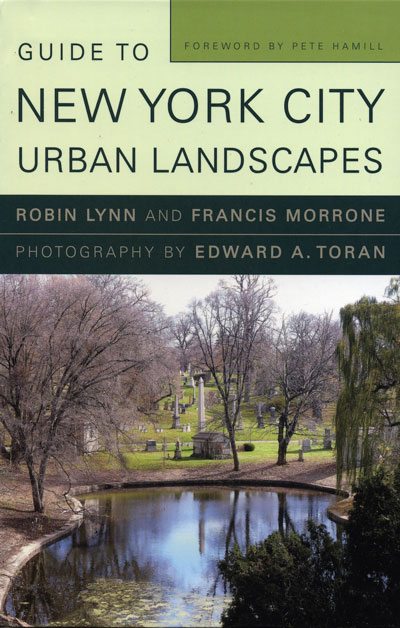
Beyond which, in my experience Francis takes his public presentations very seriously. Like when his latest book, Guide to New York City Urban Landscapes (written with Robin Lynn), had a festive do of a public book-launch party in the historic chapel of Green-Wood Cemetery, at a time when many authors would coast on the labors of book-writing now comfortably behind them, Francis seemed to have devoted as much effort to the presentation he gave as most people would devote to actually writing a damned book. The way he tied Green-Wood itself into the first of the successive eras of NYC urban landscapes it had a lot to do with settiing in motion (starting with two of the city's still-greatest urban landscapes, Calvert Vaux and Frederick Law Olmsted's Central Park and Prospect Park) was, in a word, masterful.

Beyond that, there's the sheer thrill of penetrating the mighty exterior of the University Club. Here are a few paragraphs from a post by Scott on the IWALKED Audio Tours website:
As it is likely that most of us will never see the insides of the University Club let me share what I have been able to learn of its interiors from my research. The highlight of the building is the library on the second floor which you can sometimes get a glimpse into from street level. The library is said to contain vast vault ceilings with murals painted atop its ceiling by Henry Siddons Mowbray that emulate the Vatican Apartments. Also amongst the interior is an extensive art collection, including a series of portraits by Gilbert Stuart, and a series of swimming pools allowable for usage with either swimming or birthday suits (at least in the male-only pool).

Speaking of male-only, the University Club underwent an overhaul of its membership policy in 1997 due to the passage of the New York City Public Law 63. Public Law 63 required all fee-collecting clubs with members greater than 400 (of which the University Club has over 4,000 members) to begin allowing the membership of women, or else the club would be forced to alter its charter.

The University Club has been located within this nine-story Italian High Renaissance Revival building since 1899. The Club which took on a series of temporary homes since its founding acquired a lot that was formerly owned by St. Luke’s Hospital to build on this site. They then hired the famed architectural firm of McKim, Mead and White to construct themselves new quarters for the sum of $1 million. McKim, Mead and White’s unique design integrates pink Milford granite on its exterior, along with a series of twenty-five feet columns that grace each side of the front entrance. Also integrated above each of the building’s windows are crests that are representative of various prominent universities. Perhaps the most intriguing element, however, is the deceptive appearance of the building’s exterior. By glancing at the outside of the building it seems apparent that there are no more than three levels, when in actuality the interior maintains nine.
You'll notice that phrase of Scott's, "as it is likely that most of us will never see the insides of the University Club," well, that's what I was thinking too, that day when we stood in the rain looking at the building's exterior. Well, I put that all together, swallowed hard, and -- reminding myself that a good part of the money goes to the worthy causes represented by the prsenting institutions -- shelled out the $75 they're asking for just the cocktail reception preceding the lecture and the lecture itself. That'll get me inside the building and into Francis's lecture. I didn't give serious consideration to the higher-priced option, which adds on a dinner following the lecture, at a jacked-up total of $150. It occurred to me afterward that maybe I should have really gone hog-wild, if only to see the dining facilities of the club.

I know enough from my club tours with Matt to know that the dining facilities of these places are a key feature of their design. Maybe I should have thought of the extra $75 as a fee for on-site inspection, with the meal as an added bonus. I'm not sure I could have sold myself on that, though, and anyway it's done, though I suspect an upgrade wouldn't be entirely impossible. Probably if I called the phone number listed for reservations, and mentioned that I've already registered for the recpetion and lecture, and wondered if I might still be able to tack on the dinner. . . . Oh no, now I've planted a bug in my head!

These are, of course, decisions each of us has to make for him/herself. And I just thought some of you might want to know about this. There aren't a lot of people I'd seriously consider shelling out the basic $75 for, but put Francis in a package with the University Club itself, and I'm already kind of glad I overcame my habitual cheapness.


For information about current and future Municipal Art Society walking tours, go to the MAS website, mas.org, and click on "Tours."
#

Labels: , , ,

Sunday, August 11, 2013

Urban Gadabout: Plans come together as I look out over the upper East River esplanade and later walk across 72nd Street

>

From the esplanade (more properly John H. Finley Walk) of Carl Schurz Park (lower left) we could look out at the lighthouse at the northern tip of Roosevelt Island, which I visited last week on an MAS walking tour, and, farther off, Astoria on the Queens shore, with the bird sanctuary of Mill Rock Park on the left and Wards Island farther off.

by Ken

It didn't quite rise to the level of the way the A Team's Col. Hannibal Smith always used to love it when a plan came together, but that's sort of how I felt last week during a Municipal Art Society walking tour on Manhattan's Upper East Side with Francis Morrone. It's sort of the reason at least some of us urban gadders gad: to make sense of the world around us.

It was in the East 70s and 80s, and all to the east of York Avenue, the north-south street that runs parallel to and east of First Avenue. As a matter of fact, I learned from Francis that York Avenue used to be called Avenue A, and the still-farther-east East End Avenue used to be called Avenue B, just the way the streets to the east of First Avenue in Manhattan's Lower East Side bulge have lettered-alphabet names, creating Alphabet City. I also learned that the name York Avenue has nothing to do with any of the other York place names in the region -- like, for example, New York -- all of which have to do with the Duke of York. No, York Avenue was so named in commemoration of Sergeant York.

The things you learn on these walks! And while I probably only remember about 10 percent, that's still 10 percent more than I knew before!

But I digress. It so happened that the tour meeting place, on a corner of York Avenue and East 76th Street, was right across the street from a branch of a health club I had gone to many, many years ago, since I was working on the East Side then, and that was the closest location. And so every day after work I made my way up there, and on weekends I traveled straight crosstown from the Upper West Side, where I lived then -- or as straight as you can travel with that big park there in the way. At the time, I recall, I had never set foot as far east in Manhattan as York Avenue. And now here was a walk on which York Avenue would be the western extreme.

We proceeded to tiny Cherokee Place, which had been in the tour description and which I'd never heard of. So I was relieved when Francis ventured that 99 percent of New Yorkers never have. And the reward was exposure to the "model tenements" there, known now as the Cherokee Apartments, which were designed according to health objectives involving maximum light and air, and therefore even (or especially!) now have amounts of light and air that are generally unknown now in even the most expensive Manhattan apartments. Francis described the apartments as having "almost too much light," and I remembered that I had once looked at an apartment up the block, on East 78th Street, in the City and Suburban buildings, also model tenements. It was a sixth-floor walkup, and the rooms were tiny, but I remember looking out the south-facing windows, where the 59th Street Bridge seemed almost within reaching distance, and the sun streaming in was almost blinding.

Read more »

Labels: , , , , ,

Friday, February 15, 2013

Urban Gadabout: Some highlights of the MAS March-May schedule

>

The only image I could find of Ada Louise Huxtable's 1961 book Four Walking Tours of Modern Architecture in New York City, which Matt Postal points out is long out of print, was pathetic and unusable. So here's a really lovely photo of Ms. H.

by Ken

Talk about a happy coincidence! This weekend I have walking tours in three boroughs with three of my very favorite tour leaders, all of whom I've written about here frequently: Clinton Hill (Brooklyn) with Matt Postal on Saturday, and "New York in the Time of George Washington" in Lower Manhattan with Francis Morrone and and "The Transformation of Queens Plaza" with Jack Eichenbaum on Sunday. Matt's and Francis's walks are Municipal Art Society tours and long since sold out, but Jack's Queens Plaza walk is his own and is offered on a strictly walk-up basis. (See the section below on Jack's upcoming tours.)

I can't begin to describe how much I've learned from, not to mention enjoyed the company of, all three -- and I've spent a fair amount of time and space here trying. Matt and Francis are architectural historians but with different enough perspectives and eyes to be richly complementary. Jack's perspective is strikingly different as an "urban geographer," showing us how natural and man-made geography shape the development (and redevelopment) of neighborhoods. In the many walks I've done with Jack in four of NYC's five boroughs he has radically reshaped my way of looking at and taking in the city from large vistas down to small details. One thing Jack is proud of is that even when he's leading his groups through areas frequented by other tour leaders, his groups see things we're unlikely to see with anyone else.

I might note that Joe Svehlak's terrific walks through quintessentially NYC neighborhoods not often visited by tours -- places like Sunset Park (Brooklyn) and Ridgewood (straddling Brooklyn and Queens) -- always take into consideration the kinds of developmental factors Jack highlights. These have been some of my favorite MAS tours, though I'm not sure that the folks at MAS HQ value them as highly as I do. It still kills me that I had to miss Joe's Bushwick walk in order to finish a Sunday Classics piece; everyone I've run into who was on it loved it. I've been waiting hopefully for MAS to reschedule it.

On the new schedule Joe is repeating a tour that really intrigues me: through the remains of "Downtown's Lost Neighborhood" (May 11), the barely heralded Lower West Side. The last time Joe offered it, I got as close as the No. 1 subway entrance in front of the Staten Island Ferry Terminal, with the assembling group in view across Peter Minuit Plaza, but it was pouring and I didn't even have an umbrella, so with great reluctance I shuffled back down the steps to the subway. (I only wish I could do that now. As we've noted, the relatively new South Ferry station was pretty much destroyed in Superstorm Sandy. The last I heard, the New York City Transit people planning the rebuild were still trying to determine what if anything could be salvaged.) And wouldn't you know, I don't think I'm going to be able to make it this time. I just hope it hasn't sold out by the time I know.

REGISTERING EARLY IS BECOMING MORE ADVISABLE

And the fact is that, now that everyone seems to have settled into the MAS system of preregistering for all tours (mostly online, but you can do it by phone when the offices are open), they do seem to be selling out more regularly, some of them pretty quickly. For example, it's already too late, and has been for a while, to register for Francis Morrone's annual tribute to and re-creation of MAS's very "First Tour," led by architecture critic Henry Hope Reed in Madison Square and Gramercy Park on April 8, 1956, when the idea was an astounding novelty. (Recommendation: Since you know when this tour is scheduled, watch for the announcement of the April 2014 tours and pounce. I can tell you that after doing this walk you'll never look at a flagpole the same way.)

I know that people who prefer short- to long-term planning, or are visiting from out of town, aren't entirely crazy about the pre-registration system, but it's also true that some tours may still be available as late as the-day-of. As far as I know, there's no cutoff for online registration as long as there's still space in a tour, which is clearly indicated. If you have nothing to do on a weekend, it's always worth checking the website to see if there's a tour you can slip into. Quite often the tours that don't attract waves of registrants are not only unusual but unusually interesting.

As I mentioned Wednesday, the recently posted listings cover March, April, and May (again, it's easy to remember: you go to mas.org and click on "Tours"), and the first thing that popped out for me is the pair of tours Matt Postal is doing, "Remembering Ada Louise Huxtable in Midtown" (March 2 and 16), based on the NYT's legendary architecture critic's 1961 book Four Walking Tours of Modern Architecture in New York City.

Matt is naturally scheduled for a slew of other tours, which you can check out for yourself. Among those I've done recently enough that I don't need to do them again just yet is a pungent introduction to "Brooklyn's Gowanus Canal" (April 13). I'd love to do Matt's "East River Panoramas" (April 27), but I know I'll be out of commission for that. I hope, though, to be able to do his "New to New York: Downtown Brooklyn" (May 18), even though I've done walks in the area with Francis Morrone and Joe Svehlak -- they all have their own perspectives and emphases.

Francis in fact is also doing his "Downtown Brooklyn" (March 10) again, and also the "Park Slope South" leg (April 28), covering the more working-class southern portion, of his "Three Ways of Looking at Park Slope." Frustratingly, I won't be able to do the "St. Mark's Neighborhood" (April 21) installment of his East Village series, which I was previously registered for and managed to miss (an embarrassing story). I've already registered for Francis's "Irish Footsteps in Lower Manhattan" (March 17), but I have a schedule conflict (a Transit Museum tour of the 180th Street subway shop in the Bronx) for the Washington Square-centered "American Masters: Henry James, John Lafarge, and Stanford White" (March 24). Happily, I should be able to do "Walt Whitman's New York" (May 26); anyway, I've paid my $15.

I've also registered for Eric K. Washington's "Harlem Hike: 145th Street from Hotel Olga to Sugar Hill" (April 7), as a follow-up to his "Harlem Grab Bag," which I'm doing next weekend (that's sold out, but he's doing another version of it on March 31). Eric is known as a leading chronicler of Northern Manhattan, and has written the "Images of America" series volume devoted to Manhattanville: Old Heart of West Harlem, and so I was really looking forward to his recent MAS Manhattanville tour -- so much so that I didn't realize I hadn't actually registered for it till it was too late -- sold out!

Eric is known in particular for knowing more than anybody I know of about Uptown Trinity Church Cemetery, and had a Halloween tour scheduled for MAS which was washed out by Sandy. I made a point of registering for his next MAS foray into the cemetery, the day before Christmas Eve, which synched up, for those who were so inclined, with the annual reading of "The Night Before Christmas" at the beautiful Church of the Ascension, at Broadway and 155th Street, which was for a long time a satellite of the all-powerful (in matters Episcopal in NYC) Trinity Church of Wall Street. I had previously been in the eastern half of the Trinity cemetery, on the east side of Broadway (which you'll recall includes the final resting place of Mayor Ed Koch), notably on an MAS tour that included the Church of the Ascension. But I'd never been in the wilder and more precipitous western half, on the other side of Broadway, which slopes steeply down toward the Hudson River. On that tour I learned that the otherwise-unconnected two halves of the cemetery were actually, for a time, connected by a suspension bridge over Broadway! (Eric had a picture to show us.) Eric will be venturing back into Trinity cemetery for MAS, with "Notable Women of Uptown Trinity Church Cemetery" (March 3) and a "Spring Tour" (May 12).

I've also already registered for architectural historian Tony Robins's "Art Deco on the Upper Upper West Side" (March 31), art deco being a special passion of his. (Tony has been all over the place lately with the publication last year of an updated edition of his 1987 book on the World Trade Center and now of Grand Central Terminal: 100 Years of a New York Landmark.) This time if Tony starts by asking us when art deco was born, I know it's a trick question. Tony's also doing "Landmark Battles of Midtown" (April 21) and "Central Park as a Work of Art" (May 2).

The Bedford Stuyvesant walks of Brooklyn architecture blogger Suzanne Spellen (Brownstoner.com's Montrose Morris, after her favorite architect) and architect and architectural historian Morgan Munsey have become an MAS staple, and April 14's "Bedford Stuyvesant" is actually focused on the heart of old Bedford Corners. The duo will also be touring "Brooklyn's Automobile Row" (in Crown Heights, Bedford Avenue between Fulton Street and Empire Boulevard; May 19).

SOMETIMES MAS TAPS SPECIFIC EXPERTISE

I had a great time on two such walks. Georgia Trivizas brings a native Staten Islander's special perspective to "Staten Island's Developing Waterfront" (March 23), a walk that's bound to take on some somber new tones post-Sandy, especially in the shoreline area to the east of the Ferry Terminal, where I'd never even set foot before the October walk with Georgia.

And federal court reporter Linda Fisher brings an insider's knowledge to "Manhattan's Civic Center" (April 13), which a hardy band of us did on a bitter cold day in late December (I don't think the temperature reached as high as 20 degrees that day). I'm seriously considering doing the walk again under more normal circumstances. And who knew anybody willing to endure the security screening can just walk into a courthouse and visit courtrooms? Of course most of the courts aren't functional on the weekends, but even on a Saturday the ground-floor courtroom in the Tombs where basically all Manhattan arraignments are handled will be open, because people are always being arrested in Manhattan, after all.

I'm assuming that Alexandra Maruri will be bringing similar special knowledge to the Bronx's "Little Italy on Arthur Avenue" (March 30), a tour I would love to do (as it happens, I've somehow never visited Arthur Avenue) but don't think I can since I'll be visiting Bayside (Queens) with Jack Eichenbaum that morning (see below), it's quite schlepp from Bayside to Arthur Avenue; I don't see how it can be managed in anything like the time available.

IT'S ALWAYS GOOD TO SEE ATTENTION TO THE OUTER BOROUGHS

And I don't think Brooklyn even qualifies anymore.

I expect to make the acquaintance of New School Prof. Joseph Heathcott, who's scheduled for "Queens Is the Future: Immigrant Neighborhoods Along the 7 Train" (March 9, already sold out! whoops, we all missed that one, but check out Jack Eichenbaum's "signature tour" of the "World of the #7 Train" below), "Sunnyside Gardens and Jackson Heights: America's First Garden Cities" (April 6), and "Queensbridge: America's Largest Public Housing Project" (April 27). This is territory I've covered a fair amount with Jack Eichenbaum, the Queens borough historian, but again, it's always interesting to see things through different eyes.

Speaking of Jack, though, as I've done so often here, I'm surprised to see that he's represented by just one tour. It's a terrific one, though: "Morisania: From Suburbia to the Grand Concourse" (March 24), which he did last year as the last of three northward-moving walks through the South Bronx. We got to see a staggering variety of urbanscapes sandwiched into the precipitous topography of the West Bronx -- old construction and new, the savage hatchet job inflicted on Bronx neighborhoods by Robert Moses's Cross-Bronx Expressway, the suburban enclave that has replaced the bombed-out Charlotte Street ruins once visited by Presidents Reagan and Carter, lovely Crotona Park, and the grandeur of the Grand Concourse.

Fortunately, Jack has a number of other projects coming up, starting with that Queens Plaza walk this Sunday which I mentioned at the top. More about those projects in a moment.

MY GOODNESS, THERE'S SO MUCH ELSE --

I feel terrible about all that I've left out, and tour leaders I've left out. I may need to do another post. Let me just point out, though, that there's a night-time tour, ""All Lit Up: Times Square at Night" (with Kathleen Hulser, April 20), and a tour in Spanish, "En Español! El Puente de Brooklyn: Política y Técnica" (April 14), a looks at the history and present of the Brooklyn Bridge and the cities (as New York and Brooklyn both were when the bridge was conceived and built) and the neighborhoods it connects, starting in Lower Manhattan and crossing over the bridge into DUMBO.


NOW, FINALLY, ABOUT JACK EICHENBAUM'S
UPCOMING PROJECTS


First off, if you don't know his website, The Geography of New York City with Jack Eichenbaum, you should, because it contains lots of great information in addition to Jack's schedule. On the "Public Tour Schedule" page you can also sign up for Jack's e-mail updates, which provide advance notice of plans before they make it onto the website. As it happens, Jack has just sent out a very newsy one indeed, which we'll get to.

The World of the #7 Train

Meanwhile, the splashiest news isn't brand new. Jack had already announced that this year's version of his "signature tour" will take place on April 27. I consider this one of the happiest ways an urban gadder can spend a day gadding about NYC. You not only see the full span of the IRT Flushing line (which in Queens is mostly above ground, so there's a lot to see out the windows), but do walks in six strikingly different neighborhoods along its path, including the lunch stop in Flushing's Chinatown. (Jack is a long-time Flushing resident.)

As usual, the tour will be limited to 25 people, and so requires preregistration, and can fill up in a hurry. Jack is still charging only $39, a steal in 2013 dollars. You can e-mail him (jaconet@aol.com) for "the full day's program and other info,", or just send a check. (The address is on the tour page of the website.) Or you can do both! A recent onsite note reports: "As of 2/15/13, there were 12 spots remaining." Be warned that spaces can fill up in a hurry.

Now for the big news: In October Jack offered his "Day on the J," and his new e-mail update contains the news that in June he will offer "Six Walks on the Number Six Train" -- the Lexington Avenue local train that continues on into the Bronx to the southwestern corner of the city's largest park, Pelham Bay Park. Further information is promised in the next update. Once again I expect to be writing my check the day the details are announced!

In other news, Jack reports: "In conjunction with the Grand Central centennial, I am trying to arrange Maps, Realities and the People’s Palace (scroll down at http://www.geognyc.com/?page_id=26) for a weekend date in April. This tour will require registration and I will post it ASAP." Here's the website description:
 Maps, Realities and the People’s Palace

 Tour Grand Central and Bryant Park, planned areas greatly altered since the Civil War. Then we will see how historical cartography captures the changing urban landscape in the splendidly restored Map Room of the New York Public Library.

And Jack also notes that he will be doing two walking tours as part of the third annual Long Island City Arts Open (LICAO, May 15-18), which will also include "performing arts, special gallery exhibitions, open artists’ studios, [and] a street fair," withe details to be posted at http://licartsopen.org/.

Now for Jack's other non-MAS tours:

The Transformation of Queens Plaza (this Sunday, February 17, 11am-1pm)

A look back at how this "nexus of early 20th century transportation improvements" (the Queensboro Bridge, Northern and Queens Blvds., lines of all three subway divisions, and the LIRR) set the stage for "NYC's largest and most modern industrial area," then went to seed with the exodus of industry from the area, and now has been transformed with amazing speed into something quite different.

It's $15, and we meet at the fare booth of the 39th Avenue station of the N and Q (Astoria) lines.

Flushing's Chinatown (Sunday, March 3, 11am-1pm)

As I mentioned, Jack is a longtime Flushing resident, and has watched the transformation of the area, which also experienced a period of deep decline, be reborn in mostly separate Chinese and Korean enclaves. Flushing's Chinatown, he says, "has come to rival its Manhattan antecedent. Taiwanese rather than Cantonese at its core, Flushing’s Chinatown plays host to a variety of overseas Chinese groups."

Also $15. Meet near the rest rooms on the second floor of the New World Mall on Roosevelt Avenue near the Flushing terminus of the No. 7 train. (There are more detailed directions on the website.)

My Childhood in Bayside (vs. What’s There Now) (Saturday, March 30, 2013, 10:50am-12:50pm -- the timing based on the scheduled arrival of the 10:18 LIRR train from Penn Station)

Every year Jack does a fund-raiser for the Queens Historical Society, and the ones I've done have been some of my all-time favorite walks. This year, in honor of his 70th birthday, on February 2 (sorry I missed your birthday -- happy birthday, Jack!), he's leading "a walk through old Bayside where I lived from 1943-1958. Most of the personal landmarks of my early life have vanished but there are threads of continuity and many anecdotes."

It's $12 for QHS members, $15 for others. (I'm a member, but I'm planning to spring for the full $15.) Meet in front of the post office on the south side of the LIRR stateion on 42nd Avenue. You can also get there via the Q13 bus from Flushing.)

And then there are these just announced in the e-mail update, and so not yet on the website:

Bowne St, My Street (May 4 or 5, time TBA)

As part of the annual Jane's Walks Weekend festivities, honoring Jane Jacobs (I reported on the 2012 schedule here), Jack will lead this walk "along the length of historic and multiethnic Bowne Street in Flushing where I have been living for 35 years." In recent years MAS has been organizing the NYC Jane's Walks, which are all free, and they've done such a good job that there are likely to be about 30 walks over the two days that I'll want to do. The listings should appear in April.

What’s New in Long Island City? (Friday, May 15, 5:45-8pm) -- a walk from Queensboro Plaza to the East River waterfront

Daylight Loft Buildings in Long Island City (Sunday, May 18, 10:30am-12:30pm)

In case you haven't gathered, Long Island City holds a special fascination for Jack, and these are new versions of walks of his that I think we can describe as popular "standbys."
#

Labels: , , ,

Wednesday, February 13, 2013

Urban Gadabout: Were Mayor Bloomberg's paratroopers in the City Hall area Sunday to provide a Civil War backdrop for our Lincoln walk?

>


At City Hall, New Yorkers say a final
farewell to President Lincoln.

by Ken

I had thought about writing about my touring (and nontouring) weekend here in NYC as rearranged by the storm (see my Friday post, "While we're on storm watch here in the Northeast, maybe it's an OK time to play '2016'"), but I couldn't find an angle that seemed apt to be of much interest. What's more, I felt awkward, since however life here may have been disrupted, we were largely spared by comparison with our neighbors to the east and north. As you headed east on Long Island the storm was progressively more severe, until in easternmost Suffolk County, the southern shore of which was still reeling from Superstorm Sandy, those unlucky folks got the 2-3 feet of snow that had been threatened, as did areas to the north in a path through Connecticut and Massachusetts. You don't want to go whining about what that mean storm did to you when there are so many people so nearby who had it so much worse.

I originally heard after the snow stopped that the city had gotten 5-8", but later I heard 8-12". As I note in the rambling account that follows, I wound up not setting foot outside on Saturday, when I did venture out on Sunday, it looked to me that at least up here in Washington Heights it was more like 5".

As I said, I had kind of given up on writing about the weekend. And then a friend I hadn't had contact with since before the storm e-mailed asking how I had made out, and by the time I had finished answering, I realized i just had written about it. I've fleshed out the account a little here and there, but what follows is basically my answer to his question of how I had made out during the storm, which I began: "Not bad, actually."

I had a Municipal Art Society walking tour of the Tompkins Square area of the East Village with Francis Morrone canceled on Saturday, so I wound up not budging out of the house, and then a New York Transit Museum tour that would have been mostly in the subways was also canceled, because of possibly iffy scheduling in the subways, and the difficulty of traveling into the city from Long Island. (The scheduled tour was the second half of a riding-the-rails exploration with transit historian Andy Sparberg, a longtime veteran of the Long Island Rail Road, of what is known as the Dual Contracts phase, roughly in the 1910s, of the construction of the NYC subway system. We had done the connection from Manhattan into Brooklyn in the first part, and were scheduled to look at the connections from Manhattan to Queens and the Bronx. Signing up for Andy's tours is a no-brainer for me. One of the best took place the very Sunday that the city was counting down to the transit shutdown in anticipation of Sandy, when we looked at surviving traces, from Queens to Manhattan, of the long-gone Second Avenue El.)

But the cancellation of the NYTM tour, much as I regretted it, worked out fine, because it meant I was able to do an MAS walking tour I'd paid for before that part of the NYTM tour schedule was announced. I knew I didn't want to miss Andy's tour, and so had planned to skip the Sunday MAS tour, intriguing though it looked.

It was a Lincoln's Birthday-themed walk with Matt Postal focused on a part of the city that Lincoln is known to have known from his visits here -- and through which his casket traveled on his final "visit," when it was brought to City Hall (which, remember, dates back to 1810!) for a public viewing and then transported up Broadway. Matt pointed out that the newspapers were filled with accounts of the massive public outpouring for the slain president -- and this in a city that had had little interest in or sympathy for the then-new Republican Party or its hardly-known presidential candidate.

The cool thing is that if you start from City Hall Park, which isn't all that different now from the way it was in Lincoln's time, and walk up Broadway, if you know where to look, there are a surprising number of buildings that actually existed in the 1860s (including, for example, St. Paul's Chapel a block below City Hall Park), you can begin to get a glimmering of how the city looked at that time. In addition, there are many more buildings just a decade or two newer, products of the construction boom that followed the Civil War. Again, you need to know where to look, but if you do, you can get some sense of the city of the 1860s, '70s, and '80s.

We only walked up as far as about midway between Canal St and Houston St, but some of the side streets in TriBeCa and SoHo are still mostly buildings from that period. Also along the way on or near Broadway are some of the early department stores and other businesses where Mary Todd Lincoln is either known or thought to have shopped on her visits to NYC, which were actually more frequent than the president's. For one thing, the White House was redecorated during her time residence, and this is where she did much of the purchasing for it.

Matt pointed out when we started that there's an area farther north, leading to Cooper Union, that we know Lincoln knew, but very few buildings there survive from that time EXCEPT Cooper Union, which of course is one of the seminal sites of Lincoln's life. We do know that on at least two of his visits to NYC he stayed at the Astor Hotel, which is long since gone, but whose site Matt pointed out to us right across Broadway from our starting point at the southern end of City Hall Park (i.e., the block north of St. Paul's). One of the visits was when Lincoln, still a locally little-known presidential candidate, gave the great speech at Cooper Union, one of the most important speeches in American history, a speech that, when it was printed in newspapers across the country, transformed his candidacy. To get from the hotel to Cooper Union, he would have walked pretty much the path we did, up Broadway!

Matt made a point of taking us past the statue of Horace Greeley, the onetime ardent Whig who was a founder of the Republican Party, which now sits at the eastern end of City Hall, across from what was once the city's Newspaper Row on Park Row, where Greeley's New York Tribune was headquartered. The story is that after Lincoln's Cooper Union speech, he and Greeley repaired to the Tribune building to watch over the typesetting and proofing of the speech for publication in the next day's paper.

Matt noted that he's done the Lincoln walk a number of times now, and one thing he knows is not to expect cooperation from the weather. It's always going to be scheduled on what is likely not to be the weather-friendliest weekend of the year. The tour was sold out, meaning 30 people had paid either $15 (for members) or $20 (for nonmembers). About a dozen made it. Which was probably lucky, since the condition of the streets and sidewalks so soon after the storm wouldn't have made it easy for a group of 30 people to navigate. (Of course all 30 people NEVER show up, even when there's no weather excuse! In fairness, I should point out that if the Transit Museum tour hadn't been canceled, I wouldn't have showed up either!)

What's more, the whole City Hall area was being transformed, as we passed through it shortly after 11am, into a locked-down fortress area -- the Bloomberg administration's typical military-stye response to the demonstration that was coming of striking bus drivers. I didn't know anything about it, and was totally puzzled when I came up from the Park Pl subway station and saw about 30 cops huddled at the corner of Broadway and Park Pl. They turned out to be just a tiny contingent of what must have been hundreds (perhaps many hundreds?) of police officers pressed into service for the military operation.


BY THE WAY, THE NEW MAS
TOUR LISTINGS ARE POSTED


It's easy to remember. You go to mas.org and click on "Tours." The new listings cover March, April, and May, and the first thing that popped out for me is an interesting pair of tours Matt Postal is doing, "Remembering Ada Louise Huxtable in Midtown" (March 2 and 16), retracing two of the routes proposed by the NYT"s legendary architecture critic in her 1961 book Four Walking Tours of Modern Architecture in New York City, published by MAS and MoMA.

Matt and a host of other ttour leaders, familiar and unfamiliar (at least to me) will be leading a host of other walks. I started doing some quick notes, but it's a tribute to the range of offerings that it quickly expanded to a length that requires a post of its own, so that's what I'll do, perhaps tomorrow. [UPDATE: Not tomorrow. It's Friday.]
#

Labels: , , , , ,

Sunday, November 25, 2012

Urban Gadabout: Have you checked out the Dec.-Jan.-Feb. Municipal Art Society walking-tour schedule? (Plus: Winter tour update)

>

MAS tours with Francis Morrone, Joe Svehlak, ???, and
Matt Postal (you should be able to click to enlarge a bit)

by Ken

I should have mentioned sooner for the benefit of New Yorkers that the new Municipal Art Society walking-tour schedule -- once again covering three months, December through February -- is available online. As I've mentioned here before, in the two years I've been doing MAS tours, following my ridiculously late discovery that there are such things -- they really have changed my life.

I just did a quick count on my online calendar and see that I registered for something like 20 Municipal Art Society walking tours for the three-month period from September to November. I actually do quite that many, because I "better-dealed" one or two in favor of later-announced tours of other kinds which I couldn't resist, and I had four tours canceled in the two weekends just before and then after the arrival of Superstorm Sandy.

There's so much other tour activity going on in the metropolitan area, including activity involving a number of my favorite MAS tour leaders, activity I'm still just beginning to discover, that it's easy to take the MAS schedule for granted. Which I surely don't do! This time I'll be a little more cautious in registering for tours before other schedules have been announced (I'll try to keep my options open longer, focusing on registering on tours I know will be sold out if I wait too much longer), but by the end of February I expect to wind up doing about as many MAS tours as I've done in these last three months. More, actually, accounting for the tours lost to the storm in this cycle.

I think everyone has settled into the MAS registration system -- no longer so new -- by which all tours require preregistration. It simplifies the life of most everyone concerned, most obviously at the start of each tour, where it's no longer necessary to devote all that time to collecting money for tours that once allowed walk-up registration or doing check-ins for tours that were done entirely by preregistration. The one exception I can think of, and I have met people who fall into this category, is for folks who prefer not to have to plan well ahead.

The fact is that if you do your registration online you can register anytime up to the start of the tour -- provided, of course, that there's still space for the tour you want to do; if the tour is sold out, that's indicated online. (For tour-takers without online access, registrations can still be done by phone, but only during weekday hours when the MAS office is open.)

Even with the price increase that accompanied the new system, MAS tours are an amazing bargain -- a mere $15 for members, $20 for nonmembers. A couple of weeks ago I got an online notice informing me that my renewal was due, and I can assure you, I did my renewal within minutes by return e-mail! Even at the lowest membership level, $50 for individuals ($40 for seniors), you get one free tour each year -- since I had online access to the "free tour" code, I had it applied it to one of the new-season tours even before my new membership card arrived in the mail.

Maybe it was surviving those two weekends without MAS tours that has made me so conscious of paying them their due. Certainly it felt special doing my first post-storm walk, which was of the Madison Square area with Sylvia Laudien-Meo -- on Veterans Day, at the very spot where the Veterans Day parade begins, which added an element of hubbub. I've enjoyed all the tours I've done with the amazingly charming Sylvia, who's an art person, which I'm emphatically not, meaning that I often get a different kind of view of the tour areas, as was the case with a Lower East Side tour she led, which wound up bringing me for the first time ever inside the New Museum on the Bowery. (Sylvia has a tour of Chelsea art galleries scheduled for Jan. 19, and two more of her "family tours," presumably suitable for whole families but not limited to them: Grand Central Terminal on Dec. 8 and Rockefeller Center on Feb. 24.)

(And anyone who hasn't done a Rockefeller Center tour really ought to. I've done architectural historian Tony Robins's and thoroughly enjoyed it. During the holiday season he's doing it twice: on Christmas Day and on Dec. 30.)

WEEKENDS WITH MATT POSTAL AND FRANCIS MORRONE

Then these last two weekends, the schedule has been kind to me, with four tours led by three of my favorite tour leaders. Last week I had the second in a series of three led by architectural historian Matt Postal devoted to the area known to the City Planning Dept. as Midtown East, for which major zoning changes are being proposed which could bring drastic changes (this was actually scheduled as the last of the three tours, but the middle one was a storm casualty and has been rescheduled for Dec. 15); and then Brooklyn's Carroll Gardens with architectural historian Francis Morrone, the middle leg of a three-part series covering the adjacent neighborhoods of Boerum Hill, Carroll Gardens, and Cobble Hill.

I've written about both Matt and Francis a lot here. Maybe the simplest thing to say is that depth and range of their curiosity and knowledge, I'd sign up, schedule permitting, for pretty much anything they're doing. If the subject of the walk is interesting enough to them to do, I now take for granted that it will: (a) connect pieces of my world that hadn't previously been connected, (b) teach me all sorts of things I had no idea there were to know, and (c) provide two hours' worth of wonderful entertainment. (Both Matt and Francis have all sorts of tours listed in the new schedule. Be warned that Francis's in particular are likely to fill up well before the tour dates.)

MORE FRANCIS M, AND JACK EICHENBAUM

This weekend again I had a pair of tours. For the day after Thanksgiving there was a walk through "Public Housing's Fertile Crescent," along the East River side of Lower Manhattan, an area I'd never actually walked through, with urban geographer (and the borough historian of Queens) Jack Eichenbaum. I've also written here frequently about Jack. No one has done more to help me see -- and often it is literally a matter of seeing -- how the development of regions and neighborhoods is shaped by geography, including transportation access and population patterns over time.

In the new schedule Jack is doing two of his standby walks, ways of walking north-south in Midtown Manhattan while "Keeping Off Midtown Streets" -- an East Side version (from Grand Central to Bloomingdale's, Dec. 29) and a West Side one (from the Time Warner Center to Times Square, Jan. 27). Also, it's invaluable to register for Jack's e-mail list for announcements of his MAS and non-MAS activities, which you can do on the "Public Tour Schedule" page of his website, "The Geography of New York City with Jack Eichenbaum."

Then today Francis Morrone concluded the "BoCoCa" cycle with Cobble Hill, and it was Francis at his best. I'm only sorry that I had to miss the Boerum Hill installment of this cycle owing to a schedule conflict, which was true as well for the "Heart of Flatbush" installment of a three-part series built around Flatbush's historic districts, which fell on the same day as Jack Eichenbaum's one-of-a-kind "Day on the J Train" tour, which I certainly wasn't going to miss! (Be sure to watch for Jack's "World of the #7 Train.")

I've actually done a terrific Boerum Hill walk with Joe Svehlak, another of my "old reliables," who sort of combines the geographical and architectural approaches in his masterful tours of less-walked-through neighborhoods, especially in Brooklyn. I'm still waiting for a reschedule of his Bushwick tour, which I had to miss because I had to finish a "Sunday Classics" piece; I've loved Joe's tours of Ridgewood (straddling Brooklyn and Queens), Sunset Park (where he grew up), Cypress Hills, and Downtown Brooklyn. I also see Joe all the time on other people's tours, a tribute to the range of his curiosity; he was supposed to be with us, we learned from Jack Eichenbaum, on Jack's "Day on the J Train." I know Joe does a lot of Grand Central tours, so his "Grand Central During the Holidays" on Dec. 22 should be fun. He's also doing a Lower Manhattan tour called "Downtown Connections" on Jan. 20.

NORTHERN MANHATTAN, ATLANTIC AVENUE, AND MISC.

There are also a number of tours scheduled with the highly regarded historian of Harlem and Northern Manhattan Eric K. Washington: "Uptown Trinity Church Cemetery at Christmas," Dec. 23; "Manhattanville: Revisiting a Neighborhood in Flux," Feb. 3 (Eric has literally "written the book" on Manhattanville); and "Harlem Grab Bag," Feb. 23.

I might also mention "Explore and Shop: Wintertime in the Atlantic Avenue Bazaars" with MaryAnn DiNapoli on Jan. 5. I've done MaryAnn's "Churches of Cobble Hill" (which covers not just still-functioning churches but no-longer-existing as well as repurposed ones). It's always fascinating to tour areas with neighborhood residents, and MaryAnn grew up here. Which means she knows the Middle Eastern shops of Atlantic Avenue from longtime personal experience. In fact, the tour I took with her, having been scheduled on a weekday, was compact enough that she was actually able to take us inside several of the shops where she has shopped, well, pretty much forever.

I don't think I mentioned that the MAS schedule has a Green-Wood Cemetery tour with the cemetery's historian, Jeff Richman, on Dec. 15. And I don't know what all else I haven't mentioned. Oh yes, I'm hoping that this time I'll be able to do Linda Fisher's tour of "Manhattan's Civic Center," on Dec. 30. This is one of the tours I registered for the last time it was scheduled but "better-dealed" in favor of a tour I couldn't resist, a bus tour to the Usonia Houses communal-housing development in northern Westchester which was planned in good part by Frank Lloyd Wright, during which tour leader Justin Ferate, another of my all-time favorites, led us through two of the houses, one of them one that was actually designed by Wright.

AND SPEAKING OF JUSTIN FERATE . . .

He seems to be doing most of his tours these days as coordinator of the Wolfe Walkers tours, via which in just the past year I've been able to do amazing bus tours to the Mark Twain House in West Hartford as well as the Usonia Houses, and also visit such diverse locations as the Jamaica Wildlife Refuge, the Morris-Jumel Mansion in Uptown Manhattan (combined with the Audubon Terrace complex), and Chinatown.

An unfortunate casualty of the storm aftermath was a tour of Staten Island's under-construction conversion of Staten Island's Freshkills landfill into what will be NYC's largest park. But in turn one of the MAS pre-storm cancellations allowed me to do an extra Wolfe Walkers tour I hadn't expected: a Halloween-themed walk through Greenwich Village. I've done a number of Village tours by now, but I had a feeling that Justin's Village wouldn't be the same as anyone else's, and it wasn't! Still to come in the current Wolfe Walkers cycle is a tour of the Cloisters and Fort Tryon Park on Dec. 2, one of the tours I signed up for as soon as I saw the announcement.

By the way, as a source of information about fascinating tour goings-on in the NYC area, there's no resource quite like Justin's e-mail list. Justin sends out vast quantities of pass-alongs of events he thinks may be of interest, and I can say that I ALWAYS look at his pass-alongs. I've already done a whole bunch of events I wouldn't have known about otherwise. For that matter, Justin's website, "Tours of the City with Justin Ferate," is itself an invaluable resource. Here's the link to sign up for Justin's mailing list.
#

Labels: , , , , ,

Sunday, August 12, 2012

Dropping in on "Chopped" after a hard day of walking the city, I want to see some real DRAMA!

>

For the "Grill Masters" series, the
Chopped band hit the Arizona desert.

by Ken

I'm not as big a fan of Food Network's Chopped as Howie is, but I can watch it, which is useful because when I flip the TV on with nothing in particular to watch, the odds are that the Food Network will be showing either Chopped or Diners, Drive-Ins, and Dumps, and as I say, I can watch Chopped. (I don't hate Guy Fieri. I think he's basically a decent person and knows a lot about food. I just can't bear much more of that overblown fake charm. It strikes me as sort of like radiation -- it just keeps piling up in the system, and the body has only a certain amount of tolerance for it.)

As it happens I arrived home pretty exhausted from a pair of walking tours that had me on my feet for probably a combined 5½ hours. They were terrific tours, mind you:

* First, the Municipal Art Society's Matt Postal walking us around the enormous Hudson Yards site in Manhattan's far West 30s (which includes the now-in-planning third section of the High Line Park), now shaping up as the scene of several cities' worth of mainly office-building development; then down thorugh the new West Chelsea Historic District, an unabashed tribute to the city's industrial history; and west on 27th Street (a favorite block of Matt's for its solid old construction that so far is free of urban prettifying) and to the lovely Chelsea Cove section of Hudson River Park -- an eye-popping assortment of intriguing urban environments, the sort(s) of thing Matt is terrifc with.

* Then, with an hour or so in between, it was on to an Uncle Sam's New York tour of the World Trade Center area, including the 9/11 Memorial (which I first visited last October), with (luck of the draw!) the incredible Debbie as tour guide, doing a fabulous job of introducing the site and its history to out-of-towners while also providing me with just the update I was looking for on things I've mostly seen and heard before but not recently.

Add on another hour for the trip home (starting from the very same Rector Street station of the no. 1 train I use most workdays for coming home), and I was pretty pooped when I staggered into my apartment, having stopped across the street for a takeout dinner. (I knew I wasn't going to have much energy to start cooking a meal.) So I flipped on the TV, and with no better ideas switched to Food Network, and sure enough, there was Chopped -- an installment in the current "Grill Masters" series they're doing, none of which I've seen. Okay, it was easier to watch it than to do anything else, including writing a post on FX's Louie and HBO's Girls I had suddenly conceived. That, however, would have required thought, and thought wasn't likely to be easily come by just this evening.

So instead I got to thinking about an idea I've had for a while about how the Chopped producers could improve the show.

Now we all know that it would be almost impossible to get more than 12 people to watch a show about the cooking of interesting, good-tasting food. That's why God invented gimmick cooking shows. Like Chopped. And the thing about gimmick cooking shows is that they're never thought to have enough gimmicks. They always seem to be in search of just one more, like an extra thrill-packed playoff round between, well, not the top two contestants, but more likely the bottom two. And I think I've found a way to parlay one of my ongoing peeves with the show into just such a bonus thriller.

I've expressed this peeve before. It's all that idiotic prattle contestants almost always engage in about desperately important it is to them to win. "I didn't come here to lose," they'll say, making clear that they don't consider losing even an option! No doubt the producers encourage this nonsense, insulting as it is to viewers and to the food they cook. It's amazing how many of these lunks all but say that if they don't win, life will lose all meaning, and will effectively be over.

One might try to point out to them that in fact winning means nothing more than on that given day under those given circumstances they cooked a tad better than three other people. Okay, there's the cash prize for the winner -- which calls to mind the contestants who come on the show having already spent the money, making clear that if they don't win, there goes their last hope on earth for financial salvation.

It makes you wonder if they've ever actually watched the show, or given it even a microsecond's thought. I mean, on the episode I watched this evening, there was a bozo who didn't like one of the basket ingredients, eggplant, and had what he considered the ingenious idea of "burying" (his word) the eggplant in little chunks in a sort of succotash. I mean really, is it possible for someone to go on the show without understanding that above all else what the judges are looking to see what you do with each of the basket ingredients? "Burying" one of them isn't really the sort of thing they're looking for. Ironically, hiding the eggplant that way also led to its being not properly cooked, so it wound up standing out anyway, only not int a good way.

Similarly, even the most minimal familiarity with the show -- you don't even have to have watched it to grasp this -- is that on any given episode, by the end three of the four contestants will be eliminated. Do these "winning is the only thing" new contenders seriously imagine that those 75 percent of previous contenders came on the show with the intention of losing? That losing was any more of an option for those losers than it is for their peerless selves?

Early on, watching these losers' idiotic antics, I found myself wanting to see them make good on their promised level of desperation at any outcome other than winning. My first thought was that, instead of those ritually preposterous walking-off-the-set sequences in which the just-eliminated contestant is allowed to voice his/her desolation (the really untalented ones usually slither out of the studio seething over the injustice of the biased judges' decision), it might be fun to see the newly anointed loser walk through a gauntlet of taunting, abuse, and ridicule.

Now I think that wouldn't be enough, and wouldn't add the kind of drama the producers are probably on the lookout for. No, I'm going back to my idea of inviting the contestants whose attitude toward their appearance on Chopped is essentially a life-or-death matter to make good on that commitment. Let's see the sucker do a "goodby, cruel world" Final Exit! Are you going to tell me this wouldn't be dramatic?

I can see one problem. I guess the Ultimate Loser I'm imagining would be the last person elimintated, after the head-to-head dessert round. But that person is really the "second-best" contestant on that show, having after all survived the appetizer and entrée rounds. Isn't it kind of unfair to ask that person to make the ultimate sacrifice while the two Bigger Losers walk off scot-free?

I haven't entirely solved this problem, I admit, but it has led me to the kind of creative idea the producers are bound to appreciate. How about some kind of final playoff, or maybe cookoff, in which two or three of the vile losers have, say, five minutes to do something with yet another ingredient basket, contending for the opportunity to see another day dawn, with the Ultimate Loser chosen for literal elimination?

It might be thought a wee bit ghoulish to show the actual final offing, but maybe in the playoff round each of the "final" contenders could be asked how he/she plans to end it all in the event that it should come to that. Then perhaps at the very end we could be offered a discreet still photo of some aspect of the actual event. Maybe with a 10-second clip of the late contender's nearest-and-dearest telling us how much the loser is being missed.

Contestants on Chopped always seem to be saying that if they don't win, their lives might as well be over. Isn't it time to stop letting them get away with talking the talk and asking them instead to walk the walk?
#

Labels: , ,

Sunday, July 15, 2012

Urban Gadabout: On (and alongside) the waterfront

>

The Tribeca section of Hudson River Park: Hudson River Park -- which I just toured from the river as my City of Water Day trip -- is the subject of multiple walking tours by two of the Municipal Art Society's heavy hitters, Francis Morrone and Matt Postal.

by Ken

[Last night, writing about my City of Water Day river cruise along New York City's ever-developing Hudson River Park, I promised a rundown of some of the remaining summer tour activities focused on the New York-New Jersey waterfront. Here goes!]

Today I did the first tour in a series of walks the Municipal Art Society's Francis Morrone is devoting to "Walking the New Waterfront": "The New East River Waterfront." I didn't rush to mention it since I knew it was sold out. The MAS summer schedule includes the next two installments in Francis's waterfront series. (Some editorial help would have been in order to clarify that the August 18 walk is Part 2 of his waterfront series and Part 1 of a subseries devoted to Hudson River Park.) He mentioned today that there will be more installments in the next MAS schedule announcement, and also announced -- when he was pointing to Governors Island from a stop at the East River's Pier 11 that there will be a Governors Island tour in his waterfront series.

Francis, who has a book in the works on the subject, is fascinated by the revolution in landscape architecture on display in much of this new waterfront development, which he considers at the vanguard of such activity anywhere in the world.
Walking the New Waterfront: Hudson River Park, Part 1
Saturday, August 18, 2pm-4pm

The second in our series on the dramatically changing Manhattan waterfront with architectural historian Francis Morrone takes us to the West Side, where we will begin a series of walks up the Hudson shoreline as far as Riverside Park. The first of these walks begins in the northernmost reach of Battery Park City and moves north through the TriBeCa and Greenwich Village sections of Hudson River Park to at least Pier 45.

Walking the New Waterfront, Part 3: Brooklyn Bridge Park
Saturday, August 25, 2pm-4pm

Our third walk with architectural historian and author Francis Morrone exploring new waterfronts takes us to Brooklyn, where the ambitious Brooklyn Bridge Park is rapidly taking shape among the disused piers and other spaces between the Manhattan Bridge and Atlantic Avenue. Designed by the renowned firm of Michael Van Valkenburgh & Associates, this is the most talked-about recent urban landscape project in the country, after the High Line.

I should point out that this summer Francis has done the first parts of a pair of three-part series in Brooklyn:
* one devoted to Boerum Hill, which will continue with the bordering neighborhoods with which it's often linked, Cobble Hill and Carroll Gardens

* one devoted to Ditmas Park, one of three neighborhoods in "Victorian" Flatbush which contains a historic district -- still to come are walks in the others, Prospect Park South and Midwood


FRANCIS ALSO NOTED THAT MATT POSTAL
IS DOING HUDSON RIVER PARK AS WELL!


As I've pointed out a number of times, Francis can be very funny, and he usually doesn't telegraph his jokes. He also noted out that he and Matt did their first MAS tours in the very same week, and are the same age, so I guess it's a sort of MAS Hudson River Park throwdown. Matt has two Hudson River Park walks on the summer schedule:
Down by the River: Greenwich Village and Gansevoort
Saturday, July 21, 11am-1pm

Join Matt Postal, architectural historian and author, to visit the first section of Hudson River Park. Since they first debuted in 1999, the quiet blocks where Greenwich Village meets the Hudson River have attracted increasing attention. This walking tour examines how the decline of waterfront commerce in the 1960s set the stage for recent developments, viewing several early residential projects and conversions, such as the West Village houses and Westbeth, as well as a number of stylish new apartment buildings designed by Asymptote, Julian Schnabel, and FLAnk. We'll conclude in the Gansevoort Market Historic District, where the High Line starts and the future home of the Whitney Museum of American Art by Renzo Piano is now under construction.

Down by the River: West Chelsea and Hudson Yards
Sunday, August 12, 11am-1pm

This tour with Matt Postal, architectural historian and author, focuses on the once-gritty West 20s, where former freight facilities are being converted into luxury housing, public parkland, and commercial space. We'll discuss the present progress of the Hudson Yards Redevelopment Project, the next stage of the High Line, major historic structures in the West Chelsea Historic District, and visit Chelsea Cove, a particularly lovely section of Hudson River Park that includes gardens by Lyden B. Miller and a restored railroad float transfer bridge.

(I don't play favorites here. Yesterday I did Matt's "New to New York: Broadway's Cultural Corridor" tour, and today I did Francis's inaugural waterfront tour on the lower East River, and I'm registered for both of Francis's and both of Matt's upcoming waterfront tours.)


MAS'S JOE SVEHLAK IS ON THE WATERFRONT
THIS SUMMER TOO -- AND IN CYPRESS HILLS


Joe has a long history with Coney Island, and this summer once again is doing a walk there.
Saturday, August 11, 10:30am-12:30pm
Coney Island: What's Next?

Join preservationist and lifelong Brooklyn resident Joe Svehlak for a summer favorite as we explore America's first great seaside resort. We'll look for remnants of Coney Island's "honky-tonk" past, when as many as a million people would visit "Sodom by the Sea" on a hot summer day. Have a Nathan's Famous, view the popular ballpark, the new amusements, the historic rides, and enjoy the boardwalk as we discuss the struggle to designate landmarks and the future of the fabled resort. Wear your bathing suit if you want to go for a swim with Joe after the tour!

Actually the tour of Joe's I'm really looking forward to is the next in his series of neighborhood walks, pushing farther along the Terminal Moraine that separates Brooklyn and Queens from Bushwick (which unfortunately I wasn't able to do; I sure hope he does it again!) to Ridgewood and now to Cypress Hills (see below), and also Sunset Park (where he grew up, and also very much part of the Terminal Moraine story, since it sits atop and along the shoreward side of the all-Brooklyn section of the ridge) and Boerum Hill.

Joe has been doing a bang-up job of showing us -- not just telling but showing -- how each area came to be settled, and by whom, and how those original settlers either stayed on or (so often) moved on, and who replaced them and why, and accordingly how the neighborhoods have evolved.
Brooklyn Down East: Cypress Hills/Highland Park
Sunday, August 19, 10:30am-12:30pm

Join preservationist and lifelong Brooklyn resident, Joe Svehlak, in this area east of Bushwick on the Queens border known as the Eastern District home to some lovely and varied architecture. Fine civic buildings, grand mansions, interesting row houses, and even a church by Richard Upjohn are to be found here. The varied hilly topography due to the terminal moraine from the Ice Age, makes for a fascinating walk up and down the streets. At the beginning of the tour we will make a short visit to the Evergreens Cemetery, one of the city's first garden cemeteries (1849), whose park-like setting is the final resting places of some of Bushwick's finest citizens.


AND DON'T FORGET WORKING HARBOR'S
TOURS, NOW ON LAND AS WELL AS SEA


Of course there are now kajillions of cruises on the harbor these days -- morning cruises, afternoon cruises, evening cruises; dinner cruises, cheese-tasting cruises, hideous-entertainment cruises; etc. etc. etc. But most of them tend to focus on the narrowish band of water that can be comfortably covered in an hour or two from the lower Hudson to the lower East River, naturally including the Statue of Liberty. Now, however, there are all sorts of other harbor tours, and I've just begun to discover them myself.

I should probably have called more attention to this year's schedule of those wonderful "Hidden Harbor" tours the Working Harbor Committee does aboard the yacht Zephyr in conjunction with New York Water Taxi (Circle Line Downtown), and have neglected them only because I did all three last year. However, it's still possible to do all three. They're all two hours, and scheduled for Tuesday evenings, departing from Pier 16 at South Street Seaport, with sailings scheduled for 6:15pm in July and August, 5:30pm in September. Each tour normally features a harbor veteran as running commentator plus a guest speaker with a particular interest in the particular subject.
* Newark Bay, the one I really got worked up over last year ("Newark Bay or bust! (Is there anyone else whose pulse is sent racing by the prospect?)"), which has three more outings -- on July 24, Tuesday, August 21, and September 18

* North River (i.e., the Hudson River, the river that came from the north), on August 7

* Brooklyn (a view from the river of Brooklyn's western shore from the Queens border at Newtown Creek on the north all the way down to the Sunset Park waterfront), on September 4

Working Harbor also schedules all manner of other special waterfront events -- for example, a three-hour "intensive" tour of Newtown Creek with Newtown Creek Association historian Mitch Waxman ("Walking Dutch Kills with Mitch Waxman, 'Your Guide to a Tour of Decay'") on Sunday, July 22, 11am-2pm (which I can't do, because that's the day I'll be heading to the Thomas Edison National Historical Park on a New York Transit Museum tour). Definitely keep an eye on the WHC website and blog, and get yourself on their e-mail list.

I did, however, tell you about Working Harbor's new-this-year walking tours, both of which still have upcoming dates:
* Lower Manhattan, led by Captain Maggie Flanagan, on Saturdays, July 21 and August 11, 1pm-3pm, ending up at the South Street Seaport Museum

* Staten Island (from the St. George Ferry Terminal to Sailors' Snug Harbor, spotlighting the Kill van Kull separating Staten Island from Bayonne, New Jersey), led by none other than Mitch Waxman, on Saturdays, July 28 and October 13, 11am-1pm, ending up at one of my favorite places, the Noble Maritime Collection in Snug Harbor
#

Labels: , , , ,

Sunday, January 22, 2012

Urban Gadabout: A lovely post-snowstorm gad about the formerly marshy nether region of Brooklyn's Park Slope

>

The Carroll Street Bridge over Brooklyn's super-toxic, Superfund-designated Gowanus Canal (seen on a very different day from today's post-snowstorm one), is one of the country's few remaining "retractile" bridges -- the bridge actually retracts on the rare occasions nowadays when it's opened. (I note in the official NYC Dept. of Transportation caption for this photo that the bridge "opened to traffic in 1889.")

by Ken

It was good to get out on the pavement again. I'd been carrying around the voucher for a free Municipal Art Society walking tour which I got with my membership renewal. It's only good for "walk-up" tours -- i.e., those where everyone pays at the tour, as opposed to the ones where everyone has to preregister. Which is fine with me, because while I'd grown to love preregistering, I've also taken plenty of walk-up tours. (People always thought the "preregister"-type tours were "better," but as I understood it from the now-departed director of tours, Tamara Coombs, that wasn't the case -- the idea was to balance the needs of different types of tour-takers.)

Several times I'd arrived at a tour prepared to use the voucher, but found such a crowd that I walked away. For example, Francis Morrone was doing a tour of Forest Hills Gardens which sounded really interesting, and I managed to get there on time that Sunday directly from a cruise up Newtown Creek which left me at South Street Seaport, on a day when I had to get to and from the seaport without the services of the Fulton Street station of the A subway (closed, as it frequently is on weekends, for construction work on the already way-over-budget and way-behind-schedule Fulton Street transit hub). As I say, I actually made it there on time, but held back turning in my voucher as a crowd assembled, and when the crowd grew large enough, I simply headed back toward the subway station, counting the day a "win" for (a) the very satisfying Newtown Creek cruise (not to mention getting there on time, no easy feat on a Sunday coming from Washington Heights in way-northern Manhattan without the benefit of the A train), and (b) then making it out to Forest Hills, with even enough time to get a some interesting buns at an Asian bakery-type shop.

I'd only just had the experience of doing a tour in Francis's ongoing East Village series (he had, for professional reasons, done some heavy-duty lot-by-lot research on the area, and has been trying to make use of all that acquired knowledge in the form of MAS tours), which was by preregistration only, but which in the transition between MAS tour directors had been severely oversold, making for an unmanageable group trying to snake around the narrow streets around the Bowery. Before the end of that tour, between the ongoing struggle to keep close enough to hear and some really painful complaining from my legs (about which a bit more in a moment), as we walked down Second Avenue and I realized just a couple of blocks ahead, at Houston Street, lay my version of an oasis at that moment, the F train subway station, I headed, or rather hobbled, for daylight.

Then there was another tour of Francis's, one focusing on Antonin Dvořák's New York -- whatever there is left to find remaining from the great Czech composer's several years as director of the newly established National Conservatory of Music in the city. This is something I've never really looked into, and as Sunday Classics readers are aware, the music of Dvořák is one of the great loves of my life. Another reason I bestirred myself for that tour was my fear that, with a classical composer as the tour subject, I was afraid Francis would find himself nearly alone, and I figured the least I could do was make it nearly-alone-plus-one. But not hardly. By the time I got there, there was already a huge crowd waiting, so again I turned around and headed in the opposite direction. An excellent instinct. The next time I saw Francis, at the December rescheduling of another of his East Village tours, the one that had been wiped out the weekend of Hurricane Irene, he mentioned that the Dvořák in New York tour had drawn 72 people!

Clearly part of what was at work in the crowds was making those tours "walk-up" with Francis's reputation deservedly so strong that people who felt they'd always been shut out of his usually preregistered tours that they all flocked to these. In fact, in the November-December MAS schedule, I didn't find anything to preregister for, and became so gun-shy about the crowds I was encountering at walk-up-type tours that I gave a pass even to a few in December that might have interested me.

I can't exclude the personal factor. My knees are in really bad shape, and while I think that all the walking I've done in the last year helped me retain and even to an extent regain function, it's become increasingly difficult to get myself to tip in the "awright, let's do it" direction anytime I've been faced with an optional activity. In fact, in November and December the only walking tours I did were several that were prepaid, like the one I did do with Francis. Even though the prepayment was only the MAS member price of $10, that may be enough to motivate me. Then there were a couple of New York Transit Museum tours, also preregistered, and at a considerably steeper tariff, even at their member price.

I actually formulated a "plan" for MAS tours that might wind up so heavily attended: I would arm myself with a self-guided tour, ideally in the same vicinity -- for example from Michelle and James Nevius's wonderful book Inside the Apple. (As I wrote, I had a wonderful time on a tour that James led of what can be pieced together in lower Manhattan of the Dutch colony of New Amsterdam.) I haven't actually done it yet, but it still seems to me a pretty good plan.

Yesterday I had really meant to bestir myself to an MAS tour exploring the past, present, and future of "South Hell's Kitchen," led by Laurence Frommer, with whom I've done several tours devoted to the two present and one possibly future NYC-designated "cultural districts." But it was snowing yesterday, and as I mentioned, it doesn't take much to tip me the "not doing" way in a choice between doing and not doing. I just stayed shut in my underheated apartment.

Today, however, I figured that the whopping 2-4 inches of snow we got yesterday could work on my favor, holding down the crowd for another tour of Francis Morrone's -- the first of a three-part series devoted to Brooklyn's Park Slope, the area sloping down from what's now Prospect Park to the bottomland where the Gowanus Canal was built. This was a near-must for me, because I had missed this first part, devoted to the poor lower, northwestern part of the Slope, the last time Francis offered this series. I was actually registered for it, and if I'd taken it, that would have been my first tour with Francis. However, I brazenly left town (which I do maybe once a year), kissing that $10 good-by, something I don't do easily, and so the second tour in the series, devoted to the northeastern section of Park Slope, the ritzy part, what Francis calls "the gold coast," from Seventh Avenue to the park, from the northern edge of the park down to about 10th Street.

That can't have been much more than a year ago, and in that time I can't count the number of tours I've done with Francis -- lots of tours with other guides too, but about a zillion with Francis. And now finally I got to catch up on the first part of the Park Slope series, and now that I've seen so much more of the city, I may try to do the second and third parts again, when they're offered in the spring, according to Francis.

Sure enough, the cold presumably kept the group to manageable size, and I had a great time, not least because Francis is such a jolly companion on a post-snowstorm Sunday. Along with this enormous store of knowledge, he's got a special style of humor that I can only describe as "laugh-out-loud droll," as when he observed, well into the tour, that it seemed to have turned into "My 31 Years in Park Slope," because much of what he was describing to us in the economically less favored lower reaches of the Slope had changed so much since he moved into the neighborhood (you guessed it) 31 years ago. He recalled, for example, how desolate the thoroughfare of Fifth Avenue had been back then, having never been part of the "quality" part of Park Slope, which had never extended much below Seventh Avenue. Now, he noted, Fifth Avenue is the hottest part of what is probably still Brooklyn's hottest neighborhood.

It was also fun having Francis speculate, at the site on the eastern shore of the Gowanus Canal, where Whole Foods has been threatening since, like, 2005 to build one of its larger NYC stores, whether shoppers -- assuming the company gets the latest variance it's requesting at a hearing this coming Tuesday, and assuming the store gets built on the new announced schedule of 2013 -- are going to be eager to buy produce at a store standing on that scenic bank.

It was also fun recovering ground I've covered on previous tours. For example, we crossed the Gowanus Canal first on the Carroll Street Bridge and then back on the Union Street Bridge, which I'd done on a canal-focused tour with Matt Postal on a brutally hot day -- I remember how we tried to find shelter from the sun. The canal was notably more pungent in the heat, but even in the dead of winter that strange shade of green that the water is looks mighty eerie. (I don't suppose the canal water, with all the fearful stuff lodged in it, freezes easily.) To the west of the canal lies Carroll Gardens, which I'd visited both on that tour with Matt and on one with Francis devoted to Carroll Gardens. (That one was special because it had somehow been scheduled at some hour like 11am, although, as Francis explained, his tours are always scheduled for 2pm -- as indeed today's was. He kept apologizing for his disoriented state that day, telling us he kept starting sentence and didn't know where they were going. I thought it was wonderful in a special way.)

It was a really fine afternoon, and a nice reminder of what a sensational year I've had with MAS. I'm glad I actually had a chance to tell Tamara how those tours had changed my life. We don't always, or even often, get to thank people who've done that for us. I was pleased and not surprised to learn that that wasn't the first time she'd heard that.

I'm hearing that MAS may be returning to a heavier concentration of preregistered tours, I'm gathering with price increases that are probably long overdue. I mean, $10 for members and $15 nonmembers -- what is that? Still, I can't begin to recount the extraordinary things I've seen because they were only $10.

I might add that my legs held up okay too. Like I said, it was a fine afternoon.


[For information about MAS tour offerings, go to mas.org.tours.]
#

Labels: , , , ,

Saturday, August 20, 2011

Urban Gadabout: A year later, I finally made it to the Rockaways Nostalgia Tour

>

1) Great Kills, 2) Miller Field, 3) Fort Wadsworth, 4) Canarsie Pier, 5) Jamaica Bay Wildlife Refuge, 6) Floyd Bennett Field, 7) Jacob Riis Park, 8) Fort Tilden, 9) Breezy Point 10) Sandy Hook, 11) Fort Hancock

by Ken

It was full circle for me today, participating in the New York Transit Museum's final Nostalgia Tour of the summer, to the Rockaways -- not so much because I participated in all three of the summer's Nostalgia Tours (the previous ones were to Woodlawn Cemetery in the Bronx and Coney Island in Brooklyn), not to mention a slew of other NYTM tours over the last year, bt because it has been a year. It was last summer around this time that I took advantage of a half-price offer for NYTM membership just in time, I thought, to go on its first-ever combined subway-and-bus Nostalgia Tour -- taking a train of vintage cars as far as the subway will take you on the Rockaway peninsula, to Rockaway Park, and then piling onto vintage buses for the additional journey farther west, beyond the residentially settled area of Rockaway to Jacob Riis Park, yet another Robert Moses creation of the '30s.

The problem was last year that I hadn't booked ahead, but knew that there was space on a walk-up basis, but didn't know that they weren't taking credit cards. I had meant to stop at an ATM en route to the Transit Museum that morning, but I was worried that I was running behind time-wise. As it turned out, I arrived in plenty of time, and waited in a long line, only to find out that no, they were taking cash only. Somebody said something about a bank nearby, but I couldn't rally myself.

An inauspicious beginning, but when the next batch of tours was announced, I took advantage of the week's advance reservation period for members, and began a year of discovery, fascination, and wonder in, literally, all five boroughs of New York City. It's a city I've lived in since I was 12 (no, I'm not going to tell you how many years ago that was, but it's a lot, though still on this side of

Via Transit Museum tours I've seen things I literally couldn't have seen any other way: the Coney Island subway repair center and signal tower; behind-the-scenes Penn Station including its ultra-secure command station; the inside of the awaiting-development Farley Post Office. Some of these are things we probably still should talk about. And there were a host of others, thanks to Luz, the indefatigable director of NYTM's tours.

Perhaps the most profound impact was from the tour that introduced me to "urban geographer" Jack Eichenbaum (the Queens borough historian), who took us to and through three subway "nodes," places where two or more separate subway lines intersect -- the ultimate node, Times Square in Manhattan, plus Queens Plaza and Jackson Heights in Queens -- and showed us how the intersection of those subway lines shaped the subsequent development of the areas. It set me on a whole other way of thinking about, well, places. After all, every place where there's human habitation exists where it does for a set of specific reasons.

That has changed my life, and since then I've seized a bunch of opportunities to take tours with Jack which aren't like anybody else's, always showing us places that hardly any other tour leader would think to show people. (I would have to single out the all-day tour of the No. 7 line to Flushing, Queens.) But my life was also changed by a tip Jack gave us: about the Municipal Art Society. I'm embarrassed to say that all these decades it was just a name to me, and I assumed it had nothing to do with me, since I am not what you would call an "art person." But MAS's concern is the municipal art, the art of making a more livable city, and as I've written here, MAS tours have become inextricably with my week-to-week life -- there have been a bunch of weeks when I've done MAS tours back-to-back on Saturday and Sunday.

I would be tempted by pretty much any tour announced to be led by my MAS standbys: Jack Eichenbaum, of course, and the more architecturally oriented Matt Postal and Francis Morrone, and the boundless-spirited and inexhaustibly knowledgeable Justin Ferate. I've been to bunches of places on Staten Island with Justin and Francis (and the MAS's equally indefatigable tour director, Tamara Coombs, who's a Staten Islander herself), where I'd previously hardly ventured beyond the St. George ferry terminal; and lots of places in Brooklyn with Francis and Matt, and learned to look at Manhattan skyscrapers a whole other way with Matt, and . . . well, I could go on and on, but I won't. ditto with all the other tours I've found my way to. It's been quite a year! (Oh yes, when I got a renewal notice from the Transit Museum, I sent my check in that very day.)

I'll just say that Rockaway was a blast today, and it was especially interesting wading in the surf -- real surf, since this is open ocean, in contrast with the beach at Coney Island, which as Joe Svehlak had just pointed out to us in an MAS tour of Coney Island, has the protection of being inside the Lower Bay of New York Harbor. You see how these things all fit together? One of the things I've written about here most often is my fascination with New York as a coastal city, a major harbor.

I know I'm babbling, and have left out all sorts of points I planned to make. But it's been a long day!
#

Labels: , , , ,