"When fascism comes to America, it will be wrapped in the flag and carrying the cross."
-- Sinclair Lewis
Friday, September 25, 2020
There's Something Very Strange-- And Very Dangerous-- Going On In Milwaukee's Republican Suburbs
>
Back To School With Betsy And Donald by Nancy Ohanian
Wisconsin is a thinking state and in 2016 both national parties nominated the worst possible contenders for people accustomed to using their brains. By the end of the campaign thoughtful voters on both sides of the partisan divide were ready to puke. Many sat it out and others were motivated by a lesser of two evils strategy. In the end Trump narrowly flipped Wisconsin, startling the terribly-run and completely inept Clinton campaign. Trump had fewer votes than Romney and Hillary had far fewer voters than Obama. In 2012, 3,028,951 cheeseheads voted. in the presidential race. In 2016 just 2,787,820 did. Most abstainers were Democrats and Democratic-leaning independents who just could not stomach Hillary.
Wisconsin has been a state leaning blue since the mid-80s. Even Michael Dukakis, while losing nationally to George H.W. Bush, won Wisconsin-- 51.4% to 47.8%. That was followed by 2 wins for Bill Clinton, one for Al Gore, one for John Kerry and two for Obama. The Democrats almost had to try to lose Wisconsin. And they did. On primary day, the state belonged to Bernie:
Milwaukee is a very blue city but the Milwaukee suburbs tend to be more red. Let's leave Waukesha County out of this discussion and just look at Ozaukee (north of the city) and Washington (to the northwest) counties. Although Bernie beat Hillary in both counties' 2016 primaries, both were Ted Cruz country. In the general both counties went overwhelmingly for Trump. Washington County gave Trump 67.8% to Hillary's 27.4% and Ozaukee County gave Trump 57.1% to Hillary's 37.8%. In the two counties combined 82,187 people voted for Trump. These are both well-off and well-educated counties. Ozaukee County, for example, is the 25th wealthiest county in the country with the second lowest poverty rate in America. But something is very, very, very wrong with the people there. The only Democrat to win a presidential race in the two counties since 1940 was LBJ in his contest with Barry Goldwater.
Yesterday, writing for the Washington Post, Tim Elfrink reported that this wealthy white elite GOP parents are sending their COVID-infected kids to schools in Washington and Ozaukee counties. They may be educated and wealthy-- but they are classic "idiots" by the Greek origins of the word.
"As authorities in suburban Milwaukee gamed out the complex preparations to allow children back into classrooms amid the coronavirus pandemic," wrote Elfrink, "they didn’t plan for one scenario: parents deliberately sending infected kids to school. Yet that’s exactly what’s happened multiple times in Washington and Ozaukee counties, health officials said this week."
“Something that happened and continued to happen … which I never in my wildest dreams imagined it would happen, is people sent their known positive kids to school,” Washington Ozaukee Public Health Department Officer Kirsten Johnson told television station WISN.
As health officials investigate cases in more than two dozens schools in the counties, some are demanding harsh repercussions for any parent caught sending a child to class after they test positive.
“When you have parents lying to contact tracers, refusing to get kids tested, that’s just beyond the pale,” said Washington County Board member Don Kriefall, the Milwaukee Journal Sentinel reported. “That becomes very problematic for the health department to manage this whole situation. The hammer may have to be dropped.”
Wisconsin, which has recorded more than 1,200 covid-19 deaths, isn’t the only place struggling to cope with parents who purposely evade the safety systems set up to prevent school outbreaks of a virus that has killed at least 201,000 Americans. In Massachusetts last week, a student attended the first day of high school despite a positive test, sending dozens of classmates into quarantine. A similar situation in Oklahoma forced 17 students into quarantine.
In Washington and Ozaukee counties, which sit just north of Milwaukee, a patchwork of school districts have adopted a range of back-to-school plans, but many have offered students the option of going to school in person five days a week.
Health officials already know of at least three cases where students have tested positive and showed up to class anyway, Johnson told the Journal Sentinel. One student who tested positive felt so sick after coming to school that they went to the school nurse.
In several other cases, Johnson said, parents have lied to contract tracers about test results and about whom their child had contact with. Other parents have also refused to test children, even when they are obviously ill.
“The biggest challenge for us that we’re experiencing right now is people are just being dishonest,” Johnson told the Journal Sentinel. “They don’t want their children to be quarantined from school. They don’t want to have to miss work. In doing that, they’re jeopardizing the ability to have school in person and other people’s health.”
Health officials are urging schools in Washington and Ozaukee counties to use attendance software to keep track of students who test positive for the virus, and to ensure they don’t show up for class when they’re supposed to be at home in quarantine.
The counties also plan to hire more contract tracers and will consider ordering schools to close if cases rise. As of Tuesday, the two counties were investigating cases at 25 schools.
While early evidence suggests schools have not become hot spots for coronavirus transmission so far, health officials said they will have no choice but to take drastic action if sick kids keep coming to school.
“We’re not going to be able to keep our schools open,” Kriefall told WISN. “It’s going to, I mean, just a few parents that are irresponsible are going to affect the entire school district.”
How many of these parents have heard the Trump propaganda and decided to take matters into their own hands with some good ole fashioned Republican herd mentality in furtherance of misguided concepts of herd immunity? Yesterday, Wisconsin reported another 1,762 cases (5th most in the U.S.), bringing the state's total to a rapidly-rising 105,932.
The other day we first met Richland County Supervisor Shaun Murphy-Lopez, an Assembly candidate in a rural district in the southwest corner of the state. Today he noted that "In rural Southwest Wisconsin, we have a high percentage of residents who are seniors. Unfortunately we've lost several beloved friends, neighbors, and relatives to COVID. In my travels around Assembly District 49, I see a growing number of residents who are following guidance from our local health care professionals. That's welcome news, because we need a healthy and thriving rural population. If a parent were to send their COVID-positive kid to school, they would put other students, educators, and community members at risk of severe illness or death. My hope is that this type of activity will be non-existent in rural Southwest Wisconsin. I encourage quarantined people who need help with getting groceries or other supplies to contact me at 608-462-3715. We'll make sure people get the help they need until they recover from the virus."
Emily Voight is running for an Assembly seat in the northeast part of the state, south of Green Bay. She reminded me that she's "a mom of three children, two of which are still in elementary school. My middle child is attending school virtually but my youngest is going to school in person 3 days a week and doing online school 2 days at home. I never send my kids to school when they are sick, and it completely blows my mind that anyone would send their child to school with Covid-19! Scientists have said that Covid-19 is not the flu, that it is much more dangerous and deadly than the typical seasonal flu. Schools have always had the rule in place that children need to be healthy (24 hours fever free) while attending. We need to hold these parents that send their children to school with COVID-19 accountable."
Jacob Malinowski is running in a suburban Milwaukee district that is adjacent to... Waukesha County, even worse than Washington and Ozaukee counties! A school board member himself, he's the youngest Democrat running for the Assembly this cycle. He told me that "Parents and administrators were both forced to make tough choices because the Wisconsin State Assembly has refused to show up for work in over 155 days. With no guidance, no plans, and absolutely no assistance, students and teachers are struggling to figure out the new school year. Our politicians failed to step up, and our families are paying the price-- and every day I'm praying for the safety of everyone inside of our schools and throughout our communities."
How Badly Will Trump Hurt Republican Candidates In North Carolina And Wisconsin?
>
Trump Snowball Effect by Nancy Ohanian
New polling from CNN shows Trump losing among likely voters in both Wisconsin and North Carolina. Trump is down 3 points in North Carolina and 10 points in Wisconsin. Although Trump won both states in 2016, Wisconsin had a statewide election since then which was disastrous for the GOP. Bernie/Biden-backed Jill Karofsky ousted Trump-backed state Supreme Court justice Daniel Kelly by an astonishingly wide margin-- 855,573 (55.21%) to 693,134 (44.73%). In North Carolina, Trump's 50.5% to 46.7% win over Hillary was marred when Democrat Roy Cooper defeated Trump ally Pat McCrory 2,281,155 (49.0%) to 2,276,383 (48.9%).
Wisconsin
CNN reported that among likely Wisconsin voters, Biden is widely viewed as more apt to unite the country (55% to 36%) and handle racial inequality in the US (55% to 38%). He is more trusted by a 13-point margin on the coronavirus outbreak (54% to 41%). He is more often seen as having a clear plan to solve the country's problems (49% to 43%) and has the edge on keeping Americans safe from harm (50% to 45%). Wisconsin likely voters split evenly on who would better handle the economy (49% Trump to 48% Biden) and who has the stamina and sharpness to be president (47% Trump to 44% Biden)." Trump's job approval is underwater in both states, by 8 points in North Carolina and 15 points in Wisconsin. About a third of likely voters in each state "express deep worry about the coronavirus outbreak in their community." Yesterday, North Carolina reported 1,106 new COVID cases, bringing the state total to 186,887 (17,819 cases per million residents). Wisconsin reported 1,348 new cases, bringing their total to 91,304 (15,681 cases per million residents). Both states are in the midst of harsh spikes.
North Carolina
The North Carolina U.S. Senate race is a toss-up in the poll, with 47% of likely voters saying they back the Democrat Cal Cunningham and 46% for incumbent Republican Thom Tillis. Gov. Roy Cooper, a Democrat, has a lead in his bid for reelection, 53% support him, 44% his Republican challenger Dan Forest.
A majority of Wisconsin likely voters (53%) say they plan to cast their ballots in-person on Election Day, while 27% say they want to vote by mail and 19% by using an in-person absentee ballot. North Carolina's likely voters, however, are far more likely to plan to vote early or absentee, with just 38% saying they aim to vote on Election Day. A plurality, 42%, say they will vote early in-person, and 18% say they aim to vote by mail. In both states, however, preferences on how to cast one's ballot are politicized. Less than a third of Biden supporters plan to vote on Election Day in either state (28% in Wisconsin, 22% in North Carolina), while among Trump backers, majorities in both places say they will vote on November 3 (83% in Wisconsin, 57% in North Carolina). The overall share saying they plan to vote on Election Day in North Carolina is larger than the share who voted that way in 2016, and that's mostly because of Trump's supporters. In 2016, about a third of votes in the state were cast on Election Day. Of all the votes Trump received, 37% came from in-person voting on Election Day.
New Wisconsin polling from Morning Consult was released at the end of the day yesterday. It shows Trump lagging Biden by 9 points: 51% to 42%, Trump with downward momentum.
I asked both Blue America-endorsed Wisconsin state Assembly candidates, Jacob Malinowski in the Milwaukee suburbs (next to beet red Waukesha) and Emily Voight (south of Green Bay on the northeast shore of Lake Winnebago) if Trump's loss of support statewide is resonating in their own races. Emily reminded us that "Wisconsin is a deeply gerrymandered state, one of the most gerrymandered states in the country. Even though my district, Assembly District 3, is heavily gerrymandered in favor of a Republican, our campaign is getting a lot of positive responses. I've had moderate Republicans and Independents contacting me, telling me they will vote for me because they do not like how the Republicans have been mishandling the COVID-19 pandemic. They have praised me on calling out my opponent's indiscriminate covert racism on his personal FaceBook posts. Wisconsin is truly a swing state, and when we feel that the administration in DC has gone too far one way, we tend to vote the opposite. And while it was an uncontested primary in August, our campaign received 108 more votes than the incumbent. I think Wisconsin is ready for a change!"
Malinowski noted that Trump's "apparent underperformance in Wisconsin will directly help down-ballot candidates like me all across the Milwaukee suburbs. Sen. Baldwin and Justice Karofsky both way over-performed Hilary Clinton's margins, which means that plenty of folks are willing to vote for left-leaning candidates. If President Trump loses Wisconsin by the 6ish points he's at now, we've got a real chance to flip some of these state legislative seats."
For some valuable context, we'll wrap this up with a few words from our old friend state Senator Chris Larson, the guy I know who knows the most about Wisconsin electoral politics:
Wisconsin Republicans are stuck in a bind. Many had hoped their party would have turned the page on Donald Trump after his much-anticipated, never-arriving loss of 2016. Then, they could have pretended the xenophobic, racist, mysogninistic views he expressed were unique only to him and not reflected in years of policies that whispered just as much. Instead, Trump won. While the country has had to pay the biggest price for his self-serving malfeasance, the Republican Party has had to pay the political cost. Paul Ryan cashed in his spine to Trump and refused to stand up to him. Ryan was rewarded for with outcry from Wisconsin and was forced to abandon his once-safe congressional seat, announcing his retirement just days after it was disclosed $4.75 million was already raised by Randy Bryce, the blue-collar, cancer-surviving, union-card-holding veteran running against him. Former Governor Scott Walker is now remembered as the guy who dropped out of the presidential race in an attempt to rally other institutional Republicans to rally against Trump. Instead, he whiplashed back into line for Trump after the primary. As a reward, Walker was tossed from office in the ensuing backlash against the party that surrendered all authority to a morally and financially bankrupt reality star. The Republican Party is more strained in Wisconsin than it's been in the last decade. While Trump continues to implode and be his own worst enemy on the campaign trail, he leaves no choice for Republicans but to also tie themselves to the mass of the sinking ship. America is worse off than it was 4 years ago in terms of a crashed economy, record job losses, a heating planet, and the worst response to the pandemic on the planet. Each of these have been amplified in my home state and Republicans incumbents are being called to atone for 6 months of inaction in the fact of mounting crises. Wisconsinites demand more than echoing FoxNews and trying to "trigger the libs." We've seen family farms close at a rate of two per day and the response from Trump's Ag Secretary was to spike the ball in their face as they continued to favor corporate farms and trade policies that hurt the dairy industry. While smarter Republicans try to pretend they haven't seen Trump's latest tweets/interviews/speeches, some of the newer candidates have found themselves unbound to hold back on their racism. Every state Rep is up and the ballot with Trump and Democrats have momentum going into the final stretch. With the census around the corner, there is a genuine opportunity to make lasting change to finally address our biggest problems with bold, progressive policies.
Austerity Happens-- Conservatives Make Sure Of It With Every Vote They Take
>
Unlike the federal government, states can't print money. And many are constitutionally unable to run deficits. You know what they means in the Trump Recession/Depression? Cutbacks inlays that will hurt the already hard-hit working class. And The GOP is doing all it can to make matters worse. It's their thing-- and the media calls it a political deadlock, as Mary Walsh did in a NY Times article yesterday. One of America's biggest statewide socialist programs is in Alaska-- the Permanent Fund (established in 1976), which basically pays every citizen in the state a Basic Income through a divided on oil revenues. In 2015, the dividend was $2,072. Since Trump became president it's been going down-- $1,606 in 2019, $992 this year and is estimated to be going to zero by October. Walsh didn't mention it and wrote that "Alaska chopped resources for public broadcasting. New York City gutted a nascent composting program that could have kept tons of food waste out of landfills. New Jersey postponed property-tax relief payments. Prisoners in Florida will continue to swelter in their cells, because plans to air-condition its prisons are on hold. Many states have already cut planned raises for teachers. And that’s just the start." I doubt many conservatives are going to lose their seats because Florida prison inmates don't get A/C or because of a composting program or a cutback in public broadcasting. But watch what happens in Alaska when people there figure out they're not getting their dividend checks. And, wrote Walsh. "Across the nation, states and cities have made an array of fiscal maneuvers to stay solvent and are planning more in case Congress can’t agree on a fiscal relief package after the August recess. House Democrats included nearly $1 billion in state and local aid in the relief bill they passed in May, but the Senate majority leader, Mitch McConnell of Kentucky, has said he doesn’t want to hand out a 'blank check' to pay for what he considers fiscal mismanagement, including the enormous public-pension obligations some states have accrued. There has been little movement in that stalemate lately.
Economists warn that further state spending reductions could prolong the downturn by shaking the confidence of residents, whose day-to-day lives depend heavily on state and local services. “People look to government as their backstop when things are completely falling apart,” said Mark Zandi, chief economist at Moody’s Analytics. “If they feel like there’s no support there, they lose faith and they run for the bunker and pull back on everything.” States and municipalities are also crucial employers and spenders that keep the economy moving. “We run the risk of descending into a dark vicious cycle,” Mr. Zandi said. State and local governments administer most of America’s programs for education, public safety, health care and unemployment insurance. They also provide a wide variety of smaller services, such as outdoor recreational facilities or highway rest stops, that improve the quality of life. The costs of many of these programs have spiraled because of the pandemic, which has at the same time caused an economic slump that has driven down tax revenues. Collectively, state governments will have budget shortfalls of $312 billion through the summer of 2022, according to a review by Moody’s Analytics. When local governments are factored in, the shortfall rises to $500 billion. That estimate assumes the pandemic doesn’t get worse. When the lockdowns started in March, state and local governments quickly cut 1.3 million jobs. But then they paused, waiting to see if revenue would continue to fall-- and what Washington might do to replace it. Lawmakers soon passed the $2 trillion CARES Act, which authorized one-time stimulus payments and temporary supplemental unemployment payments, which buoyed consumer spending and helped states’ sales-tax revenues. The law also allocated about $150 billion to states for expenses directly attributable to the pandemic, in areas ranging from education and health care to the operation of nearly empty airports. But the rules for what expenses that money can cover have kept much of it from being spent, according to the Treasury Department. New York State, for example, has been sent about $2.9 billion that it can’t put toward other uses. Although states’ budget challenges would be eased if Congress relaxed those rules, that still wouldn’t be enough to fill the gap. Gov. Andrew M. Cuomo has warned that without further relief New York will cut $8.2 billion in grants to local governments, a blow he said had “no precedent in modern times.” The cuts would hit “nearly every activity funded by state government,” including special education, pediatric health care, substance abuse programs, property-tax relief and mass transit, he said. No two states have tackled the budget crunch the same way. Several have torn up their annual budgets and are doling out money to programs one or two months at a time. Some have earmarked cuts but not yet carried them out. Delaware has decided to issue less debt, and a bond issue that was supposed to fund clean-water projects has been shelved. In California, people who go to court without lawyers-- an estimated 4.3 million a year-- will continue to deal with confusion because the state has scrapped plans for “court navigators” to shepherd them through. Nevada said it would forgo the penalties and interest it normally charged tax cheats, hoping to coax them and their unpaid millions up from underground. In Maryland, the Baltimore Symphony Orchestra will lose a $1.6 million state subsidy. Some states are trying to save cash on their pension contributions. Kentucky has delayed its payments to the state workers’ pension fund, already one of the most poorly funded in the country. Colorado and Maryland are among the states planning to reduce their contributions. Some, like California and New Jersey, had recently committed to raising their contributions to cover past underpayments-- but now can’t afford to do so. Without further federal aid, some of the biggest cuts will be to education and health care. California says it will send its school districts $12.5 billion in I.O.U.s if Washington doesn’t step in, and it will be on the schools to figure out how to fund themselves in the meantime. Preschool programs are being cut in many states; so are free-tuition college programs. State university systems are slated to lose billions of dollars in state funding, although some states say the cuts will be quickly reversed if enough federal money arrives. And many states say they will reduce their outlays for Medicaid. The health care program for low-income people has been growing rapidly in the pandemic as millions have lost their jobs along with their employee health benefits. States are struggling to find a way to pay for all these additional people. Some, like Colorado, are increasing the co-payments that their Medicaid patients must pay for doctor visits, pharmaceuticals and medical transport. State officials say they have little choice but to keep cutting if more aid doesn’t arrive. All but one state, Vermont, are legally bound to balance their budgets every year, and Vermont does so voluntarily. They can’t borrow their way out of a cash crunch, the way Washington can, because they have laws limiting how much bond debt they can carry. If they veer too close to the limit, lenders will start demanding higher interest rates and the rating agencies will downgrade them. In May, the Federal Reserve offered to buy states’ bonds if terms in the municipal bond market become onerous. But most states think the Fed loans cost too much and have to be paid back too quickly to be of much help. So far only one state, Illinois, and one state authority, New York’s Metropolitan Transportation Authority, have taken the Fed up on its offer. New Jersey and Hawaii are exploring deals, according to the National Conference of State Legislatures, which tracks the states’ fiscal plans as they develop. Public pensions have been a central point of contention in discussions over additional federal aid. In April, with economic activity at low ebb, Illinois lawmakers sent a detailed wish list to their state’s congressional delegation that included $10 billion for the coming year’s pension contribution. They also asked for $9.6 billion for Illinois’s cities, which needed the money to “fund retirement systems for the police, firefighters and other first responders providing emergency services during this Covid-19 outbreak.” The request drew scorn in Washington.
On a syndicated radio show, Mr. McConnell said Senate Republicans would “certainly insist that anything we’d borrow to send down to the states is not spent on solving problems that they created for themselves over the years with their pension programs.” Glenn Hubbard, an economic conservative who was chairman of the Council of Economic Advisers under President George W. Bush, said he agreed that federal money should not be used to prop up failing state pension funds. But he acknowledged that the states’ cash needs were becoming urgent and said there wasn’t time for a complete overhaul of troubled state pension systems. For the sake of speed, Mr. Hubbard said in an interview, Congress could send the states money with a simple, and probably breakable, rule that it not be used to reduce taxes or bail out pensions. Public pension reform, which would be grueling, could come later. Or, as Mr. Hubbard said in an online seminar hosted by the Economic Policy Institute last month, “if an overweight person comes to the E.R. with a heart attack, you treat the heart attack before you lecture him or her about weight.”
I spoke with some of the state legislative candidates Blue America has endorsed about how this catastrophe is playing out in their own districts and in their own campaigns. Southwest Milwaukee County challenger Jacob Malinowski, a working class candidate through and through, told me that "In Wisconsin, we’re seeing the direct effects of economic mismanagement for partisan gain. The dark store loophole-- which means mega-corporations avoid paying their fair share in property taxes-- bankrupts municipalities and leads to higher taxes for working people. Wisconsin is now one of only a few states which still hasn’t accepted the free federal Medicaid expansion dollars. This means that all of our healthcare costs go up-- just for some sort of twisted, ideological political victory. And finally, throughout most of 2020, our state legislature hasn’t even shown up for work. No debates, no bills-- but still their full salary. Enough is enough, and I’m running because we need more advocates for working and middle class families-- not wealthy billionaires."
Tulare Democrat Drew Phelps is running for a seat against Devon Mathis, arguably the worst member of the California state legislature. He told this morning that he's thankful that "California didn't have to layoff public employees this year," but was horrified that "most public workers will be seeing a pay cut of 9.23% under agreements made for next year's budget. This would be reversed if the federal government stepped in to help restore the state budget. That 9.23% represents $2.8 billion per year that is being taken away from public employees and will also no doubt represent a reduction in spending by those families that are impacted, further hurting California's economy. It was a necessary step for a state that is bound by the constitution to pass a balanced budget, but incredibly short sighted from a federal government not bound by the same constraints in a time of crisis. Some California lawmakers made written requests that their salary be cut to match the sacrifice being made by so many California state employees, but my opponent Assemblymember Devon Mathis made no such gesture."
Aside from Lee Carter, also from Virginia, Delegate Patrick Hope is the only one of our state legislative candidates who is an incumbent. He speaks from experience when he tells us that "Trump and McConnell’s failure to lead during the pandemic means that states, such as Virginia, have to cut basic core services in order to balance their budgets. Virginia is projecting a whopping $2.7 billion shortfall over the next two years leaving legislators no other choice but to make deep cuts in Medicaid programs, public education, and infrastructure. That means government support won’t be there for low-income families at a time when they need it the most. What’s just as bad is states are on their own securing virus testing and PPP, just when schools are preparing to open all over the country. The Trump Administration and Republicans in Congress have proven themselves to be unreliable when it comes to securing the basic necessities for states to fight the pandemic. At a time when the need for federal financial support to the states is at its greatest, we get nothing but broken promises. And who’s left holding the bag: the people."
Deb Lavender is a member of the Missouri House-- currently running for the state Senate-- so, like Patrick Hope, she speaks from experience about the conservative embrace of austerity-- or at least for austerity for the working class. She told me that "Over the last decade Missouri has cut taxes for large corporations, costing the state $750 million in yearly revenue. This cut in revenue to our state has forced budget cuts at a time when the economy was doing well, from 2015 thru 2019. And this is after austerity measures were taken following the recession in 2008 – 2012. Missouri has the lowest gas tax in the nation so there is no surprise when we have over 900 bridges on the critical and emergency repair list. Last year we borrowed $300 million to fix these bridges during an economic boom because we refused to raise gasoline taxes and continue to cut corporate taxes. Missouri has one of the lowest cigarette taxes in the nation, and we are one of two states that have not capitalized on the Wayfair sales tax. As a state, Missouri has not been investing in our citizens for close to a decade. We fail to fund public education, higher education, and we have not expanded Medicaid expansion so our low-income friends, neighbors and families to have to affordable healthcare. Due to corporate budget cuts we have had austere budgets for the last 5 years and then the coronavirus hit. Since March our Governor has cut over $800 Million from our budget while continuing to mismanage our tax dollars. We have billions of federal dollars from the CARES Act still not being spent, and the latest development from Missouri is our Governor's $829,000 in payments to a Virginia-based consulting company to help us spend our CARES act money. Tens of thousands of Missourians are still unemployed, over 1 million people in the state don’t have access to broadband, schools and hospitals don't have enough PPE, and the state has not taken measures to ensure everyone can safely vote in November, and we are sending our money to Virginia? Whether for good or bad, state government plays a powerful role in the lives of every person living in our state. Missouri needs to start investing in the people of the state to becomes a viable state where people want to live."
Down in Miami-Dade, Bob Lynch, is running hard for a swing district seat currently held by rot-gut Republican Daniel Perez (HD-116). Yesterday, he told me that "One of the things that attracts people like Donald Trump and Kayleigh McEnany to the state of Florida is the fact that we have no state income tax. When the good times roll, this is a big selling point. However, Ron DeSantis has torpedoed our state’s economy due to ignoring the public health component of the pandemic. All he cares about is letting his donors open up their businesses regardless of how unsafe it is. The 2021 State Budget that was jammed through at the last minute will be something that historians will study due to the brazen criminal negligence involved. The revenue assumptions in the budget were pre-COVID, despite it being passed in the middle of the pandemic. I have long since tangled with Moody’s on their rose colored glasses loss estimates, dating back to my time as a Subprime Mortgage trader. They estimate that Florida will have an $8-10 billion dollar budget shortfall. I have, and will always take the over on any Moody’s report. Ron DeSantis, Rick Scott, and Marco Rubio have been adamant about the federal government not bailing out reckless states. Florida is the most reckless state. The essential services that will have to be cut simply to balance the budget is something that Paul Ryan and Rand Paul’s wet dreams are made of. This is an impending disaster, which was the intention. Sabotage the government and then blame the government. I’m getting sick of watching this movie over and over."
Anselm Weber is also running for the state House, but west of where Bob is running, in Lee County. He wrote this morning that "the GOP has been immensely successful for the last 40+ years gaslighting the public into believing policies that directly benefit the public are somehow bad. A lot of their narrative successes could have been avoided if the Democrats put effort into defending our social safety net and policy prescriptions like single-payer healthcare and a living wage. If the Democrats put opposition up in my state of Florida things might actually be better for the working class. Right now millions of Floridians are without healthcare, affordable housing or a living wage. This has only gotten demonstrably worse with the GOP's austerity-driven approach to COVID-19 with a jaw dropping 51% of renters at risk for eviction. On top of that, 1.7 million people still have not had their unemployment claims processed! The need to rebuild our social safety net here is my top priority if elected. No longer should we accept the pay-as-you-go logic of the far right. Not when millions of people are ending up in poverty because of COVID-19 and soon to be climate change. Now is the time to call out the right's trash narrative gatekeeping the public goods we all need."
Joshua Hicks is running for state House clear on the other end of the state-- in Nassau and Duval counties. "State aid is vitally important to Northeast Florida and across the country. My opponent has joined his Republican colleagues in blocking Medicaid expansion in Florida-- funding which would place 800,000 low-income and needy Floridians on healthcare. In times of an economic crisis, like we are going through now due to the pandemic, we need leaders who will place the people and their communities first-- not political talking points or economic policies that only look out for themselves and not the people they represent. We need leaders who will support local communities and who will stand up for our workers, fighting for pay increases and expanded benefits. While Republicans in Washington stand up against supporting states in need, their colleagues in state legislatures are supporting their blockade-- at the cost of hard working Americans. That's simply wrong policy. As a state legislator, I'll fight for our workers, for the low-and-middle class families in need, for our small businesses, and will look for ways to lift up, not put down, our local communities. If we need help from the federal government, I'll happily work to accept it if it helps my district-- regardless of the consequences. That's leadership. The election this November gives us a real chance to change the direction of this nation-- from the bottom on up."
Is The Anti-Trump/Anti-Red Wave Going To Help Democrats At The State Legislative Level?
>
My guess is yes-- this November we're going to see a lot of the seats that were lost while Debbie Wasserman Schultz incompetently ran the DNC picked back up by Democrats again. And, as Joan Walsh explained this week for The Nation that process is already underway. During the Wasserman Schultz years Democrats lost 942 legislative seats. "In 2009," wrote Walsh, "Democrats controlled 27 state legislative assemblies and Republicans 14, with eight divided. (Nebraska’s unicameral legislature is nonpartisan.) By 2017, Republicans controlled 32 and Democrats 14, with three divided. In 2010 Republicans were able to use this dominance to gerrymander electoral maps across the country, locking themselves into power in state after state, including in an inordinate number of congressional districts in states like Michigan, Ohio, Louisiana, North Carolina, Texas, Wisconsin, Georgia and Pennsylvania. Walsh explained that by 2017 Trump's toxicity started impacting election results "as Democrats won back 14 state seats in special elections, plus an astonishing 15 in Virginia that November." And in 2018 Democrats "turned 380 seats from red to blue... flipping chambers in six states. In Colorado, New York, and Maine, Democrats took over Senate chambers. In Minnesota they grabbed the House, and in New Hampshire they turned both. They made huge strides elsewhere in eroding GOP power, switching 16 seats in North Carolina’s House and Senate, ending GOP supermajorities (which gave the legislature power to override the Democratic governor’s vetoes); 14 in Texas; and 19 in Pennsylvania. In 2019, Virginia Democrats finished their job, taking the House and the Senate. With a Democratic governor, the state returned to full Democratic control for the first time in over two decades. Counting those Virginia victories, Democrats have won back over 450 seats and 10 state chambers in the Trump era." Anselm Weber, a progressive state House candidate for an open seat in southwest Florida told us that his race is important for a multitude of reasons. "In terms of my District," he said, "we have intense clean water issues as we are at the frontline of massive blue algae blooms caused by nitrogen and phosphorus runoff from commercial farms. My opponent Adam Botana is heavily funded by big Agricultural companies that directly contribute to our blue algae blooms. Moreover for the state of Florida we have massive poverty and healthcare uninsured rates along with immense housing insecurities. These issues have only gotten worse with COVID as thousands of Floridians have lost their job based health insurance and a whopping 51% of Florida renters are at risk for eviction. This means we need state legislators who will fight tooth and nail for a Green Jobs Program to combat climate change while providing well paying jobs across the state. along with fighting for living wages for all, universal healthcare, and an expansion of affordable and public housing."
Heidi Campbell, one of the Nashville area mayors, is running for the last state legislative seat in greater Nashville still held by a Republican. And she's going to win it. "Every now and then," she told me this morning, "I'll talk to a Democratic voter who asks me why I'm bothering to run for state Senate. Progressives have mostly given up on Republican super-majority states like Tennessee because flipping seats is a daunting prospect. There's also a tendency to focus on the shiny televised, twitter-fied federal races, and of course we've had four solid years of a President who takes up all the oxygen in the room. As a Mayor of a small city though, I can tell you that all politics really and truly IS local. Republicans are counting on states like Tennessee to seed battles to overturn Roe v. Wade and roll back environmental regulations. We need progressive candidates in these states who can win seats and fight to flip other seats. And we also need to elect people like me to run interference on the antediluvian legislation that the conservatives write, like bills to jail librarians, honor Rush Limbaugh, and the dangerous push for permitless carry. Geographically and legislatively our states ARE united, and we have to pay attention to state races before it's too late."
Drew Phelps is the progressive Democrat working towards replacing right-wing extremist Devon Mathis in a Central Valley Assembly seat. Today he told me that "The race in AD 26 is vital because the people in this district have been ignored by Sacramento for too long. One more Democrat in the California Assembly may not seem like a big deal, but for the approximately 465,000 people in AD 26 so much more is possible with a Democratic member who represents their interests. This election is a choice between a public servant who would put the needs of the district above partisan politics and special interests on one side, and someone like Devon Mathis who accomplishes nothing, harasses his own staff, and continually puts the interests of his large donors above the average working person in the district. Assembly District 26 has been ignored and left behind for too long and Sacramento needs to prioritize the needs of the people in the district so that they no longer lag behind the rest of California. Electing Drew Phelps would give the people of the district a champion who would put their needs above all else and allow them to finally get their fair share from Sacramento."
Joshua Hicks is running for a state House seat that takes in all of Nassau County and part of Duval County. "Here in Northeast Florida," he told us this morning, "we are running a campaign in District 11 to place the people back in charge in Tallahassee. This race is vitally important because it allows us the real opportunity to hold my Republican opponent accountable for his dismal failures, while also preventing him from spending his resources on his friends both locally and across the state. It's important because as Democrats, we need to ensure we have a candidate in every race because we can't win if we don't run. It's also important because we can move real numbers in my district and in districts across the country, that will help Democrats win up and down the ballot and ride the anti-Trump wave to victory. Here in District 11, we haven't had a Democratic state House campaign like mine in the past 10 years. We are putting in the resources to turn this district blue, and we are reaching out to NPAs and Republicans to convince them to reject the hate coming from Donald Trump and embrace focusing on the kitchen table issues impacting all our families. Issues like higher wages, better healthcare, acting on climate and a renewed focus on lifting up our local economy. These are the issues that matter and we are seeing real movement away from the politics of hate in Northeast Florida."
Please consider contributing to the progressive legislative candidates endorsed by Blue America-- in Florida, Tennessee, California and across the country-- by clicking on the ActBlue thermometer above.
Now those groups and some new ones are trying to change more chambers to blue, especially in states where the legislature controls redistricting. But they need to learn the lessons of why state Democrats slumped after 2008, failing to rise to the GOP challenge, and surged after 2016. Chief among them: You can’t win if you don’t play. Democrats in many states had long failed even to field challengers to many Republican incumbents. That’s changed hugely since 2016. In this cycle, the DLCC has spent $6.2 million to recruit candidates. Democrats also need a diverse slate of challengers, especially to turn out the people least likely to vote but most likely to be Democrats: so-called low-propensity voters, mainly people of color and younger people (who obviously overlap). Then Democrats need to target those voters, as well as run on issues and urgency that match the moment. ...[T]he four states that are seeing the most investment are North Carolina, where there’s a chance to shift the House and Senate; Arizona, where both chambers are likewise in play; and Texas and Michigan, whose Houses may be up for grabs. Fights are also underway to turn the Minnesota Senate, the Iowa and Ohio Houses, and both Pennsylvania chambers. Wisconsin and Georgia are getting attention, too. And with a late, unexpected surge of first-time candidates, Florida has emerged as a fascinating laboratory for building Democratic infrastructure on the ground. Republicans hold a trifecta in state power-- hapless Governor Ron DeSantis as well as both legislative houses-- and they have botched the pandemic response beyond belief. Groups like Sister District, Forward Majority, and the DLCC are starting to spend money there to at least build a working Democratic Party in red areas, if not flip a chamber. “Running up the margins” in blue districts and preventing Republicans from doing so in red districts “can help Joe Biden win the state,” says Fergie Reid Jr. of 90 for 90, a group formed to honor his father, Fergie Reid Sr., who was elected in 1967 as Virginia’s first Black state legislator since Reconstruction, on his 90th birthday. (He’s now 95 and going strong.) It is one of the groups behind Virginia’s turnaround, by registering voters and recruiting Democratic challengers. Now it has helped inspire the late surge of Florida Democratic candidates. ...[I]n Texas, where Governor Greg Abbott is increasingly reviled for his pandemic management-- which is partly why Democrats are increasingly optimistic about their chances to win the nine seats they need to turn the state House. There are nine House districts held by Republicans that were won in 2018 by Senate candidate Beto O’Rourke, whose run is widely credited with reviving the state’s withered Democratic infrastructure. He lost to Senator Ted Cruz narrowly, but Democrats picked up an astonishing 12 seats in the House that year. Run by a bumbling GOP trifecta in the age of coronavirus, ruby-red Texas is unpredictable this year. Biden even leads Trump in a few polls there. “Governor Abbott has taken all the ownership of Covid and has refused to believe science,” says second-time Texas House candidate Joanna Cattanach. “We have refrigerator trucks outside hospitals in Dallas County now.”
The net approval rating for Abbott’s response to Covid has slipped 21 points since June, when 56 percent of Texans approved and only 36 percent disapproved; he is now underwater, with 47 percent approval, 48 percent disapproval. “He’s really made himself the face of the pandemic,” Cattanach says, sounding bewildered. Not only did Abbott open businesses too soon, the public health data shows, but he also discouraged face masks and social distancing and even blocked localities from imposing stricter requirements. ...This year, some hope that a presidential election, which always gets more voters to the polls, could help boost Texas turnout-- but maybe not at the state legislative level. “We have to avoid down-ballot drop-off,” Cattanach says. That’s always a challenge in state legislative races, even in the hyperenergized Trump era. ”In 2018 our candidates underperformed Democrats in the same congressional district by about 4 points,” Forward Majority cofounder Vicky Hausman warns. “It’s a real problem.” ...Kathy Lewis, who’s running a second time for Florida’s Senate District 20, encompassing the Tampa–St. Petersburg area anchored by Hillsborough County, didn’t hear she was too liberal for the district in 2018. Mostly she didn’t hear anything, especially from Democratic Party leaders. ...“Everyone,” including many state Democratic leaders, “said we were crazy,” she recalls. “No one would vote for us. But the party had somehow miscalculated how much this district was changing.” She garnered an unexpected 46.5 percent of the vote, winning 52 percent in populous Hillsborough County. In 2020, Lee resigned, and suddenly the party had an open seat to contest. According to several reports, Democratic leaders approached at least two others to run, even though Lewis filed almost immediately after Lee’s announcement. “They said later they didn’t know I was on the ballot,” she says, sounding unconvinced. If Democrats recruited two alternative potential candidates for Lee’s seat, they neglected a whole lot of other districts. That’s where 90 for 90 came in. After the group’s Virginia successes, it moved on to other states, helping recruit candidates where party leaders seemed unable or uninterested. In Florida the Reids reached out to Janelle Christensen, the energetic head of the state Democrats’ environmental caucus. “They explained the advantages of running in every district, and I said, ‘Hey, I’m convinced,’” she says. “It’s not necessarily that they’re going to win, although they could, but they can cut the margins in red districts for Biden and educate people on our issues.” She says she could fill maybe 10 challengers’ seats with folks close to her caucus. “But when I got started talking to them, they talked to their friends, and we recruited 36.” 90 for 90 also worked to help with the unlikely candidates’ state election filing fees, which are $1,800 each. Other national groups, including the DLCC, have since jumped into Florida. “The conventional wisdom is there’s no path to winning the Florida House. We have a contrarian view,” says Hausman. As in Texas, there are districts that appear flippable, especially the 13 GOP-held seats that were won by either Clinton in 2016 or by gubernatorial candidate Andrew Gillum in 2018.
Still, many people feel the state party is undersupportive of its new insurgents. Inexplicably, challengers have had trouble getting access to VAN, a privately owned list of local voters, with names, addresses, and phone numbers, who have voted or might vote Democratic. “It felt like the party was constantly trying to reinterpret the rules for who qualifies [to get VAN],” Christensen says. “But even once you get it, most of the numbers are bad. Nobody’s even been trying in these districts, in some cases for decades. They’re useless for anyone coming in trying to organize. If all we did in these races is build a list of interested Democrats in VAN, that’s something.” Sister District cofounder Gaby Goldstein, whose group is also working in Florida, says that’s a common problem in red states, many of which it has targeted since its founding in 2016. “In some places, we have to lay the basic groundwork because VAN is garbage. Many Democratic voter lists are garbage,” she says. I have heard this a lot in red states and districts over the last four years. There have always been stalwart Democratic activists in the reddest places, but a lot of state parties have let the infrastructure “wither away,” Goldstein says. Lewis eventually got access to VAN. There are gaps in its data, but this time around, she’s more confident anyway. “You know what? With the coronavirus, we have local people who don’t have health care. They can’t access unemployment insurance. They know Florida is a mess,” she says. She adds that after hearing her story in 2018 about fighting with the state to get services for her daughter and hearing it again in 2020, people tell her, “Kathy, I didn’t understand last time, but now I see exactly what you were saying.” Unfortunately, local party leaders still don’t seem to understand. Lewis benefited from a widely seen Zoom call in July led by Hillsborough County Democratic leader Ione Townsend with local Black leaders. When one asked about the party’s lack of support for Lewis her second time around, Townsend replied, “It’s not high on our list because of where the polling was. What we do is, we prioritize based on our overall goals. White, Black, brown-- it doesn’t matter who that candidate is, it’s where they fall on our election priority list.” Angela Birdsong, a Hillsborough Democratic activist who ran for county commissioner in 2018, responded, “I just think any Black woman in the race right now stands a chance and should be given a little more money than you might think they need. I just feel that you should give them more money!” Lewis, like other women of color running for office this year, believes the widespread American revulsion over George Floyd’s murder and the movement to end police violence buoy her campaign. For one thing, it has gotten people focused on the role of state and local leaders in reforming police departments. Here’s where electing Democrats can matter-- if not always enough. Colorado, which elected a Democratic trifecta over the past few cycles, did away with qualified immunity for police officers in June; New York, which completed a trifecta in 2018, enacted other criminal justice reforms. “We now have a Black Senate leader, Andrea Stewart-Cousins, and a Black Assembly speaker, Carl Heastie,” the DLCC’s Post says of New York. “That’s truly made a difference.” ...Even in Virginia in 2019, Bachman observes, “Democrats keep underperforming,” at least partly because outreach to voters scored as less likely to vote was sometimes undervalued when it came to door knocking, media buys, and direct mail. Virginia Democrats took control of both chambers but won only two state Senate seats, fewer than expected. “Given the nature of the 2016 election, the voters who stayed home skewed to Democrats,” she adds. “It couldn’t be more clear that the path to winning more seats is getting lower-propensity voters, particularly lower-propensity voters of color, engaged with our message and turning them out.” That’s especially true, Abrams says, since 2020 is another census year, with participation threatened by the pandemic and Trump administration malfeasance. “If we do not have adequate participation by voters of color in November,” she warns, “gerrymandering will be worse than we’ve ever seen.”
Jacob Malinowski, a candidate for the Wisconsin Assembly for the red-leaning southwest corner of Milwaukee County told me today that "In Wisconsin, there are a lot of obstacles for Democratic State Assembly candidates: the map is the worst gerrymander in the country, and many national resources are focused on a select few races. Furthermore, if Republicans make just a few gains, they'll have a veto-proof supermajority with no check on their power. But in the southwest suburbs of Milwaukee, I'm running to win. My district is a 50-50 flip that nobody is paying attention to, and we're using this to our advantage to flip the seat right under the noses of the GOP. With hard work and real conversations, I'm running a new, post-partisan campaign to build lasting progressive power in my home state. If we can win here, then the path to a people-first Wisconsin is clear: run hard-working candidates everywhere who offer real ideas and speak to the lived experience in their districts, not just the same talking points."
Christine Pellegrino is running for the New York state Senate (SD-4) in Suffolk County (Babylon and Islip), a swing district currently represented by Trumpist Phil Boyle. "For candidates like me," Pellegrino told us, "2020 will allow suburban progressives to win seats at the table of power. For too long, State House Democratic majorities have used the objections of their moderate suburban colleagues as the reason to hold up the progressive legislation we need. If more suburban progressives get elected, these excuses will no longer hold water, which means that the path to enacting progressive legislation runs through the suburbs. And I've won this kind of race before, by a landslide. I was the 2nd national red to blue flip in my 2017 special election for New York State Assembly, a harbinger for the 2018 Blue Wave midterms. And once I'm in the New York State Senate, we will be able to help reverse the damage of 2010 by fully funding our schools and libraries, improving our infrastructure, and fighting for the healthcare we all deserve. Suburban down-ballot progressives are the crucible-- the testing ground-- for enacting an agenda that helps poor and working people and families first. If Albany can pass progressive legislation, other states and the federal government will be able to accrue the support to pass similar reforms. Down ballot races like mine are the cornerstone of lasting political revolution."
Missouri state Rep Deb Lavender first ran for the legislature in 2008 and told us that she "was finally successful in 2014 running four cycles in a row. I watched firsthand in 2010 how the Tea Party swept across Missouri, and the nation, and watched as good Democrats lost their seats. Republicans picked up seats in Missouri for the next two elections. Until 2014 Missouri lost so many state legislative seats we dipped into a super minority in both chambers. In 2016 we elected a Republican Governor and since then have lost all legislative issues that are important to Democrats. In 2018, I watched my own state Senator, Andrew Koenig, file and pass one of the nation's most restrictive pieces of abortion legislation, leaving no exceptions for rape or incest. Democratic senators negotiated as best as possible and yet in the end, we still passed one of the most egregious bills in the nation, because senators are also in the super-minority in Missouri. Being an elected official is about more than having power, it's about having a seat at the table to effect positive change and pass laws that improve peoples' lives. Unfortunately today in Missouri, Democrats are not welcome at the table, not in the House or in the Senate."
Deb won her race for state Representative in 2014, flipping a long held Republican seat. Over the last 6 years Democrats have picked up 4 additional seats in the state House and one in the state Senate, a good start, though not near what they need win to get out of the super-minority. She told me that "a year ago I decided to run for this Senate seat knowing we had a chance to flip the Senate seat as I had my House seat. I have worked hard for the people in my district and have used my platform on the Budget Committee, where even a Democrat can make some change. I had the opportunity to meet Jessica Post in 2015 (she started her career here in Missouri), and she looks forward to the day when Missouri is ready to flip a chamber to Democrat again. Until then, I am proud of the results she has made across the nation in picking up so many seats these last years. A significant turning point for Missouri was when we finally became the 38th state to pass Medicaid Expansion in August of this year. My experience in budget will allow me the opportunity in the Senate, to implement Medicaid expansion. The stars are aligning and there are good signs that I will win this seat. Every week, the five women running for the State House in my senate district and I get together to discuss strategy and learn from each other what we are doing to win our races. I look forward to us all flipping Republican-held seats for Democrats this year."
Another Progressive Win This Week: Jacob Malinowski (D-WI)
>
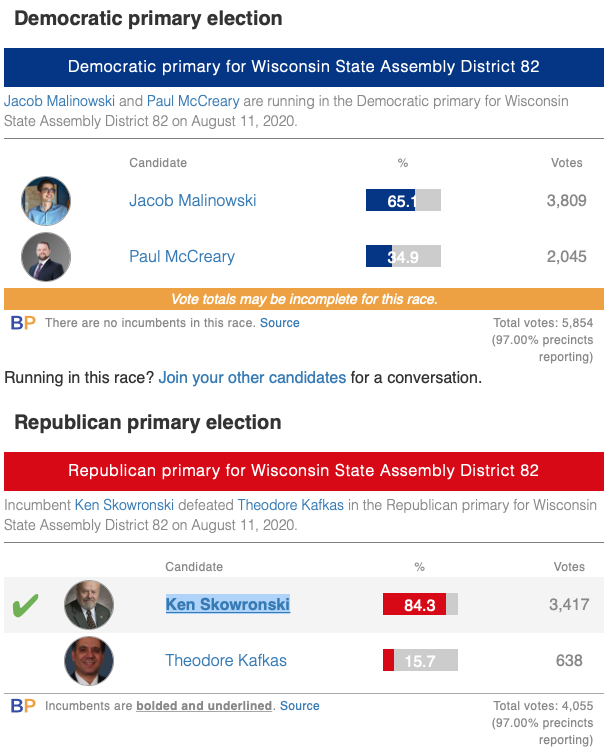
Wisconsin's 82nd Assembly District is in southwestern Milwaukee County, right where Milwaukee County, Waukesha County and Racine County meet. It's one of the reddest parts of Milwaukee County. Hillary lost it with 43% but two years later both Tammy Baldwin and Jill Karofsky were just a fraction n of a point away from 50%. The current Assemblyman, Ken Skowronski is a knee-jerk Republican careerist. He's being challenged by independent-minded Greendale School Board member Jacob Malinowski, a 22 year old progressive Democrat endorsed by Blue America.
This past Tuesday both Jacob and Skowronski won their primaries. For the first time ever, considerably more Democrats voted-- 5,854-- than Republicans-- 4,055. That bodes well for November. Jacob got 3,809 votes and Skowronski just 3,417 votes... also a good sign that even in a red district like this, voters are rethinking what the Republican Party is, now that it has been so unquestioningly supportive of an anti-patriot like Donald Trump. Another good sign for Malinowski is that a far right candidate, Marc Ciske, is running as an independent and is sure to draw away some Q-Anon types from Skowronski. His response to a question about COVID-19 from the Milwaukee Journal Sentinel demonstrates his appeal: "The first amendment states our right to assemble and freedom of religion, which were forfeited during the Safer at Home order. I would continue to support that Wisconsin remain open during COVID-19 to ensure needs are met. The people in our community are entitled to their income, job security, housing, place of worship and social networks. The economy should continue to function 100%. I think we need to trust that people will make the right decision by providing guidelines rather than forcing laws and policies." Meanwhile, Wisconsin saw another 943 confoirmedcases yesterday, bringing the state total to 63,206, nearly 11,000 cases per Cheesehead-- and 1,018 deaths. I asked Jacob to write a guest post about what motivated him to run for the Assembly seat. He wrote a bit about it and sent me the video below. Please take a look-- and please consider supporting his effort to replace a gerrymandering Republican in one of the few seats seriously flippable in November. You can contribute to his campaign by clicking on the Blue America 2020 state legislative thermometer below. Public Health Is Everyone's Problem Now
-by Jacob Malinowski Wisconsin held its state primary this week, and I’m excited to say that our people-first, issue-focused campaign came out on top. For the first time in seven years, the folks in my community will have a real choice in November. While my opponent acts as a rubber stamp for Speaker Robin Vos in Madison, we decided to run a grassroots campaign and actually talk about the issues and ideas that matter to working and middle class people. The road ahead will be long and difficult-- but I’m up for it. I got into this race because of suicide prevention and mental health. In the fall of 2019, there were three cases of youth suicide in this district-- including one in my hometown. That was the younger brother of a very good friend of mine, and that very same day my state representative missed six bipartisan votes on suicide prevention. When asked why, he said, “It wasn’t necessary that I was there. Things happen in the world and you can’t be there for everything.” It is crucial that we address mental health challenges faced by all people-- especially our students. Mental health has one of the highest morbidity rates across the country, yet unmotivated politicians refuse to tackle it head-on. I’m proposing a mental health counselor in every school district and expanding healthcare access for everyone: if you need to see a doctor, you should be able to regardless of your ability to pay. It’s important that we keep our communities both physically and mentally healthy. Speaking of public health, the Wisconsin State Assembly hasn’t shown up for work in over 100 days in the middle of a global pandemic. Even though unemployment insurance is going unfulfilled, schools are scrambling to come up with a plan to re-open, and folks are getting unnecessarily sick, our do-nothing politicians won’t show up for the job we pay them to do. My proposal is simple: get to work, follow the data, and keep people safe. It’s not an easy job, but it’s a simple mindset. We just need someone who is up for the challenge. I don’t have the typical background of a politician, but I think that’s a huge asset in this race. We’re pounding the pavement, working long days and even longer nights, and actually trying to have conversations in this district. My community is fed up with people who just do what they're told and bring no real ideas to the table. Our coalition is big and diverse: we’ve got working folks in dozens of unions, middle class families, young folks who finally see someone fighting for them, and older folks who are ready to pass the torch to the next generation. 2020 has been difficult for everyone, and we have no idea what lies ahead. My state representative simply isn’t up for the job, and his record demonstrates that. This is hard work, and I’ve got just under three months to get it done. Districts like mine don’t focus on one party vs. another: voters look for good candidates with a strong work ethic. I hope to bring everyone on board, and when I get to Madison, we’re going to restore Wisconsin’s strong, people-first legacy and push towards a more fair, equitable, and hard-working future-- no matter what challenge lies ahead.
A new YouGov poll for CBS News shows that nearly half of registered voters (48%) believe Trump's policies are making the economy worse. Worse for Republicans is that most voters (57%) say Trump is doing a very bad (43%) or somewhat bad (14%) job on handling the pandemic. 51% of registered voters with school-age children say they don't think Trump cares about the risks coronavirus poses to the health of their children. depending on the specific questions between 79 nd 83% of voters want to see massive new financial aid provided to victims of the COVID-Recession, something Republicans in Congress are blocking. Overall, Trump trails Biden among voters nationally by 10 points.
Liam O'Mara is an extraordinary progressive Democrat taking on a corrupt knee-jerk Trumpist, Ken Calvert, in a red-leaning suburban congressional district southeast of Los Angeles. A history professor, O'Mara told me yesterday that "We are in an economic depression that was entirely avoidable. We're here because this president cared only for how he looked, not what happened to the country, and is running the most incompetent administration in our history. And with 157,000 Americans dead of a preventable outbreak, 33% of GDP lost to a shut-down that never needed to happen, record-breaking levels of corporate welfare & corruption, Crooked Ken Calvert has the audacity to brag to his constituents that he's voted with Trump 98% of the time. That kind of party-before-country bullshit needs to end. Calvert has lately been trashing the First Amendment and doubling-down on militarized policing, fear-mongering about his fellow Americans, and trying to paint me as a violent anarchist. Calvert is unpatriotic, hyper-partisan, racist, and unfit for public office... sadly, much like this president."
Although there's plenty of time between now and the election for that 10 point gap to widen significantly-- which is likely-- the last time a Democrat won by over 10 points was in 1964 when Barry Goldwater's reverse coattails dragged down a net of 36 Republicans in the House (including Wyoming Republican Congressman William Henry Harrison III, whose grandfather and great-great-grandfather had both been presidents). Meanwhile, 3 Republican senators-- Jim Beall (MD), Edwin Mechem (NM), and Kenneth Keating (NY)-- lost their seats as well. Over the weekend CNN published a piece by John Harwood, Trump's coattails no boon for GOP Senate candidates with a photo of a forlorn, wistful-looking Susan Collins. Though Harwood noted that so far "Republican Senate candidates have shown little capacity to separate their fates from Trump," Collins has tried-- not always successfully-- harder than most to do just that. After three years of whining and prevaricating followed by high profile votes enabling all the worst of Trumpism, Mainers aren't buying it. The most recent public poll available for Maine was done by Colby College. It shows Trump losing by 12 points, with just 38%-- much worse than he did in 2016 when Hillary beat him statewide by a scant 3 points-- 357,735 (47.83%) to 335,593 (44.87%). When asked who they would vote for if the election were held today, Susan Collins or Democrat Sara Gideon, Gideon leads 44-39%. Collins is holding onto 75% of Republican voters and Gideon, a garden variety moderate Dem who has yet to make any successful overtures to Bernie supporters, is holding onto 79% of Democratic voters. But the real key to Gideon's lead is the way she is besting Collins with the all-important independent vote-- 38-35%. If that holds, Collins is toast. In 2016, Trump managed to win one of Maine's 4 electoral votes by winning in the second CD. This poll found that Trump is trailing Biden in the second CD by 3 points-- 42 to 45%-- even while Collins is eking out a useless win in that more conservative part of the state, leading Gideon 44-40%. Harwood lumped Collins in with Martha McSally (R-AZ), Cory Gardner (R-CO) and Thom Tillis (R-NC) as incumbents in bug trouble because of an inability to successfully separate themselves from Trumpism.
"If (the election) is today, I don't see how Republicans can hold," agrees GOP strategist Liam Donovan. Up and down the ballot, he explains: "The only question is, 'Do you like Trump?'" A generation ago, when the Democratic and Republican parties embraced considerable ideological and geographic diversity, such simple electoral equations didn't apply. The share of voters backing candidates of different parties for president and Senate has shrunk from around 20% in the 1970s to around 6% today, notes political scientist Gary Jacobson. When Obama sought reelection, such "ticket-splitting" allowed Democrats to win Senate seats in Indiana, Missouri, Montana, North Dakota and West Virginia-- all red states that Romney carried easily. Democrats candidates with comparatively conservative profiles managed to significantly outpoll Obama. Neither party pulled that off in 2016 when Trump and Hillary Clinton led the Republican and Democratic tickets. The convergence of president and Senate voting was complete; Republican Senate candidates won only in Trump-carried states, Democratic Senate candidates only in Clinton-carried states. This year, as Trump trails nationally and in critical battlegrounds alike, that bodes ill for Senate Majority Leader Mitch McConnell's field of candidates. Three months before Election Day, some endangered GOP Senate candidates are not only failing to outpace the president but actually under-performing him. In Michigan, which Trump won narrowly four years ago, the polling average on realclearpolitics.com shows him trailing by eight percentage points now. GOP Senate challenger John James trails Democratic incumbent Gary Peters by even more. The same is true of embattled Republican incumbents, who in past campaigns might have leaned on their own distinct home-state political identities. In Arizona, GOP Sen. Martha McSally trails Democratic challenger Mark Kelly by twice the three-percentage deficit Trump faces. In North Carolina, GOP Sen. Thom Tillis faces the same predicament against Democratic challenger Cal Cunningham. Political analysts cite multiple factors. The bleak national environment for the GOP has powered strong fundfraising by Democratic candidates, helping them heap fresh attacks on Republicans already weighed down by Trump's unpopularity. Among Democrats and some independents, antipathy toward Trump transfers directly onto Republican Congressional candidates they believe would assist him in office. In 2012, opponents "didn't despise Barack Obama with the level of intensity that people despite Donald Trump," says Amy Walter, an analyst at the Cook Report. "He has forced you to pick a side. There's no gray area." That black-or-white dynamic erodes intra-party support for Republicans seeking to protect themselves by establishing any distance at all from Trump. In North Carolina, after briefly bucking Trump on funding for the US-Mexico "border wall" last year, Tillis has faced catcalls from Trump allies without gaining support among Trump's adversaries. Not even the Northeastern Republican who touts her independence the loudest has escaped the undertow. In recent public polling, veteran GOP Sen. Susan Collins just about matched Trump's approval rating at around 40%. To shift attention from the President to her Democratic challenger Sara Gideon, Collins has proposed no fewer than 16 debates between them before Election Day. Other Republicans have attempted similar gambits. The gigantic shadow Trump casts over 2020, and shrinking supply on media resources available for covering state and local politics, make that a difficult strategy to pull off. What Republican candidates need most is for partisan solidarity to reverse some of the erosion Trump has suffered among Republican-leaning constituencies, such as older and non-college whites, that lifted him in 2016. "The only hope they have is that, as we get close to the election, Trump is able to win back some of those disaffected Republicans," Walter said.
Pramila and AOC by Nancy Ohanian
A Trump debacle isn't just going to mean Republican losses in the Senate and the House. It's likely that the anti-Trump, anti-Republican tsunami is going to sweep away many Republicans in state legislatures across the country. We asked a few Democratic challengers running for state legislatures around the country. Anselm Weber is the progressive Democrat running for an open state House seat to represent part of Lee County in southwest Florida. He told me that he thinks Gov. Ron DeSantis' and the other Republicans' crashing poll numbers across the state "provide enormous opportunity for everyday Floridians to hear a new perspective. My opponents, Jason Maughan and Adam Botana, are running on the 'Trump agenda' which is short for 'let's not do anything for working people and use the working class as sacrificial lambs to get the economy up and going again.' It is truly pathetic, their 'leadership' during this time, and Floridians need to have representatives who have their back during this crisis. We need to cancel rent and home payments in the short term, and provide universal healthcare, affordable housing, unions and livable wages for the years to come for the working class." I asked Jacob Malinowski, who's running for a Wisconsin Assembly seat held by conservative Republican Ken Skowronski, the same question about how the "Trump factor" is impacting his own race. He told me that Trump "has been a disaster for Wisconsin families, yet my opponent is a loud and proud Trump supporter. We're hopeful folks around here recognize that this style of politics is tearing our country apart and vote for new leadership up and down the ballot. We anticipate that our style of campaigning-- focusing on people-first, bottom-up solutions-- resonates with voters who are sick of nothing getting done, and that hard work will pay off."
Bob Lynch, who's running for a swingy Miami-Dade state House seat that the state party gave up on because the GOP incumbent, Daniel Pérez, was seen as too daunting. Lynch isn't daunted at all-- not by Pérez, not by the Republican Party and not by the Democratic Party. "This is an incredibly important point, especially with the upcoming census," he told me. "The demographic change in this country is only going one way and it does not bode well for a party of old bigoted white men. The Covid-19 pandemic has laid bare the fact that the Republican Party has absolutely no interest in providing even basic level services to the citizens of this country and the state of Florida in particular. All of the Republicans are complicit in this total criminal failure of government, especially Daniel Pérez. As someone who has been tabbed to be the speaker in 2024, he should have at least some modicum of power to prevent people in Miami-Dade County from dying needless and preventable deaths. Instead he is silent. We are getting to the point in the election where the issues are going to be very simple. Do you think that the government should be actively working to keep people alive and on unemployment or do you think the government should be looting the treasury for their corporate donors? As this situation continues to play out in red states featuring useless Republican governments, this should turn into an anti-Republican tsunami. That is why it is so important to have Democratic candidates running for every single seat in every single state. You can’t win if you don’t play. This could be a historic shift in party politics on the national level but it has to start locally."
Joshua Hicks, a progressive and a Berniecrat who is competing with Trump-Republican incumbent Cord Byrd in a northeast Florida district agrees that the 'Trump-factor' is powerful and motivating "across the country and here in Florida, in a red district. Just today, I spoke with Republicans who are ready for new leaders in Tallahassee and will be supporting me this November. They are fed up with the embarrassing daily drama Donald Trump causes, and are ready to vote out any leader associated with him. Here in Northeast Florida, people are crying for leaders who will address the bread-and-butter issues that they are facing on a daily basis. And because of this, and Trump's anti-coattails, Republicans and NPAs are willing to give Democrats a look and a vote this November. I believe that you'll see upsets across the country in districts thought safe by Republican candidates 'taking it easy' on the campaign trail."