"When fascism comes to America, it will be wrapped in the flag and carrying the cross."
-- Sinclair Lewis
Monday, October 19, 2020
What Trump's Toxicity Is Costing The Republican Party-- Let's Take Omaha And The Surrounding Suburbs, For Example
>
NE-02 can deliver more than just a member of Congress; it can also deliver one presidential electoral vote. That vote has only gone to a Democrat-- Obama in 2008-- one time. Polling indicates that electoral vote is going to go to Biden this cycle, as the district flips blue in both the presidential and congressional contests. Kara Eastman looks like she'll be replacing Trump shill Donald J Bacon in Congress and she's working hard to turn out voters who will support not just her own campaign but Biden's and other Democrats as well. Kara, who's perspective is far more populist and progressive than Biden's is being helped by Biden, just as Biden is being helped by her. Syncronicity. But both candidates owe one man the lion's share of credit for their good polling: Trump.
Politico writer David Siders reported yesterday that it's Trump's collapse in red-leaning Omaha suburbs that has resulted in a 6-7 point overall polling deficit for him. He'd wrote that what's happening in NE-02 is a case study of "how the president’s alienation of a traditional Republican constituency is proving costly to his reelection campaign-- and how his increasingly desperate last-minute appeals to suburbanites are going unheeded."
“If you look at the struggle that Trump has going on in the suburbs, it’s just super consistent,” said Ryan Horn, a Republican media strategist based in Omaha. “What you see in Nebraska 2 you’ll see in Dallas, Texas, you’ll see in Charlotte, North Carolina, you’ll see in Sioux Falls, South Dakota, you’ll see in Orange County, California … It’s super, super consistent.”
The Omaha World-Herald, which until endorsing Hillary Clinton in 2016 hadn’t backed Democrat for president since 1932, endorsed Joe Biden recently, pleading for a break from Trump’s “recklessness.” And Don Bacon, the district’s Republican congressman, has been forced to remind voters that he is not in lockstep with Trump.
“Kara Eastman frequently on TV and on radio says I’ve sworn a loyalty oath to the president,” Bacon complained in a recent debate with Eastman, his Democratic challenger. “And it’s a lie.”
Not long ago, Nebraska Republicans couldn’t have fathomed such a problem at the top of the ticket in their state, which awards one electoral vote in each of its three congressional districts and two electoral votes to the statewide winner. But in 2008, Barack Obama, carrying the 2nd District, picked off one of the electoral votes, marking the first time in 44 years that a Democrat had accomplished that feat.
Stunned, Republicans in the state’s legislature re-drew the 2nd District lines to make it safer for the GOP, adding the more conservative, western suburbs of Sarpy County to the city of Omaha. Obama lost the reconfigured district to Mitt Romney in 2012, and Trump carried it narrowly four years later.
Today, despite the advantage of a favorable map, Trump is on the cusp of undoing the entire scheme. A New York Times/Siena College poll last month put Trump 7 percentage points behind Biden in the district, losing women by 11 percentage points and independent voters by 28 percentage points. Though Trump remained ahead of Biden in Sarpy County, the margin was not wide enough to compensate for his shortcomings in Omaha and the surrounding communities of Douglas County.
...Bacon, the 2nd District congressman who’s facing a rematch with Eastman, a progressive Democrat, said competing in urban and suburban areas can be a “challenge” for any Republican. What Trump has going for him, Bacon said, is “a thing in Nebraska where we are a little more conservative in nature.”
The unemployment rate in Nebraska is lowest in the nation, and Bacon said, “I tell people, ‘Who do you trust to bring the economy back?'"
However, Bacon said, “We’re also Nebraska nice... and we want more diplomacy and decency, and I think that’s what hurts the president.”
...Former state Sen. Burke Harr, a Democrat who represented central Omaha in the state legislature, said that unlike four years ago, “even chamber of commerce people I talk to are freely admitting they’re having a hard time justifying voting for Trump.” And the World-Herald seemed to have that chamber of commerce crowd in mind when it endorsed Biden, too.
The paper appealed directly to conservative readers in its endorsement of Biden this past weekend. “Trump’s departure from the White House,” the paper opined, “would benefit not only the country but also the Republican Party, by unshackling GOP officeholders from the slavish deference they’ve felt obligated to display to the president’s years-long series of eccentricities and embarrassments.”
The 2nd District’s single Electoral College vote is unlikely to tip the balance on Election Day. But there are scenarios in which a victory in the district could push Trump or Biden to the decisive number of 270 Electoral College votes.
Last month, when Republican Voters Against Trump, a group founded by former Weekly Standard Editor Bill Kristol, announced a six-figure digital ad buy in Nebraska’s 2nd District against Trump, it called the area a “tipping point,” noting that if “Joe Biden were to pick up Pennsylvania and Michigan, a victory in NE-2 would secure him the 270 votes he would need to clinch a presidential victory.”
“We’ve seen models that show that this district will make the difference in the presidential race,” said Kyle Clark, Bacon’s political director. “We are at ground zero.”
Flush with cash, Biden has spent about $2 million on advertising in the district since Labor Day, about six times what Trump has spent, according to the ad tracking firm Advertising Analytics. Jill Biden and Doug Emhoff, Sen. Kamala Harris’ husband, have appeared in recent weeks in Omaha. So have Karen Pence and Lara Trump, the president’s daughter-in-law. On Tuesday, Donald Trump Jr. was there lacing into Biden and the “radical left.”
The full effect of Trump’s suburban deterioration on the rest of the GOP ticket remains unclear in Nebraska-- and across the country. But it is being tested in the congressional race between Bacon and Eastman... Eastman is working relentlessly to yoke Bacon to the president. In recent debates, she goaded Bacon for voting with Trump more than 90 percent of the time. She asked him if it was still an “easy choice” to endorse Trump.
Bacon, a co-chair of Trump’s re-election campaign in Nebraska, said that it was easy, contrasting Trump with Biden on economic and social issues.
However, he added, “I do not support the rhetoric. I don’t like the name calling.”
When Push Comes To Shove, What Do Blue Dogs Do? They Pull Off Their Masks And Show The World What They Always Are: Republicans
>
Two of the members of Congress I respect most, Ted Lieu (D-CA) and Jamie Raskin (D-MD) are in safe blue districts and have been working their asses off to elect other Democrats to Congress. Sometimes, it drives me crazy, though, that they are working to elect all Democrats-- from complete garbage like Oklahoma Blue Dog Kendra Horn to the top progressive challengers across the country. I had a good discussion with Ted about it but he was unshakable in his determination to elect more Democrats. Period.
To my mind, his argument is undercut, though, when conservative Democrats are seen to only help other conservative Democrats and not progressives. Progressives like Ted and Jamie are raising millions of dollars for Blue Dogs and New Dems-- as well as for progressives-- but Blue Dogs and New Dems? Let's go take a look at one of the most-- if not the most-- crucial congressional race anywhere in America: Omaha, Nebraska.
NE-02-- Omaha and the rest of Douglas County plus most of red-leaning, rural Sarpy County-- is a swing district that elects one member of Congress, just like every other district. However, NE-02, also awards an electoral vote to a presidential candidate (as does another swing district, ME-02). That's why the district is so incredibly important. Kara Eastman, a community activist and organizer, won a tough primary against an establishment candidate married to a former congressman, Blue Dog, Brad Ashford, who was beaten in 2018 by Eastman in a bitter primary. In part because of the tireless and effective organizing on behalf of Democrats up and down the ticket, both she and Biden, who is not making any efforts in Nebraska, are leading in the district. Kara is delivering him an electoral college vote.
On Wednesday evening, she beat the Trump-enabling incumbent, Don Bacon, in a debate. Moments before the debate-- in a coordinated effort by the Bacon campaign-- party-jumper Ashford-- who had already endorsed Kara-- switched his endorsement to the Republican.
That's what Blue Dogs do. I wouldn't expect Cheri Bustos, DCCC Chair and a Blue Dog herself, to care, but I would hope Ted and Jamie would take that into consideration when they help elect Blue Dog candidates. There are several Republicans running as Democrats this cycle-- just as Ashford had-- and all are possible party-jumpers like Jeff Van Drew, a New Jersey ultra-conservative who flipped into Trumpism and officially joined the GOP after voting with them for a year.
When Ashford was in Congress, he was generally considered one of the 2 or 3 most right-wing Democrats in the House and was always looking for opportunities to stab the Democrats in the back, just the way he did to Kara on Wednesday night.
Ashford first won the seat in 2014, narrowly beating GOP incumbent Terry Lee, even though he only raised $1,231,958 to Lee's $3,106,288. How did he manage that? The DCCC and Pelosi's House Majority PAC spent a little over $1.5 million slamming Lee and bolstering Ashford. One term of the conservative Ashford was more than enough for Omaha Democrats, who refused to back him again. That's when he lost to Bacon, even though he spent a million dollars more than Bacon and even though the DCCC spent $2,688,673 on his behalf, while Pelosi's SuperPAC threw in another $741,041. So... almost $3.5 million wasted trying to save the seat of a pretend-Democrat who voted with the GOP and who was hated by his own constituents! That's the DCCC!
The following year, Ashford wanted to try again, but despite backing from the DCCC, Democratic voters weren't having anything to do with him and Kara defeated him in the primary-- at which point the DCCC basically pulled out of the race and signaled to the Republicans that the district was all their's. The GOP spent a massive $1.3 million smearing Kara and another $700,000 advertising how amazingly wonderful Bacon was. The DCCC spent a ritual $90,000 on Kara before telling donors and the media that she couldn't win. And by the way, you can contribute to Kara's campaign by clicking on the thermometer on the right. Bacon defeated Kara by less than 1 percentage point despite his mammoth financial edge.
This cycle, Ashford sent his wife in to run in his place. Kara beat her in a humiliating two to one landslide. She has kept up with Bacon on spending so far-- having spent $1,132,014 to his $1,239,832. But he has twice what she does in the bank for the final push and the GOP has spent $1,958,987 on ads calling her a communist and another $1,216,895 boosting Bacon. The DCCC and Pelosi's SuperPAC have spent $1.2 million helping Kara, much less than they've spent on right-wing Blue Dogs and corporately owned New Dems. One of the most far right Democrats in the House-- hated by his normal Democratic colleagues, many of whom hope he loses-- is Anthony Brindisi, who votes with the GOP as much as Ashford used to. The DCCC has spent $2,025,213 on his race. Pelosi's SuperPAC threw in another $632,150 and the Blue Dog PAC kicked in $473,272. Or compare the $1.2 million the DCCC and Pelosi have spent on Kara to the $2,736,430 the DCCC alone had spent on conservative New Dem candidate Carolyn Bourdeaux so far.
With The Passing Of RBG, Will The Issue Of Choice Help Or Hurt Democrats Running For Congress?
>
Right after it was announced that Ruth Bader Ginsburg had passed away, Trumpist crackpot Angela Stanton-King sent out the above Tweet. Her opponent, Democratic state Senator Nikema Williams has been a fearless advocate for women for her entire adult life and worked as a vice president for public Policy at Planned Parenthood for a decade. Protecting women's choice isn't an issue she's going to run away from.
Early Monday morning, Omaha Democrat Kara Eastman-- the progressive candidate running for the congressional seat held by Trump sycophant Donald Bacon-- told me that "With the tragic passing of Justice Ruth Bader Ginsberg, I've heard from many voters in Nebraska about their fears that a more conservative Supreme Court will vote to reverse Roe v. Wade. While I support Roe and I believe that women constitutionally deserve to be able to make healthcare decisions affecting their bodies in consultation with their doctors without government interference, I know as well that Rep. Don Bacon would rather have us back in the pre-Roe dark ages of back-alley abortions and second-class status for women. The fact is that if you are really 'pro-life' you would support universal pre-natal health care, you would favor Medicare for All (which isn't much different than the socialised medicine that Don Bacon has enjoyed his entire career), and you would push for massive economic investments in jobs and infrastructure that will lead to a safe recovery from Covid."
On Sunday, the NY Times noted that Abortion Was Back-Burnered In The Presidential Race. Not Anymore. "For months, abortion has been relegated to a back burner in the presidential campaign, eclipsed by a worldwide pandemic, an economic crisis and protests over racial justice. But the death of Justice Ginsburg and the looming confirmation battle to replace her could force the candidates to discuss a volatile issue six weeks before Election Day that carries significant political risks for both sides, even as it energizes portions of their bases. Mainstream views on abortion are more moderate than those of the activists on either wing, with most Americans saying that abortions should be legal with some restrictions. An all-out fight over abortion could further alienate the more moderate suburban voters both sides are competing for. Democrats especially must navigate their own divisions over how far to push an issue that Mr. Biden has long found personally uncomfortable."
I'll leave Biden's response to the centrist spin doctors he has running his campaign. Instead, I am interested in knowing how the GOP rush to ramrod through a far-right anti-Choice Supreme Court justice who wants to end women's Choice is going to play out in congressional races around the country. Kara Eastman is running in a 50-50 purple district and her forthright position on Choice shows conviction... and courage. Same for California progressive Audrey Denney, who's running for a red California seat held by anti-Choice fanatic Dog LaMalfa. Many in the district are anti-Choice but that isn't keeping Denney from speaking out loudly and clearly. "Choice has always been a top issue for me," she told me yesterday. "I’ve been endorsed by EMILY’s List, Planned Parenthood, and Vote Pro Choice. Our polling shows it, along with access to medical care, a top issues with some of our important voter groups." She issued this statement to voters in CA-01:
This is a terrifying moment in U.S. history, when 46 years of precedent for recognizing women’s right to privacy and sovereignty over their own bodies is being systematically dismantled. The policymakers who have put forward these archaic bans on safe and legal abortion claim to be doing so because they value human life.
I deeply respect the sanctity of life. I believe that life is created by God, and I believe that every woman has the right to choose whether or not she will participate in bringing life into being. No one has the right to tell her that she must. Making the decision to end a pregnancy is a difficult and tragic one-- but having the right to make that decision is foundational to protecting women’s health, privacy, and well-being.
If the people who wrote these laws truly cared for the sanctity of life, they would be working tirelessly to reduce our country’s maternal mortality rate (currently the worst among industrialized nations), but instead they are limiting or eliminating care, and more mothers are dying during childbirth. They would be investing in initiatives to improve infant and child health and access to early education and child care. They would be fighting for paid family leave, so that parents have adequate time to regain their own health and support their new child. They would be losing sleep over the 12 million children in this country who will go to bed hungry because their parents are trapped in poverty, unable to earn a living wage.
I imagine a world where fewer women face the difficult decisions surrounding ending a pregnancy. Statistics have proven since Roe v. Wade, the path to that kind of world is not through restrictive legislation around abortion. That path is achieved through policies that support women and families, and make it easier for families to thrive in our country.
The legislators who support abortion bans have failed us. They have failed their constituents. They have failed our nation. Their time is up.
Kathy Ellis, is the progressive Democrat running to replace Trump enabler Jason Smith in the reddest district in Missouri, the eighth congressional district in the southeast corner of the state, where Missouri comes together with Arkansas, Tennessee, Kentucky and southern Illinois. The PVI is R+24 and Trump beat Hillary there 75.4% to 21.0%. Perhaps counterintuitively, polling shows that most voters in the district are pro-Choice. Jason Smith certainly isn't. Kathy's campaign has been advertising her endorsement by Planned Parenthood extensively and she certainly isn't backing away from her pledge to protect Choice. "I've always been a proud pro-choice candidate," she told me, "and protecting the right to choose is not a foreign fight for Missourians who have been up against staunchly anti-choice bills for over a decade. But now, with the passing of Justice Ginsburg, this fight has certainly gained importance. In a rural district such as mine, we've actually seen most folks fall into the pro-choice category, and when the Missouri legislature attempted to pass a full abortion ban, with no exceptions, we saw a huge increase in pro-choice organizing in the District. When I first announced my campaign, I was advised to avoid this issue, but for me, protecting a person's reproductive freedom is at the heart of why I'm running for office. I've always been proudly pro-choice, and I'll always be honest about who I am."
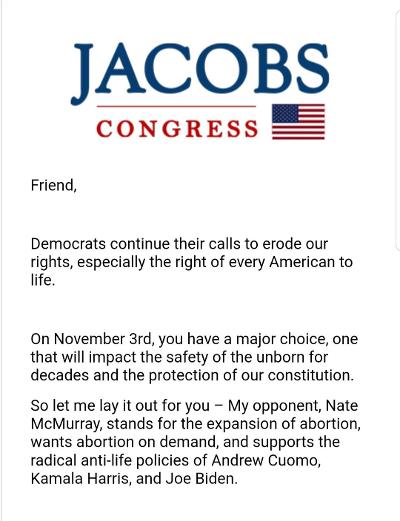
Republican Chris Jacobs is another garden variety Trump sycophant and anti-Choice ass. Typical e-mail to his supporters (last week):
The progressive Democrat running for his western New York congressional seat is our old friend Nate McMurray. Earlier, McMurray told me that "The appointment of Brett Kavanaugh to the Supreme Court became a political fight to the death in 2018 just before the midterm elections. Now the unthinkable has happened, and Justice Ginsburg's death has launched us into another situation where she hasn't even been laid to rest and Mitch McConnell is salivating over another chance to put his hypocrisy on full display-- just 43 days away from the election. Just as COVID-19 magnified the issues with our healthcare system, RBG's death reminds us all that even institutions like the Supreme Court are not safe from the corrosion of toxic political forces. The Supreme Court will hear arguments on the Affordable Care Act on November 10th. Should the Republican party have its way, millions of Americans will be thrown off their health insurance before the second wave of the pandemic hits. Reproductive rights, labor rights, civil rights, and so much more are on the line. The GOP has sunk so low-- it's not a time for us to 'go high;' we've got to fight like hell for the future of this country."
There's no question about where Mondaire Jones was coming down on this issue. One of the best hopes for progressive leadership in the next session of Congress, he's running to hold an open, narrowly blue district. ""Unfortunately, the Trump Administration and the Republican Party have systematically undermined women’s reproductive freedom," he said this morning. "The federal government must step in to protect civil rights-- and it cannot leave those rights up to the extreme conservative majority on the Supreme Court. As a member of Congress, I will work to codify Roe v. Wade by statute, repeal the Hyde Amendment, and ensure that any Medicare for All legislation includes coverage for the full range of reproductive services. That’s why I’m proud to be endorsed by leading pro-choice groups like Planned Parenthood Action Fund and NARAL Pro-Choice America. My opponent, meanwhile, is anti-choice and intends to be a staunch opponent of reproductive freedom, which could not be more out of step with the values of our district."
Of course it isn't just in congressional and federal races where the "new" issue is being injected into the election. I spoke with Heidi Campbell yesterday. The mayor of Oak Hill and a state Senate candidate in Tennessee, she is on the verge of ousting anti-Choice Republican Steve Dickerson and flipping a red seat blue. You can help her do that here. I asked her how the Supreme Court being threatened with another anti-Choice extremist is playing out in her suburban Nashville district.
"Devastatingly, she told me, "the October surprise came early this year-- not to say that there won’t be several more, in this accelerating-ly chaotic wreck of a year. Each time something like this happens though, we have to reassess the dynamics of our race. I am running for state Senate in Tennessee’s District 20 which is gerrymandered to carve out the conservative pockets of Nashville’s metropolitan area. This district has been trending blue and went for Clinton in the last election. In fact, two separate polls show us narrowly ahead of the incumbent. Democrats have not flipped a state Senate seat in Tennessee in over fifteen years, and we have a great shot at flipping this one. The SCOTUS appointment to fill RBG’s seat cuts both ways of course-- both sides are energized by it, and it should strengthen the position of candidates like myself who are running in districts that are gaining Democratic voters. But this also means that Republicans are going to spend as much as they can to hang on to their seats, and in our race they have purchased several hundred thousand dollars worth of television ad time to run attack ads against our campaign over the next five weeks. Our team is fighting with every fiber of our beings to flip this seat, in a state where anti-abortion, anti-LGBTQ, anti-immigrant (and many other) bills are intentionally seeded to wend their way up to the Supreme Court. We simply do not have as much money as the Republicans, and since we’re not going to have election finance reform in the next six weeks, we have GOT to raise as much as we can to win."
Why Can't The Conservative Brain Grapple With Science-- And Will The Climate Crisis Destroy Us All Because Of That Flaw?
>
Audrey Denney is running for Congress in the northeast corner of California (CA-01), where the state meets Oregon and Nevada. It's a largely rural district with the most exposure to Climate Change-induced wildfires anywhere in the state. She told me yesterday that the Trumpist incumbent, Doug LaMalfa "does not believe in human induced climate change. He has recently called climate change policies 'radical.' He either has been bought and paid for by the oil and gas industry (as his FEC reports show)-- or he doesn’t have the capacity to wrap his mind around science. He has also been quoted as saying abortions cause breast cancer-- so I am leaning toward both."
Denney, whose campaign leans heavily on talking with voters about the Climate Crisis said that "Climate change is not a threat in the distant future. It is taking the lives, homes, and livelihoods of people who live in my district today. We lost 93 lives in 2018 in the Carr and Camp Fires and we lost at least 15 lives last week in the North Complex fire. In 2018 the Carr fire and Camp Fire alone emitted nine times as much CO2 as the state of California was able to reduce our emissions by that year. Our federal forests are MASSIVE carbon sources-- but have the potential to be carbon sinks-- actually helping us turn the dial back on climate change. Forty-one percent of my district-- and fifty seven percent of the state of California-- is federal forests. And the vast majority of them are in desperate need of vegetation management work and forest restoration work to bring them back to a state of health. This is the only way we will reduce our fire risk and be able to mitigate climate change. If you do not think this work is critically important than you are not paying attention. Or perhaps live in one of the few places that is not shrouded in smoke from the West’s fires... Only by restoring our forests to health by doing the critical thinning, selective logging, and fuels-reduction work, will we be able to lessen our wildfire risk and mitigate the dangerous result of climate change. We can create economic incentives to find new industry utilization for the woody biomass removed from our forests. This will look like manufacturing sustainable building materials like cross laminated timber (CLT) and processing woody biomass into low carbon transportation fuels. We can set policies in place to support the career and technical education programs and apprenticeship programs that will be necessary to build the required local workforce. All of these opportunities mean high paying jobs and more economic opportunity for the real people of California’s first district."
Yesterday, Ron Brownstein's Atlantic column asks a simple question millions of Americans probably have asked themselves at one time or another, Why is it that Republican officials still don’t care about Climate Change?. He begins by introducing us to Mary Nichols, who's been "part of the struggle to prevent catastrophic climate change for about as long as anyone in American life. For years, she’s directed California’s pathbreaking efforts to reduce carbon emissions as the chair of the California Air Resources Board-- a position she held first in the 1970s before taking it up again in 2007. Nichols has also served at the federal level, working as the chief regulator for air pollution at the Environmental Protection Agency under President Bill Clinton in the 1990s. And yet even Nichols has never seen anything that crystallizes the dangers of climate change more clearly than the historic outbreak of wildfires scorching California and other western states this year. 'Yes, absolutely,' she told me earlier this week, when I asked her whether this year’s fires are the most tangible danger to California that she’s seen from climate change. 'It’s not suddenly going to reverse itself … to years when there’s no fire season, or it’s not going to happen until October. The changes are going to be real, and they are going to be long-lasting.'"
Then he introduced us to Carol Browner who served as the EPA administrator for both of Clinton’s presidential terms and later worked as Obama’s first White House adviser on climate. "When she looks at the confluence of extreme-weather events battering the United States in recent years-- not only the wildfires, but also the Gulf Coast hurricanes, Midwest flooding, and the Southwest’s extreme heat-- Browner likewise sees stark evidence that climate change is disrupting American life earlier and more powerfully than almost anyone expected when the debate over these issues seriously began about three decades ago. 'What we have now is the absolute environmental demonstration or evidence of just how dramatic the impact of climate change is going to be. This is not going to stop,' Browner told me. 'There is going to be something next year, and the year after, if we don’t get on it.'"
Environmental scientists and policy experts around the country agree that the massive wildfires are just the latest indicator that climate change has thrust the U.S., and the world, into a dangerous new era. But it’s far from certain that the growing recognition of that threat can break the stalemate over climate policy in Washington. The accumulating evidence about climate change’s destructive power represents an irresistible force for action. But it’s colliding with an immovable object: the unbreakable resistance to any response among both Republican voters and elected officials.
Polling shows that, overall, a growing share of Americans believe climate change is happening, that human activities are driving it, and that the threat is manifesting right now. But as on many issues, the gap on all of these questions is widening between voters in the Republican coalition and other Americans. Annual polls by the Yale Program on Climate Change Communication show that although the numbers have increased markedly for Democrats, Republican partisans are no more likely than in 2008 to believe that human activity is causing climate change, and they express even less concern about its impact now than they did then. (Belief in human causation has declined somewhat among independents, but concern about the effects of climate change has increased substantially.)
These attitudes within the GOP coalition both reflect and reinforce Republican officials’ rejection of any effort to reduce carbon emissions. [The Donald], echoed by many prominent conservative commentators and congressional Republicans, continues to dismiss the evidence that climate change is even contributing to the spike in extreme-weather events. With Joe Biden offering the most aggressive climate-change agenda of any Democratic presidential nominee in history, the conditions for the long-stalled debate over the issue in Washington are becoming as combustible as the dried forest floors of California.
Anthony Leiserowitz, the director of the Yale climate program, says that in the past, even those Americans concerned about climate change tended to see it as a remote problem. “It was distant in time, [in] that the impacts won’t be felt for a generation or more,” he told me. And it was “distant in space”-- “this is about polar bears and maybe some developing countries, but not the United States … not my friends, not my family, not me.”
Seen through that lens, he said, climate “just blended in the background with 1,000 other issues out there... so we can deal with it later. That’s where more of the country was in 2007 and 2008. Now we skip forward to today, that’s not true anymore because of the [weather] events we’ve been talking about.”
In Yale’s polling, the share of Americans who say that climate change is affecting weather at least somewhat reached nearly three-fifths in 2020, up from about half in early 2013. But Leiserowitz said more disruptive weather events aren’t the only things moving attitudes on climate. Another important factor is the broad, diverse chorus of voices expressing worry about it. Ten years ago, he noted, Americans might have heard concern about the climate only from “environmentalists and liberal politicians like Al Gore”; now it’s much more common to hear concerns raised by public-health professionals, business executives, and even faith leaders, such as Pope Francis.
The result has been an undeniable, though not overwhelming, shift in public opinion. In Yale’s latest national survey this spring, slightly more than three-fifths of Americans said human activities are causing the climate to change, a new high. The share of Americans who say they are very worried about climate change’s impact is relatively modest, at 27 percent. But it’s nearly double the level it was in 2008; overall, about two-thirds of respondents are now either very or somewhat worried.
Americans’ attitudes about the imminence of the danger have changed more drastically: 45 percent in the latest survey described climate change as a threat to Americans now, a big increase from 33 percent in 2008. The share who say climate change won’t be a problem for 25 years or more is at 42 percent, down 10 points compared with 2008.
Yet, on all of these fronts, the movement has not been symmetrical. Democrats are expressing much more concern than they were a decade ago, and most independents slightly more. Republicans, meanwhile, are either no more or even less concerned. (Rigid GOP attitudes largely explain why the overall shift in public opinion on many questions hasn’t been more dramatic, despite the quickening pace of weather disruption.) Since 2008, for instance, the share of Democrats who say human activity is causing climate change has spiked from 70 percent to 85 percent; among Republicans, it’s virtually unchanged, at just 37 percent. And although nearly half of Democrats now say they are very worried about climate change (almost double the level in 2008), only about one in 14 Republicans is equally concerned. That share is essentially unchanged from 12 years ago.
This pattern of public attitudes looks very similar to opinions on racial-equity issues: Compared with a decade ago, substantially more Democrats of all races accept that systemic racism against Black Americans is a serious problem; however, many Republicans are even less likely to agree it exists compared with 10 years ago. The divergence between the parties on climate, as on race, reflects the larger resorting of the electorate along lines of culture rather than class. (Republicans, as I’ve written, increasingly rely on a coalition of older, non-college-educated, evangelical, and rural white voters, while Democrats depend heavily on young people, people of color, and college-educated white Americans.)
Just as many Republican voters have cheered GOP attacks on public-health experts during the coronavirus crisis, portraying them as “elites” who look down on and want to control ordinary people, they have embraced similar accusations against climate scientists. “Climate change is an issue... where most people don’t know that much... and in those circumstances-- especially for an abstract, seemingly far away, invisible problem like climate change-- they look to their leaders to help guide them through that incredibly complicated landscape,” Leiserowitz told me. “Republicans who began talking about climate change as if it was a ‘hoax’ had an incredible impact on other Republicans.”
Many environmentalists have hoped that more and more exposure to the furious effects of weather disruption might soften resistance among Republican voters and leaders to acting on climate change. But in dramatic polling last year from the Kaiser Family Foundation and the Washington Post even Republican voters who acknowledge that their communities are facing more extreme weather overwhelmingly reject the notion that climate change is significantly contributing to those events.
Detailed results provided to me by Kaiser underscore an astonishing gap between the parties. Among people who agree that their communities are experiencing either more hot days, more floods, or more droughts, at least three-fourths of Democrats say climate change is a “major factor” in those events; but at least seven in 10 Republicans in each case say it is only a minor factor, or does not contribute at all. Slightly more than seven in 10 Democrats living in places experiencing more wildfires consider climate change a major factor in causing them; three-fourths of Republicans see climate as little or none of the cause. Even after this summer’s searing events, an Economist/YouGov poll released yesterday found that although three-fourths of Biden supporters said “the severity of recent hurricanes and Western wildfires is most likely the result of global climate change,” fewer than one in five Trump voters agreed.
Those contrasts offer very little reason for optimism that even if Biden wins, any meaningful numbers of congressional or state-level Republicans will feel pressure to support measures to reduce carbon emissions. Among other reasons for pessimism: In both presidential and Senate elections, Republicans are more and more reliant on the states that produce the most fossil fuels, which tend to be the same states with large populations of non-college-educated, Christian, and rural white voters drawn to Trump’s message of racial and cultural backlash.
Across the 20 states that emit the most carbon per dollar of economic output-- a good proxy for states’ integration into the fossil-fuel economy-- Republicans now hold 35 of their 40 Senate seats. That’s nearly enough senators to sustain a GOP filibuster against climate action on its own. The final brick in the wall of GOP opposition is that fossil-fuel producers, once an important source of campaign funding for southern Democrats such as Lyndon B. Johnson, are all-in on bolstering Republican power. Over the past 30 years, oil and gas producers have directed more than 80 percent of their massive $711 million in total federal campaign contributions toward Republicans, according to the nonpartisan Center for Responsive Politics.
Gene Karpinski, the longtime president of the League of Conservation Voters, the environmental movement’s principal electoral arm, sees little prospect for GOP participation on climate even if Trump loses. “Because of the fossil-fuel influence on the Republican Party and the leader of the party still calling climate change a ‘hoax,’” GOP skepticism about “climate change is out of step with the rest of the country,” he says.
But others see some cracks in the resistance. Kenneth Medlock, the director of the Center for Energy Studies at the Baker Institute for Public Policy in Houston, says the terms of daily discussion in Texas and in neighboring states have changed since Houston was deluged with historic floods during Hurricane Harvey in 2017. “Even in the Gulf Coast, the conversation around extreme-weather events and the like is more the norm than it was five years ago,” he told me. “Up until Harvey happened, nobody really wanted to address the elephant in the room, which is that the climate is changing and this is a real risk.”
Even with that evolving dialogue, Medlock doesn’t expect big changes among Republican elected officials in Texas. He predicts that, to the extent that they acknowledge climate change, they would be more likely to talk about fortifying communities against its effects (an issue he considers important too) than to talk about reducing carbon emissions. But Medlock anticipates that position will become more and more untenable for Republicans over time-- not because their voters necessarily demand more action, but because the business community and institutional investors will keep moving ahead without them to cut carbon.
The dialogue among elected Republicans, he told me, “has kind of quietly shifted.” He explained that the Baker Institute, which is based at Rice University, is involved in several initiatives aimed at reducing net-carbon emissions in the region. “What’s really interesting about [those] efforts is that when we talk to state lawmakers and federal lawmakers [including Republicans], there’s no resistance,” he continued. “You open the conversation with, ‘The world is changing; consumers and investors are demanding lower carbon footprints; this is an economic opportunity for Texas...’ and immediately the conversation becomes very lively. So, in some ways, it’s about how you approach the conversation.”
Sean McElwee, the Data for Progress pollster who analyzes progressive causes, sees a similar opening. Although most Republican voters still recoil from measures presented as addressing climate change, more are open to promoting clean-energy sources, he says. (Yale’s polling has found that too.) “When we do testing … clean energies are very popular among Republican voters, and people are really interested in the jobs framework,” he told me. Just as important: Relatively few Republican voters intuitively embrace arguments from Trump and others that defending oil, gas, and coal is a culture-war statement against “elitists” promoting solar and wind energies. “I don’t think voters have an allegiance to coal and oil the way Republican politicians have,” he said.
Browner, the former EPA head, is also a voice of relative optimism. “If Biden wins and they start moving forward” with a climate agenda, she told me, “there will be Republicans calling. Maybe I’m a minority on this, but when they see you are serious and you want to do something, they want a seat at the table.”
Even if Republicans remain obdurate, unified Democratic control of Congress and the White House is more likely to produce climate action than the last Democratic trifecta in 2009 and 2010, most experts I spoke with said. At that point, the House Democratic Caucus still contained a large number of southern and rural “blue dog” members who resisted cap-and-trade climate legislation the chamber passed in 2009. (Forty-four Democrats voted no.) Now the House Democratic Caucus is overwhelmingly centered on urban and suburban districts where acting on climate is popular. As Karpinski said: “If you look at 2018, the key reason why Nancy Pelosi is now the speaker [is because] it’s mostly suburban and some of the semi-urban districts. It’s a combination of young people, communities of color, and suburban women. They are the most supportive of this issue and want action.”
If Biden wins and Democrats gain the Senate majority, he could drive a big part of his climate agenda through a coronavirus-relief stimulus package; his plan includes massive spending to promote renewable power, electric cars, and energy-efficiency upgrades for homes and businesses. Obama did the same thing in the stimulus package he signed to counter the Great Recession, tucking in huge investments in clean energy (that Biden as vice president was assigned to oversee).
But to secure Senate approval for measures that directly limit carbon emissions, Democrats would almost certainly have to end the filibuster, which empowers what I’ve called the “brown blockade” of Senate Republicans who represent the fossil-fuel-producing states. (Unable to overcome a filibuster, the Senate never considered the cap-and-trade climate bill the House passed in 2009.) And even if Democrats do end the filibuster, serious climate legislation could face a tight squeeze to reach a simple majority, with Joe Manchin, from coal-producing West Virginia, and possibly other Democratic senators having to take a very tough vote.
All of those outcomes are impossible to predict. But what’s clear is that the tension will grow between a sluggish political system locked in a partisan standoff and a climate system that is poised to generate disruption at an accelerating pace. “This is not some ‘new normal’ that we can plan around … it’s a system that continues to spiral out of control,” says Vijay Limaye, an environmental epidemiologist at the Natural Resources Defense Council. “There definitely is a signal in these record-setting months that … we are heading into a new era when we will see records set, and they will fall just as quickly … It’s hard for people to wrap their heads around now, but as bad as things have been this year, unquestionably, they will get worse.”
Nichols, the veteran climate regulator, is just as stark in her warning: Even today’s extreme weather may soon seem like the (relative) calm before the storm. “The rate of change is accelerating, so it is absolutely possible that we’ll see more visible signs of bigger storms,” as well as higher temperatures and sea-level rise, she said. “All of those things could happen much faster.”
She explained that the famous apocalyptic scene from the movie The Day After Tomorrow still isn’t likely to happen, where big waves wash over the skyscrapers of New York City. “But bigger storms and more damage and loss of property and loss of life as a result absolutely is likely going to continue-- not just in a gradual slope, but at a rate of acceleration that is greater than was predicted before,” she said.
The biggest message of the California wildfires may be that not only the terms but the tense of the climate debate is changing. Climate change has evolved from something that will threaten America to something that is doing so today. “The people who used to talk about how they were trying to save the world for their grandchildren need to start thinking about their children and even themselves,” Nichols said.
Kara Eastman is the Democratic candidate running for the Omaha-based congressional seat (NE-02) occupied by Trumpist stooge, Donald Bacon. The Climate crisis is a big issue she talks with Nebraska voters about constantly promising to help lead the battle when she replaces-nothing-Bacon in Congress:
Climate change-- appropriately called climate chaos by many-- is clearly the result of human activity. The wildfires on the West Coast bring this reality into dramatic relief. In order to reverse this trend we need immediate action from policy-makers from the entire political spectrum. In the past, there was an environmental consensus. Major environmental legislation from the Clean Water Act through the Montreal Protocol Treaty were passed by huge majorities on both sides of the aisle. Unfortunately, due to the extremist takeover of the Republican party, led by Donald Trump and Don Bacon, the GOP is no longer the party of the environment. On the contrary, they continue to give voice to the fringe belief that the massive climate upheavals we are witnessing in real-time today are part of some "normal" weather cycle, moreover, that these events we can see with our eyes and choke on in our lungs aren't really even happening.
Don Bacon wants to have it both ways. In front of a Republican audience, he says the the science is "uncertain" on climate, but on the other hand he claims membership to the bipartisan but largely ineffectual climate solutions caucus when he's confronted by local voters. Meanwhile, in Nebraska's Second Congressional District, we suffered from one of the hottest and driest summers on record, a year after central Nebraska suffered from devastating floods.
When I am in Congress, I will join my colleagues in putting climate front and center of the agenda. Nebraskans will be able to count on me to push a climate agenda, not simply push greenwashed window dressing. It's no longer some distant future crisis. It's here and now and we need to get to work.
Beth Doglio is in a D v D congressional general election in Washington. She's a progressive, endorsed by the Congressional Progressive Caucus and her opponent is a ConservaDem endorsed by the Chamber of Commerce and the Wall Street owned and operated New Dems. There is no issue more important in her campaign than Climate. And Beth has a stellar record while her opponent's record is putrid and, basically, Republican. Yesterday Beth told me that "As the wildfires rage on the West Coast, lives are being lost, towns are burning to the ground, and millions of acres of land are now charred deserts. This is climate change. The stakes have never been higher and the consequences of failing to act have never been more clear. The Intergovernmental Panel on Climate Change projects that we have just one decade, one last chance to act, before it’s too late." She continued:
The United States must step up and must act with the urgency this moment demands. And the reality is that beyond its dangers, climate change actually presents us with a great opportunity. We can build a clean energy economy, strengthen our middle-class, and create millions of good union jobs. But we need leaders with expertise to get us there. Leaders who have stood up to the fossil fuel industry and won. Leaders who have actually passed policies to reduce greenhouse gas emissions and grow jobs.
As a climate advocate, I led the effort to stop the development of 7 coal export terminals dead in their tracks, while my opponent as mayor was busy working to site the world’s largest Methanol plant in her town. While she points in part to her support for community gardens as her track record on climate issues, I point to playing a pivotal role in passing legislation that significantly reduces greenhouse gas emissions-- like the nation’s best 100% Clean Electricity Bill that integrates equity and labor standards with hard deadlines to remove fossils fuels from our electric sector and grow clean energy jobs. Or my first of its kind Green Buildings Law that makes our buildings more healthy and efficient at the same time it creates jobs. I’m calling for a sector-by-sector decarbonization of our economy. I am serious about and experienced in pushing for and passing emission reduction policies that will leave a safe planet for my kids.
You can ask anyone-- I love gardening and, in fact, I helped build a robust garden program at my children's elementary school-- but gardening is not what is going to get us out of this! This issue can no longer take a backseat, play second fiddle, remain an afterthought. We must have a plan, it must be ambitious, it must go far enough. I am calling for Washington, D.C. to follow Washington state’s lead and get serious about passing legislation to address the issue at scale.
Is One Party's Politicians More Or Less Corrupt Than The Other's?
>
Hard Ball by Nancy Ohanian
In terms of political parties, it was once clearer who the good guys were and who the bad guys were in the Dark Money world or legalistic, systemic bribery. Now... not so much. Poke a Democrat about taking legalistic bribes and he or she will start screeching about "unilateral disarmament." But as new report by Alex Seitz-Wald for NBC News makes it clear that if the Dems were once the party opposed to Dark Money, they are now the party getting the most out of it. Progressives tend to reject corporate PAC money, for example, but corrupt Democratic Party leaders like Pelosi and Hoyer scoop it up with alacrity and then buy loyalty within the House caucus by spreading it around. Seitz-Wald may be a fool but he's correct when he writes that "Democratic super PACs are spending more than Republican ones" and that Democratic Super PACs outspent conservative Super PACs in 2018. Russ Feingold's prediction has come true that Democrats would "lose our soul" if they allowed Big Money into the party. Just look at Chuck Schumer. There isn't a person on earth who would say he has anything even resembling a soul-- and he's one of (many) go-betweens connecting the Wall Street banksters with the Democratic Party.
Advocates are concerned with super PACs, which can accept donations of unlimited size but have to reveal the names of their donors and regularly disclose their activity. But they're more worried about dark money groups: nonprofit organizations that can't be as explicitly political as super PACs, but can keep their donors secret forever and don't have to reveal much about activities before elections. While concerns about campaign finance reform that once animated Democratic voters have been eclipsed by the desire to oust President Donald Trump, advocates are left to wonder if the party can really be trusted to follow through on its promises to dismantle a system that may help them get elected. "If Democrats were to win the Senate and the White House, there is reason to be concerned that they may not carry through with their commitments," Holman added. "I have no doubt that we are going to have to hold their word over their head." The Democratic National Committee adopted a platform last month calling for a ban on dark money, and Joe Biden says one of his first priorities as president would be signing the sweeping reform bill House Democrats passed last year that would, among other things, match small donations 6-to-1 to encourage grassroots giving. But his campaign also says they'll take all the help they can get for now and that bill, known as H.R.1, would have to compete for limited legislative bandwidth with efforts to address the coronavirus pandemic, the economy and much more.
Republicans, who generally oppose major campaign finance reform efforts, cry hypocrisy. "It's just like everything else Biden stands for. He believes it until it's of political benefit to reverse himself," said Trump campaign communications director Tim Murtaugh. Democrats, however, argue that the only way they can rein in big money in politics is to first use big money in politics to win. "We aren't going to unilaterally disarm against Donald Trump and right-wing conservatives, but look forward to the day when unlimited money and super PACs are a thing of the past, even if it means putting our own PAC out of business," said Guy Cecil, the chairman of Priorities USA, the super PAC first founded to support Obama's re-election. On principle, Democrats opposed Citizens United, the Supreme Court's landmark 2010 decision that opened the floodgates to virtually unlimited money in politics. But they also were against it because they were sure Republicans and their big-business allies would outspend them. At first, Obama set the example for his party by trying to keep his hands clean of the super PAC game. "It was just this slog to try to get Democrats to think there was any benefit at all to giving to outside groups," said a Democrat involved in early efforts to raise money for a super PAC. Quickly, though, party leaders concluded their position against unlimited donations and dark money wasn't tenable, and it turned out there was plenty of it flowing on the Democratic side, too. Obama eventually blessed Priorities USA, which helped kick off a proliferation of liberal big-money groups. "If Democrats don't compete, it would be like preparing for a nuclear war by grabbing your fly swatter," said Jesse Ferguson, a Democratic operative who has worked for both campaigns and outside groups.
Democrats at first said they felt sick about doing it and vowed to hold themselves to a higher standard. They would support super PACs, which publicly disclose their donors, but railed against dark money groups, which don't. But that standard eventually eroded, the apologies grew more perfunctory and they ended up diving in head-first, looking for new loopholes to exploit. And Trump's election has supercharged the spending. ...Sheila Krumholz, executive director of the Center for Responsive Politics, which runs the campaign finance data warehouse OpenSecrets.org, said her group has tracked liberal groups "taking dark money in politics to a new level of opacity" and caught them trying new tricks, such as creating faux news sites to make their attack ads seem more credible. While overall dark money spending is roughly even between the parties right now, Democrats have a clear edge in congressional races, Krumholz said. Around 65 percent of dark money TV ads in 2020 Senate races and 85 percent of dark money TV ads in House races are sponsored by liberal groups, according to Krumholz. "Unfortunately, there has been comfort with this that has grown over time on both sides of the aisle," Krumholz said. "Nobody wants to be the sucker that is playing by the rules when someone is getting away with murder." One large dark money group, the Sixteen Thirty Fund, has funneled millions of dollars to more than 100 liberal groups, accepting individual donations as large as $51.7 million and $26.7 million, all without having to reveal any information about who is behind those donations. Amy Kurtz, the Sixteen Thirty Fund's executive director, said they're just playing by the rules. "We support and have lobbied in favor of reform to the current campaign finance system (through H.R. 1), but we are equally committed to following the current laws to level the playing field for progressives in this election," Kurtz said in a statement. Now, many super PACs, which disclose their donors, are routing money through allied nonprofits, which do not have to make their contributors' names public, further obscuring the ultimate source of the cash. "For a voter who simply wants to know where the money is coming from and going to, you almost have to be a full-time researcher or investigative reporter to connect all the dots," Krumholz said. Meanwhile, Senate Majority Leader Mitch McConnell (R-KY) remains one of the fiercest opponents of campaign finance reform, not only blocking bills like H.R.1 and disclosure measures, but even intervening in legal battles to overturn state campaign finance rules. He sees it as a free speech issue, hailing the Citizens United decision as "an important step in the direction of restoring First Amendment rights." All this leaves campaign finance reform advocates dependent on Democrats winning in November-- even if it takes some dark money to get them there. "We are on the cusp of having the best opportunity to repair the campaign finance system since the Watergate scandal of the 1970s," said Fred Wertheimer, a veteran good-government advocate and president of Democracy 21. "But that depends on how the elections come out."
What a crock of crap. "Depends on how the elections come out?" Why? Are the corrupt conservatives the DCCC and DSCC recruited going to suddenly become reformers? It takes real effort and real talent-- of a kind most politicians don't possess or even strive to develop-- to raise campaign cash without resorting to criminality. Two grassroots progressives who are not owned an operated by the DC Democrats are Kara Eastman in Nebraska and Julie Oliver in Texas. Neither accepts Dark Money and both are likely too be in Congress next year. It's worth contributing to womanlike Kara and Julie (which is what I included the thermometer below. Last night Julie told me that she doesn't take a dime from any PAC, unlike Roger Williams. We need to get corporations and big money out of our politics and out of our democracy, and that's why it's so important that we're taking this stance."
Kara's campaign has been very much driven by a desire to get dark money out of American politics. Her opponent reeks of corruption. "Don Bacon must be spooked because the Republican dark money machine recently went into overdrive in Nebraska’s Second. We’ve seen dark and grainy TV ads accusing me of all sorts of hellfire and brimstone in the Omaha suburbs, paid for by secretive groups like “Defending Mainstreet” (ironic name from a DC-based right-wing Super PAC). When I talk to voters in the district they tell me the ads aren’t landing. My concern is that, like another right wing authoritarian once said, “if you repeat a lie often enough it becomes truth.” Unlike the dark money ads propping up Bacon, my voter communications are all based on fact and the Congressional record. It’s easily to do since Bacon votes with Trump 94% of the time."
Europe seems to have gotten through the first phase of the pandemic relatively well-- at least compared to Trumpland. The virus burned through their population pretty early and pretty fast and then mostly died down as people followed social distancing and mask rules to an extent unheard of in most of the U.S. Even including Russia, most of which is part of Asia, Europe has had 3,161,778 cases, compared to America's 5,539,841 cases. Then, about a month ago, as Europe started reopening and people started becoming lax about social distancing, cases started rising again in country after country. New cases in Western Europe Friday ---> Saturday and ---> Sunday:
Europeans may not be quite as idiotic as Americans... but there are plenty of idiots. Over the weekend, in two hot-beds for Wave II-- Madrid and Brussels-- hundreds of anti-mask protestors demonstrated their anger at renewed mask mandates. Spain is back in a full fledged pandemic, so bad that the government has stopped reporting out-of-control statistics. The idiot behavior there could only be compared to the state of Georgia here in the U.S. Hundreds of imbeciles in Madrid, clapping and chanting "freedom" rallied at Plaza de Colón yesterday, holding signs that read "The virus does not exist" and "Masks kill" and "We are not afraid." In Brussels, at least one moron had the sign "It's my body, it's my choice." Only Sweden has more cases per million residents than Spain (7,675) and Belgium (6,754) in Western Europe. Belgium has the most deaths per million, followed by Spain, among European countries.
Here in the U.S., the CDC now reports that "The number and rate of cases in children [ages 0-17] in the United States have been steadily increasing from March to July 2020. The true incidence of SARS-CoV-2 infection in children is not known due to lack of widespread testing and the prioritization of testing for adults and those with severe illness... It is unclear whether children are as susceptible to infection by SARS-CoV-2 compared with adults and whether they can transmit the virus as effectively as adults. Recent evidence suggests that children likely have the same or higher viral loads in their nasopharynx compared with adults and that children can spread the virus effectively in households and camp settings. Due to community mitigation measures and school closures, transmission of SARS-CoV-2 to and among children may have been reduced in the United States during the pandemic in the spring and early summer of 2020. This may explain the low incidence in children compared with adults. Comparing trends in pediatric infections before and after the return to in-person school and other activities may provide additional understanding about infections in children." CNN reported that "In Georgia, where several districts reopened in recent weeks, more than 1,000 students and staff were asked to quarantine following cases of coronavirus or exposures to someone infected. A 15-year-old boy from the Atlanta area became the second-youngest person to die from Covid-19 in the state, according to the Georgia Department of Public Health (GDPH). Earlier this month a 7-year-old boy from Savannah died... More than 7,000 children have tested positive in Alabama, according to the Alabama Department of Public Health website. Three pediatric deaths have been reported in Alabama, Dr. Karen Landers, Area Health Officer for ADPH, told CNN in an email. The deaths were two infants and one teenager, all with underlying health problems." With ideological Trumpist governors eager for genocide-- particularly Brian Kemp (GA), but also Ron DeSantis and Greg Abbott (TX)-- we'll be able to watch as unsafe openings of schools continue to lead to big increases of cases. These are the half dozen Trumpist governors who appear to be working hardest to kill as many people as they can-- reported new cases on Saturday and ---> Sunday (if they can be believed as legitimate; I have my doubts):
• Greg Abbott (TX) +8,058 ---> +2,841 • Ron DeSantis (FL) +6,352 ---> +3,779 • Brian Kemp (GA) +3,273 ---> +1,862 • Bill Lee (TN) +1,289 ---> +1,961 • Kay Ivey (AL) +1,271 ---> +853 • Henry McMaster (SC) +1,041 ---> +615
Trumptards by Chip Proser
Reporter Megan Marples, also reporting for CNN, looked at Pandemic denial: Why some people can't accept Covid-19's realities. And it isn't only because they are Fox-viewing Trumptards with pitifully low IQs. "With so much information available about the severity of the coronavirus and the need to follow guidelines," wrote Marples, "some people still refuse to accept reality. The denial manifests itself in many ways, whether that be refusing to wear a mask or attending large gatherings. Using denial as a coping mechanism is not always a bad choice. Short-term, it gives someone the time to adjust to a situation. When it becomes a long-term crutch and puts others in harm's way, it can be dangerous. There's also a psychology term called rationalism, which people often confuse with denial. It's a defense mechanism where people try to justify unacceptable behavior. With over 30 years of experience in their profession, psychologists Eve and Mark Whitmore have spent recent years studying misinformation and confirmation bias. Eve Whitmore currently works as a clinical psychologist in Stow, Ohio, and Mark Whitmore works as an associate professor in the College of Business Administration at Kent State University in Kent, Ohio."
CNN: Why do some people deny or rationalize? Mark Whitmore: Whether you react to situations with stress and anxiety or you react more positively by figuring out how to deal with them has to do with your sense of control over those situations. When the pandemic was first announced, there was very little information and we didn't know what kinds of precautions we should be taking. Since then, the pandemic has progressed. We've gotten more information about ways to protect ourselves and have some sense of control by the types of behaviors we engage in. But back in March and April, we didn't have that much information and some of the information was contradictory, and that contributed to people's feelings of not being in control. Some people felt a lot of anxiety and stress, and at that point, we have to figure out how to deal with that so we can function. For some, that's creating a myth about the pandemic or simply seeking out information that will reinforce their viewpoint that it's not really as severe as people are saying. CNN: How can being in denial or using rationalization be dangerous? MW: Both denial and rationalization are considered to be maladaptive, meaning they don't help the individual adapt to the source of the threat. It can actually expose them to an even greater chance of whatever that threatening thing is. In the case of the pandemic, you could become ill because if you're in denial, you're rationalizing the severity of the situation. Then you probably won't take the proper necessary precautions to protect yourself. Eve Whitmore: We've observed people saying, "I want to get the virus and just get it over with." There are also people traveling across the United States to different states, even though it's not recommended, because they don't believe Covid-19 is that bad. They can be asymptomatic and bring it back to their own state. We also heard people saying that they thought they were already exposed to the virus because someone in their family was sick with some undiagnosed illness and now they think it was Covid-19, and therefore they think they are fine because they should be immune. CNN: Where do people learn these behaviors? EW: These constructs develop in children and are typically reinforced by parents or guardians. By about the age of 6 or 7, a child is able to make sense of what's fact and what's fiction, but in our culture, fiction is reinforced, often with parents and children. You know that there's a Santa Claus and an Easter Bunny. Some of that is part of development and it helps children with fantasy, and fantasy can be a good thing. But sometimes, we see it can become extreme. MW: The key thing is not so much Santa Claus. It's that as parents, we teach children to face decisions, not with facts but with belief or faith. As parents we did the whole Santa Claus thing, but we also taught our children about how to make decisions based on factual information.
When adults have been raised in an environment where unfounded beliefs were a part of their upbringing, they are much more likely to believe in conspiracy theories and hoaxes. They also tend to make decisions based on hunches and preconceived ideas and biases as opposed to using factual information. CNN: If you have a friend or family member who isn't following proper safety guidelines because they're in denial or rationalizing, how can you help them? MW: This also gets at confirmatory bias, where you create a bubble by surrounding yourself with people who believe what you believe, and you search out information that supports the way you believe. That would help would be for a person to receive contradictory information, things that contradict their viewpoints. A person needs to be forced to face it and do something about it. This is best done in phases. Start out by presenting the individual with contradictory, factual information that's not so threatening along with what they can do to protect themselves. Once they begin to accept it, then you escalate the intensity of the realistic information in stages until they more fully accept it and achieve a greater sense of control. EW: You can also lead by example. They can see that you're wearing a mask washing your hands and keeping social distance. They can also see you following the mandated rules of your state.
Sunday morning, Politico reported that the Trump Regime is planning to cut the military health care by $2.2 billion, "a reduction that some defense officials say could effectively gut the Pentagon’s health care system during a nationwide pandemic... [T]wo senior defense officials say the effort has been rushed and driven by an arbitrary cost-savings goal, and argue that the cuts to the system will imperil the health care of millions of military personnel and their families as the nation grapples with Covid-19 [Trumpist Defense Secretary Mark] Esper and his deputies have argued that America's private health system can pick up the slack." In all likelihood Trump will make a big noisy deal out of stopping that-- until after the election. Since former military officer and current Trump bootlicker Donald J Bacon never breaks with Trump on anything, I asked his Democratic challenger, Kara Eastman, for a comment on the Pentagon plans. "This issue demands more attention and an immediate response from all elected officials," she told me. "By arbitrarily cutting the health care benefits of those who’ve bravely served our country, Esper’s proposal betrays the very values of our nation. It’s unfortunate that Rep. Bacon is silent on this issue while he waits for Trump to give him his talking points."
West Virginia progress Cathy Kunkel, running for the seat occupied by Trump-enabler Alex Mooney pointed out that "Providing health care for military personnel is part of paying for the true cost of war. It is a telling statement of priorities that this administration would push for cutting the Pentagon's healthcare budget, but not for cutting unnecessary military spending. Congress must ensure that this attack on our military personnel and their families does not move forward." "Healthcare, said Texas progressive Julie Oliver, "is the reason I’m running for Congress. And our district has one of the largest populations of veterans in the country. It is critical that we live up to our commitments to veterans and ensure that they get the highest quality care-- and we need someone in Congress who will fight back against any threats to cut healthcare for veterans and active-duty families in the middle of a pandemic. Today, veterans struggle with a host of service-related issues, including rates of unemployment and homelessness that far exceed the national average. Too many veterans suffer quietly from invisible wounds of war like PTSD and traumatic brain injury, and when left untreated, these combat-induced injuries lead to the elevated levels of depression, substance abuse and suicide we’re seeing among today’s veterans. What we don’t need right now is lip service-- we need action, and real Congressional oversight, so that we have accountability and transparency in how veterans and military families get the care they have earned and deserve."
Tomorrow is a big day for Adam Christensen-- a 3-way primary in his race to replace Ted Yoho in north central Florida. Adam is the progressive in the race-- and the favorite to win. "This shouldn’t even be a question," he tole me this morning. "Every single person in the United States should have healthcare especially in a pandemic. If they want to cut something from the budget, let’s try not dropping bombs in Somalia. Or stop ordering new fighter jets that we don’t need. People’s health is what matters, and if you try to take that away from them they will fight with everything that they have. People are tired of politicians that say they care but then don’t do anything. It’s time for Democrats to fight back and not just beg to be treated fairly."
Trump's November Toxicity Is Starting A Civil War Inside The Ranks Of Congressional Republicans
>
All summer, the polls Marist did for NPR-- there have been 4 so far-- have shown Trump's disapproval rating between 54 and 58%. Their newest poll has his approval at 39%-- and among Independent registered voters his approval is just 32% and his disapproval among this key cohort is 57%. You can win in Wyoming and Mississippi with numbers like that-- but it's tough in Texas, Alaska, Georgia, Montana and even South Carolina! The same poll shows that if the congressional elections were held today, 49% of voters would cast ballots for Democrats and just 43% would cast ballots for Republicans. Those numbers are, at least in part, due to the fact that more and more voters don't trust what Trump says. In March, 37% of registered voters trusted what he had to say about the pandemic, while 60% did not. Today 67% do not and only 31% do. Among Independent voters just 25% trust what he has to say, while a staggering 71% know he's a liar. In the presidential horserace, it's Biden over Trump by 11 points (53-42%), up from an 8 point Biden-lead in June.
And a new poll by Pew, also released yesterday, shows that voters are basically anti-Trump, anti-Republican, not pro-Biden and not pro-Democrat. In fact, 56% of people who intend on voting for Biden say the main reason they're behind him is because of their negative opinion of Trump. Republican Members of Congress are slowing catching on. Amanda Terkel reported how ultra-endangered Colorado Senator Cory Gardner (R) was pressured by the Trump campaign to run reelection ads for himself glorifying Señor Trumpanzee, so he did-- on Facebook... everywhere but in Colorado. It's filled with lies and the kind of bullshit that would penalize Gardner if Colorado voters were to see it, so they made the ad non-shareable and non-embeddable. Terkel points out that "every other Facebook ad Gardner is running is being seen in Colorado." McConnell is watching his Senate majority circle the drain. Republican incumbents likely to lose their seats in November, aside from Gardner-- widely considered among the walking dead-- are Susan Collins (ME)-- desperately looking for issues to disagree with Trump on-- Thom Tillis (NC), Martha McSally (AZ), Steve Daines (MT), Joni Ernst (IA), Dan Sullivan (AK)... and even David Perdue (GA). Lindsey Graham (SC) and Miss McConnell (KY Jelly) himself are playing defense. The situation in the House is also dire for the GOP-- and they know it. At dawn on Friday morning, the Washington Post published a piece by Rachel Bade, To The President, He's 'My Kevin.' To Some Republicans He 'Does Nothing But Lick Trump's Boots.' The DCCC isn't targeting McCarthy and the California Democratic Party is largely ignoring his R+14 district, where Hillary only managed to pull 36% of the vote in 2016 and where McCarthy was reelected 131,113 (63.7%) to 74,661 (36.3%) during the so-called "blue wave" election of 2018. He even won in the Los Angeles County part of the district! By the end of June, McCarthy had raised $16,638,004 and his Democratic opponent, Kim Mangone, had raised $486,753. There has been no significant outside spending in the race.
McCarthy's problem isn't in California; it's in Washington. Bade wrote that "Discontent with Minority Leader Kevin McCarthy is on the rise in the House, as Republicans increasingly fearful of a loss by President Trump on Election Day gear up for an intraparty war over the future of the GOP. A cluster of GOP lawmakers is starting to privately question whether the California Republican is putting loyalty to the president over the good of the conference. And a small group of members is discussing whether someone should challenge him for minority leader if Trump is defeated Nov. 3." Yesterday, the biggest lagging indicator in the country, the Cook Report moved 11 races in a Democratic direction and 4 in a Republican direction. Yawn; read them on November 4 when they will have mostly caught up with reality. The one ratings move of interest was in NJ-02, where they have down-graded DCCC Blue Dog Jeff Van Drew, who is now a Trumpist Republican from "lean R" to toss up. Generous of them, considering that the latest poll shows Van Drew losing his seat to Democrat Amy Kennedy 51-46%. But Cook is followed closely in DC-- it's kind of a closed feedback loop-- and the GOP incumbents they are ranking as endangered include, aside from Van Drew, seats being contested by Blue America-endorsed candidates that are tenuously held by Donald Bacon (NE-02), Michael McCaul (TX-10), Fred Upton (MI-06), John Katko (NY-24), and, to a lesser extent, Roger Williams (TX-25). Other endangered Republicans, according to Cook-- which is always weeks behind reality-- include Mike Garcia (CA-25), Ann Wagner (MO-02), Chip Roy (TX-21), Steve Chabot (OH-01), David Schweikert (AZ-06), Scott Perry (PA-10), Lee Zeldin (NY-01), Ross Spano (FL-15), Jim Hagedorn (MN-01), Brian Fitzpatrick (PA-01), Don Young (AK-AL), Richard Hudson (NC-08), Rodney Davis (IL-13), and Van Taylor (VA-03).
The matter bubbled to the surface this week with the primary election of Marjorie Taylor Greene, a fringe House candidate in Georgia who espouses the QAnon conspiracy theory and has made numerous racist comments. Multiple Republicans implored McCarthy to help defeat her by supporting her primary opponent. But McCarthy refused, phoning the candidate in an apparent peace accord before the primary, while Trump embraced her on Twitter this week as a “future Republican Star.” However, the frustration with McCarthy had already been brewing for weeks as Trump’s polling has sagged behind presumptive Democratic nominee Joe Biden. According to interviews with more than 10 House Republicans-- all of whom spoke on the condition of anonymity to be frank-- some GOP lawmakers are worried that McCarthy has tied the conference too much to Trump, refusing to stand up to the president or act as a buffer to distinguish the conference from him. Others are also furious that he did not shield them from a recent Trump campaign demand that House members donate to the president’s reelection effort. “There’s no doubt that McCarthy is a Trump loyalist, through and through,” said Doug Heye, a former House GOP leadership staffer who has known McCarthy personally for decades. “I think the challenge for everyone in the Republican conference is, at some point there will be a post-Trump world-- whether that’s coming in three months or later. What direction does the party go?” One House Republican was blunt in criticism of McCarthy, whom Trump has referred to as “my Kevin”: “He does nothing but lick Trump’s boots. That’s all he cares about-- so no, it’s not helpful.” The feeling, however, is far from unanimous. McCarthy, an affable politico, maintains a loyal crop of followers, including many conservatives who once viewed him as a foe. He also has raised $82 million for Republicans this cycle, more than the previous two GOP speakers. ...McCarthy’s ultimate test will come on Election Day, when not only Trump but the fates of several dozen Republican lawmakers and candidates hang in the balance. If Republicans pick up seats in conservative districts, McCarthy would be more likely to stave off a challenge. “He becomes damaged goods [if Trump loses], but it could be offset if he is successful in helping the GOP conference win back a bunch of seats,” said one senior House Republican. “But if we lose... the Republican conference is probably going to be looking for something different in leadership.” ...Freedom Caucus members such as Rep. Jim Jordan (R-OH) are among McCarthy’s top allies, while those with complaints hail from the moderate or establishment wings. McCarthy’s embrace of Trump has baffled some who knew the moderate, small-business owner who came to Congress in 2007. But McCarthy, more so perhaps than predecessors such as former speaker Paul D. Ryan, is a political animal who understands alliances. When Trump won the nomination in 2016, he made a choice: He was going be with Trump, even as his other colleagues were squeamish. “He changed and became fully committed on the Trump train,” said one House Republican. “Kevin has never been a conservative guy; he’s one of the most moderate guys in the House if you look at his voting record. But all of a sudden there was this metamorphosis where it was ‘Everything Trump.’ And look, there’s high-risk, high-reward with that.” In 2016, it was McCarthy who persuaded Ryan and other House Republicans not to break with Trump over the Access Hollywood tape in which the then-candidate claimed that he could grab women by their private parts with impunity. And during Ryan’s tenure as speaker, McCarthy would often encourage the Wisconsin Republican to keep his disputes with Trump private for the sake of unity. As minority leader, McCarthy has implored his members to do the same, as seen last fall when Republicans rallied together against Democrats’ impeachment inquiry. McCarthy was able to unite the far-right and the moderates under one set of talking points, a turn that might have been more difficult in previous years. But still, some Republicans have questioned whether McCarthy has given Trump too much of a pass. In the summer of 2019, several Republicans implored him to stand up to Trump when the president told four Democratic congresswoman of color to “go back” to their countries of origin, though they were all Americans. McCarthy told one of those people, Rep. Paul Mitchell (Mich.), that Trump doesn’t like to be criticized. In May, despite Trump’s massive war chest breaking records, McCarthy worked with the Trump campaign on a plan to get House Republicans to donate to the president’s reelection. A few weeks later, news broke that the Democratic Congressional Campaign Committee’s 42 most vulnerable members had an average 5-to-1 cash advantage over their GOP opponents, while 30 Democratic challengers outraised their Republican opponents in the second quarter of 2020-- putting Democrats in a prime position to grow their majority. Some GOP members were livid, wondering why they were called on to help fund the well-oiled Trump money machine when some of their own were in trouble. ...There’s also uncertainty about who would take his place or whether anyone would have the nerve to challenge him. Some Republicans have eyed House Minority Whip Steve Scalise (LA), who recently took a political risk and worked to undermine Greene, realizing how much of a problem she could be for the House. But while Scalise at one point pondered a McCarthy challenge years ago, the two seem to have made amends and worked together in the minority. Additionally, Scalise has also been loyal to Trump-- so if Republicans go in another direction post-election, they could cast their eyes elsewhere. That’s one of the reasons for all the recent chatter surrounding House Republican Conference Chairwoman Liz Cheney (WY), who has sought to create a lane for herself where she both supports Trump on most policy matters but isn’t afraid to call him out. At a time when Trump wouldn’t wear a mask and seemed to make fun of those who did, Cheney tweeted that real men cover their faces. She also backed Anthony S. Fauci, a member of the White House coronavirus task force and director of the National Institute of Allergy and Infectious Diseases, when the administration turned against him.
Democrats have never even tried to turn McCarthy into a demon in the eyes of the public, the way the GOP has done with Pelosi (and the way Democrats have done with McConnell). No one is voting against any Republican incumbents because of McCarthy toxicity. Most voters outside of Kern County don't even recognize his name. It's a different dynamic than in Senate races, where support for McConnell-- as well as for Trump-- is a factor in voters' decisions to flip seats from red to blue. In the House races, it's much more purely about Trump and about Democratic candidates successfully campaigning about the unpopular issues that Trump and his enablers have foisted-- and are trying to foist-- on the public. I asked Kara Eastman how that is playing out in her Omaha-based district, as she successfully points out the connected-at-the-hip relationship between Donald J. Trump and Donald J. Bacon. "It’s on us," Kara told me last night, "to continue to remind voters that Don Bacon refused to stray from Trump’s bitter shadow when it mattered the most: First, when he voted against the health care of the district to destroy the affordable care act, next when he supported the tax scam giveaway to the wealthiest Americans, and recently when he voted no to the reauthorization of the Violence Against Women Act. Despite his smooth-talking demeanor, Bacon can’t help but vote time and time again with the most extreme Trumpian Republicans."
Liam O'Mara told me that he and his campaign team have been focussing a lot of their outreach on independents, and finding that "their support for the Trump approach has indeed been slipping. If the national approval ratings for Trump get applied to Calvert's share of the NPPs [no party preference voters] here, then he cannot win, so all our fighting right now is concentrated on turning out our respective base and swaying those independents who are frustrated by Trump. But Calvert is in a tight spot, since he needs to brag about how close he is to Trump in order to motivate his Republican base-- and he has, telling them he's voted with Trump 98% of the time-- but that same point plays badly with the non-partisan NPPs who want to know their concerns are heard. Given how shamelessly partisan and obsequious the Republicans have been to Trump, races all over the country are going to be decided by large numbers of independent voters, and if your message cannot resonate with their economic concerns, good luck!"