Thursday, August 20, 2020

Global Warming Is Accelerating. (In Other News, Democrats Reverse Platform, Won't End Fossil Fuel Subsidies)

>

The three colors in the chart represent odds that a season will be perceived as cool (blue), normal (white) or hot (red). In 1950 to 1980, if represented on a six-sided dice, there were two blue sides, two red sides and two white sides. "The dice are now loaded, really loaded. ... Four sides of the die are now red (hot) and one side is deep red for extreme heat, more than three standard deviations warmer than in 1951-1980. Dark red (22%) is creeping onto another side" (James Hansen et. al.)

by Thomas Neuburger

As we contemplate the political events of the week — the Republican takeover of the Democratic Party and convention; Democratic media adjunct MSNBC lying about AOC's Party-approved nomination of Bernie Sanders (before changing their headline); Bill Clinton daring to show his face in public, and post-MeToo leadership letting him — it's nevertheless impossible not to be overwhelmed by this.

 • "Good morning. The Greenland ice sheet has past the melting point of no return"

"[I]ce that’s discharging into the ocean is far surpassing the snow that’s accumulating on the surface of the ice sheet" — Michalea King, lead author of the study and a researcher at The Ohio State University’s Byrd Polar and Climate Research Center.

"[S]tarting in 2000, you start superimposing that seasonal melt on a higher baseline—so you’re going to get even more losses,” meaning the melt-rate has permanently accelerated while the snowfall has not. 

But there's a bright side: “It’s always a positive thing to learn more about glacier environments, because we can only improve our predictions for how rapidly things will change in the future ... The more we know, the better we can prepare.”

We're learning how to learn sooner how wrong we are, "so we can better prepare." That's the bright side.

 • "Record Arctic blazes may herald new ‘fire regime’ decades sooner than anticipated"

"Something’s changed in the environment there" — Mark Parrington, senior scientist and wildfire expert at the EU’s Copernicus Atmosphere Monitoring Service.

“This is the type of fire event that would be described by these worst-case modeling scenarios that were supposed to occur mid-century” — Jessica McCarty, a wildfire expert at Miami University of Ohio.

Mid-century (2050) Arctic fires now occur regularly.

 • "Global warming is accelerating. 12-month mean peaked just below prior maximum"

"[G]lobal temperature is clearly running well above the linear trend that existed for decades" — climate scientist James Hansen


"1) That jump off the linear trend ought to scare the crap out of you. 2) Who but the careful public managers of your emotions say that being batcrap-scared is a useless response to the climate?" — Yours truly

Nonetheless, not everyone is scared.

 • "Democrats Drop Demand To End Fossil Fuel Subsidies From Party Platform"

"Roughly half of all U.S. oil reserves required subsidies to generate a profit, according to a study published in the journal Nature Energy in 2017, and that was before the price of crude plunged far below $50 a barrel." — Huffington Post writer Alexander Kaufman.

“This platform is a step backwards” — Charlie Jiang, Greenpeace.

• "DNC’s Flip-Flop on Fossil Fuel Subsidies Follows Deep Ties the Industry"

"In August 2018, the DNC approved a resolution from Chair Tom Perez that reversed a DNC policy prohibiting it from accepting contributions from fossil fuel PACs. ... Shortly thereafter, donations from fossil fuel executives began flowing into DNC coffers." — Donald Shaw, money-in-politics editor and co-founder, Sludge

 • "A-a-and we're done..." — Yours truly

If the question is climate, who with any power is the answer? Certainly not Joe Biden.

The real answer, of course, is the people, but only if they know it.
 

Labels: , , , , , , , ,

Monday, January 29, 2018

2017 Breaks Climate Records Despite No "El Niño Boost"

>

"Fig. 1. (a) Global surface temperatures relative to 1880-1920 based on GISTEMP data, which employs GHCN.v3 for meteorological stations, NOAA ERSST.v5 for sea surface temperature, and Antarctic research station data[1]." Source: "Global Temperature in 2018" by James Hansen. (Speech bubble annotations mine; click to enlarge.)

by Gaius Publius

This is an update on the coming climate train wreck. The numbers are in for 2017, not just the global temperature itself (see graph above), but also the clearly climate-related damage that was done — the fires, hurricanes and other extreme-weather events. 2017 ranks in the top five hottest years on record, and broke the record for climate-related damage.

About global temperature in 2017, look at the chart above and note three things.

With No El Niño, 2017 Was Still the Second Hottest Year in the Instrumental Record

First, the two most recent "super El Niño" events, in 1997-98 and 2015-16, clearly represented peaks or spikes in global warming, while the intervening years hung close to the 12-month and 132-month running means.

Not so in 2017. Despite the lack of El Niño conditions in 2017, the year still placed second on the list of the hottest years ever recorded. Dr. James Hansen:
Global surface temperature in 2017 was the second highest in the period of instrumental measurements in the Goddard Institute for Space Studies (GISS) analysis. Relative to average temperature for 1880-1920, which we take as an appropriate estimate of “pre-industrial” temperature, 2017 was +1.17°C (~2.1°F) warmer than in the 1880-1920 base period. The high 2017 temperature, unlike the record 2016 temperature, was obtained without any boost from tropical El Niño warming.
This should be concerning to everyone, for the reason explained below.

(By the way, note that the statement above covers only "global surface temperature" and not oceanic warming as well, especially deep oceanic warming. The entire planet is being heated by our use of fossil fuel, not just the surface.)

The Rate of Global Warming May Be Accelerating

Second, this data means we may be entering a period of accelerated warming. I think most people assume that global warming and its effects will be linear, will proceed along a roughly straight line that allows us to calculate how much we can delay in dealing with it. Not so.

I've argued for some time that linearity is not guaranteed, is in fact highly unlikely, and that the chief cause of global warming, the injection of CO2 into the atmosphere, seems already to have accelerated. In a piece earlier last year, "Atmospheric CO2 Jumps +4 ppm in June Compared to June 2015", I wrote:
Consider a simple calculation. Most governments that try to show they are interested in ending man-made CO2 emissions have "exit rates" — rates at which humans go to zero emissions — which nonetheless have us increasing emissions as late as 2050. The underlying assumption is that if we start the count at 400 ppm in 2014 (per the monthly chart at the above), then add +2.11 ppm per year, we don't get to 450 ppm for roughly 20-25 years (allowing for modest acceleration in the growth rate). But if atmospheric CO2 growth suddenly zooms to +4 ppm/year starting with this year's 406 ppm, we're at 450 ppm in 11 years.
As I noted then, eleven years from now is 2027, and 450 ppm is game-over — partly because global warming will have shot well past +2°C, producing enough social, political, economic and military chaos to make a global solution impossible; and partly because if we haven't stopped Exxon et al before then, we never will, and the process will go to termination.

Here's what "the process will go to termination" means: Humans won't stop adding atmospheric CO2 and other greenhouse gasses until we're pre-industrial again — or worse.

"Pre-industrial or worse" is not what we want for our species. "We" in the previous sentence includes only the non-sociopaths among us — those of us not in charge of U.S. and global energy policy.

Global Warming Has Already Reached +1.2–1.4 Degrees Above Pre-Industrial, Depending on How "Pre-Industrial" Is Defined

Third, note again Hansen's comment that "Relative to average temperature for 1880-1920, which we take as an appropriate estimate of “pre-industrial” temperature, 2017 was +1.17°C (~2.1°F) warmer than in the 1880-1920 base period." If you look at the chart above, you'll see that the 2015-2016 high was roughly +1.2°C above what Hansen defines as "pre-industrial temperature."

If global warming is accelerating along with global CO2 emissions, and the most recent peak was warming of +1.2°C, the aspirational Paris target of halting global warming at +1.5°C is impossible, despite this bit of (desperate) optimism:
IPCC 1.5°C report: A clarion call for EU action on climate

A leaked draft of the IPCC’s forthcoming report on keeping global warming at 1.5 degrees Celsius gives reason to hope that the target is attainable. But only if urgent action is taken immediately, warns Dr Bert Metz.
At this point, all optimism should be desperate, and that desperation should drive emergency action, something I and others have written many time about.

One could argue, in fact, that we're actually much closer to +1.5°C global warming than even Hansen or the IPCC recognizes. It's all a matter of where you measure from in calculating the "pre-industrial" baseline.

• Dr. Hansen puts the baseline as the "average temperature for 1880-1920" and gets present warming of +1.2°C at the 2014-2016 peak.

• The IPCC, according to the link above, puts "global average temperatures" at "just 1 degree Celsius (°C) above pre-industrial levels" — noticeably lower than Hansen's number. 

• Dr. Michael Mann (quoted here), like Dr. Hansen, gets a higher number with what he considers an even more appropriate baseline:
It has been widely reported that 2015 will be the first year where temperatures climbed to 1C above the pre-industrial. That might make it seem like we’ve got quite a ways to go until we breach the 2C limit. But the claim is wrong. We exceeded 1C warming more than a decade ago. The problem is that here, and elsewhere, an inappropriate baseline has been invoked for defining the “pre-industrial.” The warming was measured relative to the average over the latter half of the 19th century (1850-1900). In other words, the base year implicitly used to define “pre-industrial” conditions is 1875, the mid-point of that interval. Yet the industrial revolution and the rise in atmospheric CO2 concentrations associated with it, began more than a century earlier. ...

[U]sing the more appropriate 1750-1850 pre-industrial baseline, we see that the Northern Hemisphere average temperature (gray squiggly curve [in Figure 3 at the link]) has already warmed nearly 1.2C [as of 2013; Figure 3 was published in 2014]. Temperatures have exceeded 1C above pre-industrial levels for most of the past decade. [emphasis added]
Dr. Mann's current warming number, using this baseline, would be +1.3°C or a little higher.

• I took a less cautious look at determining the baseline (here) and found "the global temperature low at about 1900–1910 ... is a good proxy for the pre-industrial temperature low pointed out in the chart [at the link]. We can take the temperature in that later period (1900 or so) to be nearly the same as the "pre-Industrial low."

This gives a present global warming number of approximately +1.4°C.

None of these numbers is good if the health of the many, not profit for the few, is one's primary concern.

A Watershed

However you consider the situation — non-El Niño spikes in temperature; accelerating CO2 emissions and very possibly warming as well; or the uncertain definition of the "pre-industrial baseline" (a somewhat politicized discussion in the case of the hyper-cautious IPCC) — no matter what lens one looks through, we're clearly at a watershed.

Or two watersheds. The first, a watershed of events. The second, a watershed in public awareness of how immediate the consequences are. The first watershed is undeniably in front of us; it's in the data itself.

The second is a prediction. In my estimation, people are much more aware — today — of global warming than any in the corporatized media gives them credit for. That awareness, unreported for now, will come bursting though sooner than expected, with undeniable, and non-linear, consequences.

GP
 

Labels: , , , ,

Monday, November 27, 2017

The Building Is Burning and All the World’s Babies Are In It — Using Force to Fight Climate Change

>


Who's responsible for carbon emissions? By 1890 the U.S. had taken the dominant position and held it until 2000 (source; click to enlarge).

by Gaius Publius

This piece contains a small number of simple ideas:
  • It's going to take force to fight climate change. Asking and negotiating won't do the job.
  • There's no time to wait. New studies show sea level rise could be as much as 11 feet by the end of the century.
  • Just because we can't stop all of the coming disaster doesn't mean we can't mitigate, perhaps even halve, its effects. 
Let's look at these points one by one.
It's Going to Take Force

Anyone who thinks that asking the billionaires who run our government, and have done so since Reagan snatched the 1980 election from Carter, to do something effective about the catastrophic effects of climate change — that person is dreaming TV-induced dreams of public figures "doing the right thing" when right things need to be done. No one with power will do the right thing when it comes to climate change, or do enough of it to actually matter (though one person perhaps would have, had he advanced far enough).

The most we can hope for from current mainstream leadership is for people to look like they're doing the right thing, or to do some of the right things, but not enough of them to upset the money-laden apple cart that gets them elected, or to turn the mainstream press so against them that they get the "Sanders-Kucinich treatment." Recall that even Al Gore got the Sanders-Kucinich treatment from the press, one of the under-mentioned factors in his loss to Bush. We're going to have to use force.

What does "using force" mean when it comes to climate action? Here are just a two examples of many I could cite. So far these are orderly uses of force. (Disorderly uses of force are likely to come later, in the form of social chaos driven by global impotent anger, and are less likely to be effective. We'll consider that set of outcomes at another time.)

The Building Is Burning and All the World's Babies Are In It

An example of the orderly use of force, from climate activist Emily Johnston writing at The Guardian:
I shut down an oil pipeline – because climate change is a ticking bomb
 

Normal methods of political action and protest are simply not working. If we don’t reduce emissions boldly and fast, that’s genocide

A little over a year ago, four friends and I shut down all five pipelines carrying tar sands crude oil into the United States by using emergency shut-off valves. As recent months have made clear, climate change is not only an imminent threat; it is an existing catastrophe. It’s going to get worse, and tar sands oil—the dirtiest oil on Earth—is one of the reasons.

We did this very, very carefully—after talking to pipeline engineers, and doing our own research. Before we touched a thing, we called the pipeline companies twice to warn them, and let them turn off the pipelines themselves if they thought that was better; all of them did so.

We knew we were at risk for years in prison. But the nation needs to wake up now to what’s coming our way if we don’t reduce emissions boldly and fast; business as usual is now genocidal.
The reason this counts as "using force," despite the fact that nothing they did was permanent, is this — it gave them access to the courts and the "necessity defense" (emphasis added):
One major hope of ours was to set legal precedent by using the “necessity defense” and bringing in expert witnesses to testify that because of the egregious nature of tar sands crude and the urgency of the climate crisis, we’d actually been acting in accordance with higher laws.

The classic example of a legitimate use of the necessity defense is when someone is arrested for breaking and entering after they hear a baby crying in a burning building, and rush in to save her.

Because it requires a high bar of proof—you must have tried everything else, the danger must be imminent, the action must be likely to be effective—courts seldom even allow this defense to be argued, or expert witnesses to be brought; their only concern, generally, is did you break and enter? Not why.

Three of our trials (which are in four states) had already rejected the use of the necessity defense. In North Dakota, the judge said essentially “I’m not going to let you put US energy policy on trial”. But recently, I and the other Minnesota defendants were finally granted it.

I have little doubt that the awful weather events of the last couple of months played some role in this—it’s not just scientists seeing the truth anymore: the building is indeed burning, and all the world’s babies are in it.
The building is indeed burning. It's time to not think about property rights — imagine that revolution! — and save the babies instead.

Putting the Prosecutor on Trial

A final note. Recall above that the North Dakota judge said bringing climate science into the defense would allow the defendants "to put US energy policy on trial." That's exactly right — and exactly what's at stake.

Johnston comments, "I was struck by the North Dakota judge’s implicit understanding that letting science be spoken in her courtroom would have had the effect of putting energy policy on trial—of reversing, in effect, who was the defendant, and who the prosecutor" (my emphasis). Putting the energy industry on trial is precisely the tack to take.

A second example of the same use of force: Climate scientist and pioneer James Hansen is doing exactly the same thing here, and for exactly the same reasons — global justice. A small handful of the powerful super-rich should not be allowed to destroy the lives of billions of their fellow humans, born and unborn, for just a short decade or so of added profit.

Will the billionaires and the governments they control stand down and "do the right thing?" I wouldn't bet on it — it's going to take force. Note that orderly force can take many other forms as well, for example, destroying the stock price of fossil fuel-dependent energy companies, which I've written about before.

There's No Time to Wait

The second main point is that there's no time to wait. Every day it seems there's new news on the climate front, all with the same message — we're constantly wrong to the slow side, constantly comforting ourselves with underestimates of the speed of this evolving crisis.

The latest is this, a new study showing that a feedback loop in the West Antarctica ice shelf may, by the end of this century, melt enough land-borne ice to sink coastal cities worldwide under as much as 11 feet of water (my emphasis):
“With marine ice cliff instability, sea-level rise for the next century is potentially much larger than we thought it might be five or 10 years ago,” Poinar says.

A lot of this newfound concern is driven by the research of two climatologists: Rob DeConto at the University of Massachusetts-Amherst and David Pollard at Penn State University. A study they published last year was the first to incorporate the latest understanding of marine ice-cliff instability into a continent-scale model of Antarctica.

Their results drove estimates for how high the seas could rise this century sharply higher. “Antarctic model raises prospect of unstoppable ice collapse,” read the headline in the scientific journal Nature, a publication not known for hyperbole.

Instead of a three-foot increase in ocean levels by the end of the century, six feet was more likely, according to DeConto and Pollard’s findings. But if carbon emissions continue to track on something resembling a worst-case scenario, the full 11 feet of ice locked in West Antarctica might be freed up, their study showed.
The result?
Three feet of sea-level rise would be bad, leading to more frequent flooding of U.S. cities such as New Orleans, Houston, New York, and Miami. Pacific Island nations, like the Marshall Islands, would lose most of their territory. Unfortunately, it now seems like three feet is possible only under the rosiest of scenarios.

At six feet, though, around 12 million people in the United States would be displaced, and the world’s most vulnerable megacities, like Shanghai, Mumbai, and Ho Chi Minh City, could be wiped off the map.

At 11 feet, land currently inhabited by hundreds of millions of people worldwide would wind up underwater. South Florida would be largely uninhabitable; floods on the scale of Hurricane Sandy would strike twice a month in New York and New Jersey, as the tug of the moon alone would be enough to send tidewaters into homes and buildings.
There's no time left to dawdle. If we can't end carbon emissions in an orderly way, there's no way we can relocate all the world's coastal cities in an orderly way. The chaos alone of all that relocation would kill most of the would-be escapees.

Mitigating Climate Disaster Isn't All-or-Nothing

Which leads to the last point, one last word for those who've thrown in the towel on the likely fate of our species. Just as the climate disaster is and will be a rolling nightmare, advancing from frontier to frontier in its destruction — meaning, it won't all happen at once, but in stages — so is disaster mitigation a rolling series of preventions that can knock off the worst climate effects one by one. But only if we act.

If we started now, for example, we can very likely prevent the West Antarctic ice shelf disaster mentioned above, according to the authors of the study.

If the divestment movement takes firmer hold, and shareholder lawsuits increase against an industry that's been lying for 50 years about the price instability of their in-the-ground assets, Big Oil could see financial decline well in advance of major climate collapses. If Big Oil collapses, a massive, aggressive, worldwide turn to renewables would be the only safe way left to keep the world in kilowatts — a welcome and effective turn from a climate perspective.

If the necessity defense really takes hold in American (or global) jurisprudence in climate cases against Big Oil companies, they could be threatened with bankruptcy due to damage lawsuits alone. After all, how great are the damages? More than they or their shareholders could begin to think of paying. How do you price the global devolution of a species from a smart-phone culture to the New New Stone Age?

Any number of mitigating events could and will happen in the next 10 years, events that won't cancel climate consequences — that ship has sailed — but that could offset a great many of those effects still in doubt. In that sense, it's not "already over" — that's way too digital, too all-or-nothing an analysis. It's only "already over" if no one acts at all, and that's just not what's happening. Many, like those cited above and a great many more, are already acting, and acting with increasing force. That's encouraging.

It's also encouraging that the real (and so far failed) Resistance, which started with Occupy and continued through the 2016 election, has not ended. That fight — against Rule by the Rich — is also the climate fight, and thankfully, it's not going to stop on any of its major fronts, including the battle for a human-livable climate. 

GP
 

Labels: , , , , ,

Thursday, November 26, 2015

21 Kids and a Scientist Sue to Force Obama to Fight Climate Change

>

Climate Change: The Next Generation from BillMoyers.com on Vimeo. Kelsey Juliana, an 18-year-old activist, is fighting climate change in the courts and walking across the country to spread the word on global warming.

by Gaius Publius

(Implicit in the headline, of course, is that it will take a lawsuit to force him. As James Hansen's written testimony makes clear, that implication is correct.)

I've been meaning to write this piece for a while, and my hesitation stems from the fact that it's actually at least a magazine-length article, if I do it any justice. Here are the main pieces, and I urge you to explore them, assuming the longer article won't be written today, or this week.

Those pieces:

     ▪ According to Thomas Jefferson (and many others), in principle the earth belongs to the living, not the dead. One of the outflows from that idea is that the dead should not write rules that constrain the living from exercising their own will. Another idea is that the dead should not "eat up the usufruct of the lands for several generations to come, and then the lands would belong to the dead."

     "Usufruct" is a Latin name for a specific kind of limited legal right with respect to property. To hold a property "in usufruct" means the right to (a) enjoy the use (usus) of a property (like, say, the earth and its atmosphere, or a plot of land) without destroying it; and (b) derive profits (fructus) from the property, again, without destroying it. (The right to destroy a property is, rightly, named abusus.) Jefferson in his letter to Madison holds in principle that "lands" are held by one generation for the next in "usufruct" — for non-destructive use and profit — and for that use only. If this were not the case and the land (the earth) instead destroyed, the next generation would inherit a useless thing, and a thing would remain forever the property of the dead.

     ▪ Climate change, in a very real sense, is destroying the property held in common by all humans — our earth and its ability to sustain civilized (non-hunger-gatherer) human life. If climate change is not stopped or reversed, when this generation of Kochs and Tillersons and, yes, Obamas, passes from the earth, and the generation that inherits it looks around, they will see that their elders have not only eaten its fruits — they've eaten the earth itself. That they've abused the earth for their own enjoyment only, then died and given a dead thing to the living.

     ▪ The principle that the government holds the country and its common resources "in public trust" is established in law.

     ▪ From these principles flows one more way to use force against this generation's "climate criminals" — and I'm using the term in a very real sense, considered in light of the ideas above. That way is the force of law, in particular, the law that constrains the government to protect what it holds, including the air, the atmosphere, "in public trust."

     ▪ There have been a number of lawsuits in U.S. courts attempting to force the government to reverse the destruction of the atmosphere by CO2 emissions. As the article below details, they have had some success at the state level. There's now a federal case, and it's being brought by 21 children on behalf of their generation — and climate scientist James Hansen, the grandfather of one of the children.

I hope you can see how this piece, if it were to explore each bullet-point above, would become a lengthy article indeed. For example, I'm not done with the idea of launching a very real "climate criminals" project. But for now, the news.

21 Kids and a Climate Scientist Sue to Force Obama to Fight Climate Change

I'd like to focus on the federal lawsuit, though much could be written about the various state suits as well. Here's John Light writing at Bill Moyers' site:
21 Kids and a Climate Scientist Are Suing to Force Obama to Fight Climate Change

When the young people working with Our Children’s Trust talk about their lawsuits to compel governments to act on climate change, they like to use a quote attributed to Mahatma Gandhi: “First they ignore you, then they laugh at you, then they fight you, then you win.”

This month, it looks like these young activists have made it to step three: On Nov. 12, three fossil fuel lobby groups asked a judge to let them join the federal case as co-defendants against the 21 children (and a climate scientist) who are suing [pdf; this is the lawsuit document itself] the Obama administration and federal regulatory agencies to take serious, science-based action on climate change.

The case is the culmination of a series of lawsuits brought by various groups of young people in all 50 states since 2011. Their argument is that the federal government is infringing on the constitutional rights of America’s youth and future generations by continuing to allow fossil fuel extraction and consumption. These activities cause climate change by damaging the atmosphere, and the atmosphere is a public trust, they say, that should be protected for future generations. Ultimately, they argue that this type of pollution discriminates against young people, because young people will suffer the impact of climate change far more than today’s policymakers.
Light then details the success of similar suits, including one in Washington State and another in the Netherlands. Though I won't quote those sections, each of them is interesting. About the federal suit he writes (my emphasis):
In August, Our Children’s Trust took its case to the federal level with 21 young Americans and renowned climatologist James Hansen as plaintiffs. (Hansen’s 17-year-old granddaughter Sophie is one of the plaintiffs, and in the case he plays both the role of her guardian and “guardian” to as-yet-unborn generations.) Last Tuesday, the Obama administration filed a motion to dismiss the youths’ suit, arguing that the plaintiffs don’t have the right to bring the lawsuit in the first place, and that even if they did, the court doesn’t have authority to create climate policy. The judge may or may not choose to dismiss; if the case goes to trial, it will be this winter.
Note that the defendant is the Obama administration, and that the administration is contesting the suit. That is, the Obama administration is upholding its right to allow the fossil fuel companies to destroy the land it holds "in trust" for the children and grandchildren of those in current control, including ... itself.

Shorter lawsuit: "You can't destroy the world we will live in when you're dead." Shorter Obama: "Yes, we can, and we'll fight your attempt to stop us."

Exxon's Friends Are Asking to Join Obama As Co-Defendants

That's no joke. As you read above, the fossil fuel companies, through their entirely-controlled trade associations, have asked to join Obama and his administration as co-defendants. As well they should, in my view. Light again (my emphasis):
But for the plaintiffs [the children and Hansen], the big development this month was the request by three of Washington’s most powerful trade groups — each representing major players in the fossil fuel industry, including ExxonMobil, Shell, Chevron, Koch Industries and BP America — asking the judge to let them join the Obama administration in the suit as co-defendants. That means the American Petroleum Institute (API), the American Fuel and Petrochemical Manufacturers (AFPM) and the National Association of Manufacturers (NAM) would make their case side-by-side with the Obama administration, using their own lawyers — including Roger Martella, the former General Counsel of George W. Bush’s EPA — to argue against the youths and Hansen.

“It’s fairly common for trade associations to move to participate in lawsuits that could affect their interest,” says Michael B. Gerrard, a professor at Columbia Law School and the director of the Sabin Center for Climate Change Law.
Why would they do that? I think for several reasons. First, as Gerrard notes: “I think it shows that they’re not utterly certain it will be dismissed.”Second, they can throw their high-priced lawyers into the case. And finally ... well, perps of a feather flock together. As well they should.

Documents for Your Perusal

I think this could turn into a big deal, and yet fly way under most radars, including most (but not all) radars at MSNBC and PBS. (Obviously it hasn't flown under Bill Moyers' radar at PBS, and it may well make the news at the climate-excellent All In With Chris Hayes.)

If you'd like to read some of the source material, the data I'll be analyzing for later presentation, here are some links:
There are others, but these make a great place to start, as well as good reads in themselves, especially the Hansen testimony.

"If a man eat up the usufruct of the lands, then the lands would belong to the dead"

I want to quote some of that Jefferson letter (excerpts partly gathered from here; my emphasis):
I set out on this ground which I suppose to be self evident, "that the earth belongs in usufruct to the living;" that the dead have neither powers nor rights over it. The portion occupied by an individual ceases to be his when himself ceases to be, and reverts to the society....

[T]he child, the legatee or creditor takes it, not by any natural right, but by a law of the society of which they are members, and to which they are subject. Then no man can by natural right oblige the lands he occupied, or the persons who succeed him in that occupation, to the paiment of debts contracted by him. For if he could, he might during his own life, eat up the usufruct of the lands for several generations to come, and then the lands would belong to the dead, and not to the living, which would be reverse of our principle. What is true of every member of the society individually, is true of them all collectively, since the rights of the whole can be no more than the sum of the rights of individuals.
What Jefferson says about a generation destroying the use of a land by charging it with a debt that the next generation can never repay (something that France did to Haiti, by the way, when France was driven outand Haitian slaves freed), is equally true of any "debt" that destroys the use of a property held by one generation in trust for the next. We're going to follow this case closely. I hope you will follow it with us.

"First they ignore you, then they laugh at you, then they fight you..."

GP

Labels: , , , , , ,

Monday, September 14, 2015

Obama's Clean Power Plan: "So Weak As to Be Potentially Destructive"

>

Do you trust your climate future to the heart of a CEO? (source; click to enlarge)

by Gaius Publius

There's plenty of political news these days, and it's being well covered in these pages. (My own crystal ball gazing piece is still a question without an answer — is something hidden going on with Democratic "insiders" that will soon change the balance of power in the presidential race? The ripples are certainly there. Plus, I'll have comment on that rumored Biden-Warren rapprochement in a bit.)

So let's turn to climate, the one issue that ought to be front and center, since in a decade or less it's going to be the only conversation anyone on the planet is having. (If you're a reader who circles the circles of influence, and you think this stuff matters, you may want to be paying attention. We're not talking theory when we talk climate; this will get very real — California real — very fast. Climate collapse is not a linear process.)

Why Obama's "Clean Power" Plan Is Dangerous

I've long suspected that the "Clean Power" plan, which in my view is suspiciously named after the methane industry's self-branding — "Natural Gas, America's Clean Energy" — is in fact a methane industry enrichment proposal. Even the EPA seems to be in on the branding.

It's not that the Obama plan does nothing; it's that it does the least it can do while appearing to be more than it is. Which makes it, according to Brad Johnson writing at Jacobin, "potentially destructive." I'll have my own explanation of why Obama's plan is destructive below. Johnson and I — and climate scientist James Hansen — are in complete agreement.

Johnson opens by writing about the plan's virtue (singular):
The information necessary to understand the rule is impressively buried on the EPA website amid “fact sheets” that list out-of-context factoids and fail to cite references from the one-hundred-plus-page technical documents or ZIP files of modeling runs. The structure of the plan is complex (for example, states can choose to comply with “rate-based” pollution-intensity targets or “mass-based” total-pollution targets) and carefully designed to satisfy a wide range of stakeholders.

With sufficient inspection, the plan’s impact on climate pollution — its entire purpose — emerges: the rule locks in the rate of coal-plant retirement that has been ongoing since 2008, and that’s about it:

Under both the rate-based and mass-based approaches, the projected rate of change in coal-fired generation is consistent with recent historical declines in coal-fired generation. Additionally, under both of these approaches, the trends for all other types will remain consistent with what their trends would be in the absence of this rule.

Now, that’s a pretty good accomplishment in political terms. The administration is seizing on the ascendant power of the natural-gas industry to codify an existing economic trend at the expense of the presently weak coal industry. Coal-plant pollution has been protected from air-pollution regulation for generations; some of the plants in operation today were built during the Great Depression. These plants — immensely profitable for their owners — are not only climate killers, but destroyers of the lives of anyone who lives downwind of their poisonous effluvia.
The "rule locks in the rate of coal-plant retirement that has been ongoing since 2008, and that’s about it."

So the plan is an attempted coal-killer, though not a very aggressive one. After all, locking in the current rate of coal plant retirement is not the same as accelerating that rate. But it's a lot better than letting coal experience a "market"-based comeback if or when the price of alternative fuels rise.

And note the downside of this plan. Johnson (my emphasis):
From the perspective of actual reality, however, the proposed rule is so weak as to be potentially destructive. It is built around the premise that the United States will extend its commitment to fracked gas for decades to come, even as the climate targets Obama personally signed onto can only be met if the dismantling of all fossil-fuel infrastructure begins immediately.
Thus the contradiction built into the plan, and the danger. Obama's own climate targets can be met only if all fossil-fuel infrastructure is dismantled, starting immediately. Remember, no investor in methane (natural gas) infrastructure expects it to be dismantled. Not one.

Physics Bats Last

In other words, climate change isn't something that can be negotiated. To paraphrase Bill McKibben, Physics bats last. McKibben:
President Obama is visiting Alaska this week — a territory changing as rapidly as any on earth thanks to global warming. He’s talking constantly about the danger that climate change poses to the planet (a welcome development given that he managed to go through virtually the entire 2012 election without even mentioning it). And everything he’s saying is right: we are a nation, and a planet, beset by fire, flood, drought. It’s the hottest year in earth’s recorded history. July was the hottest month ever measured on planet earth.

But of course the alarm he’s sounding is muffled by the fact that earlier this year he gave Shell Oil a permit to go drill in the Arctic, potentially opening up a giant new pool of oil.

It’s as if the health teacher giving the anti-smoking talk to junior-high assembly had a Marlboro dangling from her lip.

To most of us this seems like a contradiction. ...

[David] Balton [the State Department’s diplomat for ocean issues ]— and Obama, and almost everyone else in power — makes the same simple-but-deadly category mistake. They think the relevant negotiation is between the people who want to drill and the people who don’t. But actually, this negotiation is between People and physics. And therefore it’s not really a negotiation.
Here's what that means...

"Stop Now" means Stop. Now.

Echoing Brad Johnson, I wrote above:
Obama's own climate targets can be met only if all fossil-fuel infrastructure is dismantled, starting immediately.
Colloquially translated, that means "Stop Now." Not, stop when David Koch and Rex Tillerson (methane-owning Exxon's CEO) find it convenient to cease being profitable. Now.

Here's the benefit of stopping and the downside of not stopping from a physics standpoint. James Hansen, in a recent peer-reviewed paper, published this diagram:

Figure 4. Decay of atmospheric CO2 perturbations.
(A) Instantaneous injection or extraction of CO2 with initial conditions at equilibrium. (B) Fossil fuel emissions terminate at the end of 2015, 2030, or 2050 and land use emissions terminate after 2015 in all three cases, i.e., thereafter there is no net deforestation. doi:10.1371/journal.pone.0081648.g004 (source; click to enlarge)

It's the (B) part we're interested in, so look at the graph on the right side of the figure. This gives three "stop now" (i.e., year when "Fossil Emissions = 0") scenarios. The graph goes out to the year 2500, so first, find 2100 on the X-axis and draw an imaginary vertical line. We're not interested in time after that. The Y-axis is atmospheric CO2 concentration. We're at 400 ppm now and headed higher at an accelerating rate of 2.1 ppm per year.

We know that polar ice, both Arctic and Antarctic, is melting (again, at an accelerating rate) in our current, 400-ppm world. If we stay above 400 ppm until 2100, the planet will have stored enough heat to melt all standing ice, likely sooner than anyone expects. We know from the table in this piece that melting all glacial ice represents 80 meters of sea level rise (about 250 feet) — not something we want to happen.

The good news is that a "stop now" scenario — which in practice means "go to zero emissions in the next ten years" — lets the climate system remove that added CO2 using natural processes. Note that each "stop now" scenario has CO2 ppm declining over time.

Now the bad news — what if we stop "later"?
  • Stop after 2015 — CO2 is 350 ppm in 2100
  • Stop after 2030 — CO2 is still close to 400 ppm in 2100
  • Stop after 2050 — CO2 is about 450 ppm in 2100
A century of emissions over 400 ppm means warming continues — not holds steady, continues — and it's basically over for us. We're now scrambling as a species in a very different and likely uncivilized world. (If you're interested in a couple of "stop slowly" scenarios, see Figure 5 of the same paper; cutting emissions by 6% per year with reforestation produces a very workable decline.)

Johnson concludes (my emphasis):
Dismantling the global fossil-fuel economy is a civilization-scale fight. Fossil-fuel industrialists have every incentive to resist democratic control to prevent their economic extinction. And that extinction is what climate policy needs to bring about, not forestall — global warming won’t stop until we stop burning fossil fuels. The Obama years have been spent in skirmishes and accommodations that have served mainly to delay the inevitable, seismic conflict between extractive capitalism and democratic society.

The modest accomplishments for climate and environmental justice in the Clean Power Plan will have little meaning unless they turn out to be the first salvos in a relentless assault on the carbon economy. In 2008, Obama envisioned that he would oversee from the White House “the moment when the rise of the oceans began to slow and our planet began to heal.”

That moment has not yet come.
Nor will it under the "Clean Power" plan alone. For "that moment" to come would take something built upon the "Clean Energy" plan — for example, denying Shell's application to drill in the Arctic. Didn't happen.

If you're in any way in position to influence policy, or a friend of someone who is, take note. This is not something a compromise or "deal" will address.

GP

Labels: , , , , , , , ,

Tuesday, June 09, 2015

The Only Solution to Climate Change — Outlaw Fossil Fuel Production

>

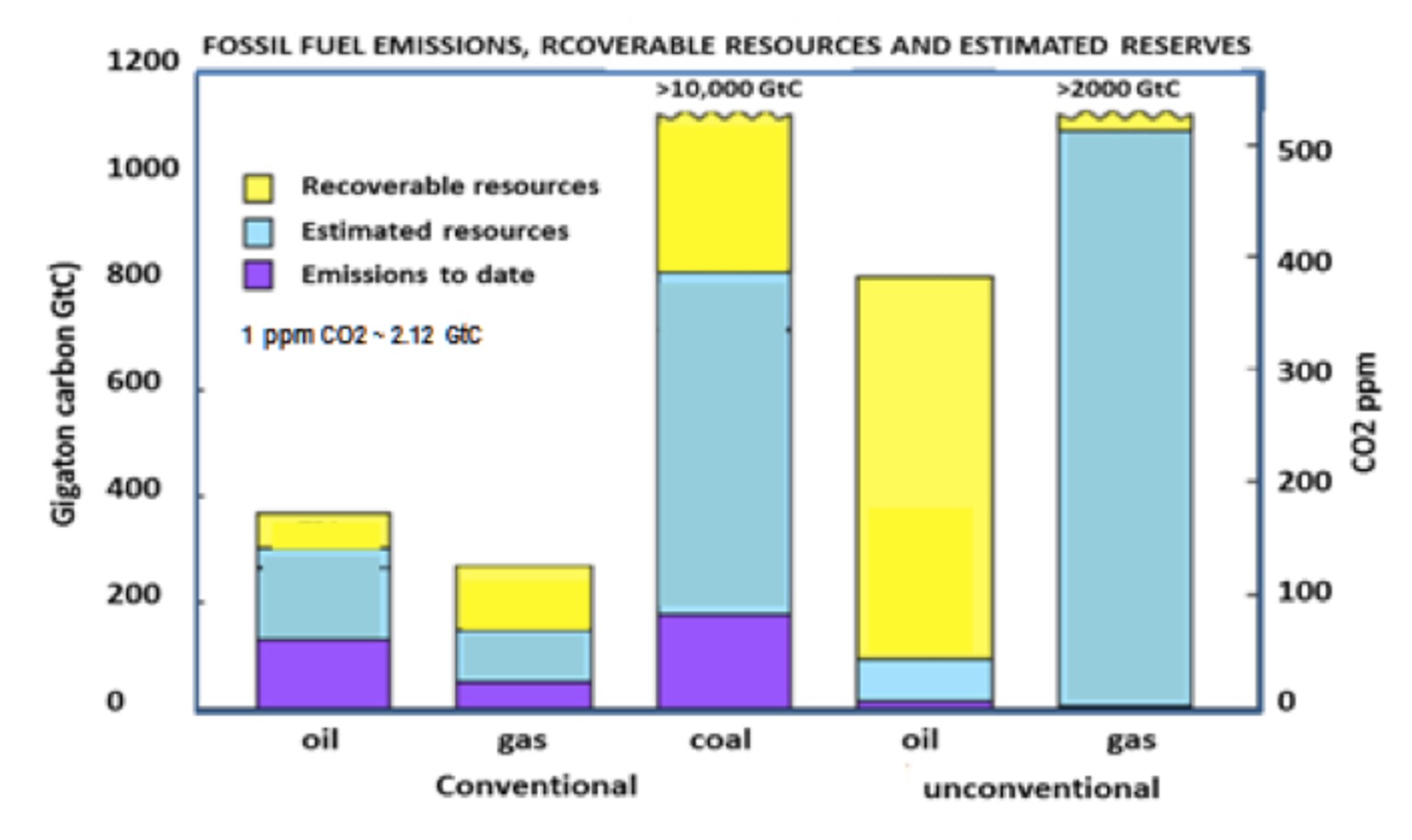
How much carbon we could dig up if we really wanted to (source; after Hansen, Fig 2). Left scale, in billions of tons of emitted carbon. Right scale, in ppm of atmospheric CO2.

by Gaius Publius

I once had the opportunity to speak one-on-one with one of our leading progressive politicians, someone who is on the right side of everything I care about, including climate change. As we were discussing solutions to the climate problem, I mentioned the carbon industry and said, "You realize, fixing the climate crisis means we have to kill the carbon industry, right?"

She (or he) stopped, thought, then said (paraphrasing): "Huh. You know, I think you're right."

Why do I bring this up? Because this person, who's right about everything I want her (or him) to be right about, hadn't thought through the climate problem to the obvious solution. If you don't want it burned, you can't dig it up. That means, we have to kill the industry. There's just no other choice.

The problem we seem to be facing is this: The industry gets that, and they're fighting back. But most people who care about climate don't. So we're stuck, year after year, with more of this:

If they dig it, they will burn it.

This has to stop, right?

Do We Really Have to Impoverish the Whole Industry?

Yes. If we don't make them poor — or make them switch to a completely different business — they'll make us extinct, or at least hunter-gatherers again, with only the odd pocket of "civilized" (agricultural, settled) humans in the odd, eco-friendly location left to show for everything we've done with our time on earth.

Future atmospheric temperatures look something like this if we we don't stop burning carbon:

CO2 concentration since the Cambrian, about 450 million years ago. The dotted line at 400 ppm shows CO2 concentration today (source).

Atmospheric temperature tracks pretty closely with atmospheric CO2 concentration, among other factors (this is temperature over the same period). The blue line near the middle of the chart above and also toward the right shows atmospheric CO2 in parts per million (ppm) prior to the Industrial Revolution. For most of the time humanoids have inhabited the earth, CO2 concentrations have been near 280 ppm. Thanks to the Industrial Revolution, we've brought that number up to 400 ppm, which is where we are today (this year in fact).

As to the future, the tallest red line on the far right shows CO2 concentration under the IPCC definition of a "business as usual" (BAU) scenario ... almost 2000 ppm ... by 2100.

(By the way, if you find 34 million years ago on the chart — look at the top in the second panel — you'll see the point at which polar ice first started forming. Think about that.)

To double-check those numbers, this recent paper by James Hansen (Figure 2, repeated above in simpler form) calculates that burning all "unconventional" oil in the ground, such as tar sands, would add about 300 ppm CO2 to the current number. Burning all unconventional (frackable) gas now in the ground would add another 900 ppm CO2. Burning all available coal would add about five times as much, or 4500 ppm CO2.

Obviously, we're never going to get to those high numbers; we'll have devolved to pre-industrial humans by then. We clearly don't want to go there, but you have to ask: If we keep allowing the carbon extraction (fossil fuel) industry to be profitable, when will we stop burning carbon?

At some point — and a sooner one rather than a later one — that industry will have to die or be killed, most likely by government force, if global warming is going to be arrested at all.

The Problem Is to Constrain Production, Not Consumption

George Monbiot, writing in The Guardian, has it just right. Solving the problem by constraining consumption of fossil fuel is not going to solve the problem at all. Everything extracted will be sold and used.

Monbiot starts by noting all of the pictures of cheering men and women after each of the climate conferences of the last 20 years (my emphasis):
If you visit the website of the UN body that oversees the world’s climate negotiations, you will find dozens of pictures, taken across 20 years, of people clapping. These photos should be of interest to anthropologists and psychologists. For they show hundreds of intelligent, educated, well-paid and elegantly-dressed people wasting their lives.

The celebratory nature of the images testifies to the world of make-believe these people inhabit. They are surrounded by objectives, principles, commitments, instruments and protocols, which create a reassuring phantasm of progress while the ship on which they travel slowly founders. Leafing through these photos, I imagine I can almost hear what the delegates are saying through their expensive dentistry. “Darling you’ve re-arranged the deckchairs beautifully. It’s a breakthrough! We’ll have to invent a mechanism for holding them in place, as the deck has developed a bit of a tilt, but we’ll do that at the next conference.”
Then he adds:
This process is futile because they have addressed the problem only from one end, and it happens to be the wrong end. They have sought to prevent climate breakdown by limiting the amount of greenhouse gases that are released; in other words, by constraining the consumption of fossil fuels. But, throughout the 23 years since the world’s governments decided to begin this process, the delegates have uttered not one coherent word about constraining production.

Compare this to any other treaty-making process. Imagine, for example, that the Biological Weapons Convention made no attempt to restrain the production or possession of weaponised smallpox and anthrax, but only to prohibit their use. How effective do you reckon it would be? (You don’t have to guess: look at the US gun laws, which prohibit the lethal use of guns but not their sale and carriage. You can see the results on the news every week.) Imagine trying to protect elephants and rhinos only by banning the purchase of their tusks and horns, without limiting killing, export or sale. Imagine trying to bring slavery to an end not by stopping the transatlantic trade, but by seeking only to discourage people from buying slaves once they had arrived in the Americas. If you want to discourage a harmful trade, you must address it at both ends: production and consumption. Of the two, production is the most important.
To repeat just one of his comparisons: "Imagine trying to bring slavery to an end not by stopping the transatlantic trade, but by seeking only to discourage people from buying slaves once they had arrived in the Americas."

You may not want to solve the climate crisis; or you may not want to believe there is one. But the greenhouse effect is a hard fact of science. (You can test it. Build a greenhouse, then sit in it on a sunny day.) If you think there is one, and you don't want to face the need to kill the carbon industry, you may as well just spend time playing with your children, or creating them.

The Silence Surrounding the Need to Kill Carbon Production

Monbiot gets that naming the problem is difficult. It's difficult for us, and also for the U.N. negotiators attempting to deal with it:
The extraction of fossil fuels is a hard fact. The rules governments have developed to prevent their use are weak, inconsistent and negotiable. In other words, when coal, oil and gas are produced, they will be used. Continued production will overwhelm attempts to restrict consumption. Even if efforts to restrict consumption temporarily succeed, they are likely to be self-defeating. A reduction in demand when supply is unconstrained lowers the price, favouring carbon-intensive industry.

You can search through the UN’s website for any recognition of this issue, but you would be wasting your time. In its gushing catalogue of self-congratulation, at Kyoto, Doha, Bali, Copenhagen, Cancún, Durban, Lima and all stops en route, the phrase “fossil fuel” does not occur once. Nor do the words coal or oil. ...

The closest any of the 20 international conferences convened so far have come to acknowledging the problem is in the resolution adopted in Lima in December last year. It pledged “cooperation” in “the phasing down of high-carbon investments and fossil fuel subsidies”, but proposed no budget, timetable or any instrument or mechanism required to make it happen.
Then he cautions:
You cannot solve a problem without naming it. The absence of official recognition of the role of fossil fuel production in causing climate change – blitheringly obvious as it is – permits governments to pursue directly contradictory policies. While almost all governments claim to support the aim of preventing more than 2C of global warming, they also seek to “maximise economic recovery” of their fossil fuel reserves. (Then they cross their fingers, walk three times widdershins around the office and pray that no one burns it.)
Is prayer the answer? Possibly, but I recommend combining it with action of our own.

The Answer Is You and Me

I still contend that this problem isn't insurmountable if enough people are determined to stop it. Nor is it too late to avoid the very worst of the consequences. If we stopped burning fossil fuel today, dead-stopped in 2015, atmospheric CO2 concentration would return to 350 ppm by 2100 (same Hansen paper, Figure 4b). That would very likely allow us to avoid completely the worst of the tipping points, like loss of polar ice.

The good news is, we can cause this good thing to happen. We just have to be willing to, as in my playful "Easter Island" metaphor:
You're a villager on Easter Island. People are cutting down trees right and left, and many are getting worried. At some point, the number of worried villagers reaches critical mass, and they go as a group to the island chief and say, "Look, we have to stop cutting trees, like now."

The chief, who's also CEO of a wood products company, checks his bottom line and orders the cutting to continue.

Do the villagers walk away? Or do they depose the chief?
There's always a choice. We just have to choose it.

GP

Labels: , ,

Monday, June 01, 2015

We Have Passed the Tipping Point for Extreme Weather

>

Passing a "tipping point." It isn't over, yet. But it is.

by Gaius Publius

The concept of "tipping point" — a change beyond which there's no turning back — comes up a lot in climate discussions. An obvious tipping point involves polar ice. If the earth keeps warming — both in the atmosphere and in the ocean — at some point a full and permanent melt of Arctic and Antarctic ice is inevitable. Permanent ice first started forming in the Antarctic about 35 million years ago, thanks to global cooling which crossed a tipping point for ice formation. That's not very long ago. During the 200 million years before that, the earth was too warm for permanent ice to form, at least as far as we know.

We're now going the other direction, rewarming the earth, and permanent ice is increasingly disappearing, as you'd expect. At some point, permanent ice will be gone. At some point before that, its loss will be inevitable. Like the passengers in the car above, its end may not have come — yet — but there's no turning back.

There are many tipping points associated with our current change in climate, our overall warming of the planet. For example, I think the American Southwest is beyond a tipping point for available fresh water. I've written several times — for example, here — that California and the Southwest have passed "peak water," that the most water available to the region is what's available now. We can mitigate the severity of decline in supply (i.e., arrest the decline at a less-bad place by arresting its cause), and we can adapt to whatever consequences can't be mitigated.

But we can no longer go back to plentiful fresh water from the Colorado River watershed. That day is gone, and in fact, I suspect most in the region know it, even though it's not yet reflected in real estate prices.

Extreme Weather Has Its Own Tipping Point

We're also noticing this spring a wave of especially extreme weather throughout the country, and indeed the world. This is from Texas, land of freedom (from use of the phrase "climate change"):
Another two bodies found in Texas after extreme weather

... [A]uthorities in Central Texas have recovered the body of a second woman killed in flash flooding last weekend along the Blanco River.

Hays County officials say a search team recovered the body Saturday afternoon near the river in the Wimberley area.

It was the second body recovered Saturday along the river. Earlier in the day, a search team recovered a woman's body along the river about midway between Wimberley and San Marcos.

The discovery brings to eight the number of people confirmed as killed in the flood and 27 killed in last weekend's storms statewide. Eleven people remain missing.

At least 31 people have died in Texas and Oklahoma since the storms began last weekend. [emphasis mine]
And from around the world (emphasis mine):
May has been a month of extreme weather around the world

Even for a world getting used to wild weather, May seems stuck on strange.

Torrential downpours in Texas that have whiplashed the region from drought to flooding. A heat wave that has killed more than 1,800 people in India. Record 91-degree readings in Alaska, of all places. A pair of top-of-the-scale typhoons in the Northwest Pacific. And a drought taking hold in the East.

"Mother Nature keeps throwing us crazy stuff," Rutgers University climate scientist Jennifer Francis says. "It's just been one thing after another."

Jerry Meehl, an extreme-weather expert at the National Center for Atmospheric Research, points out that May is usually a pretty extreme month, with lots of tornadoes and downpours. Even so, he says, this has been "kind of unusually intense."
So drought has an arc — either back and forth or marching toward an extreme — and so does the occurrence of extreme weather. Especially severe storms come and go, or they just keep coming. And just as drought can have a tipping point, beyond which you can't go back, so can the incidence of extreme weather. At some point, crazy weather becomes the "new normal," or worse, the "new normal" just keeps getting worse.

Has Extreme Weather Passed a Tipping Point?

There's no way to tie any one storm to global warming or climate change. In the same way, there's no way to tie any one lung cancer death to smoking. But over a broad population of smokers, when smokers are dropping like autumn leaves, each of them laced with throat and respiratory cancer, each of them puffing like the Marlboro Man as they fall (several of whom have also dropped like leaves), odds are there's a cause that can be named. Odds are it's already known, looking you straight in the face. Odds are not smoking will change the odds.

The art of analyzing those odds and seeing if they're indeed significant is also known, a statistical process called "event distribution" (think "bell-shaped curve" — how many events fall in the middle and how many at the ends) — measured in units called "standard deviations" or "sigmas" away from the center. As carbon emissions have increased over time, our climate has moved out of its normal distribution, toward more extremes.

For example, if before a nuclear facility was built, a certain town had a certain incidence of cancer linked to radiation (called a baseline incidence), then afterward it had an increased incidence which itself increased over time, you'd suspect radiation from the facility was the cause. Why? Because the kinds of cancer you're tracking are already associated with radiation.

We know that change in heat in the atmosphere changes the weather; that's not in dispute. The difference in temperature between warm fronts and cold fronts, for example, is an indicator of the strength of a storm — smaller temperature differences bring weaker storms; greater temperature differences bring stronger, more violent storms. There are many relationships like these in meteorology.

Atmospheric heat is rising; that's a known. Are storm strength and other indicators of more extreme weather also rising? If so, to what degree?

Those are two questions many are asking. But there's a third question few are asking — Are we so far beyond the "normal" that we'll never go back? In other words, have we crossed a tipping point for extreme weather? The authors of the following video have looked at distributions over time of extreme weather from the 1951–1980 baseline onward and have an answer.

Sadly, the answer is "yes." In every decade since 1980:
  • The midpoint has moved toward more extreme weather.
     
  • The move toward more extreme weather has not paused from decade to decade.
     
  • And worst of all, the odds of a "6 sigma" (very very extreme) event have greatly increased. Events that would almost literally never have occurred, where the odds were one in over 500 million, are now starting to appear as possibilities under the "new normal" bell-shaped curve.
As the writer above said, weather is "stuck on strange." Have we crossed a tipping point for weather? In a word, yes. All of this is nicely explained in the short video below. Please watch:


Note that the underlying scientific work is a paper by James Hansen and his colleagues, a draft follow-on to this published paper, "The New Climate Dice: Public Perception of Climate Change." Hansen, formerly of NASA, is one of the most prominent scientists in this field; in fact, he's America's original prominent climate scientist.

A Final Word

This is "a" tipping point, not "the" tipping point. We have slid into a "new normal" for weather, but please note:
  • We're talking only about the weather, not a host of other effects, like extreme sea level rise. I don't think we've passed that tipping point yet.
     
  • We can stop this process whenever we want to — or rather, we can force the "carbon bosses" and their minions in government to stop whenever we want to stop them. They have only the power we collectively allow them to have.
It really is up to us, and it really is not too late in any absolute sense. For my playfully named (but effective) "Easter Island solution," see here. For a look at one sure way out, see here.

GP

Labels: , ,

Tuesday, June 03, 2008

If the Bush regimistas would just quit, admitting they've waged an 8-year war of lies and deceit, we wouldn't have to prove all the lies one by one

>

Do we really have to keep proving, agency by agency, inspector general by inspector general, congressional inquiry by congressional inquiry, how the Bush regime turned the entire federal government into a vast right-wing propaganda machine for its catastrophic extreme ideological agenda?

"The significance of [Scott] McClellan's book is that his detailed recounting of what he saw from the inside vindicates pretty much all the central pillars of the Bush critique that have been chronicled here and elsewhere for many years now."
--Dan Froomkin, in his washingtonpost.com column yesterday,
"Vindication for the Bush Critique"


It isn't even front-page news anymore when the Bush regime is caught in another web of lies and deceit. On page A2 of today's Washington Post:

Climate Findings Were Distorted, Probe Finds
Appointees in NASA Press Office Blamed
By Juliet Eilperin
Washington Post Staff Writer

An investigation by the NASA inspector general found that political appointees in the space agency's public affairs office worked to control and distort public accounts of its researchers' findings about climate change for at least two years, the inspector general's office said yesterday.

The probe came at the request of 14 senators after The Washington Post and other news outlets reported in 2006 that Bush administration officials had monitored and impeded communications between NASA climate scientists and reporters.

James E. Hansen, who directs NASA's Goddard Institute for Space Studies and has campaigned publicly for more stringent limits on greenhouse gases that contribute to global warming, told The Post and the New York Times in September 2006 that he had been censored by NASA press officers, and several other agency climate scientists reported similar experiences. NASA and the National Oceanic and Atmospheric Administration are two of the government's lead agencies on climate change issues.

From the fall of 2004 through 2006, the report said, NASA's public affairs office "managed the topic of climate change in a manner that reduced, marginalized, or mischaracterized climate change science made available to the general public." It noted elsewhere that "news releases in the areas of climate change suffered from inaccuracy, factual insufficiency, and scientific dilution."

Officials of the Office of Public Affairs told investigators that they regulated communication by NASA scientists for technical rather than political reasons, but the report found "by a preponderance of the evidence, that the claims of inappropriate political interference made by the climate change scientists and career public affairs officers were more persuasive than the arguments of the senior public affairs officials that their actions were due to the volume and poor quality of the draft news releases."

And so on and so on.

In public, Chimpy the Prez would say that we need "more study" of the climate-change issue. In private, the storm troopers of the regime were using every available resource to stifle all those inconvenient truths.

I've been saying since the revelations from poor Scotty McClellan's book broke that we weren't likely to gain much knowledge, since all we were likely to get was insider confirmation of what we've already managed to find out. And as much as I normally esteem the judgment of washingtonpost.com's Dan Froomkin, I didn't even bother to read his above-referenced column yesterday. The point -- "vindication of the Bush critique" -- seemed so obvious as to be hardly worth belaboring.

Note that the story of NASA's wholesale rigging of its scientists' research findings isn't new. As the story indicates, it was all aired pretty thoroughly back in 2006 -- and even then, was anyone really surprised? For years now, we've been hearing the same story, agency by agency, about how the managers of the Bush regime distorted or even shut down the agency's rightful functions to turn it into yet another tentacle of the propaganda machine. All that's new is the IG report (at least something about NASA's role in the climate-change issue finally got studied

But maybe I'm wrong. Maybe in fact we need more of these reports, or something to show the American people that the dissatisfaction they're registering in Chimpy the Prez's ghastly poll numbers isn't based on stuff just happening. Their onetime hero didn't just make a bum decision or two along the way, with unfortunate consequences. The regime to which so many Americans for so long showed such unshakable loyalty was always a festering fraud. It was always a hotbed of ideological hooliganism, in cahoots with corrupt corporate profiteers, advancing an extreme right-wing agenda through a combination of secret stealth and public propaganda, including blatant lying.

The job of rebuilding a trustworthy federal government is so enormous, so overwhelming, and it has to be done at the same time as so many ongoing crises have to be managed, that I don't see how we can have much hope of success unless the country faces up to the dimension of the challenge. How can we hope to make progress with the mess in Iraq, for example, as long as anyone takes seriously anything said by anyone involved in the regime's all-deception-all-the-time policies there?

I think back to events as recent as the 2004 presidential campaign, when most of the groundwork was laid for the regime's spectacular fall from public grace, but there were still few visible signs of what was to come. Back then anyone who spoke ill of Chimpy the Prez was still dismissed, even by the so-called mainstream media, as a "Bush-basher." Back then supposedly respectable media types were still insisting that no proof existed that Chimpy had ever "lied" -- the magical "L" word.

I'm not really angling for an apology, though I wouldn't mind one from the hordes of dimwits who jeered at every attempt to penetrate the nation-choking jungle of Bush propaganda as "Bush bashing." But what would be nice would be an acknolwedgment that anyone who wasn't "Bush-bashing" was at very best deluded.

So maybe we do need more independent verification of the truths we've known for years about the Bush regime's commitment to untruth. And in that spirit I've gone back to what Dan Froomkin had to say yesterday. Here's the start:

Vindication for the Bush Critique

By Dan Froomkin
Special to washingtonpost.com

As the response to former White House press secretary Scott McClellan's new book enters its second week, the focus has shifted to the messenger rather than his message.

McClellan is a flawed vessel for any serious communication. From behind the podium, he made a mockery of the press and the public's right to know, most notably by repeating non-responsive and sometimes ludicrous talking points. He has yet to persuasively explain his change of heart. And his insistence that self-deception rather than a conscious disregard for the truth was behind what he now describes as the White House's consistent lack of candor is spectacularly self-serving.

But the significance of McClellan's book is that his detailed recounting of what he saw from the inside vindicates pretty much all the central pillars of the Bush critique that have been chronicled here and elsewhere for many years now. Among them:

* That Bush and his top aides manipulated the country into embarking upon an unnecessary war on false pretenses;

* That Bush is an incurious man, happily protected from dissenting views inside the White House's bubble of self-delusion;

* That Karl Rove's huge influence on the Bush White House erased any distinction between policy and politics, so governing became about achieving partisan goals, not the common good;

* That Vice President Cheney manipulates the levers of power;

* That all those people who denied White House involvement in the leak of CIA agent Valerie Plame's identity were either lying or had been lied to;

* That the mainstream media were complicit enablers of the Bush White House and that its members didn't understand how badly they were being played.

By coming back again and again to the CIA leak story, McClellan also validates a key theme of the Bush critique: That the Plame case was a microcosm of much that was wrong with the way the Bush White House did business.

This is no way to run a country, and it's one of those routine cliches to say that America deserves better. But maybe America doesn't deserve better. At least not as long as we don't own up to the real-world consequences of what we do.
#

Labels: , , , ,