Saturday, December 02, 2017

Trump And Ryan Scam America

>


“It’s not aimed at growth. It is not aimed at the middle class. It is at every turn carefully engineered to deliver a kiss to the donor class.”
-Edward Kleinbard, formerly of the Congressional Joint Committee on Taxation
Ted Lieu's chief of staff, Marc Cevasco, wrote, as the Republicans were passing Trump's Tax Scam, "Well at least teachers can now write off private jets!" The Tax Scam is a gigantic and blatant ripoff of the working and middle class, an exercise of use the power gained through a fraudulent election to give billionaires money ripped out of the pockets of the working poor, students, and other among the most needy Americans, in an attempt to transfer the country's wealth upward to the donor class. And Trump himself would win big. Yesterday, Greg Sargent explained how Trump's betrayal of his base runs much deeper than just that. Señor Trumpanzee, he wrote, has been "amplifying one of his biggest lies: that he, personally, would lose out bigly under the plan. Post fact-checker Glenn Kessler has a new piece blowing up this falsehood. As Kessler shows, it’s likely that Trump and his family will save tens of millions of dollars, and quite possibly a lot more."


But this provides an occasion to reconsider just how much of a betrayal of Trump’s campaign promises this plan truly embodies, in a sense that goes well beyond his bottom line. That betrayal does not merely consist in Trump reversing course on his promise to help the middle class while sticking it to elites. No, the betrayal is more complicated, and runs much deeper, than that.

During the campaign, Trump told a story, mainly aimed at working-class whites in places that have gotten pulverized amid the globalizing economy and the brutal aftermath of a financial crash caused by reckless elite financial gamesmanship that left the top 1 percent relatively unscathed. That story went like this: I’m not like other politicians (Republicans included) or like other members of that financial elite. They have conspired with one another to fleece you blind. I got filthy rich milking the system. I will put my knowledge of how we elites engorged ourselves to work for you.

This is what Trump meant when he openly admitted during the campaign that “I fight very hard to pay as little tax as possible,” when he said that not paying income taxes “makes me smart,” and when he flatly declared that big donors “are in total control” of the presidential candidates, his GOP rivals included. “I was on the other side all my life and I’ve always made large contributions,” Trump said, “and I’m the only one up here that’s going to be able to fix that system.” In other words, people like me have gotten rich by buying the politicians and getting them to rig the system in our favor, and I have the inside knowledge of the scam to put things right.

Now Trump and the politicians, working together, are set to pass a tax plan that will lavish enormous benefits on people like Trump-- and in key ways further rigs the system on their behalf.

In a big speech [Thursday; see video up top] about the plan, Trump declared that “this is going to cost me a fortune” and added: “I have some very wealthy friends” who are “not so happy with me.” But as Kessler’s fact-check shows, this is nonsense. Both GOP plans repeal the estate tax or make the exemption vastly larger (which would benefit Trump’s family after he shuffles off to account for his life to his maker). They repeal the Alternative Minimum Tax, which is designed to ensure that the rich pay at least something. They both give preferential treatment to “pass-through” income, the vast bulk of which goes to the top 1 percent, and Trump owns an untold number of pass-throughs.

We don’t know precisely how the final plan would apply to him now, but this is because Trump has not released his tax returns (his argument is basically, “I’ll lose out bigly, believe me”). But based on 2005 Trump tax returns that have leaked, Kessler shows, under the plan Trump would have saved anywhere from $35 million to $42 million that year.

But this is not just about Trump. The Senate tax plan is basically a huge permanent corporate tax cut, tailored to fit within deficit and procedural constraints by setting the benefits for the working and middle class to expire, making it possible to pass entirely on party lines a large permanent tax cut overwhelmingly benefiting the top 1 percent, facilitated by a tax hike later for as many as 50 percent of less-fortunate taxpayers. This sort of legislative chicanery is, at bottom, just what Trump decried-- very wealthy donors benefiting from politicians cleverly gaming the system on their behalf. It’s the very scam Trump vowed to put to an end.

Meanwhile, Sen. Ron Johnson (R-Wis.) is demanding even more generous treatment of pass-through income. But as one tax analyst explains, this may encourage more wealthy people-- who are more prone to having the resources and know-how to work the tax system-- to reclassify their income as pass-through and lower their tax burden further. Both bills are meant to have safeguards against such gaming. But as Dylan Matthews points out, good lawyers are already hatching ways around this, meaning these new tax breaks “will create a big new loophole for the rich.” In other words, still more system-rigging.

In a sense, then, Trump’s claim that he-- and people like him-- will personally take a financial beating from this plan represents the culmination of the false story he made absolutely central to his campaign, and serves as a reminder of just how massive a betrayal of that story he and Republicans are now set to pull off.

This helps explain why crooked Treasury Secretary Steven Mnuchin consistently lied his ass off about the "hundreds" of economists "working around the clock" to provide Congress (and voters) with an analysis of the wonders of the Tx Scam, proving beyond doubt it would pay for itself with explosive growth. It doesn't exists and the NY Times reported that an economist at the Office of Tax Analysis, on the condition of anonymity, said Treasury had no “dynamic” analysis showing that the tax plan would be paid for with economic growth because one wasn't even asked for.

Also at The Times James Stewart reported that Trump is flat out lying when he claims the tax bill doesn't benefit him personally. There are parts of the bill that "seem almost tailor-made," wrote Stewart, "to enrich the president and people like him."
“Commercial real estate came out essentially unscathed,” said Douglas Holtz-Eakin, president of the American Action Forum, a conservative advocacy group. Real estate developers “didn’t lose anything they care about,” and they got even more breaks, like a shorter depreciation schedule in the Senate tax bill, Mr. Holtz-Eakin pointed out.

...“Lower pass-through rates and the repeal of the alternative minimum tax — those two alone are so hugely beneficial to Trump that I have trouble imagining any way that he wouldn’t come out ahead,” said Steve Wamhoff, senior fellow for federal tax policy at the nonpartisan Institute on Taxation and Economic Policy. (The pass-through reference involves income that typically comes from partnerships and limited liability companies.)

Not only that, but rental income, royalty payments and licensing fees-- some of the president’s major sources of income-- get especially favorable treatment under new rates for pass-through income. (Mr. Trump’s assets include more than 500 pass-through partnerships and limited liability companies.)

“Trump will make out like a bandit on all the big items,” said Steven M. Rosenthal, a senior fellow at the nonpartisan Tax Policy Center.

As many people have pointed out, the “wealthy and well connected,” as Mr. Trump described them, will benefit disproportionately from the proposed legislation. That’s in large part because the big tax cuts for corporations heavily favor shareholders, and the wealthy own a disproportionate amount of stocks and other assets.

...[T]he additional breaks that would benefit Mr. Trump and a small cadre of real estate developers like him stand out.

Consider one of the most criticized loopholes in the current tax code: the exemption from taxation of so-called like-kind exchanges. That has enabled owners of property to sell at a large capital gain but defer any tax as long as they use the proceeds to buy some other property.

The House and Senate bills eliminate the favored treatment of like-kind exchanges-- except for “real property.” Owners of paintings, for example, would not be able to sell a Cezanne and buy a Van Gogh tax-free. But owners of commercial real estate could keep flipping the properties until they die without ever paying any capital gains tax. (And if the estate tax is abolished, the gains might go untaxed forever.)

One of the biggest reforms in the tax legislation would limit the ability of businesses to deduct interest payments from their taxable income while giving them the ability to expense capital improvements (rather than depreciate them). Commercial real estate interests had howled over this provision, because they rely so heavily on debt to finance their operations.

As is the case with properties owned by most developers, Mr. Trump’s properties appear to be highly leveraged. While he has not disclosed his exact borrowings, he has called himself the “king of debt” and a New York Times investigation found that his companies had borrowed at least $650 million. Other estimates have gone above $1 billion. And, in another windfall for people like Mr. Trump, both the House and Senate bills exempt “any real property trade or business” from the limitation on deducting business interest.

The list goes on. In both the House and Senate legislation, only certain kinds of income are eligible for the lower pass-through rates. Short-term capital gains, dividends, interest and annuity payments do not qualify.

But rent, royalties and licensing fees-- all similar in character to the disallowed income-- weren’t included in that list, Mr. Rosenthal pointed out. All remain eligible for the lower pass-through rate.

“I call them the Donald J. Trump exceptions,” since the president receives so much income from those sources, Mr. Rosenthal said. “Trump will get a huge windfall on his rental, license and royalty income,” he predicted.

...One of the biggest benefits for the president, and for other wealthy taxpayers with high deductions, is the proposed repeal of the alternative minimum tax. Thanks to Mr. Trump’s leaked 2005 tax return, we know that the only reason he paid federal tax of 24 percent of his taxable income that year was because of the alternative minimum tax. (Without it, he would have paid just 4 percent.)

The rationale for eliminating the alternative minimum tax is that such a backup system should not be necessary if the tax code is fundamentally fair and eliminates all the loopholes that made it possible for high-income taxpayers to escape taxation in the first place. As should be obvious by now, this legislation expands such loopholes.

“It’s surprising to me that no real attempt was made to close any of these loopholes,” said Mr. Wamhoff, given that “virtually every nonpartisan tax expert agrees that commercial real estate is already so favored by the tax code.” Even Democrats, for the most part, have remained silent.

Perhaps it shouldn’t be so surprising, given that the president is the real-estate-investor-in-chief, and that his personal interests align with one of the country’s most powerful lobbies.

“Real estate interests are very powerful when it comes to the tax laws,” Mr. Holtz-Eakin said. “They’ve got bipartisan support, and it’s been that way forever.”
Jared Golden, the progressive running in Maine's second congressional district-- the seat held by Trump rubber stamp Bruce Poliquin-- has been a strong economic populist in the Maine House. Yesterday, while the Republicans were arguing about their Tax Scam catastrophe, he pointed out that "rising income inequity is straining life for working people all over the county. In my state, between 2012 and 2015, statewide, around 31% of real household income growth went to the wealthiest 5% of Maine households. For comparison, the poorest 25% saw just a 0.2% total income growth. [1] The effect of this is immense-- workers give up hope of getting ahead and exit the labor force, children live in poverty-- in my district over 21% of children below age 18 are living below the poverty level. And [2] What sort of a world are we leaving for our children and grandchildren when a small number of people earn more and more-- getting tax breaks and sweetheart deals, while children go hungry in the richest county in the world? The idea of the American Dream-- that you can get ahead with hard work-- is becoming more and more a work of fiction."


Labels: , , ,

Tuesday, September 24, 2013

Which Republican Fed The Oppo Research On Right Wing Extremist Ted Cruz To Fox News' Chris Wallace?

>


Karl Rove was on Fox News Sunday this week when Chris Wallace announced that "as soon as we listed Ted Cruz as our featured guest this week, I got unsolicited research and questions, not from Democrats but from top Republicans, to hammer Cruz." Accusations started flying across the wingnut blogosphere. McConnell, panic-striken, immediately denied that it was him or any of this staffers trying to undermine Cruz. Palin, sensing an opportunity for some attention, jumped into the fray, demanding, via Twitter, Wallace release the names of the guilty Republicans. The Tweet, which she has deleted from her account, scared Fox might cut off her checks and take away her platform:


Other right-wing sources blamed Rove and some pointed to McCain. Wallace refuses to say who he was referring to, although disdain and even hatred for Cruz among Republican careerists who fear losing their jobs if they follow (or don't follow) him over the extremist cliff, is rampant and growing. The Cruz profile in the new GQ isn't going to do anything to dampen down the intra-party feuding.
For a while, veteran Republicans groused in private about the new guy. But it boiled over when Cruz joined Kentucky senator Rand Paul's filibuster of John Brennan's nomination to head the CIA—an act of protest against Obama's drone program. John McCain, already seething over Cruz's treatment of Hagel, called them "wacko birds." "He fucking hates Cruz," one adviser of the Arizona senator told me. "He's just offended by his style."

The "wacko bird" dig, however, has only endeared Cruz more to his party's purist wing. Already his fans are nudging him to think about a presidential run in 2016, and he's nudging right back, making trips to Iowa, New Hampshire, and South Carolina. He's even embraced "wacko bird," reclaiming McCain's knock as a badge of honor. Later on the day I visited him on Capitol Hill, Cruz was engaging in the kind of showing off that even his detractors might forgive: He was giving me a tour of his Senate office. "A couple of things I keep," he said, picking up a red leather rectangle branded with the words IT CAN BE DONE-- a replica, he explained, of the sign that sat on President Reagan's desk in the Oval Office. The tchotchke he was most excited to show me, however, was a black baseball cap with a picture of Daffy Duck next to the words WACKO BIRD. Supporters back in Texas made it, Cruz said, grabbing the hat from its prominent perch on his bookshelf. "Isn't it great?"


..."I cannot tell you," Cruz says now, "how many little old ladies clasped my shoulder and said, 'Ted, please don't go to Washington and become one of them.'"

The little old ladies of Texas ought to be doing cartwheels. Instead of becoming one of them, Cruz has scorched almost all of them. He's reserved his most scathing criticism for his fellow Senate Republicans-- branding those who've had the temerity to stake out not-far-right-enough positions as "squishes" and the "surrender caucus." I asked one of Cruz's colleagues, Iowa Republican Chuck Grassley, if he could recall a freshman behaving as brashly as Cruz. Grassley has been in the Senate for thirty-three years. He was stumped. "Not somebody I've served with," he said finally. "I think Barry Goldwater-- reading the history of Barry Goldwater, he made those sorts of impressions right away."

It's unclear exactly how many wacko birds are in the Senate right at this moment, but by Cruz's count there are at least three-- Rand Paul, Lee, and himself. And three, he says, is a lot. "I do think the impact of a handful of principled leaders who are fearless in the Senate is significant, and I think it's significant even going from two to three. If you have three, you pretty quickly get to five or six. Five or six is over 10 percent of the Republican conference, and that's enough to move a conference and move the Senate."

...Some Republicans are so spooked about drawing a conservative primary challenger in next year's midterms-- or, as it's now called in Texas circles, "being Ted Cruzed"-- that they've moved even farther to the right, paralyzing the Senate's GOP leadership. Exhibit A: John Cornyn, Cruz's fellow senator from Texas. "He has Cornyn just frozen on everything," one senior Senate Republican aide grumbled to me. "A member of our leadership just kind of takes his marching orders from this guy who's been here for a day!"

  That may be a problem for Republicans, but not necessarily for Cruz. "We're in a moment when the combination of being hard-core and intelligent is really at a premium," says National Review writer Ramesh Ponnuru, who's been friends with Cruz since they went to Princeton together. "Because the two things that conservatives are tired of are politicians who sell out and politicians who embarrass them by not being able to make an account of themselves." In this arithmetic, Mitt Romney is the sellout and Sarah Palin is the embarrassment-- and Cruz is the great new hope who brings the virtues of both without the liabilities of either. 
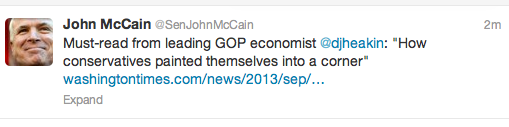
Cruz made it clear what he thinks of McCain as well. "I don't know a conservative who didn't feel embarrassed voting in 2006 or 2008. I think the Republican Party lost its way. We didn't stand for the principles we're supposed to believe in." Early Monday morning, McCain sent this tweet pimping a Douglas Holtz-Eakin article to his 1.8 million followers:


Holtz-Eakin was the top economic and health care policy advisor to McCain during his 2008 presidential run but many remember him for claiming that McCain invented the BlackBerry. Now he's the head of an obscure right-wing think tank. He can often be found articulating the incoherent stratagems of Beltway Establishment Conservatives:
The public budget debate has been hijacked by a vociferous minority of activist conservatives aligned with a number of outside activist groups led by the likes of Sen. Ted Cruz and former Sen. Jim DeMint.

Using a variety of political threats and purity tests, they have been demanding a vote on a bill to fund the government that includes "defunding Obamacare." Now that the House has passed the funding bill, they are getting their chance to prove that their strategy will work. Here's why it won't:

Resistance to the proposal had been based not on any love for President Obama's health care scheme, but on a balancing of the chances for success of this strategy against the risks inherent in presenting Mr. Obama and the Senate with an ultimatum that will cause neither to back down.

Let's look at what might happen. The House on Friday passed a bill that will keep the government funded through mid-December and would defund Obamacare. However, Senate Democratic Leader Harry Reid will amend it to strip out defunding, shorten the time period for which the government is funded, drop in a few progressive favorites, run the clock, and send it back to the House as close to the Sept. 30 deadline as possible. If so, at least Senate Democrats will be forced to vote for or against Obamacare. This, given public hostility to the plan, should cause some of them heartburn, thereby buying the same thing that would have been accomplished by House Speaker John A. Boehner's earlier proposal that was dismissed by these same folks as a mere "gimmick."

In fact, Mr. Cruz has already conceded this scenario is likely. After months of tweets, town halls and chest-thumping about the House needing to take the fight to the Senate, Mr. Cruz volunteered that Mr. Reid "likely has the votes" to "strip the defund language" just one day after the strategy was announced. Talk about irony when the leading senator yelling at the House to "fight" for three months concedes defeat on Day One of the ball being in his court.

This all-but-assured reality is unfortunate not only because it won't work, but also because the original House strategy would have.

Indeed, the speaker's proposal would have forced a "clean" vote on Obamacare that would have forced Democratic senators running next year to either embrace Obamacare or vote against the president's pet proposal. Instead, the outside groups' litmus tests would yield a strategy that allows Senate Democratic leaders to "muddy" the vote by including their preferred provisions.

Worse, once the bill is sent back, House Republicans will be forced to vote with their backs to the wall. They will either have to accept the Democratic counterproposal or be blamed for a government shutdown. The bottom line is that this approach could and may well allow the White House and Democratic Senate to control the endgame-- to the detriment of Republicans, but not the unaccountable outside activists.

Worse yet, the funding bill might fail, actually forcing a government shutdown. Most federal employees would be sent home, but "essential" personnel would be required to continue working. In particular, the exemption for cases of "emergency involving the safety of human life or the protection of property" means that the armed forces would remain on duty during a shutdown without pay. Our troops would remain in harm's way and their families will not have money for food, rent, clothing or schools simply because, as the president will argue, Republicans pursued a partisan political agenda. Not exactly a winning argument.

The same activists dismiss these concerns, arguing that voters will rally behind Republicans because the public does not support Obamacare. However, this is far from guaranteed, as Republicans should have learned in the 1990s.

A Pew poll taken in January 1996 showed that 62 percent of Americans thought a balanced budget was very important, and that if a balanced budget were to be achieved, 47 percent thought that Republicans in Congress deserved the credit versus 31 percent for President Clinton.

However, a November 1995 Gallup poll indicated that the majority of those polled thought the budget battle was about political advantage (52 percent) rather than principles (37 percent). Another poll by NBC taken during the second shutdown showed that only 17 percent thought the fight was about policy principles, compared with 76 percent thinking the fight was political.

The same dynamic will prevail today, only worse, because in the 1990s Congress had already funded the troops before the shutdown.

On top of all this, a shutdown won't defund Obamacare. Entitlement programs such as Obamacare are largely unaffected by the annual funding appropriations. The money goes out on autopilot. Even ongoing Obamacare implementation efforts pursued by agencies that would otherwise face defunding and furloughs are insulated during a shutdown.
A little bad news for Republicans hopping on the Cruz choo-choo train:
A solid majority of Americans oppose defunding the new health care law if it means shutting down the government and defaulting on debt... Opposition to defunding increases sharply when the issue of shutting down the government and defaulting is included. In that case, Americans oppose defunding 59 percent to 19 percent, with 18 percent of respondents unsure.

...[A] 54 percent majority of Republicans who also identify themselves as Tea Party supporters want the new health care law defunded even if it means a government shutdown-- the only demographic measured in the poll with such a majority.

Republicans who do not identify themselves as Tea Party supporters hold views closer to those of Democrats than to Republicans that do identify themselves as Tea Party supporters: They oppose defunding Obamacare 44 percent to 36 percent with 20 percent unsure.

Independents are more troubled by the prospect of defunding Obamacare and shutting down the government than the broader population. In general, they oppose defunding by a slight plurality of 44 percent to 40 percent. However, when the issue of shutting down the government is included, opposition to the measure swells to 65 percent, while support drops to just 14 percent.

Labels: , , , , ,

Wednesday, May 27, 2009

Republicans Trying To Figure Out How To Expand Their Collapsing Whites-Only Pup Tent

>


With the GOP continuing to fracture along ideological lines-- just today Mike Huckabee followed Jeb Bush, Jr in endorsing radical right insurgent Marco Rubio against the Republican Establishment's pick, Charlie Crist, in the race for the open US Senate seat-- Republicans are wondering how to persuade voters that the party is on the mend and not some hothouse dominated by right-wing extremists with contempt for mainstream sensibilities.

Republican Party propagandist Tucker Carlson, who became a Fox News consultant last week, thinks the way to turn things around for his floundering party is to start a right-wing version of the Huffington Post. He's calling it The DailyCaller and its purpose will be to make Fox and Hate Talk Radio seem almost mainstream in comparison to the incendiary, hysterical anti-Obama jihad that will be its hallmark. Doesn't sound likely to expand the tent? No one else thinks so either. And isn't David Frum already failing at his attempt to do the same thing?

This morning's CQPolitics reports on another initiative, this one by Republican Party operative Douglas Holtz-Eakin who wants to start another right-wing think tank. Right wing think tanks have been very successful, financially, for the folks that wind up being underwritten by them. Holtz-Eakin says his new one would be modeled on the progressive think tank Center For American Progress. His mission is to keep the base from shrinking any further, to appeal to more diverse groups, and to see if they can find anyone on the right who has any new ideas that might appeal to the mainstream.
“I think there is now pretty widespread recognition that the Republican Party needs to become demographically broader, more welcoming of different ideas,” said Holtz-Eakin, who ran the Congressional Budget Office from 2003 to 2005. “And it’s time to think strategically about how to appeal more broadly outside the South.”

...The irony, of course, is that the Center for American Progress itself was developed as a liberal answer to the Heritage Foundation, the conservative think tank that has been a source of Republican policy ideas for decades. But Holtz-Eakin says established think tanks of the right, like Heritage and the American Enterprise Institute, were “not helpful” during the McCain campaign because they weren’t politically engaged or innovative in their media strategies.

It sounds something like what Eric Cantor, Jeb Bush, Mitt Romney and a bunch of other tired old right-wing politicians tried to launch in a Virginia pizza parlor a few weeks ago, the so-called National Council for a New America. After Rush Limbaugh denounced it, it kind of ground to a halt and disappeared without a trace. But where Cantor and his clique was just regurgitating tired old right-wing talking points in a pizzeria, Holtz-Eakin wants to broaden the Republican message so that it will have some relevance to people who aren't members of whites-only country clubs. Ex-Congressman Tom Davis (R-VA) thinks its hopeless, at least for now, because the base is so far to the right and close to clinically insane, that it isn't open to anything short of domestic terrorism. “I think the grass roots right now is in an ornery mood-- ‘we are who we are.’” And no one wants to get anywhere near to who they are. "Ornery" isn't nearly as descriptive as "ugly."

Holtz-Eakin thinks the way to go is to "apply conservative principles in innovative fashion and develop solutions on issues that haven’t been a priority for Republicans." One of the darlings of his "movement" is clueless and over-hyped Wisconsin reactionary, Paul Ryan who came up with the Republican Party's "innovative and alternative" health care plan. Ryan's plans-- like Ryan's alternative budget of a few months ago-- have met with dersion and scorn from all sides.
The conservative TV pontiffs and their print counterparts, including The Wall Journal editorial page, are saying all hail the free market alternative to the Democrats government takeover of our uniquely American healthcare system. The Republicans are eager to admit that the current system is broken, but reform should not destroy it. After all, for those that can afford it or get unlimited care from the government or their employers, the care is the best in the world.

Republican Congressman Paul Ryan’s “Patients' Choice Act” is a thinly masked rehash of "McCain Healthcare: An Evil Play on Words." Both the Ryan and Senator McCain plans depend on the states, out of the goodness of their hearts, to provide “guaranteed access.” Neither plan actually forces private insurance companies to eliminate medical underwriting, nor provides for enforceable state high risk pools or for a government plan to insure the people a private insurer rejects.

Ryan’s “Patients' Choice Act Q&As” helps us dissect the illusion of guaranteed access. Guaranteed access was never intended to be confused with or imply guaranteed issue. First, consistent with McCain, Ryan would move the tax advantage from employers to employees and individuals. Next, the same type of voluntary insurance exchanges would be regulated at the state level, as would any high risk pools. Each state would act as a laboratory of innovation in cost control and adverse risk redistribution amongst private carriers.

...The Ryan plan actually offers nothing concrete. Just the dream that states might want to reform health insurance on their own. Many decades of experience has already proved Ryan wrong.

Greg Sargent points to another dynamic frustrating the Republicans who are attempting to move away from the Limbaugh-Cheney-Gingrich GOP model of extremism and mindless obstructionism-- the far right's shocking reaction to President Obama's nomination of a respected moderate woman judge to the Supreme Court.
Sonia Sotomayor was nominated only 24 hours ago, but a familiar pattern is already visible: The overheated conservative reaction to the pick is likely to further complicate the GOP’s efforts to shake off its image as intolerant, backward-looking, harshly obstructionist, and captive to extreme elements.

While some Republicans, particularly those who will have to face the voters next year, are starting to get cold feet about the disgusting smear campaign against Sonia Sotomayor, the shriveling GOP base hasn't gotten the new talking points yet and they're marching off to war-- against America. This kind of response from Tom Fitton, head of an extremist Republican Party front group, Judicial Watch, is what makes Americans mistrustful of the GOP.
David Shuster: "What evidence do you have that she would put her feelings and politics above the rule of law?"

Tom Fitton: "Because President Obama chose her."

As Christy Hardin Smith pointed out, "Taaaa daaaaaaaaaah; She was nominated by a Democratic President. Ergo, she must be unacceptable without any factual foundation as to why." That's the GOP mindset and no amount of Paul Ryan budgets without numbers or recycled plans to kill health care reform and no number of pizza parlor media opportunities with Mitt Romney and Jeb Bush will change what Americans have come to see in the Republican Party-- and hear from Rush Limbaugh, Glenn Beck, Ann Coulter and extremist members of Congress like the 3 crazy Jims (Inhofe, Bunning and DeMint) every single day. Watch the GOP mindset in action:

Labels: , , , , , , , ,