Wednesday, February 19, 2020

How Dangerous Do You Think Facebook Is To Democracies?

>


On Monday, the Financial Times published a letter from George Soros calling for Mark Zuckerberg and Sheryl Sanderberg to be removed from controlling Facebook:
Mark Zuckerberg should stop obfuscating the facts by piously arguing for government regulation ("We need more regulation of Big Tech," February 17).

Mr Zuckerberg appears to be engaged in some kind of mutual assistance arrangement with Donald Trump that will help him to get re-elected. Facebook does not need to wait for government regulations to stop accepting any political advertising in 2020 until after the elections on November 4. If there is any doubt whether an ad is political, it should err on the side of caution and refuse to publish. It is unlikely that Facebook will follow this course.

Therefore, I repeat my proposal, Mark Zuckerberg and Sheryl Sandberg should be removed from control of Facebook. (It goes without saying that I support government regulation of social media platforms.)
I hope that works-- before the election. Watch this video interview with a former Trump campaign executive that was posted by the BBC in 2017 that explains how the Trump campaign used Facebook to worm his way into the White House.


Q: What were Facebook and Google and YouTube people actually doing here; why were they here? (at Trump's digital campaign headquarters)

A: They were helping us... They were basically our hands-on partners as far as being able to utilize the platform as effectively as possible... When you're pumping in millions and millions of dollars to these social platforms, you're going to get white glove treatment. So, they would send people to the Project Alamo to ensure that all of our needs were being met. Without Facebook, we wouldn't;'t have won. Facebook really and truly put us over the edge. Facebook was the medium that proved most successful for this campaign.


Last month, a Facebook executive, Andrew Bosworth, made a similar claim, namely that Facebook out Trump in the White House.
Bosworth, a close friend of the firm's chief Mark Zuckerberg, made the remark in an internal memo last week.

Mr Bosworth said Mr Trump was not elected because of "misinformation," but "because he ran the single best digital ad campaign I've ever seen from any advertiser. Period."

...Bosworth's note discussed many of Facebook's high-profile scandals, including alleged Russian interference in the 2016 presidential election.

Mr Bosworth told staff that it was not foreign interference that helped Mr Trump get elected, but his well-planned campaign.

"So was Facebook responsible for Donald Trump getting elected?" questioned the long-time employee. "I think the answer is yes, but not for the reasons anyone thinks."
Political manipulation through Facebook is probably here to stay and by "here," I mean the planet earth. ZDNet Tuesday: "Facebook has called out the Singapore government for its use of the country's Protection from Online Falsehoods and Manipulation Act to block access to a page on the social networking platform. The move goes against an earlier pledge that the legislation will not be used to censor voices, says the US internet giant. Singapore's Ministry of Communications and Information on Monday instructed Facebook to block access to the States Times Review page, after the latter repeatedly refused to comply with previous directives issued under POFMA. The 'disabling' order, outlined under Section 34 of the Act, requires Facebook to disable access for local users. The order came two days after the ministry served a directive for the STR page on Facebook to be tagged a 'Declared Online Location.' This required the author of the page, Alex Tan, to publish a notice on the page stating it had 'a history of communicating falsehoods.' The order, which was to take effect from February 16, was not complied with, prompting the directive for Facebook to block access to the page. The page is no longer accessible in Singapore... In defending the decision to issue the disabling order against the STR page, Minister for Communications and Information S. Iswaran said the government needed to 'act swiftly' against falsehoods amidst the coronavirus outbreak. 'Because if we don't, then these falsehoods can cause anxiety, fear, and even panic,' the minister said Tuesday during a media doorstop."


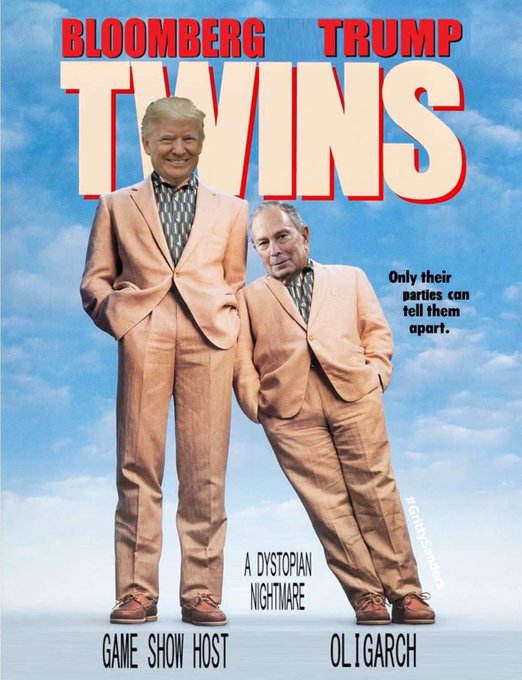
Republican oligarch Michael Bloomberg has been spending a million dollars per day on manipulative Facebook ads that seem to be working very well for him.


Labels: , , ,

Monday, July 01, 2019

Can George Soros And Charles Koch Really Turn U.S. Foreign Policy Away From War?

>


Over the last month there have been several rumors of a Koch-Soros alliance. The Observer reported it was to fight online extremism under the aegis of the After Charlottesville Project. Right-wing media outlets fretted they would be financing censorship. But over the weekend an OpEd in the Boston Globe by Stephen Kinzer, a senior fellow at the Watson Institute for International and Public Affairs at Brown University, In an astonishing turn, George Soros and Charles Koch team up to end US ‘forever war’ policy, filled in the blanks about Soros teaming up with Charles Koch to save the U.S. from the scourge of permanent war. He wrote that they haven’t had much in common— until now. “Soros is an old-fashioned New Deal liberal. The Koch brothers are fire-breathing right-wingers who dream of cutting taxes and dismantling government. Now they have found something to agree on: the United States must end its ‘forever war’ and adopt an entirely new foreign policy.” Are billionaires going to change the country and the world?

Will the Military Industrial Complex take this lying down? What about all those lobbyists thrown out of work. Does no one have any compassion for them and their families?
In one of the most remarkable partnerships in modern American political history, Soros and Charles Koch, the more active of the two brothers, are joining to finance a new foreign-policy think tank in Washington. It will promote an approach to the world based on diplomacy and restraint rather than threats, sanctions, and bombing. This is a radical notion in Washington, where every major think tank promotes some variant of neocon militarism or liberal interventionism. Soros and Koch are uniting to revive the fading vision of a peaceable United States. The street cred they bring from both ends of the political spectrum— along with the money they are providing— will make this new think tank an off-pitch voice for statesmanship amid a Washington chorus that promotes brinksmanship.

“This is big,” said Trita Parsi, former president of the National Iranian American Council and a co-founder of the new think tank. “It shows how important ending endless war is if they’re willing to put aside their differences and get together on this project. We are going to challenge the basis of American foreign policy in a way that has not been done in at least the last quarter-century.”

Since peaceful foreign policy was a founding principle of the United States, it’s appropriate that the name of this think tank harken back to history. It will be called the Quincy Institute for Responsible Statecraft, an homage to John Quincy Adams, who in a seminal speech on Independence Day in 1821 declared that the United States “goes not abroad in search of monsters to destroy. She is the well-wisher to the freedom and independence of all. She is the champion and vindicator only of her own.” The Quincy Institute will promote a foreign policy based on that live-and-let-live principle.

The institute plans to open its doors in September and hold an official inauguration later in the autumn. Its founding donors— Soros’s Open Society Foundation and the Charles Koch Foundation— have each contributed half a million dollars to fund its takeoff. A handful of individual donors have joined to add another $800,000. By next year the institute hopes to have a $3.5 million budget and a staff of policy experts who will churn out material for use in Congress and in public debates. Hiring is underway. Among Parsi’s co-founders are several well-known critics of American foreign policy, including Suzanne DiMaggio, who has spent decades promoting negotiated alternatives to conflict with China, Iran, and North Korea; the historian and essayist Stephen Wertheim; and the anti-militarist author and retired Army colonel Andrew Bacevich.

“The Quincy Institute will invite both progressives and anti-interventionist conservatives to consider a new, less militarized approach to policy,” Bacevich said, when asked why he signed up. “We oppose endless, counterproductive war. We want to restore the pursuit of peace to the nation’s foreign policy agenda.”

In concrete terms, this means the Quincy Institute will likely advocate a withdrawal of American troops from Afghanistan and Syria; a return to the nuclear deal with Iran; less confrontational approaches to Russia and China; an end to regime-change campaigns against Venezuela and Cuba; and sharp reductions in the defense budget.

It aims to issue four reports before the end of 2019: two offering alternative approaches to the Middle East and East Asia, one on “ending endless war,” and one called “democratizing foreign policy.” Its statement of principles asserts that the United States “should engage with the world, and the essence of engagement is peaceful cooperation among peoples. For this reason, the United States must cherish peace and pursue it through the vigorous practice of diplomacy... The use of armed force does not represent American engagement in the world. Force ends human life, destroying engagement irreparably. Any resort to force should occur only as a last resort and should remain infrequent. The military exists to defend the people and territory of the United States, not to act as a global police force.”


The depth of this heresy can only be appreciated by recognizing the meretricious power that nourishes Washington’s think-tank ecosystem. These “talk shops” employ experts who pop up to advise politicians, journalists, Congressional staff members, and the public. They write opinion columns and bloviate on news channels. In foreign policy, all major Washington think tanks promote interventionist dogma: the United States faces threats everywhere, it must therefore be present everywhere, and “present” includes maintaining more than 800 foreign military bases and spending trillions of dollars on endless confrontations with foreign countries. That, with some variation, is the ethos that moves conservative think tanks like the American Enterprise Institute and the Heritage Foundation as well as liberal ones like the Center for American Progress and the Brookings Institution. Just as pernicious as their relentless support of the global-hegemony project is the corruption that lies behind it. Many Washington think tanks are supported by industries and foreign powers eager to inflate threats in order shape American law, policy, and public opinion. Their “experts” are often paid shills who cloak themselves in institutional respectability so they can masquerade as independent analysts.

When foreign crises like the war in Yemen break out, critics of US policy emerge and are given space to air their views. These protests, however, are episodic. Little continuity ties one burst of outrage to the next. The Quincy Institute aims to offer a corps of experts in Washington who will promote a unified foreign-policy paradigm based on statecraft and cooperation. Its founders plan to become involved in grass-roots campaigns, especially in minority communities. They hope their specialists will eventually move on to populate Congressional staffs and the executive branch— as alumni of pro-intervention think tanks have been doing for decades.

“Some interesting currents are emerging in American politics and we want to capture this moment, but we’re in it for the long haul,” said Parsi. “We’ll be a failure if in 10 years we’re still criticizing. In 10 years, we want to be driving the bus.”

Labels: , , ,

Thursday, December 29, 2016

Failed Globalization And Austerity Agendas Led Directly To The Rise Of Trumpism— A Guest Post From George Soros

>


Over the last year or so, billionaire George Soros has given over $20,000,000 to Hillary Clinton’s campaign and to associated groups supporting her and the Democrats. As we saw last night 73% of Trump voters are convinced that George Soros has been paying protesters to demonstrate against their Dear Leader. He isn’t. Recently, though, he decided to warn his friends about his fears of a Trump regime.

Open Society Needs Defending
-by George Soros


Open societies are in crisis, and various forms of closed societies – from fascist dictatorships to mafia states – are on the rise. Because elected leaders failed to meet voters’ legitimate expectations and aspirations, electorates have become disenchanted with the prevailing versions of democracy and capitalism.

Well before Donald Trump was elected President of the United States, I sent a holiday greeting to my friends that read: “These times are not business as usual. Wishing you the best in a troubled world.” Now I feel the need to share this message with the rest of the world. But before I do, I must tell you who I am and what I stand for.

I am an 86-year-old Hungarian Jew who became a US citizen after the end of World War II. I learned at an early age how important it is what kind of political regime prevails. The formative experience of my life was the occupation of Hungary by Hitler’s Germany in 1944. I probably would have perished had my father not understood the gravity of the situation. He arranged false identities for his family and for many other Jews; with his help, most survived.

In 1947, I escaped from Hungary, by then under Communist rule, to England. As a student at the London School of Economics, I came under the influence of the philosopher Karl Popper, and I developed my own philosophy, built on the twin pillars of fallibility and reflexivity. I distinguished between two kinds of political regimes: those in which people elected their leaders, who were then supposed to look after the interests of the electorate, and others where the rulers sought to manipulate their subjects to serve the rulers’ interests. Under Popper’s influence, I called the first kind of society open, the second, closed.

The classification is too simplistic. There are many degrees and variations throughout history, from well-functioning models to failed states, and many different levels of government in any particular situation. Even so, I find the distinction between the two regime types useful. I became an active promoter of the former and opponent of the latter.

I find the current moment in history very painful. Open societies are in crisis, and various forms of closed societies – from fascist dictatorships to mafia states – are on the rise. How could this happen? The only explanation I can find is that elected leaders failed to meet voters’ legitimate expectations and aspirations and that this failure led electorates to become disenchanted with the prevailing versions of democracy and capitalism. Quite simply, many people felt that the elites had stolen their democracy.

After the collapse of the Soviet Union, the US emerged as the sole remaining superpower, equally committed to the principles of democracy and free markets. The major development since then has been the globalization of financial markets, spearheaded by advocates who argued that globalization increases total wealth. After all, if the winners compensated the losers, they would still have something left over.

The argument was misleading, because it ignored the fact that the winners seldom, if ever, compensate the losers. But the potential winners spent enough money promoting the argument that it prevailed. It was a victory for believers in untrammeled free enterprise, or “market fundamentalists,” as I call them. Because financial capital is an indispensable ingredient of economic development, and few countries in the developing world could generate enough capital on their own, globalization spread like wildfire. Financial capital could move around freely and avoid taxation and regulation.

Globalization has had far-reaching economic and political consequences. It has brought about some economic convergence between poor and rich countries; but it increased inequality within both poor and rich countries. In the developed world, the benefits accrued mainly to large owners of financial capital, who constitute less than 1% of the population. The lack of redistributive policies is the main source of the dissatisfaction that democracy’s opponents have exploited. But there were other contributing factors as well, particularly in Europe.

I was an avid supporter of the European Union from its inception. I regarded it as the embodiment of the idea of an open society: an association of democratic states willing to sacrifice part of their sovereignty for the common good. It started out at as a bold experiment in what Popper called “piecemeal social engineering.” The leaders set an attainable objective and a fixed timeline and mobilized the political will needed to meet it, knowing full well that each step would necessitate a further step forward. That is how the European Coal and Steel Community developed into the EU.

But then something went woefully wrong. After the Crash of 2008, a voluntary association of equals was transformed into a relationship between creditors and debtors, where the debtors had difficulties in meeting their obligations and the creditors set the conditions the debtors had to obey. That relationship has been neither voluntary nor equal.

Germany emerged as the hegemonic power in Europe, but it failed to live up to the obligations that successful hegemons must fulfill, namely looking beyond their narrow self-interest to the interests of the people who depend on them. Compare the behavior of the US after WWII with Germany’s behavior after the Crash of 2008: the US launched the Marshall Plan, which led to the development of the EU; Germany imposed an austerity program that served its narrow self-interest.

Before its reunification, Germany was the main force driving European integration: it was always willing to contribute a little bit extra to accommodate those putting up resistance. Remember Germany’s contribution to meeting Margaret Thatcher’s demands regarding the EU budget?

But reuniting Germany on a 1:1 basis turned out to be very expensive. When Lehman Brothers collapsed, Germany did not feel rich enough to take on any additional obligations. When European finance ministers declared that no other systemically important financial institution would be allowed to fail, German Chancellor Angela Merkel, correctly reading the wishes of her electorate, declared that each member state should look after its own institutions. That was the start of a process of disintegration.

After the Crash of 2008, the EU and the eurozone became increasingly dysfunctional. Prevailing conditions became far removed from those prescribed by the Maastricht Treaty, but treaty change became progressively more difficult, and eventually impossible, because it couldn’t be ratified. The eurozone became the victim of antiquated laws; much-needed reforms could be enacted only by finding loopholes in them. That is how institutions became increasingly complicated, and electorates became alienated.

The rise of anti-EU movements further impeded the functioning of institutions. And these forces of disintegration received a powerful boost in 2016, first from Brexit, then from the election of Trump in the US, and on December 4 from Italian voters’ rejection, by a wide margin, of constitutional reforms.

Democracy is now in crisis. Even the US, the world’s leading democracy, elected a con artist and would-be dictator as its president. Although Trump has toned down his rhetoric since he was elected, he has changed neither his behavior nor his advisers. His cabinet comprises incompetent extremists and retired generals.

What lies ahead?

I am confident that democracy will prove resilient in the US. Its Constitution and institutions, including the fourth estate, are strong enough to resist the excesses of the executive branch, thus preventing a would-be dictator from becoming an actual one.

But the US will be preoccupied with internal struggles in the near future, and targeted minorities will suffer. The US will be unable to protect and promote democracy in the rest of the world. On the contrary, Trump will have greater affinity with dictators. That will allow some of them to reach an accommodation with the US, and others to carry on without interference. Trump will prefer making deals to defending principles. Unfortunately, that will be popular with his core constituency.

I am particularly worried about the fate of the EU, which is in danger of coming under the influence of Russian President Vladimir Putin, whose concept of government is irreconcilable with that of open society. Putin is not a passive beneficiary of recent developments; he worked hard to bring them about. He recognized his regime’s weakness: it can exploit natural resources but cannot generate economic growth. He felt threatened by “color revolutions” in Georgia, Ukraine, and elsewhere. At first, he tried to control social media. Then, in a brilliant move, he exploited social media companies’ business model to spread misinformation and fake news, disorienting electorates and destabilizing democracies. That is how he helped Trump get elected.

The same is likely to happen in the European election season in 2017 in the Netherlands, Germany, and Italy. In France, the two leading contenders are close to Putin and eager to appease him. If either wins, Putin’s dominance of Europe will become a fait accompli.

I hope that Europe’s leaders and citizens alike will realize that this endangers their way of life and the values on which the EU was founded. The trouble is that the method Putin has used to destabilize democracy cannot be used to restore respect for facts and a balanced view of reality.

With economic growth lagging and the refugee crisis out of control, the EU is on the verge of breakdown and is set to undergo an experience similar to that of the Soviet Union in the early 1990s. Those who believe that the EU needs to be saved in order to be reinvented must do whatever they can to bring about a better outcome.


Labels: , ,

Sunday, June 05, 2011

George Soros on the road ahead (2)

>

How to "reinvigorate open society in America"
"First, I should like to see efforts to help the public develop an immunity to Newspeak. . . . Second, I should like to convince the American public of the merits of facing harsh reality."

On the policy challenges facing us
"[I]mproving the quality of political discourse is not enough. We must also find the right policies to deal with the very real problems confronting the country: high unemployment and chronic budget and trade deficits. The financing of state and local governments is heading for a breakdown. The Republicans have gained control of the agenda, and they are promoting a misleading narrative: everything is the government’s fault. . . . We need to undertake a profound rethinking of the workings of our political system . . . The fact that your opponent is wrong does not make you right."

On the Right's smear campaign against him
"As I earlier wrote, I have from my childhood been drawn to contending with what may seem insurmountable challenges. Those in charge of Fox News, Rupert Murdoch and Roger Ailes, have done well in identifying me as their adversary. They have done less well in the methods they have used to attack me: their lies shall not stand and their techniques shall not endure."

-- George Soros, in "My Philanthropy,"
in the June 23 New York Review of Books

by Ken

In a post this morning, I began looking at this piece titled "My Philanthropy" by George Soros (adapted from his introduction to Chuck Sudetic's The Philanthropy of George Soros: Building Open Societies) in the June 23 New York Review of Books.

We left Soros mulling his later-life realization that his lifelong belief in "open society" (as he absorbed the concept from Karl Popper), in the inherent worthiness and practical value of focusing our intellectual energies on understanding reality, can be neutralized when interest groups discover, as American right-wingers did so well, that you can instead focus on manipulating people's beliefs. What surprises him is not that the Republican propaganda machine has resorted to lies, but that it has had such success doing it. "The explanation," he writes, "lies partly in the power of Orwell’s Newspeak and partly in the aversion of the public to facing harsh realities."
On the one hand, Newspeak is extremely difficult to contradict because it incorporates and thereby preempts its own contradiction, as when Fox News calls itself fair and balanced. Another trick is to accuse your opponent of the behavior of which you are guilty, like Fox News accusing me of being the puppet master of a media empire. Skillful practitioners always attack the strongest point of their opponent, like the Swiftboat ads attacking John Kerry’s Vietnam War record. Facts do not provide any protection, and rejecting an accusation may serve to have it repeated; but ignoring it can be very costly, as John Kerry discovered in the 2004 election.

On the other hand, the pursuit of truth has lost much of its appeal. When reality is unpleasant, illusions offer an attractive escape route. In difficult times unscrupulous manipulators enjoy a competitive advantage over those who seek to confront reality. Nazi propaganda prevailed in the Weimar Republic because the public had been humiliated by military defeat and disoriented by runaway inflation. In its own quite different way, the American public has been subjected to somewhat comparable experiences, first by the terrorist attacks of September 11, and then by the financial crisis, which not only caused material hardship but also seemed to seal the decline of the United States as the dominant power in the world. With the rise of China occurring concurrently, the shift in power and influence has been dramatic.

The two trends taken together -- the reluctance to face harsh reality coupled with the refinement in the techniques of deception -- explain why America is failing to meet the requirements of an open society. Apparently, a society needs to be successful in order to remain open.

WE GOT UP TO THE QUESTION: "How can open society protect itself against dangerously deceptive arguments?"

"Only," Soros insists, "by recognizing their existence and their power to influence reality by influencing people’s perceptions."
People’s thinking is part of the reality they need to understand, and that makes the understanding of reality much harder than the philosophers of the Enlightenment imagined. They envisioned reason as something apart from reality, acting as a searchlight illuminating it. That is true for natural science but not human affairs. In political discourse we must learn to give precedence to the understanding of reality; otherwise the results will fail to conform to our expectations. Karl Popper took it for granted that the primary purpose of political discourse is the pursuit of truth. That is not the case now; therefore we must make it so.

He writes with elegant bitterness and disappointment about the Obama presidency, noting for example that "Obama assumed the presidency in the midst of a financial crisis whose magnitude few people appreciated, and he was not among those few."
But he did recognize that the American public was averse to facing harsh realities and he had great belief in his own charismatic powers. He also wanted to rise above party politics and become -- as he put it in his campaign speeches -- the president of the United States of America. Consequently, he was reluctant to forthrightly blame the outgoing administration and went out of his way to avoid criticism and conflict.

OBAMA AND THE BOOMERANGING "CONFIDENCE MULTIPLIER"

Apparently without understanding the built-in risk, the president employed a tactic that came back to bite him in the behind -- as, really, it had to. It's what George Akerlof and Robert Shiller call the "confidence multiplier"
II]n the hope of moderating the recession, he painted a rosier picture of the economic situation than was justified.

The tactic worked in making the recession shorter and shallower than would have been the case otherwise, but it had disastrous political consequences. The confidence multiplier is, in effect, one half of a reflexive feedback loop: a positive influence on people’s perceptions can have a positive feedback in its effects on the underlying economic reality. But if reality, for example the unemployment rate, fails to live up to expectations, confidence turns to disappointment and anger; that is the other half of the reflexive feedback loop, and that is what came to pass.

The electorate showed little appreciation of Obama for moderating the recession because it was hardly aware of what he had done. By avoiding conflict Obama handed the initiative to the opposition, and the opposition had no incentive to cooperate.

Of course, I would add that, as we know, the president was never prepared to commit to a real plan of economic revitalization and reform, and as countless liberal economists and commentators noted at the time, half-measures like the woefully compromised stimulus program he fought for mainly succeeded in making it impossible ever to try to do the job right. That is, assuming that he might at some point have developed such an inclination, which seems doubtful. (Soros, by the way, was from the outset an outspoken opponent of TARP and bank bailouts generally. He counts former Fed Chairman Paul Volcker as a friend and ally.)

EVENTUALLY SOROS COMES TO THE QUESTION: "What can we do to preserve and reinvigorate open society in America?"

He's under no illlusion that the answers are easy, but in broad terms, it's hard to disagree with the paths he lays out, and I think I need to let him make his case without further interruption:
First, I should like to see efforts to help the public develop an immunity to Newspeak. Those who have been exposed to it from Nazi or Communist times have an allergic reaction to it; but the broad public is highly susceptible.

Second, I should like to convince the American public of the merits of facing harsh reality. As I earlier wrote, I have from my childhood been drawn to contending with what may seem insurmountable challenges. Those in charge of Fox News, Rupert Murdoch and Roger Ailes, have done well in identifying me as their adversary. They have done less well in the methods they have used to attack me: their lies shall not stand and their techniques shall not endure.

But improving the quality of political discourse is not enough. We must also find the right policies to deal with the very real problems confronting the country: high unemployment and chronic budget and trade deficits. The financing of state and local governments is heading for a breakdown. The Republicans have gained control of the agenda, and they are promoting a misleading narrative: everything is the government’s fault. The Democrats are forced into fighting a rearguard battle, defending the opposite position.

We need to undertake a profound rethinking of the workings of our political system and recognize that half-truths are misleading. The fact that your opponent is wrong does not make you right. We must come to terms with the fact that we live in an inherently imperfect society in which both markets and government regulations are bound to fall short of perfection. The task is to reduce the imperfections and make both private enterprise and government work better. That is the message I should like to find some way to deliver.
#

Labels: , , ,

George Soros on the road ahead, part 1

>

Soros working on Wall Street, 1962,
from the NYRB article

On his role in his "exceptional position"
"I have made it a principle to pursue my self-interest in my business, subject to legal and ethical limitations, and to be guided by the public interest as a public intellectual and philanthropist. If the two are in conflict, the public interest ought to prevail. I do not hesitate to advocate policies that are in conflict with my business interests. I firmly believe that our democracy would function better if more people adopted this principle. And if they care about a well-functioning democracy, they ought to abide by this principle even if others do not. Just a small number of public-spirited figures could make a big difference."

On the threat to U.S. democracy
"The United States has been a democracy and open society since its founding. The idea that it will cease to be one seems preposterous; yet it is a very likely prospect. After September 11, the Bush administration exploited the very real fear generated by the terrorist attack, and by declaring "war on terror" was able to unite the nation behind the commander-in-chief, lead it to invade Iraq on false pretenses, and violate established standards of human rights in pursuing and interrogating terrorists."

"I thought I had a convincing argument in favor of the truth. Look at the results of the Bush policies: they were designed to demonstrate America’s supremacy, and they achieved the exact opposite; American power and influence suffered a precipitous decline. This goes to show, I argued, that it is not enough to manipulate perceptions; it is important to understand how the world really works. . . . That is the additional requirement I put into my definition of open society, but obviously it did not have an effect on the public that reelected Bush in 2004. . . . [Bush's reelection] convinced me that the malaise in American society went deeper than incompetent leadership. The American public was unwilling to face harsh reality and was positively asking to be deceived by demanding easy answers to difficult problems."

On the need to confront the manipulators
"The electorate showed little appreciation of Obama for moderating the recession because it was hardly aware of what he had done. By avoiding conflict Obama handed the initiative to the opposition, and the opposition had no incentive to cooperate. The Republican propaganda machine was able to convince people that the financial crisis was due to government failure, not market failure."

-- George Soros, in "My Philanthropy,"
in the June 23 New York Review of Books

by Ken

According to the NYRB author's note, "The essay in this issue is drawn from [George Soros's] introduction to Chuck Sudetic's The Philanthropy of George Soros: Building Open Societies. There's a lot in it that's important to the essay and clearly important to Soros which I'm not going to go into much, at least not now, because there are some other things that are of such considerable interest to me.

He talks early on about a major change in his thinking about his public-policy work, centered around "the worldwide network of Open Society Foundations," to which he says he has contributed more than $8 billion over 30 years, working with the foundations' president, Aryeh Neier. His original thinking was that the foundations shouldn't outlast his and Neier's passing. "The fate of other institutions has taught me that they tend to stray very far from the founders’ intentions." But he became convinced enough of the importance and ongoingness of their work, and of the commitment and abilities of the people working with them, that he decided that pulling the plug on them "would be an act of excessive selfishness." There is, he thinks, a wide range of tasks that need to and can be carried on without them. He talks too about steps he has taken to try to ensure the continued freshness and innovation and "entrepreneurial spirit" of the work, including setting up a School of Public Policy at the Central European University in Budapest.

In his second section Soros talks about the importance of continued work on economic matters, "to break the monopoly of the efficient market hypothesis and rational expectations theory enjoyed in academic and official circles." He insists, "We must reinvent a global financial system that has broken down," and believes that his own theory of "reflexivity," once scorned by conventional economic authorities but receiving increasing attention in the wake of the financial crisis, though not in all quarters. ("I had many more discussions with Larry Summers before he became the President's economic adviser than I did afterward," and his "greatest disappointment" was "being unable to establish any kind of personal contact with President Obama himself.") He is working to ensure the funding of the Institute for New Economic Thinking, with a board chaired by Joseph Stiglitz.

All of this, as I said, is clearly important both to Soros and to the world that stands to benefit from these ongoing initiatives.

AND THEN HE COMES TO THE PART THAT GRABBED ME
The war on terror forced me to reconsider the concept of open society. My experiences in the former Soviet Union had already taught me that the collapse of a closed society does not automatically lead to an open one; the collapse may be seemingly bottomless, to be followed by the emergence of a new regime that has a greater resemblance to the regime that collapsed than to an open society. Now I had to probe deeper into the concept of open society that I had adopted from Karl Popper in my student days, and I discovered a flaw in it.

And remember, that concept of "an open society" that he adopted from Karl Popper is so important to him that the principal vehicle for his world-improving activities has been that international network of Open Society Foundations.
Popper had argued that free speech and critical thinking would lead to better laws and a better understanding of reality than any dogma. I came to realize that there was an unspoken assumption embedded in his argument, namely that the purpose of democratic discourse is to gain a better understanding of reality.

Unfortunately, people don't just use their brains for trying "to gain a better understanding of reality." There is also "a manipulative function."
it may not be necessary to gain a better understanding of reality in order to obtain the laws one wants. There is a shortcut: "spinning" arguments and manipulating public opinion to get the desired results. Today our political discourse is primarily concerned with getting elected and staying in power. Popper’s hidden assumption that freedom of speech and thought will produce a better understanding of reality is valid only for the study of natural phenomena. Extending it to human affairs is part of what I have called the "Enlightenment fallacy."

As it happened, the political operatives of the Bush administration became aware of the Enlightenment fallacy long before I did. People like me, misguided by that fallacy, believed that the propaganda methods described in George Orwell’s 1984 could prevail only in a dictatorship. They knew better. Frank Luntz, the well-known right-wing political consultant, proudly acknowledged that he used 1984 as his textbook in designing his catchy slogans. And Karl Rove reportedly claimed that he didn’t have to study reality; he could create it. The adoption of Orwellian techniques gave the Republican propaganda machine a competitive advantage in electoral politics. The other side has tried to catch up with them but has been hampered by a lingering attachment to the pursuit of truth.

"Deliberately misleading propaganda techniques can destroy an open society," Soros writes. He cites the effectiveness of Nazi propaganda methods in destroying the Weimar Republic in Germany, and argues,
Different but in some ways similar methods have been used in the United States and further refined. Although democracy has much deeper roots in America than in Germany, it is not immune to deliberate deception, as the Bush administration demonstrated. You cannot wage war against an abstraction; yet the war on terror remains a widely accepted metaphor even today.

Regular readers will note that this is a them I've harped on: that it can't be good for our society when we have an entire political movement totally divorce itself from any obligation to or even expectation of reality or truth. It occurs to me now that there's a reason why extreme right-wingers now talk about the First Amendment and in particular free speech in ways that would once have elicited rage and derision from, well, people like them. They've come to understand that "free speech" isn't. It's a game they can rig, both through manipulation and through the application of sums of money that sure make a joke of the word "free."

Inevitably, then, comes what we might call the $30 billion question --

"HOW CAN OPEN SOCIETY PROTECT ITSELF AGAINST
DANGEROUSLY DECEPTIVE ARGUMENTS?"


And I want to pursue Soros's thoughts on the subject in my 6pm PT post.
#

Labels: , , ,