
As Señor Trumpanzee Flies Off To Hamburg To Disgrace The U.S. Again, America Cedes Its Claim As The World's Leader
>

• Sweden: -83
• Netherlands: -75
• Germany: -75
• South Korea: -71
• France: -70
• Spain: -68
• Canada: -61
• U.K.: -57
• Australia: -55
• Japan: -54
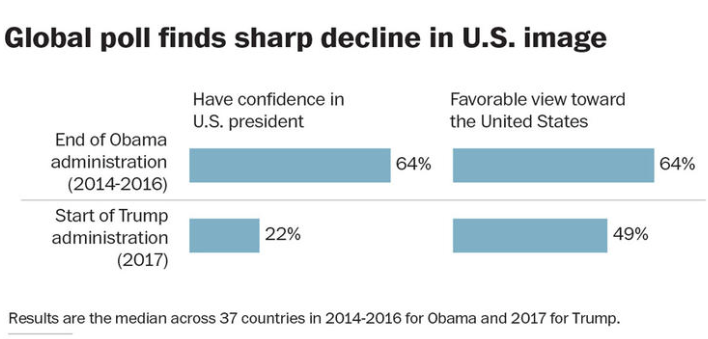
Pew concluded that "in countries where confidence in the U.S. president fell most, America’s overall image has also tended to suffer more. In the closing years of the Obama presidency, a median of 64% had a positive view of the U.S. Today, just 49% are favorably inclined toward America. Again, some of the steepest declines in U.S. image are found among long-standing allies."
Since 2002, when Pew Research Center first asked about America’s image abroad, favorable opinion of the U.S. has frequently tracked with confidence in the country’s president. Prior to this spring, one of the biggest shifts in attitudes toward the U.S. occurred with the change from George W. Bush’s administration to Obama’s. At that time, positive views of the U.S. climbed in Europe and other regions, as did trust in how the new president would handle world affairs.This is supposed to be an important, substantive meeting of world leaders. How do they have a substantive anything with the orange baboon there? CNN reported yesterday that Trump walks into this summit with the United States now in a much weaker position than when he started his presidency. The President, who prides himself on making America great again, brings with him a set of liabilities that will make it more difficult for him to persuade others at this crucial gathering in Hamburg, Germany, to listen to his recommendations or fear his threats-- despite all the economic and military power that the United States brings to the table."
Even though the 2017 shift in views of the U.S. and its president is in the opposite direction compared with eight years ago, publics on balance are not necessarily convinced that this will affect bilateral relations with the U.S. The prevailing view among the 37 countries surveyed is that their country’s relationship with the U.S. will be unchanged over the next few years. Among those who do anticipate a change, however, more predict relations will worsen, rather than improve.
Confidence in President Trump is influenced by reactions to both his policies and his character. With regard to the former, some of his signature policy initiatives are widely opposed around the globe.
...While the new U.S. president is viewed with doubt and apprehension in many countries, America’s overall image benefits from a substantial reservoir of goodwill. The American people, for instance, continue to be well-regarded-- across the 37 nations polled, a median of 58% say they have a favorable opinion of Americans. U.S. popular culture, likewise, has maintained appeal abroad, and many people overseas still believe Washington respects the personal freedoms of its people.
...Favorability ratings [for the U.S.] have only increased in Russia and Vietnam.
The heads of government in most nations prefer a certain amount of predictability and decorum from other heads of state. To have one of the most powerful people in the room being someone who is willing to send out explosive and controversial statements through social media, including nasty personal attacks or an edited video of him physically assaulting the media, does not make others at the G20 feel very confident about how he will handle deliberations with them.
Everyone knows that it is possible the next tweetstorm will be about them or that some of the conversations that were not intended for a mass audience could become public, thanks to the potential indiscretion of the President himself. Given his willingness to stretch the truth or say things that are false, this creates less than ideal conditions for negotiation.
But it doesn't just stop with Twitter. The President has continually hammered away at international agreements that involve most of the leaders at the summit. His decision to withdraw from the Paris Climate Accord was devastating since many of the key players in the room, including Germany, strongly support this commitment to slow global warning.
His announcement was seen as a prime example of the kind of conservative unilateralism that they fear is also sweeping their own continents. The President's decision to simply say no, then claim there would be a possibility for renegotiation, caused huge ripples.
...The failure of the Trump administration to deliver on any major legislation at home since his inauguration and his continuing low approval ratings (despite his strong support with the base) also make him weaker overseas.
Historically, foreign leaders pay close attention to the domestic standing of a president to gauge whether he can deliver credible commitments or follow through on tougher threats. One of the factors that put President Richard Nixon in a strong position to pursue détente, a series of steps that aimed to ease tensions between the US and the Soviets, as well as China, was that he had created a strong political coalition after the 1968 election and was seen moving legislation and foreign policies forward in his first years in office.
In the current situation, especially in the wake of the health care fiasco, there is more than enough reason for other leaders at the summit to doubt whether Trump has the ability to really mobilize support for any deal once he is back in the states.
Then there is the Russia investigation, which continues to hang like a cloud over this administration. The investigation has two effects overseas. Like the tweets, it simply adds to the sense of instability that plagues Trump's presidency. In the same way that many leaders are not very confident about what the President will be doing or saying in the next few days, they, like Republicans on Capitol Hill, watch nervously to see what the next bombshell will be in the investigation, if any.
What's more, the investigation directly impinges on Trump's ability to be as effective as possible in dealing with Russia, a pivotal nation state in a number of military and diplomatic fronts, from Ukraine to Syria. Every conversation that the President has about Russia is tainted in the minds of many officials, who wonder whether this has to do with the investigations.
Even if the President and his team had serious ambitions to achieve a kind of détente with Russia to break through some of the logjams that exist overseas right now, those efforts will be difficult and many legislators-- in both parties-- will be unwilling to give him or Putin the benefit of the doubt that more productive relations are possible.
Secretary of State Rex Tillerson offered a reminder that the State Department, the strength of which has historically been essential for presidents to succeed overseas, is under siege from the White House. According to CNN, Tillerson reportedly gave a tongue-lashing to a high-ranking White House official about the need to let his department remain independent in hiring personnel, and for shooting down proposed nominees after months when State has been severely understaffed. Without the State Department's expertise, which the President needs to prepare and engage in discussions like those taking place in Germany, the US starts the negotiations with its hands tied behind its back.

Germany has federal elections coming up and both candidates to head the government-- who believe Trump is serving Putin's interests in making Europe weaker and less united-- are bashing Trump non-stop. The German media has been reporting that Hamburg is bracing for massive anti-Trump protests, as protesters from around Germany and from all over Europe flock to the city. Protests began Sunday night!
On Sunday, German Interior Minister Thomas de Maiziere warned that violence at the G20 meeting would not be tolerated. Sunday was just the first day of a week of protests against the summit of world leaders in Hamburg, and an intense police presence has already descended on the city.
US President Donald Trump, Russian President Vladimir Putin and Turkish President Recep Tayyip Erdogan are particular enemies for much of the European left. The fact that they will meet in a densely populated, left-leaning part of Hamburg poses a huge headache for the police-- and residents.
According to German media reports, German Chancellor Angela Merkel was due to meet with Trump in Hamburg on Thursday.
More than 100,000 protesters are expected at the largest demonstrations. In the anarchist and left-wing spectrum, police estimate there are around 4,000 people who are prepared to use violence in Hamburg.
One week before the summit, thousands voiced their anger over climate change, capitalism and global conflict at the "Protest Wave"-- a huge march and a flotilla of 200 boats on Hamburg's streets and waterway.
The demonstration was called by the German Trade Union Confederation, Greenpeace, Oxfam and 12 other organizations whose supporters reject violent protest. Svenja Angenendt, the Protest Wave spokesperson in Hamburg, said the G20 summit would be an opportunity to press for significant political change.
"We want democracy to be strengthened, better protection for our climate, social justice in Germany and worldwide, and we demand a fair global trade regime."

Labels: European Union, G-20 summit, Trump's foreign policy
posted by DownWithTyranny @ 9:00 PM
3 comments
|
Reddit


