Ringling Bros. and Barnum & Bailey circus announced on Saturday night that after 146 years of performances, it was folding its big tent forever.
In a statement on the company’s website, Kenneth Feld, the chief executive of Feld Entertainment, the producer of Ringling, said the circus would hold its final performances in May. He cited declining ticket sales, which dropped even more drastically after elephants were phased out from the shows last year.
“This, coupled with high operating costs, made the circus an unsustainable business for the company,” the statement said. “The circus and its people have continually been a source of inspiration and joy to my family and me.”
Stephen Payne, a spokesman for Feld Entertainment, said in an interview on Saturday night that the closing would affect about 400 cast and crew members.
“We looked at the performance in 2016 and advance tickets sales in 2017, and we decided it was not a viable business model,” he said.
The company informed employees Saturday night after shows in Orlando, Fla., and Miami.
“There isn’t any one thing,” Mr. Feld told The Associated Press. “This has been a very difficult decision for me and for the entire family.”
Ringling has two touring circuses this season and will perform 30 shows between now and May. Major stops include Atlanta, Boston, Philadelphia and Washington. The final shows will be on May 7 in Providence, R.I., and on May 21 at the Nassau Veterans Memorial Coliseum in Uniondale, N.Y.
The final appearance of the circus in New York City will be from Feb. 23 to March 23 at the Barclays Center in Brooklyn.
An estimated 10 million people go to a Ringling circus each year.
Mr. Feld told The A.P. that transporting the show by rail and other circus quirks — such as providing a traveling school for performers’ children — are throwbacks to another era. “It’s a different model that we can’t see how it works in today’s world to justify and maintain an affordable ticket price.”
The Feld family bought Ringling in 1967.
Ringling has been targeted by activists who say forcing animals to perform is cruel and unnecessary, leading to the removal of the elephants, among the most popular features of the performances. The company sent its animals to live on a conservation farm in Florida.
On Twitter on Saturday night, People for the Ethical Treatment of Animals, which campaigned for the elephants’ removal, heralded what it called “the end of the saddest show on earth.” . . .
There are 8 million stories in the Naked City, and some of them are stories you know are serious but you nevertheless can't resist, you know, smiling at. Possibly even guffawing. Like this story from our Crime Watch team. -- Ken
UPPER EAST SIDE and ROOSEVELT ISLAND Crime and Mayhem
UPPER EAST SIDE -- A man threw a block of cheese at a Morton Williams shopper during an argument outside the grocery store Wednesday night, police said.
Barry Bernstein, 62, got into a argument with a 38-year-old Brooklyn man, who was about to enter the 1066 Third Ave. store near 73rd Street just before 9 p.m., according to a police report.
During the dispute, Bernstein threw a block of cheese at the man's stomach causing "substantial pain," police said.
It was unknown what type of cheese it was or what the argument was about, police said.
Bernstein was charged with assault and harassment and was released without bail. He's due back in court on Feb. 22, records show.
His attorney did not immediately return a call for comment.
Offered without further comment, except maybe to underscore the line: "It was unknown what type of cheese it was or what the argument was about, police said."
Okay, I'm gonna shut up in just a moment, because while it takes a heckuva lot to render me speechless, this has just about done it.
Let's just first make sure that everyone actually still knows who/what Deep Throat is/was. A show of hands? You can put your hand down, Woodward; we know you know. And you too, Bernstein. Though I guess it's nice to know that you guys haven't forgotten. I mean, after all, the guy gave you two careers.
But . . . but . . . but . . .
Just to be clear, there are no live links in the artwork above or below; these are just copies of the graphics. And frankly, if I could give you links, I'm not sure I would. And no, this is not a paid or any other kind of promotion. What it is is something that if you want to know more about it or (heaven help us) do anything about it, that's all on you. And no, this is not made up. Well, somebody made it up, but it wasn't me. This Joshua Rosenblum person seems to have his fingerprints all over it.
Okay, I'm done. Let's get back to it. Sheesh!
I KNOW I PROMISED TO SHUT UP (AND I DID PRETTY
WELL, DIDN'T I?), BUT JUST ONE FINAL THOUGHT
Goodness knows, the Watergate story didn't lack for bizarre elements, but this may be the bizarrest of all, this final episode of Deep Throat emerging as a superannuated chorus boy.
So here's my thought: In 2013 Robert Redford's Sundance Productions produced an hour-and-a-half documentary follow-up to the Redford- and Dustin Hoffman-starring 1976 film version of All the President's Men (directed by Alan J. Pakula, with a script by William Goldman based on the Woodward-Bernstein book chronicling their Watergate adventure). "All the President's Men" Revisited, which won an Emmy documentary nomination, featured interviews with many of the actual players in the saga, and even included the disclosure of the identity of Deep Throat. I know it's a little unorthodox, but it's a documentary, after all, and don't you think it needs a brief update to incorporate this bizarre final episode?
One final final thought: I see there's a temptingly priced 2013 two-disc Blu-ray special edition of All the President's Men that includes "All the President's Men" Revisited and assorted other special features. I've added it to the top of my shopping list.
In the 2013 documentary "All the President's Men" Revisited, Dustin Hoffman and Robert Redford revisited their experience portraying, respectively, Washington Post metro-reporters-turned-Watergate-sleuths Carl Bernstein and Bob Woodward in Alan J. Pakula's 1976 film.
Run for your life (or at least your sanity), SantaCon is coming!
>
If you were planning to be in any of these afflicted affected areas of Manhattan tomorrow, you might want to rethink those plans.
"While the party bills itself as a 'charitable' pub crawl, it's had a fraught relationship with people who live in its path over concerns including public urination, death threats and numerous arrests. . . .
"Last December, New York's SantaCon took to Twitter to brag about the fact that no one associated with their group was arrested in 2015, according to initial reports."
The first time I found myself enmeshed in the tide of drunken, degraded humanity that is SantaCon, a few years back, I had no idea what was happening. I guess I just assumed it was some sort of spontaneous hooliganism which was unaccountably escaping the vigilance of the NYPD. That was bad enough. When I discovered what it was, and that it was in fact organized drunken, degraded hooliganism, I was really peeved.
Now, as you can see from the quote above, the organizers of the event are actually capable of bragging that, at least according to preliminary reports, not one of their troops of marauding scumbags has been arrested! Talk about setting your behavioral bar really, really low.
For those of you who are coming into this story as clueless as I was way back when, not to mention those of you who are lucky enough not to have SantaCon anywhere near you, here's the deal:
By Veronika Bondarenko and Julia Bottles Updated December 9, 2016 11:22am
Get ready for the Santas.
SantaCon, a controversial yearly pub crawl involving roughly 20,000 revelers dressed in Santa and Christmas-themed costumes, has announced its starting location and released the map of its official route.
The Santas will gather at the Flatiron Building pedestrian plaza at West 23rd Street and Broadway starting at 10 a.m. Saturday, according to the event's website. [Note: Lots more links onsite. -- Ed.]
Then the imbibing Santas will make their way through Midtown, Gramercy, Flatiron and the East Village, hitting up over 45 bars and several strip clubs along the way.
After the kickoff, revelers will watch Twitter or sign up for alerts by texting "follow santacon" to 40404 for information about the next bars.
In addition to the SantaCon bars there will be "Santa Clubs" which revelers can get access to for a $10 charitable donation. [Onsite there follows a list, which you're welcome to access for yourself. I'll be darned if I'm going to publicize the names. -- Ed.]
While the party bills itself as a "charitable" pub crawl, it's had a fraught relationship with people who live in its path over concerns including public urination, death threats and numerous arrests.
In 2013, SantaCon rerouted around Hell's Kitchen after residents begged them to steer clear of their area. In 2014, organizers had to scrap plans to start at the Maria Hernandez Park and later in all of Bushwick after both local residents and businesses got word of the plan.
As in previous years, there will be an alcohol ban on Metro-North and the Long Island Rail Road and in train stations the weekend of SantaCon, the MTA announced Wednesday.
This year SantaCon organizers released a statement defending the pub crawl and addressing concerns saying "there is no excuse for inappropriate behavior" and promising that they are working "even more closely with the New York Police Department ensure that the event remains enjoyable for locals and Santas alike."
Last December, New York's SantaCon took to Twitter to brag about the fact that no one associated with their group was arrested in 2015, according to initial reports.
I suppose we should be encouraged by the organizers' presumed admonition to their revelers that "there is no excuse for inappropriate behavior." However, as far as I can tell, and in full realization of how fuddy-duddy-ish this sounds, it seems to me that the one and only reason this orgy of assaultive mayhem exists is precisely as an excuse for inappropriate behavior. What else is it about?
The splendid piece on John le Carré is part of an embarrassment of riches in the new NYRB
>
The new NYRB has a terrific review-essay by Neal Ascherson on John le Carré, described by his new biographer, Adam Sisman, as "one of the most important English writers of the post-war period." To me this kind of understates le Carré's importance as a writer, but hey, that's me.
by Ken
The new (October 13) issue of The New York Review of Books was in the mailbox yesterday, and such free time as I've had since then has been heavily absorbed by an issue overflowing with "must read"s. There are half a dozen or more pieces that we should probably talk about, and may yet, but for now let me rattle off some of the high points on the contents page --
In the leadoff position:
• an eye-opening piece by Freeman Dyson (but then, doesn't Freeman Dyson usually open eyes?) on the theoretical, cultural, and economic differences -- and their practical consequences -- in the divide on space exploration, which has existed as long as there's been space exploration, between "Big Space" (as practiced by NASA, running a program that is legitimately "too big to fail") and "Little Space" ("The Green Universe: A Vision," reviewing books by Julian Guthrie, Charles Wohlforth and Amanda R. Hendrix, and Jon Willis)
On the political front:
• Michael Tomasky with some striking thoughts on the question increasingly in a lot of our heads now, "Can the Unthinkable Happen?"
• Nicholas Lemann on what appears to be some sort of right-to-leftward movement in U.S. politics for the first time since well before the left-ro-right shift that set in in the mid-'60s and changed the political landscape (reviewing books by Daniel Oppenheimer, Steve Fraser, and Thomas Frank in "Can We Have a 'Party of the People'?," free to subscribers only)
• Geoffrey Wheatcraft on "Tony Blair's Eternal Shame: The Report" (reviewing the Chilcot Report itself and books by Peter Oborne and Tom Bower, free to subscribers only)
On the scientific front, in addition to Freeman Dyson's space odyssey:
• Laurence C. Smith on "Greenhouse Warming: Prepare for the Worst" (reviewing Tim Flannery's Atmosphere of Hope: Searching for Solutions to the Climate Crisis, free to subscribers only)
• Nathaniel Rich on "The George Plimpton Story" (free to subscribers only), reviewing the serial-form reissue, with added commentaries, of Plimpton's books of what he dubbed, probably intentionally misleadingly, "participatory journalism"
And on and on and on . . .
. . . including Orlando Figes on 2015 Nobel Literature Prize-winner Svetlana Alexeivich's Secondhand Time: The Last of the Soviets, Nicolas Pelham's "In Saudi Arabia: Can It Really Change?," David Miliband on "The Best Ways to Deal with the Refugee Crisis," Rana Foroohar on "How the Financing of Colleges May Lead to Disaster!," and pieces on art, architecture, and poetry, and actual poetry.
OF COURSE (AT LEAST FOR READERS FAMILIAR WITH
MY PREDILECTIONS) THE FIRST PIECE I WENT TO WAS:
• Neal Ascherson's "Which le Carré Do You Want?" (free to subscribers only), reviewing Adam Sisman's exhaustive biograhy of John le Carré, written with four years' worth of cooperation from the subject, and the subject's own new memoir, The Pigeon Tunnel: Stories from My Life
-- drawing by David Levine
Clearly, given the amount of cooperation le Carré had given Adam Sisman over the years the biographer was working on his biography, the subject was aware that the book was in the works. At some point during that time, the biographee decided to produce a memoir of his own -- not "as some sort of angry riposte," Ascherson assures us ("[Sisman's] book seems very fair and often close to affectionate"), but more likely for "professional" reasons, as "the pang of a writer who lends out his or her best anecdotes to be written up by somebody else."
Ascherson likes both books, but thinks the autobiographer has been shrewder than the biographer in one key area: keeping their shared subject's father, Ronnie Cornwell ("an exuberant con man whose excesses and betrayals shaped the characters and lives of his children"; in his son David's writing, he's most conspicuously present in A Perfect Spy) mostly confined to one section of the book. It doesn't seem to have occurred to Sisman that he needed to be kept under tight control:
Ronnie, although he died in 1975, keeps stealing the scene in this biography that is supposed to be about his son. Readers and critics have long ago grasped the idea that the le Carré novels—and not just the early “spy” fiction—can be understood as a mordant allegory of British decline; or, more accurately, of the British elite’s persistent refusal to recognize that decline. Sisman handles that element deftly. But the fact is that Ronnie’s real life is an even more lurid allegory of the same thing.
Ascherson recounts getting to know David Cornwell in 1963 when Ascherson was a Bonn-based journalist and Cornwell a functionary in the British embassy in Bonn (cover, of course, for his activities as a secret intelligence officer). The journalist, knowing nothing about his new friend's "real trade," or about his gathering-toward-explosion personal woes, found him "restless, irreverent, and very funny."
During Cornwell's time with MI6 he had published his second novel, Call for the Dead, which is loaded with spies, including one George Smiley (who had in fact appeared in the earlier book, A Murder of Quality), and which MI6 had cleared for publication -- as it did, perhaps surprisingly, with his next book, the game-changing Spy Who Came in from the Cold (whose central character is strangely referred to here as "Alan" rather than Alec Leamas). Ascherson has vivid memories of its publication.
One autumn day in 1963, David and I sat on a bench outside Hamburg’s main station, waiting for the Sunday papers to arrive from London with reviews of books we had written. The ecstatic reception of The Spy changed his life forever. Its triumph in Britain and America made him instantly wealthy; his pseudonym was penetrated within a few months; his days were overrun by importunate agents, publishers, film directors, and tax accountants. He described the impact as “like being in a car crash.”
Ascherson adds parenthetically: "Ronnie, delighted, was to be found in Berlin posing as David’s agent and selling imaginary movie rights to film studios."
Culture Watch: Isn't it time to deal with the all-consuming menace of electronic-toy tyranny?
>
"Before you take me away, I just
want to update my profile picture."
by Ken
It's time -- or more likely well past time -- to begin dealing with the rupture of the social fabric caused ty the menace of the electronic toys and the people who abuse them. You know who I'm talking about. They're the people (for convenience we'll call them "they," because they couldn't be you, right?) who brandish their toys, as they electronically suck in and spit out limitless quantities of mindless twaddle in any and all public situations without regard to the disruption caused to sane people trying to perform the basic routines of life.
I'm afraid that the suggestions I'm going to make for dealing with them may be thought of as harsh, but a bit of reflection should clarify that they're simply the minimum we can do to try to restore a modicum of healthy function in public spaces. A warning won't suffice for the obvious reason that if these offenders were capable of understanding the nature of their offense, it wouldn't be necessary to grasp for ways of dealing with them. These are offenses that grow out of the twin delusions: first, that what they're doing on their toys is so important that it can't wait for a more appropriate place and time, so important that it lends an illusion of importrance to the limitlessly vast unimportance of their worthless existences, and second, that there are no people besides themselves on the planet.
Perhaps the most obvious and egregious category of offenders is the people who through public spaces -- sidewalks, meeting places, stairways (especially stairways) with their blank faces buried in their toys, obstructing the flow of pedestrian traffic. The stairway obstructors -- either on the stairs or at the top or bottom of the flight -- need to be dealt with promptly. It shouldn't be beyond our technological resources (the technological resources that created the toys that are the problem) to devices or substances that could produce instant, painless, and mess-free elimination. "Jerkbegone" is a possible product name on which I happily waive all royalties.
One particular category of electronic-toy abuse I'd dearly love to see dealt with is the plague afflicting gyms, where the toy people routinely clog up workout equipment for endless periods while they're not working out but are playing with their toys. And perhaps because they are typically paying fairly stiff membership fees, the staff never seems to think it's a problem that calls for their attention. One obvious remedy short of automatic elimination which might perhaps get the offender's attention would be a policy of confiscating the toy, crushing it underfoot, and then stuffing the remains up the orifice of the toy person's choice.
There are, of course, related public nuisances that will still need to be dealt with -- like the whole range of camera-phone abuse, and the "showtime" hoodlums who take entire subway carfuls of passengers hostage with their "entertainments." But I think this would be a good start.
"What is truly revealing is [Antonio Sabato Jr.'s] implication that believing something to be true is the same as its being true. Because if anything, that was the theme of the Republican Convention this week. It was a four-day exercise in emphasizing feelings over facts."
-- John Oliver, on that Sunday's Last Week Tonight
by Ken
Leastwise that's my opinion, Antonio, up there atop this post -- you know, about God thinking you're an asshole and Jesus saying you suck. And you know what? As you explained so eloquently on national TV, I'm entitled to my opinion, and you can go against it, but I believe it. Why . . . why . . . denying me my right to have and express my opinion is just like Communism, as you have further explained.
And it seems only fair to allow you to make your case, seeing as how I so enthusiastically endorsed John Oliver's making a federal case of your nationally televised assault on sense, sanity, truth, and decency, your coast-to-coast declaration of war on, well, reality. I'm sure you remember what you blithered, but perhaps some readers could use a refresher. As John put it, you, an "IMDB-page-awarded actor," after "deliver[ing] a relatively restrained speech" at the convention, "open[ed] [your] heart regarding President Obama to ABC News":
Since you still don't get it, Antonio, not any of it, it's hard to know where to begin. And not, I think, with the most obvious point: that what you believe is demonstrable and well-demonstrated bullshit, delivered with the intent, or at least the result, of destroying civility and decency, and that it can only be the product of some combination of imbecility and insanity. No, I think we have to back up to the underlying belief: that being a Muslim is inherently evil, or for that matter in any way subject to reproach, especially from a demonstrated lunatic-cretin. Because with this stated belief, you declared yourself, again to a national TV audience, as a snarling, savage bigot and hate-monger, again with no imaginable goal except the destruction of sense, civility, and decency.
So while yes, you have a right to your beliefs and of course the right of free speech to express them. But included with those rights are the rights of others to respond to their ignorance, delusionality, and dangerous hatefulness. This is, after all, the way free speech is supposed to work. And yet . . . and yet . . .
Well, two weeks later, the former Dance Night Obsession star is saying that his support of Donald Trump has led to a Joseph McCarthy-like blacklist of Sabáto Jr! As an aside, here’s a tweet from Sabáto Jr. from a little over a month ago.
Sadly for Antonio Sabáto Jr, not unlike people’s reaction to 2003’s Wasabi Tuna, the backlash against him is making him frowny-face-unicorn-poo-brokenheart emoticony. He tells Variety:
I think this country allows you freedom of speech. Anybody should be allowed to say whatever they want. When you’re in my business, you can’t talk about [conservative] politics. You just can’t. You’re attacked viciously in a way that I’ve never been attacked before.
On Twitter, there’s been name calling, and celebrities attacking me. That’s fine. I see it, but I don’t read it. I block them and delete them and move on. There’s so much negativity you can be taken into that. But I’ve also heard from celebrities: “If he can do it, I want to speak my mind too.” They are fed up with the way this country has been running and by all these lies.
As our Antonio prattles on, he seems to lose some of his optimism.
I was never a politician. I care about my country. I put God first. For the last seven-and-a-half years, I’ve seen this country led by a leader that’s made mistakes. I spoke my mind about it. But because I’m in the industry, you can’t talk about that. The media and the liberals act the way they act: The will back up the president until the end. It’s been interesting. I’ve had fantastic directors who have said officially to my agents and managers they will never hire me again. They will never even see me for projects. That’s unfair. It’s just like Communism.
Um, yikes! "Just like Communism"? Do you actually known anything about Communism, Antonio? Or, more to the point, about blacklisting? This is actually the sort of thing beloved by power-mongering right-wing hatebags.
But to return to the, er, substance, of your complaint -- so much crackpot bullshit, so little attachment to reality. Well, sorry, Antonio, none of this washes, for the reasons I sketched earlier on, but also, as Walter points out with regard to your newfound diminished employability:
This would be true, if it was true. Here’s a quick list of the liberal power brokers of Hollywood:
• Robert Downey Jr. -- Conservative and top grossing actor in Hollywood
• Clint Eastwood -- seriously
• ylvester Stallone -- the guy that has three top grossing films over the last five years
• Jerry Brickheimer -- If you’ve watched a movie that goes “boom” in the last 40 years, he probably produced it.
• Arnold Schwarzenegger -- Was a governor once, I think
• James Woods, Jon Voigt, Gary Senise, John Malkovich, Bruce Willis, Mel Gibson, Adam Sandler, Robert Duvall, Dwayne “The Rock” Johnson ... and the list goes on.
Hollywood’s about narcissism and money -- yes, there are “liberals” in Hollywood, but mostly “social liberals,” which means virtually nothing except that you are aware that gay people aren’t going to some fictitious hell. However, the Shark Hunter actor, who will be coming out with a mini-series next year titled Antonio Sabato Jr Down Under, feels like he’s being punished for being as dumb as a brick.
Ah, if only our IMDB-page-awarded boy was aware that "he's being punished for being as dumb as a brick." Now I don't want to let this go without restressing John Oliver's original point, which emphatically wasn't about our Antonio being an idiot. As he made abundantly clear, it was about the belief that "believing something to be true is the same as its being true."
HOWEVER, ANTONIO, AS REGARDS YOUR CAREER . . .
. . . being dumb as a brick may well be a problem. Even more of a problem is your demonstrated willingness, even eagerness, to make headlines by spewing imbecilic, hate-infested lies and delusions. You've turned yourself into what's often known as a "loose cannon," and this often doesn't sit well with people one would like to do business with. Just consider, if you were the producer of such hot-ticket spectacles as Shark Hunter and Antonio Sabato Jr Down Under, how eager would you be to sign up a potential cancer for your extravaganza?
Now one doesn't want to get so personal as to cast aspersion on your talents, Antonio. Just because those talents don't happen to include much in the way of acting doesn't mean you shouldn't be employable as an actor. If Hollywood were to outlaw the hiring of low-talent actors, well, it would be a very different place, wouldn't it? But did you really expect Antonio, that your talents -- being pretty and having a killer body -- would be a lifetime meal ticket? Does that sound like Hollywood?
Did readers notice, by the way, buried in Antonio's blithering, the apparent source of his seemingly implacable Obama hatred? "For the last seven-and-a-half years, I’ve seen this country led by a leader that’s made mistakes." Well, DWT has had a fair amount to say about mistakes made by President Obama, but the list doesn't include being a Muslim, and wouldn't even if it were true.
Happy birthday, Theo Adam -- and don't worry, we're not going to "Check Criminal Records in Seconds"
>
by Ken
So on Monday, as part of a sustained effort to avoid doing the mountain of stuff I should have been doing, I answered an e-correspondent's question about what I was doing, and I wanted to mention that I had just done a free download of a compilation of broadcast material over at Opera Depot featuring the German bass-baritone Theo Adam.
Only I couldn't remember which birthday of the singer it was in celebration of, so naturally I paused to look it up, because what could I have had to do that was more important than that? And I found the above.
Now I should say that there aren't a lot of recordings of Theo Adam that I would listen to for purely vocal pleasure (though there are some, like his King Heinrich -- from a lightish bass-baritone angle -- in the1954 Bayreuth Lohengrin broadcast), but I don't think even the driest and shakiest of them qualifies as a crime.
In this rousing performance of the final stretch of Wagner's Die Meistersinger, from a 1988 Wagner concert in the rebuilt Leipzig Gewandhaus with Kurt Masur conducting the Leipzig Radio Chorus and Gewandhaus Orchestra, the 62-year-old Theo Adam cranks out -- one more time -- the Mastersinger Hans Sachs's peroration "Verachtet mir die Meister nicht" ("Don't disparage the Masters to me").
Follow-up on the imminent threat to the fabled Waldorf=Astoria public spaces
>
The last rehab of the Waldorf=Astoria lobby finally got it right -- and it actually looks better with people bustling in what is, after all, a hotel lobby. (Click to enlarge.)
"We are distressed to learn that the world’s preeminent Art Deco hotel will be gutted and turned into condos and fear that the lobby, entrances, Louis Rigal murals, and other great public spaces, such as the Grand Ballroom, will be destroyed."
-- from a statement by the Art Deco Society of New York
The irony here is that the last renovation of the Park Avenue lobby, largely aiming at restoring it to its once-fabled beauty and grandeur, has been generally accounted a considerable success. Thank goodness that can be expected to be wiped away.
It didn't take long for the Art Deco Society of New York to jump into the fray (see the snatch of its statement which I've quoted above), and earlier this week ADSNY sent out this e-mail appeal:
We're writing to enlist all of you to support us in protecting the interior spaces of one of New York's most celebrated and important Art Deco buildings, the Waldorf Astoria Hotel.
Last week, along with two preservationists from the Historic Districts Council, we explored many of the original stunning interior Art Deco spaces in the legendary Waldorf.
Sitting in the lobby, mystified and frustrated, we were alarmed that this iconic space is about to be decimated if we don't unite immediately to encourage the Landmarks Preservation Commission to save it.
As we toured the beautiful rooms and hallways, the need to rally to preserve the Waldorf's interiors became incontestable. We wanted to share some of the spaces and architectural elements that will be lost forever if we don't make our voices heard today.
Your voice counts! All you have to do to help protect this important Art Deco building is:
• Click the "ACT NOW!" button below
• Select "Misc. Comments" for Message Type
• Select "Landmarking Process" for Message Topic
• Fill in your contact information if you so choose
• Write your own or paste this statement into the Message text box: "I implore the LPC to act quickly in calendaring and designating the public interior spaces of the Waldorf-Astoria before these iconic spaces are demolished."
ACT NOW
As far as I know, there's still no official word about what exactly is planned for the Waldorf=Astoria, and in particular its great public spaces. Experience teaches us to expect the worst, which is why the loudest possible noise is about the best hope for some constructive impact.
At a press conference yesterday, Spurs coach Gregg Popovich says, "I'm trying to wrap my head around why I'm standing here and he's not. [Pause] And we all know why."
"During interviews with Tim Duncan (a phrase roughly equivalent to 'during photo sessions with the snow leopard') the Spurs' immortal never resisted an opportunity to josh with a teammate who happened to walk by. It certainly disturbed the rhythm of the conversation—if it can be said that one rhythmically conversed with Duncan—but he wasn't sending a message to the reporter, but rather to the teammate. It said: I'm not above you. I'd rather be with you than sitting here talking about myself. So keep the shower running, and I'll be there soon.
"Duncan hid in plain sight when he was on the court, so his departure was destined to be a non-action event, coming in a press release (with no direct quotes from Duncan or anyone else) from a Spurs public relations department that over the years has figured out how to deal with his Howard Hughes ways. Maybe, just maybe, there will be a press conference down the road, during which a fidgety Duncan will likely be checking the exits after a few vanilla comments. . . ."
Of course the physical gifts were prodigious, but then, so was what he got out of them. It seems nutty to think of a player of Tim Duncan's physical presence and accomplishments as having a "quiet" career, but good heavens, think what it means to have played at that level for that long, for one team and one coach, in a system where it was the team that mattered and expectations were always high -- qualities that exude a special poignancy for those of us doomed to dwell in the service area of the NY Knicks, the Franchise That Hope Abandoned. And then to bow out so quietly, not just with no Farewell Tour, but with no farewell -- "without a whimper," as the head on Jack McCallum's nice appreciation puts it.
Here's how Jack winds up his piece:
That sturdy, I’ve-got-everybody’s-back element is now gone from the Spurs, who were often (and rightly) held up as one of the sports world’s model franchises. But it’s gone from the game, too. It’s hard to imagine that the Duncan blueprint will be duplicated—a four-year college player who comes into the league with a skill set almost fully developed, never bows to free-agent seduction, wins consistently, doesn’t change on or off the court, and then almost tiptoes out the door, no doubt flashing a sly smile at how easily he escaped.
But listen to this, Tim Duncan: Just because you won’t miss us doesn’t mean we won’t miss you.
So after the introductions to the introduction were over, the introducer -- who would also be the evening's moderator -- stepped to the podium tonight at the Museum of the Moving Image in Astoria, and promptly got a standing ovation. Because the introducer-moderator was Martin Scorsese.
Now I'm crotchety about today's routinized standing O's, where it seems you can get one just for drawing breath. In addition, I'm hardly the world's greatest Scorsese fan. Still, it's, you know, Scorsese. You can hardly not respect the career, with that body of work and the immeasurable contributions to the preservation and appreciation of the medium of film. A standing O for Marty Scorsese is a no-brainer.
Marty proceeded to introduce the guest of honor, who he acknowledged needed no introduction -- "but I'm going to introduce him anyway." And he came out and also got a standing ovation. Because he was Jerry Lewis. If you're not going to give Jerry Lewis a standing ovation, who are you going to give one?
It was another event in the Iconic Characters of Comedy series co-presented by the Comedy Hall of Fame and MoMI. I've written about the grand times I've had at the tributes to Alan Alda, Marlo Thomas, and Norman Lear -- and only regret missing the evening with Stiller and Meara which predated my MoMI-going days.
Tonight the joint was packed, and I know that in addition the museum was selling tickets for a simulcast. As a result I had to settle for a seat fairly far back in the auditorium, and though my present glasses are only six months old, I can't say I could see Jerry terribly well. But never mind, he was there, and there was no difficulty hearing him.
Partly because when Marty and Jerry took their center-stage seats, Jerry made sure that the volume level on their microphones was cranked up to a point where they could really be heard. He was good-natured about it -- he's Jerry Lewis, after all -- but he didn't let the proceedings proceed until the matter was taken care of. As a result, for the rest of the event the audience didn't have to think about the volume level. I call that professionalism.
I suppose I should mention that the short walk to those center-stage seats wasn't easy for Jerry, and it was managed with a cane. Once he was seated, he said, pointing to the cane, that that thing was because he's nearly 90. And so he is. The record books tell us he turned 89 on March 16. Yikes!
Earlier in the day I mentioned in an e-mail to a friend, explaining where I was headed tonight, that Jerry Lewis's career is my lifetime, that I remembered the devastation my young self experienced at the news that Martin and Lewis were breaking up. To me it seemed like the end of the world.
I hadn't known about the addition of Marty Scorsese to tonight's bill; that must have been recent. I bought my ticket my online the day I got the e-announcement of the event a couple of weeks ago. It was certainly an interesting choice. After all, Jerry and Marty made an important film together 30-plus years ago. In addition, if someone's going to talk to Jerry Lewis about directing comedy on film, Marty's credentials as both a ranking film director and an obsessive student of the arts of filmmaking are pretty impressive.
Marty assumed we knew that film comedy isn't his genre, telling us that he had essayed several comedies -- like Goodfellas (and one or two others of his pictures -- I don't recall which). Later Jerry told us about time he spent with Stanley Kubrick while he (Jerry) was in London at MGM studios and Kubrick was editing 2001. "How do you write a joke?" Kubrick asked him. "How do you write a joke?" Jerry repeated.
Kubrick explained that he just didn't know how it was all done, meaning joke-making, and presumably comedy-making. Jerry pointed out that the movies he was making seemed to be working out fine, he was making a living -- "What the heck's the problem?" But he also explained that he really couldn't tell him how to write a joke. By the time it came time to use a joke he had written, it was already written; he couldn't really remember what had happened at the typewriter.
Jerry spending time with directors in the editing room wasn't limited to Kubrick. From the time he began watching movies, and then acting in them, he had been keen to understand what film directors do. He even had a mentor of sorts in Charlie Chaplin, spending chunks of time at Chaplin's home having him talk him through his own films almost frame by frame, and also looking at Jerry's work on film.
As Marty had noted in his introduction, Jerry was the first director to use "video assist" in his filmmaking. I didn't know what that meant, but it turns out to mean having on-site technical capacity to see what the movie cameras were recording on film. He explained that he'd gone to Japan to talk to the Morita family of Sony, and it was to the son that he explained what he wanted, and who produced it -- in time for use, I believe he said, on The Bellboy, which was the first film he directed, in 1960.
Nowadays, of course, filmmaking technology provides "video assist" as a matter of course, but Marty remembers having it available for the first time -- in the form of a tiny two-inch viewing device -- on The King of Comedy, and that's 1980-81. More than anything, Jerry explained, he needed such technology to see his own work on-screen. After all, the films he would be directing were films in which he would be starring. While it's been quite a while since I've seen The Bellboy or The Ladies Man or The Errand Boy, I suspect that the star is on-screen a very high percentage of the time, and how was director Jerry Lewis supposed to evaluate what the actor Jerry was doing. (We learned that while directing he always thought of that "Jerry" as a different person. During filming he frequently had to have tough talks with him, asking what he thought he'd been doing in that batch of takes.)
In addition, Jerry found his video assist technology invaluable for working with other actors, who also couldn't see what the camera was recording them doing. Actors who didn't understand, or resisted, direction he was giving them were often startled to discover that what they'd actually done during a take wasn't at all what they thought they'd done.
One other thing Jerry mentioned is that he's preparing a new edition of his 1971 book The Total Film-Maker, one of the more highly regarded texts on film directing, which he recalled selling some two million copies when it was originally released. The book has been through a number of editions, and people still want it.
I think it might have been interesting if Marty had talked to Jerry more about their one joint project. I did learn one thing about The King of Comedy that I sure didn't know: that Marty had Jerry direct one scene in the picture. It's the sidewalk scene, where talk-show host Jerry Langford is walking down the street and is recognized by a woman on a pay phone, who tries to get him to talk to the person she's talking to.
The scene was shot from a distance, Marty explained, so that passersby believed that what purported to be happening was actually happening, and with Jerry directing, the actress playing the woman was able to time her part so that the whole scene fit together with terrific comic timing. Apparently Marty had the good sense to realize that he had a better choice than himself to direct such a scene right there on location, acting in the scene.
The whole affair, including all the introductions, lasted just an hour, but that was enough. By the end Jerry had earned his next standing ovation.
NYT caption: "George Steinbrenner, right, with Yogi Berra in 1985 before Steinbrenner made 'the worst mistake I ever made in baseball,' firing Berra as manager."
by Ken
I wish I could remember which game it was, exactly, because in my memory it was just a couple of games ago that Yogi Berra's name came up in the course of a Yankees telecast, in connection with one of the vintage Yogi-isms, and announcer Michael Kay sent along best wishes to Yogi, explaining that he knew Yogi watched every game. So the first thing I thought of when I heard this morning that Yogi has died, was whether Yogi had been watching that game.
If there was anybody who didn't love Yogi, I've never heard about it.
Lawrence Peter Berra was 90 when he died late last night, and I guess you can't complain about that. His health had been fading, and his wife, Carmen, died last year, at 85, and that must have been hard on him -- and on their three sons and their families. Still, he had, as far as I know, a pretty darned good life. For sure he had a great career, one of the all-time great baseball careers, starting with his 19 years as a player -- I saw a reference to him as the "backbone" of all the great Yankee teams he played on, and that seems right -- and continuing with his in-uniform stints as a coach and manager (of the Mets as well as the Yankees) and his sunny presence once he was out of uniform for good. Even a small dose of Yogi reminded you of what you loved about the game.
The stats, both team and individual, are pretty staggering, even without considering that he looked less like a possible professional athlete than just about any guy you could think of. Which always makes me think of his growing-up story.
He grew up in St. Louis, the youngest son of Italian immigrants, including a father whose whole life was work, and who expected the same of his sons -- if they weren't in school, they were expected to be laboring to contribute to the family's upkeep. By all accounts Yogi's older brothers (he had three, and also a sister), unlike Yogi himself, were natural athletes, and splendidly gifted ones who in happier circumstances would have had legitimate shots at pro careers. The story goes that when their baby brother's turn came, they made an apparently forceful case to their father that Larry was going to get his shot.
Yogi always credited his brothers for making possible everything that followed.
(Another bit of magic from Yogi's growing up: Living across the street from him was a friend -- I seem to recall the friend clarifying once that it was across the street, since the story comes in various variants -- another Italian-American immigrant son, nine months younger, who would also become a big-time Major League catcher, and later broadcaster: his lifelong friend Joe Garagiola.)
The darkest time I'm aware of in Yogi's adult life was when he declared Yankee Stadium off limits to him after George Steinbrenner fired him as manager of the Yanks. As I recall, it wasn't so much the actual firing as the cold, impersonal way George did it. This was hard on Yankee fans, because Yogi had been for so long the heart and soul of the Yankees, and had always seemed to be around. He came to spring training every year and was frequently seen at Yankee Stadium -- and always at team events. But of course the person who suffered most during those years of self-imposed exile was Yogi himself. How much pain that must have caused him, to be cut off from the organization that had for so long been such a central part of his life.
Eventually peace was brokered, and Yogi was once again a constant presence in the life of the team. The Yogi remembrances are pouring out and will no doubt continue to do so, but I was happy to see New York Times sports columnist Harvey Araton focus on the rapprochement in this beautiful appreciation (links onsite).
After his return to the Yankees, Berra formed a lasting friendship with Ron Guidry, left, during their years at spring training.
The overdue and gloriously unscripted sequel to Yogi Berra’s wonderful Yankees’ life began on a cold Tuesday evening in January 1999, when the Hall of Fame catcher stood slightly hunched at the back-entrance doorstep of the recently opened museum named for him. He awaited the arrival of the man whose impulsive behavioral and operational tendencies had sent him into a 14-year self-imposed exile from his most cherished workplace in the South Bronx.
Berra, at 73, wore the stern look of a father counting the seconds his son was late with the car, but also fidgeted just enough to resemble an expectant boy awaiting the return of his father from a long day’s work. Even in his geriatric years, Berra had the fascinating capacity to appear proudly venerable in one moment and childishly playful the next.
Across the near decade and a half that Lawrence Peter Berra had refused to step into Yankee Stadium in protest of the way George Steinbrenner had fired him — through an intermediary — as manager in 1985, the Boss, five years younger, had come to represent both sides of the generational divide. Berra was furious and disappointed. He had expected more from Steinbrenner, the imperious owner who liked to lecture folks on the virtue and value of being a Yankee.
Berra, who died at 90 late Tuesday night on the 69th anniversary of his major league debut, stubbornly lived by that overriding doctrine. If he had to stay away from Yankee Stadium for the rest of his life to prove it, he absolutely would. Along with his three American League Most Valuable Player Awards, 10 World Series rings and interesting way of explaining things, Berra might also be remembered for one of the most principled stands — a virtual call for the worker to be treated with common decency — in the history of the game.
Not without trepidation — a person who rode with Steinbrenner that day in 1999 said he had never seen him so nervous — the Boss finally arrived at Berra’s museum on the campus of Montclair State in New Jersey. Berra had agreed to receive him only after some family pleading and with one stipulation. His wife, Carmen, had to be in the room when Steinbrenner said he was sorry.
“The worst mistake I ever made in baseball,” Steinbrenner told them in one of his finest moments and — make no mistake — smartest business decisions. In the process of bringing back Berra, Steinbrenner humanized himself and helped create one of the great second acts, symbolically launched later that year.
On July 18, Yogi Berra day, with his perfect-game battery mate Don Larsen in attendance on a piping hot afternoon, David Cone threw another one.
“Can you believe it — a perfect game on my day?” Berra said over and over to Carmen on the way home after the game.
Those who knew Berra best, who marveled at how this unpretentious and unimposing man somehow became one of America’s most successful and beloved athletes, would essentially say, well, of course.
The return to the Yankees was timed coincidentally but perfectly to the opening of the Berra Museum and Learning Center. There, Berra would hold court, greeting the community power brokers who created it, the baseball stars and insiders who enthusiastically would show up to promote it, and the students from schools all over North Jersey who benefited from the educational programs that sustained it.
Books recounting Berra’s history and his famous sayings began to appear on a fairly regular basis, a few on best-seller lists. Berra’s sons Tim and Dale launched a memorabilia business from the museum, though at this stage of life, the commercial benefits were of no great interest to Berra.
It was the uniform he craved, the baseball life recreated. The opportunity to return to spring training and work with the promising young catcher, Jorge Posada, the chance to hang around the clubhouse, kid around with the coaches, down his daily shot of Ketel One from the bottle that Joe Torre and later Joe Girardi kept reliably stored in a desk drawer inside the manager’s office.
Berra’s return to spring training formed the basis of the most enduring and endearing friendship of his post-exile years: a relationship with the former pitcher and spring training instructor Ron Guidry. Berra the coach had looked after Guidry when he was navigating the minefield that existed for young Yankees hurlers during the early Steinbrenner years in the 1970s. In return, Guidry became the aging Berra’s constant spring training companion in the early 21st century, his dining and golfing buddy.
It was Guidry who had talked Carmen Berra — who died last year — into agreeing to let her husband go to spring training in 2011 even as his health had become an issue. On the way to Carmen’s favorite salon in advance of Old-Timers’ Day in July of the previous summer, Berra had tripped outside his home and fallen, face down.
Ever punctual, he arrived for his appointment, bleeding profusely, with a towel pressed against his nose, insisting on his haircut and manicure.
He wound up in the hospital after that, missing the big event and later another of his favorites, Hall of Fame weekend in Cooperstown, N.Y.
He was 85, slowing down. Of his spring training time with his pal, Guidry would say, “Someday this is going to have to end.” But he also suspected that the end might come sooner if Berra couldn’t again have that live connection with the game, to the people around the Yankees and other teams who delighted in his presence.
So with Guidry promising Carmen that her husband would be in good hands, Berra returned to spring training in 2011 and was back at Old-Timers’ Day, and again the next year, and even after moving to a nursing home with enough strength to stay only for the ceremony. When he returned home that day, pushing a walker through the lobby, still wearing his Yankees jersey, some of the attendants told him they had seen him on television and that he’d looked great.
“Thanks,” he said, softly, only wanting to get to his room, watch the game.
First and foremost, he was still and forever a Yankee, making up for lost time.
We hear that phrase "giving back" in life a lot. For all that baseball gave Yogi -- thanks to his own hard work, of course -- he gave back at least as much.
Obviously we've known that this day would come. That doesn't make it any less sad. Thanks, Yogi.
Culture Watch: Have you ever wondered about the history of obituaries? Wonder no more!
>
N. Joseph Woodland, inventor of the bar code, is seen here -- according to the NYT caption that accompanied his December 2012 obit -- "explaining his prototype scanner for products with bar codes."
by Ken
Now and then you stumble across a piece that not only articulates a question you didn't even realize you had but proceeds to answer it, and perhaps even answer it as spectacularly well as Molly Birnbaum's "The Perpetually Dying Art of the Small-Town Obituary," another great find on the Atlas Obscura website. Actually, the head is much too limited. While Molly has fascinating things to say about "the small-town obituary," a form she plied herself in her first journalism job out of J-school, her subject is in fact the obituary form itself, as practiced in the past and the increasingly online-dominated present, leading to obvious speculation about its future.
Here's Molly's account of her baptism in obituary-writing, "at a tiny local paper in Northern California."
I didn’t know this until I got there, but this paper was one of the few, and one of the last, perhaps, to publish long, reported obituaries for the common man, woman, and, even, child. Writing them became one of my primary tasks. The work was rewarding but difficult -- I will never forget doing a two-page spread about the 9-year-old girl who drowned in a creek while having a picnic with her mom, for instance. I read reams of letters, diaries, and yellowed news clippings so old they crumbled in my hands, visited the homes of bereaved families, tracked down old photo albums -- all to tell the stories of humans I would never know. I loved it.
This is an aspect of obituary history that I myself knew hardly anything about, having lived almost entirely in large cities (Baltimore, Milwaukee, and NYC) where I doubt that the daily papers we read were doing this sort of thing, at least not in my lifetime.
My own relationship to the obituary probably developed as I settled in as a habitual daily reader of the NYT and got used to the mix of long, usually mostly pre-written obits for really famous people and shorter pieces, probably slapped together on the spot, of less famous people who had, you know, "popped up" dead. As we transitioned into the online era, it became possible to count on a selection of "reported obituaries," as I do when I cobble my own odd (as they usually are) remembrances of the departed in this space.
NOTE THAT I SPEAK HERE AS THE WRITER
OF A GRAND TOTAL OF ONE (1) NYT OBIT
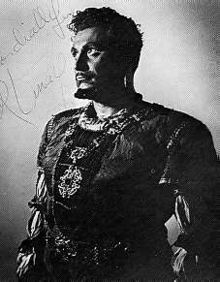
Ramón Vinay as Otello
It was of the Chilean-born tenor Ramón Vinay, who died in January 1996, during my short time as a classical-music stringer for the daily paper. The news must have come through on a day when I happened to be in the office and was nominated for the task. What I remember most is that, while I was provided with clippings of everything about him that had appeared in the paper, what I really wanted as a remembrance of this distinguished artist was a quote from the great critic Conrad L. Osborne, in a critical discography of the then-extant recordings of Verdi's Otello, to the effect that if you got through the oddities of Vinay's vocal production, you could get to the soul of Otello.
In the normal course of things at the NYT, it would have been expected that a descriptive quote or quotes would be plucked from the NYT clips, but that certainly wasn't my plan. Somehow, though, my remembered paraphrase of what CLO had written didn't seem adequate for a NYT obituary. Based on the deadline I was given, I determined that I might have just enough time to race to the Lincoln Center library (and back to the office), hoping I could track down the 1963 issue of High Fidelity in which the quote had appeared. (Luckily, I happened to know the exact issue, so I didn't have to worry about any further source-searching.)
To my surprise, if not utter amazement, this nutty scheme worked. At the library I found the appropriate bound volume of HF issues, copied out the quote (I couldn't get the bound volume to open flat enough for photocopying), and then was able to incorporate it in the obit -- which, come to think of it, I guess you could look up!
[If you want to hear Ramón Vinay capturing the soul of Otello, or however CLO put it (I should really look it up), I've already made an audio clip of the Act III monologue "Dio! mi potter scalar," which I think we'll hear in a "Sunday Classics snapshots" post this week with some other performances.]
"CAPTIVATED" BY "THE OBITUARY FORM"
Molly owns up to something that borders on obsession with obituaries as far back as she can remember.
Upon entering parties or business meetings, my mind would flash to what the obituary would be like for the person in front of me. (In my defense, the interest was also literary. They are kind of the ultimate in storytelling.) My mom traces these thoughts back to a serious car accident, about ten years ago. “You are very aware that the end could happen at any time,” she says.
And she ranges both forward and backward from her days ("not that long ago") writing obituaries.
Going forward, clearly the form and business of obituaries have clearly been transformed by the drastic shrinkage of newspapers and by the rise of digital media, notably social media.
With Facebook, Twitter, Snapchat, and Instagram, we are not only able to consume more media, but are able to create more media, media that narrates our lives the way we want it to be narrated—in effect, we have more control over our own life story now than ever.
And this translates to our death story. Today, instead of objective, reported obituaries or even paid, family-written eulogies printed in newspapers, there are sites like legacy.com—which publishes family- or even self-written obituaries online, complete with a guest book for comments—and myebit.com, which allows you to “create a free custom memorial at the world’s largest memorial site.” In February of this year, Facebook changed its policies, allowing you to designate a friend or family member to execute your Facebook “estate,” managing your account after you’ve died.
"It's all very soft and loving," Molly quotes Dr. Nigel Starck, author of Life After Death: The Art of the Obituary. "But it's untrustworthy and full of lies. It's just untrue. It's rubbish. But people want to express their grief. You cannot trust them as a historical source."
Of course, the advent of those "objective, reported obituaries" Molly referred to is itself a fairly modern phenomenon. It took a lot of doing to transform either sensationalist or elegiac yarns into a serious form of journalism, an attempt to give some kind of honest accounting of the person's life -- which is often not at all what the departed's family, friends, and admirers are looking for.
Molly traces the twists and turns in this evolution, and eventually comes to a crucial figure in the story of obituaries: Alden Whitman, "who wrote obituaries in the New York Times from 1965 to 1976.
He viewed them as feature writing, as biographies, and was famously profiled in 1966 by Gay Talese in an Esquire story called “Mr. Bad News.”
“For an obituary writer there is nothing worse than to have a world figure die before his obituary is up-to-date,” Talese wrote. “It can be a harrowing experience, Whitman knows, requiring that the writer become an instant historian, assessing in a few hours the dead man’s life with lucidity, accuracy, and objectivity."
And, for some papers -- especially larger papers like the New York Times, the Economist, the Guardian -- this remains true today. Obituaries are objective features, written by journalists.
And she talks to the NYT's current obituatry champ, Margalit Fox, author of "more than 1,200 obituaries in her 11 years at the job."
Her job, she says, is to maintain objectivity. I asked her if families, especially today in the digital age, ever try to influence the story. Sometimes, but certainly not always, she said. “What happens, too, is that you do get a sense of which people are trying to control the narrative, families trying to stage manage a story,” she noted, “And very occasionally you get a sixth sense of families trying to do it.” When that happens, she “gently but firmly” puts the families on notice—no eulogies, none of the “flowery encomiums in small town papers, where everyone was a saint and everyone died surrounded by people they loved.”
Not every grieving widower or granddaughter takes kindly to that line of thought.
“I’ve been called a bitch, a bad journalist, every name in the book. But when you calm down and listen to the message again, you realize the family is not actually identifying any issue of fact that you got wrong, it’s simply that what they wanted was a flowery eulogy and what they got was a news story,” she said.
Fox often writes of quirky contenders in history, stories of men and women who changed the world, perhaps only in tiny ways, written as a story, a biography, a fully formed narrative. I still think about the obituary she wrote in 2012 of the man who invented the bar code, a mechanical engineer in training, who sat on the beach and ran his fingers in the sand and had an idea. “The result adorns almost every product of contemporary life, including groceries, wayward luggage and, if you are a traditionalist, the newspaper you are holding.”
EVENTUALLY MOLLY SEGUES INTO A SUBJECT . . .
. . . that has hardly anything to do with obituaries. "Thankfully, though," she writes, "obituaries aren’t the only record of someone’s life," and she's off on a personal account I found fascinating in its own right.
My grandmother is now 96 years old. She lives in a nursing home near me in Boston. Fifteen years ago, she suffered a stroke. It paralyzed the majority of her left side, and left her wheelchair bound, though relatively mentally intact. The last few years, however, she has descended into a curious form of dementia—a sort of rational dementia. She tells stories. Long stories. Stories about her life. And, none of them are true.
In reality, my grandmother grew up in the “borscht belt” of upstate New York, daughter of Polish immigrants who opened a hotel. She didn’t go to college, or ever hold a job, like many women in her generation. She married young, and had three kids – including my father, her youngest. Her marriage to my grandfather was glamorous. He made a lot of money. They lived in a beautiful, large house in the nice part of Middletown, NY, and threw parties people talked about for weeks afterward. But it wasn’t a happy marriage. I grew up hearing rumors of cheating, of fighting, of anger.
The stories my grandmother tells about her life now, eight years after the death of my grandfather, are not disjointed or confusing. There are concrete details, albeit completely fabricated details, which repeat themselves from story to story. Timelines seem clear. Narratives have logical flow. She tells stories about working in the dress department at Macy’s, and starting a charity to send young students to medical school. For a while she talked about her work for the rights of the elderly, traveling all over the country, she said, to give speeches in their honor—including a talk to the members of the Supreme Court. Last year, at Passover, she told me she would be starting at Harvard Law School in the fall.
I find these stories fascinating and sad, like I am listening to my grandmother rewrite her own life in her final years —a lucid dream world where she, perhaps, did what she wanted, not what she felt she should.
When I see her, I think of the obituary a journalist would write of her life. And then I think of the one I would give her myself.
How do you mark the final day of the world's most famous toy store? How else? With selfies!
>
A scene yesterday from the last day of business at FAO Schwarz in Manhattan -- not a selfie, but an actual photograph, taken by an actual photographer, Reuters' Lucas Jackson
"By Wednesday afternoon, hours before the store was set to shut its doors at 8 p.m., many of the shelves had already been stripped bare of their stuffed animals or games, or else were marked down by fire-sale-like percentages."
As the Fifth Avenue toy store was set to close its doors, children and grown-ups took selfies with the safari of stuffed animals that lined its entrance, while others made a beeline for the big piano.
Yes, there it was: selfies! After all, can anything now be taken to exist if you can't take a selfie with it?
"The big piano," of course, refers to "the giant light-up piano that Tom Hanks and Robert Loggia dance on in the 1988 movie Big," and Big seemed to thread through the consciousness of those last-day shoppers.
Lines swerved into the hallways and other sections of the floor as people waited for their final chance to play on the piano. Each person got two minutes of near-cinematic glory.
Another employee, who was guarding the piano with a red-velvet rope, said the lines “weren’t too crazy.”
“And yeah, it gets crazy sometimes,” he added.
Dancing on the big piano -- Um, the kid at the far left doesn't look all that enthused, does he?
By the way, the periods in "F. A. O. Schwarz" -- not to mention the spaces -- in the NYT headline (and story) come not from the store name, which is correctly spelled "FAO Schwarz" but from the NYT stylebook, which gets frantic when it encounters acronyms, which in this case it chose to interpret as initials, as if it were referring not to the business but to Frederick August Otto Schwarz, who with his brothers started what was originally known as Toy Bazaar, in Baltimore in 1862. (The first New York store opened as "Schwarz Toy Bazaar" in 1870.) In theory, this relieves editors of the burden of having to find out how the store name is actually spelled, but presumably some very important copy editor still has to decide whether the "F.A.O." is an acronym or a person's initials.
"FAO SCHWARZ" ISN'T GOING OUT OF BUSINESS
That is, assuming it can be said to be "in business," since it has been owned since 2009 by none other than Toys "R" Us, after changing hands numerous times since the last Schwarz family members sold out in 1963. Toys "R" Us made the decision, announced in May, to close the flagship FAO Schwarz store on Fifth Avenue in Manhattan because of rising rents. Apparently even toys priced for the tots of plutocrats aren't profitable enough to sustain skyrocketing plutocratic rents.
Tatiana Schlossberg explains (links onsite):
F. A. O. Schwarz, in one spot or another, has been in New York City since 1862, when the Schwarz brothers opened their first toy store. It has moved around Manhattan a bit — from Broadway to Union Square and back again — landing in its current location in 1986. [As noted above, the 1862 date for Schwarz-in-NYC presence is wrong. -- Ed.]
Toys “R” Us, the chain that has owned the store since 2009, announced in May that it would close on Wednesday, though its lease would not expire until 2017.
A spokeswoman for Toys “R” Us said in a statement that the decision to close F. A. O. Schwarz was born out of the rising rent on Fifth Avenue, but that the company was looking for another location in Midtown for the iconic toy store.
It is not clear where F. A. O. Schwarz’s next home will be, although Toys “R” Us has reportedly looked at space at 1633 Broadway, close to Times Square.
Later Tatiana notes: "Even as F. A. O. Schwarz tried to become part of an increasingly brand-centric market and city -- with kiosks for Legos, 'Jurassic World' and Marvel within its walls -- it still did not command the attention of a generation used to playing with apps and touch screens, conveniently available a few feet away at the Apple Store." While the Toys "R" Us folks shop for the new home of FAO Schwarz the store, the name still graces the website, FAO.com.
As for those selfie-snapping shoppers, here's Tatiana again:
The toy soldier guards posed for their last pictures on Wednesday, and two rather dejected-looking Patrick the Pups filled the lone rotunda that used to be a mountain of plush.
Children and grown-ups took selfies with the safari of stuffed animals that lined the store’s entrance, while others made a beeline for the big piano, or hunted down the perfect toy that they would love forever.
It was the last day of business at F. A. O. Schwarz on Fifth Avenue in Manhattan.
“I’ve lived in New York my whole life, and I’ve never been here,” Carmen Thomas of Brooklyn said while wheeling her granddaughter, Sydney, through the store in a stroller. “I had to come see it before it goes.”
NOT EVERYONE'S IMPRESSED
There's the suggestion that the outpouring of love for FAO Schwartz had to do with the parents, not the youngsters. In the line for the big piano Tatiana found "a group of three mothers, each with a child in a stroller."
“I think it’s as much for us as it is for them,” one of the mothers, Jennifer Saslowsky, said. “They won’t remember this, but at least we’ll have the picture proof.”
All three said they had grown up in New York, and remembered coming to the store as children, to play on the piano or get a stuffed animal. They had not been back until now, but each planned to buy something with “F. A. O. Schwarz” written on it as a souvenir — that is, if they could find anything good enough left.
Still, not everyone was transported.
Hugh Davies stood on the sideline and watched his daughter, in her late 20s, dance on the piano.
“She’s a little old, but we’ve got to have the photo,” Mr. Davies said.
They had traveled to New York from Britain, and saw on the news that F. A. O. Schwarz was closing. Mr. Davies’s daughter, feeling nostalgic about “Big,” insisted that they come to the store.
“I’d never heard of it before,” he said, adding that he did not find the store particularly impressive, as legendary toy stores go. “It’s got cult status here in New York, though, I think.”