Sunday, January 27, 2019

The Worst Person In The World

>


Friday, Michael Bloomberg was campaigning in front of the Democratic Business Council of Northern Virginia when he assailed Señor Trumpanzee for what he called "a complete failure of presidential leadership" and "totally incompetent management." Addressing the Trump-McConnell shutdown, he added that "The whole episode really is a cynical, political stunt, and, unfortunately, we’re the ones paying the price. You’ve gotten exactly what I described: This is a person who should not be the president of the United States, and I think we have to get serious. He is way in over his head." Likening Trump to Freddy Krueger in Nightmare on Elm Street, he tried pumping himself up by saying "We’ve gotta do something to make sure we get somebody different in the White House two years from now, and I’m committed to do that. This is about competence-- or the lack of it. The presidency is not an entry-level job, and the longer we have a pretend CEO who is recklessly running this country, the worse it’s gonna be for our economy and for our security. This is really dangerous."

At this point, even Nancy Pelosi, who just forced him to CAVE and who is probably the most disliked Democrat in the country, would beat him in a head-to-head presidential match!

Last week Bill Curry, an Obama White House counselor, wrote about a visit to Donald Trump's home back in 1994, when he was running for governor of Connecticut and when Trump was a Democrat. Trump was trying to build a casino in Bridgeport at the time. "I arrived at Trump Tower," he wrote, "in early evening, accompanied by my finance chair and an old friend and colleague. Stepping off the elevator into his apartment, we were met by a display of sterile, vulgar ostentation: all gold, silver, brass, marble; nothing soft, welcoming or warm. Trump soon appeared and we began to converse, but not really. In campaigns, we candidates do most of the talking; because we like to, and because people ask us lots of questions. Not this time. Not by a long shot. Trump talked very rapidly and virtually nonstop for nearly an hour; not of my campaign or even of politics, but only of himself, and almost always in the third person. He’d given himself a nickname: 'the Trumpster,' as in 'everybody wants to know what the Trumpster’s gonna do,' a claim he made more than once."
He mostly told stories. Some were about his business deals; others about trips he’d taken or things he owned. All were unrelated to the alleged point of our meeting, and to one another. That he seldom even attempted segues made each tale seem more disconnected from reality than the last. It was funny at first, then pathetic, and finally deeply unsettling.

On the drive home, we all burst out laughing, then grew quiet. What the hell just happened? My first theory, that Trump was high on cocaine, didn’t feel quite right, but he was clearly emotionally impaired: in constant need of approbation; lacking impulse control, self-awareness or awareness of others. We’d heard tales of his monumental vanity, but were still shocked by the sad spectacle of him.

That visit colored all my later impressions of Trump. Over time, his mental health seemed to decline. He threw more and bigger public tantrums; lied more often and less artfully. The media, also in decline and knowing a ratings magnet when it saw one, turned a blind eye. Sensing impunity, Trump revived the racist ‘birther’ lie. In 2011, he told the Today show’s Meredith Vieira he had unearthed some dark secrets.


As Trump recycled old lies, Vieira had a queasy look but no apparent knowledge of the facts. Of course, there weren’t any. Trump had no proof of Obama being born in Kenya. (Since there is none.) It’s highly doubtful he had any researchers in Hawaii. (It was only after Vieira asked him that he claimed he did.) Later, when Trump’s story crumbled, he followed a rule taught by his mentor, Roy Cohn, infamous architect of McCarthyism: Admit nothing. To Trump, a lie is worth a thousand pictures.

By 2016, the private Trump was on permanent public display, raging over mere slights, seeing plots in every ill turn of events and, as always, stunningly self-absorbed. He was called a racist, a sexist and a bully. But his mental health issues were euphemized as problems of “temperament.” He lied ceaselessly, reflexively and clumsily, but his lies were called merely “unproven” or, later, “false.” The New York Times called the birther story a lie only after Trump grudgingly retracted it. Not till he was safe in office claiming that millions of phantom immigrants cast votes for Clinton did the paper of record use the word “lie” in reference to a tale Trump was still telling.


In 2016, the precariousness of Trump’s mental health was clear to all with eyes to see, but like extras in a remake of The Emperor’s New Clothes, reporters averted their glances. The day after the election, they were all in a state of shock, like staff at an asylum who woke one morning to find that the patient who thought he was Napoleon had just been named emperor of France. Once he took office, many publications began keeping running tallies of his lies. But all take a more cautious approach to questions of their origins in his deeply troubled psyche. To date, no major network, newspaper or magazine has run an in-depth analysis of Trump’s mental health.

The pathologies of American journalism are by now clichés: aversion to policy analysis; addiction to horse-race politics; smashing of walls that once separated news, opinion and advertising; an ideology that mistakes evenhandedness for objectivity. Yet we hear scant talk of reform. The press excels at public rituals of soul-searching but has little taste for the real thing. That said, its reluctance to discuss mental health reflects its virtues as well as its vices. Of major outlets, Fox News does by far the most psychological profiling. (It turns out all liberals are crazy.)

Like the language of politics, the language of psychology is imprecise; the term “sociopath” is as hard to nail down as “liberal” or “conservative.” What separates a serial liar from a pathological liar? Mere suspicion from paranoia? Righteous anger from uncontrolled rage? How do we ever tell mental illness from ill character? Our view of any antisocial behavior hinges on whether we view it through a moral, legal or therapeutic lens; to take a human life other than in self-defense is insane, and also criminal and, to many, sinful. Do we treat, punish or forgive? It’s so hard to say.

...[Y]ou don’t need to be a botanist to tell a rose from a dandelion. In 2016 Trump compared Ben Carson to a child molester and pronounced him “incurable,” but few raised the far more real question of Trump’s own mental health. Do we dare not state the obvious? You needn’t be an amateur diagnostician to see that Donald Trump is mentally ill.

Trump embodies that old therapists’ saw “perception is projection.” You can use this handy tool to locate the truth, exactly opposite from whatever he just said. He has a weight management problem, so women are “fat pigs.” He can’t stop fibbing, so his primary opponent becomes “Lyin’ Ted Cruz.” His career is rife with fraud so the former secretary of state becomes “Crooked Hillary.” He is terrified of ridicule, so Barack Obama is a “laughingstock.” When he says America’s a wasteland but he’ll make it great again, we know his secret fear.

Late in the presidential campaign Hillary Clinton famously dubbed some large portion of Trump’s base a “basket of deplorables.” A constant theme and core belief of her campaign was that his campaign was fueled by racism and misogyny, evils against which Democrats stand united. The evils are genuine and enduring, but political corruption and the economic inequality it fosters did at least as much and probably more to fuel Trump’s rise.


It’s likely that Trump’s arrested development also got him white working-class votes, among males especially. The infantilization of the American male is a phenomenon we have been slow to recognize. It is a product of fast-narrowing economic horizons fueled by cultural forces; by beer ads and anti-intellectualism, by addiction and violent video games, and now by Trump, on whom Jon Stewart pinned the fitting moniker “man baby.”

Countless surveys say our children are less racist and sexist than our parents. What many may not be is more adult. The issue isn’t the bros in the beer ads; we assume they have jobs. It’s the tinderbox we create by mixing ignorance and inequality with dashed hopes and an overwrought sense of victimization. They say presidents lead us down the paths we’re already on. It’s our job to make sure this one doesn’t.

One thing Trump has taught us is that the drafters of the 25th Amendment weren’t thinking about mental illness. It is unlikely anyone it puts in charge would have the courage to take action. In any case, progressives must put their primary emphasis on crafting a blueprint for political reform and economic justice. While they’re at it they could try making better cases on national security and climate change.

They must take another lesson from Trump: to say out loud things they never said before, not as Trump does, but with honesty, decency, reason and specificity. Trump got to be president in part because there were so many things Democrats and the media didn’t think or couldn’t bring themselves to say. Trump’s whole life is a fraud that Robert Mueller may soon expose as a criminal enterprise. His business career was a disaster till a book someone else wrote and a TV show someone else produced made him a celebrity. He then fell into the only line of work he ever prospered in: licensing that celebrity. He does it pretty well, but Zsa Zsa Gabor did it first and Kim Kardashian did it better and neither of them should be president.

In 2016 Trump’s real vulnerabilities were his mental health and personal finances. We can now add his proto-fascism and his possible or intended treason to the list. Trump was lucky in the draw. His defects were so monumental, so toxic, we had no protocol for talking about them. There are effective and responsible ways to talk about all such things, but first our media and political elites must find the courage to name them. They know as well as you or I who he is.
But what people are talking about this week, in regard to Trump, aren't critiques from the left or center, but from his base on the fringes of the far right. "Conservatives," wrote Matthew Choi for Politico, "had a quick message for President Donald Trump after he announced a deal to end the government shutdown without funds for his border wall: You caved! 'Good news for George Herbert Walker Bush: As of today, he is no longer the biggest wimp ever to serve as President of the United States,' tweeted conservative commentator Ann Coulter."
"Nancy Pelosi is alpha," tweeted conservative film maker Mike Cernovich.

And right wing commentator Michael Malice opined: "Apparently a wall isn't as good as a cave."

Conservative outlets, from the Drudge Report to Breitbart News, also blasted headlines in dramatic font declaring Trump caved with "NO WALL."


The response came like clockwork, only minutes after Trump announced the deal to reopen the government for three weeks with no guarantee of wall funds. It was unsurprising considering conservative figures including Coulter were some of the initial instigators who prodded Trump to shut down the government to get his wall.

After the White House revealed in December it could back off from Trump's demands for over $5 billion in border wall funding to avoid a shutdown, Coulter mocked the president on Twitter, leading to a feud in which Trump unfollowed one of his biggest campaign supporters.

"The chant wasn't 'SIGN A BILL WITH B.S. PROMISES ABOUT "BORDER SECURITY" AT SOME POINT IN THE FUTURE, GUARANTEED TO FAIL!' It was "BUILD A WALL!" Coulter tweeted in December.

During a March interview with the New York Times' Frank Bruni, Coulter said Trump should feel the "fear of God" if he doesn't build the wall, arguing his supporters would leave him en masse unless he fulfills his campaign promise.

"He could sell Ivanka Trump merchandise from the Oval Office if he would just build the wall," Coulter said. "If he doesn't change course, no, they're never coming back."

Trump announced the deal with Democrats during an address in the Rose Garden on Friday afternoon, where he continued to emphasize the need for physical barriers on the border. The deal will reopen the government only until Feb. 15, after which Trump said he would reshutter the government or declare a national emergency if he does not secure funding for the wall by then.

But Trump's description of what kind of wall he wants has evolved in a notable concession to his critics. Trump said Friday that natural barriers already provide ample protection in some parts of the border, and that resources for border control should also focus on ports of entry and technology developments beyond a physical barrier.

"The walls that we are building are not medieval walls. They are smart walls designed to meet the needs of front-line border agents and are operationally effective," Trump said. "We do not need 2,000 miles of concrete wall from sea to shining sea, we never did, we never proposed that."

He did propose that, however. Many times. And it was what many of his most ardent conservative followers called on him to do. But with the government shutdown stretching past a month and vital government services reaching a breaking point, the president apparently calculated that he had little choice but to concede. Trump's approval rating also suffered from the standoff, with The Associated Press showing about 60 percent of Americans blaming Trump for the shutdown.

But Malice didn't think conceding to Democrats was likely to help Trump among his most core base.

"Jeb Bush is laughing so hard rn that he's about to choke on his own puke," Malice tweeted.

Also writing for Politico on Friday, Anita Kumar and Gabby Orr wrote about the volcanic reaction on the far right to Trump's CAVE to Pelosi. One former White House official noted that "President Nancy Pelosi, she runs the country now. We went from indefinite shutdown, to down payment, to cave-- all within a span of 24 hours."
That official said that Trump’s core supporters and former aides are “furious” and “melting down.”

Bewildered by his decision to accept a deal without funding for a wall on the southern border-- not even the “down payment” the White House had requested a day earlier-- some of his most loyal supporters fretted that Trump was in danger of losing his fervent base that has fueled his presidency. It didn’t help that special counsel Robert Mueller had just released more details about the Trump campaign’s alleged attempts to backchannel with WikiLeaks during the election.

It all left Trump staring at a tough road ahead. Having staked his nascent 2020 reelection messaging to the wall fight, Trump now can’t claim victory as Democrats start entering the field. After stumbling in his first bout with Pelosi, Trump must now face an invigorated Democratic-led House keen to investigate the White House. And following Mueller's reveal of more evidence that Trump’s 2016 team tried to furtively gather intel about hacked Democratic emails, Trump will have to fend off increasing calls for impeachment.


Saturday, Alexander Burns, Jonathan Martin and Maggie Haberman at the NY Times confirmed the assertion: "Trump's defeat in his border-wall standoff with Congress has clouded his already perilous path to a second term in 2020, undercutting Mr. Trump’s cherished image as a forceful leader and deft negotiator, and emboldening alike his Democratic challengers and Republican dissenters who hope to block his re-election.The longest government shutdown in history inflicted severe political damage on the president, dragging down his poll numbers even among Republicans and stirring concern among party leaders about his ability to navigate the next two years of divided government. Mr. Trump, close associates acknowledge, appears without a plan for mounting a strong campaign in 2020, or for persuading the majority of Americans who view him negatively to give him another chance."
In a sign of the White House’s determination to project party unity, a top Trump campaign official, Bill Stepien, traveled to the Republican National Committee meeting in New Mexico this week to orchestrate an ornamental resolution of support for the president. It passed unanimously on Friday afternoon, hailing Mr. Trump for his “effective presidency” even as his shutdown strategy collapsed.

David Winston, a Republican pollster, said the burden was now on Mr. Trump to restore his stature as a leader by forging some kind of border-security deal with Democrats, and to deliver a stronger message on the economy.

“Leadership means results,” Mr. Winston said. “When you have a shutdown, people look at it, basically, as: the political system has failed.”

Mr. Winston said polling data suggested the border wall had been a problematic fight to pick. “Immigration is an important issue," he said, “but people are waking up every day trying to figure out how they’re going to pay a set of bills in front of them.”

For now, Mr. Trump remains wholly focused on appeasing his conservative base, comprising perhaps a third of the electorate, despite private G.O.P. polling suggesting that his agenda on immigration has failed to move the country in his favor, Republicans who work closely with the president said.

But Mr. Trump emerged from the shutdown with nothing to show for it, having angered swing voters with his intransigence, while disappointing hard-line supporters by failing to secure any funding for a border wall.

Conservatives still believe that Mr. Trump cannot afford to abandon his crusade for a barrier. Not long before Mr. Trump agreed to reopen the government, Representative Mark Meadows of North Carolina, a White House ally who leads the hard-line Freedom Caucus, argued that the wall fight was vital to the president’s re-election hopes.

“It’s not lost on any of us that a central component of what he said when he ran in 2016 has to be addressed in a meaningful way,” he said in a recent interview.

Privately, some of Mr. Trump’s 2016 aides have said they are pessimistic about his path to 270 electoral votes after his party’s midterm defeats in states like Michigan, Pennsylvania and Wisconsin. An Associated Press poll on Wednesday showed that Mr. Trump’s overall approval rating had fallen to 34 percent, with his support among Republicans dipping below 80 percent-- a startling turn for a president who strives for total control of the G.O.P., and has usually achieved it.

...Trump’s low standing with political moderates and especially women is leading some G.O.P. officeholders to voice unease about having him at the top of the ticket next year... [E]ven among his own political lieutenants, there is a general recognition that Mr. Trump currently lacks anything resembling a positive message.


Labels: , , , , , , , ,

Saturday, February 20, 2016

Trumpf Just Blatantly Lies His Ass Off-- Hillary's Dishonesty Is More Sneaky

>


The Clintons don't seem to get a simple point: Democratic primary voters hate when Democrats attack other Democrats. And now it isn't just Hillary's sleazy team of lobbyists, job-seekers and conservatives attacking Bernie, it's also Hillary herself. she uses the same basic debate tactics Cruz and Rubio use-- maybe she learned them when she was president of the Wellesley College Young Republicans. She slips in a quick attack on his character or his competence and then immediately says something like "but let's please talk about issues" and then throws out some policy issue that Bernie can't resist, leaving her sly, slimy personal attack hanging out there. It's how she lost to Obama in 2008.

Bill Curry, a former counselor to President Clinton, writing for Salon Tuesday, was amazed as I am that the Clintons don't understand the vicious, ugly negative attacks are losing her the election-- if not the primary, then surely the general. "How Clinton lost [in New Hampshire]," he wrote, "is as telling as the historic margin she lost by. Just as in 2008, she presented as a hawk to a party bone-weary of war. Now as then, her high-dollar, tone-deaf, leak-prone campaign telegraphed every punch. Her backers harp on her experience-- but experience only counts if you learn from it. Eight years later, Clinton makes the exact same mistakes. Still, party elites have bet the farm she’ll have it all sorted out by October. Dangerous wager."
She isn’t learning from this race, either. Her response to New Hampshire has been to double-down on her strategy. How such a bright person could be such a slow learner is a mystery. Her worst moments prior to New Hampshire were her ham-handed attempts to take down Sanders. Chelsea distorted his healthcare plans, Bill ripped his character. Hillary accused him of an “artful smear” for suggesting, obviously, that banks give to super PACs to influence policy. She voiced “concern” over reports he’d mingled with real live lobbyists at Democratic fundraisers. But to many voters the Clintons attacking Sanders’ integrity was like draft-avoider George W. Bush swift-boating Purple Heart-winner John Kerry-- except this time it backfired, and her whole family took the hit.

At this point she might have decided to curtail the personal attacks, but alas, no. In a public television debate two days after the primary, she waited till the last second to launch an attack, this time on Sanders’ alleged disloyalty to Obama. It seems this will be a principal theme going forward, so in case you missed, a sample:
Today Senator Sanders said President Obama failed the presidential leadership test…. he has called him weak. He has called him a disappointment. He wrote a forward for a book that basically argued voters should have buyers’ remorse when it comes to President Obama’s leadership and legacy it is the kind of criticism I expect from Republicans. Calling the president weak…  [Saying] several times he should have a primary opponent when he ran for re-election…
Much of this is flat-out false; all is shorn of context and rife with what Politifact called “half-truths.” Bill Press wrote a book criticizing Obama, but Sanders didn’t write the foreword (just a blurb that doesn’t criticize Obama). He never called Obama weak or a disappointment, though he once said Obama showed weakness in budget negotiations. Talking to a radio host who wanted Obama primaried, Sanders said open debate was a good thing. But notice in the above quote how Clinton, the Mary Lou Retton of syntax, made it seem Sanders said all these things.

When Clinton at last holstered her weapon, moderators Judy Woodruff and Gwen Ifill, who’d done yeoman’s work to that point, said there wasn’t time for Sanders to answer her final fusillade, but that he could do so in his closing remarks. Off balance for the first time all night, he split the difference, which made for a weak finish to an otherwise strong performance. Too bad; he deserved a chance at a full rebuttal even if it meant shaving a minute or two off Antiques Roadshow.

...Clinton’s ad hominem attacks-- call it the politics of personal destruction-- poison the air around her. Just before New Hampshire, deservedly beloved feminist icon Gloria Steinem told Bill Maher that young women join Sanders’ campaign to meet guys. Steinem got taken to the Internet woodshed for making a lighthearted, self-deprecating joke, on a comedy show, no less, but only because the tone of Clinton’s campaign is so rancid. Clinton must see how her scorched-earth policy hurts her family, her friends and her campaign, but for her there’s never any turning back.


In another reminder of 2008, Clinton has added race to the mix. On primary night on CNN, Clinton ally Michael Nutter slyly accused Sanders of subtle racism, terming his call for criminal justice reform “mildly offensive” because, Nutter falsely charged, Sanders never talks about other African-American issues. For some reason-- it can’t be ratings-- CNN lets commentators with clear conflicts of interest mouth thinly veiled partisan message. This is worse. Nutter is no more “offended” than Hillary is “concerned” or Bill “shocked” to discover trolls on the Internet. They want us to think Bernie does what they do, but of course he doesn’t.

...On Friday we learned that DNC chairwoman and Clinton lifer Debbie Wasserman Schultz ended Obama’s ban on federal contractors donating to the party. (So much for loyalty to Obama.) On Wednesday we learned Clinton will get a majority of New Hampshire delegates despite losing in a landslide. Schultz told CNN the reason 700 unelected superdelegates get to vote at the convention is to spare grass-roots activists the burden of having to primary them. No matter how much money Schultz wrings from contractors or how many superdelegates Clinton piles up in states Sanders wins, it won’t equal the price they pay for such cynicism.


To the extent Clinton gets away with it, she can thank a media nearly as out of touch as she is. Newspapers beat TV for analysis, but the gap narrows every year, and not because TV is getting better. Elite reporters reflect the elite consensus, which accounts for such recent Washington Post headlines as “Democrats Would Be Insane to Nominate Sanders” and “Sanders’ Oddball Coalition Savors Its Victory.”

...Neoliberalism appeals to the rich. Neoliberal Bill Clinton was the first Democratic presidential nominee to outspend a Republican. In 2008 Obama outspent John McCain 2-to-1, breaking a record set in 1972 by Richard Nixon. But neoliberalism is killing the middle class. It’s why both parties rely on cultural issues to hold their bases. If you back abortion rights, same sex marriage and gun safety you’re a Democrat. If not, you’re a Republican. On economic issues it’s more complex. If you hate big banks and political corruption, you could be for Sanders or Trump. It’s why Sanders talks so much about these things; they’re what the election’s all about.

When Clinton isn’t calling Sanders a traitor, she says she shares his goals. But she doesn’t. Clinton was part of the neoliberal revolt that destroyed the Roosevelt coalition and she is as we’ve seen, a woman of markedly fixed views. She may be Obama’s heir, but Sanders is FDR’s. She campaigns as she does out of habit, and to hide the very real choice. The neoliberal experiment is over. Democrats, proud heirs to Franklin Roosevelt, are ready to come home.
She'd probably prefer primary voters to be arguing over campaign tactics than over her unprecedented-- but not well-known--personal corruption. The video up today from Thursday's Las Vegas Democratic town hall, is also something Hillary would probably not want Democratic primary voters to be spending any time thinking about. It reinforces her dishonesty and untrustworthiness, as well as her corruption and affinity to the banksters. Have you checked out IWillLookIntoIt.com lately? It's been over two weeks since the site went up. Yesterday Lee Fang caught her lying again: "Clinton speaking contracts that have been made public stipulate that a stenographer is hired to make a record of her speeches and that she owns the transcripts. As the demand for her to release the transcripts has increased, Clinton’s team has reportedly began reviewing the documents to assess the political risk of making them public." He also caught her making it clear which side she's on-- not workers or ordinary American families, but the same predatory banksters the Republicans support.
Records show Bill and Hillary Clinton made over $125 million from giving paid speeches since 2001. In particular, critics question why Hillary Clinton received over $675,000 from Goldman Sachs, an investment bank notorious for using its ties to public officials to influence policy, over the course of three speeches in 2013.

And while Clinton likened her paid speeches to similar speeches given by Bernie Sanders, financial records show Sanders made $1,876 for two paid speeches and a television appearance last year. Sanders donated the speech fees to a local charity in Vermont that serves low-income families.

An attendee of one of Clinton’s Goldman Sachs speeches said she gave such a flattering speech that she “sounded more like a Goldman Sachs managing director.” According the Wall Street Journal, Clinton used one of her speeches to the bank to thank the audience for what they had done for the country.
Watch the video up top again. Then hit the thermometer:
Goal Thermometer

Labels: , , ,

Wednesday, August 26, 2015

Sanders Up Big in New Hampshire; Biden Worried About Clinton's Electability

>

June 2007 — Clinton and Biden confer during a Democratic primary debate at Howard University. (Pablo Martinez Monsivais/AP Photo; source)

by Gaius Publius

A newsy piece as we watch the shifting winds. First, there's a new PPP poll of New Hampshire voters with a Trump-centric headline — "Trump up big in NH; Sanders leads Clinton" — but for me the biggest story is Sanders' large and broadening appeal (my emphasis throughout):
There's been a big shift on the Democratic side since April as well. Bernie Sanders now leads the field in the state with 42% to 35% for Hillary Clinton, 6% for Jim Webb, 4% for Martin O'Malley, 2% for Lincoln Chafee, and 1% for Lawrence Lessig.

The main story in New Hampshire is how universally popular Sanders has become with the Democratic electorate. 78% see him favorably to only 12% with a negative opinion- that makes him easily the most popular candidate on either side with their party's voters. Meanwhile Hillary Clinton's favorability numbers have taken a little bit of a hit- she was at 78/10 with Democratic primary voters in April, but now she's at a 63/25 spread.

The ideological divide is actually not that stark on the Democratic side. Sanders is ahead with 'somewhat liberal' voters (45/32), 'very liberal' ones (46/37), and moderates (40/36) alike. And although there is certainly a gender gap Sanders is ahead with both men (44/30) and women (41/38). But the real big divide we see is along generational lines- Clinton is ahead 51/34 with seniors, but Sanders has a 45/29 advantage with everyone under the age of 65.

New Hampshire is somewhat a world unto itself in the Democratic race. We're still finding Clinton well ahead everywhere else. But it's clear there's a real race now in the Granite State.
A win in New Hampshire, or a very credible showing, means Sanders should survive through Super Tuesday in early March at least. It's also good news that his appeal has broadened.

Biden Has His Doubts About Clinton

And now the second item. I earlier wrote that Democratic Party insiders — the small group of people who will really decide whom the party nominates, if they can get away with it — are having doubts about Clinton's ability to turn out the base. Now the Huffington Post offers Joe Biden's recent thoughts, according to a "former adviser who remains close to the vice president":
Joe Biden Worried Hillary Clinton Isn't Credible On Income Inequality

If Vice President Joe Biden decides to jump into the presidential race, his decision will be driven, he has said in recent conversations, by a belief that Hillary Clinton's background won't allow her to be a credible messenger when it comes to income inequality, which Biden sees as a defining issue. But even as Biden sees that opening, and is being urged by members of his family to run, his remaining reluctance stems from his wife Jill Biden's discomfort with a bid at this moment.

... His final choice on whether to run, according to a Democratic fundraiser who has met with Biden aides, will likely come in late September. However, another prominent Democratic fundraiser who has raised money for Biden in the past suggested that an entry could come as late as early October, in the weeks leading up to the first Democratic debate.

Biden is also waiting to see how the current Democratic primary process plays out. It's not just Hillary Clinton's trouble shaking criticism over her use of a private email account while secretary of state that he's watching. Biden has also expressed concerns in conversations with fellow Democrats that Clinton won't be able to effectively push issues like economic inequality, owing to her time at the Clinton foundation and the paid speeches she's given since leaving the State Department.

For weeks now, Democratic officials had assumed that talk of a run from inside Biden's orbit was merely an effort to keep options open should a Clinton candidacy fall apart. But in recent days, the chatter has grown louder and more specific, with inquiries being made into how a campaign structure could be put together and how much money could be raised. Speculation hit a near fever pitch this past weekend, after the vice president Saturday with Sen. Elizabeth Warren (D-Mass.), who has yet to endorse in the primary.
Were these "thoughts" leaked with permission? Likely. Does that matter? In this case, no. It almost strengthens the case and also suggests that other insiders — Biden is a consummate insider, just like Clinton — may have similar doubts.

As Bill Curry presciently wrote in June (quoted and discussed here):
Hillary Clinton is going to lose: She doesn’t even see the frustrated progressive wave that will nominate Bernie Sanders

Clinton's positioning on TPP is way too cute. When it passes with Dems' implicit support, grass roots will explode

... A bigger problem for Clinton may be that we know what she thinks. Her platform is like Obama’s trade deal; she won’t say what’s in it, but we can easily guess. It isn’t populism and it isn’t reform. The TPP? She never met a trade deal she didn’t like. The minimum wage? She and Obama let McDonald’s get the drop on them. The surveillance state? Her handling of her emails told us all we need to know of her views on transparency. More war in Iraq? For 12 years as a senator and secretary of state she was John McCain’s best friend. If she gets to be commander in chief, get ready to rumble.

She’s weakest on the sleeper issue of 2016: public corruption and the general debasement of politics and government. Voter disgust is so deep even consultants who make their real livings off corporate clients tell their political clients to talk about it. In her speech Clinton vowed to “wage and win four fights for you.” The first three were jobs, families and national security. The fourth was “reforming our government and revitalizing our democracy.” She vowed to overturn Citizens United and fight GOP efforts to disenfranchise the young, the poor and people of color, but then drifted off onto technology and cutting waste. Unlike nearly every Republican announcing for president, she never mentioned ethics or corruption.

Democratic elites don’t want to hear it but Hillary Clinton’s in trouble. It isn’t in all the data yet though you can find it if you look. In a straw poll taken in early June at a Wisconsin Democratic convention she edged out Bernie Sanders by just 8 points, 49% to 41%. In a poll of N.H. primary voters this week she beat Sanders by 41% to 31%. An Ohio poll had her in a dead heat with the likes of Ted Cruz and Rand Paul. If Sanders can poll 40% in a Wisconsin straw poll in June he can do it [in] an Iowa caucus in January. Imagine a Hillary Clinton who just lost Iowa and New Hampshire to Bernie Sanders. ...
Bill Curry is himself an insider, or at least a former one. As his Salon bio states: "Bill Curry was White House counselor to President Clinton and a two-time Democratic nominee for governor of Connecticut." Just like Biden, Curry talks to people who know people who know things, even if they're sometimes yelling at him.

What Does This Mean for Clinton?

This shift in the insider wind could mean any number of things for Clinton, including nothing at all. After all, the Democrats have the Republican's "front-runner problem" in a slightly different form. Republican insider decision-makers may not want Trump as their nominee, but to whom do they turn? Their electorate clearly prefers none of the other alternatives, and Trump is belittling them daily. Every minute he stands tall, they look smaller and smaller.

Democratic insider decision-makers may fear a loss with Clinton, but to whom do they turn? To Martin O'Malley, polling near the bottom in every state? To Bernie Sanders, who could win (in the opinion of many of us), but who is the insiders' worst nightmare? Sanders, after all, is a card-carrying member of the hated "Warren wing," and we've seen time and again that "Wall Street" Democratic insiders would rather lose an election — or a house of Congress — to insiders from the other party than win with outsider progressives from their own.

Do you see most insider Democrats actually backing a Sanders bid, if he does get the nomination? I think he could easily beat any of the Republicans, especially and including Donald Trump, but I'll bet he has the party leaders' wind in his face as he does it.

So far, according to the rest of the Huffington Post article, Biden's bid to attract anti-Clinton insiders has drawn little interest. We'll see how this plays out. Which brings me back to a point I've made for a while, that this is the most important presidential election in this generation. Its consequences will be with the country — if not the species — for a very long time.

It's also turned interesting, almost thriller-interesting. Stay tuned.

(If you like, you can help Sanders out by clicking here; adjust the split any way you wish at the link.)

GP

Labels: , , , , , , ,

Tuesday, June 23, 2015

Democratic Elites Don’t Want to Hear It, But "Hillary Clinton’s In Trouble"

>


The famous "Yes We Can" theme, just before its conversion to "No I Won't." Why is this painful to watch? Six years of broken promises and a party-wide TPP cave by its leaders have rebranded Democrats for a generation.

by Gaius Publius

TPP and Fast Track may be closing down the show and heading home. We may (or may not) know its fate very soon. Rather than make a prediction, though — I have one, in case you're wondering, and my Twitter followers have heard it — let's go broader this time.

Ever since Bill Clinton, Al From and the DLC remade the Democratic Party into the "other party of money," there's been a train wreck just waiting to happen. It's taken a long time for voters, the people who keep Democrats in elected office, to start to figure out the betrayal that always awaits them. I think the 2008 burst of "Yes We Can" enthusiasm — genuine, heartfelt, a true Children's Crusade of newfound innocence — was that last golden opportunity for the Party to rescue itself from the grip of leaders who only pretend to have its voters' interests at heart. Yes, they care about some issues, but even then, only when forced, and only when the polls are running in their favor.

That "Children's Crusade of newfound innocence" I mentioned was not the innocence of children who believe that impossible unicorns exist. It's the adult suspension of belief that all Democrats would ultimately sell them out; it's one last hope (to coin a phrase) that at least one Democratic leader would actually act in their interests, just this once.

But Nancy Pelosi's 2006 "impeachment is off the table" was a harbinger. Then came Candidate Obama's 2008 betrayal of his FISA promise; his appointment of Robert Rubin–Wall Street regulars to his cabinet; his calculated and deliberate sellout of the ACA public option, using his friends in the Senate to screw his enemies in the House, meaning progressives; his chief of staff Rahm Emanuel's contempt for those same progressives — and we're not even out of year one.

And now, TPP, the largest "trade" deal in a generation, the "largest in the history of commerce" as one writer put it — and the leaders of the Democratic Party, even Nancy Pelosi, are dialing for donor dollars while dancing to fool the base.

So you see what I mean by "going broader." This moment connects not just to the Fast Track votes, the TPP votes (if they come), the TISA votes (which, if they come, will change labor and wages in this country forever). It connects to the Democratic Party "brand," to the 2016 races (all up and down the ticket) and ... Hillary Clinton.

There's no better person to help us along than Bill Curry, writing at Salon. Trade and TPP is not his starting point, but it can be ours. Curry writes (my emphasis throughout):
Politicians have always ducked tough issues, but today’s Democrats are the worst. When the TPP came before the House, enough Democrats played it cute to leave the outcome in doubt till the very end. Minority Leader Nancy Pelosi didn’t tip her hand until just before the vote. Many who voted no never said exactly why. Some want to curb currency manipulation. Some oppose the fast track process, others the secret tribunals or the intellectual property rules that actually restrain competition. If the caucus as a whole has a bottom line, no one knows what it is.

The TPP is a mystery because our leaders wish it so. We don’t know what’s in it because our president won’t let us read it, and not out of respect for precedent or protocol. George W. Bush showed us drafts of his trade agreements. We’re negotiating one right now with Europe, and Europeans get to read those drafts. If a comma gets cut from the TPP, hundreds of corporate lobbyists know in an instant. The only people who don’t know are the American people — and that’s only because our president thinks our knowing would ruin everything.

The process by which Congress considers the TPP is confusing in itself. The pact is still being negotiated by the 12 nations who’d be parties to it. The fight now is over legislation meant to grease the skids for it when it finally arrives. At issue are trade promotion authority or TPA — the ‘fast track’ by which Congress vows not to amend or filibuster a trade agreement it hasn’t even read – and trade adjustment assistance or TAA, which gives benefits (money, health insurance, job training) to workers who can prove to the federal government that they lost their jobs due to trade. Signed into law by John Kennedy, expanded by Bill Clinton and extended by George W. Bush, the half-century old program is set to expire in September. The bills now before Congress would keep it alive another six years.
But the Senate passed a united bill that yoked Fast Track and Trade Assistance (TPA + TAA) as a single bill; the House split the bills and passed only half, resulting in temporary defeat for the pro-corporatists.
The press called the June 12 votes a huge win for labor and a “humiliating defeat” (the Washington Post) for Obama. Reading such stories one might think fast track or even the TPP itself had suffered a crushing blow. Some on the left even called it historic. ...

[But] I wouldn’t pop any corks quite yet. For the first time ever Congress hit the pause button on globalization, but that’s all it did. House Dems didn’t suddenly lurch left; they just did what they always do. In 1993 they voted no on NAFTA. In 2002 they voted against the Iraq War. In 2010 they passed an Obamacare bill with a public option. But they can’t ignore their president or their donors forever. In 2008 they resisted Bush’s bailout but finally gave in to Obama and Wall Street. Republicans held firm, thus setting in motion the Tea Party and the sad, sorry debacle of 2010.

On Thursday the Republicans did what any fool could have predicted: they passed a new rule and sent the TPA to the Senate sans worker assistance. We don’t know what will happen next, but we do know fast track has already passed both houses of Congress once. In the end, Obama, Boehner, McConnell and their global capital partners will likely get their way, but June 12 may yet prove historic.
Democrats just "did what they always do" — they attempted the right thing, then surrendered to party leadership. Which brings us to the party split, a chasm really, and open rebellion, this time by the voters.

The Peasants Are Rebelling and the Leaders Aren't Listening

Curry on how all this plays with the base:
Krugman’s right: there’s a rumbling out there, but most Democrats are a long way from hearing it, let alone joining in. If House Dems stand firm, they too may plant the seeds of a grass-roots movement. Much of their party will resist. Every political party is really many parties. The Democrats’ presidential, Senate, governors’ and donors’ parties all line up with global capital. Even in the House, Minority Whip Steny Hoyer is a staunch ‘free trader’ and Pelosi herself spent the week before the vote quietly imploring her caucus to swallow the poison pill.

No one knows where scores of Democrats really stand. Both parties are caught in a crossfire between their donors and their base. Republican voters are suspicious of the TPP and hate fast track, mostly because they hate Obama. Democratic voters hate fast track but accept the TPP, mostly because they love Obama. Republicans in Congress are civil because they can’t bash Democrats for doing what their base wishes they would do. Democrats in Congress are quiet because they don’t want their donors to think they mean what they say — and don’t know when someone may offer them something to take one for the team by switching sides.
As a party, the Democrats are obviously lost, and their leaders are swimming in donor-funded obfuscation:
This week I told two liberal friends that Pelosi is trying to find “a path to yes on fast track.” (Her words) Both said Pelosi and Clinton had broken with Obama, are moving left and now oppose the deal. In terms of strategy and message it was true — all except the part about Clinton and Pelosi opposing the deal.
There's much about Clinton and Pelosi pretending to care about workers, when all they want is for the deal to be done without their fingerprints on it. That obviously applies to Pelosi. Curry says that's equally true of Clinton.

Clinton Is Trying to Run Obama-2008

In a fine catch, Curry says this:
Clinton’s trade talk is of a piece with her entire 2016 campaign. It’s also of a piece with Obama’s 2008 and 2012 campaigns. Clinton insiders make no secret of her desire to emulate him. Obama’s 2008 campaign had three hallmarks. One was its fundraising. Obama was the first Democratic presidential campaign to outraise a Republican on Wall Street and the first of either party to crack the code of Internet fundraising. The second was its massive, web-driven, volunteer effort, probably the biggest of any presidential campaign in history.

The third was its message, at once fiercely populist and reassuringly centrist — and vague. Much of it came from chief strategist David Axelrod who opined that for too long Democrats had been mired down in issues. His campaigns were famous for selling personalities rather than platforms, for finding ways to reconcile our conflicts in the biographies of his candidates. It worked for Obama. “Yes we can,” audiences called out. “Do what?” few bothered to ask, or thought they had to.
For Curry, that won't work twice. He makes a fine case, but the reasoning is obvious as well. Can she make a Larry Summers, say, her Secretary of Treasury and claim the Piketty mantle of "Yes I Care" about wealth and inequality? Obviously not.

Hillary Clinton "Is in Trouble"

Which brings us to 2016 and the Democratic candidate for president:
Democratic elites don’t want to hear it but Hillary Clinton’s in trouble. It isn’t in all the data yet though you can find it if you look.  In a straw poll taken in early June at a Wisconsin Democratic convention she edged out Bernie Sanders by just 8 points, 49% to 41%. In a poll of N.H. primary voters this week she beat Sanders by 41% to 31%. An Ohio poll had her in a dead heat with the likes of Ted Cruz and Rand Paul. If Sanders can poll 40% in a Wisconsin straw poll in June he can do it [in] an Iowa caucus in January. Imagine a Hillary Clinton who just lost Iowa and New Hampshire to Bernie Sanders. It’s still hard to picture but it gets easier every day.
Which brings me back to my point — this is the most important election in a generation, 1968-important in its possibilities. One battle at a time, starting with the Democratic primary. Yes We Can put a real progressive in the White House, if one will run. Sanders is running. And if he gets the big chair, he won't be Mr. "No I Won't" but Mr. "You Bet I Will."

GP

Labels: , , , , , , , , , ,

Tuesday, January 20, 2015

Progressives And The Democratic Party-- A Match Made In Hell?

>

The party's over...

"It's always 'Groundhog Day' for Democratic leaders who can't adjust, can't organize and can't win. Let's dump them." That sounds like pretty standard fare for DWT but it comes from a Salon post by Bill Curry, a White House counselor to President Clinton and a two-time Democratic nominee for governor of Connecticut. His warning is clear as a bell and, alas, falling on deaf ears: "As a wise man once said, never underestimate the capacity of an entire social order to commit suicide. The Democratic Party’s old order is doing it now. It may seem strange but make no mistake, the Democrats’ leaders are already unconscious. If they don’t wake up soon, they’ll go the way of the Whigs. If progressives don’t wake up now, they’ll go with them."
In 2014 Democrats were supposed to hold a populist revival. Aside from a few tinny sounding ads, they didn’t. Tied to the tracks with a giant locomotive barreling down on them, they couldn’t bring themselves to cut their Wall Street ties and dodge otherwise certain death. Now, after six years of blown chances, they say they’re ready to act as our tribunes and ask us once again to commingle our hopes and dreams with theirs. I say not so fast.

Obama has made more populist gestures in the last two months than in his first six years as president. It’s why his popularity’s rising. Some say it’s the economy, but the economy rose for some time without the middle class or Obama’s ratings being much helped by it. Proposals to fund universal access to community colleges and tax Wall Street speculators to finance a middle class tax cut are catnip not just to the left but to the middle class. The question for us all is whether this populist charm offensive signals real change.

I believe that without a stronger, more independent left the Democrats’ rhetoric will remain just that. Proof is everywhere in the party, but since its congressional wing is its most enduring and influential component it makes sense to look there first. As always, the most relevant comparison is that between words and deeds.

After their worst Senate loss in 34 years and worst House loss in 86 years, not one Democratic leader in Congress got ousted. One can’t help but ask: What does it take to fire these guys? In 1998, Newt Gingrich lost four measly seats and got the ax. They say we should run government like a business-- but if you’re a Democratic leader in Congress you can bankrupt the company and still keep your job.

Democratic caucuses are literally run by gerontocracies. This isn’t another misuse of the word “literally.” Senate Leader Harry Reid is 75. Whip Dick Durbin is 70. Their youth ambassador is 64-year-old Chuck Schumer, who has served as chair of the policy committee, vice chair of the caucus and less formally as guardian and protector of the Democrats’ late-life marriage to the barons of Wall Street.

No Senate leaders lost their jobs but Reid did decide, a bit late, to freshen up their images. To achieve the desired effect, he elevated two women to leadership posts: Minnesota’s Amy Klobuchar and Massachusetts’ Elizabeth Warren. Progressives were happy about Warren but it’s unclear that Reid meant her to serve as anything more than his ambassador to them. She gave a rousing speech before the December budget vote, but it would seem her fellow leaders weren’t listening.

In the House, Pelosi and Assistant Leader James Clyburn are 74. Minority Whip Steny Hoyer is 75. Steering and Policy chair Rosa DeLauro is 71. Caucus chair Xavier Becerra is 56 and in his twelfth term. Next to them, House Republicans look like ingénues. John Boehner is 65. Majority Whip Steve Scalise is 49. So’s Majority Leader Kevin McCarthy. McCarthy replaced Eric Cantor, 51, who lost a primary, a handy means of forced retirement Democrats no longer employ.

...It’s easier to milk middle-class resentment than meet middle-class needs, but the reason Democrats so rarely address the distribution of wealth, power or opportunity is that most of their leaders and all of their consultants are so tightly bound to corporate interests. When Emanuel was on Clinton’s campaign, he was being paid by Goldman Sachs. On leaving Clinton’s White House, he snatched up $16 million in a 30-month layover at another investment bank.

I question no one’s integrity. What Rahm did, everyone does, but isn’t that the problem? All top Democratic consultants make most of their money from big business. However principled or smart they may be, they reflect their clients’ views and apply lessons learned in their service. The inevitable result is a campaign like the one we just saw.

2014 wasn’t about money. Democrats outspent Republicans in key races and still lost. Though they ran some feeble candidates, it wasn’t about personnel either. Some blame Obama, but his low standing alone can’t account for such a drubbing. Voters were thinking about Obama’s program, not his personality. It wasn’t about him; it was about them, and all the ways they felt politicians had betrayed them.

Early in 2014 a few Democrats saw disaster looming and tried to avert it. In the spring a rump caucus of 20 or so House members met to consider their plight. They recalled running in 2006 on a plan that set out broad goals-- raising the minimum wage, getting out of Iraq, defending student loans-- but also concrete steps and firm deadlines. It wasn’t the main reason they won, but they thought it helped. Might something like it help now?

Washington, you’ve no doubt heard, is a small town, and word of the meeting spread fast. When Pelosi got wind of it she congratulated the group for showing some initiative. Not really. The idea of members meddling in policy when they should be home memorizing their stump speeches seemed to upset her. At the next caucus she made it clear that while she appreciated their input, this was a job for the consultants.

In July she unveiled a brand-spanking-new 2014 message, like the GOP’s famed “Contract with America,” but dubbed, less snappily, “A Middle Class Jump Start.” You think you never heard of it but you can’t be sure; it’s so forgettable you can’t recall it now and you just read it. Before Pelosi took her first question it was dead, leaving Democrats to wander in a political desert without water or a compass.

Bereft of a platform, they did what they do best; raised boatloads of money; honed wedge issues for constituencies they treat like so many niche markets; filled the air with locust-like swarms of TV ads and geared up their highly mechanized turnout machine to deliver the base to the polls. We know how that went.

They ran the same race everywhere. Colorado’s Mark Udall was scorned for running endless ads on “women’s issues,” but he could be his party’s poster child. He, his opponent and their various fronts ran 60,000 TV ads. One state; one race: 60,000 ads. Udall’s differed little from those all Democrats aimed at blacks, Latinos, students, veterans; any group their pollsters could configure. Voters had other concerns but Udall didn’t hear them, or notice Republicans running as fast as they could from the fight he was bringing. In this too he was like most Democrats.

On Election Day, four red states voted to raise the minimum wage. Some said it proved that if voters paid attention they’d all be Democrats, but it could just as easily suggest that voters see Democrats as insincere and ineffectual. Had Dems raised the minimum wage when they had the votes to do it, more workers would have gotten bigger raises sooner, states would have been spared the expense of holding referenda and Democrats would have gotten all the credit.

It’s a lesson Democrats never learn: Elections turn more on how you govern than on how you campaign. In 2012, pundits wanted Obama to run, Harry Truman-like, against a do-nothing Congress. He couldn’t because Harry Reid ran a do-nothing Senate, blocking any vote he feared might embarrass his caucus. Democrats who never governed as populists ran as populists in 2014 and lost because running on policies you don’t support makes you look like a hypocrite, not a populist.

Within hours of the Democrats’ own Dunkirk, Republicans were readying their 2016 cross-channel invasion. Republicans know governing is the key to winning. In Congress they opened with the Keystone pipeline, inflating by tenfold the number of jobs it could create. Next up: a budget that cuts taxes but not defense or middle-class entitlements, the viability of which they exaggerate by a factor of infinity. No one knows for sure what Obama will ultimately do on either front. We do know he has yet to offer a solid rebuttal to GOP propaganda, or a credible plan to grow jobs and lift wages.

How are Democrats in Congress preparing for 2016? It’s a trick question, of course. They aren’t. Apart from re-upping the contracts of their veteran leadership team, their every action mocks the populist image they sought to project in the campaign. It’s almost as if they don’t know we’re watching them.

...Worst of all was the Democrats’ complicity in passing a corrupt, shameful budget. Aside from its senseless priorities-- wars are winding down so let’s give the military some more dough-- it curtailed efforts to slow global warming, restored Wall Street grifters’ ability to shift their losses onto honest wage earners and weakened what’s left of campaign finance laws. Without scores of Democratic votes it could never have passed.

The budget crystalizes a debate Democrats have with themselves every day. On one side are those who decry the compromises they believe led the party to its present impasse. On the other are those who decry the decriers, who say life is compromise and that criticizing Democrats only helps Republicans. It’s a false choice. The issue isn’t whether to compromise but how and with whom.

Democrats thought opposing the budget risked a shutdown. But could Republicans afford to get caught sticking taxpayers with the bill for Wall Street’s next scandal? Within weeks of an inglorious defeat the Dems had a chance to hit the reset button. Instead they gave Republicans priceless cover while making it harder for their own members to go on posing as populists. They bartered their honor and got nothing in return. Someone should tell these “realists” that their compromises are killing them.

In late November Chuck Schumer stopped by the National Press Club to expound on the election. After urging his party to “embrace government,” he said its big mistake was passing Obamacare: “Democrats blew the opportunity the American people gave them… We put all our focus on the wrong problem-- health care…” He said Democrats should “focus on the middle class” and craft “stronger themes” for the next campaign.

With so many reporters on hand it’s odd no one thought to ask Schumer if he understood that health care done right would be the best gift Democrats ever gave the middle class, or had ever considered the possibility that he himself might be part of the problem. Language for the Wall Street bailout came from Citicorp, a Democratic ally in good times. Schumer was all for it. He thinks he can make up lost ground with stronger themes. Some people never learn.

Schumer gets a lot wrong, but credit him at least for speaking up. After their last defeat Republicans tripped over themselves to confess old sins and proclaim new visions. Congress opened with hardly a whisper of any new Democratic strategy or agenda. Instead Democrats prepare for 2016 in their usual way: raising money to pay for polls, to craft ads, to woo voters. Someone must break their tragic cycle of dependency and begin to build a new model of politics and governance. Who will it be? We know for sure it won’t be them. How could it be? They’re practically dead.
He also wrote that "Hillary Clinton is poised to run the same awful race in 2016 she ran in 2008." And that isn't all. The new front at the DCCC, Ben Ray Luján, is an errand boy for Steve Israel and is recruiting a dreadful cast of characters for 2016-- as is the DSCC.

Labels: ,

Wednesday, July 30, 2014

Today's Democratic Party-- Soul On Ice

>


If you're from Connecticut, you probably remember Bill Curry as a leader of the liberal wing of the Democratic Party and a two-time nominee for governor. Most Americans who know who he is, though, know him for his role as a domestic policy advisor to Bill Clinton. I know the Clintons are very touchy about their sometimes tattered brand and I suspect Bill Curry won't be invited to the Medici Palace when Hillary takes over the world. A look at the piece he wrote Sunday for Salon-- My party has lost its soul: Bill Clinton, Barack Obama, and the victory of Wall Street Democrats, makes you wonder if Curry will even be able to force himself to vote for her. When you say "Wall Street Democrats" you could be talking about Chuck Schumer or Joe Crowley or Steve Israel or Jim Himes but mostly you're talking about Hillary Clinton's soul being sold to the banksters.

According to Curry, the beginning of the end for the Democrats having a soul came in 1980, not because of a Reagan landslide per se, but because a crooked California congressman, Tony Coelho-- the Rahm Emanuel of his day-- was made DCCC chair. "It is inarguable," wrote Curry, "that Coehlo set Democrats on an identity-altering path toward ever closer ties to big business and, especially, Wall Street… In 1985 moderate Democrats including Bill Clinton and Al Gore founded the Democratic Leadership Council, which proposed innovative policies while forging ever closer ties to business. Clinton would be the first Democratic presidential nominee since FDR and probably ever to raise more money than his Republican opponent."
Between 1996 and 2000 the Wall Street Democrats who by then ruled the party’s upper roosts scored their first big legislative wins. Until then their impact was most visible in the quietude of Congress, which had not enacted any major social or economic reforms since the historic environmental laws of the early ’70s. It was the longest such stretch since the 19th century, but no one seemed to notice.

In the late ’70s, deregulation fever swept the nation. Carter deregulated trucks and airlines; Reagan broke up Ma Bell, ending real oversight of phone companies. But those forays paled next to the assaults of the late ’90s. The Telecommunications Act of 1996 had solid Democratic backing as did the Financial Services Modernization Act of 1999. The communications bill authorized a massive giveaway of public airwaves to big business and ended the ban on cross ownership of media. The resultant concentration of ownership hastened the rise of hate radio and demise of local news and public affairs programming across America. As for the “modernization” of financial services, suffice to say its effect proved even more devastating. Clinton signed and still defends both bills with seeming enthusiasm.

The Telecommunications Act subverted anti-trust principles traceable to Wilson. The financial services bill gutted Glass-Steagall, FDR’s historic banking reform. You’d think such reversals would spark intra-party debate but Democrats made barely a peep. Nader was a vocal critic of both bills. Democrats, he said, were betraying their heritage and, not incidentally, undoing his life’s work. No one wanted to hear it. When Democrats noticed him again in 2000 the only question they thought to ask was, what’s got into Ralph? Such is politics in the land of the lotus eaters.

…Democrats today defend the triage liberalism of social service spending but limit their populism to hollow phrase mongering (fighting for working families, Main Street not Wall Street). The rank and file seem oblivious to the party’s long Wall Street tryst. Obama’s economic appointees are the most conservative of any Democratic president since Grover Cleveland but few Democrats seem to notice, or if they notice, to care.

…In 2009, when he had the votes in Congress, Obama chose not to raise the minimum wage. Not till late 2013 did Democrats press the issue. Why then? As the New York Times reported, “they found an issue they believe can lift their fortunes both locally and nationally in 2014.” If there’s a true populist revolt on the left it is as yet invisible to the naked eye.

Meanwhile the populist revolt on the right persists. In 2010 the Tea Party declared open season on GOP incumbents. It has since bagged quite a few. But Republicans don’t just fight over offices, they fight over ideas. It’s hard to track all the players in their endless policy scrum: Heritage, American Enterprise, Focus on the Family, Club for Growth, etc. Rand Paul pilfers Democratic issues like a fox stealing chickens while dynasty star Jeb Bush grapples with such timeless questions as whether there can be such a thing as a conservative social program.

Democrats aren’t even having a debate. Their one think tank, the Center for American Progress, serves their establishment. (Its founder, John Podesta, once Clinton’s chief of staff, is now counselor to Obama.) The last real primary challenge to a Democratic senator was in 2006 when Ned Lamont took on Connecticut’s Joe Lieberman. They say the GOP picks presidents based on seniority. Two years out, Republicans seem headed for a bloody knife fight while Hillary Clinton may be headed for the most decorous, seniority-based succession in either party’s history. (If she loses this time it will be to herself.)

If Democrats had caught populist fever they’d be reappraising their own orthodoxy and offing a few of their own incumbents. Owing only partly to the Supreme Court’s Citizens United ruling, they instead spend their days as Republicans do, in an endless search for new ways to help the rich pump money into politics. As public alienation deepens, polls show Democrats generally content with their party’s leaders. Of such stuff revolutions are not made.

...Republicans make their livings off the misappropriation of populism. Democrats by their silence assist them. Rand Paul is more forceful than any Democrat on privacy and the impulse to empire. The Tea Party rails loudest against big banks and corporate corruption. Even on cultural issues Democrats don’t really lead: Your average college student did more than your average Democratic congressman to advance gay marriage.

It’s hard for Democrats to see that their problems arise from their own mistakes. Obama called the 2008 recession “the worst since the Great Depression.” It wasn’t; by most measures-- jobs, wages, exports-- it was the worst since 1982. The valid comparison to the 1930s is that now as then all our vital institutions are broken. Our healthcare, banking, energy and transit systems are badly broken. Our defense policy is obsolete. Politics is a cesspool. Oddly, the one system working relatively well, public education, is the object of our only sustained reform effort.

Mistaking the nature of the crisis, Obama mistook massive fraud for faulty computer modeling and a middle-class meltdown for a mere turn of the business cycle. Had he grasped his situation he’d have known the most he could do by priming the pump would be to reinflate the bubble. Contrast him to FDR, who saw the systemic nature of his crisis. To banks Roosevelt offered only reform; financial help went to customers whose bad mortgages he bought up and whose savings he insured. By buying into Bush’s bailout, Obama co-signed the biggest check ever cut by a government, made out to the culprits, not the victims. As for his stimulus, it didn’t cure the disease and hefty portions of it smelled like pork.

Populist rage against the bailout and stimulus saved the Republican Party. In 2006 it had lost Congress, in 2008 the White House. Younger voters recoiled from its racial and religious politics. Middle-class decline had even devout Christians focused on family finances. That’s when Democrats handed over title to economic populism. Absent the bailout and stimulus it’s hard to imagine the Tea Party being born, Republicans retaking Congress or the government being so utterly paralyzed.

Liberals have spent the intervening years debating macroeconomic theory but macroeconomics can’t fathom this crisis. This isn’t just a slow recovery from a financial sector collapse, or damage done by debt overhang or Obama’s weak tea Keynesianism. We’re in crisis because of all our broken systems; because we still let big banks prey on homeowners, students, consumers and retailers; because our infrastructure is decrepit; because our tax code breeds inefficiency and inequality; because foreign interventions bled us dry. We’re in peril because our democracy is dying. Reviving it will take more than deficit spending and easy money. It will take reform, and before that, a whole new political debate.

…It pains us to watch Democrats bungle populist issues. We see Rand Paul corner the market on privacy and the scrutiny of defense budgets and wonder why no Democrat rises to expose his specious rantings. We yearn for a new politics but worry that our democracy, like that Antarctic ice shelf, has reached its tipping point. For things to improve Democrats must come up with better ideas and learn how to present them. So why don’t they?

One reason is that today’s Democrats think politics is all about marketing. While Republicans built think tanks Democrats built relationships with celebrity pollsters. When things go awry one pops up on TV to tell us how they “lost control of the narrative.” Asked to name a flaw, Obama invariably cites his failure to “tell our story.” Judging by his recent book, Tim Geithner thinks failing to tell his story was the only mistake he ever made. People don’t hate the bailout because Tim Geithner gives bad speeches. They hate it because their mortgages are still underwater.

Democrats must learn that policy precedes message; figure out what you believe, then how to tell people about it. A good idea advertises itself.

Democrats must also learn to argue history. They chortle when Michele Bachmann credits the founders with ending slavery or Sarah Palin forgets who Paul Revere rode to warn. Yet they let the right turn our founding myths into pulp propaganda with nary a reply from any but academics. In Unstoppable Nader enlists Jefferson, Adam Smith, Friederich Hayek and a raft of others to buttress his case and reclaim valuable ground.

Democrats think the power of money is greater than the power of ideas. Nader thinks that with the right ideas you can win even if outspent 100-to-1.  Every year Democrats further dilute their ideas to get the money they think they need to sell them. The weaker the ideas, the more ads they need, the more money it takes, the weaker the ideas. As you can tell from their ads, they’ve been at this a long time.

They don’t believe in ideas because they don’t believe in people. Obama wasted years dickering with Republicans who wished him only ill. He should have talked to the people and let them talk to the Republicans.

One reason we know voters will embrace populism is that they already have. It’s what they thought they were getting with Obama. In 2008 Obama said he’d bail out homeowners, not just banks. He vowed to fight for a public option, raise the minimum wage and clean up Washington. He called whistle-blowers heroes and said he’d bar lobbyists from his staff. He was critical of drones and wary of the use of force to advance American interests. He spoke eloquently of the threats posed to individual privacy by a runaway national security state.

He turned out to be something else altogether. To blame Republicans ignores a glaring truth: Obama’s record is worst where they had little or no role to play. It wasn’t Republicans who prosecuted all those whistle-blowers and hired all those lobbyists; who authorized drone strikes or kept the NSA chugging along; who reneged on the public option, the minimum wage and aid to homeowners. It wasn’t even Republicans who turned a blind eye to Wall Street corruption and excessive executive compensation. It was Obama.

A populist revolt among Democrats is unlikely absent their reappraisal of Obama, which itself seems unlikely. Not since Robert Kennedy have Democrats been so personally invested in a public figure. Liberals fell hardest so it’s especially hard for them to admit he’s just not that into them. If they could walk away they might resume their relationship with Nader. Of course that won’t be easy.

Populism isn’t just liberalism on steroids; it too demands compromise. After any defeat, a party’s base consoles itself with the notion that if its candidates were pure they’d have won. It’s never true; most voters differ with both parties. Still, liberals dream of retaking Congress as the Tea Party dreams of retaking the White House: by being pure. Democratic elites are always up for compromise, but on the wrong issues. Rather than back GOP culture wars, as some do, or foreign wars, as many do, or big business, as nearly all do, they should back libertarians on privacy, small business on credit and middle-class families on taxes.

If Democrats can’t break up with Obama or make up with Nader, they should do what they do best: take a poll. They would find that beneath all our conflicts lies a hidden consensus. It prizes higher ethics, lower taxes and better governance; community and privacy; family values and the First Amendment; economic as well as cultural diversity. Its potential coalition includes unions, small business, nonprofits, the professions, the economically embattled and all the marginalized and excluded. Such a coalition could reshape our politics, even our nation.
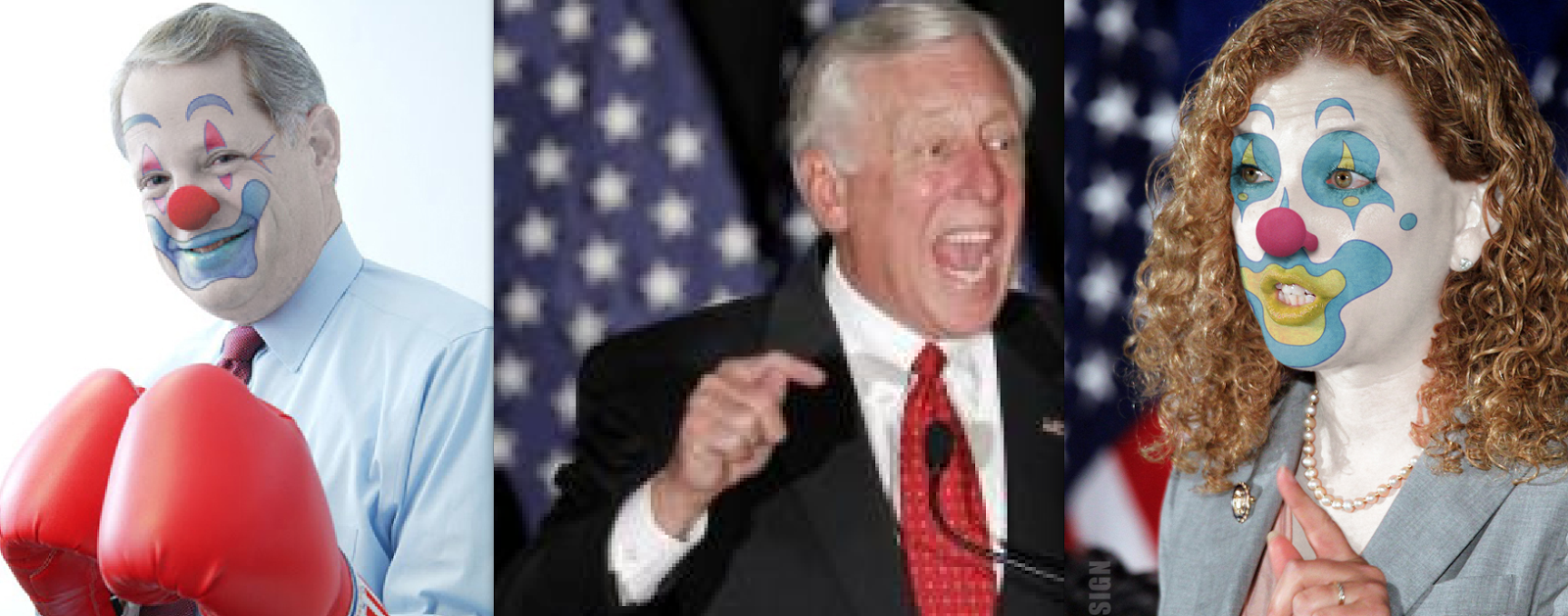
Curry is writing a book about populism now. When he writes his condemnation of the Democratic Party I hope he looks beyond the Clintons and scrapes a little Steve Israel, Debbie Wasserman Schultz and Steny Hoyer off the bottom of the barrel too.

Wall Street controls the House Dems through these shills

Labels: ,