Wednesday, March 20, 2019

Are Americans Ready For A Transformative Presidency?

>


The woman in the video is Disney heiress, Abigail Disney, a member of Patriotic Millionaires, which released the video yesterday to advocate for the inclusion of an ultra-millionaires tax in the New York state budget (which is going to be wrapped up in 2 weeks... and the villains here are Governor Cuomo and Senate Leader Andrea Stewart-Cousins, of course + The Long Island 6: Todd Kaminsky, Monica Martinez, Kevin Thomas, James Gaughran, John Brooks and Anna Kaplan). The tax only affects individuals with annual income over $5 million. It's meant to help bail out cash-strapped public schools that are facing further budget cuts, and the long-neglected subway system which just continues to decline.

I'm glad New York is trying to solve these problems on a local level. As for addressing these kinds of problems across the country-- on the national level-- obviously nothing's going to happen while Trump and McConnell have a choke-hold on the political system. But a transformative presidency would. Not a Status Quo Joe bullshit presidency or that of any other pick-me, pick-me candidate with nothing to offer the American people-- but a really transformative presidency, the likes of which we haven't seen since FDR passed away. I guess I gave it away, right? Bernie.


You've probably noticed that many of his once-shocking policy ideas have lately moved from the fringe to the mainstream of the Democratic Party-- from Medicare-For-All and the Green New Deal to putting working families interests before Wall Street's interests. Most of the potential nominees-- despite their own histories and records-- are now trying to offer some version of Bernie's populist economic message.

Faiz Shakir, Bernie campaign manager, reminds the media that all Trump offered to woo working class voters was a ripped-off, hollow version of what Bernie has been advocating for decades-- almost making himself sound like what Shakir calls a "faux-Bernie Sanders."

Yesterday the AP reported that the case for Bernie being able to beat Trump is now front-and-center in discussions of the Democratic nomination.
“The polls have been pretty consistent that Democratic primary voters are very focused on which candidate has the best chance to beat Trump, so I expect all the candidates to argue why they are uniquely positioned to win,” said Dan Pfeiffer, a former senior adviser to President Barack Obama.

“Bernie Sanders has a strong case that his economic message works in the states that delivered Trump the presidency in 2016, but his challenge is going to be articulating how he can defend himself against attacks that he is a socialist,” Pfeiffer said.

Goal ThermometerKarine Jean-Pierre, a Democratic strategist and senior adviser at MoveOn, argued against the notion that a more centrist candidate is inherently more electable. “Often you’ll hear arguments from centrist, or more corporate-aligned, Democrats that a candidate needs to run as a centrist to win-- but those comments say more about the commenters’ interests and ideology. They don’t actually tell you much useful about political outcomes,” she said.

“This year’s primary is obviously a different dynamic than 2016, when there were only two Democrats, and much of that debate centered on electability-- and then the candidate presumed by the Democratic establishment to be most ‘electable’ lost,” Jean-Pierre said.

So far, Sanders has been focused on Democrats’ shared goal of defeating Trump, whom he’s called the most dangerous president in American history. But he’s also placed himself as a standard-bearer in today’s political environment.

“In 2016, this is where the political revolution took off,” Sanders said during a recent trip to New Hampshire, a state that he won by 22 percentage points. He said that he began the race far behind Clinton, campaigning on ideas “considered by establishment politicians and mainstream media to be ‘radical’ and ‘extreme.’”

Sanders says that now his ideas are supported by a majority of Americans, particularly Democrats and independents, as well as his rivals in the race.


Labels: , ,

Wednesday, March 06, 2019

The Forces Arrayed Against Bernie-- Before He Faces Trump

>


Not that anyone thought she would try, but Hillary finally announced yesterday-- on camera-- that she isn't running for president again in 2020. "I'm not running, but I'm going to keep on working and speaking and standing up for what I believe," she said. On Wednesday, Holly Otterbein's report at Politico might lead you to believe that what she believes in is preventing a progressive from becoming president-- particularly one progressive. Clinton die-hards are leading the charge against Bernie and are as vicious today and this were in 2016. Otterbein wrote that the creepy crawly, right-of-center corporate slime around her-- like GOP-hatchet-man who turned Clinton mainstay, David Brock-- "both on the record and on background, on Twitter and on cable television, Clinton’s former aides and allies are taking pains to lay out what they see as all of Sanders’s flaws, imperfections and vulnerabilities-- much as he once did to their ex-boss during a primary that saw mud flying on both sides. The other Clintonistas leading an anti-Bernie scorched earth campaign that could help reelect Trump are Neera Tanden, Adam Parkhomenko, Zac Petkanas, and Zerlina Maxwell (who has distinguished herself as someone who tells as many unhinged lies as Trump).

This week, though, Norman Solomon, executive director of the Institute for Public Accuracy, wrote that The Big Obstacle For Bernie Isn't DNC "Rigging"-- It's Media Trashing, quickly asking his readers to recall Frederick Douglass' most famous quotation: "Power concedes nothing without a demand. It never did and it never will." Adds Solomon: "Of course top Democratic Party officials don’t intend to give up control. It has to be taken from them. And the conditions for doing that are now more favorable than ever... But let’s be clear. The huge obstacle ahead is not the DNC-- it’s the mass media. The corporate-owned and corporate-advertiser-funded media of this country are the biggest barriers between Bernie Sanders and the Oval Office."
Often functioning as propaganda outlets, the major news media serve as an amplification system for corporate power that has long shielded the Democratic Party from the combined “threats” of social movements and progressive populist candidates. The synergies of momentum from the left-- outside and inside of electoral arenas-- are continuing to accelerate.

It’s crucial that progressives develop more effective challenges to the media serving the predatory big-money system. More than any other force, reflexive spin from corporate media stands between us and a Bernie Sanders presidency.

In sharp contrast to campaigns with enormous budgets for Astroturf, the first Sanders presidential campaign was able to effectively defy the conventional wisdom and overall power structure by inspiring and mobilizing at the grassroots. His campaign was-- and is-- antithetical to the politics of corporate media.


Two examples of news coverage, exactly three years apart, indicate what the Bernie 2020 campaign will be up against. In early March 2016, at a pivotal moment during the primary campaign, FAIR analyst Adam Johnson documented that the Washington Post “ran 16 negative stories on Bernie Sanders in 16 hours... a window that includes the crucial Democratic debate in Flint, Michigan, and the next morning’s spin.”

Days ago, when Bernie Sanders launched his campaign with a big rally in Brooklyn, the MSNBC coverage was so slanted that an assessment from Glenn Greenwald appeared under the headline “MSNBC Yet Again Broadcasts Blatant Lies, This Time About Bernie Sanders’ Opening Speech, and Refuses to Correct Them.”

Greenwald’s critique of MSNBC focused on flagrantly inaccurate anti-Sanders commentary from a former Hillary Clinton aide that immediately followed the senator’s Brooklyn speech. No Sanders supporter was included in the discussion. The coverage prompted an email from FAIR founder (and my colleague) Jeff Cohen to an MSNBC vice president: “You have no trouble finding hardcore Clintonite Bernie-bashers; please offer some balance in your analysts. In today’s Democratic Party, there’s clearly more sympathy for Bernie than the Clintons-- but not on MSNBC.”

It’s worth noting that the Post is owned by the world’s richest person, Jeff Bezos, while MSNBC is owned by Comcast, “the world’s largest entertainment company.”

To counteract the media propaganda arsenal now in place, we should fully recognize that arsenal as the main weaponry that corporate power will deploy against the Bernie 2020 campaign. We must confront those corporate media forces while vastly strengthening independent progressive media work of all kinds.

Labels: , ,

Saturday, January 26, 2019

Biden And Bloomberg Are Too Old To Be President-- Bernie Isn't And Here's Why

>


Let me talk about something difficult for most people, though not for me. Next month I turn 71. My old friend Martha was just in town and she's either my age or a year younger. She's a research scientist at Columbia and recently retired. In college she was the only person I knew who was politically to the left of me. When she asked me who I was voting for next year, I said Bernie of course. She voted for him last time too but said she's not so sure this time. "Too old." We argued but she said she feels her brain slowing down lately and asked me if I do too. I do. A little. Trump will be 73 in June. His brain has come to... a grinding halt. He's an unhealthy fat man who doesn't exercise either his mind or his body. Joe Biden just turned 76. He seems out of it an awful lot; he isn't Trump but his brain is failing. Mike Bloomberg turns 77 in a few weeks. He seems sharp ands clear. He was born the same year as Bernie, who also seems sharp and clear. I spoke with him a few weeks ago when I was in Burlington. I could have been speaking to someone 20 years younger. He sure seems a lot healthier than Trump or Biden.

But age means something else to me than all of that. It has to do with ideas. When you hear conservative jackasses scolding younger Congress members like AOC, Ilhan Omar and Rashida Tlaib and telling them to grow up or stop acting like children, they can probably throw Bernie in there too. What conservatives can't grapple with are the ideas these people are putting forward. On Tuesday, Mike Bloomberg said the push to legalize recreational marijuana "is perhaps the stupidest thing anybody has ever done." Now that's old! Really, really, disqualifyingly old. And ignorant. "Last year, in 2017, 72,000 Americans OD’d [overdosed] on drugs. In 2018, more people than that are OD-ing on drugs, have OD’d on drugs, and today, incidentally, we are trying to legalize another addictive narcotic, which is perhaps the stupidest thing anybody has ever done." His idea on pot is from the 1950s.


Biden has similarly old fogey perspectives on the world. He doesn't understand Medicare-For-All and he doesn't understand the Green New Deal. It would be a complete waste of time to nominate the Warren G. Harding of the Democratic Party to follow Trump. Trump is ignorant and venal but his instincts are much "hipper" than two squares like Bloomberg and Biden. Bernie on the other hand... he may not skateboard or do Ramones covers, but his ideas are way hipper-- and more fearless-- then Beto's. I hope you read Jason Zengerle's fantastic GQ report about a road trip with Bernie, The Unfinished Business of Bernie Sanders. The link gives you the whole piece. Here are some excerpts:
Sanders has become an entirely different person. In the nearly four years since he announced his first presidential campaign, he has done more to remake the modern Democratic Party in his image than any politician since Bill Clinton-- and that includes Barack Obama, who not only spent eight years in the White House but also was a Democrat. (As his friends and foes often emphasize, the socialist Sanders does not serve in the Senate as a Democrat but rather as an independent who caucuses with the Democrats.) Medicare for All, a $15-an-hour minimum wage, free college-- the issues that he championed during the 2016 Democratic primary and that Hillary Clinton dismissed as naive and unrealistic-- are now mainstream Democratic Party positions. “We are where we are,” says Shakir, who’s now the ACLU’s national political director, “because Bernie forced the party to rethink everything.”

Having toiled his entire political career as a gadfly, Sanders is now a prophet. “The ideas we brought forth in 2016, which were considered, not only by the Democratic establishment but by the editorial writers, to be extreme and fringe and out of step with where the American people are,” Sanders told me, “are now what is in, by and large, the Democratic national platform and are being adopted by candidates across the country.” What’s more, the Democratic Party’s future-- as reflected by the remarkable rise of the 29-year-old New York congresswoman Alexandria Ocasio-Cortez-- has clearly tilted to the left. This development has been as satisfying for Sanders as it was unexpected. “We have had more success in ideologically changing the party than I would have dreamed possible,” he said. “The world has changed.”


In Kenosha, Sanders was appearing at a union hall to stump for Randy Bryce. A mustachioed ironworker and labor activist who went by the nickname “Iron Stache,” Bryce was running for Paul Ryan’s old congressional seat. He’d supported Sanders in the 2016 presidential race, speaking at Wisconsin rallies, and Sanders had been an early backer of Bryce’s congressional bid. When Bryce traveled to Washington to seek Sanders’s advice about his campaign, Sanders had warned him that things could get nasty: “Randy, you run and you threaten these people, they’re going to throw millions of dollars against you in ugly, personal, destructive type ads.” It was another instance of Sanders’s prophetic tendencies. A GOP super PAC supporting Bryce’s Republican opponent, a former Ryan aide named Bryan Steil, had indeed spent millions attacking Bryce over arrests for drunk driving and marijuana possession, as well as labeling him a “deadbeat” for delinquent child-support payments to his ex-wife. By the time Sanders arrived in Kenosha, two weeks before Election Day, Iron Stache was a dead man walking-- badly trailing in the polls and relying on his ex-wife to defend his honor. “D.C. politicians are putting our family’s personal business all over the news and television, right where our son can see it,” she’d said in a statement.

Standing on stage in the union-hall ballroom, with Bryce sitting on a stool just to his right, Sanders did his best to help in what already appeared to be a lost cause. “They do ugly ads because they have nothing positive to say,” he told the crowd of several hundred people that had gathered, sounding as frustrated about Bryce’s travails as he does about income inequality.

...Before the 2016 campaign, he’d tried to persuade Elizabeth Warren, the Massachusetts senator and his closest friend in the Senate, to run against Clinton. It was only after Warren told him no that Sanders decided to enter the race himself. “He said, ‘Okay, I have to do it, because someone has to represent this viewpoint,’ ” a Democratic strategist with ties to Sanders told me.

But in 2020, not only is Warren running; so, most likely, are a host of other Democrats—Ohio senator Sherrod Brown, Hawaii congresswoman Tulsi Gabbard, Oregon senator Jeff Merkley, to name a few—who are so similar to Sanders in their worldviews that they’ve been dubbed “Bernie 2.0’s.” There are some Sanders supporters who believe that the best decision he could make for 2020 would be not to run himself but to anoint a successor-- a woman, a person of color, someone who isn’t in their late 70s-- and then turn over to that candidate the keys to his movement. Will Bunch, the Philadelphia Daily News columnist and an ardent booster of Sanders in 2016, recently urged Sanders to sit it out in 2020, arguing that there is “a sense that white dudes from the baby-boomer-and-older-generation have been running things for far too long, and that America needs some new blood.” Indeed, while Sanders emerged from his defeat in 2016 with newfound prominence and power, a loss in 2020 would almost certainly serve to diminish him-- and perhaps his legacy.

...In a Democratic Party that is increasingly deriving its energy-- not to mention its votes-- from minorities and women, Sanders remains a critic of identity politics and a firm believer that issues of race, while important, are not as salient and determinative as those of class. “There are people who are very big into diversity but whose views end up being not particularly sympathetic to working people, whether they’re white or black or Latino,” he said. “My main belief is that we need to bring together a coalition of people-- of black and white and Latino and Asian-American and Native-American-- around a progressive agenda which is prepared to take on an extraordinarily powerful ruling class in this country. That is my view. Many of my opponents do not hold that view, and they think that all that we need is people who are candidates who are black or white, who are black or Latino or woman or gay, regardless of what they stand for, that the end result is diversity.” He hastened to add that “diversity is enormously important,” but there was a bigger goal: “to change society and create an economy and a government that work for all people.”

His balancing act wasn’t just rhetorical. I noticed that one wall of his conference room was decorated with black-and-white photos of bucolic Vermont scenes—barns, mountains, snow-covered roads. On the wall facing it hung three humongous oil paintings of black women.

When Sanders does talk about what he wants right now, he says his 2020 decision will ultimately come down to one basic question: Is he the candidate with the best chance of ending Donald Trump’s presidency? “He really does want to beat Trump in a deeply personal way,” Weaver says. “It’s distressing for him to see democracy going in this Trumpian direction.”

Sanders and his advisers believe he’s uniquely suited to the task of defeating Trump. Part of the reason is Sanders’s appeal to white working-class and rural voters-- those same voters Sanders refused to denounce as racist for being uncomfortable about voting for a black candidate in the 2018 midterms. Those who would staff a 2020 Sanders campaign talk not only of taking back Michigan, Pennsylvania, and Wisconsin-- the three states that put Trump over the top in 2016-- but of putting Iowa and possibly other Plains states in play. One Sanders adviser even told me that he thought Sanders would compete in West Virginia-- a state Trump won by 42 points in 2016. “The untold story of 2016 was Bernie’s strength with rural voters,” Weaver says.


But it’s more than just the electoral map. Sanders has some of the same political skills as Trump. It’s a depressing reality that Trump, for all of his flaws, is a savant when it comes to messaging; he has a gift for boiling down complex issues into simple, visceral, often unrealistic policy proposals—such as building a wall to combat illegal immigration. It’s why some Trump supporters say that you need to “take him seriously, not literally.” Democrats, by contrast, are quite good at developing realistic policy proposals that nonetheless, in part because of their complexity, fail to excite the public. Sanders is a rare exception.

Last fall, for instance, he introduced the Stop Bad Employers by Zeroing Out Subsidies Act (Stop BEZOS), a bill that would force large companies like Amazon to pay additional taxes to fund certain government services used by their low-wage workers. Stop BEZOS was laughably bad public policy and completely unworkable due to the way benefits eligibility works, which many liberal policy wonks pointed out. But Stop BEZOS did deliver a strong message: Giant companies like Amazon should pay their employees a living wage. And, sure enough, a few weeks after Sanders introduced Stop BEZOS, Jeff Bezos announced that Amazon would raise the company’s minimum wage in the U.S. to $15. “[Sanders] is a very American kind of populist,” Vox’s Matthew Yglesias wrote at the time, “whose specific policy proposals are best understood as props in a larger moralistic narrative rather than well-designed cures for specific ills.” Or, as Sanders told me when I asked him about Stop BEZOS and his general approach to public policy, “What I have always believed, and Trump believes it, too, as a matter of fact, is that the way you bring about change is you garner grassroots support, and then that support filters on up.”

Sanders knows that, should he run in 2020, his battle would be with forces even larger than Trump. “How much would the pharmaceutical industry spend not to have Bernie in the White House?” asks one Sanders adviser. “Is there a number big enough to articulate?” And were Sanders to win? “If you thought President Obama faced insane opposition from Senate and House Republicans, you ain’t seen nothing yet,” one former Sanders staffer says. “He’d be trying to dismantle the economic system that benefits the D.C. elite on both sides of the aisle.”

Yet, in order for Sanders to go after the D.C. elite, he’ll have to go through Trump. And while those encouraging him to run believe he’s the Democratic candidate best suited to that task, even Sanders sometimes wonders just how he’d do that.

At the end of a long day last October stumping for midterm candidates in Arizona, Sanders sat in a small meeting room at Arizona State University-- where he’d soon address a thousand people at a rally in the student union-- and let out a loud sigh when I asked him if he felt Democrats still didn’t quite know how to handle a politician like Trump. “Yes,” he said, and then paused for several seconds. “Look, Trump in a very bad way has redefined the nature of American politics. Every politician in the world stretches his or her point, you know, that’s nothing new. But now that we have a president who is a pathological liar, who can say anything he wants, who does say anything he wants, regardless of whether or not it has any bearing on the truth, that’s something new. All right, how do you deal with that? How do you deal with that? How do you deal with a president who is a racist, who is a sexist, who is a xenophobe, who is a homophobe, and who is a religious bigot?”

Sanders had begun his day in Nogales, along the Mexican border, where he’d met in a budget motel conference room with about a dozen or so immigration and environmental activists. Trump, and cable news, were talking nonstop about “the caravan”-- the group of migrants slowly making their way across Central America toward the Mexico-U.S. border-- and Sanders wanted these people’s advice about how to respond. One of the activists suggested that Democrats ask Trump what he’s done to help the Central American countries improve the conditions of their citizens so that people don’t feel compelled to leave.


“You’re talking rationally,” Sanders said. “But I want you to put yourself in Trump’s head and what he cares about, and his job is to simply win votes and pit one group of people against the other. You already gave me a rational answer. All right? But I need a political answer.” A local lawyer suggested talking about “the rule of law” and how Trump was waiving numerous environmental laws to crack down on immigration at the border. Sanders nodded and pointed to another activist, who proposed a “welcoming action” at the border where people showed up with food and clothing for immigrants. Then another activist argued that “we have to be not afraid to be rational” and said Democrats should point out just how few immigrants were coming across the southern border.

Sanders wasn’t satisfied. “I’m not sure that I’m getting through to you,” he barked. “This is all politics! It’s like me telling you there’s a guy with a machine gun out there, and if you don’t do this he’s going to bust in here and shoot you all up! It’s not true. All right? But I can create that fantasy. I can tell you that there’s somebody coming down with a machine gun, right? I can get you really scared! And you’re going to come to me: 'How do we protect ourselves?' That’s what it’s about! Right-wing extremism and demagoguery is not based on rationality. It is based on fear." Sanders told the group that their-- and his-- challenge was to “be really smart and figure out how we fight that demagoguery effectively.”

Ten hours later in Tempe, I asked Sanders if he had any answers. “I think what Trump has gotten away with is saying the economy is booming,” Sanders said. “What we have got to talk about is the economic pain that still exists in America. The second thing I think we have to do is to make it clear that when he ran for office, he lied directly to the people. He said he was going to provide health care for everybody. He said he was not going to cut Social Security. He said he was going to take on the pharmaceutical industry. Absolute lies, not just generalizations, these are lies in the campaign he told people who voted for him. I think we have to expose that as well.”

I asked Sanders if that wasn’t just more rationality. How would any of that counter the visceral nerve Trump touched in some voters when he talked about the caravan?

Goal Thermometer“Well, I mean, it’s difficult if you are not a pathological liar,” Sanders said. “It is difficult if you will not say anything at any time, just to get a vote. So what your real question is: How could one do politics that are honest, that are respectful, and beat somebody who is an authoritarian demagogue, who is a pathological liar, who will say anything at any time? That’s your question.”

Yes, that was my question, I said.

Sanders paused and suddenly, for the first time on the campaign swing, he seemed tired. “The answer is, it is hard,” he said. “And we better damn well find the answers to that pretty soon.”
People always ask me if he's made up his mind and if he's decided to run or not. That thermometer above wouldn't be there if I wasn't absolutely certain that he is. Just one great president in our lifetimes... is that too much to hope for? Just one. We can do it. Tim Russo: "The 2020 Democratic Primary is beginning to resemble the dynamics of the 2016 Republican Primary in which Donald Trump cruised to the GOP nomination over 17 establishment dopes Trump easily crushed. Similarly, by the time of Ohio’s March 2020 primary, Bernie Sanders will either be wrapping up the Democratic Party nomination in a walk, or facing a final showdown with whoever of the two dozen Democratic Party tools of capital survives a Hunger Games auctioning of themselves off in order to end up in a distant second place."

Labels: , ,

Friday, December 21, 2018

Bernie: Breaking The Cycle Of Mediocrity And Mendacity

>


As Jonathan Bernstein made clear in an OpEd yesterday for Bloomberg News, Americans have become inured to deceit and manipulation from our political class. And he wasn't even speaking about Trump. His piece was on Paul Ryan's farewell speech. Unlike many inside the Beltway, Bernstein has long recognized Ryan as a faker and a fraud. "The same people," are wrote, "who celebrated him as a wonk-- something he never has been, as Paul Krugman and others have pointed out for years-- have also declared President Donald Trump’s clearly inadequate policy knowledge to be sufficient. It’s not just about false perceptions: One of the main reasons that Ryan’s agenda has gone nowhere, despite his ascent in the House and his party’s unified control of government, is precisely that Republicans didn’t have well-developed policy options ready to go. That was true for all of Ryan’s supposed areas of interest, from entitlement reform to immigration to poverty, and of course it was very much true of health care... [T]hings got even worse with Ryan in charge than they had been during Boehner’s tenure, and that’s at least partially on him. As is the least productive period of unified party government in decades."

Is this all we can expect from government? Conservatives would like us to believe so. It's a win/win for them. If they succeed with their dreadful agenda, they accomplish specific goals; if they fail-- as they inevitably do-- then people lose faith and trust in government, an even bigger goal for conservatives. It is absolutely crucial for conservatives-- regardless of party-- to defeat Bernie. The establishment can not tolerate him and his campaign against the status quo. The carefully crafted comfort of conservatism in this country will crumble if he becomes president and conservatives will fight to the death to prevent that from happening.

This week, writing for The Intercept, Mehdi Hasan dismisses their arguments against him and points out that "the case for Sanders in 2020 is as strong as it was in 2016-- if not stronger. He now has much better name recognition, a standing army of loyal and experienced activists, an unrivaled social media presence, an authenticity that cannot be bought or taught, and a string of substantive policy wins under his belt, from big-name Democratic support for his Medicare for All bill to the Stop BEZOS Act to the historic Senate vote on Yemen last week." Nathan Robinson, writing on the same day for The Guardian made similar points. "Based on his record, Sanders should be the progressive favorite by default. In 2016, he ran an impressive insurgent campaign that came close to defeating the party elite’s handpicked candidate. Savvier Democrats have already recognized that Sander’s message is the one that best suits the mood of the electorate."


His ideas have set the agenda for the Democratic party for the past two years, with elected officials trying to burnish their progressive credentials by doing photo ops with Sanders and adopting his policies, from free college to Medicare for All (a plan that even the majority of Republican voters now favor). Many polls suggest he is the most popular politician in the country, and would be the clear favorite in a match-up against Trump. Attempts to portray Sanders as the candidate of white “Bernie Bros” ignore the facts-- Sanders has higher favorability ratings among people of color than any other Democratic politician. It’s obvious that he’s the party’s best shot. He has a formidable team of experienced organizers, national popularity and name recognition, and a clear, bold agenda that can win over working-class people of all genders and races.

...A candidate should be judged on their record. Based on how recently most of the 2020 prospects have embraced the progressive agenda, it’s reasonable to suspect some opportunism. Sanders, on the other hand, has a lifelong history as a thorn in the side of the establishment. Even as a teenager, Sanders was getting himself arrested in civil rights demonstrations.

As mayor of Burlington, he pioneered an innovative community land trust approach to affordable housing. He has been an efficient legislator, even earning the title “amendment king” for his success in getting measures through Congress. And he has shown a willingness to take principled stands, including his early opposition to the Iraq war plus his votes against the Defense of Marriage Act and the Patriot Act.

There are only a few serious criticisms of Sanders, the main one being “he’s too old.’ But while age might be a more serious factor if the current president were far younger, Trump is a septuagenarian like Sanders. Sanders still shoots hoops, he criss-crosses the country giving speeches, and he has more energy than many of us who are less than half his age. If Trump tries to make an issue of Sanders’ superior age, experience, and wisdom, Sanders can just challenge him to settle it on the basketball court.

There are a few other criticisms that can be made of Sanders, including his unfair criticism of leftist “open borders” advocates. He has cast bad votes (the 1994 Clinton crime bill comes to mind) and sometimes makes frustrating gaffes. I do not think Sanders is the ideal candidate, the one I would make in a laboratory. It would indeed be nice to have someone younger, ideally a woman of color (if only the constitution didn’t bar Alexandria Ocasio-Cortez!) But the question isn’t “Is Sanders flawless?” Rather, it’s “Is Sanders the best candidate we have available?” To that, the answer is clear. No other 2020 prospect comes close.
Matt Taibbi was at Berniepalooza and his report is in the new issue of Rolling Stone.He sounds sold. He wrote that "After seizing 43 percent of the Democratic vote in the 2016 primaries and winning high-profile battles against companies like Amazon and Disney to raise their workers’ minimum wages to $15 an hour, Sanders in some circles is something it would have been hard to imagine him being years ago: a celebrity."
It’s possible the Democratic brand has been rehabilitated in the public’s eyes since 2016, and a combination of a new candidate, better tactics and voter experience of two years of a Trump presidency would spell victory for any Democrat in 2020.

It’s also possible this is not the case, however, and the absence of someone like Sanders in the race would mean surrendering all that populist anger out there into Trump’s cynical hands, again.

Campaign reporters constantly make the mistake of thinking politicians are causes, not effects. They’ve been trained to think of candidates as consumer creations that succeed or fail on the strength of concept (and if not the concept, the execution).

Bill Clinton is the sui generis of Third-Way-ism, a southerner who offered a mix of aw-shucks stump charisma, fiscal conservatism and a whiff of post-Sixties social liberalism. His 1992 run perfectly executed the plan for victory that folks in the Democratic Leadership Council dreamed might work, after the catastrophe of Walter Mondale in 1984. Offer voters the right political product, they thought, and they will buy.

But in the real world, these things can work backwards. The 2016 electorate was so profoundly dissatisfied with the usual choices that when Donald Trump slipped in the polls briefly in late October and early November of 2015, the immediate beneficiaries were two other non-politicians, Ben Carson and Carly Fiorina.

Pundits had been predicting that a Pat Buchanan-style protest curiosity like Trump would sooner or later fade, and he did. But he didn’t stay “faded,” among other things because 2016 Republican voters could not and would not consider any establishment alternative, not even fringy, mean ones like Ted Cruz.

Sometimes voters go through drastic changes of mind before parties even have a chance to offer them choices. After years of not embracing big shifts, they may suddenly decide they want universal health care, free college tuition, a slashed defense budget, a national minimum wage, and other sweeping ideas.

Other younger politicians may end up offering those same things, which would be great. But with Sanders, voters burned by past broken promises have probably guessed by now he’s constitutionally incapable of deviating from his platform. I don’t even think Sanders would know how to betray his own ideas for political gain.

About that: He was roundly mocked in 2016 for describing his campaign as a revolution, but as the policy discussions at the Gathering showed, his platform is actually revolutionary, in a specific way.

UMass-Amherst economist Robert Pollin appeared to unveil a massive plan to cost out the Medicare-for-All proposal Sanders is likely to spend the next years stumping.

Pollin’s plan is to reduce medical costs in America from 18 percent of GDP to between 9-11 percent, using a single-payer plan that mainly targets the waste in the system (read: corporate profits). He addressed the “biggest insurance companies in America,” saying half-wryly, half sternly: “We’re going to put you out of business.”

Sanders is no Lenin or Trotsky. He doesn’t want to overthrow free enterprise or establish a national ice cream. But the movement he and his wife are leading has goals that are genuinely threatening to the traditional funders of presidential campaigns of both parties in America: banks, defense contractors, pharmaceutical and energy companies, etc.

Sanders and co. hope to plow the proceeds of these conquests into an FDR-scaled “Green New Deal,” aimed at a fundamental transformation of the country’s transportation, housing, energy and agricultural systems.

It’s ambitious and drastically different from what Democratic voters have been offered by any viable candidate for a while. If voters aren’t behind such a program, that’s what primary seasons are for, finding that out. If they are, however, it would be a huge error not to have someone in the running backing it.

...[C]ynics always respond negatively to Sanders. In their world he doesn’t compute at all, so they keep inventing angles to explain him: he’s an “egomaniac,” or in it for personal gain somehow (“He has three houses!”), or a delusional bumbler out to poison the electorate with irresponsible and unrealistic expectations.

Goal ThermometerAs to that last point: Sanders in 2015-2016 went from harmless, terminally ignored fringe-left curiosity to despised, possibly Russian-backed Hillary Spoiler virtually overnight. He’s probably second only to Trump as a target of press and social media invective, which paints him as a racist, socialist serpent in the fallen Eden of the should-have been Clinton presidency.

Some of this negativity is predictable, given that the Sanders platform would massively disenfranchise the traditional financial backers of the modern Democratic Party: Wall Street, pharmaceutical and insurance companies, Silicon Valley, lobbyists and corporate law firms, etc.

Whether it’s now or later, whoever takes on those interests is going to take a hell of a beating. That Sanders seems willing to be that person seems reason enough to embrace another run. Someone has to take up those fights eventually. It might be a while before anyone else volunteers for the job.

Labels: , , , , ,

Wednesday, December 19, 2018

Does The Corporate Media Have A Candidate For President? It Ain't Bernie

>


I always figured the battle for the Democratic nomination would pit a progressive, presumably Bernie, against a corporate Dem, like Biden or Bloomberg or Gillibrand... unless he proves to be a flash-in-the-pan, maybe Beto. The first 2020 DFA presidential straw poll, in which over 90,000 people voted, was released yesterday and shows Bernie way out front:
Bernie- 36%
Biden- 15%
Beto- 12%
Elizabeth Warren- 8%
Kamala Harris- 7%
Other polls show Bernie in second or even third place but whatever these polls are worth-- not much-- Bernie is certainly the progressive contender in a sea of mostly tepid status quo corporatists. Although there's really bogus anti-Bernie "poll" circulating from a group calling itself "She the People" and insinuating it is run by progressives like Alexandria Ocasio and Rashida Tlaib, which is false. It sounds more like a Mark Penn-Nancy Jacobson front operation. A couple of weeks ago, Michael Tracey, writing for Spectator, asked Why is no one treating Bernie Sanders like the Democratic front-runner? The media treats him the way they dealt with also-rans like Lindsey Graham and Sarah Huckabee's father. "By most conventional pundit metrics," wrote Tracey, "Bernie Sanders should be the presumptive 2020 Democratic presidential nominee. To state the obvious, he was last cycle’s runner-up, having won 46 percent of elected delegates, 23 states, and smashed small-dollar fundraising records. His policy platform has taken hold across the party, with most every nationally ambitious figure now calling for universal Medicare, free public college tuition, and a host of other measures that were closely associated with his 2016 run. He has consistently polled as the most popular politician in America, he just won re-election in his home-state by a massive margin, and his social media engagement is off-the-charts. So what’s the problem?"
Simply put, large sections of the party still view him as a threat. As much as they’ve attempted to court him, flatter him, and accommodate him in various respects-- recall the awkward ‘unity tour’ he held with DNC chairman Tom Perez in 2017-- he is still fundamentally at odds with the interests of the party’s most powerful actors. They might adopt bits and pieces of his agenda, as everyone from New York governor Andrew Cuomo to Nevada senator-elect Jacky Rosen has to varying degrees. And they might offer him polite compliments on the campaign trail, knowing he has an enthused core of supporters. But they will not formally back him in a primary, under virtually any conceivable circumstances. And that’s because for all the kind words Democratic officials have sent his way in the past two years, they are largely just that: words. These entreaties should be seen as attempts at appeasement more than any wholesale endorsement of his basic political program.

Sanders’s economic vision, elementally, is not compatible with the Cuomos and Rosens of the party. He is a socialist, and they are avowedly not. All other considerations around his candidacy can be distilled into that basic, unalterable fact. And this fact is what animates the emerging punditocracy perception of his 2020 prospects. You could almost imagine an alternate universe in which there were demands for the ‘field to be cleared’ for Sanders by virtue of the stature he acquired from the previous cycle. But that’s not happening, and won’t happen, because the ideological chasm he harnessed in 2016 is still there. And it will only continue to widen.

Assumptions about presidential ‘front-runners’ in the political press often derive from the attitudes of party donors, who share their candidate-fancying whims with reporters. This then congeals into a narrative about ‘who’s up and who’s down.’ But Sanders will never be ‘up’ by such a metric, because not only does he have zero interest in supplicating to the party’s donor base-- he is actively hostile to them. They were not who he relied on for financial support in 2016, because he pioneered ground-breaking grassroots fundraising tactics which vaulted him to contender status. Central to his overall political vision is doing everything possible to circumvent wealthy donors and diminish their influence.


...Dave Wasserman, a [not very good] Cook Political Report elections data analyst , promulgated his conclusion that the ideal opponent for Trump in 2020 must be a young and charismatic female with ‘a natsec background’ and no long history in elected office. Notice that none of these criteria have much to do with policy; it’s on identity grounds that Sanders will probably be most vehemently attacked. He’s too old, white, crotchety, or whatever. But as loud as these criticisms will be, they’ll be underlain by one which is more salient for the power base of the party: the ideological fissure he inescapably represents. People who are most threatened by that might opt for the more superficial arguments against him, because they know Sanders’s socialist vision is increasingly popular with the electorate. But the most central reason for their hostility will always be ideological.

There is another important factor militating against Sanders, at least in the eyes of the opinion-making class. In the 2016 primaries Sanders consistently over-performed with rural white voters, notably in Wisconsin and Michigan, states now crucial to any Democratic victory in 2020. On paper you’d think this would be a huge point in Sanders’s favor, as Democratic losses among that demographic have hobbled their electoral fortunes time after time. But when filtered through the myopic lens of the punditocracy, what might otherwise be regarded as a valuable asset will instead be cast in dark, nefarious terms: as if Sanders’s appeal among these voters makes him vaguely suspicious and perhaps even racist (yes, this will be alleged.)

The 2018 midterms demonstrated that the Democratic party is increasingly anchoring its political support in areas of the country that are highly wealthy, a trend ably described by Matt Karp in Jacobin magazine. He cites Virginia’s 10th congressional district, the richest in the country by median household income, as a case study. This district was one of the night’s most rousing victories for Democrats, with incumbent GOP representative Barbara Comstock dumped decisively for generic Democrat Jennifer Wexton. One could infer, plausibly, that Democrats’ Trump-era messaging has resonated strongest in the country’s most affluent regions-- probably due to a combination of cultural aversion to the modern GOP and marginal gripes with the 2017 tax cut bill, which crushed well-off conservative areas in Democratic-leaning states. Now more than at any point in its centuries-old history, Karp declares, Democrats are the ‘party of the prosperous.’


Per the terms of conventional pundit thinking, this bodes ill for Sanders. Sanders has a clear constituency, and it’s emphatically not ‘the prosperous.’ In the 2016 cycle, he frequently trounced Clinton in poor, rural areas, as his landslide victory in the West Virginia primary highlighted. Nationally, the counties in which Sanders performed the best tended to be its most rural and poorest, by median household income. Take California, where he won the five poorest counties by double digits. Conversely, he was battered in the wealthiest counties, where the nucleus of the state’s political power resides-- losing rich liberal enclaves like San Francisco, Marin, and San Mateo by huge margins to Clinton.

The rural areas integral to Sanders’s 2016 success are increasingly being written off by Democratic pundits and operatives as unnecessary to forge any winning national electoral coalition. Paul Krugman recently dismissed them as almost intrinsically incorrigible, echoing Clinton’s ‘deplorables’ remark in slightly more charitable terms. And there is some logic to this, however misplaced: Democrats’ biggest gains in the House were disproportionately the very kinds of districts at which Clinton aimed her focus in the 2016 general election-- affluent suburbs with tiny shares of persuadable Republicans-- to predictably disastrous effect. But now that this narrow approach has yielded geographically-isolated victories in the House, Democrats may reason that Clinton’s strategy wasn’t so bad after all. Consequently, Sanders’s strength among dispossessed rural voters will be argued away, somehow, as a weakness.

With the (hellishly long) 2020 cycle having semi-officially begun, the move will be to pressure Sanders to put aside his ego and bow out for various unpersuasive reasons. Among other tactics, this will take the form of anonymous operatives counseling that he expend his considerable energies on something other than a presidential campaign-- the same kind of condescending head-patting that was common in the liberal commentariat during the 2016 run. The logic then was that Sanders should be politely complimented for ‘changing the debate’ in numerous vague respects, but actually supporting his electoral victory was a non-starter. One of the ‘hacked’ emails released by WikiLeaks in 2016 showed Democratic National Committee officials discussing ways to ‘throw [Sanders] a bone’ with meaningless concessions to gain his support, and that attitude will persist as they figure out ways to not-so-gently nudge him from 2020 consideration.

This is all the more ironic, because from a purely electoral standpoint, Sanders stands the best chance against Trump. For one, he is largely unsusceptible to charges of personal hypocrisy-- at least by national politicians’ standards-- having said much the same thing in public life for several decades. He is not marred by questions around personal corruption, although the FBI investigation into his wife’s land deal in Burlington would have to be affirmatively dealt with at some point. If that’s his one major liability, though, then his liabilities are few – especially compared to the previous Democratic nominee and Trump, whose various personal corruptions could be barely captured by several days’ worth of exhaustive documentation. The age issue will be exhaustively whinged about, but he’s only four years older than the incumbent president, and by all appearances in much better physical shape.

But as much as Democratic power brokers loathe Trump, they can’t countenance Sanders. And their mindset will inform pundit consensus as the hellishly long presidential cycle barrels forward. In Sanders’s calculation, maybe this is for the better. An unambiguous ‘front-runner’ designation would be a mixed blessing, because one of Sanders’s strengths last cycle was how his appeal grew somewhat under the radar, until the evidence for it became impossible to ignore. So it could easily creep up on them again, only this time louder and more determined, backed up by a national infrastructure that didn’t exist in 2016. He also has what amounts to his own sub-rosa alternative media eco-system, which has only grown in the past few years, and some Sanders supporters do now occupy prominent positions in elite journalism, whereas last time there were almost none. So the campaign to disqualify him won’t be easy, but it will be waged vigorously. And that might be exactly what Sanders should want.
Ostensibly, David Klion's new piece for Foreign Policy is about the $100 million wedding in India last week that included a glittery guest list of the rich and famous, like Beyoncé, Priyanka Chopra, a Jonas brother, Arianna Huffington, John Kerry and Hillary Clinton. But, as it turned out, it was really a thinly disguised endorsement of Bernie 2020. The rich and repulsive hang out with each other so they can reinforce their corrupt intent. "That message is this: the ultrarich have each others’ backs," wrote Klion. "In this case, both of Barack Obama’s secretaries of state, Clinton and Kerry, are completely at ease with Reliance Industries, the $110 billion Indian energy and telecommunications conglomerate presided over by Mukesh Ambani. Ambani’s empire has been tied to pilferage, insider trading, illegal imports, corporate espionage, and other scandals. While his modest donations to the Clinton Foundation were intended to support green energy initiatives, Reliance is nonetheless among the 100 businesses in the world with the highest carbon emissions, and is the only privately owned Indian company to make the list."
What the presence of Clinton and Kerry at Ambani’s daughter’s wedding says is that all of this is fine. True, unlike their successors Rex Tillerson and Mike Pompeo, both Clinton and Kerry acknowledge anthropogenic climate change and the need to do something about it. But they aren’t going to let it get in the way of a good time with one of the world’s biggest profiteers off carbon emissions, someone with an enormous personal stake in preventing decisive climate action.

The public receives this message loud and clear, at least in the United States, where trust in politicians has been declining for years. Sure, one party professes to believe in climate change and one doesn’t, but if the leaders of both parties are happily cavorting with energy company executives from India to the Persian Gulf, does it really make a difference? Similarly, one party stands on the side of women’s reproductive rights and bodily autonomy and one does not, but if leaders in both parties are taking rides on a serial pedophile’s private jet, what is the public supposed to conclude?

The solution to all this isn’t that complicated. If voters worldwide want a political system that doesn’t shield elites from accountability and that prioritizes the needs of the vast majority of the electorate, they will have to start supporting political leaders who are not and have no desire to become unaccountable elites. Socializing with the heads of predatory and destructive industries ought to be seen as disqualifying, or at the very least, as a clear sign of where a politician’s real loyalties lie. Populist rhetoric from liberals is meaningless when everyone can see that the speaker doesn’t actually believe it, and this in turn creates an opening for the more flamboyantly dishonest populist rhetoric of the right.

The Trump administration’s innumerable global conflicts of interest, from Russiagate to Jared Kushner’s budding friendship with Saudi Crown Prince Mohammed bin Salman, have had the salutary effect of putting anti-corruption measures on the progressive agenda in a serious way. The threat posed by oligarchs and kleptocrats, both foreign and domestic, is now a mainstay among Democratic presidential aspirants. But that message will only work if it’s coming from a credible source. The public doesn’t even need to look at a would-be president’s tax returns to determine whether they’re trustworthy; it’s enough to know whose weddings they attend.

Take a look at this video. Who do you think is going to deal with the problems it points out? Biden? Beto? Kamala Harris? Gillibrand? Bloomberg? No, they'll be dancing with Beyoncé and Jeffrey Epstein at Jamie Dimon's grandkids' weddings. So... someone else?


Labels: ,

Tuesday, December 11, 2018

Post-Trump, America Needs Something Better Than Another Back To Normalcy President

>


It would be a tragic mistake for Democrats to pick a 2020 nominee based solely on ousting Trump. Electability is always an important consideration but it should never-- not even now-- be the only consideration. Almost any reasonably decent candidate should be able to beat Trump. It's not about them; it's not even about Trump. It's about us. Is there a candidate offering us something we want from our government? Chances are, whomever can get it together to win the primary is going to beat Trump.

Right now wikipedia is keeping a running list of potential Democratic nominees. 6 have declared: ridiculous New Dem multimillionaire ex-Congressman John Delaney, Richard Ojeda, Michael Arth, Ken Nwadike (the Free Hugs Guy), Robby Wells and Andrew Yang. Washington Governor Jay Inslee and spiritual teacher and author Marianne Williamson have exploratory committees. And then there are two dozen who have "expressed interest," from Bernie and Biden to Oscar De La Hoya, Michael Bloomberg and Tracy Flick.


On CNN Sunday, the Democrats' great GOP ally Rick Santorum warned Jake Tapper that Democrats have to pick someone unexpected to win-- he'd probably like Beto or Alexandria, or maybe Richard Ojeda, Pete Buttigieg, or Julian Castro to be the nominee-- and not someone "expected." He said "When the Democrats win, they pick someone unexpected. Or someone that is not the favorite-- Bill Clinton, Barack Obama, Jimmy Carter-- when they pick John Kerry or Al Gore or Hillary Clinton, they lose. So I'm hoping for Bernie [Sanders] or Elizabeth [Warren] or somebody like that. Some tired, old-- Joe Biden, put them out there and we'll win. If they pick someone new then I think they have a chance." Another Tapper guest, Illinois Republican Adam Kinzinger, said it couldn't be anyone "far left" and then went on to define Nancy Pelosi and anyone who isn't from the Republican wing of the Democratic Party as being far left. He's sad that it's taking too long for the Democrats to transform themselves into the Eisenhower Republican Party while the GOP has moved so rapidly and decisively transforming themselves into a Hitlerite fascist party. Kinzinger was pumping for a nice safe corporate whore, Joe Biden and said he could beat Trump. "He can attract the kind of people voting for Donald Trump, the middle class, the blue-collar workers. I think he's the one that can take that away. If you put somebody like Bernie Sanders up, it's just out of the stream of what people want." Luckily Nina Turner was on the panel as well and she corrected both GOP doofuses: "Let me tell you something, wanting people to have a $15 an hour minimum wage, wanting to make sure that people have Medicare for all... there is no far-left, so don't paint Sanders and other people like that." Sure they do. Turner wants Democrats to win; Kinzinger and Santorium want Republicans to win. Is that so complicated?

2020 isn't just an opportunity to get rid of Trump. It's also an opportunity to replace him with someone as good as he is horrible-- with the great president America hasn't seen in over 7 decades! It's a chance to pick a candidate based on a vision for moving America forward. In 1920-- exactly a century ago-- the country went for a schlemiel who had a campaign theme everyone get behind: a return to normalcy (after the Great War). They wound up with a catastrophe: Warren G. Harding, the beginning of a downward spiral that led directly to the Great Depression and World War II. The Return to Normalcy candidate for the centenary is of course Joe Biden, the ultimate status quo or status quo ante candidate with nothing to offer except "not Trump."

Well-meaning Republicans-- not just sneaking partisans like Santorum-- will also be urging Democrats to nominate Biden or one of the other blind establishment centrists (say a Hickenlooper or, worse stir, a Bloomberg). Sunday night, at the 92nd Street Y in Manhattan, 2 "good" Republicans-- James Comey and Nicolle Wallace-- begged Democrats for a back to normalcy candidate. They hate Trump, although perhaps for somewhat different reasons than normal people hate Trump. They think he stole their putrid conservative party. They just want to bring back more putrid conservatism. That isn't what we want though, is it.


When CNN reports that "former FBI Director James Comey asked American voters Sunday night to end Donald Trump's presidency with a 'landslide' victory for his opponent in 2020," it sounds sweet to us. "All of us should use every breath we have to make sure the lies stop on January 20, 2021," said Comey, who "all but begged Democrats to set aside their ideological differences and nominate the person best suited to defeating Trump in an election. 'I understand the Democrats have important debates now over who their candidate should be,' Comey told MSNBC's Nicolle Wallace, 'but they have to win. They have to win.'" We know that but what comes after we win is important to us too.
Over the course of more than an hour, Comey repeatedly derided Trump's character, again likening the atmosphere around the President to what he saw in prosecuting mafia figures and suggested that Trump's tweets could eventually amount to witness tampering. Asked if Trump might be an unindicted co-conspirator in some of the crimes recently described by special counsel Robert Mueller, Comey said he didn't know, "but if he's not there, he's certainly close."


Still, Comey said he hoped that Trump would be swept out of office without being impeached. Framing the rise of Trumpism as a political ill the country needed to exorcise at the ballot, he expressed a hope that Americans would "in a landslide rid ourselves of this attack on our values."

"Removal by impeachment would muddy that," he said, and potentially leave a third of the country feeling like their chosen leader had been removed in a "coup."

Trump's decision to fire Comey in May 2017 was a key factor in the appointment of Mueller, who was handed the job by Deputy Attorney General Rod Rosenstein in the aftermath of Comey's dismissal and the subsequent leak of a memo in which he recounted Trump asking that he end an investigation into former national security adviser Michael Flynn. In a book and in public statements, Comey has become a leading critic of Trump-- and Trump has berated him in turn, relentlessly and usually on Twitter.

Hours earlier, Trump attacked Comey in a pair of testy morning tweets, claiming without evidence that the former FBI chief had lied on Friday in his testimony to the House Judiciary and Oversight committees.


Comey laughed at the idea Trump had even looked over the actual testimony, joking to Wallace before she could read the tweets, "He's finished reading the 253 pages?"

After hearing the words out loud, he turned serious.

"My reaction to it is actually disturbing to me, which is kind of, 'Eh, there he goes again.' I thought I was 'Lyin' James Comey' now I'm 'Leakin' James Comey'. But I kind of shrug and sometimes smile and laugh about it and then I have a secondary reaction, which is to be horrified at my own numb reaction," Comey said. "We have to remind ourselves the President of the United States of America is publicly announcing that people are committing crimes, that they should be in jail."

Asked if Trump's tweets could be viewed as witness tampering, Comey answered carefully-- insisting he had no insight into Mueller's thinking.

"I'm not prepared to judge it," Comey said, "but again, if I were prosecuting a case in the Southern District of New York and a prominent person started attacking my witnesses, I'd want to know so what's going on there and does that cross the line from free speech, which we have to keep protected, into something else?"

Speaking about the period before the 2016 election, Comey was unsparing of Republican congressional leaders who he said opposed making public intelligence community concerns over Russian interference.

"To their everlasting shame, the leaders-- (Senate Majority Leader Mitch) McConnell, (House Speaker Paul) Ryan-- refused," Comey said. "I think they're going to have a hard time explaining that to history."

He had kinder words for former President Barack Obama, describing the Democrat as a foil to Trump in almost every way.

"I was struck that Barack Obama is the best listener as a leader I had ever seen and Donald Trump is the worst I've ever seen," Comey said. "Obama had the confidence to be quiet and try and get that. Donald Trump is a deeply, deeply insecure person, so I don't see any prospect that he would be able to be quiet for long enough to hear the truth."
Speaker... 2020?
Hillary surrogates used to whisper that if were was elected president he wouldn't be able to get anything through Congress because he hand allies there (other than Raul Grijalva, Keith Ellison, Tulsi Gabbard, Ro Khanna and Alan Grayson). Now there are way more than that behind Bernie and his programs and in 2020 there should enough to swing Congress towards the widely popular ideas he's running on, from Medicare-for-All and Job Guarantee to Free state universities and the Green New Deal. In 2020, we need to elect Bernie and and House ready for his programs. No more New Dems and Blue Dogs from the Republican wing of the Democratic Party.

Two silly-as-whoopie-cushions updates (a little early morning humor): Third Way wants Beto-- imagine a BETO/Lieberman ticket!!-- and, even more hilarious, Biden has been hiring DCCC staffers... which should be enough to guarantee him a sad, sad DOA campaign.

Labels: , , , , , , ,

Tuesday, December 04, 2018

Will Bernie Run In 2020?

>

Progressive Democrats by Nancy Ohanian

I went to the first convention of the burgeoning alternative music business way back in the late '70s. All of us at indie labels, indie radio, indie publications, etc, got to meet in person for the first time and share our passion nd ideas about a music scene that was starting too take root in the popular culture. It was small and focused and fun. Now, I really hate going to conventions. At Warner Bros we did them annually, often twice a year-- one for the domestic company and one for the international company-- and I revelled that upon retiring I would never have to go to one again. All those germs... all that drunken behavior... all that bullshit and pointless travel. So I never went to any for the netroots movement that I really knew I should have gone to. But last night I got home from Berniepalooza. I had a good time and it was small enough to not be overwhelming-- maybe 250 people-- and to not be obsessed with mass inebriation and mass germ attacks. And I got to meet people in person who I've been conspiring with for over a decade on progressive politics. One woman whose work I admire tremendously told me she's in her 40's and said she's been wanting to meet me in person for years so that she could thank me for something that happened to her when she was 17 years old at a Morrissey concert at Madison Square Garden. She had charged the stage and was being escorted out of the building by the police when I walked over and gave her a backstage pass so she could get back in. She's been grateful all these years.

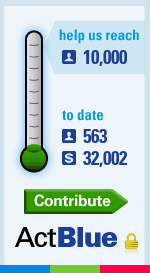
Goal ThermometerThe event itself was good. Meeting all those people was enough for me but some of the presentations were inspiring and elucidating. Some weren't. But my mood kept going up and down based on whether or not I felt I was getting signals that Bernie is running or not. Blue America was the first PAC to start raising money for his 2016 campaign--even before he announced back then-- and we're doing it again this cycle too (just tap the thermometer on the right). But I was positive he was running a few months ago and Berniepalooza left me unsure. I asked Jeff Weaver every time I saw him and he said "maybe" every time. He and his staff are working as though Bernie is 100% in but when you talk to them they say that what Bernie says in public-- he's 50% decided basically-- is exactly what he says in private: he's 50% decided. So one day I felt all the signals added up to 49% and I would get depressed and the next day it was 51% and I would be all elated. Look, I'm not going to last forever; I'm not young anymore and the sense of immortality I had when I was climbing Mt. Everest or horseback riding in the Afghanistan's trackless Hindu Kush is long gone. I just want to see one great president before I die. Don't we all get one? There's no rule that says we do, is there? I just want to see one-- not someone who's somewhat good and relatively great, like Obama, but one who's historically great and who moves the country forward, like FDR. That's not Amy Klobuchar or Michael Bloomberg or Kirsten Gillibrand. That's Bernie.

But, as it turns out, I didn't even have to venture up into the frozen tundra to "find out" the good news. The Associated Press' Steve Peoples had the scoop all along. Sanders, his headline blared, eyes 'bigger' 2020 bid despite some warning signs. Dateline Burlington. "An insurgent underdog no more," he wrote, "Vermont Sen. Bernie Sanders is laying the groundwork to launch a bigger presidential campaign than his first, as advisers predict he would open the 2020 Democratic presidential primary season as a political powerhouse." Whew. And then...
"A final decision has not been made, but those closest to the 77-year-old self-described democratic socialist suggest that neither age nor interest from a glut of progressive presidential prospects would dissuade him from undertaking a second shot at the presidency. And as Sanders’ brain trust gathered for a retreat in Vermont over the weekend, some spoke openly about a 2020 White House bid as if it was almost a foregone conclusion.

“This time, he starts off as a front-runner, or one of the front-runners,” Sanders’ 2016 campaign manager Jeff Weaver told The Associated Press, highlighting the senator’s proven ability to generate massive fundraising through small-dollar donations and his ready-made network of staff and volunteers.

Weaver added: “It’ll be a much bigger campaign if he runs again, in terms of the size of the operation.”

Amid the enthusiasm-- and there was plenty in Burlington as the Sanders Institute convened his celebrity supporters, former campaign staff and progressive policy leaders-- there were also signs of cracks in Sanders’ political base. His loyalists are sizing up a prospective 2020 Democratic field likely to feature a collection of ambitious liberal leaders-- and not the establishment-minded Hillary Clinton.

Instead, a new generation of outspoken Democrats such as Massachusetts Sen. Elizabeth Warren, New Jersey Sen. Cory Booker and California Sen. Kamala Harris are expected to seek the Democratic nomination. All three have embraced Sanders’ call for “Medicare for All” and a $15 minimum wage, among other policy priorities he helped bring into the Democratic mainstream in the Trump era.


Let me stop here for a minute. Elizabeth Warren-- yes. She's the real deal; a real progressive. Tried and true-- PROVEN. Filled with great ideas, if-- maybe-- not the easiest to elect. But Kamala and Cory. You know a progressive by their actions, not by their electoral positioning strategies. Maybe Cory and Kamala will turn out to be progressives. They could start being progressives for a few years, obliterating past mistakes and in a decade, maybe less, run for president as progressives. I'm open to it. But in 2020? Are you kidding? I'm glad they've learned to parrot Bernie and that they've decided to vote well. It means something that they both have ProgressivePunch "A"s and that for the current session Kamala scores 99.61 and Cory scores 97.29, sandwiching Bernie's 98.82. It means "something," but not enough. Slow down kids, you both have a lot to prove before you'll win my vote. And you can do it-- by doing it, not claiming you will do it. People reported that a "high-profile Sanders supporter who was in attendance, Cornel West, described the Vermont senator as 'the most consistently progressive one out there,' suggesting that some would-be 2020 candidates have adopted Sanders’ words, but maintained ties to Wall Street and 'militarism.'" BINGO!


Perhaps the most important member of Sanders’ network, wife Jane O’Meara Sanders, said Democrats may be embracing Sanders’ “bold progressive ideas” on health care and the economy in some cases, but there’s need to go further on issues like climate change, affordable housing and student debt.

Whether her husband will lead the debate as a presidential candidate in 2020, she said, remains unclear. O’Meara Sanders noted that one question above all others would guide their decision: “Who can beat Donald Trump?”

“That has to be the primary goal. To win. We think you win by a very strong progressive commitment,” she told AP. When asked if Sanders could win in 2020, she said “every single poll” showed that Sanders would have beaten Republican nominee Donald Trump two years ago.

...“It’s not about us,” O’Meara Sanders added. “It’s about what’s right for the country.”

Despite signs pointing to a 2020 run, Sanders has given himself a clear escape hatch.

Weaver, like Sanders himself in a recent interview, suggested that the senator would step aside if he believes another candidate has a better shot at denying Trump a second term. There are no clear indications from Sanders or those closest to him, however, that he currently has that belief.

“I know they haven’t announced, but it sort of seems like that’s what’s happening,” said John Cusack, another actor invited to the weekend summit. Asked about his preference for 2020, he called Sanders “the only real progressive candidate out there.”

“All of the sudden, what was once fringe politics is now mainstream. Don’t get me wrong, it’s great that (Texas congressman) Beto O’Rourke and all these young candidates are running on the People’s Summit and progressive movement platform, but let’s not forget who broke us through.”

“If he runs again, I’ll be on board,” Cusack said.
A word about Beto, since Cusack brought him up. Beto's a friend who I like a lot. Blue America backed him when he first ran for Congress and endorsed him against against Ted Cruz. And Beto is as progressive as they come on 3 issues: immigration, campaign finance reform and marijuana. Other than that... Beto never joined the Progressive Caucus. He joined the New Dems. His record in Congress was, at best, middling. It's great that he took on Cruz and did so well... and, perhaps (I think so) grew as a politician. But hie's no Bernie Sanders. He's been in Congress for 6 years. Go ahead and name an accomplishment or an initiative. His ProgressivePunch voting record, I'm sorry to say is an overall "F." Sorry to shatter any hallucinations. His lifetime crucial vote score-- 78.99. And this cycle... 67.65, pretty terrible, especially for someone representing a deep blue district (PVI D+17) where Obama won twice and where TRump's share of the 2016 general election vote was a miserable 27.2%.

Labels: , , , ,