Wednesday, September 05, 2012

Not Every Queen Is An Aaron Schock Or A Lindsay Graham Or A Mark Foley Queen

>


Over the weekend I wrote a funny throwaway piece about an excursion with Digby and Amato to see a new film about a family of trashy billionaires from Orlando, The Queen of Versailles. In the course of the documentary, the male protagonist, David Siegel, declared it "a riches to rags story," as their fortunes plummeted from billionarity to mere multimillionairity. The Queen worried that the money was evaporating so rapidly that her 7 children might be forced to go to college so they could get jobs someday. Heart rending? No, but I'm such a coldhearted beast when it comes to elites; I had the same response to the film Farewell, My Queen earlier this summer, which endeavored to make the end of the absolute monarchy in France and of the Ancien Régime itself into a reality show, a classy Real Housewives of Versailles. As Siegel was savvy enough to point out when he sued the film maker recently-- total frivolous suit-- it was like a pilot for a completely déclassé Real Housewives of Orlando. And was it ever!

Not that I was immune to the humor or the human drama, but what fascinated me most about the film was the delicious irony of a guy bragging about having personally cheated to elect George Bush in 2000 then being laid low by Bush's bungled economic agenda while he and his wife personalized the economic collapse at the hands of the banksters. The banksters are the unseen villains in the film. From my Sunday post:
I'll never forget the shopping and spending addicted Mrs. Siegel's plaintive cry about how the Wall Street bailout money should have gotten to the "common people"... like them. She was upset because their planes had been repossessed and the banksters were pressuring them to sell Versailles, the 90,000 square feet home they were building for a hundred and something million dollars, the largest home in America. And David Siegel was just full of the same kinds of ironies, complaining bitterly throughout the film that greedy banksters tempted him with cheap money to take out loans he couldn’t repay-- which is exactly what he has trained his sales force to do to their pathetic time-share customers, who are uncharitably referred to as "the moochers."

Well since the film was finished, Siegel's back in business and making bigger profits than ever before and work has resumed on Versailles and they're back to billionairity again and the kids won't have to worry about going to college after all. Not sure if he's contributing any cash to the Romney campaign or not. But, speaking of Romney, Daniel Gross has an interesting post at the Daily Beast about the Romney business model, Bankruptcy for Billionaires. "On Aug. 29," he writes, "Contec Holdings, a Schenectady, N.Y., company that repairs cable boxes, filed a prepackaged bankruptcy plan-- a court-sanctioned deal with lenders in which the firm will reorganize, wipe out up to $300 million in debt, and move on under new ownership." It's not uncommon and in 2011, 9,772 businesses filed for Chapter 11 bankruptcy protection. The Romney model is right out there for everyone to see-- and he says, or used to say, he was running on it for whatever office he was running for. But he's certainly counting on the voting public to not kick the tires or look any further than all the money he's made for himself and imagine-- somehow-- that he can make that money for them if he's elected.
Contec was acquired by Bain Capital in 2008, years after Mitt Romney had left the private-equity firm. But the timing of the bankruptcy filing-- coming a day before he was poised to accept the Republican nomination for president-- was inconvenient. It also highlighted a larger issue. We’ve heard about “strategic defaults” in housing: when the current value of a home is hopelessly below the total mortgage, some owners stop making payments on their loans even though they could afford to.

Corporate gunslingers do the same thing. When a debt-laden company (like Contec) owned by a private-equity firm (like Bain) runs into trouble, the bespoke-suited bankers have a few options. They can roll up their Thomas Pink shirtsleeves and attempt a turnaround, deploy idle money in their funds to shore up the company, or sell profitable investments in the fund to raise new cash. Or the guys who own the private-equity firm-- hell-bent on salvaging the investment and preserving jobs-- could use part of their vast fortunes to pay the debt.

They rarely do. In fact, companies owned and effectively managed by billionaires routinely fall behind or default on their obligations, all for want of a few million dollars. LifeCare Holdings, a hospital chain owned by the Carlyle Group, missed a $5.5 million interest payment due Aug. 15 on $119.3 million in notes. It’s worth mentioning that Carlyle’s top three executives earned a combined $400 million in 2011.

Walking away from bad debts is a feature-- not a bug-- of the industry. This year Standard & Poor’s has tallied 29 major debt defaults by large U.S. companies. By my count, at least 14 were backed by private-equity firms.

The big players rarely suffer professional, legal, or social repercussions if they fail to bail out debt-laden companies in their portfolio. For individuals of more modest means, of course, it’s a different story. Thanks to a change in the bankruptcy law in 2005, credit-card debt is no longer easily discharged in bankruptcy. “If you have any ability to pay any of your debt from the point you file bankruptcy forward, you’ll be on the hook for it,” says Tamara Draut, vice president for policy and research at Demos, the New York–based progressive think tank. Likewise, student loans can’t be easily shucked in bankruptcy court.

When a company files for Chapter 11, bankers and bondholders get stiffed. But so do vendors, landlords, service providers, employees-- and, sometimes, the public. In 2008, Chrysler and the auto lender GMAC, then both owned by private-equity firm Cerberus, hurtled toward messy bankruptcies when their well-heeled owners decided they were better off walking away. The government controversially stepped in and took ownership of the companies. Taxpayers have taken a $1.2 billion loss on the Chrysler bailout and are still saddled with GMAC. In May, Hawker Beechcraft, the aircraft company owned by Goldman Sachs’s private-equity fund and Onex Corp., went tapioca. Over the years, the company had underfunded its workers’ pensions by $600 million. So in late August the Pension Benefit Guaranty Corporation, a self-funding agency that is backstopped by taxpayers, agreed to pour in $390 million of its own cash to shore up the pensions.

Is it any coincidence that the first private-equity baron to run for president is proposing something similar? The Ryan plan-- now largely the Ryan-Romney plan-- is an exercise in walking away. Medicare and Social Security, we are told, are in danger of going bankrupt. That’s because these enterprises’ wealthy backers-- i.e, Washington politicians--have chosen not to fund the levels of expenditures promised to America’s rapidly aging population. Rather than raise new funds or reallocate existing resources, Republicans propose to turn Medicare into a voucher program and to consider raising the retirement age for Social Security. Across the country, governors and legislators who repeatedly refused to fund the retirement and health-care benefits promised to state employees are also trying to walk away.

Just like private-equity bosses, political leaders are choosing not to afford financial commitments-- and betting they won’t suffer any sanctions as a result.

Back to David Siegel for a momento. Like I said, he's rolling in good fortune again and "sales are roaring back inside the timeshare gates, and the mood of the company is as positive as it's been since Westgate was generating $1 billion in annual revenue five years ago."
"We're feeling extremely good," said David Siegel, founder/president and CEO of one of the largest privately owned timeshare companies in the world. "At the first of this year, we gave pay raises to our employees for the first time in a while and we're enhancing our employee benefit programs. This is a great time to be at Westgate because we have a great future.

"We have a very supercharged and energized sales team. They're very excited because they are seeing a lot of new and upgraded amenities at many of our resorts. When you see that kind of activity going on and you're making more money. ... It really puts a lift in the step of our team. Morale right now is at an all-time high within Westgate."

"Our customer is the Walmart customer," Siegel proudly said at last year's high-profile Shared Ownership Investment Conference panel. "They pay their credit card on time. It's the truck driver from Iowa who is treated like a king. We make Middle America feel like a Rockefeller."

Even if they don't have their own 90,000-square-foot Versailles palace to one day call home.

In the film they're referred to as "the Moochers" and the business model is based on selling them an empty, wretched, glitzy dream they can't afford. Apparently Siegel's brush with financial catastrophe hasn't reformed him one bit and his business model is still his business model... just like Mitt's.

Labels: , , ,

Sunday, July 15, 2012

Conservatives Don't Understand Why Bain Is A Real Issue

>


David Frum's statement on his conception of Bain as a non-issue came yesterday in a Daily Beast post, Bain: The Debate You Have When You Don't Have Ideas. I'm not a huge Obama fan and can't imagine voting for him-- unless I happen to move to a swing state between now and November, in which case I would-- but it's hardly intellectually honest to claim he doesn't have ideas. Whether you agree with them or not, he's offered a plethora of ideas, all of which have been obstructed and destroyed by conservatives in Congress who are more intent on preventing an economic recovery than allowing any of his ideas to solve the problems 8 years of conservative governance have left the country struggling with.

Frum doesn't seem to see the importance of the controversy swirling around Romney's time at Bain as being a real character issue, something that is helping voters understand what kind of man Romney essentially is. His legalistic but thoroughly deceitful and opportunistic filings and excuses for filings with government boards tells voters far more about him than the fact he's a Mormon bishop or a happily married man with a pack of sons who refused to serve in the military or wealthy enough to have a dancing horse and a new elevator for his car collection. (Frum is, however, correct, when he admits Romney has no idea about how to solve the economic problems caused by conservative governance.)
Non-college whites may dislike Barack Obama, but they don’t like corporate raiders either. In the Republican primaries of both 2008 and 2012, Romney consistently lost among Republicans earning less than $100,000 per year. (Back in 2008, Romney’s populist rival Mike Huckabee quipped, “People want to vote for somebody who reminds them of the guy they work with-- not the guy who laid them off.”)

Knowing that, the Romney campaign has strenuously repudiated any Romney responsibility for Bain’s actions in 2000-2002. And when the Obama campaign insisted otherwise, the Romney campaign took the bold step of releasing an ad from the campaign itself-- not some allegedly uncoordinated SuperPAC-- that used the word “liar.”

That was Thursday. Bad luck for them, Thursday was also the day that the Boston Globe posted a big investigation itemizing all the many, many forms that Romney had signed on Bain’s behalf after his 1999 departure.

I'm not saying that Frum won't grow up to be a Nobel Prize winner some day-- it could happen-- but meanwhile, there is one who tried explaining-- also yesterday-- in the NY Times why the character issue about Romney's knee-jerk deceitfulness is indeed a crucial issue in this election cycle... and why Republicans are getting very, very nervous. Conservatives-- from both parties-- don't like Obama using the issue. It tars too many of them and too many of the people who have financed their entire careers. "I agree," writes Krugman, "that the awfulness of Romney’s policy proposals is the main argument against his candidacy. But the Bain focus isn’t a diversion from that issue, it’s complementary. Given the realities of politics-- and of the news media, as I’ll explain in a minute-- any critique of Romney’s policies has to make use of his biography."
The first point is that voters are not policy wonks. They do not go to the Tax Policy Center website to check out distribution tables. And if a politician cites those distribution tables in his speeches, well, politicians say all kinds of things.

Nor, alas, can we rely on the news media to get the essentials of the policy debate across to the public-- and not just because so many people get their news in quick snatches via TV. The sad truth is that the cult of balance still rules. If a Republican candidate announced a plan that in effect sells children into indentured servitude, the news reports would be that “Democrats say” that the plan sells children into indentured servitude, with each quote to that effect matched by a quote from a Republican saying the opposite.

Remember, Republicans have already voted for a plan that would convert Medicare into a system of inadequate vouchers bearing no resemblance to the program we currently have-- yet Factcheck declared Democrats’ claim that this ends Medicare as we know it “lie of the year”.
So running on the real policy issues by itself isn’t going to work. By all means, run on the real issues-- but do so by creating a narrative, a pattern that registers with the public.

And Romney’s biography offers a golden opportunity to do just that. His policy proposals amount to a radical redistribution of income away from the middle class to the very rich; he’s also being highly dishonest about budgets and just about everything else. How to make those true facts credible? By associating them with his business career, which involved a lot of profiting by laying off workers and/or taking away their benefits; his personal finances, which involved so much tax avoidance that he’s afraid to let us see his returns before 2010; his shiftiness over when exactly he left Bain.

You could criticize the biographical focus if it were being used to convey a false impression of where Romney stands, but that’s not what’s going on here; instead, it’s being used to get the truth about the candidate past the noise and the media barrier. The truth is that the Obama campaign would be doing the American people a disservice if it didn’t make the most of Bain.

And for anyone tuning into this debate late, TPM has broken it down very carefully and precisely so people who haven't been paying attention can get up to speed and understand why the timing of Romney's departure from Bain does matter and is not, as Frum terms it "a distraction." In essence, it's all about Romney's responsibility for the deprecations committed by Bain between 1999 and 2002. Romney admits he was chairman, president, CEO, owner, sole shareholder, capo di tutti capi... but swears that otherwise he barely even recalls what that company did for a living. They were outsourcing specialists for a living. And that's even more of a problem for someone running for presidente than hiring undocumented workers to mow the lawns of the various and sundry estates. The Bain model, developed by Romney, is predicated on laying off workers and, basically, pillaging companies, stripping them of value and then selling off the pieces to make profits for the investors. It got uglier and uglier-- and Romney got richer and richer-- in the late '90s and early 2000s.
Beyond specific case studies, the Obama campaign is also trying to use the questions surrounding Romney’s role at Bain to highlight his failure to release more information about his personal finances. The Obama campaign has accused Romney of being the most secretive candidate “since Richard Nixon,” noting he has not released more than a year of tax returns or a list of his campaign bundlers. Romney has asked voters to take him at his word that SEC filings listing him at the top of the Bain hierarchy were formalities and did not tie him to the company’s decision-making.

The Obama campaign says he needs to release minutes of company meetings regarding the various deals in question to prove he really was hands-off, and release more tax returns to clear up his financial relationship with Bain during that period, and to shed light on a variety of affiliated companies in Bermuda and the Cayman Islands.


Labels: , , , , ,

Saturday, July 14, 2012

Has Romney Already Blown The Trustworthy Thing?

>

Mitt says he is not responsible for Bain's deprecations after he left in 1999. But he was still CEO, President, Chairman & sole shareholder thru 2002

This has been a bad week for Romney in terms of getting his message out. Instead of the media focusing on the economy, the discussion was all about Romney's relationship to Bain again-- and, even worse (for him), the character issue. How serious were a series of carefully crafted lies about when he left Bain and how much control he had over companies that were outsourcing American jobs to China? If David Corn's blockbuster in Mother Jones seeps into the mainstream media, it's going to further damage Romney's ability to build any kind of trust among independent voters. He'll be fine with the GOP base but he'll find it increasingly difficult to appeal to voters who aren't already... well, like this.
Last month, Mitt Romney's campaign got into a dustup with the Washington Post after the newspaper reported that Bain Capital, the private equity firm the GOP presidential candidate founded, invested in several US companies that outsourced jobs to China and India. The campaign indignantly demanded a retraction, claiming that these businesses did not send jobs overseas while Romney was running Bain, and the Post stood by its investigation. Yet there is another aspect to the Romney-as-outsourcer controversy. According to government documents reviewed by Mother Jones, Romney, when he was in charge of Bain, invested heavily in a Chinese manufacturing company that depended on US outsourcing for its profits-- and that explicitly stated that such outsourcing was crucial to its success.

This previously unreported deal runs counter to Romney's tough talk on the campaign trail regarding China. "We will not let China continue to steal jobs from the United States of America," Romney declared in February. But with this investment, Romney sought to make money off a foreign company that banked on American firms outsourcing manufacturing overseas.


Republicans in Mississippi, Texas and Alabama might not care about this, but voters in swing states like Ohio, Wisconsin, Iowa, Michigan and Pennsylvania will... a lot. Voters are left with the impression he lied about being with Bain, lied about his taxes, lied about stashing money overseas, lied about sending American manufacturing jobs to China, lied on filings to the SEC... It would be hard to have been conscious this week and to have not gotten a possibly enduring impression that Romney is a liar and that his word can't be trusted. And questions about Bain is all reporters want to ask him now-- which will drive Romney further and further from the mainstream media and into the arms of Fox and Hate Talk Radio GOP propagandists-- again, appealing solely to the already demented and delusional Republican Party base. But normal people want to know why he hasn't released his tax reports and when he will. Even Republicans are starting to ask him to release his taxes. He can't though; there's too much unsavoury stuff in them that disqualify him from running for office. His secret bank accounted and stashed wealthy in Switzerland, the Caymans, Bermuda and Luxembourg are going to haunt him right up through November. Voters-- not countering Republicans in the South-- aren't morons. How hard is it to figure out that if the maximum you can put in an IRA is $4,000/ a year, you can't have IRAs sheltering a hundred million dollars the way Romney does. That kind of math won't work outside of Mississippi. No one likes a tax evader-- especially not a tax evader who's worth hundreds of millions of dollars. And another thing that's not going away is the outsourcing of jobs to China and his relationship to the immense sums of tainted Chinese money flooding into his campaign via Sheldon Adelson, his now #1 financial backer-- an organized crime figure in both the U.S. and China.

Layers of opportunistic and contradictory lies have caught up with him and he's stuck in a quicksand-like quagmire of his own making. His own staffers and surrogates are at a loss for how to explain him now.
The Romney campaign repeatedly declined to say Thursday evening whether the Republican presidential candidate attended any meetings or had any contact with Bain Capital during the time he ran the Olympic Games.

Mitt Romney’s relationship with Bain has become a flashpoint in the presidential race as Democrats seek to tie him to corporate decisions made after 1999, when he took a leave from the private equity company to administer the Salt Lake City games until their completion in early 2002. The Boston Globe and other outlets reported this week that SEC documents show Romney was listed as a top executive until 2002.

Romney’s spokespeople have denied that he had any management role in the company during the time he was involved with the games, despite maintaining legal and financial connections to Bain. They say the title listed in SEC filings was an in-name-only position Romney maintained while on leave.


The former Massachusetts governor, however, has previously acknowledged that he remained active in the corporate arena while heading the Salt Lake City games. In a June 17, 2002, appearance before the Massachusetts State Law Ballot Commission, Romney said that during his Utah-based Olympics service, there were “were a number of social trips and business trips that brought me back to Massachusetts, board meetings, Thanksgiving and so forth.”

How much time Romney did or didn’t spend in Massachusetts in the years prior to 2002 became an issue when he ran for governor due to questions about his state residency.

Romney testified about his residency after Democrats challenged his eligibility to run in Massachusetts after having been based out of state. The election panel signed off on his candidacy.

Romney didn’t mention Bain Capital in his testimony as one of the companies with which he continued to work while leading the Olympic committee. Asked whether Romney attended any meetings or participated in any phone calls for Bain-- as he did for other firms-- a Romney spokeswoman reiterated that the candidate didn’t have an “active role” in the company during that time.

“As we’ve said countless times, since Feb. 11, 1999, Gov. Romney has not had any active role with Bain Capital,” Romney press secretary Andrea Saul said.

Earlier Thursday, the campaign released a statement from former New Hampshire Gov. John Sununu mocking the idea that Romney could have been engaged with the Olympics and Bain at the same time.

“The Obama campaign must think Mitt Romney is Superman. He was, in reality, rescuing the Olympics by working in Utah 24/7 for the years the Obama campaign also alleges he was running Bain Capital,” Sununu said. “Even though the Obama campaign may be wrong about his involvement in Bain Capital, it shows that even they can admit Mitt Romney is a great leader.”

Romney told the Massachusetts election panel in 2002 that he remained active in a number of companies while in Utah, including Marriott and Staples, the office supply giant he helped create through investments from Bain.

During his ballot commission testimony, when asked whether he continued to serve on boards while working on the Olympics, Romney answered: “Yes.”

“I immediately resigned from the board of Sports Authority located in Florida, feeling it could present a conflict of interest with my Olympic responsibilities and of course the travel could be challenging as well. I remained on the board of the Staples Corporation and Marriott International, the Life Like Corporation. And I remained as a corporator of the Belmont Hill School,” he said.

Asked specifically about the Staples board, Romney said there were four to five meetings a year and he returned to Massachusetts “for most of those meetings. Others I attended by telephone if I could not return.”

People are starting to wonder if Romney committed any criminal activities in all his phony filings and concerted efforts to skirt the laws mere mortals have to live by. Lede's like this in papers all across the country aren't going to help him focus people on Obama's role in a struggling economy:
Newly-uncovered public record documents are putting Mitt Romney under the microscope again that not only question his credibility but could find him in legal trouble.

Hopefully, tomorrow's edition of Up With Chris Hayes!, which will feature an interview with a former Bain partner, will be able to answer the question once and for all about Romney's role in the company after he falsely claimed he had left in 1999.

Labels: , , , ,

Monday, June 25, 2012

Mitt Romney Endeavors To Explain His Outsourcing & Offshoring Agenda To American Working Families

>


Wait! I titled this post incorrectly. Romney's not explaining anything to anyone. (CEO's rarely do; they feel they're entitled to blind obedience and knee jerk allegiance. After all, they sign the bonus checks.) Romney's actions as head of Bain speak for themselves. He profited immensely by sending good middle class manufacturing jobs to backwards low-wage countries without environmental or labor safeguards. Anything for a buck-- even the destruction of the American middle class. OK, that's the right-wing mindset... but them to expect working families and middle class voters to support your bid for the presidency? And based on a platform that would encourage even more of this economic mayhem? That's taking CEO entitlement to new heights lows!

Romney would probably like to make hamburger out of the Washington Post reporter who reported his role in sending Americans jobs overseas. Romney's surrogates' hemming and hawing on the differences between outsourcing and off-shoring are almost comic... but more scary than funny. The rest of Romney's presidential campaign will be haunted by these words:
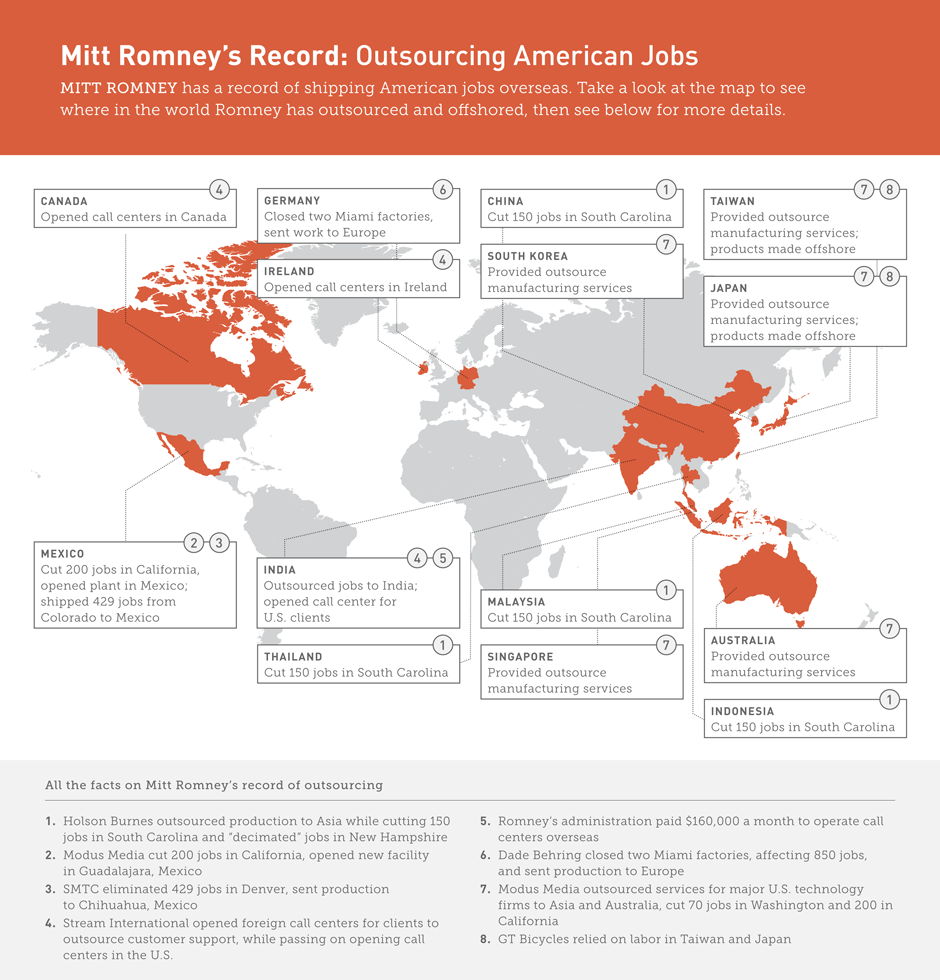
During the nearly 15 years that Romney was actively involved in running Bain, a private equity firm that he founded, it owned companies that were pioneers in the practice of shipping work from the United States to overseas call centers and factories making computer components, according to filings with the Securities and Exchange Commission.

Romney can yell and scream and demagogue against China all he wants now, but he has a long and disgraceful record of dismantling American companies and sending thousands and thousands of jobs to China, India and Mexico, while filling his offshore Swiss and Cayman Island bank accounts with millions of dollars in blood money. Speaking about China at a Toledo, Ohio fence factory a few months ago, the right-wing hypocrite told workers “They’ve been able to put American businesses out of business and kill American jobs. If I’m president of the United States, that’s going to end.”
[A] Washington Post examination of securities filings shows the extent of Bain’s investment in firms that specialized in helping other companies move or expand operations overseas. While Bain was not the largest player in the outsourcing field, the private equity firm was involved early on, at a time when the departure of jobs from the United States was beginning to accelerate and new companies were emerging as handmaidens to this outflow of employment.

Bain played several roles in helping these outsourcing companies, such as investing venture capital so they could grow and providing management and strategic business advice as they navigated this rapidly developing field.

Over the past two decades, American companies have dramatically expanded their overseas operations and supply networks, especially in Asia, while shrinking their workforces at home. McKinsey Global Institute estimated in 2006 that $18.4 billion in global information technology work and $11.4 billion in business-process services have been moved abroad.

...Until Romney left Bain Capital in 1999, he ran it with a proprietor’s zeal and attention to detail, earning a reputation for smart, hands-on management.

Bain’s foray into outsourcing began in 1993 when the private equity firm took a stake in Corporate Software Inc., or CSI, after helping to finance a $93 million buyout of the firm. CSI, which catered to technology companies like Microsoft, provided a range of services including outsourcing of customer support. Initially, CSI employed U.S. workers to provide these services but by the mid-1990s was setting up call centers outside the country.

...Two years after Bain invested in the firm, CSI merged with another enterprise to form a new company called Stream International Inc. Stream immediately became active in the growing field of overseas calls centers. Bain was initially a minority shareholder in Stream and was active in running the company, providing “general executive and management services,” according to SEC filings.

By 1997, Stream was running three tech-support call centers in Europe and was part of a call center joint venture in Japan, an SEC filing shows. “The Company believes that the trend toward outsourcing technical support occurring in the U.S. is also occurring in international markets,” the SEC filing said.

Stream continued to expand its overseas call centers. And Bain’s role also grew with time. It ultimately became the majority shareholder in Stream in 1999 several months after Romney left Bain to run the Salt Lake City Olympics.

Bain sold its stake in Stream in 2001, after the company further expanded its call center operations across Europe and Asia.

The corporate merger that created Stream also gave birth to another, related business known as Modus Media Inc., which specialized in helping companies outsource their manufacturing. Modus Media was a subsidiary of Stream that became an independent company in early 1998. Bain was the largest shareholder, SEC filings show.

Modus Media grew rapidly. In December 1997, it announced it had contracted with Microsoft to produce software and training products at a center in Australia. Modus Media said it was already serving Microsoft from Asian locations in Singapore, South Korea, Japan and Taiwan and in Europe and the United States.

Two years later, Modus Media told the SEC it was performing outsource packaging and hardware assembly for IBM, Sun Microsystems, Hewlett-Packard Co. and Dell Computer Corp. The filing disclosed that Modus had operations on four continents, including Asian facilities in Singapore, Taiwan, China and South Korea, and European facilities in Ireland and France, and a center in Australia.

“Technology companies, in particular, have increasingly sought to outsource the business processes involved in their supply chains,” the filing said. “.?.?. We offer a range of services that provide our clients with a one-stop shop for their outsource requirements.”

According to a news release issued by Modus Media in 1997, its expansion of outsourcing services took place in close consultation with Bain. Terry Leahy, Modus’s chairman and chief executive, was quoted in the release as saying he would be “working closely with Bain on strategic expansion.” At the time, three Bain directors sat on the corporate board of Modus.

The global expansion that began while Romney was at Bain continued after he left. In 2000, the firm announced it was opening a new facility in Guadalajara, Mexico, and expanding in China, Malaysia, Taiwan and South Korea.

In addition to taking an interest in companies that specialized in outsourcing services, Bain also invested in firms that moved or expanded their own operations outside of the United States.

One of those was a California bicycle manufacturer called GT Bicycle Inc. that Bain bought in 1993. The growing company relied on Asian labor, according to SEC filings. Two years later, with the company continuing to expand, Bain helped take it public. In 1998, when Bain owned 22 percent of GT’s stock and had three members on the board, the bicycle maker was sold to Schwinn, which had also moved much of its manufacturing offshore as part of a wider trend in the bicycle industry of turning to Chinese labor.

In the past I've written about Bain's role in the destruction of Warner Bros. Records, which was eventually sold off to the Russian Mafia as a money laundering operation. Perhaps Joni Mitchell, Lou Reed, Wilco and other vital American artists were dropped... at least Mitt Romney was able to deposit even more money into his Swiss and Cayman Islands bank accounts. And how does he respond to all these charges against him? Igor Volsky wasn't writing satire yesterday when he explained:
Mitt Romney’s campaign is responding to evidence that Bain Capital invested in companies that sent American jobs overseas by accusing the Obama administration of “outsourcing” telemarketing jobs to Omaha, Nebraska.

During an appearance on CNN’s State of the Union, Romney adviser Ed Gillespie continued the campaign’s dubious strategy of schooling reporters on the difference between “outsourcing” and “offshoring” jobs, insisting that a Washington Post investigation-- which found that Romney’s company “invested in a series of firms that specialized in relocating jobs done by American workers to new facilities in low-wage countries like China and India”-- misunderstood the complicated business jargon.

Gillespie said that he was “not aware” if companies tied to Bain shipped jobs overseas, before adding, “what happened in the story as near I can tell is that the reporter confused the notion of outsourcing.” “Now a lot of American companies outsource, they outsource domestically,” he said, noting that the Obama campaign outsources jobs to Nebraska and CNN contracts out video editing projects.

Pressed by host Candy Crowley, Gillispie seemed to deny that the companies featured in the Post story set up operations in foreign countries, but suggested that some of the firms Bain invested in did, in fact, ship jobs overseas:

CROWLEY: But your statement today that those companies, while he was head of Bain, did not outsource jobs?

GILLESPIE: In the Washington Post article, which is what we went back and looked at, no.

CROWLEY: So those specific companies, but there might be other companies…

GILLESPIE: Those specific companies are the ones we checked because that was the story and again I would encourage you to have the Washington Post reporter on and see if they can demonstrate to you or to the American voters the validity of the headline that was on that story, because like I say it was a breathless headline, but a baseless story.

But as well as the Washington Post is learning just who Mitt Romney really is, no set of journalists know better what a sleazebag he's always been than the Boston Globe. Yesterday they raised the Post one by breaking a story on Romney's dealings with notorious junk-bond king Michael Milken.
What transpired would become not just one of the most profitable leveraged buyouts of the era, but also one of the most revealing stories of Romney's Bain Capital career. It showed how he pivoted from being a relatively cautious investor to risking his reputation for a big payoff. It is one that Romney has rarely, if ever, mentioned in his two bids for the presidency, perhaps because the Houston-based department store chain that Bain assembled later went into bankruptcy.

But what distinguishes this deal from the nearly 100 others that Romney did over a 15-year period was his close work with Milken's firm, Drexel Burnham Lambert Inc. At the time of the deal, it was widely known that Milken and his company were under federal investigation, yet Romney decided to go ahead with the deal because Drexel had a unique ability to sell high-risk, high-yield debt instruments, known as "junk bonds."


Labels: , , ,

Saturday, June 23, 2012

Jobs! Jobs! Jobs!-- Romney Has A Record Of Sending Them To China And India

>


It scares me that so many Americans taking election year polls express confidence that Romney's business acumen-- his ability to make himself and his partners very, very rich-- will result in national job creation. This week an OpEd in the very Republican Wall Street Journal makes the case that congressional Republicans are willfully blocking Obama's attempts to promote American job creation and that if Romney were to be elected he wouldn't lift a finger to create any jobs for anyone-- other than for butlers and parlour maids.
As the economy continues its recovery from the worst downturn in three generations, it's clear that, once again, decisive action is needed to create jobs now and lay the foundation for stronger, shared economic growth.

There is a strong consensus about what the immediate challenges facing our economy are: first and foremost, a continued lack of demand as a lingering result of the recession. We also know the areas where this has caused the most damage, including deep state and local government layoffs and continued weakness in the construction sector. And we have a good idea of what tools work best to address these problems.

The president has put forward a plan that uses exactly these tools. Nine months ago, President Obama outlined his American Jobs Act and independent economists said it would create as many as 1.9 million jobs. While Congress has acted on some of his proposals-- most notably, extending payroll tax cuts that provide $1,000 for an average family-- it left more than a million jobs on the table.

One of the largest drags on our economy has been the layoffs of public employees like teachers, firefighters and police officers due to state budget cuts. Even as American businesses have created nearly 4.3 million private-sector jobs over the past 27 months, state and local government employment has fallen by 450,000 jobs during that time. But Congress has failed to act to put hundreds of thousands of teachers and first-responders back to work.

Likewise, the crash of the housing markets continues to take a toll on construction workers. There are still two million fewer construction workers employed than when the recession started in 2007. Yet Congress has failed to act on the president's plan to put construction workers back on the job rebuilding our roads, bridges and airports.

Both of these steps would strengthen our economy now and for years to come. Economists Raj Chetty, John Friedman and Jonah Rockoff have shown that in a single year of teaching a great teacher raises the lifetime earnings of her students by $250,000 relative to an average teacher-- so laying off some of our most promising teachers is tragic. Infrastructure boosts productivity and economic growth, yet we are spending less than half as much on infrastructure as Europe does as a share of the economy, and only a quarter of what China spends.

President Obama would take other steps as well: cut taxes for small businesses that add jobs or increase wages, make it easier for homeowners to refinance their mortgages, and put veterans back to work. The president has also put forward a budget that would reduce the deficit by more than $4 trillion over the next decade and stabilize our debt-to-GDP ratio. But he would achieve that deficit reduction while continuing to invest in education, infrastructure and innovation.

This approach stands in stark contrast to that of Gov. Mitt Romney. What would Gov. Romney do to create jobs now? In a word, nothing. In fact, the proposals he has put forward would slow the recovery, reversing the gains we have made since the recession ended.

But not even Romney tries to claim-- at least not any more-- that Bain was creating jobs. Other than in the most superficial terms, Romney doesn't want to talk about his role at Bain or the role he played in the two places where Bain did create jobs: Indian and China-- although even there it wasn't really creating jobs as much as stealing them. Bain, it turns out, was shipping decent middle class American jobs to China and India where they could be done much more cheaply and with no safeguards for the workers or the environment or the society in general.


Today, as a candidate, part of Romney's song and dance routine stump speech is to denounce China for stealing American manufacturing jobs. But Bain Capital made a fortune facilitating that. It was an integral part of the Romney business model.
During the nearly 15 years that Romney was actively involved in running Bain, a private equity firm that he founded, it owned companies that were pioneers in the practice of shipping work from the United States to overseas call centers and factories making computer components, according to filings with the Securities and Exchange Commission.

...[A] Washington Post examination of securities filings shows the extent of Bain’s investment in firms that specialized in helping other companies move or expand operations overseas. While Bain was not the largest player in the outsourcing field, the private equity firm was involved early on, at a time when the departure of jobs from the United States was beginning to accelerate and new companies were emerging as handmaidens to this outflow of employment.

Bain played several roles in helping these outsourcing companies, such as investing venture capital so they could grow and providing management and strategic business advice as they navigated this rapidly developing field.

Over the past two decades, American companies have dramatically expanded their overseas operations and supply networks, especially in Asia, while shrinking their workforces at home. McKinsey Global Institute estimated in 2006 that $18.4 billion in global information technology work and $11.4 billion in business-process services have been moved abroad.

...In addition to taking an interest in companies that specialized in outsourcing services, Bain also invested in firms that moved or expanded their own operations outside of the United States.

One of those was a California bicycle manufacturer called GT Bicycle Inc. that Bain bought in 1993. The growing company relied on Asian labor, according to SEC filings. Two years later, with the company continuing to expand, Bain helped take it public. In 1998, when Bain owned 22 percent of GT’s stock and had three members on the board, the bicycle maker was sold to Schwinn, which had also moved much of its manufacturing offshore as part of a wider trend in the bicycle industry of turning to Chinese labor.

Another Bain investment was electronics manufacturer SMTC Corp. In June 1998, during Romney’s last year at Bain, his private equity firm acquired a Colorado manufacturer that specialized in the assembly of printed circuit boards. That was one of several preliminary steps in 1998 that would culminate in a corporate merger a year later, five months after Romney left Bain. In July 1999, the Colorado firm acquired SMTC Corp., SEC filings show. Bain became the largest shareholder of SMTC and held three seats on its corporate board. Within a year of Bain taking over, SMTC told the SEC it was expanding production in Ireland and Mexico.

In its prospectus that year, SMTC explained that it was in a strong position to meet the swelling demand from other manufacturers for overseas production of circuit boards. The company said that communications and networking companies “are dramatically increasing the amount of manufacturing they are outsourcing and we believe our technological capabilities and global manufacturing platform are well suited to capitalize on this opportunity.”


Just as Romney was ending his tenure at Bain, it reached the culmination of negotiations with Hyundai Electronics Industry of South Korea for the $550 million purchase of its U.S. subsidiary, Chippac, which manufactured, tested and packaged computer chips in Asia. The deal was announced a month after Romney left Bain. Reports filed with the SEC in late 1999 showed that Chippac had plants in South Korea and China and was responsible for marketing and supplying the company’s Asian-made computer chips. An overwhelming majority of Chippac’s customers were U.S. firms, including Intel, IBM and Lucent Technologies.

A filing with the SEC revealed the promise that Chippac offered investors. “Historically, semiconductor companies primarily manufactured semiconductors in their own facilities,” the filing said. “Today, most major semiconductor manufacturers use independent packaging and test service providers for at least a portion of their... needs. We expect this outsourcing trend to continue.”

This isn't the image Romney has worked so hard to craft for himself. He'd much rather talk about how he saved the 2002 Olympics in Utah. But even that is being challenged-- and by people who know... the folks at Salt Lake Magazine. Romney's back in Utah this weekend with every super-rich Mormon in America-- and super-rich non-Mormons who are willing to help them take over the White House. But the cover story of the magazine, The Myth of Mitt, isn't the kind of stuff Romney wants any of them to dwell on. It begins with a look at all-too-typical Romney self-aggrandizement: "The opening ceremonies of the 2002 Winter Olympics were still months away, but already Mitt Romney was thinking about the legacy they would leave behind. " In Romneyworld, it's always about him-- until it starts falling apart... and then he always finds someone else to blame for his poor leadership qualities. Today his staffers would probably prefer to talk about the Olympics instead of the nitpicking between what is "outsourcing" (which he admits that he champions) and what is "offshoring" (which he's afraid to touch with a 10 foot pole). I can't imagine Romney, out of touch as he is, is clueless enough to want his staff to get into a protracted argument about how Willard spent 15 years of his life getting rich by sending American workers' jobs overseas-- especially not when his two top economic advisors, Greg Mankiw and Glenn Hubbard and notorious advocates for aggressive outsourcing and offshoring.

Labels: , , ,

Friday, June 01, 2012

Bain Still Uses The Romney Model To Loot And Wreck Companies

>


There's been a lot of talk about how Romney's experience in the private sector has made him especially unfit for any kind of government service. Certainly the Bain experience at Warner Bros. Records proved that to everyone at the company as they slashed and burned, dropped heritage artists, drained the company of capital, destroyed the concept of artist development, and left the whole institution a smoldering wreck. This week Jerry Del Colliano, editor of the Inside Music Media trade publication posted on how Bain continues to rob Clear Channel blind.
There is increasing evidence that Bain Capital in cahoots with Lee Capital Partners continues to pillage what was once a great radio company driving it deep into debt as it collects huge fees and makes unbelievable profits even as employees get sacrificed.

We’ve all known something is fishy but the details I am about to share are staggering.

The situation is getting worse even as I write this which means that you will be shocked and perhaps amazed at how deeply Clear Channel will have to further reduce its work force to keep paying its investment banks.

Bain is not creating jobs. 

It is robbing Clear Channel blind.

And ready to layoff large numbers of people, as you will soon read.

Here’s how bad things are and how Clear Channel employees are going to have to pay the price again-- soon.

...Let me tell you what questions will be answered:

1.  What Clear Channel will lose this year-- a whopping number and nowhere near the $1 billion it used to make.

2.  What owner/investment banks Lee and Bain make in fees every year. Go ahead and guess. You’re too low! I’ve not only got the accurate number but how much they made in fees in the first three months of 2012. Plus, when this sweet arrangement ends. (This is why you’re being laid off at Clear Channel!)

3.  How Lee and Bain came up with the money to do the original Clear Channel acquisition and how they plan on paying for it.

4.  The number of layoffs at Clear Channel since Lee & Bain took over – I’ve been looking for an accurate number and I’ve got it for you.

5.  Why Clear Channel is on the default list-- that’s right, default is expected and only 10% of the money they borrowed is likely to be recovered-- if that. This is incredible!

6.  Why shell-shocked employees don’t want to believe the massive layoffs that are yet to come.  As the Boy Scouts say “be prepared.”

The answers begin here.

And the rest is behind a paywall. But the billionaire sociopaths behind Romney know exactly what's behind that paywall... which is why they're going all out to finance his bid to take over the White House. Rolling Stones names 16 dangerous predators who are looking the use Romney to buy the U.S. government: William "the other brother" Koch ($4 billion), Harold Simmons ($9.8 billion), Bob Perry ($600 million), Jim Davis ($1.8 billion; stop buying New Balanced Shoes), Bill Marriott, Jr. ($1.7 billion), Edward Conrad (over a billion), Frank VanderSloot ($1 billion), Steven Lund ($31.9 million), Julian Robertson, Jr. ($2.5 billion), John Paulson ($12.5 billion), Paul Singer ($1 billion), Robert Mercer (secretive and dangerous predator who made $125 million in 2011 but has managed to hide his net worth), Kenneth Griffin ($3 billion), Francis Rooney III ($1.8 billion), and Steven Webster (billionaire).
Presidential politics has always been a rich man's game. But now, thanks to the Supreme Court ruling in Citizens United that upended decades of limits on campaign donations, financing a presidential race is the exclusive domain of the kind of megadonor whose portfolios make Mitt Romney look middle-class. "I have lots of money, and can give it legally now," Texas billionaire and top GOP moneyman Harold Simmons recently bragged to the Wall Street Journal. "Just never to Democrats."

In past elections, big donors like Simmons gave millions for advocacy groups like Swift Boat Veterans for Truth. By law, such groups were only allowed to run issue ads-- but instead they directly targeted John Kerry, drawing big fines from the Federal Elections Commission. Now, with the blessing of the Supreme Court, the wealthy can legally hand out unlimited sums to groups that openly campaign for a candidate, knowing that their "dark money" donations will be kept entirely secret. The billionaire Koch brothers, for instance, have reportedly pledged $60 million to defeat President Obama this year-- but their off-the-book contributions don't appear in any FEC filings.

Even more money from megadonors is flowing into newly created Super PACs, which, unlike advocacy groups, can spend every cent they raise on direct attacks on an opponent. Under the new rules, the richest men in America are plying candidates with donations far beyond what Congress intended. "They can still give the maximum $2,500 directly to the campaign-- and then turn around and give $25 million to the Super PAC," says Trevor Potter, general counsel of the Campaign Legal Center. A single patron can now prop up an entire candidacy, as casino magnate Sheldon Adelson did with a $20 million donation to the Super PAC backing Newt Gingrich.

The undisputed master of Super PAC money is Mitt Romney. In the primary season alone, Romney's rich friends invested $52 million in his Super PAC, Restore Our Future-- a number that's expected to more than double in the coming months. This unprecedented infusion of money from America's monied elites underscores the radical transformation of the Republican Party, which has made defending the interests of 0.0001 percent the basis of its entire platform. "Money buys power," the Nobel Prize-winning economist Paul Krugman observed recently, "and the increasing wealth of a tiny minority has effectively bought the allegiance of one of our two major political parties." In short, the political polarization and gridlock in Washington are a direct result of the GOP's capitulation to Big Money.

That capitulation is evident in Romney's campaign. Most of the megadonors backing his candidacy are elderly billionaires: Their median age is 66, and their median wealth is $1 billion. Each is looking for a payoff that will benefit his business interests, and they will all profit from Romney's pledge to eliminate inheritance taxes, extend the Bush tax cuts for the superwealthy-- and then slash the top tax rate by another 20 percent. Romney has firmly joined the ranks of the economic nutcases who spout the lie of trickle-down economics. "Support from billionaires has always been the main thing keeping those charlatans and cranks in business," Krugman noted. "And now the same people effectively own a whole political party."

And as Glenn Greenwald put it on Twitter early this morning, "In a nation of whiny, self-pitying billionaires, the chronic bully Frank VanderSloot may be the most petulant of all." Ken Vogel has a fuller story at Politico on how the billionaires who are trying to buy the White House don't like being criticized for their perfidy. They claim they're being abused for their generosity. And if you use Melaleuca products, you are funding this dangerous anti-democracy predator.
VanderSloot is one of the loudest of the aggrieved mega-donors, announcing that his family’s privacy has been invaded and his health and home products company, Melaleuca, had lost hundreds of customers, and asserting the Obama campaign list and liberal websites have misrepresented his company and political activism.

He’s waged an aggressive response, making a series of appearances on the Fox News Channel in which he called for donations to Romney in protest of the list. He also spoke at a Heritage Foundation event in Washington this week. And he told Politico he intended to make additional donations to the pro-Romney super PAC each time something untruthful was published about him-- a plan he said his wife predicted could yield “several hundred thousand dollars” more in contributions.

The top lawyer for VanderSloot’s company has demanded corrections from media outlets writing about VanderSloot’s political activity. When one blogger emailed back, “I do not appreciate thinly veiled threats,” the lawyer responded, “We have been neither thin nor veiled. … Melaleuca is more than capable and willing to protect its reputation from false and defamatory statements as it sees fit.”

Plus, VanderSloot launched a website where he defends himself against what he calls attacks from “extreme, far left blog sites.”

Labels: , , , ,

Wednesday, May 23, 2012

Bain Capital-- How Did Cory Booker Wreck His Career?

>


The DWT art department rarely asks any questions. They just send art and tell me to post a blog about it. But yesterday they did ask a question:
Why would Romney's leeching organization be called Bain? That is identical in pronunciation the Bane...

bane  (bn)
n.
1. Fatal injury or ruin: "Hath some fond lover tic'd thee to thy bane?" (George Herbert).

2.
a. A cause of harm, ruin, or death

Earlier this year, on January 8, while campaigning in New Hampshire, then candidate Newt Gingrich opened a can of worms-- and a can of whoopass on Willard-- by publicly uttering what many were already thinking: “Those of us who believe in free markets and those of us who believe that in fact the whole goal of investment is entrepreneurship and job creation, we find it pretty hard to justify rich people figuring out clever legal ways to loot a company, leaving behind 1,700 families without a job.” Two days later a second GOP candidate, Texas Governor Rick Perry, took up the same theme-- and expanded on it, at least rhetorically, this time in South Carolina: "Mitt Romney and Bain Capital were involved with what I call vulture capitalism.” Later the same day, in an interview with the National Journal, he went further in denigrating the Bain model that is the crowning achievement of Romney's public life:
“Instead of trying to work with them to try to find a way to keep the jobs and to get them back on their feet, it’s all about how much money can we make, how quick can we make it, and then get out of town and find the next carcass to feed upon”

Gingrich, whose $4.8 million campaign debt has turned him into another word for the world's oldest profession, "a Romney surrogate," indicated to CNN's Piers Morgan he needs to smelling salts now to cope with the attacks by President Obama on Romney's record at Bain. "I’m very surprised that President Obama went down this road." Surprised? Maybe someone on President Obama's team noticed the only significant contribution Newt made to the 2012 campaign for president, the 28 minute film, When Mitt Romney Came To Town which has been watched in its entirety by a quarter million people. It's worth watching-- or watching again-- in light of the Republican hysteria over the gall of the Obama campaign raising the issue of Romney's record-- and using prominent Republicans to do it for him.


Newark Mayor Cory Booker stepped right in it on Meet The Press last weekend, doing what conflicted, conservative Democrats do-- including, all too often, the Obama administration: they twist themselves into a knot kissing the ass of the Wall Street special interests that are the natural allies in almost all ways-- economic success being the exception-- of the Republican Party.


Booker's career-- much like Rahm Emanuel's, Artur Davis' and Harold Ford's-- has been financed by Wall Street. They picked him out early, the same way they picked out Paul Ryan and Eric Cantor-- as an energetic young politician with no ethical compunctions about bribery who could go far in the cesspool of politics. Monday, Josh Israel, did some digging around for Think Progress.
A ThinkProgress examination of New Jersey campaign finance records for Booker’s first run for Mayor-- back in 2002-- suggests a possible reason for his unease with attacks on Bain Capital and venture capital. They were among his earliest and most generous backers.

Contributions to his 2002 campaign from venture capitalists, investors, and big Wall Street bankers brought him more than $115,000 for his 2002 campaign. Among those contributing to his campaign were John Connaughton ($2,000), Steve Pagliuca ($2,200), Jonathan Lavine ($1,000)-- all of Bain Capital. While the forms are not totally clear, it appears the campaign raised less than $800,000 total, making this a significant percentage.

He and his slate also jointly raised funds for the “Booker Team for Newark” joint committee. They received more than $450,000 for the 2002 campaign from the sector-- including a pair of $15,400 contributions from Bain Capital Managing Directors Joshua Bekenstein and Mark Nunnelly. It appears that for the initial campaign and runoff, the slate raised less than $4 million-- again making this a sizable chunk.

In all-- just in his first Mayoral run-- Booker’s committees received more than $565,000 from the people he was defending. At least $36,000 of that came from folks at Romney’s old firm.

Joe Biden, the guy was less a creation of Wall Street. And last week his explanation of what Bain is all about had, for him, surprising clarity: “Romney made sure the guys at top got to play by a different set of rules, he ran massive debts, and the middle class lost. And folks, he thinks this experience will help our economy? Where I come from, past is prologue.” Yesterday I ook a taxi to JFK on my way back to L.A. The driver, an Egyptian-American, who hasn't missed voting in a presidential election since George H.W. Bush ran-- and who he admires and voted for-- told me he is horrified by Romney. He explained to me that businessmen only care about making money for themselves and their circle and that if Romney won, he would be an even worse president than Bush II. I know that from personal experience with Romney's Bain model.

I've written about it before and I didn't need to hear it back in January from David Axelrod, but who was correct in pointing out about Bain that “They closed down more than 1,000 plants, stores and offices. They outsourced tens of thousands of jobs, and they took 12 companies to bankruptcy. I don’t think those are the values that people want to animate our economy. He is not a job creator, he is a corporate raider. Those aren’t the values that we want to lead our economy.” My own Bain experience was at TimeWarner where I was a division president. (I ran Reprise Records at Warner Bros and was mortified to see the Bain people come in and loot the company, drain it of assets, drop artists we had developed over decades so they could line their own pockets-- and then leave the barely-living carcass for the Russian Mafia to pick over.


On he Democratic side of this story, it's important to remember that many Democratic politicians-- maybe even most Democratic politicians-- are as culpable as a garden variety Republican when it comes to taking money from banksters and other shady characters looking for people without morals they can bribe who will sell out their own constituents. So far this cycle, the finance sector has spent $253,290,163 on elections, 49.5% to Republicans and 31.2% to Democrats. Since 1989 they spent $1,710,713,286 on congressional races. Of that $936,860,394 went to Republicans and $761,397,793 went to Democrats. If current Members of the House were to be arrested and charged with accepting bribery based on taking big money from the banksters in return for services rendered the Top 3 criminals would be:
John Boehner (R-OH)- $6,653,176
Eric Cantor (R-VA)- $6,027,865
Spencer Bachus (R-AL)- $5,763,934

But waddling right up to the bar behind them would be another notorious crook Charlie Rangel, a Democrat, and former Chair of the House Ways and Means Committee, who has accepted $5,155,543 in bribes from the financial criminal class he was supposed to be helping to regulate. And the 5 worst in the Senate are John McCain (R-AZ- $36,390,767), John Kerry (D-MA- $20,043,114), Chuck Schumer (D-NY- $18,757,891), Joe Lieberman (I-CT- $10,891,541), and Miss McConnell (R-KY- $6,841,197).

Republicans are bad, very bad, but that doesn't make Democrats good. Are they all on the take? No, but most of them are. Who doesn't take money from the banksters? On the Senate side, Bernie Sanders (I-VT) and Herb Kohl (D-WI). And on the House side Walter Jones (R-NC), Hansen Clarke (D-MI) and... um... that's about it I'm afraid. But not all Democrats have sold their souls to private equity the way the GOP has-- or the way Rahm Emanuel has or the way Harold Ford has or the way Cory Booker has. Robert Reich sure hasn't-- and he's urging Obama to go on the attack against casino gambling in the form of both Bain and JPMorganChase... and to resurrect Glass-Steagall for real.
I wish President Obama would draw the obvious connection between Bain Capital and JPMorgan Chase.

That way his so-called “attack” on private equity is neither a personal attack on Mitt Romney nor a generalized attack on American business.

It’s an attack on a particular kind of capitalism that Romney and JPMorgan both practice: Using other peoples’ money to make big bets which, if they go wrong, can wreak havoc on the economy.

It’s the substitution of casino capitalism for real capitalism, the dominance of the betting parlor over the real business of America, financial innovation rather than product innovation.

It’s been terrible for the American economy and for our democracy.

It’s also why Obama has to come out swinging about JPMorgan. The JPMorgan Chase debacle would have been prevented if the Volcker Rule were sufficiently strict, prohibiting banks from using commercial deposits to make bets except very specific offsetting bets (hedges) on narrow classes of trades.

But Jamie Dimon and JPMorgan have been lobbying like mad to loosen the Volcker Rule and widen that exception to include the very kind of reckless bets JPMorgan made. And they’re still at it, as evidenced by Dimon’s current claim that the rule that eventually emerges would allow those bets.

As a practical matter, the Volcker Rule is hopeless. It was intended to be Glass-Steagall lite-- a more nuanced version of the original Depression-era law that separated commercial from investment banking. But JPMorgan has proven that any nuance-- any exception-- will be stretched beyond recognition by the big banks.

So much money can be made when these bets turn out well that the big banks will stop at nothing to keep the spigot open.

There’s no alternative but to resurrect Glass-Steagall as a whole. Even then, the biggest banks are still too big to fail or to regulate. We also need to heed the recent advice of the Dallas branch of the Federal Reserve, and break them up.

At the same time, there’s no point to the “carried interest” loophole that allows private-equity managers like Mitt Romney to treat their incomes as capital gains, taxed at only 15 percent, when they’ve risked no money of their own.

If private equity were good for America it wouldn’t need this or the other tax preference it depends on, elevating debt over equity. But the private equity industry has huge political clout, which is why these tax preferences remain.

Get it? Bain Capital and JPMorgan are parts of the same problem. The President should be leading the charge against both.


Labels: , , ,

Monday, May 14, 2012

DANGER! DANGER! MIND THE GAP! Willard Fails The Psychopath Test

>


In his NY Times column Saturday, Mean Boys, Charles Blow pins Romney down and dissects the mind of a bully. And you know, it's sure not all about Romney acting out his fears of being gay by violent and abusive behavior towards younger, weaker gay students. Blow recalls how he walked a blind teacher into a closed door o entertain himself and his clique. He remind us that the violent, now infamous, haircutting incident is not, as Romney is desperately trying to portray it, a youthful prank and hijinks. "It's an assault" and "honorable men don't chuckle at cruelty... Americans want a president who doesn’t target the weak, but valiantly seeks to protect them." Well... some Americans do. Other Americans actually admire psychopaths.

Saturday, just after I had read Blow's column, I drove way out to the edges of L.A. County to see another psychopath with my own eyes-- hands-on torturer and unpunished war-criminal Allen West, a guest at an all-white BBQ/fundraiser for Buck McKeon. On the way I listened to Ira Glass' NPR show, This American Life. Saturday's episode was all about psychopaths. "Wow," I thought, what could be better listening on my way to meet Allen West! But it was all about Mitt Romney. Turns out 4% of American businessmen are certifiable psychopaths. Listen to the tape of the show above-- get "Chainsaw" Al Dunlap out of your mind and just think about the spoiled prep school brat with the scissors and the cruel streak. It wants to be president... of the Unites States.

Friday, while making a complete fool out of himself by trying to rewrite very recent history in terms of his role in the auto bailout crisis-- he was the foremost and loudest advocate of letting Detroit go bankrupt (a garden variety GOP position) and now he claims the bailout was all his idea-- Romney very publicly announced that he supports gay people adopting children. I almost fell out of my chair. If there's one thing the far right base of the Republican Party hates more than marriage equality, it's gay couples adopting children. I bet a friend that the time before Romney walked back the statement would be measured in minutes or hours, not days or weeks. I tweeted that one angry grimace from one angry Republican Satanist and, BOOM!, Romney would be ready to start advocating prison for gay adopters. I won the bet.
Republican presidential candidate Mitt Romney on Friday backed away from his support of adoptions by same-sex couples, saying that he simply "acknowledges" the legality of such adoptions in many states.

A day earlier, Romney, in an interview with Fox News' Neil Cavuto, had indicated that while he does not support same-sex marriage, he considers the adoption of children by same-sex couples a "right."

He said on Thursday: "And if two people of the same gender want to live together, want to have a loving relationship, or even to adopt a child-- in my state individuals of the same sex were able to adopt children. In my view, that's something that people have a right to do. But to call that marriage is something that in my view is a departure from the real meaning of that word."

But then on Friday, he was asked, in an interview with CBS' WBTV in Charlotte, N.C., how his opposition to same-sex marriage "squared" with his support for gay adoptions. Romney told anchor Paul Cameron, "Well actually I think all states but one allow gay adoption, so that's a position which has been decided by most of the state legislators, including the one in my state some time ago. So I simply acknowledge the fact that gay adoption is legal in all states but one."


Labels: , , ,