"When fascism comes to America, it will be wrapped in the flag and carrying the cross."
-- Sinclair Lewis
Monday, October 26, 2020
This New Dem Careerist Crap Really Pisses Me Off
>
I was speaking with a congressional candidate the other day. And she asked me if I know a particular member of Congress who had called her recently. I never met the fellow but I do know he's a corporate-friendly New Dem with an "F" rating from ProgressivePunch-- and in a ultra-safe blue district (D+over 20) that was designed to suck up every Democrat in the area to make it safer for 4 Republican incumbents by making sure their districts would be less competitive.
In any case, what did this New Dem want from the progressive? Was it to make a contribution to her campaign? Nah. But he had some advise for her: he chastised her for not taking PAC money-- even though she had out-raised her opponent without the money that comes with strings attached (which is how the congressman finances his own career).
And the other advise was even more offensive. She told me that the person who has done the most for her campaign has been Bernie Sanders, who has sent fundraising letters and done on-line events with her. The congressman wanted to warn her that if she was seen to be associating with Bernie, it would hurt her efforts to get elected.
This isn't even sound advice on the surface. There are 3 counties with almost all the people in her district. Two of the three-- including the biggest one-- all went for Bernie in 2016 and again in 2020. This isn't an area looking for a conservative, status-quo Democrat. His district isn't either. Democratic turnout in his district is pathetic, just a fraction of what it should be. He's very lucky there are so few Republicans there.
I spoke to other progressive candidates who have told me they've gotten very similar advice from incumbents, usually New Dems! "Go light on the anti-PAC message" and "Don't play up the Bernie association." Advice from the DCCC consultants is even harsher and more vile-- both in terms of the content and in the ways the content is delivered, especially to women candidates who always seem to get talked down to by these DCCC consultants. (I thought they put Bustos into therapy to make her less of a bigot. I guess it either didn't work or she didn't realize she was supposed to instill decency into her co-workers and consultants.)
The Democratic Party is going to need serious, committed men and women in Congress, not a bunch of worthless careerists who are serious about nothing but how to get reelected and not committed to anything but themselves. The DCCC candidates, for the most part, don't make the grade. I was just reading how Trump's plan is to leave Biden with a poison pill that will take candidates who are going to fight to win-- the way Pramila Jayapal and Ted Lieu and Jamie Raskin do and not whimper like a bunch of Third Way/Problem Solver/New Dem weenies. Andrew Feinberg reported that "The order, which the White House released late Wednesday evening, would strip civil service protections from a broad swath of career civil servants if it is decided that they are in 'confidential, policy-determining, policy-making, or policy-advocating positions'-- a description previously reserved for the political appointees who come and go with each change in administration. It does that by creating a new category for such positions that do not turn over from administration to administration and reclassifying them as part of that category. The Office of Personnel Management-- essentially the executive branch’s human resources department-- has been charged with implementing the order by publishing a 'preliminary' list of positions to be moved into the new category on what could President Donald Trump’s last full day in office: January 19, 2021."
The range of workers who could be stripped of protections and placed in this new category is vast, experts say, and could include most of the non-partisan experts-- scientists, doctors, lawyers, economists-- whose work to advise and inform policymakers is supposed to be done in a way that is fact-driven and devoid of politics. Trump has repeatedly clashed with such career workers on a variety of settings, ranging from his desire to present the Covid-19 pandemic as largely over, to his attempts to enable his allies to escape punishment for federal crimes, to his quixotic insistence that National Weather Service scientists back up his erroneous claim that the state of Alabama was threatened by a hurricane which was not heading in its direction.
Creating the new category-- known as “Schedule F”-- and moving current civil servants into it could allow a lame-duck President Trump to cripple his successor’s administration by firing any career federal employees who’ve been included on the list. It also could allow Trump administration officials to skirt prohibitions against “burrowing in”-- the heavily restricted practice of converting political appointees (known as “Schedule C” employees) into career civil servants-- by hiring them under the new category for positions which would not end with Trump’s term. Another provision orders agencies to take steps to prohibit removing “Schedule F” appointees from their jobs on the grounds of “political affiliation,” which could potentially prevent a future administration from firing unqualified appointees because of their association with President Trump.
“It's a two-pronged attack-- a Hail Mary pass to enable them to do some burrowing in if they lose the election,” said Walter Shaub, who ran the US Office of Government Ethics during the last four years of the Obama administration and first six months of the Trump administration. “But if they win the election, then anything goes for the destruction of the civil service… [This could] take us back to the spoils system and all the corruption that comes with it.”
Shaub explained that at the core of it, a non-partisan civil service is one of the most basic anti-corruption measures that any government can implement “because they free federal employees to disobey illegal orders, be ethical, and resist fraud, waste, and abuse.”
“Taking those away creates a cadre of people who are either too intimidated by or loyal to a politician instead of the rule of law and the Constitution,” he said. “That’s the goal here.”
It's why I've been advocating declaring that Trump was an illegitimate president and that everything he did is null and void-- a kind of modern day Damnatio Memoriae. That's a job for progressives, not careerist centrists.
Audrey isn't the candidate I spoke to about the New Dem phone call but I just saw her new TV ad and thought it fit--exactly what a DCCC consultant would tell her not to run:
The Chaotic Rule Of Donald J Trump Hurtles Towards A Final Denouement... Chaotically
>
Active Shooter by Nancy Ohanian
Based on a national voter survey released yesterday, the Public Religion Research Institute (PRRI) reported that Trump will lose by 14 points (54% to 40%), unless voter turnout is extremely high-- which looks likely-- in which case Trump will lose by 18 points (56% to 38%).
Some of the most interesting findings show an extremely bifurcated America-- with normal people basing their stands on reality, while Republicans live in a Fox/Hate Talk Radio bubble in an alternative reality.
•About three in four Americans (76%) think that shutdowns, mask mandates, and other steps taken by state and local governments since the coronavirus pandemic began are reasonable measures to protect people, including majorities of Republicans, independents, and Democrats (56%, 71%, and 94%, respectively).
•Nine in ten Democrats (90%), 78% of independents, and 65% of Republicans say they always wear masks in public places. White evangelical Protestants stand out among religious groups as less likely than others to report wearing a mask all the time in public (63% vs. 77% and higher among all other groups).
•White evangelical Protestants are the only religious group who are more likely to say that Trump rather than Biden has strong religious beliefs (43% vs. 18%) and best models religious values with his actions and leadership (49% vs. 18%).
•A majority of Americans (55%), including 24% of Republicans and 77% of Democrats, say they are not at all confident that President Trump will concede defeat if Biden is declared the winner of the election. One-third of Americans (36%), including 26% of Republicans and 46% of Democrats, are not at all confident that Republican leaders in Congress would demand Trump leave office if he refuses to concede an election loss.
•Two-thirds of Americans (66%) say the winner of the popular vote rather than the Electoral College should determine the next president.
•Partisan views of the other party are harsh.
◦ Eight in ten Republicans (81%) say the Democratic Party has been taken over by socialists, compared to 17% who say the Democratic Party is trying to make capitalism work for average Americans.
◦ Eight in ten Democrats (78%) say the Republican Party has been taken over by racists, compared to 20% who say the Republican Party is trying to protect the country against outside threats.
• Democrats (17%) are significantly less likely than they were in both 2018 (26%) and 2015 (32%) to believe that police killings of Black men are isolated incidents, as white Democrats’ views have become more aligned with those of African Americans over the last five years. By contrast, Republican views that police killings of African Americans are isolated incidents (79%) have not changed significantly since 2015 (82%).
• Majorities of all religious groups, including 58% of white evangelical Protestants, say immigrants living in the U.S. illegally should be allowed a way to become citizens, provided they meet certain requirements.
•Majorities of Democrats (91%), independents (79%), and Republicans (53%) oppose an immigration border policy that separates children from their parents and charges parents as criminals when they enter the country without permission.
•Democrats (76%) and independents (61%) are about twice as likely as Republicans (31%) to think that climate change will cause them harm.
•Majorities of Democrats, independents, and Republicans favor guaranteeing all Americans access to affordable childcare (95%, 85%, and 71%, respectively) and guaranteeing all Americans a minimum income (88%, 69%, and 52%, respectively).
On Sunday, NY Times reporters tried Maggie Haberman and Alexander Burns explaining why Trump's campaign seems so dysfunctional and is flailing so badly. "Away from their candidate and the television cameras," wrote Haberman and Burns, "some of Mr. Trump’s aides are quietly conceding just how dire his political predicament appears to be, and his inner circle has returned to a state of recriminations and backbiting. Mark Meadows, the White House chief of staff, is drawing furious blame from the president and some political advisers for his handling of Mr. Trump’s recent hospitalization, and he is seen as unlikely to hold onto his job past Election Day. Mr. Trump’s campaign manager, Bill Stepien, has maintained to senior Republicans that the president has a path forward in the race but at times has conceded it is narrow. Some midlevel aides on the campaign have even begun inquiring about employment on Capitol Hill after the election, apparently under the assumption that there will not be a second Trump administration for them to serve in. (It is not clear how appealing the Trump campaign might be as a résumé line for private-sector employers.)... Among some of Mr. Trump’s lieutenants, there is an attitude of grit mixed with resignation: a sense that the best they can do for the final stretch is to keep the president occupied, happy and off Twitter as much as possible, rather than producing a major shift in strategy. Often, their biggest obstacle is Mr. Trump himself."
Instead of delivering a focused closing message aimed at changing people’s perceptions about his handling of the coronavirus, or making a case for why he can revive the economy better than Mr. Biden can, Mr. Trump is spending the remaining days on a familiar mix of personal grievances, attacks on his opponents and obfuscations. He has portrayed himself as a victim, dodged questions about his own coronavirus testing, attacked his attorney general and the F.B.I. director and equivocated on the benefits of mask-wearing.
Rather than drawing a consistent contrast with Mr. Biden on the economy, strategists say, the president’s preference is to attack Mr. Biden’s son Hunter over his business dealings and to hurl personal insults like “Sleepy Joe” against a candidate whose favorability ratings are much higher than Mr. Trump’s.
[S]ome prominent Republicans have noted in newly direct language the possibility-- and even the likelihood-- of defeat for the president. Senator Lindsey Graham of South Carolina, a close ally, said this week that Democrats had “a good chance of winning the White House,” while Senator Ben Sasse of Nebraska said his party might be facing a “blood bath.”
Though fear of retaliation by Mr. Trump has muzzled most members of the party, strategists are deeply concerned that Mr. Trump might spend the final weeks of the campaign entertaining and energizing his existing supporters while eschewing any concerted effort to find new ones-- an approach that could cripple other Republicans running for office.
And that retaliation theme against Republicans was highlighted by Sam Stein and Asawin Suebsaeng at the Daily Beast yesterday where they reported on a virtual game of chicken about who is going to throw who under the bus sooner-- Trump going nuts on Republicans in Congress or Republicans in Congress claiming they never heard of anyone named Trump.
Under The Bus by Nancy Ohanian
"That sense of paranoia," wrote Suebsaeng and Stein, "has been fed by the president’s aides and confidants, who have flagged news coverage for him of Republican politicians either openly criticizing his conduct or else trying to distance themselves from a looming possible electoral bloodbath. According to one of the sources with direct knowledge, the president is already contemplating retribution... Some of the coverage that has been bookmarked for Trump includes recent stories on Senate Majority Leader Mitch McConnell (R-KY), who has not only split with the president on coronavirus-related stimulus legislation but made a point of saying he hadn’t been to the White House in weeks because of its cavalier approach to the pandemic. Trump’s frictions with Republican senators don’t stop there. This past week, the president attacked Sen. Susan Collins (R-ME) on Twitter over 'a nasty rumor' that she was going to oppose his Supreme Court nominee, Amy Coney Barrett. He said of the endangered incumbent: 'Not worth the work!'... Beyond that, there is strong suspicion within Trump’s inner sanctum that Sen. Ben Sasse’s (R-NE) office leaked the contents of a call he held with constituents in which he chastised the president for embracing dictators and not condemning conspiracists. Trump’s anger with the call boiled over on Saturday with yet another Twitter attack."
Back to Haberman and Burns who wrote that "There is also growing frustration among congressional Republicans that the White House has not driven a strong positive message about Judge Amy Coney Barrett’s Supreme Court nomination-- a confirmation battle that Republicans until recently regarded as their best chance for a political turnaround. Republicans and allies of the president have trained their ire specifically on Mr. Meadows, viewing some of his actions, like showing up at Ms. Barrett’s hearings, as a form of personal brand-building.
In some respects, the trajectory of Mr. Trump’s campaign in its final weeks reflects longstanding structural weaknesses and internal divisions.
...For much of the past four years, Mr. Kushner [basically a moron] had cast himself as the chief executive of the re-election effort, but he pulled back from that role during the summer and in September, when the political environment had clearly soured. Instead, he thrust himself into a number of diplomatic negotiations in the Middle East that have little evident salience in the election. He has become more engaged in recent weeks, officials said.
...Many Republicans have resorted to hoping that the president might be disciplined enough for the remaining 16 days to narrow the gap with Mr. Biden and salvage the party’s House and Senate candidates.
But few people close to Mr. Trump present the path ahead to him in those terms, Republicans say. They recognize that the president knows he outpolls most G.O.P. candidates in their own districts or states and that suggesting to him that he is on track to lose would be unlikely to produce constructive results.
Early Monday morning, Paul Kane wrote in his Post column that "In competitive Senate races across the country, including states where Trump remains popular, Republican incumbents are facing a conundrum: how to prove their pro-Trump bona fides to a MAGA movement that sees many longtime Republicans as insufficiently pure while stopping the hemorrhaging among suburban moderates who wonder why they have enabled the president... The result for [Joni] Ernst and as many as a half-dozen of her GOP colleagues may be the worst of both worlds, in which they risk alienating energized Trump backers if they criticize the president but then, if they stick with him, lose some centrist voters who have soured on Trump and are open to voting for a Democrat."
The same is happening in House races, of course. I asked Audrey Denney how her Trump-loving opponent Doug LaMalfa is walking that tight-rope. "LaMalfa isn’t walking the tight rope," she told me. "He has let his extremist obstructionist flag fly with zero regard to facts or science. That is leaving all of the more moderate Republicans and conservative NPP voters up for grabs! We’re going to pull this off."
I also asked Michigan state Rep. Jon Hoadley the same question about the Trump enabler he's running against."Time and time again, Fred Upton has failed to stand up to President Trump. Just as with all other decisions in his 34-year career, Upton considers political expediency first and foremost before weighing the interests of the district he's been elected to represent. As Donald Trump continues to stoke the flames of domestic terrorism and incite violence amongst his supporters, Upton remains unsurprisingly silent. Our district deserves better, and it's past time we change our Representative."
There Are People In Congress Working On Sustainable Energy And Environmental Justice-- But We Need More Of Them
>
In its mission statement, Congress' Sustainable Energy & Environment Coalition lays out two overarching goals:
• Advance policies that promote clean energy innovation and domestic manufacturing, develop renewable energy resources, and create good green jobs across the economy and the country. • Advance polices to address climate change, protect our nation’s clean air, water and natural environment, and promote environmental justice.
There are 67 members-- all Democrats-- who have joined the Caucus. This week, Blue America has been working with their SEEC PAC to help raise last minute campaign contributions for congressional candidates who have been endorsed by both groups, the men and women who will be helping to lead the group's future.
One member, Ted Lieu, was a California state Senator when I first got to know him. At a discussion, someone asked him whey he would want to move away from his life in balmy California to go to the DC snakepit. He immediately focused on what turns out to be the SEEC mission statement. It was all about leaving his two young children a livable world. Yesterday, now-Congressman and now-SEEC member Ted Lieu reminded us that "One of the main reasons I ran for Congress was to work on legislation to address climate change on the national level. But in order to make any meaningful progress, we need to elect more Members of Congress who want to expand sustainable energy and address our climate crisis. That is why I am so grateful that Blue America is partnering with SEEC PAC to help these great candidates."
SEEC was founded in 2009 by now-Governor Jay Inslee (D-WA) at the start of the 111th Congress and is now a key green voice in the Congress. Last Congress, the coalition introduced its Sustainable Infrastructure Proposal and has continued to call for an infrastructure bill that takes bold steps to address climate change. Through its advocacy efforts, SEEC has seen increased funding for clean energy programs at the Department of Energy and the inclusion of water sustainability policy in the Fiscal Year 2019 National Defense Authorization Act (NDAA). It also successfully opposed anti-environmental riders in the 2018 Farm Bill and focused early attention on the dangerous health consequences of Trump’s Clean Power Plan replacement. Another California SEEC member, Katie Porter told us today that "The climate crisis demands an all-hands-on-deck approach, and that includes strengthening our research in and use of green technology. We need allies in Congress who will fight for a more sustainable future and invest in the innovative clean energy we need to protect our planet."
Please consider helping elect new members of Congress who have prioritized the SEEC agenda in their campaigns and will be the kinds of allies Porter is talking about. Click on the thermometer on the right for the whole list-- and to contribute to the carefully and doubled-- vetted candidates, like Jon Hoadley, who is taking on Trump enabler and friend of polluters Fred Upton in southwest Michigan. Hoadley noted that "Michigan is the Great Lakes state, but we're still facing a drinking water crisis as a result of corporate pollution. We need to put an end to the large-scale contamination of our water and air we've seen from fossil fuel companies, and take bold action to preserve our climate for future generations."
Electing Kara Eastman to replace Trump puppet Donald Bacon in Omaha is a top priority for both SEEC PAC and Blue America. This morning she told us that "It's incredibly important to have the support of SEEC and Blue America because climate change is the number one national security threat to our country now, and it's the number one moral crisis facing America going forward. In Nebraska, we've fought against the Keystone XL Pipeline and successfully pushed our public power district to move to a carbon neutral plan. Let's turn up the heat on climate change together."
Mike Siegel's campaign has been almost an embodiment of the SEEC mission statement-- cleaning up the environment, ameliorating climate change and working with unions to guarantee good green jobs in the new economy. "I'm honored to have the support of SEEC and Blue America as we build a broad national coalition to combat climate change and build the renewable economy we need," he said this week. "As a Democrat running for Congress in the heart of Texas, I know how important it is that we take bold, courageous steps to address climate change and environmental degradation, even when those steps require difficult conversations with workers and businesses that depend on fossil fuel revenue. The Texas 10th Congressional District is already suffering from the impact of our fossil fuel economy. We have a coal plant in Fayette County that has been polluting the air and water for 40 years; we have widespread fracking operations that release chemicals into our groundwater and methane into our air; we have a Houston region that has suffered five 500-year flood events in five years; and we have Bastrop county, which was devastated by a massive wildfire nine years ago. These natural and unnatural disasters can all be traced to fossil fuel emissions. Even though Texas is built on a fossil fuel economy, we can't put our heads in the sand and pretend that change is not needed. I'm running for Congress to build an unparalleled coalition of unions, environmentalists, ranchers and farmers, progressives and activists of all types, to fight climate change, to create jobs in a renewable economy, and to address the legacy of pollution and environmental injustice. Thank you, SEEC and Blue America for your belief and support, and I look forward to joining with you in the days, months and years ahead, for the good of our planet, and for the good of our nation."
Audrey Denney is taking on Trumpist do-nothing Doug LaMalfa again in the northeast corner of California. She told us she's "honored to have the support of Congress' Sustainable Energy & Environment Coalition! Human induced climate change is already here and we are living through the consequences. We can’t grow cherries in Butte county because there aren’t enough chill hours. Fire season is almost year round and our fires are burning hotter than ever before. In some cases creating their own weather. Through our horrific fires of the last two years my district became the face of this crisis. As evidenced by politicians on both sides of the aisle using our devastation for photo ops. But this district can become the face of the solution. I’m talking about restoring our forests to health so they become carbon sinks not sources. We’re talking about ag policy that equips and trains farmers to use practices that sequester carbon-- that actually turn the dial back on climate change. I cannot wait to get to Congress and work with the members of the SEEC to push this policy agenda forward!
UPDATE: Nate McMurray (NY-27)
"Receiving the support from SEEC and Blue America is not just important for my campaign but also for the people of the NY-27. Climate change is the most pressing environmental challenge facing our planet and communities in the U.S. and around the globe are already experiencing its impacts. We feel the impact of increasingly extreme weather quite dramatically in Western New York, the NY-27, where we live alongside not one, but two of the Great Lakes-- Lake Erie and Lake Ontario. So Western New Yorkers see every day, in every season that effects of decades of bad environmental policies. And finally people see that we have an obligation to ourselves, our children, and the states and our neighbor to the north, to take immediate action to address climate change’s threats to our economy, health, and environment. In Congress the NY-27 and I as their representative, will have great partners in SEEC and Blue America in the fight for the region's environmental priorities, like supporting 100% transition to clean energy by 2050, access to clean air and water as well as regionally funded initiatives such as the Great Lakes Restoration Initiative, Lake Ontario-St. Lawrence River Plan 2014, more conservation-focused planning by the Great Lakes' International Joint Commission, and improved Farming and Conservation initiatives. I cannot thank SEEC and Blue America enough for their support and belief in my campaign. We are on the cusp of victory and making a Democratic supermajority in Congress a reality in 2020!"
A new Wall Street Journal/NBC News poll of registered voters shows Trump losing in a 53% to 42% election-- an 11 point deficit. That's a lot. In the 1968 presidential election, the first time I was allowed to vote, Nixon beat Hubert Humphrey by seven-tenths of a point, about half a million votes. Carter beat Ford by 2 points. Four years later, Reagan's landslide win over Carter was 9.7 points. Clinton beat George HW Bush by 5.6 points and then beat ole Bob Dole by 8.5 points. Gore actually beat George W Bush 50,999,897 (48.4%) to 50,456,002 (47.9%) but the Republican Supreme Court blatantly stole the election for Bush. Four years later, Bush beat Kerry by 2.4 points. In 2008 Obama beat McCain by 7.2 points and then beat Romney by 3.9 points in 2012. Hillary beat Trump 65,853,514 (48.2%) to 62,984,828 (46.1%) but was denied the presidency because of the purposely anti-democratic electoral college (which should have been abolished long ago-- and would have been if it ever worked against a Republican or if the Democratic Party ever grew a pair).
Wall Street Journal reporter Eliza Collins wrote that "The poll holds warning signs for Republicans down-ballot, as well. Democrats came out ahead of Republicans by 8 points when voters were asked which party they planned to support for Congress... Biden continues to gain with groups that backed Mr. Trump in 2016, such as seniors and white women. At the same time, Mr. Trump’s lead has weakened among some core parts of his base, including white men without college degrees. A majority of voters are unhappy with the president’s response to the coronavirus pandemic. Some 41% approve of his handling of Covid-19 in the latest poll, compared with 57% who disapprove."
Even in states where a statewide loss is not likely for Trump, his unpopularity in suburban districts is going to kill his GOP enablers from coast to coast. It's what the silly Beltway prognosticators-- including at the DCCC-- don't understand about a wave. Even the very worst and least-deserving-of-reelection Democrats, like Blue Dogs Anthony Brindisi (NY), Kendra Horn (OK), Joe Cunningham (SC), Ben McAdams (UT) and Abigail Spanberger (VA), are all probably going to be reelected because of widespread antipathy towards Trump and his lackeys.
Progressive challengers in deep red districts who the DCCC wrote off early in the cycle, are now on the verge of defeating powerful entrenched Republican incumbents-- and some have even been embraced, albeit reluctantly, by the DCCC! Look at these 7 candidates. All are running in prohibitively red districts gerrymandered to elect Republicans; all were entirely ignored by the Democratic establishment; all are in districts where Trump's support is collapsing; and all are pulling even or surpassing their Republican opponents. These are the candidates whose campaigns we should be pouring resources into right now:
7 races with an average PVI of about R+10... all once considered out of reach and absolutely impossible, but all now very much within reach and very much possible and worth investing in. For example, Julie Oliver's "impossible race" has now been endorsed by the DCCC, which is starting to get excited about seeing her replace one of the most vile of the Trump enablers in the House. "Everyone knows big money and the ultra-wealthy have too much power in Washington," Julie told me this morning, "and I’m a political outsider who has refused all PAC money and isn’t afraid to stand up to corrupt special interests and leaders in both parties. We need to end the culture of corruption in Washington, and Roger Williams has shown a disturbing pattern of unethical behavior-- whether it’s being investigated for amending a bill to support car dealerships by letting them rent out dangerous vehicles under active safety recall, cutting to the front of the line to take millions in bailouts for his car dealership while Texas small business owners lost everything and voting to keep that hidden from the public, or abusing his position to make backroom deals on behalf big money donors."
Progressive Democrat J.D. Scholten is running a campaign in Iowa based on the same kinds of ideas. Last night he told me that "All farmers can agree that we need to enforce our antitrust laws in agriculture because right now corporations are controlling the inputs, outputs, and choices for farmers. In my first year in Congress, my goal is to introduce legislation to modernize the Packers and Stockyards Act, level the playing field for farmers, and hold corporations accountable. Meanwhile, my opponent takes corporate PAC donations from Tyson, Smithfield, and Syngenta-- the very corporations that are helping to push farmers off the farm and into bankruptcy. My strong, unwavering support for enforcing antitrust laws has earned me support from farmers across the political spectrum."
This morning California progressive Audrey Denney told me that she has "consistently been running on: 1) Forest health and fire prevention, 2) Truly universal healthcare and an emphasis on rural health, 3) COVID recovery and economic growth, 4) Rural broadband. All with the underlying theme of the essential need to get money out of politics and fire corrupt self-serving politicians. Our message is getting through to voters and we are going to win... Since we sent Rep. LaMalfa back to DC for his 4th term:
• He voted against HR 968 that would have protected people with pre-existing conditions. • He voted against HR 3 that would have lowered prescription drug prices. • He voted against HR 1 which among many other things, would have strengthened ethics rules for members of Congress. • He voted against S47 wildly bipartisan public lands funding bill-- when half of his district is public lands. • He voted against the HEROES Act twice-- even though besides desperately needed COVID relief it would have provided: $500 million for Safer Grants (Fire emergency response), $500 million for Fire Fighter Assistance grants, assistance to livestock producers (we are now losing 4th generation cattle ranches), money for rural hospitals, and rural broadband.
Want To Know Which Campaigns To Direct A Little Cash Where It Will Do The Most Good Right Now?
>
Let's remember on November 4 that as late as mid-October, DC prognosticators were still predicting, on average, that the GOP would lose about 7 seats in the House. Yesterday, the Politico crew called the likely thinning of GOP ranks an undertold story and wondered who would take the fall among the GOP House leaders, without mentioning Kevin McCarthy's attached at the hip relationship with Señor Trumpanzee, who's clearly dragging the GOP House conference down the drain with him. Their "election guru," Steve Shepard, moving Anne Wagner (MO-02), Jim Hagedorn (MN-01) and Steve Chabot (OH-01) into the danger zone, wrote that "signs of a possible Democratic wave abound." He also rated the House as "likely Dem." Not even "very, very" likely. What is this "election guru" waiting for, Nov. 4th?
I don't know him and he may be a lovely person, but... give me a break! "there’s a good chance they [the House Democrats] could grow the majority they won in 2018: If they split the 32 'toss-up' races evenly with the GOP, Democrats would have 236 seats, one more than they did at the start of this Congress. What a moronic thing to say. "If they split the 32 'toss-up' races evenly." Why should that be a consideration? Waves aren't about splitting toss up districts evenly. There's a better chance that the Democrats will win all of them and more than split them evenly.
Trump’s failure to broaden his base and win back suburban voters is a particular weakness for House Republicans. Two of the three districts moving from “Toss Up” to “Lean Democratic” are in once-Republican suburban strongholds currently held by Democratic freshmen: Reps. Lizzie Fletcher in the Houston suburbs and Tom Malinowski in Northern New Jersey.
Similarly, GOP Rep. Ann Wagner’s suburban St. Louis district is moving from “Lean Republican” to “Toss Up,” as is Rep. Steve Chabot’s suburban Cincinnati seat.
Those aren’t the only places where Trump is dragging down House Republicans. Freshman Democratic Rep. Jared Golden holds a rural Maine district that embraced Trump in 2016, but polls there show Golden well ahead of Republican Dale Crafts. His race moves from “Toss Up” to “Lean Democratic.” Meanwhile, freshman GOP Rep. Jim Hagedorn, who holds a Trump-friendly, rural, Southern Minnesota seat that flipped to Republicans in the 2018 midterms, sees his seat move from “Lean Republican” to “Toss Up”-- in part due to Hagedorn’s ethics woes.
Though most of the movement is in the other direction, two longtime Democratic congressmen find themselves in tougher-than-expected races, though both are still favored to win: Reps. Peter DeFazio of Oregon and Ron Kind of Wisconsin. Both were reelected easily in 2018, but Republicans recruited strong candidates for both seats-- borrowing a page from Democrats, the GOP candidates are both military veterans-- and the races move from “Likely Democratic” to “Lean Democratic.” Trump carried Kind’s seat while winning Wisconsin in 2016, and he ran essentially neck-and-neck in DeFazio’s district.
What the election guru doesn't want to say is that this election is a referendum on Trump and his enablers and voters are pissed off and ready to say so at the polls. It's a tragedy that the DCCC leadership doesn't seem to understand that either and is still playing their old games-- like progressives can't win in red districts. This is the cycle they can and will. Please take a look at the Blue America 2020 congressional endorsement page by clicking on the ActBlue thermometer on the right. If you're in a giving mood, please give special consideration to candidates the DCCC is still ignoring in winnable races-- like Nate McMurray in NY-27 (who was edged out in 2018 (again, no help from the DCCC) 140,146 (49.1%) to 139,059 (48.8%). It would seem like a no-brainer for the DCCC to help Nate this cycle. But... too progressive for the district. The DCCC would rather pour millions of dollars into Blue Dogs' campaigns who are too conservative for Democrats to stand voting for even if they lose half of those races.
Other races with momentum that Cheri Bustos and her Blue Dog DCCC are ignoring include Adam Christensen (FL-03), Audrey Denney (CA-01), Liam O'Mara (CA-42) and J.D. Scholten (IA-04). Let's give those races a little extra attention on the contribution page.
"I have to be honest," Audrey Denney told me this morning. "If you look at my race on paper-- it doesn’t look winnable. Which is why I haven’t gotten much national attention. But when people look closer-- they know this is a swing district. Congressman LaMalfa is a lazy fundraiser-- especially compared to the big numbers I’m putting up. We are polling within the margin of error. My district is the cheapest media market in the state. For $1million you can buy 37,000 gross rating points. If you dropped that amount in CA-25-- you’d get 1,000 points. With the turnout models we are expecting this year-- I can win this seat. People are starting to notice that. I’m seeing small dollar donations coming in from around the nation. National organizations like EMILY’s list are getting on board. But I still need more help to get over the finish line. As of right this minute I still need to raise $439,964 to fully fund my paid communications and field plan. My average contribution size is $47. Every little bit helps!"
J.D. Scholten, like Audrey, ran last cycle and nearly won-- with no DCCC help then and none now. His IA-04 campaign is pure grassroots. "In the past two months alone," he told me, "I've driven 7,786 miles in our Winnebago RV, Sioux City Sue, to all 374 towns in Iowa's 4th district. You can feel the economic pain in our small towns and see the shuttered downtowns that haven't even bounced back from the 2008 financial crisis. These folks have been left behind by the Democratic Party and by the corporations that are sucking the wealth and potential out of our communities-- that's why we turn down corporate PAC money and help from the DCCC. We're doing this our way to bring hope and change to Iowa's 4th district, revitalize our rural communities, and level the playing field for working people."
These are the seats Cook claims are up for grabs. As usual, they are too conservative, generally giving the GOP every possible benefit of the doubt, including calling utterly safe Democratic seats "likely" or "leaning" and calling seats likely to flip to the Democrats "toss-ups," "lean R" and, in the case of TX-25 (Julie Oliver vs Roger Williams) even "likely R."
Finally: Panic Washes Over GOP... But They Will Still Persist In Their Hateful And Unpopular Agenda
>
Republicans in Congress are preparing to triage Trump-- but not Amy Coney Island Baby. That's the hill they all seem happily willing to die on, a hill that symbolizes anti-Choice fanaticism, anti-healthcare mania, a pro-corporate and anti-regulatory extremism and, of course, the religious bigotry the GOP has wrapped itself in over the past two decades.
Republican Senators, Congress Members, state legislators, local officials, operatives and donors are all blaming Trump for their predicament. I hate Trump as much as anyone but if they want someone to blame for the tsunami headed their way, they should look in the mirror, not just to the White House. There was no time when they could not have said, "Wait, you are a fucking fascist and I am not and neither is my party." Too late for that now, though, because now their party is fascist and they have been enabling a fascist agenda-- eyes wide open.
The phrase on the lips of virtually all Beltway Republicans this month: "sinking ship," a way to describe the Trump reelection campaign, a battle being fought not in states Hillary won narrowly like New Hampshire, Virginia, Minnesota, Nevada and Maine but in states that were firmly in the Republican column way back then-- Arizona, Iowa, Georgia, Alaska, Ohio... even Texas.
And now, down-ballot Republicans are realizing-- too late-- they they are going down with that sinking ship. Some are even hoping to start showing their "independence" from Trump by breaking with his policies might help, after after their years of willing spineless subservience. Foolishly, they've chosen the wrong policy to break with. Trump, desperate to offer something to the voters, has ordered-- or re-ordered-- Mnuchin to work with Pelosi on a pandemic relief package that will include stimulus checks for struggling Americans (voters). For Mitch McConnell and his Senate colleagues that's a step too far. On Friday, Jonathan Swan and Alayna Treene reported for Axios that McConnell refuses to be tethered to Trump's growing desperation and that the president "has zero leverage to push them to support a bill crafted by House Speaker Nancy Pelosi and congressional Republicans aren’t inclined to wrap themselves any tighter to a sinking ship." McConnell's camp says "You’re never going to get a deal out of Pelosi that Republicans can support. So do you really want to divide your party within days of an election? This entire exercise from Pelosi is basically trying to jam up the Senate in the midst of a Supreme Court confirmation. They know that from a procedural standpoint McConnell can drive this train to conclusion, so what they’re trying do is throw as many roadblocks in the way as possible-- and the best way to do that is get the president focused on some extraneous issue." Swan and Treene concluded that even if Pelosi and Mnuchin were to strike a deal, "there is little chance the Senate GOP would get on board with it... Senate Republicans remain far apart on what they want as a conference. They also view Trump and Mnuchin as far more willing to give more to Pelosi than what they're comfortable with-- both numbers-wise and on policy." And to make matters worse, "McConnell doesn’t want to do anything to interrupt the only visible Republican win before the election in his chamber-- the confirmation of Amy Coney Barrett to the Supreme Court."
Americans have been voting-- and in much biggest numbers than ever before this early. No one needs a debate. This is a referendum on Trump and his enablers. Biden is horrible. People don't care. The majority of the Democrats recruited by the DCCC are horrible-- as are all the Democrats recruited by Schumer. No one cares. (They will in 2022, but not now. Now they only care about Trump and those who allowed him to run amok.) In early voting reporting yesterday's NY Times, a trio of writers noted that early returns give Democrats a 10 point advantage among the 275,000 first-time voters nationwide who had already cast ballots and an 18-point lead among 1.1 million "sporadic voters" who had already voted.
As of Saturday, more than 8.8 million ballots had already been received by elections officials in the 30 states that have made data available. In five states-- including the battlegrounds of Wisconsin and Minnesota-- the number of ballots returned already is more than 20 percent of the entire 2016 turnout.
The L.A. Times headline was hardly unique: As Trump’s fortunes sink, Republicans start to distance themselves in bid to save Senate. Evan Halper wrote that as "Trump skids deeper into political peril, anxious Republicans have started to try to distance themselves from his fate, appealing to voters to elect them as a check on a Joe Biden administration. As they make closing arguments in a desperate bid to keep control of the Senate, even Trump loyalists are chafing when asked how deep their support for the president runs. Senate campaigns, which long focused on electing candidates who would be loyal to Trump, now pitch a darker message to Republican voters-- one that assumes Trump won’t be there. 'If we lose the Senate, there will be no firewall to stop the Democrats from implementing their Armageddon plan to pack the courts with activist judges and to add four new Democrats to the Senate by giving statehood to DC and Puerto Rico,' said a fundraising appeal from the Senate Conservative Fund."
Halper noted that McConnell, who has been "one of Trump’s most loyal lieutenants, abruptly jumped off the Trump train this week to stake out a politically-- and medically-- safer position on the coronavirus crisis that is Trump’s biggest political liability. McConnell said at a news conference Thursday in Kentucky that he had not been at the White House for more than a month because he did not think its safety standards were stringent enough. 'My impression was that their approach to how to handle this is different from mine and what I suggested that we do in the Senate, which is to wear a mask and practice social distancing,' said McConnell, who is 78 and in an expensive fight for reelection this year. Veteran Texas Republican Sen. John Cornyn, in his pitch for an endorsement from the Houston Chronicle, scolded Trump for downplaying the dangers of the coronavirus. The paper, which had endorsed Cornyn in the past, ultimately opted to support Democrat MJ Hegar."
“I think Trump might cause us a tidal wave,” said one top Republican strategist and Trump supporter, who asked not to be named discussing internal party matters. “He is ankle weights in a pool on Senate candidates.”
The move away from Trump resembles the strategy Republicans followed in 2016, when many party leaders assumed he would lose, and in 1996, when the party’s nominee, Sen. Bob Dole of Kansas, badly trailed President Clinton.
In both cases, the approach was to avoid directly criticizing the nominee for fear of alienating his loyalists, while appealing to voters to keep a Republican Congress to deny Democrats a “blank check.”
...“A lot of Republicans are now having to walk this line where they don’t want be too critical of Trump and anger his base, but they need to reach out to moderates and independent,” said J. Miles Coleman, associate editor at the political forecasting journal Sabato’s Crystal Ball.
Yesterday, GOP lifer Ed Rollins, chair of Trump's Great America PAC, told CNN that the jig is up. "I'm afraid the race is over... What happened after the first presidential debate is every Senate race saw a 3- to 4-point drop for Republican candidates across the board. So campaigns are panicking and it’s the first time in a long while that they are being outraised. The potential is there to lose not only the presidency but the Senate as well… and to see the kind of wipeout we haven’t an experienced since the post-Watergate year of 1974." How could it can any worse for Trump. Well the Taliban could endorse him. Actually, they did.
NBC News reported that "some Republican operatives and donors" have given up on Trump's reelection and are "proposing that the party shift focus to protecting seats in Congress." Former NRCC staffer Ken Spain told NBC's Sahil Kapur that he sees "growing chances of a tsunami that drowns congressional Republican candidates," calling Trump's unpopularity "an anchor" for GOP candidates and worrying not about races in Colorado, Arizona and Maine-- that Republicans have given top on winning-- but in South Carolina, Georgia, Kansas and Alaska that they are in danger of losing.
Brendan Buck, a Republican consultant, who was a top adviser to former House Speaker Paul Ryan, said it would be a rational response to steer resources to saving endangered incumbents.
“We need to protect the Senate and limit the damage in the House,” he said. “They can’t say it out loud, but the president is likely toast, and a Republican Senate can serve as a check on a Biden administration and Democratic House. Republicans also need to keep the House in reach of flipping it back in 2022.”
If Republicans are struggling to protect an incumbent in the deep-red Palmetto State, it means the seat of Sen. John Cornyn in electoral vote-rich Texas may not necessarily be safe either, along with about a dozen others in a cycle in which Democrats need to pick up four seats to secure control, or three if they win the White House.
Biden’s campaign appears more bullish on Texas, purchasing $6.3 million in ads on TV and radio in the Lone Star State from Wednesday through Election Day, according to Advertising Analytics. His wife, Jill Biden, plans to travel to the state next week, the campaign announced Friday, with an itinerary a Biden campaign spokesperson said would include stops in Dallas, Houston and El Paso.
“Trump is definitely helping us,” Beto O’Rourke, a former Texas congressman and presidential candidate, told NBC News. “They have been neck and neck for weeks now, and Biden’s chances are only improving after his and Kamala (Harris)’s strong debate performances.”
O’Rourke, who came within 3 points of winning a Texas Senate race in 2018, insists the state and its 38 electoral votes are in play, and has been pleading with the Democrats to invest more there.
Democrats running for Republican-held congressional and state legislative seats are on the attack in Texas and closing in on Republican incumbents. Yesterday, Julie Oliver, progressive Democratic candidate running against crooked conservative Roger Williams in an R+ 11 district that the DCCC has completely ignored, told me that "We're in the middle of a pandemic that has killed hundreds of thousands of people. Many of our kids' schools are still closed. Women are having to leave their jobs. We've lost millions of jobs. And meanwhile, both Donald Trump and Roger Williams have consistently put themselves and their financial interests before the people in Texas. This presidency has been an unmitigated failure-- and Roger Williams has enabled him, every step of the way." Polling has turned so positive towards Oliver that last week the DCCC felt compelled to add her to their Red-to-Blue program. Same just happened in the district next door, TX-10, where Mike Siegel has battle the wealthiest man in the House, Trump lieutenant Michael McCaul to a dead heat. (You can contribute to both Siegel and Oliver here.)
Although Democrats stand to pick up a half dozen Texas congressional seats-- and win back the state House to boot-- Texas isn't the only "red" state preparing the shed more seats to the Democrats. Kapur's report noted Beltway imbeciles-- he was more polite-- who long believed the GOP would gain seats are now confronting the prospect that their minority might shrink. "Cook Political Report’s forecast gives Democrats a better than even chance of expanding their House majority." That can be interpreted as "even the conservative fools at Cook fear Democrats are on the verge of winning dozens of seats we scoffed at the idea of flipping just a few weeks ago."
Beltway insiders like Cook and the DCCC have never taken Audrey Denney's race against Trump appendage Doug LaMalfa seriously. After all, CA-01, in the northeast corner of rural California where it borders on Republican parts of Oregon and Nevada, has a daunting PVI of R+11. It was one of only 2 districts in California where Hillary took less than 37% of the vote and in the midst of 2018's "Blue Wave," neither Gavin Newsom nor Dianne Feinstein won a single one of CA-01's eleven counties. But look a little closer at the 2018 results and you'll notice that in both the biggest and third biggest counties in the district-- Butte and Nevada-- Denney beat LaMalfa with substantial majorities. This cycle, she's been expanding her base into Shasta, Placer, Siskiyou and Placer counties and is poised to make up the 9 point vote deficit from 2018. Her latest tracking poll by Lake Research, one of the most consistently accurate polling firms in the country, shows her and LaMalfa in a dead heat. Please consider contributing to Denney's campaign here and take a look at this analysis from Lake, an analysis that shows exactly how a deep red district flips progressive blue:
With The Passing Of RBG, Will The Issue Of Choice Help Or Hurt Democrats Running For Congress?
>
Right after it was announced that Ruth Bader Ginsburg had passed away, Trumpist crackpot Angela Stanton-King sent out the above Tweet. Her opponent, Democratic state Senator Nikema Williams has been a fearless advocate for women for her entire adult life and worked as a vice president for public Policy at Planned Parenthood for a decade. Protecting women's choice isn't an issue she's going to run away from.
Early Monday morning, Omaha Democrat Kara Eastman-- the progressive candidate running for the congressional seat held by Trump sycophant Donald Bacon-- told me that "With the tragic passing of Justice Ruth Bader Ginsberg, I've heard from many voters in Nebraska about their fears that a more conservative Supreme Court will vote to reverse Roe v. Wade. While I support Roe and I believe that women constitutionally deserve to be able to make healthcare decisions affecting their bodies in consultation with their doctors without government interference, I know as well that Rep. Don Bacon would rather have us back in the pre-Roe dark ages of back-alley abortions and second-class status for women. The fact is that if you are really 'pro-life' you would support universal pre-natal health care, you would favor Medicare for All (which isn't much different than the socialised medicine that Don Bacon has enjoyed his entire career), and you would push for massive economic investments in jobs and infrastructure that will lead to a safe recovery from Covid."
On Sunday, the NY Times noted that Abortion Was Back-Burnered In The Presidential Race. Not Anymore. "For months, abortion has been relegated to a back burner in the presidential campaign, eclipsed by a worldwide pandemic, an economic crisis and protests over racial justice. But the death of Justice Ginsburg and the looming confirmation battle to replace her could force the candidates to discuss a volatile issue six weeks before Election Day that carries significant political risks for both sides, even as it energizes portions of their bases. Mainstream views on abortion are more moderate than those of the activists on either wing, with most Americans saying that abortions should be legal with some restrictions. An all-out fight over abortion could further alienate the more moderate suburban voters both sides are competing for. Democrats especially must navigate their own divisions over how far to push an issue that Mr. Biden has long found personally uncomfortable."
I'll leave Biden's response to the centrist spin doctors he has running his campaign. Instead, I am interested in knowing how the GOP rush to ramrod through a far-right anti-Choice Supreme Court justice who wants to end women's Choice is going to play out in congressional races around the country. Kara Eastman is running in a 50-50 purple district and her forthright position on Choice shows conviction... and courage. Same for California progressive Audrey Denney, who's running for a red California seat held by anti-Choice fanatic Dog LaMalfa. Many in the district are anti-Choice but that isn't keeping Denney from speaking out loudly and clearly. "Choice has always been a top issue for me," she told me yesterday. "I’ve been endorsed by EMILY’s List, Planned Parenthood, and Vote Pro Choice. Our polling shows it, along with access to medical care, a top issues with some of our important voter groups." She issued this statement to voters in CA-01:
This is a terrifying moment in U.S. history, when 46 years of precedent for recognizing women’s right to privacy and sovereignty over their own bodies is being systematically dismantled. The policymakers who have put forward these archaic bans on safe and legal abortion claim to be doing so because they value human life.
I deeply respect the sanctity of life. I believe that life is created by God, and I believe that every woman has the right to choose whether or not she will participate in bringing life into being. No one has the right to tell her that she must. Making the decision to end a pregnancy is a difficult and tragic one-- but having the right to make that decision is foundational to protecting women’s health, privacy, and well-being.
If the people who wrote these laws truly cared for the sanctity of life, they would be working tirelessly to reduce our country’s maternal mortality rate (currently the worst among industrialized nations), but instead they are limiting or eliminating care, and more mothers are dying during childbirth. They would be investing in initiatives to improve infant and child health and access to early education and child care. They would be fighting for paid family leave, so that parents have adequate time to regain their own health and support their new child. They would be losing sleep over the 12 million children in this country who will go to bed hungry because their parents are trapped in poverty, unable to earn a living wage.
I imagine a world where fewer women face the difficult decisions surrounding ending a pregnancy. Statistics have proven since Roe v. Wade, the path to that kind of world is not through restrictive legislation around abortion. That path is achieved through policies that support women and families, and make it easier for families to thrive in our country.
The legislators who support abortion bans have failed us. They have failed their constituents. They have failed our nation. Their time is up.
Kathy Ellis, is the progressive Democrat running to replace Trump enabler Jason Smith in the reddest district in Missouri, the eighth congressional district in the southeast corner of the state, where Missouri comes together with Arkansas, Tennessee, Kentucky and southern Illinois. The PVI is R+24 and Trump beat Hillary there 75.4% to 21.0%. Perhaps counterintuitively, polling shows that most voters in the district are pro-Choice. Jason Smith certainly isn't. Kathy's campaign has been advertising her endorsement by Planned Parenthood extensively and she certainly isn't backing away from her pledge to protect Choice. "I've always been a proud pro-choice candidate," she told me, "and protecting the right to choose is not a foreign fight for Missourians who have been up against staunchly anti-choice bills for over a decade. But now, with the passing of Justice Ginsburg, this fight has certainly gained importance. In a rural district such as mine, we've actually seen most folks fall into the pro-choice category, and when the Missouri legislature attempted to pass a full abortion ban, with no exceptions, we saw a huge increase in pro-choice organizing in the District. When I first announced my campaign, I was advised to avoid this issue, but for me, protecting a person's reproductive freedom is at the heart of why I'm running for office. I've always been proudly pro-choice, and I'll always be honest about who I am."
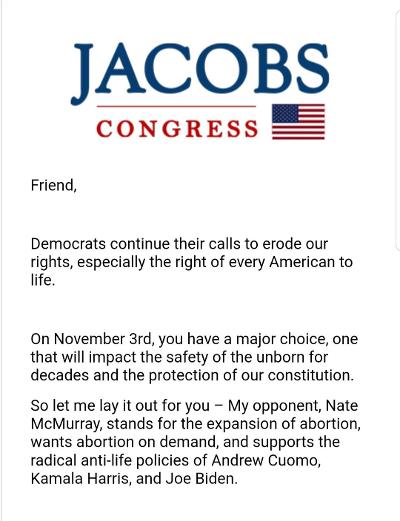
Republican Chris Jacobs is another garden variety Trump sycophant and anti-Choice ass. Typical e-mail to his supporters (last week):
The progressive Democrat running for his western New York congressional seat is our old friend Nate McMurray. Earlier, McMurray told me that "The appointment of Brett Kavanaugh to the Supreme Court became a political fight to the death in 2018 just before the midterm elections. Now the unthinkable has happened, and Justice Ginsburg's death has launched us into another situation where she hasn't even been laid to rest and Mitch McConnell is salivating over another chance to put his hypocrisy on full display-- just 43 days away from the election. Just as COVID-19 magnified the issues with our healthcare system, RBG's death reminds us all that even institutions like the Supreme Court are not safe from the corrosion of toxic political forces. The Supreme Court will hear arguments on the Affordable Care Act on November 10th. Should the Republican party have its way, millions of Americans will be thrown off their health insurance before the second wave of the pandemic hits. Reproductive rights, labor rights, civil rights, and so much more are on the line. The GOP has sunk so low-- it's not a time for us to 'go high;' we've got to fight like hell for the future of this country."
There's no question about where Mondaire Jones was coming down on this issue. One of the best hopes for progressive leadership in the next session of Congress, he's running to hold an open, narrowly blue district. ""Unfortunately, the Trump Administration and the Republican Party have systematically undermined women’s reproductive freedom," he said this morning. "The federal government must step in to protect civil rights-- and it cannot leave those rights up to the extreme conservative majority on the Supreme Court. As a member of Congress, I will work to codify Roe v. Wade by statute, repeal the Hyde Amendment, and ensure that any Medicare for All legislation includes coverage for the full range of reproductive services. That’s why I’m proud to be endorsed by leading pro-choice groups like Planned Parenthood Action Fund and NARAL Pro-Choice America. My opponent, meanwhile, is anti-choice and intends to be a staunch opponent of reproductive freedom, which could not be more out of step with the values of our district."
Of course it isn't just in congressional and federal races where the "new" issue is being injected into the election. I spoke with Heidi Campbell yesterday. The mayor of Oak Hill and a state Senate candidate in Tennessee, she is on the verge of ousting anti-Choice Republican Steve Dickerson and flipping a red seat blue. You can help her do that here. I asked her how the Supreme Court being threatened with another anti-Choice extremist is playing out in her suburban Nashville district.
"Devastatingly, she told me, "the October surprise came early this year-- not to say that there won’t be several more, in this accelerating-ly chaotic wreck of a year. Each time something like this happens though, we have to reassess the dynamics of our race. I am running for state Senate in Tennessee’s District 20 which is gerrymandered to carve out the conservative pockets of Nashville’s metropolitan area. This district has been trending blue and went for Clinton in the last election. In fact, two separate polls show us narrowly ahead of the incumbent. Democrats have not flipped a state Senate seat in Tennessee in over fifteen years, and we have a great shot at flipping this one. The SCOTUS appointment to fill RBG’s seat cuts both ways of course-- both sides are energized by it, and it should strengthen the position of candidates like myself who are running in districts that are gaining Democratic voters. But this also means that Republicans are going to spend as much as they can to hang on to their seats, and in our race they have purchased several hundred thousand dollars worth of television ad time to run attack ads against our campaign over the next five weeks. Our team is fighting with every fiber of our beings to flip this seat, in a state where anti-abortion, anti-LGBTQ, anti-immigrant (and many other) bills are intentionally seeded to wend their way up to the Supreme Court. We simply do not have as much money as the Republicans, and since we’re not going to have election finance reform in the next six weeks, we have GOT to raise as much as we can to win."
Why Can't The Conservative Brain Grapple With Science-- And Will The Climate Crisis Destroy Us All Because Of That Flaw?
>
Audrey Denney is running for Congress in the northeast corner of California (CA-01), where the state meets Oregon and Nevada. It's a largely rural district with the most exposure to Climate Change-induced wildfires anywhere in the state. She told me yesterday that the Trumpist incumbent, Doug LaMalfa "does not believe in human induced climate change. He has recently called climate change policies 'radical.' He either has been bought and paid for by the oil and gas industry (as his FEC reports show)-- or he doesn’t have the capacity to wrap his mind around science. He has also been quoted as saying abortions cause breast cancer-- so I am leaning toward both."
Denney, whose campaign leans heavily on talking with voters about the Climate Crisis said that "Climate change is not a threat in the distant future. It is taking the lives, homes, and livelihoods of people who live in my district today. We lost 93 lives in 2018 in the Carr and Camp Fires and we lost at least 15 lives last week in the North Complex fire. In 2018 the Carr fire and Camp Fire alone emitted nine times as much CO2 as the state of California was able to reduce our emissions by that year. Our federal forests are MASSIVE carbon sources-- but have the potential to be carbon sinks-- actually helping us turn the dial back on climate change. Forty-one percent of my district-- and fifty seven percent of the state of California-- is federal forests. And the vast majority of them are in desperate need of vegetation management work and forest restoration work to bring them back to a state of health. This is the only way we will reduce our fire risk and be able to mitigate climate change. If you do not think this work is critically important than you are not paying attention. Or perhaps live in one of the few places that is not shrouded in smoke from the West’s fires... Only by restoring our forests to health by doing the critical thinning, selective logging, and fuels-reduction work, will we be able to lessen our wildfire risk and mitigate the dangerous result of climate change. We can create economic incentives to find new industry utilization for the woody biomass removed from our forests. This will look like manufacturing sustainable building materials like cross laminated timber (CLT) and processing woody biomass into low carbon transportation fuels. We can set policies in place to support the career and technical education programs and apprenticeship programs that will be necessary to build the required local workforce. All of these opportunities mean high paying jobs and more economic opportunity for the real people of California’s first district."
Yesterday, Ron Brownstein's Atlantic column asks a simple question millions of Americans probably have asked themselves at one time or another, Why is it that Republican officials still don’t care about Climate Change?. He begins by introducing us to Mary Nichols, who's been "part of the struggle to prevent catastrophic climate change for about as long as anyone in American life. For years, she’s directed California’s pathbreaking efforts to reduce carbon emissions as the chair of the California Air Resources Board-- a position she held first in the 1970s before taking it up again in 2007. Nichols has also served at the federal level, working as the chief regulator for air pollution at the Environmental Protection Agency under President Bill Clinton in the 1990s. And yet even Nichols has never seen anything that crystallizes the dangers of climate change more clearly than the historic outbreak of wildfires scorching California and other western states this year. 'Yes, absolutely,' she told me earlier this week, when I asked her whether this year’s fires are the most tangible danger to California that she’s seen from climate change. 'It’s not suddenly going to reverse itself … to years when there’s no fire season, or it’s not going to happen until October. The changes are going to be real, and they are going to be long-lasting.'"
Then he introduced us to Carol Browner who served as the EPA administrator for both of Clinton’s presidential terms and later worked as Obama’s first White House adviser on climate. "When she looks at the confluence of extreme-weather events battering the United States in recent years-- not only the wildfires, but also the Gulf Coast hurricanes, Midwest flooding, and the Southwest’s extreme heat-- Browner likewise sees stark evidence that climate change is disrupting American life earlier and more powerfully than almost anyone expected when the debate over these issues seriously began about three decades ago. 'What we have now is the absolute environmental demonstration or evidence of just how dramatic the impact of climate change is going to be. This is not going to stop,' Browner told me. 'There is going to be something next year, and the year after, if we don’t get on it.'"
Environmental scientists and policy experts around the country agree that the massive wildfires are just the latest indicator that climate change has thrust the U.S., and the world, into a dangerous new era. But it’s far from certain that the growing recognition of that threat can break the stalemate over climate policy in Washington. The accumulating evidence about climate change’s destructive power represents an irresistible force for action. But it’s colliding with an immovable object: the unbreakable resistance to any response among both Republican voters and elected officials.
Polling shows that, overall, a growing share of Americans believe climate change is happening, that human activities are driving it, and that the threat is manifesting right now. But as on many issues, the gap on all of these questions is widening between voters in the Republican coalition and other Americans. Annual polls by the Yale Program on Climate Change Communication show that although the numbers have increased markedly for Democrats, Republican partisans are no more likely than in 2008 to believe that human activity is causing climate change, and they express even less concern about its impact now than they did then. (Belief in human causation has declined somewhat among independents, but concern about the effects of climate change has increased substantially.)
These attitudes within the GOP coalition both reflect and reinforce Republican officials’ rejection of any effort to reduce carbon emissions. [The Donald], echoed by many prominent conservative commentators and congressional Republicans, continues to dismiss the evidence that climate change is even contributing to the spike in extreme-weather events. With Joe Biden offering the most aggressive climate-change agenda of any Democratic presidential nominee in history, the conditions for the long-stalled debate over the issue in Washington are becoming as combustible as the dried forest floors of California.
Anthony Leiserowitz, the director of the Yale climate program, says that in the past, even those Americans concerned about climate change tended to see it as a remote problem. “It was distant in time, [in] that the impacts won’t be felt for a generation or more,” he told me. And it was “distant in space”-- “this is about polar bears and maybe some developing countries, but not the United States … not my friends, not my family, not me.”
Seen through that lens, he said, climate “just blended in the background with 1,000 other issues out there... so we can deal with it later. That’s where more of the country was in 2007 and 2008. Now we skip forward to today, that’s not true anymore because of the [weather] events we’ve been talking about.”
In Yale’s polling, the share of Americans who say that climate change is affecting weather at least somewhat reached nearly three-fifths in 2020, up from about half in early 2013. But Leiserowitz said more disruptive weather events aren’t the only things moving attitudes on climate. Another important factor is the broad, diverse chorus of voices expressing worry about it. Ten years ago, he noted, Americans might have heard concern about the climate only from “environmentalists and liberal politicians like Al Gore”; now it’s much more common to hear concerns raised by public-health professionals, business executives, and even faith leaders, such as Pope Francis.
The result has been an undeniable, though not overwhelming, shift in public opinion. In Yale’s latest national survey this spring, slightly more than three-fifths of Americans said human activities are causing the climate to change, a new high. The share of Americans who say they are very worried about climate change’s impact is relatively modest, at 27 percent. But it’s nearly double the level it was in 2008; overall, about two-thirds of respondents are now either very or somewhat worried.
Americans’ attitudes about the imminence of the danger have changed more drastically: 45 percent in the latest survey described climate change as a threat to Americans now, a big increase from 33 percent in 2008. The share who say climate change won’t be a problem for 25 years or more is at 42 percent, down 10 points compared with 2008.
Yet, on all of these fronts, the movement has not been symmetrical. Democrats are expressing much more concern than they were a decade ago, and most independents slightly more. Republicans, meanwhile, are either no more or even less concerned. (Rigid GOP attitudes largely explain why the overall shift in public opinion on many questions hasn’t been more dramatic, despite the quickening pace of weather disruption.) Since 2008, for instance, the share of Democrats who say human activity is causing climate change has spiked from 70 percent to 85 percent; among Republicans, it’s virtually unchanged, at just 37 percent. And although nearly half of Democrats now say they are very worried about climate change (almost double the level in 2008), only about one in 14 Republicans is equally concerned. That share is essentially unchanged from 12 years ago.
This pattern of public attitudes looks very similar to opinions on racial-equity issues: Compared with a decade ago, substantially more Democrats of all races accept that systemic racism against Black Americans is a serious problem; however, many Republicans are even less likely to agree it exists compared with 10 years ago. The divergence between the parties on climate, as on race, reflects the larger resorting of the electorate along lines of culture rather than class. (Republicans, as I’ve written, increasingly rely on a coalition of older, non-college-educated, evangelical, and rural white voters, while Democrats depend heavily on young people, people of color, and college-educated white Americans.)
Just as many Republican voters have cheered GOP attacks on public-health experts during the coronavirus crisis, portraying them as “elites” who look down on and want to control ordinary people, they have embraced similar accusations against climate scientists. “Climate change is an issue... where most people don’t know that much... and in those circumstances-- especially for an abstract, seemingly far away, invisible problem like climate change-- they look to their leaders to help guide them through that incredibly complicated landscape,” Leiserowitz told me. “Republicans who began talking about climate change as if it was a ‘hoax’ had an incredible impact on other Republicans.”
Many environmentalists have hoped that more and more exposure to the furious effects of weather disruption might soften resistance among Republican voters and leaders to acting on climate change. But in dramatic polling last year from the Kaiser Family Foundation and the Washington Post even Republican voters who acknowledge that their communities are facing more extreme weather overwhelmingly reject the notion that climate change is significantly contributing to those events.
Detailed results provided to me by Kaiser underscore an astonishing gap between the parties. Among people who agree that their communities are experiencing either more hot days, more floods, or more droughts, at least three-fourths of Democrats say climate change is a “major factor” in those events; but at least seven in 10 Republicans in each case say it is only a minor factor, or does not contribute at all. Slightly more than seven in 10 Democrats living in places experiencing more wildfires consider climate change a major factor in causing them; three-fourths of Republicans see climate as little or none of the cause. Even after this summer’s searing events, an Economist/YouGov poll released yesterday found that although three-fourths of Biden supporters said “the severity of recent hurricanes and Western wildfires is most likely the result of global climate change,” fewer than one in five Trump voters agreed.
Those contrasts offer very little reason for optimism that even if Biden wins, any meaningful numbers of congressional or state-level Republicans will feel pressure to support measures to reduce carbon emissions. Among other reasons for pessimism: In both presidential and Senate elections, Republicans are more and more reliant on the states that produce the most fossil fuels, which tend to be the same states with large populations of non-college-educated, Christian, and rural white voters drawn to Trump’s message of racial and cultural backlash.
Across the 20 states that emit the most carbon per dollar of economic output-- a good proxy for states’ integration into the fossil-fuel economy-- Republicans now hold 35 of their 40 Senate seats. That’s nearly enough senators to sustain a GOP filibuster against climate action on its own. The final brick in the wall of GOP opposition is that fossil-fuel producers, once an important source of campaign funding for southern Democrats such as Lyndon B. Johnson, are all-in on bolstering Republican power. Over the past 30 years, oil and gas producers have directed more than 80 percent of their massive $711 million in total federal campaign contributions toward Republicans, according to the nonpartisan Center for Responsive Politics.
Gene Karpinski, the longtime president of the League of Conservation Voters, the environmental movement’s principal electoral arm, sees little prospect for GOP participation on climate even if Trump loses. “Because of the fossil-fuel influence on the Republican Party and the leader of the party still calling climate change a ‘hoax,’” GOP skepticism about “climate change is out of step with the rest of the country,” he says.
But others see some cracks in the resistance. Kenneth Medlock, the director of the Center for Energy Studies at the Baker Institute for Public Policy in Houston, says the terms of daily discussion in Texas and in neighboring states have changed since Houston was deluged with historic floods during Hurricane Harvey in 2017. “Even in the Gulf Coast, the conversation around extreme-weather events and the like is more the norm than it was five years ago,” he told me. “Up until Harvey happened, nobody really wanted to address the elephant in the room, which is that the climate is changing and this is a real risk.”
Even with that evolving dialogue, Medlock doesn’t expect big changes among Republican elected officials in Texas. He predicts that, to the extent that they acknowledge climate change, they would be more likely to talk about fortifying communities against its effects (an issue he considers important too) than to talk about reducing carbon emissions. But Medlock anticipates that position will become more and more untenable for Republicans over time-- not because their voters necessarily demand more action, but because the business community and institutional investors will keep moving ahead without them to cut carbon.
The dialogue among elected Republicans, he told me, “has kind of quietly shifted.” He explained that the Baker Institute, which is based at Rice University, is involved in several initiatives aimed at reducing net-carbon emissions in the region. “What’s really interesting about [those] efforts is that when we talk to state lawmakers and federal lawmakers [including Republicans], there’s no resistance,” he continued. “You open the conversation with, ‘The world is changing; consumers and investors are demanding lower carbon footprints; this is an economic opportunity for Texas...’ and immediately the conversation becomes very lively. So, in some ways, it’s about how you approach the conversation.”
Sean McElwee, the Data for Progress pollster who analyzes progressive causes, sees a similar opening. Although most Republican voters still recoil from measures presented as addressing climate change, more are open to promoting clean-energy sources, he says. (Yale’s polling has found that too.) “When we do testing … clean energies are very popular among Republican voters, and people are really interested in the jobs framework,” he told me. Just as important: Relatively few Republican voters intuitively embrace arguments from Trump and others that defending oil, gas, and coal is a culture-war statement against “elitists” promoting solar and wind energies. “I don’t think voters have an allegiance to coal and oil the way Republican politicians have,” he said.
Browner, the former EPA head, is also a voice of relative optimism. “If Biden wins and they start moving forward” with a climate agenda, she told me, “there will be Republicans calling. Maybe I’m a minority on this, but when they see you are serious and you want to do something, they want a seat at the table.”
Even if Republicans remain obdurate, unified Democratic control of Congress and the White House is more likely to produce climate action than the last Democratic trifecta in 2009 and 2010, most experts I spoke with said. At that point, the House Democratic Caucus still contained a large number of southern and rural “blue dog” members who resisted cap-and-trade climate legislation the chamber passed in 2009. (Forty-four Democrats voted no.) Now the House Democratic Caucus is overwhelmingly centered on urban and suburban districts where acting on climate is popular. As Karpinski said: “If you look at 2018, the key reason why Nancy Pelosi is now the speaker [is because] it’s mostly suburban and some of the semi-urban districts. It’s a combination of young people, communities of color, and suburban women. They are the most supportive of this issue and want action.”
If Biden wins and Democrats gain the Senate majority, he could drive a big part of his climate agenda through a coronavirus-relief stimulus package; his plan includes massive spending to promote renewable power, electric cars, and energy-efficiency upgrades for homes and businesses. Obama did the same thing in the stimulus package he signed to counter the Great Recession, tucking in huge investments in clean energy (that Biden as vice president was assigned to oversee).
But to secure Senate approval for measures that directly limit carbon emissions, Democrats would almost certainly have to end the filibuster, which empowers what I’ve called the “brown blockade” of Senate Republicans who represent the fossil-fuel-producing states. (Unable to overcome a filibuster, the Senate never considered the cap-and-trade climate bill the House passed in 2009.) And even if Democrats do end the filibuster, serious climate legislation could face a tight squeeze to reach a simple majority, with Joe Manchin, from coal-producing West Virginia, and possibly other Democratic senators having to take a very tough vote.
All of those outcomes are impossible to predict. But what’s clear is that the tension will grow between a sluggish political system locked in a partisan standoff and a climate system that is poised to generate disruption at an accelerating pace. “This is not some ‘new normal’ that we can plan around … it’s a system that continues to spiral out of control,” says Vijay Limaye, an environmental epidemiologist at the Natural Resources Defense Council. “There definitely is a signal in these record-setting months that … we are heading into a new era when we will see records set, and they will fall just as quickly … It’s hard for people to wrap their heads around now, but as bad as things have been this year, unquestionably, they will get worse.”
Nichols, the veteran climate regulator, is just as stark in her warning: Even today’s extreme weather may soon seem like the (relative) calm before the storm. “The rate of change is accelerating, so it is absolutely possible that we’ll see more visible signs of bigger storms,” as well as higher temperatures and sea-level rise, she said. “All of those things could happen much faster.”
She explained that the famous apocalyptic scene from the movie The Day After Tomorrow still isn’t likely to happen, where big waves wash over the skyscrapers of New York City. “But bigger storms and more damage and loss of property and loss of life as a result absolutely is likely going to continue-- not just in a gradual slope, but at a rate of acceleration that is greater than was predicted before,” she said.
The biggest message of the California wildfires may be that not only the terms but the tense of the climate debate is changing. Climate change has evolved from something that will threaten America to something that is doing so today. “The people who used to talk about how they were trying to save the world for their grandchildren need to start thinking about their children and even themselves,” Nichols said.
Kara Eastman is the Democratic candidate running for the Omaha-based congressional seat (NE-02) occupied by Trumpist stooge, Donald Bacon. The Climate crisis is a big issue she talks with Nebraska voters about constantly promising to help lead the battle when she replaces-nothing-Bacon in Congress:
Climate change-- appropriately called climate chaos by many-- is clearly the result of human activity. The wildfires on the West Coast bring this reality into dramatic relief. In order to reverse this trend we need immediate action from policy-makers from the entire political spectrum. In the past, there was an environmental consensus. Major environmental legislation from the Clean Water Act through the Montreal Protocol Treaty were passed by huge majorities on both sides of the aisle. Unfortunately, due to the extremist takeover of the Republican party, led by Donald Trump and Don Bacon, the GOP is no longer the party of the environment. On the contrary, they continue to give voice to the fringe belief that the massive climate upheavals we are witnessing in real-time today are part of some "normal" weather cycle, moreover, that these events we can see with our eyes and choke on in our lungs aren't really even happening.
Don Bacon wants to have it both ways. In front of a Republican audience, he says the the science is "uncertain" on climate, but on the other hand he claims membership to the bipartisan but largely ineffectual climate solutions caucus when he's confronted by local voters. Meanwhile, in Nebraska's Second Congressional District, we suffered from one of the hottest and driest summers on record, a year after central Nebraska suffered from devastating floods.
When I am in Congress, I will join my colleagues in putting climate front and center of the agenda. Nebraskans will be able to count on me to push a climate agenda, not simply push greenwashed window dressing. It's no longer some distant future crisis. It's here and now and we need to get to work.
Beth Doglio is in a D v D congressional general election in Washington. She's a progressive, endorsed by the Congressional Progressive Caucus and her opponent is a ConservaDem endorsed by the Chamber of Commerce and the Wall Street owned and operated New Dems. There is no issue more important in her campaign than Climate. And Beth has a stellar record while her opponent's record is putrid and, basically, Republican. Yesterday Beth told me that "As the wildfires rage on the West Coast, lives are being lost, towns are burning to the ground, and millions of acres of land are now charred deserts. This is climate change. The stakes have never been higher and the consequences of failing to act have never been more clear. The Intergovernmental Panel on Climate Change projects that we have just one decade, one last chance to act, before it’s too late." She continued:
The United States must step up and must act with the urgency this moment demands. And the reality is that beyond its dangers, climate change actually presents us with a great opportunity. We can build a clean energy economy, strengthen our middle-class, and create millions of good union jobs. But we need leaders with expertise to get us there. Leaders who have stood up to the fossil fuel industry and won. Leaders who have actually passed policies to reduce greenhouse gas emissions and grow jobs.
As a climate advocate, I led the effort to stop the development of 7 coal export terminals dead in their tracks, while my opponent as mayor was busy working to site the world’s largest Methanol plant in her town. While she points in part to her support for community gardens as her track record on climate issues, I point to playing a pivotal role in passing legislation that significantly reduces greenhouse gas emissions-- like the nation’s best 100% Clean Electricity Bill that integrates equity and labor standards with hard deadlines to remove fossils fuels from our electric sector and grow clean energy jobs. Or my first of its kind Green Buildings Law that makes our buildings more healthy and efficient at the same time it creates jobs. I’m calling for a sector-by-sector decarbonization of our economy. I am serious about and experienced in pushing for and passing emission reduction policies that will leave a safe planet for my kids.
You can ask anyone-- I love gardening and, in fact, I helped build a robust garden program at my children's elementary school-- but gardening is not what is going to get us out of this! This issue can no longer take a backseat, play second fiddle, remain an afterthought. We must have a plan, it must be ambitious, it must go far enough. I am calling for Washington, D.C. to follow Washington state’s lead and get serious about passing legislation to address the issue at scale.


 I spoke to other progressive candidates who have told me they've gotten very similar advice from incumbents, usually New Dems! "Go light on the anti-PAC message" and "Don't play up the Bernie association." Advice from the DCCC consultants is even harsher and more vile-- both in terms of the content and in the ways the content is delivered, especially to women candidates who always seem to get talked down to by these DCCC consultants. (I thought they put Bustos into therapy to make her less of a bigot. I guess it either didn't work or she didn't realize she was supposed to instill decency into her co-workers and consultants.)