Wednesday, August 24, 2016

Do native Americans speak with an accent? Yes, but most of us don't know what they are, including our own

>


Stephen Colbert challenges Michelle Dockery, Hugh Bonneville, and Allen Leech to read a Downton Abbey scene in American accents. Stephen's own idea about American accents could use some touching up, it seems.

"Nationally, most Americans don’t really know that much about the people who live in [Colorado, Wyoming, or Nebraska], which means we also haven’t constructed elaborate and unreliable legends about the ways people in those states speak. And because the way we see people is the primary factor in the way we hear them speak, if we don’t know much about a population? We don’t hear much of an accent, either."
-- Dan Nosowitz, in "Is There a Place in America Where
People Speak Without Accents?
," for Atlas Obscura

by Ken

Though Howie and I go back together to the ninth grade at the James Maddison High School annex, we go back together only that far, because I'm not a native New Yorker. When we moved here in 1961, many of the Brooklynites I now lived among were puzzled by my accent, which had been concocted through seven years in my native Baltimore and five years in the Midwest bastion of Milwaukee, where the kids I went to school with made fun of my "Southern accent." In Brooklyn especially, having what might be called "Midwestern speech" was interesting, because as I came to learn, Midwestern speech is the basis for what had come to be known as "General American" speech -- the sort of thing favored by the people who hired newscasters and other on-air personalities they hoped would sound "un-accented."

Only now it turns out that "General American" speech was itself mythologicall Oh, it might have described a cauldron of speech patterns, among which the "General American" speakers may well have tended to employ a few. But it doesn't seem likely that there was ever anywhere where the locals generally spoke "General American," and even in the areas where it was thought to be spoken, it isn't anymore -- there have been major shifts in the speech patterns of the whole presumed-"General American" belt since John Kenyon "laid out some linguistic and geographical guidelines for General American," which he claimed was spoken by 90 million Americans, in his 1930 book, American Pronunciation, as Dan Nosowitz reports for Atlas Obscura in a piece called, "Is There a Place in America Where People Speak Without Accents?"

Dan draws inspiration and courage in debunking the whole concept of General American from Oklahoma State University dialectologist and sociolinguist Dennis Preston, who says, "General American doesn't exist. He was demoted to private or sergeant a long, long time ago."
But the concept persists: we believe that, for example, newscasters, maybe some actors, and certainly some people, somewhere, speak an unaccented variety of American English. For instance, when Stephen Colbert explained his vocal patterns to 60 Minutes, he said:
"At a very young age, I decided I was not gonna have a Southern accent. Because people, when I was a kid watching TV, if you wanted to use a shorthand that someone was stupid, you gave the character a Southern accent. And that's not true. Southern people are not stupid. But I didn't wanna seem stupid. I wanted to seem smart. And so I thought, 'Well, you can't tell where newsmen are from.’"
The name of this accentless accent varies; sometimes it’s called Standard American, or Broadcast English, or Network English, or, as it was created by two independent linguists in the 1920s and 1930s, General American. It is a neutral accent, one without distinguishing features.

But where does General American come from? Is there a place where people, young and old, speak like newscasters?
I expect it won't surprise you to learn that, while Dan has an answer of sorts for the first question, his answer to the second is a resounding "no." It turns out that John Kenyon's General American was based on the speech he tended to hear from the speakers he was most familiar with growing up in Northeastern Ohio. It seems most unlikely that even then it was the "standard" speech of the area, and as noted above, since Kenyon's time, "The entire vowel system of the parts of the country along the Great Lakes, stretching from New York cities like Rochester and Buffalo straight through to Chicago and Detroit, began to dramatically change," in what came to be known to linguists as the "Northern Cities Vowel Shift."

You can check out for yourself some of the specifics, but the key point is that, "within the linguistic community, the idea that General American had any relation to any actual geographical place was quickly destroyed."
The field of American linguistics advanced very quickly in the mid-20th century, and by 1950 numerous studies were released that found that even within Northeastern Ohio, there were multiple distinctive accents and dialects, and that certainly Kenyon’s rules for General American did not apply to the vast part of the country he claimed. The Northern Cities Vowel Shift work further combusted any idea that General American described the way people talk in the Midwest.
In this more sophisticated understanding of American "accents," researchers like Dennis Preston have concluded that Americans (a) mostly think they themselves don't have an accent, except for some specific regions like the South, in part because (b) Americans are pretty terrible at recognizing accents, their own or anybody else's. Ironically, for example, "Midwesterners tend to not actually hear the very things that distinguish them to the rest of the country." Again, go to the source for some description of the kinds of things Dan is talking about, including some video clips of broadcasters speaking anything like a standardized "accentless" American.

One thing broadcasters frequently do do, though, is to enunciate with great care, which apparently is easily mistaken as "accentless" speech by hearers who aren't good to begin with at recognizing most American accents, which Dan assures us do exist, in every locality in the country. In the end, he says,
the search for an accent-less accent is more about our own perception and lack of understanding of linguistics than any objective, observable pattern. In other words, we are hearing what we want to hear, not what people are actually saying.
Hmm. "We are hearing what we want to hear, not what people are actually saying." Nothing surprising about that, is there?
#

Labels: , ,

Thursday, September 24, 2015

Yes, let's give thanks to Pope Francis for trumping Chuanpu,* at least for a while, in the 24/7 news cycle

>

*Chuanpu = Trump, "as he is known in Mandarin," according to The New Yorker's Evan Osnos in a Sept. 28 "Comment" piece, "Dinner Talk," on the state visit of People's Republic of China President Xi Jinping


If you'd like to "continue reading," click here.


"If you read the speech in its entirety -- as I did after watching it being delivered -- you will find something more coherent and substantial: a polite but firm request for the United States to stand up for, and live by, some of the things it claims to represent and, at times, has actually represented."
-- John Cassidy, in a newyorker.com post a few hours
ago,
"Pope Francis's Timely Message to Congress"

by Ken

Even a few days of low-trumpery would be a blessing. When last heard from, The Donald was screeching his stinking guts out like a diseased, wounded hyena over -- among other things -- the "foul language" uesed by National Review editor and Fox Noisemaker telling fellow Noisemaker Megyn Kelly that Carly Fiorina had cut The Donald's balls off. The Donald is demanding that the FCC fine Fox Noise -- which he is of course famously boycotting in the latest phase of his feud with the Noisybunch.

Really?

Now if I say that The Donald is a giant stinking pile of shit, I know that that's foul language. I might risk it anyway since calling him a giant stinking pile of doody or feces doesn't give the full measure of his turditude. However, I'm not sure where the "foul language" is in saying that someone's had his balls cut off, especially when you consider the volume of filth that has come out of The Donald's campaign since he announced it.

(If the objection is that Rich Lowry is a moron, and that saying Carly had cut The Donald's balls off was moronic, I'd say that's two for two. But once we go down that lane, most of what comes out of The Donald's maw is moronic too, and most of the gibberish spewed on Fox Noise by the legion of Noisemaking morons. Fortunately, though, from a First Amendment-wise standpoint, the FCC has no jurisdiction over morons or moronitude.

But to return to The Donald's cut-off balls, is the idea here that "balls" is foul language? Really? So, like, baseball announcers now have to give hitting counts as, say, "three uh-uhs and two strikes," or else The Donald will demand that the FCC fine them?

Oh, you're saying that if "balls" refers to the male sex organs it's foul language? So it would be okay if Rich had told Megyn that Carly cut The Donald's testicles off?


WELL, THE POPE IS HERE IN THE BIG APPLE NOW

And we New Yorkers are keeping track of his itinerary by monitoring the zillions of street closings and bus reroutings (or is it vice versa?). I know he's got a  tight schedule, so there doesn't seem much point in my suggesting some spots for him to hit. (At least those spots won't become temporarily inaccessible to the rest of us.)

There's a lot of good will toward the pope here, as witness this photo taken by a reader of the Brooklyn blog Brownstoner on Brooklyn's Court Street on Tuesday afternoon, the day of the start of Yom Kippur, the Day of Atonement, the most holy day in the Jewish calendar -- when the traditional greeting is "Good yom tov" (or "yontif"), "yom tov" meaning literally "good day," or holiday.


Brownstoner asks: "Is it kosher? Or should
Peter Shelsky atone for this joke?"


AS FOR THE POPE'S ADVENTURES IN WASHINGTON --

Here's the start of John Cassidy's newyorker.com post, "Pope Francis's Timely Message to Congress":


If you watched Pope Francis’s historic address to a joint session of Congress on Thursday, and judged it by the standards of contemporary politics and discourse, it perhaps seemed a bit disappointing. The Pope spoke slowly and in a thick accent. He ranged widely, making it tricky to discern a common thread. Some of his language was elliptical; some of his rebukes were implied. Soundbites and applause lines were few and far between.

But if you read the speech in its entirety—as I did after watching it being delivered—you will find something more coherent and substantial: a polite but firm request for the United States to stand up for, and live by, some of the things it claims to represent and, at times, has actually represented. Speaking in a legislature dominated by a party that is increasingly held hostage to the doctrines and interests of individualism and free enterprise, the visitor from the Holy See delivered a timely defense of communal values and solidarity with the poor and dispossessed. While he was at pains not to appear partisan or to give offense to his hosts, there was a reason why some Republicans were nervous about what the Pope might say. Between the follower of Saint Francis of Assisi and the leadership of the G.O.P. lies a gulf that no politesse can disguise.

To the delight of the assembled, the Pope began by saying that he was grateful for the opportunity to speak “in the land of the free and the home of the brave.” But he quickly made clear that his concept of liberty and freedom doesn’t jibe with the one promoted by the Republican Study Committee or the Club for Growth. Citing Abraham Lincoln’s call for “a new birth of freedom,” he said, “Building a future of freedom requires love of the common good and coöperation in a spirit of subsidiarity and solidarity.” The “common good” isn’t a concept that gets discussed often in Washington these days, but Pope Francis invoked it several times. And in reminding the senators and representatives sitting before him of their obligation to pursue this goal, he said that they had a particular obligation to protect “those in situations of greater vulnerability or risk.”

It was perhaps predictable that Francis would bring up Lincoln and Martin Luther King, Jr., two Americans who have achieved secular canonization, and to whom politicians across the political spectrum pay lip service. But the other two Americans he cited as inspirations were both figures of the left: Dorothy Day, the founder of the Catholic Worker Movement, and Thomas Merton, a Catholic theologian and mystic, whose enthusiastic support for the civil-rights movement and participation in protests against the Vietnam War attracted criticism from some conservative clergy. . . .

THERE'S A PROBLEM, THOUGH -- THE SEX-ABUSE VICTIMS

When I saw the link to this piece, my first response was, oh, some people always have to find a dark side. Then I started reading, and it wasn't hard to see why there are people who are upset. Note that in the set of remarks referenced here, Pope Francis was speaking not to Congress as the head of the Catholic Church but to his middle-management team as chief executive of the company -- and getting applause for a line he's going to hear a lot more about.

Here's the start of the piece:
Why advocates for clergy sex abuse victims call Pope Francis’s remarks a ‘slap in the face’

By Abby Ohlheiser, Michelle Boorstein and Terrence McCoy | September 23 at 9:15 PM


In a midday prayer at Saint Matthew's Cathedral in Washington, Pope Francis said that sex crimes must "never repeat themselves." [Watch video at the link.]

Speculation began almost as soon as Pope Francis’s first visit to the United States was announced months ago.

Would the popular pontiff – who has spoken boldly on so many controversial topics – address the clergy sexual abuse scandals that have caused many American Catholics to fall away from the church and detracted from his optimistic message of renewal? Would he take time to meet with survivors?

In his address to U.S. bishops at the Cathedral of St. Matthew the Apostle, he at least partially answered that question.

Francis lauded the bishops for their “courage” in the face of what he called “self-criticism and at the cost of mortification and great sacrifice.”

“I realize how much the pain of recent years has weighed upon you and I have supported your generous commitment to bring healing to victims – in the knowledge that in healing we, too, are healed – and to work to ensure that such crimes will never be repeated,” Francis said.

But it wasn’t the answer that many victims’ advocates had hoped to hear. They criticized Francis for offering comfort and
sympathy to the bishops and praising their bravery while saying little to address the suffering of clergy sex abuse survivors.

“To characterize the response of American Bishops to clergy abuse victims as ‘generous’ and ‘courageous’ is bizarre,” said John Salveson, president of the Philadelphia-based Foundation to Abolish Child Sex Abuse and a survivor of clergy sex abuse.

“In reality, the American church hierarchy has treated clergy sex abuse victims as adversaries and enemies for decades,” he said. “His concern about how the abuse crisis has weighed on the bishops’ spirits, and his hope that all of their good deeds will help them heal from the crisis, reflects a profound misunderstanding of the role the church has played in this self-inflicted crisis.”

Barbara Dorris, victims outreach director of the Survivors Network of Those Abused by Priests, called Francis’s remarks “a slap in the face to all the victims, that we’re going to worry about how the poor bishop feels.”

“You’re the ones who created it, and now we’re going to feel sorry for what you created?” Dorris said.

It is not yet clear whether Francis will address the scandal again, or meet with survivors during his visit, which will also include stops in New York City and Philadelphia, where he will address a global meeting on family issues in a city that has been rocked over the last decade by abuse allegations.

Several top U.S. church officials said that the pope would meet with survivors, but have been reluctant to give specifics.

A Vatican spokesman declined comment on the pope’s remarks at the cathedral, which were met with lengthy applause by the bishops. . . .

FINALLY, LOOKING AHEAD TO THE END OF THE PAPAL
VISIT: "POPE FRANCIS AFTER ONE WEEK IN THE USA"


Daily Kos Comics' Lalo Alcaraz writes:
Pope Francis is the "Pope of the People" and arrived this week to his first ever visit to the USA. I hope he had a good time, and I'm sure he adapted well to American culture. This is how I see El Papa after five long days in our fabulous country.


NOTE: HOWIE WILL HAVE LOTS MORE TO
SAY ABOUT THE POPE'S SPEECH TODAY --

with extended excerpts and a team of guest commenters, in his post at 9pm PT/12am ET.
#

Labels: , , , , , , ,

Wednesday, June 03, 2015

How Mainstream Is Bernie Sanders?

>

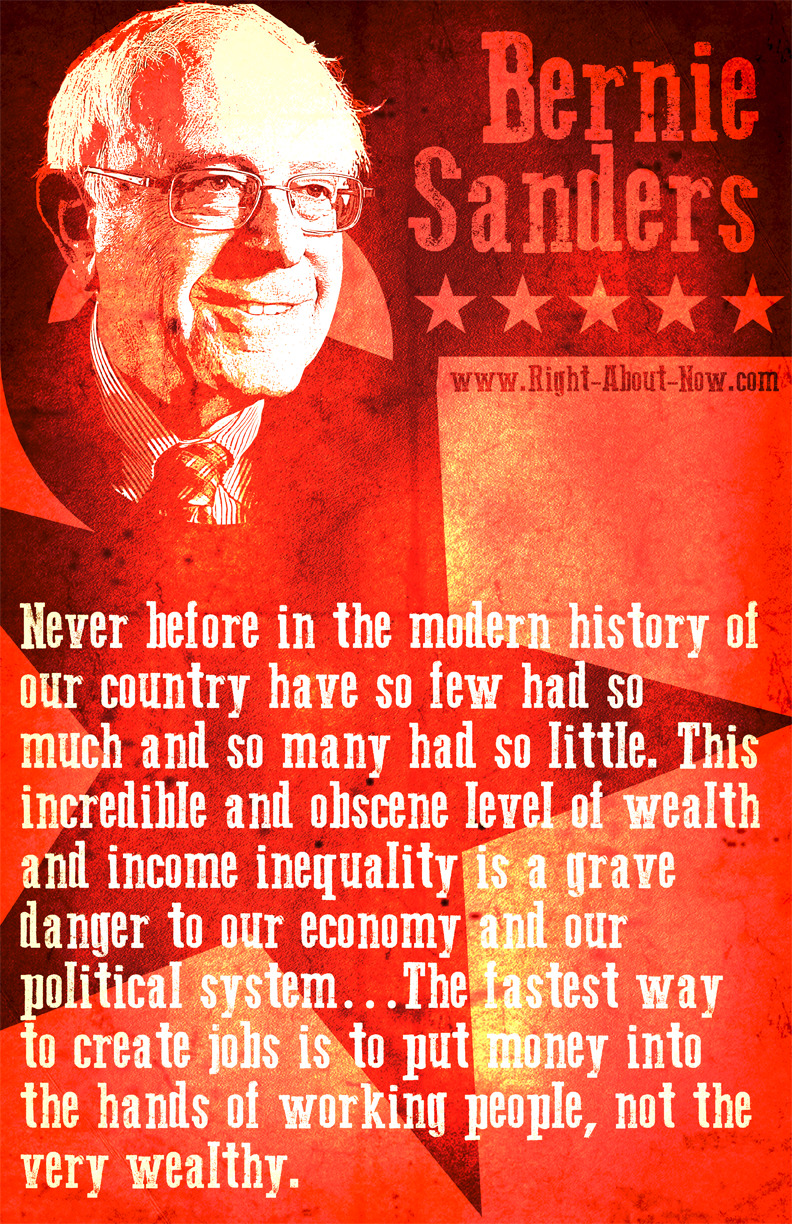
Bernie Sanders, making the One Percent wish he were gone (image source; image artist; more images here)

by Gaius Publius

How mainstream is Bernie Sanders? This question will come up a lot as Sanders gains traction in Iowa and elsewhere. The charge will be that a "socialist" is too far to the left for American voters.

Buried in the question is an assumption — that the "mainstream" opinions of those asking the questions and funding the campaigns (the billionaires and their millionaire employees in the media) are also the mainstream opinions of the American voters. That assumption could not be more wrong.

It's clear that Bernie Sanders, with his message of reversing economic inequality, is to the left of the Chuck Todds and Wolf Blitzers of the world. But where does he stand with respect to the people? I'll offer two data points of my own, then turn the stage over to Juan Cole.

First, 87% of Republicans want TPP (widely seen as "the next NAFTA") to fail, for a large variety of reasons, from executive overreach to job loss to loss of sovereignty. Even the new Reuters/Ipsos poll, which TPP proponents are touting, shows Americans solidly against TPP-type deals when American jobs are at stake.

About that poll, Public Citizen reports:
Today’s Reuters/Ipsos poll finds that a majority of the U.S. public “support[s] new trade deals to promote the sale of U.S. goods overseas.”  This is not surprising.  Who would be opposed to trade deals framed as simply boosting sales of U.S. goods?  (Never mind that exports of U.S. goods have actually grown slower, not faster, under existing U.S. trade deals.)

The poll did not ask whether respondents “support new trade deals that could offshore U.S. manufacturing jobs.”  We do not need to rely on hypotheticals to guess how the U.S. public would respond to this question. Just three weeks ago, another Ipsos poll stated: “International trade agreements increase Americans’ access to foreign-made goods and products but at the risk of American jobs being lost. What would you say is more important...?”

Eighty-four percent of the U.S. public said that “protecting American manufacturing jobs” is more important than “getting Americans access to more products.” Based on Ipsos' own polling, if today’s Reuters/Ipsos poll had presented not just the claimed upsides of trade deals, but the documented downsides, the results likely would have been quite different.

The same Ipsos poll from earlier this month also asked, “If the Obama administration supports an international trade agreement that does not specifically prohibit currency manipulation, do you think the United States Congress should support or oppose that trade deal?”

Seventy-three percent of the U.S. public said that Congress should oppose any trade agreement that does not prohibit currency manipulation. The TPP, of course, fits that bill. The Obama administration has repeatedly dismissed Congress' bipartisan, bicameral demand for the TPP to include binding disciplines against currency manipulation.

Today’s Reuters/Ipsos poll did not address this fact about the TPP. ...
Second, I challenge you to find one Tea Party voter who approves of the Wall Street bailout. Not a Koch- or Wall Street-bought Tea Party office-holder; a Tea Party voter. There are no good words on the right for that atrocity.

Juan Cole makes the same point I do above, that One-Percenters have no use for Sanders' policy proposals:
How Mainstream is Bernie Sanders?

Sen. Bernie Sanders, the presidential candidate for the Democratic nomination, has trouble being taken seriously by the corporate media, what with him being a democratic socialist and all.

If you go to Google News and put in his name, you get headlines about him being nothing more than a protest candidate, or having “odd views,” or promoting “dark age economics.”

But Sanders’s positions are quite mainstream from the point of view of the stances of the American public in general. Of course, the 1%, for whom and by whom most mainstream media report, are appalled and would like to depict him as an outlier.
In Cole's view (and mine), Sanders is "mainstream" on a variety of issues. For example, the wealth gap:
Sanders is scathing on the increasing wealth gap, whereby the rich have scooped up most of the increase in our national wealth in the past twenty years. The average wage of the average worker in real terms is only a little better than in 1970; the poor are actually poorer; but the wealth of the top earners has increased several times over.

Some 63% of Americans agree that the current distribution of wealth is unfair. And in a Gallup poll done earlier this month, a majority, 52%, think that government taxation on the rich should be used to reduce the wealth gap. This percentage is historically high, having been only 45% in 1998. But there seems to be a shift going on, because Gallup got the 52% proportion in answer to the question on taxing the rich both in April and again in May of this year....
On getting money out of politics:
Sanders wants to get big money out of politics.

A majority of Americans oppose the Supreme Court “Citizens United” ruling, one of a number of such rulings that have increased the ability of the super-wealthy to influence politics. A good half of Americans support federally financed political campaigns so as to level the playing field.

On this issue, Bernie Sanders is the most mainstream of all the candidates. The others are in a part of the political spectrum that by the polling represents a tiny lunatic fringe, in opposing significant campaign finance reform.
On student debt:
Some 79% of Americans believe that education beyond high school is not affordable for everyone. And some 57% of people under 30 believe student debt is a problem for youth.
On global warming and climate change:
According to a very recent Yale/Gallup poll, Some 71% of Americans believe global warming is occurring, and 57% are sure that human activity (emitting greenhouse gases like carbon dioxide) is causing it, while another 12 percent think the warming is at least partly human-caused. That’s 69% who blame human beings wholly or in part.
And reinforcing my point that like Warren, Sanders could easily pick up votes from traditional Republicans in the general election:
Even among Republicans, 48% say that they are more likely to vote for a candidate who wants to fight climate change.
It would be hard to find an economic issue on which Sanders is not squarely in the mainstream of bipartisan voter thinking.

Is Sanders Too Mainstream for the One Percent?

I've argued before that Sanders' biggest problem may not be that his views are unpopular — his biggest threat is because he's too popular with ordinary people. Sanders as a dismissible "fringe" candidate is acceptable, even desirable for the One Percent that funds and feeds off our elections.

Dismissible fringe candidates foster the illusion of choice. But actual populists are a danger to the world of insiders who scratch each other's well-moneyed backs. Even though the New York Times has recently broken radio silence on the Sanders campaign, I still look for the billionaire-owned media to do everything it can to tank the one candidate running against billionaire ownership of the country.

GP


Labels: , , , ,

Friday, April 03, 2015

Sarah Brady (1942-2015)

>


Dan Gross, president of the Brady Campaign to Prevent Gun Violence, writes: "Join me in mourning the loss of Sarah Brady and share your note of tribute with us."

"I come before you today as not just another pretty face, but out of sheer talent."
-- Jim Brady, to a press corps aware that First Lady-to-be
Nancy Reagan had wanted a Ken doll as press secretary

"Neurosurgeon Arthur I. Kobrine later recalled telling the president's personal physician about Mr. Brady: 'It's a terrible injury. I don't think he has a chance. I don't think he's going to make it, but I think we should try.' "
-- from Jon Thurber's Washington Post obituary

"The bullies have succeeded too often. They have made cowardly lions out of too many members of Congress. . . .

"I implore our president and our Congress: Take a risk. Re-direct your moral compass. Plow new ground in your consciousness. Say 'no' to those who won't retreat from an ideology that is fixated on weapons of war that are turned on babies and grandmothers alike. An ideology that helps assassinate dreamers and the dreams they hold dear. That litters across our fruited plains the bloodstains of innocents. That has kept us from forming that more perfect union, and pistol-whipped us into a seemingly endless cycle of wounding, maiming and murdering one another."

-- Sarah Brady, in a January 2011 CNN Opinion piece,
"Sarah Brady to Obama: Lead on gun control"
by Ken

The above quotes are lifted straight from my post of Aug. 4, 2014, on the passing, after his many years of struggles, of Ronald Reagan's first White House press secretary, shot in the line of duty, Jim Brady.

This evening I thought I was just about to escape from the office for the weekend when I noticed the following e-mail that had slipped into my inbox:


Dear Kenneth,

It is with a heavy heart that I write to inform you of the passing of our Chairperson, Sarah Brady. Our deepest condolences go to her family as we mourn her loss.

Together with her husband Jim “Bear” Brady, Sarah was the heart and soul of this organization. In the history of our nation, there are few people, if any, who are directly responsible for saving as many lives as Sarah and Jim. The Brady Handgun Violence Prevention Act (The “Brady Law”) has prevented more than 2.4 million sales of firearms to criminals and other dangerous people and remains, by far, the most significant achievement in the history of the gun violence prevention movement.

All Americans are safer today because of Sarah Brady’s resilience, compassion and what she always said she enjoyed the most: her hard work in the trenches with this organization, which she continued right up to the very end.

Today our nation has lost a great hero, and I have lost a dear friend. I am certain that Sarah would want nothing more than to know we are carrying on her and Jim’s legacy with the same passion and dedication that made her so remarkable.

Sincerely,
Dan Gross
President, Brady Campaign to Prevent Gun Violence

JUST RECENTLY, I WROTE ABOUT NORMAN LEAR --

in a March 20th post called "If Norman Lear isn't an 'Iconic Character of Comedy,' who is? (And a mensch besides)," happily not a post-mortem piece -- that with the creation of People for the American Way "he did as much as any one person can do to take the curse off the term ["liberal"] and fight back against right-wing propaganda to promote good solid American liberal values." In fact, at the ensuing celebration of Norman thrown by the Museum of the Moving Image and the Comedy Hall of Fame, the 93-year-old guest of honor insisted that he's so imbued with those traditional American values that he thinks of himself as a conservative!

Well, you could equally well say about both Jim and Sarah Brady, both imbued with those good traditional American values, that no one could have done more than each of them did to push back against the gun insanity besetting the country.

This was the opening paragraph of my August piece:
I hope it isn't necessary to explain the significance and sadness of the news of the death of Ronald Reagan's first presidential press secretary, Jim Brady. He didn't ask to become a hero, and certainly wouldn't have chosen the circumstances that led him to it, but I don't know that there's a better word for the role that he, his wife Sarah, and the rest of the family took on in the wake of the calamitous events of March 30, 1981.

But then this was the second paragraph:
I worry, though, that over the decades, as the cloud of gun-happy insanity has enshrouded the land, the heroic efforts of the Bradys to bring some measure of sanity to national gun policy have already been forgotten -- thanks to the coalition forged by the country's violence-for-profit merchants of mayhem and death with rank-and-file U.S. gun-worshippers in the death grip of Tiny Penis Syndrome.

There was a third paragraph, before I turned the floor over to the Washington Post's Jon Thurber for a proper obituary of Jim B, and it seems relevant too:
Even before that calamitous day, Jim Brady had established himself as a decent guy, setting himself apart from the general run of Reagan appointees and from the general run of presidential press secretaries. The class he and Sarah showed when they were put to such an extreme test set them way above most of us mere mortals. It would be nice if Jim's death inspired some revived respect for the work the Bradys tried so hard to do via the Brady Campaign to Prevent Gun Violence.

Well, um, it would be nice now if Sarah's death inspired some revived respect for the work the Bradys tried so hard to do.

Thank you again, Jim, and thank you, Sarah.


#

Labels: , , , ,

Monday, June 23, 2014

Just what we need now is "Big Dick" Cheney and his ilk polluting public discourse with their plug-ignorant lies and delusions

>


And these lies and imbecilities come from a scumbag who should be living out the rest of his wretched existence in prison for his war crimes and crimes against humanity.

by Ken

It can't be easy to be Dick Cheney. Even now, at his advanced age, in his precarious state of health, there are so many lies left to tell -- and so little time to tell them in. And when you have a record as catastrophically dismal and overweeningly earth-destructive as his to obfuscate and explain away and cover up, that just makes it harder.

Still, you have to wonder what sort of human being is capable of this kind of "thinking":


Possibly, of course, it's just projection. He's well aware that there are people in public life in the U.S. today who are evil at their very core and whose purpose for drawing breath is to turn the earth into the miasma of destruction, torment, and hate that they live in in their toxic heads. Unfortunately, perhaps because of his profound mental disabilities, he is unable to make the fundamental connection: Look! There in the mirror! There's one of the human-hating Satanites.

As you know perfectly well, President Obama never said or so much as hinted at the time of the capture of bin Laden that the problem of terrorism was solved. That's just your compulsive need to make up lies. What was true at the time of the capture of bin Laden was that it was something that, through either incompetence or lack of will, you worthless scumbags of the Bush Earth-Destruction Regime didn't or couldn't do. You know it, but something inside you just makes you lie your putrid guts out. It's who and what you are.

The nonsense you spew is so childishly predictable. The demon Obama withdrew us from Iraq and is withdrawing us from without leaving forces behind and thereby creating "a big vacuum in the Middle East." Let's forget for a moment, Big Dick (and I do mean the Biggest Dick of Them All), the way you morons and sociopaths of the Bush Earth-Destruction Regime actually did leave Afghanistan behind for bin Laden and the Taliban -- presumably so you could proceed to turn to the heroic task of turning Iraq into the shithole of your psychotic "dreams."

You rattle off the list of groups filling that vacuum as if you know something about them, but of course as always you know nothing. Most of these are forces that you toxic scumbags of the Bush Earth-Destruction Regime did so much to make major players in the Middle East, even though you were warned by people who actually knew something about the Middle East that that would be the all but certain result.

But then, on a scale of zero to a kajillion, Big Dick knows diddly squat about Iraq or Afghanistan or any other frigging place on the planet. So it's pointless to point out that he has zero clue as to how any problems in the Middle East might have been averted or even ameliorated. Because his specialty is creating problems that no amount of competence or good will could solve. He did everything in his considerable power to set forces in motion in the Middle East that would wind up, well, very much where they have wound up.

Then, of course, with such singularly scumbaggish lack of grace, he blames it all on somebody else.

Big Dick and his kind are creatures of such psychotic arrogance that they are probably literally incapable of receiving actual information and trying to figure out how it might be dealt with. Remember how he haunted the CIA rooting out all actual intelligence coming in from and about Iraq and forcing the analysts instead to rubber-stampe his lies and delusions?

Haven't you done enough to turn the planet into living hell, Big Dick? Rot in hell.


I SUGGESTED THE OTHER DAY THAT IAN WELSH'S
POSTS OFFER A FRESH VIEW ON THE MIDDLE EAST


One that Big Dick might benefit from if he were actually interested in understanding what's going on in the Middle East is "Military Effectiveness: ISIS, Taliban, Hezbollah," which began:
I think it’s worth emphasizing that what we’ve seen over the past 30 years is a revolution in military affairs. New model militaries have arisen which are capable of fighting Western armies to a draw in irregular warfare, or even defeating them on the battlefield (Hezbollah v. Israel.) It’s not that guerrilla warfare wasn’t effective before (ask the Americans in Vietnam), it’s how stunningly cheap it has become and how brutally effective at area denial and attrition warfare.
As an example, Ian cited the transformative influence of IEDs.
With IEDs the cost for occupation soars, and entire areas of a country can be made no-go zones except for large groups of troops.

But just as bad is the cost-effectiveness. Western militaries are brutally costly. Islamic “militias” are cheap. The Taliban runs on blackmail and drugs, ISIS runs, to a large extent, on donations from rich Muslims along with some state support. These armies cost peanuts compared to the US or British or Israeli military. Nothing. And they are capable, at the least, of tying down Western militaries for years, bleeding them white and eventually winning. Hezbollah is capable of defeating, in battle, what was (before Hezbollah proved otherwise) widely considered one of the most effective militaries in the world.
"Americans keep thinking," Ian wrote, "they can assassinate their way to victory. They can’t."
In any actual effective organization, lower level people can fill the slot "above them, and the slot above that. A strong ideology, and strong doctrine means that leaders are replaceable. Western leaders don’t believe that because as a class they are narcissists, who think that leaders are something super-special. Almost no leaders are actually geniuses, for every Steve Jobs or Rommel, there are a hundred CEOS or Generals who are just effective drones. They don’t matter. Any reasonably bright person with a bit of experience could run their company or army corp just as well and almost certainly better. (Canadian troops were amongst the most effective in WWI in part because they weren’t professionals. So they did what worked.)

Western societies are hard to run precisely because we refuse to actually fix our problems. Temporizing, “managing” is hard. Fixing problems is a lot easier. I know, again, that most people don’t believe this, because they don’t remember ever living in a country that actually tried to fix problems, and have never worked for a company that wasn’t dysfunctional, but it is so true.

So the West uses assassination and highly expensive troops who don’t want to die and extensive surveillance. And the various Islamic militias, on budgets that aren’t even shoestring, survive and grow stronger. They are evolving: getting smarter all the time. They are Darwinian organizations: if you screw up, you die.

A military doctrine which is hundreds of times more expensive than its main competitor has problems. In general, in military affairs, effectiveness is more important than efficiency. But if your effectiveness doesn’t actually let you win, in the sense of making it so your enemies stop fighting, then efficiency will start to run against you.

The West is not unaware of this: drones are cheaper than planes, for example. Ground combat robots, which the army is working on hard, may be effectively cheaper than troops, as well as having the advantage of requiring fewer troops, meaning less danger to the elites and more likely to fire in the case of a revolution.

Finally, I note again, that I do not expect drones and the new ground combat robots (about 10 years out) to remain tools of the powerful for all that long. Competent technicians will be able to make home brew models fairly effectively and quickly.
Got that, Big Dick? Any of it? No, I didn't think so.
#

Labels: , , , , ,

Sunday, May 04, 2014

"How do you define American?" Jose Antonio Vargas -- speaking for many other undocumented Americans -- asks us to think about it

>


"Not Legal, Not Leaving"

A year after coming out about my undocumented status in the New York Times Magazine, I wrote an essay for TIME magazine—this time, addressing provocative questions that everyday Americans around the country, from Alabama to Arizona, have asked me.

"Why haven’t you gotten deported?"

That’s usually the first thing people ask me when they learn I’m an undocumented immigrant or, put more rudely, an “illegal.” Some ask it with anger or frustration, others with genuine bafflement. At a restaurant in Birmingham, not far from the University of Alabama, an inebriated young white man challenged me: “You got your papers?” I told him I didn’t. “Well, you should get your ass home, then.” In California, a middle-aged white woman threw up her arms and wanted to know: “Why hasn’t Obama dealt with you?” At least once a day, I get that question, or a variation of it, via e-mail, tweet or Facebook message. Why, indeed, am I still here?

Full story here.
-- from the home page of Jose Antonio Vargas's website

by Ken

For the possible benefit of anyone who might have been able to take advantage of the information this weekend I should have gotten this done before the weekend, because Friday Jose Antonio Vargas's remarkable film Documented began a weeklong run at NYC's Village East Cinema (Second Avenue at 12th Street). I apologize, but I only found out about it Friday, and time has been tough since then. This coming Friday, May 9, it begins a theatrical run in Los Angeles at the Landmark Regent. It's going to be shown sometime thereafter -- the closest date I could find was "this summer" -- by CNN. CNN Films acquired distribution rights in November.

There's still at least one New York screening left at which Jose is scheduled to appear for a panel discussion: tomorrow's at 7:30. (Advance tickets can be bought here.) And I imagine similar events will be included during the Los Angeles run.

When the Museum of the Moving Image recently announced a screening of Documented a couple of weeks ago at which filmmaker Jose Antonio Vargas, among others engaged in the issue, would be present, I recognized the name immediately and was surprised how much I remembered of the story he had told in the New York Times Magazine in June 2011. (Well, no, I didn't remember the date. I've filled that in here for the sake of informativeness.)

A CLASSIC AMERICAN STORY, WITH A TWIST

Told one way, Jose's is a classic, great American story: A young man who came to the U.S. from the Philippines at 12 and, with a combination of talent, determination, and help from people who admired his talent and determination, turned himself into a reporter, made his way to the Washington Post, and at a bewilderingly young age was part of a Post team that won a Pulitzer Prize.

Of course there's a vast amount of detail omitted from this bare-bones sketch, but there's just one teeny detail that's kind of important -- no, crucial. In fact it overrides all the rest. But in fairness it's a teeny deteail that Antonio himself didn't know until he was 16: that the green card with which his grandparents, who had already been living in the U.S., equipped him, was fake. He learned this when he presented it as ID when, in the most traditionally American 16-year-old (check the age in your state) ambition imaginable, he tried to apply for a driver's license. The person he showed it to took one look at it and broke the news to him.

His grandfather was furious that he had been so foolish as to show the fake green card to anybody. And he told Jose some more of his story (though still not quite all of it, as we'll see shortly): that he was not, as he had been led to assume, a documented immigrant. From that point, as all those other things I sketched earlier were happening in Jose's life, overriding them was this fateful secret: that he was an undocumented alien.

In Documented he recalls the first time he actively lied about his status, as opposed to saying untrue things that he believed to be true, or talking around dangerous questions. After that the lying became more familiar but perhaps not that much easier. Oh, along the way he shared the secret with a few people, who responded sympathetically and courageously, keeping his secret. But there was no getting around the secret.

Until finally, in June 2011 he came clean in the New York Times Magazine. But I couldn't recall anything after the Times Magazine piece. It turns out I'd missed a year-later follow-up in Time, and when the Time editors decided to put the story on the cover, he had the idea of sharing the cover with other undocumented Americans. (On Jose's website there's a slide show on the making of the Time cover.)


Jose Antonio Vargas (born February 3, 1981) is a journalist, filmmaker, and immigration activist. Born in the Philippines and raised in the United States from the age of 12, he was part of The Washington Post team that won the Pulitzer Prize for Breaking News Reporting in 2008 for their coverage of the Virginia Tech shootings online and in print. Vargas has also worked for The San Francisco Chronicle, The Philadelphia Daily News, and The Huffington Post.

In a June 2011 essay in The New York Times Magazine, Vargas revealed his status as an "undocumented immigrant" in an effort to promote dialogue about the immigration system in the US. It was also a way to advocate for the DREAM Act, which would help children in similar circumstances have a path to citizenship. A year later, a day after the publication of his Time cover story about his continued uncertainty regarding his status, the Obama administration announced its halt to the deportation of undocumented immigrants under age 30 eligible for the DREAM Act; Vargas himself does not qualify due to his age.

Vargas is the founder of "Define American", a non-profit organization intended to open up dialogue about the criteria people use to determine who is an American. About himself he says, "I am an American. I just don't have the right papers."
-- the opening of Jose's Wikipedia entry
(links and footnotes onsite)

THE FILM HE HAD TO MAKE

I saw Documented at the Museum of the Moving Image screening (where it was introduced by the new New York City Council speaker, Melissa Mark-Viverito), and one of the most powerful things about the experience was seeing Jose's reaction. Obviously he has been working on the film for years now, and once it was substantially edited he began showing it to audiences, which he has continued to do as he has continued editing the film. At the museum here, watching it in its present state with the large audience left him barely able to speak for a while.

Jose describes Documented as not the film he set out to make but the film he had to make. One of the subjects that came to the fore is his relaltionship with his mother, whom he hasn't seen since he left the Philippines when he was 12, but more recently hadn't had any real communication with. In his early years living with his grandparents in small-town California, thinking that his mother would be following as soon as the paperwork could be managed, he remained in fairly close contact. But eventually he came to understand that there was little to no chance of her emigrating for legal reasons (if I'm remembering correctly, she lied on a visa application, presumalby relating to Jose's legal status), and of course he learned that he had been spirited into the U.S.

I don't remember that there was much about Jose's mother in his Times Magazine piece. As the story is pieced together in Documented, she was a beautiful and naive young woman who quickly found herself pregnant and then married, and soon thereafter abandoned with an infant son, scrounging as best she could to support him. For those 12 years they seem to have been inseparably close.

Jose's mother had, it seems, no role in arranging his emigration. She learned about it at almost the same time it happened. It was arranged by her father, then already living in the U.S., who no doubt thought he was doing what was best for his grandson. (Jose's grandfather has died, but we do meet his grandmother in the film.) Jose's mother learned of his scheduled departure the morning it was to happen.

All of which seems to have led him to feel that his mother had abandoned him, and he broke off communication. Painfully, that sense of abandonment seemed to twist his memory of his flight from Manila to the recollection that his mother didn't even come to the airport. She assures him she did. For her, of course, it was to see her only child taken away from her, perhaps never to be seen again.

More recently they have reestsablished contact electronically, and have seen each other via Skype. In Jose's undocumented status, of course, there has never been any question of his returning to the Philippines to see her, because he has had no reason to believe he would be allowed back in the country where, now, nearly two-thirds of his life has been. He now has a younger half-brother and -sister, and with them too he has established the start of an electronic relationship. He was, however, able to send a hardy little camera crew back home to enable us to meet his family.


THE ISSUE OF THE UNDOCUMENTED

I realize I haven't said much about the actual issue of undocumented Americans. But I hope my use of that phrase "undocumented Americans" says something. You wouldn't think that a nation of immigrants would be so obtuse about the subject of immigration, but then, maybe it takes a nation of immigrants to be so obtuse. There is an image of the undocumented taking away jobs from real Americans, and of the undocumented living high off the hog on rich U.S. benefits.

But of course the undocumented mostly fill low-level crap jobs that real Americans don't want to do -- although this argument has perhaps become less persuasive as more and more of us real Americans are doing low-level crap jobs that we don't want to do. (Or are the immigration-bashers thinking that they could have become Pulitzer Prize-winning journalists if they'd-a felt like it?) As for government benefits, the undocumented get hardly any, whereas they pay a staggering amount in taxes -- some $15 billion annually just in Social Security taxes, of which they collect maybe $1 billion, as Adam Davidson reported iIn a February 2013 Times Magazine piece, "Do Illegal Immigrants Actually Hurt the U.S. Economy?."

After meeting an undocumented Guatemalan immigrant, Pedro Chan, who does the lowest-level construction gruntwork in Brooklyn (earning "up to $25,000 a year, which is considerably less than the average entry wage for New York City's 100,000 or so documented construction wqorkers"), Davidson writes:
Illegal immigration does have some undeniably negative economic effects. Similarly skilled native-born workers are faced with a choice of either accepting lower pay or not working in the field at all. Labor economists have concluded that undocumented workers have lowered the wages of U.S. adults without a high-school diploma — 25 million of them — by anywhere between 0.4 to 7.4 percent.

The impact on everyone else, though, is surprisingly positive. Giovanni Peri, an economist at the University of California, Davis, has written a series of influential papers comparing the labor markets in states with high immigration levels to those with low ones. He concluded that undocumented workers do not compete with skilled laborers — instead, they complement them. Economies, as Adam Smith argued in “Wealth of Nations,” work best when workers become specialized and divide up tasks among themselves. Pedro Chan’s ability to take care of routine tasks on a work site allows carpenters and electricians to focus on what they do best. In states with more undocumented immigrants, Peri said, skilled workers made more money and worked more hours; the economy’s productivity grew. From 1990 to 2007, undocumented workers increased legal workers’ pay in complementary jobs by up to 10 percent.
As to the overall economics of the undocumented:
Earlier that day, I was reminded of another seldom-discussed fact about immigrant life in the United States. Immigrants spend most of the money they make. Chan had broken down his monthly expenses: $400 a month in rent, another $30 or so for gas, electric and Internet. He sends some money home and tries to save a few thousand a year in his Citibank account, but he ends up spending more than $10,000 annually. That includes the $1,400 or so he pays the I.R.S. so that he can have a taxpayer I.D. number, which allows him to have a credit score so that he can rent an apartment or lease a car.

There are many ways to debate immigration, but when it comes to economics, there isn’t much of a debate at all. Nearly all economists, of all political persuasions, agree that immigrants — those here legally or not — benefit the overall economy. “That is not controversial,” Heidi Shierholz, an economist at the Economic Policy Institute, told me. Shierholz also said that “there is a consensus that, on average, the incomes of families in this country are increased by a small, but clearly positive amount, because of immigration.”

WHY HE MADE THE FILM

In May, Jose Antonio Vargas explained for CNN "Why I made Documented":
Every day, an estimated 1,100 immigrants are deported. The U.S. government has deported nearly 2 million immigrants in five years -- a record.

But not me.

I am privileged to still be in America, my home, and privileged to put "Documented" on the screen.

To me, politics is culture. I became a journalist, and later a filmmaker, to get to know my new country and my volatile place in it as a gay, undocumented Filipino-American. As a newcomer to America who learned to "speak American" by watching movies, I firmly believe that to change the politics of immigration and citizenship, we must change culture -- the way we portray undocumented people like me and our role in society.

That's why I felt compelled to take charge of my own narrative and write, produce and direct "Documented."

This film, to me, is as much an artistic statement as it is a political one: I am not the "illegal" you think I am, and immigration is not what you think it is.

After publicly outing myself as an undocumented immigrant in The New York Times Magazine in June 2011, I had planned to make a film about undocumented youth who call themselves "DREAMers," named after a long¬stalled congressional bill called the DREAM Act.

I had written my story, I thought -- I was done. In my mind it was time to find and document other stories. But after nearly a year of shooting, wherein my story joined the fold, I was forced to ask harder questions of myself.

How could I possibly tell my story and not include my mother? And if I were to include my mother, who lives in the Philippines, how do I direct the shoot if I cannot leave the United States? (If I leave, there's no guarantee that I would be allowed back. My mother has been denied a tourist visa and awaits a family visa to come to the United States.)

And, the toughest question of all: Can I trust myself to tell my own story? Making this film became more painful, more confrontational, and wholly personal. Mama put me on a plane to America at age 12 and I have not seen her in person since. While editing the film, I saw more of her than I have in the past 20 years.

This is not the film I set out to make, but it is the film I needed to make. A broken immigration system means broken families and broken lives.

I did not realize how broken I was until I saw how broken Mama was. In the process of documenting myself, I ended up documenting Mama -- and the sacrifices of parents who make America what it is, then and now.

And in telling my own specific story that underscores a universal truth, I hope it incites others to tell their stories, too.

At the very least, I want viewers to ask the question I posed as I filmed and traveled our country from California, Iowa to Alabama: How do you define American?
For more about the film and realted activities, you can check the "Define American" website.
#

Labels: , ,

Saturday, December 29, 2012

Michael Moore tries to figure out, why are we so violent?

>


"There is a level of arrogance in the otherwise friendly American spirit, conning ourselves into believing there's something exceptional about us that separates us from all those 'other' countries (there are indeed many good things about us; the same could also be said of Belgium, New Zealand, France, Germany, etc.). We think we're #1 in everything when the truth is our students are 17th in science and 25th in math, and we're 35th in life expectancy. We believe we have the greatest democracy but we have the lowest voting turnout of any western democracy. We're biggest and the bestest at everything and we demand and take what we want."
-- Michael Moore, in his Christmas Eve post,
"Celebrating the Prince of Peace in the Land of Guns"

by Ken

Earlier this week I took brief note of a Christmas Eve piece from Michael Moore, "Celebrating the Prince of Peace in the Land of Guns," prompted by the Newtown shootings, in which he made clear his support for stronger gun laws but argued --
We need a ban on automatic AND semiautomatic weapons and magazine clips that hold more than 7 bullets. We need better background checks and more mental health services. We need to regulate the ammo, too.
but at the same time insisted on this "little bit of holiday cheer":

"These gun massacres aren't going to end anytime soon."

On the gun-law front, he writes,
We need a ban on automatic AND semiautomatic weapons and magazine clips that hold more than 7 bullets. We need better background checks and more mental health services. We need to regulate the ammo, too. . . . [A]ll of the above will certainly reduce gun deaths (ask Mayor Bloomberg -- it is virtually impossible to buy a handgun in New York City and the result is the number of murders per year has gone from 2,200 to under 400.
But . . .

None of this, Michael says, will "really bring about an end to these mass slayings and it will not address the core problem we have." Connecticut's strong gun laws, he points out, "did nothing to prevent the murders of 20 small children on December 14th." "The sad facts," he says, are that there are countries with lots of guns, countries where kids watch the same violent movies we do and play the same violent video games, and "they simply don't kill each other at the rate that we do." And he thinks we need to be trying to figure out why.
I'd like to try to answer that question.

We are a country whose leaders officially sanction and carry out acts of violence as a means to often an immoral end. We invade countries who didn't attack us. We're currently using drones in a half-dozen countries, often killing civilians.

This probably shouldn't come as a surprise to us as we are a nation founded on genocide and built on the backs of slaves. We slaughtered 600,000 of each other in a civil war. We "tamed the Wild West with a six-shooter," and we rape and beat and kill our women without mercy and at a staggering rate: every three hours a women is murdered in the USA (half the time by an ex or a current); every three minutes a woman is raped in the USA; and every 15 seconds a woman is beaten in the USA.

We belong to an illustrious group of nations that still have the death penalty (North Korea, Saudi Arabia, China, Iran). We think nothing of letting tens of thousands of our own citizens die each year because they are uninsured and thus don't see a doctor until it's too late.

"WHY DO WE DO THIS?"

(Note that there are lots of links in the onsite version.)
May I respectfully ask that we stop and take a look at what I believe are the three extenuating factors that may answer the question of why we Americans have more violence than most anyone else:

1. POVERTY. If there's one thing that separates us from the rest of the developed world, it's this. 50 million of our people live in poverty. One in five Americans goes hungry at some point during the year. The majority of those who aren't poor are living from paycheck to paycheck. There's no doubt this creates more crime. Middle class jobs prevent crime and violence. (If you don't believe that, ask yourself this: If your neighbor has a job and is making $50,000/year, what are the chances he's going to break into your home, shoot you and take your TV? Nil.)

2. FEAR/RACISM. We're an awfully fearful country considering that, unlike most nations, we've never been invaded. (No, 1812 wasn't an invasion. We started it.) Why on earth would we need 300 million guns in our homes? I get why the Russians might be a little spooked (over 20 million of them died in World War II). But what's our excuse? Worried that the Indians from the casino may go on the warpath? Concerned that the Canadians seem to be amassing too many Tim Horton's donut shops on both sides of the border?

No. It's because too many white people are afraid of black people. Period. The vast majority of the guns in the U.S. are sold to white people who live in the suburbs or the country. When we fantasize about being mugged or home invaded, what's the image of the perpetrator in our heads? Is it the freckled-face kid from down the street – or is it someone who is, if not black, at least poor?

I think it would be worth it to a) do our best to eradicate poverty and re-create the middle class we used to have, and b) stop promoting the image of the black man as the boogeyman out to hurt you. Calm down, white people, and put away your guns.

3. THE "ME" SOCIETY. I think it's the every-man-for-himself ethos of this country that has put us in this mess and I believe it's been our undoing. Pull yourself up by your bootstraps! You're not my problem! This is mine!

Clearly, we are no longer our brother's and sister's keeper. You get sick and can't afford the operation? Not my problem. The bank has foreclosed on your home? Not my problem. Can't afford to go to college? Not my problem.

And yet, it all sooner or later becomes our problem, doesn't it? Take away too many safety nets and everyone starts to feel the impact. Do you want to live in that kind of society, one where you will then have a legitimate reason to be in fear? I don't.

I'm not saying it's perfect anywhere else, but I have noticed, in my travels, that other civilized countries see a national benefit to taking care of each other. Free medical care, free or low-cost college, mental health help. And I wonder – why can't we do that? I think it's because in many other countries people see each other not as separate and alone but rather together, on the path of life, with each person existing as an integral part of the whole. And you help them when they're in need, not punish them because they've had some misfortune or bad break. I have to believe one of the reasons gun murders in other countries are so rare is because there's less of the lone wolf mentality amongst their citizens. Most are raised with a sense of connection, if not outright solidarity. And that makes it harder to kill one another.

"Well, there's some food for thought," Michael says, "as we head home for the holidays."
Don't forget to say hi to your conservative brother-in-law for me. Even he will tell you that, if you can't nail a deer in three shots – and claim you need a clip of 30 rounds – you're not a hunter my friend, and you have no business owning a gun.
Yes, I think there's a lot of food for thought there.
#

Labels: , , , ,

Wednesday, July 25, 2012

The New Yorker's John Cassidy asks: "Is America Crazy?" -- and offers "Ten Reasons It Might Be"

>

Plus, Alex Koppelman ponders "Mitt
Romney, the Gun-Control Candidate
"


This lovely Mike Twohy cartoon graces John Cassidy's newyorker.com blogpost "Is America Crazy? Ten Reasons It Might Be."

"Call it what you want, the upshot is the same: a failure to look reality in the eye and deal with it on a sensible, empirical basis. Which, if you think about it, pretty much defines Washington politics over the past twenty or thirty years."
-- John Cassidy, in the above-cited blogpost

by Ken

One of these days I will get caught up on the Aaron Sorkin-written show The Newsroom, which has been piling up on my DVR since the pilot episode, which I actually liked a lot. At the moment, though, I'm recalling the remarkable live-on-air diatribe that news anchor Will McEvoy (Jeff Daniels) delivered in that episode in response to a mindless audience question about "why America is the greatest country in the world." When normally let's-make-nice, never-take-a-stand Will was finally bullied into giving an answer, he began, "It's not the greatest country in the world."


Talk to any sane non-American for a while, in particular one with extensive experience of living here, and you're likely to hear astonishment -- and not a little hostility -- registered on the subject of American exceptionalism, the belief that not only is this the greatest country in the world but the gap between us and No. 2, whoever that might be, is so enormous as to constitute a formality in the ballot-counting. As we're reminded in particular during national election seasons, going against this belief amounts to political suicide, no matter how carefully the suicidal devil may try to distinguish between a country's aspirations and its reality.

What makes this all the more exasperating is that, thanks to the traditional American tolerance of ignorance, which has grown to a positive mania, and the carefully cultivated passion for delusion, our "greatest country"-ists know:

* nothing at all about any other country

* at best slightly more about our own

I've had nothing to say here about our latest gun massacre-horror show, because what is there to say? Well, quite a lot, but it's the same quite a lot that there's been to say after each of its horrific predecessors, and it mostly hinges on a conversation that the world's greatest country psychotically refuses to have, as The New Yorker's Adam Gopnik pointed out, well, pointedly in a recent blogpost, "One More Massacre," which I should have commended to your attention -- the post to which John Cassidy refers in his new post. For reference, this is the paragraph to which Cassidy raises his "only quibble":
Only in America. Every country has, along with its core civilities and traditions, some kind of inner madness, a belief so irrational that even death and destruction cannot alter it. In Europe not long ago it was the belief that "honor" of the nation was so important that any insult to it had to be avenged by millions of lives. In America, it has been, for so long now, the belief that guns designed to kill people indifferently and in great numbers can be widely available and not have it end with people being killed, indifferently and in great numbers. The argument has gotten dully repetitive: How does one argue with someone convinced that the routine massacre of our children is the price we must pay for our freedom to have guns, or rather to have guns that make us feel free? You can only shake your head and maybe cry a little. "Gun Crazy" is the title of one the best films about the American romance with violence. And gun-crazy we remain.

Gopnik is speaking to "the reality that no one -- really no one -- anywhere on the political spectrum has the courage to speak out about the madness of unleashed guns and what they do to American life." I have my own quibble here (as I often do with Gopnik, a writer I admire enormously, but always seem to have a quibble with), namely that the statement just isn't true. I hear plenty of people speaking out about "the madness of unleashed guns and what they do to American life." They're not, by and large, people in the mainstream of American political life, but they're sure as shootin' somewhere on the political spectrum. Still, the fact that would-be players on that spectrum almost all lack that courage, just as Gopnik says, actually seems to me to make his point more emphatically.

Here again is the link for the new Cassidy post, and a link as well for the earlier post of his own to which he refers, "Why Obama Shouldn't Write James Holmes Out of History," also very much worth your attention.

"Every country has, along with its core civilities and traditions, some kind of inner madness, a belief so irrational that even death and destruction cannot alter it."

That was my colleague Adam Gopnik commenting the other day on America's attitude toward gun laws. Having read some of the comments on my own post about President Obama's failure to pursue more restrictions on the sale of firearms, I can only agree with Adam. When Bill Moyers, Keith Olbermann, Mayor Bloomberg, and Rupert Murdoch [see links onsite -- Ed.] are all in favor of something—in this case, tougher gun laws—and there's still no chance of it being enacted, you can rest assured that forces other than reason and partisan politics are involved.

My only quibble with Adam is his use of the singular form: "a belief." Are firearms the only subject on which Americans are, let us say, a little batty? I'm not so sure. Having lived here for almost thirty years, and having been a U.S. citizen for the past five, I am greatly attached to this country and admire many aspects of it enormously. But the dogged persistence of certain American shibboleths has always struck me as somewhat curious.

What are these shared convictions? I could go on all day, but here, for argument's sake, are ten. Not all Americans subscribe to them, of course. In some instances, the true believers may amount to a small but vocal minority. Still, the popular sentiment underlying these statements is so strong that politicians defy it at their peril.
1. Gun laws and gun deaths are unconnected.
2. Private enterprise is good; public enterprise is bad.
3. God created America and gave it a special purpose.
4. Our health-care system is the best there is.
5. The Founding Fathers were saintly figures who established liberty and democracy for everyone.
6. America is the greatest country in the world.
7. Tax rates are too high.
8. America is a peace-loving nation: the reason it gets involved in so many wars is that foreigners keep attacking us.
9. Cheap energy, gasoline especially, is our birthright.
10. Everybody else wishes they were American.

Some of these statements may be true. But truth or falsehood isn't the point here: it is whether or not certain beliefs are amenable to reason. I don't think these are, which is what puts them in the category of irrationality, flakiness, nonsense, nuttiness, absurdity, craziness.

Call it what you want, the upshot is the same: a failure to look reality in the eye and deal with it on a sensible, empirical basis. Which, if you think about it, pretty much defines Washington politics over the past twenty or thirty years.

MEANWHILE, IN THE 2012 PRESIDENTIAL RACE, IS
WILLARD THE REAL GUN-CONTROL CANDIDATE?


This hypothesis is put forward in yet another newyorker.com blogpost, by Alex Koppelman, who first does a quick historical survey of presidential responses to Colorado youth gun massacres and finds President Obama lagging well behind Bill Clinton, who visited the state in April 2000, in the year following the Columbine horror, and said:
Gun safety cannot be the only area of our national life where we say no to prevention. Colorado is here to say we have lost enough of our children; it's time to have prevention, too, in this important area of our national life. I don't want any future President to have to go to Columbine; or to Springfield, Oregon; or to Jonesboro, Arkansas; or to all the other places I have been. It's tough enough to comfort the families of our servicemen and women who die in the line of duty. Children have no duties except to their studies and their families. Our duty is to protect their lives, and give them futures.

The Obama White House seems happy to hide behind the crackpot Supreme Court rewrite of the Second Amendment (by the five ninnies who like to be thought of as the Supreme Court Justices Who Are Too Stupid to Know How to Read), and so in 2012 the President Who Went to Colorado was too craven even to utter the word gun. Koppelman points out that his unflinching cave-in to the NRA during his presidency isn't going to earn him any points.
Throughout Obama's Presidency, even as he’s done nothing to make firearms less freely available, the N.R.A. has maintained that he is coming for America’s guns. In fact, leaders of the organization now argue that the fact that Obama hasn’t pursued gun control during his first term in office is proof that he plans to do so if he’s reëlected.
(He explains this with reference to a truly certifiable heap of lying lunacy published last year by NRA Exec VP Wayne LaPierre, "Obama's Secret Plan to Destroy the Second Amendment by 2016.")

By contrast, Koppelman, writes,
When he was the governor of Massachusetts, Romney signed a ban on assault weapons, like the one used in the movie theatre in Aurora. "Deadly assault weapons have no place in Massachusetts," he said at the time. "These guns are not made for recreation or self-defense. They are instruments of destruction with the sole purpose of hunting down and killing people." Romney also signed a law that raised the state's gun-licensing fee to a hundred dollars, from twenty-five.

It's true that once upon a time -- "in the years before the Democratic Party concluded that gun control was a political loser and abandoned it" -- Barack Obama "supported fairly tough regulations on firearms." Of course Willard too has undergone a reversal of his Massachusetts position, pandering shamelessly to the NRA, but Koppelman argues that they have no better reason to trust his evolution on this issue than the president's. "The N.R.A. might not trust Obama's evolution on this issue, but there's no real reason they should be any more convinced by Romney's."
#

Labels: , , ,

Friday, March 09, 2012

It counts for something that Paul Krugman hasn't yielded to the Willardite imperative: "Give up!"

>


"[W]hat about people like Mr. Romney? Don't they have a stake in America's future economic success, which is endangered by the crusade against education? Maybe not as much as you think.

"After all, over the past 30 years, there has been a stunning disconnect between huge income gains at the top and the struggles of ordinary workers. You can make the case that the self-interest of America's elite is best served by making sure that this disconnect continues, which means keeping taxes on high incomes low at all costs, never mind the consequences in terms of poor infrastructure and an undertrained work force."

-- Paul Krugman, in his NYT column today, "Ignorance Is Strength"

by Ken

Luckily, Howie has been keeping up on what needs to be said about the ongoingly excruciating struggle for the GOP presidential nomination in the wake of not-so-Super Tuesday. I've been trying to think of some new way of saying what's been true since the ordeal began: The only thing more bizarre than knowing that Willard Inc. is going to be the eventual nominee is observing the human sludge that has stood between him and the inevitable.

How wrenching is it to realize that at this point Willard can't wrap this thing up because Republican voters keep voting for Rick Santorum and Noot Gingrich? I'm not sure I have the measuring instruments you'd need to ascertain whether any of these three slugs is a "better" or "worse" idea as POTUS than any of the others. But still, the idea that anyone in his or her right mind would give even a moment's consideration to voting for Rick Santorum or Noot Gingrich boggles the mind.

I'm not sure the WaPo blurb-writer intended this blurb -- from a post-primary "Today's Headlines" e-mail -- quite the way I read it, but it does establish a certain tone that resonates for me:


Give up! Yes indeed, that's what this presidential season has come down to. Ya might as well give up now. The same thing will be true once Willard is hailed as the nominee and his party grumpily sort-of-unites behind him (probably a good distance behind him). Those poor devils have been so brainwashed with bogusly based Obama hatred that they can't begin to understand why so many of us will be voting to reelect with such despondence. But is it really possible to imagine withholding a vote that might lead to the election of the Republican nominee?

Luckily (yes, again!), Paul Krugman is paid to think seriously about this unholy mess we find ourselves in, and he continues to do so. Today's column, "Ignorance Is Strength," strikes me as one of his important ones.

In pondering the swamp of filth and human degradation into which the 21st-century Republican Party and conservative movement have fallen -- no, leapt -- is the bellicose worship of ignorance and its one-better, out-and-out lies. I continue to insist that I'm not being hyperbolic when I insist that every word out of the mouth of every right-winger is a lie. Oh sure, there are those who don't know that they're lies, because again mind-consuming ignorance has become such a crucial part of the right-wing "mentality." But as I've also continued to insist, one of the reasons right-wing pols have become so smitten with lies -- beyond the evident reality that there is no longer any price to be paid for lying -- is that a good part of the American public has been conditioned to expect, or even demand, lies.

Oh (again!), maybe they don't own up to the fact that they're lies; they've been conditioned to believe that they can assess the reality of proffered "realities" is how such proffers make them feel. The condition for "truth" is "makes me feel good"; the condition for "untruth" is "makes me feel not good." (And remember, feelings like "Ooh, I just hate that Kenyan Muslim bum Obama," while they might seem like examples of "feeling bad" to people of healthy mind and disposition, in fact qualify as "feeling good" for minds that have been destroyed by right-wing mis-education.

Which, by chance, brings us to the subject of Paul K's anger today: the politically motivated utter betrayal of American education. "One way in which Americans have always been exceptional," he begins, "has been in our support for education." He reviews that history a bit before coming to the far-from-expectable reality that "remarkably, this new hostility to education is shared by the social conservative and economic conservative wings of the Republican coalition" -- as exemplified by candidates Santorum and Willard, respectively.
About that hostility: Mr. Santorum made headlines by declaring that President Obama wants to expand college enrollment because colleges are "indoctrination mills" that destroy religious faith. But Mr. Romney's response to a high school senior worried about college costs is arguably even more significant, because what he said points the way to actual policy choices that will further undermine American education.

Here's what the candidate told the student: "Don't just go to one that has the highest price. Go to one that has a little lower price where you can get a good education. And, hopefully, you'll find that. And don't expect the government to forgive the debt that you take on."

Wow. So much for America's tradition of providing student aid. And Mr. Romney's remarks were even more callous and destructive than you may be aware, given what's been happening lately to American higher education.

For the past couple of generations, choosing a less expensive school has generally meant going to a public university rather than a private university. But these days, public higher education is very much under siege, facing even harsher budget cuts than the rest of the public sector. Adjusted for inflation, state support for higher education has fallen 12 percent over the past five years, even as the number of students has continued to rise; in California, support is down by 20 percent.

One result has been soaring fees. Inflation-adjusted tuition at public four-year colleges has risen by more than 70 percent over the past decade. So good luck on finding that college "that has a little lower price."

Another result is that cash-strapped educational institutions have been cutting back in areas that are expensive to teach -- which also happen to be precisely the areas the economy needs. For example, public colleges in a number of states, including Florida and Texas, have eliminated entire departments in engineering and computer science.

The damage these changes will inflict -- both to our nation's economic prospects and to the fading American dream of equal opportunity -- should be obvious. So why are Republicans so eager to trash higher education?

He doesn't find the hostility of the Santorum-friendly wing of the party mysterious.
His specific claim that college attendance undermines faith is, it turns out, false. But he's right to feel that our higher education system isn't friendly ground for current conservative ideology. And it's not just liberal-arts professors: among scientists, self-identified Democrats outnumber self-identified Republicans nine to one.

I guess Mr. Santorum would see this as evidence of a liberal conspiracy. Others might suggest that scientists find it hard to support a party in which denial of climate change has become a political litmus test, and denial of the theory of evolution is well on its way to similar status.

Here Paul is resorting to perhaps-dangerous understatement. I have no difficulty putting it more bluntly: This wing of the party (and the conservative movement) has given itself over to an active, even violent hatred for truth and reality. They regard truth and reality, no doubt rightly, as their mortal enemy.

But what about people like Willard? We've already seen Paul's answer to this very question, at the top of this post. Let's back up a little and then let him continue:
[O]ver the past 30 years, there has been a stunning disconnect between huge income gains at the top and the struggles of ordinary workers. You can make the case that the self-interest of America's elite is best served by making sure that this disconnect continues, which means keeping taxes on high incomes low at all costs, never mind the consequences in terms of poor infrastructure and an undertrained work force.

And if underfunding public education leaves many children of the less affluent shut out from upward mobility, well, did you really believe that stuff about creating equality of opportunity?

So whenever you hear Republicans say that they are the party of traditional values, bear in mind that they have actually made a radical break with America's tradition of valuing education. And they have made this break because they believe that what you don't know can't hurt them.

Again, these supposed supporters of "traditional values" have in fact "made a radical breeak with America's tradition of valuing education." I suppose you could also argue -- I guess I would argue -- that the strain of militantly boastful and bullying ignorance is as deeply embedded in American culture as the "tradition of valuing education." Only now an entire "major" party has embraced it.

In case you weren't already, be afraid. What was that message from the Willardites? Give up!
#

Labels: , , , , ,