Monday, October 05, 2015

Why Do Catastrophically Failed Economists Keep Getting Recycled By Establishment Politicians?

>


I was happy for the U.K. last week when I read that the newly elected leader of the Labour Party, Jeremy Corbyn, had selected two of the world's most brilliant economists as advisers, Thomas Piketty and Joseph Stiglitz. Corbyn's comment to the media on his selections: "I was elected on a clear mandate to oppose austerity and to set out an economic strategy based on investment in skills, jobs and infrastructure. Our economy must deliver security for all, not just riches for a few."

How different from that are the grotesquely failed economic advisers most of the U.S. presidential candidates are recycling, self-serving garbage like Glenn Hubbard, Robert Rubin, Lawrence Summers, Kevin Warsh, Tim Geithner, Alan Greenspan, Ben Bernanke (oh, this is convenient), Arthur Laffer, Stephen Moore...?

I have no doubt Jeb, Rubio, Trump and Fiorina would try to bring back Andrew Mellon, clueless Treasury secretary from 1921 to 1932 under Warren G. Harding and Calvin Coolidge, if they could. Cruz, on the other hand, might opt to resuscitate Roger Taney, who was Treasury Secretary-- also the first nominee to any Cabinet position to be rejected by the Senate when his recess appointment failed-- before becoming the worst Chief Justice of the Supreme Court in 1836.

Let's start with an excerpt from NY Times economics columnist Jeff Madrick's book Seven Bad Ideas: How Mainstream Economists Have Damaged America and the World:
Economists were indeed set back on their heels by the financial crisis of 2008 and by the depth of the recession and the levels of unemployment that followed. Though not well implemented, the aggressive financial rescue efforts of the government in 2008 nevertheless kept matters from getting far worse that year. Were it not for the social programs started in the New Deal of the 1930s and expanded in the 1960s, including Social Security, unemployment insurance, and Medicare, and those adopted later, including the earned income tax credit and food stamps—the great embrace of government, not its denigration—the nation would likely have entered a full-fledged depression by 2009. For all the criticism, President Obama’s roughly $800 billion stimulus package of government spending and tax cuts was also a vital contributor to a softer landing for the economy in 2009. Non-laissez-faire economics saved the day.

... In 2001, after the Clinton administration had left office, Lawrence Summers, a Harvard professor and Bill Clinton’s third Treasury secretary, endorsed this new faith in free markets and opposition to government intervention as a victory of new ideas. By contrast, in the 1930s John Maynard Keynes had advocated aggressive government spending—outright budget deficits—to stop recessions and support vigorous recoveries. “The political debates take place within a universe that is shaped by the development of new ideas,” Summers told an interviewer, attributing the change to good, fresh thinking, not merely the return of an old laissez-faire ideology in a more politically conservative time. “Of those new ideas, none is more important than the rediscovery of Adam Smith and the idea that a decentralized system relying on price signals collects information and provides much more insurance than any kind of centrally planned or directed type of system.” Summers, a onetime Keynesian, had for the moment changed his tune, and in this he represented economists generally.

Economists basically discarded Keynesian policy and relied on a narrow version of monetary policy: the manipulation of interest rates by the Federal Reserve, the nation’s central banking system. “We thought of monetary policy as having one target, inflation, and one instrument, the policy rate,” conceded Blanchard. “So long as inflation was stable, the output gap [the difference between potential and actual GDP] was likely to be small and stable and monetary policy did its job.” He noted that “old-style Keynesian stimulus,” by which he meant more government spending, was now “secondary.”

During this period, Clinton, the first Democratic president since 1981, chose to act on the advice of Summers and Robert Rubin, his second Treasury secretary and a former head of Goldman Sachs, and pay down the nation’s debt before seriously raising public investment. The federal deficit was widely thought to deter growth, limiting the money available to private businesses to distribute the nation’s savings. In Clinton’s last year in office, the level of federal public investment as a proportion of GDP was lower than in Ronald Reagan’s last year in office, especially for physical infrastructure and education spending. It was also substantially lower for research and development. The policy was part and parcel of the laissez-faire revolution.

Had economists been fully dedicated to their free-market views, they would also have been up in arms over the glaring lack of regulation of the new and deliberately opaque derivatives market on Wall Street. Based on securities that could be bought and traded with little down payment, these derivatives were at the heart of the financial crisis. If someone is selling a good or a security, competitors cannot offer it for less if they do not know the price asked. Yet the Clinton administration, following the new economic thinking, prevented regulators from setting federal standards of openness in this market.

The most damaging of the new financial derivatives were credit default swaps, a technical name for insurance sold by financial firms to protect investors against price declines of securities. The insurance to protect against losses on mortgage securities became especially popular as the housing boom progressed-- particularly insurance for securities based on subprime mortgages. Because the prices of these insurance-like derivatives were traded secretly, however, there was not adequate competition to keep prices sensible. Economists should have rallied in opposition to the lack of rules, but I could find no research papers done on the phenomenon until it was too late. Some investors and professional traders bought the insurance at high prices, some sold at low prices. Moreover, there were no legal requirements to hold a reserve to ensure that someone selling insurance could pay off—as is done with traditional life and property insurance. When the value of mortgages collapsed as the housing bubble burst, those who sold such insurance-- notably the insurance giant AIG-- could not pay off, making the crisis far worse. Investors who thought they were protected against falling mortgage securities were now losing fortunes, forcing them to sell other securities to meet their liabilities. This drove the prices of other securities still lower, and market prices fell further in a vicious spiral.

Economists also said little when they should have proverbially shouted about the obvious conflicts between those who issued securities and the agencies they hired to rate the securities they sold. These agencies, Standard & Poor’s and Moody’s, were inclined to make their clients happy and gave their securities high ratings, even those based on subprime mortgages. Giving unjustifiably high ratings to the securities of clients who were paying for them seems, well, almost inevitable. After the collapse, the agencies sharply, and with at least temporary embarrassment, reduced their ratings for the large majority of securities they had previously given their highest ratings, the value of which had often fallen to zero.

“Get the incentives right” had become a cliché for economic reform, especially in poorer developing nations. But financial incentives were awry on Wall Street. Traders were paid lavishly when they were correct but were not penalized commensurately when they were wrong, thereby incentivizing them to take risks. Much of the profits earned on trading the new derivatives were kept secret from buyers and sellers so that customers could not seek a better deal elsewhere. It was said that the very high compensation of bankers and traders reflected their unusual talents and that high profits for financial institutions meant they were contributing ever more to the nation’s prosperity. Economists were barely disturbed by such implausible nonsense. Meanwhile, by contrast, laws to set higher minimum wages, it was argued by many economists, would only distort labor markets and result in lost jobs.

Wall Street itself exhibited the characteristics of a monopoly. Commissions were fixed at abnormally high levels for most financial transactions, suggesting the lack of true competition. Fees earned by bankers on transactions were always high but did not fall as a percentage of the soaring value of financial assets, which under normal competitive conditions should likely have been the case. Blanchard, looking back, wrote: “We thought of financial regulation as mostly outside the macroeconomic policy framework.” The silence of so many economists when even their most bedrock conservative principles were violated was disturbing. They had spoken up as a group before, sometimes vociferously, about the benefits of free trade, for example. Their current views on laissez-faire economics, including financial deregulation, were now markedly sympathetic to big business and Wall Street.

In the 1980s, 1990s, and 2000s, the prices of stocks, bonds, and housing rose to untenable levels on the watch of free-market economists who preached deregulation. During this period, over-speculation led to serious financial crises at home and abroad as free-market advocates successfully reduced controls on lending and investing around the world. A series of major financial crises affecting America began with a 1982 Mexican financing debacle involving U.S. banks and climaxed with the 2008 crisis. Mexico had borrowed significantly from U.S. banks in the 1970s and early 1980s, the careless banks essentially speculating on the future strength of the Mexican economy with loans to the government and for spurious industrial projects. With no guidelines from government or international institutions, the banks had recycled petrodollars through loans especially to Latin America; a favorite recipient was Mexico. When interest rates were pushed up sharply by Paul Volcker’s Federal Reserve in order to stanch U.S. inflation, interest rates on Mexican debt also rose sharply. At the same time, a resulting worldwide recession undercut Mexico’s oil exports. The nation declared that it could not pay its debts to American banks. The Fed and the International Monetary Fund, a world lending organization, helped bail out the banks.

Ensuing financial crises were variations on this theme. The investors in equity incurred huge losses because of overly optimistic speculative investments that initially earned a lot of money and then went bad, but banks were often bailed out. Economies typically slid into recessions when inflation rose and the prices of these financial assets fell. The 1982 recession in the United States, for example, was the worst since the Great Depression-- until the recession of 2008. Despite wide-eyed assertions by well-schooled economists that Americans were now enjoying the Great Moderation, the financial collapses and ensuing recessions had, as noted, cost Americans trillions of dollars in lost wealth and jobs, diminished investment, and failed companies. The U.S. housing crash that began in 2006, along with the accompanying collapse in stock prices, reduced the wealth of Americans by roughly $8 trillion by the time it hit bottom. This crash was also of course the result of overspeculation fueled by borrowing-- homebuyers and investors in complex and hard-to-understand mortgage securities kept buying at ever-higher and less sensible prices. While average wealth rose again in the years after the crash, the money essentially went to the wealthy. Banks had been rescued, stock prices came back, and the well-off held the large majority of stocks; housing prices rebounded only partially. The high-technology stock plunge that occurred in the early 2000s resulted in comparable losses for most Americans. Most high-technology stocks did not recover. Many economists insisted such speculation was necessary to encourage risk taking.

...The free-market economics that had been in vogue were now failing badly. The old remedy advocated by John Maynard Keynes to cure recession—federal spending that would lead to a temporary budget deficit-- had been accepted momentarily but was again soon disdained by many. Since the inflationary 1970s, a federal budget deficit was increasingly seen as the culprit, even among Democratic economists, and this view has been hard to shake completely even after the major recession. The thinking was that a deficit often, even usually, created too much demand for goods and services, thus pushing up prices. It created more demand than the wages and profits the economy itself was generating, requiring borrowing to do so. Once slack was taken up, it was believed, a deficit resulted in an overheated economy. Keynesians typically argued with the new free-market orthodoxy over whether full employment had been reached and whether the capacity of the economy was fully utilized. It was said that the debt financing that pushed up interest rates also left less room for businesses to borrow.

To call economists overconfident during the modern laissez-faire experiment understates their hubris. The susceptibility of economists to new fashions in thinking, their opportunistic catering to powerful interests, and their walking in lockstep with the rightward political drift of America are disturbing for a discipline that claims to be a science.
Larry Kudlow- renowned economist (and deranged drug addict)

The kind of advice Corbyn-- and presumably President Bernie-- will get from Stiglitz is entirely different and from an entirely different, people-oriented perspective. Friday Stieglitz and Adam Hersh, senior economist at the Roosevelt Institute, published a decidedly non-establishment piece on the TPP-- which is nearly negotiated now-- and "free trade" in general. Details are being ironed out in Atlanta. "The biggest regional trade and investment agreement in history," they wrote, "is not what it seems."
You will hear much about the importance of the TPP for “free trade.” The reality is that this is an agreement to manage its members’ trade and investment relations-- and to do so on behalf of each country’s most powerful business lobbies. Make no mistake: It is evident from the main outstanding issues, over which negotiators are still haggling, that the TPP is not about “free” trade.

New Zealand has threatened to walk away from the agreement over the way Canada and the US manage trade in dairy products. Australia is not happy with how the US and Mexico manage trade in sugar. And the US is not happy with how Japan manages trade in rice. These industries are backed by significant voting blocs in their respective countries. And they represent just the tip of the iceberg in terms of how the TPP would advance an agenda that actually runs counter to free trade.

For starters, consider what the agreement would do to expand intellectual property rights for big pharmaceutical companies, as we learned from leaked versions of the negotiating text. Economic research clearly shows the argument that such intellectual property rights promote research to be weak at best. In fact, there is evidence to the contrary: When the Supreme Court invalidated Myriad’s patent on the BRCA gene, it led to a burst of innovation that resulted in better tests at lower costs. Indeed, provisions in the TPP would restrain open competition and raise prices for consumers in the US and around the world – anathema to free trade.

The TPP would manage trade in pharmaceuticals through a variety of seemingly arcane rule changes on issues such as “patent linkage,” “data exclusivity,” and “biologics.” The upshot is that pharmaceutical companies would effectively be allowed to extend-- sometimes almost indefinitely-- their monopolies on patented medicines, keep cheaper generics off the market, and block “biosimilar” competitors from introducing new medicines for years. That is how the TPP will manage trade for the pharmaceutical industry if the US gets its way.

Similarly, consider how the US hopes to use the TPP to manage trade for the tobacco industry. For decades, US-based tobacco companies have used foreign investor adjudication mechanisms created by agreements like the TPP to fight regulations intended to curb the public-health scourge of smoking. Under these investor-state dispute settlement (ISDS) systems, foreign investors gain new rights to sue national governments in binding private arbitration for regulations they see as diminishing the expected profitability of their investments.

International corporate interests tout ISDS as necessary to protect property rights where the rule of law and credible courts are lacking. But that argument is nonsense. The US is seeking the same mechanism in a similar mega-deal with the European Union, the Transatlantic Trade and Investment Partnership, even though there is little question about the quality of Europe’s legal and judicial systems.

To be sure, investors-- wherever they call home-- deserve protection from expropriation or discriminatory regulations. But ISDS goes much further: The obligation to compensate investors for losses of expected profits can and has been applied even where rules are nondiscriminatory and profits are made from causing public harm.

Philip Morris International is currently prosecuting such cases against Australia and Uruguay (not a TPP partner) for requiring cigarettes to carry warning labels. Canada, under threat of a similar suit, backed down from introducing a similarly effective warning label a few years back.

Given the veil of secrecy surrounding the TPP negotiations, it is not clear whether tobacco will be excluded from some aspects of ISDS. Either way, the broader issue remains: Such provisions make it hard for governments to conduct their basic functions-- protecting their citizens’ health and safety, ensuring economic stability, and safeguarding the environment.

Imagine what would have happened if these provisions had been in place when the lethal effects of asbestos were discovered. Rather than shutting down manufacturers and forcing them to compensate those who had been harmed, under ISDS, governments would have had to pay the manufacturers not to kill their citizens. Taxpayers would have been hit twice-- first to pay for the health damage caused by asbestos, and then to compensate manufacturers for their lost profits when the government stepped in to regulate a dangerous product.

It should surprise no one that America’s international agreements produce managed rather than free trade. That is what happens when the policymaking process is closed to non-business stakeholders-- not to mention the people’s elected representatives in Congress.
But how could we do a post about economists and leave Paul Krugman out-- or Republican voodoo economics? On Friday, Krugman looked at the Trump-Jeb-Rubio tax plans in terms of Republican voodoo orthodoxy. They all passed with flying colors: "lavish huge cuts on the wealthy while blowing up the deficit."
[T]here’s the recent state-level evidence. Kansas slashed taxes, in what its right-wing governor described as a 'real live experiment' in economic policy; the state’s growth has lagged ever since. California moved in the opposite direction, raising taxes; it has recently led the nation in job growth.
True, you can find self-proclaimed economic experts claiming to find overall evidence that low tax rates spur economic growth, but such experts invariably turn out to be on the payroll of right-wing pressure groups (and have an interesting habit of getting their numbers wrong). Independent studies of the correlation between tax rates and economic growth, for example by the Congressional Research Service, consistently find no relationship at all. There is no serious economic case for the tax-cut obsession.
Except one:
Republicans support big tax cuts for the wealthy because that’s what wealthy donors want. No doubt most of those donors have managed to convince themselves that what’s good for them is good for America. But at root it’s about rich people supporting politicians who will make them richer. Everything else is just rationalization.

... [N]ever forget that what it’s really about is top-down class warfare. That may sound simplistic, but it’s the way the world works.

Labels: , , , , , , , ,

Wednesday, March 05, 2014

"Bernanke earns more in one day than he did all of last year as Fed chief" (Reuters/AOL headline)

>


Awww, isn't this adorable? Big Al 'n' Big Ben, together! Are they on the clock? Holy bank balance, Batman! Or maybe it's like one of those glossy National Geographic photos of a lion or tiger mama tending to one of her cuddly little offspring. (The official caption reads: "US Federal Reserve chairman Ben Bernanke (R) speaks with former chairman Alan Greenspan during a ceremony marking the centennial of the founding of the Federal Reserve in Washington, DC on December 16, 2013.")

"Lawyers and agents say Bernanke, 60, should be able to command around $250,000 per speech for a while to come. The paycheck 'sounds reasonable to me,' said one speaking-circuit agent who did not want to be named. Bernanke could have a 'very long shelf life,' he added."

by Ken

Several points before we proceed:

(1) That head that I've made the title of this post, "Bernanke earns more in one day than he did all of last year as Fed chief" -- it's correct, but maybe understates the claim made in the lead for this story by Jonathan Spicer and Mirna Sleiman, which reads: "Ben Bernanke earned more in 40 minutes on Tuesday than he made all of last year as head of the U.S. Federal Reserve" [emphasis added].

(2) Anyone care to hazard a guess as to why the speaking-circuit agent quoted above by Spicer and Sleiman even asked for, let alone was granted, anonymity? This is someone who really (and realistically?) believes that he/she puts him/herself at some sort of risk by saying that the quoted figure of $250K per speech "sounds reasonable"? Huh? Note that I'm not questioning the judgment of "reasonableness," or his opinion that Big Ben could have a very long shelf life. After all, the Reuters reporters note that the reported fee leaves Big Ben "well short of former President Bill Clinton -- the gold standard of Americans turning charisma into cash -- who has, by some estimates, earned two or even three times that much for some appearances in recent years." All I'm questioning is the secret source's trepidation at being identified as someone who judges the fee "reasonable" and thinks Big Ben could be riding this gravy train for much time to come.

(3) The Reuters dateline on the story reads "NEW YORK/ABU DHABI, March 4." Does that tell you anything?

NOW THAT THAT'S OUT OF THE WAY . . .

Let's get back to the news. Former Fed Chairman "Big Ben" Bernanke, our faithful Reuters scribes report,
was paid at least $250,000 for his first public speaking engagement, in Abu Dhabi, since stepping down in January, according to sources familiar with the matter. That compares to his 2013 paycheck of $199,700, and the appearance was only the first of three around the world this week.
Now let me say that I'm not sure it's fair to use Big Ben's Fed salary as a reference point, since it was after all an artificially low salary explained by his fervent desire to serve. It's the sacrifice our ruling class makes. Not that I sneer at the $199.7K, apart from its implicit reproach that the wage slave in question just couldn't slip on up over the $200K line. (Or was the salary intentionally held below that line? Perhaps in the knowledge that if he passed over it, he would have to pay for his own light bulbs and postage stamps?) I would think that with certain economies (e.g., buying supermarket store brands wherever possible, relying on Groupons and similar vouchers for as much as possible of one's entertainment and travel needs, scaling back the price level of the strip clubs and hookers one patronizes), it should be possible to squeak by tolerably well on that not-quite-$200K. But the point is, why should so august a personage as Big Ben have to suffer the indignity of such paltry compensation, so far from what he and his people consider his just worth?

At the same time, amusing as it is to characterize the putative $250K payday as compensation for 40 minutes' work (or less, if he had the sense to heed the fidgeting that surely set in long before the 15-minute mark), the fact is that a good deal more time was expended on the speaker's part than those 40 (or however many) minutes. Unless, for example, he happened to be in Abu Dhabi anyway, he would have had to allow travel time -- surely a minimum of a day before and a day after. So already instead of $250K for 40 minutes, Big Ben is taking down hardly more than $83K a day! Or, well, maybe not quite. You see, today Big Ben was scheduled to speak at "a Johannesburg forum hosted by the financial firm Discovery Limited," and on Friday he's in Houston to "discuss the U.S. energy boom at a conference hosted by Siemens and IHS." (I'm assuming that travel expenses and meals, including snacks, were divvied up by the Abu Dhabi, Joburg, and Houston hosts.)

The conference was sponsored by the National Bank of Abu Dhabi, and attendees were charged $2000 a head to soak up the wisdom of Big Ben -- and assorted other speakers, among them former Treasury Secretary "Big Larry" Summers. There doesn't seem to be any information about the size of Big Larry's honorarium, but the Reuters team does note that when Big Ben's predecessor, "Big Al" Greenspan, make his post-Fed trek to Abu Dhabi in 2008, he "garnered a similar fee."

It's pointed out, though, that Big Al ran took some flak when he transitioned from Fed chief to speaking whore.
Greenspan drew criticism for giving high-paying investors a potential leg up on their competitors with closed-door remarks about interest rates shortly after he left office, and for comments in March 2007 on the probability of a U.S. recession that roiled financial markets even as Bernanke was reassuring investors about the outlook. . . .

Greenspan took to the speaking circuit one week after departing office in January 2006 with an appearance at a private dinner hosted by Lehman Brothers. That brought in a reported $250,000, while a private telechat with investors in Japan that same day brought in about $120,000.

Greenspan's take on that first day is equivalent to $433,000 today after adjusting for inflation.
Anyway, the Abu Dhabi banksters were shelling out the full $250K for 40 minutes of Big Ben's yammering. It seems only fair to ask they get for their money. That is, not counting whatever suck-up value may have accrued to an organization prestigious enough to hire whores like Big Ben and Big Larry for a meet-and-greet.
Bernanke, who is now a distinguished fellow at the Washington-based Brookings Institution think-tank, did not discuss monetary policy, and only brushed on prospects for the U.S. economy. Instead, he choose to elaborate on his experience as chairman, acknowledging the Fed could have done more to battle the financial crisis.

Questions from the audience were relatively soft, leading to a discussion about family and baseball. . . .

Through a Brookings spokeswoman, Bernanke declined to comment on his speaking engagements.

NOW HOLD ON JUST A DARNED SECOND!

Back up, back up! Our Ben acknowledged that the Fed could have done more to battle the financial crisis???

And none of the $2000-a-pop swells had any, you know, follow-up questions? They just wanted to hear about family and baseball??? It might have been nice at least to know on whose behalf Chairman Ben "could have done more to battle the financial crisis." It might be that the "more" he might have done would have been on behalf of, well, people like the nice folks he was speaking to there in Abu Dhabi. Maybe the rest of us should count ourselves lucky that our man Ben didn't do more to battle the financial crisis.

The one thing we can say with reasonable certainty about those speaking fees that are being paid to distinguished citizens like "Big Al" Greenspan, "Big Bill" Clinton, and "Big Ben" Bernanke is that they give us a pretty good idea on whose behalf they were actually working during their years of "public" service.

But then, we already knew that, didn't we?

Never mind.
#

Labels: , , ,

Monday, December 24, 2012

Merry Christmas: Just think of the Campaign to Fix the Debt as economy-wrecking former Fed Chairman Alan Greenspan's holiday gift to us all

>

Even at the age of 125, our Alan never tires of public service.

by Ken

As I've written here numerous times, even now I'm frequently fascinated by how similarly Howie and I have reacted to so many things in the (gasp) 50-plus years we've known each other. The other day it was a wonderful quote from economist Dean Baker which had independently charmed both of us. On the subject of the current oligarchs' crusade to inflict the "chained CPI" on us for calculating cost-of-living-based benefit increases, as a devious way to cut things like Social Security benefits without having to own up to the intent to cut things like Social Security benefits: "Among voters across the political spectrum the chained CPI is a huge loser. It only wins among the DC money crowd."

Howie noted wryly that Dean's "not on Obama's short list to be Treasury Secretary, a position he's given America's worst and most deadly enemies -- the Wall Street predators -- veto power over." I can still get off on this implicit endorsement of Dean for the job, and I still experience a thrill at the thought of the Wall Street crowd waking up to find him installed at Treasury.

Now, for Christmas Eve, Dean offers a post ("Mr. Incompetent, the Economy Wrecker Alan Greenspan, Was Central to the Formation of the Campaign to Fix the Debt") in which he passed on the discovery, buried in a NYT piece on the Campaign to Fix the Debt, "the corporate financed effort to reduce the deficit," that present at the creation of the campaign was none other than . . . our Alan, who Dean says,
will go down in history as the person who has done more damage to the U.S. economy and society that anyone who was not a foreign enemy. In fact the destruction he wreaked through his incompetence would also exceed the damage caused by almost all would-be enemies as well.
Dean pays tribute to our Alan's "remarkable feat as Fed chair of ignoring the growth of the $8 trillion housing bubble."
This bubble could not have been easier to see if it had been 500 feet high and lit up with huge neon signs saying "Huge Housing Bubble." But Greenspan insisted the bubble was not there. . . .
Now Dean is delighted to find our Alan in the thick of Annie Lowrey's NYT piece:
The Campaign to Fix the Debt started to come together at a salon dinner held in the backyard of Senator Mark Warner, Democrat of Virginia, in the fall of 2011. An influential group of economic, political and business leaders -- including the former Federal Reserve chairman Alan Greenspan and Mark Bertolini, the chief executive of the Aetna insurance company -- huddled in a too-small tent in the pouring rain.
"If we had a political debate that was driven by evidence," Dean writes,
where the accuracy of one's past judgements played any role in the credibility granted their current opinion, then Greenspan would be relegated to the role of ranting fool. His opinions on the economy would be given slightly less credibility than the mumblings of a street drunk.
Instead, "The person most responsible for wrecking the economy -- and incidentially adding trillions of dollars to the debt -- was there at the founding of the Campaign to Fix the Debt." To Dean, "This is such an amazing tidbit that it really should have been the lead of the article."

Perhaps this will come up at Dean's Treasury secretary confirmation hearings.
#

Labels: , , , , ,

Friday, January 28, 2011

The Fin Report Isn't About Sharks, At Least Not The Ones Swimming In The Oceans

>


Yesterday, finally, the full report from the Financial Crisis Inquiry Commission was released. It should turn the stomach of every American who has ever paid one dime to the taxman. It took long enough because the Republicans on the Commission did everything they could to stall, undermine and twist its work on behalf of their Wall Street benefactors.
For months now, the Financial Crisis Inquiry Commission — which is supposed to be offering a report on the causes of the 2008 financial meltdown — has been bogged down by partisan bickering, with the Republican commissioners griping about the tone of the commission’s final report, which they think is too tough on the banking industry. Now, as Shahien Nasiripour reported, all of the commission’s Republican members “voted in favor of banning the phrases ‘Wall Street’ and ‘shadow banking’ and the words ‘interconnection’ and ‘deregulation’ from the panel’s final report.”

And HuffPo's Shahien Nasiripour had an advance copy of the report yesterday and his post on just the role of bankster criminals Goldman Sachs was absolutely terrifying. The American ruling elite should pay for this, pay for the fact that there has been "a direct transfer of wealth from the Treasury to Goldman's shareholders," for example.
Goldman Sachs collected $2.9 billion from the American International Group as payout on a speculative trade it placed for the benefit of its own account, receiving the bulk of those funds after AIG received an enormous taxpayer rescue, according to the final report of an investigative panel appointed by Congress.

The fact that a significant slice of the proceeds secured by Goldman through the AIG bailout landed in its own account-- as opposed to those of its clients or business partners-- has not been previously disclosed. These details about the workings of the controversial AIG bailout, which eventually swelled to $182 billion, are among the more eye-catching revelations in the report to be released Thursday by the bipartisan Financial Crisis Inquiry Commission.

The details underscore the degree to which Goldman-- the most profitable securities firm in Wall Street history-- benefited directly from the massive emergency bailout of the nation's financial system, a deal crafted on the watch of then-Treasury Secretary Henry Paulson, who had previously headed the bank.

"If these allegations are correct, it appears to have been a direct transfer of wealth from the Treasury to Goldman's shareholders," said Joshua Rosner, a bond analyst and managing director at independent research consultancy Graham Fisher & Co., after he was read the relevant section of the report. "The AIG counterparty bailout, which was spun as necessary to protect the public, seems to have protected the institution at the expense of the public."

Goldman and AIG both declined to comment.

Did they? We've gone over this before, but let's recall that after Congress turned down the Bush administration's request for the billions it took to bail out their Wall Street bankster allies, the terror they released on Congress and the public, was accompanied by threats from Republican congressional leaders to squeeze enough votes out of their caucus to pass the bill. And which Republicans fought the hardest for Wall Street and against the interest of the American people? Well, just look who took over Congress after November: Wall Street shills John Boehner, Eric Cantor, Paul Ryan, Pete Sessions, Spencer Bachus, David Dreier... They all voted for the Wall Street bailout and they all twisted arms to persuade Republican congressmen (like Charlie Dent) who had opposed it the week before, to change their votes and pass it. Over two dozen Republicans changed their votes, enough to pass TARP and flood Wall Street bankster's pockets with taxpayer dollars. Among the vote switchers-- (besides the hapless Dent) were the new head of the House Foreign Relations Committee, Ileana Ros-Lehtinen (FL), Mean Jean Schmidt of Ohio, Sue Myrick of North Carolina, the new Governor of Oklahoma, Mary Fallin, and Nebraska's Lee Terry all of whom are trying to ride the faux conservative Ryan bandwagon of teabagger ignorance into lifetime political careers.

And which freshmen did Boehner put on the House Financial services committee after he grabbed power? All Wall Street shills. And it goes beyond just bank lobbyist Steve Stivers (R-OH).
The ten incoming House freshmen chosen to serve on the House Financial Services Committee should denounce incoming committee chairman Rep. Spencer Bachus’ (R-Ala.) statement that Washington is there to serve big banks, said nonpartisan campaign watchdog Public Campaign Action Fund. A Public Campaign Action Fund analysis of data from the Center for Responsive Politics found that the incoming members had already raised $1.9 million in campaign donations from Wall Street and financial interests.
 
“Spencer Bachus may think his job is to serve the banks, for which they reward him handsomely, but a wide majority of the American people would disagree,” said David Donnelly, national campaigns director for Public Campaign Action Fund. “The ten incoming Republican members chosen for the committee should stand with consumers and not the bankers that brought the economy to its knees.”
 
The ten new Republican House members that have been selected to serve on the House Financial Services Committee in January have already received a combined $1.9 million in campaign contributions (see below) from the financial, insurance, and real estate industries during the 2010 election cycle.

Robert Dold (R-IL)- $554,024
Steve Stivers (R-OH)- $294,105
Michael Grimm (R-NY)- $222,350
Nan Hayworth (R-NY)- $204,215
Steve Pearce (R-NM)- $176,580
Robert Hurt (R-VA)- $127,200
Michael Fitzpatrick (R-PA)- $122,250
Francisco Canseco (R-TX)- $101,550
Sean Duffy (R-WI)- $91,175
Bill Huizenga (R-MI)- $68,250

Total- $1,961,699

...“Washington has served the banks for too long, and that’s why, in part, we’re in this economic mess,” said Donnelly. “These incoming members ought to send a very clear signal that they work for their constituents and not the big banks by publicly distancing themselves from Rep. Bachus’ statement and the sentiments expressed by him. Otherwise, they’ll look like they're catering to their big donors, just like he is.”

The Americans for Financial Reform issued a statement immediately upon release of the report:
It is important that the Financial Crisis Inquiry Commission's majority report-- based on 19 hearings and 700 interviews lays out some of the abusive, reckless, and sometimes criminal behavior on Wall Street that caused the financial crisis, and cost Americans millions of lost jobs, billions in tax-payer funded bailouts and trillions in lost homes and savings. We must document what led to the financial crisis, and learn lessons from it so that neither the financial industry nor regulators are allowed to repeat their devastating failures.

These failures make the case for strong implementation of the 2010 Financial Reform law; for holding individual corporate heads, financial institutions, and regulators who abetted wrongdoing,
accountable, including through prosecution; and for more action to end the 'heads we win, tails you lose' privileges of the biggest Wall Street banks and to redirect the financial system to support families and businesses looking to invest and grow. We need to protect and strengthen laws that rein in Wall Street abuses; we need to fund agencies like the CFTC and SEC crucial to enforcing them; and we need to hold Wall Street accountable for following them. Financial industry interests that lost important fights in the battle over Wall Street reform last year are working now to reverse those decisions in the regulatory process; by defunding the cops we need to police the rules as the CFTC and SEC must do for new derivatives regulations, and even to roll back the new consumer protections and transparency for the shadow markets. But the public's broad support for Wall Street Reform will only grow as evidence continues to emerge of the details of the Wall Street actions that caused the crisis.

Only this week, for example, stories are emerging in a lawsuit filed by mortgage insurer Ambac Assurance against Bear Stearns, now owned by JPMorgan Chase, that show executives stunning disregard for the truth, and for contractual obligations to clients, with high ranking traders knowing and even bragging about how they were ripping off investors.

Unbelievably, instead of getting tough on Wall Street, the dissenting Commission members decided to absolve the financial industry of all responsibility-- going so far as to support banishing key words--
including 'Wall Street,' 'shadow banking,' 'interconnection,' and 'deregulation' from the report vocabulary entirely. This approach rewards and therefore perpetuates Wall Street's bad behavior, and that's unconscionable. Thankfully, the public has no appetite for moving backwards on Wall Street Reform.

One thing is certain-- without real accountability, of which we can be sure there will be absolutely none, there will be no lessons learned and there will be premeditated gambles made to try the same shenanigans again and again and again.


UPDATE: Economist Dean Baker Asks If We Can Take Away Alan Greenspan's Pension

Dean Baker, author and co-Director of the Center For Economic And Policy Research, is probably the clearest and most credible voice about the Bush era economic collapse of anyone in Washington. Today he took a look at the Financial Crisis Inquiry's Commission's report and agrees that it is a story of "gross negligence, greed, and outright fraud" the catastrophic effects of which were exacerbated by the housing bubble. And at the core of the problem-- the unwillingness of Randian "regulator" Alan Greenspan to actually do any regulatin'. "[C]entral bankers like Alan Greenspan and Ben Bernanke... are not supposed to succumb to mass delusions. They are supposed to make their assessments of the economy based on a measured analysis not the hysterical rantings of the deluded masses."
Using simple economic analysis and the arithmetic we all learned in 3rd grade it was possible to recognize the housing bubble as early as 2002. It was also possible to know that the bursting of the bubble would be bad news for the economy and that the news would get worse as the bubble grew larger.

The Fed had enormous power with which to shoot at the bubble. First, Greenspan and Bernanke could have used the resources of the Fed to document the evidence for the existence of the bubble and highlight the consequences of its bursting. Note that this is not about mumbling "irrational exuberance." The idea is have the Fed's research staff put out paper after paper showing that house prices were hugely out of line with their historic levels with no plausible explanation in the fundamentals. This research could have been highlighted in Congressional testimony and other public appearances by Greenspan and other top Fed officials.

The second step involves the Fed's regulatory power. The deterioration of lending standards and outright fraud in issuing mortgages that is documented in the FCIC report was knowable to regulators at the time. (I knew about it because people from around the country were telling me about abuses by their friends/relatives in the mortgage industry. And, I have no regulatory authority.) The Fed could have used its regulatory authority to crack down on the banks that were issuing fraudulent mortgages and to prod the SEC to go after the investment banks that were securitizing them.

Finally, if steps one and two did not work, the Fed could have raised interest rates. Greenspan has always been dismissive of the idea that higher interest rates could have popped the bubble, noting that long-term rates stayed low in 2005 and 2006 even as short-term rates rose by several percentage points. This is again a silly cop out.

Suppose that Greenspan started a round of rate increases with the explicit target of popping the housing bubble. For example, suppose he announced the first half point rise in the federal funds rate and said that he would continue to raise interest rates until the real value of the Case-Shiller 20 City index fell below its 2000 level. This likely would have gotten the attention of financial markets and had some impact on house prices.

Instead Alan Greenspan, with Ben Bernanke at his side, did nothing. In fact, at several points he seemed to foster the bubble by dismissing the concerns of those who raised questions about the run-up in house prices.

There is a real problem of incentives here. Greenspan and Bernanke would have gotten serious heat from the financial industry if they had done the right thing and shot at the bubble. After all Angelo Mozillo, Robert Rubin, and many other rich and powerful types were getting very rich. On the other hand, they seem to have suffered zero consequence from doing nothing, even when their failure to act had absolutely disastrous consequences.

The lesson here for future central bankers is to keep the financial industry happy and everything will be fine. If that is the case, then we should expect more irresponsible behavior from the industry and possibly more bubbles. The problem is that the cops are on their payroll.

It is not too late-- we could still fire Bernanke and take away Alan Greenspan's pension. Unfortunately, the financial industry is not about to let that happen nor is the business media likely to even let these options be discussed in polite circles.

Labels: , , , , ,

Saturday, September 11, 2010

How Alan Greenspan Helped Bring Down the US Economy-- And What Boehner And His Cronies Have In Store For Us If They Win In November

>


Shaun Connell is a DWT reader who describes himself as a "recovering laissez faire follower." He's also a serious investor who's been researching the causes of the Bush Recesssion and I asked him to guest post on some of his findings for us today. You can find more of his work at the websites he manages dealing with debt and other financial issues. Shaun:

Alan Greenspan, the former Federal Reserve Chairman, appears incapable of issuing a mea culpa despite mounting evidence that he played a significant role in causing our recession. “The Maestro” continues to defend against his detractors by affirming that the entire dark episode in the financial life of the United States and the world happened as a maverick event that even a financially sagacious man could not predict. He's rivaled only by Bush and GOP leadership when it comes to economic denial regarding the bubble-nature of outrageously low interest rates.

In an interview with Bloomberg Television in September, 2010, Greenspan asserted his belief that the crisis was a singular event without precedence in the history of the world. He claimed that there was no instance of short-term credit withdrawal across the planet that quite matched what happened after the fall of Lehman. Apparently oblivious to the financial crisis that occurs every five years like clockwork since the middle of the 1970s, he insisted that the entire catastrophe was a rare, unprecedented event that caught everyone by surprise.

Defending his track record regarding his role in instigating the Fed’s monetary policy prior to the financial disaster, Greenspan insisted on the sagacity of his decision making, suggesting that the low interest rates that he initiated during his reign as the Fed Czar was only a part of a massive financial credit splurge. It did not seem to occur to him that it was highly unlikely that the United States Federal Reserve played a minor and inconsequential effect on the monetary trend that affected the entire world. In fact, he went on to disingenuously claim that the root of the problems in the monetary policy were related to the Cold War because the effects of that era reduced long term interest rates. In contrast to the economic effects of the end of the Cold War, he argued, his policies only had an in insignificant aspect effect.

In March 2010, Greenspan issued a defensive 48 page document to the Brookings Institute that showed he was far more aware of the economic crisis than he let on during the Bloomberg Television interview.

According to this paper, the Feds didn’t pop the alarming spread of the credit bubble in 2007 because the dot-com fiasco, the 1990-1991 recession, and the 1987 recession did not significantly affect the global GDP, thus leading sophisticated investors, as well as the Federal Reserve, to believe that future recessions would all be equally forgettable.

And by "forgettable" I mean in the short-term by the American public. Bush and Greenspan worked together to create as much of a bubble as they possibly could as a reactionary response to the dot-com bubble collapse, 9/11 and every other economic problem the money-printing duo happened to run accross.

Bush and Greenspan worked together to duct-tape the US economy so it looked healthy to the public. The weapons of choice were war expenditures and easy credit. Plus, don't forget George Bush's not-so-brilliant "ownership society" ideology, where consumers would move from renting to asking banks for loans in order to buy houses. "Ownership" of course, was just a clever way of saying "go into debt to create banking profits to make the bubble last a little longer."

In other words, a financial crisis, like a passing cold, did not deserve much serious consideration because taking economics seriously just might cost an election-- and after all, that's all that really matters to a lot of politicians. Moreover, the reason the Fed did not burst the bubble, although it had the power to do so at the time, was because it did not want to dampen economic growth. This is in direct contradiction to what he said in the Bloomberg Television interview when he talked about how the crisis could not be anticipated.

What we have here is a massive, dangerous contradiction, unfortunately only one of many instances of the misdirection offered by the man who played a huge role in causing the recession. In March, he knew about the foreseeable and preventable nature of economic crisis, but somehow, in September, the economic crisis appeared to come out of nowhere, a strange anomaly in an otherwise well-regulated and forecastable economic system.

Labels: ,

Monday, May 03, 2010

Comedy Tonight: From the unique comedy stylings of Al "Mumbles" Greenspan

>


by Ken

Are you sitting down for this? Trust me, you'll thank me later.

Our colleague Ryan Grim, HuffPost's indefatigable senior congressional correspondent, went rummaging in the newly released transcript of a March 2004 Federal Reserve meeting, included with the transcripts of Federal Open Market Committee meetings for 2004 released on Friday (that's the most recent year for which transcripts are available), and passes on a gem, for both news and comedy value, spotted by CalculatedRisk

Ryan notes that the subject of a possibly dangerous housing bubble came up at that March 2004 meeting, with alarm being voiced by at least one participant, Atlanta Fed President Jack Guynn. He adds: "Had Guynn's warning been heeded and the housing market cooled, the financial collapse of 2008 could have been avoided." But then-Fed chairman Al "Mumbles" Greenspan kept said discussion strictly within the Fed's Cone of Silence. This is actually a fairly substantial news story: that the Fed Open Market Committee actually discussed the housing bubble at a time when its official policy was that no such thing existed.

But from the comedic standpoint what's truly magnificent is the way the great man ordered that the subject be kept in strict Fed confidence. This is our Mumbles at his most side-splittingly hilarious:
We run the risk, by laying out the pros and cons of a particular argument, of inducing people to join in on the debate, and in this regard it is possible to lose control of a process that only we fully understand.

Note: Emphasis in the above added by yours truly. But that's right, ladies and germs: "that only we fully understand"! And so today's Henny Youngman "You Can't Make This Stuff Up" Award for Comedy goes, uncontested, to the Mumbling Man.

I don't have the transcript, but I'm guessing that Al's next joke was: "Take my wife, please!"
#

Labels: , , ,

Wednesday, April 28, 2010

Are the banksters we have the bankers we deserve? Part 2

>


Last night we left returned banker and former Sgt. Al Stephenson (Fredric March) being dressed down by his boss, Mr. Martin (Ray Collins, before he joined the LAPD to be shown up weekly by Perry Mason as investigative buffoon Lieutenant Tragg), for approving a loan to collateral-less vet-farmer, the very day Al was to be honored as a returned war hero at this banquet. Here an already tipsy (and getting tipsier) Al, with his alarmed wife Milly (Myrna Loy) looking on in dread, says some things bankers weren't used to hearing back then -- and would be fond of hearing today.

"[T]he Goldman Sachs case may turn into a final referendum on the greed-is-good ethos that conquered America sometime in the 80s. . . .
"[I]n England last year . . . Goldman's international adviser, sounding exactly like a character in Atlas Shrugged, told an audience at St Paul's Cathedral that "The injunction of Jesus to love others as ourselves is an endorsement of self-interest".

-- Matt Taibbi, in "Will Goldman Sachs prove
greed is God?," in The Guardian Saturday

by Ken

Some of the Democrats are actually keen to do some serious financial-system reform to restore some measure of stability and give the nonrich some protection from our Big Money overlords, but many Democrats are more attuned to seeing what's the least they can get away with doing to satisfy the (to them) surprising public appetite for some sort of financial system reform, without making their Wall Street patrons too mad.

The Republicans, meanwhile, even more astonished by the current public touchiness about Wall Street palsy-walsy-ism (do these pols live in a bubble or what?), are looking to find out, preferably in suitably secret back-room negotiations, what's the very most it has to concede without jeopardizing its reclamation of those financial overlords as paymasters.

If you have any interest in a rigorous examination of the proper role of the banks, and suggestions for reforms based on that, there is now an excellent resource in the form of a post by The Agonist's Numerian, "Basic Principles of Modern Banking Which Should Guide Bank Reform." But it doesn't seem likely that this is going to figure in any eventual "reform" package. At the moment the course of legislation is being framed by the Republicans' precarious tightrope walk on the one end and the embarrassment of the Goldman Sachs debacle on the other.

GOLDMAN SACHS? DID SOMEONE SAY GOLDMAN SACHS?
APRIL 28, 2010

Goldman to Employ So-called ‘Douchebag Defense’

Fabrice Tourre to be Exhibit A

NEW YORK (The Borowitz Report) – In the event of a criminal case against the banking giant, Goldman Sachs is planning to employ a rarely-used legal strategy known as the “douchebag defense,” sources confirmed today.


Davis Logsdon, Dean of the University of Minnesota School of Law, summarized the unorthodox strategy: “Basically, they will be arguing that the Goldman executives had no control over their actions because they are ginormous dicks.”


“Exhibit A” if the bank decides to go forward with the douchebag defense will be Goldman banker Fabrice “Fabulous Fab” Tourre.

“

I think the government would have a hard time arguing that he was not an egregious douche,” Logsdon said.


In order to establish Tourre’s douchebag bona fides, Goldman’s lawyers would most likely offer up his emails, his Facebook profile, and several of his ex-girlfriends.


Jury selection could also be key to the success of Goldman’s douchebag defense strategy, Logsdon said.


“Goldman’s dream jury would be made up of twelve angry dickwads,” Logsdon said. “In New York, that shouldn’t be hard to find.”

Speaking of the Goldman Sachs case, yesterday I mentioned Matt Taibbi's sensational piece in The Guardian, warning that we would probably be coming back to it. Well, here we are. At the outset Matt notes that "legally, the case hangs on a technicality."
Morally, however, the Goldman Sachs case may turn into a final referendum on the greed-is-good ethos that conquered America sometime in the 80s -- and in the years since has aped other horrifying American trends such as boybands and reality shows in spreading across the western world like a venereal disease. [All boldface emphasis added.]

While, outside of America, Russian-born Rand is probably best known for being the unfunniest person western civilisation has seen since maybe Goebbels or Jack the Ripper (63 out of 100 colobus monkeys recently forced to read Atlas Shrugged in a laboratory setting died of boredom-induced aneurysms), in America Rand is upheld as an intellectual giant of limitless wisdom. Here in the States, her ideas are roundly worshipped even by people who've never read her books or even heard of her. The rightwing "Tea Party" movement is just one example of an entire demographic that has been inspired to mass protest by Rand without even knowing it.

Last summer, Matt notes, he wrote "a brutally negative article about Goldman Sachs for Rolling Stone magazine (I called the bank a 'great vampire squid wrapped around the face of humanity') that unexpectedly sparked a heated national debate," a debate between "people like me, who believed that Goldman is little better than a criminal enterprise that earns its billions by bilking the market, the government, and even its own clients in a bewildering variety of complex financial scams" and "people who argued Goldman wasn't guilty of anything except being 'too smart' and really, really good at making money."
This side of the argument was based almost entirely on the Randian belief system, under which the leaders of Goldman Sachs appear not as the cheap swindlers they look like to me, but idealised heroes, the saviours of society.

In the Randian ethos, called objectivism, the only real morality is self-interest, and society is divided into groups who are efficiently self-interested (ie, the rich) and the "parasites" and "moochers" who wish to take their earnings through taxes, which are an unjust use of force in Randian politics. Rand believed government had virtually no natural role in society. She conceded that police were necessary, but was such a fervent believer in laissez-faire capitalism she refused to accept any need for economic regulation -- which is a fancy way of saying we only need law enforcement for unsophisticated criminals.

Rand's fingerprints are all over the recent Goldman story. The case in question involves a hedge fund financier, John Paulson, who went to Goldman with the idea of a synthetic derivative package pegged to risky American mortgages, for use in betting against the mortgage market. Paulson would short the package, called Abacus, and Goldman would then sell the deal to suckers who would be told it was a good bet for a long investment. The SEC's contention is that Goldman committed a crime -- a "failure to disclose" -- when they failed to tell the suckers about the role played by the vulture betting against them on the other side of the deal.

Now, the instruments in question in this deal -- collateralised debt obligations and credit default swaps -- fall into the category of derivatives, which are virtually unregulated in the US thanks in large part to the effort of gremlinish former Federal Reserve chairman Alan Greenspan, who as a young man was close to Rand and remained a staunch Randian his whole life. In the late 90s, Greenspan lobbied hard for the passage of a law that came to be called the Commodity Futures Modernisation Act of 2000, a monster of a bill that among other things deregulated the sort of interest-rate swaps Goldman used in its now-infamous dealings with Greece.

Both the Paulson deal and the Greece deal were examples of Goldman making millions by bending over their own business partners. In the Paulson deal the suckers were European banks such as ABN-Amro and IKB, which were never told that the stuff Goldman was cheerfully selling to them was, in effect, designed to implode; in the Greece deal, Goldman hilariously used exotic swaps to help the country mask its financial problems, then turned right around and bet against the country by shorting Greece's debt.

What Matt describes as "the really weird thing" is that, "confronted with the evidence of public outrage over these deals, the leaders of Goldman will often appear to be genuinely confused, scratching their heads and staring quizzically into the camera like they don't know what you're upset about." He insists it's not an act, that what separates Goldman from history's many other greedy financiers and banks is "its truly bizarre cultist/religious belief in the rightness of what it does."
Even if he stands to make a buck at it, even your average used-car salesman won't sell some working father a car with wobbly brakes, then buy life insurance policies on that customer and his kids. But this is done almost as a matter of routine in the financial services industry, where the attitude after the inevitable pileup would be that that family was dumb for getting into the car in the first place. Caveat emptor, dude!

People have to understand this Randian mindset is now ingrained in the American character. You have to live here to see it. There's a hatred toward "moochers" and "parasites" – the Tea Party movement, which is mainly a bunch of pissed off suburban white people whining about minorities consuming social services, describes the battle as being between "water-carriers" and "water-drinkers". And regulation of any kind is deeply resisted, even after a disaster as sweeping as the 2008 crash.

This debate is going to be crystallised in the Goldman case. Much of America is going to reflexively insist that Goldman's only crime was being smarter and better at making money than IKB and ABN-Amro, and that the intrusive, meddling government (in the American narrative, always the bad guy!) should get off Goldman's Armani-clad back. Another side is going to argue that Goldman winning this case would be a rebuke to the whole idea of civilisation -- which, after all, is really just a collective decision by all of us not to screw each other over even when we can. It's an important moment in the history of modern global capitalism: whether or not to move forward into a world of greed without limits.

It's hard to think of a more entertaining recent specimen of American political theater than the spectacle of the tribal chieftain of the Republican "Just Say No" obstructionists, Senate Minority Leader Miss Mitch McConnell, having to view video clips of his own past lies on the Senate floor. Naturally the Republicans, stuck-pig-like, squealed foul, in accordance with the invariable right-wing rage anytime their own actual words and deeds are recollected -- even as they insist on their right to make up and disseminate (via the famous, implacable Right-Wing Noise Machine) any delusion or lie they choose to fabricate, no matter how outrageous and counterfactual, about their opposition. But of course, being a right-winger in modern times means you're in permanent and violent conflict with even the ghostliest hint of truth, reality, sanity, or decency.

I realize that in this stew of present-day politico-economic sophistication, it's hopelessly naive to be quoting The Best Years of Our Lives" on proper banking procedures and appropriate risk-taking. But I guess I don't agree that what our friend banker-sergeant Al Stephenson has to say about banking and risk in tonight's clip. Remember, it has to be understood in the context of the loan he authorized for that veteran who wanted to buy a farm without collateral. Recall the argument Al made:
In the Army I've had to be with men when they were stripped of everything in the way of property except what they carried around with them -- and inside them. I saw them being tested, and some of them stood up to it, and some didn't. But you got so you could tell which ones you could count on. I tell you, this man Novak is okay. His -- collateral is in his hands, and his heart, and his guts. It's in his right as a citizen.

Here's what Al has to say in his drunken speech:
One day on Okinawa a major comes up to me and he says, "Stephenson, you see that hill?" "Yes, sir, I see it." "All right," he said, " you and your platoon will attack that hill and take it." So I said to the major, "But that operation involves considerable risk. We haven't sufficient collateral." "I'm aware of that," said the major, "but the fact remains that there is the hill, and you are the guys who are going to take it." So I said to him, "I'm sorry, major, no collateral, no hill." So we didn't take the hill, and we -- lost the war. I think that little story has considerable significance, but, uh, I've forgotten what it is.

It may sound as if Al is arguing the Goldman Sachs position, that bankers need to embrace risk. (Remember, after all, that the justification of Mr. Milton the bank president for enforcing prudence on loan applications is the bank's responsibility to protect the money of its depositors.) The apologists for the modern system of crony capitalism we've developed always insist that those preposterously inflated salaries we pay to thieving incompetent CEOs and hack predators like the Wall Street pirates are justified by the "risks" they take, even though of course they take virtually no risks. They have, in fact, virtually eliminated risk from their business model, even in the extreme case of the economic meltdown they engineered, from which they emerged not only whole but actually enriched.

As many people have pointed out, the system of phony capitalism, the system defended with such fervor by senators like Miss Mitch and Arizona's John Kyl and Alabama's Richard Shelby we've developed is "capitalist" only insofar as there are profits, which are gobbled up by the grotesquely overpriced titans of industry and finance, who share less and less of those winnings with the people who perform actual work on their behalf. (Shelby at least displays a dab of honesty in attributing his opposition to the Democrats' financial reform proposals to his opposition to the "radical" consumer protection board. Although I suspect he has more basic objections, I don't doubt for a moment that he loathes the idea of a government body charged with protecting the interests of ordinary citizens. These right-wing "capitalists" are pretty uniform in their hatred for unions or any other structure that stands between the superrich and their unfettered greed.)

When it comes to losses, however, those are socialized. Indeed we have something close to pure socialism, ;which the right-wing delusionals -- or just plain liars -- claim to find in President Obama's obsessively centrist agenda. No, the Confederate faux-capitalists are unanimous in drawling their approval for unfettered socialism when it comes to corporate losses, which are mandated to be shared by all of us. Or maybe not even "shared"; we're invited to simply pick up the tab, since the corporate titans are protected by so many layers of contractual insulation. Such as those plunder-like rewards for jacking up a company's stock price by any kind of chicanery the chief can get away with, without any penalty for drops in the company's actual value) -- including, in the extreme case, the brave new world of golden parachutes.

I want to return now to the end of Al Stephenson's banquet speech, as seen in tonight's clip:
I love the Cornbelt Loan and Trust Company. There are some who say that the old bank is suffering from hardening of the arteries, and of the heart. I refuse to listen to such radical talk. I say that our bank is alive, it's generous, it's human, and we're going to have such a line of customers seeking, and getting, small loans that people will think we're gambling with the depositors' money. And we will be. We'll be gambling on the future of this country."

When was the last time the megacorporate predators or financial titans gambled on the future of this country, or even of the increasingly interconnected world reflected but never really championed in the concept of "globalism"? When was the last time they attempted to build anything, or create anything except new schemes for ever cleverer if shadier and intentionally more inscrutable "deals"?

Paul Krugman has been pointing out repeatedly that one thing we shouldn't be worrying about in trying to rebound from the meltdown is rebuilding the financial sector, because the oversize financial sector of modern times has been the problem, not any part of the solution. Contrary to the delusion that it was involved in "creating wealth," pretty much all it did was to move numbers around, trying to make sure that as many of those numbers as possible, converted into fungible form, dropped into their greedy maws, without the slightest obligation on their part to produce anything or share any of the plunder.

Of course they shared some of that plunder. As a necessary business expense, they shoveled chunks of it into the pockets of the very politicians who are now charged with reforming the financial system. For anyone who doesn't see the difference between that and "gambling on the future of this country," well, never mind.
#

Labels: , , , , , , ,

Wednesday, April 14, 2010

Didn't Learn What A Derivative Is In School? Don't Worry-- That Was The Whole Idea

>


This past weekend I went to a symposium set up by the Congressional Progressive Caucus Foundation that featured Barney Frank, chairman of the House Financial Services Committee. Although there were several wonderful Barney moments-- especially the ones where he urged progressives to primary conservative Democrats who vote with the GOP-- he spent most of his time talking about the importance of, and difficulties surrounding, passing strong financial reform regulations. His biggest regret about the bill that passed in the House is that it doesn't tackle derivatives more aggressively, and he said he hopes the Senate-- instead of making the bill weaker, their normal role-- will actually strengthen it. Hard to imagine that happening, particularly with reactionary, corporately owned Wall Street shill Blanche Lincoln in charge of one of the key Senate committees and with the GOP leadership already announcing their intention of obstructing and filibustering the reform efforts.

How can they get away with that, you ask? Well, the stuff is complicated, almost no one understands it, and the GOP message machine will just lie and distort all efforts at reform. Simple. But in case you want to know what it is Blanche Lincoln is doing to water down legislation and what it is Miss McConnell and Jim DeMint are trying to claim is socialistic or fascist or not sufficiently something-or-other, let's turn to our old friend Thom Hartmann and his latest book, Threshold, where he makes derivatives (relatively) simple, through the observations of William Seidman, the chairman of the FDIC appointed in 1989 by George H.W. Bush to run the Resolution Trust Corporation, whose function was to save the nation's savings and loans.
[I]n 2004 the investment banking industry went to the Security and Exchange Commission (SEC), which regulated then, and asked the SEC to abandon their requirement that banks couldn't borrow more than twelve dollars (to buy these tranches-- aggregated subprime loans-- and sell them for a profit) for every dollar they had in capital assets. They argued that the twelve-to-one ratio limit was antiquated, and suggested that they could self-regulate with oversight from the SEC. The SEC, being run by "free market" guys appointed by George W. Bush [corporate shills Harvey Pitt, William Donaldson and Christopher Cox], agreed. As Seidman said, "They [the banks then] went from 12 times leverage to 30 to 35 times leverage." At the same time, the derivative market was developing. A derivative is typically a bet on the future value of a stock or mortgage or some other underlying asset from which its value is "derived." Mortgage insurance-- betting that a mortgage won't fail (a "credit default swap")-- for example, is a form of a derivative.

"The problem was that there was no regulatory agency for these," Seidman said, "and it was proposed that regulation or at least disclosure be required. The industry fought it and the Federal Reserve, under Alan Greenspan, vehemently opposed [transparency or regulation]. I can remember Alan saying, 'Look, these are sophisticated contracts between knowledgeable buyers and knowledgeable sellers, and no regulator can do as well as they'll do, so what do you need a regulator for? The market will regulate these.'

"And he [Greenspan] won the day. Alan was the key person responsible for the fact that we didn't even know how many of those contracts there were, and it was in the trillions."

At the end of his speech, Seidman noted the worldwide crash brought about by the SEC's 2004 deregulation of the banks and the Fed's unwillingness to regulate the derivative market at all, saying that this was "just part of believing that the market will regulate itself if you just let those good people go out there and bargain on their own."

This, of course, is the essence of conservative Law of the Jungle economics. It's nihilistic and revels in creating an unsafe situation for unwary consumers being preyed on by savage and unrestrained predators in fancy suits. Voters may not be completely comfortable with the Wall Street apologists Obama has surrounding him, but they're far from ready to embrace the alternative. McConnell is gambling the farm on being able to trick voters into agreeing to make themselves victims of greedy banksters again and supporting the GOP anti-regulatory positions. This morning, though, Kentucky's populist Attorney General, Jack Conway, who's running for the open Senate seat McConnell pushed Jim Bunning out of, hit back hard against McConnell's pro-Wall Street position:
"As Kentucky small businesses are struggling to get loans and hundreds of thousands of working families are trying to make ends meet all across the Commonwealth, it's outrageous that Senator McConnell is defending Wall Street and threatening to block financial reform regulations,. These tactics are exactly what is wrong with Washington.

"The legislation being considered is an important step toward stopping the excessive greed and risk-taking on Wall Street and Senator McConnell knows it. The American public is angry that it has taken so long for Congress to reign in Wall Street and they won't tolerate any more delays. I support robust financial reform because it will help Kentucky working families by putting consumers first, protecting taxpayers, and preventing financial institutions from ever again becoming 'Too Big To Fail'. If elected to the Senate, I will work to build on this legislation to ensure that Congress is always looking out for Kentucky families before Wall Street and the special interests."

The cookie-cutter Republican shill McConnell is trying to replace Bunning with, Trey Grayson, is being financed by Wall Street and completely supports their assertions that they should be allowed to regulate themselves with no interference from the government. Chris Dodd took to the floor of the Senate to expose McConnell's lies on behalf of the special interests, particularly going after the GOP's Luntz memo. And Bob Reich has a great suggestion for how to deal with shills like McConnell:
Don’t let them get away with it. Smoke the Republicans out. Respond to their criticism that the Dodd bill leaves open the possibility that some future bank will become too big to fail by amending the bill to limit the size of banks to $100 billion of assets-- so no bank can become too big, period. Challenge the Republicans to join you in voting for the amendment. If they decline, force them to explain themselves to their local Tea Partiers.


Labels: , , , ,

Tuesday, October 20, 2009

Must Watch TV Tonight: PBS' Front Line Exposes Who Besides The Regular Republican Suspects Enabled The Financial Crisis

>

Trying again

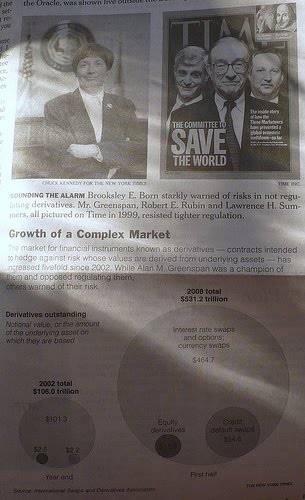
Short answer: Rubin, Greenspan, Summers... and Geithner-- as much the enemies of financial regulation as any slimoid, bought-and-paid for Republican. And then there was, "buried deep in the bureaucracy," Brooksley Born, chairwoman of the Commodities Futures Trading Commission, who saw right through what these banksters were up to-- and blew the whistle, or at least tried to. She understood derivatives. No one would listen. Instead they shut her up. And the Fed continued to inflate an economy based on businesses too big to fail that were pre-destined for failure. When Republicans tried blaming Clinton for the inevitable crash that ended Bush's regime and doomed McCain's campaign, they weren't all wrong. There was plenty of blame to go around and it started with Reagan's policies, policies tragically embraced by Clinton and still embedded deep inside the Obama White House, where the same cast of malevolent banksters has been joined by Wall Street's very own Chief of Staff, Rahm Emanuel.

Tonight at 9PM PBS is debuting The Warning by Mark Kirk. I heard him being interviewed on the radio this morning. It promises to be a blockbuster of a program and if you ever wonder how all these highly paid smart guys dragged the whole country-- if not much of the world-- into ruin, you really ought to try to watch. Kirk's goal is to open the black box and unearth "the hidden history of the nation's worst financial crisis since the Great Depression." And he's got Born, in her first TV appearance discussing her attempts to straighten out the crooked dealers inside the Administration, to help him with the daunting task.
"I didn't know Brooksley Born," says former SEC Chairman Arthur Levitt, a member of President Clinton's powerful Working Group on Financial Markets. "I was told that she was irascible, difficult, stubborn, unreasonable." Levitt explains how the other principals of the Working Group-- former Fed Chairman Alan Greenspan and former Treasury Secretary Robert Rubin-- convinced him that Born's attempt to regulate the risky derivatives market could lead to financial turmoil, a conclusion he now believes was "clearly a mistake."

Born's battle behind closed doors was epic, Kirk finds. The members of the President's Working Group vehemently opposed regulation-- especially when proposed by a Washington outsider like Born.

"I walk into Brooksley's office one day; the blood has drained from her face," says Michael Greenberger, a former top official at the CFTC who worked closely with Born. "She's hanging up the telephone; she says to me: 'That was [former Assistant Treasury Secretary] Larry Summers. He says, "You're going to cause the worst financial crisis since the end of World War II."... [He says he has] 13 bankers in his office who informed him of this. Stop, right away. No more.'"

Greenspan, Rubin and Summers ultimately prevailed on Congress to stop Born and limit future regulation of derivatives. "Born faced a formidable struggle pushing for regulation at a time when the stock market was booming," Kirk says. "Alan Greenspan was the maestro, and both parties in Washington were united in a belief that the markets would take care of themselves."

None of these guys have been drawn and quartered and none are in prison. Instead they're running the Obama Administration and pushing the economy inexorably over the financial cliff. "It'll happen again if we don't take the appropriate steps," Born warns. "There will be significant financial downturns and disasters attributed to this regulatory gap over and over until we learn from experience." As for effective regulations on derivatives... bizarrely it comes under the aegis of the House's most corrupt committee, Collin Peterson's Agricultural Committee, completely dominated by reactionary Blue Dogs and widely expected to kill any attempt at genuine reform.

A sneak peak at The Warning (Part 1)


(Part 2)

Labels: , , , , ,