Monday, February 06, 2017

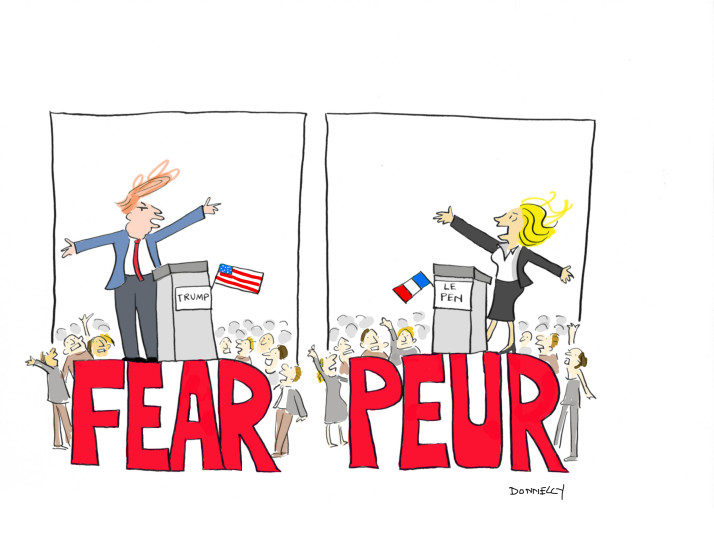
Is It Time To Ask Ourselves, Once More, If Trump Is Hitler? Or Is It Too Late Already?

>


There are a lot of Republicans wishing Trump hadn't gone on O'Reilly's show and created the impression of moral equivalency between Putin's fascist regime in Russia and our own country.Like many vulnerable Rep[ublican members of Congress, Wisconsin freshman Mike Gallagher panicked and immediately tried distancing himself from Trump. Yesterday Mitch McConnell was on CNN's State of the Union where he tried distancing himself-- and thereby Senate Republicans-- from Trump's statement about Putin and Russia. He told Jake Tapper that Putin "is a former KGB agent, a thug, not elected in a way that most people consider a credible election... I don't think there is any equivalency with the way the Russians conduct themselves and the way the United States does." That was a big slap in the face for Trump, who, luckily for him, has a base of support that will probably be unable to comprehend what all the fuss is about. And I suspect not many any Trump voters are New Yorker readers or followers of Adam Gopnik. The latter wrote in the new issue of the former that "Beate and Serge Klarsfeld, the couple who did so much to bear witness to the terrible truths of the Second World War, came to town last week to introduce their new memoir to an American audience. In it, there is a photograph that can only be called heartbreaking in its happiness, unbearable in its ordinariness. It shows an eight-year-old Serge with his sister and their Romanian-Jewish parents walking along a promenade in Nice, in 1943, still smiling, still feeling confident, even at that late date, that they are safe in their new French home. Within a few months, the children and their mother were hiding in a false closet, as Gestapo agents took their father to Auschwitz, and his death. What the photograph teaches is not that every tear in the fabric of civility opens a path to Auschwitz but that civilization is immeasurably fragile, and is easily turned to brutality and barbarism. The human capacity for hatred is terrifying in its volatility. (The same promenade in Nice was the site of the terrorist truck attack last year.) Americans have a hard time internalizing that truth, but the first days of the Trump Administration have helped bring it home."

Hitler didn't do it alone. He had millions of accomplices. Trump does as well. And we're not just talking about the top officials, either. It doesn't matter if you want to think of Stephen K. Bannon as someone manipulating Trump or just his alter-ego. There's a lot more to the Trump Regime than just the malevolent presence of Steve Bannon. In fact, many Trumpists-- most?-- have 2-digit IQs and have been brainwashed-- after years and years of long commutes to work and back-- by Hate Talk Radio and Fox News. Shocking numbers of Trump voters are addicted to prescription drugs and very severely mentally incapacitated. "Regimes with an authoritarian ideology and a boss man on top," wrote Gopnik, "always bend toward the extreme edge, because their only organizational principle is loyalty to the capo. Since the capo can be placated only by uncritical praise, the most fanatic of his lieutenants end up calling the shots. Loyalty to the boss is demonstrated by hatred directed against his enemies."

After Hitler became Chancellor but before he became dictator, the German establishment argued he would grow more reasonable once in office and that his cabinet would tame him. A dictatorship? Out of the question! They miscalculated; almost everyone miscalculated. When French Ambassador Andre François-Poncet first met the new chancellor he was relieved, finding him "dull and mediocre," a kind of miniature Mussolini.


Yet what perhaps no one could have entirely predicted was the special cocktail of oafish incompetence and radical anti-Americanism that President Trump’s Administration has brought. This combination has produced a new note in our public life: chaotic cruelty. The immigration crisis may abate, but it has already shown the power of government to act arbitrarily overnight-- sundering families, upending long-set expectations, until all those born as outsiders must imagine themselves here only on sufferance of a senior White House counsellor.

Some choose to find comfort in the belief that the incompetence will undermine the anti-Americanism. Don’t bet on it. Autocratic regimes with a demagogic bent are nearly always inefficient, because they cannot create and extend the network of delegated trust that is essential to making any organization work smoothly. The chaos is characteristic. Whether by instinct or by intention, it benefits the regime, whose goal is to create an overwhelming feeling of shared helplessness in the population at large: we will detain you and take away your green card-- or, no, now we won’t take away your green card, but we will hold you here, and we may let you go, or we may not.

This is radical anti-Americanism-- not simply illiberalism or anti-cosmopolitanism-- because America is not only a nation but also an idea, cleanly if not tightly defined. Pluralism is not a secondary or a decorative aspect of that idea. As James Madison wrote in Federalist No. 51, the guarantee of religious liberty lies in having many kinds of faiths, and the guarantee of civil liberty lies in having many kinds of people-- in establishing a “multiplicity of interests” to go along with a “multiplicity of sects.” The idea doesn’t reflect a “weak” desire for niceness. It is, instead, intended to counter the brutal logic of the playground. When there are many kinds of bullied kids, they can unite against the bully: “Even the stronger individuals are prompted, by the uncertainty of their condition, to submit to a government which may protect the weak as well as themselves.”
Trump supporters don't even read the warnings their vials of Oxycontin, Roxicodone, Oxecta, hydromorphone, codeine, fentanyl-- and those packets of heroin with Trump's picture on them don't even have warnings. So I'll take a wild guess that Trump supporters aren't going be reading Germany's version of Time, appropriately enough, Die Zeit . But who better to warn us about how fascism takes over a country? The German are scared. They know what comes next.
Is there reason to worry? No, thought Nikolaus Sieveking, an employee at Hamburg’s World Economy Archive. "I find the act of viewing Hitler’s chancellorship as a sensational event to be childish enough that I will leave that to his loyal followers," he wrote in his diary on Jan. 30, 1933.

Like Sieveking, many Germans didn’t initially recognize this date as a dramatic turning point. Few sensed what Hitler’s appointment as chancellor actually meant, and many reacted to the event with shocking indifference.

...Hitler’s thirst for power couldn’t have been more grossly underestimated. The nine conservative ministers in the so-called "Cabinet of National Concentration" clearly carried more weight than the three National Socialists. But Hitler also made sure that two key ministries were filled by his men. Wilhelm Frick took over the Ministry of the Interior of the German Reich. Hermann Göring became a cabinet minister without a portfolio, but also Prussia’s interior minister, thus acquiring power over the police in Germany’s largest state-- an important precondition for the establishment of the Nazi dictatorship.

Media mogul and head of the German National People’s Party Alfred Hugenberg was seen as the strongman in the cabinet. He was given the Ministry of Economy and Agriculture of both the Reich and Prussia. The new super minister purportedly told Leipzig Mayor Carl Goerdeler he had made the "biggest mistake" of his life by aligning himself with the "biggest demagogue in world history," but his assertion is hard to believe. Hugenberg, like Papen and the remaining conservative ministers, was convinced that he could steer Hitler to go along with his own ideas.

Big-business representatives shared the same illusion. In an editorial in the Deutsche Allgemeine Zeitung, which had close ties to heavy industry, editor-in-chief Fritz Klein wrote that working together with the Nazis would be "difficult and exhausting," but that people had to dare to take "the leap into darkness" because the Hitler movement had become the strongest political actor in Germany. The head of the Nazi party would now have to prove "whether he really had what is needed in order to become a statesman." The stock market didn’t seem spooked either-- people were waiting to see what would happen.


The conservatives who helped Hitler rise to power, and his opponents in the republican camp, were wrong in their assessment of the true division of power. On Jan. 31, Harry Graf Kessler, the diplomat and arts patron, reported having a conversation with Hugo Simon, a former close colleague of Foreign Minister Walther Rathenau, who was murdered in 1922. "He sees Hitler as a prisoner of Hugenberg and Papen." Apparently Kessler felt similarly, because only a few days later he prophesized that the new government wouldn’t last long, since it was only held together by the "Papen’s cream puffery and intrigues." He argued, "Hitler must have noticed by now that he has fallen prey to a deception. He is bound, hand and foot, to this government and can move neither forward nor backward."

In his book Defying Hitler, written in exile in England in 1939, journalist Sebastian Haffner recalled the "icy horror" he felt when he had learned of Hitler’s appointment while working as a clerk at the Kammergericht court in Berlin six years earlier. For a moment, he had "physically sensed (Hitler’s) odor of blood and filth." But on the evening of Jan. 30, he discussed the views of the new government with his father, a liberal progressive-educator, and they quickly agreed that while the cabinet could do a lot of damage, it couldn’t stay in power for very long. "A deeply reactionary government, with Hitler as its mouthpiece. Apart from this, it did not really differ much from the two governments that had succeeded Brüning's… No, all things considered, this government was not a cause for alarm."

The big liberal newspapers also argued that nothing truly terrible would happen. Theodor Wolff, the editor-in-chief of the Berliner Tageblatt saw the cabinet as the embodiment of what the united right-wing political groups had wanted since their meeting in Bad Harzburg in 1931. He opened his editorial on Jan. 31 by writing: "It has been achieved. Hitler is the Reich Chancellor, Hugenberg is the economics dictator and the positions have been distributed as the men of the ‘Harzburger Front’ had wanted." The new government, he argued, would try anything to "intimidate and silence opponents." A ban on the Communist Party was on the agenda, he thought, as well as a curtailing of the freedom of the press. But even the imagination of this otherwise so clear-sighted journalist didn’t go far enough to conceive the power of a totalitarian dictatorship. He argued there was a "border that violence would not cross." The German people, who were always proud of the "freedom of thought and of speech," would create a "soulful and intellectual resistance" and stifle all attempts to establish a dictatorship.

In the Frankfurter Zeitung, politics editor Benno Reifenberg expressed doubt Hitler had the "social competence" for the office of chancellor, but didn’t think it was out of the question that the responsibility of his office might transform him in ways that could earn him respect. Like Theodor Wolff, Reifenberg described it as "a hopeless misjudgment of our country to believe a dictatorial regime could be forced upon it." "The diversity of the German people demands democracy," he wrote.

Julius Elbau, the editor-in-chief of the Vossischer Zeitung, displayed less optimism. "The signs are pointing to a storm," he wrote in his first commentary. Although Hitler wasn’t able to achieve the absolute power he sought-- "it is not a Hitler cabinet, but a Hitler-Papen-Hugenberg government"-- this triumvirate was in agreement, despite all of their inner contradictions, that they wanted to make a "complete break from all that had come before." Given this prospect, the newspaper warned that it constituted "a dangerous experiment, which one can only watch with deep concern and the strongest suspicion."

The left was also concerned. In their appeal on Jan. 30, the party executive of the Social Democrats and their Reichstag parliamentary group called for supporters to carry out a "fight on the basis of the constitution." Every attempt by the new government to damage the constitution, they argued, "will be met with the most extreme resistance of the working class and all elements of the population who love freedom."

With their strict insistence on the legalities of the constitution, the Social Democratic Party (SPD) leadership overlooked the fact that the previous presidential governments had already hollowed the constitution and that Hitler would not hesitate to destroy its last vestiges.

The Communist Party of Germany (KPD) also made a misjudgment in its call for a "general strike against the fascist dictatorship of Hitler, Hugenberg, Papen." Given that there were 6 million unemployed people in Germany, few had the desire to go on strike. The call to build a common line of defense also wasn’t very popular with the Social Democrats, whom the Communists had defamed as "social fascists" only a short time earlier.

The idea of taking action outside of parliament was just as far from the unions’ minds. "Organization-- not demonstration: That is the word of the hour!" Theodor Leipart, the head of the General German Trade Union, said on Jan. 31. In the views of the representatives of the social-democratic workers’ movement, Hitler was a henchman of the old socially reactionary power-elites-- large landowners in the eastern Elbe region and the Rhineland-Westphalian heavy industry. In a talk in early February 1933, SPD Reichstag lawmaker Kurt Schumacher described the Nazi leader as being merely a "decoration piece." "The cabinet has Hitler’s name on the masthead, but in reality the cabinet is Alfred Hugenberg. Adolf Hitler may make the speeches, but Hugenberg will act."

The dangers emanating from Hitler could not have been more grotesquely misread. Most of the leading Social Democrats and unionists had grown up in the German Kaiserreich. They could imagine repression similar to Bismarck’s anti-socialist law, but not that someone would seriously try to destroy the workers’ movement in its entirety.


The fact that Hitler’s appointment meant that a fanatical anti-Semite had come to power should have made Germany’s Jews, above all, nervous. But that was not the case at all. In a statement given on Jan. 30, the chair of the Central Association of German Citizens of Jewish Faith said, "In general, today more than ever we must follow the directive: wait calmly." He said that although one watches the new government "of course with deep suspicion," President Hindenburg represents the "calming influence." He said there was no reason to doubt his "sense of justice" and "loyalty to the constitution." As a result, he said, one should be convinced that "nobody would dare" to "touch our constitutional rights." In an editorial in the Jüdische Rundschau, a Jewish newspaper,published on Jan. 31, the author argued that "there are powers that are still awake in the German people that will rear up against barbarian anti-Jewish policies." It would only be a few weeks before all these expectations would prove to be illusory.

...Rarely has a political project so rapidly been revealed to be a chimera as the idea that the conservatives would "tame" the Nazis. In terms of tactical cunning, Hitler towered high above his cabinet allies and opponents. In a short time, he had upstaged them and driven them against the wall, dislodging Papen from of his preferential position with Hindenburg and forcing Hugenberg to resign.

Hitler needed only five months to establish his power. By the summer of 1933, fundamental rights and the constitution had been suspended, the states had been forced into conformity, the unions crushed, the political parties banned or dissolved, press and radio brought into line and the Jews stripped of their equality under the law. Everything that existed in Germany outside of the National Socialist Party had been "destroyed, dispersed, dissolved, annexed or absorbed," [French Ambassador Andre] François-Poncet concluded in early July. Hitler, he claimed, had "won the game with little effort." "He only had to puff-- and the edifice of German politics collapsed like a house of cards."
Back to Gopnik again, in the new New Yorker. "Democratic civilization," he concluded, "has turned out to be even more fragile than we imagined; the resources of civil society have turned out to be even deeper than we knew. The battle between these two shaping forces-- between the axman assaulting the old growth and the still firm soil and deep roots that support the tree of liberty-- will now shape the future of us all." Don't forget, there are congressional elections in 2018. They're the only thing that can stop Trump and Bannon at this point. Meanwhile... these men and women are the voice of The Resistance inside Congress. Support them so they can support us:

Goal Thermometer

Labels: , , , , ,

Monday, August 01, 2016

We Need a Clothespin Campaign for Hillary

>


- by Helen Klein

In this monumental upcoming election, it would behoove Americans to take a lesson from the French and strongly encourage Republicans, Independents and Democrats – including progressives – to hold their noses and vote for Hillary.

In a March 3, 2016 New Yorker article, Adam Gopnik describes how, in 2002, the French found themselves in a situation that was similar to our current presidential election. Jacques Chirac was running against Jean-Marie Le Pen. As with Bernie Sanders, the French progressive socialist candidate, Lionel Jospin, had lost in the primaries and was not in the running for the general election. The choice between Chirac and Le Pen presented voters with the "classic fascist double whammy." Chirac was a right-center candidate who was viewed as unprincipled, mediocre and corrupt, and whom the Socialists had spent a lifetime fighting against. Le Pen was a right wing, authoritarian racist who was anti-immigrant as well as anti-Semitic. He was friendly to corporations, yet not opposed to government welfare. Sound familiar?

So what did the French do? An alliance was formed, including respectable conservatives and French Socialists. They held their noses and voted for Chirac. As they voted, they held clothespins in their pockets to signify their disgust, since wearing them into the voting booth would have publicly shown who they were voting for, and that was unconstitutional.

This fall, Americans need to do the same. Let’s hand out the clothespins!
The French "were operating on the wise premise that sometimes people who are mistaken about almost everything are better than someone who is wrong about the only thing that counts. There are politicians we strongly disagree with, and then there are anti-constitutional crypto-fascist authoritarians. Pretending they’re the same is what happened at Vichy, and it should never be allowed to happen again."
There’s a lesson here for Bernie supporters: "Sometimes, as the French left learned, the people you can’t stand are better than the people you can’t live with." At the Democratic convention, Bernie-- noting that we live in the real world-- gave his support to Hillary.

In France, Le Pen and his daughter, Marine, are "quarantined from respectable conservatism," as Trump should be here. Unfortunately that hasn’t happened, and we’ve watched in disbelief as he’s risen to the top of the Republican ticket.


And as if the parallels weren’t already disturbing enough, Le Pen came out in February and endorsed Trump. No surprise there. Two peas in a pod.

In his June article on the John Halle website, Noam Chomsky-- MIT professor and life-long progressive--expresses views in alignment with Clothespin voting. Chomsky describes LEV (Lesser of Two Evils) voting and why it is so important to do so in this election. He asserts that if Trump is elected, the progressive movement will be diminished and all that it has been trying to accomplish will be greatly undermined. His points are quoted below:

Voting should not be viewed as a form of personal self-expression or moral judgment directed towards major party candidates who fail to reflect our values or a corrupt system designed to limit choices to those acceptable to corporate elites.

The exclusive consequence of the act of voting in 2016 will be (if in a contested “swing state”) to marginally increase or decrease the chance of one of the major party candidates winning.

One of these candidates, Trump, denies the existence of global warning, calls for increasing use of fossil fuels and the dismantling of environmental regulations, and refuses assistance to India and other developing nations as called for in the Paris agreement, the combination of which could, in four years, take us to a catastrophic tipping point. Trump has pledged to deport 11 million Mexican immigrants, offered to provide for the defense of supporters who have assaulted African American protestors at his rallies…. Trump has also pledged to increase military spending while cutting taxes on the rich, hence shredding what remains of the social welfare “safety net” despite pretenses.

The suffering which these and other similar extremist policies and attitudes will impose on marginalized and already oppressed populations has a high probability of being significantly greater than that which will result from a Clinton presidency.

(The above) should constitute sufficient basis to voting for Clinton where a vote is potentially consequential-- namely in a contested “swing state.”

…The left should also recognize that, should Trump win based on its failure to support Clinton, it will repeatedly face the accusation (based in fact) that it lacks concern for those surely victimized by a Trump administration.

Often this charge will emanate from establishment operatives, who will use it as a bad faith justification for defeating challenges to corporate hegemony either in the Democratic Party or outside of it. They will ensure that it will be widely circulated in mainstream media channels, with the result that many of those who would otherwise be sympathetic to a left challenge will find it a convincing reason to maintain their ties with the political establishment, rather than breaking with it, as they must.

Conclusion: by dismissing a ‘lesser evil’ electoral logic and thereby increasing the potential for Clinton’s defeat, the left will undermine what should be at the core of what it claims to be attempting to achieve.

Last week in the Huffington Post (initially posted on Vox), Ezra Klein summed up this election:
“This campaign is not merely a choice between the Democratic and Republican parties, but between a normal political party and an abnormal one… Republicans held an abnormal convention and nominated an abnormal candidate.

Trump has already been scolded by his own party for racist comments, for attacks on the judiciary, for undermining the NATO alliance, for inviting foreign governments to meddle in American elections. None of this is okay. None of it is normal. This is not a man with the temperament, the steadiness, or the discipline to be president.”
One quote from Rand Paul, noted in Ezra Klein’s article, is too good to pass up. Paul described Trump as "a delusional narcissist and an orange-faced windbag. A speck of dirt is way more qualified to be president." Tell us what you really mean, Rand!

In today’s New York Times, Paul Krugman’s editorial, while aimed at Republicans, has meaning for all Americans:
The bottom line is that even if you don’t like Mrs. Clinton or what she stands for, it’s hard to see how you could view her possible victory with horror. And it’s hard to see how you could view Mr. Trump’s possible victory any other way… Democracy isn’t about making a statement, it’s about exercising responsibility. And indulging your feelings at a time like this amounts to dereliction of your duty as a citizen.
To end this post, here is one last piece from Friday’s New York Times. In Gail Collins’ blog, Joan Wheeler from New Orleans wrote:
Joan: One of the most important reasons to elect Hillary Clinton is to put down Donald Trump, and put him down hard! Trump is the biggest threat to this country that I’ve experienced in my 84 years on the planet. That includes the Great Depression, World War II, the Cold War, McCarthyism, Richard Nixon, the Cuban Missile Crisis, the assassination of J.F.K. and Martin Luther King, the presidency of George W. Bush, the current problem with terrorism and every other bad thing this country has gone through in the 20th and 21st centuries.

Gail: Well, Joan, I’m not sure I agree with you about World War II. But you have definitely driven your point home.
Trump is truly alarming and should not be anywhere near the Oval Office or the nuclear button. For this election season, the spotlight needs to be shifted off of Hillary and turned on Trump. Hillary policies can be fought once she is in office.

So everyone, purchase your clothespins and get ready for November 8!

Goal Thermometer

Labels: , , , ,

Monday, October 05, 2015

Enemies of the State – Reflections on Insurrection and the Second Amendment

>

"Famous Whiskey Insurrection in Pennsylvania", an 1880 illustration of a tarred and feathered tax collector being made to ride the rail (click to enlarge; source)

by Gaius Publius

Not long ago, this excellent piece by Ken explored the real meaning of the Second Amendment. An added, also excellent, comment by John Puma contributed to the discussion. I'd like to summarize what these two are saying, then print the whole of the first part of Justice John Paul Stevens' dissent in Heller, the Scalia-authored Supreme Court majority opinion that "found" a right for personal gun ownership in the Second Amendment, an amendment about "militias." At the end, I'll add a comment of my own about American insurrection.

Quoting Adam Gopnik's good essay on this subject in The New Yorker, Ken writes (my emphasis):
To the inevitable argument "that the Second Amendment acts as a barrier to anything like the gun laws, passed after mass shootings, that have saved so many lives in Canada and Australia," Adam replies: "In point of historical and constitutional fact, nothing could be further from the truth: the only amendment necessary for gun legislation, on the local or national level, is the Second Amendment itself, properly understood, as it was for two hundred years in its plain original sense."
So what is the "plain original sense" of the Second Amendment? Keep in mind the times. The Constitution was establishing a strong federal government, and the relationship between that government and the (formerly supreme) state governments were continuously at issue. Each state had a state "militia" — a state army, in other words. Would the federal government require that these state militias be disbanded and replaced with a (standing) federal army?

Keep in mind as well that these state militias (state standing armies) had many functions, including suppressing insurrections — in the South, especially slave insurrections, as Thom Hartmann points out. In fact, according to Hartmann, these "militias" were also called "slave patrols," tasked with hunting down runaways.

But state militias weren't just for use against the slaves. This shows the role of state militias during the Whiskey Rebellion of 1791 (links at the source; my emphasis):
The Whiskey Rebellion, also known as the Whiskey Insurrection, was a tax protest in the United States beginning in 1791, during the presidency of George Washington. The so-called "whiskey tax" was the first tax imposed on a domestic product by the newly formed federal government. It became law in 1791, and was intended to generate revenue to help reduce the national debt.[3] Although the tax applied to all distilled spirits, whiskey was by far the most popular distilled beverage in the 18th-century U.S. Because of this, the excise became widely known as a "whiskey tax". The new excise was a part of U.S. treasury secretary Alexander Hamilton's program to fund war debt incurred during the American Revolutionary War.

The tax was resisted by farmers in the western frontier regions who were long accustomed to distilling their surplus grain and corn into whiskey. In these regions, whiskey was sufficiently popular that it often served as a medium of exchange. Many of the resisters were war veterans who believed that they were fighting for the principles of the American Revolution, in particular against taxation without local representation, while the U.S. federal government maintained the taxes were the legal expression of the taxation powers of Congress.

Throughout counties in Western Pennsylvania, protesters used violence and intimidation to prevent federal officials from collecting the tax. Resistance came to a climax in July 1794, when a U.S. marshal arrived in western Pennsylvania to serve writs to distillers who had not paid the excise. The alarm was raised, and more than 500 armed men attacked the fortified home of tax inspector General John Neville. Washington responded by sending peace commissioners to western Pennsylvania to negotiate with the rebels, while at the same time calling on governors to send a militia force to enforce the tax. With 13,000 militiamen provided by the governors of Virginia, Maryland, New Jersey, and Pennsylvania, Washington rode at the head of an army to suppress the insurgency. The rebels all went home before the arrival of the army, and there was no confrontation. About 20 men were arrested, but all were later acquitted or pardoned. Most distillers in nearby Kentucky were found to be all but impossible to tax; in the next six years, over 175 distillers from Kentucky were convicted of violating the tax law.[4] Numerous examples of resistance are recorded in court documents and newspaper accounts.[5]

The Whiskey Rebellion demonstrated that the new national government had the will and the ability to suppress violent resistance to its laws.
Even after the ratification of the Constitution, state militias had a military function.

Justice Stevens' Dissent in "Heller"

Now read Justice Stevens' excellent takedown of Justice Scalia's majority opinion in Heller. Trust me, you'll enjoy it (my emphasis in italics; links in the original):
Stevens, J., dissenting
SUPREME COURT OF THE UNITED STATES
No. 07–290
DISTRICT OF COLUMBIA, et al., PETITIONERS v. DICK ANTHONY HELLER 
on writ of certiorari to the United States Court of Appeals for the District of Columbia Circuit
[June 26, 2008]

Justice Stevens, with whom Justice Souter, Justice Ginsburg, and Justice Breyer join, dissenting.

The question presented by this case is not whether the Second Amendment protects a “collective right” or an “individual right.” Surely it protects a right that can be enforced by individuals. But a conclusion that the Second Amendment protects an individual right does not tell us anything about the scope of that right.

Guns are used to hunt, for self-defense, to commit crimes, for sporting activities, and to perform military duties. The Second Amendment plainly does not protect the right to use a gun to rob a bank; it is equally clear that it does encompass the right to use weapons for certain military purposes. Whether it also protects the right to possess and use guns for nonmilitary purposes like hunting and personal self-defense is the question presented by this case. The text of the Amendment, its history, and our decision in United States v. Miller, 307 U. S. 174 (1939), provide a clear answer to that question.

The Second Amendment was adopted to protect the right of the people of each of the several States to maintain a well-regulated militia. It was a response to concerns raised during the ratification of the Constitution that the power of Congress to disarm the state militias and create a national standing army posed an intolerable threat to the sovereignty of the several States. Neither the text of the Amendment nor the arguments advanced by its proponents evidenced the slightest interest in limiting any legislature’s authority to regulate private civilian uses of firearms. Specifically, there is no indication that the Framers of the Amendment intended to enshrine the common-law right of self-defense in the Constitution.

In 1934, Congress enacted the National Firearms Act, the first major federal firearms law.1 Upholding a conviction under that Act, this Court held that, “[i]n the absence of any evidence tending to show that possession or use of a ‘shotgun having a barrel of less than eighteen inches in length’ at this time has some reasonable relationship to the preservation or efficiency of a well regulated militia, we cannot say that the Second Amendment guarantees the right to keep and bear such an instrument.” Miller, 307 U. S., at 178. The view of the Amendment we took in Miller—that it protects the right to keep and bear arms for certain military purposes, but that it does not curtail the Legislature’s power to regulate the nonmilitary use and ownership of weapons—is both the most natural reading of the Amendment’s text and the interpretation most faithful to the history of its adoption.

Since our decision in Miller, hundreds of judges have relied on the view of the Amendment we endorsed there;2 we ourselves affirmed it in 1980. See Lewis v. United States, 445 U. S. 55, n. 8 (1980).3 No new evidence has surfaced since 1980 supporting the view that the Amendment was intended to curtail the power of Congress to regulate civilian use or misuse of weapons. Indeed, a review of the drafting history of the Amendment demonstrates that its Framers rejected proposals that would have broadened its coverage to include such uses.

The opinion the Court announces today fails to identify any new evidence supporting the view that the Amendment was intended to limit the power of Congress to regulate civilian uses of weapons. Unable to point to any such evidence, the Court stakes its holding on a strained and unpersuasive reading of the Amendment’s text; significantly different provisions in the 1689 English Bill of Rights, and in various 19th-century State Constitutions; postenactment commentary that was available to the Court when it decided Miller; and, ultimately, a feeble attempt to distinguish Miller that places more emphasis on the Court’s decisional process than on the reasoning in the opinion itself.

Even if the textual and historical arguments on both sides of the issue were evenly balanced, respect for the well-settled views of all of our predecessors on this Court, and for the rule of law itself, see Mitchell v. W. T. Grant Co., 416 U. S. 600, 636 (1974) (Stewart, J., dissenting), would prevent most jurists from endorsing such a dramatic upheaval in the law.4 As Justice Cardozo observed years ago, the “labor of judges would be increased almost to the breaking point if every past decision could be reopened in every case, and one could not lay one’s own course of bricks on the secure foundation of the courses laid by others who had gone before him.” The Nature of the Judicial Process 149 (1921).

In this dissent I shall first explain why our decision in Miller was faithful to the text of the Second Amendment and the purposes revealed in its drafting history. I shall then comment on the postratification history of the Amendment, which makes abundantly clear that the Amendment should not be interpreted as limiting the authority of Congress to regulate the use or possession of firearms for purely civilian purposes.

I

The text of the Second Amendment is brief. It provides: “A well regulated Militia, being necessary to the security of a free State, the right of the people to keep and bear Arms, shall not be infringed.”

Three portions of that text merit special focus: the introductory language defining the Amendment’s purpose, the class of persons encompassed within its reach, and the unitary nature of the right that it protects.

“A well regulated Militia, being necessary to the security of a free State”

The preamble to the Second Amendment makes three important points. It identifies the preservation of the militia as the Amendment’s purpose; it explains that the militia is necessary to the security of a free State; and it recognizes that the militia must be “well regulated.” In all three respects it is comparable to provisions in several State Declarations of Rights that were adopted roughly contemporaneously with the Declaration of Independence.5 Those state provisions highlight the importance members of the founding generation attached to the maintenance of state militias; they also underscore the profound fear shared by many in that era of the dangers posed by standing armies.6 While the need for state militias has not been a matter of significant public interest for almost two centuries, that fact should not obscure the contemporary concerns that animated the Framers.

The parallels between the Second Amendment and these state declarations, and the Second Amendment ’s omission of any statement of purpose related to the right to use firearms for hunting or personal self-defense, is especially striking in light of the fact that the Declarations of Rights of Pennsylvania and Vermont did expressly protect such civilian uses at the time. Article XIII of Pennsylvania’s 1776 Declaration of Rights announced that “the people have a right to bear arms for the defence of themselves and the state,” 1 Schwartz 266 (emphasis added); §43 of the Declaration assured that “the inhabitants of this state shall have the liberty to fowl and hunt in seasonable times on the lands they hold, and on all other lands therein not inclosed,” id., at 274. And Article XV of the 1777 Vermont Declaration of Rights guaranteed “[t]hat the people have a right to bear arms for the defence of themselves and the State.” Id., at 324 (emphasis added). The contrast between those two declarations and the Second Amendment reinforces the clear statement of purpose announced in the Amendment’s preamble. It confirms that the Framers’ single-minded focus in crafting the constitutional guarantee “to keep and bear arms” was on military uses of firearms, which they viewed in the context of service in state militias.

The preamble thus both sets forth the object of the Amendment and informs the meaning of the remainder of its text. Such text should not be treated as mere surplusage, for “[i]t cannot be presumed that any clause in the constitution is intended to be without effect.” Marbury v. Madison, 1 Cranch 137, 174 (1803). [...]
The rest is a good read as well, though occasionally legalistic, as you'd expect.

Again, the concern of the framers was to protect armed state militias ... only. If they were concerned with protecting the hunting rights of citizens, as the contemporaneous Pennsylvania and Vermont Declaration of Rights documents did explicitly, they would have done so, explicitly. Scalia's opinion, joined by the right-wing majority of the Court, is a 180-degree reversal of the plain meaning of the Second Amendment.

Which leads us to one or two more considerations.

Enemies of the State: The American Insurrection

I have two takeaways from this discussion. Both are striking, and they echo each other in that they stand in 180-degree opposition to each other on exactly the same topic, American insurrection.

First, the primary argument (the "rationale" in sales terms*) of the American Right in favor of a "gun rights" interpretation of the Second Amendment is this: The reason (they say) the Founders wanted citizens to be armed is to oppose the federal government. Yet, as John Puma points out, Article One, Section 8 of the U.S. Constitution enumerates the powers of Congress, one of which is (paragraph 15, my emphasis):
To provide for calling forth the Militia to execute the Laws of the Union, suppress Insurrections and repel Invasions;
▪ So ask yourself — How can anyone, for any minute, consider that a Constitution that protects the government's right to "suppress insurrections" also adds a right that encourages and arms them? The Constitution is plainly, obviously, an anti-insurrectionist document.

Second, it's been clear for some time that the American Right is not interested in government as established by the Constitution. Their elected officials aren't interested in using the power of Congress to govern, in using the power of the Executive Branch to enforce the law; nor are their appointed justices interested in using the power of the Court to enforce the Constitution.

Using the power of government to subvert the government is itself insurrectionist. Which tells us two things — the insurrectionist strain in voters of the American Right (per their arguments in favor of "gun rights") is matched by the insurrectionist strain in their leaders and those who hold office in their name.

▪ So ask yourself — Why is the rest of the country not treating this insurrection as an insurrection, like the Whiskey Rebellion, instead of treating it as just another difference of political opinion? In other words, why are we not treating the virtual (and sometimes literal) armed rebels in the hills as a threat to the existence of our government?

That's a serious question. The rest of the country does not see the American Right as an insurrection, is determined not to, in fact, and also is encouraged not to. The reasons they don't and won't see the insurrection as an insurrection are both revealing and determinative of the outcome. After all, would the modern and mainly corrupted Democratic Party be able to sell its own brand of "rule by the rich" if they didn't have Republicans to point to as political enemies, instead of what they are, enemies of the state itself?

It seems at least possible that if the Democrats didn't keep the insurrectionist Republican Party alive as political enemies, their leaders would have to offer actual popular solutions, Sanders- and Warren-esque solutions, instead of only offering solutions favored by the wealthy that finance both parties.

I'm serious. Picture a world in which the Republicans were delegitimized as a political party. What would happen to the Democratic Party? It would split, of course, into a party that could only offer blackmail as a reason to vote for them, and a party that offered solutions to real problems instead.

Interesting considerations, no?

*The "rationale" in sales terms — The "rationale" is the cobbled-together explanation you give your spouse for why you want some god-awful something he's certainly going to oppose and you're determined to buy. And yes, this is how sales pitches work. They teach you about the "rationale," just this way, in courses about writing these pitches. The rationale always comes second in the pitch, after you stimulate the "want," the lizard brain reason for buying in the first place ("chicks will love you" or "fish will jump out of the water into your net"). 

GP

Labels: , , , , , , , , ,

Friday, October 02, 2015

"The Second Amendment is a gun-control amendment" (Adam Gopnik)

>


Retired Supreme Court Justice John Paul Stevens

"The right the Court announces [in Heller] was not 'enshrined' in the Second Amendment by the Framers; it is the product of today's law-changing decision.… Until today, it has been understood that legislatures may regulate the civilian use and misuse of firearms so long as they do not interfere with the preservation of a well-regulated militia. The Court's announcement of a new constitutional right to own and use firearms for private purposes upsets that settled understanding."
-- from Justice Stevens's dissent in D.C. v. Heller (2008)

by Ken

In the wake (all too literally) of our latest gunfest, The New Yorker's Adam Gopnik rises to remind us that the Second Amendment, thought to leave us powerlsss to deal with gun violence, in fact does so only because of complete gross misreadings, that in fact "The Second Amendment Is a Gun-Control Amendment," provided that one (a) knows how to read and (b) has the basic historical knowledge to make sense of the nonsense that gun-loving Second Amendment defilers have so thoroughly mucked up.

"It hardly seems worth the energy," Adam writes, "to once again make the same essential point that the President -- his growing exasperation and disbelief moving, if not effective, as he serves as national mourner -- has now made again: we know how to fix this."
Gun control ends gun violence as surely as antibiotics end bacterial infections, as surely as vaccines end childhood measles—not perfectly and in every case, but overwhelmingly and everywhere that it’s been taken seriously and tried at length. These lives can be saved. Kids continue to die en masse because one political party won’t allow that to change, and the party won’t allow it to change because of the irrational and often paranoid fixations that make the massacre of students and children an acceptable cost of fetishizing guns.
To the inevitable argument "that the Second Amendment acts as a barrier to anything like the gun laws, passed after mass shootings, that have saved so many lives in Canada and Australia," Adam replies: "In point of historical and constitutional fact, nothing could be further from the truth: the only amendment necessary for gun legislation, on the local or national level, is the Second Amendment itself, properly understood, as it was for two hundred years in its plain original sense."

But, but, but . . . the Supreme Court, you say? We'll come back to that in a moment. Meanwhile, to summarize what Adam is calling the Second Amendment's "plain original sense," he offers a single sentence:
"Iif the Founders hadn’t wanted guns to be regulated, and thoroughly, they would not have put the phrase “well regulated” in the amendment.
And he offers what he calls "a quick thought experiment":
What if those words were not in the preamble to the amendment and a gun-sanity group wanted to insert them? Would the National Rifle Association be for or against this change? It’s obvious, isn’t it?
And, he points out, "The confusion is contemporary." (To which he adds parenthetically, "And, let us hope, temporary.") This confusion "rises," he notes, "from the younger-than-springtime decision D.C. v. Heller, from 2008, when Justice Antonin Scalia, writing for a 5–4 majority, insisted that, whether he wanted it to or not, the Second Amendment protected an individual right to own a weapon." (Again he adds parenthetically, "A certain disingenuous show of disinterestedness is typical of his opinions.")
This was an astounding constitutional reading, or misreading, as original as Citizens United, and as idiosyncratic as the reasoning in Bush v. Gore, which found a conclusive principle designed to be instantly discarded—or, for that matter, as the readiness among the court’s right wing to overturn a health-care law passed by a supermajority of the legislature over a typo. Anyone who wants to both grasp that decision’s radicalism and get a calm, instructive view of what the Second Amendment does say, and was intended to say, and was always before been understood to say, should read Justice John Paul Stevens’s brilliant, persuasive dissent in that case. Every person who despairs of the sanity of the country should read it, at least once, not just for its calm and irrefutable case-making but as a reminder of what sanity sounds like.

Stevens, a Republican judge appointed by a Republican President, brilliantly analyzes the history of the amendment, making it plain that for Scalia, et al., to arrive at their view, they have to reference not the deliberations that produced the amendment but, rather, bring in British common law and lean on interpretations that arose long after the amendment was passed. Both “keep arms” and “bear arms,” he demonstrates, were, in the writers’ day, military terms used in military contexts. (Gary Wills has usefully illuminated this truth in the New York Review of Books.) The intent of the Second Amendment, Stevens explains, was obviously to secure “to the people a right to use and possess arms in conjunction with service in a well-regulated militia.” The one seemingly sound argument in the Scalia decision—that “the people” in the Second Amendment ought to be the same “people” referenced in the other amendments, that is, everybody—is exactly the interpretation that the preamble was meant to guard against.

Stevens’s dissent should be read in full, but his conclusion in particular is clear and ringing:
The right the Court announces [in Heller] was not “enshrined” in the Second Amendment by the Framers; it is the product of today’s law-changing decision.… Until today, it has been understood that legislatures may regulate the civilian use and misuse of firearms so long as they do not interfere with the preservation of a well-regulated militia. The Court’s announcement of a new constitutional right to own and use firearms for private purposes upsets that settled understanding.
Justice Stevens and his colleagues were not saying, a mere seven years ago, that the gun-control legislation in dispute in Heller alone was constitutional within the confines of the Second Amendment. They were asserting that essentially every kind of legislation concerning guns in the hands of individuals was compatible with the Second Amendment—indeed, that regulating guns in individual hands was one of the purposes for which the amendment was offered.

So there is no need to amend the Constitution, or to alter the historical understanding of what the Second Amendment meant. No new reasoning or tortured rereading is needed to reconcile the Constitution with common sense. All that is necessary for sanity to rule again, on the question of guns, is to restore the amendment to its commonly understood meaning as it was articulated by this wise Republican judge a scant few years ago. And all you need for that is one saner and, in the true sense, conservative Supreme Court vote. One Presidential election could make that happen.
So now all we need is a Supreme Court majority that (a) can read and (b) understands these excruciatingly simple points. (I will add parenthetically that, personally, I'm not holding my breath.)
#

Labels: , , , , ,

Tuesday, May 27, 2014

Two fathers respond to the Isla Vista shooting -- the only problem is that one is a journalistic joke

>


We don't need any stinking Magic 8 Ball. Tonight to read the future we have . . . the Great Punditto!

"The war against euphemism matters most because it forces us to look at the truth we already know. The actual consequences of the N.R.A. and the gun policy it frightens those craven politicians into sponsoring is the death of kids like Christopher Michael-Martinez. This truth may not triumph tomorrow, but the truth remains the truth."
-- Adam Gopnik, in a Sunday newyorker.com post,
"Christopher Michael-Martinez's Father Gets it Right"

by Ken

The New Yorker's Adam Gopnik began the above-referenced Sunday blogpost:
I don't think I've ever been as heartbroken by anything as I was, last night, by the video of Richard Martinez, whose twenty-year-old son, Christopher, a college student at the University of California Santa Barbara, had been murdered the day before. Christopher and six others were killed in a mass shooting near campus. That I have a twenty-year-old son who is also a college student makes an empathetic response easy, almost obligatory -- but I suspect that many others felt the same way, and that they felt this way because they were hearing a hard truth spoken clearly. Martinez, almost overcome with a grief that he knows and we know will never fade, not for as long as he lives, still struggled to speak sanely in that moment. And so there was something almost heartening amid the heartbreak. Richard Martinez, in the height of his grief, somehow did the hardest thing there is, and that is to find the courage to speak a painful truth: "Why did Chris die? Chris died because of craven, irresponsible politicians and the N.R.A.," he said. "They talk about gun rights. What about Chris's right to live? When will this insanity stop? When will enough people say, 'Stop this madness; we don't have to live like this?' Too many have died. We should say to ourselves: not one more."
Adam had some important things to add to his previous writings on this subject, notably about the importance to have the courage to speak truth in place of lying euphemism on the subject, very much worth reading. But for now I want to focus one more prosaic but extremely important thing he had to say:
Why did Christopher Michael-Martinez die? Because the N.R.A. and the politicians they intimidate enable people to get their hands on weapons and ammunition whose only purpose is to kill other people as quickly and as lethally as possible. How do we know that they are the 'because' in this? Because every other modern country has suffered from the same kinds of killings, from the same kinds of sick kids, and every other country has changed its laws to stop them from happening again, and in every other country it hasn't happened again. (Australia is the clearest case -- a horrific gun massacre, new laws, no more gun massacres -- but the same is true of Canada, Great Britain, you name it.)

ALONGSIDE THIS I WOULD LIKE TO PLACE
THIS STERLING PIECE OF RAPPORTAGE


It's from this afternoon, courtesy of washingtonpost.com's august Fix-master, the Great Punditto, Richard Martinez’s grief won’t change the gun debate. It just won’t.

Like Adam Gopnik, the Great Punditto quotes from Richard Martinez's message:
"Today, I’m going to ask every person I can find to send a postcard to every politician they can think of with three words on it: Not one more," Martinez told The Washington Post's Kimberly Kindy on Tuesday morning. "People are looking for something to do. I’m asking people to stand up for something. Enough is enough." Martinez added a stern message to politicians up to and including President Obama: "I don't care about your sympathy. I don't give a s--- that you feel sorry for me. Get to work and do something. I'll tell the president the same thing if he calls me. Getting a call from a politician doesn’t impress me."
And Punditto allows that Richard Martinez's "grief and anger is hard to look away from."
As a father of two boys who gets worked up when either one of them gets a fever, the thought of losing one of them to this sort of act of violence makes his emotion all the more real and affecting for me. The tendency in the wake of these shootings -- and the emergence of people like Richard Martinez -- is to think that his pain and loss will be the tipping point when it comes to legislating guns.

But it almost certainly won't be that galvanizing moment. In the same way that the attempted assassination of then-Arizona Rep. Gabrielle Giffords wasn't. In the same way the deaths of 20 children in Newtown wasn't. (In fact, since Newtown, more states have loosened gun laws than have tightened them.)

The simple fact is that tragedies involving guns do not move the political needle -- whether you are talking about public opinion or the actions of politicians --  in any meaningful way.  Check out this chart from Gallup detailing peoples' thoughts on gun laws from 1990 through the end of 2013.

AH, PUNDITTO! THE VOICE OF COLD, HARD TRUTH!

Well, Punditto has spoken. Pack up your anger and your heartbreak. Ain't gonna change no thing, so let's all do the jolly NRA victory dance. Who knows, maybe next time it'll be Punditto's kids. Won't that be a hoot? Doesn't matter, because we're Americans, and that's the way it is.

Omitting only the one crucial fact: We're Americans, and we kill people with guns because we love it, baby, it's cool, it's a gas, it makes us feel manly, and godlik.. Is it any wonder that God loves Americans and thinks everybody else sucks?

Just this one thing, Punditto. YOU SUCK, YOU WORTHLESS PILE OF IGNORANT PUKE. YOU ARE WHAT'S WRONG WITH AMERICA. Well, not just you personally, but assuredly including you personally. Let's listen again to Adam Gopnik:
How do we know that they [i.e., "the N.R.A. and the politicians they intimidate"] are the 'because' in this? Because every other modern country has suffered from the same kinds of killings, from the same kinds of sick kids, and every other country has changed its laws to stop them from happening again, and in every other country it hasn't happened again. (Australia is the clearest case -- a horrific gun massacre, new laws, no more gun massacres -- but the same is true of Canada, Great Britain, you name it.)
So, Punditto, by all means trot out your facts and numbes and charts. Because you don't have the skills or maybe just the inclination to do an actual job of reporting, which might consist of asking why Americans are so crapitatious (but uh-oh, this might already lead us right back to the NRA and all its money and power and willingness to use both as ruthlessly as necessary), and wondering what it is that makes Americans different from, you know, Australians and Canadians and Brits. Or were you hoping to pass it off as a Universal Truth that horrific and senseless gun violence never has an effect on public opinion?

Maybe we need to listen to Adam Gopnik after all about why it's so important to speak the truth at a time like this.
Martinez's brave words put me in mind of a simple point, which I failed to make in a long essay about language this week, or didn't make strongly enough. The war against euphemism and cliché matters not because we can guarantee that eliminating them will help us speak nothing but the truth but, rather, because eliminating them from our language is an act of courage that helps us get just a little closer to the truth. Clear speech takes courage. Every time we tell the truth about a subject that attracts a lot of lies, we advance the sanity of the nation. Plain speech matters because when we speak clearly we are more likely to speak truth than when we retreat into slogan and euphemism; avoiding euphemism takes courage because it almost always points plainly to responsibility. To say "torture" instead of "enhanced interrogation" is hard, because it means that someone we placed in power was a torturer. That's a hard truth and a brutal responsibility to accept. But it's so.

Speaking clearly also lets us examine the elements of a proposition plainly. We know that slogans masquerading as plain speech are mere rhetoric because, on a moment's inspection, they reveal themselves to be absurd. "The best answer to a bad guy with a gun is a good guy with a gun" reveals itself to be a lie on a single inspection: the best answer is to not let the bad guy have a gun. "Guns don't kill people, people do." No: obviously, people with guns kill more people than people without them. Why not ban knives or cars, which can be instruments of death, too? Because these things were designed to help people do things other than kill people. "Gun control" means controlling those things whose first purpose is to help people kill other people. (I've written at length about farmers and hunting rifles, and of how they're properly controlled in Canada. In any case, if guns were controlled merely as well as cars and alcohol, we'd be a long way along.) And the idea that you can be pro-life and still be pro-gun: if your primary concern is actually with the sacredness of life, then you have to stand with Richard Martinez, in memory of his son.

There, that isn't hard, is it? The war against euphemism matters most because it forces us to look at the truth we already know. The actual consequences of the N.R.A. and the gun policy it frightens those craven politicians into sponsoring is the death of kids like Christopher Michael-Martinez. This truth may not triumph tomorrow, but the truth remains the truth. It would be nice if the President, who knows all this perfectly well, put aside his conciliatory manner and his search for consensus and just said it. Speak up, Mr. President! Speak plainly. Just say, "Last night, I heard Chris's dad. He's right."
As for you, Punditto, we all know that the system that allows the NRA to have its way is the system that makes you employable despite your journalistic ineptitude. The best advice I can offer is: Go suck an egg.
#

Labels: , , ,

Thursday, September 19, 2013

"For the foreseeable future," says Dana Milbank, "gun control is dead," but as Adam Gopnik says, this is "no time to despair"

>


"There are no more grounds for despair about gun control than there were grounds for despair about the persistence of lynching in the face of the fight against that horror. The truth is known, obvious and inarguable. It cannot be said too clearly, and it cannot be said too often: guns make gun violence happen, gun-control laws make it stop. Anyone who says that this is 'dubious' or 'uncertain' or 'as yet undecided' or 'up for argument' is a liar or a fool or -- well, the third possibility is that he is a true 'American exceptionalist'; that is, someone who believes that Americans are so intrinsically, genetically homicidal that the same gun laws that have alleviated violence and ended massacres in Canada and Australia and Great Britain and Europe won't work here."
-- Adam Gopnik, in a newyorker.com post,
"No Time to Despair About Gun Control"

by Ken

On Monday night, the night of "The horror in D.C.," I noted that as the horror was unfolding and being processed, Washington Post readers were reading a customarily outstanding column by E. J. Dionne Jr., "The Colorado recall's morality lesson on guns," which concludes:
Certainly Colorado shows that when sane legislation is enacted, its supporters need to sell the benefits far more effectively and to persuade more voters to see gun sanity as a make-or-break issue. And they should follow the NRA in never allowing setbacks to demobilize them.

But they also need to be clear that they seek background checks, smaller magazines and the like not to disempower gun owners but to liberate all of us from fears that madmen might gun down our children and wreak havoc in our communities.

Those of us who support gun regulations share with most gun owners a devotion to a rather old-fashioned world. We believe that the possession of firearms comes with responsibilities and that we need to take seriously our obligations to protect one another. Ours is the real fight for liberty. For if we become a society in which everyone has to be armed, we will truly have lost the most basic freedom there is.
As usual, E.J. is far more generous than I am in his understanding of the gun nuts (um, not the term he uses) as people drawn from a large community of Americans who mourn a "lost world" of "solidarity and shared commitment," which they felt, paradoxically, "had once given them more real control over their own lives." But he winds up hitting pretty much the same mark I would:
The gun lobby responds to this lost world by saying: If you feel your power ebbing, grab a gun, and don’t let the elitists disarm you because they disdain your values and your way of life.
I also take the point made by conservative Post columnist Kathleen Parker ("Another mass murder, another conversation), who -- recalling a series on gun control she was assigned to do "about 30 years ago as a young reporter in Florida . . . in response to gun violence, which had peaked in the United States in 1980," and argues that every time we have the gun-control conversation again, we have the same conversation. But I don't think it's entirely true. As Adam Gopnik argues in a newyorker.com post, "No Time to Despair About Gun Control":
[I]t is fortifying, if not comforting, to know that the argument only gets stronger with each new day and each new study. Another one was just published, in that left-wing rag The American Journal Of Public Health, called "The Relationship Between Gun Ownership and Firearm Homicide Rates in the United States, 1981-2010." It shows the same things that every other scientific, refereed, and peer-reviewed study has shown:
We observed a robust correlation between higher levels of gun ownership and higher firearm homicide rates. Although we could not determine causation, we found that states with higher rates of gun ownership had disproportionately large numbers of deaths from firearm-related homicides.
The caution about causation, as I have written before, is not a sign of uncertainty but, rather, a sign of proper reserve: correlations are not causes, but they are the strongest evidence we will ever have. This one is about as robust a correlation as exists in the social science.
Nevertheless, it's hard to quarrel with the thrust of Dana Milbank's Post column After Navy Yard shooting, RIP for gun control":
Why can't conservatives just take the win on gun rights?

On Monday morning, President Obama didn't even try to use the massacre at the Washington Navy Yard to revive the gun- control debate. He praised the "patriots" who were targeted by the gunman, offered the requisite thoughts and prayers, and, without any overt call for gun restrictions, moved on to Syria, the economic recovery and his budget fight with Republicans.

Rather than accept this surrender on gun control, Republican National Committee Chairman Reince Priebus accused Obama of a "bizarre response" to the shootings, and House Speaker John Boehner complained the president didn't "rise above partisanship."

"President Obama delivered only brief condolences for the victims of the shooting at the Navy Yard in Washington, D.C., Monday morning, before quickly pivoting to a scheduled attack on Republicans," protested the conservative Daily Caller.

Of course, conservatives would have been even more indignant had Obama used the occasion to talk about gun control, as he did after the Newtown, Conn., massacre. His response was really a tacit acknowledgment that there is no hope of reviving even the modest gun measure that failed in the Senate in April. If 20 slain first-graders didn't move Congress, the killing of a dozen adults -- a depressingly ordinary event in this violence-numb nation -- wasn't about to change the equation.

Obama continues to favor gun control, which he reiterated Tuesday when asked by Telemundo in an interview. But the issue, for the foreseeable future, is settled: Gun control is dead.

Days earlier in Colorado, voters tossed out two state senators because they had supported laws requiring background checks for gun transfers and limiting the capacity of ammunition clips. That dashed hopes that gun-control advances could be made in the states if not in Washington.

Some of Congress's most fervent gun-control advocates, Sens. Dianne Feinstein (D-Calif.) and Dick Durbin (D-Ill.), made their ritual pleas for legislation, but they were going through the motions. "God forbid we go on with business as usual and not understand what happened yesterday," Durbin said on the Senate floor. He then proceeded with business as usual, looking up at the public gallery and debating Republicans on Obamacare.

Rep. Steny Hoyer (D-Md.) didn't even go through the motions. He said at a Politico breakfast Tuesday that the recall vote in Colorado "does not bode well for asking people to vote for legislation similar to that which went down in the Senate just a few months ago."

In the Senate, Joe Manchin (D-W.Va.) put out word that he had no intention of reviving the legislation he wrote with Pat Toomey (R-Pa.) to keep guns away from the mentally unstable and the violent. When it failed in April, Manchin vowed to reintroduce it.
Dana concluded his column:
At the White House on Tuesday, the Associated Press's Julie Pace noted Obama's subdued response to the shooting and asked if "maybe there's some sort of numbness among the public since these shootings have happened so frequently." Another questioner asked if there's "an exhaustion and an acceptance that this is the new normal."

Press secretary Jay Carney said the president "doesn't accept that it's the new normal."

Maybe not. But the loss of hope for gun control is becoming a durable abnormal.
Which brings me back to Adam Gopnik, whose post, you'll recall, is titled "No Time to Despair About Gun Control."
Now, one can get depressed having won an argument without winning a political fight, but that misunderstands the nature of political fights. Once the argument is won -- gay marriage is a fine recent example -- the action will go with it, sometimes far more quickly than one expects. The broken consensus is vulnerable to simple aging, at the very least. There are no more grounds for despair about gun control than there were grounds for despair about the persistence of lynching in the face of the fight against that horror. The truth is known, obvious and inarguable. It cannot be said too clearly, and it cannot be said too often: guns make gun violence happen, gun-control laws make it stop. Anyone who says that this is "dubious" or "uncertain" or "as yet undecided" or "up for argument" is a liar or a fool or -- well, the third possibility is that he is a true "American exceptionalist"; that is, someone who believes that Americans are so intrinsically, genetically homicidal that the same gun laws that have alleviated violence and ended massacres in Canada and Australia and Great Britain and Europe won't work here. The only way not to know that is to decide not to know anything. People can do that for a long time, but not forever.
Yes, Adam notes, there is an intractable Supreme Court standing in the way, but in time that can change too. There's also the overriding obstacle of the deep-rooted cultural "love of guns, the identification of gun ownership with liberty," but such cultural beliefs also change.
Jared Diamond's book "Collapse" is a fine study of why societies persist in obviously irrational, sometimes suicidal, behavior, even when the reality of just how suicidal it is stares them in the face. Why do they continue to deforest in the face of floods, refuse to eat fish even at the price of starvation? Most of the time, he points out, the simple sunk cost of the irrationality helps it persist: we have always believed this, and to un-believe it is to lose our faith in ourselves. Yet sometimes things change. Diamond cites the success story of the Tikopia chiefs who presided over the decision to eliminate pigs from their tiny island, despite an ancient chieftain's attachment to the destructive animals, and to turn instead to eating shellfish. Passionately held irrational values, even when they are hugely destructive, deserve empathy from all of us, since we all have values that are just as irrational, and just as passionately held. But it's our job as grownups, not to mention as citizens, to learn the price of our pet irrationality and, like the Tikopians, to undo the animal forces, on our island and in our head, before they finish undoing us.
#

For a "Sunday Classics" fix anytime, visit the stand-alone "Sunday Classics with Ken."

Labels: , , ,