Tuesday, October 27, 2020

Republicans Are Still Up To No Good-- Sabotaging America In Advance Of The Change Of Administrations

>


Transfer of Power by Nancy Ohanian

Today McConnell adjourned the Senate until after the election-- so that there can be no debate and no vote on a compromise pandemic relief bill.

Yesterday I went for my first "joy ride" since March. Not really a joy ride in the classic sense but my first trip outside my house that wasn't essential. Once every 10 days I go to the grocery story and once a month I go to the bank. I filled my car up once and I've been to the post office twice. Then yesterday I decided to go check out the new Erewhon that just opened in my neighborhood. I suited up with my N-99 mask, my surgical goggle and my one-use latex gloves and drove the 2-3 miles to the new store in Silverlake. It was a beautiful place and not crowded at all-- more employees than customers. Everything looks so sparkling clean and everything is organic. Only problem is that it is incredibly expensive-- more so than any of the other places in the area to buy organic food. They had the best selection-- but when I say "more expensive," I don't mean a few cents more. I mean really expensive-- everything, from turnips to tamari to raw cheddar. I asked 3 employees if they shop there. Two laughed and one was too embarrassed to answer.

I can't believe I even went. There was no real reason to-- although I did spend over $170 on groceries. But it wasn't really anything I needed-- pickled ginger, various kinds of seaweed, chickpeas, rice-- you can always use more chickpeas and rice-- shiitake mushrooms, a big daikon root... Really I just wanted to get out of the house. I noticed that the neighborhoods were hustling and bustling. People were out-- ever single one of them with a mask, but out. The restaurants and cafes were packed with outdoor diners and stores were open and the streets were full. I was surprised. I've basically been in the house since March.

Reporting for the Wall Street Journal Monday morning, Stacy Meichtry, Joanna Sugden and Andrew Barnett wrote that pandemic fatigue-- collective exhaustion with coronavirus restrictions-- is taking root-- everywhere. The problem, of course is that as cases spike gigantically in the U.S. and Europe and governments are easing back into restrictions, many of their citizens aren't having it. New cases reported on Sunday ---> and Monday:
USA +63,510 ---> 69,841
France +52,010 ---> +26,771
India +45,158 ---> +36,838
Italy +21,268 ---> +17,012
U.K. +19,790 ---> +20,890
Belgium +17,709 ---> +15,622
Russia +16,710 ---> +17,347
Brazil +12,904 ---> +17,422
Poland +11,742 ---> +10,241
Netherlands +10,202 ---> +10,343
Germany +9,829 ---> +12,621
Argentina +9,253 ---> +11,712
And among U.S. states, the dozen worst in terms of cases per million, so a different metric, but one that more accurately measures how badly each state has been hit. Anything over 20,000 cases per million is considered extremely dangerous and basically out-of-control. These are based on Monday's reports; you'll notice that these are all states where majorities voted for Trump in 2016 and all states that have generally eschewed masks and social distancing:
North Dakota- 50,181 cases per million residents
South Dakota- 44,922
Mississippi- 38,897
Louisiana- 38,735
Alabama- 37,796
Iowa- 36,999
Tennessee- 36,588
Florida- 36,410
Arkansas- 35,366
Wisconsin- 34,530
South Carolina- 33,309
Idaho- 33,598
In the midst of this nightmare, Meichtry, Sugden and Barnett reported that "Hospital staff world-wide are demoralized after seven months of virus-fighting triage. The wartime rhetoric that world leaders initially used to rally support is gone. Family members who willingly sealed themselves off during spring lockdowns are suddenly finding it hard to resist the urge to reunite."
[C]ollective exhaustion-- known as pandemic fatigue-- has emerged as a formidable adversary for governments that are counting on a high degree of public cooperation with the latest rounds of restrictions to flatten the infection curve. Too much pandemic fatigue, authorities say, can fuel a vicious cycle: A tired public tends to let its guard down, triggering more infections and restrictions that in turn compound the fatigue.

That is part of what is driving the recent spate of policy reversals. Bars and cafes that reopened after the spring lockdown are suddenly off limits again. Workers who were told to return to their offices are now being asked to work from home if possible. In France, authorities recently halved the length of quarantines to one week, believing it would boost compliance.

“It’s a matter of balance. To be able to enforce a new rule, we need to make sure first that people can accept it,” French Education Minister Jean-Michel Blanquer said in an interview.

Surveys on both sides of the Atlantic show people are better at keeping up with the latest rules and advice when it comes to personal hygiene, like hand-washing and masks. Weekly Gallup polls of between 2,714 and 9,353 people in the U.S. found that 91% of respondents said they had worn a mask in the past seven days as of Sept. 27, compared with 80% as of May 10.

Problems begin when the rules run up against the need for social connection. Gallup polling over the same May-to-September period showed the number of Americans avoiding small gatherings with family and friends had fallen from 71% to 45%.

A government survey in France found that 72% of people said they were avoiding gatherings and face-to-face meetings as of mid-May, right after the country’s lockdown ended. By Sept. 23, that figure had fallen to 32%. In the same time frame, the percentage who said they greeted others without shaking hands or embracing fell from 88% to 69%.


The resolve to wear masks also appears to weaken in certain social settings. A U.K. survey found that 98% of people reported wearing a mask over a seven-day period ended Oct. 11. That figure dropped to 19%, however, when it involved one-on-one social activity.

That is a problem, epidemiologists say, as winter sets in. More people will socialize indoors, where the virus spreads most efficiently, and at close quarters.
Alas, an out of control pandemic isn't the only disaster Trump is leaving America with. You may have read that he plans to fire the top officials-- all appointed by himself-- at Defense, the FBI and the CIA, among many others. Axios' Jonathan Swan and Alayna Treene reported that Christopher Wray (FBI) and Gina Haspel are "despised and distrusted almost universally in Trump's inner circle. He would have fired both already, one official said, if not for the political headaches of acting before Nov. 3. A win, no matter the margin, will embolden Trump to ax anyone he sees as constraining him from enacting desired policies or going after perceived enemies. Trump last week signed an executive order that set off alarm bells as a means to politicize the civil service. An administration official said the order "is a really big deal" that would make it easier for presidents to get rid of career government officials... While Trump has also privately vented about Attorney General Bill Barr, he hasn't made any formal plans to replace him, an official said. Trump is furious that Barr isn't releasing before the election what Trump hoped would be a bombshell report by U.S. Attorney John Durham on the Obama administration's handling of the Trump-Russia investigation... Trump soured on Esper over the summer when the Defense secretary rebuffed the idea of sending active-duty military into the streets to deal with racial justice protests and distanced himself from the clearing of Lafayette Square for a photo op at St. John's church."

I don't care that much about these political appointees. No one working for him and propping up his fascist regime deserves any mercy anyway. But the really bad thing the Trumpists seem to be plotting-- as I briefly mentioned yesterday-- is the sabotaging in advance of the incoming Biden administration. And, of course, aside from the assault on the civil service, the spend-thrift Republicans are ready, now that a Democrat is coming into office, to get back into full-on Austerity mode. Over the last couple of months, the New Republic ran three posts on it: The Preachers of the Austerity Gospel Are Back by J.C. Pan, Zoë Hu's A New Age of Destructive Austerity After The Coronavirus and, most recently, The Republicans’ Familiar, Troubling Plan to Torpedo Biden’s Presidency by Bruce Bartlett. Barlett quoted former Trumpist chief-of-staff in a moment of honesty: "My party is very interested in deficits when there is a Democrat in the White House. The worst thing in the whole world is deficits when Barack Obama was the president. Then Donald Trump became president, and we’re a lot less interested as a party."
One reason Republicans are far more successful than Democrats in implementing their agenda is they have a long-term plan that actually anticipates Democratic victories from time to time; in fact, the occasional Democratic victory is essential to its success. The basic strategy here is called “starve the beast”: it involves big tax cuts when Republicans are in power and hardline deficit reduction when Democrats are in charge. (Occasional Democratic control is actually essential to give Republicans political cover for spending cuts that might otherwise prove politically painful for them.) It worked perfectly during the administrations of Bill Clinton, George W. Bush, Barack Obama, and Donald Trump, and Republicans are now preparing to keep it going through an almost-inevitable Joe Biden administration.


Pelosi's insistence on PayGo, is part of the GOP strategy, which is why so many Democrats are bridling at it right now. But Biden has been a doctrinaire Austeritarian for his whole career, so I'm guessing the GOP won't have to fight too hard for it this time around. Bartlett continued that "Bob Woodward wrote a whole book, The Agenda, about how Bill Clinton pretty much abandoned all his campaign promises immediately upon taking office in favor of deficit reduction. Clinton forced a number of Democrats in Congress to cast agonizing votes in favor of spending cuts, tax increases, and budget controls that led many to defeat in 1994-- a move that helped immeasurably in putting Republicans in control of Congress for the first time in 40 years. Republicans voted against Clinton’s deficit-reduction package, all the while proclaiming their fealty to a balanced budget and eternal opposition to budget deficits. Later, when the 1993 budget bill eliminated the deficit and created budget surpluses, Republicans falsely took credit. The minute George W. Bush took office, his first order of business was a big tax cut. Fortunately for him, Clinton had bequeathed him projected budget surpluses that Bush could simply draw down to pay for the tax cut. It was possibly Clinton’s worst mistake in office to simply hoard the surpluses rather than using them to pay for Social Security or health reform, thus taking them off the table when Republicans regained power. A long-term Democratic strategy would have locked up the surpluses so that Republicans couldn’t piss them away on tax cuts.
The extraordinarily hypocritical Republicans treated the vast rise in debt as if it were entirely Barack Obama’s fault when he took office in 2009. They even blamed him for spending programs they themselves had created, such as the Troubled Asset Relief Program, which helped keep the economy afloat during the recession that began in December 2007-- during the Bush administration-- and didn’t end until June 2009. Republicans also voted en masse against Obama’s stimulus program in February 2009, illogically insisting that budget cuts would be more stimulative. (Notice that no Republican suggested that budget cuts would be stimulative when the coronavirus tanked the economy in early 2020.)

To his everlasting shame, Obama allowed himself to be railroaded into a budget deal in 2011. Vice President Joe Biden was his chief negotiator. At times, Obama and Biden were willing to go even further than Republicans toward the longtime conservative goal of cutting Social Security by altering the inflation formula that automatically increases benefits. In the end, Obama acceded to Republican demands that there be no increase in taxes. The Republican Speaker of the House John Boehner later said that he got 98 percent of what he wanted in the deal.

During the 2016 campaign, Donald Trump promised to pay off the national debt. As someone who had often stiffed those who lent him money and declared bankruptcy, he asserted that he was uniquely qualified to tame the national debt. But once Trump was in office, he quickly abandoned this promise as he splurged on higher defense spending and a huge tax cut in 2017. (Trump asserted that the government could simply print money to pay off the debt.)


Republicans nevertheless proclaimed their fiscal responsibility by consistently lying about it, saying the tax cuts would pay for themselves through faster growth and simply denying that the national debt had in fact risen. The only honest thing Trump has ever said on the subject was when he said he wouldn’t be around when the chickens came home to roost.

I repeatedly warned Democrats that they needed to put up a stronger fight against the tax cut to lay down a marker for when Republicans inevitably demanded spending cuts to pay for it during the next Democratic administration. Now the chickens are coming home to roost.

Republicans are preparing once again to make the deficit a major issue, to pin all the blame for it on the Biden administration-- and to browbeat Democrats into putting aside their agenda and embrace deficit reduction.
They have perfect working partners in Biden, Pelosi and Schumer, three timid political cowards who look kindly on the whole concept of Austerity to begin with.


Labels: , , ,

Tuesday, October 20, 2020

It Appears As Though Trump Wants To Kill As Many Americans As He Can Before He's Forced Out Of The White House

>


The scope of the disaster of the pandemic in the U.S. is the most blatant indictment of Trump's "leadership" so far.

The kind of actions-- by government and populace-- needed to defeat the pandemic went quickly into effect in east Asian countries-- from China, Taiwan, Japan, Hong Kong and South Korea to Vietnam, Thailand and Singapore. And it worked. The pandemic may have started in east Asia, but no one complained that wearing a mask or social distancing was an unacceptable infringement on their freedoms-- and the pandemic is pretty much under control across the region, certainly in comparison to the U.S. or Europe.

Over the weekend, 697,396 new cases were reported. 99,174 of those cases were reported in the U.S. It was a very different story in mask-wearing, social distancing east Asia. These were reported new cases for Saturday and Sunday:
Japan +1,225
South Korea +164
China +26
Hong Kong +21
Thailand +17
Vietnam +11
Singapore +10
Taiwan- 0
The combined population of these 8 countries is 1,821,626,954. The population of the U.S. is 331,584,544. The U.S. has 25,296 cases per million residents. Japan has 733 cases per million residents. South Korea has 491 cases per million residents. China has 60 cases per million residents. Thailand has 53; Taiwan 22; Vietnam 12.

The data-driven Financial Times report on the pandemic crisis on Sunday noted that "by late February new cases in China were in decline, and attention had shifted to two new areas of concern, one a regional neighbour and the other further afield. Alarms were raised in South Korea in mid-February after a single super-spreader sparked more than 1,000 cases in the city of Daegu in a matter of days. Between February 17 and 25, the country’s confirmed case count rose from 31 to 1,146-- a 37-fold increase in just eight days, with cases doubling every day and a half. Meanwhile, in Europe, all eyes were on Italy as a cluster of infections began spreading through the northern region of Lombardy. Both trajectories looked bleak, but the countries’ fortunes quickly diverged. South Korea acted quickly, taking advantage of legislation passed in response to the 2012 Mers crisis that allows for extensive surveillance of its citizens during an infectious disease outbreak. A comprehensive contact-tracing operation was put in place, partnered with a rapid expansion of testing. On March 20, South Korea was carrying out 100 tests for every positive one that came back, the same day it recorded its 100th death. It took Italy three more months and 34,000 deaths to reach the same testing levels."

The US entered the crisis already particularly vulnerable among western nations due to many residents being without health insurance and a lack of paid sick leave in many areas. Moreover, in Donald Trump, it had a president who consistently downplayed the severity of the disease that he would eventually contract.

In the absence of a co-ordinated federal response, state and local governments introduced their own measures to contain the virus. Loosening of restrictions has been similarly fragmented, and in some cases started before evidence suggested local outbreaks were under control.

The complex patchwork of often contradictory state-level measures can be visualised using an index developed by political scientists at Oxford university’s Blavatnik School of Government to summarise the overall stringency of responses to the pandemic.

When the virus claimed thousands of victims in the spring, the centre of the crisis was New York City, its suburbs and similar cities in the north-east; vast swaths of the country were largely unaffected. As the year wore on, startlingly different geographical patterns emerged. Once confined to the most densely populated cities, the virus seeped out into small-town and rural America, with places such as Hancock county, Georgia, (population: 8,457) registering among the highest death rates in the country. By early October, the overall death rate was highest in counties classified as the small towns and rural areas-- and lowest in large urban counties.
Another invaluable data provider is CovidExitStrategy.org and this map the published yesterday shows each state's progress towards a new normal. Two states are in decent shape: Maine and Vermont. California, Oregon, New York and New Hampshire don't look good but the the rest of the country looks terrible and most of it is in an "uncontrolled spread." If you want all the numbers, study the website. This map gives you can idea of the horror-show we're facing thanks to Trump's version of "leadership."


Trump's version of leadership has always been highlighted by infighting and chaos. It's how lesser men control situations in business and politics. It doesn't work for anyone but the leader. It's a disaster in a national challenge-- like the pandemic. Philip Rucker took it on yesterday with a Washington Post deep dive focusing on the catastrophic response to the pandemic: Trump’s den of dissent: Inside the White House task force as coronavirus surges. "Atlas shot down attempts to expand testing," he began. "He openly feuded with other doctors on the coronavirus task force and succeeded in largely sidelining them. He advanced fringe theories, such as that social distancing and mask-wearing were meaningless and would not have changed the course of the virus in several hard-hit areas. And he advocated allowing infections to spread naturally among most of the population while protecting the most vulnerable and those in nursing homes until the United States reaches herd immunity, which experts say would cause excess deaths, according to three current and former senior administration officials. Atlas also cultivated Trump’s affection with his public assertions that the pandemic is nearly over, despite death and infection counts showing otherwise, and his willingness to tell the public that a vaccine could be developed before the Nov. 3 election, despite clear indications of a slower timetable. Atlas’s ascendancy was apparent during a recent Oval Office meeting. After Trump left the room, Atlas startled other aides by walking behind the Resolute Desk and occupying the president’s personal space to keep the meeting going, according to one senior administration official."
Discord on the coronavirus task force has worsened since the arrival in late summer of Atlas, whom colleagues said they regard as ill-informed, manipulative and at times dishonest. As the White House coronavirus response coordinator, Deborah Birx is tasked with collecting and analyzing infection data and compiling charts detailing upticks and other trends. But Atlas routinely has challenged Birx’s analysis and those of other doctors, including Anthony S. Fauci, Centers for Disease Control and Prevention Director Robert Redfield, and Food and Drug Administration Commissioner Stephen Hahn, with what the other doctors considered junk science, according to three senior administration officials.

Birx recently confronted Vice President Pence, who chairs the task force, about the acrimony, according to two people familiar with the meeting. Birx, whose profile and influence has eroded considerably since Atlas’s arrival, told Pence’s office that she does not trust Atlas, does not believe he is giving Trump sound advice and wants him removed from the task force, the two people said.

Pence did not take sides, but rather told Atlas and Birx to bring data bolstering their perspectives to the task force and to work out their disagreements themselves, according to two senior administration officials.

The result has been a U.S. response increasingly plagued by distrust, infighting and lethargy, just as experts predict coronavirus cases could surge this winter and deaths could reach 400,000 by year’s end.

...On Saturday, Atlas wrote on Twitter that masks do not work, prompting the social media site to remove the tweet for violating its safety rules for spreading misinformation. Several medical and public health experts flagged the tweet as dangerous misinformation coming from a primary adviser to the president.

“Masks work? NO,” Atlas wrote in the tweet, followed by other misrepresentations about the science behind masks. He linked to an article from the American Institute for Economic Research-- a libertarian think tank behind the Barrington effort-- that argued against masks and dismissed the threat of the virus as overblown.

Trump and many of his advisers have come to believe that the key to a revived economy and a return to normality is a vaccine.

“They’ve given up on everything else,” said a senior administration official involved in the pandemic response. “It’s too hard of a slog.”

Infectious-disease and other public health experts said the friction inside the White House has impaired the government’s response.

“It seems to me this is policy-based evidence-making rather than evidence-based policymaking,” said Marc Lipsitch, director of the Center for Communicable Disease Dynamics at the Harvard T.H. Chan School of Public Health. “In other words, if your goal is to do nothing, then you create a situation in which it looks okay to do nothing [and] you find some experts to make it complicated.”

These days, the task force is dormant relative to its robust activity earlier in the pandemic. Fauci, Birx, Surgeon General Jerome Adams and other members have confided in others that they are dispirited.

Birx and Fauci have advocated dramatically increasing the nation’s testing capacity, especially as experts anticipate a devastating increase in cases this winter. They have urged the government to use unspent money Congress allocated for testing-- which amounts to $9 billion, according to a Democratic Senate appropriations aide-- so that anyone who needs to can get a test with results returned quickly.


Opposition Research by Nancy Ohanian

But Atlas, who is opposed to surveillance testing, has repeatedly quashed these proposals. He has argued that young and healthy people do not need to get tested and that testing resources should be allocated to nursing homes and other vulnerable places, such as prisons and meatpacking plants.

...The president gave voice to this mind-set during an NBC News town hall Thursday night, when he declined to answer whether he supported herd immunity. “The cure cannot be worse than the problem itself,” Trump told host Savannah Guthrie.

But medical experts disagreed, saying it is dangerous for government leaders to advocate herd immunity or oppose interventions.

“We’d be foolish to reenter a situation where we know what to do and we’re not doing it,” said Rochelle Walensky, chief of the division of infectious diseases at Massachusetts General Hospital and a professor of medicine at Harvard Medical School. “This thing can take off. All you need to do is look at what’s happened at 1600 Pennsylvania Avenue over the last two weeks to see that this thing is way faster than we’re giving it credit for.”

...Trump’s notion of a vaccine as a cure-all for the pandemic is similarly miraculous, according to medical experts.

“The vaccines, although they’re wonderful, are not going to make the virus magically disappear,” said Tom Frieden, a former CDC director who is president of Resolve to Save Lives. “There’s no fairy-tale ending to this pandemic. We’re going to be dealing with it at least through 2021, and it’s likely to have implications for how we do everything from work to school, even with vaccines.”

Frieden added: “Remember, we have vaccines against the flu, and we still have flu.”

Still, Trump has ratcheted up his push for vaccines over the past several months, intensifying the pressure on government scientists, federal regulators and pharmaceutical executives. He has had one end date in mind: Nov. 3, which is Election Day.

Trump has envisioned a greenlit vaccine as the kind of breakthrough that could persuade voters to see his management of the pandemic as successful and thus upend a race in which virtually all public polls show him trailing Democratic nominee Joe Biden.

...The relationships between FDA officials and White House staffers have grown more acrimonious since September, when details of stricter FDA vaccine guidance were reported by The Post. Trump and White House Chief of Staff Mark Meadows-- who has involved himself in the work of health agencies to a degree other officials consider inappropriate-- have repeatedly challenged Hahn over his agency’s proposals and rules, much to the FDA commissioner’s frustration.

Trump is asserting control over the messaging campaign around a vaccine. His politically minded aides in the White House have taken over the government’s communications effort, as opposed to health or scientific communicators at the relevant agencies.

For example, White House aides have sought to persuade Moncef Slaoui, head of “Operation Warp Speed,” the government’s initiative to mass-distribute an eventual vaccine, to speak more positively about the vaccine, and sometimes he has pushed back on their talking points, two officials said.

Trump routinely has told his political advisers that a vaccine would be ready by the time he stands for reelection. And he has plotted with his team on a pre-election promotional campaign to try to convince voters a vaccine is safe, approved and ready for mass distribution-- even if none of that is true yet.

These are some of the ingredients of a public health disaster, experts say.

“The one thing you can’t do-- and it’s what everybody fears, it’s what the pharmaceutical companies fear, it’s what everybody on the inside fears-- is that the government would, because of political purposes or because other countries put a vaccine out before us, truncate the normal process you’d accept for a safe and effective vaccine,” said Paul A. Offit, director of the Vaccine Education Center at Children’s Hospital of Philadelphia, a professor of vaccinology at the University of Pennsylvania and a member of the FDA’s vaccine advisory council.

Trump’s view of the FDA has darkened considerably in recent weeks. The president now believes-- despite the absence of any such evidence-- that officials there are working against him to slow-walk vaccine approval as “some sort of ‘deep state’ push to keep him from winning reelection,” according to an administration official. Trump has said as much himself.

“New FDA Rules make it more difficult for them to speed up vaccines for approval before Election Day. Just another political hit job! @SteveFDA,” the president wrote in an Oct. 6 tweet, tagging Hahn’s Twitter handle.

Trump’s conspiratorial view of the FDA is shaped in part by White House trade adviser Peter Navarro and others in the president’s orbit, both inside and outside the government. Saad B. Omer, director of the Yale Institute for Global Health, said the atmosphere of pressure and recrimination, nurtured by the president, is “very concerning.”

“These are people who have dedicated their lives to working in public health and medicine and research,” he said. “To think that in the biggest public health event of their lives they would sleep an extra hour or slow-walk this for any reason is absurd.”

He added, “It’s like how an ambulance drives faster than a regular car because it’s an emergency, but even an ambulance driver is not foolhardy. They don’t want to drive over the bridge.”

'A lot of political pressure'

The distrust in Washington has trickled down to the states, where friction has increased between several governors and the administration over the vaccine process.

Some governors and officials close to them privately have expressed alarm about Trump and his aides laying the groundwork for a rushed vaccine announcement. The president has delegated much of the state outreach to Pence, who in regular calls with governors has come across as a smooth salesman for Trump’s speedy approach. The vice president has encouraged governors to help build confidence for eventual vaccines among their constituents.

Illinois Gov. J.B. Pritzker (D), whose state is the site for vaccine trials, said in an interview, “I certainly fear there is a lot of political pressure being applied.” He said his state is preparing for a vaccine rollout, but would carefully evaluate the integrity of any announcement emanating from the White House.


“Nobody has told me that it’ll be ready by November 2nd or anytime before the election,” Pritzker said. “But [Trump] will no doubt claim such a thing because of the cocktail of drugs that he seems to be on now. He’s liable to say anything that isn’t true.”

The concerns are not limited to Democrats. One Republican state official who works with the Trump administration and spoke on the condition of anonymity to preserve that relationship, said, “It’s what I would call soft power. Pence comes on these calls and sounds normal and upbeat, and basically says, ‘Stand with us.’”

The official added, “We all want a vaccine, right? We obviously want it. We’ll take it. But we don’t really know if they’ll do this right.”

The politicization of the process has damaged public credibility in an eventual vaccine. A Gallup poll released this month found that 50 percent of Americans said they would be willing to take a coronavirus vaccine approved by the FDA “right now at no cost.” That is a sharp decline from 61 percent in August and 66 percent in July.

During a virtual task force meeting led by Pence on Sept. 21, Washington Gov. Jay Inslee (D) said, “There is a substantial concern,” according to an audio recording of the meeting. “A significant part of that problem is the president’s continued anti-science statements that are contradictory to his medical advisers in so many different ways.”

Inslee asked Pence directly, “Have you discussed with the president how he’s been eroding public confidence in our efforts, including the vaccine approval? Have you discussed that with him? Have you urged him to stop this behavior?”

Pence did not directly answer the question. Rather, he replied, “We think you and all the governors on this call have a great responsibility to make sure the public knows while we’re moving rapidly and while there may be differences in opinion about various events, we just don’t want any undermining of confidence in the vaccine.”

The vice president added, “I can assure you the president will continue to speak clearly about that process.”

Inslee later said in an interview that Pence was anything but assuring.

“There is a pressure campaign,” Inslee said. “We need to follow science and not this distortion campaign... The people are on to [Trump]. They know he is trying to turn this into an electoral issue.”

...Trump has used Atlas to back up his own rejection of medical expertise. At Thursday’s NBC News town hall, a Florida voter asked the president whether after contracting covid-19 he now believed in the importance of mask-wearing.

“I’ve heard many different stories on masks,” he said.

When Guthrie challenged him by noting that all of his health officials were united in advocating masks, Trump countered by invoking Atlas.

“Scott Adkins,” Trump said, mispronouncing the doctor’s name. “If you look at Scott, Dr. Scott, he’s from-- great guy-- from Stanford, he will tell you.”

“He’s not an infectious-disease expert,” Guthrie said.

“Oh, I don’t know,” Trump replied. “Look, he’s an expert. He’s one of the experts of the world.”
Back to Gov. Pritzker for a moment. Illinois is in a catastrophic situation right now-- full-fledged pandemic crisis back after a long summer lull. Sunday, Illinois reported the most new cases of any state-- 4,245, bringing the statewide total to 347,635-- 27,434 cases per million residents. What made everything turn south again? Pritzker blames Trump and his allies. He was on CNN's State of the Union Sunday and told Jake Tapper that "People are not following the mitigations, because the modeling is so bad at the leadership level, the federal level. We are trying to get the word out and you're trying to continue to convince people to do the right thing but it is the president's allies in our state, all across the state, who are simply saying to people don't pay any attention to the mitigations, don't follow the rules."

Pritzker told the viewers that Trump is "modeling bad behavior. He doesn’t wear a mask in public. He has rallies where they don’t encourage people to wear masks in public. Truly, this is now rhetoric that people understand, particularly in rural areas in my state, 'Well, the president doesn’t wear a mask; we don’t need to wear a mask. It’s not that dangerous.' The truth of the matter is that it is very dangerous."


Labels: , , , , ,

Wednesday, October 14, 2020

Trump Will Now Bet The Farm That Racism And Misogyny Will Save Him-- He'll Lose That Bet

>


"Please Stop And Let Me Finish, Sir" by Nancy Ohanian

Republicans are desperate to make the election about something other than Trump. In a Trump referendum, they lose-- top to bottom. And now it looks like someone has finally persuaded Trump to do the unthinkable, help make the election not-about-him. Appealing to his innate racism and misogyny, Trump is preparing to try to make the election about Kamala Harris.

Reporting for the Associated Press yesterday, Kathleen Ronayne wrote that "Grasping for a comeback, President Donald Trump and his Republican allies are intensifying their focus not on Democratic nominee Joe Biden, but on his running mate, Sen. Kamala Harris-- arguing without evidence that it’s Harris, the first Black woman on a major party ticket, who would really be in charge if Democrats win the White House. The effort is laced with sexist and racist undertones, and one that is aimed at winning back Republicans and independents who are comfortable with Biden’s more moderate record, but may associate Harris with Democrats’ left flank, despite her own more centrist positions on some major issues."

I filled out my ballot yesterday. My record is unbroken-- another pass on Kamala Harris. I looked at her every time she's run for office and didn't vote for her. The funny thing about this time, though, is that if it were Harris vs Trump, I probably would have voted for her. But as much as I understand the consequences of another Trump term, I just couldn't vote for Biden, safe in the knowledge that the size of the anti-Trump landslide in California doesn't need my vote. During Biden's many decades in the Senate, he always had one of the worst, most GOP-like voting records-- always an "F" and always among the 2 or 3 Democrats eager to vote against progressive priorities. Kamala, like most politicians, may not believe in anything beyond her own career trajectory, but her voting record is actually excellent. ProgressivePunch rates her a solid "A" and her record is not just in the top 10, the not always relective-of-reality algorithm employed by ProgressivePunch shows her "more progressive" than Bernie. (She's got a 95.47% lifetime crucial vote score; his is 94.55%.) On the other hand; he's an actual progressive; she's... a savvy California politician from the liberal wing of the establishment.

Trump, of course, isn't going to attack Kamala because she isn't a true progressive. Ronayne wrote that "During the past week, Trump told Sean Hannity of Fox News that Harris would assume the presidency within 'three months' of Biden’s inauguration. During a conversation with Rush Limbaugh, he warned that House Speaker Nancy Pelosi would 'replace' Biden with Harris. And the president called her a 'monster' during an interview with Maria Bartiromo of Fox Business." If Trump thinks this is going to help him with suburban women, it may be in for a rude awakening next month.
Former House Speaker Newt Gingrich, a Trump ally, is pushing the president to make Harris a campaign centerpiece.

“If voters understand the totality of her radicalism, they would conclude that she would be a very high-risk person to put in the White House,” Gingrich said.

He went on to call Biden “docile” and Harris “aggressive.”

The sexism and racism associated with such language, including Trump’s reference to Harris as a “monster,” are aimed at Trump’s most loyal supporters.

“It is really an effort to say to their base, ‘Look, we don’t want a Black woman to be president,’” said Rep. Marcia Fudge (D-OH), a former chair of the Congressional Black Caucus. ”‘We don’t want this Black person to take over in case something happens to Joe Biden.’”

Fudge said efforts to brand Harris as radical don’t align with her record, particularly on law enforcement. Harris and Fudge are both former prosecutors.

Republicans “consistently talk about law and order to the only person in this race that has a law-and-order background,” Fudge said.

Still, there are some signs that Trump’s message is resonating with his base.

“I’m scared that if Harris gets in, it will be a Harris administration ’cause old Joe’s got some issues,” said Bob Stanley, a retired orthopedic physician assistant who lives in Johnstown, Pennsylvania, and said he will be voting again for Trump.
Unless Biden dies, ole Bob Stanley needn't worry about Harris running the country any more than any other vice president ever has, including the current master-manipulator. Chances are, if Biden is a puppet for anyone, it will be Obama. Ronayne added that "Joshua Dyck, an associate professor of political science at the University of Massachusetts, Lowell, said the focus on Harris is a sign that Trump’s attacks on Biden aren’t working. 'This is a desire not to run against Joe Biden, to run against anybody but Joe Biden,' he said."
There’s little evidence that Trump’s strategy will change minds. While vice presidential picks generate buzz, they rarely sway voters, said Dyck, who also runs the UMass-Lowell’s Center for Public Opinion.

One exception may be 2008, when Republican John McCain chose little-known Alaska Gov. Sarah Palin as his running mate. McCain was 72. A New York Times/CBS News poll taken just before the election found 59% of voters said Palin was not prepared to be president.

...Biden and Harris can best respond to the attacks by focusing on their agenda and policies, said Democratic Rep. Barbara Lee of California. Other allies can denounce Trump’s comments, as the women of the Congressional Black Caucus recently did.

“There are those in the country who need to raise their voices and say this is un-American,” Lee said. “We cannot tolerate this in a multiracial country.”
OK, here's one voter who didn't vote for Kamala and who agrees completely with Barbara Lee-- Trump, as always, is un-American, racist and fun of rage and hatred towards women. Is that news to anyone?


Labels: , , ,

Monday, May 18, 2020

Most Republicans Don't HaveThe Guts To Break With Trump, NoMatter How Outrageous He Becomes-- And That Is Very Dangerous

>


It should probably come as no surprise to anyone that Trump went into immediate attack mode after last night's 60 Minutes interview with Rick Bright. If you missed it, by all means give it a listen above. Meanwhile, this was Trumpanzee's childish and intentionally misleading Twitter-tantrum:


Last night, Fed chair Jerome Powell was interviewed by Scott Pelley on 60 Minutes. Clearly, Señor Trumpanzee did not write his talking points. He made a prediction based on an absurd supposition that there won't be a Wave II, which is already building strength and promises to be far, far worse than Wave I. "Assuming there's not a second wave of the coronavirus, I think you'll see the economy recover steadily through the second half of this year." That's not the message Trump wants out there.

And Powell is hardly the only Republican out there speaking up about Trump in a way that isn't advancing his reelection campaign. Over the weekend, Mitt Romney (R-UT) denounced Señor T's firings of inspectors general, calling it a "threat to accountable democracy"-- a response to Trump's Friday firing of State Department Inspector General Steve Linick.


Chuck Grassley R-IA) and Susan Collins (R-ME) made a little bit of noise too, but too little to be heard. "As I've said before, Congress requires written reasons justifying an IG's removal. A general lack of confidence simply is not sufficient detail to satisfy Congress," said Grassley. While Collins tweeted on Saturday night:


Most Republicans who stand up to Trump are former office-holders, not current ones. In 1978 Dave Durenberger was elected to fill the Minnesota Senate seat when Hubert Humphrey died. Durenberger served until 1995 and at one point was chair of the Senate Intelligence Committee. He's no fan of Trump and went so far as to endors Hillary in 2016. Last week, he penned an OpEd for the StarTribune asking Minnesota Republicans to wake up to Trump's malfeasance.

"Minnesota Republicans," he wrote, "will meet for a virtual state convention this weekend to endorse candidates for the U.S. Senate and U.S. House and to approve a party platform." Durenberger wasn't invited and wrote that he wouldn't have participated if he had been.
While the GOP continues to do well in local races in rural Minnesota, its statewide appeal has vanished. This isn’t a new phenomenon. In the past 24 years, Republicans have won only three of 15 races for governor or U.S. senator. That’s quite a swing from the pre-Tea Party, pre-anti-government Republican Party of Minnesota.

...Today, the GOP increasingly is being written out of the state’s future. It isn’t competitive in the urban centers and first-ring suburbs, and it is barely holding on in second- and third-ring communities. The largest and fastest-growing blocs of voters in the state more and more see the GOP as noncompetitive.

At best, the party’s role now is to control a portion of state government and be the brakes on the DFL Party. Today it’s the state Senate, but will that still be true after the 2020 census documents the continuing population shift to the metro area?

And that brings us to the party’s policy problem. At the end of World War II, Minnesota was in the lower tier of wealth among the nation’s states. In less than three decades, Minnesota earned the reputation as “the state that works.”

...The Minnesota Republican Party was based back then on core values that put government in service to support and promote the incredible innovation and energy of Minnesotans, their businesses, and our philanthropic and faith communities. The GOP recognized that government’s role should be limited but not missing in action. It should be a partner with individuals and families at the times in our lives when we are vulnerable.

And, government should be transparent in words and actions. “Draining the swamp” is an insult to voters when it’s accompanied by ethical abuses piled on corrupt and self-serving policies.

Those values have given way to blind allegiance to a president who has abandoned nearly every core principle that once defined the GOP. We believe that the re-election of Donald Trump would be disastrous for the country and ruinous for the Republican Party. For us, there is a positive alternative in Joe Biden and a vehicle for our support, the Lincoln Project.


Biden isn’t an “anyone-but-Trump” alternative. He is a positive choice to restore integrity and decency to the White House. Certainly, there are policy areas where we part ways with Biden and, like all of us, Biden has his personal flaws. But more than anything else, we believe he has the ability and commitment to rebuild trust between government and the people it serves. And nothing is more important to good government than the confidence of the governed.

The Lincoln Project, created by Republicans who are dismayed at what has become of our party, isn’t a group of disaffected outsiders. Quite the contrary. Those who are coming to the Lincoln Project to support Biden have made the nonpartisan decision to put country first. As the mission of the group states, “Electing Democrats who support the Constitution over Republicans who do not is a worthy effort.” We agree.

Even as we work to defeat Trump, we hope that the Minnesota Republican Party will find its way back to its ethical and moral roots. We want a strong GOP in Minnesota, and we will continue to offer conservative policy proposals and support Republican candidates who are in the mold of those who in the past not only made the GOP the state’s dominant party but made Minnesota a dominant state.

So, sincere best wishes to those Republicans meeting online for their convention. We still count many of you as friends. And as friends, we offer our sincere hope that you will avoid the coronavirus that threatens us all and rise above the illness that afflicts our party.


Labels: , , , ,

Thursday, May 14, 2020

Rick Bright Is Blowing The Whistle On Trumpanzee's Incompetence And Mismanagement

>


Sunday should be more than interesting at 60 Minutes, when courageous whistle-blower Rick Bright exposes what he knows about the Trump regime's mishandling on the U.S. pandemic response. There's a little CBS video teaser above that's worth watching. The pandemic numbers continue getting worse as the worst of the American governors... drumroll... meet the clownish Brian Kemp of Georgia:


... open wide. Another 579 Georgians were infected by Brian Kemp Wednesday. That brings the state's cases per million to 3,337. So what does that mean in real life? Well, the third worst pandemic-- after the U.S. (with 1,426,241 confirmed cases) and Spain (with 271,095 confirmed cases) is Russia (with 242,271 confirmed cases). But they all have different populations so it's like comparing apples with hamburgers. That's whew use the number of cases per a million people in the population. Russia has just 1,660, bad but not nearly as bad as the Open-Up states like Georgia (3,337 per million), Indiana (3,784), Tennessee (2,397), Iowa (4,212), Mississippi (3,390), Nebraska (4,691) and South Dakota 4,219. In other words, Brian Kemp (R-GA), Eric Holcolmb (R-IN), Bill Lee (R-TN), Kim Reynolds (R-IA), Tate Reeves (R-MS), Pete Ricketts (R-NE) and Kristi Noem (R-SD) are all doing a worse job that fascist murderer Vladimir Putin (R-Russia).

I hope these governors-- and their supporters-- decide to watch 60 Minutes Sunday, a must-watch for the whole nation but Bright testified before the House Energy and Commerce's health subcommittee today. Big PhRMA shill Anna Eshoo is the chair and there are no real Democratic firebrands on the subcommittee-- although people were hoping Debbie Dingell, Peter Welch, Joe Kennedy, John Sarbanes and Nanette Barragán might step up to the plate.

CNN reported, that Bright was planning on telling the committee "that the Trump administration was unprepared for the coronavirus pandemic and warn that the the US will face 'unprecedented illness and fatalities' without additional preparations. 'Our window of opportunity is closing. If we fail to develop a national coordinated response, based in science, I fear the pandemic will get far worse and be prolonged, causing unprecedented illness and fatalities... 'Without clear planning and implementation of the steps that I and other experts have outlined, 2020 will be the darkest winter in modern history.'"


Someone work up nervous this morning


Bright will reiterate that he believes he was removed from his post because he "resisted efforts to promote and enable broad access to an unproven drug, chloroquine, to the American people without transparent information on the potential health risks."

Bright is seeking to be reinstated to his position as the head of the Biomedical Advanced Research and Development Authority (BARDA) and the Office of Special Counsel, which is reviewing Bright's complaint, has determined there is reason to believe his removal was retaliatory and is recommending he be reinstated during its investigation, according to Bright's attorneys.

A Department of Health and Human Services spokesperson responded that it was "a personnel matter that is currently under review" but said it "strongly disagrees with the allegations and characterizations."

Expanding on his whistleblower complaint, Bright is expected to testify that he sought to warn his superiors about potential shortages of critical medical supplies earlier this year, but that his "urgency was dismissed" and that he "faced hostility and marginalization from HHS officials" after conveying his concerns about shortages to a senior White House official, Peter Navarro.

"As I reflect on the past few months of this outbreak, it is painfully clear that we were not as prepared as we should have been. We missed early warning signals and we forgot important pages from our pandemic playbook," Bright will testify, according to his written testimony.

In his written testimony, Bright also calls for several key steps to improve the federal government's response to the pandemic and head off a spike in cases in the fall, including increasing public education of preventative measures, ramping up production of essential medical supplies and developing a national testing strategy.

"The virus is out there, it's everywhere. We need to be able to find it, to isolate it and to stop it from infecting more people," Bright plans to say. "We need tests that are accurate, rapid, easy to use, low cost, and available to everyone who needs them."
After today's congressional testimony, Aaron Blake put together a list of 5 takeaways for Washington Post readers:
1- ‘Lives were lost’ because of ‘inaction,' unheeded warnings

Bright said that early inaction by the government-- particularly in the Department of Health and Human Services-- had, in fact, cost lives.

“That inaction has put a lot of lives at risk in our front-line health-care workers” Bright said.

Bright has said that he pushed for ramping up production of medical equipment such as masks, but that it went unheeded for months after he was informed that officials didn’t think there was a “critical shortage” of masks.

“I pushed that forward to the highest levels I could in HHS and got no response,” Bright said. “From that moment, I knew that we were going to have a crisis for our health-care workers because we were not taking action. We were already behind the ball. That was our last window of opportunity to turn on that production to save the lives of those health-care workers, and we didn’t act."

Bright added that even today, the country is dealing with the consequences of that early negligence and that health-care workers are still more at risk than they should be.

“Lives were endangered, and I believe lives were lost,” Bright said. “And not only that: We were forced to procure these supplies from other countries without the right quality standards. So even our doctors and nurses in the hospitals today are wearing N95-marked masks from other countries that are not providing the sufficient protection that a U.S.-standard N95 mask would provide them. Some of those masks are only 30 percent effective. Therefore, nurses are rushing in the hospitals thinking they’re protected, and they’re not.”

2- Administration pushed vastly expanded use of unproven drugs

One of Bright’s key claims is that he was moved to another post after raising objections to the administration pushing the use of the malaria drugs chloroquine and hydroxychloroquine to treat coronavirus.

The administration allowed for the emergency use of the drugs to treat the virus, though later studies-- which have yet to be peer-reviewed and were not randomized-- suggest that the use of the drugs don’t help and can, in fact, have negative consequences. The FDA has now warned about the dangers of using the drugs...

3- Pessimism about 12- to 18-month timeline for vaccine

President Trump has been effusively optimistic about not just treatments such as the chloroquines but about the timeline for a vaccine for the virus.

Shortly before Bright’s testimony Thursday, Trump even said, “I think we’re going to have a vaccine by the end of the year.”

That’s even more optimistic than the 12- to 18-month timeline that medical experts such as Anthony S. Fauci, head of the National Institute of Allergy and Infectious Diseases, have said is realistic for the vaccine. But Bright said that even a year to year-and-a-half timeline might also be overly optimistic.

“I still think 12 to 18 months is an aggressive schedule, and I think it’s going to take longer than that to do so,” Bright said.

4- We don’t have ‘a single point of leadership’ or ‘master plan’

As Trump increasingly criticized Fauci, Bright said the government needs to have more regard for it scientists-- and a more consistent message from the top.

He said that right now the response has been hampered by not having a “single point of leadership.”

“We need to install and empower leadership, and we need to unleash the voices of the scientists in our public health system in the United States so they can be heard and their guidances need to be listened to,” Bright said. “And we need to be able to convey that information to the American public so they have the truth about the real risk and dire consequences of this virus.

He added: "And we don’t have a single point of leadership right now for this response, and we don’t have a master plan for this response. So those two things are absolutely critical.”

Fauci has said in recent days that states that move forward with reopening their economies before meeting the guidelines from the Centers for Disease Control and Prevention are risking new outbreaks-- which could set back the entire response.

5- Azar, Republicans cast Bright as a malcontent skipping work

As Bright offered one of the most significant rebukes of the federal coronavirus response to date, Republicans on the committee and members of the Trump administration sought to undercut his testimony and character. Health and Human Services Secretary Alex Azar, in particular, had strong words for Bright.

“Everything he is complaining about was achieved,” Azar said while standing next to Trump on the White House lawn. “Everything he talked about was done. He says he talked about the need for respirators; we procured respirators under the president’s direction.”


Labels: , , , , ,

Monday, April 13, 2020

Peter Navarro-- LOL

>


One step ahead of the police, I left New York for Europe at the end of my senior year at college in 1969 and 2 years later I was living, placidly, in Afghanistan. Yesterday, another alum from Stony Brook University, Mitchel Cohen, noted that one of our fellow students, Larry Remer-- today a political operative in San Diego usually referred to as "take-no-prisoners" or "scorched-earth" campaign consultant-- is in the news. Cohen noted that the last time he had seen Remer, "he was in one of the Red Balloon affinity groups driving Mike Zweig's van in 1971 back from the protests on MayDay in D.C. We were rear-ended in Wilmington Delaware by a Hertz Truck filled with Stony Brookers and driven by Fred Friedman (who claimed the brakes failed). I was flown to the hospital by police helicopter." He isn't sure if he and Remer ever saw each other after that.

Remer, who is usually associated with conservative Democrats-- like now-Congressman Juan Vargas and now Trump crackpot trade advisor Peter Navarro. (Navarro, a former Republican turned Democrat and environmentalist was a fringe economist who ran for office, unsuccessfully, 5 times in San Diego-- for mayor, city council, board of supervisors and Congress. Remer ran two of Navarro’s campaigns, and now describes him as "the biggest asshole I’ve ever known." Go Stony Brook!

Always superficial and generally unreliable Politico reporter Carla Marinucci, wrote that "Today, Remer says he’s not surprised that Navarro has wedged his way into Trump’s inner circle ­ or that he has stubbornly defended his credentials (a Ph.D in economics) on the issue of prescribing hydroxychloroquine, even though it’s put him in conflict with Fauci, the government’s leading infectious disease expert and the longtime director of the National Institute Of Allergy and Infectious Diseases. 'He totally had a sense of his own righteousness ...and it may have been ultimately his undoing, because he was so totally arrogant about it,' Remer said. 'I can totally see him taking on Fauci....it fits, because he really believes that he alone knows the truth.'"
Former California Republican Party chair Ron Nehring, who also served as San Diego County GOP chair, tweeted about Navarro Monday, saying he would rely on Fauci’s comments on medical expertise over Navarro's every time. He later deleted his Twitter comments.

“We all know Peter Navarro in San Diego,” Nehring said in the deleted tweet. “He ran for office four times as a Democrat, each time moving around the county. He was defeated every time.”

San Diego Republicans say Navarro’s unfailing belief in his own intellect ­ coupled with his repeated efforts to win elected office ­ were at times the source of astonishment.

“He was a hothead who wasn’t quite sure when to bend, and when to back off...He was a guy who kept running against Republicans...with all the typical rhetoric you would expect from a Democrat,’’ said one GOP insider, who declined to be named for publication.

Navarro made so many bids for public office that it became an inside joke to some party regulars. "You know that game, ‘Where in the world is Carmen San Diego?’," the insider said, recalling that one GOP operative “had a map on his office wall that was called, “Where in San Diego is Peter Navarro?” which featured “all the places he moved to, in order to keep running for office.”

More than one of those campaigns were dogged by headlines related to Navarro’s past troubles.

In his 1992 campaign for San Diego mayor, Navarro paid $4,000 in fines and court costs for violating city and state election laws in connection with loans received from his mother. The San Diego Union Tribune reported that then-Deputy City Attorney Richard Ostrow, who headed the city’s DA’s public integrity division, said the fines were leveraged because of “a pattern of disdain for the reporting laws that we’ve seen in the past from Peter Navarro.”

The Union Tribune also reported that, in a separate action, the state’s Fair Political Practices Commission also fined Navarro for improperly reporting loans.

Navarro also “defaulted on a federally funded student loan” as a student at Tufts University, and was sued in 1979 in Boston Municipal Court by university trustees for his failure to replay the $1,652.83 loan, the paper said.

Navarro’s temperament and penchant for over-the-top political comments were his undoing in the often-fractious campaigns, says Remer.

At one point in his mayoral campaign, Navarro accused Republican Susan Golding of having a male prostitute on her campaign finance committee, a remark for which he later apologized. Golding had accused Navarro of accepting campaign funds from pornographers; Navarro said he was not aware the funds had come from owners of local adult book stores, the Union Tribune reported.
Golding won that race and became mayor of San Diego. Last night, Navarro-- crazy as ever-- was a pointlessly obnoxious guest on 60 Minutes where he issued a bravado-laden challenge: "I challenge you: Show me the 60 Minutes episode a year ago, two years ago, or during the Obama administration, during the Bush administration, that said, 'Hey, global pandemic's coming, you gotta do X, Y, and Z, and by the way, we would shut down the entire global economy to fight it.' Show me that episode, then you’ll have some credence in terms of attacking the Trump administration for not being prepared." Well... it looks like they do have some credence in terms of attacking the Trumpist regime for not being prepared-- and for making all the wrong decisions since then.

Labels: , , ,

Saturday, February 22, 2020

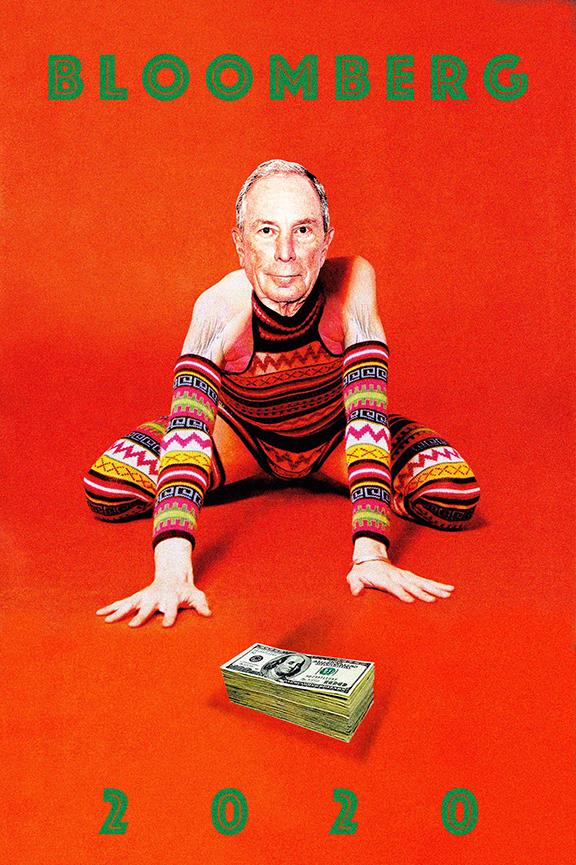
It Would Be Hard To Imagine A President As Entitled And Self-Centered As Trump... But Think About Republican Oligarch Michael Bloomberg

>


Julia Carrie Wong, reporting for The Guardian-- $45 Million in 90 days: How Bloomberg Bought Your Facebook Feed-- wrote that "In the first six weeks of 2020, more than 1.6 billion of the 2.4 billion presidential campaign ads shown to U.S. Facebook users were from the Bloomberg campaign. Since launching his campaign in mid-November, the former mayor of New York City has spent nearly $45m on Facebook ads-- more than all his opponents combined. And Bloomberg’s spending doesn’t just dwarf that of other Democrats; Donald Trump’s giant re-election effort on Facebook looks paltry in comparison.”


Bloomberg is also blanketing the TV and radio airwaves-- especially in deep red SuperTuesday states like Tennessee, Arkansas, Oklahoma and Alabama where the other Democrats are spending nothing. He has also been pestering YouTube and Google users with another $40 million in annoying pop-up ads and paying Instagram "mini-influencers for Mini-Mike" to put up "well-lit" photos of himself with campaign-approved messaging. That debate performance killed his momentum on the spot. He's now behind Biden for the conservative lane and, by his own logic, should drop out and help rally conservative Democrats around Status Quo Joe. But no one things his ego-driven campaign would consider doing anything like that. Note that after the debate the two progressive in the race gained 4 points while the 4 conservatives lost a total of 5 points.


Tomorrow, Bernie will be the featured guest on 60 Minutes. In a teaser CBS put out yesterday, Anderson Cooper asked him about Bloomberg's debacle debate in Vegas this week:


In that debate, Elizabeth Warren pulverized Bloomberg on several fronts, one of which was his Trump-like non-disclosure agreements he signed with women he molested after paying them off to keep quiet. At a CNN town hall Wednesday Warren rubbed it in, saying "I used to teach contract law. And I thought I would make this easy. I wrote up a release and covenant not to sue. And all that Mayor Bloomberg has to do is download it. I’ll text it. Sign it. And then the women, or men, will be free to speak and tell their own stories." Her "or men" is a reference to the fact that Bloomberg is a closet case who has also molested young men and shut them up with pay-offs as well. Can you imagine what Trump would do with that information?

On Thursday, NYC-based journalist Alison Rose Levy, writing for TruthDig, took on the DNC's disaster-in-the-making decision to align with the Republican oligarch, a political opportunist with an open checkbook. And this despite (???) Bloomberg's years-long battle to help elect Republicans. "Bloomberg," she noted, "calls himself an environmentalist while investing in fracking, championing it politically (as he did at this week’s Democratic presidential debate), and donating to a notorious green-washing environmental organization, the Environmental Defense Fund, in an ongoing but doomed effort to make fracking safe."
“Michael Bloomberg is often sold to people as a climate hero. Headlines that tout him as a green visionary adorn the pages of The New Yorker and Vanity Fair. He skips across the globe as the UN’s special envoy for climate action,” Derek Seidman wrote in Eyes on the Ties. “Bloomberg’s framing of fracking as the practical, common-sense option is a big obstacle to more far-reaching measures needed to curb carbon emissions now.”

At this week’s Democratic presidential debate in Las Vegas, Bloomberg reiterated his support for fracking, dismissing the Sanders-backed Green New Deal. Bloomberg also opposes plans to transition to renewables within the time frame dictated by reports issued by the United Nations’ Intergovernmental Panel on Climate Change.

Bloomberg’s support for both fossil fuels and Republicans may be connected. Consider this useful research provided by Alex Kotch of the Center for Media and Democracy:
Over the last decade, Bloomberg helped Republicans take and maintain control of the U.S. Senate, which, in the Trump era and under Mitch McConnell’s (R-KY) leadership, has confirmed scores of right-wing judges, blocked liberal legislation passed by the House, and shielded the president from any repercussions after seeking foreign election assistance, tampering with witnesses and defying congressional subpoenas.
For several decades up to and through 2018, Bloomberg, whose own party affiliation has changed repeatedly, “donated over $900,000 directly to Republican candidates’ campaigns, national GOP party committees and federal PACs of state Republican Party committees,” Kotch reported. Bloomberg added millions more through his two super PACs, one of which spent over $10 million “supporting Republican federal candidates from 2012-16.”

In what the Philadelphia Inquirer called a “pivotal” 2016 campaign that “many thought could decide control of the Senate,” Bloomberg “poured millions of dollars into the contest-- to help Pennsylvania Republican Sen. Pat Toomey” gain reelection. Bloomberg’s $5.9 million donation, used to buy television ads in key Philadelphia suburbs, portrayed the pro-fracking Republican as a moderate centrist, helping him win by a narrow margin over Democrat Katie McGinty, an environmental policy expert.

A Bloomberg spokesperson now claims the billionaire’s support for Toomey was based on the latter’s stance on gun control, even though Toomey’s challenger McGinty “supported far stronger gun measures, including bans on assault-style weapons.”

Raising further questions as to Bloomberg’s actual agenda in pushing Toomey, McGinty campaign adviser Mike Mikus noted that with the Senate secured by Republicans, no gun bills “would see any light as long as [McConnell] controlled the chamber. The Senate was up for grabs, and [Bloomberg] clearly sided with Mitch McConnell.”

Whatever his purported motive in helping Toomey, Bloomberg spent considerable funds to reelect a fracking apologist who represented the environmentally devastated swing state of Pennsylvania, the second most important natural gas state after Texas. Fracking may represent a boon to investor-donors like Bloomberg and their vested politicians, but the practice poses a clear health hazard to Pennsylvania communities as well as climate hazards to the global community. A recent review of scientific literature found close correlations between “health impacts including cancer, infant mortality, depression, pneumonia, asthma, skin-related hospitalizations and other general health symptoms” and “living near unconventional oil and gas development [in] Pennsylvania.”


In November 2019, Toomey introduced federal legislation to unilaterally prevent future presidents from introducing a moratorium on fracking. The Pike County Courier reported that the measure squarely aims “at several Democratic presidential candidates” by thwarting their potential moves with regard to introducing fracking regulations.

Bloomberg’s intervention-- supporting a pro-fracking senator and keeping the Senate under Republican-control-- unleashed other serious consequences. One related outcome of that Senate race is that in preserving GOP control, the Senate was able to see through Brett Kavanaugh’s Supreme Court nomination. In Justice Kavanaugh, the nation’s top court gained an anti-choice ideologue who had faced credible charges of sexual predation.

The problematic aspect of Bloomberg’s personal history vis-s-vis allegations of his own sexist remarks and actions was discussed at Wednesday night’s Democratic presidential debate. After being energetically challenged on the debate stage by Democratic rival Sen. Elizabeth Warren, Bloomberg explained that he had needed to sign non-disclosure agreements with several women in his professional milieu who he claimed were offended because “they did not like a joke I told.”

Goal Thermometer...The exploitation of people, earthly resources and money cannot be ignored or dismissed. Bloomberg now poses a new danger by using his largesse to act, in turns, as either a kingmaker or candidate, thus threatening the nomination process and the will of American voters. Sanders, currently the clear Democratic front-runner, is the sole candidate who has pledged to rely only on donations from citizens rather than from the billionaires who fund nearly all the other candidates.

Through the campaign this year, Sanders has helped Americans to grasp what has been apparent but long denied: Billionaires like Bloomberg have been controlling the country, decimating the middle class, putting health care out of reach and destroying the environment for profit. Democrats can’t afford to anoint a candidate who uses his money and influence to rob them of their futures.

Labels: , , ,