"When fascism comes to America, it will be wrapped in the flag and carrying the cross."
-- Sinclair Lewis
Saturday, September 28, 2019
We Have A Traitor In The White House... And Then There's The NRA, A Russian Front Operation!
>
In the interview above on CNN, you can watch Carl Bernstein explaining why Trump is "unravelling both factually and also temperamentally... [Trump] recognizes that there is, in this whistleblower's documents terrible evidence of the president's corruption, of his willingness to undermine the free electoral system in this country, to involve foreign powers in our election..." The Washington Post reported that over 300 former national security and foreign policy officials have signed a statement warning that President Trump’s actions regarding Ukraine are a profound national security concern. They served both Democratic and Republican administrations and all support an impeachment inquiry by Congress to determine the facts. "To be clear, we do not wish to prejudge the totality of the facts or Congress' deliberative process. At the same time, there is no escaping that what we already know is serious enough to merit impeachment proceedings." Trump may have changed his endless screeches of "No Collusion! No Collusion!" to "No Pressure! No Pressure!" but his NRA allies are drowning in collusion, as Mark Maremont and Julie Bykowicz of the Wall Street Journal pointed out yesterday. First off, the NRA "paid for lodging and travel of Russian nationals throughout 2015 and 2016, as part of a relationship that allowed foreign actors looking to influence the U.S. election, including now-convicted Maria Butina, to infiltrate the gun-rights group." Secondly, "NRA leaders traveled to Moscow in December 2015 partly on the NRA’s dime, even though some went there to pursue their own personal business opportunities. This raises questions... about whether they violated laws on how nonprofit funds can be used. The trip to Moscow gave Russians an opening to the organization as the election was ramping up, as well as access to other events involving Republican party leaders." All this comes from a well-documented, 76-page report published by Senate Finance Committee Democrats, led by Ron Wyden (D-OR).
Looking At Gun Legislation by Nancy Ohanian
The Democrats’ report also documents a parallel effort by then-Russian Ambassador Sergei Kislyak to build relationships with NRA officers. It says the NRA delegation in Moscow met with more senior officials than previously known, including multiple oligarchs close to President Vladimir Putin, two sanctioned individuals, and a person Ms. Butina claimed was Mr. Putin’s campaign manager. Ms. Butina, a Russian gun enthusiast, was sentenced to prison in April after pleading guilty to conspiring to influence U.S. politics. She and a Russian official named Alexander Torshin helped organize the 2015 Moscow trip and developed close relationships with NRA leaders, the report says. As a nonprofit organization, the NRA is not supposed to use its funds for insiders’ personal benefit. The NRA already is being buffeted by allegations of spending abuses and cozy vendor dealings that have benefited CEO Wayne LaPierre and other top officials or their family members. The Moscow travel “was an official trip undertaken so NRA insiders could get rich-- a clear violation of the principle that tax-exempt resources should not be used for personal benefit,” said Sen. Ron Wyden, of Oregon, one of the Democrats who has been probing the NRA’s ties to Moscow. The report calls on Congress to “explore options to reform tax-exempt laws to protect against foreign threats,” but it is unlikely to provoke any immediate legislative impact. Republicans hold a majority of Senate seats, and the party has expressed its continued support of the NRA and has shown little interest in tightening restrictions on tax-exempt organizations. The Democrats’ report includes new details about the relationship between the NRA and the Russian nationals, pushing back on the gun group’s early assertions that it was not working with them in an official way. The report documents formal communications with the Russian nationals and details how NRA funds ended up in a shell company set up by Ms. Butina to reimburse her for costs associated with the 2015 Moscow trip.
The gun group’s leaders introduced the Russian nationals to Republican Party leaders at its annual meetings and board meetings and helped them gain access to other conservatives at events such as the National Prayer Breakfast, the report says. “NRA resources appear to have been used to pay for membership and registration fees to third-party events for the Russian nationals as well as to arrange for transit to and lodging for many of those events throughout 2015 and 2016,” the report says. The report suggests at least somebody associated with the NRA had misgivings about Ms. Butina. After she was introduced to Donald Trump Jr. at the 2016 NRA annual meeting, this person texted the younger Mr. Trump: “I understand that someone introduced a Russian gal to you this week. I’ll fill you in this week but I would steer clear if she tries to reach out to you.” The previously undisclosed text message was provided by the NRA, the report says, adding that the group didn’t identify the sender or respond to other questions about the message. A spokesman for Donald Trump Jr. declined to comment. The new report digs into the origins of the December 2015 NRA trip to Moscow, and what happened afterward. Although the NRA has claimed the members who traveled to Russia were not authorized to do so in an official capacity, the Democrats’ report provides evidence to the contrary. The report says NRA then-President Allan Cors withdrew from the trip, but wrote Mr. Torshin, the Russian official, on his NRA letterhead designating others as representing “the NRA and our five million members.” After the Treasury Department cautioned then-NRA Vice President Pete Brownell against meeting with U.S.-sanctioned Russians while abroad, the compliance director of Mr. Brownell’s private company assured him such meetings would be permissible because “he planned to do so as part of a cultural exchange in his official capacity as a member of the NRA’s delegation.” Mr. Brownell agreed to go on the trip only because his gun-retail operation, Brownells Inc., had business interests in Russia, the report alleges. “I am not interested in attending if just an nra trip,” Mr. Brownell wrote his compliance director, saying the trip was “an opportunity to be hosted in Russia to broaden our business opportunities.” A representative of Mr. Brownell didn’t immediately respond to a request for comment. Mr. Brownell and Ms. Butina traveled around Russia together for three days to explore business opportunities before the rest of the NRA delegation arrived in Moscow, the report says. The Republican rebuttal says Mr. Brownell’s dual-purpose trip “appears to be entirely normal behavior for a CEO of a major firearms retailer, as the facts show Mr. Brownell started his December 2015 trip to Russia for this personal-professional purpose and then concluded it with an NRA-focused goodwill purpose.” Mr. Brownell initially picked up some of the trip costs, including a $6,000 payment to Ms. Butina’s shell company, and shortly afterward was reimbursed by the NRA, the report says. When the trip came under scrutiny in early 2018, Mr. Brownell repaid $17,000 to the NRA as a way of “getting the trip off the NRA’s books,” Mr. Brownell’s counsel told investigators.
Barbara Lee is ready for impeachment proceedings to begin.Thursday, she told her constituents that "The Trump administration’s corrupt behavior surrounding the Mueller report has been startling to say the least. Both Trump and his right-wing surrogates have pushed blatant lies, twisting the truth in a thinly-veiled cover-up. After a nearly two-year long investigation into the Trump campaign’s criminal behavior, Special Counsel Robert Mueller made it clear: 'If we had confidence that the president clearly did not commit a crime, we would have said so.' This is a big deal. After two years' worth of extensive interviews, intense background checks, and multiple convictions of Trump’s closest allies, Mueller could not clear Trump of any wrongdoing. And just last night, Trump admitted he would use dirt on political rivals from foreign governments. That’s right, Trump just welcomed foreign governments to interfere in our elections-- again... Mueller and his report gave the House everything we need to start impeachment proceedings." Jonathan Chait's headline was a provocative Trump Goes on TV to Solicit 2020 Foreign Collusion. "Trump," he wrote, "continues to show every sign of hoping and expecting to benefit from foreign collusion in 2020. In May, he intended to send Rudy Giuliani to Ukraine to pressure the government to supply dirt on Joe Biden. He and his ally, Mitch McConnell, are blocking measures (including ones with bipartisan support) to help safeguard elections against foreign attacks and social-media propaganda. His message to Russia, or any other government that wants a close relationship with him, is obvious: Do anything you can to help me win. Trump also said the whole Republican caucus takes foreign dirt on their opponents. "When you go and talk, honestly, to congressmen, they all do it, they always have, and that’s the way it is. It’s called oppo research." That has made-- this whole controversy has made-- Republicans on Capitol Hill very nervous. McCarthy is trying, absurdly, to blame it all on Adam Schiff! Less sleazy Republicans than McCarthy-- pretty much meaning any other Republican-- are taking this more seriously. Tom Cole (R-OK): "I don’t think it’s appropriate to ever do anything like that and I think you have an obligation to pick up the phone and call the FBI if we know this is from a foreign government. I am just worried about the general carelessness of that remark. I don’t think that’s going to sit well with most Americans. It shouldn’t. It’s just not an appropriate way to behave in a political campaign." Mike McCaul, one of the most vulnerable Republicans being targeted for political extinction is 2020, said "I wouldn’t accept it,” said Rep. Michael McCaul (R-TX), adding, “I don’t trust Russians." Mike Siegel, the progressive Democrat who nearly defeated McCaul in 2018-- with no help from the DCCC-- is going to finish the job next year. He noted that "McCaul's refusal to criticize the President, even when Trump flouts the rule of law and undermines the foundations of our democracy, is unfortunately par for the course. If McCaul and his Republican buddies would use their power to keep the President in line-- instead of occasionally distancing themselves through ineffectual comments-- we would not be in the position we are in now. Instead, we have an out-of-control President, openly courting foreign interference in our elections. Again."
On Tuesday, Trump gave us direct evidence of his contempt toward the most foundational precept of our democracy-- that no person, not even the president, is above the law. He filed a brief in the nation’s second-most-important court that takes the position that Congress cannot investigate the president, except possibly in impeachment proceedings. It’s a spectacularly anti-constitutional brief, and anyone who harbors such attitudes toward our Constitution’s architecture is not fit for office. Trump’s brief is nothing if not an invitation to commencing impeachment proceedings that, for reasons set out in the Mueller report, should have already commenced. The case involves a House committee’s efforts to follow up on the testimony of Trump’s now-incarcerated former attorney, Michael Cohen, that Trump had allegedly committed financial and tax fraud, and allegedly paid off paramours in violation of campaign finance laws. The House Committee on Oversight and Reform subpoenaed Trump’s accountants in mid-April for relevant documents, and Trump tried to block the move, only to be sternly rebuked in mid-May by a federal judge in Washington. The appeals brief filed Monday by Trump attacks that decision. But to describe Trump’s brief is to refute it. He argues that Congress is “trying to prove that the President broke the law” and that that’s something Congress can’t do, because it’s “an exercise of law enforcement authority that the Constitution reserves to the executive branch.” But in fact, Congress investigates lawbreaking, and potential lawbreaking, all the time. Mobsters, fraudsters, government employees, small companies, big companies-- like it or not, all types of people and businesses get subpoenaed from time to time so that Congress can figure out whether current laws are effective, whether new laws are needed, whether sufficient governmental resources are being devoted to the task, whether more disclosure to the government or the public is required, or greater penalties, and so on. To this, Trump’s brief complains that “Congress could always make this (non-falsifiable) argument” to justify any investigation. But that’s simply the result of the fact that, as the district court explained, Congress’s “power to investigate is deeply rooted in the nation’s history.” Congress, relying on English parliamentary tradition, has performed this function since the founding. To accept Trump’s argument to the contrary-- to say Congress can’t look into matters that might involve crimes-- would in many cases gut Congress’s ability to gain information it needs to legislate. And perversely, in Trump’s case, it makes a virtue of the fact that he has been accused of committing crimes. Which brings us to the main point: England’s King George III was above the law, but the founders of our republic wanted a system that would divide power and have the branches check one another. The idea that only the president can investigate the president is an argument for autocrats, not Americans. Trump says “trust me,” but that was exactly the argument the founders rebelled against. They knew that public officials would not always be angels, and that power had to be checked and dispersed. As James Madison put it in Federalist No. 51, “It may be a reflection on human nature, that such devices should be necessary to control the abuses of government.” The only redeeming quality of Trump’s legal brief is its seeming, grudging acknowledgment that Congress’s powers might be greater in an impeachment proceeding. That has things only half-right. Yes, Congress could investigate Trump’s finances in an impeachment proceeding, but it can do so without launching the formal process of impeachment. That said, Trump’s brief can be construed as an invitation to commence impeachment proceedings. In those proceedings, Trump’s attitudes toward our Constitution’s checks and balances, in addition to evidence of obstruction of justice, must play a key role. Indeed, the third article of impeachment against President Richard M. Nixon, adopted by the House Judiciary Committee in 1974, charged him with defying lawful subpoenas issued by the House Judiciary Committee. Not only has Trump done that, but he has also demonized judges who disagree with him and insulted the press (despite its constitutional status) for calling him to account. Other leaders around the world may behave this way, but these are not proper actions of a president of the United States. What makes the United States exceptional is its commitment to its constitutional architecture, particularly divided powers. For the past three decades, many constitutional law classes have begun with Nixon’s breathtaking statement to David Frost in May 1977: “Well, when the president does it, that means that it is not illegal.” Generations of students have gasped, shocked that a former president could say such a thing. This time, it’s not a former president but a sitting one. Every principle behind the rule of law requires the commencement of a process now to make this president a former one.
As the morning crew at Politico pointed out, Trump handed those who want to impeach him a gift. "far be it for us to divine why the president said this," they wrote, "and what exactly is going through his head. But the people we spoke to Wednesday night said it is rooted in a win-at-any-and-all-costs mentality -- a life-is-complicated vibe that tries to paint everyone else as rubes, and yet ignores the guts of American law. Furthermore, it reflects his thinking that he hates the idea the 2016 election was stolen from him, so he tries to rationalize the very things he and his campaign stand accused of doing. In our time covering Congress-- going back a decade-- we’ve never heard anyone ever even privately say they would accept foreign assistance in an election. Ever. And a lot of members have said crazy stuff to us privately!... If you are a Republican or a Democrat and you'd like to defend the president here, drop us a line. OK... how about a floor objection from Trump puppet Marsha Blackburn? Pelosi's comment was some bullshit about what a bad boy Trump is but said Democrats are "no closer" to impeaching him. At Bloomberg News, Jonathan Bernstein wrote that Trump's Awful Comments Need a Real Response. He wants Republicans to take a stand, reminding his readers that Senor Trumpanzee supplied "a helpful reminder on Wednesday that he’s entirely unfit for the office he holds by once again welcoming foreign interference in U.S. elections... How bad is all this? Most of the comments I’ve seen condemning Trump’s remarks-- none, I should note, from Republicans in Congress, although perhaps I missed some-- treat it as grievous misbehavior for a political candidate. True enough. But it’s considerably worse coming from a sitting president. Trump’s obligations in office extend far beyond following campaign laws. He’s the country’s commander in chief and top diplomat, and as such responsible for making clear to all foreign nations and other groups that messing with the internal affairs of the United States will have serious consequences. Instead, he’s basically inviting everyone in."
As the political scientist Jennifer Victor says: “Democracy happens when people use a legitimate process to select leaders from among its citizens. If people from another country influence the selection of leaders, the sovereignty of the democracy is eroded. If foreigners affect an election, the results are comprised.” The flip side is that the U.S. government is supposed to conduct foreign policy on behalf of the nation, not on behalf of the personal interests-- political and private-- of the president. So what should happen now? For one thing, it would be helpful for Wray to speak up and explain why Trump is wrong. If he doesn’t do so on his own, perhaps the House Judiciary Committee could invite him to explain it to them. This would be an appropriate time, too, for former President George W. Bush to say something. (Whatever one thinks of Bush’s terms in office, it’s hard to imagine him inviting a foreign nation to disrupt our elections.) The same for any former FBI directors, secretaries of defense and state, and other heavyweights, especially Republicans. But we all know the truth: This is really on the current Republicans who could do something about it. That includes the people at Fox News and other Republican-aligned media, who don’t actually have to pretend that encouraging foreign nations to influence U.S. elections is exemplary behavior for a president. And it includes Senate Majority Leader Mitch McConnell and other congressional Republicans, who have the ability to put an end to this if they want. As long as they’re all willing to join Trump in this kind of despicable behavior, there’s no reason to expect him to stop.
Notice, in the video, how agitated Trump got at the mention of the FBI chief-- the one he hand-picked as head of the FBI? According to reporting from Darren Samuelsohn and Natasha Bertrand yesterday, Trump's willingness to accept foreign assistance has essentially invited overseas spies to meddle with 2020 presidential campaigns, undoing months of work. They wrote that "Nearly two years ago, FBI Director Chris Wray set up an office tasked solely with stopping the type of Russian interference efforts that infected the 2016 campaign. On Wednesday night, President Donald Trump undercut the whole operation in a matter of seconds... America’s enemies will see Trump’s comments and likely 'come out of the woodwork like never before to try to influence the president,' said longtime FBI veteran Frank Figliuzzi, who served as the bureau’s assistant director for counterintelligence until 2012. 'And it’s going to be more difficult to defend against because they’ll try harder than ever to mask their attempts.'"
Barr Will Never Release Anything Showing Trump Is Guilty In The Putin-Gate Scandal
>
Señor Trumpanzee was throwing his bananas and toys around the White House Thursday morning screaming like a madman. Finally his keeper gave him back his cell and he calmed down enough to direct his rage at the New York Times, Bob Mueller and the Democrats. It was inevitable that eventually it would start leaking out that the Mueller Report very much does let the country know just how criminal and complicit he has always been.
And that The Times tweeted right back in his face, may have caused him to throw his phone at a wall and break it. Who knows... all we do know for sure is that he stopped his twitter rampage right after this:
The original Times story by Nicholas Fandos, Michael S. Schmidt and Mark Mazzetti hit like the proverbial bombshell Wednesday evening during the primetime cable news shows. "Some of Robert S. Mueller III’s investigators," they wrote, "have told associates that Attorney General William P. Barr failed to adequately portray the findings of their inquiry and that they were more troubling for President Trump than Mr. Barr indicated, according to government officials and others familiar with their simmering frustrations... Some members of Mr. Mueller’s team are concerned that, because Mr. Barr created the first narrative of the special counsel’s findings, Americans’ views will have hardened before the investigation’s conclusions become public... The special counsel’s investigators had already written multiple summaries of the report," summaries which Barr purposefully did not release to the public-- or even to Congress. Barr is determined not to release anything that is in any way detrimental to Trump or his family members.
Though it was not clear what findings the special counsel’s investigators viewed as troubling for the president, Mr. Barr has suggested that Mr. Mueller may have found evidence of malfeasance in investigating possible obstruction of justice. “The report sets out evidence on both sides of the question,” Mr. Barr wrote in his March 24 letter. Mr. Mueller examined Mr. Trump’s attempts to maintain control over the investigation, including his firing of Mr. Comey and his attempt to oust Mr. Mueller and Attorney General Jeff Sessions to install a loyalist to oversee the inquiry. ...Trump has fully embraced Mr. Barr’s version of events. For days, he has pronounced the outcome of the investigation a “complete and total exoneration” and called for the Justice Department and his allies on Capitol Hill to investigate and hold accountable those responsible for opening the inquiry.
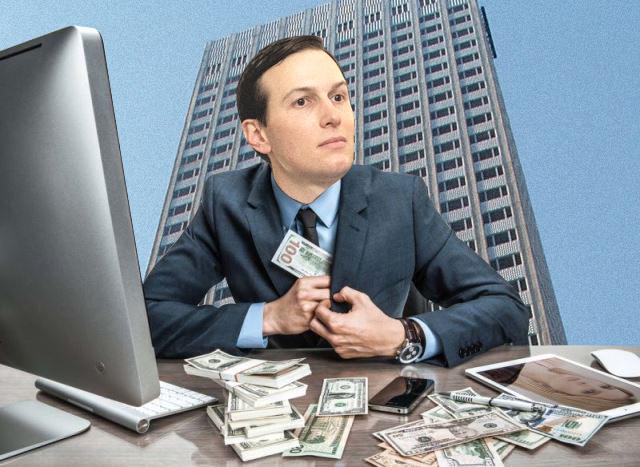
Traitor Jared... embezzlement
Yesterday the Department of Justice asserted that there were NO pages in the Mueller report that didn't possibly contain information that could not be publicly release. The threats of redaction are sobering and Barr will apparently do everything he can to protect Trump and his spawn. Jerry Nadler was on CNN yesterday and said wants to know why the prepared summaries weren't released instead of Barr's press release that was meant to mislead people into thinking the report cleared Trump. Nadler said "I think it's inevitable that Mueller is going to testify at some point, but the first thing we need is the release of the report and the documents."
As you know, every House Republican joined every House Democrat to call for the release of the full Mueller Report to the public-- very much what the public is demanding. Yesterday though-- and for the 5th time-- the Kentucky Senate tag team blocked the resolution that passed the House from being voted on in the Senate. This time it was Rand Paul instead of McTurtle. Paul says he'll unblock it snd allow a vote if and only if he can add an amendment calling for the release of communications between Obama-era intelligence officials that he says could shed light on potential "misuse of power" leading up to the launch of the Trump-Russia investigation.
Meanwhile let's not forget... Trump, gaslighting America... bigly:
The Mueller Report: Time For Jerry Nadler To Get Busy
>
If Trump and his family of grifters were innocent, they would have already put the full report out. Instead, all there is is an interpretation of the report from someone who was hand-picked by Trump for this purpose only. If you haven't already, you can read Barr's bogus interpretation of the report here.
As Richard Hasen offered earlier today in his Slate column, "Barr’s decision to release a summary of the twin Robert Mueller conclusions in the special prosecutor’s still-secret report-- no collusion between the Russian government and the Trump campaign and Mueller’s punt on whether Trump obstructed justice-- leaves open many questions that cannot be answered until the Department of Justice releases the report itself. At the top of my list of unanswered questions is why Mueller declined to prosecute former Trump campaign manager Paul Manafort or Trump’s son Donald Trump Jr. for violating laws prohibiting the solicitation of foreign contributions to American campaigns, based on those campaign surrogates’ June 2016 meeting with Russian agents at Trump Tower. How Mueller answered this question could have profound ramifications for what federal law enforcement will do to stop foreign involvement in the upcoming 2020 elections... It sure looked like at least Trump Jr. and perhaps others at that meeting committed a crime. Federal law makes it a potential crime for any person to 'solicit' (that is, expressly or impliedly ask for) the contribution of 'anything of value' from a foreign citizen." David Frum's tongue-- or pen-- was sharper this afternoon, asking why Muller didn't answer the question "Are Americans comfortable with this president in the White House, now that they know he broke no prosecutable criminal statutes on his way into high office?"
Frum's assertions are very different from the coordinated messaging-- a national demonstration of gas-lighting perfected-- from the GOP blanketing the airwaves today. "Russia," Frum wrote to America, "helped install your president. But although he owes his job in large part to that help, the president did not conspire or collude with his helpers. He was the beneficiary of a foreign intelligence operation, but not an active participant in that operation. He received the stolen goods, but he did not conspire with the thieves in advance. This is what Donald Trump’s administration and its enablers in Congress and the media are already calling exoneration. But it offers no reassurance to Americans who cherish the independence and integrity of their political process."
The question unanswered by the attorney general’s summary of Special Counsel Robert Mueller’s report is: Why? Russian President Vladimir Putin took an extreme risk by interfering in the 2016 election as he did. Had Hillary Clinton won the presidency-- the most likely outcome-- Russia would have been exposed to fierce retaliation by a powerful adversary. The prize of a Trump presidency must have glittered alluringly, indeed, to Putin and his associates. Why? Did they admire Trump’s anti-NATO, anti–European Union, anti-ally, pro–Bashar al-Assad, pro-Putin ideology? Were they attracted by his contempt for the rule of law and dislike of democracy? Did they hold compromising information about him, financial or otherwise? Were there business dealings in the past, present, or future? Or were they simply attracted by Trump’s general ignorance and incompetence, seeing him as a kind of wrecking ball to be smashed into the U.S. government and U.S. foreign policy? Many public-spirited people have counted on Mueller to investigate these questions, too, along with the narrowly criminal questions in his assignment. Perhaps he did, perhaps he did not; we will know soon, either way. But those questions have always been the important topics. The Trump presidency from the start has presented a national-security challenge first, a challenge to U.S. public integrity next. But in this hyper-legalistic society, those vital inquiries got diverted early into a law-enforcement matter. That was always a mistake, as I’ve been arguing for two years. Now the job returns to the place it has always belonged and never should have left: Congress. This is all the more the case since the elections of 2018 restored independence to that body. The 2016 election was altered by Putin’s intervention, and a finding that the Trump campaign only went along for the ride does not rehabilitate the democratic or patriotic legitimacy of the Trump presidency. Trump remains a president rejected by more Americans than those who voted for him, who holds his job because a foreign power violated American laws and sovereignty. It’s up to Congress to deal with this threat to American self-rule.
Author-- Compelling People: The Hidden Qualities That Make Us Influential-- and former DNC Communications director John Neffinger told me that he's "open to the idea that there was not enough evidence to establish criminal conspiracy (at the very least in the same way that DOJ said that with a straight face about Wall St executives during the financial crisis), "COLLUSION!!" is not a legal term, though, and "no collusion" is misleading at the very best." "Barr's obstruction of justice finding," he pointed out, "is pure CYA gaslighting. All sentient people know Trump obstructed justice 8 ways to Sunday-- including by firing Comey and replacing Sessions with Whitaker and then Barr. Mueller seems to have assembled evidence and chosen not to declare a finding. Barr declaring a finding of no obstruction is worth something politically to Trump for sure, but it's not up to the AG to prosecute and it's not binding on Congress. It is a smart part of a good PR rollout, nice lipstick for this gigantic pig. The game for them now is to convince everybody it's over and done and anyone talking about about Trump doing anything wrong is just a Sore Loserman before anybody gets to see Mueller's actual findings. We need the report as soon as possible, and to retell the bigger story in the meantime."
He said he doesn't think Democrats should concede that and that they "should demand to see this report that 'does not exonerate' Trump. Recall that the Trump team held dozens of secret meetings with Russian agents when they knew (before the public knew) that Russia was in the process of breaking US law to help them win. They may well not have materially assisted with the Russian operation, but during the campaign they strongly encouraged it by consistently signaling they supported changing US policy to benefit Putin. And then once Trump won, he took extraordinary steps to move in that direction before the publicity around all of this spooked the GOP (who may or may not have Russian money in their campaign coffers) and shut them down. To believe there was no collusion, you have to believe they arranged all of those secret contacts just to talk about the weather, or Emin Agalarov's music career." Neffinger predicts that what comes next is not good. "Trump knows he can be indicted (for Stormy at least) when out of office, and knows he's not going to be impeached (or removed at least) while in office, and he will feel more unleashed than ever. Part of that relates to 2020 directly. Word is Russia already is interfering with our elections, and Trump will be holding the door for them wider this time. So just like in 2016, the Democratic candidate will be running not only against the GOP, but against the Russian military-intelligence apparatus. Plenty of people are arguing about the political damage, and the argument itself will determine that. But if you're tallying up what this effort accomplished, aside from the indictment/conviction/sentencing count, don't forget: The continued focus here has kept the pressure up and kept the Magnitsky sanctions in place, keeping Russia turning the Arctic into a vast oilfield and jacking up global warming a few extra degrees. It led to Cohen's office raid, which produced clear evidence of an impeachable and/or later indictable crime in the Stormy payoff, plus potentially more investigations we don't know about yet. And it put the once considerable doubt around whether Russia ran an enormous influence operation in 2016 to rest."
UPDATE: Political Ramifications Think Trump is overplaying his hand? This just is more Trumpian bullshit:
According to the GOP president release (Barr's 4 page "summary"), Mueller "did not find that the Trump campaign or anyone associated with it conspired or coordinated with Russia in its efforts to influence the 2016 U.S. presidential election." I'll believe that when I read the full report and hear Mueller's sworn, public testimony. Even the GOP press release admitted that Mueller "did not draw a conclusion" about Trump's obstruction justice all during the investigation, but "it also does not exonerate him." Mueller left it to Barr to decide if Trump should be charged. That doesn't sound like anything close to an exoneration to me. Barr, whose was hired by Trump just for this moment, contends that "the evidence developed during the Special Counsel's investigation is not sufficient to establish that the President committed an obstruction-of-justice offense."
I suspect this will fire up Democrats for 2020. As I've always believed, the only way to get rid of Trump is at the ballot box. Pelosi's not going to impeach him, especially not now. Suggestion: support Bernie Sanders, not a pale imitation of him-- and, for that matter, not a pale imitation of a Republican.
Cleaning Up After Trump Is Going To Be A Full-Time Job-- He Really Does Need To Be Impeached So America Can Move Forward
>
Today's NY Times exposé by Mark Mazzetti, Maggie Haberman, Nicholas Fandos and Michael Schmidt would be the most shocking thing to read about a White House occupant at any time in history... before 2016. Intimidation, Pressure and Humiliation: Inside Trump’s Two-Year War on the Investigations Encircling Him reads like a crime thriller or a spy thriller. It's way too long for Trump to read or to even have it read to him. Will someone in the White House do a coloring book version? Will Ivanka condense it down to half a page? There are pictures... and a chart. Actually I'm going to try to do that for Ivanka since I'm sure she's busy with... whatever she does. Matthew Whitaker, who has privately told associates that part of his role at the Justice Department was to "jump on a grenade" for Señor Trumpanzee, said he wouldn't be able to grant his boss' wish of putting one of his cronies Geoffrey Berman, the US Attorney for the Southern District of NY, in charge of the escalating investigation of all (criminal) things Trump. So... Trump quickly "soured on Mr. Whitaker, as he often does with his aides, and complained about his inability to pull levers at the Justice Department that could make the president’s many legal problems go away." Another in a long list of Trumpy-the-Clown attempts to obstruct justice thwarted! The Times team makes the point that Trump’s very public war against the Putin-Gate investigation has been almost normalized, "Trump," they wrote "rages almost daily to his 58 million Twitter followers that it's all a treasonous witch hunt against him. That's the public face. But there have been some less public aspects to Trump's attempts to obstruct justice as well-- the basis for this latest exposé, fusing strands that reveal "an extraordinary story of a president who has attacked the law enforcement apparatus of his own government like no other president in history, and who has turned the effort into an obsession."
It is a public relations strategy as much as a legal strategy-- a campaign to create a narrative of a president hounded by his “deep state” foes. The new Democratic majority in the House, and the prospect of a wave of investigations on Capitol Hill this year, will test whether the strategy shores up Mr. Trump’s political support or puts his presidency in greater peril. The president has spent much of his time venting publicly about there being “no collusion” with Russia before the 2016 election, which has diverted attention from a growing body of evidence that he has tried to impede the various investigations. ...It was Feb. 14, 2017, and Mr. Trump and his advisers were in the Oval Office debating how to explain the resignation of Michael T. Flynn, the national security adviser, the previous night. Mr. Flynn, who had been a top campaign adviser to Mr. Trump, was under investigation by the F.B.I. for his contacts with Russians and secret foreign lobbying efforts for Turkey. The Justice Department had already raised questions that Mr. Flynn might be subject to blackmail by the Russians for misleading White House officials about the Russian contacts, and inside the White House there was a palpable fear that the Russia investigation could consume the early months of a new administration. As the group in the Oval Office talked, one of Mr. Trump’s advisers mentioned in passing what Paul D. Ryan of Wisconsin, then the speaker of the House, had told reporters-- that Mr. Trump had asked Mr. Flynn to resign. It was unclear where Mr. Ryan had gotten that information, but Mr. Trump seized on Mr. Ryan’s words. “That sounds better,” the president said, according to people with knowledge of the discussions. Mr. Trump turned to the White House press secretary at the time, Sean Spicer, who was preparing to brief the news media. “Say that,” Mr. Trump ordered. But was that true, Mr. Spicer pressed. “Say that I asked for his resignation,” Mr. Trump repeated. The president appeared to have little concern about what he told the public about Mr. Flynn’s departure, and he quickly warmed to the new narrative. The episode was among the first of multiple ham-handed efforts by the president to carry out a dual strategy: publicly casting the Russia story as an overblown hoax and privately trying to contain the investigation’s reach. “This Russia thing is all over now because I fired Flynn,” Mr. Trump said over lunch that day, according to a new book by Chris Christie, a former New Jersey governor and a longtime Trump ally. Mr. Christie was taken aback. “This Russia thing is far from over,” Mr. Christie wrote that he told Mr. Trump, who responded: “What do you mean? Flynn met with the Russians. That was the problem. I fired Flynn. It’s over.”
Jared Kushner, the president’s son-in-law and senior adviser, who was also at the lunch, chimed in, according to Mr. Christie’s book: “That’s right, firing Flynn ends the whole Russia thing.” As Mr. Trump was lunching with Mr. Christie, lawyers in the White House Counsel’s Office met with Mr. Spicer about what he should say from the White House podium about what was a sensitive national security investigation. But when Mr. Spicer’s briefing began, the lawyers started hearing numerous misstatements-- some bigger than others-- and ended up compiling them all in a memo. The lawyers’ main concern was that Mr. Spicer overstated how exhaustively the White House had investigated Mr. Flynn and that he said, wrongly, that administration lawyers had concluded there were no legal issues surrounding Mr. Flynn’s conduct. Mr. Spicer later told people he stuck to talking points that he was given by the counsel’s office, and that White House lawyers expressed concern only about how he had described the thoroughness of the internal inquiry into Mr. Flynn. The memo written by the lawyers said that Mr. Spicer was presented with a longer list of his misstatements. The White House never publicly corrected the record. Later that day, Mr. Trump confronted the F.B.I. director, James B. Comey, in the Oval Office. The president told him that Mr. Spicer had done a great job explaining how the White House had handled the firing. Then he asked Mr. Comey to end the F.B.I.’s investigation into Mr. Flynn, and that Mr. Flynn was a good guy. Mr. Comey responded, according to a memo he wrote at the time, that Mr. Flynn was indeed a good guy. But he said nothing about ending the F.B.I. investigation. By March, Mr. Trump was in a rage that his attorney general, Jeff Sessions, had recused himself from the Russia inquiry because investigators were looking into the campaign, of which Mr. Sessions had been a part. Mr. Trump was also growing increasingly frustrated with Mr. Comey, who refused to say publicly that the president was not under investigation.
Mr. Trump finally fired Mr. Comey in May. But the president and the White House gave conflicting accounts of their reasoning for the dismissal, which only served to exacerbate the president’s legal exposure. A week after the firing, the New York Times disclosed that the president had asked Mr. Comey to end the Flynn investigation. The next day, the deputy attorney general, Rod J. Rosenstein, appointed Mr. Mueller, a Republican, as special counsel. Instead of ending the Russia investigation by firing Mr. Comey, Mr. Trump had drastically raised the stakes. Mr. Mueller’s appointment fueled Mr. Trump’s anger and what became increasingly reckless behavior-- triggering a string of actions over the summer of 2017 that could end up as building blocks in a case by Congress that the president engaged in a broad effort to thwart the investigation. On Twitter and in news media interviews, Mr. Trump tried to pressure investigators and undermine the credibility of potential witnesses in the Mueller investigation. He directed much of his venom at Mr. Sessions, who had recused himself in March from overseeing the Russia investigation because of contacts he had during the election with Russia’s ambassador to the United States. The president humiliated Mr. Sessions at every turn, and stunned Washington when he said during an interview with The Times that he never would have named Mr. Sessions attorney general if he had known Mr. Sessions would step aside from the investigation.
...One of Mr. Trump’s lawyers also reached out that summer to the attorneys for two of his former aides-- Paul J. Manafort and Mr. Flynn-- to discuss possible pardons. The discussions raised questions about whether the president was willing to offer pardons to influence their decisions about whether to plead guilty and cooperate in the Mueller investigation. The president even tried to fire Mr. Mueller himself, a move that could have brought an end to the investigation. Just weeks after Mr. Mueller’s appointment, the president insisted that he ought to be fired because of perceived conflicts of interest. Mr. Trump’s White House counsel, Donald F. McGahn II, who would have been responsible for carrying out the order, refused and threatened to quit. The president eventually backed off.
Gaetz grabs a selfie with Trumpanzee
Sitting in the Delta Sky Lounge during a layover in Atlanta’s airport in July 2017, Representative Matt Gaetz, a first-term Republican from the Florida Panhandle, decided it was time to attack. Mr. Gaetz, then 35, believed that the president’s allies in Congress needed a coordinated strategy to fight back against an investigation they viewed as deeply unfair and politically biased. He called Representative Gym Jordan, a conservative Republican from Ohio, and told him the party needed “to go play offense,” Mr. Gaetz recalled in an interview. The two men believed that Republican leaders, who publicly praised the appointment of Mr. Mueller, had been beaten into a defensive crouch by the unending chaos and were leaving Democrats unchecked to “pistol whip” the president with constant accusations about his campaign and Russia. So they began to investigate the investigators. Mr. Trump and his lawyers enthusiastically encouraged the strategy, which, according to some polls, convinced many Americans that the country’s law enforcement apparatus was determined to bring down the president. Within days of their conversation, Mr. Gaetz and Mr. Jordan drafted a letter to Mr. Sessions and Mr. Rosenstein, the first call for the appointment of a second special counsel to essentially reinvestigate Hillary Clinton for her handling of her emails while secretary of state-- the case had ended in the summer of 2016-- as well as the origins of the F.B.I.’s investigation of Mr. Flynn and other Trump associates. The letter itself, with the signatures of only 20 House Republicans, gained little traction at first. But an important shift was underway: At a time when Mr. Trump’s lawyers were urging him to cooperate with Mr. Mueller and tone down his Twitter feed, the president’s fiercest allies in Congress and the conservative media were busy trying to flip the script on the federal law enforcement agencies and officials who began the inquiry into Mr. Trump’s campaign.
Gym Jordan and Trump, a match made in GOP Heaven
Mr. Gaetz and Mr. Jordan began huddling with like-minded Republicans, sometimes including Representative Mark Meadows, a press-savvy North Carolinian close to Mr. Trump, and Representative Devin Nunes of California, the head of the House Intelligence Committee. Mr. Nunes, the product of a dairy farming family in California’s Central Valley, had already emerged as one of Mr. Trump’s strongest allies in Congress. He worked closely with Mr. Flynn during the Trump transition after the 2016 election, and he had a history of battling the C.I.A. and other intelligence agencies, which he sometimes accused of coloring their analysis for partisan reasons. In the spring of 2017, he sought to bolster Mr. Trump’s false claim that President Barack Obama had ordered an illegal wiretap on Trump Tower. Using Congress’s oversight powers, the Republican lawmakers succeeded in doing what Mr. Trump could not realistically do on his own: forcing into the open some of the government’s most sensitive investigative files-- including secret wiretaps and the existence of an F.B.I. informant-- which were part of the Russia inquiry. House Republicans opened investigationsinto the F.B.I.’s handling of the Clinton email case and a debunked Obama-era uranium deal indirectly linked to Mrs. Clinton. The lawmakers got a big assist from the Justice Department, which gave them private text messages recovered from two senior F.B.I. officials who had been on the Russia case. The officials-- Peter Strzok and Lisa Page-- repeatedly criticized Mr. Trump in their texts, which were featured in a loop on Fox News and became a centerpiece of an evolving and powerful conservative narrative about a cabal inside the F.B.I. and Justice Department to take down Mr. Trump. The president cheered the lawmakers on Twitter, in interviews and in private, urging Mr. Gaetz on Air Force One in December 2017 and in subsequent phone calls to keep up the House Republicans’ oversight work. He was hoping for fair treatment from Mr. Mueller, Mr. Trump told Mr. Gaetz in one of the calls just after the congressman appeared on Fox News, but that did not preclude him from encouraging his allies’ scrutiny of the investigation. Later, when Mr. Nunes produced a memo alleging that the F.B.I. had abused its authority in spying on a former Trump campaign associate, Carter Page, Mr. Trump called Mr. Nunes a “Great American hero.”(The F.B.I. said it had “grave concerns” about the memo’s accuracy.)
The president became an active participant in the campaign. He repeatedly leaned on administration officials on behalf of the lawmakers-- urging Mr. Rosenstein and other law enforcement leaders to flout procedure and share sensitive materials about the ongoing case with Congress. As president, Mr. Trump has ultimate authority over information that passes through the government, but his interventions were unusual. By the spring of 2018, Mr. Nunes zeroed in on new targets. In one case, he threatened to hold Mr. Rosenstein in contempt of Congress or even try to impeach him if the documents he wanted were not turned over, including the file used to open the Russia case. In another, he pressed the Justice Department for sensitive information about a trusted F.B.I. informant used in the Russia investigation, a Cambridge professor named Stefan Halper-- even as intelligence officials said that the release of the information could damage relationships with important allies. ...Gaetz makes no apologies. “Do I think it’s right that our work in the Congress has aided in the president’s defense?” he asked, before answering his own question. “Yeah, I think it is right.” Ultimately, his strategy was successful in softening the ground for a shift in the president’s legal strategy-- away from relatively quiet cooperation with Mr. Mueller’s investigators and toward a targeted and relentless frontal attack on their credibility and impartiality. Last April, Mr. Trump hired Rudolph W. Giuliani, his longtime friend and a famously combative former mayor of New York, as his personal lawyer and ubiquitous television attack dog. A new war had begun. In jettisoning his previous legal team-- which had counseled that Mr. Trump should cooperate with the investigation-- the president decided to combine a legal strategy with a public-relations campaign in an aggressive effort to undermine the credibility of both Mr. Mueller and the Justice Department. Mr. Mueller was unlikely to indict Mr. Trump, the president’s advisers believed, so the real danger to his presidency was impeachment-- a political act that Congress would probably only carry out only with broad public support. If Mr. Mueller’s investigation could be discredited, then impeachment might be less likely. Months of caustic presidential tweets and fiery television interviews by Mr. Giuliani unfolded. The former mayor accused Mr. Mueller, without evidence, of bias and ignoring facts to carry out an anti-Trump agenda. He called one of Mr. Mueller’s top prosecutors, Andrew Weissmann, a “complete scoundrel.” Behind the scenes, Mr. Giuliani was getting help from a curious source: Kevin Downing, the lawyer for Paul Manafort, who had been the president’s 2016 campaign chairman. Mr. Manafort had agreed to cooperate with the special counsel after being convicted of financial crimes in an attempt to lessen a potentially lengthy prison sentence. Mr. Downing shared details about prosecutors’ lines of questioning, Mr. Giuliani admitted late last year. It was a highly unusual arrangement-- the lawyer for a cooperating witness providing valuable information to the president’s lawyer at a time when his client remained in the sights of the special counsel’s prosecutors. The arrangement angered Mr. Mueller’s investigators, who questioned what Mr. Manafort was trying to gain from the arrangement. The attacks on the Mueller investigation appeared to have an effect. Last summer, polling showeda 14-point uptick in the percentage of Americans polled who disapproved of how Mr. Mueller was handling the inquiry. “Mueller is now slightly more distrusted than trusted, and Trump is a little ahead of the game,” Mr. Giuliani said during an interview in August.
“So I think we’ve done really well,” Mr. Giuliani added. “And my client’s happy.” But Mr. Giuliani and his client had a serious problem, which they were slow to comprehend. In April the F.B.I. raided the Manhattan office and residences of Mr. Cohen-- the president’s lawyer and fixer-- walking off with business records, emails and other documents dating back years. At first, Mr. Trump wasn’t concerned. The president told advisers that Mr. Rosenstein assured him at the time that the Cohen investigation had nothing to do with him. In the president’s recounting, Mr. Rosenstein told him that the inquiry in New York was about Mr. Cohen’s business dealings, it did not involve the president and was not about Russia. Since then, Mr. Trump has asked his advisers if Mr. Rosenstein was deliberately misleading him to keep him calm. Mr. Giuliani initially portrayed Mr. Cohen as “honest,” and Mr. Trump praised him publicly. But Mr. Cohen soon told prosecutors in New York how Mr. Trump had ordered him during the 2016 campaign to buy the silence of women who claimed they had sex with the president. In a separate bid for leniency, Mr. Cohen told Mr. Mueller’s prosecutors about Mr. Trump’s participation in negotiations during the height of the presidential campaign to build a Trump Tower in Moscow. Mr. Trump was now battling twin investigations that seemed to be moving ever close to him. And Mr. Cohen, once the president’s fiercest defender, was becoming his chief tormentor. In a court appearance in August, Mr. Cohen pleaded guilty and told a judge that Mr. Trump had ordered him to arrange the payments to the women, Stormy Daniels and Karen McDougal. Mr. Cohen’s descriptions of the president’s actions made Mr. Trump, in effect, an unindicted co-conspirator and raised the prospect of the president being charged after he leaves office. Representative Jerrold Nadler, the New York Democrat who in January became the chairman of the House Judiciary Committee, which has jurisdiction over the matter, said the implied offense was probably impeachable. The president struck back, launching a volley of tweets that savaged Mr. Cohen and his family-- insinuating that Mr. Cohen’s father-in-law had engaged in unexamined criminal activity. He called Mr. Cohen a “rat.” The messages infuriated Democratic lawmakers, who claimed the president was trying to threaten and intimidate a witness ahead of testimony Mr. Cohen planned before Congress. “He’s only been threatened by the truth,” the president responded. As the prosecutors closed in, Mr. Trump felt a more urgent need to gain control of the investigation. He made the call to Mr. Whitaker to see if he could put Mr. Berman in charge of the New York investigation. The inquiry is run by Robert Khuzami, a career prosecutor who took over after Mr. Berman, whom Mr. Trump appointed, recused himself because of a routine conflict of interest. What exactly Mr. Whitaker did after the call is unclear, but there is no evidence that he took any direct steps to intervene in the Manhattan investigation. He did, however, tell some associates at the Justice Department that the prosecutors in New York required “adult supervision.” Second, Mr. Trump moved on to a new attorney general, William P. Barr, whom Mr. Trump nominated for the job in part because of a memo Mr. Barr wrote last summer making a case that a sitting American president cannot be charged with obstruction of justice for acts well within his power-- like firing an F.B.I. director. A president cannot be found to have broken the law, Mr. Barr argued, if he was exercising his executive powers to fire subordinates or use his “complete authority to start or stop a law enforcement proceeding.” The memo might have ingratiated Mr. Barr to his future boss, but Mr. Barr is also respected among the rank and file in the Justice Department. Many officials there hope he will try to change the Trump administration’s combative tone toward the department as well as the F.B.I. Whether it is too late is another question. Mr. Trump's language, and allegations of “deep state” excesses, are now embedded in the political conversation, used as a cudgel by the president’s supporters. This past December, days before Mr. Flynn was to be sentenced for lying to the F.B.I., his lawyers wrote a memo to the judge suggesting that federal agents had tricked the former national security adviser into lying. The judge roundly rejected that argument, and on sentencing day he excoriated Mr. Flynn for his crimes. The argument about F.B.I. trickery did, however, appear to please the one man who holds great power over Mr. Flynn’s future-- the constitutional power to pardon. “Good luck today in court to General Michael Flynn,” Mr. Trump tweeted cheerily on the morning of the sentencing.
Yeah... couldn't do the synopsis version for Ivanka the way I planned. Too much important stuff here. And Saudi Arabia... that's a very big deal on top of all this. We'll have to get more into that one. I'd trust Ro to make sure everyone in the country understands exactly with Trump and his little cabal have been up to with the Saudis.
Politics Putinesca-- Why Republicans Love the New Russia
>
-by Dorothy Reik Democrats don't understand why Republicans aren't worried about Russian interference in America and in other western democracies we used to call our allies-- so let me explain: Russia is no longer communist. It is a fascist kleptocracy the likes of which Lewis Powell envisioned back in 1971. A country where corporate oligarchs rule and elections are a foregone conclusion-- where opposing candidates are jailed or worse. He wrote his memorandum at a time when corporations were frightened by the upheaval of the sixties, and he envisioned a future of corporate control from the campuses to the media to the White House itself-- a vision which the Republican Party whores directed by their whoremeisters-- the Kochs, the Waltons, et al-- have been working towards ever since. In Russia the "government" has no power. The country is ruled by kleptocratic oligarchs who run the companies that control the government, such as it is, and who operate as a Mafia which is probably why Manafort is content to die in the relative safety of an American jail rather than be tortured to death like Serge Magnitsky. In Russia, the Mafia is the real government and that is what Republicans are trying to accomplish here. If Russia can help the Republican Party suppress the vote of Democrats, that is an outcome to be aided and applauded. The Republican Party is happy to approve judges who will help the process along. And while they are suppressing the vote - remember the Voting Rights Act was gutted BEFORE Trump was elected-- if they can install judges who will advance White Supremacy, weaken the rights of women and minorities, and close our borders to Black and Brown people, so much the better. They use ALEC (American Legislative Exchange Council) to write laws which are given to Republicans tools, "elected" in gerrymandered districts, to pass - laws which let these same corporations donate unlimited money to elect these puppet legislators and keep them in power. They use their Senators to approve judges who will advance their agenda while their entire Congress passes laws that deny rights to minorities, women and LBGTQI citizens, and both the judges and Congress dnable the atrocities taking place on our Southern border and in visa offices all over the world where desperate people are denied entry into the US because of their religion. If the Republicans get their way soon these refugees will look elsewhere and our country will suffer mightily.
Russia is the model. Russia is white as white can be and to make it better the Russian Orthodox Church is the only accepted religion. Beating homosexuals is accepted practice-- except if they are American figure skaters! Our corporate masters would make Christianity (tolerating Judaism as needed to advance the apocalypse) the state religion. One of Trump's favorite pastors, Robert Jeffress, states that America was founded as a Christian nation:
The founding fathers, Pastor Robert Jeffress told listeners at First Baptist Church Dallas, were predominately Christians who wanted to found a Christian country and believed that "our future success depends on our country being faithful to those eternal truths of God’s will."
This is the America of Lewis Powell whose quote "The day is long past when the chief executive officer of a major corporation discharges his responsibility by maintaining a satisfactory growth of profits, with due regard to the corporation’s public and social responsibilities," is cited by Sheila Kennedy. He had a particular hatred for Ralph Nader, who wanted corporations to stop killing people:
The passion that rules in him-- and he is a passionate man-- is aimed at smashing utterly the target of his hatred, which is corporate power. He thinks, and says quite bluntly, that a great many corporate executives belong in prison-- for defrauding the consumer with shoddy merchandise, poisoning the food supply with chemical additives, and willfully manufacturing unsafe products that will maim or kill the buyer. He emphasizes that he is not talking just about ‘fly-by-night hucksters’ but the top management of blue chip business.
Tom Hayden wrote the Port Huron Statement at about the same time as Powell wrote his Powell Memorandum. Tom saw a democratic, pluralistic, fair and loving future. Powell had a very different view and, sadly, with the Republican whores in the Senate, the White House and the Courts, Powell's vision is prevailing. Greenpeace says Powell wanted corporations to "dominate democracy"-- I would say Powell wanted corporations to destroy it. Don't be fooled by the aroma of that pasta! Be careful where it leads you!