Saturday, May 09, 2020

Foreign Correspondent: Biden vs. Trump On Foreign Policy

>


-by Reese Erlich

We all know that President Donald Trump’s foreign policy has been a disaster. But is Joe Biden’s any better?

Trump promised to stop America's endless wars but has stationed some 80,000 troops in the Middle East. He pulled out of the Iran nuclear accord, and imposed harsh sanctions and even sent drones to assassinate a top Iranian Revolutionary Guard. But Iran still has more political influence in Iraq than the United States. His administration negotiated an agreement with the Taliban, only to see it rejected by the U.S.-installed Afghan government.

Joe Biden, the presumptive Democratic Party presidential nominee, sharply criticizes Trump but, unfortunately, continues to defend many of the failed policies of the Obama Administration.

During Biden’s time as Vice President, the White House went from fighting two active wars (Afghanistan and Iraq) to seven (Iraq, Afghanistan, Libya, Syria, Yemen, drone war in Pakistan, and escalation in Somalia).

Biden now says he disagreed with some of Obama's interventionist policies, most notably in Libya. Today Biden calls for easing Iran sanctions, returning to the Iran nuclear accord, and reestablishing relations with Cuba.

“Biden represents the return of the classical foreign policy establishment,” Alan Minsky, executive director of Progressive Democrats of America, tells me. “Biden is running a campaign as a restoration candidate.”

But given significant changes in the world’s balance of power, it’s not all that clear what Biden could restore.

A changing world

Many corporate, State Department, military, and intelligence officials-- otherwise known as the Deep State-- hate Trump for his nationalist, America First policies.

The President imposed tariffs on allies around the world. He’s questioned the need for NATO. China and Russia have grown stronger economically and politically on the world stage, even after the COVID-19 pandemic.

Even card-carrying members of the Deep State acknowledge Washington has no reason to keep fighting in the Middle East. Martin Indyk, a former US ambassador to Israel, says what’s “been hard for many in the American foreign-policy establishment, including me, to accept: Few vital interests of the US continue to be at stake in the Middle East.”

In a major mea culpa in the Wall Street Journal, Indyk admits, “[A]fter the sacrifice of so many American lives, the waste of so much energy and money in quixotic efforts that ended up doing more harm than good, it is time for the US to find a way to escape the costly, demoralizing cycle of crusades and retreats.”

Whoever wins the election in November will face an economy wracked by recession, an electorate wary of more long-term military interventions, and other countries determined to go their own way.

What kind of foreign policy will that produce?

Biden boasts

Biden boasts of his foreign policy credentials. He chaired the Senate Foreign Relations Committee from 2001-2003 and 2007-2009. While generally hewing to interventionist Democratic Party policies, he has taken some independent stands, for example, by voting against the 1991 Gulf War.

By far Biden’s most reprehensible stand was his strong support for the 2003 invasion and occupation of Iraq. As documented by Professor Stephen Zunes in The Progressive, Biden forcefully supported the war, but later claimed he opposed it. (Of course, Trump lied about his support for the war as well.)

When the Iraqi occupation failed in the mid-2000s, Biden infamously called for splitting Iraq into three parts along sectarian lines, so the United States could continue imperial control at least in Kurdistan.

Even today, Biden favors maintaining some troops in the region, using the excuse of fighting ISIS. “I think it’s a mistake to pull out the small number of troops that are there now to deal with ISIS,” he’s said.

Biden hasn’t learned the lessons of the Afghan war either. After nineteen years of failed war and occupation, he still wants to maintain some troops in the country.

“I would bring American combat troops in Afghanistan home during my first term,” Biden tells the Council on Foreign Relations. “Any residual U.S. military presence in Afghanistan would be focused only on counterterrorism operations.”

But whoever wins in November will have to face the new reality: People in Afghanistan and the United States are fed up with the war. All foreign troops will have to withdraw.

Venezuela

Besides his bad record in the Middle East, Biden continues to support U.S. domination in Latin America. Both Trump and Biden call for the removal of Venezuela’s President Nicolas Maduro, for example. Last year they supported efforts by Juan Guaido, the former head of the National Assembly, to anoint himself president.

The Venezuelan government accuses Washington and Guaido of trying to overthrow Maduro by armed force. Rightwing, former military officers tried to assassinate Maduro with a drone strike last year. Then on May 4, a group of mercenaries-- including two US Army vets-- landed on the Venezuelan coast intending to overthrow Maduro and install Guaido in power. The coup plot was organized by a Florida private security company. It has the earmarks of a U.S. intelligence operation, although not surprisingly, Trump denies it.

While Biden has not formally called for regime change in Venezuela, neither has he criticized the armed coup attempts. And he favors economic sanctions to cripple the economy, saying: “The U.S. should push for stronger multilateral sanctions so that supporters of the regime cannot live, study, shop, or hide their assets in the United States, Europe, or Latin America.”

In my opinion and that of many others, Bernie Sanders offered a far better foreign policy program than Biden. But Biden will at least restore the Iran nuclear accord, normalize relations with Cuba, and take steps to end the Yemen War. On the whole, Biden is better than Trump.

Biden has the potential of attracting working class and young voters disillusioned with Trump's aggression overseas. Younger voters have seen the country at war their entire lives, says Erik Sperling, executive director of the advocacy group Just Foreign Policy. “They know that, at a minimum, 30,000 people die every year in the U.S. from lack of health insurance. Fighting endless wars is not their priority.”

Biden will respond to anti-war activists far more readily than Trump. If Biden wins on November 3, then starting on November 4 progressives should be pressuring Biden to do more than “restore” U.S. foreign policy.

After the election, says Minsky, “We will be poised and ready to oppose a whole range of issues pursued by a Biden Administration.”


Labels: , , , , ,

Tuesday, June 18, 2019

Midnight Meme Of The Day!

>


by Noah

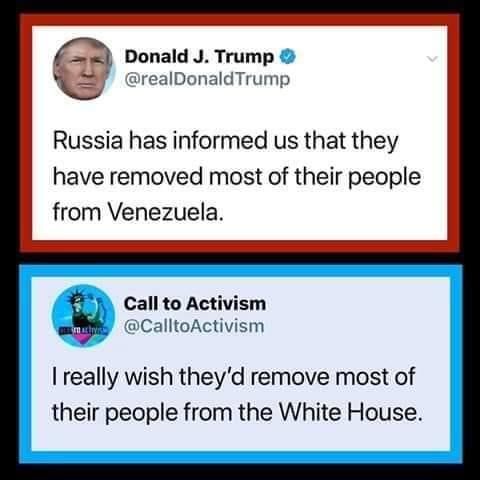
Knowing what we do about Trump, it's easy to imagine that, right now as you read this, Trump is asking Kellyanne Conway or some other Russian asset on his staff how he can get all of those Russians that are supposedly leaving Venezuela jobs in his administration and on his campaign staff, maybe even the Federal Elections Commission. Maybe Mitch McConnell will have room for some of them on his staff or the staffs of his Senate cronies. That's where we are, as we approach the fourth of July 2019.

Labels: , ,

Thursday, May 16, 2019

The Standoff at the D.C Venezuelan Embassy and Why It's Bad for the U.S.

>

Standoff at the Venezuelan embassy in Washington, D.C. (Photo Ann Wright)

by Thomas Neuburger

This is US military policy, being carried out unlawfully on US soil. The DC police and Mayor Bowser's administration are siding with the right-wingers, who are acting unlawfully and with excessive force.
     —RJ Eskow via Twitter

UPDATE: The last Embassy Protectors have been arrested and removed. It has begun.


You may have heard news of something going on at the Venezuelan Embassy in Washington, D.C, but since none of the usual media outlets are covering it, it may not have made much of an impression and the detail may be a bit of a mystery to most people.

In a nutshell, here's what's happened to date:

• The Trump administration attempted to spark a coup in Venezuela against the corrupt, but legitimately elected president Nicolás Maduro using opposition politician Juan Guaidó as its agent of change.

For more on the background of U.S.-Venezuelan relations and the current crisis, see "Venezuela and Binary Choice" and this timeline via Code Pink. Venezuela has oil, of course, a whole lot of it, and the U.S. has John Bolton in charge of foreign policy.

• The coup failed, however, leaving Maduro still in office and still in charge of the government.

• On April 10, prior to the failed coup, the Maduro government, fearing a takeover of their D.C. embassy by pro-Guaidó opponents and/or agents provocateurs backed by the U.S., invited members of the anti-war group Code Pink into the D.C. embassy as guests. They have been there ever since.

• The U.S. government, which still considers the Maduro government illegitimate, responded by cutting off electricity, food and water to the embassy, creating a standoff and an embassy under siege — in Georgetown.

This is where things stood until May 13, when the D.C. police taped "trespass notices," with no signature or letterhead, to the doors of the embassy and prepared to enter by force. (Consider for a moment what would, could, and will happen to U.S. embassies elsewhere in the world — starting with the embassy in Venezuela — if Bolton, Trump and the U.S. government are allowed to set invasion of foreign embassies as a precedent.)

Police did enter the embassy, but what happened next will surprise you. I'll turn the rest of the narrative over to Medea Benjamin and Ann Wright of Code Pink (emphasis mine). For the outcome, stay tuned.


Venezuela Embassy Protection Collective Defies Unlawful “No Trespass” Order

As this saga of the future of the Venezuela Embassy in Georgetown continues to unfold, history will record this as a key turning point in U.S.-Venezuela relations

by Medea Benjamin, Ann Wright

An extraordinary set of events has been unfolding at the Venezuela Embassy in Washington DC, ever since the Embassy Protection Collective began living at the embassy with the permission of the elected government of Venezuela on April 10 to protect it from an illegal takeover by Venezuela’s opposition. The actions of the police on the evening of May 13 added a new level of drama.

Since the cutting off of electricity, food and water inside the embassy has not been enough to force the collective to leave, late Tuesday afternoon, the Washington, D.C. Metropolitan Police handed out a trespassing notice that was printed without letterhead or signature from any U.S. government official.

The notice said that the Trump administration recognizes Venezuela opposition leader Juan Guaido as the head of the government of Venezuela and that the Guaido-appointed ambassador to the United States, Carlos Vecchio, and his appointed ambassador to the Organization of American States (OAS), Gustavo Tarre, were to determine who is allowed into the Embassy. Those not authorized by the ambassadors were to be considered trespassers. Those inside the building were “requested” to depart the building.

The notice appeared to have been written by the Guaido faction, but was posted and read by the DC police as if it were a document from the U.S. government.

The police taped the notice to the doors all around the Embassy and later called in the fire department to cut the lock and chain that had been on the front door of the Embassy since diplomatic relations were broken between Venezuela and the United States on January 23.

Adding to the drama, supporters of both sides began to gather. The pro-Guaido forces, who had erected tents around the perimeter of the embassy and had set up a long-term encampment to oppose the collective inside the building, were ordered to take down their encampment. It seemed as though this was part of moving them from outside the embassy to the inside.

Two hours later, some members of the collective inside the embassy voluntarily left to reduce the load on food and water, and four members refused to obey what they considered an illegal order to vacate the premises. The crowd waited in anticipation of the police going inside and physically removing, and arresting, the remaining collective members. The pro-Guaido forces were jubilant, crying “tic-toc, tic-toc” as they were counting down the minutes before their victory.

In a remarkable turn of events, however, instead of arresting the collective members who remained inside, a lengthy discussions ensued between them, their lawyer Mara Verheyden-Hilliard and the DC police. The discussion focused on the reason collective members were in the Embassy in the first place—trying to stop the Trump administration from violating the 1961 Vienna Convention on Diplomatic and Consular Facilities by turning over the diplomatic premises to a coup government.

Collective members reminded police officers that following illegal orders does not protect them from being charged with criminal actions.


After two hours, instead of arresting the collective, police turned around, locked the door behind them, posted guards and said they would ask their superiors how to handle the situation. The crowd was stunned that the State Department and DC police, after having over a month to organize the eviction, had begun this operation without a full plan to include arrests warrants in case the Collective members did not vacate the building voluntarily.

Kevin Zeese, a Collective member, wrote a statement concerning the status of the Collective and the Embassy:
This is the 34th day of our living in the Venezuelan embassy in Washington, DC. We are prepared to stay another 34 days, or however long is needed to resolve the embassy dispute in a peaceful way consistent with international law...Before doing so, we reiterate that our collective is one of independent people and organizations not affiliated with any government. While we are all US citizens, we are not agents of the United States. While we are here with permission of the Venezuelan government, we are not their agents or representatives...  The exit from the embassy that best resolves issues to the benefit of the United States and Venezuela is a mutual Protecting Power Agreement. The United States wants a Protecting Power for its embassy in Caracas. Venezuela wants a Protecting Power for its embassy in DC.

The Embassy Protectors will not barricade ourselves, or hide in the embassy in the event of an unlawful entry by police. We will gather together and peacefully assert our rights to remain in the building and uphold international law. Any order to vacate based on a request by coup conspirators that lack governing authority will not be a lawful order. The coup has failed multiple times in Venezuela. The elected government is recognized by the Venezuelan courts under Venezuelan law and by the United Nations under international law. An order by the US-appointed coup plotters would not be legal... Such an entry would put embassies around the world and in the United States at risk. We are concerned about US embassies and personnel around the world if the Vienna Convention is violated at this embassy. It would set a dangerous precedent that would likely be used against US embassies... If an illegal eviction and unlawful arrests are made, we will hold all decision-makers in the chain of command and all officers who enforce unlawful orders accountable... There is no need for the United States and Venezuela to be enemies. Resolving this embassy dispute diplomatically should lead to negotiations over other issues between the nations.
We anticipate that the Trump administration will go to court today, May 14 to request an official U.S.-government order to remove the Collective members from the Venezuelan Embassy.

Members of the National Lawyers Guild wrote a statement challenging the Trump administration’s handing over of diplomatic facilities to unlawful persons:
The undersigned write to condemn the violations of law which are occurring at the Venezuelan Embassy in Washington D.C. and to demand immediate action be taken. Prior to April 25, 2019, a group of peace activists were invited to the Embassy by the government of Venezuela—recognized as such by the United Nations—and continue to be lawfully on the premises.

Nonetheless, the United States government, through various law enforcement agencies, have condoned and protected violent opponents in support of an attempted siege of the Embassy. In so doing, the U.S. government is creating a dangerous precedent for diplomatic relations with all nations. These actions are not only illegal, but they put embassies around the world at risk. [...]

The contempt shown by the Trump Administration for these principles and for international law puts at risk the entire system of diplomatic relations which could have a reverberating effect in nations throughout the world.

The undersigned demand that the United States immediately cease its ongoing state-sponsored assault and illegal intervention in Venezuela and against its government, which continues to be recognized by the United Nations and the majority of the world. We demand that local and federal law enforcement immediately refrain from exposing the peaceful invitees and their supporters inside and outside the Embassy to harm in violation of their fundamental human rights.
As this saga of the future of the Venezuela Embassy in Georgetown continues to unfold, history will record this as a key turning point in U.S.-Venezuela relations, U.S. violation of a key tenet of international law and most of all, as a heroic example of US citizens doing everything in their power--including going without food, water and electricity and facing daily assaults by the opposition—to try to stop a US-orchestrated coup.
 

Labels: , , , , , , ,

Sunday, March 24, 2019

How the Media Distort News from Venezuela

>

Food

by Reese Erlich

Whenever officials in Washington, D.C. set out to overthrow a foreign government, mainstream US media outlets are there to give a helping hand. All pretense of fairness and balance disappear in favor of outrageous distortion. For the most recent example, let’s look at Venezuela.

Both high-level Republicans and Democrats have decided it’s time for Venezuela, with the world's largest oil reserves, to rejoin the US sphere of influence. Hawks may call for direct military intervention while doves seek punishing sanctions, but all agree that the elected government of President Nicolas Maduro has got to go.

Mainstream media took a particularly rightward turn in January after Juan Guaidó anointed himself as Venezuela’s president, with the blessings from the administration of President Donald Trump. Guaidó is president of the opposition-dominated National Assembly and had never even run for president. A January opinion poll showed he was unknown to 81 percent of the people. He represented an unstable alliance of opposition parties. As I’ve written before, lack of legality didn’t stop the United States and its allies from declaring Guaidó president and pretending he ran an actual government.

As if responding to a bat signal in the skies above Gotham City, the mainstream media rushed to back the Trump team’s policies. The administration, which has proven incompetent and dangerous on other issues, was suddenly a reliable source of information on Venezuela. Statements from the administration and Venezuelan opposition leaders were uncritically reproduced, no matter how untethered to reality. Allow me to offer some examples.

In February, Guaidó announced plans to deliver international aid to starving Venezuelans by mobilizing massive demonstrations at the Venezuela-Colombia border, hoping a significant number of military officers would defect. The plan was obviously flawed because military leaders continued to back Maduro. Sure enough, the aid convoy didn’t get through, and military officers didn’t defect.

Many media outlets reported that Maduro’s security forces burned an aid truck as it attempted to enter Venezuela. In reality, aerial and other photos reported in real time by the leftist website Venezuela Analysis indicated that the fire was started by an anti-government protester. Weeks later, the New York Times got around to reporting that Maduro's forces didn’t start the fire.

Another example of bias: The Times and other US media focused exclusively on the US aid, ignoring that donated by Russia and Cuba without incident.

In mid-March, Venezuela's electric grid went out nationwide, causing huge economic dislocation and dozens of deaths. President Maduro said a US cyber attack caused the shutdown. CBS News reported this claim, but gave it no credence, dutifully saying US officials “dismissed the Venezuelan government’s accusation as absurd and an attempt to divert attention from its own chronic failings.”

The Maduro government has yet to provide proof of its assertion. But as a commentary in Forbes showed, the United States could well have launched such an attack. Remember, the US and Israel initially denied creating the Stuxnet virus that disabled Iranian nuclear facilities.

Why distortions?

I’ve been a foreign correspondent for forty years and have reported from Venezuela since 1994. I’ve met many journalists in the mainstream media, from the New York Times to CNN and NPR. None see themselves as government mouthpieces, and in private, many will criticize Trump. So why the distorted coverage?

Mainstream reporters and editors take their cues from Washington, D.C. Since bipartisan leaders see Venezuela as beyond the pale, so do the media. They see Maduro as “hard left,” similar to the leaders of Cuba or the old USSR. As a result, they accept US government assertions pretty much without question. They often make no effort to get Maduro’s side, or even to find academics or former government officials who can balance a story with a pro-Maduro views.

In one particularly egregious article, the the New York Times Washington, D.C., bureau recently quoted Secretary of State Mike Pompeo at length about how Russia and Cuba are “propping up Venezuela,” an absurd claim given Cuba’s own economic problems and Russia’s distance. The article contained one perfunctory paragraph with the Venezuelan government viewpoint.

Vicious attacks

Reporters know there are few consequences for misreporting about Maduro and his allies, but that the roof caves in if they report negatively about the opposition.


In 2017, I filed a series of stories on Venezuela for Canadian Broadcasting Corporation’s daily website. While reporting government-sponsored brutality, I also noted that the opposition engaged in violent tactics against the police. I wrote that the momentum was shifting away from the anti-government demonstrators. I came under vicious attack online in a clear effort to discredit not only the articles but me as a reporter.

To their credit, CBC editors defended my reporting. A few weeks later, the opposition demonstrations petered out as the country prepared to vote for a Constituent Assembly.

A positive exception

Of course, the mainstream media is not monolithic. Knight-Ridder, now owned by McClatchy, accurately reported that weapons of mass destruction didn’t exist in Iraq during the run up to the 2003 war.

McClatchy reporters have now uncovered covert US arms shipments from Miami to Venezuela. Their article explored possible links between the charter airline carrying the weapons and the CIA’s program in the 2000s of kidnapping and taking civilians to black sites. I hope other reporters follow up-- but am not holding my breath.

The government of Venezuela certainly deserves a lot of criticism. Inflation is skyrocketing. Venezuelans face shortages of food and medicine. Unemployment is increasing as work places shut down because of the crisis. But that doesn’t justify US efforts to overthrow Maduro and install an opposition leader.

Labels: , ,

Saturday, February 09, 2019

Venezuela: Democratic Uprising or U.S. Coup?

>

Community activists in Caracas who support the government of President Nicolas Maduro  have formed food co-ops to help overcome the economic crisis

by Reese Erlich

Tens of thousands of angry people march in the streets to protest lack of democracy. Women bang on pots to raise alarm over the economic crisis brought on by a socialist president. The United States denounces the leftist government and promises to help bring democracy to the country.

Venezuela in 2019? No, it was Chile in 1973.

Chileans had elected a Marxist president, Salvador Allende, and the U.S. government was seeking to oust him. Allende’s platform rejected the anti-communist foreign policy of the United States and threatened the profits of U.S. corporations. So, in a time-honored tactic of course, the Nixon Administration claimed Allende was an autocrat allied with the U.S.S.R.

With National Security Council head Henry Kissinger as point man, the United States squeezed Chile economically, sponsored trucker strikes, fomented opposition demonstrations, and ultimately supported the coup that brought General Augusto Pinochet to power. The people of Chile would suffer under a brutal dictatorship for the next sixteen years.

Perhaps the Trump Administration is hoping history will repeat itself, but so far Venezuelans aren’t going for it. Elected President Nicolas Maduro, while politically weakened by recent U.S. maneuvering, still retains a measure of popular support. Unlike the Chilean army, much of the Venezuelan military remains loyal to the government.

As I reported from Caracas two years ago, Maduro survived violent attacks by upper-class opposition leaders on his government. His supporters hope he will do so again, despite massive economic chaos promoted by the United States.

In January the Trump Administration intensified a brutal economic and political campaign to overthrow Maduro. It blocked the state owned oil company, Petróleos de Venezuela, known as PDVSA, from receiving payment for oil shipments to the United States. The administration also orchestrated denunciations of Maduro by U.S. allies in Latin America and Europe.

Venezuela depends on oil exports to earn hard currency. The Wall Street Journal reported that oil production has dropped 10 percent since December. That means the government will have a harder time importing essential goods, like pharmaceuticals, medical equipment, and food.

While the U.S. has sanctioned PDVSA, it has also granted waivers allowing Chevron Corporation and two U.S. oil service providers, Halliburton and Schlumberger, to continue operating and making profits in Venezuela. Hmmmm. The U.S. promotion of democracy in Latin America seems, once again, to be attached to corporate interests.

“The Trump Administration is trying to asphyxiate Venezuela,” Carolina Morales, a Venezuelan immigrant rights activist living in San Francisco, told me. “The U.S. claims it favors humanitarian aid to Venezuela, but the best aid is a functioning economy. The sanctions hurt ordinary people.”

Trump and the Venezuelan opposition claim that Maduro orchestrated fraudulent presidential elections in May 2018 and has become an autocrat. The Venezuelan constitution provides that if the presidency is “abandoned,” the president of the National Assembly can assume that office. On January 23, National Assembly head Juan Guaidó swore himself in as president, claiming that Maduro had abandoned his office by conducting fraudulent elections.

However, the major opposition parties had boycotted the 2018 elections because they were badly divided. They made no claims that Maduro had “abandoned” the presidency. The argument-- a thin legal thread created to justify a coup-- arose months later.

Guaidó, until last month, was a virtual unknown. He had never run for national office, and was head of the National Assembly only as part of a rotation system among the opposition parties. Guaidó’s party, Popular Will, is self-described as a social democratic party. The United States will certainly pressure Popular Will to adopt neo-liberal economic policies such as tax benefits for the rich, taking on onerous loans from international banks and privatizing state owned companies, particularly PDVSA.

Venezuelans have been down that path before. Neoliberal economic policies caused a massive economic crisis in the 1990s, leading to the election of Hugo Chávez, according to Luis Salas, a former minister of economy under Maduro. I interviewed him during my last trip to Caracas.

“That era only produced increased poverty and high inflation,” Salas told me.

Venezuelans will likely be worse off under opposition rule than under Maduro, as admitted by Fernando Cutz, a former White House official who worked on Venezuela policy.

“Things probably will get worse for the people of Venezuela before they get better when you actually start doing things for the greater good,” Cutz told the New York Times.

Surely, the opposition owes much of its support to the country's deteriorating economy. Inflation hit a staggering 80,000 percent last year and is expected to go even higher in 2019.

That means workers’ wages are almost worthless. “It’s difficult to get enough money to buy food,” admitted immigration activist Morales.

Stringent U.S. sanctions and fluctuating oil prices have impacted the Venezuelan economy. But the government also made serious errors, according to Rodulfo Perez, a former minister of education in Maduro’s cabinet.

“We should have invested our oil money in the domestic economy,” Perez told me during my last trip. “Such a policy would have strengthened the bolívar fuerte [Venezuelan currency] and reduced the need for imports.”

Trump’s Latin American policy is now spearheaded by John Bolton, Elliott Abrams, and a group of neocons determined to reassert U.S. control of Venezuela’s oil. And, as Bolton has admitted, “It will make a big difference to the United States economically if we could have American oil companies invest in and produce the oil capabilities in Venezuela.”

From a geopolitical standpoint, the neocons see overthrowing the government in Venezuela as a first step towards doing the same in Cuba and Nicaragua.

A U.S. coup is by no means a done deal. “I am optimistic and hoping the government will survive,” said activist Morales. She then added, “I’m also worried. The U.S. could send troops to Venezuela, which would provoke a civil war. There could be thousands of deaths in the streets. That’s why I’m speaking up against this coup.”

Labels: , ,

Friday, February 01, 2019

Would You Trust Trump Not To Foment Violence In Venezuela To Enhance His Own Collapsing Electoral Prospects?

>


Before retiring and joining the shady international private equity firm, the Carlyle Group, Admiral James Stavridi had been Commander of U.S. Southern Command and then Supreme Allied Commander at NATO. Yesterday he penned an OpEd for Time, I Commanded the U.S. Military in South America. Deploying Soldiers to Venezuela Would Only Make Things Worse. His attitude towards the Chavez and Maduro governments is as negative as you would expect from someone at the center of the Military Industrial Complex. But even he knows how catastrophic a Trump invasion of Venezuela would be.
It is clearly time for Maduro to go. But America should be cautious. Even though he is repressing the population and rounding up opponents, a full-blown invasion by the U.S. would foment rage in the region and internationally.

Everywhere I went as a four-star Admiral in the region while commanding U.S. Southern Command, I would be reminded of America’s history of intervention. A good example was the reaction there when we created the Navy’s Fourth Fleet in 2008. We intended for it to focus on disaster relief, humanitarian operations, medical diplomacy and counter-narcotics. But from Brasilia to Havana, the negative responses were stunning... Even the Colombian Minister of Defense (and later President of Colombia) Juan Manuel Santos-- my best friend and partner in the region-- counseled me against the initiative. Too many people there truly felt that standing up a new fleet was a return to gunboat diplomacy and a prelude to military action in Venezuela. Good intentions do not make old ghosts disappear.

...There may come a time for more dramatic military activities, perhaps an international peacekeeping force. But for the moment, our efforts are best served by supporting the brave Venezuelans fighting the Maduro regime through the overall efforts of the international community. As Simon Bolivar, the liberator of Venezuela and a revered figure there, said, “When tyranny becomes law, rebellion is a right.”
Today Pence and top Florida Republicans were in Miami at a rally to show off the Trump Regime's anti-Maduro stance. Marc Caputo wrote that the rally is "an opportunity to open a door with Hispanic voters in a state that’s critical to the president’s reelection. The Hispanic vote here is far from monolithic: About 17 percent of Florida’s active registered voters are Hispanic, about a third of whom are estimated to be of Cuban-American descent and a third of Puerto Rican descent, followed by those whose families have roots throughout Latin America: Colombia, the Dominican Republic, Nicaragua, Venezuela, El Salvador, Guatemala and Mexico."
Between ongoing strife in Nicaragua under Daniel Ortega and the unrest in Venezuela under dictator Nicolás Maduro-- which has also led to troubles in neighboring Colombia-- Republicans see a window to send a hardcore anti-socialist message-- one that, some say, helped the GOP win just enough of the overall Hispanic vote in November’s midterm elections to keep Florida’s governorship in Republican hands and take a Senate seat from the Democrats.

The Friday event-- which could feature Gov. Ron DeSantis, Rep. Mario Diaz-Balart and Sens. Marco Rubio and Rick Scott-- follows the Trump administration’s decision last week to lead a multinational coalition to formally recognize Juan Gerardo Guaidó Márquez as the legitimate acting president of Venezuela amid what many nations see as an unconstitutional power grab by Maduro.

In Florida, Trump’s decision was cheered by Republicans as well as Democrats. But some Florida Democrats fret that Trump could politically benefit both from the policy and from the critical reaction to it by a few national members of their party-- including Sen. Bernie Sanders, a likely presidential candidate-- who have raised the specter of a U.S.-led “coup” taking place in Venezuela.

...Diaz-Balart (R-FL) is co-sponsoring legislation with Democrat Darren Soto (New Dei-FL) to extend Temporary Protected Status to Venezuelans, about 3 million of whom have fled amid food shortages and hyperinflation of more than 1 million percent under Maduro.

Amid the crisis in Venezuela, Maduro last year held what critics say was a sham election and took office Jan. 10. But since they don’t see his election as legitimate, the Venezuelan opposition, democracy activists, the Trump administration and most South American countries say there’s a vacancy in the Venezuelan presidency, thereby elevating Guaidó to acting president under the country’s constitution because he’s the leader of the National Assembly.

The day after Trump’s recognition of Guaidó, Sen. Sanders issued a three-tweet thread on Twitter that urged caution while criticizing Maduro’s “violent crackdown.”

“But,” Sanders wrote, “we must learn the lessons of the past and not be in the business of regime change or supporting coups-- as we have in Chile, Guatemala, Brazil and the Dominican Republic. The US has a long history of inappropriately intervening in Latin American nations; we must not go down that road again.”

Rep. Tulsi Gabbard, also a Democratic presidential hopeful, warned on Twitter that the “United States needs to stay out of Venezuela.” Of the Democratic responses, Minnesota Rep. Ilhan Omar’s tweet most outraged Venezuelan exiles by suggesting Guaidó was part of a “US backed coup” in Venezuela and saying he was part of “Trump's efforts to install a far right opposition” in the country.


Guaidó isn’t a conservative politician. He’s a member of the social-democratic Popular Will Party, which would look far left in the U.S. political system.

“I am disgusted by some of the statements Democrat lawmakers around the country have made,” said Helena Poleo, a Florida Democrat and Venezuelan exile and commentator, citing the “ignorant and damaging statements” from Omar, Gabbard and Sanders.

“When it comes to facilitating democracy in Venezuela, my party has historically dropped the ball,” she said. “This will absolutely help the Republicans in Florida if this keeps up. In Florida, Democrats are saying the right things. But nationally, some of them don’t know what they’re talking about and the damage they’re doing to our party.”

To Venezuelan exiles in Florida, the national Democrats criticizing Trump sound as if they’re echoing Maduro, who took to social media Wednesday with this message: “People from #USA, I ask for your support in order to reject the interference of Donald Trump's administration which intends to turn my Homeland into a ‘Vietnam war’ in Latin America. Don't allow it! today compared US intervention with Vietnam.”

Also on Wednesday, Trump congratulated Guaidó in a phone call, according to a White House spokeswoman.

Juan Escalante, an undocumented immigrant and activist whose family fled the Chavez regime 19 years ago, has little love for the Trump administration’s policies on immigration, but he said its actions in Venezuela and the “wall-to-wall” coverage on Spanish-language media lauding the work of Rubio, Diaz-Balart, Scott and DeSantis could have an impact in 2020.

“If you compare and contrast actions and say who showed up at the end of the day, people remember these things,” he said. “It’s going to be imprinted in a lot of people’s minds.”

Another Trump critic, former Republican Rep. Carlos Curbelo of Miami, said he doesn’t like the president’s position on immigration but no one can ignore the positive effect that administration’s policy on Venezuela could have in 2020.

“For all those people bewildered that so many Hispanics in South Florida are Republican-leaning, now we’re seeing why,” Curbelo said.

“There’s a great camaraderie with different groups that have been victims of leftist movements: Colombians who fled FARC, and Nicaraguans who fled Ortega twice,” Curbelo said. “So yeah, there are just a few thousand Venezuelan voters. But everyone in Miami hates Nicolás Maduro. And if Trump wins by 20,000 votes, this will be why.”
Yves Smith's Naked Capitalism post on Thursday is based on the article, U.S. Push To Oust Venezuela's Maduro Marks First Shot In Plan To Reshape Latin America Wednesday inWall Street Journal by reporters Jessica Donati, Vivian Salama and Ian Talley. Rubio is eager to turn Venezuela into a fascist state like Bolsonaro's Brazil. "The Trump Administration," wrote Smith, "has apparently decided to embark on a large-scale interventionist campaign to reverse supposed undue influence of Russia, China, and Iran in Latin America. Venezuela and Cuba are the first targets, and Nicaragua is next on the list. John Bolton, in too obvious a nod to Bush’s 'axis of evil' has called them the 'troika of tyranny'. One would think the fact that our 'remake the world in our image' plans worked out so well in the Middle East might curb US adventurism. And it isn’t just that we made a mess of Iraq, failed to break Iran, and failed to install new regimes in Afghanistan and Syria. The New American Century types are deep in denial that this geopolitical tussle not only cost the US greatly in terms of treasure, but it also wound up considerably enhancing Russia’s standing."


Consider another bad outcome from US war-making in the Middle East: the rise of the radical right in Europe. American nation-breaking had produced a flood of refugees trying to enter Europe. In a misguided show of humanitarianism, European countries welcomed the over one million migrants that arrived in 2015, with the upsurge due mainly to the civil war in Syria. Angela Merkel in particular backed the idea of taking in the refugees, in part because German has a lower-than-replacement birth rate, and Syrian has a high level of public education. However, the EU members had patchy and generally poor programs for helping the migrants assimilate and find jobs. The result was what one hard core left wing political scientist who has spent a considerable amount of time in Germany calls “Merkelization”: a rise of nativist right wing parties like AfD in response to large-scale, poorly-managed migrant inflows.

Consider how this tendency might play into US nation-breaking near our border. Many readers have pointed out that the “caravans” from Central America are heavily populated with people from countries like Honduras that our tender ministrations have made much worse. My colleague was warning of Merkelization of the US even before the US launched its coup attempt, that it is one thing to have an immigration process that is generous towards asylum-seekers, and quite another to have open borders when political and economic conditions in countries to the South are unlikely to get better.

Bernie Sanders was browbeaten into holding his tongue after pointing out early in his Presidential campaign that “open borders” is a Koch Brothers position, and that the top 10% professional class that has become the base of the Democratic party are now heavy employers of servants, in the form of nannies and yard men. When I was a kid, even the few times we lived in middle/upper middle class suburbs full of senior corporate managers and professionals, no one had servants. Men worked full time and wives did the housework; the most you’d see would be a housekeeper in once a week to give the wife some relief.

As Peter Beinart pointed out in The Atlantic in 2017:
In 2005, a left-leaning blogger wrote, “Illegal immigration wreaks havoc economically, socially, and culturally; makes a mockery of the rule of law; and is disgraceful just on basic fairness grounds alone.” In 2006, a liberal columnist wrote that “immigration reduces the wages of domestic workers who compete with immigrants” and that “the fiscal burden of low-wage immigrants is also pretty clear.” His conclusion: “We’ll need to reduce the inflow of low-skill immigrants.” That same year, a Democratic senator wrote, “When I see Mexican flags waved at pro-immigration demonstrations, I sometimes feel a flush of patriotic resentment. When I’m forced to use a translator to communicate with the guy fixing my car, I feel a certain frustration.”

The blogger was Glenn Greenwald. The columnist was Paul Krugman. The senator was Barack Obama.

Prominent liberals didn’t oppose immigration a decade ago. Most acknowledged its benefits to America’s economy and culture. They supported a path to citizenship for the undocumented. Still, they routinely asserted that low-skilled immigrants depressed the wages of low-skilled American workers and strained America’s welfare state. And they were far more likely than liberals today are to acknowledge that, as Krugman put it, “immigration is an intensely painful topic … because it places basic principles in conflict.”

A larger explanation [for the change] is political. Between 2008 and 2016, Democrats became more and more confident that the country’s growing Latino population gave the party an electoral edge...

Alongside pressure from pro-immigrant activists came pressure from corporate America, especially the Democrat-aligned tech industry, which uses the H-1B visa program to import workers...

According to a comprehensive new report by the National Academies of Sciences, Engineering, and Medicine, “Groups comparable to … immigrants in terms of their skill may experience a wage reduction as a result of immigration-induced increases in labor supply.” But academics sometimes de-emphasize this wage reduction because, like liberal journalists and politicians, they face pressures to support immigration.

Many of the immigration scholars regularly cited in the press have worked for, or received funding from, pro-immigration businesses and associations.
...I had really hoped that Trump would tire of Bolton’s aggressiveness and need for the limelight, but that clearly isn’t happening fast enough, if at all. In the meantime, kicking small and poor countries who pose no threat is not the behavior of a confident superpower. And grabbing Venezuela’s oil because we can is theft. It’s been depressing to be an American for a very long time, and there’s no prospect for improvement.


Labels: , , ,

Sunday, September 02, 2018

How Long Did Ron DeSantis Affair With Nicolás Maduro Last?

>

Ron DeSantis-- not a brain surgeon

Because the Egyptian dynasties were all inbred-- the only suitable woman to bear a pharoah's child was his sister or half sister-- most pharaohs were far from the sharpest knives in the draw. The Egyptian dynasties didn't last long. The admissions officer at the Wharton School of Business and Finance, had been a friend of Trump's brother and he allowed Trump, a mediocre student (at best), to transfer from Fordham. Trump was way out of his league intellectually at Wharton. One of his professors, William T. Kelley, said-- long before Trump got into politics-- that "Donald Trump was the dumbest goddam student I ever had." Was he as dumb as a pharaoh? Possibly. But does that mean Trump wants to turn the U.S. into Egypt? Of course not.

Trump is also a would-be dictator? You know who else is a would-be dictator? Nicolás Maduro! Does that mean Trump wants to turn the U.S. into Venezuela? Nope.

Today I was on the phone with Kim Schrier, the progressive Democratic pediatrist who is running for the open seat congressional east of Seattle. I asked her what attacks Paul Ryan's sleazy SuperPAC had started running against her. Mostly that she was the "most liberal candidate" in the history of the known universe and that she was "against veterans." No Nancy Pelosi's twin sister ads yet? "I think that starts next week," she said. The dull-witted-- perhaps inbred?-- Republicans use the same attack strategy in every district and in every election cycle. But there's a new-ish one they've been testing out this year. Every Democrat is a "Bernie Sanders/Alexandria Ocasio socialist" who wants to turn the U.S. into Venezuela. (It's an alternative to this year's "he/she was in a band" or "was a skateboarder" or has a tattoo.)


Pretty much everyone agrees that this year's dimmest bulb running for governor in any state is Florida Trumpist Ron DeSantis. Whether for agree or disagree with his stands on issues, DeSantis is D-U-M-B-- to the max. Sunday he was on John Catsimatidis' show on AM 970 in New York calling his progressive Democratic rival, Tallahassee Mayor Andrew Gillum, "untraditional" because he favors Medicare-For-All. You know who else favors Medical-For-All?


Goal ThermometerYou know who's against it? Selfish, greed-obsessed plutocrats, Republican ideologues and staffers at the DCCC. "This Andrew Gillum, he's on the far-left socialist fringe," babbled DeSantis. "He's a Bernie Sanders/Ocasio-Cortez type candidate... If you have a guy like this enacting a socialist agenda it's going to absolutely destroy all the progress that Florida has made. He wants to turn Florida into Venezuela." Maybe that's a signal DeSantis has already  decided to stop with the racial slurs and move on to red-baiting. In any case, expect to hear the newest GOP talking point all season and everywhere in the country: "He/She wants to turn [blank] into Venezuela." If you'd like to help, Andrew Gillum-- and other gubernatorial candidates being attacked as Venezuelan recreaters-- please tap on the 2018 Blue America executive branch thermometer on the right. By the way, I've known Andrew for almost 2 decades and I urged him to run for governor long before he ever did. I think I'd know if he ever wanted to turn Florida into Venezuela. I guarantee you... he never did. Helping the underprivileged get a fair shake?  Yes! Turning Florida into Venezuela? No, not a chance!

Labels: , , , ,

Thursday, August 23, 2018

Right-wingers Invent Self-Serving Narratives Which Their Media Turns Into Conventional Wisdom-- Take Venezuela And Medicare-For-All

>


The war against dumb conventional wisdom, often bolstered by self-serving propaganda, will never end. Francisco Toro gave it a try at the Washington Post a couple days ago in regard to the agony in Venezuela, No, Venezuela Doesn't Prove That Socialism Will Bring About A Zombie Apocalypse, later prudently retitled "No, Venezuela Doesn't Prove Anything About Socialism." Toro, raised in Caracas and schooled in the U.S. is a journalist, political scientist and blogger. "Venezuela is clearly having its moment in the American conservative mediasphere," he wrote. "The country’s catastrophic collapse is, we’re told, all we need to know about the terrifying dangers of socialism." He recognizes a convenient right-wing narrative when he sees one.


First there was Meghan McCain turning Venezuela into Exhibit A in her screed against socialism on ABC’s The View. On Fox Business Network, Stuart Varney used Venezuela’s latest bout of instability as a “teaching moment” for Americans tempted by “pie-in-the-sky” socialism.

Off on the fringes, it’s a popular theme, too: Remember that the priceless Infowars gotcha video with the world’s most unflappable sailor girl turned on the killer line: “You know Venezuela? The majority of the country is now eating rats.”

I’ve spent two decades chronicling every agonizing twist and turn in the decay of Venezuela’s democracy, economy and society. You’d think I’d be on board with these takes. Think again. I’m revulsed. It’s appalling to see my country’s suffering leveraged for cheap partisan point-scoring.

It bothers me because it’s lazy. But it bothers me more because it’s wrong.

...Look, I get it. When U.S. conservatives bring up "Venezuela," they're not talking about the place I grew up in. They're using the word as a rhetorical club, a verbal firebomb you throw at the the opposing ideological barricade. Their goal isn't to enlighten; it's to delegitimize vast sectors of the left. After all, if you convince people that every left-wing government is on a slippery slope to Venezuela, the entire left becomes toxic. Which is very much the point.

Don't be fooled. All Venezuela demonstrates is that if you leave implementation to the very worst, most anti-intellectual, callous, authoritarian and criminal people in society, socialism can have genuinely horrendous consequences. But couldn't the same be said of every ideology?
Is the Trump Regime proving that capitalism is a zombie apocalypse? Not necessarily. But currently, both the U.S. and Venezuela are-- pure and simple-- kakistocracies. Funny, when you google the phrase a photo of Trump, Eric Trump, Ivanka Trump, Betsy DeVos and Dr. Ben comes up. Wikipedia defines kakistocracy as "a system of government which is run by the worst, least qualified, or most unscrupulous citizens." The page ends with this suggestion:


Writing for This Week, Ryan Cooper also took on a major right wing narrative been pushed so strongly to the lazy corporate media that it's becoming more false conventional wisdom-- that Medicare-For-All costs more than the current system. It doesn't. But that doesn't stop right-wing media to endlessly parrot the bullshit. Cooper wrote that the question of what Medicare-for-All would cost is "tying fact checkers in knots." Maybe they should follow Ro Khanna on Twitter:


A recent study by the libertarian Mercatus Center unwittingly answered that Medicare-For-All would save America money-- $2 TRILLION over a 10 year period. Imagine that-- everybody gets healthcare and we save that kind of money. I can imagine it but fact checkers at the Washington Post, the Associated Press, FactCheck.org, PolitiFact, and CNN can't and "have absolutely beclowned themselves trying to dispute the study's clear finding."
Here's the background. Bernie Sanders has a Medicare-for-all bill that he put out last year. It would fold all Americans into an upgraded Medicare system over four years, which would now cover dental, vision, and hearing with no cost-sharing. Prescription drugs would be covered with small cost-sharing, capped at $250 per year. It would be paid for with new taxes, but offset by zeroing out insurance premiums and almost all cost-sharing.


When it comes to overall spending, this would have three effects pulling in different directions. First, there would be higher utilization and thus more spending, as people who were prevented from seeking treatment due to cost could now go to the doctor. But second, medical providers would be paid somewhat less, because Medicare reimbursement rates are 40 percent lower than those of private insurance-- though they are higher than Medicaid (the largest insurer in the country) and much higher than that of uninsured people who simply can't pay for the emergency treatment that hospitals are legally required to provide.

Third, because they would now only have to deal with one billing system, providers would be able to dramatically streamline their administrative apparatus. A Health Affairs study of eight rich countries, for instance, found U.S. hospitals spent by far the highest faction of their budgets on administration, at 25.3 percent-- while those of the Netherlands spent 19.8 percent, the U.K. spent 15.5 percent, and Canada spent 12.4 percent.

Therefore, figuring out what Sanders' Medicare-for-all bill might cost overall depends on two estimates and one fact: 1. how much utilization will increase, 2. how much can be saved on administration, and 3. what the provider reimbursement rates are. The first two are necessarily uncertain, but the third is simply whatever is stipulated in the Medicare-for-all legislation.

Charles Blahous of the Mercatus Center did an elementary study of Sanders' Medicare bill whose main purpose was pretty obviously to find a really big number for new public spending, and then get that headline figure blasted out in the media.

But buried in the tables there was also an estimate of total national health expenditures (that is, all public and private spending) of the status quo compared to the Sanders plan. Here is the table-- look at "Currently projected national health expenditures (NHE)" versus "NHE under M4A," which I have underlined:


Mysteriously, Blahous chose not to display the summed total figures for those rows, but if you do the arithmetic, you find he estimates status quo NHE at $59.7 trillion over 10 years, while he estimates NHE under the Sanders plan at $57.6 trillion over the same time frame-- for a savings of $2.1 trillion.

Perhaps not satisfied with this result, Blahous then put forward an alternative plan of his own in which provider payments would not be cut as much, with total NHE spending somewhat higher. Importantly, this plan has nothing at all to do with the Sanders bill. It's just something he made up.

He also heavily emphasized that Medicare reimbursement rates are 40 percent lower than private insurance, but did not outline how much the Sanders plan specifically would cut. However, if you go into his tables and reverse-engineer the figures, it must be something like 11 percent.

That brings me to the epic fact checker faceplant. Sanders trumpeted the Mercatus finding, because it was hilarious and a good demonstration of how America could be getting universal Medicare while spending less overall-- even given no doubt slanted libertarian assumptions. Glenn Kessler of the Washington Post was first on the attack, giving Sanders 3 out for 4 "Pinocchios" for a supposedly "cherry-picked" $2 trillion figure. He asserted that Blahous' alternative Medicare plan was more realistic, as did Robert Farley of FactCheck.org and AP's Ricardo Alonso-Zalvidar. PolitiFact rated Sanders' claim as "half true" because he didn't mention the Blahous plan. CNN's Jake Tapper put out a video chiding him and Alexandria Ocasio-Cortez for relying on the $2 trillion figure. "A reminder to all you politicians out there, you're perfectly entitled to your own opinions, but not your own facts," tut-tutted Tapper.

This point is wildly misleading, and indeed has nothing to do with facts as such at all. The fact checker brigade is saying that provider payments will be hard to cut, and therefore Sanders might end up passing something different than his Medicare bill. Therefore he is a liar. But Blahous's study absolutely, positively does say that the Sanders plan as written will save the American people $2 trillion. Sanders didn't mention the more expensive Mercatus plan because it is not his plan. Vague speculation about future political negotiations has nothing whatsoever to do with the facts of the Sanders proposal, nor the empirical contents of the Mercatus study.

But that's not even the worst part.

As part of its PR rollout of the paper, Mercatus bought buying ads for Facebook in D.C. promoting a Wall Street Journal op-ed in which Blahous baldly misrepresents his own paper, writing that the Sanders bill would "immediately and dramatically cut provider payment rates by roughly 40 percent."

As noted above, this is absolutely false, because only about half of people are on private insurance. Medicare payments would stay the same, while Medicaid and uninsured payments would go up. But Kessler, after talking to Blahous, initially swallowed this characterization, writing in his first article that providers "would face an immediate cut of 40 percent in their payments."

He was forced to correct that article (for that and several other factual errors)-- though a video which is still up on the Washington Post at the time of writing contains the same false claim, asserting the plan "generously assumes providers would be paid roughly 40 percent less than they are now." Unbelievably, even after correcting his first article, Kessler wrote another article making the false claim again, writing "the Sanders plan would slash payments to providers by 40 percent." That one is still uncorrected at the time of writing.

This 40 percent talking point is not just wrong, it is preposterous. One way of seeing why is by looking at how much Blahous estimates Sanders will save with provider cuts in the table above. On the right-hand column, we find the sum total of "Applying Medicare payment rates" from 2022-31 is $5.3 trillion in spending cuts. If that is a 40 percent cut, then that implies that the total volume of provider payments in the Sanders plan must be only about $8.0 trillion ((5.3/0.4)*0.6 = 7.96)-- over a period in which national health expenditures are $57.6 trillion. Less than a seventh of medical spending going to providers in a Medicare system doesn't pass the laugh test-- in 2015 existing Medicare provider payments accounted for at least 77 percent of spending, with another 14 percent going to prescription drugs-- and again, the true cut to providers in the paper itself must be about 11 percent.

Finally, this study should be seen as the absolute worst-case scenario for universal Medicare, not a fair estimate of what it might cost. The fact that even the Mercatus Center couldn't make it look that bad is a very good sign. Fact checkers need to get a grip.
And you know that "witch hunt: narrative Trump has been propagating? Republicans for the Rule of Law-- a group of Never Trumpers-- is running this ad today and tomorrow on Fox and Friends and Morning Joe in selected markets (including in D.C., so Señor Trumpanzee will see it in real time).


Labels: , , , ,