"When fascism comes to America, it will be wrapped in the flag and carrying the cross."
-- Sinclair Lewis
Friday, December 18, 2009
Sunday Classics preview: Easing our way back to Tchaikovsky
>
Mark Elder and the Hallé Orchestra perform the second half of Tchaikovsky's 1812 Overture in the Royal Albert Hall as part of the 2004 Nation's Favourite Prom. Don't worry, we've got better performances coming up.
by Ken
In case you haven't guessed, Sunday we're headed for "A Very Tchaikovsky Christmas." There won't be much all that Christmas-y about it; mostly it'll just be our 2nd Annual Tchaikovsky Christmas Post.
I suppose there are people who snicker at what is surely Tchaikovsky's most-performed work, the 1812 Overture. Tchaikovsky didn't think much of it either, but in his case it's understandable -- it didn't exactly tap into his deeper creative powers. The nature of the piece, a musical reenactment of the Battle of Borodino, in which the beleaguered Russian army in 1812 routed Napoleon's seemingly unstoppable invading force (which had actually been stopped by the unimagined harshness of the Russian winter), pretty well dictated that for thematic material the composer would borrow familiar Russian and French tunes. It's understandable, then, that the composer regarded the piece as a commissioned trifle. But that anyone else would deprive him/herself of the piece's matchless pleasures seems to me an exercise in snobbery that's beyond me.
In the score Tchaikovsky himself provided indications for cannon firings and pealing bells, and nowadays "effects"-oriented performances thrive on adding not only those but choruses, fireworks, light shows, and anything else they can think of. The regrettable result is often to detract attention from the unadorned wonders of the piece. I thought we might start by hearing it "plain" -- meaning just for orchestra, since there's nothing "plain" about this classic performance. (Sorry, Bil, I would have loved to offer a shiny new recording, but I couldn't find one played or recorded half as well as this one.)
TCHAIKOVSKY: 1812 Overture, Op. 49
Chicago Symphony Orchestra, Fritz Reiner, cond. RCA/BMG, recorded Jan. 7, 1956
In 1954, Mercury Records, eager to show off its advanced-for-the-time recording technology got the idea of producing a version of the 1812 that added the cannons and bells indicated in the score. The assignment fell to one of its regular recording teams, Antal Dorati and the Minneapolis Symphony (since 1968 the Minnesota Orchestra), and the result was, for a classical record, a monster hit. So it was only natural when Mercury redid it for stereo in 1958, again with Dorati and the Minneapolis SO. It's hard to believe this legendary recording is 50 years old.
Minneapolis Symphony Orchestra, Antal Dorati, cond. (with cannon and carillon). Mercury, orchestral part recorded April 5, 1958
If you want to know more about the making of the recording, composer-commentator Deems Taylor had provided a spoken commentary for the 1954 mono version, and Mercury had him do the honors again for the stereo remake.
Spoken commentary by Deems Taylor recorded in New York City, Nov. 13, 1958
Now, do you have a hankering for more than cannons and bells? I'm afraid we're not equipped for fireworks. But conductor Igor Buketoff produced a version that effectively retrofits choral settings of the Russian Orthodox hymn "God Preserve Thy People," which is used first solemnly at the opening and triumphantly later on, when it leads into a choral rendering of the anthem "God Save the Tsar."
Temple University Choirs, Philadelphia Orchestra, Eugene Ormandy, cond. (with electronic cannon and bells). RCA/BMG, recorded 1970
Finally, if you just like cannons and bells, Mercury and Dorati came up with a sequel to their 1812s: Beethoven's Wellington's Victory, a not-quite-joke "Battle Symphony" written originally for the "panharmonicon," a giant mechanical orchestra invented by Johann Nepomuk Maelzel, whose name became a household word for another of his inventions, the metronome.
In a lighter-hearted way, Wellington's Victory re-creates the defeat -- at the Battle of Vitoria, in northeastern Spain, in 1813 -- of another Napoleon, the reeling emperor's older brother Joseph Bonaparte, still ruling as king of Spain, at the hands of a multinational European army commanded by the future Duke of Wellington. You shouldn't have any difficulty recognizing, musically, the English and French sides of the action.
BEETHOVEN: Wellington's Victory, Op. 91
i. Battle ii. Victory Symphony
London Symphony Orchestra, Antal Dorati, cond. (with cannon and carillon). Mercury, orchestral part recorded June 9, 1960
Once again Mercury enlisted Deems Taylor to provide commentary:
Spoken commentary by Deems Taylor recorded in New York City, Nov. 22-23, 1960
Deems Taylor introduces and Leopold Stokowski conducts (the Philadelphia Orchestra) in most of the Nutcracker Suite segment of Walt Disney's Fantasia: "Dance of the Sugar Plum Fairies," "Chinese Dance," "Dance of the Reed Flutes," "Arabian Dance," and "Russian Dance" -- missing only the final "Waltz of the Flowers" (which can be seen here).
by Ken
If you've been with us for the previews -- NutcrackerFriday night, and Swan Lake and Sleeping Beautylast night -- you know the plan. Two years ago we did our first "Very Tchaikovsky Christmas" in the form of a tribute to John Lanchbery's splendid recordings of all three Tchaikovsky ballets, and last year we branched out for a little bit of everything Tchaikovsky.
We've got lots of music coming, so there will be a minimum of chatter. We're going to take the ballets in chronological order, meaning that we start with Swan Lake and finish with The Nutcracker. And speaking of Swan Lake, I can't resist pausing for this:
Violinist Joshua Bell plays Tchaikovsky's most famous song, "None but the Lonely Heart," accompanied by Michael Stern and the Orchestra of St. Luke's. We're going to hear the song actually sung later.
by Ken
Last year I took advantage of the impending Christmas holiday to point out that you could get utterly delicious and authoritative performances of Tchaikovsky's three great ballets -- Swan Lake, The Sleeping Beauty, and The Nutcracker -- conducted by the distinguished ballet composer-arranger-conductor John Lanchbery, only slightly inconveniently scrunched onto five CDs, for under $20! I'll bet you can still find cheap copies around, but unfortunately EMI has deleted that set.
(There are Amazon vendors listing the individual ballets priced from $5.49 through $9.98, and even with three shipping charges added, that's a good buy. The six-CD set of André Previn's wonderful recordings with the London Symphony is still available, and as I write there are Amazon vendors selling it for as little as $11.90 and $14.99. You can also find inexpensive copies of the individual ballets. There's also a fine Decca set conducted by Richard Bonynge, and a host of attractively priced issues of all three ballets.)
We talked a little more about the Tchaikovsky ballets recently, and I'm sure we'll have occasion to come back to them. But for now --
I. VISIONS OF SUGAR PLUMS
Of course only The Nutcracker has a Christmas association. So just to touch base, I thought we'd start with the composer's own suite, from a slightly unexpected source -- this isn't music you necessarily associate with Leonard Bernstein.
TCHAIKOVSKY: Nutcracker Suite, Op. 71a
i. Overture
ii. Danses caractéristiques: (a) March (b) Dance of the Sugar Plum Fairy (c) Russian Dance (Trepak) (d) Arabian Dance (e) Chinese Dance (f) Dance of the Mirlitons
iii. Waltz of the Flowers
New York Philharmonic, Leonard Bernstein, cond. Columbia/CBS/Sony, recorded May 2, 1960
II. SONG OF THE RUSSIAN SOUL
As I mentioned in last night's Sunday Classics preview, I want to look at, or rather listen to, the element in Tchaikovsky's music that defies description without the words "soul" and "soulful." It is, as I suggested, one of the building blocks of Russian music, one of its most powerful appeals to non-Russian ears -- though perhaps also one of the things that certain later Russian composers worked like heck to get out from under. (Obviously I'm thinking of Igor Stravinsky.)
For some reason the music that pops to mind is from an operatic scene that appears to be something of a throwaway until you take into account how much it tells us about who these people are. It's the second scene of Act I of Tchaikovsky's not-at-all-faithful rendering of Pushkin's Queen of Spades (he had a very different agenda from that of the laconic poet-playwright), following hard upon one of the most action-packed, dramatic opening scenes in all of opera. At curtain rise we find our heroine, Lisa, entertaining a group of friends in her room in the home of her guardian, the old Countess.
As the scene starts [track 1], Lisa and her friend Paulina, who's at the piano (the libretto says "harpsichord," but I don't think I've ever heard that), sing a song about the setting of the sun, [2] to the approval of the others. Lisa urges Paulina to sing a song of her own, but it takes her a moment to think of something to sing, whereupon [3] she addresses her "dear friends" ("podrugi miliye," sung twice, with a tingling upward sweep on the second) and offers them a brooding song about former happiness and (yikes!) a grave. When the clarinet picks up the haunting tune of her song, Paulina chides herself for choosing such a morbid song, then [4] launches a "jolly Russian" ditty about a happy bridegroom and bride, which draws a suitably lively response from the girls until [5] Lisa's governess storms in upbraiding the girls for their raucous behavior, which has drawn a complaint from the Countess. (As we will hear, complaining comes readily to the old woman, especially when it concerns the shocking deterioration in behavior and standards.) Such behavior, the Governess explains, is appropriate in the servants' hall, but not for well-bred young ladies.
Mirella Freni (s), Lisa; Katherine Ciesinksi (ms), Paulina; Janis Taylor (ms), Governess; Tanglewood Festival Chorus, Boston Symphony Orchestra, Seiji Ozawa, cond. RCA/BMG, recorded Oct.-Nov. 1991
Unfortunately, I don't have a CD edition of the recording I would have liked to excerpt, the Bolshoi Opera's first stereo Queen of Spades, conducted by Boris Khaikin, in which the great dramatic mezzo-soprano Irina Arkhipova brought her deep, rich voice to this rather small role; she really makes you feel the upward sweep on that second "Podrugi miliye.") With the passage of time Arkhipova, like many distinguished Russian mezzos before (and after) her, migrated to the crotchety role of the old Countess. Here she is in Act II, Scene 2, sending her chattering maids off and expressing her vehement distaste for all things modern and then [track 2], giving voice to her preference for The Way Things Were, sings the aria "Je crains de lui parler la nuit" ("I fear speaking to him at night") from André Grétry's Richard the Lion-Hearted, from the last century.
OOPS, I LEFT OUT THE ARKHIPOVA CLIP!
So here, belatedly, is the great Irina Arkhipova -- at 66 -- singing the first bit of the Countess's scene in Act II, Scene 2 of Tchaikovsky's Queen of Spades:
Orchestra of the Kirov Theater, Valery Gergiev, cond. Philips, recorded May 1992
As long as we're in Queen of Spades and talking about "soul," it seems foolish to neglect the gorgeous aria, just possibly the most beautiful aria ever written, from the scene between the two we've sampled, Act II, Scene 1, the ball at which the dashing Prince Yeletsky, a prince in every imaginable sense, first has to persuade an evasive Lisa to linger with him a moment, then straightforwardly and unabashedly declares [track 2], "I love you." I've always thought it a measure of Tchaikovsky's scrupulous fairness as an artist that he portrayed Yeletsky so attractively, while the opera is trying to arouse sympathy for the tormented outsider, Gherman, who attracts Lisa's fascination.
Vladimir Chernov (b), Yeletsky; Maria Guleghina (s), Lisa; Orchestra of the Kirov Theater, Valery Gergiev, cond. Philips, recorded May 1992
Again, I'd have liked to present a different performance of Yeletsky's recitative and aria -- from the next-earliest Bolshoi Queen of Spades, conducted by Alexander Melik-Pashayev, with the peerless Armenian baritone Pavel Lisitsian. (I think Chernov sings it quite nicely, though.) By way of compensation, here is Lisitsian singing Tchaikovsky's "None but the Lonely Heart":
UPDATE: THE LISITSIAN RECORDING SUPPLIED!
Thanks to our friend Balakirev, we can hear one of the most stupendous pieces of singing I know, Lisitsian's recording of Yeletsky's aria from Queen of Spades -- including the preceding recitative. (I have a Russian Lisitsian LP on which the aria performance is neatly lifted out of the complete Queen of Spades, but without the lead-in, so it just starts with "Ya vas lyublyu." Unbelievable! No such dereliction from our friend B -- this week's Sunday Classics hero!) Wow! It's especially interesting to hear Lisitsian's performance alongside Vladimir Chernov's perfectly respectable one. If you want to hear the difference between pretty good singing and great singing, here it is. Wow!
Pavel Lisitsian (b), Yeletsky; Yevgenia Smolenskaya (s), Lisa; Bolshoi Theater Orchestra, Alexander Melik-Pashayev, cond. Melodiya, recorded c 1951
III. WORLD'S MOST SOULFUL SYMPHONIES
"Heart on sleeve" is one of the ways in which Tchaikovsky's six unapologetically emotional symphonies are belittled. This is one of those cases where the public has gotten it righter than the belittlers -- way righter. One of the fascinations of Tchaikovsky's symphonies, in fact, is that no two of them resemble each other. The composer invented a new model each time out. But even in the most extroverted and dynamic of them, the Fourth, the element of "soul" threads its way in. Here's the tempestuous finale:
TCHAIKOVSKY: Symphony No. 4 in F minor, Op. 36: iv. Finale: Allegro con fuoco
Baltimore Symphony Orchestra, David Zinman, cond. Telarc, recorded Nov. 20-25, 1989
Surely the most surprising finale, and possibly the most surprising movement in a Tchaikovsky symphony, is the last movement of the last of them, the haunting finale of the Pathétique. This is a symphony that begins in the brooding depths of the orchestra, in time disgorging one of the composer's most famous, most throbbing melodies, then continues with a "slow" movement that's really an "allegro" and an imposing march movement that could pass for the finale of most symphonies. But Tchaikovsky had in mind a more anguished envoi.
TCHAIKOVSKY: Symphony No. 6 in B minor, Op. 74 (Pathétique): iv. Finale: Adagio lamentoso; Andante
Boston Symphony Orchestra, Pierre Monteux, cond. RCA/BMG, recorded Jan. 26, 1955
I suppose it's possible that Mahler would have arrived independently at the idea of concluding his most monumental symphony, the Third, with an elegiac parting movement. But in my mind there's no question that in his mind this remarkable precedent of Tchaikovsky was playing in the background.
SYMPHONIC BONUSES
I don't mean to suggest that we've done anything like justice to these great symphonies. This is a pretty backwards way of looking at works that are, after all, dominated by enormous (20-minute-ish) opening movements, and feature pretty remarkable middle ones too. (Hey, how about that soulful yet perky little song that slips in after the massive first movement of the Fourth, or the plucked-strings scherzo that follows?) In compensation, and in the spirit of holiday cheer, here are the complete symphonies.
TCHAIKOVSKY: Symphony No. 4 in F minor, Op. 36: i. Andante sostenuto; Moderato con anima; Moderato assai, quasi andante; Allegro vivo ii. Andante in modo di canzone iii. Scherzo: Pizzicato ostinato; Allegro iv. Finale: Allegro con fuoco
London Symphony Orchestra, George Szell, cond. Decca, recorded September 1962
TCHAIKOVSKY: Symphony No. 6 in B minor, Op. 74 (Pathétique): i. Adagio; Allegro non troppo ii. Allegro con grazia ii. Allegro molto vivace iv. Finale: Adagio lamentoso; Andante
London Symphony Orchestra, Igor Markevitch, cond. Philips, recorded January 1962
Sunday Classics (holiday edition) preview: For the first time since 2012, we bring back the legendary DWT gala "Nutcracker ('The Whole Deal')"
>
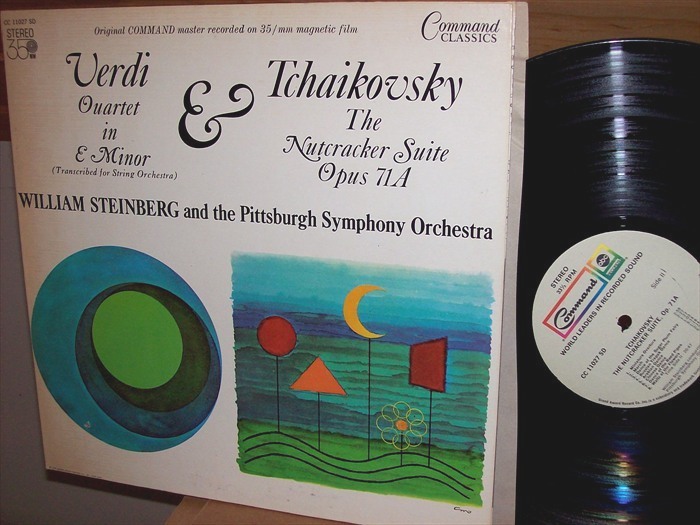
You'd want to think twice before bidding on this record. The ABC Command label tells you it's one of the inferior later pressings; you want an original gold-label issue. (Note: Unfortunately, last year's preview-opening video clip of the Nutcracker Suite segment of Walt Disney's Fantasia has disappeared -- not entirely surprisingly, I guess. To be honest, I don't like it much anyway.)
by Ken
As far back as the mind recalls, Sunday Classics has celebrated the holiday musically at last in part with music from Tchaikovsky's ballets, and last year I went whole hog and offered a complete Nutcracker, basically double-covered throughout, and assembled from, well, a whole bunch of recordings. And as I ventured in 2010's Nutcracker preview, what better way could there be to "warm up" for the main event than with the composer's own Nutcracker Suite, good old Op. 71a? In the click-through we've got two quite splendid, and interestingly different, performances.
WE HAVE TWO DIFFERENTLY SPLENDID RECORDINGS OF THE NUTCRACKER SUITE
TCHAIKOVSKY: Nutcracker Suite, Op. 71a:
i. Miniature Overture
Pittsburgh Symphony Orchestra, William Steinberg, cond. Command, recorded c1963
Montreal Symphony Orchestra, Charles Dutoit, cond. Decca, recorded c1985
You'll note straightaway in the Miniature Overture that William Steinberg is taking a rather spritelier approach and Charles Dutoit a more buoyant, caressing one. Both the Pittsburgh Symphony and the Montreal Symphony play utterly delectably.
IN AUDIO TERMS, BOTH RECORDINGS HAVE
STELLAR PEDIGREES, IN CONTRASTING STYLES
Sunday Classics preview: The gala Sunday Classics "Nutcracker (The Whole Deal)" returns AGAIN (one last time!)
>
You'd want to think twice before bidding on this record. The ABC Command label tells you it's one of the inferior later pressings; you want an original gold-label issue. (Note: Unfortunately, last year's preview-opening video clip of the Nutcracker Suite segment of Walt Disney's Fantasia has disappeared -- not entirely surprisingly, I guess. To be honest, I don't like it much anyway.)
by Ken
As far back as the mind recalls, Sunday Classics has celebrated the holiday musically at least in part with music from Tchaikovsky's ballets, and two years ago I went whole hog and offered a complete Nutcracker, basically double-covered throughout, and assembled from, well, a whole bunch of recordings. I brought it back last year, and now darned if it isn't here again. And as I ventured first in 2011's Nutcracker preview, what better way could there be to "warm up" for the main event than with the composer's own Nutcracker Suite, good old Op. 71a? In the click-through we've got two quite splendid, and interestingly different, performances.
WE HAVE TWO DIFFERENTLY SPLENDID RECORDINGS OF THE NUTCRACKER SUITE
TCHAIKOVSKY: Nutcracker Suite, Op. 71a:
i. Miniature Overture
Pittsburgh Symphony Orchestra, William Steinberg, cond. Command, recorded c1963
Montreal Symphony Orchestra, Charles Dutoit, cond. Decca, recorded c1985
You'll note straightaway in the Miniature Overture that William Steinberg is taking a rather spritelier approach and Charles Dutoit a more buoyant, caressing one. Both the Pittsburgh Symphony and the Montreal Symphony play utterly delectably.
IN AUDIO TERMS, BOTH RECORDINGS HAVE
STERLING PEDIGREES, IN QUITE DIFFERENT STYLES
Sunday Classics preview: By popular demand, the gala DWT "Nutcracker (The Whole Deal)" returns
>
You'd want to think twice before bidding on this record. The ABC Command label tells you it's one of the inferior later pressings; you want an original gold-label issue. (Note: Unfortunately, last year's preview-opening video clip of the Nutcracker Suite segment of Walt Disney's Fantasia has disappeared -- not entirely surprisingly, I guess. To be honest, I don't like it much anyway.)
by Ken
As far back as the mind recalls, Sunday Classics has celebrated the holiday musically at last in part with music from Tchaikovsky's ballets, and last year I went whole hog and offered a complete Nutcracker, basically double-covered throughout, and assembled from, well, a whole bunch of recordings. And as I ventured in last year's Nutcracker preview, what better way could there be to "warm up" for the main event than with the composer's own Nutcracker Suite, good old Op. 71a? In the click-through we've got two quite splendid, and interestingly different, performances.
WE HAVE TWO DIFFERENTLY SPLENDID RECORDINGS OF THE NUTCRACKER SUITE
TCHAIKOVSKY: Nutcracker Suite, Op. 71a:
i. Miniature Overture
Pittsburgh Symphony Orchestra, William Steinberg, cond. Command, recorded c1963
Montreal Symphony Orchestra, Charles Dutoit, cond. Decca, recorded c1985
You'll note straightaway in the Miniature Overture that William Steinberg is taking a rather spritelier approach and Charles Dutoit a more buoyant, caressing one. Both the Pittsburgh Symphony and the Montreal Symphony play utterly delectably.
IN AUDIO TERMS, BOTH RECORDINGS HAVE
STERLING PEDIGREES, IN QUITE DIFFERENT STYLES
Sunday Classics preview: A sampling of our "Swan Lake" and "Sleeping Beauty" selections
>
Swan Lake from Tokyo:Kazufumi Yamashita conducts the NHK Symphony, 2005.
by Ken
Last night we began easing our way into our "3rd Annual 'Very Tchaikovsky Christmas'" with excerpts from The Nutcracker, the last of Tchaikovksy's three ballets. Tonight we sample the first two, full-length ones, Swan Lake and The Sleeping Beauty.
I apologize in advance for the LP pops and tics. But the fact that I can now offer you music I have only on LP means that I can present performances I haven't been able to in the past. (Actually, in the first "Tchaikovsky Christmas" post, I was still wholly dependent on found-online video clips. Last year, casting a wider net over Tchaikovksky's output, I was at least able to draw on my CDs.)
TCHAIKOVSKY: Swan Lake, Op. 20
Actually, two Swan Lake records quickly popped into my head, and while I was trying to decide between them I went ahead and started making audio files of both of them. In the end I couldn't choose. So we've got both that great musical sensualist Leopold Stokowski conducting the whole of Acts II and III, and a much more spread-out selection by a conductor esteemed for his elegance and animation, Efrem Kurtz -- with a surprise guest. Let's start with the Kurtz disc.
No. 5, Act I, Pas de deux, Nos. 1-2 Yehudi Menuhin, violin; Philharmonia Orchestra, Efrem Kurtz, cond. EMI, recorded c1957
[12/16/2011] Preview: If it's the holidays, it must be "Nutcracker" time! (continued)
>
You'd want to think twice before bidding on this record. The ABC Command label tells you it's one of the inferior later pressings; you want an original gold-label issue.
AS NOTED, WE HAVE TWO RATHER DIFFERENTLY
SPLENDID NUTCRACKER SUITE RECORDINGS
You'll note straightaway in the Miniature Overture that William Steinberg is taking a rather spritelier approach and Charles Dutoit a more buoyant, caressing one. Both the Pittsburgh Symphony and the Montreal Symphony play utterly delectably.
And in audio terms both recordings have sterling pedigrees, in two noticeably different styles of recording.
* The Command recordings that Enoch Light produced with the Pittsburgh Symphony and its longtime music director Wiliam Steinberg, done on 35mm film by engineer Robert Fine, the talented engineer of most of the legendary Mercury Living Presence recordings, are one of the great triumphs of orchestral recording technology. (This is the dub I made from my Command LP two years ago for our "3rd annual Very Tchaikovsky Christmas." Since it doesn't have CD track points, it plays continuously; I've provided time cues below for the individual movements.)
* And the vivid recordings that Decca made with Charles Dutoit and the Orchestre symphonique de Montréal (this one produced by Andrew Cornall and engineered by Jimmy Lock) have long been understandably prized by audiophiles.
TCHAIKOVSKY: Nutcracker Suite, Op. 71a: i. Miniature Overture
ii. Characteristic Dances
-- (a) March [at 3:01 in the trackless Steinberg version]
-- (b) Dance of the Sugar Plum Fairy [at 5:30]
-- (c) Trepak (Russian Dance) [at 7:01]
-- (d) Coffee (Arabian Dance) [at 8:06]
-- (e) Tea (Chinese Dance) [at 11:22]
-- (f) Dance of the Reed Pipes [at 12:43]
iii. Waltz of the Flowers [at 14:59]
Pittsburgh Symphony Orchestra, William Steinberg, cond. Command, recorded c1963 [audio link] Montreal Symphony Orchestra, Charles Dutoit, cond. Decca, recorded c1985 [audio link] NOW FOR THAT NON-NUTCRACKER BONUS I PROMISED You'll recall that our commenter Karin offered as her prime example of Tchaikovskian happiness the Capriccio italien, a piece that I confessed has at times held a rather obsessive hold on my imagination. As it happens, the very same Decca CD that contains Charles Dutoit's splendid Montreal recording of the Nutcracker Suite contains a quite splendid performance of the Capriccio. So I thought I'd throw it in here. TCHAIKOVSKY: Capriccio italien, Op. 45Montreal Symphony Orchestra, Charles Dutoit, cond. Decca, recorded c1985 [audio link]
IN THIS WEEK'S SUNDAY CLASSICS POST As noted, this year for this first time in Sunday Classics history we're going to hear the whole of The Nutcracker!
RETURN TO THE BEGINNING OF THE POST
NBC Symphony Orchestra members, Leopold Stokowski, cond. RCA, recorded Oct. 1954-Feb. 1955
TCHAIKOVSKY: The Sleeping Beauty, Op. 66
The Sleeping Beauty, Op. 66: excerpts
Introduction Prologue: No. 1, March No. 3, Pas de six: a. Intrada and Adagio; e. Variation IV; Fairy of the Canaries; f. Variation V, Fairy Violente
Act I: No. 6, Garland Waltz No. 8, Pas d'action: a. Rose Adagio; c. Aurora's Variation; d. Coda No. 9, Finale: Aurora's Dance of Delirium; The King and Carabosse; Transformation of the Garden into a Forest
Act II: No. 13, Farandole and Mazurka No. 17, Panorama
Act III: No. 22, Polonaise No. 23, Pas de quatre: a. Intrada; c. Variation II, The Silver Fairy; e. Variation IV, The Diamond Fairy; f. Coda No. 25, Pas de quatre: c. Variation II, The Blue Bird and Princess Florine; d. Coda No. 26, Pas de caractère: a. Red Riding Hood and the Wolf No. 28, Aurora Pas de deux: b. Adagio; c. Coda No. 30, Finale: a. Mazurka; b. Apotheosis London Symphony Orchestra, Pierre Monteux, cond. RCA/Decca, recorded June 1957
TCHAIKOVSKY: The Nutcracker, Op. 71
Nutcracker Suite, Op. 71a
As I mentioned Friday night, the Steinberg-Pittsburgh Symphony recordings made by Command in the '60s, produced by company founder Enoch Light, with the legendary Robert Fine as "recording chief," were of strikingly high quality both musically and sonically. (After Command was acquired by ABC Records, the market was flooded with cheap copies of significantly inferior pressings, so you have to be careful to go back to the gold-label originals.)
i. Miniature Overture ii. March iii. Dance of the Sugar Plum Fairy iv. Trepak (Russian Dance) v. Arabian Dance vi. Chinese Dance vii. Dance of the Reed Pipes viii. Waltz of the Flowers Pittsburgh Symphony Orchestra, William Steinberg, cond. Command, recorded c1963
In time for the holidays (um, which holiday again, Bill-O?): Buy John Lanchbery's splendid recordings of all three Tchaikovsky ballets for a mere $20!
>
Leopold Stokowski conducts the "Dance of the Sugar-Plum Fairy" in Walt Disney's Fantasia
by Ken
I've spent a lot of time listening to recordings and trying to puzzle out musical and technical enigmas that arise. I don't know that my "explanations" are much good, but what really throws me is when I can't come up with a reasonable explanation. I encountered such a case recently when I first became aware of a 2004 EMI France CD reissue of John Lanchbery's 1981 recordings of all three complete ballets by Tchaikovsky.
It seemed like an eminently logical idea: having Lanchbery (1823-2003), an internationally renowned ballet composer, arranger, and conductor, record this music in London in state-of-the-art digital sound with the excellent Philharmonia Orchestra. Lanchbery, after all, had impeccable credentials as a dance conductor, and therefore wouldn't commit the gross improprieties the Ballet Bullies always attribute to non-dance conductors who perform music composed for the dance.
The only thing was that when the recordings were released on LP, they didn't seem terribly special. Alongside the numerous outstanding recordings that had been made of all three ballets, they seemed rather pallid.
Over the years I returned to those LPs periodically, to see if I might get some message I'd previously missed, without success. But the other day I noticed the aforementioned French EMI CD issue, which squeezed the pieces onto five budget-priced discs. The set I saw was priced at $20 (and you can find it for that price online) -- for all three full-length ballets. My curiosity was reignited., even though I had previously bought EMI's CD compilation of Andre Previn's beautiful recordings of the three Tchaikovsky ballets with the London Symphony and found the sound quality distinctly disappointing -- and these are recordings I know to be musically and sonically top-notch.
I won't bore you with the paltry theories I've come up with to explain the discrepancy. Instead, let me just report, with delight, that as I hear them now the Lanchbery performances are a consistent joy -- full-bodied, rhythmically driving, passionate, songful, and gorgeously played and recorded. The scrunching onto five very well-filled isn't painless. A mere 8 1/2 minutes of The Nutcracker spills onto the second CD (though on the plus side, that puts "The Dance of the Sugar-Plum Fairy" [ye gods in heaven, is there really such a thing as Sugar-Plum Fairy Barbie?] at the start of the disc), and less than 5 minutes of the start of Act II of Sleeping Beauty is tacked onto a previous disc.
I should also say that I haven't sat down with scores to verify that, say, no repeats have been trimmed to squeeze the music on. Ironically, given the quality of the performances and recording, and the low per-disc cost (you can find the set online for $20), it would have been just as fine a bargain spread out over the more usual six CDs, but that may be just too persnickety. While we're being persnickety, English-speaking buyers need to know that the contents listing and liner note are all in French.
Does Tchaikovsky need defending?
As to the music itself, I hope at this date it doesn't need selling. There used to be Tchaikovsky snobs who sneered at those of us who adore his music, but my impression is that they've mostly gone on to other hobbies.
Poor Tchaikovsky's reputation among some "serious" critics has always suffered because of the sheer irresistibleness of so much of his music. It seems to pump directly into the bloodstream.
The composer himself may have had a touch of this same feeling. He had a low opinion of The Nutcracker, at least as compared with the short opera, Yolanta, which he composed to share a double bill with the littlest of his three ballets. (He was positively withering on the subject of the little Nutcracker Suite he extracted from the full ballet, which is probably still his most-performed work. The difference is that now there are a large number of other, more substantial Tchaikovsky works that are performed an awful lot.)
Yolanta is indeed a lovely work, of remarkably delicate sensibilities. It tells the story of a king who tries to protect (as he sees it) his daughter, the princess Yolanta, from suffering the pain of being blind by using all his royal powers to prevent her from ever knowing that she's blind. Of course it's a wonderful metaphor for parents' regrettable impulse to "protect" their children from realities it's ultimately dangerous and destructive to shield them from. But it's also a remarkable attempt to imagine a world where there is nothing to see and nothing seen -- and obviously music, placing such a premium on sound and hearing, is an ideal medium through which to try to imagine such a world. Yolanta might be deeply moving if the damned thing could be really well performed, but that's something I don't expect ever to see. (Records aren't a bad way to experience it, but even from a musical standpoint it's an excruciatingly difficult piece to bring to life.)
Whereas The Nutcracker is, for goodness' sake, one of the most astonishing creations to spring from the mind of humankind. Not even its involuntary servitude as a ritual Christmas torture for the kiddies can dim the brilliance of its imagined world of toy drama. In a competent performance, the inexorable build to the soaring climax of Act I is one of the supreme spans of musical construction -- and Lanchbery brings it off as well as anybody I've heard (with the optional choral part, if you're keeping score).
Oh, that's the "Dance of the Sugar-Plum Fairy"?
At the top of this piece we have a clip of the chunk of Walt Disney's Fantasia in which Leopold Stokowski conducts the Philadelphia Orchestra in the oh-so-familiar "Dance of the Sugar-Plum Fairy" from The Nutcracker -- the kind of all-sense-stimulating music that set Stoky's imagination roaring. (From this excerpt in particular it's hard to believe that the original Fantasia recordings will be 70 years old in April!) We know that the piece was inspired by Tchaikovsky's curiosity as to what use could be made of the intriguing celesta, a keyboard instrument that produces this distinctive chimelike sound. We know too that nobody has ever found a more arresting, not to mention tingling, application.
I'm sorry I can't offer you Lanchbery's performance, which holds its own against Stoky's. For that matter I would have liked to offer you, at minimum, say, the Sleeping Beauty Act I finale, which Lanchbery builds wonderfully. Alas, I'm still working on my (basically nonexistent) computer audio and video technical skills. One of these days perhaps . . .
It was Howie who pointed out to me the seasonal coincidence that I happened to decide to write about the Tchaikovsky ballets during the holiday season, the very time when kiddies the world over are being force-marched into renderings of The Nutcracker, with the apparent intent of engender a life-long hatred of serious music. You have only my word that the timing is a coincidence; I listen to the Tchaikovsky ballets year-round.
But if this is a good time of year for you to think about this music, that works for me.
Why listen to the ballets complete?
Sometimes I listen to the Tchaikovsky ballets in suite form, but more often I prefer to hear them in full -- or at least a full act at a time. It's partly a matter of the sustained musical invention, which goes far beyond what you might guess from listening to collections of musical "highlights." But there's more to it. The complete scores aren't conceived in terms of highlights and lowlights. This composer's imagination had a specifically dramatic cast that comes to the fore in his theater works, the operas and ballets, animating the best of them in a way that you can't imagine from just excerpts, memorable as they are.
It occurs to me that we tend to think the Tchaikovsky ballets represent a genre, that of the "full-length ballet." However, the reality is that, except for Tchaikovsky's later countryman Sergei Prokofiev with his Romeo and Juliet and Cinderella, nobody else has pulled off the feat of sustaining musical interest through the length of a full-evening ballet score. I guess you could make a case of sorts for Leo Delibes, but really now, how often would anybody really wish to sit through the whole of Coppelia or Sylvia?
Tchaikovsky, as noted, made his own little Nutcracker Suite, and Prokofiev extracted no fewer than three orchestral suites from his Romeo and Juliet. In addition, countless other hands have assembled suites from all of these great ballets -- and any conductor can make his/her own, by stringing together as much or as little music as he/she sees fit. Certainly, there have been many performances of Tchaikovsky and Prokofiev ballet suites I've treasured, notably from conductors we have no opportunity to hear perform the complete scores, people like Yevgeny Mravinsky, Pierre Monteux, even Herbert von Karajan (a better Tchaikovsky conductor than a lot of people seem to remember).
Then there's the curious case of Eugene Ormandy, Stoky's successor in Philadelphia, who during his long tenure as music director gave glorious performances of (usually) his own suites from the Tchaikovsky ballets. The single LP's worth of each that he recorded for Columbia Masterworks ranks with the great Tchaikovsky on records. Surely, if he had wished, when it came to redoing their recorded repertory for RCA Red Seal, Ormandy and the Philadelphia Orchestra could have done the ballets complete; it's my understanding that RCA would have been only too happy to have more repertory Ormandy and the Philadelphians hadn't already recorded. I have to assume the conductor just wasn't interested in doing so. For RCA he once again did a single LP's worth of selections from each of the ballets.
No knock on Tchaikovsky's little Nutcracker Suite -- it gathers 20 or so minutes' worth of ever-delightful music. But as an experiment, try listening to the Suite and then to just Act I of the complete Nutcracker, which lasts about 45 minutes. First off, I think you'll be astonished at how much wonderful music you lose in the Suite. And then, even if you don't know the story, especially as you get to know the music well, I think you'll find yourself overwhelmed by the dramatic build-up of the complete Act I.
You don't have to be a "dance person" -- I'm sure not!
I should stress that I'm not speaking here of the music's appeal for ballet fans. I'm not much of a dance person myself. On those rare occasions when I'm dragged to the ballet, generally on the promise of hearing some music I love played by musicians who supposedly understand its dance qualities, I usually come away (a) fuming at the miserable quality of the musical presentation, and (b) churlishly ungrateful for the tedious visual "spectacle," which, rather than adding anything to the music, merely distracts or actually detracts from it. In the same way that I rarely enjoy actual stagings of Stravinsky's trio of ballet masterpieces The Firebird, Petrushka, and The Rite of Spring (I much prefer to let them take shape in the theater of my imagination), I listen to Tchaikovsky's ballets for their all but unimaginable sustained inspiration.
Composer-arranger-conductor John Lanchbery
Now, I'm not about to chuck a shelfful of other recordings of these timeless masterpieces -- or rather shelves full, allowing for various recorded media. But I can say that I would be unable to direct you to a better version of any of them. I find this almost as remarkable as the quality of the music itself.