Friday, May 24, 2013

Republicans In Congress Hike The Cost Of Education For Poorest Students

>

Boehner puppet, John Kline (R-MN)

Last week, we warned that John Kline's House Education and Workforce Committee was dead set on raising the cost of college education. When Elizabeth Warren's amendment to lower the cost of student loans to 0.75%, just like the banksters get, it was voted down, every Republican plus Colorado New Dem Jared Polis voting against it in committee. Yesterday, the full House voted on Kline's awful bill, which Democrats are calling the Make College Less Affordable Act, and it passed 221-198 all but 8 Republicans-- most of whom, like GOP crackpots Louie Gohmert (TX), Vern Buchanan (FL) and Tom Cotton (AR) just oppose public education as a matter of their extremist ideology-- voting for it, along with 4 Democrats:
• Jared Polis (New Dem-CO)
• Scott Peters (New Dem-CA)
• Joe Garcia (New Dem-FL)
• Dan Maffei (New Dem-NY)
Immediately after the vote Congressional Progressive Caucus Co-Chairs Reps. Raúl Grijalva (D-AZ) and Keith Ellison (D-MN) asked the question, Why are Republicans trying to make it more costly to attend college?
Students who work hard to get a college education should not be saddled with a lifetime of crushing debt. The latest Republican proposal would make getting a college education more expensive. College education is already too expensive. Why are Republicans trying to make it more costly to attend college?

In June, the student loan interest rate will double from 3.4% to 6.8%. Under the Republican ‘fix,’ when next year’s college freshmen start repaying their loans after they graduate, the interest rate on their college loan is projected to be 7.4%. Meanwhile, the world’s biggest banks borrow money from the government at an interest rate of 1% or lower.

                                                                                                     We should be helping students go to college. We shouldn’t charge students more to borrow for college than we charge banks. We support Senator Elizabeth Warren’s (D-MA) and Rep. John Tierney’s (D-MA) bill to tie the student loan interest rate to the current Federal Reserve lending rate.

Education continues to be the gateway to the American Dream. At a time when more and more of our nation’s wealth goes to corporate profits instead of middle class wages, the Republican scheme continues handouts to Wall Street at millions of students’ expense.”
No one wants to talk about it, but Republicans would like to drive the children of working class households-- particularly children of color from working class households-- off the college path and into menial labor and trades. It's the Republican Party policy everyone knows about but no one mentions out loud. They're even willing to sacrifice the future of lower middle class white kids to accomplish their goal. Donna Edwards (D-MD) skirted the ugly truth yesterday after the vote, pointing out that "the Republican Majority introduced legislation which, according to the nonpartisan Congressional Research Service, would in fact make college more expensive for students and parents than if Congress did nothing. The bill would set variable interest rates for student loans tied to 10-year Treasury notes +2.5 percent for Stafford and +4.5 percent for PLUS loans. Under the Republican bill, students who borrow the maximum amount of subsidized and unsubsidized Stafford loans over five years would pay nearly $2,000 more in interest costs than if interest rates doubled. The bill passed the House by a vote of 221-198."
“America’s families simply cannot afford the Republican solution to student loan rates. That is why I proposed two amendments to reduce the cap for Stafford and PLUS loans, and further reduce the cap for Stafford loans for students pursuing the science, technology, engineering and mathematics (STEM) fields. Our economy requires that we curtail unaffordable student loan debt while incentivizing students to join a workforce that will ensure the United States’ competitiveness in the 21st century. Republicans rejected both these ideas, but I urge them to reconsider as Congress works towards a long-term higher education bill.

“My decision to attend Wake Forest University then law school came at a cost of $100,000, a quarter of that was a result of interest and service fees. I understand personally that we need a short and long-term solution to college affordability, but it is irresponsible to, at a time when a college education is more important and expensive than ever, to place more of a burden on our students and parents.”
But that's the point. Republicans don't want more Donna Edwardses rising up and championing the interests of working families. Nobel economist Joe Stiglitz: "The life chances of a young American are more dependent on the income and education of their parents than in other industrial countries... Students are being squeezed. Incomes are down, and tuition is going up. They don't qualify for Pell Grants, and their parents really have no way to pay tuition at most schools." He backs Warren's bill to lower the cost of student borrowing.

The White House released a statement just before the vote suggesting President Obama would veto the bill if it ever makes it to his desk. "Under the President's proposal, the rate on new Federal student loans would be set each year based on the Treasury's actual cost of borrowing, and would remain fixed for the life of the loan so that borrowers would have certainty about the rates they would pay. The President's proposal also would expand the 'Pay As You Earn' repayment option to ensure that no student borrower is required to pay more than ten percent of his or her discretionary income on student loans. "While the Administration welcomes action by the House on this issue, H.R. 1911 is the wrong approach. First, the bill would not guarantee low rates for today's students. A rate that continues to vary after the loan has already been taken out would create uncertainty and lessen transparency for students and their families who are making decisions about borrowing for college. Second, the bill's changes would impose the largest interest rate increases on low‑ and middle‑income students and families who struggle most to afford a college education. Third, the bill does not include the President's proposal to extend repayment options to borrowers who have already left school and often face the same debt burdens as current and future students. Finally, the Administration believes that student loan interest rates should not be raised to reduce the deficit. If the President were presented with this legislation in its current form, his senior advisors would recommend that he veto the bill.

Labels: , , ,

Monday, October 06, 2014

There's No Nice Way To Say This: John Kline Takes Bribes From Crooked For-Profit "Colleges"

>


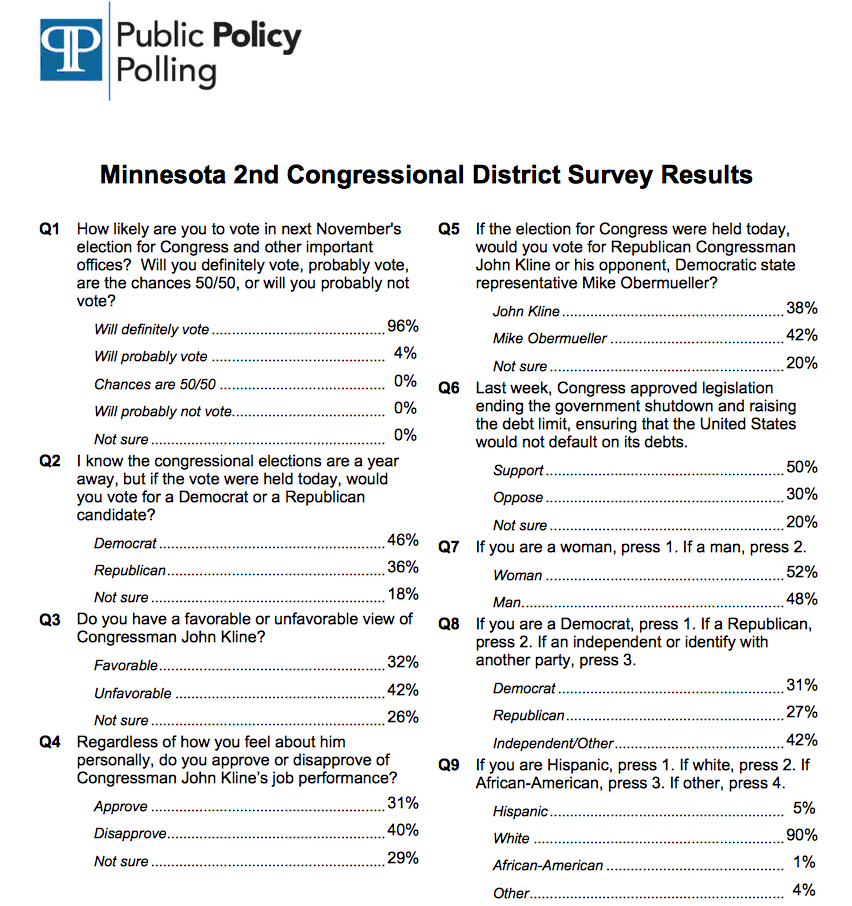
We’ve talked a lot about how DCCC chairman Steve Israel refuses to target any Republican leaders or policy makers, including GOP committee chairs, even ones in vulnerable blue-leaning districts. MN-02 south of Minneapolis/St Paul is a good example. In 2008, Obama beat McCain there by 10,000 votes. Four years later it was much closer but he still beat Romney in the district, which had also voted for Amy Klobuchar in 2006 and 2012 and for Al Franken in 2008. All those blue victories don’t guarantee a Democrat can beat John Kline— not even this poll showing Mike Obermueller leading him 42-38% is a guarantee. But it takes an exceptionally venal and incompetent DCCC chair to interpret that information as meaning Democrats shouldn’t even fight in MN-02. Meet Steve Israel— venal, incompetent and corrupt.

This cycle, Kline had raised $2,185,735 by the July 23 FEC filing deadline, most of it special interest money— and only 6% in small contributions. Chairman of the House Education Committee, Kline’s single biggest source of cash is… the education industry— $250,849, more than double his second biggest contributor industry (the banksters). His single biggest donor this year is Apollo Education Group (University of Phoenix) for a nice $28,100. Other for-profit “universities” which profit by ripping off their students that contributed big bucks to Kline include Itt Educational Services, Globe University, Full Sail University (owned by TA Associates, a private equity firm), Herzing University, DeVry, Education Management Corp, Association of Private Sector Colleges and Universities, Capella Education and his pals at Corinthian Colleges, a real doozy of a criminal enterprise.

Who remembers when Boehner took over the Speakership and said he wouldn’t tolerate any corruption from the Republican caucus? Apparently he doesn’t either. Kline wouldn’t return any of the legalistic bribes he gets from these crooks and won’t stop letting them craft predatory legislation for his committee to protect their own special interests while preying on students and their families. When the latest Corinthian scandal erupted in August, it was suggested that Kline disassociate himself from the scandal by getting rid of the money Corninthian had given him. This is what Mike Obermueller had to say when Kline refused:
"Last week, I challenged John Kline to donate the $10,000 he's received in campaign cash from those associated with the unscrupulous and legally embattled Corinthian College to a non-profit that would help students actually get a real college education. After more than a week of waiting, Kline has refused to act, demonstrating yet again that he chooses to prioritize himself over the interests of students.

"Congressman Kline should not be funding his campaign with money from people or organizations who willingly act in predatory ways toward students. Apparently, John Kline disagrees.

"Since he refuses to move forward legislation that would help students obtain the transparency they deserve, he should at least live up to the high standards of a committee chairperson and counter the perception that this school has purchased his allegiance.”
Corinthian has been subpoenaed by an Orange County grand jury. So far, John Kline hasn’t been.
The subpoena requests a broad range of documents and records related to the company's job placement rates, graduation rates and marketing materials used to recruit students. The Santa Ana firm has previously received subpoenas and similar document requests from state attorneys general, the Securities and Exchange Commission and the federal Consumer Financial Protection Bureau, but Wednesday's announcement was the first to signal the possibility of a federal criminal inquiry.

The subpoena, issued Friday, is the latest in a string of headaches for Corinthian, which announced last month that it would sell 85 of its 107 campuses and online programs amid heightened scrutiny from the U.S. Department of Education.

A company spokesman, Kent Jenkins, said in a statement that Corinthian would cooperate with the request, but added that the company is prepared to "vigorously defend its policies, practices and track record of serving students effectively."

Corinthian operates schools under the Everest College, WyoTech and Heald brand names. Nearly a quarter of the company's campuses are based in California— more than any other state.

The for-profit college industry has faced greater scrutiny from federal and state authorities in recent years, as attorneys general and federal investigators allege that some schools are aggressively targeting low-income students who are eligible for the maximum in federal aid.

The Obama administration in March proposed new rules for the industry and other vocational schools that are intended to weed out bad actors that leave students with enormous debts and few job prospects.

Other companies have faced declining enrollments in recent years, but Corinthian's recent troubles far outweigh those of its peers.

Over the last year, Corinthian has been inundated with investigations by state and federal authorities into its business practices, including concerns that employees falsified job placement rates and student attendance records to retain access to federal student loans and grants— the lifeblood of company profits.

The U.S. Department of Education set its sights on Corinthian in January, requesting extensive data and documentation to justify the company's job placement rates. In June, the Education Department contended Corinthian had failed to provide the information as requested, and put a 21-day hold on the company's access to federal student aid.

The sanctions put Corinthian on the brink of collapse. Last year, the company received nearly 85% of revenue from federal loans and grants.

In a June regulatory filing announcing the financial penalties, the company told investors it might have to shut down without additional funds. Amid declining enrollments and problems with an internal student lending program, Corinthian had already been struggling with cash flow this year.

In early July, Corinthian agreed to sell of most of its schools and close a dozen of them in a deal with U.S. education officials.

Patrick Fitzgerald, a former U.S. attorney in Chicago, is serving as an independent monitor overseeing Corinthian's operations.

Corinthian is also facing a lawsuit filed by California Atty. Gen. Kamala Harris last October. Harris' office alleged a wide range of fraudulent behavior, including having financial arrangements with temp agencies to count students as being "employed." Job placement rates are a key marketing tool for recruiting new students, and are crucial to maintaining accreditation and access to federal aid.

That lawsuit is ongoing. Corinthian faced a similar lawsuit from the California Attorney General's office in 2007. The company settled the case for $6.5 million, admitting no wrongdoing.
This is the Republican Party vision of education— crooked businessmen looking to lure students into worthless fake universities that benefit the businessmen and leave everyone else high and dry. Veterans have especially been targeted And John Boehner gave the job of overseeing the whole scam to John Kline. Solution? Replace John Kline with Mike Obermueller in 4 weeks. Bill Maher will be in MN-02 tomorrow to kick off his ground campaign to defeat Kline. He’s been zeroing in and taking Kline to task for being in the pocket of the student loan industry and for-profit education lobby. Kline has continually voted to raise student loan interest rates and let for-profit education institutions take advantage of students. Most voters in the district don’t know this. Hopefully Maher will see to it that voters in the suburbs south of the Twin cities, in Eagan, Northfield, Apple Valley, Red Wing and Cottage Grove find out what their congressman has been up to.


Labels: , , ,

Thursday, October 30, 2014

John Kline-- Congress' Worst Enemy Of Public Education

>

Earlier this month we looked into the astounding legalistic bribes John Kline takes from the for-profit college industry, far more than any other Member of Congress. So far this cycle the for-profit education business has spent $1,488,432 in congressional races. Kline got $179,849 by himself. He wasn't just the biggest recipient of their bribes, he took in quite a bit more than the next two biggest recipients combined, Virginia Foxx ($88,380) and Senator Lamar Alexander ($51,500). Kline has been the industry's henchman on Capitol Hill.

This week, Kline's progressive opponent, Mike Obermueller, proposed cracking down on crooked for-profit college predators that have been targeting veterans and playing fast and loose-- thanks to Kline's efforts-- with taxpayer dollars. Obermueller's proposed legislation is geared to ensure schools are as invested in their students' education as their own bottom line. Obermueller went right to the point. According to the federal Department of Education students at for-profit colleges represent only about 13% of the total higher education population, but about 31% of all student loans and nearly half of all loan defaults.

Worse yet, most students at for-profit gainful employment programs who graduated with an associate degree were also left with federal student loan debt, which averaged $23,590, while the majority of students at community colleges did not borrow, earning the same degree. And of the for-profit gainful employment programs the Department of Education could analyze, the majority-- 72%-- produced graduates who on average earned less than high school dropouts.


"It's been made clear that the for-profit industry is simply not doing an acceptable job of producing a high quality education," said Obermueller. "Worse, these schools have been abusively targeting prospective students, using various lies and distortions of the truth to recruit them."

Recently the for-profit industry has come under increased scrutiny on both the state and federal level, with multiple schools being investigated on charges of fraud. Obermueller's proposed legislation seeks to put an end to the industry's ability to offer substandard programs and still profit.

The proposal will protect veterans, prevent abuses of federal dollars, increase transparency, and promote good performance.

One of the most egregious practices of these predatory actors is the targeting of veterans for access to their federal tuition benefits. Currently at least 10% of a school's revenue must come from non-Title IV federal dollars, which include Pell Grants and federal loans.

Because veterans' benefits are not Title IV dollars, veterans have become an attractive target for for-profit schools. One simple change-- counting all federally supplied dollars as federal dollars under this law-- would end the predatory targeting of veterans by for-profit schools.

"To these bad actors, veterans are walking dollar signs," said Obermueller. "It's disgusting to think that these schools have been targeting our veterans' tuition benefits without any intention of providing them with a real education. But unfortunately, current regulation is set up in a way that incentivizes these schools to go after veterans. This is an easy thing to change, and I would expect to find broad bipartisan support for this measure."

Our education dollars should be funding one thing: education. Taxpayers deserve to know their hard-earned tax dollars are going to actually fund what they're meant to fund. Marketing and recruitment makes up an average of 23% in many large for-profit budgets.

"It's surprising that these regulations don't already exist," said Obermueller. "Making sure our education funding is actually used to fund education seems like it should be an obvious requirement for these schools. Unfortunately, as sensible as it is, these for-profits are using large amounts of federal money for only one purpose-- getting more federal money."

The bad actors in the for-profit world will do everything they can to obscure the truth about their disgraceful practices. Much of their marketing and advertising plays on the heartstrings of those people who want to better themselves.

"The people going to these schools are trying to get ahead," said Obermueller. "In many cases, these folks have families that they're trying to provide for at the same time. We owe it to them to make sure they're armed with the best information possible, so they can make an informed choice about the school and program that's best for them."

Requiring schools to provide information both to the federal government and to prospective students would ensure that everyone has the information necessary to find the best fit for them, and to know when schools are acting maliciously. Simple facts, like graduation and job placement rates, as well as median income and debt upon graduation, would give students a fairer look at what these schools can offer them.

"Too often these schools are intentionally blinding prospective students from the truth about their programs, enticing them with promises that have no basis in reality," said Obermueller. "This is abuse we can prevent."

The most direct way to incentivize these bad actors to reform is by using federal money, the money these schools depend on, to leverage schools to adopt a more outcome-focused approach.

"Too many of these schools are focused solely on making money,"  said Obermueller. "As inconvenient as it might be for them, they're in the business of educating our nation's students, and our students have a right to expect a meaningful return on their investment.

"These schools need to share in the responsibility for their students' outcomes. To do anything less is to do nothing more than defraud our students, and that's completely unacceptable.

Tying outcomes, such as default rates and income to debt ratios, to federal money is a focused approach to getting these schools to clean up their act."

One of the most disappointing aspects of this situation is that many of these reforms could already have been enacted if it weren't for Congressman John Kline. As chair of the Education and Workforce Committee in the House, Kline has repeatedly refused to regulate the for-profit college industry. While advocating for the protection of veterans' benefits or transparency in school choice to constituents, Kline has been protecting the way these predatory colleges have been acting when he's in Washington.

"John Kline has been one of the largest single obstructions on the path to ensuring for-profit colleges offer a high quality education," said Obermueller. "Between his refusal to regulate this industry responsibly and his votes to increase student loan interest rates, it's clear he's comfortable with students being nothing more than a profit center.

"When education becomes about profits instead of producing high caliber students, we've failed. Unless we do something to counteract the status quo, that's the path we're heading down.

"We can turn this around. We can enact these pieces of legislation to help ensure high quality education is the priority in the for-profit industry. But it starts with removing the obstacles to these goals, and that means removing John Kline from office."
The highly respected Rochester Post-Bulletin sat down with all three candidates running for the congressional seat Kline is sitting in. Yesterday they announced their endorsement: Mike Obermueller. "Sending Kline back to Washington," wrote the editors, who had endorsed Kline in 2012 and are willing to admit they made a terrible error, "would be rewarding him for failure."
Obermueller's economic strategy focuses on college affordability, improving the Affordable Care Act and equalizing women's economic security. "We need to have working-class families with money in their pockets," he said. "You'll get more demand by having a stronger, bigger middle class. They are the real job creators."

Kline cites his work on the House Education Committee as evidence he can work in a bipartisan manner, pointing to the reauthorization of the Workforce Innovation and Opportunity Act, a measure that streamlined 47 federal job-training programs to 32.

He also pointed to legislation that tied student loan rates to 10-year Treasury notes, stabilizing Stafford Subsidized Student Loans that had doubled from 3.4 percent to 6.8 percent. The loans are now at 4.6 percent.

Obermueller disagrees with Kline's approach, saying a better solution would allow people to refinance student loans. "You can refinance your home loan, you can refinance your car loan, but you can't refinance your student debt? And there's absolutely no reason for it," Obermueller said.

Not surprisingly, they differ on the Affordable Care Act, with Obermueller seeing it as "certainly not perfect, but it is having a big impact in terms of coverage." Obermueller predicted it will grow in popularity with both parties eventually taking credit for it. "Right now, it's a political hot potato," he said. "I don't think it should be. I think we should work to improve it, but repealing it is not an option."

As a preface to his position on health-care reform, Kline said: "By far the best way to approach it was to repeal whole Affordable Care Act before it was implemented and replace it with some other reforms." Kline listed some of the frequent Republican talking points, such as increasing competition among private insurers across state lines, creating coverage pools for people with pre-existing conditions and providing incentives for health savings accounts.

"Now that it's being implemented, it gets a lot trickier to do," Kline said. "It doesn't mean that we have to accept it just as it is. It means we have to go in and change much of the Affordable Care Act."

The Post-Bulletin's Editorial Board found the statement disingenuous. To "change much of the Affordable Care Act" is a euphemism for repealing the four-year law. Even if the Republicans control the House and the Senate, they won't have strong enough majorities to override a presidential veto. President Barack Obama, who has vetoed just two bills during his nearly six years in office, will not allow his signature legislation to be dismantled like a game of Jenga.

Two years ago, we endorsed Kline, believing his seniority and leadership would help Congress avoid the "fiscal cliff" of expiring tax cuts and sequestration that would impose mandatory, across-the-board budget cuts.

So what happened? Congress passed a series of temporary measures to postpone a decision on the debt limit. Finally, the federal government partially shut down for the first 16 days of October 2013, largely because of the Republican-controlled House tried to derail the Affordable Care Act and demand concessions on the budget.

"They shut the government down for 16 days as a political stunt to show them how much they don't like it," Obermueller said.

As much as Kline wants to point to the obstinacy of the Senate Democrats, the House Republicans are just as much to blame. Sending Kline back to Washington would be rewarding him for failure.

That's why the Post-Bulletin Editorial Board is endorsing Mike Obermueller for the 2nd Congressional District. When Obermueller served in the Minnesota Legislature, he was chosen to carry the omnibus state economic development bill, a rare honor for a freshman representative. Obermueller credits his moderate reputation for helping recruit Republican co-authors on that bill and for helping him win a state House seat once held by Tim Pawlenty, a Republican who later became Minnesota's governor.

"Most people are most enthused for a fight out there as opposed to the end game and the solution," Obermueller said. "We have to have people who can actually move forward on these important topics, so laying out actual plans, having vigorous debate and building coalitions around it is really the most important thing."

We agree with Mike Obermueller, and we recommend him to be the next representative for the 2nd Congressional District.
Steve Israel refuses to allow the DCCC, which he chairs, take on any senior Republican leaders or committee chairmen and has given Kline a free pass to reelection, despite all the damage he is doing to American education and to American students. Bill Maher and Blue America are trying to help call attention to the nature of Kline's tenure in Congress. If you have it in you for one last contribution today, you can give directly to Mike's campaign here.

Labels: , , , ,

Friday, June 13, 2014

Why Is Republican John Kline Blocking Student Loan Re-Financing? Just Follow The Money Flowing Into His Shady Career

>


The battle over refinancing student debt has been playing out-- badly-- in the Senate. Senate Republicans have filibustered Elizabeth Warren's bill so that it couldn't even be formally devoted on the floor.

And in the House? Education and the Workforce Committee Chairman, John Kline, has bottled up the House version, H.R. 4582, proposed by John Tierney (D-MA) and cosponsored by 111 Members of Congress, although not even one Republican. He and House Ways and Means Committee chairman, Dave Camp (R-MI), won't even schedule hearings on the bill.

Mike Obermueller, the progressive Democrat running for the southeast Minnesota seat Kline occupies, isn't letting him slide into reelection without being held accountable for his role in this catastrophe for so many millions of American families. "The facts," Obermueller told MN-02 voters, "are pretty clear-- Congressman Kline accepts hundreds of thousands of dollars from for-profit colleges and then turns around and opposes a proposal to make college more affordable for students. Congressman Kline is doing a superb job protecting for-profit education’s bottom line while he disregards what’s in student’s best interests-- that’s what’s wrong with Washington, D.C."

During the 2012 election cycle, Kline took in more money from for-profit education PACs and special interests than any other Member of Congress $209,109. In fact, the only politician they gave more money to in 2012 was presidential candidate Mitt Romney ($292,983). By way of comparison, other shills who have been in the pockets of anti-student special interests have gotten far less in payoffs than Kline:
• John Boehner (R-OH)- $69,450
• Scott Brown (R-MA/NH)- $54,500
• Virginia Foxx (R-NC)- $53,918
• Buck McKeon (R-CA)- $28,500
• Eric Cantor (R-VA)- $24,000
All 5 combined-- including the Speaker and the Majority Leader-- got less than Kline! And so far this cycle, the same pattern is emerging. They have already pumped $117,650 into Kline's reelection campaign, more than double the crook in second place, Virginia Foxx ($50,250). And their greasy, shady PACs alone have also made Kline their top recipient this cycle-- $36,500-- just as they gave him the most in 2012 ($63,500). And, clearly, these special interests are who he's working for, not the middle class families in southeast Minnesota struggling to put their kids through college.

"As Chair of the Committee on Education and the Workforce, no one is in a better position to deal with exponentially growing student loan debt, yet Congressman Kline discounted the President’s proposal and continues to work against students," said Obermueller.  "As a dad with two sons in college, Kline is working against me and every other middle class family that is trying to balance the sky-rocketing cost of education with the dream of sending their kids to school. Not only is education a valuable investment for our country, it also makes economic sense for our government to give graduates and young families a fighting chance at buying their first home or car or starting their own business without being burdened by crippling student loan debt."

Blue America has endorsed Obermueller and if you'd like to help him replace Kline in Congress, here's where you can help.


Labels: , , , , , ,

Monday, June 29, 2015

At The Heart Of The Scandals Roiling The For-Profit Educational World: John Kline

>

Compliments of John Kline (R-MN)

Earlier today I spent some time on the phone speaking with Angie Craig, a candidate for Congress from southeast Minnesota, MN-02, which butts right up against St. Paul. The seat is currently occupied by one of the worst Members of Congress, John Kline. Behind Angie's progressive ideals and her determination to help government work for regular working families, I sensed a passion and a commitment to clean up the mess Kline is leaving in his wake, particularly to the nation's education system. Angie talked about it a lot, as we do here at DWT.

As chairman of the House Education and Workforce Committee, Kline has done more damage to the education system and to the lives of millions of young people than anyone else I can think of. An editorial in Thursday's NY Times never called out Kline by name, but there should be no doubt that the writer had John Kline firmly in mind when he wrote "Predatory Colleges Find Friends In Congress." Hold onto this while you read it: In the last election cycle, Kline raised $2,185,735 by mid-summer, most of it special interest money— and only 6% in small contributions. Kline’s single biggest source of cash is… the education industry— $284,499, more than double his second biggest contributor industry, the banksters. His single biggest donor last cycle was Apollo Education Group (University of Phoenix) for a nice $28,100. Other for-profit “universities,” which profit by ripping off their students, that contributed big bucks to Kline include ITT Educational Services, Globe University, Full Sail University (owned by TA Associates, a private equity firm), Herzing University, DeVry, Education Management Corp., Association of Private Sector Colleges and Universities, Capella Education and his pals at Corinthian Colleges, a real doozy of a criminal enterprise.


A Federal District Court judge in Washington on Tuesday upheld new Obama administration rules that will deny federal aid to career training programs that saddle students with crushing debt while giving them useless degrees in return.

The ruling strongly reaffirms the government’s authority to regulate these often-corrupt programs-- and comes at a time when federal and state investigations are uncovering fraud and misconduct by for-profit schools all over the country. Regrettably, however, Republicans in both houses are moving bills that would block the Obama administration from enforcing the rules.

The court ruling involved the administration’s “gainful employment” rules denying federal aid to programs that have historically burdened students with loans well beyond their capacity to repay. The rules were inspired by data showing that students in for-profit schools account for only about 12 percent of college enrollment, but nearly half of student loan defaults. Other data has shown that graduates of for-profit institutions are more likely than graduates of other institutions to carry debt of more than $40,000 when they leave school. Predatory schools are all the more problematic because they target veterans, minorities and the poor.

The rules cover about 5,500 career training programs, some of which award college degrees but most of which award certificates. To comply, a training program would have to show that, on average, the annual loan payments of its graduates amount to less than 8 percent of their total income, or less than 20 percent of their discretionary income, after the cost of basic necessities like food and housing.

A program that failed to satisfy these criteria for four straight years would lose federal funding. Funding would also be denied if, over two years of a three-year period, the average loan payments exceeded 12 percent of total earnings and more than 30 percent of discretionary earnings. Programs nearing these thresholds would have the further obligation of giving students and prospective students advance warning that they are at risk of losing their federal grants and loans-- and might need to find some other way to pay for college.

The rules cover both for-profit and nonprofit programs. But the Department of Education estimates that 99 percent of the 1,400 programs that would probably fail under the new standard are run by for-profit schools.

An association representing the schools challenged the new rules, arguing that the standards were capricious and that the only permissible measure of “gainful employment” is whether or not the student got a paying job-- any job. The judge was openly contemptuous of this argument.

Republican attempts to block the new rules are not sitting well with organizations that work on behalf of consumers, veterans and the poor. This spring, a coalition of these groups sent a letter reminding Congress that 37 state attorneys general are jointly investigating allegations of fraud in for-profit schools. Various investigations have already uncovered deceptive tactics; dismal graduation rates; false or inflated job placement rates; and dubious sales and admissions policies that target veterans and students of color.

At issue here is an industry that routinely exploits the country’s most vulnerable citizens and fleeces the federal student aid program at the same time. The administration’s effort to bring it under control deserves support, not legislative sabotage.
Kline, more than any other Member of Congress, carries water for this contemptible industry and their lobbyists. If Angie Craig beats him next year, she'll be providing a tremendous service not just to the folks in Minnesota but to the entire nation.

And let's not forget America's worst governor, Scott Walker, and what he's doing destroy Wisconsin public education system. Watch this:


Labels: , , ,

Saturday, June 01, 2013

Why Doesn't Obama Get New Dems Polis, Garcia, Maffei And Peters To Change Their Anti-Student Votes And Show The GOP He's Serious?

>


This college loan rate we've been writing about is a big deal. On Wednesday we pointed out the hypocrisy of the Democratic leadership in playing politics with the issue. After all, double the number of Republicans (8) joined the 190 Democrats to oppose John King's GOP rate hike bill than the 4 New Dems who crossed the aisle in the other direction to vote against students-- Jared Polis (CO), Scott Peters (CA), Joe Garcia (FL) and Dan Maffei (NY).

Early Friday, the DCCC-- which is promising huge money for Garcia's and Maffei's reelection efforts (the other two are multimillionaires)-- released ads targeting students at the University of Minnesota (John Kline), Cal State- San Bernardino (Gary Miller), Clark College (Jaime Herrera Beutler), Florida State U. (Steve Southerland) U of Illinois- Champaign-Urbana (Rodney Davis) and UNLV (Joe Heck).

Why not University of Wisconsin- Milwaukee (Paul Ryan), Why not UCSD- La Jolla (Darrell Issa?) Except for chairman Kline, these two clowns have a lot more to say about formulating and promulgating the reactionary GOP policy agenda than any of the backbenchers the DCCC is going after. And why not University of Colorado- Boulder (Polis), University of Miami (Garcia), Syracuse University (Maffei) or UCSD (where they could target Issa and New Dem Scott Peters in one ad)?

"The Democratic Congressional Campaign Committee," their press release announced, "today is launching paid advertising in six college newspapers to alert students that their member of Congress is poised to allow their student loan rates to double by the end of June. The average college graduate already leaves school with $26,000 in student loan debt." College students aren't as dumb as your typical DCCC donor. How hard will it be for them to realize the hypocrisy of the DCCC chastising Republicans for voting the exact same way as 4 New Dems?

I might add that one of the New Dems tried explaining it to me but his reasoning was flawed, shot through with factual errors and the only part of his explanation worth retaining is that Hoyer decided to NOT whip the Democratic caucus on the vote! That means the whip team wasn't out talking to Members about why they need to present a sold front and listening to their feedback. Hoyer-- making mischief again... potentially very costly mischief for working families across the country. Meanwhile, Boehner is crowing how Kline's Students Pay More Act passed with a bipartisan majority. Nice.

“This should be a wakeup call for every student in America-- House Republicans are on a path to double your interest rates,” said Emily Bittner of the Democratic Congressional Campaign Committee. “College students absolutely need to know that their representatives are about to make school more expensive, even while they’re subsidizing Big Oil companies to the tune of billions of dollars a year. For the umpteenth time, House Republicans are ignoring the needs of middle class families and standing with corporate special interests-- and we urge all these students to sign our petition to keep loan rates low.”
According to the Associated Press: “Under the GOP proposal, student loans would be reset every year and based on 10-year Treasury notes, plus an added percentage. For instance, students who receive subsidized or unsubsidized Stafford student loans would pay the Treasury rate, plus 2.5 percentage points. Using Congressional Budget Office projections, that would translate to a 5 percent interest rate on Stafford loans in 2014, but the rate would climb to 7.7 percent for loans in 2023. Stafford loan rates would be capped at 8.5 percent, while loans for parents and graduate students would have a 10.5 percent ceiling under the GOP proposal."

...In real dollars, the GOP plan would cost students and families heavily, according to the nonpartisan Congressional Research Service. The office used the CBO projections for Treasury notes’ interest rates each year. Students who max out their subsidized Stafford loans over four years would pay $8,331 in interest payments under the Republican bill, and $3,450 if rates were kept at 3.4 percent. If rates were allowed to double in July, that amount would be $7,284 over the typical 10-year window to repay the maximum $19,000.” If the Republican plan were implemented, college graduates would pay $4,881 more in interest, compared to the current rate.
Maybe no one showed this to Joe Garcia, Jared Polis, Scott Peters and Dan Maffei? It would have been nice if Obama and the Democratic leadership all just got behind Elizabeth Warren's proposal to lower student loan rates to the same rate-- 0.75%-- that the banksters pay the Fed. But that makes too much sense for the Beltway Democrats. They have their own difficult-to-understand, cockamamie approach, better than the Republicans but not nearly as good as Warren's. Instead, Obama took to the Rose Garden Friday morning and made a speech. Here are some salient parts in a talk very much meant not just for students but for their parents and the general public.
[T]he cost of a college education... isn’t just critical for their futures, but it’s also critical for America’s future.

Over the past four and a half years, we’ve been fighting our way back from a financial crisis and an incredibly punishing recession-- the worst since the Great Depression-- and it cost millions of Americans their jobs and their homes, the sense of security that they’d spent their lives building up.

...[W]e’re seeing progress, and the economy is starting to pick up steam. The gears are starting to turn again, and we’re getting some traction. But the thing is, the way we measure our progress as a country is not just where the stock market is; it’s not just to how well the folks at the top are doing; it’s not just about the aggregate economic numbers. It’s about how much progress ordinary families are making. Are we creating ladders of opportunity for everybody who’s willing to work hard? Are we creating not only a growing economy, but also the engine that is critical to long-lasting, sustained economic growth-- and that is a rising, thriving middle class. That’s our focus. That’s what we’ve got to be concerned about every single day. That’s our North Star.

And that means there are three questions we have to ask ourselves as a nation. Number one: How do we make America a magnet for good jobs in this competitive 21st century economy? Number two: How do we make sure that our workers earn the skills and education they need to do those jobs? And number three: How do we make sure those jobs actually pay a decent wage or salary, so that people can save for retirement, send their kids to college?

Those are the questions we’ve got to be asking ourselves every single day. So we’re here today to talk about that second question. How do we make sure our workers earn the skills and education they need to do the jobs that companies are hiring for right now, and are going to keep hiring for in the future? We know that the surest path to the middle class is some form of higher education -- a four-year degree, a community college degree, an advanced degree. You’re going to need more than just a high school education to succeed in this economy.

And the young people here today, they get that. They’re working through college; maybe just graduated. And earning their degree isn’t just the best investment that they can make for their future-- it’s the best investment that they can make in America’s future.

But like a lot of young people all across the country, these students have had to take on more and more and more debt to pay for this investment. Since most of today’s college students were born, tuition and fees at public universities have more than doubled. And these days, the average student who takes out loans to pay for four years of college graduates owing more than $26,000. How many people are on track here for $26,000?

And that doesn’t just hold back our young graduates. It holds back our entire middle class, because Americans now owe more on our student loans than we do on our credit cards. And those payments can last for years, even decades, which means that young people are putting off buying their first car, or their first house-- the things that grow our economy and create new jobs. And I’ve said this before, I know this firsthand-- Michelle and I, we did not finish paying off our student loans until about nine years ago. And our student loans cost more than our mortgage. Right when we wanted to start saving for Sasha and Malia’s college education, we were still paying off our own college education.

And we were lucky. We had more resources than many. So we cannot price the middle class or folks who are willing to work hard to get into the middle class out of a college education.We can’t keep saddling young people with more and more and more debt just as they’re starting out in life.

Now, the good news is over the past four years, my administration has done a lot to address this.  Working with members of Congress, we’ve expanded student aid. We’ve reformed the student loan system. We’ve saved tens of billions of taxpayer dollars that were just going to big banks, and made sure that the money went to helping more young people afford college.

We made it easier to pay back those loans by passing a law that says you’ll only have to pay 10 percent of your monthly income towards your student-- federal student loans once you graduate. This is important to emphasize, by the way, because a lot of your peers, a lot of young people don’t know this. Under existing law that we passed, you never have to pay more than 10 percent of your income in paying back your federal student loans, which means if you want to be a teacher, you want to go into a profession that does not pay a lot of money but gives you a lot of satisfaction, you are still capable of doing that and supporting yourself.

We unveiled a new college scorecard that gives parents and students the clear, concise information that you need to shop around for a school with the best value for you. And I’ve made it clear that those colleges that don’t do enough to keep college costs down should get less taxpayer support.

So we’re doing what we can, but here’s the thing: If Congress doesn’t act by July 1st, federal student loan rates are set to double. And that means that the average student with those loans will rack up an additional $1,000 in debt. That’s like a $1,000 tax hike. I assume most of you cannot afford that. Anybody here can afford that? No.

Now, if this sounds like déjà vu all over again, that’s because it is.  We went through this last summer.  Some of you were here.  It wasn't as hot. (Laughter.) I don't think we did this event outside. (Laughter.) But we went through this. And eventually, Congress listened to all the parents and young people who said “don’t double my rate.” And because folks made their voices heard, Congress acted to keep interest rates low. But they only did it for a year and that year is almost up.

So the test here is simple. We’ve got to make sure that federal student loan rates don’t double on July 1st. Now, the House of Representatives has already passed a student loan bill, and I’m glad that they took action. But unfortunately, their bill does not meet that test. It fails to lock in low rates for students next year. That’s not smart. It eliminates safeguards for lower-income families. That’s not fair. It could actually cost a freshman starting school this fall more over the next four years than if we did nothing at all and let the interest rates double on July 1st.

So the House bill isn't smart and it's not fair. I'm glad the House is paying attention to it, but they didn't do it in the right way. So I’m asking young people to get involved and make your voices heard once again. Last year, you convinced 186 Republicans in the House and 24 Republicans in the Senate to work with Democrats to keep student loan rates low. You made something bipartisan happen in this town that is-- that's a powerful thing. You guys were able to get Democrats and Republicans to vote for something that was important.

So this year, if it looks like your representatives have changed their minds, you're going to have to call them up again or email them again or Tweet them again and ask them what happened, what changed? You're still taking out these loans. You're still facing challenges.

Remind them that we're a people who help one another earn an education, because it benefits all of us. During the Civil War, Lincoln had the foresight to set up a system of land grant colleges. At the end of World War II, we set up the GI Bill so that people like my grandfather could come back from a war and get an education. All these things created the greatest middle class on Earth.

My mom, a single mom, was able to get the support that she needed through loans and grants-- even while she was also working and raising two kids-- to get her degrees. I'm only here, Michelle is only right over there in the East Wing because we got great educations. We didn't come from privilege. And we want to make sure that the next generation has those same opportunities, because that has been good for the country as a whole.

It’s up to us now to carry forward that tradition. Higher education cannot be a luxury for a privileged few. It is an economic necessity that every family should be able to afford, every young person with dreams and ambition should be able to access. And now is not the time for us to turn back on young people. Now is not the time to slash the investments that help us grow. Now is the time to reaffirm our commitment to you and the generation that's coming behind you, and that if we work together to generate more jobs and educate more kids and open up new opportunities for everybody who’s willing to work and willing to push through those doors of opportunity, America can't be stopped.
It would be nice if President Obama picked up the phone and called the 4 New Dems who voted with the GOP against students and got them to change their minds. It could set a good example for enough wavering-- or is that quivvering?-- Republicans, to get a reasonable plan back in gear. Granted, even if Obama brings the New Dems to their senses, deranged extremist ideologues like Luke Messer (R-IN) aren't ever changing their minds. Watch:


Labels: , ,

Monday, October 13, 2014

For-Profit Education Profits Everyone... Except Students, Teachers, Taxpayers And America

>


Bob Herbert’s piece in last week’s Politico Magazine, The Plot Against Public Education— How Millionaires And Billionaires Are Ruining Our Schools, casts Microsoft’s Bill Gates, the richest man in the world, as the arch-villain of public education. Between 2000 and 2009 Gates spent $2 billion on his theory that smaller high schools would better educate students. He managed to break up 8% of America’s high schools. “Smaller schools,” wrote Herbert, “were supposed to attack the problems of low student achievement and high dropout rates by placing students in a more personal, easier-to-manage environment. Students, teachers and administrators would be more familiar with one another. Acts of violence and other criminal behavior would diminish as everybody got to know everybody else. Academic achievement would soar.” It didn’t work. “[H]is experiment was a flop. The size of a high school proved to have little or no effect on the achievement of its students. At the same time, fewer students made it more difficult to field athletic teams. Extracurricular activities withered. And the number of electives offered dwindled… There was very little media coverage of this experiment gone terribly wrong. A billionaire had had an idea. Many thousands had danced to his tune. It hadn’t worked out. C’est la vie.” That didn’t stop Gates. He then moved on to his relentless attack against American teachers.
I’ve covered Gates, and his desire to improve the quality of education in America seemed sincere. But his outsized influence on school policy has, to say the least, not always been helpful. Although he and his foundation were committed to the idea of putting a great teacher into every classroom, Gates acknowledged that there was not much of a road map for doing that. “Unfortunately,” he said, “it seems that the field doesn’t have a clear view on the characteristics of great teaching. Is it using one curriculum over another? Is it extra time after school? We don’t really know.”

This hit-or-miss attitude— let’s try this, let’s try that— has been a hallmark of school reform efforts in recent years. The experiments trotted out by the big-money crowd have been all over the map. But if there is one broad approach (in addition to the importance of testing) that the corporate-style reformers and privatization advocates have united around, it’s the efficacy of charter schools. Charter schools were supposed to prove beyond a doubt that poverty didn’t matter, that all you had to do was free up schools from the rigidities of the traditional public system and the kids would flourish, no matter how poor they were or how chaotic their home environments.

Corporate leaders, hedge fund managers and foundations with fabulous sums of money at their disposal lined up in support of charter schools, and politicians were quick to follow. They argued that charters would not only boost test scores and close achievement gaps but also make headway on the vexing problem of racial isolation in schools.

None of it was true. Charters never came close to living up to the hype. After several years of experimentation and the expenditure of billions of dollars, charter schools and their teachers proved, on the whole, to be no more effective than traditional schools. In many cases, the charters produced worse outcomes. And the levels of racial segregation and isolation in charter schools were often scandalous. While originally conceived a way for teachers to seek new ways to reach the kids who were having the most difficult time, the charter school system instead ended up leaving behind the most disadvantaged youngsters.

In her book Reign of Error, Diane Ravitch explains the problem: “Many studies show that charters enroll a disproportionately small share of students who are English-language learners or who have disabilities, as compared with their home district. A survey of expulsion rates in the District of Columbia found that the charters— which enroll nearly half the student population of the district— expel large numbers of children; the charters’ expulsion rate is seventy-two times the expulsion rate in the public schools. … As the charters shun these students, the local district gets a disproportionately large number of the students who are most expensive and most challenging to educate; when public students leave for charters, the budget of the public schools shrinks, leaving them less able to provide a quality education to the vast majority of students.”

…Few people would accuse Gates of acting out of greed. For other school reformers, however, a huge financial return has been the primary motivation. While schools and individual districts were being starved of resources, the system itself was viewed as a cash cow by so-called education entrepreneurs determined to make a killing. Even in the most trying economic times, hundreds of billions of taxpayer dollars, earmarked for the education of children from kindergarten through the twelfth grade, are appropriated each year. For corporate types, especially for private equity and venture capital firms, that kind of money can prove irresistible. And the steadily increasing influence of free-market ideology in recent years made public education fair game.

Stephanie Simon, writing for Reuters in the summer of 2012, captured the excitement of investors eager to pounce: “The investors gathered in a tony private club in Manhattan were eager to hear about the next big thing, and education consultant Rob Lytle was happy to oblige. Think about the upcoming rollout of new national academic standards for public schools, he urged the crowd. If they’re as rigorous as advertised, a huge number of schools will suddenly look really bad, their students testing way behind in reading and math. They’ll want help, quick. And private, for-profit vendors selling lesson plans, educational software and student assessments will be right there to provide it.”

With billions to be reaped from the schools by proponents of online classes and entirely online charter schools— virtual schools— teachers would find that they, too, were expendable.

The foothold established by for-profit virtual schools was extremely disturbing. Their most fervent advocates spoke in the most glowing terms about getting rid of buildings, classroom teachers, playgrounds— everything most people associate with going to school. “Kids have been shackled to their brick-and-mortar school down the block for too long,” said Ronald Packard, a former Goldman Sachs banker who was the CEO of K12 Incorporated, the nation’s largest operator of online public schools, likes to say.

Packard was an operator, not an educator. When he founded K12 in 2000, one of his two primary financial backers was Michael Milken, the disgraced junk-bond king of the 1970s and 1980s. The other was Larry Ellison, the billionaire co-founder of Oracle and the fourth-richest person in America. The first chairman and chief proselytizer of K12 was William Bennett, who had served as education secretary under Ronald Reagan and drug czar under George H. W. Bush. There was something odd about Bennett’s trumpeting the wonders of cyberschools. In his book The Educated Child, published just a year earlier, he had sounded less than enthralled about the potential of online schooling. “When you hear the next pitch about cyber-enriching your child’s education,” he wrote, “keep one thing in mind: so far, there is no good evidence that most uses of computers significantly improve learning.”

He was, nevertheless, the energetic public face of K12 until 2005, when he had to resign because of a controversy that erupted over a comment he’d made on his radio program. (In response to a caller, Bennett had offered what he described as a thought experiment, saying, “If you wanted to reduce crime … you could abort every black baby in the country, and your crime rate would go down.” He added, “That would be an impossible, ridiculous, and morally reprehensible thing to do, but your crime rate would go down.”)

Virtual schools remained under the radar for several years before eventually becoming too big to ignore. There were close to a quarter of a million full-time students attending online charter schools in the United States in 2014, and that number was growing. The schools were heavily advertised, and the companies running them spent tens of millions of dollars on political lobbying. Very few taxpayers were aware that some of the money they thought was paying for schools of the brick-and-mortar variety was actually being used for advertising and politics and to fatten the portfolios of virtual school proselytizers and promoters.
Performance results have been uniformly abysmal for students— although the investors, the lobbyists and the crooked politicians who take their legalistic bribes have done spectacularly well. And the crooked politicians aren’t just Republicans. Corporate Democrats like Cory Booker might as well be Republicans when it comes to destroying the public school system for profit. Eli Broad and the Walton family have been particularly predatory when it come sot stealing taxpayer dollars and funneling them into initiatives that wreck public schools while making wealthy investors wealthier. Political hucksters like Fox’s Rupert Murdoch, Chicago Mayor Rahm Emanuel, sleazy lobbyists Lanny Davis and Ed Rendell and would-be president Jeb Bush have looked at education as a big fat honey pot to further enrich themselves.

“Those who are genuinely interested in improving the quality of education for all American youngsters,” concluded Herbert, “are faced with two fundamental questions: First, how long can school systems continue to pursue market-based reforms that have failed year after demoralizing year to improve the education of the nation’s most disadvantaged children? And second, why should a small group of America’s richest individuals, families, and foundations be allowed to exercise such overwhelming— and often such toxic— influence over the ways in which public school students are taught?

Despite the New Dems and other corrupt corporate Democrats looking to line their own pockets and advance their miserable careers, most Democrats do support public education as much as most Republicans want to abolish it. The Education Opportunity Network makes the case that Democrats can win electorally by standing up to the Jeb Bush profiteers and fighting to fund public education.
Both anecdotal information and empirical data drawn from surveys confirm that voters don’t just value public education; they want candidates who will support classroom teachers and oppose funding cuts to public schools. The evidence is strong that Democrats can make support for public education a winning issue— if they’re willing to take the advice.

Democrats looking to score points with the voting public should talk up public education. At least that’s the conclusion that can be drawn from new survey data from pollster Celinda Lake.

…Education is not often viewed as a hot button issue that will turn out voters. Thus, candidates often mouth virtually identical platitudes about education being “a way out of poverty” and “America’s great equalizer.” Then after the election, they proceed to cut funding for public schools and saddle classroom teachers with more and more burdensome “accountability.”

But 2014 may be different.

According to Lake’s research, “The top testing turnout message overall emphasizes education, specifically Republicans’ efforts to cut programs for students while giving tax cuts to the wealthy. This message is the strongest argument for coming out to vote in all of the states except Colorado (where it ranks second, just behind a message focused on how Republicans are working to turn back the clock on women’s rights).”

Taking a strong stance for “education and public schools” was far and away the message that most survey responders found “very convincing.”

Further, Lake found that the “turnout message” with the greatest “intensity was:
Education & Public Schools


Republicans keep cutting education and attacking public schools, hurting our ability to compete economically and taking away opportunities for our children. Republicans proposed cutting billions in public education, including programs like Head Start, to pay for tax cuts for the wealthy. That hurts our children, as good teachers leave, class sizes increase, art and music programs disappear, and schools become less safe. Families are struggling, paying for basic supplies, and seeing their schools decline. Those priorities are just wrong.
Lake’s work also examined more closely a potential target of “individuals who shift to higher interest (‘10’) in voting in November.” This group is a significant part of the sample (39 percent), which tends to be women (62 percent), married (54 percent), and under the age of 40 (42 percent).

These voters are particularly moved by education messaging. They are concerned that a GOP takeover of the Senate would result in Republicans shutting down the government again (71 percent) and cutting funding for Head Start and K-12 education (71 percent).

“Two messages are particularly strong with this group,” Lake found. “A message focusing on the middle class falling behind (73 percent very convincing) and the education message (72 percent)” were “the most effective with these targets.”

After hearing messages that include strong support for public schools, 39 percent of these important voters say they are “very interested (rate ’10′) in voting this November.” After being told the election in their state would “determine control of the U.S. Senate, 50 percent say they are very interested in voting.”

The discovery that Americans are highly supportive of public schools is nothing new. Recent polling results from the annual PDK/Gallup Poll of the Public’s Attitudes Towards the Public Schools show that Americans overwhelmingly support their public schools and respect classroom teachers.

That survey also found that a majority of Americans do not support current public education initiatives— such as new standards and teacher evaluations based on test scores— that most political candidates are touting as “reform.” When asked what they think are the biggest problems that public schools in their community deal with, Americans of all political persuasions cite “lack of financial support” number one.

This strong support for public schools is having an impact on upcoming elections. As an experienced education journalist at Education Week recently observed, education is top issue in most important senate races in November.

“In North Carolina, candidates are locking horns over education spending and teacher pay; in Georgia, the Common Core State Standards are taking center stage; and in Iowa, higher education and student loans are the subject of the latest skirmish between Senate hopefuls.”

The results of many of the gubernatorial races around the country also hinge on education.

In Georgia, education funding and the role of charter schools in the state’s system have come to the fore in the contest between incumbent Republican Nathan Deal and Democratic challenger Jason Carter, a state senator and grandson of former President Jimmy Carter.

In Kansas, widespread voter anger over school closures and funding cuts have imperiled the reelection of Republican Governor Sam Brownback.

In Florida, Republican incumbent Rick Scott’s support for new Common Core standards and his cuts in education spending have put him in hot water with a range of voters, from conservative Tea Party activists, to Independents, and Democratic Party voters alike.

In Pennsylvania, voters rank education as the most important issue, and current Republican Governor Tom Corbett has been rated “the most vulnerable governor in America” due in part to his support for severe cuts to education funding.

Whether Democrats can overcome the staggering odds against them this election remains to be seen. But one thing is clear: Democratic candidates in these contests and others need to make support for public education front-and-center of their campaigns.
One of Blue America’s most ardent supporters of public education is former ACLU-Executive Director and current candidate for the Senate from Maine, Shenna Bellows. Her opponent, Susan Collins, is a lockstep Republican zombie who consistently votes for the for-profit education complex agenda. If you’d like to help Shenna beat her, you can do that here on the Blue America Senate 2014 page. Shenna:
I wouldn’t be running for US Senate today if it were not for good public schools. We are in a vicious cycle of testing and austerity that is hurting our schools and our children’s future. The only people who benefit from some of these testing schemes are private testing companies. Schools are not businesses, and our children are not a commodity. Susan Collins, has been on the wrong side. So-called bipartisan reforms like No Child Left Behind, which Collins voted for, are being implemented in such a way that is hurting our local schools and good teaching. In my husband’s hometown of Skowhegan, Maine, the local public schools are reeling from the diversion of much needed public funds to a new charter school with questionable civil rights practices. We need to get back to basics, and that means investing in good teachers and adequate infrastructure in a community-based system that strengthens our local public schools instead of tearing them apart and diverting students and resources into a profit-driven model.
No one in Congress has a worse record on education than the man John Boehner appointed chairman of the House Committee on Education and the Workforce, right-wing ideologue John Kline (R-MN). Since 1990 the for-profit education industry has handed out $10,453,60 to Members of Congress in legalistic bribes. The number one recipient— not just among House Members but among senators as well— was Kline: $441,258, significantly more than Speaker Boehner, who they gave $183,000. This cycle alone Kline is raking in more than anyone else in Congress: $168,849. The runner-up, another anti-education lunatic on his committee, Virginia Foxx (R-NC) “only” got $86,380 and Boehner only took in $34,800 from these predatory operators. In return, Kline has done more than anyone else in government to further their toxic agenda.

Last week, following an endorsement of Kline’s progressive Democratic opponent, Mike Obermueller, by the American Federation of Teachers, the National Education Association (NEA) also came out for Obermueller against Kline. "When you consider the number of votes Kline has taken against the best interest of students, teachers, and education support staff, it's not hard to figure out why these groups are tired of having Kline in Congress," said Obermueller. "We have problems to address in education, and we don't have an education chair willing to do what's necessary to solve those problems. People are tired of inaction, and it's time for change… "We need to be doing everything we can to make sure our kids are getting the best education possible. That means supporting our teachers in the classroom, making sure our young people are in safe learning environments, and prioritizing education above special interests."

Kline wrote and passed the #1 priority of the for-profit education industry, an amendment to prevent “the use of funds by the Department of Education to implement and enforce the gainful employment rule, which would prohibit college programs from receiving Federal student loans unless new complicated loan repayment criteria are met.” It passed 289-136, only 4 Republicans joining 132 Democrats sticking up for students and for public education. 58 mostly corrupt Democrats crossed the aisle and voted with the Republicans, including almost all the corporately-owned New Dems and Blue Dogs, reactionaries and bribe-takers like Steve Israel (Blue Dog-NY), Debbie Wasserman Schultz (New Dem-FL), Gary Peters (New Dem-MI), John Barrow (Blue Dog-GA), Joe Crowley (New Dem-NY), Collin Peterson (Blue Dog-MN), and Ron Kind (New Dem-WI).


If you'd like to help replace Kline with Mike Obermueller, you can do that on this ActBlue page. Not sure? Watch the forum on this video and I think you will be:


Labels: , , , , , , , , , ,