Tuesday, July 14, 2020

Why It Amazes Me That ANY Working Class Voters Are Trumpists

>

Gangsta President by Nancy Ohanian

The top problem with the pandemic is health, of course. And Trump and his party have failed miserably there. Not unrelated, they have also failed in terms of the economy. As usual, Trump and the GOP are taking care of their wealthy campaign donors-- and leaving the working class to... whatever fate has in store. And what fate has in store has been made much worse by the incompetence and venality of the GOP. We'll come back to that in a moment. First, I want to reference an essay in the New Yorker, How Trump Is Helping Tycoons Exploit The Pandemic, in which top drawer investigative journalist Jane Mayer takes Trump to task for catering to the top 1% at the expense of everyone else. Short version: "The secretive titan behind one of America’s largest poultry companies, who is also one of the President’s top donors, is ruthlessly leveraging the coronavirus crisis-- and his vast fortune-- to strip workers of protections." Trump has aided and abetted billionaire scumbag Ronald Cameron-- widely considered one of the most evil and satanic men in the world-- in his vivious campaign to destroy the union representing poultry workers.
Trump issued an executive order defining slaughterhouse workers as essential. The White House had appointed Cameron to an advisory board on the pandemic’s economic impact. The executive order commanded meat-processing facilities to “continue operations uninterrupted to the extent possible.” The Labor Department released an accompanying statement that all but indemnified companies for exposing workers to covid-19. It assured employers in essential industries that the agency wouldn’t hold them responsible if they failed to follow the C.D.C.’s health guidelines, as long as they made a “good faith” effort.

Meat and poultry workers had to keep working and risk infection-- or lose their jobs. By July 7th, OSHA had received more than six thousand coronavirus-related workplace complaints but had issued only one citation, to a nursing home in Georgia. David Michaels, a professor of public health at George Washington University, who headed osha during the Obama Administration, told me that the agency was “saying that the Labor Department would side with the employers if workers sued,” and added, “That would be unthinkable in any other Administration. OSHA’s job isn’t to protect corporations-- it’s to protect workers!”

The prospect of food shortages understandably caused concern in the White House. Yet reports show that in April, as Tyson and other producers were warning that “millions of pounds of meat will disappear” from American stores if they had to shut down, exports of pork to China broke records-- and Mountaire’s chicken exports were 3.4 per cent higher than they were a year earlier. The next month, the company’s exports were 10.9 per cent lower than in 2019, but its exports to China and Hong Kong grew by 23.1 per cent in April and by fourteen per cent in May, according to statistics provided by Christopher Rogers, an analyst with Panjiva, which tracks the food-supply chain. Tony Corbo, a lobbyist for Food and Water Watch, a progressive nonprofit advocacy group, said, “They were crying about shortages, and yet we’re still exporting meat. The shortage was phony.”

Meanwhile, coronavirus cases exploded in the meat-and-poultry industry. Initially, Mountaire released statistics about employee infections. At the end of March, the company told the union that there had been forty-one cases in Selbyville. However, Hill’s shop steward, Manuel Rosales, told him not to trust this number. “Half the plant isn’t there,” he explained, either because the workers were sick or because they feared becoming so. A month later, a television station in North Carolina reported that a Mountaire plant, in Siler City, which employs some sixteen hundred workers, had at least seventy-four positive cases among workers and their families. After that, the company stopped sharing its covid-19 numbers. Mountaire became so secretive, Hill said, that workers “were seeing people disappear, and they didn’t know what the hell was going on.” In many cases, a “co-worker had tested positive, but the company wouldn’t tell anyone.” Rosales, who works in the deboning department at the Selbyville plant, told me, “People are coughing and they don’t look well, but they just want to keep the chicken coming. It’s all hush-hush.”

...The union’s struggles with the Labor Department are part of a much larger reversal of federal protections for workers, consumers, and the environment under Trump. In 2016, the President promised to “dismantle the regulatory state,” as Stephen Bannon, his former White House strategist, often put it. Given the complexities of federal rulemaking, this proved somewhat difficult in the first three years of the Administration. But the pandemic has offered Trump an opportunity: now that he can invoke an economic emergency, he can relax, rescind, or suspend federal regulations by fiat. In May and June, Trump issued a pair of executive orders directing national agencies to ignore federal regulations and environmental laws if they burdened the economy-- again, in many instances, the companies were told that they just had to act “in good faith.” As the Times and the Washington Post have reported, these moves have weakened regulations on all kinds of businesses, from trucking companies to oil and gas pipelines. In Corbo’s view, many in the media have missed one of the biggest aspects of the covid-19 story. “Everyone is looking at the shiny object-- the pandemic,” he said. “Meanwhile, the government is deregulating everything. It’s unreal.”

In April, for instance, the United States Department of Agriculture granted fifteen waivers to poultry plants, including a Mountaire facility in North Carolina, authorizing them to increase the number of birds per minute-- or B.P.M.-- that workers must process. The waivers enabled companies to accelerate the pace from a hundred and forty B.P.M. to a hundred and seventy-five. Angela Stuesse, an anthropologist at the University of North Carolina at Chapel Hill, who has studied the poultry industry, told me that, in the chicken business, “you make pennies on a pound.” Among the few ways to increase profits are squeezing labor costs and accelerating line speeds, which are set by the U.S.D.A. to accommodate federal inspectors, who are supposed to assess every bird. The regulations have long been a point of contention between poultry-plant owners and unions, because as the line speed increases so do injuries and other stresses on workers’ bodies. “They move the birds so fast, you have to be really close together to get every bird,” Williams, the union spokesperson, told me. “It’s like the I Love Lucy episode at the chocolate factory.” Even though the C.D.C. has emphasized that social distancing is necessary to maintain safety, faster production lines require more workers, who must then squeeze closer together. In many areas of a plant, poultry workers already stand two feet apart at most, often facing one another. Nonetheless, the U.S.D.A. has now indicated that it plans to permit faster line speeds throughout the poultry industry. The National Chicken Council, the industry’s trade group, had lobbied for precisely this change. Williams fears that “these policies will result in the deaths of many more workers.”


Debbie Berkowitz, a program director at the National Employment Law Project, a pro-labor group, who previously headed the health-and-safety division of the United Food and Commercial Workers Union, told me that, thanks to the pandemic, “the Chamber of Commerce is getting everything they always wanted.” An analysis of public records by her group found that, of the fifteen poultry plants granted waivers to increase line speeds in April, eight had covid-19 outbreaks at the time. “If you’re a worker in a plant bursting with covid-19, it’s a shitshow for you,” Berkowitz said. “The industry is getting away with murdering people.”

Michaels, the former OSHA head, told me, “We’re very much back in Upton Sinclair’s The Jungle ”-- the 1906 novel that exposed abuses in the meat industry. The book so shocked Americans that President Theodore Roosevelt ordered an immediate investigation of slaughterhouses. The result was landmark consumer-protection legislation that formed the foundation of today’s Food and Drug Administration. But, for the past four decades, wealthy donors to the Republican Party have pushed hard for the dismantling of Progressive Era reforms and later curbs on corporate power. The 1980 platform of the Libertarian Party, which was underwritten by the billionaire conservative donors Charles and David Koch, laid out a road map, calling for the abolition of almost every federal agency, including the F.D.A. Although Trump claims to be a defender of the working class, he has delighted wealthy donors-- and their pressure groups, such as the Club for Growth-- by reliably serving their agenda. Michaels told me, “Mountaire and others are taking advantage of the covid-19 crisis to say, ‘We need more chickens.’ The Trump Administration is aiding and abetting this. They’re saying, ‘Produce more food,’ regardless of the cost to workers. If companies cared as much about their workers as they do about their chickens, we’d be a better country.”
You get the picture right? These workers-- many of them immigrants-- are treated like animals so actual beasts like Cameron can get richer and throw down some bribes to worse beasts like Trump. Cameron spends tens of millions underwriting right-wing SuperPACs and committees.


A director of the notorious Family, his most recent contribution was a max-donation to Randy Feenstra, the far right Republican running around Iowa calling J.D. Scholten a socialist!!!. [ You can contribute to J.D.'s campaign here.]

That's how Trump differentiates between citizens in the pandemic. His regime and his agenda almost appear to have been designed to drive working families into the dirt. Yesterday, writing for the Washington Post, Eli Rosenberg reported about ordinary working class families, thrown out of their jobs because of the pandemic but unable to collect the benefits Congress passed for them. "The pandemic’s toll on workers who have been furloughed or laid off ," he wrote, "is measured in numbers that splash across headlines: 1.4 million new weekly unemployment claims and 18 million people are already receiving continuous unemployment insurance. Tens of thousands of workers at Levi’s, Wells Fargo and United Airlines learned this past week they could be furloughed or laid off in coming months, sending those workers to seek jobless benefits as well. Four months into the worst recession since the Great Depression, tens of thousands of workers... across the country have filed for jobless claims but have yet to receive payments. Many are now in dire financial straits."
The issue has spilled back into public view in recent weeks, as thousands of frustrated workers awaiting payments have camped out, sometimes overnight, in front of unemployment offices in states like Oklahoma, Alabama and Kentucky.

The ongoing delays are the result of a confluence of crises, experts say.

A flood of new jobless applications-- about 50 million-- has overwhelmed state unemployment offices over the past four months. The agencies themselves are hampered by years of neglect. They rely on reduced staffs and badly outdated technology after years of budget cuts, often at the behest of business groups and Republican legislatures. Issues with fraud and user confusion over the new rules and filing process have further bogged down the process.

...[W]hat happens when workers simply run out of money and the social safety net malfunctions with defaulted payments and trips to food banks[?] In more desperate situations, workers become homeless.


“We’ve kind of abdicated our responsibility to the unemployed,” George Wentworth, a senior counsel at the National Employment Law Project and an expert on unemployment insurance. “There need to be more standards and those standards need to be rigorously enforced by the federal government.”

The Department of Labor does not track the percentage of unemployment benefits that have been processed, an agency spokeswoman said in an email. The agency did not offer a comment on the issue of delays in processing benefits.

But previously unreleased data compiled by Andrew Stettner, a senior fellow at the Century Foundation, illustrates the scope. By the end of May, about 18.8 million out of 33 million claims-- 57 percent-- had been paid nationwide. That number has steadily improved from 47 percent of paid claims at the end of April and 14 percent at the end of March.

In Wisconsin, where about 13 percent of claims remained unprocessed as of July 7, residents told local reporters that they had waited 10 weeks or longer for their claims to be processed, leaving some on the brink of bankruptcy and eviction. The Wisconsin Department of Workforce Development said through a spokesman that the average time from application to payment is 21 days. In Pennsylvania, another 15 percent of claims were still in review as of mid-June.

Oklahoma has approved 235,000 out of about 590,000 claims, with about 2,000 still under review as of June 21, but the state also has denied a whopping 350,000 claims, said Shelley Zumwalt, the interim director of the Oklahoma Employment Security Commission. Zumwalt said a small portion of the denied claims-- about 47,000-- are people who have applied for the Pandemic Unemployment Assistance (PUA), a program for gig and self-employed workers who must get rejected from regular unemployment insurance before qualifying for the expanded benefit for gig workers.

Nevada has also had issues processing these gig worker jobless claims, fulfilling only 74 percent of the 106,667 eligible PUA claims by June 19.

Cone Of Shame by Nancy Ohanian


...One problem is that some states have made it tougher to access benefits. Florida was one of many Republican-led states that restricted unemployment benefits in the aftermath of the Great Recession. After sustained lobbying from corporations hoping to reduce unemployment taxes, the state, under then Gov. Rick Scott, limited unemployment to 12 weeks and capped weekly benefits at $275, according to the Orlando Sentinel.

By contrast, unemployed workers in Florida, and across the nation, are temporarily eligible for $600 in supplemental federal benefits every week, but that’s slated to expire at the end of the month unless Congress extends them.

A report written in 2017 by Wentworth, the unemployment expert, found those types of changes, which both limit the amount of benefits paid out and add restrictions, disqualifications or higher burdens for workers applying, had drastically reduced the number of unemployed workers collecting benefits in states around the country.

“States that have been the most restrictive in moving people off unemployment insurance-- those states have had the hardest time processing claims now,” Stettner said in an interview.

...[S]tates systems are... bogged down by outdated or poorly designed technology, concerns about fraud and staffing issues. In Nevada, the interim director for the state unemployment system resigned in June after facing threats from angry workers. In Washington state, 100 National Guard members have been called in to help sort through issues around fraudulent cases.

The delays in getting jobless benefits to the unemployed have led to some informal organizing-- social media groups with thousands of members have cropped up on Facebook and other sites in states like Wisconsin, Nevada, Florida and Oklahoma.
Anselm Weber is going to be an explosive tribune for the working-class inside the Florida legislature-- which very much needs what he's offering. "Florida," he told me this morning, "is now the global epicenter for COVID-19 with the state reporting a record 15,000+ cases consecutively over the weekend and 12,000+ as of today, leaving the state total at over 270,000. However, instead of prioritizing paying out jobless claims or giving relief to tenants and homeowners, our Governor and GOP leadership is moving forward with reopening our economy and our schools. The GOP has been brazen about their pro-austerity and anti-poor ideology in the past, but now it is at a new level of evil. Sadly, many working class people in Florida and across the country are still drawn to Trump and the GOP because they can relate to them on somewhat of a cultural appeal. This is partly because the Democrats, for the last 40-50 years, have not prioritized addressing deep material inequities in our system. It should be a slam dunk for the Democrats to be yelling and screaming about expanding universal healthcare, rent control, a living wage or ending Right-to-Work laws. However, they will only push in so far as it agrees with their donors and those donors include private healthcare companies, real estate and property managers, along with companies like Amazon that have been militant to local organizers addressing management's terrible labor practices. What we desperately need at this moment is a massively mobilized and organized labor movement and a party that 100% has their back."

Goal ThermometerSupporting Anselm with a small contribution, is a real good idea-- and why the 2020 Florida electoral thermometer is included here. Adam Christensen, Cindy Banyai and Sheila Cherfilus-McCormick are reformists running for Congress in tough races-- and can also use some help. Christensen is exactly what the Gainesville region is in need of in Washington. "Some of the hardest working people I know are currently working minimum wage jobs and struggling to survive," he said. "They are designated 'essential' but treated as expendable. Any company that purposefully puts their workers in danger has be held accountable. We have to force a change the structure so that people are valued over profits. The pandemic didn’t create the underlying issues that we we have, it just made them blatantly clear and exasperated them."

Cindy Banyai pointed out that "Florida’s unemployment system was designed to fail by then governor Rick Scott to keep unemployment number low during the Great Recession. Ron DeSantis looked the other way when reports that the unemployment system had problems. Republicans in Florida have a long track record of thinking of themselves first, the truth and the people be damned."

Sheila Cherfilus-McCormick is clear-eyed about why she's running for Congress in South Florida. "Time and time again," she said, "Trump and the GOP fail the working class. Working class families have lost their jobs as a result of this pandemic, yet have struggled to receive their unemployment benefits for stimulus checks. Written into the stimulus bill meant to support American families, were tax breaks and bailouts for large corporations. Moreover, Trump and Republican lawmakers are pushing from public schools to reopen, despite growing numbers of COVID cases. This will disproportionately impact working class families who are forced to work but cannot afford childcare. They have no other alternative but to send their children into COVID hotspots. Throughout the course of my campaign, I have helped voters and working class citizens apply for unemployment and small business loans. If elected, I will pledge to support all current, and future small business owners. I will also support further rule changes to the PPP that would ensure only deserving small businesses get all the help they need for as long as they need. I plan to stand against the Republican lawmakers who serve corporate interests of working class families. It is time for real leadership in Congress."


Labels: , , , , ,

Saturday, February 08, 2020

You Expect Republicans To Oppose Pro-Union Legislation... But I Want To Introduce You To 7 Anti-Working Class Democrats

>


On Thursday night, the House passed Bobby Scott's PRO Act-- Protecting the Right To Organze (H.R. 2474). There were only 5 Republicans-- all in swing districts-- who voted with the Democrats to pass this. There were, however, 7 anti-working class Democrats who crossed the aisle in the other direction, Blue Dogs from the Republican wing of the Democratic Party. (It passed 224-194.) These were the so-called Democrats who opposed it:
Henry Cuellar (Blue Dog-TX)
Joe Cunningham (Blue Dog-SC)
Kendra Horn (Blue Dog-OK)
Ben McAdams (Blue Dog-UT)
Lucy McBath (New Dem-GA)
Stephanie Murphy (Blue Dog-FL)
Kurt Schrader (Blue Dog-OR)
The state of organized labor is so fucked up and the unions are so in thrall to the Democratic Party establishment that I would bet good money that most of these candidates will be endorsed by unions, regardless of their votes being a direct attack on unions. Right after the vote, Jim Hoffa, president of the Teamsters issued this statement:
In approving the Protecting the Right to Organize (PRO) Act, the House agreed to restore fairness to the economy at a time when income inequality has stifled the ability of far too many hardworking Americans to earn a decent wage that allows them to support their families.

The PRO Act will strengthen the NLRA so that workers seeking to organize a union and negotiate higher wages and better benefits will be protected. Workers deserve a safe workplace, the ability to stand together and negotiate better working conditions, and to live a middle-class lifestyle.

"Lawmakers have realized what happens when workers are abandoned by their elected officials. The misclassification of workers is on the rise and too many working Americans are falling through the cracks. The Teamsters have witnessed such behavior firsthand as XPO workers across the country try to organize with this union. I'm glad to see a majority of the House are standing with workers by allowing them to join together to negotiate on the job.


So far this cycle, the Teamsters Union has given the DNC 120,000 and the DCCC $105,000. Four of the anti-union members are getting immense financial support from the DCCC-- Cuellar, McBath, Cunningham and Horn. The Teamsters Union has already given substantial amounts to some of the anti-union members-- $10,000 to Horn and $5,000 each to McAdams and Cunningham, as well as $3,500 to West Virginia Republican David McKinley, $2,500 to Long Island Republican Peter King, $2,000 to Illinois Republican Rodney Davis, $1,000 to Omaha Republican Donald Bacon. All 4 Republicans voted against the PRO-Act.

Goal ThermometerOne good thing the Teamsters Union did do though was to write a $5,000 check to Jennifer Cisneros, the progressive Democrat opposing Cuellar in south Texas. She lit into Cuellar for voting against workers, pointing out that he sided "with his big corporate donors over working people in our district once again showing why he’s Trump’s favorite Democrat. Workers deserve the right to negotiate for proper pay, good working conditions, and benefits they deserve. I’m proud to have the support of workers in our district and local unions, who have our back because they know we have theirs." Her campaign let votes know that "Cuellar's vote comes just days after the staunchly anti-labor, pro-Republican U.S. Chamber of Commerce announced a $200,000 ad buy" to support Cuellar primary race. Cuellar was also denied the endorsement of the Texas AFL-CIO last week, which opted to back Cisneros instead. Cuellar's campaign is being financed by anti-union corporate PACs from companies like Amazon, Exxon, Koch Industries, Core Civic, and Raytheon, with less than 1% coming from small-dollar donations.

"Being anti-union is the same as being anti-middle class," Mark Gamba told us, "so it’s no surprise that millionaire Kurt Schrader was one of the few Democrats to vote against the PRO Act yesterday." Gamba is the progressive, pro-worker mayor of Milwaukie, Oregon and he's challenging Schrader for the 5th district congressional seat. "Over the last four decades, neo-liberals like Kurt have worked to whittle down the power of the unions, because they know that if the unions are strong, the middle class is strong and they will be forced to share their amassed power. The PRO Act is simply a long overdue course correction in union law that would hold bad employers accountable for dishonest behavior and allow working folks a fair shot at organizing. This law is more important than ever with the growing gig economy. If we hope to reverse the decades long stagnation in wages, we must support our unions. Schrader’s vote is a clear signal that he neither represents the union-dense 5th district people, nor does he have any intention of working for the benefit of the shrinking middle-class."


Labels: , , , , , , ,

Monday, July 02, 2018

Midnight Meme Of The Day!

>


by Noah

More than a little lost in all of the talk last week about these 5 Trumpist Republican Supreme Court justices supporting their master's Muslim ban was the news of their anti-union ruling. These 5, wrapped in the comfort of their union-like benefits, took the old "I got mine, Jack, so fuck you" approach, kinda like Congress does every day but then the $enate did approve these sleazebags in the first place, and that includes not just the Repug ones but owned-by-Wall Street types like Chuck Schumer who supported John Roberts. Union-busting has always been both a tool and a goal of totalitarian governments.

Labels: ,

Monday, June 18, 2018

Union-Busting by Planned Parenthood in Colorado

>

A shadow from a chain link fence falls across the Planned Parenthood of the Rocky Mountains (source)

by Gaius Publius

Planned Parenthood, via its Action Fund (PAC), is one of the cornerstones of the Democratic coalition, both in standing up for the Democratic Party and being stood up for by the Democratic Party.

The national Action Fund has come under fire in intra-Party disputes. It endorsed Hillary Clinton over Bernie Sanders while admitting that "both [are] good on reproductive health." That's certainly a choice they get to make.

In addition, they made sure Sanders came under their fire when he called Planned Parenthood (meaning the Action Fund, not the health care organization) "part of the establishment":
Planned Parenthood and other progressive groups are calling out Bernie Sanders for referring to them as "part of the establishment," saying the Vermont senator needs to show a more explicit commitment to women's reproductive health.

"It's a little ridiculous to call an organization Congress and Republican presidential candidates have spent six months attacking ‘establishment’ — especially when Planned Parenthood health centers are out there every day ensuring millions of often marginalized Americans have access to basic reproductive health care,” Dawn Laguens, executive vice president of Planned Parenthood Action Fund told POLITICO in an email.
Notice the switch in terms: The Action Fund, which was criticized for its political leanings in an intra-Party dispute, claimed Sanders didn't show enough of support for the non-political health care part of the organization — all while the Action Fund, in its Clinton endorsement, was praising Sanders as just as good on reproductive health issues as Clinton. (The deciding factor for them was that Clinton "pushes harder." Again, that's their choice to make.)

Sanders, of course, had to say, unnecessarily, that he would defend Planned Parenthood (the non-political health care arm) against attack, a statement that was widely taken as walking back his criticism.

If you're a Sanders supporter, you likely noted in all of this the good part of PP (the clinics) and the "less good" part (the political arm). The health care part of the organization emerged from this dispute still known-good, while the the highly political Action Fund remained part of the problem, at least from a Sanders supporter's perspective. The political arm, which controls political spending, is indeed part of the well funded Democratic Establishment — Sanders was right in that assessment — and acts to protect the Establishment against the real progressive insurgency that the Sanders 2016 campaign represented.

Planned Parenthood Fights Unions in Colorado

Now come two illustrations, however, about the health care part of the organization that threaten to tar its own reputation as "known good." They are presented briefly below. Both involved Planned Parenthood in Colorado, and both involved an attempt at unionization within Planned Parenthood clinics.

For background on the Planned Parenthood union-busting story, read this good report at The Intercept. For now, this is all you need to know:
Colorado Planned Parenthood executives, with help from President Donald Trump’s labor board appointees, are fighting their health center workers’ unionization efforts in a case that could set a precedent for workers’ rights nationwide.
Ugly stuff — shades of Walmart and Amazon, in fact.

First consider this plea from Mimi Yedinak, a Planned Parenthood clinic worker, writing on Facebook. (The following was printed as a single Facebook paragraph. I've taken the liberty of adding paragraph breaks where appropriate since many infrequent Facebook users have trouble creating paragraphs for themselves.)
Mimi Yedinak
June 14 at 2:17pp

Friends- today is my last day working for Planned Parenthood of the Rocky Mountains.

Many people are not aware that this past year PPRM’s clinic workers voted to create a union in order to improve issues like working conditions, wages and hours. Since we made this vote, PPRM’s management have only pushed back in order to keep us from accessing our basic employee rights.

Last night they sank to an incredible low. Some of my coworkers showed up to a PPRM fundraising event wanting to educate major donors about where their money is going and to encourage donors to specify that their money goes towards patient care and NOT towards anti-union activity (the agency has hired an anti-union lawyer whose hourly rate costs roughly the same price as an out-of-pocket medication abortion).

Instead of giving my colleagues an opportunity to inform donors, PPRM called the police on its own employees and threatened to have them arrested, including a loyal abortion provider who has been involved with this cause for over 30 years.

If you truly want to stand with Planned Parenthood then stand with its clinic workers and PLEASE get the word out to anyone you can (other donors, media, etc.) about how PPRM is treating its employees. Contact PPRM directly to let them know you support us and share this info with anyone who gives money to PPRM.

I’ve given the last two years of my life to this cause that I love so much and to see my colleagues bullied like this by the agency they have worked so hard for breaks my fucking heart. Stand up for the employees on the ground-floor like me, rather than those at the top who are fine with kicking us out of fundraisers and threatening us with unnecessary police force. Don’t let PPRM silence its employees.

#prochoice #propatient #prounion #standwithpp #droptheappeal
"Stand up for the employees on the ground-floor like me, rather than those at the top who are fine with kicking us out of fundraisers and threatening us with unnecessary police force." Sounds like every bad-actor organization you know.

Next, note that the unionization issue seems to have escalated into the political sphere, with the local Action Fund getting involved. David Sirota's wife Emily is running for the state legislature in Colorado. He recently tweeted this:
Seems she criticized the anti-union actions of local Planned Parenthood clinic executives, and the PP RR's Action Fund started spending money, apparently $50,000 to date, to try to defeat her. Keep in mind that Emily Sirota is a strong pro-choice advocate, and this is a Democratic primary.

You'd think they'd have better ways to spend $50,000, given to them in good faith to carry on the real fight, not the fight to keep clinic workers' wages low.

Ryan Grim tweeted his support for Emily Sirota in this dispute:
To which David Sirota replied:
This shows to too many what the "Democratic Establishment" is made of. Note again that this isn't just the local Action Fund acting. The local PAC is defending vigorous Walmart-like anti-union behavior by the clinic.

How Will the Democratic Establishment Respond? How Will Voters Respond?

The 2018 elections are fast approaching and Democratic leaders are betting the farm that they can run and win as "not Trump." Of course, that's their choice to make. But will it work if stories like these keep popping up? Two key questions emerge as this unfolds.

How will Democratic leaders respond to this story, if they respond at all? And how will voters respond to stories like these — for examples, stories about widespread Democratic Party support for the comically corrupt Joe Crowley in his primary race against an actual and viable progressive challenger, Alexandria Ocasio-Cortez?

It's possible to brand yourself by your advertising, and many have made money selling that service. It's also possible to brand yourself by your deeds — for that, no outside help needed.

If the Democratic Party continues to brand itself as what caused many voters to rise up against it, what will its future be?

GP
 

Labels: , , , ,

Monday, February 26, 2018

Subverting Public Education-- A Top Conservative Goal

>


My best friend Roland is a public school teacher in Compton. He texted me last night that teachers nationwide are wearing all black today in anticipation of the Supreme Court revisiting a 1977 compromise between union and non-union workers at unionized workplaces that declared that when public employees vote to affiliate with a union, state and local governments can require those who don't join the union to pay partial fees to help cover the costs of negotiating and administering the contract that the non-union employees benefit from. Conservatives have been working to undermine it ever since and a case is back in front of the Supreme Court today. And right-wing fanatic Neil Gorsuch, Trumpanzee's appointee, could be the key.
The court split 4-4 the last time it considered the issue in 2016. Gorsuch joined the court in April and has yet to weigh in on union fees. Organized labor is a big supporter of Democratic candidates and interests. Unions strongly opposed Gorsuch's nomination by President Donald Trump.

Illinois government employee Mark Janus says he has a constitutional right not to contribute anything to a union with which he disagrees. Janus and the conservative interests that back him contend that everything unions representing public employees do is political, including contract negotiations.

The Trump administration is supporting Janus in his effort to persuade the court to overturn its 1977 ruling allowing states to require fair share fees for government employees.

The unions argue that so-called fair share fees pay for collective bargaining and other work the union does on behalf of all employees, not just its members. People can't be compelled to contribute to unions' political activities.

The American Civil Liberties Union is on the unions' side against an individual's free speech claims. ACLU Legal Director David Cole said fair share fees do not violate nonunion workers' rights.

Labor leaders fear that not only would workers who don't belong to a union stop paying fees, but that some union members might decide to stop paying dues if they could in essence get the union's representation for free.
The far right is in a frenzy of anticipation.

Clint Smith was a high school English teacher in DC whose work at Harvard focused on race, mass incarceration and education. He's probably best known as a poet and for being part of the winning team at the 2014 National Poetry Slam. Earlier this month he penned an essay for The Atlantic, The New Tax Law’s Subtle Subversion of Public Schools. As Betsy DeVos wanted, the bill facilitates private-school attendance and puts more obstacles in front of the neediest students.

"American public schools," he wrote, "have long been, and remain, deeply unequal. At the most dilapidated and underperforming schools, teachers are blamed for stagnant graduation rates, students are derided for low tests scores, and parents are chastised for not being involved. Too often, however, scrutiny of these schools’ performance doesn’t take into account the structural factors that have contributed to their outcomes. One of the most significant factors contributing to the chasm of educational opportunity is the way that schools are funded."
According to the most recent data made available by the Department of Education in 2015, the wealthiest 25 percent of school districts receive 15 percent more in per-student funding from state and local governments as compared to the poorest 25 percent of school districts. Nationally, that accounts for a $1,500-per-student funding gap, a gap that has grown by 44 percent since the 2001-02 school year. It’s a system that leaves the poor with less and the rich with more-- a phenomenon that the new GOP tax law has the potential to make even worse.

Under the Republican plan passed through Congress last December, families can now use 529 college-savings plans to pay for private K-12 schooling, allowing them up to $10,000 in tax-free withdrawals per child annually. This new provision effectively operates the same way a voucher program would, but without the name: While vouchers distribute funds directly to parents to pay for private school, the new law uses the tax code to facilitate private-school attendance.

This change in tax law will largely benefit the rich, providing families that are aware and take advantage of 529 plans-- families that are predominantly wealthy and can likely already afford private education-- with a $10,000 tax deduction. (It’s worth noting that since 529 plans are administered by states and some states have stipulations in place that don’t comply with the new rule, families who make withdrawals could face high state-tax bills or tax penalties, depending on the state in which they live.) This deduction also creates an incentive for parents to take their children out of public schools and put them in private ones. Without those pupils, many public-school systems could get less money-- but have the same overhead costs-- because they rely on enrollment numbers to qualify for much of their funding.

The Republican plan also caps the deduction for state and local taxes at $10,000. Public schools receive most of their funding from these state and local taxes, and with the cap, many may have a more difficult time finding the money they need to keep their doors open. “It is nothing more than a massive transfer of wealth-- a giveaway to corporate special interests and the wealthy paid for by working families and students,” the National Education Association President Lily Eskelsen García said in a statement. According to an analysis from the NEA (which represents more than 3 million teachers, school staff, and administrators and has historically supported Democratic candidates), the tax law would, over the next 10 years, blow a $150 billion hole in state and local revenue earmarked for elementary and secondary schools, putting more than 130,000 education jobs at risk. California would lose more than $35 billion in funding, New York $31 billion. Individual schools will have to come up with millions of dollars to make up for the shortfalls; those in poorer districts will be hit the hardest, as they already receive insufficient funding to begin with.

“We already have a huge teacher shortage due to multiple factors,” said Jose Vilson, a middle-school math teacher in New York City’s Washington Heights neighborhood. “Losing that many teachers would only exacerbate the issues of large class sizes, special-needs students not getting serviced, lack of arts and music classes, and the over-reliance on narrow measures of learning.” To Vilson’s latter point: With fewer teachers and subsequently larger class sizes, educators often have less of an opportunity to provide students with the sort of individualized learning opportunities that come with having a smaller group of students, and that are most closely correlated with increased student achievement and developing deeper, more conceptual understandings of various subjects.

Many GOP governors have already slashed billions of dollars in public-school funding, often redirecting education funding toward programs like vouchers, although recent research suggests that vouchers may not have the unequivocally positive impact that its proponents espoused. In fact, as Kevin Carey of the New America Foundation has noted, recent studies have found that the educational achievement of students who received vouchers to attend private schools has often suffered. In one study, the Brookings Institution’s Mark Dynarski found that voucher students scored lower on reading and math tests than similar students who remained in public school and that, more broadly, the assumed academic superiority of private schools as compared to public schools is no longer necessarily true.

Even the Thomas B. Fordham Institute, a conservative, pro-school-choice think tank, found that “students who use vouchers to attend private schools have fared worse academically compared to their closely matched peers attending public schools.” Interestingly, however, the study also found a correlation between the existence of a voucher program and improved academic performance among public-school students who didn’t take advantage of it; the researchers attributed that finding to the competition created by vouchers.

That the competition created by school choice improves education for all is certainly a compelling idea. President Trump touted this logic on the campaign trail before the 2016 election when he advocated for reassigning $20 billion in federal funding to a block grant that would enable poor students to enroll in the private or public school of their parents’ choice. “Competition always does it,” he said that September. “The weak fall out and the strong get better. It is an amazing thing.”

The GOP education platform is predicated on the idea of “school choice,” stating that it “gives parents the option to choose the school best suited for their child’s success.” Education Secretary Betsy DeVos has long been a champion for vouchers, arguing that they reflect “investments made in individual children, not in institutions or buildings.” The rhetoric is enticing. School choice, in theory, is incredibly appealing and sensible-- no one would disagree that it is important for parents to be able to send their children to a strong school where they are able to learn and thrive. Additionally, few would disagree that there are examples of children who have been well-served by the opportunity to attend a different school based on a voucher program.

But in many ways, the very notion of school choice operates under a false pretense-- an assumption that every child has the same set of choices to make and the same places to choose from. It doesn’t contend with the host of structural factors including housing, transportation, and low-wage jobs that preclude parents in poverty from taking advantage of opportunities presented under the guise of choice. Nor does it acknowledge that the disparities in school funding and quality are not simply grounded in the different socioeconomic demographics of neighborhoods, but rather are the result of decades of public-policy decisions meant to socially and economically isolate black people and many immigrants.

This makes especially dangerous the free-market logic of school choice, which operates in a paradigm of winners and losers rather than treating quality education as a universal public good with investments that intend to help all children. The new tax provisions will reinforce the misperceptions about school choice and their consequences.

The rhetoric around competition reflects either a misunderstanding or purposeful ignoring of  how schools are beginning at the same proverbial starting line, when in fact structural disparities such as property-tax funding continue to stagger these starting lines. And over the past 20 years the gap has only continued to widen. According to a Stanford University study, over the past two decades the gap in academic achievement between children from high-income families and low-income families is approximately 40 percent larger among children born in 2001 than among those born 25 years earlier.

Since the Puritans set up the first public schools in the Massachusetts Bay Colony, local school districts have largely relied on property taxes for funding. In 1973, Demetrio Rodriguez sued the state of Texas, accusing it of violating the equal-protection clause of the Fourteenth Amendment on the grounds that his children in the predominantly Mexican American West Side of San Antonio were not receiving adequate funding for their schools. The case advanced to the Supreme Court, which ultimately held that the school-funding mechanisms in Texas were constitutional. In his opinion, Justice Powell stated that the system of school funding in Texas “was not the product of purposeful discrimination against any class, but instead was a responsible attempt to arrive at practical and workable solutions to the educational problems.”

Justice Powell’s opinion, however, seems to under-appreciate the extent to which resource allocation allows students to receive any semblance of a quality education. It also reflects a fundamental misunderstanding about how systemic inequality perpetuates itself—it need not exist under the pretense of being purposeful in order to be real.

The federal government has never stepped up in a substantive way to establish more equitable funding practices. Lyndon Johnson-- who had, as a young man, taught fourth-, fifth-, and sixth-graders in an impoverished school for the children of Mexican immigrants in the Rio Grande—signed the Elementary and Secondary Education Act into law in 1965 as part of his War on Poverty, giving schools some federal funding to reduce the disparities between rich and poor school districts. But the federal government still contributes only 10 percent to the cost of running public schools in the United States, less than its counterparts in most other developed countries in the world. Per the National Center for Education Statistics, 93 percent of education expenditures come from state and local funding. As a result, as disparities in wealth and income continue to expand, so do the disparities in school funding. As The Atlantic’s Alana Semuels has previously pointed out, in the 2014-15 school year the schools in the wealthy Greenwich, Connecticut, spent $6,000 more per pupil as compared to the impoverished city of Bridgeport, in the same state.

The Republican tax law is poised make these disparities worse. What’s perhaps most insidious is the public’s lack of familiarity with the harmful impact of tax deductions on public-education funding. Because private-school money is not being directly given to families, the potential for the tax law to exacerbate educational inequality has moved largely under the radar.

Until lawmakers can disentangle property taxes from public education, inequalities-- perpetuated by the Supreme Court and Congress—will persist. Schools shouldn’t have to choose between serving a student with special needs or cutting an art class, laying off teachers or using outdated textbooks. But these are the positions that far too many schools have been placed in, and only a meaningful acknowledgment of the problem can begin the process of getting them out.
Helen Klein was a school psychologist until she retired recently to devote for time to DWT. She wrote this morning that the bottom line question we all have to ask in about what our priorities as a society are. "How much do we really care about our children and their education? They are the future of this country. We will not be competitive without a highly educated work force and our democratic principles will continue to suffer as we have fewer informed citizens. If we really want to 'make America great again' education is surely key. We have lost our way and have been turning a blind eye toward this critically important issue: Betsy DeVos is the ultimate representation of this failure. After World War II, we invested heavily in the GI Bill: the result was the most highly educated work force in the world. We could surely do so again if we had the will. Finland did so-- they decided to invest heavily in their future and decades later, their educational system is number one. Are we willing to put our hearts, minds and money behind educating our students? At this time it does not look good. The Republicans have shown their hand with DeVos: they are clearly not invested in education and have little incentive to change-- poorly educated voters suit them quite well. They’d rather spend our money on other things that please them but do little for the American people."

Ellen Lipton a former Michigan state legislator-- and later President of the Michigan Promise Zone Association-- was successful in holding DeVos at bay in her state. Blue America has endorsed her in her run for Congress. This morning she told us that "One of the best ways to change the narrative around school funding is to require statewide adequacy studies to answer the question 'What are the true costs of educating a student in my state?' When I was elected to the Michigan State House in 2009, I asked this question because two years prior, Pennsylvania had just completed its statewide adequacy study which resulted in a gradual increase in education funding. In Michigan, given the influence of the DeVos agenda, funding to our public schools had been slashed, and by 2010, many of our school districts were in crisis. As such, I introduced legislation to create a statewide adequacy study, and this became law in 2014, when I left the legislature. As we all expected, once the adequacy study was completed, we now had the backing to prove that our state was underfunding our schools by at least 50%, and more if special education costs were included. For the first time in years, a significant increase in the school aid budget has been proposed, primarily in response to the results of the adequacy study. The conversation around public school funding has dramatically shifted from 'schools just need to spend their dollars more wisely' to 'we need to put more dollars into our public schools because we have been underfunding them for so long.'"

Goal ThermometerJenny Marshall is a public school teacher in a hot electoral battle with Paul Ryan's chair of the House Education Committee, a vociferously anti-education fanatic. I have been fighting the privatization of public education," Jenny told us, "for almost a decade now. When I first became a teacher in the late 90's there was no talk about vouchers or charter schools. In the Indiana schools I taught, we were highly unionized and we boasted about having some of the best teaching universities in the nation. Those teachers often came back home to their communities and put down roots to educate the next generation. We all knew that we would not be making the kind of salaries other degreed professionals touted, but when you are a teacher you in it for the outcome, not the income. We would make a difference, but little did we know that the GOP model of educational reform was looming. In 2010 it hit like a tornado out of the blue bill after bill was filed aiming to strip union rights, create a voucher system, greatly expand charter schools and create a system of accountability that would hamstring schools into failing. Over the past decade I have seen the over regulation and systematic defunding of public education push entire school systems to the brink of collapse. It is time that we begin to fight for fully funded public schools. It is time we fight for the rights of teachers to unionize and to ensure that schools are places where both teachers and students have an positive learning environment. It is time that we treat teachers with the dignity and respect that they deserve."

Labels: , , , , , ,

Saturday, October 14, 2017

Here's Why Bruce Poliquin Is Going To Lose His Seat In Congress To Jared Golden Next Year

>


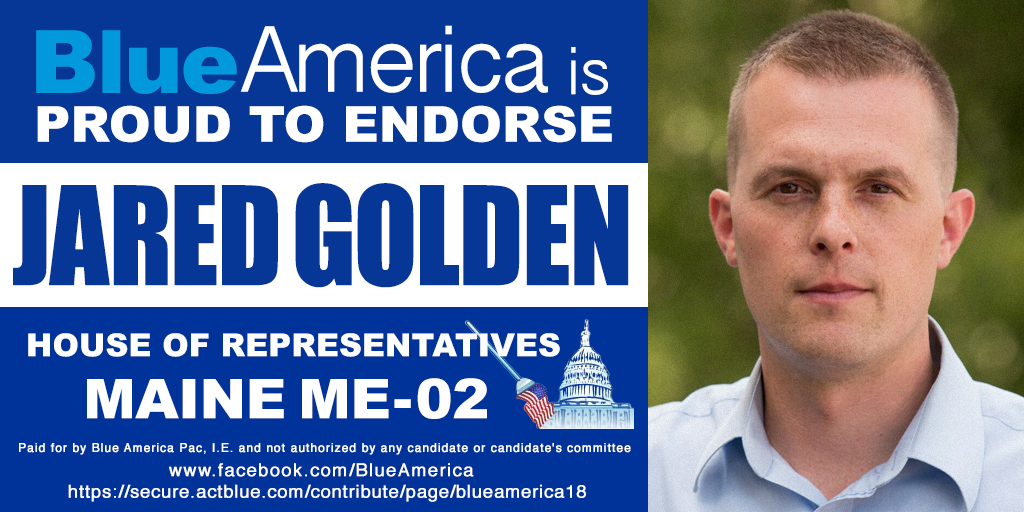
Thursday night Jared Golden, the Majority Whip of Maine's state House, and the progressive running for Congress in the sprawling 2nd congressional district, was the recipient of the Maine AFL-CIO's Edie Beaulieu Legislative Award "in recognition of outstanding leadership and support for working class people and working families' priorities. He received this award because of his work to pass a new law to increase access to workers' compensation for firefighters, paramedics and police officers suffering from a work place injury related to mental health. He also got it for legislation he introduced to increase fines for wage theft and to bring automatic voter registration to Maine. And finally, because he stood by the voice of the voters and refused to vote for bills that repealed the referendum questions they approved with ballot referendums last fall. "Edie Beaulieu," he said at the awards ceremony, "was a janitor [who] worked hard to help provide for her family. She was a strong, working class woman who saw a need for advocacy in her community and took it upon herself to organize and lead it. And as a legislator, she developed a reputation for taking on the establishment and fighting tirelessly for every cause she committed herself to. We’ve all heard the story of her historic fight to put smoke detectors in homes which has saved so many lives in Maine. The legislation failed several times but Edie kept bringing it back until finally she’d built the coalition necessary to beat the establishment." It was obvious Jason relates strongly with her story and her place in Maine history. This is what he told the union members who honored him Thursday night:
I am receiving this award in part because I took on a fight to pass a bill that had failed several times in the Legislature. This is a law that can save lives too.

It can save the life of one of the heroes that we rely on to show up when the smoke detectors sound. Firefighters and paramedics.

Everyone in this room knows that hard work takes a toll on working men and women. That’s especially true of police officers, firefighters and paramedics. The people who show up to help and protect others, during the toughest times of their lives.

When you put all your heart into helping others, you live their pain. You come to understand it in new ways. And it can take a toll on you.

You almost can’t help it, even though you know that what you’re doing is honorable and right. The repeated exposures and the risks that you take-- catch up and get ahead of you.

I fought this fight for you because I know what some of you are going through. I was diagnosed with Post Traumatic Stress when I came home from tours in Afghanistan and Iraq.

And while I worked, pushing a broom in a mechanics shop, and working part-time at night to get by on dirt wages, I had to struggle with a government system that was broken and that let a lot of veterans like me fall through the cracks.

Lucky for me I had friends and family to help and keep me putting one boot in front of the other. But I’ve also lost good friends with the same problems but no one there that knew how to help them or who even understood that they needed help.

That’s why I have no tolerance for standing by and watching a broken system that’s failing good men and women that have given so much.

Goal Thermometer I didn’t care when people told me that this bill had no chance in hell of passing. That it had already been tried. Or that the insurance and corporate lobbyists were too strong to defeat.

Well I guess they weren’t strong enough to take on Labor.

The success of this bill belongs to the union men and women-- the firefighters, paramedics and police officers who showed up in the Labor Committee and laid their hearts and souls out telling their stories.

They had the courage to share their personal struggles publicly. Not for themselves-- but for others. For their brothers and sisters that serve alongside them and for future generations that are going to step up and follow in their footsteps.

You did this so that your brothers and sisters can get the workers’ compensation that they deserve when they’ve been hurt by the job.

My life experience-- growing up having to earn every penny that’s come my way. Having to overcome struggles that are the result of the jobs that I’ve done. Living paycheck to paycheck. These experiences are what I call upon as a guide to set my priorities as an elected official.

And that’s why you can count on me to always have your back.

Every vote that I take, I’m going to ask “how does this help or hurt working men and women and their children back home. No matter if it’s in the State House or in Congress.

For too long now, some people in the Democratic Party have taken unions for granted. They want your PAC money-- they want the strength of your organizing abilities in the field to turn out the vote.

But at the same time they whisper that organized Labor is dying. If that’s true, then the progressive movement is going to die with it. I’m not one of those Democrats.

My voting record speaks for itself. I admire the hard work that you do and I admire the values that you stand for. The idea that unions are somehow less important in the new economy couldn’t be more wrong.

Now more than ever-- with everything that’s going on in America, now more than ever WE need YOU. Organized Labor is the answer to returning fairness and economic security to working men and women.

And that’s why unions are under attack. Under attack by a conservative Supreme Court. Under attack by a Congress that’s hostile to organized Labor.

I don’t have all the answers, but collectively you do, and I am all ears. I promise you this-- I will not sit by and watch the establishment come after you. I’m sick of just playing defense. Killing union busting bill, year after year.

I want to go on the the offensive to strengthen unions. Stronger unions, stronger America. I believe that from the bottom of my heart.

Earlier this year I sponsored a bill to increase fines on businesses caught stealing workers’ wages. And the Chamber of Commerce said that I had slapped the business community across the face. Well it’s damned right that if you’re stealing the hard earned fruits of your workers’ labor I will slap you with legislation to hold you accountable.

In the New York Times this past Sunday. There was an article about how there’s a lot of work, but not enough pay, and it said
economists assert that the weak growth in wages is an indicator of a new economic order in which working people are at the mercy of their employers.
At the mercy of their employers.

The Labor Movement exists because that is not acceptable.

You are in this room because you will never view a job as an act of mercy from a boss.

And no matter where I am, or what office I hold, I will stand shoulder to shoulder with you to demand a different economic order-- based on honest value for our blood and sweat, and based on equal power for our voice.

This award is the greatest honor I’ve been given as a legislator. I thank you-- but it is not mine-- it’s yours. Thank you for the work that you do. And thanks for having me here with you tonight.
The Democratic Party needs to get behind more union candidates who understand what solidarity means-- like Jared and like Randy Bryce, Jenny Marshall and Paul Clements-- and fewer self-funding multimillionaire Republican-lite candidates, who don't relate to the lives and aspirations of ordinary American working families.


Labels: , , , , ,

Sunday, April 10, 2016

Despite Scott Walker And Paul Ryan, Democracy Is Still Alive And Kicking In Wisconsin

>


Great that Wisconsin state Rep. David Bowen, a DNC super-delegate, pledged his support to Bernie after Bernie's sweeping victory in his state last week. Bernie beat the establishment candidate 567,936 (56.6%) to 432,767 (43.1%) and won 71 of Wisconsin's 72 counties. Bowen, who is Vice-Chair of the Wisconsin Democratic Party mentioned on his Facebook page that Wisconsin "voters have decided by a 14 point margin that they desire the political revolution Bernie Sanders speaks about... I am honored to endorse the Senator and to work with the campaign in amplifying its message that has taken a hold in Wisconsin." (Next door in Minnesota, that state's 3rd congressman, Rick Nolan, endorsed Bernie too yesterday and committed his super-delegate vote to his cause.)

But that wasn't even the best news out of the Badger State this weekend-- not by a long shot. Circuit Court Judge William Foust has struck down Scott Walker's extreme right-wing anti-union law as unconstitutional and tossed it out. Walker's right-wing Attorney General, Brad Schimel, is filing an appeal, of course.
Wisconsin's right-to-work law, championed by Republican Gov. Scott Walker as he was mounting his run for president, was struck down Friday as violating the state constitution.


...Three unions [International Association of Machinists, United Steelworkers and the AFL-CIO] filed the lawsuit last year shortly after Walker signed the bill into law. They argued that Wisconsin's law was an unconstitutional seizure of union property since they now must extend benefits to workers who don't pay dues.

Dane County Circuit Judge William Foust agreed. He said the law amounts to the government taking union funds without compensation since under the law they must represent people who don't pay dues. That presents an existential threat to unions, Foust wrote.

"While (union) losses today could be characterized by some as minor, they are not isolated and the impact of (the law) over time is threatening to the unions' very economic viability," he wrote.

...The law's Democratic supporters hailed the decision as a victory for the middle class and working families.

"The extreme right-wing Republican agenda has been incredibly harmful to working people and businesses in Wisconsin," said Democratic Assembly Minority Leader Peter Barca.

Frederick Perillo, lead attorney for the unions, said the judge's decision was based on well-established Wisconsin law and should stand on appeal.


"I don't think the decision can just be dismissed as a product of a liberal judge in one county. ... We think that justice prevailed in the lower court and we would be hopeful that it would continue to prevail," he said.

The lawsuit was brought by three unions-- Machinists Local Lodge 1061 in Milwaukee, the Wisconsin AFL-CIO chapter and United Steelworkers District 2 in Menasha. Phil Neuenfeldt, president of the Wisconsin AFL-CIO, said the ruling was a "needed check on Scott Walker's attacks on working families."

"Right to work has always been unjust, now it's proven unconstitutional," he said.
Let's keep the revolution alive and, by the way, speaking of Wisconsin... can you help STOP PAUL RYAN:
Goal Thermometer

Labels: , , ,

Tuesday, September 15, 2015

Will Walker's Latest Clueless Attack On Unions Signal The Death Knell For A Campaign That Has Already Capsized?

>


Once the Koch brothers struck a deal with Sheldon Adelson that his boy Marco Rubio could be the vice presidential nominee, it looked like Wisconsin Governor Scott Walker would be able to overcome Jeb Bush and be the Republicans' candidate for president. Things didn't quite work out as planned. Walker has lately nearly disappeared from even second-tier polling and showed up on the newest Washington Post/ABC poll at 2%, tied for 9th place with failed CEO Carly Fiorina.

His strategy for winning neighboring Iowa and then sweeping away the opposition collapsed as Iowans got to know him better and his polling started plunging. The serial flip-flopper went from first place (18%) to 8th place (3%) in just a few months, according to the latest Quinnipiac poll in Iowa. Pretty bad... but better than New Hampshire, where yesterday's Monmouth Poll showed him slipping into a tie for 9th place with Chris Christie, at 2%. And it was even worse news in Florida, where Gravis Marketing's new poll showed him with 1.1% among the state's likely Republican voters, worse than Huckabee and barely ahead of Rick Perry, who has already dropped out of the race. In this morning's NYTimes, their coverage of the polling data from yesterday noted that "Jeb Bush fell in the poll, to 6 percent, from 13 percent, and Gov. Scott Walker of Wisconsin tumbled to 2 percent from 10 percent. No other candidates fell as much as those two, according to the poll." Walker has lost an astounding 80% of his support among Republican primary voters! Why does the Beltway media still talk about him as a serious contender rather than as a crank like Santorum, Jindal, Christie, Gilmore or Pataki?

Fox News warned Walker a few days ago: "A low finish in either or both Iowa or South Carolina, the third state to vote, frequently results in donors pulling out of campaigns, forcing them to end. New Hampshire votes second." Yesterday Paul Waldman at the Washington Post referred to this disintegrating campaign as Scott Walker's race to the bottom. Walker is hoping GOP animus toward organized labor, the issue that has so endeared him to the Koch brothers, would do for him what anti-immigration fanaticism has done for Trump.


His plan to attack organized labor as the last ditch of his failing campaign started yesterday. He is determined to see every labor union crushed and every vestige of workers’ power banished.
While he doesn’t say so explicitly, what Walker seems to hope for is really a world without any labor unions at all, or at the very least a world where unions are so weakened that they are unable to advocate for anyone. Here are the major parts of his plan:

Eliminate the National Labor Relations Board. Walker says the NLRB is “a one-sided advocate for big-labor special interests,” but the truth is that Democrats appoint pro-labor members to the board, while Republicans appoint anti-labor members to the board. Transferring the NLRB’s authority to adjudicate labor disputes to the courts would probably be a mixed bag in terms of worker rights.

Eliminate big-government unions.” This is pretty straightforward. You don’t like unions? Get rid of ’em. Today there are around seven million Americans represented by a public sector union, and around one million of those are employed by the federal government (including the Postal Service). If Walker got his way, the latter group could kiss their representation goodbye-- and given his record, it’s pretty clear he wouldn’t mind getting rid of the state and local public-sector unions as well.

Institute a national “right to work” law. The phrase “right to work” is a triumph of conservative PR, because how could anyone object to a right to work? What it means in practice, however, is that in places where unions negotiate salaries and benefits for workers, those workers can’t be required to contribute to the union that got them those salaries and benefits (no one can be required to join a union, but where there are no right to work laws, you can be required to contribute when the union negotiates on your behalf). Whenever a right to work law is being debated in a particular state, Republicans argue that because the law would weaken unions, it will draw employers who don’t want to have to bother with the high wages and good benefits those unions can negotiate.

Which, the evidence suggests, is probably true. But such laws have another effect: they pull down wages and benefits. So that’s the bargain a state makes when passes a right to work law:  more jobs, but worse jobs.

Think about what would happen if you took this policy national. On a state level, it’s possible for a right to work law to draw a factory from one state to another. But if every state was a right to work state, then that incentive to move is eliminated. The decrease in union representation would spread, which drives down wages and benefits for everyone. Whether you think that’s a good thing depends on whether you are concerned with the interests of large business owners or the interests of workers.

There are a number of smaller ideas in Walker’s plan, like eliminating the requirement that federal contractors pay the “prevailing wage” (i.e. union wage) for construction projects, further reinforcing what seems to be Walker’s belief that the problem with unions is that they let workers earn too much money.

...Though Walker’s plan is couched in all kinds of pro-worker rhetoric like that (and endless repetition of the phrase “union bosses”), in truth it’s about as pure an expression of supply-side, trickle-down economics as you’ll find. Its basic principle is that once we eliminate workers’ ability to bargain collectively, everything will turn out great for everyone.

But here’s what we know: union membership has been declining for decades, while incomes have been stagnant and Americans have felt increasingly at the mercy of employers who treat them like interchangeable cogs who can be manipulated, surveilled, and tossed aside at the employer’s whim. There’s no question that Scott Walker succeeded in creating a politically beneficial showdown with public sector unions in Wisconsin. But how many Americans think that the problem with our economy is that too much power in the workplace lies in the hands of workers?
This isn't a program that's going to steal away Trump's base of white blue-collar workers, although the Koch brothers may get boners reading it. If this is what Walker meant by wreaking havoc on Washington... well, it's even more unlikely now than ever before that he'll ever get there. Interestingly, the Anzalone Liszt Grove Research just released some information that may make Walker regret he even tried going down this path. Support for labor unions has started to grow, after hitting an all-time low of 48% disapproval in 2009.


[P]opular support for labor unions is returning to pre-recession levels. Just last month, Gallup released a poll announcing that labor unions are enjoying an approval rating of 58%, jumping five points over the last year and 10 points since 2009. That is in line with every Gallup poll for 70 years before the recession, which found a majority of Americans approve of labor unions (72% approve 1936 / 60% approve 2008). For the first time in more than six years, more Americans would like to see labor unions have a greater influence in the country rather than less (37% more / 35% less / 24% same). At the height of anti-labor sentiment in 2009, 42% of Americans said labor unions should have less influence while only 25% thought they should have more.

Today, union membership hovers around 11 percent-- half of what it once was when data was first tracked over thirty years ago. Views are mixed on whether this decline in membership has been good for the country (45% mostly bad / 43% mostly good) but a majority of Americans believe it has been bad for working people (52% mostly bad / 40% mostly good).

So what has inspired this rising favorability towards labor? Could it be a byproduct of an improving economy coupled with frustration over stagnant wages? A retaliation against the bludgeon a number of GOP governors have taken to unions in their states? A result of changing demographics, specifically in lower wage industries like food service and hospitality? Could it be some combination thereof?

Support among different demographics gives us a few clues. 66 percent of young adults, ages 18-34, approve of labor unions and 44 percent want them to have more influence-- the highest ratings among all age groups. Unions also enjoy a higher margin of support among minorities, a demographic steadily growing as a share of the population. African-Americans rate labor unions the most favorably (60% favorable / 29% unfavorable) while nearly half of Hispanics view labor unions favorably (49% favorable / 32 unfavorable). Among low earners, specifically those working full time in minimum wage jobs (earning less than $30,000 annually), labor unions have a 23 point net favorability rating (54% favorable / 31% unfavorable).

Not only do minorities view labor unions more favorably, they are also more likely to be members of a labor union, according to the most recent data by the Bureau of Labor and Statistics . This fact is not lost on labor leaders who see mainstream efforts advocating greater racial equality and immigration reform as keys to their survival. Hispanics make up one-quarter of all workers in the accommodation and food services industry , and are joining labor unions' member roles at higher rates than white workers.

...Among the GOP field, candidates wear their union-bashing credentials as badges of honor in a regular game of Who Hates Labor Unions More. Earlier this spring, Scott Walker went so far as to compare terrorist groups like ISIS to labor demonstrators during his first term. John Kasich joked that if he were king, he "would abolish all teachers' lounges, where they sit together and worry about 'Woe is us.'" And Chris Christie did not mince words when he said that the American Federation of Teachers deserved a punch in the face.

What they fail to fully appreciate: these workers are far more popular than any of these GOP candidates will ever be. Moreover, according to Pew Research, labor unions enjoy sizable favorability among GOP voters today. Many Republicans are favorable towards labor unions (31% favorable / 57% unfavorable), and they are especially popular with the following GOP voters:
Republicans who didn't go to college (41% favorable / 43% unfavorable)
Republicans under 35 years old (45% favorable / 44% unfavorable)
Republicans earning less than $30,000 per year (42% favorable / 42% unfavorable)
So the slate of GOP presidential candidates is out of step with a significant portion of their voters.

You will not hear such sentiments among Democrats, however. Democrats are more in sync with the American population on supporting labor unions, and in turn, labor households remain an important piece of the Democratic coalition. Obama would have lost the popular vote in 2012 without strong support from union households-- he lost non-union households on election day, with union households giving him a margin of victory. The electoral impact would have been especially felt in the union-dense Midwest. In Michigan, for example, a state Obama won by nine points (Obama 54% / Romney 45%), Obama would have run dead even with Romney if no union households voted. In Wisconsin and Ohio, similarly, union households provided the margin of victory for Obama.

The union-dense Midwest is a region the GOP plans to win by alienating people of color and running up the white vote. Reality reveals this strategy's shortcomings, however:  it's hard to win enough white Midwestern votes when you're telling a big chunk of these voters that their right to organize is what's ruining America.

Even the Koch brothers are starting to lose faith in Walker-- not as a devoted puppet, but as someone who can deliver for them. Their network is starting to trend towards Texas fascist Ted Cruz, which will leave Walker-- and Rubio-- up shit's creek without a paddle. A timely little reminder: someone whose credentials as a supporter of the legitimate rights of working families and as someone who has always backed-- and will always back-- organized labor, is Bernie Sanders. (Read the comments in this post after a union disregarded its members and endorsed Hillary.) If you can, please consider supporting Bernie's grassroots campaign here.

Labels: , , , ,