Sunday, November 04, 2018
Friday, November 02, 2018
Which Party Will Turn Out Its Base? And What Will Independents Do?
>
I feel like a tape: Republicans generally vote for Republicans and Democrats generally vote for Republicans. That's why, in so many districts-- including ALL the battleground districts-- independents decide the outcome. And you know who independents do not like? Right-- Trump. Glen Borger is a top GOP pollster and he sees it the same way I do:
Trump may be too dense to understand that, but, believe me, there are operatives around him who do-- and who read and grok what Amy Walter wrote for Cook yesterday about the end of the cycle's added uncertainty and chaos spurred by Señor Trumpanzee in the waning hours of the campaign. "Every midterm is about the sitting president," she wrote, "even ones who are more traditional and less unorthodox than the one currently sitting at 1600 Pennsylvania Avenue. The better a president’s approval ratings, the better his party does in the midterms. The weaker his ratings, the more losses his party suffers. This president has always wanted the election to be about him. And, in these final hours he's made sure to put the focus back on himself. He's ramped up the rhetoric on illegal immigration, ordered the military to the southern border and floated the idea about doing away with birthright citizenship with an executive order. But, what's also been true about this president, is that the less he's front and center, the better his job approval rating." Republicans up for reelection and party strategists are flipping out because he's thrusting his biggest weaknesses-- his temperament, his racism, his mendacity, his over-heated rhetoric and undisciplined tweeting-- into everyone face and Walter reported that GOP strategists have told her that they're "seeing slippage in Trump’s approval rating similar to the drop we saw this week in Gallup’s tracker (Trump dropped from 44 percent to 40 percent). This is why many of them are more worried about big losses in the House than they were just a week or ten days ago."
The racist, xenophobic, inflammatory new Trump ad isn't going to help with independents-- nor with mainstream conservatives. CNN termed it "the most racially charged national political ad in 30 years... the most extreme step yet in the most inflammatory closing argument of any campaign in recent memory." Opposite of "moderate" in every way. White nationalism isn't working for him either, at least not with independents or many mainstream Republicans. The NY Times reported Monday that "If the 2016 election hinged in large part on a rightward shift among working-class whites who deserted Democrats in the presidential race, Tuesday’s House election may turn on an equally significant and opposite force: a generational break with Republicanism among educated, wealthier whites-- especially women-- who generally like the party’s pro-business policies but recoil from strident, divisive language on race and gender. Rather than seeking to coax voters like these back into the Republican coalition, Mr. Trump appears to have all but written them off, spending the final days of the campaign delivering a scorching message about preoccupations like birthright citizenship and a migrant 'invasion' from Mexico that these voters see through as alarmist." That kind of stuff is part of what got Bolger flipping out yesterday.
Writing for the Washington Post, Glen Balz and Scott Clement reported on a new Schar School poll of likely voters in 69 battleground congressional districts. The poll found 50% of likely voters in those districts (combined; they don't break them down by district, wasting time instead writing about their murdered colleague, Khashoggi who will not determine a single vote anywhere) support the Democrats and 46% support the Democrat. Keep in mind that only 6 of the 69 seats are currently in Democratic hands, meaning that 63 Republican seats were being polled-- and the Democratic candidate was still leading in the aggregate.
Turnout remains a critical factor in next Tuesday’s balloting, and given past patterns, Democratic turnout is at greater risk of falling short of what the candidates in competitive races might need to win. The party’s current level of support in the poll of battleground districts is fueled by a 21-point advantage among voters under age 40, a 21-point advantage among independents who lean toward neither party and a 40-point advantage among nonwhite voters.
These groups have turned out at low rates in recent midterm elections. In 2014, 36 percent of eligible African Americans voted, along with 21 percent of Hispanics and 16 percent of people under age 30, according to the United States Elections Project. At the same time, 41 percent of whites cast ballots. And while some voters in these groups express heightened enthusiasm this year, it is unclear how much the electorate’s makeup will shift from previous years. Overall, voters who did not turn out in the 2014 midterms favor Democrats by 55 percent to 42 percent, while those who did vote split 49 percent to 48 percent in Republicans’ favor.
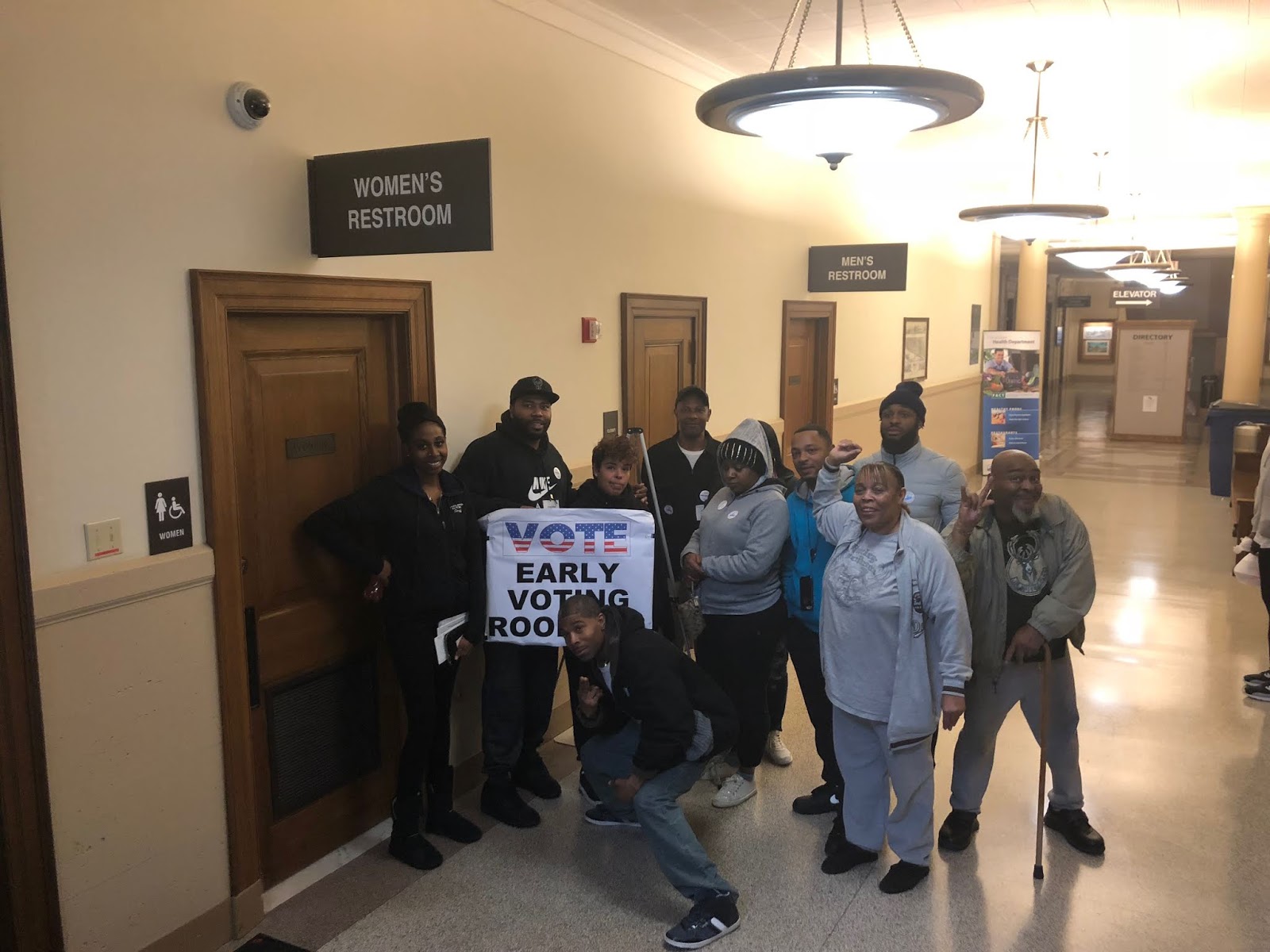
I'm not including this photo (above) of these people because they are early voters-- although each one of them did vote early-- but because they are bus drivers who have been bringing their neighbors to the early voting location in Racine all week. One of the top Wisconsin Democratic operatives told me today that early voting in Racine is higher than it was in the 2016 presidential election and "probably higher than it has ever been. Our voters flooded into early voting places all week giving incredible head starts to Tony [Evers], Tammy [Baldwin] and Randy [Bryce] and to our down-ballot candidates... I've never seen anything like this before-- no one has-- and I've been doing this longer than most of these people have been alive."
We're hearing that Democratic turnout in WI-01 blue bastions-- Kenosha and Janesville particularly-- are even higher than they are in Racine. There were immense lines to get into city clerk's offices to vote-- some wrapping around buildings, as it did in Racine. I've been hearing identical reports from Austin, Texas and from Atlanta, Georgia, where Democrats-- particularly the ones the media says are unlikely to vote (millennials and people of color)-- are charged up and prepared to wait on long lines as if at the end of the line they could smack Trump across his sneering face.
Trump may be too dense to understand that, but, believe me, there are operatives around him who do-- and who read and grok what Amy Walter wrote for Cook yesterday about the end of the cycle's added uncertainty and chaos spurred by Señor Trumpanzee in the waning hours of the campaign. "Every midterm is about the sitting president," she wrote, "even ones who are more traditional and less unorthodox than the one currently sitting at 1600 Pennsylvania Avenue. The better a president’s approval ratings, the better his party does in the midterms. The weaker his ratings, the more losses his party suffers. This president has always wanted the election to be about him. And, in these final hours he's made sure to put the focus back on himself. He's ramped up the rhetoric on illegal immigration, ordered the military to the southern border and floated the idea about doing away with birthright citizenship with an executive order. But, what's also been true about this president, is that the less he's front and center, the better his job approval rating." Republicans up for reelection and party strategists are flipping out because he's thrusting his biggest weaknesses-- his temperament, his racism, his mendacity, his over-heated rhetoric and undisciplined tweeting-- into everyone face and Walter reported that GOP strategists have told her that they're "seeing slippage in Trump’s approval rating similar to the drop we saw this week in Gallup’s tracker (Trump dropped from 44 percent to 40 percent). This is why many of them are more worried about big losses in the House than they were just a week or ten days ago."
What creates wave elections is usually a big differential in turn-out. One party turns out. The other stays home. And, as such, the winning party picks up seats that they would never have been able to capture at a time of ‘normal’ turnout.
This year is different. Democratic enthusiasm is sky high. But, Republicans are energized too. The so-called ‘enthusiasm gap’ in the NBC/Wall Street Journal poll went from Democrats +12 for most of 2018 to a smaller D+4 lead in October.
...Of course, intent to vote and actually voting are two different things. Just because Trump has retained the loyalty of his base doesn’t mean that they are also committed to showing up to vote. The most recent NBC/Wall Street Journal poll found Democrats more intensely negative about Trump (79 percent) than Republicans are intensely positive (65 percent).
For Democrats, the question is whether their least reliable mid-term voters-- young voters and voters of color-- show up. The early vote suggests they will, but many Democrats who are tracking this on the ground remain skeptical.
Intensity can also be measured by who has the most financial fire-power. On this score, Democrats are also dominating. A Republican source showed me the amount of money spent since July 1 on advertising in the most competitive 75+ House races. Democratic candidates have outspent GOP candidates almost 2-1 ($163M to $88M). And, the GOP outside groups haven’t been able to fill in the gaps. The three biggest GOP outside group funders-- the Paul Ryan affiliated Congressional Leadership Fund, the NRCC independent expenditure (IE) and Trump SuperPAC, America First, have spent a combined $174.5M. But, the three biggest Democratic groups: the DCCC IE, House Majority PAC and the Michael Bloomberg SuperPAC Independence USA are not far behind at $156.6M.
Polarization Means Independents More Important Than Ever
The most recent polling suggests that Republicans haven’t ‘solved’ their independent voter problem. The Marist/PBS poll showed Democrats leading among independents on the generic ballot by 10 points. The NBC/Wall Street Journal poll shows Democrats leading the generic by 14 points. This is in line with the last three midterm wave elections (2006, 2010, and 2014), in which the winning party carried independents by 12 to 19 points.
How are the two parties trying to woo these independents in the closing days of the campaign? For Republicans, their message is focused almost exclusively on three things: Nancy Pelosi, taxes and ‘government-run/socialized health care.” Why? Among independent voters (according to the NBC/Wall Street Journal survey), Nancy Pelosi is 13 points more unpopular (-33) than Trump (-20).
For Democrats, it’s all about health care (the second most important issue to these voters in the NBC/Wall Street Journal poll) and the GOP incumbent’s attachment to ‘special interests” (‘changing how things work in Washington is another top issue for these voters). We are also seeing a number of closing ads from candidates that feature their commitment to solving problems (i.e., I’m not going to be a part of the partisan food fight in DC). It also serves as a contrast to the divisive language the president is using in these final days.
The racist, xenophobic, inflammatory new Trump ad isn't going to help with independents-- nor with mainstream conservatives. CNN termed it "the most racially charged national political ad in 30 years... the most extreme step yet in the most inflammatory closing argument of any campaign in recent memory." Opposite of "moderate" in every way. White nationalism isn't working for him either, at least not with independents or many mainstream Republicans. The NY Times reported Monday that "If the 2016 election hinged in large part on a rightward shift among working-class whites who deserted Democrats in the presidential race, Tuesday’s House election may turn on an equally significant and opposite force: a generational break with Republicanism among educated, wealthier whites-- especially women-- who generally like the party’s pro-business policies but recoil from strident, divisive language on race and gender. Rather than seeking to coax voters like these back into the Republican coalition, Mr. Trump appears to have all but written them off, spending the final days of the campaign delivering a scorching message about preoccupations like birthright citizenship and a migrant 'invasion' from Mexico that these voters see through as alarmist." That kind of stuff is part of what got Bolger flipping out yesterday.
Writing for the Washington Post, Glen Balz and Scott Clement reported on a new Schar School poll of likely voters in 69 battleground congressional districts. The poll found 50% of likely voters in those districts (combined; they don't break them down by district, wasting time instead writing about their murdered colleague, Khashoggi who will not determine a single vote anywhere) support the Democrats and 46% support the Democrat. Keep in mind that only 6 of the 69 seats are currently in Democratic hands, meaning that 63 Republican seats were being polled-- and the Democratic candidate was still leading in the aggregate.
Turnout remains a critical factor in next Tuesday’s balloting, and given past patterns, Democratic turnout is at greater risk of falling short of what the candidates in competitive races might need to win. The party’s current level of support in the poll of battleground districts is fueled by a 21-point advantage among voters under age 40, a 21-point advantage among independents who lean toward neither party and a 40-point advantage among nonwhite voters.
These groups have turned out at low rates in recent midterm elections. In 2014, 36 percent of eligible African Americans voted, along with 21 percent of Hispanics and 16 percent of people under age 30, according to the United States Elections Project. At the same time, 41 percent of whites cast ballots. And while some voters in these groups express heightened enthusiasm this year, it is unclear how much the electorate’s makeup will shift from previous years. Overall, voters who did not turn out in the 2014 midterms favor Democrats by 55 percent to 42 percent, while those who did vote split 49 percent to 48 percent in Republicans’ favor.
I'm not including this photo (above) of these people because they are early voters-- although each one of them did vote early-- but because they are bus drivers who have been bringing their neighbors to the early voting location in Racine all week. One of the top Wisconsin Democratic operatives told me today that early voting in Racine is higher than it was in the 2016 presidential election and "probably higher than it has ever been. Our voters flooded into early voting places all week giving incredible head starts to Tony [Evers], Tammy [Baldwin] and Randy [Bryce] and to our down-ballot candidates... I've never seen anything like this before-- no one has-- and I've been doing this longer than most of these people have been alive."
We're hearing that Democratic turnout in WI-01 blue bastions-- Kenosha and Janesville particularly-- are even higher than they are in Racine. There were immense lines to get into city clerk's offices to vote-- some wrapping around buildings, as it did in Racine. I've been hearing identical reports from Austin, Texas and from Atlanta, Georgia, where Democrats-- particularly the ones the media says are unlikely to vote (millennials and people of color)-- are charged up and prepared to wait on long lines as if at the end of the line they could smack Trump across his sneering face.
Labels: 2018 congressional races, independents, turn-out, Wisconsin
Friday, October 12, 2018
Will Millennials Turn Out This Time? There ARE Ways To Encourage Them To
>
Laura Dawn, the founder and chief executive of Art Not War, sent me that great 60 second video above, featuring Aja Naomi King, star of How to Get Away With Murder to help spread the word about the midterms to young people (in the 18-29 year old bucket). These are people with very progressive views-- and a very low propensity to turn out to vote, especially in non-presidential elections.
Another friend of mine, Richard Greene has the same idea, but with a completely different approach. Yesterday he told me that he's trying to put together a series of PSA-type TV spots that make it clear what exactly is at stake in the midterms and what the difference is between the 2 parties. Remember, Pelosi has led the Democrats down a big tent rat-hole where the Democrats stand for virtually nothing other than being the lesser-of-two evils-- no grand approach that will make anyone's life better-- not even something as simple and non-controversial as adding dental, eye and ear care to Medicare, for example. Instead, her midterm cri de guerre is PayGo, something no one in the country cares about other than her multimillionaire donors and cronies-- and certainly ZERO millennials.
How about these suggestions from Greene instead?
• If you care about renewable energy, vote for Democrats on November 6-- yes, Democrats in every single race... For U.S. Senate, for the House, for governor, for state legislators-- EVERY. SINGLE. RACE.Greene's approach should even offend too many of Pelosi's big tent Democraps, since these popular issue solutions are pretty much all agreed on among members of her caucus. Some people might want to add in more cutting edge, even controversial issues-- like free state college-- very popular among millennials-- or Medicare-For-All or Job Guarantee or raising the minimum wage. But then you get about a third of the House Democrats--the Republican wing of the party-- New Dems and Blue Dogs-- starting to distance themselves from a party message they don't support.
Why? Because Democrats support clean and renewable energy and Republicans do not. The best renewable energy bill is called "The OFF Act" to get off of fossil fuels by 2030. 100% of the Members of Congress sponsoring this bill are Democrats-- one hundred percent. And ZERO percent are Republicans.
If you care about renewable energy, vote for Democrats on Nov. 6. ONLY Democrats.
And if you want bills like this to pass the ONLY way for this to happen is if you vote.
• If you care about equal pay for women, vote for Democrats on November 6-- yes, Democrats in every single race... For U.S. Senate, for the House, for governor, for state legislators-- EVERY. SINGLE. RACE.
Why? Because Democrats support EQUAL PAY FOR WOMEN and Republicans do not.
The best equal pay bill is called "THE PAYCHECK FAIRNESS ACT" which mandates that women get $1 for every dollar that a man makes in the same job. 100% of the Members of Congress sponsoring this bill are Democrats. 100%! 0% are Republican.
If you care about equal pay for women, vote for Democrats on Nov. 6. ONLY Democrats
And if you want bills like this to pass the ONLY way for this to happen is if you vote!
• If you care about comprehensive background checks to buy a gun in America, vote for Democrats on November 6-- yes, Democrats in every single race... For U.S. Senate, for the House, for governor, for state legislators-- EVERY. SINGLE. RACE.
Why? Because Democrats support comprehensive background checks and Republicans do not. The best background check bill is called "THE BACKGROUND CHECK EXPANSION ACT" which closes the loopholes so that no criminals, domestic abusers, terrorists, rapists or mentally ill individuals can get their hands on guns. 100% of the Members of Congress sponsoring this bill are Democrats. 100%! 0% are Republican.
If you care about common sense gun policies, vote for Democrats on Nov. 6-- ONLY Democrats. And if you want bills like this to pass the ONLY way for this to happen is if you vote!
Richard's moderate approach would at least be something that differentiates the two parties in an easy-to-understand and positive way... certainly better than PayGo at least.
Primary Turn-out Surged. But Far More For Democrats Than For Republicans
>
On Wednesday Axios posted a fascinating chart about the blue vs red primary surge in swing districts this cycle. You can probably read it if you click on the image:
They compared 19 battleground House districts to see how much of a primary vote surge there was for each party in each district. And there was a surge for each party in each district-- but the surges were disproportionately stronger for the Democrats in every single one of the 19 districts, all of which have Republican congressmen now
Now let me make a few things clear that Axios didn't look at. First off, even in districts where there were non-competitive primaries-- take WA-08-- for example, there were much bigger Democratic voter surges than Republican. The incumbent, Cathy McMorris Rodgers, saw a modest 1.6x jump from the 2014 midterms, the second biggest of any of the 19 districts for a Republican. But that was dwarfed by the 2.8x jump for Democrats who came out in droves to vote for Lisa Brown. And that isn't an outlier... that was the story in every one of these districts.
Look at CA-45, the Orange County district where Trump rubber-stamp Mimi Walters is desperately clinging to life. There were no other Republicans in the primary. However there were 4 Democrats participating, from a right-of-center New Dem, Dave Min, to Katie Porter, who won. But all that activity drive up Democratic participation from 2014 3.3 times among Democrats but just 1.4 times among Republicans.
How about where was no incumbent and there was a real Republican contest? Let's look at the CA-49 race (southern Orange County and northern San Diego County). Darrell Issa had announced he was retiring and the primary was wild-- 9 Republicans and 4 Democrats. You'd think all those Republicans would drive up turnout, right? But no. Democratic turnout zoomed up 2.7 times while GOP turnout lagged at 1.5 times.
It was even worse for Republicans in WI-01, where Paul Ryan withdrew from the race. There were 6 Republicans in the hunt but just 2 Democrats. 61,087 Democrats participated and just 59,870 Republicans. Democrats were so charged up to vote for Randy Bryce-- 36,397 did-- that Democratic voter participation surged two and a half times, while barely ticking up among Republicans at all-- 0.9 times. Ryan's handpicked candidate, corporate lawyer Brian Steil, was endorsed by Trump but he only managed to get 30,883 votes.
There was no circumstance or combination of circumstances that created a greater-- or even equal-- surge among Republicans than there was for Democrats.
Axios says this matters because 'poor turnout has been the scourge of Democrats' efforts to win congressional elections in the last decade. But this data suggests that a surge of anti-Trump enthusiasm could boost their turnout in November-- and not just in already-blue areas, but in parts of the country that could deliver control of the House to the Democrats."
OK, they have that right, but you know who's all wet? The DCCC. Notice that what's driving this is "anti-Trump enthusiasm," not enthusiasm for the shit candidates the DCCC recruited or for the so-called message the Democrats are supposedly pushing. The ridiculously unpopular "big tent" party is incapable to coming top with a popular message-- say Medicare-For-All or Job Guarantee or free state colleges-- because the DCCC recruits so many conservative Blue Dogs and New Dems from the Republican wing of the party. The only thing the DCCC is good at is digging a grave for the Democratic Party and setting in motion another anti-blue wave for the 2022 midterms. When Pelosi listed her 3 inane priorities, the most memorable one was also the most horrible: PayGo. There is no blue wave-- just an anti-red wave.
So how many of these 19 seats will the Democrats take? Probably 17. Possibly 18. And 19 wouldn't be a shock.
They compared 19 battleground House districts to see how much of a primary vote surge there was for each party in each district. And there was a surge for each party in each district-- but the surges were disproportionately stronger for the Democrats in every single one of the 19 districts, all of which have Republican congressmen now
Now let me make a few things clear that Axios didn't look at. First off, even in districts where there were non-competitive primaries-- take WA-08-- for example, there were much bigger Democratic voter surges than Republican. The incumbent, Cathy McMorris Rodgers, saw a modest 1.6x jump from the 2014 midterms, the second biggest of any of the 19 districts for a Republican. But that was dwarfed by the 2.8x jump for Democrats who came out in droves to vote for Lisa Brown. And that isn't an outlier... that was the story in every one of these districts.
Look at CA-45, the Orange County district where Trump rubber-stamp Mimi Walters is desperately clinging to life. There were no other Republicans in the primary. However there were 4 Democrats participating, from a right-of-center New Dem, Dave Min, to Katie Porter, who won. But all that activity drive up Democratic participation from 2014 3.3 times among Democrats but just 1.4 times among Republicans.
How about where was no incumbent and there was a real Republican contest? Let's look at the CA-49 race (southern Orange County and northern San Diego County). Darrell Issa had announced he was retiring and the primary was wild-- 9 Republicans and 4 Democrats. You'd think all those Republicans would drive up turnout, right? But no. Democratic turnout zoomed up 2.7 times while GOP turnout lagged at 1.5 times.
It was even worse for Republicans in WI-01, where Paul Ryan withdrew from the race. There were 6 Republicans in the hunt but just 2 Democrats. 61,087 Democrats participated and just 59,870 Republicans. Democrats were so charged up to vote for Randy Bryce-- 36,397 did-- that Democratic voter participation surged two and a half times, while barely ticking up among Republicans at all-- 0.9 times. Ryan's handpicked candidate, corporate lawyer Brian Steil, was endorsed by Trump but he only managed to get 30,883 votes.
There was no circumstance or combination of circumstances that created a greater-- or even equal-- surge among Republicans than there was for Democrats.
Axios says this matters because 'poor turnout has been the scourge of Democrats' efforts to win congressional elections in the last decade. But this data suggests that a surge of anti-Trump enthusiasm could boost their turnout in November-- and not just in already-blue areas, but in parts of the country that could deliver control of the House to the Democrats."
OK, they have that right, but you know who's all wet? The DCCC. Notice that what's driving this is "anti-Trump enthusiasm," not enthusiasm for the shit candidates the DCCC recruited or for the so-called message the Democrats are supposedly pushing. The ridiculously unpopular "big tent" party is incapable to coming top with a popular message-- say Medicare-For-All or Job Guarantee or free state colleges-- because the DCCC recruits so many conservative Blue Dogs and New Dems from the Republican wing of the party. The only thing the DCCC is good at is digging a grave for the Democratic Party and setting in motion another anti-blue wave for the 2022 midterms. When Pelosi listed her 3 inane priorities, the most memorable one was also the most horrible: PayGo. There is no blue wave-- just an anti-red wave.
So how many of these 19 seats will the Democrats take? Probably 17. Possibly 18. And 19 wouldn't be a shock.
Labels: 2018 congressional races, anti-red wave, Cathy McMorris Rodgers, Lisa Brown, Randy Bryce, turn-out, WA-05
Friday, June 08, 2018
Don't Democrats Want More People To Vote? That Depends
>
I don't know many people who like Pelosi any longer. It's hard to imagine she could win the Speakership again with so many Democrats pledging they will not vote for her The new NBC/Wall Street Journal poll shows that most voters are "sour"on her. So sour that "45% say they’re less likely to support a candidate who wants Pelosi as speaker, versus 21% who are more likely to back such a candidate." McInturff, the GOP pollster for the bipartisan poll pond out that "She continues to be a serious drag and a net-negative" for Democrats."
A few months ago I spoke at some length with the top two Democratic candidates who primaried her this year, Shahid Buttar and Stephen Jaffe. Both thought they could beat her and both had the feeling that no one in San Francisco could stand her any longer. They were very wrong. In fact the 12th district had the highest turnout of any district in California-- 130,36 voters turned out. (For comparison sake, there were half a dozen California districts with contested primaries where less than 50,000 voters turned out last Tuesday. And, one (CA-35) had only 38,993 people voting. Pelosi took 89,337 votes (68.5%) to Buttar's 10,090 (7.7%) and Jaffe's 7,639 (5.9%). I used to live in San Francisco. I guess I lost track of how the voters feel there.
Nationally, the population of the average congressional district is 710,767. Two real outliers are the Montana at-large district with 994,416 people and Rhode Island's first CD (526,283). There's a huge difference between districts in terms of how many people turn out to vote-- especially in primaries. That was clearly demonstrated Tuesday in California. This list only includes the 41 districts where there were at least 3 candidates.
This year will be Crowley's first real contest. He and his family live in Virginia and few in the district know who he is. He's counting on a low turnout-- but not taking any chances. as of the March 31 FEC reporting deadline he had already spent $2,306,48 (most of it from PACs). Alexandria raised $115,653 and spent $67,128. Please watch this:
Crowley wants to hold down voters participation. Alexandria wants to get as many people registered and voting as she can. That's what her campaign strategy-- aside from her platform-- is all about. The political boss of Queens has made sure as few people of color register as possible. Only 19% of the voters are white and that's his base. Let's compare the number of voters who turned out in 2014 in NY-14 with the other districts in Queens.
A few months ago I spoke at some length with the top two Democratic candidates who primaried her this year, Shahid Buttar and Stephen Jaffe. Both thought they could beat her and both had the feeling that no one in San Francisco could stand her any longer. They were very wrong. In fact the 12th district had the highest turnout of any district in California-- 130,36 voters turned out. (For comparison sake, there were half a dozen California districts with contested primaries where less than 50,000 voters turned out last Tuesday. And, one (CA-35) had only 38,993 people voting. Pelosi took 89,337 votes (68.5%) to Buttar's 10,090 (7.7%) and Jaffe's 7,639 (5.9%). I used to live in San Francisco. I guess I lost track of how the voters feel there.
Nationally, the population of the average congressional district is 710,767. Two real outliers are the Montana at-large district with 994,416 people and Rhode Island's first CD (526,283). There's a huge difference between districts in terms of how many people turn out to vote-- especially in primaries. That was clearly demonstrated Tuesday in California. This list only includes the 41 districts where there were at least 3 candidates.
CA-12 (San Francisco)- 130,360Let's turn to NY-14 for a moment. The NRCC doesn't contest the district which spans a section of northern Queens and the Bronx. The PVI is a prohibitive D+29 and Trump only drew 19.8% of the vote. It's Queens Country machine boss' Joe Crowley's district and this cycle, ardent progressive Alexandria Ocasio is making an excellent case to the voters to replace him with her. No one primaries Crowley and 2014 not even a Republican ran against him. In the general election the Conservative Party ran a candidate instead, Elizabeth Perri, who won 6,735 votes (10%), considerably less than events blank and voided ballots (15.3%). In total only 67,372 people voted. In the 2016 general election 178,132 people voted, 82.9% for Crowley (AKA, the Democrat) and 17.1% for the vanity candidate, a random Republican. Crowley spent $3,107,073 and Frank Spotorno, the Republican, put $140,000 of his own into the race and spent $95,880.
CA-04 (northern Sacramento suburbs)- 124,713
CA-49 (south Orange Co, northern San Diego Co)- 112,000
CA-24 (Santa Barbara)- 111,710
CA-48 (coastal Orange Co.)- 109,343
CA-01 (northeast state)- 108,301
CA-33 (Santa Monica, Beverly Hills)- 103,301
CA-45 (Orange Co.)- 102,688
CA-02 (Marin, Sonoma)- 102,669
CA-52 (northern San Diego)- 102,182
CA-03 (western Sacramento suburbs)- 94,097
CA-18 (silicon Valley, Palo Alto)- 92,566
CA-50 (Inland San Diego Co.)- 88,782
CA-53 (eastern San Diego)- 87,349
CA-26 (Ventura)- 87,608
CA-05 (Napa Valley)- 85,946
CA-39 (northeast Orange County)- 85,786
CA-30 (souther San Fernando Valley)- 82,544
CA-11 (San Francisco N.E. suburbs)- 81,921
CA-28 (Burbank, Glendale, Hollywood)- 81,205
CA-23 (Central Valley, Bakersfield)- 80,313
CA-25 (Santa Clarita, Antelope Valley)- 78,205
CA-22 (Central Valley)- 73,534
CA-36 (Palm Springs, Idio)- 72,244
CA-08 (High Desert, San Bernardino suburbs)- 70,879
CA-47 (Long Beach)- 69,374
CA-15 (Hayward, Fremont)- 69,264
CA-07 (eastern Sacramento suburbs)- 66,076
CA-10 (Central Valley)- 65,342
CA-20 (Central Coast)- 64,241
CA-17 (Silicon Valley, San Jose)- 61,530
CA-42 (Inland Empire)- 59,233
CA-43 (Inglewood, LAX)- 58,358
CA-31 (southwest San Bernardino)- 56,717
CA-09 (Central Valley)- 55,191
CA-51 (San Diego to Nevada)- 46,938
CA-34- (Downtown L.A.) 43,506
CA-29 (Central San Fernando Valley)- 41,954
CA-46 (Noah Orange Co.)- 40,404
CA-44 (Southe L.A. San Pedro, Compton)- 40,041
CA-35 (East L.A., Inland Empire)- 38,993
This year will be Crowley's first real contest. He and his family live in Virginia and few in the district know who he is. He's counting on a low turnout-- but not taking any chances. as of the March 31 FEC reporting deadline he had already spent $2,306,48 (most of it from PACs). Alexandria raised $115,653 and spent $67,128. Please watch this:
Crowley wants to hold down voters participation. Alexandria wants to get as many people registered and voting as she can. That's what her campaign strategy-- aside from her platform-- is all about. The political boss of Queens has made sure as few people of color register as possible. Only 19% of the voters are white and that's his base. Let's compare the number of voters who turned out in 2014 in NY-14 with the other districts in Queens.
• NY-05- 94,400See that thermometer above and on the right? Please click on it and consider helping Alexandria to get more people out to vote, not fewer. I knew Buttar and Jaffe, both good people, had no chance to beat Pelosi; Ocasio does have a chance to beat Pelosi's hand-picked successor. And Crowley far worse than Pelosi is, far, far worse. And please, be sure to check this out... and pass it along to your friends and family.
• NY-06- 77,306
• NY-07- 68,522
• NY-08- 95,113
• NY-12- 117,420
• NY-14- 67,372
• NY- 16- 138,655
Labels: Alexandria Ocasio, Joe Crowley, Nancy Pelosi, NY-14, turn-out
Tuesday, August 22, 2017
2018-- Getting Voters Off Their Couches Will Be A Real Trick, Trump Or No Trump
>

-by Tom Sullivan
Off-year mobilization is tough anytime. But while Democrats here in North Carolina still have a statewide registration edge, unaffiliated voter registration is spiking. Getting voters to turn out will be especially challenging in 2018 because there will be no national or statewide races in North Carolina. Neither U.S. Senate seat is on the ballot in 2018. Congressional races will be the top of the ticket in the state's 13 famously gerrymandered districts. Republicans hold 10 out of the 13 seats. Fair redistricting in 2021 could make the rest more competitive for Democrats. But that means winning very local state House and Senate races to which many voters pay little attention.
Winning U.S. House seats here may help Democrats in Washington, but it won't do much for us in North Carolina unless those districts overlap state House and Senate seats where Democrats can field competitive legislative candidates who might benefit from coattails.
Getting volunteers and voters off their couches statewide will be a real trick, Trump or no Trump. Democrats prone to focusing globally on national and statewide races struggle when it is time to focus granularly on smaller districts. In rural ones where many legislative seats lie, county teams can be less experienced at campaign tech. And because party focus is always on short-term wins, there are never resources for longer-term infrastructure-building.
It is a perennial complaint in progressive circles that Democrats slack sufficient infrastructure for winning independent of having rock-star candidates to draw interest, donations, and volunteers. It's true. When a Barack Obama comes along with limitless money and boisterous volunteers, Democrats are hard to beat. The problem, however, is that campaign infrastructure appears overnight and disappears just as quickly when campaigns pull up stakes. If they show up at all where you live, state and national campaign teams expect to call the shots, leave little behind except unused office supplies, and state parties (as best I can tell) focus on immediate get-out-the-vote needs only, and then primarily in cities where the largest blocks of blue votes are. In 2-4 years, we start again from scratch.
Rural counties where big campaigns don't go are left to fend for themselves with little direction except in organizing precincts and pulling walk/phone lists. You'd go blue in the face holding your breath waiting for the cavalry to arrive with additional resources. And those places are where the state House and Senate seats are that Democrats need to win to flip state legislatures across the country.
Our county has the only Democratic state representatives and state senator west of Charlotte. What has made us successful is having campaign infrastructure that persists beyond Election Day. We built a progressive team. We have a plan. We know our jobs. We train our replacements. When one leadership team ages out, the next is ready to go. Know-how isn’t lost when the old team steps aside (and we do) to make room for younger blood. That inspires confidence in both volunteers and donors. When we ask prospective candidates to run for office, they have confidence we have their backs all the way to Election Day. When volunteer vans rolled in here last fall from Nashville and Memphis the weekend ahead of the election, Tennessee vols said they'd never seen anything like it. Not the first time I've heard that.
Volunteers persist year-round here. I left on August 9th to drive to Atlanta for Netroots Nation. I stopped by our party office on the way out of town. There were several cars in the parking lot. There were maybe 10 people inside doing organizing work in two different offices.
On a Wednesday.
In the middle of the day.
In August.
In an off-year with no federal or state races here.
That says something about the vitality of our team. The sad thing is it is so rare.
We build experience with each election cycle. To win here, we don't need marching orders from national campaigns that parachute in every four years. We sit them down and tell them how we expect them to work with us to elect their candidates and ours down-ticket. Imagine if every county in every state had that permanent foundation.
So I wrote a primer for teaching under-resourced counties typically not on the cutting edge of digital tech how to build an effective field campaign. It is intended for county-level party officers, not professional campaign geeks. No theory. No targeting. No messaging. It is not a magic bullet or magic beans that become a tower overnight, just teaching people how to put their pants on one leg at a time and tie their shoelaces, in that order. This is what Howard Dean meant the 50-state strategy to do, to build infrastructure from the bottom up, not from the top down.
For The Win is the field-tested nuts-and-bolts of how local parties can organize and coordinate a months-long, countywide effort to help national, state, and local campaigns win. On a shoestring. If it's in there, we've done it here. Sixty-six conversational pages, plus free tools and simple Office templates. They don't teach this at Wellstone. Over the next 6-7 months I hope to be exporting what we know to points east in my state. I'll be issuing an update in March for 2018.
We launched the online portion of this effort at Digby's place at the end of July. Requests come mostly from red states and red areas of blue states. So far I've had over 60 requests from Democratic activists (mostly) in 27 states, including from state party officers in a couple.
Because political campaigns are not just contests of ideas. They are contests of skills.
Can I get an Amen?

* * * * * * * *
Request a copy of For The Win, my county-level election mechanics primer, at tom.bluecentury at gmail.
Labels: campaign strategies, North Carolina, turn-out
Wednesday, May 31, 2017
What Is Today's Democratic Party Offering The Working Class?
>
The GA-06 special election is June 20th-- three weeks from yesterday. And yesterday was the first day of early voting there. The ad up top was just put up on local TV to the tune of $500,000 by Pelosi's SuperPAC. Or more important, who is it speaking to? Who is it not saying a word to? Patrick Ruffini had an interesting post up yesterday at FiveThirtyEight: Black Voters Aren’t Turning Out For The Post-Obama Democratic Party. Before we get into his post, which has a lot to offer, let me over a simplistic short version: concerted, unconstitutional Republican efforts at voter suppression aimed at African-Americans has been working well. Ryan's SuperPAC and other shady GOP entities are outspending the Democrats massively, as they did in Montana. But with this kind of race, Democrats don't have to go toe-to-toe on spending, not if they have a superior ground game or field operation and can get out the vote.
And this:
Ruffini's post starts off with the reminder that GA-06 is "nearly 10 percentage points more Republican than the nation as a whole" but that Democrats have something else to worry about June 20-- turnout trends.
In 2016, turnout among whites was up across the country, and in highly educated areas like the 6th District in the suburbs of Atlanta. This redounded to Democrats’ advantage. At the same time, black turnout was down precipitously, from 66 percent in 2012 to 59 percent in 2016. This black-white turnout gap continued in the first round of Georgia’s special election, where the Democrats got impressive turnout levels from all races and ethnicities-- except African-Americans.
Lower black turnout in 2016 might be explained as a reversion to the mean after that group’s historic turnout for Barack Obama in 2008 and 2012. It’s possible that Clinton could never inspire black turnout the way the first African-American president could. But even if this shift is more of a return to the old status quo, Democrats will still have to grapple with these turnout levels going forward, and there are powerful lessons we can learn from the party’s failure to raise or maintain previous black turnout levels in 2016. Painting Trump as a bigot did not motivate more African-Americans to vote, in 2016 or in the Georgia 6th. Hope and shared identity seem to be much more effective turnout motivators than fear.
Elections are decided by two chief factors: Who turns out and which candidate they vote for. It’s been pointed out that turnout alone did not decide the 2016 election-- and that the key factor in Trump’s success with groups like the white working class was not that he got way more of them to the polls than Mitt Romney did, but simply that he won a much higher share of their votes.
But if there was one area where Democratic turnout was undeniably weaker in 2016 than 2012, it was among African-Americans-- and this is borne out in my own analysis of the 2016 voter files, which consisted of comparing actual 2016 turnout to pre-election modeled turnout expectations. While most of the conversation around electoral demographics has focused on the growing Latino population, African-Americans are still the most electorally influential nonwhite group because they make up a larger share of the voting population both in the U.S. overall and in swing states in particular. And for Democrats, the influence of black voters is further amplified because, as a group, they vote for Democratic candidates by such large margins. Clinton won about 66 percent of Latino voters, compared to Trump’s 28 percent; she won African-American voters 89 percent to 8 percent. Turnout among Latino voters is rising, and this is good news for Democrats, especially as African-American turnout has fallen. But the difference in the margins by which these two groups lean Democratic means Democrats need to work twice as hard to net the same number of votes from the Latino community as they could from the African-American community.
We saw last year how lower engagement among African-American voters is a serious problem for the Democrats, as black turnout declined nearly uniformly across all the swing states in 2016:
Turnout did not decline equally among all parts of the African-American electorate. The dropoff was particularly steep among men, and especially young men. Across the swing states for which we have voter files, turnout among black men aged 18-29 was 22 percent lower than 2012 levels, while it rose 7 percent among white men in the same age group. Age aside, we also see steeper differences in turnout rates along gender lines among African-Americans than any other racial group.
The post-Obama Democratic Party may be less able to count on black voters turning out at Obama-era levels, forcing it to become more reliant on whites with a college degree, Hispanics and Asians.
Indeed, on April 18th in Georgia, black voters did not necessarily join their white counterparts in a surge of Democratic enthusiasm against Trump. Compared to turnout levels in the 2014 midterms-- which, like this special election, was an off-year election where Democratic enthusiasm was low and Obama was not on the ballot-- black Democratic turnout in Georgia’s 6th lagged around 10 points behind that of white Democrats, though black voters still turned out at a higher rate than Republicans as a whole did.
As in 2016, the Democratic coalition in the Georgia special election relied somewhat less on African-American votes, gaining numbers instead through higher-than-expected turnout from the district’s fast-growing Hispanic and Asian populations. Nonwhite voters make up a smaller share of the 6th District’s electorate than Georgia’s as a whole, but the trends shown below are consistent with ones we saw in many states in a post-2016 review of voter turnout.
Democrats may partially solve their midterm turnout problem before they repair the cracks in their Electoral College strategy. In 2018, Democrats may be able to win over and turn out the kinds of white voters who showed up for them in Georgia’s 6th-- educated, left-leaning, but usually unlikely to vote in midterms-- even as “the resistance” fails to appeal to the African-American community that has been a major element of Democrats’ traditional base. But that strategy is more limited in 2020, when marginal voters are concentrated in African-American and other nonwhite communities, and no candidate has shown an Obama-like ability to reach them.
You can't see the video of Grayson, just above, too often. He addressed a very basic problem of the Democratic Party brand and how careerists thinking more about their own career trajectories instead of the people they're supposed to be serving have strayed very far from the values and ideals of Franklin and Eleanor Roosevelt. Rahm Emanuel and Debbie Wasserman Schultz, Pelosi, Hoyer, Crowley and the rest of the losers can take their asinine identity politics with them when they exit. Jeff Stein had an important post at Vox Monday morning, Tired of losing the Rust Belt, new Democratic group has strategy to un-Pelosi the party. We'll see what Krystal Ball's new PAC-- the People's House Project-- turns into, but she says the aim is "to give progressive candidates in the Midwest and Appalachia a new form of support that isn’t dependent on the Democratic Party's coastal financial elite." OK, sounds good; they went public yesterday. Stein points out that the GOP has been successfully running attack ads tying Democratic candidates to the party’s coastal and culturally elites.
Ball and the House Democrats behind the People’s House Project say they’re determined to shake that image. They’ll try to fundraise for the PAC’s candidates, recruit candidates that fit the bill, and give them a slogan to use to try to distinguish themselves from the national party. “It will allow them to say, ‘I’m a different kind of Democrat,’” said Rep. Tim Ryan (D-OH), one of the House Democrats backing the project, in an interview. “It’s hard to convince people around here sometimes how toxic our brand is. But, clearly the brand is damaged, and we need to see if something else can work.”
So far, three House Democrats from the two regions targeted by the PAC-- Ryan, Michigan’s Dan Kildee, and Kentucky’s John Yarmuth-- are supporting the People’s House Project.
The two House Democrats interviewed for this story emphasized that they view the project as complementary, rather than in conflict with, the existing Democratic Congressional Campaign Committee. Similarly, they stressed that they don’t intend for the new organization to serve as a rebuke to House Minority Leader Nancy Pelosi. (Ryan ran against Pelosi for minority leader in December 2016 and lost.) “This has to be a movement with a lot of hands rolling in the same direction,” Kildee said in an interview.
But Ball was more willing to directly attack the Democratic Party’s leadership in the House-- and cast the new effort as an attempt to break with it. Some political analysts say Democratic candidates are weighed down by what the Cook Political Report calls the “Pelosi Factor.” In the home stretch of several House elections, including Thursday’s Montana race, Republicans have deployed images of Pelosi in attack ads to go after their Democratic opponents.
“She’s an impediment to every House Democrat in the country except for a few coastal enclaves,” Ball said in an interview. Candidates running under the People’s House Project will be able to say they’re of a different cast than Pelosi and Senate Minority Leader Chuck Schumer, Ball said.
“This gives us a chance to go straight into the heartland with an economic message,” said Kildee, who like Ryan stressed that he doesn’t view the effort as contradictory to Pelosi. “We have really not led with an economic message that transcends the whole spectrum of voters who would benefit from Democratic policies.”
Obviously Ball, Ryan, Kildee, Yarmuth and the rest working on this project aren't the first to understand the problems. Who knows, maybe it's time to stop obsessing about "the white working class" and just talked about "the working class."
Labels: 2017 congressional races, Alan Grayson, GA-06, identity politics, Krystal Ball, Ruffini, special elections, turn-out
Friday, September 16, 2016
Has Miserable DSCC/DCCC Recruitment Jeopardized Hillary's Chances Against Trump?
>
Is this supposed to inspire the Democratic base to turn out?
The recruitment theory at the DSCC and DCCC was grounded in a Hillary landslide. Piss-poor, unpopular candidates who Schumer and Tester spent millions of dollars to get the nomination-- particularly Patrick Murphy (FL), Katie McGinty (PA) and Ted Strickland (OH)-- crushing far better and more viable candidates in the process, could only possibly get through on Hillary's coattails in the anti-Trump tsunami that imagined was building. But the tsunami is nowhere in sight... and the DSCC has all but given up on Strickland and Murphy already. Yesterday's CBS/New York Times poll of likely voters shows Clinton with 46% and Trump closing in with 44%. If respondents are given a choice that includes Gary Johnson and Jill Stein, Hillary and Trump tie at 42% each.
Discontent with the major party candidates is widespread. Among those who say they intend to vote for Mr. Trump or Mrs. Clinton, slightly more than half express strong support. The rest say that they harbor reservations about their candidate, or that they are simply voting to thwart the other nominee.This whole "lesser-of-two-evils" theory of politics could work out to be a catastrophe for the Democratic Party and a catastrophe for America. Thanks a lot Chuck Schumer, Harry Reid, Jon Tester, Nancy Pelosi, Steve Israel, Debbie Wasserman Schultz and the whole wretched DC party establishment than is so loathed-- so deservedly loathed-- throughout the country.
![]() |
| Strickland, down by double digits |
The Democrats'-- or at least Hillary's-- superior ground game can still counter his celebrity and his uncanny ability to tap into-- and manipulate-- the mood of the electorate.
But at its core, the race is about race, about motivating white versus non-white voters. The whiter the electorate, the likelier it is Trump wins. And older whites are keeping Trump in the hunt.Look how incredibly easy bad DSCC recruitment can make it for the Republicans. Could the NRSC ever ask for a better target for their ad-making machinery? This one was released this morning:
Without the backing of older whites, polls indicate Trump would lose Florida-- in this retirement mecca, the elderly are still a force at the ballot box. Of Florida’s 12.4 million active registered voters, more than 3.3 million are older than 65 years old, making them the largest age group on the rolls (followed by those 50 to 64). The elderly also have the highest turnout rate in Florida.
When it comes to race, non-Hispanic whites are 65 percent of the overall voter rolls and are the most-reliable voters. So Trump’s base is easier to turn out in big numbers. If he can keep Clinton’s white support below 35 percent (Obama won 37 percent, according to 2012 exit polls) and boost white turnout by just a few points, Florida operatives say he’ll likely win the state.
Polling from local legislative and congressional races throughout Florida shows Trump is running stronger than 2012 GOP nominee Mitt Romney in the suburban areas of the Tampa Bay media market and Southwest Florida, according to results of confidential campaign surveys shared with Politico on condition of anonymity. Enthusiasm also appears high in Republican-rich North Florida and the Space Coast.
Clinton’s base-- African-Americans, mixed-race voters, Hispanics-- are historically harder to turn out, although they do a better job showing up in presidential election years as opposed to midterm elections. But they disproportionately support her.
An Univision poll this week had the Democratic presidential nominee leading Trump by 24 points among likely Hispanic voters, about 3 points more than President Obama beat Romney by four years ago to win Florida.
Because of the influence of Republican-leaning Cuban-Americans, Clinton’s poll numbers among Florida Latinos-- slightly lower when compared to other battleground states. Another problem for Clinton: a plurality of Florida Hispanics, 46 percent, agreed with the sentiment that she is a “liar,” although they trusted her more than Trump in the poll that was conducted by Bendixen & Amandi International and the Tarrance Group.
Clinton’s campaign says it’s heavily investing in turnout of Puerto Rican voters. Puerto Ricans are the fastest-growing Latino group in the state-- and could eclipse the 1.5 million Cuban-Americans in raw numbers by the next presidential election. Clinton’s focus: the urban counties of Southeast Florida, and the cities of Tampa, Daytona Beach, Jacksonville and Orlando, home to the Puerto Rican diaspora.
If the majority of Florida polls are right and non-white voters turn out at the statewide average, she’s expected to win Florida-- an outcome that could rest on Puerto Rican turnout near Disney World.
...For Trump, the biggest potential problem of all rests in the one county he lost to Sen. Marco Rubio in his blowout Florida primary win March 15: Miami-Dade County. It’s the most-populous in the state and has the largest concentration of Republicans, 72 percent of whom are Hispanic and mainly Cuban-American.
Even with the backing of Cuban-American leaders, Romney lost Miami-Dade to Obama by 208,000 votes in 2012. That gave the Democrat enough of a cushion to win Florida overall by just 74,000. Unlike Romney, Trump has little institutional support in the county. Among those not backing Trump: the GOP mayor of Miami; Miami-Dade's Republican mayor and his challenger; Lt. Gov. Carlos Lopez-Cantera; former Gov. Jeb Bush and two of the area’s three Cuban-American Republican U.S. House members.
If that lack of elite Miami GOP support is indicative of broader rank-and-file sentiment in the county, one Republican organizer in Florida said, Trump could see a “nightmare scenario … Clinton gets a 300,000 vote margin in Miami-Dade. If that happens, we should just start drinking early.”
Only Congressman Mario Diaz-Balart says he would-- but he wants Trump to clarify some “basic policy positions” on issues like Cuba, Israel and Russia. But Trump hasn't even replied to his repeated letters.
“As far as an organized effort, a campaign, I haven’t seen it,” Diaz-Balart said. “I’ve not seen a real attempt to engage the community. What Trump has going for him is the Cuban-American community’s serious disgust with Hillary Clinton. But many are looking for a reason to vote for Trump and have received no reassurance on the issues that are important to them.”
Wealthy, anti-populist former Republican Patrick Murphy is a Wall Street candidate and, at the risk of sounding unkind, a talentless sieve who was pushed into the nomination by Wall Street's own best friend in DC, Chuck Schumer. Schumer had the DSCC go on an out-of-control rampage of slander and calumny against Alan Grayson and spent $1,013,760 of Senate Majority PAC money, $235,867 of DSCC money and $441,350 of Murphy's father's money against Grayson to get the nomination for Patrick. Even with multiple letters from Obama to every Democratic household in Florida and a barrage of dishonest Obama ads to minority voters, Grayson still won in the parts of Florida where Puerto Rican votes are most heavily concentrated. Murphy could conceivably help Clinton with rich Republicans who find Trump crude and deplorable, but that isn't where she needs the help and Murphy is up shit's creek without a paddle when it comes to those voters with whom he has nothing in common, no rapport and no experience-- and to whom he has nothing to offer whatsoever.
Meanwhile, demographic shifts-- whether in Florida or across the nation-- don't seem to be working the magic Democratic Party leaders were counting on. As Nate Cohn reported in the NY Times yesterday, turnout and enthusiasm are far more powerful than demographic change. Hillary, he wrote, "is not poised to match the gains Mr. Obama made among nonwhite voters over previous Democratic nominees... [which] brings the pace of Democratic gains down to the slow crawl of demographic change."
![]() |
| Want more of this? |
You can find this cycle's most inspiring candidates-- the kinds who the DCCC and DSCC flee from in terror-- by tapping the thermometer below. Once again, it looks like it will be up to grassroots progressives to save the Democratic Party from its geriatric institutional leaders' own worst instincts and practices!
Labels: DCCC, demographics, DSCC, Florida, Ohio, Patrick Murphy, Strickland, turn-out
Thursday, March 03, 2016
The Democratic Party, Donald Trump & the 2016 Turnout Problem
>
Primary voter turnout in doubly-contested years (source; click to enlarge). Notice the large Democratic advantage in 2008 (lower graph) and the relatively lower Democratic turnout so far in 2016 (upper graph).
by Gaius Publius
One of the noticeable features, if feature is the word, of the 2016 presidential contest so far is the marked difference in voter turnout. On the Democratic side, turnout overall is significantly down. On the other hand, Republican turnout is way up. (See chart at the top.)
There are at least three factors at play here, and one very large problem. Those factors — turnout driven by the Clinton candidacy; turnout driven by the Sanders candidacy; and turnout, both Democratic and Republican, driven by Trump's presence in the race. The first is quite low; the second is not yet well understood; and the third, on the Republican side, is quite high. We know the Republican turnout is Trump-driven because he's the exciting candidate on the Republican side, he's winning, and turnout is well above Republican norms.
On the Democratic side, attributing the low voter turnout to candidates is difficult for a number of reasons. One is that two viable candidates are on the ballot; another is that we don't know to what degree Republican contests are stealing independent voters from Democratic contests (i.e., Trump driving Democratic turnout down). What we do know, however, is that in areas that are more or less exclusively Clinton's domain — where she competes neither with Trump nor, for the most part, with Sanders — her numbers are nowhere near Barack Obama's numbers in 2008.
Nick Confessore, the author of the article linked below, quotes a pollster who puts it this way:
“Barack Obama without that surge [in new voters] is John Kerry [who lost to George Bush].”Thus the very large problem. If the Democratic candidate is Hillary Clinton, she may be facing a wave of turnout for the other side, a problem similar to the one John McCain faced in 2008 and Mitt Romney, to a lesser degree, faced in 2012.
Because Confessore's piece focuses on Clinton's turnout problems, I'll cover just that part here. (If the Democratic nominee is Bernie Sanders, the analysis is more complicated. Some preliminary thoughts at the bottom on that, but the data is not in.)
Confessore writes (my emphasis):
Beneath Hillary Clinton’s Super Tuesday Wins, Signs of Turnout TroubleConfessore cites a number of Clinton-specific districts, those where Clinton was significantly more successful than Bernie Sanders, and also looks at the general case of Massachusetts. For example (my emphasis):
Hillary Rodham Clinton set out 10 months ago to inspire and energize the Democratic Party, hoping to bring together the rising American electorate of black, brown, young and female voters into a durable presidential coalition. But buried beneath Mrs. Clinton’s wide-ranging and commanding victories on Tuesday night were troubling signs of a party that has not yet rallied to her call.
Democratic turnout has fallen drastically since 2008, the last time the party had a contested primary, with roughly three million fewer Democrats voting in the 15 states that held caucuses or primaries through Tuesday, according to unofficial election results. It declined in virtually every state, dropping by roughly 50 percent in states like Minnesota and Texas. In Arkansas, Alabama, and Georgia, the number of Democrats voting decreased by roughly a third.
The fall-off in Democratic primary turnout — which often reveals whether a candidate is exciting voters and attracting them to the polls — reached deeply into some of the core groups of voters Mrs. Clinton must not only win in November, but turn out in large numbers. It stands in sharp contrast to the flood of energized new voters showing up at the polls to vote for Donald J. Trump in the Republican contest.
Some Democrats now worry that Mrs. Clinton will have difficulty matching the surge in new black, Hispanic, and young voters who came to the polls for President Obama in 2008 and 2012.
“Barack Obama without that surge is John Kerry,” said Cornell Belcher, a Democratic pollster who worked on Mr. Obama’s re-election campaign, referring to the losing Democratic nominee in 2004. “Just turning out the traditional minority base is not a 51 percent pathway going into November.”
- "In three precincts of Virginia’s Third Congressional District, the heart of the state’s African-American community, where overwhelming black turnout in 2008 helped Mr. Obama win the state, turnout was down by an average of almost 30 percent on Tuesday night."
- "Mrs. Clinton’s strong victory in South Carolina, which was celebrated for her dominance among African-American voters, obscured a big decline in black turnout of about 40 percent."
- "On Super Tuesday, Republicans smashed turnout records in Massachusetts, a traditionally Democratic-leaning state, and saw huge turnout in both Virginia and Tennessee."
But the answer may also be simply the candidates, or the fact that the leading candidate is not Barack Obama. Nevertheless, there is some early reason to be concerned.
What About Sanders and Turnout?
Confessore doesn't dig into that, so we have to speculate. The data may well show that Sanders voters are turning out in greater numbers than Clinton voters, though in a state like South Carolina, so dominated by the institutional Democratic Party, the numbers could be skewed enough to make that not readily visible.
But the answer — and this needs to be checked — may also come from another aspect of the race, alluded to above. The media has managed to paint this election as already a contest between Trump and Clinton, and low-information (i.e., busy) voters may be buying that. In states where voters can choose which primary or caucus to participate in, potential Sanders voters may choose to vote for the more exciting Trump, rejecting the presumed Democratic nominee and not casting a vote on the Democratic side.
Put more simply, Trump may be cannibalizing Democratic turnout in a primary that Clinton is presumed to have "already won" nationally.
For example, look at that Super Tuesday comment again:
"On Super Tuesday, Republicans smashed turnout records in Massachusetts, a traditionally Democratic-leaning state, and saw huge turnout in both Virginia and Tennessee."Did Trump's greater turnout (he "smashed records") account for Clinton's narrow win over Sanders in Massachusetts, by taking Sanders-leaning independent votes from the Democratic primary? That's at least possible if you look at Sanders' well documented greater appeal to independents relative to Ms. Clinton's. Trump may have become the default choice of potential "Sanders voters" in Massachusetts, if those voters thought the national Democratic race was already over.
Which leads to these thoughts, also speculative. It's possible that in a Clinton–Trump contest, turnout alone would be against her, even before adding in any other turnout effects, such as the effect of negative advertising. In other words, assuming the Republican vote in a Clinton–Trump contest would be high anyway (the "Trump effect"), Clinton would have to overperform (according to Confessore and those he interviewed) among non-white voters in order to offset the working class and non-ethic vote that Trump might easily draw (again, my emphasis):
[D]espite the seemingly inexorable demographic rise of Hispanic voters, the American electorate is still overwhelmingly white. Some analysts said they believed Mr. Trump could even exceed Mitt Romney’s 59 percent share of the white vote — winning over disaffected Republicans and even working-class Democratic men, and putting Democratic-leaning swing states like Michigan, and potentially Pennsylvania, in play. That could offset losses Republicans might suffer among Latino voters, forcing the Democratic nominee to overperform significantly among the smaller proportion of nonwhite voters.Now let's consider a Sanders–Trump contest. Would Sanders offset some of Trump's appeal to working class and non-ethnic voters? Available polling, though early, says yes. In other words, Sanders, who is already (and falsely, in my view) being accused by both the media and Clinton campaign of running a "too white" campaign, could well outperform Clinton in that demographic, and in fact, steal those voters back from the Trump campaign.
How will we know? It will, I think, come down to this — Who is more believable on trade? Who is more credible as an anti-NAFTA, anti-TPP candidate among non-racist independents of any ethnicity? Given Sanders' consistent opposition, even hatred, of these job-killing trade deals, and his proven ability to stay on-topic despite distractions, he could easily outperform Clinton with working class voters, ethnic and non-ethnic alike. (Especially in debates. We've touched briefly on the debate problem Clinton may have with Trump. On trade I think Trump would be entirely credible with working class voters, those who don't listen past the words, and Clinton uniquely vulnerable. More on that separately.)
On the other hand, could Sanders attract and keep Clinton-preferring ethnic voters in a contest against Trump, since we know he would keep his own not-small portion of this population? That's a hypothetical and good data isn't in on his success in contests outside of the South — in states, in other words, a Democrat could actually win in the general election. But it's very hard to imagine any ethnic voter staying home in a contest featuring Donald Trump as a potential president.
Which leaves us with this thought. If a Trump candidacy could lower Democratic turnout for either Democratic candidate, what would be the effect on persuadable — and economically struggling — independents of a Clinton candidacy vs. a Sanders candidacy? In other words, for whom would a lower turnout be more damaging?
We clearly need more data; stories like this, about party-switching in Massachusetts, are only anecdotal. Still, if I had to bet, I think I see a favorite for my money. Will the Party see it this way as well? Will they try to find out?
(Blue America has endorsed Bernie Sanders for president. If you'd like to help out, go here. If you'd like to "phone-bank for Bernie," go here. You can volunteer in other ways by going here. And thanks!)
GP
Labels: 2016 presidential race, Bernie Sanders, Gaius Publius, Hillary Clinton, polls, primaries, Trump, turn-out