Wednesday, September 12, 2018

How To Be A Dickhead By Donald J. Trumpanzee

>


I still haven't bought a copy of Fear-- but I plan to... for a plane ride to Istanbul. Meanwhile I'm depending on Rachel Maddow and, yesterday on Greg Sargent in the Washington Post-- Another big Woodward reveal: Trump’s bottomless bad faith and nonstop lying. He reminds us that there's more to Woodwards book than just Señor Trumpanzee's "raging, volatile temperament, his erratic mind-changing, and his startling lack of knowledge or curiosity about complex domestic and global policy problems." And Sargent has noted that the portrait that emerges is of a man "who is mentally and intellectually unfit to serve as president."

But there's more: "Trump’s nonstop lying, his utter contempt for legal and governing process, and his bottomless bad faith in developing rationales for extremely consequential decisions. These sorts of traits-- unlike Trump’s temperament and incuriosity-- are not usually looked at as evidence of his unfitness for this office. But they should be." Yes, they should-- and I hope Ted Lieu, Pramila Jayapal, Jamie Raskin, Steve Cohen or Karen Bass decides to read Sargent's column into the record when the committee the five of them are on-- the House Judiciary Committee-- gets around to the investigation that comes before the actual impeachment.

CNBC at a look at the book from their unique perspective, starting with Señor T's blatant campaign lies about balancing the federal budget and lowering the national debt. Woodward pointed out that once he won, Trump's approach was dangerous and quickly slapped down by his chief economic advisor, Gary Cohn.
"Just run the presses-- print money," Trump said, according to Woodward, during a discussion on the national debt with Gary Cohn, former director of the White House National Economic Council.

...Cohn was "astounded at Trump's lack of basic understanding," Woodward writes.

...The president also floated an idea for making money from the recent rise in interest rates, according to Woodward.

"We should just go borrow a lot of money, hold it, and then sell it to make money," Trump reportedly said.

The president also made clear that he was not pleased by the Federal Reserve's current policy toward moving interest rates back to historical levels after suppressing them during the decade that followed the 2008 financial crisis. Cohn said he supported the Fed's move to raise rates.

Trump then told Cohn that he wouldn't pick him to be Fed chair, according to the book.

"That's fine," Cohn said, Woodward reports. "It's the worst job in America."
Meanwhile ABC News reported that Fuck Up, Jr. confirmed that Fuck Up, Sr. (yes, the illegitimate "president") doesn't trust most of his White House staffers any more. The dysfunctional White House took a fall from dysfunctional to non-functioning. Fuck-Up, Jr. told ABC News the number of people in the White House that his father can trust is smaller than he’d like. It's almost like the title of Woodward's book was forward-looking.
“I think there are people in there that he can trust, it's just-- it's a much smaller group than I would like it to be,” Trump Jr. said in an interview aired Tuesday on ABC’s Good Morning America.

“It would be easier to get things done if you’re able to fully trust everyone around you,” he said. “I think that’s a shame.”

Donald Trump Jr. said he believes the controversial New York Times op-ed penned by an anonymous senior administration official was written by a “low-level person,” and that the Justice Department should investigate the author.

“This is very low level person who will throw their name on an op-ed, and basically subvert the vote of the American people who elected my father to do this job,” Trump Jr. said, calling the editorial “pretty disgusting” and “sad.”

“Listen, I think you're subverting the will of the people. I mean, to try to control the presidency while not the president. You have millions and millions of Americans who voted for this,” he said when asked whether any laws were broken.
Why is this White House such a mess? I think Team Axios hot on it yesterday-- The Trump Rules of Life and Leadership. "Leadership books," they wrote, "are filled with calls for brutal candor, hiring people more talented than yourself, and collaboration as a force multiplier. But the "Trump lessons of leadership, like his approach to the presidency, are radically and ruthlessly different. Here are the Trump Rules, distilled from conversations we have had with countless people close to the president, some of whom have studied him for years" Here it is-- a 7-step guide to how to fail at life and be known as an absolute dickhead to everyone you come in contact with:
1- Your brand should piss someone off. The worst thing you can be is milquetoast, bland. He wants some people to have a viscerally negative response to him and what he’s doing, because he bets that’s going to harden support on the other side.
2- Crisis is a powerful weapon-- fire it indiscriminately. "Forget planning," a source said. "Wake up every morning, survey the battlefield, let your gut instinct lead you to a crisis to exploit, bet that no one else can thrive in the chaos the way you can. Ratchet up the pressure until everyone else's pipes burst."
3- You can create your own truth. Just keep repeating it.
4- Accuse the accuser. A source who's spent hundreds of hours working with Trump puts it this way: "He has a history of accusing people of whatever he’s being accused of. Collusion? Democrats colluded on the dossier! Blue wave? Red wave coming!"
5- Fear trumps friendship. Trump wants his inferiors to fear him and hold him in awe. He likes watching them duke it out in front of him.
6- Loyalty trumps talent. Case in point: Michael Cohen. No serious person would employ Michael Cohen as their personal attorney... a point Trump has belatedly acknowledged himself. But as Cohen used to say, he'd "take a bullet" for Donald Trump. Oops.
7- Never admit you are-- or did-- wrong.  Trump’s #MeToo advice, per Bob Woodward's Fear: "You’ve got to deny, deny, deny and push back on these women. If you admit to anything and any culpability, then you’re dead."
Ever work for someone who lived life by following those rules? I did-- and, yes, it's as horrific as you might guess.

Labels: , , , ,

Sunday, June 12, 2016

Martin Shkreli Isn't The Only Greedy Little Monster Driving Up The Price Of Medicine

>


More great investigative reporting from David Sirota at the International Business Times, this time on how proposed healthcare insurance mergers between Anthem-Cigna and Aetna-Humana will harm the public by reducing competition and raising costs for consumers. He reports how Kathleen Sebelius, "one of the key architects of President Obama’s Affordable Care Act is raising questions about the potential consequences of two giant healthcare insurance mergers that could affect millions of Americans now facing rising premiums." Sebelius is worried that going from 5 major insurance companies down to just 3 will impact the entire American population negatively.
The two mergers, which were announced in 2015, are now undergoing reviews by both federal and state regulators charged with making sure they do not restrict competition and hard consumers. Sebelius said that “part of the premise of the Affordable Care Act” was to engender the kind of competition that mergers can threaten.

“Creating a marketplace structure and encouraging additional companies to come into the market [was] certainly part of the overall strategy” of the Affordable Care Act, she said.

“Competition actually is a great price lever, and competition gives not only more choices to consumers but typically better prices to consumers.”

Executives for the companies have argued that the mergers will bring greater efficiencies and cost savings, ultimately benefiting consumers.

"It's going to increase choice, not decrease choice. It's going to increase affordability, not decrease affordability," said Cigna CEO David Cordani, who Bloomberg News says could reap a personal $58 million windfall if the deal goes through, depending on the personnel changes at the new company. That payout is second only to the $131 million that could be made by Aetna’s CEO Mark Bertolini, who told congressional lawmakers in September that a merger “will enable us to offer more consumers a broader choice of products and access to higher quality and more affordable health plan options.”

Sebelius is no stranger to the supercharged regulatory debates around healthcare mergers: as Kansas insurance commissioner in 2002, the Democrat blocked Anthem’s proposed acquisition of Kansas Blue Cross Blue Shield in what at the time was seen as a precedent-setting case . Back then, she said the transaction “would cost Kansas businesses, small employers and families millions of dollars.” Campaigning on the issue in her first successful bid for governor, she called Anthem “an aggressive, for-profit holding company whose primary objective is to beat its national competitors” -- which, she said, “may be fine for Anthem, but it's simply wrong for the health care and economic security of the people of Kansas.” (Anthem challenged her move in a lawsuit and won an initial victory, only to see it overturned by the state’s Supreme Court, which backed Sebelius).

Fourteen years later, Anthem has only grown bigger: It went on to merge with Wellpoint, and now stands to become the single largest health insurer in American history-- with 53 million customers-- if its acquisition of Cigna is approved. That proposed transaction was supported by the company’s shareholders, just as it was by Cigna’s shareholders-- and just as Aetna and Humana shareholders supported their separate merger.

Sebelius, however, said that shareholders and regulators face different questions when they consider approving mergers.

“Overwhelmingly the shareholders have signed off on this with all four companies, and so they clearly are confident that these mergers will produce more profitable insurance companies,” she said. “What the regulators want to know-- and it sort of gets flipped-- is what happens to consumers? Is this bad or good for consumers? And they are not necessarily the same answers.”

Following an IBT investigative report last week, consumer and ethics watchdog groups have criticized Connecticut Democratic Gov. Dan Malloy for appointing a former longtime Cigna lobbyist to the regulatory position now leading 26 states’ review of the Anthem-Cigna deal. Sebelius said that in general, questions about potential conflicts are “appropriate.”

“There’s always a concern about whether there is conflict or whether there are interests involved,” she said. “The connection with the specific company involved is maybe a little unusual, but it is not at all unusual to have a state regulator who actually has been deeply involved in the industry and it does bring a level of expertise. I think it is appropriate to ask, and I’m sure this question will be asked all along, are there any conflicts? Are consumers going to be adequately represented?”

She added that regardless of the controversy over the Malloy administration’s appointment, others in Connecticut such as U.S. Sen. Richard Blumenthal-- a former state Attorney General-- have in the past made sure that mergers get the scrutiny they need.

“I don’t think there are any shortage of people who will be engaged and involved in the Connecticut situation,” she said.


It sounds very similar to an argument over healthcare raging in Vladimir Putin's Russia, where his prime minister, Dmitry Medvedev, was caught on camera being confronted by angry pensioners demanding higher pensions to cover the increased costs of medicine and food. "There's no money, but take care," he told them cavalierly. In a similar exchange with the public, Putin told angry questioners about rising costs of medicine-- gargantuanly rising, like on a Shkreli level-- that he tries to steer clear of medicines "by leading a healthy lifestyle." If eating fresh fruits and vegetables and fish are part of that, it's also out of reach for increasing numbers of Russians as they watch the prices rising for food stables out of reach.
Medicine sales have fallen for the first time in Russia since 2008: Analysts recorded a 10 percent drop in drug sales in the first quarter of this year. During a severe economic crisis, a growing number of Russians can no longer afford to buy medicine.

The figure is the latest indicator of falling living standards in Russia, and has alarmed some experts, who say that medicine is the last commodity for people to cut back on. Writing in Slon magazine, Yevgeny Gontmackher said more and more Russians are turning to home remedies to cure illnesses.

Russia's deteriorating health care system will also have long-term effects. Staff cuts in hospitals and growing pressure on doctors mean an increasing number of Russians, especially in remote regions, are losing access to free medicine.

...[Marina Krasilnikova, an economist at the Moscow-based Levada Center] says medicine sales show that life is about to become much harder for families with chronically ill family members and pensioners.

"The prices just keep soaring," says Irina Kuninskaya, a woman buying prescription drugs for her 78-year-old mother in a Moscow pharmacy. "With my mother's miserable pension and my income falling, we don't know how to feed the family anymore," she says.

The drugs Kuninskaya bought are foreign-made. She expressed hope that Russia would soon be able to produce affordable medicine of the same quality.

The Russian government has tried to boost self-sufficiency in drug production by limiting imports of foreign substances for pharmaceutical companies. Moscow introduced new laws last year forcing Russian companies to import less from European companies in a bid to increase the amount of Russian-made drugs on the market from 30 percent to 50 percent by 2020.

While there may be more domestically produced drugs in Russian pharmacies, many prices are, in fact, rising faster than those of imported medicine. According to a study by Moscow's Higher School of Economics, the price of Russian-made essential medicines rose by 28.9 percent in 2015, compared to just 4.9 percent for imported drugs. In that same year, prices for life-saving medicine, whose prices are regulated by the government, rose by as much as 32 percent.

The Kremlin has said it will crack down on pharmaceutical businesses not selling products at the regulated price. Starting this week, pharmacies not adhering to these rules could be shut down for up to 90 days.

But Russian pharmaceutical companies say they cannot compete in a foreign-dominated market. The crash of the ruble meant foreign substances used in drug production became more expensive, further straining Russian companies. During the call-in with Putin, the owner of a pharmaceutical company from Samara asked the Russian president to scrap government price restrictions. "We are forced to sell goods at the same price as six years ago," he said.

Pensioners are perhaps the group most affected by increasingly expensive medicine in Russia. This year, the government increased pensions by only 4 percent, set against double-digit inflation in food and medicine.
What would Putin-admirer Donald Trump say? Probably something derogatory about Pocahontas.

Labels: , , , , , ,

Saturday, January 24, 2015

"Yes, Virginia, all that money printing did show up as inflation"

>


Red line: S and P. Blue line: Fed Funds rate. "Tightening" means Fed raises the Funds rate. See why we'll never see the Fed raise rates? (Source) [Click to enlarge.]

by Gaius Publius

Nice catch by Ian Welsh. Start here, then think about it:
One of the great “mysteries” of the last 7 years or so is why all the  money from unconventional monetary policy hasn’t shown up as inflation. Many analysts thought that printing that much money must surely increase prices, but inflation indices in most of the developed world are barely up, and in many cases are flirting with deflation.

The answer is obvious, but you’ll hardly see anyone point it out.
My inner Modern Monetary Theorist says, an expanded money supply can't show up as inflation until there's way too much, which there isn't yet. That's the nature of fiat money systems, which we have, especially at zero interest rates.

But Welsh is onto something. There is way too much, but only for some people — our "billionaire overlords," as Digby is wont to say. Welsh completes the thought:
First, who was the money given to?

Rich people and corporations.

Ok then, what do rich people and corporations spend their money on? Stocks, and real estate—high end real estate.

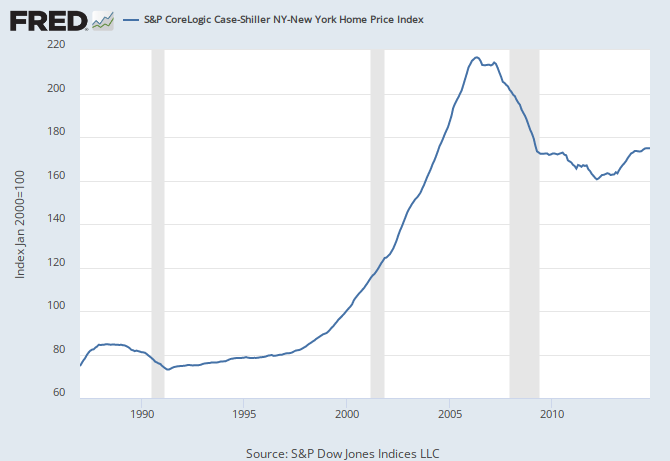
In America as a whole, let alone New York, housing prices have not returned to pre-financial crisis values. But luxury apartment prices now exceed pre-financial crisis prices. Real estate prices, period, in London, are now higher than pre-financial collapse.

Meanwhile, the Dow Jones Industrial Index is up about 175% off its lows of 2009.  The annualized gain is therefore about 29% a year. GDP has not risen anything like that, neither have wages. Corporations, however, are flush with money, and they have spent a great deal of it on stock buy-backs, while rich people, of course, have bought stocks.

Inflation has, then, shown up exactly where one would expect, in the assets bought by the people who were given money.
Welsh has more to say, but I'd like to end here, with one more instance of what I've been calling the invisible obvious:
This is not hard, this is not difficult, this is not complex. The fact that mainstream analysts and pundits do not connect the dots on this is because they do not want to.
Too right.

By the way, if you think that asset inflation is a problem or an error, think again. Assets are where the global wealthy have parked their money; their piggy bank. If Fed governors don't keep those values high, they'd be replaced by governors who will.

GP

Cross-posted with permission from Digby's Hullabaloo.
#

Labels: , , ,

Friday, August 22, 2008

Inflation-- Another A Weapon The Rich Use Against America's Working Families

>

The Daily Show welcomes McCain and his cronies to St Paul

Yesterday I mentioned that I had gone out for lunch with a senior VP from Citigroup. She told me more than just how Dubai's Sheikh Mohammed bin Rashid Al Maktoum celebrated his 4th wife's 28th birthday by buying her Barney's. She also told me that "we" had decided that the way to keep the U.S. from slipping from a nasty Recession into a devastating Depression, was to let inflation run loose "a bit." But don't worry, even if McCain knows nothing about economics and even if McCain's chief economic advisor, Phil Gramm, thinks economics is a study of how to relieve the middle class of its savings on behalf of his clients and patrons, we all know that George Bush was an economics scholar at both Yale and Harvard. And the proof: the Bush Economic Miracle, which McCain promises to keep on track exactly as it is if he's elected president.

Today the mainstream newspaper most acceptable to the right-wing establishment, the Wall Street Journal, indicates, in a story called Inflation Is Stinging U.S. Workers Harder, that the plans to let a little inflation loose is right on schedule. And, as planned, the burden in America is falling right on the shoulders of American workers. No matter how much one quibbles over how many homes McCain has or over his definition of "rich" as meaning someone who earns $5 million a year or more, inflation isn't likely to make him feel much pain-- even if it's policies that he's supported that are the cause. According to his personal financial disclosure McCain's net worth is about $36 million dollars. He doesn't feel our pain.
Consumer prices are rising at their fastest pace in more than a decade in both the U.S. and the euro zone. But it's affecting workers on the two sides of the Atlantic in very different ways.

In Montgomery, Ala., Steve Murphy, an instructor for adults with mental disabilities, doesn't expect to get a raise because his employer is getting squeezed by higher fuel bills. In Madrid, Spain, travel agent Ignacio Temprano gets raises to match inflation because Spanish unions helped negotiate such increases into law. He says he considers the extra money "a bonus."

Unions are more powerful in the 15-nation euro zone than in the U.S., and many laws and practices there are more worker-friendly. That's part of the reason why many European workers are keeping up with inflation better than their U.S. counterparts.

Wages and salaries in the euro zone were 3.4% higher in the first quarter than in the year-earlier period, matching the first-quarter annual inflation rate. It was the steepest wage increase in the 15 countries that share the currency in nearly six years. Inflation in the euro zone hit 4% in July, and many economists expect wages to keep rising this year.

In the U.S., where unions are weaker and wages aren't often indexed to inflation, workers fell behind. Consumer prices were 4.1% higher in the first quarter than in the year-earlier period, but workers' wages and benefits increased 3.3% over the same period. Inflation has risen further since the first quarter, hitting 5.6% in July, while compensation growth has slowed.


Experienced, class conscious European workers have been smart enough-- and powerful enough-- to protect themselves from the avarice and selfishness of the McCains and Bushes of their societies. Upper class Europeans can no longer use inflation as a "cure" for their excesses without the pain being spread throughout society. American workers have bought into the "we're all middle class" myth (which includes anyone making less than $5 million/year in McCain's construct to $250,000/year in Obama's vision of Hope to the bitter reality of a $50,000/year paycheck). The result has been a weakening, naive network of American unions, unable to protect themselves from the predictable excesses of unregulated predatory capitalism that is so well personified by Bush, Cheney, McCain and McCain's likely running mate, Mitt Romney... oh, and Larry Ellison.
In the U.S., Federal Reserve policy makers appear confident that a slowing economy will suppress wage growth. They are expected to keep the Fed's key short-term interest rate at 2% through the end of the year, which could help nurse the economy and financial system back to health. Fed Chairman Ben Bernanke has signaled that he's keeping a close eye on wage behavior to gauge the risk of a price spiral.

Organized labor has a lot to do with differences between wage inflation in the U.S. and Europe. In the U.S., just 7.5% of private-sector workers are union members, and about 12% of all workers, including government employees. In the euro zone, 18% of private-sector workers, and 22% of all workers, are unionized.

In parts of Europe, unions have even more clout than their membership numbers suggest. In much of the euro zone, there is a tradition of big unions negotiating wages for large sectors of the work force, not just their own members. The unions wrangle with employer associations, rather than individual firms, to secure wage deals. In euro-zone countries where such centralized negotiations are less common, wage gains are lagging.

...In the U.S., collective bargaining is far less common, and dwindling union membership has eroded workers' bargaining power. Labor laws enable most companies to trim staff freely during an economic
downturn, leaving U.S. workers with less leverage to press for higher pay. Health insurance linked to employment often makes workers reluctant to leave their jobs, even if wage gains are meager.

Only 2% of U.S. union contracts have clauses that tie wages to inflation, according to a survey of unions and employers by the Bureau of National Affairs, a publisher based in Arlington, Va. In the late
1970s, more than one-third of such contracts included cost-of-living adjustments. High inflation during the 1970s prompted many employers to eliminate the provisions.

Some U.S. workers in industries that are booming, such as coal and steel, are managing to keep up with inflation. Massey Energy Co. of Richmond, Va., a mostly nonunion coal producer, has already given
miners two raises this year, and has guaranteed increases and job security for the next three years. The company is handing out $80 a month in gasoline cards to help workers cover fuel costs.

U.S. Steel Corp., one of the world's largest steel producers, agreed this month to a contract with workers that the United Steelworkers union has called its best in three decades. Workers would receive an initial raise and a $6,000 payment, plus annual pay increases of 4% for several years.

But as the economy has slowed, many U.S. workers haven't been able to keep pace with inflation. In Low Moor, Va., 154 unionized production workers at MeadWestvaco Corp., a packaging and office-products maker, argued for wage increases that would help them cover higher fuel costs. Ray Plasters, an equipment operator and head of United Steelworkers Local 8-490, says it was a tough sell. "The company takes the approach that its costs are going up, too," he says.

Last month, workers agreed to a new contract with annual wage increases of no more than 2.25% for the next three years. Mr. Plasters says he figured the union had little leverage to push for more because MeadWestvaco's competitors are also holding down wages. Fight too hard, he reasoned, and the company might shift work overseas.

Yes, the ultimate threat that the Republican/Blue Dog trade policies have dumped on American working families.

Labels: , , , , ,

Friday, August 15, 2008

A Little Good Economic News-- And A Lot That's Not So Good

>


The good news came early this morning in Asia. The price of oil is continuing to drop. The bad news, despite concerns that Big Oil is dropping it a little to help their Republican buddies before the election (like they did in 2004), is that it went below $114 a barrel because "investors speculated slowing economic growth in the world's largest economies will continue undermining global crude demand."
'Worries about an economic slowdown in the U.S. and Europe, and even Japan, are weighing on the oil market,'' said Victor Shum, an energy analyst with consultancy Purvin & Gertz in Singapore.

Europe's biggest economies-- Germany, France and Italy-- all contracted in the second quarter. Japan said this week its gross domestic product also shrank in the April-June period.

An unstable Russian has stock markets spooked but oil markets aren't factoring in a real trouble that would disrupt oil and gas deliveries. Musharraf's impending resignation isn't spooking anyone in the markets yet, although the CIA may be a little freaked.

Me? I'm spooked and freaked. I bought a Prius this week. I don't have a job and live off my savings. Inflation scares me. The return of inflation will probably be one of Bush's ugliest legacies.
The cost of living, led by the soaring cost of gasoline and food, is rising at the fastest rate since the recession of the early 1990s, the government said on Thursday, handing a de facto pay cut to the American worker.

The report, from the Labor Department, offered quantitative proof of what Americans have been feeling for months: almost everything costs more, even as they have less money to pay for it.

Prices of a wide range of common products in the Consumer Price Index were 5.6 percent higher last month than they were in July 2007, the sharpest annual increase since January 1991.

...In July, rank-and-file workers-- those in production or nonsupervisory roles-- earned 3.1 percent less than they did a year ago, after adjusting for the rising cost of living.

“Any way you slice it, incomes aren’t keeping up with the inflation rate,” said Michael T. Darda, chief economist at the trading and research firm MKM Partners.

It was the 10th consecutive month that the weekly average salary had failed to keep pace with inflation, according to statistics from the Labor Department.

Employers are doling out modest wage increases, but not nearly enough to compensate for more expensive food and fuel.

“People see it and they feel it on a daily basis,” Mr. Darda said. “If it’s gasoline or food, that’s visible inflation, and the stuff that households need the most and depend on.”

Prices have not risen at the speed they did during the oil crises of the 1970s, and financial policy makers have said they do not expect a repeat of the so-called wage-price spiral that led to double-digit inflation rates during that decade.

But with home values falling and the stock market in a slump, Americans are finding it more and more difficult to pay for basic purchases. Credit card debt has spiraled upward, home foreclosures are rising, and banks have become more guarded in giving out loans and mortgages.

Social Security recipients are now on track to receive the highest cost-of-living increase since 1982.

I've been hanging on to an extremely interesting report from Congressional Quarterly all week about how most corporations don't pay any income taxes. The GAO conducted a study that spanned Bush's entire presidency and found that "72 percent of foreign-owned corporations went at least one year without owing taxes, and the same was true for 55 percent of domestic corporations."
[M]ore than 3,500 large domestic corporations-- with more than $250 million in assets or $50 million in gross receipts-- did not pay taxes in 2005.

The report said about 80 percent of the companies studied paid no taxes because they didn’t generate any profit after expenses. Money-losing companies can legitimately owe no tax, and others can use provisions of the tax code to lower or eliminate their liability.

But the lawmakers who sought the data seized on the report as proof of corporate gamesmanship.

“It’s shameful that so many corporations make big profits and pay nothing to support our country,” said Byron L. Dorgan, D-N.D., who requested the report along with Carl Levin, D-Mich. “The tax system that allows this wholesale tax avoidance is an embarrassment and unfair to hardworking Americans who pay their fair share of taxes. We need to plug these tax loopholes and put these corporations back on the tax rolls.”

And if you wonder how all this is going to play out at the ballot boxes in November, take a look at the winning ad from the Republican primary in the Kingsport/Knoxville congressional district in eastern Tennessee, where a far right-wing Republican was beaten by another far right-wing Republican based on this:


I don't think there's a Democrat running who won't win if he or she runs an ad like this. Yesterday Obama's economic policy director, Jason Furman, responded to the report on rising inflation:
"Today, we got the truly shocking news that inflation hit a 17-year high of 5.6 percent as the prices of gas and groceries continued to soar. Families have now lost an entire decade's worth of raises to inflation as weekly earnings adjusted for inflation lie below the level they reached in August 1998. While Senator McCain apparently thinks the economy is doing just fine, and refuses to support any meaningful, short-term relief for America's struggling families, Barack Obama has proposed an Emergency Economic Plan that would immediately put $1,000 in the pocket of families to help them pay for gasoline, groceries and other necessities. In addition, the Obama plan includes $50 billion in immediate measures to save more than one million jobs from being lost. America cannot afford four more years of a policy that puts tax cuts for the wealthy and corporations ahead of the real change America's middle-class families need."

Labels: , , ,

Wednesday, July 16, 2008

Inflation, Unemployment, A Crashing Real Estate Market And Bad Political Leadership

>

Why the Democrats haven't ended the war

If you're 25 or under, the economic policies pushed by Bush and the Republicans, with the support of reactionary Blue Dogs, you are in the midst of the worst inflationary spiral of your life. If you are over 25, the out-of-control energy prices, increasing food prices, increasing unemployment, crashing real estate market and rotten stock market you may remember marginally worse economic times. But unless you're even older than John McCain the pain at the bottom three-quarters of the economic divide in growing to unprecedented levels.

Stopping the disastrous standard of living slide will be the job that will take up all of Obama's presidency-- both terms. The economic downturn, a serious recession that could turn into a full down depression, isn't just the will of the gods. It is very much the result of bad leadership, not just bad leadership, but the absolute worst leadership in the history of our nation. And, you know what? It isn't even just Bush I'm talking about, although her certainly qualifies as the very worst president ever. And it isn't even just Republicans I'm talking about, although their narrowly driven ideological agenda, based on greed, selfishness, class warfare and corruption is certainly the single biggest reason for the inflation and unemployment disaster we're experiencing. But they couldn't have done it alone-- especially not in the past 18 months.

Eighteen months ago "the Democrats" were given the mantle of leadership in the House and the Senate. They've accomplished things of significance they would never have been accomplished by Republicans-- a long overdue, if niggardly, increase in the minimum wage, for example-- but "the Democrats" is dysfunctional as a concept. The party is riddled through and through with... frightened careerists and, in many cases, a Republican mentality that encompasses disdain for working families, worship of Big Business interests and personal corruption.

Regardless that Tom DeLay is an extreme right Republican and Rahm Emanuel is a corporate-oriented Democrat, the essence of the two as political leaders is identical-- and it is the worst our system has to offer. I almost threw up my breakfast shake today when I read a story about how Emanuel is on the road to the Speakership. If congressional progressives don't get it together and assert themselves and their values within the Democratic caucus, they-- and, more important, we-- will be the victims of the boundless selfish ambitions of the Rahm Emanuels and Steny Hoyers and Debbie Wasserman Schultzoids.

Matt Stoller talks with Brooklyn congressional candidate Kevin Powell about spineless Democrats who betray American values. Listen to what a real Democrat sounds like:

Labels: , , , , ,

Tuesday, June 17, 2008

INFLATION-- AN INEVITABLE OUTGROWTH OF BUSH ECONOMIC POLICIES

>


The Bush Regime has become adept at doctoring numbers and explaining reality to suit its own needs. With the same sincerity that Bush regimists could assure the American people that Iraq was brimming with WMDs and that a mushroom cloud was on the horizon, and that Saddam was working hand in hand with bin Laden, his Labor Secretary, Elaine Chao, the nest-feathering and extremely corrupt "wife" of Mitch McConnell, will assure us with a straight face that inflation is not a problem. Today's NY Times paints a more alarming picture:
Producer prices bolted ahead in May at the fastest pace in six months as energy and food costs marched higher.

The Labor Department reported Tuesday that its Producer Price Index, which measures the costs of goods before they reach store shelves, shot up 1.4 percent in May. That was up from a modest 0.2 percent rise in April and was the biggest increase since November.

Chao says if you don't count energy and food prices, there is no inflation. Is that because the housing market has collapsed and 2 decades worth of home equity has disappeared, with home prices dropping even faster than gasoline prices rises? Or is it because out of touch automobile manufacturers are willing to drop the price of their gas guzzling products that no one wants to buy any longer so drastically that buying a car-- except a hybrid-- is actually a genuine bargain these days?

None of that means much to the average American. What does that that "energy prices jumped 4.9 percent in May, also the biggest rise since November. Diesel fuel prices galloped by 11.2 percent, gasoline prices were up by 9.3 percent and home heating oil increased by 8 percent. Food prices also rose sharply. They increased by 0.8 percent in May, after being flat in April." And, as any economist-- or anyone with a lick of common sense-- will tell you, "energy and food costs will force companies to boost prices for lots of other goods and services, spreading inflation through the economy." That's part of poison pill Bush and his rubber stamp Republicans are bequeathing the nation in their wake.

I was food shopping yesterday. I read that pork is up by 8% in one month. I can't remember the last time I ate pork, but I know I certainly never did since 1970 when I woke up for the first time in the house I had rented just off the beach in Goa, went to the "bathroom," and realized-- viscerally-- that the waste removal system was the herd of pigs I had asked the uncomprehending, smiling landlord to remove the day before. Actually I was a vegetarian even before that. And yesterday I noticed that the prices of fruits and vegetables had all increased... significantly. Organic apples that had been selling for $1.49/pound were selling for $1.99/pound. That's inflation; I don't care what Elaine Chao-- or any other Bush dead-ender-- says.

Aside from food and energy, airplane travel costs have been skyrocketing, as have health care prices. At the same time, unemployment is rising rapidly as more and more people get laid off because of GOP/Blue Dog policies that have encouraged outsourcing and responded, predictably, to corporate belt-tightening.

Next comes the inevitable stock market-killing interest rate hike. Bernanke wants to start next week but he may hold off... for now.
Wall Street investors and some others predict the Fed will have to bolster rates later this year to ward off an inflation flare-up. Others, however, believe the Fed will leave rates alone through the rest of this year. Raising rates too soon, they said, will hurt the fragile economy, which has pounded by housing, credit and financial problems.

Soaring energy and food prices are walloping consumers and businesses alike.
Last week, the government reported that consumer prices jumped 0.6 percent in May, the biggest increase in six months. Those higher prices also are cutting into workers’ paychecks-- further straining budgets.

Businesses, meanwhile, also are tightening the belt. Employers have cut jobs every month so far this year. That’s pushed the nation’s unemployment rate up to 5.5 percent in May, from 5 percent in April-- the biggest one-month rise in two decades.

Producer prices are rising faster than consumer prices because businesses-- or competitive or other reasons-- have been limited in their ability to pass along all of their higher costs from energy and other raw materials to customers.

Elsewhere in the wholesale inflation report, prices for light truck dipped 0.9 percent and prices for cars dropped 1 percent. Cigarette prices rose 2.5 percent and airplane prices increased 1.1 percent, the most since August 2004.

And what can we expect from McCain? His record is clear-- four more years:

Labels: ,

Monday, June 16, 2008

MORE ON THE BUSH ECONOMIC MIRACLE

>


We started the day here at DWT with a look at Paul Krugman's assertion that the Bush Regime is leaving America with a nasty poison pill that will hamper economic and social progress for at least a generation. The top of the Times' Business Page just changed twice in less than 20 minutes and each change sounded pretty dire. At 1:54 pm, ET, Reuters filed a story about Bernanke warning that "rising U.S. government spending on health care risks triggering runaway budget deficits that could put economic stability in danger." Lucky thing Bush was able to get his rubber stamp Republican Congress to prohibit negotiating for bulk discounts from his pharmaceutical campaign contributors-- and to pass the biggest corporate welfare bill in the history of "health" care. The U.S. health care industry is one of the least efficient on a dollar for dollar basis of any developed country. Far too much money goes to for-profit bureaucracy (HMOs and predatory insurance companies) that not only have no relationship to "health," but actually enforce policies that drastically decrease mortality rates and general healthfulness. [Note: well-informed sources claim that McCain is planning to nominate Bill Frist as his Secretary of Health and Human Services.]

With Bush slinking around Europe trying to avoid demonstrations against his existence, Bernanke felt it safe to tell the Senate Finance Committee that "There are limits to how big the deficit and the debt can be... Soon it will begin to have effects on interest rates, it will have effects on economic growth, and on stability, so ... it's not just balancing the federal budget, it's really a much broader question of the stability and strength of our economy over a longer period of time." One has to wonder if he or that guy who had his job before him ever mentioned that to Bush.
Health-care spending is the largest single component of personal consumption and currently exceeds 15 percent of U.S. gross domestic product, Bernanke said. There is little evidence health-care spending will stop rising as a share of GDP, he added.

...Current government spending on the two major health care programs-- Medicare for retirees and Medicaid for low-income people-- takes up 23 percent of federal spending that is not for interest payments, up from 6 percent in 1975, Bernanke said.

..."Higher government spending on health-care spending will, of necessity, require reductions in other government programs, higher taxes, or larger budget deficits," he said.

Even as government spending on health care rises, 47 million Americans, or about 16 percent of the population, are without health insurance, Bernanke said.

"Access to health care is the first major challenge that health-care reform must address," he said, adding that the issue is likely to be a topic of debate in the upcoming presidential election.

Seeing health care as an excuse for corporate welfare, the Bush/McCain approach doomed us to both poor health care and a disastrous economy. A few minutes later the Times changed it's lede to Policymakers Declare Inflation Top Threat. Reuters filed that one from Brussels and South Korea at 2:11 pm, ET. That means higher interest rates and lower living standards. The whole world thanks George W. Bush... and the Supreme Court judges who allowed him to steal the 2000 election.

Labels: , ,

Friday, March 21, 2008

COULD THE BUSH RECESSION TURN INTO A BUSH DEPRESSION?

>


I don't know anyone who thinks we're not in a recession and I don't know anyone who says we're on the brink of a Depression. Most people have no reason to think we won't have a Depression; they just think "it can't happen here" or "now" or "to me." It shouldn't either. Nor should have George Bush. The most unlikely of morons to assume the presidency he's done everything that anyone could do to bring on a financial calamity. This morning's Paul Krugman column, Partying Like It's 1929, gets right to the point: right wing ideology is toxic. The "banking crisis of the 1930s showed that unregulated, unsupervised financial markets can all too easily suffer catastrophic failure." Krugman claims the hard-learned lessons were "forgotten" as the decades passed. I'm less generous.

To the laissez fairies of the extreme right Krugman's carefully regulated and supervised financial markets are communism. Anything that impedes absolute greed and selfishness in pursuit of the general good is treason. And along came Bush and his merry band of agenda-driven Mayberry Machiavellis.

Krugman is so logical and generous in his understanding of how markets work. I don't think he used the words "greed" or "selfishness" once in his column-- or even implied the base instincts behind them. But that is what has driven us to the brink of disaster-- and he knows it. He explains what made a garden variety recession of 1929 into the Great Depression of the 1930s and how society-- or at least the New Deal (imagine only 17 Republicans in the 1937 Senate)-- dealt with it. "And we all lived happily for a while-- but not for ever after."
Wall Street chafed at regulations that limited risk, but also limited potential profits. And little by little it wriggled free-- partly by persuading politicians to relax the rules, but mainly by creating a “shadow banking system” that relied on complex financial arrangements to bypass regulations designed to ensure that banking was safe.

For example, in the old system, savers had federally insured deposits in tightly regulated savings banks, and banks used that money to make home loans. Over time, however, this was partly replaced by a system in which savers put their money in funds that bought asset-backed commercial paper from special investment vehicles that bought collateralized debt obligations created from securitized mortgages-- with nary a regulator in sight.

As the years went by, the shadow banking system took over more and more of the banking business, because the unregulated players in this system seemed to offer better deals than conventional banks. Meanwhile, those who worried about the fact that this brave new world of finance lacked a safety net were dismissed as hopelessly old-fashioned.

In fact, however, we were partying like it was 1929-- and now it’s 1930.

The financial crisis currently under way is basically an updated version of the wave of bank runs that swept the nation three generations ago. People aren’t pulling cash out of banks to put it in their mattresses-- but they’re doing the modern equivalent, pulling their money out of the shadow banking system and putting it into Treasury bills. And the result, now as then, is a vicious circle of financial contraction.

Mr. Bernanke and his colleagues at the Fed are doing all they can to end that vicious circle. We can only hope that they succeed. Otherwise, the next few years will be very unpleasant-- not another Great Depression, hopefully, but surely the worst slump we’ve seen in decades.

Even if Mr. Bernanke pulls it off, however, this is no way to run an economy. It’s time to relearn the lessons of the 1930s, and get the financial system back under control.

Problem is there's another lesson Americans haven't learned-- or have forgotten. Calvin Coolidge is about to finish his second term, the worst presidency ever. And too many Americans seem more than willing to vote for Herbert Hoover.

Interestingly, this morning's Washington Post reports on the long overdue re-evaluation of the over-hyped Alan Greenspan, a kind of financial markets J. Edgar Hoover. "Perhaps," Steven Mufson's article begins, "the Maestro composed some discordant notes after all." Not that he gave two craps about the non-rich, but the Post also reports on how his policies are-- predictably-- hurting the poor and middle class hardest. "Inflation is walloping Americans with low and moderate incomes as the prices of staples have soared far faster than those of luxuries. Overall, inflation may only been up by 4% from last year, but for staples like groceries, gasoline, health care and other basics it's approaching 10%. That's real inflation that hurts people who live on budgets.
The record of longtime Federal Reserve chairman Alan Greenspan -- worshipped by business leaders and dubbed "Maestro" in a 2000 biography by the Post's Bob Woodward-- is getting a critical look as his successor Ben S. Bernanke wrestles with problems that began on the Maestro's watch.

Many economists blame Greenspan for lax bank supervision and for keeping interest rates too low, too long from mid-2003 to mid-2004. That, the theory goes, fueled the housing bubble and spawned subprime and adjustable-rate mortgages for low-income people, vast numbers of whom can't make their payments now. Banks bought those mortgages in bundles that are worth far less than they originally were. That has led to big write-offs, shaking the entire financial system.

And I don't think continuing Bush's economic policies-- as McCain has already been doing-- is going to help do anything to solve any of the problems... at least not for America. McCain and Bush seem to think exporting American jobs abroad is sound policy. They're incorrect-- although the French might disagree with me:


UPDATE: OLD LINE GREED & SELFISHNESS REACTIONARIES ARE TURNING ON BUSH BIG TIME

Steve Forbes is fuming at the ineptness of the Bush Regime's response to what he calls a financial panic. "Not since Jimmy Carter has the U.S. had a President so oblivious to the damage done by an increasingly feeble greenback."
The Bush administration must take two steps immediately to quickly halt the unending, enervating credit crisis: shore up the anemic dollar and, for the time being, suspend "marking to market" those new financial instruments, such as packages of subprime mortgages.

The weak dollar is pummeling equities, disrupting the economy, distorting global trade and giving hundreds of billions of dollars in windfall revenues--through skyrocketing commodity prices-- to our adversaries such as Iran and Venezuela.

...The Federal Reserve can rally the markets for a day or two by finding some new mechanism through which to lend more money to banks and other financial institutions. But this is the proverbial Band-Aid for a patient who is beginning to hemorrhage.

Labels: , , , ,

Wednesday, February 27, 2008

BUSH WILL LEAVE US WITH MORE THAN JUST IRAQ-- STAGFLATION IS A DIRECT RESULT OF RIGHT WING ECONOMIC POLICIES

>


When I woke up this morning Fed Chairman Ben Bernanke was droning on in front of some semi-somnolent congressional committee about The Economy, carefully tiptoeing thru the tulips mine field of a shaky stock market. Tomorrow's NY Times emphasizes what he was trying to say without saying it: "Who cares about inflation, anyway."

From what I gathered from his nearly indecipherable and overly tepid blathering is that we have the worst of all possible worlds coming on: slowing (i.e.- no or even negative) growth coupled with rising (i.e.- out of control) inflation. That's stagflation and it's bad news. Is it Bush's and the rubber stamp Republicans' fault? Do you really have to ask?

At the behest of their big corporate contributors, the entire GOP and all the Blue Dog Democrats and their allies have allowed the regulatory reforms of the financial industries enacted since the 1930s to wither and die, not as fast as the far right would have liked, but fast enough to bring on a strong dose of the economic catastrophe headed our way. This has been great for quick turn-over profits, and disastrous for our nation's long term prospects-- and for everyone's pocketbook who isn't in the top one-half of one percent of income earners. "Don't bother us with rules," they demanded (as they handed out the fat bribes); let the free market soar." What goes up...
The Fed chairman acknowledged that the central bank faced increasingly contradictory pressures of slowing growth and rising consumer prices. But his bottom line was that, for now, the top priority would be fighting a recession rather than fighting inflation.

Mr. Bernanke’s view of the state of the economy, part of his semiannual appearance before Congress, came as the dollar sank to a historic low against other major currencies, introducing a possible third dimension to the economic problems the Fed chairman must tackle all at once.

Having already cut short-term interest rates by almost half since September, Mr. Bernanke painted a grim picture of consumers reluctant to spend, businesses reluctant to invest and banks reluctant to lend. On top of it all, housing prices keep falling.

“The economic situation has become distinctly less favorable” since last summer, he told the House Financial Services Committee. In words that investors immediately recognized as a hint of lower rates, he vowed to “act in a timely manner” and “provide adequate insurance against downside risks.”

The Fed’s decision to err on the side of faster growth poses risks. Ever since the wrenching experience with stagflation in the late 1970s, the rule of thumb in monetary policy has been that revving up a slow economy is far easier than slowing inflation once it becomes entrenched.

Several friends of mine-- each gainfully employed in campaign work-- have been urging me to support Blue Dogs against Republicans-- the lesser of two evils. Tuesday I explained why a Blue Dog is not the lesser of two evils and in some ways is the greater of two evils.

When Steny Hoyer was willing to anything to get the House Leader's post he called me and told me how he wasn't such a bad guy and how he supports civil rights and something else; Choice I think. That's good. As Leader he has presided over a decline in respect for Congress that makes that institution less admired by Americans than even George Bush, the most hated man in the entire world. He has also guaranteed that Bush would be able to continue, relatively unmolested, with his Iraq agenda. And Hoyer isn't even a full fledged Blue Dog, just a fellow traveler.

My friends, as my friend John McCain might say, if you care about building a progressive coalition on a foundation of values and principles, do not consider supporting, or even voting for reactionary Democrats. They are our enemies, on balance, as much as Republicans. I would rather invest in authentic high quality Democrats like Donna Edwards, Jim Himes, Darcy Burner, Howard Shanker, Vic Wulsin and Alan Grayson, than help election two dozen Democrats who will wind up voting with the Republicans to destroy the environment, enrich their campaign contributors to the detriment of the rest of us, and refuse to the courage to stand up to petty tyrants like Bush and Cheney and their henchmen and cronies.

Today Bernanke made it as clear as he's capable of that he and the Fed are "more worried about a sharp slowdown and rising unemployment than they are concerned about inflation. (And then there's the rising unemployment numbers, another effect of the MBA-President's economic policies.) His muddled reasoning-- "that slower economic growth will reduce inflationary pressure in the months ahead, because debt-laden consumers will be far more wary of spending money and businesses will be more cautious about investing in plant and equipment"-- leads no where but straight down the toilet.

'Til then... something about writing this piece made me think of this song. So I made a clip for ya:

Labels: , , , ,

Wednesday, February 20, 2008

NEW POLLS OUT IN TIME FOR THE BUSH RECESSION-- MEET MR. 19%... AND HIS HEIR

>

Do we get to eat cake?

In light of the horrendous economic news today-- the admission that inflation caused by Bush's incompetent and ideological approach to the economy, is spiraling out of control, coupled with collapsing housing prices, and a Bush Recession that could lead to "the mother of all meltdowns," there are two new polls that came out worth looking at.

The first was done by the American Research Group, which has been polling Bush's job approval ratings regularly. As I've been predicting for 3 years, Bush just went under 20% overall approval: Mr. 19%. That's still better than people perceive his handling of the economy: Mr. 14%. [Keep in mind, Bush was the CEO President with the business degrees from Yale and Harvard. His heir, John McCain admits he doesn't know shit about the economy but he can hire... MBAs from Yale and Harvard.] Interestingly a full 1% of Americans feel the economy is getting better-- the same percentage who feel it is in excellent shape. 74% of Americans feel the economy is doing badly, very badly or terribly. Perhaps more important for the election coming up in November 41% of Americans report that their personal household financial situation is deteriorating 8% says their is getting better.

Rasmussen also has a poll out today.
If the Presidential election were held today, the Democratic candidate would likely win 284 Electoral Votes, the Republican candidate would likely win 216 Electoral Votes while 38 more would be in the Toss-up category.

The safe Republican states are the Old Confederacy (minus Virginia, Florida and Arkansas), plus Idaho, Utah, Kansas, Kentucky, Montana, Nebraska, North Dakota, Alaska, Oklahoma, and Wyoming. That's what's left of the base. In terms of the national popular vote Obama will not just bury McCain in terms of electoral votes, he will also beat him handily in the popular vote. Here's why:


UPDATE: McCAIN CLAIMS HE'S NOT BUSH'S SOCK PUPPET

He also claims Bush's biggest blunder-- wasn't how he handled Iraq or Hurricane Katrina or how he failed so dismally to protect America on 9/11 or capture bin-Laden but how he didn't veto budgets-- and these are all budgets McCain voted for!

Labels: , , ,