Tuesday, April 14, 2020

Historic November Landslide In The Making?

>


Utah has a couple of blue and purple counties-- Salt Lake and Summit (which Hillary won in 2016) and Grand which she kind of won too-- 1,934 for Hillary and 1,932 for Señor Trumpanzee, a 43.4% to 43.4% tie, with #NeverTrump conservative Evan McMullin and Libertarian Gary Johnson getting most of the balance. In 2018 Mitt Romney lost both Summit and Grand to Jenny Wilson, a Democrat. And a putative Democrat, Blue Dog Ben McAdams narrowly ousted (50.1% to 49.9%) Republican incumbent Mia Love in UT-04, where the D+9 performance of Salt Lake County overcame the massive red tide in Utah, Sanpete and Juab counties.

But we all know that Utah is a beet red, blood red state. Utah voted for FDR and Truman and in 1964 backed LBJ against Barry Goldwater, 219,628 (54.9%) to 180,682 (45.1%). But 1964 was the last time Utah gave its electoral votes to a Democrat. In fact, since 2000, Obama's first race was the only time Utah gave over 30% of it;'s vote to a Democrat. McCain beat him 62.6% to 34.4%. Usually, Democrats get around a quarter of the presidential vote in Utah-- worse than in the Deep South. And that's why the new poll from UtahPolicy.com was so shocking yesterday:


If it gets so bad for Trump that he loses Utah, he'll wind up the way Strom Thurmond did when he ran for president in 1948 on the Dixiecrat Party and won 4 states. The electoral map looked very different then and current Republican bastions now-- like Texas, West Virginia, Oklahoma, Wyoming, Georgia and Utah-- were deep, deep blue. But these were the states that went for Thurmond in 1948 and will go for Trump in November:
• Alabama
Thurmond- 79.75%
Truman- not on the ballot
Dewey- 19.04%
• Louisiana
Thurmond- 49.07%
Truman- 32.75%
Dewey- 14.45%
• Mississippi
Thurmond- 87.17%
Truman- 10.09%
Dewey- 2.62%
• South Carolina
Thurmond- 71.97
Truman- 24.14%
Dewey- 3.78
Thurmond also did pretty well in Arkansas, Florida and Georgia. He wasn't on the ballot in Utah. Anyway, as I was saying, if Trump can't win Utah... the national election results in November will be pretty gratifying for normal Americans. How could that happen, though? Well, ever hear of a U.S. president conspiring-- relatively openly-- with Russia and Saudi Arabia to drive up the price of gasoline at the pump? Yesterday the Financial Times reported that Saudi Arabia and Russia ended their oil price war on Sunday by finalizing a deal to make the biggest oil production cuts in history, following pressure from U.S. President Donald Trump to support an energy sector ravaged by the coronavirus pandemic." That may give economically hard-pressed American voters some food for thought... at least about where Trump's priorities really are. Cliff Krauss, writing for the NY Times, noted that with "Trump, facing a re-election campaign, a plunging economy and American oil companies struggling with collapsing prices, [he] took the unusual step of getting involved after the two countries entered a price war a month ago. Mr. Trump had made an agreement a key priority. It was unclear, however, whether the cuts would be enough to bolster prices. Before the coronavirus crisis, 100 million barrels of oil each day fueled global commerce, but demand is down about 35 percent. While significant, the cuts agreed to on Sunday still fall far short of what is needed to bring oil production in line with demand... While the planned cut is slightly smaller than a tentative pact reached last Thursday, the deal should bring some relief to struggling economies in the Middle East and Africa and global oil companies, including American firms that directly and indirectly employ 10 million workers."


Higher gas prices are never popular but Trump is counting on the fact that most Americans aren't using gas now and that they might not notice him driving up the price. Unfortunately for him though, most Americans probably agree with the New Yorker's David Remnick that Trump is the preëxisting condition in the Oval Office that has made everything worse than it had to be. "From the start," he wrote, "the Trump Administration has waged war on science and expertise, making a great nation peculiarly vulnerable to the foreseeable public-health calamity of the coronavirus. When has New York known a grimmer week? The sirens are unceasing. Funeral parlors are overwhelmed. Refrigerator trailers are now in service as morgues, and can be found parked outside hospitals all over town. We’re told that there are 'glimmers of hope,' that hospital admissions are slowing, that the curve is flattening. Yet the misery is far from over... Across the country, the coronavirus continues to ravage the confined and the vulnerable, from inmates of the Cook County jail, in Chicago, to workers at the Tyson Foods poultry plant in Camilla, Georgia. Data from a variety of reliable sources show that African-Americans, who suffer disproportionately from poverty, inadequate housing, limited access to good health care, and chronic illnesses such as diabetes and hypertension, are dying from covid-19 at horrific rates. The pandemic is an event in the natural history of our species, but it is also a political episode. Its trajectory is shaped by policy measures specific to particular governments. The fact that the United States is experiencing tremendous losses-- that it has far more covid-19 cases than any other country in the world-- relates to a number of collective risk factors and preëxisting conditions. The most notable one is to be found in the Oval Office." Remnick joked that from the beginning of his term, Trump "practiced social distancing from anyone who told him what he didn’t want to hear."


The coronavirus has inflicted a level of pain that is deep and global. And yet many nations, from South Korea to Germany, have done far better at responding to it than the United States has. The reasons for the American failing include a lack of preparation, delayed mobilization, insufficient testing, and a reluctance to halt travel. The Administration, from its start, has waged war on science and expertise and on what Trump’s former adviser Steve Bannon called “the administrative state.” The results are all around us. Trump has made sure that a great nation is peculiarly vulnerable to a foreseeable public-health calamity.

...The knowledge that we are led so ineptly and with such brazen self-regard is humiliating to millions of American citizens, if not to their leader. Trump gives himself “a ten” for his performance and berates any reporter who dares to challenge that premise. “You should say, ‘Congratulations! Great job!’ ” he told one, “instead of being so horrid in the way you ask the question!”

A nation facing a common threat normally pulls together, but Trump’s reflex is always to divide; he has invoked a multiplying litany of enemies. He directs his fire at the Obama Administration, at the World Health Organization, and at governors from Albany to Sacramento, with their constant pleas for ventilators, test kits, and face masks. The Democrats are to blame for everything. Early in the year, as the pandemic grew, they “diverted” the attention of the federal government, because “every day was all about impeachment,” as Trump’s unfailing loyalist Mitch McConnell, the Senate Majority Leader, put it.

At a time of medical peril and economic devastation, the President heads to the White House briefing room and frames the terms of his reëlection campaign. It is a campaign of cynicism and authoritarian impulses. To begin with, he has made it clear that he does not approve of efforts to make voting easier in November. Why should he? He takes a dim view of early voting, voting by mail, and same-day registration. Such reforms, he complains, would produce “levels of voting that, if you ever agreed to it, you’d never have a Republican elected in this country again.”


Let's hope. As Rep. Andy Levin (D-MI) told DWT readers a few hours ago, "Last week, Joe Biden became the presumptive Democratic nominee for president.  I will support him wholeheartedly, with no reservations. As many of you know, I supported Elizabeth Warren in the primaries.  Her leadership in our current crisis, as exemplified by her April 8 NYT op-ed, shows why she could have been one of our greatest presidents. After she dropped out of the race, I switched my Michigan primary vote to Bernie Sanders. Why? Because Senator Sanders and I agree on the need to transform our country in bold ways, including:  
•  Medicare for All
• A Green New Deal
• Real worker voice and power in individual companies, industries and society
Bernie didn’t just run two successive presidential campaigns-- he inspired a movement that will have deep impacts on American policy and politics for years to come. Now, Bernie, Elizabeth and I will join with other progressives to create a veritable tsunami of organizing around our priorities to help sweep Joe Biden to power. The more we contribute, the more we help shape the fall campaign with open hearts and our best ideas, the more a Biden presidency will move America towards dignity and justice for all."


Labels: , , , , , , ,

Friday, January 09, 2015

What's Going On with Oil Prices? Triads And Consequences

>


by Gaius Publius

As most people know — certainly everyone with a car — oil prices have plunged in the last six months. Here's what that looks like to an investor:


At the same time, the dollar — by many accounts a "petrocurrency" in two solid senses — has been strong. Normally, when your currency is pegged to something and that something goes down, your currency goes down as well. Yet the dollar is strong, and among the currencies in the tank is the Russian ruble. Are these things connected?

At the other same time, the money-center "too big to fail" (TBTF) banks have gotten Obama, almost all Republicans, and most Democrats to whip for and approve the "Citigroup rider" — an amendment written by Citigroup itself — to put taxpayers back on the hook for that portion of their derivatives "plays" (bets) that the Dodd-Frank bill disallowed. Are these things connected?

What's going on? No one knows for sure, but this certainly gets your attention, doesn't it?

This piece is an attempt to wrangle many of the puzzle parts into some semblance of order. We'll adjust our thinking as events evolve, so stay tuned. For now though, these are the dots I think are currently connected. They are many.

The Saudis Are Engineering Low Oil Prices. Why?

Let's start at the beginning, with oil itself. There's no question the Saudis are engineering or abetting low prices by refusing to cut back production and by their aggressive discounting. As a result, crude oil is now costs 50% of its price six months ago — dropping from roughly $100 per barrel to below $50 per barrel (see chart above; source here).

One theory holds that the Saudis are trying to screw American shale oil and shale gas producers, who have flooded the market with too much supply; in other words, to drive them out of business. This theory is common — for example here, from an interview with oil expert Arthur Berman. (Great thanks to friend and radio host Arnie Arnesen for this link; my emphasis.)
With all the conspiracy theories surrounding OPEC’s November decision not cut production, is it really not just a case of simple economics? The U.S. shale boom has seen huge hype but the numbers speak for themselves and such overflowing optimism may have been unwarranted. When discussing harsh truths in energy, no sector is in greater need of a reality check than renewable energy.

In a third exclusive interview with James Stafford of Oilprice.com, energy expert Arthur Berman explores:
• How the oil price situation came about and what was really behind OPEC’s decision
• What the future really holds in store for U.S. shale
• Why the U.S. oil exports debate is nonsensical for many reasons
• What lessons can be learnt from the U.S. shale boom
• Why technology doesn’t have as much of an influence on oil prices as you might think
• How the global energy mix is likely to change but not in the way many might have hoped

OP: The Current Oil Situation - What is your assessment?

Arthur Berman: The current situation with oil price is really very simple. Demand is down because of a high price for too long. Supply is up because of U.S. shale oil and the return of Libya’s production. Decreased demand and increased supply equals low price.

As far as Saudi Arabia and its motives, that is very simple also. The Saudis are good at money and arithmetic. Faced with the painful choice of losing money maintaining current production at $60/barrel or taking 2 million barrels per day off the market and losing much more money—it’s an easy choice: take the path that is less painful. If there are secondary reasons like hurting U.S. tight oil producers or hurting Iran and Russia, that’s great, but it’s really just about the money.

Saudi Arabia met with Russia before the November OPEC meeting and proposed that if Russia cut production, Saudi Arabia would also cut and get Kuwait and the Emirates at least to cut with it. Russia said, “No,” so Saudi Arabia said, “Fine, maybe you will change your mind in six months.” I think that Russia and maybe Iran, Venezuela, Nigeria and Angola will change their minds by the next OPEC meeting in June.
So the Saudis are simply taking advantage of low prices, and the effect on Russian, Iranian, Syrian and U.S. shale producers are secondary considerations. This is one explanation.

Did the U.S. Engineer the Price Drop As an Attack on Russia?

Another theory holds that the Saudi's weren't attacking U.S. producers, but cooperating with U.S. policy-makers in an attack on Russia. For example, from The Guardian (h/t Mike Whitney for the find; my emphasis):
Stakes are high as US plays the oil card against Iran and Russia

Washington is trying to drive down prices by flooding the market with crude but risks collateral damage to its own shale industry

Imagine that at the start of 2014 you were an investor who liked to dabble in the commodity markets. You could sniff something going seriously wrong in Ukraine and you were alarmed by early reports of groups of militants marauding across northern and western Iraq.

With hopes that the global economy would continue to strengthen, the smart money would have been on oil prices continuing to climb. That’s what geopolitical tension plus robust demand usually means.

On this occasion, though, the smart money was wrong. After standing at well over $110 a barrel in the summer, the cost of crude has collapsed. Prices are down by a quarter in the past three months. More oil has been pumped at a time when the global recovery has faltered, with traders caught unawares by the slowdown in China and renewed stagnation in the eurozone. ...

Washington is trying to drive down the oil price by flooding an already weak market with crude. As the Russians and the Iranians are heavily dependent on oil exports, the assumption is that they will become easier to deal with. ...

John Kerry, the US Secretary of State, allegedly struck a deal with King Abdullah in September under which the Saudis would sell crude at below the prevailing market price. That would help explain why the price has been falling at a time when, given the turmoil in Iraq and Syria caused by Islamic State, it would normally have been rising.
Are you buying that? It would be a bold move if true. Here's more; Whitney, commenting on the information in the Guardian article:
U.S. powerbrokers have put the country at risk of another financial crisis to intensify their economic war on Moscow and to move ahead with their plan to “pivot to Asia.”

Here’s what’s happening: Washington has persuaded the Saudis to flood the market with oil to push down prices, decimate Russia’s economy, and reduce Moscow’s resistance to further NATO encirclement and the spreading of US military bases across Central Asia. The US-Saudi scheme has slashed oil prices by nearly a half since they hit their peak in June.
Note especially the part about NATO encirclement of Russia. Mikhail Gorbachev had come away from his 1990 talks with the Bush I team — on the unification of Germany, the collapse of the USSR, and the future of NATO — with this as a firm bottom line:
On Feb. 9, 1990, Mr. Baker asked Mr. Gorbachev, “Would you prefer to see a unified Germany outside of NATO, independent and with no U.S. forces or would you prefer a unified Germany to be tied to NATO, with assurances that NATO’s jurisdiction would not shift one inch eastward from its present position?” Mr. Gorbachev, according to Mr. Baker, answered that “any extension of the zone of NATO would be unacceptable.”
And of course, Gorbachev felt betrayed by later U.S. actions:
President George H.W. Bush promised Mikhail Gorbachev that if the Soviets let the Warsaw Pact go, Russia would not have to worry about NATO expansion. The U.S. responded to this deal by immediately taking the former Warsaw Pact states into NATO and then moving into former Soviet territory in the Baltics. Nobody could blame new entrants for wanting NATO entry, given their past of Soviet occupation. But, neither could anyone blame Russians for feeling betrayed by the U.S. breaking its word.
The western press has successfully painted Putin as the devil, perhaps deservedly. But he and all of Russia remember that betrayal, and the whole country sees the current struggles around the Ukraine, Iran and oil price manipulation through that lens. From just a few weeks ago:
A new military doctrine signed by President Vladimir Putin identified NATO as Russia's number one military threat and raised the possibility of a broader use of precision conventional weapons to deter foreign aggression.

The new doctrine was signed on Friday, and it maintains the provisions of the 2010 edition of the military doctrine regarding the use of nuclear weapons.

The doctrine, which came amid tensions over Ukraine, reflected the Kremlin's readiness to take a stronger posture in response to what it sees as US-led efforts to isolate and weaken Russia.

Russia's relations with the West have plummeted to their lowest level since Cold War times, and NATO cut off ties to Moscow after it annexed Ukraine's Crimean Peninsula in March.
Just because we're not watching doesn't mean the Russians are blind. Or unresponsive.

The First Triad — U.S. Interests, Russian Interests, and Saudi Oil Prices

So that sets up our first triad of dots, the international triad. This part of the puzzle involves global geopolitics. The U.S. is either causing or using low oil prices in order to pressure Putin, Russia and its interests in Iran, Syria and Europe.

Consequences to us — Increased chance of military conflict with Russia, perhaps directly, certainly via proxies (like the "independent" Ukranian rebellion).

Takeaway — Putin may be the devil, but he plays his cards well. Watch this one. It could be dangerous.

The Second Triad — Shale Oil Producers, Junk Bonds, and Fed-Led Asset Inflation

Now for the fun part, a domestic triad. Shale oil producers are dying in this low-price environment. From the interview with Arthur Berman quoted above:
OP: How do you see the shale landscape changing in the U.S. given the current oil price slump?

Arthur Berman: We’ve read a lot of silly articles since oil prices started falling about how U.S. shale plays can break-even at whatever the latest, lowest price of oil happens to be. Doesn’t anyone realize that the investment banks that do the research behind these articles have a vested interest in making people believe that the companies they’ve put billions of dollars into won’t go broke because prices have fallen? This is total propaganda.

We’ve done real work to determine the EUR (estimated ultimate recovery) of all the wells in the core of the Bakken Shale play, for example. It’s about 450,000 barrels of oil equivalent per well counting gas. When we take the costs and realized oil and gas prices that the companies involved provide to the Securities and Exchange Commission in their 10-Qs, we get a break-even WTI [West Texas Intermediate crude oil, used as a market benchmark] price of $80-85/barrel. Bakken economics are at least as good or better than the Eagle Ford and Permian so this is a fairly representative price range for break-even oil prices.

But smart people don’t invest in things that break-even. I mean, why should I take a risk to make no money on an energy company when I can invest in a variable annuity or a REIT that has almost no risk that will pay me a reasonable margin?

Oil prices need to be around $90 to attract investment capital. So, are companies OK at current oil prices? Hell no! They are dying at these prices. That’s the truth based on real data. The crap that we read that companies are fine at $60/barrel is just that. They get to those prices by excluding important costs like everything except drilling and completion. Why does anyone believe this stuff?

If you somehow don’t believe or understand EURs and 10-Qs, just get on Google Finance and look at third quarter financial data for the companies that say they are doing fine at low oil prices.

Continental Resources is the biggest player in the Bakken. Their free cash flow—cash from operating activities minus capital expenditures—was –$1.1 billion [that's "minus," a negative number] in the third- quarter of 2014. That means that they spent more than $1 billion more than they made. Their debt was 120% of equity. That means that if they sold everything they own, they couldn’t pay off all their debt. That was at $93 oil prices.

... Capital costs, by the way, don’t begin to reflect all of their costs like overhead, debt service, taxes, or operating costs so the true situation is really a lot worse.

So, how do I see the shale landscape changing in the U.S. given the current oil price slump? It was pretty awful before the price slump so it can only get worse. The real question is “when will people stop giving these companies money?” When the drilling slows down and production drops—which won’t happen until at least mid-2016—we will see the truth about the U.S. shale plays. They only work at high oil prices. Period.
As you will read in the rest of the interview, the wheels are coming off of shale oil "plays" (testosterone language for "investments" or "casino bets"). Wells are unproductive financially, producers in a lot of debt, and the shift to natural gas won't happen quickly, according to Berman. The Saudis can sell at low prices because they're cash-rich and carbon-rich. Shale oil producers are cash-poor and debt-strapped and their carbon is expensive to get at. At these prices, shale oil producers can sell into the European market, undercutting Russia, but they can't make a profit doing it.

If shale oil producers are in trouble, so is their financing. Shale oil production isn't self-financed; it has investors and issues debt (bonds). Trouble for these U.S. producers means trouble for their investors, lots of it. Mike Whitney again:
The problem with falling oil prices is not just mounting deflation or droopy profits; it’s the fact that every part of the industry – exploration, development and production — is propped atop a mountain of red ink (junk bonds). When that debt can no longer be serviced or increased, then the primary lenders (counterparties and financial institutions) sustain heavy losses which domino through the entire system. Take a look at this from Marketwatch:
“There’s ‘no question’ that for energy companies with a riskier debt profile the high-yield debt market “is essentially shut down at this stage,” and there are signs that further pain could hit the sector, ” senior fixed-income strategist at U.S. Bank Wealth Management, Dan Heckman told Marketwatch. “We are getting to the point that it is becoming very concerning.” (Marketwatch)
When energy companies lose access to the market and are unable to borrow at low rates, it’s only a matter of time before they trundle off to extinction.
This brings us to the "giant pool of money" — the trillions sloshing around in hedge funds, sovereign wealth funds, central banks all around the world, and rolling as lint in David Koch's pocket, as a proxy for all lint in all pockets of that ilk. (The link at the start of this paragraph is an excellent listen, by the way, one of the best financial shows ever produced on the 2008 crisis. The equally good follow-up is here. For more information on this concept, search the transcript for the phrase "global pool of money" and start reading.)

And it also brings us to the Fed. The job of the Fed — believe it — is to make sure the giant pool of money has safe places to park and earn a profit; it's why the housing bubble was allowed (created) and, later, why banks and players like AIG were bailed out when it burst. A secondary Fed goal is to make sure U.S. Treasury bonds are the world's one safe haven in times of crisis (goldbugs, you heard that right).

Wolf Richter:
Fed Chairman Ben Bernanke had explained his wealth effect in an editorial in 2010. The Fed’s “strong and creative measures” – as he called QE and ZIRP [zero interest rate policy] – will goose stock prices [where much of modern CEO compensation is stored]. ...

These “strong and creative measures” worked: people who had a lot of money to invest benefited from it. Rising asset prices bailed out banks, TARP, Warren Buffett, GE, and so on. Savers where ritually sacrificed at the altar dedicated to Wall Street. It worked even in economies that continue to be in terrible shape. Not the wealth effect, of course. It never worked anywhere; but asset price inflation.

And oil price inflation? ... Oil was sitting at $107 per barrel in late June this year as QE-3 was being tapered out of existence. There was a self-satisfied calm in the oil markets. Oil was perfectly priced, high enough for mega-profits but not so high that it would strangle the world economy. Junk bonds to fund fracking and off-shore drilling were selling at record low yields. Nothing could go wrong.

[Then] oil crashed. And the crash accelerated with the official end of QE-3 in October.
Mike Whitney puts it succinctly:
The troubles in the oil patch are mainly attributable to the Fed’s easy money policies. By dropping [interest] rates to zero and flooding the markets with liquidity, the Fed made it possible for every Tom, Dick and Harry to borrow in the bond market regardless of the quality of the debt. No one figured that the bottom would drop out leaving an entire sector high and dry. ...

[F]alling oil prices have started to impact the credit markets where investors are ditching debt on anything that looks at all shaky. The signs of contagion are already apparent and likely to get worse. Investors fear that if they don’t hit the “sell” button now, they won’t be able to find a buyer later. In other words, liquidity is drying up fast which is accelerating the rate of decline. Naturally, this has affected US Treasuries which are still seen as “risk free”. As investors increasingly load up on USTs, long-term yields have been pounded into the ground like a tentpeg. As of Friday [December 12, 2014], the benchmark 10-year Treasury checked in at a miniscule 2.08 percent, the kind of reading one would expect in the middle of a Depression.
The second triad of dots, the next three pieces of the oil-price puzzle, involves the effect of oil prices on domestic, over-leveraged shale oil (fracked-oil) producers and the markets that finance them. In the near term, these companies will go out of business, and in a worsening spiral, the cost to stay in business for those remaining will go up with their cost of borrowing.

Consequences to us — The price of gas will likely remain low, since the Saudis et al can't mind seeing the shrinking of U.S. fracked-oil production. This puts pressure on fracking itself, which must be hated everywhere it happens, even among the loyal army of rural tea. But don't look for this effect, this lessening of fracking, immediately. There are a number of reasons for these companies to hold out and drop slowly, one by one.

A second consequence — The Fed's ZIRP (zero interest rate policy) should continue for quite some time. It has to for asset prices to remain high, for money-center banks to remain profitable, and for U.S. Treasuries to remain the global investment of last resort. The average retiree today may never see a decent interest rate for the rest of her life.

Takeaway — The world of the Bigs is roiling. ZIRP is propping up the Dow and other assets in the bubble, but oil prices threatening part of the game. What does that mean for investors caught in the oil asset bubble, and the economic system itself? Read on; there's one more triad. 

The Third Triad — TBTF Banks, Oil-Based Derivatives & the CR-Omnibus "Citigroup Rider"

Which leads us to the final set of dots. Money-center (TBTF) banks like Citigroup and Goldman Sachs are once more big in derivatives, as you may know. Many of those derivatives are already held in bank subsidiaries that don't put taxpayers on the hook for losses, or are tied up in true hedges. But a portion of them are hooked to the oil bubble.

Let's look at some numbers. Dealbook on the overall size of this market:
American banks have nearly $280 trillion of derivatives on their books, and they earn some of their biggest profits from trading in them.
As you'll see below, that's about 20 times the U.S. national debt. Most of these derivatives are already exempt from the Dodd-Frank limitation (called the "Lincoln Amendment"), the one that was recently repealed. Forbes in June 2012:
Dodd-Frank's Derivatives Curbs Won't Be A Problem For Big Banks, Fitch Says

The biggest U.S. banks are likely to see little impact from a portion of the Dodd-Frank Act that seeks to constrain derivatives activity.

In a report Tuesday, Fitch Ratings argues that the “swaps push-out rule,” known as the Lincoln Amendment to Dodd-Frank, is unlikely to have much of an impact on the major U.S. banks.

The rule prohibits federal assistance – including FDIC insurance and access to the Federal Reserve’s discount window – for banks that deal in certain derivatives, but has loopholes you could drive an 18-wheeler through.

For instance, Fitch notes that “interest rate, currency, gold/silver, credit derivatives referencing investment-grade securities, and hedges are permissible activities within an insured depositary institution.” ...

For Goldman Sachs and Morgan Stanley, the rule is almost a non-event, as they already conduct derivatives activity outside of their bank subsidiaries. ...

The impact on Bank of America, Citigroup, JPMorgan Chase, and to a lesser extent, Wells Fargo, would be greater, but still rather middling, as the size and scope of the restricted activities is but a fraction of these firms' overall derivative operations.
But a "fraction" can still be a rather large number. From the same piece:
Fitch estimates that the total notional value of derivatives at the four banks stood at $193 trillion at the end of 2011, about 95% of which will be unaffected and able to remain under banking units without risking loss of access to federal assistance.
Let's take the Dealbook total-market number as more recent. As pointed out here, 5% of $280 trillion is $14 trillion, roughly the size of the U.S. federal debt. And according to Reuters, almost $4 trillion of that is in commodities "plays":
Last year, the top ten regional banks active in the space together held an average of $23 billion in commodity derivatives contracts on their books, up nearly 50 percent from their holdings in 2009, according to a Reuters analysis of quarterly regulatory data from Thomson Reuters Bank Insight.

This is still miniscule relative to the $3.9 trillion in commodity derivatives that the top six Wall Street banks still controlled, according to the data, though that sum has barely risen over four years.
I've seen estimates that much of these commodity derivatives are in oil. For example:
It has been estimated that the six largest “too big to fail” banks control $3.9 trillion in commodity derivatives contracts.  And a very large chunk of that amount is made up of oil derivatives.

By the middle of next year [2015], we could be facing a situation where many of these oil producers have locked in a price of 90 or 100 dollars a barrel on their oil but the price has fallen to about 50 dollars a barrel.

In such a case, the losses for those on the wrong end of the derivatives contracts would be astronomical.
The consequences are made clear here:
Among the banks' most important commodities bets are oil derivatives. An oil derivative typically involves an oil producer who wants to lock in the price at a future date, and a counterparty -- typically a bank -- willing to pay that price in exchange for the opportunity to earn additional profits if the price goes above the contract rate. The downside is that the bank has to make up the loss if the price drops.

As Snyder observes, the recent drop in the price of oil by over $50 a barrel -- a drop of nearly 50 percent since June -- was completely unanticipated and outside the predictions covered by the banks' computer models. The drop could cost the big banks trillions of dollars in losses. And with the repeal of the Lincoln Amendment, taxpayers could be picking up the bill.
Let's say $3 trillion in oil-related derivatives goes bad. That's "trillion." Despite being just a "fraction" of the $280 trillion in derivatives, it's a lot of money. The 2014 U.S. deficit was just under $500 billion (half a trillion), down from a Bush II–era high of just under $1.5 trillion (2009; source). In contrast, TARP was "just" $700 billion, though the true cost of the 2008 bailout was much higher.

Still a $3 trillion dent will leave a lasting impression, if only on the willingness of people, red and blue, to tolerate another giveaway. Ultimately this is political as well as financial. Ordinary Americans "win" at the pump, but lose at the payroll window. All while the global tribe, the billionaires drink deep and often of the wealth generated by others. At some point, this will be made to stop. The only question is the trigger.

The Senators Who Cared Enough to Filibuster the Next Bailout

We started with oil prices and ended with the repeal of the Dodd-Frank "Lincoln Amendment" which Citigroup stuck into the CR-Omnibus bill. Let's stop just a moment to notice that only six Democratic senators opposed the bill enough to support the filibuster. Those six again:
  • Elizabeth Warren
  • Sherrod Brown
  • Al Franken
  • Bernie Sanders
  • Claire McCaskill (for reasons of her own)
  • Joe Manchin (for reasons of his own)
Every name not on that list helped break the filibuster and pass the bill. It's a side note here, but we have our work cut out for us, as do they.

Three Triads, Three Potential Consequences

For the larger point, were back where we started, with three sets of pieces to this puzzle, and three sets of consequences. The Russian ruble has dropped more than 50% in the past year, from about $0.03 to about $0.015. The Russians are getting killed on the import side — everything they buy abroad is twice as expensive. On the oil export side the Saudis are killing them also, with heavily discounted oil. If Obama, Kerry and the Russia-hating foreign policy establishment engineered this, they succeeded.

But there's a cost, a set of consequences, associated with each of the three triads discussed above:

First Triad — Increased international tension and a seriously annoyed Vladimir Putin, fully supported by an embattled and NATO-surrounded Russia. We don't see the Bush I betrayal because we, and our press, choose to pretend it didn't happen. Russia sees that betrayal every day as NATO approaches closer and closer.

Second Triad — The near-certain failure of highly leveraged shale oil producers who failed to lock in January and June high prices with derivatives contracts. The climate folks may cheer this outcome, though it won't happen fast enough to be helpful. Energy investors, however, are being hurt badly.

Third Triad — Trillions in losses waiting in the wings for any money-center (TBTF) bank that acted as a counter-party to oil producers who did lock in high prices with derivatives. Also, losses for money-center banks who simply bought into an oil "play" thinking prices couldn't fall because world tension means pricier oil. (In other words, the housing market error made twice.)

And thanks to the CR Omnibus bill, which Obama and almost the whole of the Democratic leadership desperately wanted (h/t CorrenteWire) ...
"I think we got hurt when Jamie Dimon and the president started to whip," [Rep. Maxine] Waters told reporters after the [CR-Omnibus] vote. "That's when I think we lost some votes." ...

When asked if she thought that Obama had sold out to Wall Street, Waters replied: "That's not for me to determine. I know that the president was whipping. I know that Jamie Dimon was whipping and calling directly into members' offices. And that's odd. That's an odd combination."
... the American taxpayer may get to bail out casino-dwelling billionaires again — that's twice in ten years — with money that the bigs will turn, again, into reasons for even more austerity at home. That didn't go down well the first time; it may go down less well the second. At some point people just might find they've had enough.

Unless there's a game on, of course.


Sorry, wrong game. This one:


Which means one more dot to connect — American propaganda.

GP

Labels: , , ,

Monday, December 01, 2014

Fracking Isn't Going To Save The World

>


-by Jack Hannold

The price of gasoline has been falling lately because U. S. oil production has soared to its highest level in decades, producing a worldwide surplus. OPEC’s Thanksgiving Day announcement that its members won’t soon cut oil production means prices will remain low for now.

One Russian oil executive thinks OPEC wants to crash the U.S. shale oil boom, which he compares to the dot-com boom of the 1990’s. He predicts prices will rise again in 2016, after OPEC finishes “cleaning up the American marginal market.”

Fracking for shale oil costs more than conventional drilling. The consulting firm Wood Mackenzie estimates that the break-even prices for oil producers range from around $50 a barrel in the most promising areas to over $100 in the worst spots, with the average being around $76 a barrel. And the global glut from fracking has already reduced the price of conventional oil futures to about $70 a barrel.

If OPEC can bust the shale oil boom, that’s good news for the environment. And the likely effect on Canadian tar sands production is even better news.

Bitumin from tar sands costs more to extract than shale oil. The process looks more like strip mining coal than drilling for oil. Bitumin is costlier to refine, too. That’s why it sells for $20 to $30 a barrel less than conventional oil-- and why it can’t be profitable unless it’s exported to countries where fuel prices are higher.

It costs $25 a barrel to ship bitumen by rail from Alberta to the Gulf Coast, but only $9 a barrel to send it through a pipeline. Four firms-- Shell, Total SA, Statoil and Canada’s own Suncor-- have halted new tar sands development because it’s not profitable without the Keystone XL pipeline. And at $50 a barrel, it wouldn’t be profitable with KXL either.

Bitumin has the consistency of peanut butter. To make it flow, it’s diluted-- usually with naphtha, a known carcinogen. Diluted bitumen, or “dilbit,” is far more corrosive than conventional crude. It shortens the useful life of tank cars and pipelines. Leaks are inevitable, and a pipeline can spill far more oil than a single ruptured tank car. Nevertheless, the new Republican Congress will try to force completion of KXL.

Fortunately, President Obama, mindful of his legacy, will probably veto their efforts. Let’s hope at least 34 Senators will be sane enough to sustain his veto.


UPDATE: Hillary Clinton-- Warrior On Behalf Of Frackers?

This morning David Freedlander reported that at a speech to the League of Conservation Voters in midtown Manhattan last night, before hundreds of deep-pocketed donors, Hillary Clinton came out in favor of fracking-- and ignored the controversial Keystone XL Pipeline project. And she had no answers at all on Climate Change, the biggest dilemma facing the country (the species).

Labels: , , , ,

Saturday, July 28, 2012

To Some Conservatives A Romney Victory Is Very Worrying-- And For Plenty Of Reasons

>


James Stafford runs a blog called OilPrice.com and the other day he interviewed conservative economic commentator Mike “Mish” Shedlock, who writes the blog Mish's Global Economic Trend Analysis. Stafford, of course, is just trying to figure out where oil prices are headed and he asked Shedlock to give him an idea of what might happen after the November election, Shedlock was pessimistic.
Oilprice.com: In regards to presidential elections, how do you think energy will fare under Obama and under Romney? Which sectors will benefit, and which will suffer?

Mish: Mitt Romney has declared that if he’s elected he is going to label China a currency manipulator and increase tariffs on China across the board. That's something that I believe he might be able to do by mandate. If he's elected and he does follow through, I think the result will be a global trade war the likes of which we have not seen since the infamous Smoot-Hawley Tariff Act compounded problems during the Great Depression. Simply put, I think that global trade will collapse if Romney wins and he follows through on his campaign promises.

Unfortunately, campaign rhetoric now is heating up to the point where President Obama and Mitt Romney are trying to outdo each other on who's going to do more to China. Thus, we may very well see a global trade war regardless of who wins.

As an aside, Mitt Romney is pledging to increase military spending. Given Romney’s statements on Iran, it's more likely he would start a war with Iran than Obama. Note that the U.S. military is one of the biggest users of petroleum worldwide and oil price shocks could be devastating.

None of this is any good for the world economy at all. I believe that Romney will do what he says. I believe he's more likely to start wars than Obama, but that doesn't make Obama any good. This is the worst slate of candidates in U.S. history running for president, and I'm writing in Ron Paul.

I think that's what all Ron Paul backers should do. And did you know that Ron Paul asked Romney for a chance to speak at the Republican Convention in Tampa and Romney turned him down flat-- twice! That isn't going to help Romney with Jewsih Ron Paul supporters-- and neither is his trip to Israel. Even if he doesn't do something foolish like eat a ham and cheese sandwich at the Wailing Wall, he isn't picking up any steam among Jewish voters in the U.S., despite the GOP strategy of offending Muslims at every opportunity.
According to Chemi Shalev writing in Israel's Haaretz:
 
In any case, the poll shows that until now, the Republican campaign against Obama's attitude toward Israel has achieved only modest results and Romney has his work cut out for him if he is seeking to change the equation in Israel. With 68% of the vote and 7% undecided, Obama seems to be on track to coming close to his 2008 levels of support among Jewish voters, which was estimated to be about 75%.

If we take away the undecided voters in the Gallup survey, Jewish voters break 73/27 for Obama.

A recent report by the non-partisan Solomon Project found retroactively that Obama received 74% of the Jewish vote in 2008.
 
Last month, Gallup found that Obama led Romney 64%/29%. But if we compare it to Gallup's data from June 2011, this poll shows a significant increase in Jewish support for the President. Further, if we compare this to the Gallup data from June 2008, Obama is doing better this year over Romney than he did against John McCain in 2008.
 
One thing is clear from this trend in the polling data: the more American Jews get to know Mitt Romney, the less they like him and the more they support Obama.
 

Labels: , ,

Wednesday, April 04, 2012

Will Gas Prices Impact The Elections?

>


"The money they make from high gas prices is going right into Mitt Romney's campaign."

The ad above, which an Obama-friendly SuperPAC started running in seven key swing states yesterday, and the quote I pulled from it, are in response to the GOP campaign to tie Obama to the high gas prices that are roiling the election cycle. It seemed inevitable-- and we've been talking about it in terms of Romney's commodities speculator friends driving up the price for profit and politics-- but lately congressional candidates all over the country are sharing polling data with me that shows gas prices a MAJOR problem for Democratic candidates. And with the Democrats' transactional allies at some labor unions pushing false and moronic GOP talking points about how the Keystone XL pipeline will create jobs, many candidates are beginning to waver.

Instead of talking about retooling the economy in a green energy direction, which will create employment, they're operating out of fear and are using the AFL-CIO neanderthals as an excuse to buckle. As usual, Obama is trying to have it both ways and comes down, ineffectively, in the middle.
The American Energy Alliance is spending $3.6 million on an ad attacking Obama that blames him for the fact that gas prices “nearly doubled” since he took office (gas prices were low at the time because of the financial crisis), and amplifies multiple falsehoods, including the suggestions that Obama wants gas prices higher. Politico recently reported that the American Energy Alliance has deep ties to the oil billionaire Koch brothers.

In response, Priorities USA’s new ad-- which will be running in Colorado, Florida, Iowa, Michigan, New Mexico, Nevada, Ohio and Virginia-- blasts the AEA ad as funded by Big Oil, and points out that the oil industry has pledged $200 million to Romney’s campaign.


Yesterday we had a live blogging session at C&L with Illinois progressive David Gill, who said he thinks a green energy economy is the single most important issue the country faces: This is worth clicking on and reading carefully:


Good to know that not every Democrat is buckling to Big Oil demands and threats (made through their bought-and-paid-for congressional shills and lobbyists). Dr. Gill's approach to moving the country forward makes a lot more sense than just scoring points to win an election over a garden variety "drill, baby, drill" Republican being financed by predators from Big Oil. If you can, please give him a hand at the Blue America ActBlue page.

Labels: , ,

Saturday, February 25, 2012

Republican Speculators And Hedge Fund Manipulators Driving Up The Price Of Gas

>

The 15 most corrupt Big Oil whores in the history of the House-- 13 Republicans & 2 slimy Blue Dogs

Thursday we took a brief glimpse at how Romney's billionaire backers-- hedge fund dealers and speculators-- are driving up the cost of gasoline. That will cover the cost of their contributions to Romney (much the way Enron paid for the Bush campaign by over-charging California rate-payers) and it will have the bonus effect of slowing down the recovery and giving the Republicans an opportunity to try to blame Obama and the Democrats. Obama has been successfully pushing back against this perfidy but so have Democrats running for Congress. Thursday evening I went up to Santa Clarita to hear Lee Rogers, the Blue America-endorsed candidate running against Big Oil whore Buck McKeon, speak to CA-25 Democrats. What he had to say resonated with everyone in the room:
"Oil speculators gamble on Wall Street and we pay the price at the pump. The price is not governed by supply and demand. The supply is not our problem. Fuel was America's largest export in 2011. Our oil output is higher now than it has been in decades. But speculators who bet that oil will be a higher price in a month from now, based on turmoil in the Middle East, rising global demand, or refinery capacity, end up causing an artificial supply problem even when one doesn't exist. This is because those who own the commodity, hold on to it waiting for the price to raise. It's a self fulfilling prophecy that makes both the speculator and the oil company rich. Oil is one of our most valued commodities. It affects the price of nearly everything we purchase from fresh produce, to shipping, to airplane tickets, to taxi rides. In some cases those who gamble with speculation, also own the commodity. Talk about a conflict of interest!

"Big oil and the Republicans solution is to 'drill, drill, drill.' Since high gas prices isn't really a supply problem, drilling for more oil and increasing the supply won't solve our problems. It will just make more money for the oil companies already raking in record profits, because speculators will keep the price high and there will be more oil to sell at that high price. Plus, if we start drilling today, the real effects at the pump will take months or years to feel. On the other hand, ending oil speculation will have an immediate effect on gas prices.

"Speculation causes volatility in the market price for oil. Let's restrict oil trading like other goods, in the open market based on real stock investments. I'm calling for an end to oil speculation and when I get to Congress, some of my first actions will be fighting to remove this stranglehold around the necks of consumers at the hands of big oil companies and speculators trying to get rich."

Meanwhile, in New Hampshire Ann Kuster took a solid swing at longtime Oil Industry shill Charlie Bass, who she's opposing in November. Bass has taken $419,490 in "contributions" (really nothing more than blatant legalistic bribes) from the Energy/Natural Resources Sector and has completely toed their line, even when that line, as it often does, is to the detriment of his own constituents. Like McKeon, he's an adamant supporter of continuing transferring billions of taxpayer dollars into the oil companies as they continue to make obscene profits. Congressmen like Bass and McKeon get direct kickbacks for their support of these payments in the form of campaign "contributions." Kuster is fuming that the already super already profitable oil industry is being subsidized by tax dollars while New Hampshire residents are paying painfully high prices at the pump (and for heating oil). Her campaign put out a statement saying that “While families are struggling on tight budgets, it’s getting harder to fill the gas tank and Congressman Bass is giving taxpayer subsidies to big oil companies that are already making record profits. Families here in New Hampshire are already tightening their belts and the last thing they want is to continue giving billions of dollars in subsidies to oil companies. Congressman Bass not only continues to support the subsidies, he is getting rewarded for his support with campaign cash.”

Last May, both Bass and McKeon voted to bypass consideration of the Big Oil Welfare Repeal Act of 2011 (H.R. 1689), which would repeal key taxpayer-funded subsidies for oil and gas companies. Ann Kuster and Lee Rogers are on the same page in terms of ending taxpayers subsidies to Big Oil-- and they're both on the same page here as well, the Blue America ActBlue page.

Labels: , , , , , ,

Thursday, February 23, 2012

How Willard's Hedge Fund Managers Are Over-Charging Us At The Gas Pump To Pay For Romney's Campaign

>


Former Secretary of Labor Robert Reich had posts up Monday and Tuesday that I found not just interesting but very related as well. But Reich did explicitly connect them. Monday was, at least in part, a post about all the multimillionaire and billionaire hedge fund managers who are financing Willard's run for the Republican nomination. "Mitt Romney’s super PAC raised $6.6 million last month-- almost all from just forty donors. Bruce Kovner, co-founder of the New York-based hedge fund Caxton Associates, gave $500,000, as did two others. David Tepper of Appaloosa Management gave $375,000... Julian Robertson, co-founder of hedge fund Tiger Management, gave $250,0000." And that doesn't even go into notorious hedge fund criminals like John Paulson, Paul Singer, Jim Simons, Edward Conard, Robert Mercer and Julian Robertson (a cool million each to Willard's PAC) who gave in previous months. Other shady hedge fund crooks pouring massive cash into Romney's bid to take over the White House include Chris Shumway ($750,000), Miguel Fernandez ($500,000), Steven Webster ($500,000)... the list stretches endlessly from Boston to Wall Street to Salt Lake City and beyond.

OK, we all know... the one percent's class war against the rest of us has turned into a freak-fest of unregulated financial sector cash flowing into Romney's campaign war chest. The long dreamed of Mormon quest to seize the White House is being financed by people who aren't even aware of what a Mormon is. But it was Reich's Tuesday column, The Gas Wars that alarmed me most. It's the very same hedge fund managers who are writing checks for millions and millions of dollars to bankroll Romney's campaign who are driving up the price of gasoline at the pump, thereby threatening the economic recovery, something they expect will help Romney even more than their checks-- while helping them recoup the money they're giving the campaign!


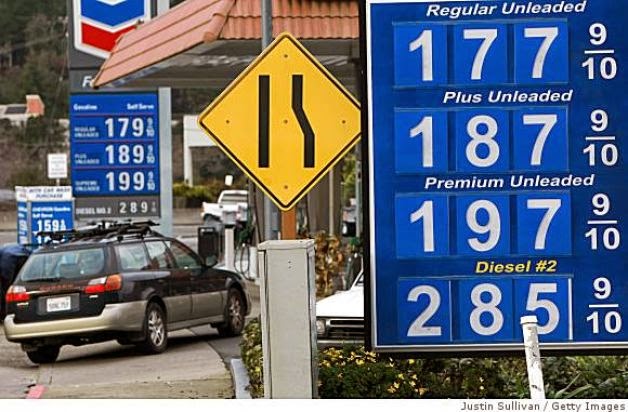
Nothing drives voter sentiment like the price of gas-- now averaging $3.56 a gallon, up 30 cents from the start of the year. It’s already hit $4 in some places. The last time gas topped $4 was 2008.

And nothing energizes Republicans like rising energy prices. Last week House Speaker John Boehner told Republicans to take advantage of voters’ looming anger over prices at the pump. On Thursday House Republicans passed a bill to expand offshore drilling and force the White House to issue a permit for the Keystone XL pipeline. The tumult prompted the Interior Department to announce on Friday expanded oil exploration in the Arctic.

If prices at the pump continue to rise,  expect more gas wars.

In fact, oil prices are rising for three reasons-- none of which has to do with offshore drilling or the XL pipeline.

The first, on the supply side, is Iran’s decision to cut in oil exports to Britain and France in retaliation for sanctions put in place by the EU and United States. Iran’s threat to do this has been pushing up crude oil prices for weeks.

The second, on the demand side, is rising hopes for a global economic recovery-- which would mean increased oil consumption. The American economy is showing faint signs of a recovery. Europe’s debt crisis appears to be easing. Greece’s pending bailout deal is calming financial nerves on both sides of the Atlantic, and the Bank of England and European Central Bank are keeping rates low. At the same time, China has decided to boost its money supply to spur growth there.

Neither of these would have much effect were it not for the third reason-- overwhelming bets of hedge funds and other money managers that oil prices will rise on the basis of the first two reasons.

Speculators have pushed crude oil to $105.28 per barrel, up 35 percent since September. Brent crude, Europe’s benchmark, is now $120.37 a barrel-- also worrisome because many East Coast refineries use imported oil.

Funny, I don’t hear Republicans rail against speculators. Could that have anything to do with the fact that hedge funds and money managers are bankrolling the GOP as never before?

Obama can't say he wasn't warned. Bernie Sanders-- the only Senate incumbent Blue America has endorsed for reelection-- has been warning about the dangers of oil and gas speculators for a very long time. Sanders says he has been disappointed by the "lack of urgency" by the Commodity Future Trading Commission and he and Maria Cantwell (D-WA) have been threatening congressional action if the CFTC doesn't curb oil speculation.

Not photoshopped

Labels: , , , , ,

Sunday, May 08, 2011

Do You Ever Get The Idea That Big Oil Runs The Country?

>


A lot of people noticed that news of the Libyan civil war had barely hit the newspapers when the price of gasoline in our neighborhood stations started steadily shooting up. Odd, many of us thought, since that gasoline came from crude that had been pumped and refined and shipped a month ago when the price was much lower. In fact, the price wasn't even higher yet, just starting to be driven higher by unregulated commodities speculators. And the many of us who ruminated on that were proven right when the Oil Industry explained patiently that although the price of crude has dropped by a lot, prices at the pump will not drop-- and may even continue to rise a bit-- because the high-priced oil is in the pipeline. Makes sense.

It would have also made sense that some Oil Industry top executives would have been indicted, tried and punished for their crimes over the years. Not doing so, is absolute permission for them to continue robbing us blind. And we don't even have to go all the way back to when Standard Oil was in bed with a rising young political figure in pre-War Germany (yes, the Adolf guy... but there was no way to do that without arresting prominent American traitors with household names like Rockefeller, Bush and Dulles). Just go back into the really recent past-- remember the ExxonValdez? The boat ran aground and spill oil all over. Everyone knew expensive lawsuits were coming so all the oil companies-- what a coincidence, since price fixing and collusion is clearly illegal-- jacked up their prices by a third, claiming a shortage of crude. Good thing it wasn't two boats!

I know you've been hearing this from me for years, so let me quote someone else, the nonprofit watchdog group, Public Campaign, who also tracks the legalistic bribes our Members of Congress takes from the corporations they're supposed to oversee and regulate and protect us from. Last week when the House Republicans were determined to pass H.R. 1230 to restart offshore oil and gas leasing in the Gulf of Mexico, Democrats responded with a Motion to Recommit that would have required that all the oil and gas pumped would be offered for sale in the U.S. and not go to China and India or wherever Big Oil could get the most profits from it. "If oil is taken from land owned by the American taxpayer, it should benefit American families. Democrats want to lower the price of gas, put consumers first, and strengthen our economic recovery," is how Nancy Pelosi explained it. It may sound reasonable but it lost 171-238, only one Republican, Walter Jones (NC), crossing the aisle to vote YES, while 4 Democrats crossed in the other direction. When the underlying legislation-- to force through the leasing-- came to a vote, it passed 266-149-- two Republicans, Jones and Key West Rep Ileana Ros-Lehtinen, joining the Democrats, while 33 of the most corrupt Democrats in the House crossed the aisle to curry favor with Big Oil, like for example, virtually all the Blue Dogs.
U.S. House members who defeated a measure to begin debate on legislation to end certain subsidies for oil companies received five times more in campaign contributions, on average, from the oil and gas industry in the 2010 election cycle than those who voted to proceed with the motion, according to campaign watchdog Public Campaign Action Fund.

This afternoon, House Democrats tried to pass a motion that would allow a vote on a provision to end certain subsidies to oil companies, but it was defeated 241-171, with just seven Democrats joining with Republicans to oppose the measure.

“Americans are struggling with the high cost of filling their gas tanks, but some members of Congress seemed only concerned with their Big Oil donors,” said David Donnelly, national campaigns director for Public Campaign Action Fund.

According to the analysis of data from the Center for Responsive Politics:

• House members who voted to continue the subsidies received, on average, five times more money in 2010 from oil and gas interests. Those voting to block debate received $36,066, on average, in campaign contributions from oil and gas interests. Those who voted to begin debate received, on average, $7,192 in campaign contributions from the industry.

• Overall, members that voted to continue the subsidies received more than $8.7 million in campaign contributions from oil and gas interests in 2010 while those opposed raised just $1.2 million.

• 16 of the 18 U.S. House members that received over $100,000 in campaign contributions from the industry in 2010 voted to block debate. One voted to proceed and a second did not vote.

...The five largest U.S. oil companies-- Exxon, Conoco Phillips, BP, Shell, and Chevron-- made over $30 billion in profits in the first quarter of 2011, yet they continue to get generous government subsidies and tax breaks. Today’s House vote would’ve ended these unnecessary handouts.

“Voting to keep these wasteful subsidies for oil companies might be good for campaign bank accounts, but it won’t solve our deficit,” said Donnelly. “Members of Congress should be standing with their constituents instead of their big oil donors.”

I'd like to point out the dozen most Oil-corrupted Members of the House. These 12 have taken the most in direct, legalistic bribes from Big Oil in their political careers. All of them-- surprise, surprise-- voted against the interests of their constituents and for the interests of the Big Oil companies that bribe them:

Joe Barton (R-TX)- $1,510,280
Steve Pearce (R-NM)- $1,188,092
Don Young (R-AK)- $1,000,913
Mike Conway (R-TX)- $678,818
Pete Sessions (R-TX)- $677,164
Dan Boren (Blue Dog-OK)- $651,310
Kay Granger (R-TX)- $646,307
John Sullivan (R-OK)- $596,000
Ralph Hall (R-TX)- $549,426
Kevin Brady (R-TX)- $489,947
John Culberson (R-TX)- $456,761
Randy Neugebauer (R-TX)- $448,222

The bill referred to above, the one that was meant to strip away the billion in tax subsidies to the mega-profitable oil industries was written by Tim Bishop (D-NY) would have resulted in $12 billion in savings for taxpayers over the next decade. Conservatives, who cry a lot about the deficit when it means paying a living wage to teachers and other public servants but never find any tax giveaways to their Big Business contributors too outrageous, disagreed. “We’re in this situation because of this administration’s policies that have shut off energy supply,” Rep Steve Scalise (R-LA), one of Congress' most blatant Oil Industry whores, said on the floor before the vote. He argued that the oil industry would pass on their extra costs to consumers if their tax subsidies are repealed. Just a week ago, both Speaker John Boehner and Budget Chairman Paul Ryan said publicly that they thought Big Oil should pay their fair share. I guess they must have felt a lot of pressure because they both voted against their constituents and for Big Oil on all three votes last week. Watch Ryan and some of his sleaziest colleagues in action:


[Time to dump Paul Ryan? Oh, absolutely-- and we have an Act Blue page dedicated just to that project. His own read on this is a lot like most Americans': "The GOP (greedy oil people) keep fleecing the American people by supporting the special interests of Oil and Gas companies with subsidies. This is not a path to fiscal responsibility, but a continuation of corporate welfare." Voters in WI-1 will have a real choice in 2012.]

Meanwhile the League of Conservation Voters sent out an e-mail to their list this week that I want to share with anyone not on that list. "Enough is enough," they begin.
ExxonMobil has reported 1st quarter profits of nearly $11 billion. Shell announced $6.9 billion in profits. BP earned over $5 billion during the first three months of the year.

Meanwhile Americans across the country are struggling with near-record prices at the pump.

And do you know the worst part? While the Big Oil companies rake in obscene profits, they’re also getting billions of dollars in taxpayer-funded subsidies.

Tell Congress: It’s time to end Big Oil handouts. Click here to add your name to the petition.

Over the past decade, the big five oil companies-- BP, Chevron, ConocoPhillips, ExxonMobil and Shell-- have enjoyed more than $900 billion in profits. Let me repeat that. Since 2001, the world’s biggest oil companies have made over $900 billion in profits.

At the same time, these oil companies benefit from more than $4 billion in special tax breaks every year. Why are we subsidizing one of the most profitable industries? Why does ExxonMobil get a tax break while we get stuck paying higher gas prices?

The House of Representatives has already cast several votes this year related to ending oil industry subsidies, but each time Big Oil’s congressional backers successfully beat back those efforts. In fact, pro-polluter lawmakers in the House are instead pushing irresponsible drilling that puts our economy and our environment at risk-- demonstrating their energy policy is simple: oil above all.

But momentum is building for action. Senate Majority Leader Reid has said that the Senate may vote as soon as next week on legislation that would strip the biggest oil companies of the government handouts they enjoy.

Labels: , , , ,