Wednesday, September 23, 2020

Neofascism and the Trump Phenomenon-- A Guest Post By Liam O'Mara

>


Liam O'Mara is a history professor running for a Riverside County congressional seat held by Trump enabler and crook Ken Calvert. Because there are so many incorrect conceptions about fascism floating around, and because Professor O'Mara teaches his students what it actually is, I asked him to do a guest post on how fascism and the Trump Regime intersect.

Goal ThermometerThe video up top is an ad Blue America is running in Riverside County right now and has nothing whatsoever to do with the post below. The video at the bottom contains a number of lectures Liam sent us from classes he has given on fascism and you might want to watch after you read his essay. Another thing I hope you'll want to do after you read his essay, is contribute to his campaign. Although he is being supported by the California Democratic Party, the DCCC is not enamored of independent-minded progressives taking on Republican incumbents in red districts-turning purple (like CA-42). So, to win this contest, O'Mara is going to need some grassroots love. He has an uphill but winnable battle against a corrupt right-wing slug who is self-serving and without a care when it comes to the benefit of working families in Riverside, in California or across the country. Time for Calvert to go. That's why I've included the Blue America 2020 Making California Bluer thermometer on the right. Please give it a click and consider contributing to Liam O'Mara's campaign.


Neofascism and the Trump Phenomenon
-by Liam O'Mara


Trumpism did not come out of no-where. Forty years of neoliberal policies have shrunk the middle class and strangled the American Dream. That decline has fuelled a reactionary politics that plays on fears, grievances, and insecurity about the future. But is it fascism?

The label of ‘fascism’ is thrown around a lot these days, despite people on all sides of the political spectrum often having an incomplete, or dead-wrong, understanding of the term. I am certainly guilty of using the term myself.

But as a historian of ideas, I often feel it is both necessary and warranted to raise the issue, given the global resurgence of the reactionary and nationalist right, and because I want more people to know what it means and where it ought to be used.

And we should better know what it means, given how many current leaders fit the mould of neofascism, despite rejecting the label. Vladimir Putin tends to call his enemies ‘the real fascists’, while literally quoting Russian fascist thinker Ivan Ilyin in his speeches!

We need to get better at recognizing what pulls together figures as diverse as Putin, Bolsonaro, Erdoğan, and Trump. The simplest way I can think of to frame an article on this is to outline the nine essential characteristics I use in my lectures. I will, along the way, point to some applications of those ideas in contemporary geopolitics.

Fascism is anti-liberal – Fascism argues against democracy and/or makes supportive gestures towards authoritarianism and authoritarian rulers, and supports greater policing powers over people. It is critical of human rights discourses and individual rights, and sceptical about universal moral values. It attacks the free press, and argues that respect for difference, for the Other, and often common courtesy, are just a scam to emasculate us.

Have you heard someone arguing, ‘You have nothing to fear if you did nothing wrong’, ‘Don’t resist and they won’t shoot you’, or ‘It’s okay he killed those people because they were commies / gays / criminals /etc.’..?


I Can't Breath by Nancy Ohanian


Have you seen public figures eschew all pretence of civility and ‘political correctness’ in order to delegitimize institutions, the media, and opposing parties? Trump’s constant attacks on the news, and the far-right’s crusade against universities (which they call ‘Marxist indoctrination camps’) are examples of illiberal thinking.

Fascism is anti-conservative – Fascists are often socially conservative, but are reactionaries, not political conservatives. Conservatives believe in preservation for the status quo and for slow, managed change that respects tradition. Fascists argue for a radical regeneration of the nation, and restoration of an earlier golden age.

When someone argues that contemporary culture is ‘degenerate’, or that we need to ‘Make American Great Again’, they are saying that something is wrong and needs major change. In doing so they sometimes call for a return to traditional values, but just as often will innovate in the values they wish to instill in the population.

Fascism does not promise a conservative social vision, but a revolutionary one, with near-messianic promises of rebirth.

Fascism is nationalistic – Fascists focus on the ethnic nation and/or ethné and/or nation-state over the individual, disdain minorities and scapegoats them for problems, and either oppose outright or seek to limit immigration..

Fascism idolizes the military, or at least a particular ideal of military power, and gets caught up in symbolic displays of enthusiasm. Consider the way that Erdoğan shifts attention to the Kurds to cover up criticism of his domestic policies, and unifies the nation by bombing innocents across the border in Iraq and Syria.

To really get this one, we need to distinguish some commonly-confused terms. Nationalism is not like patriotism – they have entirely different objects.

A nation is a group of people with some features in common (shared history, ethnicity, religion, language, culture, etc. – which features are used varies). A state is a collection of institutions (the military, the courts and laws, civil administration, parliaments, borders, etc.). And a country is a state with sovereign control of territory.

A patriot is someone who loves and serves their country or state. A nationalist is someone who loves and serves their nation.

Nationalisms are, by definition, exclusionary, and while based on actual cultural elements and history, are always selective and artificial in their construction of a political identity. Consider the way that Trump’s view of the nation seems to embrace white supremacists but not Muslims or immigrants.

Wrapping oneself in the flag, preaching distrust of foreigners, calling for an ‘America First’ policy that disdains alliances, and blaming problems on perceived Others in society are characteristic of nationalism. Lost your job? ‘Mexicans took it’! Company closed down? ‘Competition with China is to blame’! Need to justify a war? ‘Muslims all support terrorism, donchaknow’!

Fascism is conspiracist – Fascism is defensive, and sees the world in terms of mortal struggle between the forces of good and a nebulous, hidden enemy. It sets up a mix of internal and external enemies which must be opposed by patriots and challenged aggressively by the nation.

But those enemies cannot be so strong as to be a real threat – fascists use them to motivate fear, but it must be a flexible fear without real consequence, and thus the enemy must appear rhetorically as an all-powerful existential danger, but one that can easily be contained by state policy and the Great Leader.

Conspiracies are illogical by definition, and not dependent upon empirical evidence. You can read between the lines and find support for the beliefs in almost anything, since it is the emotional satisfaction of the conspiracy that matters most. Belief in élite paedophile rings run out of pizza places by Satan-worshipping liberals determined to eliminate all borders and turn the country over to Jewish financiers is somehow appealing to people confused by a more interconnected world. But such Illuminati-style nonsense only works if it isn’t real. It has to be something that you can address by voting for your side, joining a ‘patriotic’ organization, and sending e-mails to your friends.

Fascism is anti-rational – One of the reasons fascism is so hard to understand is that it does not have a strong philosophical foundation that can be supported logically. Instead, it focusses on emotional appeals and rhetoric, setting aside the need for statistics or evidence and calling for belief instead.

Fascism addresses the fears of working people by talking about their victimhood, about how things are changing and seeming to up-end their idealized picture of the world. Building on public fears, fascism distracts from them with big rallies and patriotic displays, and puts on events that celebrate the nation’s power, such as military parades.

Folks like Duterte, Bolsonaro, or Trump do not depend upon reason, facts, or policies for their appeal, but rather on simple messages & images, on slogans, etc. It doesn’t matter if their ideas are incoherent or if they would bankrupt the nation – the details are invisible to their fans because of their presentation.

Human beings have an almost infinite capacity to rationalize beliefs and paper over contradictions. It is possible for someone simultaneously to claim support for liberty and individual rights, yet ignore the presence of literal concentration camps and the systemic abuse of innocents within. These things are either ‘not happening’ – it’s just ‘fake news’ – or they are entirely justifiable for this or that reason, and do not call into question their commitment to freedom.

Fascism is charismatic – One of the things that helps to sell the contradictions and hypocrisy is the charisma of the Great Leader. Fascism requires a leader-cult focussed on a central figure, showing that leader as the solution to problems great and small, and slapping his name and/or image everywhere. Fascists will argue that his/her pronouncements are more valid than the media or experts, so they denigrate the media and tell people to trust the leader and/or the party first, and to disdain higher education and/or experts and/or the universities. It thus builds on a long history of anti-intellectualism on the reactionary right.

While running for office, Trump sold himself as a god-like figure, a saviour, telling us that ‘only’ he could ‘save’ us, that only he knows what has to be done. He said that knows ‘more than the generals’, ‘more than the scientists’, that he has ‘secret plans’ to defeat our enemies and that the scientists don’t actually know anything.

Because there is no substance to the claims, he sells everything with ‘believe me’ appeals to his own credibility, and disparages any source which undermines his narrative, including his own government. This kind of leader-cult is not a feature of democratic societies, but of failed democracies and totalitarian states.

Fascism is corporatist – Fascism is both capitalistic and anti-capitalistic; it argues for private enterprise and markets, sometimes mixed with state-owned businesses, but geared always toward serving the nation. This means that it can criticize big banks and corporations, but refuse to address the private nature of them and their profit motive, since it views the cut-throat competition in markets to be beneficial, in the same way that it favours competition among individuals.

Consider again the ‘America First’ rhetoric – fascists tend to support tariffs and trade wars, viewing all foreign exchange in terms of competition and dominance or submission. The US is not buying from Chinese companies – China is taking advantage of America!

Corporatism is another commonly misused word in American politics, with many thinking that it means support for corporations (meaning, the business model). The corporations that it means are a kind of public middle-man layer where something like a guild will speak for the workers in the place of trade unions.

The reason for this is that fascism opposes utterly the idea of class consciousness, favouring national consciousness instead. Fascist corporatism is meant to neuter the labour movement, weakening the ability of workers to challenge the powerful, and instead suggesting that all Germans – regardless of class – are allies against all French people, for example.

This is, of course, one of the reasons it is utterly absurd to consider Nazism (or any kind of fascism) to be socialistic. Socialists talk about the world and the economy in terms of class struggle, with the workers held back as a permanent underclass by the bourgeoisie and the capitalists. Fascism throws this distinction out completely, subordinating both the workers and the bourgeoisie to the shared interests of the nation.

Fascism is populist – Fascists talk frequently about working class interests and fears. This is the other area of overlap sometimes seen, falsely, between socialist and fascist movements. Socialism can be seen as a form of left-populism, while fascism is a form of right-populism.

Whereas the socialists point to the class enemy as the source of trouble, fascists point to foreign and domestic enemies of the nation. It will talk about the ‘left behind’ and the ‘forgotten man’, but often with a racist or nativist component (whether dog-whistled or overt). And it builds a shared sense of persecution, of the common man as an entitled, aggrieved victim of strange forces beyond his control.

Neofascists movements, from Alternativ für Deutschland to the Rassemblement National in France to the Trumpists in the US will make their appeals to working class, mainly high school-educated voters, by explaining the world in terms of competition with nefarious enemies at home and abroad.

The immigrants are bringing crime and drugs and sexual assault, they are influencing your children and destroying your culture, they are bringing about a ‘white genocide’! And who supports these immigrants? Why, the universities and the left! Communism, socialism, and even liberalism are seen as an existential threat, and the left must be resisted by any means available, including violence, because to leave them alone is to watch them poison and destroy the nation.

All totalitarian movements depend upon fabrication of internal and external enemies to justify the power of the party – but fascism is distinct in merging nationalism and populism to create a philosophy ideally suited to a working class suffering decline in the face of neoliberal globalization and automation.

Instead of addressing the economic structures and bipartisan policies which have created this decline, it offers a a scapegoat, and easy promises of a return to prosperity if only the Great Leader is granted more power and time.

Fascism is misogynist – Another way that fascists exploit the fears and grievances of working class men is through sexism and literal misogyny. All fascist movements have been anti-feminist, because women have been such an easy target for worker fears – ‘She’s taking your job! Shouldn’t she be at home raising your children instead?’.

The fascists offer men an easy way to decrease competition for good work by supporting ‘traditional’ gender rôles and the patriarchy, and suggesting that women are naturally better suited to being mothers and caretakers.

This is intimately tied to nativist and nationalist rhetoric, since a female sex restricted to birthing duties could help to eliminate immigration entirely, allowing populations to replace themselves and grow without ‘harming’ the nation through ‘interbreeding’.

Fascist movements are obsessed with demographic decline, which makes a certain amount of sense given its origins in the early twentieth century. By the early 1900s, the major powers of Europe were already dependent upon immigration for the population growth needed to fuel industrialization, and the movement of peoples from within and without Europe provided an easy target for fear-mongering about a cultural Other who would undermine the nation.

Needless to say, this continues in the anti-immigrant hysteria of neofascist parties in Europe, the US, Australia, Canada, and beyond.

On Trumpism and the GOP – I hope that this run through of the key features present in fascist and neofascist movements has helped, both in clarifying how and when the word should be used, and in underscoring the danger in which we find ourselves in much of the developed world. Nationalist and right-populist movements have been in steady resurgence for decades, moving from tiny fringe parties in the ‘1960s and ‘70s, to forming governments and coalitions in countries on every continent by the early twenty-first century. The present crisis has been a long time coming.

Again and again I try to remind people that Trump himself is neither surprising nor unique, but instead the product of a steady drift on the American right which goes back many decades, and arguably all the way to the same moment in the early twentieth century which spawned the original fascists. In movements as distinct as that of Father Coughlin and the German American Bund we see prototypes for the arguments which began pushing into the mainstream under Reagan, in the campaign of Buchanan, and finally with Trump.

Beating Trump in November may be critical to the survival of our republican institutions, but it is not enough. We need to confront the very real fears and systemic failings that leave so many American vulnerable to the rhetoric of the far right. Until we manage to toss the faulty neoliberal consensus, and begin to build an economy that works for all of us, far too many will be tempted by the easy answers of neofascist demagogues..

Regardless of when we manage to escape Trump himself, the Trumpist movement will carry on, with new right-populist leaders stepping up to claim the Great Leader’s mantle. Whether they succeed in remaking America in their image is up to us.


Labels: , , ,

Sunday, August 23, 2020

Do You Ever Imagine How Hard You Would Fight Against A Fascist Take Over?

>

Lambchop by Nancy Ohanian

I don't think the theme of Suzanne Gamboa's report for NBC News yesterday-- 'White supremacy' was behind child separations-- and Trump officials went along-- would surprise many people. Like someone missed the fact that Trump's top domestic advisor, Stephen Miller is a deranged neo-Nazi, even if the media doesn't like using those words? Gamboa put it more politely just referring to Miller, as Señor Trumpanzee’s "senior adviser and immigration policy architect [as he] called for a show of hands among senior officials on separating children from parents [now looked at as] 'a damning display of white supremacy' and a repeat of crimes against humanity seen through history. In a meeting of 11 senior advisers, Miller warned that not enforcing the administration’s 'zero tolerance' immigration policy 'is the end of our country as we know it' and that opposing it would be un-American, according to two officials who were there." The Trump Cabinet, damning itself for eternity, voted with Miller who "saw the separation of families not as an unfortunate byproduct but as a tool to deter more immigration. According to three former officials, he had devised plans that would have separated even more children. No one who attended the meeting argued on the children’s behalf or on the humanity or morality of separating the largely Central American families."


Have you watched A French Village (subtitles) on Prime? It's really an excellent-- if horrifying-- depiction of life in this fictional village occupied by the Nazis during World War II, especially for Jews and other minorities. And there are plenty of French characters like Stephen Miller. Would you take your life into your hands to resist or would you collaborate-- and how much?


Two years ago NBC ran a precursor by Noah Berlatsky: The Trump effect: New study connects white American intolerance and support for authoritarianism He wrote that a new study "suggests that the main threat to our democracy may not be the hardening of political ideology, but rather the hardening of one particular political ideology. Political scientists Steven V. Miller of Clemson and Nicholas T. Davis of Texas A&M have released a working paper titled "White Outgroup Intolerance and Declining Support for American Democracy." Their study finds a correlation between white American's intolerance, and support for authoritarian rule. In other words, when intolerant white people fear democracy may benefit marginalized people, they abandon their commitment to democracy."

White people who say they did not want to live next door to immigrants or to people of another race are more supportive of the idea of military rule, or of a strongman-type leader who could ignore legislatures and election results. MAGA!!
Trump's bigotry and his authoritarianism are not separate problems, but are intertwined. When Trump calls Mexicans "rapists," and when he praises authoritarian leaders, he is appealing to the same voters.

If You Support by Chip Proser


Miller and Davis' paper quotes alt right, neo-fascist leader Richard Spencer, who in a 2013 speech declared: "We need an ethno-state so that our people can ‘come home again’… We must give up the false dreams of equality and democracy." Ethnic cleansing is impossible as long as marginalized people have enough votes to stop it. But this roadblock disappears if you get rid of democracy. Spencer understands that white rule in the current era essentially requires totalitarianism. That's the logic of fascism.

Trump's rise is often presented as a major break with the past, and as a repudiation of American values and democratic commitments. But in an email, Miller pointed out that white intolerance has long served as an excuse for, and a spark for, authoritarian measures.

"People are fond of the Framers’ grand vision of liberty and equality for all," Miller says, "but the beauty of the Federalist papers can’t paper over the real measures of exclusion that were baked into their understanding of a limited franchise."

Black people, Asians, Native Americans and women were prevented from voting for significant stretches of American history. America's tradition of democracy (for some) exists alongside a tradition of authoritarianism (for some). The survey data doesn't show people rejecting American traditions, then, Miller says, so much as it shows "a preference for the sort of white-ethnocentrism that imbued much of the functional form of democracy for the better part of two centuries."

The Founders supported democracy as long as it was restricted to white male property holders. Today, our understanding of democracy is more expansive-- at least in theory.


In practice, the GOP has increasingly been embracing a politics of white resentment tied to disenfranchisement. "Since Richard Nixon's ‘Southern Strategy,’ the GOP has pigeon-holed itself as, in large part, an aggrieved white people's party," Miller told me.

Trump's nativist language made the GOP's sympathies more explicit, leading to further erosion of support among non-white voters. George W. Bush won 35 percent of Hispanic voters in 2000; Trump won only 28 percent. His showing with Asian-American voters was only 27 percent-- worse than any winning presidential candidate on record.

White people continue to decrease as a percentage of the U.S. population; at some point, it's going to be impossible to win a national, democratic American election with a platform that alienates people of color. The GOP, seeing their coming demographic apocalypse, has pushed voter ID laws and other barriers to voting to try to prevent black and other minority voters from getting to the polls. In Wisconsin, Republican Governor Scott Walker even attempted to delay elections for state seats that he believed Democrats would win.

"The GOP has dug itself into such a hole on this that the most practical effort to stave off these impending losses is to disenfranchise the votes of the same ethnic/racial outgroups against whom GOP messaging has been stoking animosity," Miller tells me. A party built on demonizing and attacking marginalized people is a party that will have to disenfranchise those same people if it is to survive.

Blaming authoritarianism on partisanship suggests that both sides are equally to blame for the erosion of democratic norms. But greater commitment to abortion rights and free healthcare in the Democratic party isn't a threat to the foundations of democracy. The growing concentration of intolerant white voters in the GOP, on the other hand, has created a party which appears less and less committed to the democratic project. When faced with a choice between bigotry and democracy, too many Americans are embracing the first while abandoning the second.
You can imagine that self-selected groups Americans reacted differently to the nationwide protests over the extrajudicial murder (lynching) of George Floyd. A new PRRI survey found that Republicans didn't change their opinions at all, while normal people were profoundly impacted:


The CEO of PRRI, Robert Jones, wrote that "In the wake of the killing of George Floyd by a police officer, the attitudes of Democrats and religiously unaffiliated Americans have shifted significantly, but there has been no movement among Republicans and white evangelical Protestants. For example, approximately eight in ten Republicans and seven in ten white evangelical Protestants continue to say that the recent killings of Black men by police are isolated incidents, rather than part of a pattern of how police treat African Americans-- views that are unchanged since PRRI began asking this question in 2015.”

The survey found that "a majority (56%) of Americans believe that recent killings of unarmed Black men are part of a pattern of how police treat African Americans, compared to 42% who say these are isolated incidents. These views are consistent with views in 2018 but the inverse of views from 2015, when a majority (53%) believed these events were isolated incidents. Republicans are about as likely today as they were in 2015 to say the killing of Black men by police are isolated incidents rather than part of a pattern of how police treat African Americans (78% vs. 82%), Democrats are about half as likely as they were in 2015 to agree with this sentiment (17% vs. 32%). Among white Democrats, this shift is even bigger (19% vs. 43%)." White evangelicals are nearly as racist as Republicans in general, their attitudes having remained unmoved over the last five years, with 72% in both 2020 and 2015 agreeing that the killing of Black men by police are isolated incidents."

Labels: , , , , , ,

Sunday, August 09, 2020

Which Is A Worse Trait Of Brian Kemp's-- His Authoritarian Bent Or His Incredible Stupidity? Or Is He Just A Genocidal Murderer?

>

COVID-Kemp with another idiot

On Friday, Georgia reported 4,109 new cases of COVID-19, the 4th most of any state, after much more heavily populated California, Florida and Texas. As of this afternoon, there have been 216,956 confirmed cases in the state or 20,400 cases per million residents-- worse than California or Texas and worse than any European country. There's only one reason Georgia is doing so badly: Brian Kemp and a Republican controlled legislature to back him up. Yesterday there were another 4,423 new confirmed cases reported and today another 3,169.

Kemp, one of the country's worst of the aggressively knee-jerk Trumpists, was Georgia's secretary of state when he ran for governor in 2018. He clearly lost the election and then stole it from rightful governor or Georgia, Stacey Abrams. So now he gets to kill students and teachers in a school re-opening rush that is already turning catastrophic.


Yesterday, reporting for The Atlantic, Amanda Mull penned a definitive Kemp piece, America’s Authoritarian Governor. Her point isn't just that he's a proto-fascist, but that he is also willfully stupid-- and Georgians are dying because of it. (There were 91 new deaths reported Friday, bringing the total to 4,117-- 388 deaths per million Georgians-- worse than California, Florida or Texas.) She wrote that the country has seen "as many leadership bungles in regard to the pandemic as there are states: Some failed to heed early warnings. Others refused to learn the lessons of outbreaks that came before theirs. Still others played politics instead of following science. And then there’s Georgia.
Georgia’s response to the pandemic has not been going well. It was bad from the beginning: Back in early April, weeks after other states took initial precautions, Georgia dawdled toward a shutdown while its coronavirus cases surged. Still, less than a month later, the state chose to be among the first in the nation to reopen, bringing back businesses known to accelerate the virus’s spread, such as restaurants and gyms, even though new infections had never made a significant or sustained decline. In June, the state welcomed back bars. What happened next was predictable, and was predicted: Case counts came roaring back. More people got sick and died. Many of these deaths were preventable. The state now has the sixth-highest number of coronavirus cases in the United States, behind five states with significantly larger populations.

Lots of states-- such as Florida, California, and New York-- have mishandled the pandemic since it hit in March. But when you look closely at Georgia, you see a state with a leader unique among his peers. First-term Republican Governor Brian Kemp presided over a late shutdown so short that his reopening drew a public rebuke from President Donald Trump, who has frequently opposed shutdowns altogether. Kemp’s administration has repeatedly been accused of manipulating data to downplay the severity of the outbreak. He has sparred publicly with the state’s mayors and sued to stop them from implementing safety restrictions or even speaking to the press.

To understand the course that Georgia has plotted through the pandemic, you have to understand Kemp’s failures. Those same failures, and the trajectory of the state governed by them, also represent a microcosm of America under Trump. The governor has demonstrated a willingness to defer to the president instead of his own constituents, sacrifice Georgians’ safety to snipe at his political foes, and shore up his own power at the expense of democracy. In short, Kemp is a wannabe authoritarian, and millions of Georgians have suffered as a result, with no end in sight.

Kemp has emulated strongmen since he entered state government. In 2018, as Georgia’s secretary of state, Kemp administered his own election by a thin, contested margin, despite calls to resign the office before running for governor. In his previous role, Kemp systematically purged more than 1 million voters from the state’s rolls, disproportionately disenfranchising Georgians of color. More than half a million of those voter registrations were voided in July 2017 alone, months into Kemp’s campaign for governor. Kemp’s office did not respond to a request for an interview, but in the past, he has repeatedly denied that these actions amounted to voter suppression.

In Georgia, and around the world, it has become clear that a novel virus doesn’t respond to the anti-scientific, expertise-shirking preferences of modern authoritarianism. When Kemp announced the closure of the state’s nonessential businesses on April 2, he said it was because he had learned something game-changing about the virus: that it is transmissible before an infected person develops symptoms. In reality, that had been a widely accepted belief for weeks, one that had helped encourage earlier lockdowns around the country. And unlike other states that were slow to shut down, Georgia already had a raging outbreak of nearly 5,000 identified cases. In southwest Georgia in late February, a funeral in the small, majority-Black town of Albany set off a chain of infection that sickened hundreds of people and left the local hospital system overburdened and overpaying for low-quality protective gear.

If a slow shutdown had been Kemp’s only major fumble, he’d be in broad and ideologically varied company both nationally and internationally. Instead, he has continued to double down on the state’s approach to the virus in ways that mirror not just Trump, but authoritarian leaders overseeing poorly controlled outbreaks all over the world, such as Brazil’s Jair Bolsonaro and India’s Narendra Modi. He has also taken a more hard-line stance than most of his Republican peers. GOP governors in Alabama, Mississippi, and Texas have implemented statewide mask rules in response to worsening outbreaks, and others who haven’t, such as Ron DeSantis in Florida and Doug Ducey in Arizona, have still allowed cities and counties to enforce their own local requirements. Not only has Kemp repeatedly refused to require masks in Georgia, but the state’s current pandemic emergency order was written with an explicit restriction to prevent local leaders from implementing their own mask rules.

Kemp’s administration has gone so far as to sue Atlanta Mayor Keisha Lance Bottoms over the city’s mask mandate and its plan to roll back the city’s reopening to its earliest stage, closing bars and restricting restaurants to takeout. When Bottoms fought the lawsuit, Kemp sought to stop her from speaking to the press. Other cities in the state, such as Savannah and Athens, also passed their own mandates but escaped inclusion in the lawsuit, which has pushed some to question whether the governor was trying to punish Bottoms for her support of Joe Biden. A Kemp spokesperson told the Washington Post that the lawsuit was primarily about the new restrictions on businesses in Bottoms’s order, which weren’t present in other municipalities’ mask mandates, but as the paper pointed out, masks were listed as the first issue in the complaint. “One has to ask about the political aspect of a conservative southern governor and a strong supporter of the president having a very public legal action against the Atlanta mayor, who’s been a vocal supporter of Joe Biden,” Harry Heiman, a professor at the Georgia State University School of Public Health, told me. Kemp backed down from the lawsuit last week, and Atlanta’s local mandate remains in effect.

None of Kemp’s actions has been popular among the state’s residents. According to findings released last week by the Atlanta-based market-research platform 1Q, 73 percent of Georgians surveyed believe that cities should be able to enforce their own mask mandates, and 70 percent disagree with Kemp’s refusal to institute a mandate statewide. In recent months, his overall approval rating has taken a hit. In May, Kemp was the only governor whose coronavirus response was less popular than the president’s among his own constituents. A recent poll pegged Kemp’s approval rating at 43 percent, down from more than 59 percent in January.

Kemp, like Trump, has recently started to encourage mask usage while still aggressively opposing any kind of enforceable mask rule. The problem with that approach, according to public-health experts, is that it sows confusion, making it more difficult for people to feel confident in their safety. The state’s own messaging has at times been misleading in other ways. On its Department of Public Health website, the state spent months backdating cases to a patient’s first symptoms, which meant that the most recent two weeks of the graph always looked as if the pandemic was in marked decline. The state has also released misleading graphics that it later insisted were honest errors in data rendering, such as a bar graph of case counts with the dates out of chronological order, again depicting a nonexistent downward slope.


In mid-July, two nearly identical maps of Georgia’s coronavirus outbreak began circulating on Twitter, depicting the state’s outbreaks on July 2 and July 17, over which time cases increased significantly. Both maps show only three of the state’s 159 counties shaded in red, marking the most dire spread of the disease. As case counts exploded, the state had raised the number of cases required for a county to change color. Once local media took notice, the state redesigned its map. The public health department’s website also now allows users to sort new coronavirus cases by date of diagnosis, the method used almost exclusively in other government and media visualizations of the pandemic.

Then there is the matter of reopening schools. The state’s accelerated reopening spiked cases just in time for the South’s typically early school calendar to begin, leaving educators, parents, and students to fend for themselves as Kemp urges the resumption of in-person instruction in order to protect kids from non-coronavirus threats such as malnutrition and abuse. But if Kemp’s concerns lie with the safety of the state’s children and the importance of getting them back in the classroom, why didn’t he do more to stop the spread of the virus? Why, instead, did he prioritize sending low-wage workers back to their jobs in bars, restaurants, nail salons, and gyms?

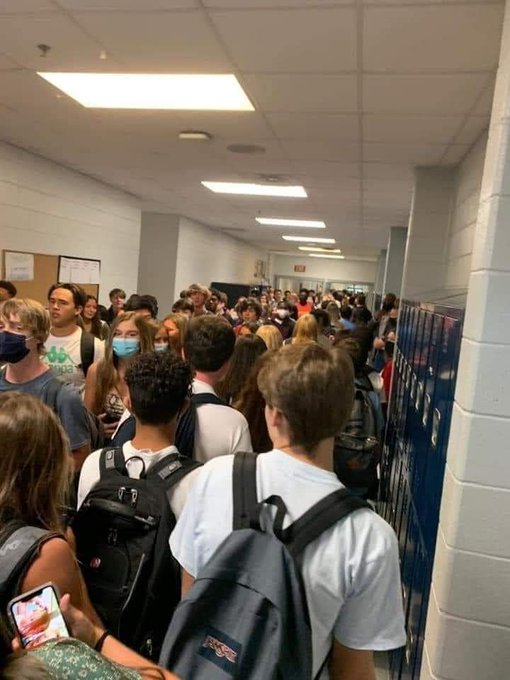
Some of Georgia’s school districts opened this week, and already the system is buckling under the weight of infection: Yesterday, we learned that the state’s outbreak had claimed its youngest victim yet, an otherwise healthy 7-year-old boy. One Cherokee County elementary-school class has already had to be quarantined after a second grader received a positive test result on the first day of school. Earlier this week, a photo from inside North Paulding High School in exurban Atlanta showed a crowded hallway with few teenagers wearing masks. An outbreak has already sickened members of the school’s football team, and students say they fear expulsion if they don’t show up. Two students were suspended for distributing photos of the school’s lax safety measures; at least one of those students has been reinstated following a public outcry over her right to free speech.

Georgia’s public universities, which are preparing for students to come back over the next couple of weeks, provide a bleak view of how the state is managing the dangers that a return to regular life presents for Georgians. For much of this summer, the University System of Georgia refused pleas from faculty and staff to require students to wear masks to class, or to allow individual colleges to make their own mask rules, before eventually relenting and requiring masks. At the University of Georgia, freshmen will still be required to live in cramped on-campus housing, much of which assigns two students to one privacy-free room, even if their classes are remote. For students who attend instruction in person, photos have begun to circulate on social media of the safety measures that await them: a small plexiglass divider loosely affixed to the front of a teacher’s classroom desk, or every other urinal in a public bathroom marked off with painter’s tape. With the majority of students yet to return, UGA already has the third-largest campus outbreak in the country, and Athens, the town where the school is located, ran out of intensive-care beds last week.

Is Paulding County ready for a Kemp-COVID outbreak?

Despite all his mistakes, it’s not too late for Kemp to wrangle the pandemic, said Heiman, the Georgia State professor. He told me that a statewide mask mandate; closing bars, gyms, and indoor dining; and clear, consistent messaging from state leadership about pandemic safety can work quickly to limit transmission of the virus, just as such measures have in New York, following that state’s catastrophic outbreak. Once transmission is low, more businesses can be safely reopened, testing supplies and personal protective equipment can be stockpiled, school buildings can be altered for better ventilation, and life can return to something closer to normalcy while Georgians wait for treatments and vaccines to come along.

In order to do that, though, Kemp would have to do something authoritarians hate: admit he was wrong, and change his mind based on evidence, the advice of experts, and the will of the people. The same is true for the country as a whole. America is a few decisions away from a much different future.

Instead, like the authoritarian he’s shown himself to be, Kemp seems intent on maintaining the disastrous course his administration has plotted so far, at the expense of the people of Georgia. “It’s truly unbelievable,” Heiman said. “It will be a case study for decades to come of what an utter collapse of political and public-health leadership looks like.”

Labels: , , , ,

Friday, June 12, 2020

Countries Dominated By Incompetent Authoritarian Leaders Have Been Unable To Cope With The Pandemic-- What Will It Take To Make Their Citizens Rise Up?

>

A modern day tableau like this is only wishful thinking for Russians, Americans, Indians... but what about Brazilians?

A lot of people have noticed that countries with anti-democratic authoritarian leaders-- namely, the U.S., Brazil, Russia and India-- are being hit hardest by the pandemic. It's almost like God wants to punish fascists, especially incompetent fascists:
Señor Trumpanzee- 2,116,428 confirmed cases
Bolsonaro- 829,902
Putin- 511,423
Modi- 309,603
Boris Johnson- 292,950
Erdoğan 1,195 New cases today), Khamenei 2,369 new cases today), el-Sisi (1,577 new cases today) and bin Salman (3,921 new cases yesterday) are watching their countries-- respectively Turkey, Iran, Egypt and Saudi Arabia-- spiking gigantically everyday and catching up to the Big Five. Meanwhile, though, a question: are people getting restless, angry and frustrated enough to work towards removing their horrible leaders? Not really... except Trump will be out on his fat ass in January. And then there's Brazil. They've been having frightening surges every day-- 31,197 new cases Tuesday and 1,185 new deaths (the most of any country in the world), 33,100 new cases Wednesday as well as 1,300 new deaths (again the worst in the world) and 27,644 new cases yesterday and 1,123 new deaths (worst in the world)... Today: 24,253 new cases and 843 new deaths so far.

Writing for the New York Times Wednesday, Simon Romero, Letícia Casado and Manuela Andreoni reported that with daily corona-deaths topping anywhere else in them world, with investors bailing on Brazil, with Bolsonaro, his sons and his allies under investigation and his election possibly about to be overturned, "some of the most powerful military figures in Brazil are warning of instability." Bolsonaro and his cronies are embracing the idea of military intervention. "In fact, one of the president’s sons, a congressman who has praised the country’s former military dictatorship, said a similar institutional break was inevitable. 'It’s no longer an opinion about if, but when this will happen,' the president’s son, Eduardo Bolsonaro, recently told a prominent Brazilian blogger, warning of what he called a looming 'rupture' in Brazil’s democratic system."

Bolsonaro-19... worse for Brazil than COVID-19?

The standoff traces an ominous arc for Brazil, a country that shook off military rule in the 1980s and built a thriving democracy in its wake. Within two decades, Brazil had come to represent the energy and promise of the developing world, with a booming economy and the right to host the World Cup and the Olympics.

Since then, its economy has faltered, corruption scandals have toppled or ensnared many of its leaders and an impeachment battle ousted its powerful leftist government.

Mr. Bolsonaro, a former Army captain, stepped into this tumult, celebrating the country’s military past and promising to restore order. But he has come under blistering criticism for downplaying the virus, sabotaging isolation measures and cavalierly presiding over one of the highest death tolls in the world, saying, “We are sorry for all the dead, but that’s everyone’s destiny.”

He, his family and his supporters are also being pursued on allegations like abuse of power, corruption and illegally spreading misinformation. Yet nearly half of his cabinet is made up of military figures, and now, critics contend, he is relying on the threat of military intervention to ward off challenges to his presidency.

A retired general in Mr. Bolsonaro’s cabinet, Augusto Heleno, the national security adviser, shook the nation in May when he warned of “unpredictable consequences for national stability” after the Supreme Court let an inquiry into Mr. Bolsonaro’s supporters move forward.

Another general, the defense minister, swiftly endorsed the provocation, while Mr. Bolsonaro lashed out as well, suggesting that the police ignore the “absurd orders” of the court.

“This is destabilizing the country, right during a pandemic,” said Sergio Moro, the former justice minister who broke with Mr. Bolsonaro in April, said of the threats of military intervention. Though he considers military action unlikely, he added: “It is reprehensible. The country does not need to be living with this type of threat.”

Political leaders and analysts agree that military intervention seems unlikely. Even so, the possibility is hanging over the nation’s democratic institutions, which are scrutinizing Mr. Bolsonaro and his family on multiple fronts.

Two of the president’s sons are under investigation for the kind of disinformation and defamation campaigns that helped get their father elected in 2018, and late last month the federal police raided several properties tied to influential allies of Mr. Bolsonaro. The Superior Electoral Court, which oversees elections, has the authority to use evidence from the inquiry to annul the election and remove Mr. Bolsonaro from office.

Two of his sons are also under investigation for corruption, and the Supreme Court recently authorized an inquiry into allegations that Mr. Bolsonaro tried to replace the federal police chief in order to protect his family and friends.

Even the president’s handling of the pandemic is under legal threat: On Monday, a Supreme Court justice ordered the government to stop suppressing data on Brazil’s surging death toll.

The threats of military intervention have incited a broad backlash, even from some senior members of the armed forces. And General Heleno, the national security adviser, later said that he did not support a coup, contending he was misunderstood.

Still, military and civilian officials in Mr. Bolsonaro’s own administration-- as well as allies of the president in Congress, evangelical megachurches and military associations-- say the maneuvering is aimed at heading off any attempts by Brazil’s legislative and judicial institutions to oust the president.

Silas Malafaia, a right-wing televangelist close to Mr. Bolsonaro, insisted that the president had not told him of any plan for military intervention. Still, he argued that the armed forces had the right to prevent courts from overstepping or even ousting the president.

“That’s not a coup,” Mr. Malafaia said. “It’s instilling order where there is disorder.”

The pro-Bolsonaro officials issuing such threats are generally not referring to the way coups have often been carried out in Latin America, with the armed forces toppling a civilian leader to install one of their own.

Instead, they seem to be urging something similar to what happened in Peru in 1992, when Alberto Fujimori, the right-wing leader, used the armed forces to dissolve Congress, reorganize the judiciary and hunt down political opponents.


Mr. Bolsonaro, who still draws support from about 30 percent of Brazilians, already casts himself as the embodiment of Brazilian military culture, and portrays the armed forces as ethical and efficient managers.

Brazil’s armed forces already exercise exceptional influence in his government. Military figures, including retired four-star generals, account for 10 of 22 ministers in the cabinet. The government has named nearly 2,900 other active-duty members of the military to administration posts.

The clout of Brazil’s armed forces was on display when congressional leaders mostly exempted them from a 2019 pensions overhaul, allowing members of the military to avoid the deeper benefits cuts endured by other parts of society.

Mr. Bolsonaro’s pandemic response showcased the military’s rising profile in his government-- as well the risks for leaders of the armed forces when Brazilians start ascribing blame as things go badly awry.

...Sidelined and balking at expanding the use of hydroxychloroquine, a malaria drug promoted by Mr. Bolsonaro that has not been proven effective against the virus, the health minister was replaced. His successor lasted only a few weeks until he resigned, replaced by an army general, Eduardo Pazuello.

One former official in the health ministry said the abrupt changes created a sense of chaos within the agency, resulting in weeks of dysfunction and paralysis at the most crucial time-- when the country should have been fighting the uncontrolled spread of the virus.

...Carlos Fico, a historian at the Federal University of Rio de Janeiro who studies the Brazilian military, said the growing power of the armed forces carried the risk of revealing their incompetence in crucial areas.

“They think that bombastic declarations will make things happen as in the military realm, where an order is given and those of lower rank obey,” Mr. Fico said.

But with the military now guiding the pandemic response, Mr. Fico added, “They’re running the risk of being blamed by society for what happens next.”

Top allies of Mr. Bolsonaro insist that the armed forces have no plans for a coup. “Not one four-star general is in favor of military intervention,” said Sostenes Cavalcante, a right-wing congressman.

But in the same breath, Mr. Cavalcante argued that something must be done to curb the power of the Supreme Court. He contended that the talk of a coup by Mr. Bolsonaro’s son was merely a way of pressuring the judiciary.

“You could interpret that as the Supreme Court having overstepped its authority,” Mr. Cavalcante said.

At the same time, some officials within Mr. Bolsonaro’s administration are actively examining scenarios in which the military might intervene. One military official in the government who was not authorized to speak publicly said an intervention remained off the radar for now, but that certain moves by the judiciary, such as ordering a search of Mr. Bolsonaro’s palace as part of an investigation, could change that.

Similarly, the official added, any potential annulment of the 2018 election by a judge would also be considered unacceptable, because it would remove not only Mr. Bolsonaro, but also his running mate and vice president, Hamilton Mourão, a retired general.

Mr. Mourão has repeatedly asserted that no kind of military takeover is under consideration. But even the debate over military intervention is raising concern about the resilience of Brazil’s democratic institutions and a return to chronic political instability, with constant military meddling.

Fernando Henrique Cardoso, a former civilian president who was exiled during the military dictatorship, said he didn’t think a coup was imminent. But he worried that Mr. Bolsonaro’s intimidation tactics could intensify.

How do democracies die? You don’t need a military coup,” Mr. Cardoso, 88, who has already urged Mr. Bolsonaro to resign, told reporters. “The president himself can seek extraordinary powers, and he can take them.”


Labels: , , ,

Thursday, June 04, 2020

Trump's Foray Into A Fascist Takeover Isn't Going Well For Him

>


Yesterday Anita Kumar reported that within minutes of Trumpanzee’s poorly-received address to the nation Monday, "his campaign aides began to mobilize. They cut a video of his speech. They promoted a black-and-white photo of him striding out of the White House to a partially burned church. One tweeted: 'Triumph. Leadership. Law and Order.'... Staffers are now embracing and promoting Trump’s threats to send the military into cities to help quell looting and vandalism in the hopes it will help the president win over seniors and suburban women, even if it comes at the expense of black voters."

Reporting on the same topic, also for Politico David Siders noted that Trump will attempt to move the campaign away from being a referendum on his to a revitalization of the Silent Majority. "The lines of demarcation between the nation’s cities and their suburbs have faded in the decades since Richard M. Nixon courted the 'Silent Majority' that elected him to the White House. With his law-and-order, tough-on-protesters rhetoric, Donald Trump is betting his presidency it still exists... Trump’s approach to the violence and unrest that have gripped the nation’s big cities seems calibrated toward winning back [suburbs that have trended blue since he was elected], in the hopes that voters will recoil at the current images of chaos and looting-- as they did in the late 1960s-- and look to the White House for stability."


Not everyone agrees with that strategy. James Miller, a former undersecretary of defense at the Pentagon resigned from his role on the Defense Advisory Board because of Defense Defense Secretary Mark Esper's visible support for law enforcement officers' clearing of protesters from Lafayette Square Monday. In a letter published by the Washington Post, Miller called Esper's support for suppressing the protest a violation of his oath of office.
When I joined the Board in early 2014, after leaving government service as Under Secretary of Defense for Policy, I again swore an oath of office, one familiar to you, that includes the commitment to “support and defend the Constitution of the United States... and to bear true faith and allegiance to the same.”

You recited that same oath on July 23, 2019, when you were sworn in as Secretary of Defense. On Monday, June 1, 2020, I believe that you violated that oath. Law-abiding protesters just outside the White House were dispersed using tear gas and rubber bullets-- not for the sake of safety, but to clear a path for a presidential photo op. You then accompanied President Trump in walking from the White House to St. John’s Episcopal Church for that photo.

President Trump’s actions Monday night violated his oath to “take care that the laws be faithfully executed,” as well as the First Amendment “right of the people peaceably to assemble.” You may not have been able to stop President Trump from directing this appalling use of force, but you could have chosen to oppose it. Instead, you visibly supported it.

Anyone who takes the oath of office must decide where he or she will draw the line: What are the things that they will refuse to do? Secretary Esper, you have served honorably for many years, in active and reserve military duty, as Secretary of the Army, and now as Secretary of Defense. You must have thought long and hard about where that line should be drawn. I must now ask: If last night’s blatant violations do not cross the line for you, what will?

Unfortunately, it appears there may be few if any lines that President Trump is not willing to cross, so you will probably be faced with this terrible question again in the coming days. You may be asked to take, or to direct the men and women serving in the U.S. military to take, actions that further undermine the Constitution and harm Americans.

As a concerned citizen, and as a former senior defense official who cares deeply about the military, I urge you to consider closely both your future actions and your future words. For example, some could interpret literally your suggestion to the nation’s governors Monday that they need to “dominate the battlespace.” I cannot believe that you see the United States as a “battlespace,” or that you believe our citizens must be “dominated.” Such language sends an extremely dangerous signal.

You have made life-and-death decisions in combat overseas; soon you may be asked to make life-and-death decisions about using the military on American streets and against Americans. Where will you draw the line, and when will you draw it?


Trump had been urging Esper to use an 1807 law signed by Thomas Jefferson, the Insurrection Act, as an excuse for sending in the troops to clear the streets and bolstering Trump's image as "a tough guy," yes the same tough guy who was cowering in a bunker when some protestors were shouting at him through the White House fence. [You know how much this drives Trump up a wall; yesterday, he told NBC News that "I was there for a tiny, short period of time... it was more for an inspection."] Esper told NBC in an interview Tuesday night that those powers "don't need to be used. We have more than enough National Guard capacity out there. I say this not only as Secretary of Defense but also as a former soldier and a former member of the National Guard. The option to use active-duty forces in a law enforcement role should only be used as a matter of last resort and only in the most urgent and dire situations. We are not in one of those situations now. I do not support invoking the Insurrection Act." I wonder how long it will take Trump to turn him into a punching bag among fascists promoting Trump.


At least Trump seems to have gotten a potential award-winning song out of this whole mess. This brand new Courtney Jaye song is really beautiful, as long as you don't think about whom she is writing.


Unfortunately, for Señor Trumpanzee, a new poll from Ipsos shows that a majority of Americans (64%) sympathize with the protestors and disapprove (55%) with how Trump has handled the unrest-- especially independents. In fact, just 67% of Republicans think Trump is handling the protests well. Only a third of Americans agree with how he's handling the situation. Voters see Trump as fanning the flames of violence and hatred and this poll showed Biden with a 10 point lead for November.


Yesterday, Kos wrote that while Trump was cowering in his bunker, public support for Black Lives Matter was surging. They and Civiqs have tracked public attitudes around Black Lives Matter for three years. "Charlottesville catalyzed a slow and steady progression of support, as well as a gradual decline in opposition. Thus, prior to the murders of Ahmaud Arbery, Breonna Taylor, and George Floyd, 42% supported the Black Lives Matter movement, 31% opposed, and 25% were indifferent. That all changed this past weekend, as the nation convulsed in anger at the systemic mistreatment of the Black community at the hands of the police. The nation’s hiding-in-a-bunker president, Donald Trump, has responded to the protests the only way he knows how-- by further stoking the fires of division, hatred, and violence. And we, as a country, don’t have a great deal of faith in the nation’s white population to process these events in a way that is positive and heals wounds. How could we? Only 37% of white Americans voted for Hillary Clinton! Yet our daily tracking poll shows that support isn’t just up, it’s way up. For the first time, the Black Lives Matter movement has majority support among white people. From the day that Arbery was killed to Monday, support for Black Lives Matter is up a net 15 points. And the weekend protests, despite the efforts of Trump and conservative media to paint them as threatening race riots, did nothing to arrest that growing support. Instead, support keeps growing. The protests are working. The movement even has majority support (39-30) among non-college whites-- Trump’s strongest demographics! It’s impossible to stress just how mind-blowing these numbers are, particularly given the glacial pace of public opinion on matters of race and justice. Here’s the net shift among some key demographics, from March 13, when Breonna Taylor was murdered, to yesterday:


Don't miss this new ad-- a thing of beauty! This is a time for choosing... America or Trump!-- another brilliant ad from the Lincoln Project. I hope people are seeing this series of ads in swing states.


Labels: , , ,

Thursday, January 23, 2020

What Drives Mitch McConnell? A Conscienceless, Near-Cartoonish Pursuit of Power

>


by Thomas Neuburger

For all the damage he’s inflicted on American democracy, for all the political corpses he’s left in his wake, Mitch McConnell has never betrayed an ounce of shame.
—Robert Moser, Rolling Stone

Mitch McConnell is a unique individual in the modern political world.

Most politicians are filled with a mix of fevered desires, flattering self-projections, a bittersweet mashup of idealistic regret and sad bows to "practicality," naked ego and the many attractive perks of the "Oh It's You, Senator" club (search on "you get it all the time") — and especially lots and lots of money. (I must add though that their vast corruption is vastly under-compensated, a point I've many times; the money-corrupted among them need a much better agent.)

It's a rare politician who simply wants power and power alone, power for its own sake, power unalloyed by other human desires. Mitch McConnell, like Rupert Murdoch and the real Mayor Daley (Richard J.) before him, is such a man.

At least that's the assessment of Dan Froomkin, writing at his site Press Watch:
Three things the media should be telling you about Mitch McConnell

McConnell’s motivations are essential context for a public trying to understand what’s going on in the Senate – and specifically, why McConnell is blocking Democratic attempts to introduce evidence that wasn’t available to the House.

The good news is that Mitch McConnell is not a hard guy to figure out. Indeed, countless, extensive profiles of him have concluded the same thing: that he is singularly uncomplicated. His only ideology is power. ...

[T]here is no appealing to reason with Mitch McConnell. There is no appealing to precedent, or to a sense of history. There is no appealing to the separation of powers, the role of Congress, or the sanctity of the Senate. There is certainly no appealing to the idea of country or the Constitution over party.

If it doesn’t help Republicans get elected, he’s not interested.

Here are three of the things reporters know about McConnell, but routinely fail to tell their readers and viewers...
Those three things are these:

1. Since money in politics is the chief agent of corruption, and Republican corruption means the acquisition of power for its own sake — what ever you think of Democrats, and I don't think much of them these days, Republicans aren't called "authoritarian" and "fascist" for no reason — "the only issue that McConnell really cares about is opposing any limits to money in politics."

Quoting Alex Parene:
Mitch McConnell is the great avatar of the decades-long enclosure of our public life by money. He does not offer a stirring vision of conservative national greatness or even ends-justify-the-means rationales for Senate horse-trading ... In Mitchworld, you simply pay—and pay, and pay—to play.
And:
Being a Senate majority leader who doesn’t care about almost any particular outcome to any particular political issue not directly related to making sure your funders can fund you actually seems to take quite a bit of pressure off, job performance–wise.
A simple, uncomplicated life. When you want exactly and only one thing, distraction is never an issue.

2. McConnell has "ruined the Senate," and that's just fine with him.

As Froomkin writes, "McConnell has dramatically transformed the U.S. Senate, from a place that once relied heavily on tradition and precedent and was less partisan and more deliberative than the House, into a slaughterhouse for any legislation that might hurt his donor pool."

But that's just one way he's damaged the body he's part of. The other way is to empower a radical judiciary that is more and more taking power away from the legislature, including the Senate, and arrogating to itself decisions the Founders meant the people to decide.

According to Charles Homans, "In the coming years, battles over voting rights, health care, abortion, regulation and campaign finance, among other areas, are less likely to be decided in Congress than in the nation’s courthouses. In effect, McConnell has become a master of the Senate by figuring out how to route the Republican agenda around it."

Using the Senate to diminish the Senate — that's our Mitch.

3. The simplicity of his wickedness renders him almost cartoonish.

Robert Moser (also quoted above), writes of McConnell, "like the president he now so faithfully serves, McConnell has always exuded a sense of pride in the lengths to which he’s gone to achieve his ambitions and infuriate his enemies."

And James Zengerle noted in Politico, "While most politicians desperately want to be liked, McConnell has relished—and cultivated—his reputation as a villain. After all, he achieved his iron-fisted grip on the politics of his home state and his fractious party on Capitol Hill through discipline, cunning and, oftentimes, fear. ... [A]t the moments that have found him happiest—winning elections, blocking bills, denying the sheen of bipartisanship to President Barack Obama—he has radiated not joy but menace."

Yet as amusing as cartoon villainy is to contemplate, this last point should not be dwelt on.

McConnell may well be the most dangerous man in politics today, not just because of his terrible goals — the acquisition of total power for a party that hosts the worse authoritarians in the country — but also because not an ounce of conscience pulls him back from the brink of his most terrible deeds.

He not only fails to fear that brink; he relishes finding it.

If I could choose just two politicians to remove immediately and forever from office, from a list that includes such dark angels as Boris Johnson, Jair Bolsonaro, Donald Trump, Benjamin Netanyahu, the murderous Mohammed bin Salman, our own progressive-hating Chuck Schumer and his House counterpart (yes, even her) and many more like them — I just might choose to eliminate Mitch McConnell. Twice.


Labels: , , , , , ,