Thursday, July 16, 2020

Let's All Shake Hands And Be Friends And Defeat the Real Enemy, Donald Trump And His Enablers-- Ummm... Just A Minute There

>


My political enemies are conservatives and reactionaries, and in Trump's case, mentally deranged fascists. The Democratic establishment will never hesitate for a moment to say "All you Bernie (and, to whatever small extent is needed) Elizabeth Warren supporters get on board the Biden for President train now." I'm not going to try to dissuade anyone from doing so-- and I wish people who discovered electoral politics 2 weeks ago would stop frothing at the mouth about me refusing to personally vote for Biden-- but Biden has a long and repulsive record going back 5 decades that has helped me form a hatred for him that's not going away. I know Trump is worse. I don't like racists and Biden only ran on one issue in his first election: racism. I don't like corporatists and he has always tried-- even harder than some Republicans-- to fellate Wall Street and the banksters and to wreck Social Security and Medicare in the name of Austerity... Yeah, yeah, you're heard it all before. But locking arms with a bunch of corrupt status quo Democrats to help elect Status Quo Joe Biden and other establishment candidates is not something I have any intention of doing. As you already know, the lesser of two evils is still evil.


Who's better? Who's worse?


My grandfather, a socialist and a devoted FDR fan, once told me, when I was very young, that there's only one thing in American politics worse than the Democratic Party-- the Republican Party. As I've written many time, Chuck Schumer went to James Madison High School in Brooklyn at the same time I did (a few years after Bernie graduated). He was as much "Little Schucky Schmucky" back then as he is now.


Writing for Too Much Information yesterday, Andrew Perez revealed that Schumer spent $15 million destroying progressive primary candidates. And now they expect us to vote for putrid conservatives like Frackenlooper (Colorado) or somewhat less putrid nothing candidates like Sara Gideon (Maine), Amy McGrath (Kentucky), Jon Ossoff (Georgia), Theresa Greenfield (Iowa), Ben Ray Luján (New Mexico), Barbara Bollier (a Kanas Republican pretending to be a Democrat), Jaime Harrison (South Carolina), and Cal Cunningham (North Carolina). I wouldn't vote for any of them. I vote for someone, not against someone who is worse. "With the help of the party, its major donors, and the Senate Majority PAC (SMP)-- a super PAC funded by labor unions, corporate interests and Wall Street billionaires-- candidates endorsed by Senate Minority Leader Chuck Schumer’s Democratic Senatorial Campaign Committee have won contested primaries in four battleground states," wrote Perez.
Colorado was the most emblematic example of the party putting its thumb on the scale against progressives: There, former Gov. John Hickenlooper cruised to a primary victory over former Colorado House Speaker Andrew Romanoff. In the final weeks of the race, SMP spent $1 million to boost Hickenlooper, after he spent his failed presidential campaign attacking key tenets of progressives’ legislative agenda, including Medicare for All and the Green New Deal.

At the time of the cash infusion, Hickenlooper was losing ground in the polls and engulfed in scandals: He had just been fined by Colorado’s Independent Ethics Commission for violating state ethics law as governor, the local CBS station uncovered evidence of his gubernatorial office raking in cash from oil companies, and a video circulated showed Hickenlooper comparing his job as a politician to a slave on a slave ship, being whipped by a scheduler.

With the help of SMP and the endorsement of the DSCC, Hickenlooper held off the more progressive Romanoff to win a 17 point primary victory.

SMP is led byformer top staffers at the DSCC. The super PAC has raised a staggering $118 million this cycle, pooling cash from both organized labor and business titans to promote corporate-aligned candidates over more progressive primary challengers.

Working for Working Americans, a super PAC funded by the United Brotherhood of Carpenters and Joiners, has donated $5 million. The Laborers' International Union of North America’s super PAC has given $1.5 million. The International Brotherhood of Electrical Workers’s political action committee has chipped in $1.3 million. SMP has received also big donations from groups affiliated with labor unions like the Service Employees International Union ($1 million), the National Association of Letter Carriers ($750,000), and Communications Workers of America ($500,000).

Overall, the top donor to SMP so far this cycle has been Democracy PAC-- a super PAC that’s bankrolled by billionaire George Soros and the Fund for Policy Reform, a nonprofit funded by Soros. Democracy PAC has contributed $8.5 million to SMP.

Other donors from the financial industry include: Renaissance Technologies founder and billionaire Jim Simons and his wife Deborah ($5.5 million) and billionaire D. E. Shaw & Co. founder David Shaw ($1 million).

Some major donors have financial stakes in current and future legislation.

For instance: SMP received a $1 million donation from billionaire Jonathan Gray, an executive at Blackstone, which owns the hospital staffing chain, TeamHealth. SMP also received $2 million from the Greater New York Hospital Association.

In late 2019, Schumer helped stall Senate legislation that would have kept patients from receiving “surprise medical bills,” the hefty charges that occur when they visit hospitals that are in their insurance network but are unknowingly treated by providers who are considered out-of-network.

SMP is affiliated with Majority Forward, a dark money group focused on attacking Republican Senate candidates. Majority Forward received $450,000 in 2018 from pharmacy giant CVS Health-- which also owns health insurer Aetna. The group also received $300,000 from the American Health Care Association (AHCA), a trade association that represents the nursing home industry.

The Democratic primary candidates backed by the DSCC have expressed reservations about Medicare for All, arguing they believe people should be allowed to keep their private health insurance if they want it. Many of the DSCC’s favored candidates do support creating a public health insurance option.

Meanwhile, the Real Estate Roundtable, a trade group for real estate investors, donated $50,000 to Majority Forward. Schumer and Senate Democrats recently helped Republicans unanimously pass pandemic relief legislation that included a special, little-noticed provision that amounted to $170 billion worth of new tax breaks for wealthy real estate investors.
Goal ThermometerSchumer has also derailed progressives in Maine, North Carolina, New Mexico, Kentucky, Texas, Georgia and Iowa. He and his cronies basically ignored West Virginia-- allowing Paula Jean Swearengin to win the primary and find herself as the only progressive challenging a Trumpist incumbent in the Senate this cycle. The 2020 Blue America Senate thermometer on the right makes it easy to contribute to her campaign. It's either that or an all-Schumer status quo Democratic caucus in the Senate next year-- doing nothing but disappointing people so badly that 2022 will see a replay of 2010, when progressives didn't even bother to vote, giving the Republicans massive wins in both houses of Congress and bringing on a decade of right-wing control.

And one more thing-- a question. Do the Democratic committees, like the DCCC and DSCC get behind progressives in the general election when they manage to win primaries? Sometimes, but rarely. They want progressives to help them after primaries... but they usually refuse to help progressives.

Labels: , , , , , ,

Friday, June 26, 2020

Trump And His Pet Governors Oversee The Spread Of A Disastrous Second Spike

>

The Second Spike by Nancy Ohanian

West Virginia appears to have had a relatively mild pandemic-- just 2,694 confirmed cases and 92 deaths. Their 1,503 cases per million is better than every other state except Hawaii, Montana and Alaska. And just a little below average among states for their rate of testing. But... was the state sending fake statistics, the way China and Florida do, covering up reality for political expedience? On Wednesday, the state's crackpot governor said there is "every reason to believe" the number of active COVID-19 cases in the state are less than what was previously reported due to recovered cases not being removed from the active case count," before firing the state's well-respected chief health officer, Cathy Slemp. The Associated Press took a little look.

Trumpist Governor Jim Justice has adamantly refused to strengthen West Virginia’s weak and unenforced virus restrictions in response to recent spikes. "He has," reported the AP, "repeatedly balked on mandating face masks in public spaces, as other governments have done, saying such an order would be politically divisive. Instead, he has stressed that people should follow existing safety rules, encouraging people to get tested for the virus and to wear face masks. Justice has also asked that people avoid traveling to Myrtle Beach, which has seen cases rise in recent weeks, rather than ordering quarantines as people return from the popular resort city... [A]t least 72 cases in 11 counties have been linked to tourism travel to Myrtle Beach, South Carolina, and about 70 cases have been linked to church services in three counties.
West Virginia Gov. Jim Justice forced out the commissioner of his public health bureau on Wednesday, hours after he publicly questioned the accuracy of the state’s coronavirus data and detailed growing outbreaks in about a dozen counties.

The abrupt resignation of Cathy Slemp, who was also a state health officer, came after the Republican governor vented during a news conference that West Virginia’s active virus caseload may have been overstated.


“If we were on our game here, in DHHR (Department of Health and Human Resources) and Dr. Slemp’s office, if we’re on our game and you’re listening to the governor say that there’s six active cases at Huttonsville and you’re looking at the reports that you’re putting together and sending them to me on active cases and your looking at Randolph County and they’re reporting a hundred-and-some-odd cases then you’re not doing your job,” Justice told reporters, without additional explanation.

In a statement Wednesday afternoon, the governor’s office said Justice had expressed his “lack of confidence” in Slemp to Bill Crouch, secretary of the state health department, who then asked for Slemp’s resignation. She resigned immediately, the statement said. In a separate statement, a spokeswoman for the health department said there were discrepancies related to virus caseload data at the Huttonsville Correctional Center in Randolph County.

Slemp, who was a regular feature of the governor’s daily virus news conferences, has decades of public health experience. She was previously the acting state health officer and was the founding director of the state’s public health emergency preparedness and response programs, according to a biography on the state health department website. Slemp is also on the board of scientific counselors at the federal Centers for Disease Control and Prevention.

Justice, a billionaire coal businessman without previous political experience, had showered Slemp with praise as he hosted press conferences about the virus during the outbreak, often stressing that his aggressive plan to lift virus restrictions was guided by his health experts. Slemp did not appear at Wednesday’s news briefing.
In her resignation letter Slemp wrote "COVID-19 is a crisis unlike any most of us have ever seen. I encourage all to stay true to the science, to further work to engage and empower communities to address such an unprecedented situation collectively, to meet people where they are and to move forward together."

West Virginia isn't unique in experiencing an uptick in cases in recent days. As Sam Baker and Andrew Witherspoon noted for Axios Thursday morning, The coronavirus surge is real, and it's everywhere. They wrote that the "pandemic is getting dramatically worse in almost every corner of the U.S. [and] getting closer to the worst-case scenario envisioned in the spring-- a nationwide crisis, made worse by a vacuum of political leadership, threatening to overwhelm hospitals and spread out of control. Nationwide, cases are up 30% compared to the beginning of this month, and dramatically worsening outbreaks in several states are beginning to strain hospital capacity-- the same concern that prompted the nationwide lockdown in the first place... Over half the country-- 26 states-- have seen their coronavirus caseloads increase over the past week. New cases are up 77% in Arizona, 75% in Michigan, 70% in Texas and 66% in Florida. California, which has seen steady increases for weeks, recorded a 47% jump in new infections over the past week. These steep increases come after weeks of steadily climbing cases or back-and-forth results across the South, Midwest and West Coast. Only the New York region and parts of New England-- the earliest hotspots-- have consistently managed to get their caseloads down throughout May and June."

And despite shrieks of protest from Death Cult leaders Trump and Pence, "Increased testing does not explain away these numbers. Other data points make clear that we’re seeing a worsening outbreak, not simply getting better data. Seven states, including Arizona, have set records for the number of people hospitalized with coronavirus, and the percentage of all tests that come back positive is also increasing. The whole point of the national lockdown was to buy time to improve testing and give infection levels a chance to level off without overwhelming hospitals. That worked in New York, but as other parts of the country begin to see their outbreaks intensify later, the same risks are back at the forefront."

In its exhaustive pandemic report yesterday, How The Virus Won, the NY Times noted that "Invisible outbreaks sprang up everywhere. The United States ignored the warning signs... At every crucial moment, American officials were weeks or months behind the reality of the outbreak. Those delays likely cost tens of thousands of lives."


Top federal health experts concluded by late February that the virus was likely to spread widely within the United States and that government officials would soon need to urge the public to embrace social distancing measures, such as avoiding crowds and staying home.

But Mr. Trump wanted to avoid disrupting the economy. So some of his health advisers, at Mr. Trump’s urging, told Americans at the end of February to continue to travel domestically and go on with their normal lives.

...By the time President Trump blocked travel from Europe on March 13, the restrictions were essentially pointless.

The outbreak had already been spreading widely in most states for weeks.

...Faced with an outbreak that had grown beyond their ability to test or trace, American officials had no option but to ask the public to stay home.

On March 16, weeks after health officials privately concluded a more active response would be needed, President Trump asked Americans to limit travel, avoid groups and stay home from work and school if they felt sick. One by one, states issued stay-at-home orders and closed businesses.

...By March 24, much of the country had followed. Within weeks, those shutdowns stopped exponential growth of the virus from overwhelming many parts of the country.

But every day mattered to halt the virus in New York City, where political leaders waited crucial days to close schools and impose a stay-at-home order as the virus spun out of control... [I]n New York City, the response was too late, said Lauren Ancel Meyers, an epidemiologist at the University of Texas at Austin. Other factors, such as the city’s density and its rate of international travel, also may have played a role, Dr. Meyers said. More than 22,000 deaths in the New York City area could have been avoided if the country had started social distancing just one week earlier, Columbia University researchers estimate. About 36,000 deaths nationwide could have been avoided by early May had social distancing begun earlier, the estimates say.


Even now, America remains in the dark.

Most infected people are never tested. There is little capacity to trace and isolate the contacts to those who do test positive. After the lockdowns expired, new cases spiked once again.
These 10 states had especially dangerous increases in their one day loads of new cases, from Wednesday to Thursday to Friday:
Texas +6,177 ---> +5,960 ---> 5,614
Florida +5,511 ---> +5,004 ---> 8,942
California +4,966 ---> +5,540 ---> 5,619
Arizona +1,795 ---> +3,056 ---> 3,428
Georgia +1,703 ---> 1,714 ---> 1,900
North Carolina +1,667 ---> +1,147 ---> 1,695
South Carolina +1,284 ---> 1,125 ---> 1,313
Mississippi +526 ---> 1,092 ---> 550
Alabama +967 ---> +1,142 ---> 977
Tennessee +932 ---> 799 ---> 1,410

Labels: , ,

Sunday, May 10, 2020

Don't Tell The DCCC, But There's A House Seat We Can Win Back In West Virginia

>


West Virginia was Bernie territory in the 2016 primary. Most people know that he beat Hillary in every single county, but fewer people know he also garnered more votes than Trump did in many counties. West Virginia voters are a lot more progressive than people think. WV-02, the district Cathy Kunkel is running to represent, has 17 counties, though most of the population lives in just four. Kanawah is the biggest county in the district and trends blue. Bernie beat Hillary and the two of them combined had more votes than 10 Republicans combined! Although Hillary lost to Trump in the general, Kanawha voted against GOP incumbent Alex Mooney in 2018. Similar story in Jefferson County-- Bernie beat Hillary and the combined votes for those two top Dems were greater than for all 10 Republicans on the ballot. In some of the smaller counties, the two Dems also beat the 10 Republicans. In fact, in Braxton, Calhoun and Clay counties, Bernie beat the combined 10 Republicans on his own! In Randolph County Bernie beat Hillary 2,492 to 1,515 but the more interesting comparison was between Bernie and Trump, who led the Republican field but with just 2,206 votes. In the end, Bernie and Hillary has 4,007 votes compared to 2,828 votes for Trump, Ted Cruz, John Kasich, Ben Carson, Mike Huckabee, Marco Rubio, Rand Paul, Jeb Bush, Carly Fiorina and Chris Christie combined.

No need to write West Virginia off-- even if he did win every single county and pulverize the status quo Democrat in the general. His 68.9- 26.5% win was one of his strongest showings in the country. West Virginians weren't interested in preserving the status quo. Since Trump was inaugurated in 2017, his job approval has decreased among West Virgina voters by 13 points.

Cathy Kunkel, who earned undergraduate and master’s degrees in physics from Princeton and Cambridge, is nothing like a status quo Democrat. She's been fighting for West Virginians for the last decade. After the 2014 Freedom Industries chemical spill contaminated the drinking water of Charleston and the surrounding region, Cathy co-founded Advocates for a Safe Water System, a community group that fought for three years to win improvements to the safety of the drinking water.

Goal ThermometerCathy also co-founded and chaired Rise Up WV, an organization that advocates for expanded healthcare access, public education, and better services for people struggling with addiction. During West Virginia’s 2018 and 2019 school employee strikes, Rise Up WV administered strike funds that raised over $340,000 for striking employees. Rise Up WV has helped to win state legislative victories around healthcare access and to elect new candidates for municipal government and state legislature in the Charleston area.

As an energy policy expert, she has testified before the West Virginia Public Service Commission to defeat an electric utility corporate bailout that would have cost consumers hundreds of millions of dollars; to defend West Virginia’s rooftop solar laws; and to strengthen energy efficiency programs and save consumers money.

She is running for Congress as part of WV Can’t Wait, a coalition of more than 90 candidates running for offices up and down the ballot in West Virginia who have all pledged not to take corporate money in their campaigns. Cathy is unopposed in the Democratic primary and will face Congressman Mooney this fall. Congressman Mooney won his re-election in 2018 with 54% of the vote, and the WV Can’t Wait coalition is working hard this year to turn out the thousands of voters who have become disenchanted with the establishments of both parties.


West Virginia Deserves Better
-by Cathy Kunkel


In recent weeks, Congressman Alex Mooney’s contempt for the people of his district has been on full display. In March, Mooney was one of 40 members of Congress who voted against the Families First Coronavirus Relief Act. Among other things, this bill mandated free coronavirus testing, expanded paid sick days and bolstered unemployment insurance and food assistance. Mooney’s argument was that he wanted to wait and see how the previous round of federal coronavirus spending went before authorizing more spending.

Of course, it turns out that both the Families First Coronavirus Relief Act and its predecessor were a drop in the bucket in terms of addressing the severe economic shock caused by the coronavirus. Shortly thereafter, Congress passed the CARES Act, which authorized $1200 relief payments, pandemic unemployment insurance, the small business paycheck protection program, and a massive corporate bailout fund at the discretion of the Treasury. You might think that a fiscal conservative like Congressman Mooney would have been concerned about these corporate bailouts, but apparently not.

Instead, on May Day, Congressman Mooney co-sponsored legislation (H.R. 6657, the WUHAN Recissions Act) to claw back some of the spending authorized in the CARES Act-- not the hundreds of billions authorized for corporate bailouts, but the hundreds of millions (or less) authorized for the Legal Services Corporation, public transportation, rural telecommunications, international disaster assistance and the Peace Corps. Prior to the pandemic, nearly a quarter of West Virginia’s workforce was employed in low-wage, service sector jobs, and one in five West Virginia kids struggled with hunger. Today, demand at food banks has surged more than 40%, unemployment has skyrocketed and nearly 60,000 West Virginians have lost their employer-provided health insurance during a pandemic.

Yet the struggle of thousands of West Virginians to afford rent, food and healthcare is somehow not as important as cutting funding for programs that Congressman Mooney ideologically opposes. Sadly, this is no surprise given the rest of Congressman Mooney’s record. He voted to repeal the Affordable Care Act, against raising the minimum wage and in favor of eliminating the Consumer Financial Protection Bureau. He has even gone so far as to introduce legislation to put the U.S. back on the gold standard.

What West Virginia actually needs in this moment is not Congressman Mooney’s failed ideology, but real relief for working people. That includes rent and mortgage payment cancellations, ongoing economic stimulus payments, paid sick days for all workers and prioritization of small business relief.

And going forward, West Virginia needs Medicare for All and billions of dollars of federal investment to put people back to work building the infrastructure the state needs to move forward. West Virginia could employ thousands of people in building rural broadband, upgrading drinking water and wastewater infrastructure, and fixing the damage that coal and gas corporations have done to the state’s land and water. The pandemic and the ongoing climate crisis highlight the urgency of a Green New Deal to create jobs, protect workers and communities, and lay the foundation for a more diverse and stable economic future for the state.


Labels: , , , , ,

Tuesday, February 11, 2020

Paula Jean Swearengin-- A Coal Miner’s Daughter, Granddaughter, Niece And Stepdaughter

>


West Virginia was the ultimate blue state starting with FDR's first election in 1932. Two years earlier, the Democratic Party won the state House and held it, uninterrupted from 1930 to 2012. The state's voters even went for Adlai Stevenson against Eisenhower in 1952, for Hubert Humphrey against Nixon in 1968, for Jimmy Carter against Reagan in 1980 and for Michael Dukakis against George H.W. Bush in 1988. The last time a Democratic president candidate won in West Virginia, though was in when Bill Clinton beat Bob Dole in 1996. The state suddenly turned so red after that that Hillary won just 26.4% of the state's vote in 2016. The only state that was less supportive of her was Wyoming. Democrats held the state's two Senate seats from 1958 until Shelley Moore Capito won one of them-- on Jay Rockefeller's retirement-- in 2014. Capito is the daughter of former 3-term Republican Governor Arch Moore, a corrupt sack of crap who was sentenced to 6 years in prison on extortion charges to which he plead guilty.

The party registration, though, still favors Democrats, at least on paper. In November, 2016, as Hillary and Trump faced off, Democrats outnumbered Republicans 44.74% to 31.21% (with 20.91% registered voters unaffiliated with any party). Last month, the secretary of state reported that 39.62% of registered voters are Democrats, 33.76% are Republicans and 22.81% are unaffiliated. In November Capito will fight her first reelection battle. DC pundits rate her seat "safe." She has already raised $3,419,526.

Goal ThermometerCapito's most serious opponent is Paula Jean Swearengin, a strong Berniecrat who is part of the West Virginia Can't Wait movement, which seeks to rescue the state Democratic Party from the clutches of corrupt conservatives with more in common with the Top than with the FDR Democrats who were so popular in West Virginia for so many decades. Today Blue America endorsed Paula Jean and we've added her to out 2020 Senate page which you can access by clicking on the ActBlue thermometer on the right. I asked her to help us understand why she's running for the Senate as a strong progressive in a state that went so strongly for Trump. More than almost any other candidate I've spoken to, she really and truly is... one of us.


Guest Post
-by Paula Jean Swearengin


As a native of Mullens, West Virginia my coal mining roots run deep. I’m a coal miner’s daughter, granddaughter, niece and stepdaughter. As a child, I was taught to have  a deep sense of pride in our state. West Virginia's hard work powered our nation through the Industrial Revolution, and kept our factories running through World War II. America was built on our coal-- it was built, in part, on the backs of Appalachians.

Like so many other families in Appalachia, my family paid a steep price. I’ve lost family and friends to poverty and the healthcare crisis in Appalachia. I’ve watched as family members, neighbors and community members suffered with addiction, cancer and poverty.

When my stepfather lost his job at the coal mine, he moved our family to North Carolina as he tried to find a new line of work. A few years later I came back home to take care of my grandfather. What I saw when I came back disturbed me. I saw entire communities left in the dust when a mine shut down, small businesses drying up, miners and their children struggling with diseases brought on by the industry that we turned to for security. I saw a whole generation struggling to find reliable, safe jobs that would put enough food on the table. As a single mom of four boys, I had to do something about it.


I was driven to speak out for a brighter future for my family, my friends and my community. I went to town halls and confronted legislators for protecting corporations, instead of workers. I stood with families who were begging for clean water to flow from their taps. I rallied with teachers, healthcare providers, coal miners and other union members who were calling for fair wages, healthcare and decency.

Eventually I felt our calls for change were continuing to be ignored by our representatives. Something had to be done. That’s when I decided, in order to make change, I had to step up and fight from within. 

When I mounted a campaign for Senate in 2018 we rallied volunteer and support from across the state and country. We spread our message of economic diversity, healthcare and basic human rights from the Western Panhandle to the Southern coalfields and across the state.

Our race broke state records by garnering nearly 50,000 votes, the highest votes in a primary in West Virginia in 75 years.

The industrial revolution was built on the backs of coal miners, their families and our communities. I am tired of watching my state suffer after we have sacrificed so much.


West Virginia is one of the poorest and sickest states in the country. Our people have been keeping the lights for our nation for more than a century. The industrial revolution was built on the blood, sweat and tears of Appalachian laborers. While corporations have gotten wealthy off the backs of our workers and our communities, industries drained our state and left us ravaged by pollution and poverty.

I am running for 2020 to finish what I started. My first grandchild was born in January and I have to fight for his future.


Labels: , , ,

Friday, January 24, 2020

71 Pro-Labor Candidates Just Filed to Run in West Virginia…Together

>


At the very end of last year, reporting for the American Prospect, David Dayen explained why he thinks the West Virginia gubernatorial election is the most important race in the country, with "implications that endure the farthest into the future." Dayen wrote that the election "just might inaugurate a new kind of people-centered politics in the heart of what’s assumed to be Trump country... Smith’s bet, that building a people’s movement will generate a deeper well of support to take back West Virginia from a corrupt political structure, would be transformational. It would deliver a roadmap for how to organize in rural towns thought to be lost to the right wing forever. It would identify how to bring in infrequent voters who have given up on politics. It would lay out how to break a corrupt establishment and return government to its people, on principles that bring people together rather than driving them apart. If this can work, it opens up an entirely new style of politics, one rooted in something so simple it’s absurd that it seems so novel: respecting the wishes and needs of the electorate. 'My whole life, I’ve been told that voters are the problem, they vote against their own interests,' Smith says. 'We believe the opposite. Voters are the answer to the problem, not the problem themselves. We think the people closest to the problem should solve it.'"

Goal ThermometerIn 2019 we endorsed Stephen Smith for governor of West Virginia and introduced you to the West Virginia Can't Wait movement. That movement has almost morphed into a political party now, replacing the moribund state Democratic Party, which is little more than a political machine for Joe Manchin. "This has never happened before in our nation," Stephen told me a couple of days ago, "let alone in a place like West Virginia. The wealthy Good Old Boys hate it. But there aren’t nearly enough of them to stop us if we join together and demand what West Virginia has never had before: government by and for our people, not just the powerful."

I asked Stephen to expand those sentiments into a guest post. Please read it-- and if you like what he has to say, consider contributing to his campaign by clicking on the 2020 Blue America gubernatorial thermometer above. David Dayen is right about how important this race really could be for the whole country.


Guest Post
-by Stephen Smith

Two years ago, West Virginia educators sparked a nationwide strike movement. Now, the state’s working class is leading the nation again. On Saturday, a coalition called West Virginia Can’t Wait gathered more than 200 supporters outside the state House chambers to announce that 71 candidates.

Candidates include 11 teachers and school service personnel, like Brittney Barlett (an English teacher running for Delegate in Lewis County) and Johnny Nick Hager (a school bus driver running for Mingo County Commission). Tina Russell is a Black social worker who’s running against an incumbent who suggested that if he discovered his children were gay, he would drown them. Rosemary Ketchum is running a vibrant grassroots campaign for Wheeling City Council; when she wins, she will become the first openly transgender person to hold elected office in West Virginia. The vast majority of candidates are running for the first time.

In a state where less than 20 percent of the legislature are women, less than 10 percent are working class, and less than 5 percent are people of color, the West Virginia Can’t Wait candidates represent the state across race, county, gender, and class lines. And every one of them has signed a pledge, which was read on Saturday at the Capitol by Congressional candidate Cathy Kunkel: “I promise not to take corporate cash… I promise never to cross a picket line… I promise never to hide from a debate… I promise never to punch down.”

Dozens of the WV Can’t Wait candidates filed for office at the Capitol, posing for photos with friends and family who never could have imagined being in this spot. “I’ve never been to the Capitol. I didn’t know where I was supposed to go. But I knew I needed to fight for a state where my kid could grow up and make a living,” said veteran David Childers, a first-time candidate for the state senate in the rural 14th district.

Candidates also delivered their “People’s State of the State” address, unveiling the WV Can’t Wait policy platform which had been crowd-sourced during 156 Town Halls. 47 “Platform Parties” and more than 11,000 face-to-face conversations with voters. It includes the first state-level Wealth Tax in the nation, a massive shift from corporate tax giveaways to local businesses and entrepreneurship, full cannabis legalization, aggressive caps on drug prices, public financing of elections, and more-- 32 plans in all, which are being rolled out at wvcantwait.com.

Delegate Danielle Walker, from the 51st House District, was one of 8 candidates who delivered part of the People’s State of the State.
“We will choose the side of miners, by granting a state Black Lung Pension Fund and a jobs guarantee. We will choose the side of women, and advance the nation’s most ambitious guarantee of child care, health care, education, reproductive rights, and economic opportunity. We will choose the side of Black and Brown people, and pass the nation’s most ambitious plan to end mass incarceration and attack the racial discrimination that persists in education, hiring, and health care. We will choose the side of the LGBTQ+ community, and pass the nation’s strongest EHNDA laws, ban conversion therapy, and recognize the dignity of every human being. We will choose the side of homeless people, fighting for a homes guarantee. We will choose the side of veterans by guaranteeing not only higher education and job opportunities, but also our country’s most ambitious mental health care plan, a veterans nursing home in Beckley, and a tax credit for those who have served. And we will choose the side of people with disabilities, by clearing the IDD/Waiver waiting list, ending discrimination in pay and transportation, implementing the Olmstead Act, and growing a disability jobs program.” (View other detailed plans on small business, wages, the overdose crisis, and more at wvcantwait.com.)


The WV Can’t Wait strategy is having some early successes. In addition to recruiting and training 71 candidates and defining many of the key issues in the race, many of those candidates are getting early traction. In my own race, we have an early lead in the polls and we have outraised every other candidate in the race-- on both sides of the aisle! Our campaign has more than doubled the previous record for small dollar donations in a West Virginia governor’s race.

Movements are not led by candidates… those people get the most credit. But they are not the ones who sacrifice the most or work the hardest. The most crucial leaders in any movement are the people who do the most work for the least recognition. These people come from every walk of life, but they tend to be mostly women, mostly working class, mostly young people. These people sacrifice what’s most precious to them-- money, security, time with their families-- because they believe in something bigger than any one of us. Our movement is no different. This is the first union campaign staff in West Virginia history.

West Virginia’s primary is May 12th. Follow the West Virginia Can’t Wait movement at facebook.com/wvcantwait.


Labels: , , , ,

Thursday, September 05, 2019

West Virginia Can't Wait-- Meet Cathy Kunkel

>


There isn't a blue congressional district in West Virginia. But if there was one, it would be WV-02, which goes from the DC exuburbs in the east-- Jefferson, Berkeley, Morgan and Hampshire counties, through the middle of the state to the border with Ohio. The PVI is R+17-- a bit better than WV-01 in the north (R+19) and WV-03 in the south (R+23). The biggest source of votes is Kanawha county (Charleston) which is a blue county.

Bernie did well in the West Virginia primary in 2016. There are 17 counties-- or part of counties-- in the districts. Bernie beat Hillary in every single county and in the general election Hillary lost every single county. The list is by number of voters at it shows Bernie's and Hillary's percentage of the vote:
Kanawha- Bernie- 48.0%, Hillary- 45.0%
Berkeley- Bernie- 49.2%, Hillary- 44.0%
Putnam- Bernie- 51.3%, Hillary- 40.1%
Jefferson- Bernie- 50.1%, Hillary- 45.0%
Jackson- Bernie- 49.9%, Hillary- 40.0%
Randolph- Bernie- 52.3%, Hillary- 31.8%
Upshur- Bernie- 52.9%, Hillary- 36.5%
Hamsphire- Bernie- 50.5%, Hillary- 33.0%
Morgan- Bernie- 55.1%, Hillary 39.3%
Lewis- Bernie- 54.9%, Hillary- 31.8%
Hardy- Bernie- 46.1%, Hillary- 34.2%
Roane- Bernie- 52.9%, Hillary- 39.1%
Braxton- Bernie- 51.3%, Hillary- 34.9%
Pendelton- Bernie- 48.6%, Hillary- 38.6%
Clay- Bernie- 51.0%, Hillary- 29.4%
Calhoun- Bernie- 60.6%, Hillary- 23.6%
Wirt- Bernie- 56.0%, Hillary- 29.2%
Last year, moderate Democrat Talley Sergent, a former Hillary campaign official, didn't have much to offer anyone, but she did better than Hillary had anyway, suggesting some voters were already beginning to fall out of love with Trump. Kanawha County performed at a D+10 level and Sergent significantly outperformed Hillary in Jefferson and Randolph counties as well.

Next cycle, Democrats are going to run a full-fledged progressive, Cathy Kunkel, running on unabashedly progressive issues-- Medicare for All, Green New Deal, $15 minimum wage, assault weapons sales ban, etc.

Kunkel is running on a slate with progressives all over the state, starting with gubernatorial candidate, Stephen Smith. In Cathy's own words, "I am running for Congress in West Virginia’s second Congressional district, but I am not running alone. I am running as part of a slate of candidates aligned with the WV Can’t Wait movement. WV Can’t Wait is a populist organizing project launched by the campaign team of gubernatorial candidate Stephen Smith to build the infrastructure for ongoing political organizing, independent of either party, beyond 2020. Like the way that sounds? You can contribute to Cathy's campaign here. This is what she told us about her campaign:
WV Can’t Wait has taken on much of the work that is typically done by a political party-- building local political infrastructure, supporting down-ballot candidates, constructing a basic political analysis to cohere his supporters and constructing a platform that is not constrained by the influence of corporate donors (which he doesn’t have). County teams exist now in most of West Virginia’s 55 counties, as well as various constituency-based organizing groups (Students Can’t Wait, Labor Can’t Wait, Veterans Can’t Wait, etc). Leadership in these teams include Democrats, Republicans and people who have not previously been active in politics. Smith himself is running as a Democrat, as am I.

The organizing strategy reflects a populist political analysis that points its finger directly at West Virginia’s political elites and their historic and ongoing collusion with outside industry as the source of many of West Virginia’s economic and social ills. It is an analysis that the West Virginia Democratic Party is institutionally incapable of providing because many of the Party’s top leadership are those elites. (For example, our current governor, Jim Justice, is a billionaire coal CEO who ran for office in 2016 as a Democrat and then switched parties shortly thereafter).

Strains of this analysis were heard during West Virginia’s historic school employee teacher strike last year, during which teachers and school service personnel flooded the state capital chanting “tax our gas!”-- demanding an increase in the natural gas severance tax to fund the public employee health insurance plan. It was also seen in the state’s strong showing for Bernie Sanders, who won every single county in the 2016 Democratic primary.

The strategy of building an organizing base outside of either party apparatus is to reach those voters who feel-- rightly-- that they have been abandoned by the leadership of both political parties. Over the last couple of decades, an increasing number of West Virginia voters have chosen not to affiliate with either political party. In 1998, West Virginia’s registered voters were 63% Democrat and 29% Republican. By 2019, the fraction of voters registered as Democrats had dropped to 41%, but the defectors had largely switched to “no party” (22%), with the Republican party at 33%.

WV Can’t Wait is recruiting candidates to run up and down the ballot. The WV Can’t Wait candidates are united by a pledge, which includes not taking corporate money, never crossing a picket line, and holding regular public meetings. In a state that has been dominated by extractive industries for more than a century, a pledge to not take corporate money is arguably the WV Can’t Wait movement’s strongest claim to be building something different. Nearly 60 candidates have signed the pledge so far.

In my case, I am running for Congress on a populist platform that includes Medicare for All, strong federal support for public education, closing corporate tax loopholes and raising taxes on the wealthiest, and-- crucially in West Virginia-- tackling the climate crisis without leaving behind workers and communities in Appalachia. But I know that I cannot deliver on these ideas without strong social movements fighting for them. For me, that is the fundamental reason to align with WV Can’t Wait-- because it is building an uncompromised organizing infrastructure that will last beyond the election.

Labels: , ,

Thursday, June 13, 2019

How Can California Help West Virginia?

>


Glad you asked. As you may know, the only gubernatorial candidate endorsed by Blue America so far this cycle is dedicated populist Stephen Smith. If that name is new to you, here's the guest post he did for us a month ago. In the post he tried to shatter common misconceptions about his state. "Some of you," he wrote "think we 'vote against our own interests.' But Good Old Boy Democrats held power here for 82 years, while wages fell, jobs vanished, and our divorce, obesity, and overdose rates soared. We’re not wrong to question whether the party has had our interests at heart. Some of you think we’re backwards. But it was our teachers and school service personnel who sparked a nationwide strike movement last year. And this February, our educators walked out again-- this time to reject an “education reform” bill that would have paid them the raise they were after-- because they knew the bill would make things worse for our kids by privatizing schools. Some of you call our home Trump Country. But more of us opted not to vote in 2016 than voted for the President. A 2017 poll of likely voters revealed that we favor Bernie over Trump, 48 to 46 percent. In West Virginia, we are rejecting a political establishment that rejected us long ago. We’re not foolish. We’re fed up."

Rumors are rampant-- both in West Virginia and in DC-- that conservative Democrat Joe Manchin will be announcing for governor next month. He doesn't have to give up his Senate seat to run and if he wins, he gets to pick the next senator (for about 9 months when there will be a special election a Republican would likely win). Manchin might beat Republican Jim Justice in a general election, but it would be a lot harder for him to win a Democratic primary against Stephen Smith. Smith is running one of the most exciting 2020 statewide campaigns in the country.
While Smith has his sights set on the governor’s mansion, the progressive-populist campaign he’s running isn’t just about that. Smith is setting out to build a statewide movement; his gubernatorial run is just the anchor.

“What we’re interested in is fundamentally changing who the government works for, and you can’t do that with one candidate, no matter what the office is,” Smith said in a phone interview with The Intercept. “So the way we do that-- the way we win that-- is by building an unprecedented political infrastructure in our state’s history.”

Operating with the battle cry of “West Virginia Can’t Wait,” the campaign is setting out to create a pipeline of progressive, working-class candidates to defeat the “good old boys.” The plan isn’t to get a new governor “and pat ourselves on the back,” Smith said.

The result is a broad political organizing effort: locally organized groups led by local “captains” and leaders dubbed “Constituency Captains” who volunteer to mobilize their communities. “This movement will be built by 1,000 leaders, not one,” says the campaign’s website. Key to these efforts are the small donors, who made up the rolls that broke the secretary of state’s software.

Smith won't identify himeself as a 'progressive.' Yet his campaign draws inspiration from the Battle of Blair Mountain, an armed uprising of coal miners in West Virginia, widely considered to be the largest labor rebellion in American history. “In 1921, West Virginia mineworkers-- black, white, and immigrant-- marched together on Blair Mountain against corporate rule,” says a video [above] on Smith’s campaign site. “They wore red bandanas to identify themselves in battle.”

The video cuts to a West Virginia Can’t Wait event where red bandanas are being handed out, then showing a crowd of onlookers with the kerchiefs around their necks.


Though stopping short of taking up arms, Smith in fact takes a host of standard progressive positions. He is emphatic about rejecting corporate cash, unapologetically supports a single-payer health care system, and is in favor of free college. But he refers to his ground game as a “people’s campaign.” The outlook is based on the fundamental belief that the everyday people of West Virginia are far better suited to solve their problems than the out-of-state lobbyists, out-of-state landowners, and monopolies that dominate the state. Smith said, “Our government would work a whole lot better for all of us if all of us were in charge, instead of a handful of lobbyists.”

It’s not an exaggeration. In January, Justice, the Republican governor, handpicked a registered lobbyist who represents his own family’s companies to replace former state Sen. Richard Ojeda, an aggressively pro-labor Democrat who left his seat for a short-lived presidential run. Justice, who campaigned in 2016 as a political outsider, is the wealthiest person in West Virginia. He inherited his coal mining business from his father, which allowed him to build a massive business empire of more than 100 companies.

It was Justice who gave the Republican Party nearly full control of West Virginia, long a bastion of southern Democratic support that has turned increasingly red on the state level. Justice had switched to the Democratic Party to run for governor, only to switch back to the GOP less than seven months after taking office.

Smith’s campaign wants to turn the governor’s mansion blue again, despite the fact that West Virginia handed Donald Trump his second largest margin of victory in the 2016 presidential race. The state is not inherently red, Smith’s team contends, and their anti-establishment message paves a plausible path to victory. After all, it’s the same state that voted for Sen. Bernie Sanders (I-VT) over Hillary Clinton in the 2016 Democratic primary.

“What we’re seeing all across the country is that the government is failing our people and both parties are failing our people,” Smith said. “Our people are picking up the baton and saying, ‘You know what, we can govern ourselves.’”

West Virginia Can't Wait, the campaign, formally launched at the end of November 2018 and has since held 12 kickoff events across the state. But the campaign doesn’t want Smith to be the face of the movement; the movement is supposed to transcend a single candidate and build a lasting infrastructure of political power.

The roadmap is simple: Organize locally, recruit local candidates who know their neighbors’ needs, and run those candidates in local races. So far, Smith’s campaign has recruited an estimated 56 candidates and potential candidates who are mulling a run in 2020. They have their sights set on positions like city council memberships, magistrate judge seats, county commissioners, and delegates. Their candidate pipeline includes people who are ready to go-- and have their campaign website set already-- to others who are considering running for office for the first time and want go to a training to get a sense of what it takes.

Smith’s campaign will train candidates and their campaign staff. Perhaps most crucially, West Virginia Can’t Wait will grant these smaller campaigns access to their team and join them on the trail, opening up town halls and events to the local candidates.

“When the election rolls around, the 10 volunteers that you’re recruiting for your city council race combined with the 10 I’m getting from the governor’s race and the 10 someone else is getting for the delegate’s race means that we all have 40, instead of 10 each,” Smith said.

The other part of their strategy is to get at least two “County Captains” in each of the state’s 55 counties, a position intended to act as a community organizer rather than a campaign spokesperson. West Virginia Can’t Wait has recruited and trained more than 160 people to work as County Captains, who are then responsible for building their own volunteer team within the county.

Those county teams will receive support from the statewide campaign but will be given the latitude to craft their approaches to specific local issues and concerns. West Virginia Can’t Wait has laid out a number of steps toward this end: County teams are to identify local issues by talking to at least 1,000 voters; plan events and actions; recruit and train additional volunteers; identify community members who might want to run for office as part of a slate; and run a get-out-the-vote operation leading up to the primary and general elections.

Another prong of the organizing calls for “Constituency Captains” to build support within their communities, the campaign says. These organizers-- distinct from the “county” organizing groups because they instead find likeminded individuals-- are to develop an online presence, host meetups, plan public events, and recruit candidates from their crew.

“It’s more a movement than a campaign, to be honest with you, for the simple fact that he’s trying to get everybody involved in his campaign, such as the Muslim community, the youth, the African American community, the LGBTQ community, anybody and everybody,” said Ibtesam Barazi, who has a long history of advocating for immigrant and refugee rights in West Virginia and is an adviser to the campaign as well as a captain of the Muslim constituency team.
Goal ThermometerIt isn't Jim Justice that frightens Manchin. It's Stephen Smith... and his movement. Please consider clicking on the thermometer on the right to contribute to the movement/campaign. "The West Virginia Can't Wait campaign," wrote Aída Chávez for The Intercept last month, "is building on a renaissance of populism. 'West Virginia has a long and deep history of bottom-up politics and distrust for both parties,' Smith said. 'And that energy was not invented by our campaign. It was invented, you know, a hundred years ago during the Mine Wars. And people have kept connected to it and building our state off of it for a long time.' The campaign is seeking to harness the momentum of a major organizing feat last year: a wildcat teachers’ strike. Thousands of public school teachers and staffers across the state had launched an illegal nine-day strike to rebel against years of stagnant wages, poor working conditions, and privatization of the school system. During the work stoppage, Smith joined a handful of other organizers in setting up a support fund to help the teachers and school service personnel make ends meet, raising more than $332,000, mostly from small donations. Not only did teachers win concessions, but the teachers’ victories helped spark a wave of strikes across Republican-led states, including Arizona, Kentucky, and Oklahoma. The resurgence of Appalachian populism might cut both ways: Many analysts think Trump’s election and the Republican takeover of the state legislature suggest that West Virginians are increasingly turning more conservative. Smith disagrees, suggesting that the problems that have left so many West Virginians behind are evident in both parties: “More people stayed home in 2016 than voted for the president in West Virginia.” He also cited polling that has found West Virginians prefer Sanders over Trump. According to a survey a Sanders pollster conducted in late 2017, the Vermont senator would beat Trump by 2 percentage points in the state."
Smith’s wariness of more centrist, establishment-oriented Democrats could become the major theme of his primary race. Sen. Joe Manchin, one of the most conservative Democrats in Congress and frequent Trump ally, may yet jump into the governor’s race: He told Politico earlier this month that he’s thinking about running for the “best job in the world” and will make a decision sometime this fall.

Smith’s supporters note Manchin did a similar dance in 2016 and ultimately decided against trying to get into the governor’s mansion. Manchin barely won his Senate reelection last year-- the toughest race of his career-- against GOP Attorney General Patrick Morrisey. And despite Manchin’s decisive victory in the primary, that race offered a ray of hope for campaigns like Smith’s: The incumbent senator’s progressive primary challenger, Paula Jean Swearengin, pulled in 30 percent of the vote despite having a fraction of the name recognition and campaign cash. National politics might, however, keep Manchin out of the governor’s race entirely: In 2020, he would be giving up a seat that’s crucial to the Democratic Party’s uphill battle of retaking the Senate.
Smith is visiting family in California next week and former West Virginians here are hosting five FREE events for people to get to meet him in person.
June 18 in L.A.
June 20 in Santa Monica
June 22 in San Francisco (morning)
June 22 in Portola Valley (afternoon)
June 22 in San Francisco (evening)

Labels: , , ,

Tuesday, May 14, 2019

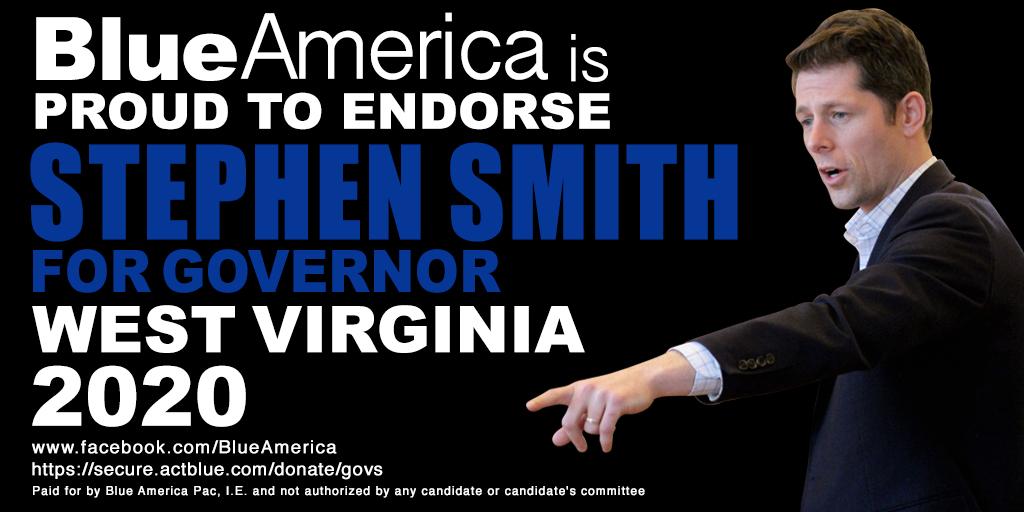
Blue America's First Gubernatorial Endorsement Of 2020: Stephen Smith, West Virginia

>


West Virginia gubernatorial candidate Stephen Smith is a West Virginia native, lifelong organizer, and public servant. And, as of today, Blue America's first endorsed candidate for governor for the 2020 election cycle. Last year, WV Living magazine named Stephen "West Virginian of the Year" for his consistent work in fighting shoulder-to-shoulder with poor and working families as the Director of the West Virginia Healthy Kids and Families Coalition. He grew up in a tight-knit West Virginia family, one that had the means to support him to attend college at Harvard University. His experience at school quickly taught him about our rigged economic system-- and about how to fight for change. He tells us that the hallmark of his time at college was helping to organize a 21-day student sit-in that brought about a living wage for Harvard janitors, food service workers, and security guards. His track record has extended from there.

After moving back to his hometown in 2012, and prior to his bid for Governor, Stephen helped to build dozens of powerful local and statewide institutions. Under his leadership at the Healthy Kids and Families Coalition, the group organized hundreds of rural development projects and more than two dozen successful issue campaigns. When the national teachers strike started in West Virginia in 2018, Stephen helped build a Strike Fund that raised and distributed $332,000 to teachers and their families.

Smith, with his nose-to-the-grindstone work ethic, is running a massive field operation against the richest man in West Virginia, Jim Justice. A Trumpist coal baron and casino owner known for literally sitting down on the job. Justice, who was elected as a fake Democrat only to switch to the GOP almost immediately, was recently dubbed Forbes Magazine’s Deadbeat Billionaire.

Goal ThermometerToday, the stage is set. And don’t be fooled; West Virginia is a place that is ripe for revolution. Not only did the Teachers Strike start in West Virginia; Bernie outpolls Trump 48-46 in the Mountain State. When West Virginians voted in 2016, they didn’t pick a party, they picked a fight. And Smith and his team are poised to channel that righteous outrange into a winning people’s campaign. As Smith says, "we’ve done it before." In fact, the thing we like most about Smith’s campaign is its connection to successful, multi-racial rebellions of the past: namely West Virginia's rich labor history. Check out his unique, inspiring campaign video above. If you’re not sold yet, keep an eye out for the more than 59 candidates who Smith and his team have already recruited as a part of a West Virginia Can’t Wait candidate pipeline. That’s right, the Smith team is building a slate to run alongside Stephen. West Virginia is preparing for the contest of a generation. Here’s our chance to get in and show solidarity.


Why I’m Running
-by Stephen Smith, stephen@wvcantwait.com


You can feel it. This is a moment. Every 50 years or so, the nation turns to West Virginia for leadership. The American revolution started here. The Civil War, the Mine Wars, the Teachers’ Strike-- it is in our blood to fight for our people, no matter their race, their accent, or who their father was.

My name is Stephen Smith and I’m running for Governor, because I want my sons to know whose side I was on.

West Virginians may have the least, but we give the most. In West Virginia, we always hear that we’re last. But we are near the top for charitable giving, for military service, for volunteer service. We’re #1 in the amount of time we spend with our neighbors.

That’s the kind of family I grew up in-– my dad helped start the WV Coalition for the Homeless and the Public Defender Services. My mom made our house the kind of place that always had extra people in it-- foster kids, neighbors, family members who were between jobs.

I took the values I learned at home to Harvard and raised hell for working families. For four years, students and workers fought together, and we won a living wage for the janitors, cooks, and security guards. Since then, I’ve spent my career shoulder to shoulder with people who are fighting for their dignity. Seven years ago, my wife Sara and I chose to move home to West Virginia, because we wanted to raise our family in a place that cares more about who you serve than what you own.

The West Virginia organization I led for the last six years helped pass more than two dozen pieces of legislation, using old fashioned people power: health insurance for 182,000, a raise in the minimum wage, 5.2 million more school breakfasts annually. Meanwhile we lifted-up more than 300 community projects. We helped build gardens, after-school programs, and small businesses. All this happened not because of me, or because we had a lot of money, but because we knew that no one is more capable or more creative than the people who are closest to a problem.

The idea of this campaign is simple: what if the values of generosity, common sense, and courage that guided our neighborhoods also governed our statehouse?

This is the richest time in West Virginia history. Our people deserve to have the best roads and safest water we have ever had. We deserve universal, single payer health care and child care and higher education for all. We deserve an economy rigged in favor of unions, small businesses, artists, family farms, and local entrepreneurs – not out-of-state landowners and monopolies.

I’m running because the only way we get that kind of government is if we take it. No outside company or billionaire politician will save us.

We need a thousand leaders, not one.

Here’s the thing. The people of West Virginia are not America’s problem. We are her solution.

Some of you think we “vote against our own interests.” But Good Old Boy Democrats held power here for 82 years, while wages fell, jobs vanished, and our divorce, obesity, and overdose rates soared. We’re not wrong to question whether the party has had our interests at heart.

Some of you think we’re backwards. But it was our teachers and school service personnel who sparked a nationwide strike movement last year. And this February, our educators walked out again-- this time to reject an “education reform” bill that would have paid them the raise they were after-- because they knew the bill would make things worse for our kids by privatizing schools.

Some of you call our home Trump Country. But more of us opted not to vote in 2016 than voted for the President. A 2017 poll of likely voters revealed that we favor Bernie over Trump, 48 to 46 percent. In West Virginia, we are rejecting a political establishment that rejected us long ago.

We’re not foolish. We’re fed up.

And we’re taking action. Never in American history has a single person or politician won the sort of change we need and deserve. It has always required a movement, not a savior. That’s what we are building in West Virginia. It is called West Virginia Can’t Wait, and we need your help. Our movement already recruited and trained 160 County Captains across all 55 Counties-- who have executed 65 kickoffs and town halls, and more than 270 additional meetings in food pantries, clinics, small businesses, churches, and union halls.

We have recruited more than 120 Constituency Captains, who are leading 37 constituency teams-- Veterans Can’t Wait, Students Can’t Wait, Seniors Can’t Wait, LGBTQ Can’t Wait, Educators Can’t Wait People in Recovery Can’t Wait, and so on. Their building independent political power across the state, while also preparing us to govern. Because the people who are closest to the problem are also best equipped to solve it.

Finally, our movement is also recruiting candidates up and down the ballot who reject corporate cash and pledge never to cross a picket line. There are 57 in our pipeline, and we are adding more each week. We offer these mostly first-time, mostly women candidates free training, access to our network and staff, and the power of running together.

You need money to run for office. And our fundraising works. We raised more than $152,000 in our first quarter and literally broke the Secretary of State’s on-line software system because our file upload of individual donations was too large to handle. Furthermore, we have pledged that at least 1 out of every $10 we raise in this campaign will be spent on real projects that improve lives before election day-- so that voters get to know us by our actions, and not just our words.

I’ve never achieved anything in my life by myself, and I’m not starting now. I hope you’ll join us. West Virginia can’t wait.


Labels: , ,