Monday, April 27, 2020

In a Slap in the Face to Progressives, Biden Appoints Larry Summers, a "Literal Architect of Neoliberalism," to Economic Advisory Role

>


by Thomas Neuburger

Over the past three decades, Summers has amassed a policy record of almost unrivaled social ruin.
—Zach Carter, Huffington Post

In a slap in the face to progressives, Joe Biden, who has already announced that if he's elected "nothing would fundamentally change," has appointed the head of Barack Obama's National Economic Council, Larry Summers, as a key adviser to his campaign.

From Bloomberg, which occasionally still reports the news (emphasis added):
Former Treasury Secretary Lawrence Summers is advising Joe Biden’s presidential campaign on economic policy, including its plans to revive the U.S. economy after the coronavirus pandemic, according to five people familiar with his involvement.

The Obama and Clinton administration veteran’s role roiled progressives who view his past work on the 2009 recovery as too favorable to big banks. That’s awkward for the Biden campaign at a time when it is trying to win the trust of former supporters of Bernie Sanders and Elizabeth Warren.
Five people confirming is a deliberate leak, especially since non of them are said to be "unauthorized to speak about the matter."

Progressive groups are aghast, of course:
Two Sanders-aligned groups, Justice Democrats and Sunrise Movement, said Friday they “hope Biden publicleconomic y rejects Summers’s role as an economic adviser to better earn the trust of our generation.” They said they also plan to start a petition calling on Biden to pledge to exclude Summers from his transition team or administration.

Larry Summers’s legacy is advocating for policies that contributed to the skyrocketing inequality and climate crisis we’re living with today,” the groups said in a joint statement.
Summers is such a bad choice for the campaign to be aligned with that The American Prospect writer Robert Kuttner put Summers at the top of his "do not re-appoint" list

But as Rising's Saagar Enjeti points out, the real group that Biden needs to assure isn't Progressive Avenue, or even Main Street — it's Wall Street — and leaking via five sources to Bloomberg News that Summers is now in Biden's inner circle does just that. As Bloomberg put it, with this move Biden has "offered some reassurance [to] Wall Street that Biden is not moving too far to the left from the centrist positions that earned him his establishment support."

I'm not if sure this will get him elected, but it is certain to be noticed, even by not-well-read voters who nonetheless care about the direction of the country. Summers was a marquee name in the Obama administration. As Robert Kuttner points out:
Under Clinton, Summers was a prime architect and huge enthusiast of what proved to be fatal financial deregulation. He was also in charge of Clinton’s economic policy for post-Soviet Russia, and was responsible for pushing for early and catastrophic privatization of state assets, a fire sale that led directly to the creation of Russia’s oligarchs. As president of Harvard, he proved to be both arrogant and sexist, to the point where he got himself fired. ...

[As Obama's chief economic advisor, Summers] not only lowballed the necessary economic stimulus and ended it prematurely, but he successfully fought for rescuing the biggest banks rather than taking them into temporary receivership. Back at Harvard, Summers earns over $600,000 as a university professor but also moonlights at the hedge fund D.E. Shaw, where his compensation is well into the seven figures. (Some would say he moonlights at Harvard.)
There are so many ways that Summers is a bad choice, it's difficult to enumerate them, though both Kuttner and the HuffPost's Zach Carter try. (Carter: "Over the past three decades, Summers has amassed a policy record of almost unrivaled social ruin." Then he lists the ways.)

It's sufficient to say that his appointment is the economic-policy equivalent of bringing in Rahm Emanuel, who famously called liberals "fucking retarded," to handle the Biden's relationship with progressive groups.

If Larry Summers' appointment is part of the mainstream Democratic plan to unite the Party and rally "change voters" behind the Biden candidacy, good luck.
 

Labels: , , , , , ,

Wednesday, April 01, 2020

As We've Established, Trump Is Worse Than Biden-- But Trump Is Also Worse Than Cuomo

>


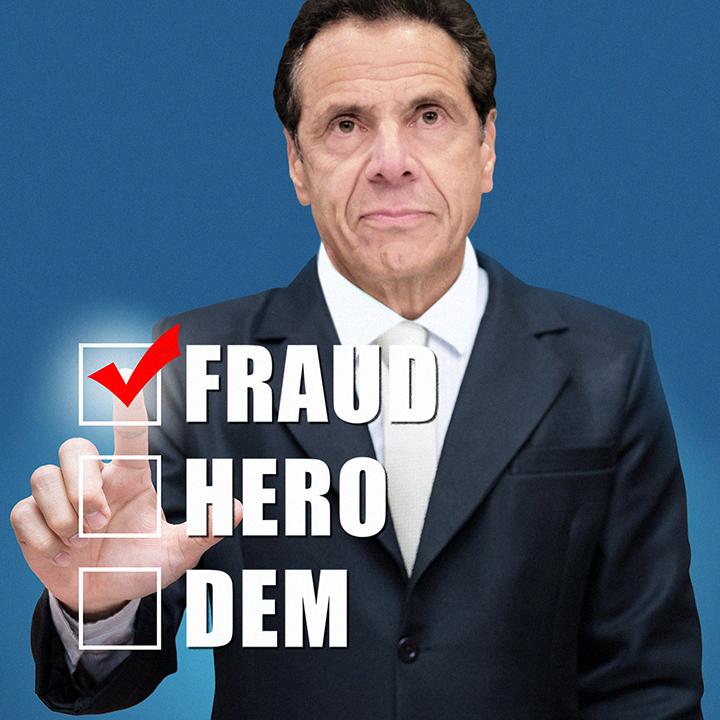
The Democratic establishment seems eager to do a switcheroo-- anything to keep Bernie out of there White House-- replacing a doddering unelectable Biden with hero du jour, Andrew Cuomo. How unfit is Biden-- how incapable of campaigning and beating Trump, not to mention how incapable of running the United States well? Let's start with some clips and a little commentary and from Saagar Enjeti before proceeding to Cuomo:


OK, now the other neo-liberal asshole, son of the late great Mario Cuomo, a skillful politicians and decent enough actor. Yesterday, the Wall Street Journal added to the reinvention of the hated neoliberal crook, now being touted as a visionary and heroic figure. Reporters Jennifer Calfas, Chang Koh Ping and Dominic Chopping wrote that U.S. officials and hospitals braced for an influx of patients as infections of the new coronavirus continued a relentless rise and projections showed the pandemic’s possible heavy toll and lengthy duration. The U.S. has more confirmed cases than any other country, with more than 175,000 infections, according to data compiled by Johns Hopkins University. The death toll, now greater than that of China, stands at 3,416. That is still far less than Italy, where fatalities rose to 12,428 Tuesday, or Spain, which has reported 8,269 deaths." When then pandemic is peaking around the country in August, there could benaround 84,000 deaths at a rate of over 2,000 a day.
Nearly half of the 50 states have now reported more than 1,000 confirmed cases of Covid-19, the respiratory disease caused by the new coronavirus. And much of America is expected to experience extended closures of schools, offices, restaurants and other venues as concerns about a coming surge in patients have pushed mayors and governors to take steps unprecedented in modern times to fight the contagion.

State leaders have extended, and in some cases expanded, stay-at-home orders, while the Trump administration lengthened its social-distancing guidelines through April 30.

The apex of the pandemic is expected to occur sooner in New York, the hardest-hit state with 75,795 confirmed cases and 1,550 deaths so far.

“We underestimated this virus,” New York Gov. Andrew Cuomo said Tuesday. “It’s more powerful, it’s more dangerous than we expected.”


We? How about he? When Mayor de Blasio begged Cuomo to allow him to shut down NYC in mid-March, Cuomo-- a conservative asshole, not the hero the corporate media is painting him to be-- sounded just like Trump and flat-out refused. De Blasio was telling New Yorkers to prepare to shelter in place, the way San Franciscans were doing-- with a great deal of success-- when Cuomo's office contradicted him-- something that has been catastrophic for the City: "Any blanket quarantine or shelter-in-place policy would require state action, and as the governor has said, there is no consideration of that for any locality at this time." Cuomo himself sentenced hundreds to death by brainlessly babbling the the media "I have no interest whatsoever to quarantine any city."


Meanwhile, Cuomo's federal counterpart, Señor T, continues making matters worse, although he's now beginning to worry that red-state voters-- who he affectionately refers to as "the poorly educated"-- are going to start dying in droves and will threaten his reelection chances. L.A. Times reporters Noah Bierman and Chris Megerian wrote that "Over the last weekend, one of his most chaotic [press briefings] since the pandemic struck, Trump drastically redefined success, claiming that if the pandemic kills between 100,000 and 200,000 Americans, 'we all together [would] have done a very good job.' Trump has stood in front of TV cameras as much as any president in history the last two weeks, holding forth with meandering, frequently testy, near-daily news briefings that often go 90 minutes or longer while tens of millions are Americans are marooned at home, desperate for information. The constant exposure has provided a real-time look at Trump’s decision-making process-- the vacillating, the wishful thinking, the degree to which he’s influenced by whoever talked to him last or whatever he last saw on cable TV-- that has long been reflected in the daily chaos of his presidency but never tested as when so many American lives were at stake. In this case, the mixed messages from the mercurial president have left state and local leaders, as well as corporate chief executives and others, unsure what medical supplies and other support the federal government will provide as they attempt to survive the double-barreled public health crisis and economic shutdown."

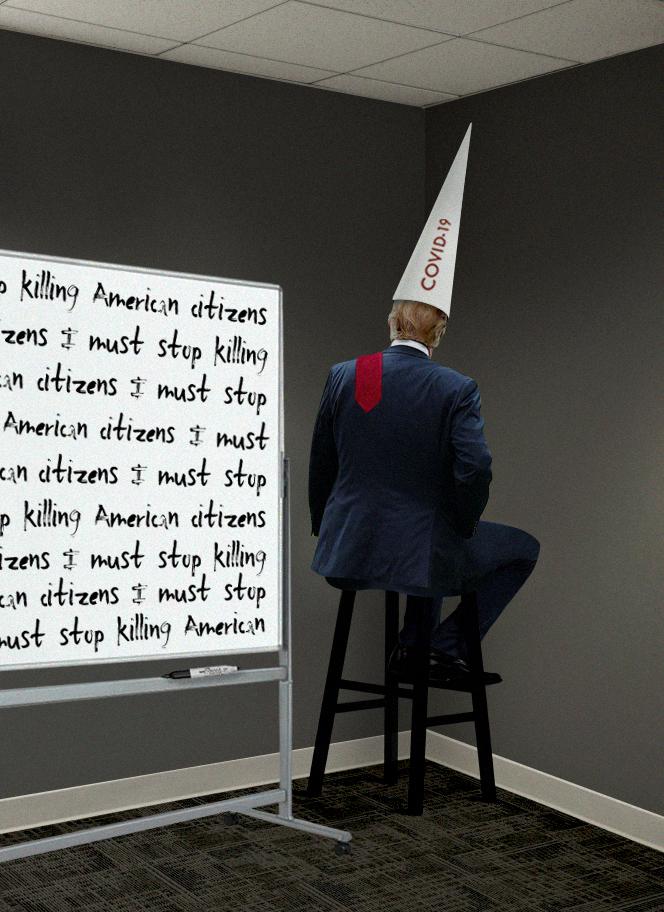
MAGA by Chip Proser

“Presidents speak during times of crises,” said Julian Zelizer, a presidential historian at Princeton University. “But usually they’re very deliberative about it. This is more free flowing thought. It’s more like a radio talk show host.”

“It’s become incredibly problematic because that information flow matters a lot for how the public acts and how the resources are allocated,” he added.

On Saturday, for example, Trump set off waves of confusion in New York, the epicenter of the outbreak for now, by repeatedly saying he was considering ordering a quarantine for parts of New York state, New Jersey and Connecticut, blindsiding the governors of those states. That night, under intense criticism, he backed down.

And on Sunday, six days after Trump had said he hoped the locked-down country would be “opened up and raring to go” by Easter, Trump abruptly reversed course and extended the national shutdown guidelines for another month, until April 30.

Standing in the Rose Garden, Trump described his call for packing church pews by Easter “just an aspiration,” adding that he now expects the death toll from COVID-19, the disease caused by the coronavirus, to peak in about two weeks. Public health experts said that may be wishful thinking as well.

At Monday’s news conference, Trump said the federal guidelines “may be toughened up a little bit” but did not say how. Hours earlier, the leaders of Washington, D.C. and neighboring Virginia and Maryland had issued stay-at-home orders, joining numerous other cities and states in escalating restrictions.

Trump could not order governors and business owners to reopen-- and he never explained what a federal quarantine of the New York area would entail.

But his decision to keep strong federal guidelines in place nonetheless is one of the most consequential of his presidency. It reflects a grim calculation that the potential death toll of reopening the country too soon-- nearly 3,000 Americans had died as of Monday-- outweighs the vast economic pain and personal sacrifices of keeping it closed.

Many inside and outside advisors had argued that Trump could relax restrictions in areas where the outbreak has yet to spread. But public health experts argued that the contagion would overwhelm hospitals and that up to 2 million Americans could die, hurting the economy as much as keeping workers home.

Trump’s two top medical advisors in the pandemic, Dr. Anthony Fauci, who heads the National Institute of Allergy and Infectious Diseases, and Dr. Deborah Birx, who is the federal response coordinator, studied the models and brought the data to Trump at the White House, Fauci said Monday on CNN.

We “went in together in the Oval Office and leaned over the desk and said: ‘Here are the data. Take a look.’ He looked at them. He understood them. And he just shook his head and said, ‘I guess we got to do it,’” Fauci said.

It was a major climb down for Trump. He started last week by repeatedly insisting “we cannot let the cure be worse than the disease itself.” When he set Easter Sunday as a loose deadline to reopen businesses, he said scientists like Fauci would close the country for a year or two if they had their way.

“We’ve never closed down the country for the flu,” Trump said last week. “So you say to yourself, what is this all about?”

Trump, as he often does, spent hours on the phone with conservative pundits and business leaders, seeking feedback. When he saw that Vice President Mike Pence, who heads the coronavirus task force, had planned a call with hedge fund managers and Wall Street executives, Trump jumped on the call, according to a White House official who spoke on condition of anonymity to describe the conversation.

Some on the call warned that the economy was sinking faster than at any time in history. Trump needed little convincing, according to the official, who said the comments reinforced Trump’s belief that he could safely relax social distancing guidelines.

“Outside voices were confirming what he wanted to do anyway, which is get this economy going,” said Stephen Moore, who advises Trump on the economy and served on his 2016 campaign. “There was a real campaign to get him to [lift the guidelines]. A lot of people, including myself, were making the point that a six-, eight-, 10-week shutdown would be catastrophic.”

The voices came from inside as well. Larry Kudlow, Trump’s chief economic advisor, was a strong advocate for relaxing the guidelines, according to several people close to Trump or the White House.

To many allies who had Trump’s ear, even a small gesture could help calm the roller-coaster stock markets and the nerves of business owners forced to shut down for an indefinite period.

“He’s trying to send a message that we’re going to come back,” said a lobbyist with close ties to the administration. “This is not going to be prolonged till the end of time.”

But others were scared that Trump would make the disaster worse. They feared that setting an unrealistic deadline would unsettle the business climate and that Trump’s insistence that some regions could safely return to work would weaken the resolve of other Americans stuck at home.

One former White House official said Trump’s reelection campaign advisors are terrified that the coronavirus outbreak, which so far has hit largely Democratic coastal cities hardest, will soon scythe across the rural areas that remain deeply loyal to Trump.

The advisors have warned Trump that the political consequences at the ballot box in November will be even worse if he is seen as too lax.

“Pay attention. You’re going to lose the election,” the former official said, summarizing the intervention.


As recently as late last week, some in Trump’s inner circle thought he would recommend allowing restaurants, bars and other small businesses to reopen by mid-April in parts of the country so far spared by the virus.

Trump struggled openly. “You know, I get it from both sides, in all fairness, and maybe it’s a combination of both,” he said Thursday, suggesting he was trying to find an elusive middle ground.

Ultimately, Trump could not split the difference. His old talking point-- that COVID-19 was no worse than the flu-- was shattered by images of ailing celebrities and overrun hospitals, including the Elmhurst Hospital in Queens, N.Y., where Trump grew up.

“Body bags all over, in hallways. I’ve been watching them bring in trailer trucks-- freezer trucks, they’re freezer trucks, because they can’t handle the bodies, there are so many of them,” Trump said Sunday of TV coverage of the horrors at Elmhurst.

By Monday, Trump was quoting worst-case scenarios, suggesting 2.2 million Americans could die if people returned to work and school too early. Some of the projections were published weeks ago, influencing the initial decision on March 16 to recommend strict social distancing.

But Trump acted as if the model was new, only revealed to him on Sunday by Fauci and Birx.

“I used to say, a lot of people said, ‘Could you just have kept [normal life] going? Like the flu, like a bad case of the flu, a really bad case?’” he said Monday on Fox & Friends. “And the answer came in yesterday... 2.2 million people could have died.”

Trump said he is relying on the experts. But while Fauci has warned that the coronavirus runs on its own schedule, Trump couldn’t resist setting a new deadline.

“We think by June 1, a lot of great things will be happening,” he said.
Wrong! Want proof? How's this? And the idiot's moron followers like Governor Ron DeSantis in Florida are doing the same. This morning, cowardly DeSantis finally issued a "stay-at-home" order for his afflicted state-- but includes mega-churches as exceptions, guaranteeing the curve will continue to steepen, not flatten, in Florida and, of course, beyond its borders.


Labels: , , , ,

Thursday, March 26, 2020

We All Want To See The Last Of Trump. Would You Vote For A Corpse Instead Of Him? The Democratic Establishment Wants To Give You Just That Choice

>


Krystal: "Just ask yourself-- Is that the man you want leading this response to this crisis right now? If you're a person like me, you're looking at him, you're looking at Trump, you're going 'My God! What a choice is laid before us!' It's honestly horrifying."

Saagar: "This guy can get away with pretty much anything, as long as he just stays alive. That's all they want. He's like an empty husk to which the establishment can project whatever they want-- tax cuts, the Obama era neo-liberalism, continuing their grip, continuing the gate flow, all of that. That's what he represents. He's like an ideologically composed thing, of all of their wants and and wishes and dreams; and he's like a blank slate they can just write themselves onto. It's not for the people who think the system is screwed; it's not for people who think that what's happened in this country overs the last 40 years has been a complete and abject disaster. And the worst part is, he's just going to continue these interviews; he's going to continue to make a fool out of himself... completely bizarre and strange behavior and never once will he get asked a real question."

Do you want to know what Bernie wants to accomplish as president? Just look at his record (or look here at his platform). How about Biden's record? It's as bad as it could be and still belong to someone calling himself a Democrat-- racist, corporate, war-mongering. And why is Biden running for president again? Why not? It's all about ego and his desire to accomplish the one thing that has evaded insiders for decades-- a Grand Bargain to cut Social Security and Medicare. Biden thinks it will be the equivalent of Nixon's trip to China, something only a Republican could have achieved. Cutting Social Security and Medicare is something, he thinks, only a Democrat could get away with. Don't let him. Stop him now.


Vanity Fair's Chris Smith wrote yesterday how Democrats are playing right into Trump's hands by nominating Biden. Ole Status Quo Joe, he wrote "will need to find creative ways to expand his media presence for as long as the crisis lasts, and to regularly highlight President Donald Trump’s epic, lethal incompetence in dealing with the pandemic. Expecting Trump’s blunders to have political consequences all by themselves would be a huge mistake, as polls are already showing. 'That line of thinking drives me fucking nuts,' says Lis Smith, the strategist whose maximalist media tactics turned Pete Buttigieg into a surprisingly strong primary contender. 'Democrats always think that there’s going to be some divine intervention, that Trump will somehow self-destruct. That is a losing strategy. Biden can do a mix of national TV, local TV, Spanish-language TV, hit the phones, and do radio. But what’s really important in this moment is that the audience for this is not your typical political audience. It’s literally everyone. Sports podcasts would have him on. Entertainment podcasts would have him on. People are really hungry for information, they’re really hungry for facts, and they’re really hungry for leadership.'"
As Biden becomes more visible again, there is the risk-- actually, the likelihood-- that he will say goofy things along the way. The greater danger is that he gets drawn into a pissing match with Trump, something Trump is already trying to stoke. "The media also wants a fight, and we want the story to go on," says Jennifer Palmieri, the communications director for Hillary Clinton’s presidential campaign in 2016 and now a contributor to The Circus on Showtime. "So the campaign needs to be somewhat wary of playing into that. But Super Tuesday showed that Biden has a deep reservoir of support and goodwill from voters, and not just with Democrats, because Independents and moderate Republicans voted for him too."

Biden himself shouldn’t be the one doing all the talking. His team has already taken some steps in this direction, releasing a coronavirus explainer video featuring a top aide, Ron Klain, who was in charge of President Barack Obama’s response to the Ebola threat. The Klain video has been viewed 4.3 million times online. “This is a different situation from the 2008 financial crisis, because Obama had been elected but not yet sworn in,” says Brian Fallon, a top strategist for Clinton in 2016. “But during the transition he did daily news conferences where he was trying to signal, ‘Hey, I got this.’ Obama was making news with the announcement of people he would be installing, or just answering questions about his priorities for a stimulus package and presenting a contrast with Bush. Biden could be creating a very favorable juxtaposition by assembling a shadow cabinet, convening the Ron Klains and the Zeke Emanuels of the world and doing almost a mirror image version of Trump’s press conferences in which Biden is saying, ‘Where are the damn tests?’ and laying the wood to Trump.”

Social distancing makes traditional retail campaigning impossible for the foreseeable future. Yet being stuck in Delaware gives Biden the chance to cover more ground, at least virtually, and to target his efforts. Of the six battleground states that are likely to decide the electoral college winner this November, four are led by Democratic governors. A Biden spokeswoman says the campaign will do nothing that might distract officials who are confronting life-and-death decisions at the moment. But at some point it would be wise for Biden to host a livestream with Governor Gretchen Whitmer of Michigan to talk about the economic impact of the virus. Wisconsin has (thankfully) few cases right now, but Biden and Governor Tony Evers could discuss the need for vote-by-mail and the state’s legal fight over online registration. New York and California should be reliably blue this fall, but Biden sessions with governors Andrew Cuomo and Gavin Newsom could generate a wealth of coverage.

“This is an opportunity to run an innovative virtual campaign, to reach people while they’re at home and they’re concerned. Media consumption patterns are way, way up, and people are listening,” says Ben LaBolt, who was national press secretary for Obama’s successful 2012 reelection campaign. “The question is whether or not Trump is actually digging himself into a hole. If you follow Twitter and read the Washington Post and the New York Times, you know that Trump started this crisis by denying its scope, by calling it a hoax, and saying everything is under control. But if you are someone who doesn’t follow politics closely, and you tune in to the briefing every day, which is aired by the cable networks without fact-checking, and Trump is saying that he’s doing a great job and he demands that everyone around him praise him, like he’s Kim Jong Un, then you might be getting a different impression of what’s going on.”

Biden’s inner circle, with a handful of exceptions, has been with him for decades. Fortuitously, Biden hired a new campaign manager just before the coronavirus shutdowns changed the game. Jen O’Malley Dillon had most recently run Beto O’Rourke’s primary effort; previously she was the battleground states director for Obama ’08 and deputy campaign manager for Obama ’12. “Jen is never satisfied about what you did or what worked in the last campaign,” Palmieri says. “She’s extraordinarily literate in all kinds of technology and new campaign methods. And Biden is going to need all of that, because what we used to think of as a politician setting himself on fire is how Trump thrives.”


She is probably right. But Biden’s appeal in 2020 has always been more as a concept than as an actual candidate: Primary voters decided he is the Democrats’ Best Chance to Beat Trump. It’s good that Biden is now becoming more visible again. His real goal, though, should be to survive undamaged until November. Just like the rest of us.
And anyone who really expects that, might want to look for an offer to buy a bridge connecting Manhattan to Boston. I'm sure Trump has some for sale. After all...


You always knew Trump would make us #1-- and now we are... numero uno in COVID-19 cases, more than China or Italy or Spain or anywhere. And it's just starting. It didn't have to be this way. If instead of Trump we had a remotely competent, less self-centered president-- and with a competent team instead of a pack of fish raters... well, then we would have taken precautions like every other country has. Instead insisting for weeks that it was all a Democratic hoax. As of today the U.S. has 81,321 known coronavirus cases. Donald McNeil wrote earlier today that "A series of missteps and lost opportunities dogged the nation’s response. Among them: a failure to take the pandemic seriously even as it engulfed China, a deeply flawed effort to provide broad testing for the virus that left the country blind to the extent of the crisis, and a dire shortage of masks and protective gear to protect doctors and nurses on the front lines, as well as ventilators to keep the critically ill alive... The United States, which should have been ready, was not. This country has an unsurpassed medical system supported by trillions of dollars from insurers, Medicare and Medicaid. Armies of doctors transplant hearts and cure cancer. The public health system, limping along on local tax receipts, kills mosquitoes and traces the contacts of people with sexually transmitted diseases. It has been outmatched by the pandemic."


Labels: , , , ,

Wednesday, March 25, 2020

What The Pandemic Lays Bare: We Have Become, In Saagar Enjeti's Words, "A Sclerotic, Rotten Society"

>


After midnight. congressional negotiators and the White House reached an agreement on the $2 trillion relief/stimulus package. There will be a vote on it later today. What did the Democrats achieve by stopping the Trump-McConnell first iteration of the bill? It now includes more funding for hospitals and health care workers; expanded and enhanced unemployment benefits (by 13 weeks) covering individuals who are not currently covered by traditional unemployment assistance and with full salaries for workers; and some semblance of oversight-- I'll believe it when someone catches Trump trying to steal some of it-- over the $400 billion slush fund for corporate America. Under the terms of the deal an "independent" inspector general and a congressional oversight board would be in charge of scrutinizing the lending decisions out of that pot of money. There is also a proviso that companies accepting aid from taxpayers cannot reward shareholders and top executives through stock buybacks.

Earlier that day, the Washington Post reported that Trump has finally "agreed to allow enhanced scrutiny over a massive loan program that is a centerpiece of the Senate’s $2 trillion coronavirus economic package, taking steps to address a major Democratic concern and potentially pave the way for a vote." They had hope it would have been yesterday, but are happy enough that it will come today both in the Senate and the House.

Señor Trumpanzee had "already said where he wants some of the money to go, promising assistance to cruise ship companies, for example, that have operations in Miami. And when he was asked Monday evening who would perform oversight of the program, Trump responded, 'I’ll be the oversight.' But during closed-door negotiations on Capitol Hill, White House officials have agreed to allow an independent inspector general and an oversight board to scrutinize the lending decisions."

McConnell's package was stuffed full of Republican Party agenda items-- bailouts for corporations primarily-- and Pelosi's wasn't nearly as terrible but was still bullshit. Who can resist including their own priorities when a must-pass-package around 2 trillion dollars is on the line? An honest broker, perhaps? That leaves out McConnell, Schumer, Pelosi, Hoyer, McCarthy and, obviously Trump and Mnuchin. The Democrats accuse McConnell of putting together a corporate slush fund. The Republicans accuse Pelosi of trying to pass the Green New Deal (part of a "Democratic wish list"). If only!


McConnell's bill was 247 pages long. Pelosi's is 1,432 pages. Let's compare:

McConnell wanted to give direct payments of $1,200 to individual Americans making less than $75,000 annually, and $2,400 for eligible married couples making less than $150,000 combined, with an additional $500 for every child. The amount of money is reduced by $5 for every $100 that a person earns over $75,000, so Americans earning more than $99,000 will get nothing. Pelosi's bill is pretty much the same in that way except that it increases the figure per individual to $1,500. Her bill also waives $10,000 in federal student loan payments. McConnell addresses education by allowing Betsy DeVos to defer student loan payments and by allowing students who were forced to drop out of school due to coronavirus to keep their Pell grants.

After that the two bills go off in different directions. McConnell is unreasonably generous to corporate America, no strings attached:
$50 billion in loan guarantees for passenger air carriers.
$8 billion for cargo air carriers.
$150 billion for other large businesses.
$300 billion for small businesses. (Pelosi wants $500 billion here.)
Pelosi's plan is far more ambitious, dedicating $4 billion in grant funding to help states with upcoming elections and nationally mandates 15 days of early voting and no-excuse absentee vote-by-mail, including mailing a ballot to all registered voters in an emergency, something violently opposed by Republicans, who always oppose expanding the franchise. Things that will never stay in the final bill include canceling several of Trump's executive orders that labor complains have weakened public sector unions' ability to engage in collective bargaining; requiring companies receiving federal assistance during the pandemic to institute a $15 minimum wage; and creating new carbon offset guidelines for airlines, with a long-term goal of reducing jet fuel emissions by 50% by 2050.


Pelosi's bill also allocates $150 billion to support hospitals, local health centers and government-funded medical programs, with an additional $80 billion in low-interest loans to hospitals; provides child care assistance to health care workers and emergency personnel; temporarily provides $600 per week to unemployed workers affected by the pandemic. Self-employed workers, Americans whose contracts were canceled, and new entrants to the job market would also be eligible; expands paid sick leave and family medical leave, as well as gives more money to food-safety benefits; dedicates $20 billion to reimbursing the U.S. Postal Service for lost revenue, and forgives USPS debt; and one that McConnell is likely to approve of: creating a $200 billion stabilization fund for states and $15 billion for local governments through the Community Development Block Grant program. The legislation also authorizes the Federal Reserve to purchase state and local government bonds.

In an OpEd for Newsweek yesterday, Robert Reich wrote that Republicans are helping corporations to exploit the crisis. "Airlines," he wrote, "are big enough to get their own loans from banks at rock-bottom interest rates. Their planes and landing slots are more than adequate collateral. Why do airlines deserve to be bailed out? Over the last decade, they spent 96 percent of their free cash flow, including billions in tax savings from the Trump tax cut, to buy back shares of their own stock. This boosted executive bonuses and pleased wealthy investors but did nothing to strengthen the airlines for the long term. Meanwhile, the four biggest carriers gained so much market power they jacked up prices on popular routes and slashed services (remember legroom and free bag checks?)." He continued, echoing what many frequent fliers feel about the airline companies that McConnell is so eager to bail out at taxpayer expense:
United CEO Oscar Munoz warned that if Congress doesn't bailout the airline by the end of March, United will start firing its employees. But even if bailed out, what are the odds United would keep paying all its workers if the pandemic forced it to stop flying? The bailout would be for shareholders and executives, not employees.


While generous toward airlines and other industries, the Republican bill is absurdly stingy toward people, stipulating a one-time payment of up to $1,200 for every adult and $500 per child. Some 64 million households with incomes below $50,000 would get as little as $600. This will do almost nothing to help job-losers pay their mortgages, rents and other bills for the duration of the crisis, expected to be at least the next three months.

The Republican coronavirus bill is about as Burring as legislation can be-- exposing the underlying structure of power in America as clearly as Burr's stock trades. In this national crisis, it's just as morally repulsive.

Take a look at how big corporations are treating their hourly workers in this pandemic and you see more Burring.

Walmart, the largest employer in America, doesn't give its employees paid sick leave, and limits its 500,000 part-time workers to 48 hours paid time off per year. This Burring policy is now threatening countless lives. (On one survey, 88 percent of Walmart employees report sometimes coming to work when sick.)

None of the giants of the fast-food industry-- McDonald's, Burger King, Pizza Hut, Duncan Donuts, Wendy's, Taco Bell, Subway-- gives their workers paid sick leave, either.

Amazon, one of the richest corporations in the world, which paid almost no taxes last year, is offering unpaid time off for workers who are sick and just 2 weeks paid leave for workers who test positive for the virus. Meanwhile, it demands that its employees put in mandatory overtime.

And here's the most Burring thing of all: These corporations have made sure they and other companies with more than 500 employees are exempt from the requirement in the House coronavirus bill that employers provide paid sick leave.

At a time when almost everyone feels burdened and fearful, the use of power and privilege to exploit the weaknesses and vulnerabilities of others is morally intolerable.

We are all in this together, or should be. Whatever form it takes, Burring must be stopped.


Labels: , , , , ,

Sunday, March 08, 2020

The People, Yes! Let’s Crush the Woke Plutonomy! An Interview + Review Of "The Populist’s Guide to 2020: A New Right And New Left Are Rising" By Krystal Ball And Saagar Enjeti

>


-by John Siman

As I reread in his book, Hate Inc. Matt Taibbi’s analysis of how the corporate media have worse-than-cynically divided our nation into mutually-despicable but highly profitable demographic silos, and as I await the publication of Thomas Frank’s forthcoming book The People, No!, which will, I believe, be about the grim suppression of Populism in American history, I have been utterly surprised by the sudden appearance-- as if out of nowhere-- of Krystal Ball and Saagar Enjeti’s delightful YouTube show Rising, which every day now dispenses brilliantly produced, multiple doses of actual Populist conversation. Glenn Greenwald, who Krystal says is one of her heroes, calls it “the super-perky radical trans-ideological 21st-century subversive sequel to the Katie Couric/Matt Lauer morning Today Show in its heyday minus all that unpleasantness.” The People, Yes!

And, mirabile dictu, Krystal and Saagar’s Rising originates from within the most bubblicious confines of the D.C. bubble-- their studio is literally on K Street-- how is this even possible? How, that is, can their show even be permitted to air in the 21st-century USA, where next-level corporate control requires, as Taibbi has explained, the manufacture of media products as strictly standardized and aggressively dumbed-down as McDonald’s food products are, and in an eco-system even more deleterious to the nation’s health?

Perhaps Krystal and Saagar’s new right + new left friendship presages the actual rising up of a new Populist movement in the USA, out of the long-awaited ruins of neoliberal oligarchy. Well, that might be too much to hope for, but in any event their appearance on the political scene is good news coming at a time when I, for one, thought that good news had gone extinct.

And to top it all off Krystal and Saagar have just written a book, The Populist’s Guide to 2020: A New Right and New Left are Rising. It’s a collection of thirty-nine of their YouTube essays (twenty written by the nominal Democrat Krystal and nineteen by the nominal Republican Saagar; all thirty-nine were broadcast between last July and this January), with some useful updates and analysis added. Their essays are arranged not chronologically, but according to four rather audacious themes:
Core Rot (the ugly result of the elites’ utter betrayal of the American working class)

Media (why most all Americans hate it)

Identity (understood as a woke intersectionalist weapon effecting societal division)

Theories of Change (Krystal and Saagar really are envisioning a working-class revolution)
Each of these four themes is introduced by a short, insightful, jointly-written essay. The whole thing weighs in at a very lively and readable 243 pages, and it’s a remarkable feat of modern publishing that so many of the essays in the printed-on-paper book had so recently been broadcast on the Internet -- about a quarter of them since Thanksgiving. Soon after its launch on February 8, Krystal and Saagar’s book made it into the top ten on Amazon’s list of new releases.

And while their book was selling so briskly on Amazon, their YouTube viewership continued its months-long increase: Rising reached 300,000 subscribers in February. (The now-venerable Jimmy Dore Show has about 700,000 subscribers.) “The runaway success of our show and of so many others on YouTube,” they write, “is a direct indictment of the mainstream media” (p. 82).

So then, if we really are witnessing the risingof a new Populist movement, it seems that it will be characterized by media content of sparklingly high production value and remarkably quick turnaround. Leonidas Lafayette Polk and William Jennings Bryan would be duly impressed.

Indeed Krystal is so TV-polished and camera-ready that when I first saw her electronic image on Rising a few months ago (I had never seen her in the three years during which she was a co-host on MSNBC), I instinctively assumed that she would be just another plastic mouthpiece of official Neoliberal opinion, another “super-perky” (pace Glenn Greenwald) robot for the National Security State. Saagar, similarly, who is a decade younger than Krystal, presents himself as a very cheerful, very well-adjusted, very well-dressed (awesome ties!) D.C. politics nerd and describes himself as a conservative Trump-supporter who vehemently opposes socialism. And yet, when they come together, they write and say things like this: “The old order will die. It is dying before our eyes. The only question is how long before a new order is born” (p. 23).


They are intellectuals, and they are writing from the gut. Here is a sentence from Saagar’s essay, “My Dire Warning for the American Right”: “[W]e need to turn an eye toward our decrepit city in Washington to highlight just how exactly we got to a point where polling indicates that almost half the American public wants to burn our institutions to the ground” (p. 194).

Both Krystal and Saagar, I should point out here, are fascinated with the mechanics of the New Deal, with all the details of how Franklin Roosevelt was able to engineer a revolutionary transformation of the federal bureaucracy. Krystal, in fact, has written a book in which she envisions a new New Deal, Reversing the Apocalypse: Hijacking the Democratic Party to Save the World, and Saagar gave us a mini-lecture about the insider political genius whom he calls “the chief architect of the New Deal,” Thomas “Tommy the Cork” Corcoran. Saagar’s point was to illustrate just how gargantuan a task it is to reinvent government. It’s something he obviously thinks about a lot.

Also salient: Krystal was born and raised and continues to live in-- and to commute to K Street from-- rural King George County, Virginia. She retains the good manners of someone who grew up in the South. Saagar, the son of immigrants, grew up in College Station, Texas. Flyover country. My point here is that they both have, in real life, rubbed shoulders with actual... deplorables.

And so it is altogether fitting that it is from Krystal and Saagar that I have learned the revolutionary word plutonomy. It looks like plutocracy, like a word from Ancient Greek, but it isn’t. It is, as we shall see, more badass than that.

Back in Ancient Athens, when Plato and Xenophon were recalling how Socrates had described the type of regime in which private wealth determines public power, Plato used the word oligarchy and Xenophon the word plutocracy. Two words, but a single outcome: the rich rule and the poor are disenfranchised. And so Plato in The Republic observes the fundamental political failure of oligarchy/plutocracy: it causes a city to be divided against itself, into a city of the rich and a city of the poor, which, though they continue to dwell together in the same spot, continuously plot against one another.

And what then becomes of these disenfranchised poor? In The Constitution of the Athenians Aristotle presents us with a worst-case scenario, but a historical one nevertheless:

[In the time before Solon, Aristotle writes] the Athenian regime was in all respects oligarchical, and the poor and their wives and their children were enslaved to the rich, and they were called Dependents and Sixth-part-sharecroppers, for it was under a sixth-part rent that they farmed the fields of the rich-- all the land was owned by the rich. And if they ever failed to pay their rents, both they and their children were liable to arrest...

So much for economic plight of the disenfranchised poor-- what of the ruling rich, the oligarchs /plutocrats? Well, they get richer and richer of course. And this is why plutonomybecomes for us an essential term of analysis: it denotes the economic arrangements that arise naturally from oligarchic/plutocratic political arrangements.

Plutonomy means that wealth grows only for the wealthy. It’s the economy of a plutocracy. And so plutonomy is not, as we have seen, an ancient word, but a modern portmanteau word, a fusion of plutocracy + economy.

And Krystal and Saagar describe the dynamic of plutonomy with vividness, as in this passage from their book:
Our entire economy has become increasingly oriented around the special flowers of Richard Florida’s so-called “Creative Class” [Thomas Frank uses the term “Liberal Class”; during our conversation Saagar used the term “Cosmopolitan Class,” and Krystal the term ”Professional/Managerial Class”; I am old enough to remember “Yuppie Scum”]. These are the lucky, mostly college-educated, types to whom the entire low-wage service community caters: the ones who came mostly from big cities or were identified as “special” in their small towns and put on the college track. They are the Pete Buttigiegs of the world, whose privilege and particular type of intellect gained them access to the elite world and all the stamps of elite privilege that come with it: the people who expect their sustainable [!] sushi to be available at 2 a.m. and for whom an entire army of exhausted and underpaid workers has been marshaled (p. 22).
Michael Hudson describes plutonomy with statistics: “[A]ll the growth in GDP has accrued to the wealthiest 5 Percent since the Obama Recession began in 2008. Obama bailed out the banks instead of the 10 million victimized junk-mortgage holders. The 95 Percent’s share of GDP has shrunk” (The Democrats’ Quandary-- In a Struggle Between Oligarchy and Democracy, Something Must Give). The rich get richer, and the poor get uninsured gig jobs serving the rich.

Krystal told me that she learned the word plutonomy in the context of Wall Street, from an analyst who communicated the message: “Look. All the money to be made comes from catering to the plutocrats-- with luxury goods, with luxury experiences, with luxury services. That’s where all the money is to be made because no one else has anything.”

She continued: “So our whole economy has become a plutonomy, where you have a small slice of people who are very fortunate, who have their credentials and their ticket to the elite class, and they can get their sushi on demand delivered to them by Uber Eats at 2 a.m., and the whole society is set up to cater to their every whim and desire. And they are the only people who in their workplace and in their life are actually treated like human beings.”

“The Meritocracy,” Saagar interjected.

“The Parasite Class,” I thought to myself.

Krystal resumed: “Which is why I responded so much to Andrew Yang’s message-- the core of his message-- which was very simple: that everyone deserves to be treated with humanity, like a human being. But that is the opposite of how our economy is structured.”


Plutonomy is so bad that Socrates and Plato and Xenophon and Aristotle didn’t have a word for it.

How in heaven’s name then is it being shoved down America’s throat? One way is by its being sugar-coated with a gooey layer of identity politics, of intersectional wokeness. Krystal and Saagar write:
There is genuine racism, sexism and hatred in this country-- bigotry of all kinds. But what animates American politics right now is not a true desire to make America a place free of the systemic legacy of racist and sexist policies: what animates American politics is the desire for elites to cling to power, engage in rent-seeking behavior and hog all the spoils of plutonomyfor themselves. Identity politics is the sop thrown to working class people to keep them in line [italics mine]. It keeps us all running around yelling: “Racist!” and “Sexist!” and “Un-American” at each other rather than noticing the way that we are all united in a shared struggle” (pp. 134-135).
With the phrase “united in a shared struggle” Krystal and Saagarget to the heart of the matter. For the most horrible of the many horrors of identity politics is its rejection of the very possibility of human solidarity. Oligarchy, as Plato described it, was bad enough, for it causes a city to divide against itself, to divide into two hostile factions, but woke identity politics divides and divides again, into as many hostile factions as there are countable identitarian intersections. And so, just as plutonomy arises naturally from oligarchy, so likewise does a truly anti-human viciousness arise from identity politics.

The horrors of identity politics and woke anti-capitalism can perhaps best be fought by means of satire, as Andrew Doyle has been doing with his Twitter character, Titania McGrath, an imaginary “radical intersectionalist poet committed to feminism, social justice and armed peaceful protest.” He and his colleague Douglas Murray are the two greatest heroes of the war against woke in the UK, and I have often wondered who has risen up to their level of moral and intellectual valor here in the USA. In an important way, Krystal and Saagar’s critique of identity politics is even more powerful than Doyle and Murray’s, for while the two Englishmen write from a sensibility that is at its core literary-- Doyle has a doctorate in Elizabethan literature from Oxford and Murray wrote a major biography of Oscar Wilde while still an undergraduate there-- Krystal and Sagaar have politics in their bone marrow. They are therefore able to analyze the monstrosity that is the woke corporation, to unveil the intersectionof identity politics with plutonomy. “So the big insight I got from your book,” I told them, “is that Woke is the next level of union busting.”

“I agree,” Saagar said, “I think it’s a pernicious attempt... I don’t think it started out this way, [but now] corporations realize that they can buy off key elements of the left by sponsoring critical race theory and identity stuff, and by using that they can basically not answer for any of the structural and economic damage that they have caused to American workers. I don’t think it started out this way... I don’t think these critical race theorists-- [for example] I don’t think the founder of the 1619 Project, Nikole Hannah-Jones, was ever like, Yeah, I’m gonna get funded by the Shell Corporation, but, because she thinks that race is the fundamental divide amongst Americans, taking that money is fine... 1619 to me encapsulates all of this: the New York Times telling a bunch of upper-middle-class white liberals that they’re actually fundamentally racist from the very beginning, and that race in and of itself-- and not class-- is the primary dividing line in this country.”


Saagar continued: “And what I would say is: ...This is the worst possible thing you can actually do to a lot people of color in this country … who are disproportionately affected by class-based policies, which destroy unions, which go after wages. I mean, who do you think is affected when we have union-busted jobs or low-wage work, which is fundamentally catering to an upper class, to a Cosmopolitan Class which is diverse in name only?” (The contrived diversity of what Saagar here calls the “Cosmopolitan Class” is one of Adolph Reed’s most insightful observations-- I asked about this, and of course Krystal and Saagar admire Reed’s work, and of course they’ve had him on the show.)

“Yes,” Krystal agreed, “it’s a way to keep the working class divided so they do not accumulate power-- because there’s many more of them than there are of the elites. But the Republican Party uses white identity, and the Democratic Party uses: Look, at least we’re not racists like those guys!-- to be able to keep people in the tent so they can center the party around the interests of the Professional / Managerial Class.”

Krystal paused and continued: “Identity politics to me means taking something that is real... bigotry... and weaponizing it to maintain the status quo.”

“Yeah,” I said.

Back to Krystal: “To say: Look, if we have a gay millennial mayor, we’ve made progress, even when he’s pushing the same status quo politics. Or-- having the first black president. We have made progress. And I don’t want to say that that’s nothing. It is something. It does matter for children to be able to look up and see a black man as our president. But does it really make you feel better if it’s like Kamala Harris prosecuting you as a single parent for your kids being truant or possessing marijuana? Does it matter to you if it’s black woman who did that? No! Personally, my aspirations are much greater than changing the gender ratio or racial makeup of, of...“

“...of the Fortune 500!” Saagar interjected.

“Great!” Krystal said, and we all laughed, “We have our first female CIA torturer. Fantastic!”

Ha! What fun it is to visit K Street! The People, Yes! When, a year or so ago, I met Thomas Frank at a similarly bubblicious location and told him that I had travelled there from West Virginia, he entertained me with an anecdote about a trip he had once made westward across West Virginia: each time he crossed a mountain ridge, he told me, the only station he could pick up on his car radio would be broadcasting the Rush Limbaugh Show. Then he’d be crossing over the next ridge, and the station would fade out … only to be replaced by a successor station broadcasting the same episode of Rush on the same schedule. So up and down, up and down, again and again, over a couple hundred miles, Thomas Frank was able to listen to an entire episode of Rush Limbaugh virtually uninterrupted from a half a dozen or more West Virginia radio stations, operating a sort of aural relay race.

Maybe the Thomas Frank Phenomenon works in reverse too, for as I headed home from the bubble, before I crossed back over the mountain and into West Virginia, I heard a broadcast of a new NSO recording of Dvořák‘s New World Symphony. As I listened I thought of Thomas Frank progressing happily up and down those West Virginia mountains, and then I thought, Yes, I am hearing an intimation of a better post-woke American futureand this future will be like Dvořák‘s music moving seamlessly back and forth between echoes of Beethoven and echoes of old slave spirituals. Dvořák, I was thinking, had seen what could go wrong in America, but he also had seen what could go right: pure beauty set free from social class or caste or race. America was-- is-- the place where that can happen. Maybe, I thought, Dvořák‘s symphony could be the theme song for a new, a rising Populist movement. A half century ago Neil Armstrong took a recording of it to the moon, you know.


Maybe the Thomas Frank Phenomenon works in reverse too, for as I headed home from the bubble, before I crossed back over the mountain and into West Virginia, I heard a broadcast of a new NSO recording of Dvořák‘s New World Symphony. As I listened I thought of Thomas Frank progressing happily up and down those West Virginia mountains, and then I thought, Yes, I am hearing an intimation of a better post-woke American future, and this future will be like Dvořák‘s music moving seamlessly back and forth between echoes of Beethoven and echoes of old slave spirituals. Dvořák, I was thinking, had seen what could go wrong in America, but he also had seen what could go right: pure beauty set free from social class or caste or race. America was-- is-- the place where that can happen. Maybe, I thought, Dvořák‘s symphony could be the theme song for a new, a rising Populist movement. A half century ago Neil Armstrong took a recording of it to the moon, you know.

Grim Reaper by Nancy Ohanian

Labels: , , , ,