Monday, December 26, 2016

For Christmas Day (observed), by popular demand the gala Sunday Classics " 'Nutcracker' (the Whole Deal)" returns!

>


The March from the Opening Tableau of The Nutcracker (in the Nutcracker Suite, the first of the "Characteristic Dances" that follow the "Miniature Overture") is performed by the Maryinsky Theater Ballet, with the orchestra conducted by Valery Gergiev.

by Ken

Herewith a change of plan since last night's "Hopeful holiday musical greeting from G. F. Handel -- and another from L. van Beethoven" (necessitated, as already foreseen, by the arduousness of reformatting-for-reuse, as originally intended, the 2011 post containing the whole of Part I of Messiah): Instead we have a (heavily updated) encore presentation of "Nutcracker (the Whole Deal)," not seen/heard since all the way back in 2014. By way of background, I explained in the preview to the 2013 revival of the Nutcracker extravaganza:
As far back as the mind recalls, Sunday Classics has celebrated the holiday musically at least in part with music from Tchaikovsky's ballets, and two years ago I went whole hog and offered a complete Nutcracker, basically double-covered throughout, and assembled from, well, a whole bunch of recordings. I brought it back last year, and now darned if it isn't here again.
In those previous renderings we had the luxury of a preview post, in which I eased into the main event by resorting to the little Nutcracker Suite that Tchaikovsky himself assembled, little imagining that it would become one of his most-performed works. And this still seems to me an excellent way to, er, get our musical toes wet. So we're going to hear once again two really splendid -- and interestingly different -- performances of the suite, which happen also to be, in their original formats, audio spectaculars, though again of quite different sorts. More about this after we've heard a bit of them. And what better bit to start with than the very first one, the "Miniature Overture" that sets the piece in motion?

TCHAIKOVSKY: Nutcracker Suite, Op. 71a:
i. Miniature Overture


Pittsburgh Symphony Orchestra, William Steinberg, cond. Command, recorded c1963

Montreal Symphony Orchestra, Charles Dutoit, cond. Decca, recorded c1985


YOU'LL NOTE STRAIGHTAWAY . . .

Read more »

Labels: , , , , , , , , , , ,

Tuesday, December 30, 2014

Before The Selma March Massacre There Was B. Bumble & The Stingers And... Tchaikovosky

>


With apologies to Ken-- and in recognition of all the work he's done to make sure everyone at DWT knows everything there is to know about The Nutcracker-- I wanted to mention something not many people do remember about the score to that 1892 ballet. First though, by way of a little refresher, this is a performance by the Cologne New Philharmonic Orchestra under the direction of Volker Hartung, filmed in Hamburg, February 1, 2009.


Officially Tchaikovsky's Nutcracker Suite op.71a, it is better known in America as the March of the Toy Soldiers. And there was a 1962 version, "Nut Rocker," by Los Angeles-based session musicians calling themselves B. Bumble & The Stingers (which included the great drummer Earl Palmer whose work you might recognize from albums by Neil Young, Frank Sinatra, Bonnie Raitt, Randy Newman, Sam Cooke, the Beach Boys, Bobby Darin, Tim Buckley and dozens of others). The single went to #23 in the U.S. and #1 in the U.K. Emerson, Lake and Palmer recorded a somewhat overblown version a decade later in 1972, although here they are, in all their glory, live in Switzerland in 1970, doing the song after their first album was released:


In between B. Bumble & The Stingers' version and Emerson, Lake and Palmer's cover, a different march was gripping Americans-- 3 marches that attempted to go from Selma to Montgomery, Alabama in March 1965. The ferocity of the police brutality against the peaceful, non-violent marchers by the racist and fascist beasts led to a national feeling of disgust towards the vicious thugs still dominating The South and, soon after, to the passage of the Civil Rights Act of 1965, apparently not something LBJ was eager to get behind. Listen to him and Alabama's sick, racist governor, George Wallace, discussing the march on the phone:


I was a college freshman during this period and the impact on my soul was tremendous and existential. I still can't not cry when I watch depictions of that march. Everyone I know who has seen Selma is raving about it:


By the way, Louisiana's racist Republican congressman, Steve Scalise, Boehner's Majority Whip, is not accused of forgetting whether or not he spoke at a gay rights convention or of wandering into a conclave advocating economic justice for all Americans. David Duke, whose organization Scalise addressed, was a well-known Republican politician who ran for statewide and local office and served as the state Rep for the Metairie area, near where Scalise lived, an area he later served in the state legislature himself. While there, Duke distinguished himself by espousing neo-Nazi ideology on the floor of the legislature and selling copies of Mein Kampf in the state Capitol. There is no one in Louisiana who didn't know this at the time. And no one who didn't know Duke was the Grand Wizard of the KKK or what the KKK was advocating for blacks, Latinos and Jews. It was on TV, radio and on the front pages of the newspapers. Today, the third-ranking Republican in Congress, Scalise doesn't have what it takes to admit he was wrong and promise to mend his racist ways.

Boehner solemnly accepts Scalise's excuse that he thought he was addressing a bedsheet manufacturers' convention

Labels: , , , , ,

Thursday, December 25, 2014

Sunday Classics (holiday edition): It's "The Nutcracker" -- the whole deal! (One more time!)

>


With the "Nutcracker Suite" sequence of Disney's Fantasia now unavailable, I thought to kick off we'd just look at this little teaser from Helgi Tómasson's San Francisco Ballet staging.

by Ken

[To repeat, this is a second "encore presentation" of 2011's complete-Nutcracker post (the first since since all the way back in 2012!), which I thought came out pretty darned well. As I wrote in 2012, you probably think it's a huge labor-saver just running a post "rerun," and perhaps I thought so too, but it didn't work out that way.]

The plan is pretty simple. As promised in last night's preview, when we heard two quite differently terrific performances of Tchaikovksy's own Nutcracker Suite, today we're going to hear the complete ballet, and chunks of it -- solely at my discretion -- twice!

Pretty much the last thing I added to what you'll see in the click-through is the plot synopsis (filched from Wikipedia). I went back and forth a lot about this, because I really don't pay much attention to plots, or even programs, when I listen to music written for the dance. I'm not a dance person to begin with, and I guess my listening orientation is to allow the music to plug its own built-in "program" into my imagination. Still, in the end it seemed to me that this curious format (for want of a better word) we've got going here at Sunday Classics is actually an extremely good way to hook up the plot and the music.

I'll have some quick (I hope) notes about the specifics when we get to the click-through, so let me just throw out two points about The Nutcracker:

(1) Tchaikovsky really didn't want to write the damned thing. So no, it was about as far from a "labor of love" as you can get.

(2) It was written to share a double bill with one of the composer's less-performed operas, Yolanta, which is the part of the bill that really interested and moved him. It has, in fact, nothing (that I can see or hear) in common with its birth billmate, and it strikes me as an incredibly difficult piece to really bring to life, but as with many difficult, fragile creations, its specialness holds special rewards. It deals, first, with the desperate desire of a very powerful man -- a king, in fact -- to shield a loved one, in this case his only daughter, from pain, in her case the knowledge that she's blind. But in the larger sense it deals with the futility of trying to protect someone from something it's impossible to "protect" her from, like reality. Someday we should undoubtedly talk about Yolanta. (But it's difficult.)


MOVING ON TO OUR COMPLETE NUTCRACKER

Read more »

Labels: , ,

Wednesday, December 24, 2014

Sunday Classics (holiday edition) preview: For the first time since 2012, we bring back the legendary DWT gala "Nutcracker ('The Whole Deal')"

>

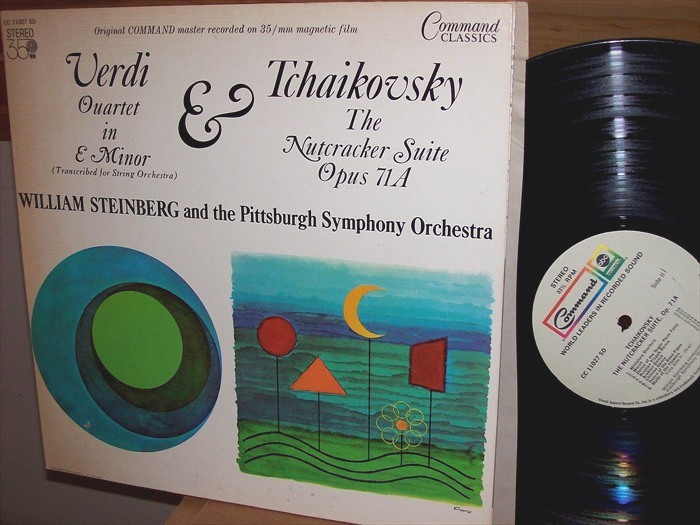
You'd want to think twice before bidding on this record. The ABC Command label tells you it's one of the inferior later pressings; you want an original gold-label issue. (Note: Unfortunately, last year's preview-opening video clip of the Nutcracker Suite segment of Walt Disney's Fantasia has disappeared -- not entirely surprisingly, I guess. To be honest, I don't like it much anyway.)

by Ken

As far back as the mind recalls, Sunday Classics has celebrated the holiday musically at last in part with music from Tchaikovsky's ballets, and last year I went whole hog and offered a complete Nutcracker, basically double-covered throughout, and assembled from, well, a whole bunch of recordings. And as I ventured in 2010's Nutcracker preview, what better way could there be to "warm up" for the main event than with the composer's own Nutcracker Suite, good old Op. 71a? In the click-through we've got two quite splendid, and interestingly different, performances.


WE HAVE TWO DIFFERENTLY SPLENDID
RECORDINGS OF THE NUTCRACKER SUITE

TCHAIKOVSKY: Nutcracker Suite, Op. 71a:
i. Miniature Overture


Pittsburgh Symphony Orchestra, William Steinberg, cond. Command, recorded c1963

Montreal Symphony Orchestra, Charles Dutoit, cond. Decca, recorded c1985

You'll note straightaway in the Miniature Overture that William Steinberg is taking a rather spritelier approach and Charles Dutoit a more buoyant, caressing one. Both the Pittsburgh Symphony and the Montreal Symphony play utterly delectably.


IN AUDIO TERMS, BOTH RECORDINGS HAVE
STELLAR PEDIGREES, IN CONTRASTING STYLES


Read more »

Labels: , ,

Sunday, December 22, 2013

Sunday Classics: It's "The Nutcracker" -- the whole deal! (again -- our last annual encore presentation)

>


With the "Nutcracker Suite" sequence of Disney's Fantasia now unavailable, I thought to kick off we'd just look at this little teaser from Helgi Tómasson's San Francisco Ballet staging.

by Ken

[To repeat, this is an "encore presentation" of last year's encore presentation of 2011's complete-Nutcracker post, which I thought came out pretty darned well. You probably think it's a huge labor-saver just running a post "rerun." Perhaps I thought so too, but it never works out that way.]

The plan is pretty simple. As promised in Friday night's preview, when we heard (once again) two quite differently terrific performances of Tchaikovksy's own Nutcracker Suite, today we're going to hear the complete ballet, and chunks of it -- solely at my discretion -- twice!

Pretty much the last thing I added to what you'll see in the click-through is the plot synopsis (filched from Wikipedia). I went back and forth a lot about this, because I really don't pay much attention to plots, or even programs, when I listen to music written for the dance. I'm not a dance person to begin with, and I guess my listening orientation is to allow the music to plug its own built-in "program" into my imagination. Still, in the end it seemed to me that this curious format (for want of a better word) we've got going here at Sunday Classics is actually an extremely good way to hook up the plot and the music.

I'll have some quick (I hope) notes about the specifics when we get to the click-through, so let me just throw out two points about The Nutcracker:

(1) Tchaikovsky really didn't want to write the damned thing. So no, it was about as far from a "labor of love" as you can get.

(2) It was written to share a double bill with one of the composer's less-performed operas, Yolanta, which is the part of the bill that really interested and moved him. It has, in fact, nothing (that I can see or hear) in common with its birth billmate, and it strikes me as an incredibly difficult piece to really bring to life, but as with many difficult, fragile creations, its specialness holds special rewards. It deals, first, with the desperate desire of a very powerful man -- a king, in fact -- to shield a loved one, in this case his only daughter, from pain, in her case the knowledge that she's blind. But in the larger sense it deals with the futility of trying to protect someone from something it's impossible to "protect" her from, like reality. Someday we should undoubtedly talk about Yolanta. (But it's difficult.)


MOVING ON TO OUR COMPLETE NUTCRACKER

Read more »

Labels: , ,

Friday, December 20, 2013

Sunday Classics preview: The gala Sunday Classics "Nutcracker (The Whole Deal)" returns AGAIN (one last time!)

>

You'd want to think twice before bidding on this record. The ABC Command label tells you it's one of the inferior later pressings; you want an original gold-label issue. (Note: Unfortunately, last year's preview-opening video clip of the Nutcracker Suite segment of Walt Disney's Fantasia has disappeared -- not entirely surprisingly, I guess. To be honest, I don't like it much anyway.)

by Ken

As far back as the mind recalls, Sunday Classics has celebrated the holiday musically at least in part with music from Tchaikovsky's ballets, and two years ago I went whole hog and offered a complete Nutcracker, basically double-covered throughout, and assembled from, well, a whole bunch of recordings. I brought it back last year, and now darned if it isn't here again. And as I ventured first in 2011's Nutcracker preview, what better way could there be to "warm up" for the main event than with the composer's own Nutcracker Suite, good old Op. 71a? In the click-through we've got two quite splendid, and interestingly different, performances.


WE HAVE TWO DIFFERENTLY SPLENDID
RECORDINGS OF THE NUTCRACKER SUITE

TCHAIKOVSKY: Nutcracker Suite, Op. 71a:
i. Miniature Overture


Pittsburgh Symphony Orchestra, William Steinberg, cond. Command, recorded c1963

Montreal Symphony Orchestra, Charles Dutoit, cond. Decca, recorded c1985

You'll note straightaway in the Miniature Overture that William Steinberg is taking a rather spritelier approach and Charles Dutoit a more buoyant, caressing one. Both the Pittsburgh Symphony and the Montreal Symphony play utterly delectably.


IN AUDIO TERMS, BOTH RECORDINGS HAVE
STERLING PEDIGREES, IN QUITE DIFFERENT STYLES


Read more »

Labels: , ,

Sunday, December 23, 2012

Sunday Classics: It's "The Nutcracker" -- the whole deal! (Again!)

>


Since we already saw the "Nutcracker Suite" sequence of Disney's Fantasia with Friday night's preview, I thought to kick off we'd just look at this little teaser from Helgi Tómasson's San Francisco Ballet staging.

by Ken

[To repeat, this is an "encore presentation" of last year's complete-Nutcracker post, which I thought came out pretty darned well. You probably think it's a huge labor-saver just running a post "rerun." Perhaps I thought so too, but it never works out that way.]

The plan is pretty simple. As promised in Friday night's preview, when we heard two quite differently terrific performances of Tchaikovksy's own Nutcracker Suite, today we're going to hear the complete ballet, and chunks of it -- solely at my discretion -- twice!

Pretty much the last thing I added to what you'll see in the click-through is the plot synopsis (filched from Wikipedia). I went back and forth a lot about this, because I really don't pay much attention to plots, or even programs, when I listen to music written for the dance. I'm not a dance person to begin with, and I guess my listening orientation is to allow the music to plug its own built-in "program" into my imagination. Still, in the end it seemed to me that this curious format (for want of a better word) we've got going here at Sunday Classics is actually an extremely good way to hook up the plot and the music.

I'll have some quick (I hope) notes about the specifics when we get to the click-through, so let me just throw out two points about The Nutcracker:

(1) Tchaikovsky really didn't want to write the damned thing. So no, it was about as far from a "labor of love" as you can get.

(2) It was written to share a double bill with one of the composer's less-performed operas, Yolanta, which is the part of the bill that really interested and moved him. It has, in fact, nothing (that I can see or hear) in common with its birth billmate, and it strikes me as an incredibly difficult piece to really bring to life, but as with many difficult, fragile creations, its specialness holds special rewards. It deals, first, with the desperate desire of a very powerful man -- a king, in fact -- to shield a loved one, in this case his only daughter, from pain, in her case the knowledge that she's blind. But in the larger sense it deals with the futility of trying to protect someone from something it's impossible to "protect" her from, like reality. Someday we should undoubtedly talk about Yolanta. (But it's difficult.)

Read more »

Labels: , ,

Friday, December 21, 2012

Sunday Classics preview: By popular demand, the gala DWT "Nutcracker (The Whole Deal)" returns

>

You'd want to think twice before bidding on this record. The ABC Command label tells you it's one of the inferior later pressings; you want an original gold-label issue. (Note: Unfortunately, last year's preview-opening video clip of the Nutcracker Suite segment of Walt Disney's Fantasia has disappeared -- not entirely surprisingly, I guess. To be honest, I don't like it much anyway.)

by Ken

As far back as the mind recalls, Sunday Classics has celebrated the holiday musically at last in part with music from Tchaikovsky's ballets, and last year I went whole hog and offered a complete Nutcracker, basically double-covered throughout, and assembled from, well, a whole bunch of recordings. And as I ventured in last year's Nutcracker preview, what better way could there be to "warm up" for the main event than with the composer's own Nutcracker Suite, good old Op. 71a? In the click-through we've got two quite splendid, and interestingly different, performances.


WE HAVE TWO DIFFERENTLY SPLENDID
RECORDINGS OF THE NUTCRACKER SUITE

TCHAIKOVSKY: Nutcracker Suite, Op. 71a:
i. Miniature Overture


Pittsburgh Symphony Orchestra, William Steinberg, cond. Command, recorded c1963

Montreal Symphony Orchestra, Charles Dutoit, cond. Decca, recorded c1985

You'll note straightaway in the Miniature Overture that William Steinberg is taking a rather spritelier approach and Charles Dutoit a more buoyant, caressing one. Both the Pittsburgh Symphony and the Montreal Symphony play utterly delectably.


IN AUDIO TERMS, BOTH RECORDINGS HAVE
STERLING PEDIGREES, IN QUITE DIFFERENT STYLES


Read more »

Labels: , ,

Sunday, September 09, 2012

Sunday Classics: Do I hear a waltz? (Tchaikovsky edition)

>

Ferenc Fricsay (1914-1963)

by Ken

Nothing fancy going on here this week. As I explained in Friday night's preview, we're just listening to four waltzes that happen to be included on an-all Tchaikovsky DG CD reissue conducted by Ferenc Fricsay. Okay, maybe not quite "just." It's possible that there are one or two diversions or digressions along the way.

Right now, for example, we're going to kick off, not with a waltz, but with a polonaise. Friday we listened to the waltz from Act II of the opera Yevgeny Onegin -- in both its "concert" form and as it's heard in the opera, as the music around which the opening scene of Act II, a ball given on the country estate of Madame Larina, unfolds. We're going to hear that again, in some different performances (plus the Fricsay, of course), but first we're going to hear the polonaise that opens Act III, introducing a considerably more cosmopolitan ball, in Moscow, at the home of Madame Larina's daughter Tatiana, now married to a genuine prince (and a prince of a fellow is our Prince Gremin).

TCHAIKOVSKY: Yevgeny Onegin, Op. 24:
Act III, Polonaise


Staatskapelle Dresden, James Levine, cond. DG, recorded June 1987

Orchestre de Paris, Semyon Bychkov, cond. Philips, recorded October 1992

USSR State Radio and Television Large Symphony Orchestra, Vladimir Fedoseyev, cond. Audiophile Classics, recorded 1986

Sofia Festival Orchestra, Emil Tchakarov, cond. Sony, recorded Jan. 15-21, 1988

Orchestra of the Royal Opera House, Covent Garden, Sir Colin Davis, cond. Philips, recorded December 1977

New York Philharmonic, Leonard Bernstein, cond. Columbia/CBS/Sony, recorded Jan. 12, 1971


TO CONTINUE WITH OUR TCHAIKOVSKY
WALTZ CELEBRATION, CLICK HERE

#

Labels: , , , ,

Sunday, December 18, 2011

Sunday Classics: It's "The Nutcracker" -- the whole deal!

>


Since we already saw the "Nutcracker Suite" sequence of Disney's Fantasia with Friday night's preview, I thought to kick off we'd just look at this little teaser from Helgi Tómasson's San Francisco Ballet staging.

by Ken

The plan is pretty simple. As promised in Friday night's preview, when we heard two quite differently terrific performances of Tchaikovksy's own Nutcracker Suite, today we're going to hear the complete ballet, and chunks of it -- solely at my discretion -- twice!

Pretty much the last thing I added to what you'll see in the click-through is the plot synopsis (filched from Wikipedia). I went back and forth a lot about this, because I really don't pay much attention to plots, or even programs, when I listen to music written for the dance. I'm not a dance person to begin with, and I guess my listening orientation is to allow the music to plug its own built-in "program" into my imagination. Still, in the end it seemed to me that this curious format (for want of a better word) we've got going here at Sunday Classics is actually an extremely good way to hook up the plot and the music.

I'll have some quick (I hope) notes about the specifics when we get to the click-through, so let me just throw out two points about The Nutcracker:

(1) Tchaikovsky really didn't want to write the damned thing. So no, it was about as far from a "labor of love" as you can get.

(2) It was written to share a double bill with one of the composer's less-performed operas, Yolanta, which is the part of the bill that really interested and moved him. It has, in fact, nothing (that I can see or hear) in common with its birth billmate, and it strikes me as an incredibly difficult piece to really bring to life, but as with many difficult, fragile creations, its specialness holds special rewards. It deals, first, with the desperate desire of a very powerful man -- a king, in fact -- to shield a loved one, in this case his only daughter, from pain, in her case the knowledge that she's blind. But in the larger sense it deals with the futility of trying to protect someone from something it's impossible to "protect" her from, like reality. Someday we should undoubtedly talk about Yolanta. (But it's difficult.)


FOR TODAY'S GALA NUTCRACKER, CLICK HERE
#

Labels: , ,

Friday, December 16, 2011

Sunday Classics preview: If it's the holidays, it must be "Nutcracker" time!

>


The Nutcracker Suite segment of Walt Disney's Fantasia -- with, of course, Leopold Stokowski conducting the Philadelphia Orchestra

by Ken

It didn't really occur to me when I devoted a recent post, "The Violin Concerto may be Tchaikovsky's happiest creation," to the Tchaikovsky Violin Concerto that we might be returning to the composer so soon. But I was reminded of the timing by this comment from reader Karin:
I have to disagree. His happiest creation is Capriccio Italien. And the Nutcracker is pretty happy too.

I replied that I had no problem with Karin's nominations.
There was a period in my life where I listened to the Capriccio italien pretty much exclusively and unceasingly for a period of months. And around here we do a more or less annual Nutcracker-themed post.

But I'll stick with the Violin Concerto as a rare expression among Tchaikovsky's works of geniality and even hopefulness that seems to me to come from inside rather than being put on for the occasion.

As best I can tell (I keep telling myself I've really got to roll up my sleeves and update the long-neglected Sunday Classics index, even if only for my own use), I broke the Tchaikovsky-for-the-holidays thread last year, but this holiday-season week we have an almost entirely Nutcracker-themed post. (The exception is a special bonus we'll have at the end of this preview.)

Actually it's more than Nutcracker-themed. This year for the first time we're going to hear the whole darned thing!. And what better way to "warm up" for it than with Tchakovsky's own Nutcracker Suite? In the click-through we've got two quite splendid, and interestingly different, performances.

FOR OUR NUTCRACKER SUITE RECORDINGS, CLICK HERE
#

Labels: , ,

Sunday, December 12, 2010

Sunday Classics: Yes, it's our 3rd Annual "Very Tchaikovsky Christmas"

>


Deems Taylor introduces and Leopold Stokowski conducts (the Philadelphia Orchestra) in most of the Nutcracker Suite segment of Walt Disney's Fantasia: "Dance of the Sugar Plum Fairies," "Chinese Dance," "Dance of the Reed Flutes," "Arabian Dance," and "Russian Dance" -- missing only the final "Waltz of the Flowers" (which can be seen here).

by Ken

If you've been with us for the previews -- Nutcracker Friday night, and Swan Lake and Sleeping Beauty last night -- you know the plan. Two years ago we did our first "Very Tchaikovsky Christmas" in the form of a tribute to John Lanchbery's splendid recordings of all three Tchaikovsky ballets, and last year we branched out for a little bit of everything Tchaikovsky.

We've got lots of music coming, so there will be a minimum of chatter. We're going to take the ballets in chronological order, meaning that we start with Swan Lake and finish with The Nutcracker. And speaking of Swan Lake, I can't resist pausing for this:


FOR SWAN LAKE (KURTZ & STOKOWSKI), SLEEPING BEAUTY
(MONTEUX), AND NUTCRACKER (STEINBERG) MUSIC, CLICK HERE

#

Labels: , , , ,

Friday, December 10, 2010

Sunday Classics Preview: Can this really be our 3rd Annual "Very Tchaikovsky Christmas"?

>


The brilliant little Russian Dance (Trepak) from The Nutcracker is performed by the Cologne New Philharmonic Orchestra under Volker Hartung in Hamburg, Feb. 1, 2009.

by Ken

It all started when I thought that with the holidays upon us, I should say something about the fact that you could buy all three of Tchaikovksy's indispensable ballets in marvelous performances by the distinguished composer-arranger-conductor John Lanchbery, squeezed by EMI onto five CDs, for under $20.

(Now, alas, the lowest price I see for it is $31.95, used. A better deal is the six-CD Previn-EMI set, which can be had new for less, and used from a number of sources in the $17-22 range. I've just never been wild about the sound on these CDs, which doesn't measure up to what I've heard for these performances on British EMI LPs.)

Last year we broke out of the confines of Tchaikovsky's ballets, but this year we're back to those three amazing creations. We actually don't have a lot of Nutcracker on this year's program, but we do have a performance and recording that I consider pretty special -- and three samples in tonight's preview.

We start, logically enough, with the Overture.


TO HEAR MORE NUTCRACKER EXCERPTS, AND
LEARN WHO OUR PERFORMERS ARE, CLICK HERE

#

Labels: , ,

Saturday, December 11, 2004

[12/12/2010] Yes, it's our 3rd Annual "Very Tchaikovsky Christmas" (continued)

>


The beginning and end of the 1959 Disney film version of Sleeping Beauty


TCHAIKOVSKY: Swan Lake, Op. 20

Swan Lake, Op. 20: excerpts

For the Kurtz recording i've maintained the groupings created by the banding on the LP.

Introduction
No. 2, Act I, Waltz
No. 4, Act I, Pas de trois, Nos. 1-6


No. 5, Act I, Pas de deux, Nos. 1-2


No. 5, Act I, Pas de deux, Nos. 3-4
No. 10, Act II, Scène
No. 13, Act II, Dance of the Swans, Nos. 1, 2, and 4


No. 13, Act II, Dance of the Swans, No. 5
No. 20, Act III, Hungarian Dance (Czárdás)
Supplement, Russian Dance


Yehudi Menuhin, violin; Philharmonia Orchestra, Efrem Kurtz, cond. EMI, recorded c1957


Swan Lake, Op. 20: Acts II-III

Act II


Act III

NBC Symphony Orchestra members, Leopold Stokowski, cond. RCA, recorded Oct. 1954-Feb. 1955


TCHAIKOVSKY: The Sleeping Beauty, Op. 66

The Sleeping Beauty, Op. 66: excerpts

Introduction
Prologue:
No. 1, March
No. 3, Pas de six: a. Intrada and Adagio; e. Variation IV; Fairy of the Canaries; f. Variation V, Fairy Violente


Act I:
No. 6, Garland Waltz
No. 8, Pas d'action: a. Rose Adagio; c. Aurora's Variation; d. Coda
No. 9, Finale: Aurora's Dance of Delirium; The King and Carabosse; Transformation of the Garden into a Forest


Act II:
No. 13, Farandole and Mazurka
No. 17, Panorama


Act III:
No. 22, Polonaise
No. 23, Pas de quatre: a. Intrada; c. Variation II, The Silver Fairy; e. Variation IV, The Diamond Fairy; f. Coda
No. 25, Pas de quatre: c. Variation II, The Blue Bird and Princess Florine; d. Coda
No. 26, Pas de caractère: a. Red Riding Hood and the Wolf
No. 28, Aurora Pas de deux: b. Adagio; c. Coda
No. 30, Finale: a. Mazurka; b. Apotheosis

London Symphony Orchestra, Pierre Monteux, cond. RCA/Decca, recorded June 1957


TCHAIKOVSKY: The Nutcracker, Op. 71

Nutcracker Suite, Op. 71a

As I mentioned Friday night, the Steinberg-Pittsburgh Symphony recordings made by Command in the '60s, produced by company founder Enoch Light, with the legendary Robert Fine as "recording chief," were of strikingly high quality both musically and sonically. (After Command was acquired by ABC Records, the market was flooded with cheap copies of significantly inferior pressings, so you have to be careful to go back to the gold-label originals.)

i. Miniature Overture
ii. March
iii. Dance of the Sugar Plum Fairy
iv. Trepak (Russian Dance)
v. Arabian Dance
vi. Chinese Dance
vii. Dance of the Reed Pipes
viii. Waltz of the Flowers

Pittsburgh Symphony Orchestra, William Steinberg, cond. Command, recorded c1963


RETURN TO THE BEGINNING OF THE POST
#

Labels: , , , ,

Friday, December 10, 2004

[12/10/2010] Preview: Can this really be our 3rd Annual "Very Tchaikovsky Christmas"? (continued)

>

You'd figure there would be some video of our mystery conductor, William Steinberg (1899-1978), longtime music director of the Pittsburgh Symphony, and later of the Boston Symphony as well. But I couldn't find any!


Steinberg and the Pittsburgh Symphony had already recorded for Everest and Capitol when Enoch Light's Command label came on the scene and made them one of its classical mainstays. All that extensive series of recordings had going for it was (a) generally truly outstanding performances and (b) invariably truly outstanding recorded sound -- a special concern of Light's. The "recording chief" (working with producer Light) of the Steinberg-Pittsburgh Nutcracker Suite we're hearing this week was Robert Fine, a revered name in the annals of recording history -- he had been the engineer, mostly with Wilma Cozart (from 1957, Wilma Cozart Fine!) as producer, of most of the Mercury Living Presence recordings, still among the best-sounding records ever made.

Here, then, are two more excerpts from the Steinberg-Pittsburgh Nutcracker Suite:

TCHAIKOVSKY: Nutcracker Suite, Op. 71a

3. Dance of the Sugar Plum Fairies


8. Waltz of the Flowers

Pittsburgh Symphony Orchestra, William Steinberg, cond. Command, recorded c1963


BONUS: THE FLIP SIDE

If you're wondering, the LP coupling for the Steinberg-Piitsburgh-Command Nutcracker Suite was a string-orchestra rendering of Verdi's String Quartet in E minor. Heck, we haven't had that much music tonight, so why don't we hear that? (I suppose one of these days we should hear the actual string-quartet version, but I'll control myself for now. As it happens, for all my veneration of Verdi, the String Quartet -- a late piece, from roughly the period of Aida -- isn't something I listen to a lot.)

VERDI: String Quartet in E minor (arr. for string orchestra)
i. Allegro
ii. Andantino
iii. Prestissimo
iv. Scherzo fuga: Allegro assai mosso

Pittsburgh Symphony Orchestra, William Steinberg, cond. Command, recorded c1963


IN TOMORROW NIGHT'S PREVIEW . . .

We've got samples of some real treats we're going to hear, from the full-length Tchaikovsky ballets, Swan Lake and The Sleeping Beauty. Our conductors are Efrem Kurtz, Leopold Stokowski, and Pierre Monteux.


RETURN TO THE BEGINNING OF THE POST
#

Labels: , ,

Thursday, December 18, 2003

12/18/2011] It's "The Nutcracker" -- the whole deal! (continued)

>

The Land of Sweets: Konstantin Ivanov's original sketch for the set of Act II of the 1892 premiere of The Nutcracker


I WROTE OUT A BUNCH OF NOTES ABOUT THE
COMPONENTS OF OUR COMPOSITE NUTCRACKER . . .

. . . and how they came together, and fit together (or don't quite), but I think I'm going to let that mostly drop. The breakdown of the piece into our little "work groups" is entirely my own, as is the decision whether to present individual numbers within groups separately or, um, combinedly. I mean, could I really separate Nos. 8 and 9? (The unrelenting buildup of the "Scene in the Pine Forest" is my favorite section of the piece. Wow!) So, finally, is the decision to double up on the sections I've doubled up on. One obvious doubling up occurs in the Miniature Overture and the "Waltz of the Flowers," where I've cheated and brought back the wonderful Steinberg and Dutoit performances from their recordings of the suite, which we heard Friday night. I guess you can assume that these sections are pretty darned special.

The plot synopsis, again, is from Wikipedia. You'll notice that by Act II there isn't a whole lot of plot.


TCHAIKOVSKY: The Nutcracker, Op. 71


Miniature Overture (two performances)
Pittsburgh Symphony Orchestra, William Steinberg, cond. Command, recorded c1963 [audio link]
Montreal Symphony Orchestra, Charles Dutoit, cond. Decca, recorded c1985 [audio link]

ACT I

Tableau 1: The Silberhaus Home
It is Christmas Eve at the house of Herr and Frau Silberhaus and their children. Family and friends have gathered in the parlor to decorate the beautiful Christmas tree in preparation for the night's festivities. Once the tree is finished, the younger children are sent for; among them are Clara, the Silberhaus' daughter, and her brother Fritz. The children stand in awe of the tree sparkling with candles and decorations. The festivities begin. A march is played.
No. 1. The Christmas Tree [audio link]
No. 2. March [audio link]
No. 3. Children's Galop and Arrival of the Guests [audio link]
London Symphony Orchestra, Sir Charles Mackerras, cond. Telarc, recorded May 13-16, 1986
Presents are given out to the children. Suddenly, as the owl-topped clock strikes eight, a mysterious figure enters the room. It is Herr Drosselmeyer, a local councilman and Clara and Fritz's godfather. He is also a talented toymaker who has brought with him gifts for the children, including four lifelike dolls -- a Harlequin and Columbine, and a Vivandière and Soldier -- who dance to the delight of all. Herr Silberhaus has the precious dolls put away for safekeeping. Clara and Fritz are sad to see the dolls taken away, but Herr Drosselmeyer has yet another toy for them: a wooden nutcracker carved in the shape of a little man, used for cracking hazelnuts. The other children ignore it, but Clara immediately takes a liking to it. Fritz, however, purposely breaks the toy. Clara is heartbroken. Clara takes the wounded toy to her doll's bed, lulling it to sleep. The boys interrupt with their toy trumpets and horns. Herr and Frau Silberhaus announce it is time to finish off the evening with a traditional Grandfather dance. After the dance, the guests depart, and the children are sent off to bed.
No. 4. Scene and Arrival of Drosselmeyer with Presents [audio link]
No. 5. Scene and Grandfather Dance [audio link]
London Symphony Orchestra, Antal Dorati, cond. Mercury, recorded July 11-13, 1962
During the night, after everyone else has gone to bed, Clara returns to the parlor to check on her beloved nutcracker. As she reaches the little bed, the clock strikes midnight and she looks up to see her Godfather Drosselmeyer perched atop the clock in place of the owl. Suddenly, mice begin to fill the room and the Christmas tree begins to grow to dizzying heights. The Nutcracker also grows to life-size. Clara finds herself in the midst of a battle between an army of gingerbread soldiers and the mice, led by the Mouse King. The mice begin to eat the gingerbread soldiers. The Nutcracker appears to lead the gingerbread soldiers, who are joined by tin soldiers and dolls (who serve as doctors to carry away the wounded). As the Mouse King advances on the still-wounded Nutcracker, Clara throws her slipper at him, distracting him long enough for the Nutcracker to stab him.
No. 6. The Spell Begins: Clara and the Nutcracker [audio link]
No. 7. Battle of the Nutcracker Against the Mouse King [audio link]
Philharmonia Orchestra, Michael Tilson Thomas, cond. CBS/Sony, recorded May 1985

Tableau 2: A Pine Forest
The mice retreat and the Nutcracker is transformed into a handsome Prince. He leads Clara through the moonlit night to a pine forest in which the snowflakes dance around them (the Waltz of the Snowflakes is the best known snow dance of many inspired by the "Grand ballet of the snowflakes" from Offenbach's Le voyage dans la lune, scene 15).
No. 8. Scene in the Pine Forest
No. 9. Scene and Waltz of the Snowflakes
(two performances)

Boys of the Berlin State and Cathedral Choir (in No. 9), Berlin Philharmonic, Semyon Bychkov, cond. Philips, recorded May 1986 [audio link]
[No. 9 at 3:39] Bolshoi Theater Children's Chorus (in No. 9), Bolshoi Theater Orchestra, Gennady Rozhdestvensky, cond. Melodiya, recorded 1960 [audio link]


ACT II

Tableau 3: The Land of Sweets
Clara and the Prince travel in a nutshell boat pulled by dolphins to the beautiful Land of Sweets in Confiturembourg, ruled by the Sugar Plum Fairy in the Prince's place until his return. The Prince recounts for the Sugar Plum Fairy how he had been saved by Clara from the Mouse King and had been transformed back into a Prince.
No. 10. The Magic Castle on the Mountain of Sweets
No. 11. Clara and the Prince

Philharmonia Orchestra, John Lanchbery, cond. EMI, recorded 1981 [audio link]
In honor of the young heroine, a celebration of sweets from around the world is produced: chocolate from Spain, coffee from Arabia, and tea from China all dance for their amusement; candy canes from Russia perform a Trepak; Danish marzipan shepherdesses perform on their flutes; Mother Gigogne has her Polichinelle children emerge from under her enormous skirt to dance.
No. 12. Character Dances (Divertissement)
(a) Chocolate (Spanish Dance)
(b) Coffee (Arabian Dance)
(c) Tea (Chinese Dance)
(d) Trepak (Russian Dance)
(e) Dance of the Reed Pipes
(f) Polichinelle (The Clown)

Kirov (Mariinsky Theater) Orchestra, Valery Gergiev, cond. Philips, recorded in Baden-Baden, August 1998 [audio link]
A string of beautiful flowers perform a waltz.
No. 13. Waltz of the Flowers (two performances)
Pittsburgh Symphony Orchestra, William Steinberg, cond. Command, recorded c1963 [audio link]
Montreal Symphony Orchestra, Charles Dutoit, cond. Decca, recorded c1985 [audio link]
To conclude the night, the Sugar-Plum Fairy and her Cavalier perform a Pas de Deux.
No. 14. Pas de deux (two performances) [time cues offered for the trackless Ansermet clip, made from LP -- sorry about the surface noise at the start of the "Dance of the Sugar-Plum Fairy"]
(a) Intrada
(b) Variation I: Tarantella {Ansermet: at 5:29]
(c) Variation II: Dance of the Sugar-Plum Fairy [at 6:10]
(d) Coda [at 8:07]

Royal Philharmonic Orchestra, André Previn, cond. EMI, recorded Jan.-Feb. 1986 [audio link]
Orchestre de la Suisse Romande, Ernest Ansermet, cond. Decca, recorded October 1958 [audio link]
A final waltz is performed by all the sweets, after which Clara and the Prince are crowned rulers of the Land of Sweets forever and are shown the riches of their kingdom domed with an enormous beehive. There is no indication in the original ballet plot, however, that the two ever fall in love or marry.
No. 15. Closing Waltz and Grand Finale
Orchestre de la Suisse Romande, Ernest Ansermet, cond. Decca, recorded October 1958 [audio link]

§

DOWNLOAD A PRETTY GOOD NUTCRACKER FOR $5!
(PLUS: MY FAVORITE NUTCRACKERS)


It's by Valery Gergiev and the Kirov Orchestra and Chorus, from whom we heard a pretty smart performance of the important Act II "Character Dances" (not that these are difficult pieces to make work). The original issue of this recording was the only Nutcracker I've encountered on a single CD, but then, I haven't been keeping up. In any event, you could do a lot worse.

And if I could have only one Nutcracker? (Perish the thought!) I think it would be the Dorati-London Symphony version from which we heard Nos. 4 and 5. Along with maybe André Previn's first recording, also with the LSO, of which EMI has released a new CD mastering (in its moderately priced Ballet Edition) to replace the disappointing earlier one.

FURTHER THOUGHT: I've been listening to my digital dubs from LP (a pretty-good-sounding early London Records pressing) of the final numbers of the Ansermet Nutcracker, and I'm thinking that deserves to be thrown into this mix. (There's also a $6.99 downloadable version.) There was, by the way, one of those fancy 180-gram audiophile-LP editions, and if you can lay hands on that and you've got really good record-playing equipment, I'll bet it sounds really fine.

Labels: , ,