Sunday, February 19, 2017

"If Trump were more rational and more competent, he might have a chance of destroying our democracy" (George Packer)

>


by Ken

The question of President Trump's mental fitness for the office dates back at least to some of his wilder ravings during the campaign, and less than a month into his tenure is being discussed more widely. As noted, the above graphic, for example, is filched from a January 28 post of that title by Gregory Johnson on the Resources for Life blog.

Now, in a "Comment" piece in the February 27 New Yorker, "Holding Trump Accountable," George Packer offers a stark portrait of our moment in time, proceeding from the proposition that, a month into his tenure,
Donald Trump has already proved himself unable to discharge his duties. The disability isn’t laziness or inattention. It expresses itself in paranoid rants, non-stop feuds carried out in public, and impulsive acts that can only damage his government and himself. Last week, at a White House press conference, the President behaved like the unhinged leader of an unstable and barely democratic republic.
George gives a graphic portrayal of a White House "isolate[d] in power struggles" and an administration "in nearly open revolt," and foreign leaders looking on either:

• "with disbelieving alarm":
Allies such as Prime Ministers Justin Trudeau, of Canada, and Shinzo Abe, of Japan, flatter the President in order to avoid the fate of Australia’s Malcolm Turnbull, whom Trump first berated and then hung up on during their get-to-know-you phone call."
• or "with calculating interest":
Vladimir Putin is already testing Trump, by sending Russian fighter jets to buzz a U.S. Navy ship. Xi Jinping is positioning China to fill the void in the Pacific Rim which will be left by Trump’s policy of America First. Pragmatists in Iran are trying to judge whether the new American government can be counted on to act rationally—exactly what U.S. officials always wondered about the fractured leadership of the Islamic Republic.

GEORGE BEGAN HIS PIECE OUTLINING A KNOWN
REMEDY: SECTION 4 OF THE 25TH AMENDMENT


As George explains, Section 4 of the 25th Amendment, which has still never been used (though he notes that the new team appointed by Ronald Reagan in 1987, on the advice of the outgoing team, checked it out), "empowers the Vice-President, along with 'a majority of either the principal officers of the executive departments or of such other body as Congress may by law provide,' to declare the President unfit and to install the Vice-President as Acting President."

The blurb atop George's piece reads: "After a month in office, [President Trump] has already proved himself unable to discharge his duties. But the only people with real leverage over him won’t use it." And after setting forth the current situation, George says starkly: "It won’t get better."
The notion that, at some point, Trump would start behaving “Presidential” was always a fantasy that has the truth backward: the pressure of the Presidency is making him worse. He’s insulated by sycophants and by family members, and he can still ride a long way on his popular following. Though the surge of civic opposition, the independence of the courts, and the reinvigoration of the press are heartening, the only real leverage over Trump lies in the hands of Republicans. But Section 4 won’t be invoked. Vice-President Mike Pence is not going to face the truth in the private back room of a Washington restaurant with Secretaries Betsy DeVos, Ben Carson, and Wilbur Ross, or in the offices of Speaker of the House Paul Ryan and Senate Majority Leader Mitch McConnell. Republican leaders have opted instead for unconstrained power.

They need Trump to pass their agenda of rewriting the tax code in favor of the rich and of gutting regulations that protect the public and the planet—an agenda that a majority of Americans never supported—so they are looking the other way. Even the prospect of Russian influence over our elections and our government leaves these American patriots unmoved. Senator John Cornyn, of Texas, the Republican whip, made it plain: Trump can go on being Trump “as long as we’re able to get things done.” Senator Rand Paul, of Kentucky, explained, “We’ll never even get started with doing the things we need to do, like repealing Obamacare, if we’re spending our whole time having Republicans investigate Republicans.”

The growing Russian scandal will challenge the willingness of the Party to hold the President accountable. So far, the situation is not encouraging. The heads of the key House and Senate committees are partisans who are doing as little as possible to expose corruption and possible treason in the White House. The few critical Republican voices—Senators John McCain, Lindsey Graham, and Susan Collins, and Representative Mark Sanford—are ineffective. Perhaps Party leaders are privately searching their souls; perhaps, as with the old Bolshevik Rubashov, in Arthur Koestler’s “Darkness at Noon,” ideology and power have rendered them incapable of independent moral judgment. Whatever the case, history won’t be kind to them.

An authoritarian and erratic leader, a chaotic Presidency, a supine legislature, a resistant permanent bureaucracy, street demonstrations, fear abroad: this is what illiberal regimes look like. If Trump were more rational and more competent, he might have a chance of destroying our democracy.
Obviously if those Republicans George accuses of delinquency were to rouse themselves to action, we would be left in the hardly more attractive clutches of a President Pence. Eventually it may come to that, but at least for now, as George points out, "they need Trump to pass their agenda" -- in their present situation of "unconstrained power." So pick your poison -- heads they win, tails the country loses.
#

Labels: , , , , ,

Saturday, January 07, 2017

Hey, cartoon-caption-writing compulsives, for the first time in a decade "The New Yorker" is staging a Reverse Caption Contest

>


by Ken

What you see above is one example provided by New Yorker cartoon editor Bob Mankoff of the process of a Reverse Caption Contest. Of course in the standard weekly New Yorker Caption Contest, one of the magazine's formidable roster of cartoonists provides a drawing minus a caption, and readers are invited to submit their best efforts. In the "reverse caption" process, cartoonists are provided with a caption for which, as Bob puts it, they have to "come up with an unusual image that makes it into a punch line." As, for example, the line "No wonder we could get tickets."

"We did this about ten years back," Bob explains, "with exactly that phrase." And the results included the cartoon above, and also these:


In case you hadn't guessed, the occasion for this look-back is Bob's announcement of a new Reverse Caption Contest. "Send your reverse-cartoon-caption entry to reversecaptioncontest@gmail.com," says Bob, "and we’ll pick the top three phrases for our cartoonists to hilarify." He goes on to provide Cartoon Contest links, which you'll find onsite: "To Enter the Contest," "To Help Pick the Three Finalists," and "To Vote for the Winner."

It's an interesting question how different a process it is to concoct a conception totally from scratch vs. creating one to complete an existing drawing. I'm afraid I have no insight to offer, since my brain seems singularly ill-suited to cartoon-caption-writing. For me the Caption Contest is strictly a spectator sport. Over the years I've found that whenever I actually try to do the contest, all I come up with are pathetically obvious, literal snoozes -- I've never come up with anything I wouldn't be horribly embarrassed even to submit. It's always interesting, when I do spend time on it, to check back to see the way the three chosen finalists' minds took the caption and ran with it.

How different is it when you're in complete control of the caption content? Boy, are you asking the wrong person.
#

Labels: , ,

Tuesday, January 03, 2017

Will the Istanbul nightclub massacre lead to "The End of Democracy in Turkey"?

>


Turkish journalist Ahmet Sik, reportedly now under arrest, told The New Yorker's Dexter Filkins in August, early in the Turkish-government crackdown following the failed coup against the regime, that "he had little doubt that [President] Erdoğan aimed to remove all impediments to his rule" -- and that he himself expected to be arrested "very soon."

by Ken

Although I refrained from fobbing off my amateur speculations in taking note of the bloody New Year's Eve assault on that Istanbul nightclub -- at least 39 killed, scores injured -- you didn't have to be either clairvoyant or an expert on Turkish domestic affairs to call this one: that President Recep Tayyip Erdoğan would use what seemed clearly another act of violence against the Turkish state to clamp down even further on the remaining opposition, as he did in the wake of the strange coup attempt against him perpetrated by elements in the Turkish military in July.

To be sure, as The New Yorker's Dexter Filkins writes in a newyorker.com post today, although "the shooter has not yet been identified,"
the Islamic State claimed that one of its soldiers had done the job. In its typical deranged language, the group said that it had happily struck the revellers, “turning their joy into sorrows.” The attack, the group said, was in retaliation for air strikes and other military operations carried out by the “Turkish apostate government” against isis in Syria.
Filkins's post, it should be noted, is called "The End of Democracy in Turkey."

"Since July," Filkins notes, "thousands of civilians have been arrested and jailed -- many, if not most, with no apparent connection to [Pennsylvania-resident Muslim cleric Fethullah] Gülen [whose followers may have been behind the coup attempt] or ISIS or Kurdish militants," and "hundreds of thousands of others have been either fired or suspended from their jobs," among them "university professors, career bureaucrats, leaders of the democratic opposition, and journalists."
Last week brought word that Ahmet Sik, one of the country’s most fearless investigative reporters, had been arrested and detained; apparently, Turkish officials charged him with spreading “terrorist propaganda” through a series of tweets. In 2010 and 2011, he served a year in prison, in a blatant (and futile) attempt by Turkish authorities to halt publication of his investigation into the secretive activities of Gülen -- who, at the time, was Erdoğan’s most important ally -- and his followers. I saw Sik this past August, after the purges had begun, and he told me he had little doubt that Erdoğan aimed to remove all impediments to his rule. “Very soon, I think, they will arrest me, too,” he said.
Filkins also notes the awkard role the Erdoğan government has played in the fight against ISIS, which it eventually joined -- but only after having offered various kinds of support to the opposition, in hopes of seeing Syrian President Bashar al-Assad overthrown. "Turkey’s leaders," Filkins notes, "bear a heavy responsibility for the rise of extremists across the border—and inside Turkey, too. ISIS, allowed to operate inside Turkey for years, is now well established there."

Filkins concludes his piece:
Following the New Year’s Eve attack, Erdoğan asked his countrymen to remain calm. “We will retain our coolheadedness as a nation, standing more closely together, and will never give ground to such dirty games,” he said.

If only Erdoğan would follow his own advice.
I don't think Filkins or anyone else is holding his breath for any such development.
#

Labels: , , ,

Friday, December 30, 2016

A cartoonists' eye view of 2016: great moments from the "New Yorker" "Daily Cartoon's"

>


"I blame the media."

by Ken

"It's definitely been one year," concedes The New Yorker's Colin Stokes as he looks back on 2016 in introducting "2016: The Year in Cartoons, a slide show drawn not from the heap of cartoons published in the magazine but from the website's "Daily Cartoon" blog, for which, on a rotating basis, stalwarts from the magazine's Cartoon Corps stand watch over the cartoonable universe, "getting up every day, " notes Colin, "reading the news, and forming it into a cartoon." It has to be, you would think, a markedly different process from their normal creative process, knowing that each day during their watch they have to come up with something worthy of blogposting.

If I recall correctly, David Sipress -- one of the current elite members of the New Yorker cartoon fraternity -- was the first Daily Cartoonist, and the medium seems to suit him; he seems to jump into the rotation considerably more frequently than any of his colleagues and to have no trouble producing at top quality on demand. So it's probably not surprising that as I went through the couple of dozen cartoons in the slide show, pulling out the ones I really liked, David S was heavily represented -- starting with the specimen I've placed atop this post, my favorite of the bunch.

As for the rest, maybe if I really thought about it I could make some useful groupings of the cartoons I plucked out, or then again maybe not. I didn't try. I've just grouped them by creator. I don't know that this is an especially representative sampling of what was on the Daily Cartoonists' minds, but then again, I don't know that it isn't. I know that these specimens all gave me a hearty charge.


DAVID SIPRESS


“Mr. Trump said on Friday that Hillary Clinton started the birther theory. He also said that she came up with Trump Vodka and founded Trump University.”


“I’m sorry, but it’s against my religion to serve middle-aged, heterosexual couples with matching Shih Tzus, wearing skinny jeans and Uggs, and camo shorts and God-themed T-shirts.”


“The crowd goes crazy when I mention waterboarding. So what about the rack? The rack is terrific. Or that thing where they squeeze you into a tiny cage filled with spikes? That’s also terrific.”


“You know what I think was the problem
all along? The exclamation point.”


“I had a dream last night that Planned Parenthood did something new and horrible to a fetus! We need to launch an immediate congressional investigation.”


KIM WARP


“I do plenty -- that meme I posted on Facebook
will go a long way toward healing the nation.”


“The British are leaving, the British are leaving!”


“But if Trump surrounds himself with non-idiots,
it won’t matter so much that he is an idiot.”


EMILY FLAKE


“Oh, look—he must be from one of those fake-news outlets.”
#

Labels: , ,

Friday, August 12, 2016

Why does The Donald lie?

>


[Click to enlarge.]

"In returning to this sort of language now that he’s got the nomination—and escalating it with his use of the phrase 'founder of ISIS'—Trump is, on the face of it, harming his prospects for November. . . . He sounds like he is talking to his angry base, and supplying them with an inflammatory narrative that can be trotted out for years, and decades, to come."
-- John Cassidy, in a new newyorker.com post, "Why
Trump's Crazy Talk About Obama and ISIS Matters
"

by Ken

Idea for a post: "Prophetic utterances uttered by a young imp known as The Donnie." As for example: "Someday I'm gonna be so rich, people will have to laugh at my jokes." Not for today, but still safely lodged in the Idea Hopper. Meanwhile, now all grown up, or as grown up as it appears he's ever going to get, The Donald sprinkles his little "jokes" all over the damn place, most recently inspiring this Borowitz Report:


NEW YORK (The Borowitz Report)—Clarifying his position on a key national-security issue, Donald Trump said on Friday that as President he would be willing to use nuclear weapons, “but only in a sarcastic way.”

“People who are worried about me having the nuclear-launch codes should stop worrying, O.K.?” Trump told CNN’s Wolf Blitzer. “If I ever used nuclear weapons, it would be really obvious that I was just being sarcastic.”

Pressed by Blitzer to explain the difference between a sarcastic and non-sarcastic nuclear attack, Trump responded, “You’d use the weapons and everything, but then you’d say, ‘Just kidding.’ ”

Trump did not specify which nations he would target for a sarcastic nuclear attack. “I can’t say right now,” he said. “But there are a lot of countries that need to lighten up.”
Stunning as this latest round of Donald-esque delusions and lies is, it's hardly a novelty, in that by now we have learned to expect pretty much anything when our boy opens his yap. Now I've already argued that this isn't in itself ground-breaking -- that, after all, we had a president who served for eight years (2001-09) without ever intentionally uttering a public word of truth. (I say "intentionally" to allow for the possibility that on occasion, in his usual slapdash, devil-may-care way "Chimpy the Prez" Bush may have delivered an accidental word of truth.) And in 2008, we had a presidential campaign in which the Republican candidate not only did the same but upped the ante, nestling lies within lies, and even lies within lies within lies. What's more, at least as of that magical year 2008 it appeared that every campaigning Republican in the country had fully adopted the new GOP fuck-the-truth standard

Still, there is something different about The Donald: the sheer brazenness of his lying. As witness the present case. As The New Yorker's John Cassidy puts it in the newyorker.com post from which I quoted up top, "Why Trump's Crazy Talk About Obama and ISIS Matters":
On Thursday morning, Donald Trump doubled down on his latest verbal outrage: the claim that President Obama was the “founder” of ISIS. Actually, the Republican Presidential nominee tripled down. Appearing on CNBC’s “Squawk Box,” he described himself as “a truth teller” and went on to say that the President was “the founder of ISIS absolutely, the way he removed our troops.” Referring to Hillary Clinton, Trump added, “I call them co-founders.”

Peripatetic as ever, Trump gave another interview, a short time later, to Hugh Hewitt, the conservative radio host, who said to him, “Last night, you said that the President was the founder of ISIS. I know what you meant. You meant that he created the vacuum, he lost the peace.”

Trump wasn’t having it. “No. I meant that he’s the founder of ISIS,” he said. “He was the most valuable player. I gave him the Most Valuable Player award. I give her”—Clinton—“too, by the way.” Hewitt evidently thought that this was unfair to Obama. “But he’s not sympathetic to them,” he said. “He hates them; he’s trying to kill them.” Trump was unabashed. “He was the founder,” he said, referring to Obama. “His, the way he got out of Iraq, that was the founding of ISIS.”
If this rings a bell, perhaps it's from the similarly loony rewrite of history done by The Donald's hand-picked running mate, The Unspeakable Pence, who managed -- in distancing himself from the still more extreme position of the man who has chosen him to be a heartbeat away from his presidency -- to "explain" that Capt. Hamayun Khan's killing in Iraq in 2004 was the fault of the devil Obama and the chaos he created in Iraq, even though at the time of Captain Khan's death Chimpy the Prez not only was still president but would still serve another full term.

And the problem for the country is that this may seem quite believable to the people who are prepared to vote for The Donald. Which is not only terrifying but ironic, because clumsily buried beneath the Trump and Co. lies about Iraq is a truth that the country has never been prepared to face: that indeed all sorts of humongous international problems were created, or at least exacerbated, by American actions in Iraq (and also Afghanistan) -- except not the devil Obama's, but none other than Chimpy the Prez and the invasion that was "justified" by an entire fabric(ation) of out-and-out lies.

From which episode two lessons need to be remembered, it seems to me:

(1) The country as a whole swallowed Chimpy and the Neocons' lies pretty much whole.

It's not as if absolutely nobody was in possession or at least in search of the truth about Iraq (and Afghanistan). Enough of it was already gleaned that it should have made a difference if the country had given a damn about the truth. And, as we've noted frequently, even in the aftermath of the disaster of our involvement in Iraq, the people who had advocated for the truth were almost uniformly punished, while the people who had formulated or at least propagandized for the lies were almost uniformly rewarded.

(2) Similarly, the country ignored the real-world effects of our military involvement in Iraq and Afghanistan.

Again, there were observers pointing out that our actions in Iraq and Afghanistan, far from combatting terrorism, were laying the groundwork for a whole new generation of terrorists, for wider-spread and more destructive terrorism. But the country as a whole made it clear that it didn't want to hear anything about that. Only to be easy pickings for the Trump and Co. rewrite of history. Does this make any sense?

As a matter of fact, it does. Because at some point in the above-alluded-to second term of Chimpy the Prez, that same broad middleground of America, people who had once treated Chimpy as divinity, and denounced even the mildest criticism as "Bush-bashing," lost its devotion to the lies of Chimpy and Co. Partly it was the inescapability of the messes in Iraq and Afghanistan, and the contrast of the reality with the bright and cheery lies Chimpy had fed them and they had swallowed so eagerly. Partly it was the visible ineptitude of the Bush administration's response to Hurricane Katrina. Partly it was assorted other first-term Chimpy-chickens coming home to roost. And eventually there was economic catastrophe presided over by Chimpy and his team. This idea of creating your own reality and pretending it's actual reality is fun as far as it goes, but sometimes the real thing has a way of getting in the way.

Interestingly, though, when the former Chimpyites turned on their onetime idol, it didn't take the form of them blaming him for what he'd done. He simply disappeared from their consciousness. By the time of the 2008 presidential campaign, it was as if he had never existed, even though he was still the president of these United States. Barack Obama, by contrast, gets blamed for everything that Chimpy never did get blamed for.

As I argued at the time, it wasn't that the Chimpyites were prepared to come to grips with reality. No, it was more like they had become passionately disillusioned with the years' worth of lies Chimpy and his people had told them but they were demanding, often angrily, newer and better lies.

And now they're getting 'em. And, I worry, swallowing 'em.

This scares me for two reasons. First, I'm still not persuaded that The Donald can't win. If people are sufficiently determined to reject reality in favor of a more "acceptable" concocted version, they can do it. And the degree of Hillary hatred makes this possibility substantially less impossible. But second, even assuming the Trump candidacy crashes and burns, the broad national disaffection he's tapped into, and the descent into delusion he's proposed as a response, will remain fixtures of the political landscape going forward.

Which, as it happens, is the very subject John Cassidy pursues in this post of his. Following the chunk from the post I quoted above, he asks, "What are we to make of all this?" And he continues:
At this stage, some will argue that it isn’t worth the effort to interpret Trump’s misstatements, or to point out the truth of the matter—in this case, that a Jordanian named Abu Musab al-Zarqawi founded ISIS, in 2004. At the very least, it should be obvious to everyone by now that Trump doesn’t deal in reality; he deals in mythmaking, demagoguery, and carnival barking.

When he’s not tied to a teleprompter, Trump often seems to say the most provocative thing that comes into his head, with little thought for the consequences for his campaign, or for the campaigns of other Republicans. He’s like a small child, trying to be the center of attention, even if that means he has turned himself into an object of outrage and ridicule.

If you take this view of Trump, there isn’t much more to be said. He’s the melting figure on the cover of this week’s Time magazine [see image above -- Ed.]: a reality-television shyster who somehow captured the nomination of a major political party and is now dissolving in front of us. The only remaining questions for you are how big a majority Clinton will rack up, and whether the Republicans can limit the damage in the Senate and the House of Representatives.
"I’ve got a lot of sympathy for this interpretation.," John writes. "But, just for the sake of argument, let’s assume that Trump is smarter and less myopic than he seems."
Let’s assume that what he’s really focussed on isn’t winning this year’s election, a task he now realizes is beyond him, but creating a long-term Trumpian movement. A nationalistic, nativist, protectionist, and authoritarian movement that will forever be associated with him, but which also has the capacity to survive beyond him.
And he cites the current reactionary movements in France, Austria, and the U.K., not to mention the similar movements in our own history.
History tells us that for right-wing populist movements to succeed, a number of things need to be in place. For one thing, they need a narrative that mainstream political leaders, and political parties, are guilty of not merely incompetence but betrayal.
And John refers us to "the 'stab-in-the-back' myth" in post-1918 Germany, which led to the rise of Hitler, and to post-de Gaulle French right-wingers' accusation that the Général had betrayed France by "giving up" Algeria and that later French governments had betrayed France by embracing the European Union. Looked at this way, John argues, the kinds of anti-Obama indictments The Donald has been pronouncing (he notes, for example, that Trump "first suggested that Obama and Clinton created isis seven months ago, long before this week’s comments") suggest a larger purpose than merely electioneering for 2016. Which brings us to the quote atop this post. Here it is again, with a sentence I omitted in the middle restored, and with the continuation included:
In returning to this sort of language now that he’s got the nomination—and escalating it with his use of the phrase “founder of ISIS”—Trump is, on the face of it, harming his prospects for November. He certainly doesn’t sound like he’s trying to win over the soccer moms in Columbus, or the office workers in Tampa, that he needs to win the election. He sounds like he is talking to his angry base, and supplying them with an inflammatory narrative that can be trotted out for years, and decades, to come. It’s a tactic that politicians outside the United States, such as Jean-Marie Le Pen and Jörg Haider, have used to good effect in building up far-right nationalist movements.
John goes on to make quite a nice case about the potential effectiveness -- in the context of building a longer-term movement, of The Donald's blithering about the election being stolen -- a scenario to which a lot of Americans are apparently susceptible, as long as it doesn't include that actual attempts at election-fixing by the soldiers of the Right, with some interesting backup from other scribes.

You may be relieved to learn, as I was, that John doesn't really believe The Donald is masterminding "an enduring America First movement that will eventually supplant the Republican Party."
I wouldn’t give him that much credit. He’s precisely the self-centered, shortsighted, and insecure figure he appears to be, and he’s now flailing around for excuses to explain a humiliating defeat in the making. In his interview with CNBC, he said, “If, at the end of ninety days, I’ve fallen short . . . it’s O.K. I go back to a very good way of life.”
But that doesn't mean the country will pick up as if nothing happened in the event that The Donald simply leaves the mess behind him and "go[es] back to [his] very good way of life."
Four years from now, or eight years from now, a more disciplined and self-controlled figure could take up where he left off. If at that time the United States were facing a serious economic or national-security crisis, more Americans—conceivably even a majority of them—might be willing to accept the argument that regular politicians have failed and betrayed them, and that drastic measures are called for. Healthy democracies don’t decay overnight. They gradually rot from within, with termites like Trump undermining their foundations.
Which is kind of what I've been trying to say, John, only you've said it much better.
#

Labels: , , , , , , , , ,

Wednesday, June 15, 2016

"It’s hard for Trump to be seen as a protector when it isn’t clear whom he would be willing to protect" (Benjamin Wallace-Wells)

>


"In Trump’s speeches, lines of ethnic strife are always present but forever being rearranged—suddenly drawn, then erased, and then drawn again. The pattern shows an intellectual habit of Trump’s—ethnic essentialism, in which individuals are blurred out in favor of the groups to which they belong."
-- The New Yorker's Benjamin Wallace-Wells,
today in
"Trump's Unrecognizable America"

by Ken

I've been trying my darnedest to avoid the bleak spectacle(s) of the presidential race. Everywhere we look, we find new evidence of the frightening state of the country. I don't say that "not looking" is a good solution, but it's a solution of sorts.

The Orlando massacre is a difficult subject to talk about, at least for people with a grain of sense. That number apparently doesn't include the presumptive Republican nominee, who has a free pass of sorts over, or through, such difficulties: riding the bulldozer of his inane bigotries. So you figured he would come out with a salvo of pandering and ethnic baiting, and perhaps it doesn't matter that the pandering and baiting is so confused. After all, confusion hasn't been an impediment to the Trump campaign so far.

The New Yorker's Benjamin Wallace-Wells thinks there may perhaps be a price to pay this time.
Trump's Unrecognizable America

by Benjamin Wallace-Wells

“The Muslims have to work with us,” Donald Trump said on Monday, in his speech responding to the slaughter of forty-nine people at Pulse, a gay night club in Orlando, by a twenty-nine-year-old Muslim-American security guard. He repeated, “They have to work with us. They know what’s going on. They know that he was bad. They knew that the people in San Bernardino were bad. But you know what? They didn’t turn them in. And you know what? We had death, and destruction.”

“Us versus them” has been Trump’s theme since the beginning of his candidacy. But the more often he applies it, the more slippery and opportunistic those categories seem. A week ago, in his attack on Judge Gonzalo Curiel, Trump suggested that Hispanic-Americans might have divided loyalties. In Orlando, most of the dead were Hispanic-Americans, and so he pledged to protect “all Americans within our borders. Wherever they come from, wherever they were born, I don’t care.” Hispanics, formerly “them,” were all of a sudden “us.” Trump moved quickly toward a different “them,” Muslims, the people who “know what’s going on.” That same day, he suggested that Barack Obama’s own loyalties might be divided and that the President might have known about the attack in advance. (“He doesn’t get it, or he gets it better than anybody understands,” Trump said.) Echoing the candidate, Trump’s ally Roger Stone claimed that Huma Abedin, the vice-chair of Hillary Clinton’s campaign, could be a “Saudi spy” or “terrorist agent.”

In Trump’s speeches, lines of ethnic strife are always present but forever being rearranged—suddenly drawn, then erased, and then drawn again. The pattern shows an intellectual habit of Trump’s—ethnic essentialism, in which individuals are blurred out in favor of the groups to which they belong. Not Muslim-Americans, but “the Muslims.” Not African-Americans, but “the blacks.” (2011: “I’ve always had a great relationship with the blacks.”) This talk is something of a relic of the New York of the nineteen-eighties, from which Trump himself emerged, suffused with ethnic competition and fear. It was Trump’s sensibility as a real-estate executive of that era, whose managers marked “C” for colored on rental applications. These views incline a business executive and those around him to acts of discrimination and bias. They have an additional effect in a politician trying to make sense of human events: they nudge him toward seeing the entire group as responsible, and blind him to the individual.

On Monday, the conflict Trump saw was between Muslims and everyone else. “If we want to protect the quality of life for all Americans—women and children, gay and straight, Jews and Christians and all people—then we need to tell the truth about radical Islam,” he said. But, as is almost always the case, the more we learned about the shooter’s life, the less to the point this sounded. At first, it was possible to see in Omar Mateen a recognizable character: a young, radicalized Muslim man who, on a 911 call just before his attack, pledged allegiance to isis. But, in the second news cycle, and then the third, complicating details emerged. Mateen’s father initially said that his son had been angered when he saw two men kissing in Miami, and that this might have inspired the attack, but it turned out that Mateen himself had been a regular at Pulse for years. Two other patrons told reporters that Mateen had recently messaged them via a gay dating app. Mateen’s father has denied that his son was gay, and said, in apologizing for the attack, that “God himself will punish those involved in homosexuality.”

Mateen’s bigotry, in the descriptions collated in the news reports, belonged to a familiar American strain, sometimes animated by religion but sometimes not.  A man named Daniel Gilroy, who worked with Mateen for about a year, said, “I complained multiple times that he was dangerous, that he didn’t like blacks, women, lesbians, and Jews.” The two men once saw an African-American man drive by them, Gilroy told the Los Angeles Times, and Mateen said that he wished he could kill all black people, using a racial slur. “You meet bigots, but he was above and beyond,” Gilroy said. “Just angry, sweating, angry at the world.” Perhaps that anger and sweat had something to do with Islam, or with religiosity generally, but exactly how much is impossible to know. “The Muslims have to work with us,” Trump said. But that obscures the collective responsibility. Mateen was not “an Americanized guy,” as his ex-wife put it to the New York Times, but an American. His views were visible not just to his co-religionists but also to his co-workers. He was part of our society.

During the barnstorming, protectionist phase of Trump’s primary campaign, his tendency to talk about “the Chinese” or “the Mexicans” as though they were hive-minded actors seemed mostly to betray an allergy to nuance. But, as the general-election campaign has begun, the public scrutiny of Trump’s words has intensified. His ethnic essentialism, the dwelling on dual loyalties, has become not just a point of offense but an electoral problem. For months, some progressives have worried that a terrorist attack could tip the election to Trump, because he might be seen as an avatar of strength. That attack came on Sunday, and, after Trump’s scapegoating reply, those worries have eased. A Bloomberg poll released Tuesday showed Clinton leading her Republican rival by twelve percentage points; fifty-five per cent of likely voters polled swore that they would “never” vote for the casino mogul. It’s hard for Trump to be seen as a protector when it isn’t clear whom he would be willing to protect.
I might add that my worries about the impact of the Trump phenomenon go beyond the 2016 election. Even if The Donald can't get elected (and I'm not saying he can't, just "even if" he can't), the massive legitimizing of raw sludge as legitimate political course will live beyond. When you're appealing to people's worst instincts, it doesn't necessarily matter how illogical you are.
#

Labels: , ,

Wednesday, June 08, 2016

"A great cartoonist creates a whole world" (Bob Mankoff): Celebrating "New Yorker" greats Wm Hamilton and Roz Chast

>

Update: Adding the caption to that final Wm Hamilton cartoon (oops, didn't realize it wasn't included with the graphic!)


by Ken

Some readers will have noticed that after goodness-only-knows-how-many years of daily (and even twice-daily) posts here, I pretty much disappeared from this space -- and even, sometime after that, from my own Sunday Classics with Ken from DWT blog. There were lots of reasons, but overshadowing them all was the deadly combination of deadline exhaustion and a profound sense of purposelessness.

Of course, the habit of scrounging each and every day for a post-worthy subject (often defining "post-worthiness" really, really broadly) doesn't die easily, and in the ensuing time I've been constantly beset by ideas I thought I really should write about. But I learned, not at all to my surprise, that once I didn't "hafta" write, I pretty much always didn't write. So while the profound sense of purposelessness hasn't lightened -- nor, for that matter, has the dread of that implacable looming deadline, even if it's just for some crappy blogpost -- I found myself with lowered resistance the most recent time Howie broached the subject. And, tough negotiator that he is, he pinned me down to a thrice-weekly schedule (Wednesday, Friday, Sunday) of, well, something.

And the obvious starting point is with a post idea I tried to execute a couple of months ago: a remembrance of the great New Yorker cartoonist William Hamilton, who died April 9 after a career at the magazine (among other places, of course) spanning "more than 50 years" and "more than 950 published cartoons" (these numbers according to New Yorker cartoon editor Bob Mankoff, from whom more in a moment). That remembrance proved hard going, though, because I felt obliged to explain first how it happened that, for all the blogfootage I've devoted to New Yorker cartooning and its greatest practitioners, from James Thurber to Roz Chast, I didn't recall ever having mentioned WH. And what could I say except that over my decades of New Yorker readership, I had become so used to his presence that his work came to feel like simply part of the natural landscape rather than an act of human endeavor.


William Hamilton (1939-2016)

The first note Bob Mankoff took of the passing was in an April 10 post called "Remembering the New Yorker cartoonist William Hamilton," whose entire text read:
The New Yorker cartoonist William Hamilton died on Friday. When someone as witty and clever as William Hamilton passes, you feel the obligation to come up with something commensurately witty to commemorate those great cartoons. I’d rather let some of his best work do that.
Bob's instincts in such matters tend to be impeccable, and the slide show that formed the rest of the post was pretty breathtaking. I've included one sample up top, one that happens to speak really loudly to me at the moment. (It might be said to be shouting at me.) And here are a couple more that also, in my present state of advanced age and unemployment (a state I may want to talk about a bit more one of these days), have seismic resonance for me:


Of course that April 10 post hardly exhausted the subject, and the very next day Bob returned with a post called "The World of William Hamilton," which began:


What separates great cartoonists from really good cartoonists is not any single cartoon—many really good cartoonists have done individual cartoons that are great—but that a great cartoonist creates a whole world.

Like Peter Arno, Charles Addams, James Thurber, and Roz Chast, the great and now, so very unfortunately, late William Hamilton did just that. In more than nine hundred and fifty cartoons published over five decades, he skewered the comfortable class he was a member of with the acerbic wit of an insider.

His drawings were a delight, effortlessly fashioned with an old-fashioned Crow Quill pen dipped in India ink. Above is an image from an episode of “Nightline,” in 1997, catching the master in the act.

Of this particular image, he remarked that he had no idea where the woman he was drawing came from. But one thing he did know was that she looked pompous, and that “being unaware of your own pomposity is always funny.”
This led Bob to an interesting take on his subject's cartoonistic genius:
On “Nightline,” Ted Koppel said of Hamilton, “He looks every inch the patrician Wasp—all six feet five inches, in fact. He could be one of his own upper-crust characters.”

No way. That elegantly attired six-feet-five frame was both imposing and proudly pompous, but certainly not unaware of who he was and the foibles and failings of his tribe.

There’s much talk these days of what the purpose of humor should be. The general consensus is that it shouldn’t kick down but punch up. When I think of Hamilton’s cartoons, neither of these descriptions comes to mind. Rather, I think of him vigorously elbowing to the side—with very sharp elbows, indeed.
Finally, Bob invoked a name that has been plastered all over this space:
Not unexpectedly, tributes from his fellow New Yorker cartoonists are flooding my inbox right now. Here’s one from the inimitable Roz Chast, which I think captures his work and meaning perfectly.

“William Hamilton was the real thing. His cartoons had a distinctive visual style and voice. They took place in a specific world: that of upper-middle class, socially ambitious, attractive men and women, at home, at cocktail parties, and in restaurants. They were ‘Hamilton people.’ His cartoons were funny, but they were not just jokes. They were closely observed social critiques done by someone who was both inside and outside of the world he was critiquing. I often think of one or another of his cartoons. One of my favorites is of a Hamiltonesque couple at a restaurant with their adult son and daughter and they all have cocktails. The mother or father says, ‘It’s so much easier now that the children are our age.’ ”
For the record, Bob added one more Wm Hamilton post, an April 25 "Postscript," noting the publication of one final cartoon:
William Hamilton had a lot to say about the nation’s country-club class and how it viewed itself. His cartoons were peopled by ladies and gentlemen of the Park Avenue variety, speaking confidently about their place in the upper crust, even as that crust was crumbling. Hamilton first found a place at this magazine in 1965, when he was only twenty-six. At the time of his death, last week, at seventy-six, he had published more than nine hundred and fifty drawings that lampooned sophisticates and pseudo-sophisticates with dry, incisive jabs. He was that rare artist whose style suits his humor perfectly; a Hamilton joke is unimaginable rendered any other way. A final one, alas, appears here.
And here it is:


"What the hell are you trying to do?"


Now, speaking of Roz Chast . . .


For a while, while I was grappling with the Hamilton nonpost, I thought maybe it could be combined with exciting news about and from the amazing Ms. Chast, who was to be the subject of an elaborate exhibition at the Museum of the City of New York scheduled to open in May, and scheduled to include an appearance by the artist herself, on May 6.

If that last sentence suggests some uncertainty as to whether the events eventuated, rest assured that they did. The exhibition is open, and will remain so through October 9, and is obviously self-recommending to anyone who is within striking distance of the museum (in Manhattan on Fifth Avenue at 103rd Street) and has any curiosity about the absurdities of life as we know it, including a lot of laughter at them.


The exhibition Roz Chast: Cartoon Memoirs continues at
the Museum of the City of New York through October 9.

Myself, I will have to get back to the exhibition, as there was simply too much to take in after the May 6 event, when we in the audience had an opportunity to go upstairs and peruse it. It's also possible that I was in a state of imminent collapse from all the roaring laughter I did, pretty much nonstop, during Roz's abundantly illustrated presentation. I was hardly alone. The whole overflow audience had been reduced to a state of near-collapse reminiscent of the killer joke in the classic Monty Python "World's Funniest Joke" piece.

The only surprise was that Roz didn't seem, as I expected, in any way reserved or retiring, an impression I'd formed in my head from all her years of self-portrayal, including in particular her 2014 book Can't We Talk About Something More Pleasant?, which featured prominently in the presentation. (In this space we looked at some of it, in a pair of 2014 posts based on the portion of the book that appeared online in a newyorker.com "sketchbook" and then in a 12-page spread in the March 10 issue of the magazine.)

Here, for example, are just a few bits of her portrayal of her parents, who were born 11 days apart in 1912, had known each other practically all their lives, and "had tough lives," says Roz, "way, way tougher than mine."


Roz ventured that, "between their one-bad-thing-after-another lives and the Depression, World War II, and the Holocaust, in which they both lost family,"


OF COURSE WE'VE SEEN LOTS MORE OF ROZ'S WORK

Just hit the "Roz Chast" label below.
#

Labels: , , ,

Monday, February 15, 2016

If that funny-talking Limey John Oliver thinks he can embarrass "Miss Mitch" McConnell, he's got another think coming

>

John Oliver tells us all about the "Thurmond Rule" -- and
shows us Miss Mitch calling it "this rule that doesn't exist"


"If the President has trouble doing nothing, we will be more than happy to show him how it is done."
-- Senate Majority Leader "Miss Mitch" McConnell, as
quoted this morning by the Borowitz Report (see below)

by Ken

First, a confidential to whoever thought it was a good idea to have John Oliver's Last Week Tonight off HBO's airwaves for three months: WTF??? I assume there were Reasons. There are always Reasons, aren't there?) I just trust that somewhere among those Reasons there's some assurance that the LWT team will be on the job with only minimal interruptions between now and the election.

As probably everyone knows by now -- since by this morning I saw the lead item plastered all over the Internet (here, for example, is Marlow Stern at The Daily Beast) -- the LWT gang was back last night. And as John explains, that lead item hadn't been in preparation for three months. It was only precipitated by Saturday's of the death of Supreme Court Justice Antonin Scalia, and the subsequent declaration by Senate Majority Leader "Miss Mitch" McConnell that his cabal of crackpots and thugs will not consider any nomination for a new Supreme Court justice which comes from President Obama. And never mind that the Constitution clearly makes such a nomination not only the president's right but his responsibility.


TO CATCH YOU UP ON THE STORY --


WASHINGTON (The Borowitz Report)—In a television appearance on Sunday, the leading Senate Republican warned President Obama “in no uncertain terms” against doing anything in his remaining three hundred and forty days in office.

“The President should be aware that, for all intents and purposes, his term in office is already over,” Mitch McConnell said on Fox News. “It’s not the time to start doing things when you have a mere eight thousand one hundred and sixty hours left.”

While acknowledging that the President has eleven months remaining in the White House, McConnell said that he and the President “have an honest disagreement about how long eleven months is.”

“The President believes it is almost one year,” he said. “I believe it is almost zero years. I’m not a mathematician, but I believe I am right.”

As for how Obama should spend his remaining time in office, McConnell said, “If the President has trouble doing nothing, we will be more than happy to show him how it is done.”

WELL, YOU KNOW THOSE RIGHT-WINGERS!

They don't answer to the law or the Constitution. They answer to a higher power: their megalomania and psychotic delusions.

Writing Saturday night, arguing that "we mustn't pretend that Justice Nino was anything but, you know, what he was," I may have surprised readers by being fairly accepting of Miss Mitch's declaration that his cabal will not allow consideration of an Obama Supreme Court nomination. But I was simply  accepting the reality --
that as our system has evolved, there isn't much chance of Senate consideration of a Supreme Court nomination that's made in the final year of a presidential term, even though the Constitution doesn't offer any such proscription. But it is the reality, isn't it?
I did, though, add a footnote noting that if we were to play the game I'm so fond of, If the Shoe Were on the Other Foot, we could expect Miss Mitch and his fellow cabalists to sing a wildly different tune. "Of course," I wrote,
if it was a Republican president faced with a Supreme Court vacancy in February of the fourth year of his/her term, any attempt by Democrats to interfere with his/her constitutional responsibility to name a replacement would be greeted with choruses of right-wing outrage and cries of "tyranny!"
Even as I wrote, I had a hunch that some version of this game had already been played for real. Now the Last Week Tonight team has given us the video.


DOES THE THURMOND RULE EVEN APPLY HERE?


I confess that when I wrote Saturday, I was fuzzy on the exact time frame specified in what John explains is known as the Republicans' Thurmond Rule. That's why I took pains to describe the situation of a president "faced with a Supreme Court vacancy in February of the fourth year of his/her term." The LWT segment clarifies that the actual terms of the Thurmond Rule would disallow a presidential nomination for a lifetime judgeship in the last six months of his term. (Note: I don't think we have to say "of his/her term" where Strom Thurmond is concerned. For old Strom, the idea of a "her" president was probably as inconceivable as, say, the idea of a "colored" president.)

As John Oliver points out in the segment, the last six months of the Obama administration begin on July 20. Meaning that even under the Thurmond Rule-that-isn't-a-rule, we're nowhere near the Point of No Lifetime Judicial Nominations.


SO WHAT? DOES IT MATTER AT ALL TO MISS MITCH?

Is there any reason to think that Miss Mitch cares any more about the terms of the wholly extra-constitutional Thurmond Rule than he cares about American law or the Constitution itself? He answers to no authority but the "Fuck America!" ethos of the 21st-century American Far Right, whose overriding goal is to turn the country into the toxic cesspool that is their minds.

Because, after all, Miss Mitch has done a lousy job of keeping it secret that throughout the Obama presidency his entire objective has been to obstruct and destroy. Fuck America! If he can't have his diseased vision of a fascist autocracy, then just fuck it, and Fuck All the Americans Who Don't Matter, because that's what right-wingers want to do: Fuck All the Americans Who Don't Matter. Of course for our One-Percenters, which is to say the most important group of Americans Who Matter, there's money to be made off the misery of the Americans Who Don't Matter. And for those who sense -- some rightly, some wrongly -- that they're being screwed but nevertheless embrace right-wing ideology, there's some kind of primitive satisfaction to be had in seeing those other poor souls screwed.

Otherwise, how to explain the existence, let alone the actual popular followings, of life forms like The Donald, Rafael "Ted from Alberta" Cruz, and the world's most immoderate "moderate," Marco Rubio? What has appalled me most about the creatures who have made up the Republican presidential "fields" in this and the last couple of presidential election cycles isn't that their politics is so reactionary and stupid but that they are all such screamingly horrible, inexcusable people.

And in their various ways they have all cynically embraced, even encouraged, modern-day America's Flight from Reality, something I've been squawking about for years now. It's the triumph of reality-substitute over reality -- of, as Stephen Colbert framed it, "truthiness" over truth.


WE CAN'T HANDLE THE TRUTH

In that Saturday footnote in which I speculated about the application of the If the Shoe Were on the Other Foot game to Miss Mitch's declaration of policy-by-hissy-fit. So what if it were to turn out that Miss Mitch was being hypocritical?
For right-wingers nowadays, hypocrisy is considered not just "no foul" but a virtual obligation. If you aren't being hypocritical, it's assumed you aren't really trying.
After all, hypocrisy is the least of it. Reality and truth have been prime casualties of the rise of the modern Far Right. Somewhere in the formative years of the new century, under the influence of propagandists like Karl Rove and Roger Ailes, and under the unwatchful eye and imbecile grin of George W. "Chimpy the Prez" Bush, the Right formally went off the truth standard, disclaiming any obligation at all to reality or truth.

Where Chimpy's own presidency faltered, it wasn't for lack of truthfulness, after all. He was never held to account for any of the lies with which his administration's policies had been sold. But well before he left the White House, Chimpy had begun to disappear before our very eyes, and it seemed clear to me that the public wasn't looking to him for truth -- about the disastrous Iraq and Afghanistan policies, for example -- but instead was insisting on its right to newer and better lies.

Instead the people got the Great Financial Meltdown of 2008. And even then they didn't connect the dots: that there's a price to be paid for government by the One Percent for the One Percent. Similarly, if there's any price to be paid for Government by Lies, the bill comes due far, far down the line, and can usually be fobbed off on some poor, unsuspecting souls.

The Right's Grand Disconnect from Reality hit home for me in the 2008 presidential campaign of Young Johnny McCranky, in which the candidate managed not just to avoid ever speaking the truth about anything but on most issues to offer a minimum of two, and usually more, mutually contradictory lies. After the election, I looked at the number of votes McCranky had nevertheless scored, and couldn't help but think there was going to be a price to pay for the GOP's official Disconnect from Reality. Even so, I couldn't have imagined the 2012 and 2016 GOP presidential "fields."

And the hard core of Democratic officialdom managed to remain only a few steps behind, making it official party philosophy that the very most that Dems had to do was be just the merest hair's breadth better than the R's.


Ain't this a kick in the pants? Compared with the nutso ravings of Miss Mitch and The Donald and Ted from Alberta and the rest, Colonel Jessup's argument sounds reasonable.


BONUS: A SCENE FROM THE FLIGHT FROM REALITY

The great David Sipress is currently on "Daily Cartoon" duty at The New Yorker, and today's offering seems very much appropriate to the theme of "Reality as Perceived (and Promulgated) by the Modern-Day Right."


I had a dream last night that Planned Parenthood
did something new and horrible to a fetus! We need
to launch an immediate congressional investigation.
#

Labels: , , , , , , , , , , , ,

Monday, September 14, 2015

In search of "The Inquiring Demographer"; or, After my encounter with Ed Koren, why I can't be trusted with Calvin Trillin

>

The great Edward Koren at work:


"There are some words I will not tolerate in
this house -- and 'awesome' is one of them."

by Ken

The other day I was contemplating joining the throng seeking frantically to slap down 150 smackers to secure one of the precious 40 slots on Calvin Trillin's annual Village-to-Chinatown eating tour, offered as part of the New Yorker Festival. I explained that part of my hesitation is the expectation of "making a tongue-tied gibbering idiot of myself in the presence of my idol." (There was also a bit of follow-up about the event here.)

Now of course, when you're part of a tour group of 40 (mostly) pushy New Yorkers, you don't have to worry about embarrassing contact with the tour leader, since you're not likely to have any contact with the tour leader unless you're, you know, one of those pushy New Yorkers. Still, I would want to have contact, to try to express to Trillin how much his writing has meant to me.

The "tongue-tied gibbering idiot" part may have sounded hyper-self-critical, not to mention theoretical. Not so, I say, and I want to offer anecdotal evidence.

Many years ago -- I think we could say "decades ago," in fact -- I had occasion to be introduced to the great New Yorker cartoonisht Ed Koren. Now I can't say I feel toward Koren quite the same reverence I do for Trillin, but there's a lot of awe stored up. What's more, I knew at the time that Koren and Trillin were friends, and had in fact collaborated on an occasional series of pieces for The New Yorker called "The Inquiring Demographer," their take on "man in the street" Q-and-A features in which they created people to answer harmless or dope questions, with Koren providing images and Trillin providing text, of course.

I loved "The Inquiring Demographer." And at the time of my "great encounter" with Ed Koren, it must have been a few years since he and Trillin had done an "Inquiring Demographer." I was genuinely concerned that, not having clipped and saved the pieces as they appeared, they would be lost to me forever. Hence the question I asked: Into whose books would the "Inquiring Demographer" pieces go, his or Trillin's.

He seemed like a very nice and very shy person. While giving me the sort of look that says, "This person is clearly unbalanced but I can't determine yet whether he's dangerous," he said something about those pieces just being something the two of them had cranked out, or words to that effect, and that nobody would be interested in them now.

At that point I had the sense and decency to leave the man alone. But I wanted those pieces in book form then, and I'd love to have them now.

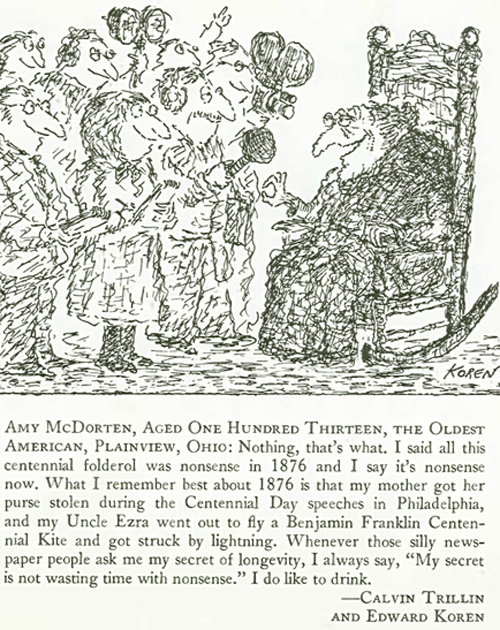
Just to give you some idea of what I'm talking about, I did an online search for "The Inquiring Demographer," and actually found a link. I didn't even look beyond it to see if other links had appeared; I just checked this one out, and sure enough found myself eyeballing an actual "Inquiring Demographer piece. It's not one of the best, and I apologize for the technical limitations of what I'm presenting here, but at least this will give you some idea of what I'm talking about.


THIS WEEK'S QUESTION: WHAT ARE YOU
DOING TO CELEBRATE THE BICENTENNIAL?


Also heard from:

WAYNE JONES, JR., Chairman, Black Students Association, East Oakland Community College
TALIAFERRO BARNSDALE, Bicentennial Committee Chairman, Priors, Virginia
ROBERT T. MACKINTOSH, Robmac Enterprises, Mineola, Long Island


[Click to enlarge.]
WHAT HAPPENED TO THE NEW YORKER WEB INDEX?

When I decided to go in search of "The Inquiring Demographer," it occurred to that there's now a resource that didn't exist the last time I went searching: the magazine's Web archive. Or at least it used to exist. As some readers may be aware from my incessant whining, I've had quite a lot of difficulty logging onto the New Yorker website since it went back behind a new paywall.

Well, by jockeying the browsers I use, I've managed to get kind of shaky access -- and was even able to log into the Archive. But as far as I can tell, the spectacular search function that used to be there is gone, and all it seems you can do now is "browse issues." If you happen to know which issue you're looking for, you can browse it and probably find what you're looking for. If that capability still exists, I sure couldn't find it.

It used to be relatively easy to find most anything you thought might have been published in The New Yorker, and considering the range of what has been published in The New Yorker over its storied history, that was a treasure trove.
#

Labels:

Saturday, September 12, 2015

Further thoughts about Roz Chast's "HAMLET vs. AMAZON PRIME"

>

With updates on my New Phone Day Maybe and
Calvin Trillin's New Yorker Festival eating tour


Surely Roz Chast's "Hamlet hat" will henceforth be de
rigueur for every actor who takes on this marquis role.

by Ken

I'm still preoccupied by this Roz Chast cartoon, from the September 14 New Yorker, which I presented the other day:


I mean, there's just so much to think about here. Like that, um . . . what would you call it?, that heavenward eye roll Hamlet executes as he thinks that soon-to-be-immortal thought: "And yet: FREE SHIPPING." What subtlety, what poignancy, what hope, what inscrutability, what depth is incorporated here! Going forward, how can any actor who tackles the role fail to take it into account? How challenging it will be, though, to make this real and convincing as an expression of the prince's rich inner life.


AND THERE IS, OF COURSE, THE "HAMLET HAT"

From now on, what Hamlet director, what costume designer will feel able to send their Hamlet out onstatge without it?


THEN CONSIDER THE  TOUCH OF THE POWER
CORD SNAKING OUT FROM HAMLET'S LAPTOP


Surely this is a recognition of the historically accurate reality of the primitiveness and unreliability of the battery technology of the prince's time.


FINALLY, THERE'S THE COFFEE MUG THAT'S SO
STRANGELY DISTANT FROM OUR PROTAGONIST


Finally there's the coffee cup so strangely distant from our protagonist, as if it had perhaps been shoved out of reach. Interestingly, we can't tell whether the mug is empty, perhaps expressing the prince's resentment or even disgust at having no one in the castle to refill it, or it contains a quantity of coffee that has cooled to undrinkability, thereby reflecting Hamlet's agonized knowledge that the microwave hasn't been invented yet for convenient reheating. Looming over the whole mug question is the suggestion that overcaffeination is a contributing factor, if not perhaps the root cause, of Hamlet's considerable behavioral eccentricities.

#

SOME OTHER NOTES FROM THURSDAY'S POST

As I thought would be understood from the post title, "Nothing to read here -- go on to whatever you had in mind," readers weren't really intended to read the post, except maybe to look at the cartoons -- this one by the great Roz Chast and the "Cocktail Party Heckler" one ("You call that a bon mot?") by Dan Roe. I realize, however, that this may have been taken less as a strict injunction than as some sort of advisory, and so I can't be as harsh as I might otherwise be with readers who apparently went right ahead and read the thing.

For those readers, in the improbable event that they're wondering, I should perhaps report that:

(1) With regard to the event I was celebrating that day, my personal New Phone Day Maybe:

No, I'm no closer than I was then to figuring out what to do upon the completion of my two-year contract using a Samsung Galaxy S4 phone. I suppose this qualifies, at least for the time being, as the option I described like so: "I could, of course, spend nothing on a new phone and continue 'using' (for want of a better word) my S4 -- with the same probable outcome," namely pretending that this time I'm gonna learn how to use the damned thing, déjà vu all over again from two years ago, when I upgraded from my defunct S2 to the S4.

Yeah, let's say that I'm invested in that option, while keeping my future options open. That sounds more like a decision and less like abject whiffing.

(2) With regard to the decision about whether to even try to secure a precious spot on Calvin Trillin's 14th-annual Village-to-Chinatown eating tour:

No, I didn't even try, and maybe that was just as well from the standpoint of my psychic well-being. I've just dug out a report I recalled from the Grub Street website, in which Sierra Tishgart began her "Dispatch from Calvin Trillin's Always-Spectacular 'New Yorker" Food Tour," 2013 edition:
Gaining admission to Calvin Trillin's eating tour for The New Yorker Festival is pretty much the real-life, adult equivalent of scoring a golden ticket to Willy Wonka's chocolate factory. The 40-person event always sells out online within seconds (though several lucky attendees actually scored tickets in the last-minute standby line).
Sierra proceeded to offer a stop-by-stop account of the event, from the day before:
Trillin led everyone from Greenwich Village to Chinatown over the span of three hours, pausing to snack at his favorite shops, markets, and parks while narrating New York's culinary history. The stops on the tour have changed over thirteen years, but recent additions include Xi'an Famous Foods and Full House Cafe. For anyone who wants to re-create the tour themselves — or simply would like some recommendations for awesome places to eat — check out the full list, straight ahead. [Note: Food-source links onsite. -- Ed.]

Stop 1: Murray's Cheese Shop and Faicco's Pork Store
To Eat: Pecorino Toscano and soppressata
Trillin's Take: "I used to go to a meat shop around here where the guy would spook customers by popping pieces of raw pork into his mouth."

Stop 2: Blue Ribbon Bakery Market
To Eat: Savory matzoh cracker
Trillin's Take: "If matzoh actually tasted like this the Jews would have never left Egypt!"

Stop 3: Delivery from an unidentified store at Forsyth and East Broadway
To Eat: Greens sandwich
Trillin's Take:"I don't actually know what kind of greens are inside. Some people love it, and some people hate it. The sandwiches used to cost $1 — not that there's a big profit margin on this trip."

Stop 4: Despaña
To Eat: Tortilla Despaña
Trillin's Take: "The biggest change in eating in America was the Immigration Act of 1965. If you're excluding the Chinese and allowing English people, it's sort of suicidal. It made it okay for middle-class kids to become farmers and chefs."

Stop 5: Saigon Vietnamese Sandwich
To Eat: Vietnamese summer rolls with peanut sauce
Trillin's Take: "Most summer rolls taste like grass. These people make them as they go, so they're not sitting in the fridge for days."

Stop 6: Di Palo's
To Eat: Fresh mozzarella
Trillin's Take: "One of the other things that I used to get here is butter inside of cheese. It's an old way of preserving butter. We used to do this when we had parties: If you cut it in half, you can serve the butter and then eat the provolone cheese."

Stop 7: Bánh Mì Saigon Bakery
To Eat: Vietnamese pork sandwich
Trillin's Take: "Bánh mìs are really the only good argument for colonialism."

Stop 8: Xi'an Famous Foods
To Eat: Spicy lamb burger
Trillin's Take: "This young man [Jason Wang] is very entrepreneurial!"

Stop 9: Full House Cafe
To Eat: Soup dumplings (and a side of jellyfish!)
Trillin's Take: "I heard about this place from reading a piece by Robert Sietsema from the Voice about the soup dumplings here ... and eating jellyfish is [my] revenge for whenever they've frightened me."
Of course I have no idea whether the itinerary was changed in last year's edition of the tour, not to mention what Trillin may have in store for this year. Still, isn't this the next best thing to actually being on the tour? Belated thanks, Sierra!

Plus, for me it offers the advantage that it spares me the potential humiliation of trying to express my admiration to the tour leader for his body of writing -- and I don't mean the food writing and the humor writing, or not just the food writing and the humor writing. In his big-boy capacity as a reporter, he has probably taught me more about the way humans live and deal with each other than any living writer.

Still, as an example of the kind of question I would be apt to ask, I have it in mind to offer a demonstration ripped from history, perhaps tomorrow.
#

Labels: , , ,

Thursday, September 10, 2015

Nothing to read here -- go on to whatever else you had in mind

>


I know you won't have any interest in what follows, which is just for me. I feel bad, though, so I thought you might enjoy this Roz Chast cartoon from the same issue of The New Yorker referenced below. (Click to enlarge.) Oh, and also the Dan Roe one below.

by Ken

I know there are important things happening in the world which demand comment from me, but they'll just have to wait another day (or possibly more). Because today is 9/10.

I should explain that on the subject of this momentous date I wrote approximately two versions of a post in my head and then decided to omit them, under the influence of John McPhee's latest New Yorker "Writing Life" piece, "Omission: Choosing what to leave out" (September 14), which I read on the subway ride home from work, while I was also writing those posts in my head. McPhee's new piece is a miraculous turnaround from his last, deeply obnoxious "Writing Life" piece, "Frames of Reference" (March 9), which I wrote about here and here. My resulting omissions represent a benefit not just to readers but to the writer as well -- since those pieces hadn't actually been written yet, there is a significant saving in labor.

So, what's 9/10? you ask. Of course yesterday, 9/9, was Bridgegate Anniversary Day, and tomorrow, 9/11, is, well, you know. But 9/10? Well, for me it's New Phone Day Maybe --the day when I can upgrade my smartphone without having to pay a $50 upgrade fee (but apparently not without paying a $30 activation fee). I have a number of options, and I can make a strong case against all of them.

The smart thing to do would be just to deactivate the thing and save both the $78/month and the bargain price I'll be offered on, say, a not-quite-current model Samsung Galaxy or iPhone. (No, of course I'm not being offered one of the brand-new iPhones.) This would be especially smart because it's looking like a really tough financial year ahead, as I continue paying off a dental bill I thought I'd paid off, except that there turned out to be a whole bunch of other charges that hadn't been billed yet. By the time the thing is paid, it will have consumed, by my rough calculation, more than a third of my humble yearly take-home pay.

And it's not as if I couldn't live without a smartphone. In the two years of my current contract I've hardly ever used my Galaxy S4, which I understand even less about than its predecesor, an S2 that I'd actually started to use -- at least as a telephone -- before it succumbed to supposed water damage that the Samsung people in Texas declared beyond repair; I thought it was kind that they paid shipping both ways, though. (Based on one phone call I attempted with the then-new S4, it sucks as a telephone, except maybe if you use earphones to hear and speak right into the mic, as I notice people doing.)

Or I could instead do one of the above-hypothesized upgrades. After all, everyone insists that the iPhone is way easier to learn to use than an Android. I might actually have gone that route two years ago, except that my carrier, Credo Mobile, didn't offer iPhone service. (Naturally they began not long after I made my two-year commitment to the S4.) Now, however, I have reached the point in my mounting loathing of Apple and everything it has come to stand for (can you tell I'm an old-time Mac user?) where joining the iPhone legions is, shall we say, burdensome.

An upgrade to whatever Galaxy model Credo is offering might make sense, except that it would be based on the same theory as my last Galaxy upgrade: that this time I would learn how to use the damn thing. In my defense, I actually attended a class in Android basics at the public library, and came away knowing approximately less than when I went in. I could, of course, spend nothing on a new phone and continue "using" (for want of a better word) my S4 -- with the same probable outcome.

Before I left work today, I went online to see what's actually on offer now that my New Phone Day Maybe is here, thinking that perhaps this would make it all become clear. Instead, it became murkier, if possible -- except for the part about my having to pay the $30 activation fee this time, which I didn't two years ago. That part seemed pretty clear. (I don't know, maybe it was waived then, and might conceivably be again. This hardly qualifies as movement in the direction of clarity, though.)

So it looks like New Phone Day Maybe is going to have the accent on the "maybe," or maybe the "maybe not."

I can't think about it anymore, especially since now I have another situation to worry about. On this evening's subway ride, after I finished the McPhee New Yorker piece, I was thumbing through the issue and noticed that, along with all the other New Yorker Festival events for which tickets go on sale tomorrow, there's Calvin Trillin's 14th annual Village-to-Chinatown eating tour, which I know sells out immediately if not sooner -- even assuming I'm prepared to pay $150. I might be, partly because it's by all accounts a great event, but also because Trillin is probably my favorite living writer, and who wouldn't pay $150 for the privilege of making a tongue-tied gibbering idiot of himself in the presence of his idol?

How cool, though, that I discovered this the day before registration starts! Or maybe not. Because I also learned that there's a full day of early registration, like today, for MasterCard users, and by consulting a financial self-cheat sheet I keep, I was reminded that no, I don't have a MasterCard anymore, since CitiBank -- another of my great corporate hates -- canceled mine because I wasn't using it. So in all likelihood by the "start" of registration tomorrow the event will be sold out anyway.


"You call that a bon mot?"
#

Labels: , , ,