Saturday, November 07, 2020

Partisan Realignment-- Is The Working Class Up For Grabs?

>


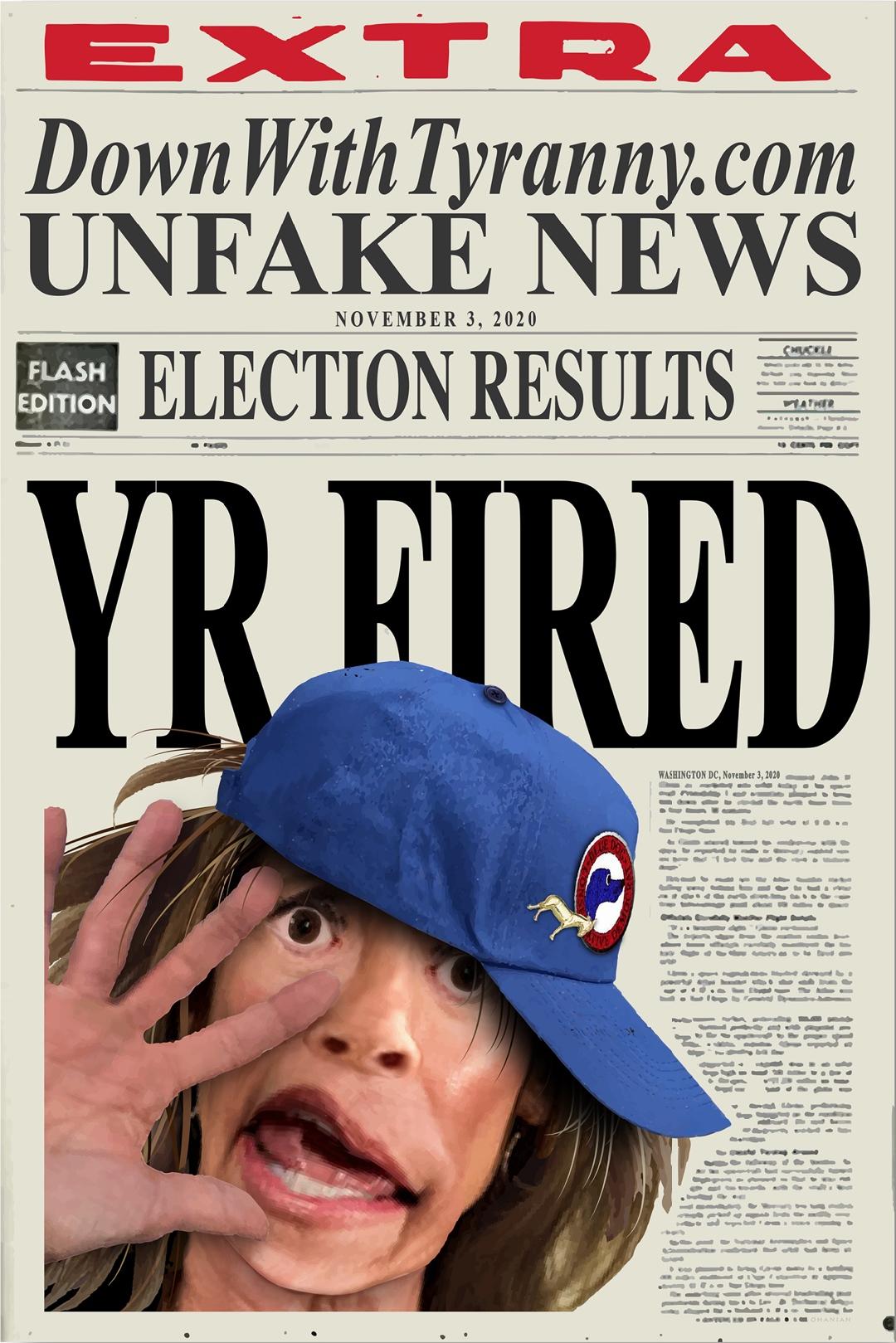
Cheri Bustos-- Worst DCCC Chair since her mentor Rahm by Nancy Ohanian


Blue Dog/New Dem Cheri Bustos, DCCC chair, who represents a northwest Illinois congressional district gerrymandered by the Democratic Party-controlled state legislature to elect Democrats, finally eked out a victory on Friday morning. She beat little-known Republican Esther Joy King 153, 947 (51.9%) to 142,621 (48.1%). Bustos spent $4,573,839 to King's $1,634,304. Pelosi's House Majority SuperPAC just in $1,044,002 to save Bustos in the last days of her meaningless campaign. It's tragic for the Democratic Party that she didn't lose; it would have taught them a lesson they badly need.

George HW Bush tried hard but failed to pass Reagan's NAFTA for their wealthy Republican donors. There were just too many Democrats in Congress standing up for the working class back then. When Bill Clinton defeated Bush in 1992 one of the very first things he did was to assign one of his campaign thugs, Rahm Emanuel, to force reluctant Democrats in Congress to join the Republicans to pass the bill. Members were bribed, threatened and blackmailed and it finally passed November 17, 1993, 234–200, 102 Democrats joining 132 Republicans in the House and, 3 days later, 27 Democrats (including Biden-- though certainly not Wellstone) joining 34 Republicans in the Senate in favor of ratification. What cluster fuck-- but most of the Democrats depending on working class votes and union support voted no despite Clinton and Emanuel. (And, yes, of course Pelosi and Hoyer voted for the bill.) It would be a lot easier for the Democrats to pass something like that now, although it would be more difficult to get enough Republicans behind it.

Yeah, there's been a reversal of support since then-- starting then-- for the working class, as Clinton made a play for Wall Street and corporate donors and acceded to the strings attached-- with the cooperation of congressional Democratic leadership. Don't expect any reversal of that trend with Biden in the White House. The Democrats who lost their seats on Tuesday-- or who are struggling to hang on-- were all Blue Dogs and New Dems from the Republican wing of the party, none of whom could be called a friend of the working class-- anti-progressive chumps like Joe Cunningham (Blue Dog-SC), Max Rose (Blue Dog-NY), Xochitl Torres Small (Blue Dog-NM), Kendra Horn (Blue Dog-OK), Debbie Mucarsel-Powell (New Dem-FL), Abby Finkenauer (IA), Susan Wild (New Dem-PA), Gil Cisneros (New Dem-CA), Anthony Brindisi (Blue Dog-NY), Collin Peterson (Blue Dog-MN), Angie Craig (New Dem-MN), Abigail Spanberger (Blue Dog-VA), Harley Rouda (New Dem-CA)... That's a big glaring problem-- an existential one, no less-- that neither Nancy Pelosi nor Chuck Schumer understands, let alone addresses.

Yesterday Matt Taibbi asked which party is the real working class party now? What an about-face that a question like that could even be taken seriously, which, of course, it must be. "Trump lost the election," he wrote, "because of his handling of the pandemic, the top issue for 41% of voters, who chose Biden by a nearly 3-1 margin. But among people whose top concern was the economy-- 28% of the electorate-- Trump won an incredible 80% of the vote... Democrats’ conspicuous refusal to address economic inequality and other class issues in a meaningful way created an opening."
Now, Trump is likely to leave the White House, but he created a coalition that some Republicans already understand would deliver massively in a non-pandemic situation. As Missouri Republican Josh Hawley put it the night of the election, “We are a working-class party now. That’s the future.”

What happens from here is a race to see which political party can make the obvious dumb move faster. Will the Democrats, emboldened by the false high of a Biden victory, blow off the clear need to revamp their economic messaging before 2022, when they risk losing both houses of Congress?

Or will the Republican opposition give away the Trump coalition just as fast, by choosing Mitch McConnell’s donor list over Hawley’s insight?


Labels: , , , ,

Monday, July 01, 2019

Neoliberalism Killed 346 People Aboard the Boeing 737 MAX 8

>

What was left of Ethiopian Airlines Flight 302, a Boeing 737 MAX 8 jet, after it crashed to the ground six minutes after takeoff. All 157 people aboard were killed (source)

by Thomas Neuburger

The essence of modern neoliberalism, as encouraged and enabled by both political parties, is the Ayn Randian notion that the greatest amount of freedom in the world should be given to capital — that the giant pool of money should be allowed to flow unrestrained into any country it wishes, seek whatever profit it wishes to seek, then flow out, again unrestrained, leaving in its wake whatever wreck it wishes to walk away from.

The poster child for neoliberal profit-seeking is, of course, NAFTA and its legacy of devastated lives in every country touched by it, but there are more examples than anyone could count. This devastation has been going on for decades, starting in my own memory with Ronald Reagan's permitted transfer of the U.S. semiconductor manufacturing industry to Asia. (Reagan "earned" two million dollars in speaking fees during a fully paid eight-day grand-tour trip to that country within a year of leaving office — clearly "thank you" money for his many gifts to the suddenly swollen wealth of Japan.)

Since the age of greed was kicked off in the 1980s, and because in those years Americans were taught to love their predators (remember breathless praise of shows like Lifestyles of the Rich and Famous), the pursuit of profit by the few at the expense of the lives of the many has only accelerated.

The latest instance of this destructive pursuit is the story of the Boeing 737 MAX 8 jet. There are many parts to the 737 MAX 8 story. This part takes us, once again, to U.S. outsourcing to Asia and $9/hour software engineers in India.

From Bloomberg:
Boeing's 737 Max Software Outsourced to $9-an-Hour Engineers

• Planemaker and suppliers used lower-paid temporary workers
• Engineers feared the practice meant code wasn’t done right

It remains the mystery at the heart of Boeing Co.’s 737 Max crisis: how a company renowned for meticulous design made seemingly basic software mistakes leading to a pair of deadly crashes. Longtime Boeing engineers say the effort was complicated by a push to outsource work to lower-paid contractors.

The Max software -- plagued by issues that could keep the planes grounded months longer after U.S. regulators this week revealed a new flaw -- was developed at a time Boeing was laying off experienced engineers and pressing suppliers to cut costs.

Increasingly, the iconic American planemaker and its subcontractors have relied on temporary workers making as little as $9 an hour to develop and test software, often from countries lacking a deep background in aerospace -- notably India.
According to Mark Rabin, a former Boeing engineer whose work supported the 737 MAX project, the decision to outsource coding to India “was controversial because it was far less efficient than Boeing engineers just writing the code. I took many rounds going back and forth because the code was not done correctly.”

But outsourced U.S. jobs and greatly reduced wage costs were not the only benefits to Boeing from this decision. The company was also rewarded handsomely for it, winning, according to Bloomberg, "several orders for Indian military and commercial aircraft, such as a $22 billion one in January 2017 to supply SpiceJet Ltd. That order included 100 737-Max 8 jets and represented Boeing’s largest order ever from an Indian airline, a coup in a country dominated by Airbus."

Needless to say, in a nation dominated by neoliberal thinking and morality, more than $22 billion in new contracts easily offsets the loss of 346 lives in the two 737 MAX crashes, each of which killed everyone on board.

In a nation that abhors neoliberal morality, on the other hand, one would see trials for manslaughter instead.
 

Labels: , , , , , , , ,

Saturday, April 13, 2019

It's Hard Staying Focused On Issues In The Midst Of Trump's 10-Ring Circus-- But Bernie Is Staying On Message

>


How does Trump get people to not think about his disastrous economic policies, built on an entirely wasteful deficit that has nearly doubled to a trillion dollars since he occupied the White House? His pathetic circus routine has done the trick in a general sort of way. No one seems to be paying attention, for example, to his trade agenda with new outages come out every day, often more than one a day.

Yesterday, for example, Jake Tapper broke the news that a senior White House source-- probably Kushner-in-law or someone trying to get Kushner-in-law in trouble-- leaked the news that Trump told the Customs and Border Protection Commissioner Kevin McAleenan that he would grant him a pardon if he were sent to jail for having border agents illegally block asylum seekers from entering the U.S. Another Hair on Fire Friday moment! (And, by the way, since then Trump named McAleenan, acting secretary of the Department of Homeland Security.)

Active Shooter by Nancy Ohanian


Doing his best to leave Trump's constant, insane and attention-grabbing provocations to the media, Bernie keeps focusing on his core issues of income inequality and a rigged system. Yesterday he followed up on his trade agenda by releasing the video below, itself an update of the video above from last year. Bernie's key points about Trump's soggy trade deal with Mexico and Canada-- currently in no man's land in Congress where it has virtually no chance of being ratified-- are that:
the deal would continue to ship U.S. jobs to Mexico because Mexico's workers make as little as two dollars an hour, which the deal doesn't address
the deal doesn't protect the enironment
the deal is a give-away to pharmaceuticals and other big corporate special interests
Last November Bernie told his Vermont constituents exactly why he opposes Trump's deal too replace the same NAFTA that Bernie has always opposed and feels needs to be replaced.
As someone who not only voted against NAFTA, but walked on the picket lines against it, there is no question that this unfettered trade deal needs to be fundamentally rewritten. In my view, a re-negotiated NAFTA must stop the outsourcing of U.S. jobs, end the destructive race to the bottom, protect the environment, and lower the outrageously high price of prescription drugs. Clearly, Trump’s NAFTA 2.0 does not meet these standards and I will strongly oppose it in its current form. Unless strong enforcement mechanisms are written into the text of this agreement, corporations will continue to ship U.S. jobs to Mexico where workers are paid as little as $2 an hour.

Further, this deal includes some outrageous giveaways to the fossil fuel industry and big pharmaceutical companies that will harm the environment and increase prices for life-saving prescription drugs. Before this deal is sent to Congress for a vote it must include strong enforcement mechanisms to increase jobs and wages and all of the riders that benefit big fossil fuel polluters and pharmaceutical companies must be taken out of it. Trade is a good thing-- but it has got to be fair.

Labels: , ,

Monday, February 11, 2019

Pelosi Advisor Proposes Non-Binding Arbitration as Road to Lowering Drug Prices

>

Prescription drug prices in the U.S. are universally hated (source). Which political party will step up and genuinely address the issue?

by Thomas Neuburger

Let's put two recent stories next to each other and see what conclusions we can draw.

A "Game Changing" Opportunity

First, Democratic pollster Stan Greenberg has found that Donald Trump has two strong vulnerabilities — one on trade, one on drug prices — and also that these are interlinked:
Democrats and progressives believe they may have found a way to unmask [Trump's] sham populist pivot. And their developing counterargument involves not one, but two, of the issues on which Trump will build his case for reelection: prescription drugs and trade.

This counterargument surfaced almost by surprise in a series of focus groups recently conducted in the industrial Midwest by veteran Democratic pollster Stan Greenberg, for the trade watchdog group Public Citizen. Greenberg outlined his findings in a memo that was shared with this blog.

Specifically, Greenberg found that working-class white voters who switched from Barack Obama to Trump are deeply angry about soaring prescription drug prices. As a result, they vehemently oppose a key provision benefiting Big Pharma at the core of Trump’s renegotiation of NAFTA — which he touts as proof that he’s delivering for his working-class white base.
The problem on the trade side is that the proposed NAFTA 2.0 agreement (rebranded as "USMCA") includes major concessions to drug manufacturers. Elizabeth Warren, for example, in announcing her opposition, said that "NAFTA 2.0 is ... stuffed with handouts that will let big drug companies lock in the high prices they charge for many drugs."

Especially egregious is the increased patent protection in the new agreement (emphasis added):
[T]he US Trade Representative Office’s Fact Sheet on the deal states that it “Includes 10 years of data protection for biologic drugs and expanded scope of products eligible for protection.” (Details await publication of the full agreement. Also, apparently, “data protection”—of, for example, clinical trial results—is the equivalent of patent protection for such products.)

The 10-year span is more than what had existed before (in the case of Mexico, essentially nothing; with Canada, an eight-year term is on the books) but the biopharma industry has long argued for the same 12-year exclusivity that exists for biologics within the US market. That 12-year span was a key sticking point in the long-ago Trans Pacific Partnership (TPP), which, before it was dumped by the incoming Trump Administration, was an effort to bring some added protection to biopharma products.
The problem on the drug side is that almost every voter in the country, Republican and Democrat, hates the current price of pharmaceutical drugs. The polling against it is universal. Here's how Greg Sargent characterized Greenberg's results:
Working-class whites in Greenberg’s focus groups apparently agreed. As his memo notes, these voters “hate” pharmaceutical companies and are deeply convinced that high drug prices are the result of their political influence.

In effect, Greenberg concluded, this debate links corporate power directly to soaring medical costs, providing a gateway to a larger argument about the ability of big corporations to rig market rules in their favor. These voters, Greenberg noted, “especially distrust the way that corporations bend the system to their will,” with lobbyists and big campaign donations, “so that they can earn more profits while hurting workers and consumers.” As one Macomb man put it: “They are buying their laws, basically.”

Greenberg was surprised by the depth of emotion about pharmaceutical companies and drug prices, noting that they “emerged as an extraordinary point of anger.” The result: Pointing to the Big Pharma provision constitutes the “single most powerful argument” against Trump’s NAFTA rewrite.
All of this provides Democrats with an excellent opportunity in the next election cycle, an opportunity that Greenberg characterizes as "game changing."

Pelosi Advisor Proposes Non-Binding Arbitration as Road to Lowering Drug Prices

Second, here's what Democratic leaders are doing in the face of this opportunity:
Liberals worry Pelosi may pivot away from a bold drug price plan

A split between House Democratic leaders and rank-and-file members over how to lower drug prices is threatening the party's efforts tries to make good on one of its biggest campaign promises just weeks into the new congressional session.

Some progressive lawmakers and outside groups are concerned that aides to Speaker Nancy Pelosi are proposing to have a third party help decide the price of a drug through binding arbitration — a solution that falls short of the Democrats' 2018 campaign platform that promised direct government negotiations for medicines in Medicare Part D.
Note that the plan's "binding" arbitration is actually non-binding, since drug companies can opt out.

The same article says, "Two major concerns are emerging with his push for arbitration. Sources say [Pelosi senior advisor Wendell] Primus is limiting it to a select group of high-cost drugs, instead of developing a broader proposal for all medicines. Additionally, the arbitration process would be voluntary and nonbinding, meaning companies could opt out without consequence" (emphasis added). 

Public Citizen's Peter Maybarduk calls the deal "a total capitulation to pharma from what we can tell." Social Security Works' Alex Lawson said, "Poll after poll shows that lowering drug prices is a top concern for the American people. They also show that maintaining access to needed drugs is equally important. ... Negotiating with licenses ... accomplishes both goals by directly negotiating lower prices without putting patients’ access in pharma’s greedy crosshairs."

The Pelosi plan appears to be toothless and impotent.  

What Is Democratic Party Leadership Up To?

Debate is now raging in progressive circles about this proposal. The question isn't, What good is it? It's universally disliked. The question instead is, What is Pelosi up to?

Answers range from "she has a secret plan" to "acting foolishly but well-intentioned" to "protecting sources of Party revenue on the backs of voters' health."

The question for this piece isn't, What do you think of Pelosi's proposal? The question instead is, What will voters think of the Democratic Party in 2020?

Feel free to answer these questions in a way that makes sense to you.
  

Labels: , , , , , ,

Monday, December 03, 2018

Another Criminal Dies

>

Ronald Reagan and George H.W. Bush in 1985

by Gaius Publius

George H.W. Bush's life is a testament to the notion that public service is a noble, joyous calling. And he did tremendous good along the journey.
     —Former president Barack Obama

Rosalynn and I are deeply saddened by the death of former President George H.W. Bush. His administration was marked by grace, civility, and social conscience.
     —Former president Jimmy Carter

Scouring the Web for comments on the death of George H.W. Bush turns up quite a bit of praise from luminaries as widely disparate as the Dalai Lama, Ellen DeGeneres and CIA director Gina Haspel. Mohammed bin Salman paid a visit to Bush senior and was welcomed warmly, spawning this tweet from the former president:


From lesser lights to greater, from murderers to comedians, the praise continues. 

As usual, the network of those who run the world we merely inhabit have nothing but respect for each other. And why not? They may pick each other off from time to time (both Saddam Hussein and Moamar Khaddafi, were once in high favor), but over the long haul, keeping each member of the ruling circle in a reverential spotlight keeps them all — keeps the circle itself — in reverence as well. Since they operate as a system, the system is honored each time its members, no matter how deadly, are honored as well. And the system sees that the system is always honored.

That's why Bernie Sanders and his new progressive colleagues in the House are so hated. They want to take that system apart. It's why Nancy Pelosi surrendered to the No Labels-financed "Problem Solvers" caucus rather than to those same new progressives and their agenda. The tiny system of people that run the world supports the tiny system of people that run the world, and always will.

For a truer perspective on who those people are and what they do, let's look not to the system's predictable, fawning self-praise, but at less propagandistic comments on the passing of one of its members, former CIA director, former vice president, and former president George H.W. Bush, a man who stood at the center of American power for most of his long adult life.

Again, this is just a sample of those comments on a sample of that life. A true deep dive into his sordid history would take a book.

George H.W. Bush, the CIA and a Case of State-Sponsored Terrorism

To pick just a single incident, this is from the late Robert Parry, writing in 2000 at Consortium News:
In early fall of 1976, after a Chilean government assassin had killed a Chilean dissident and an American woman with a car bomb in Washington, D.C., George H.W. Bush’s CIA leaked a false report clearing Chile’s military dictatorship and pointing the FBI in the wrong direction.

The bogus CIA assessment, spread through Newsweek magazine and other U.S. media outlets, was planted despite CIA’s now admitted awareness at the time that Chile was participating in Operation Condor, a cross-border campaign targeting political dissidents, and the CIA’s own suspicions that the Chilean junta was behind the terrorist bombing in Washington.

In a 21-page report to Congress on Sept. 18, 2000, the CIA officially acknowledged for the first time that the mastermind of the terrorist attack, Chilean intelligence chief Manuel Contreras, was a paid asset of the CIA.

The CIA report was issued almost 24 years to the day after the murders of former Chilean diplomat Orlando Letelier and American co-worker Ronni Moffitt, who died on Sept. 21, 1976, when a remote-controlled bomb ripped apart Letelier’s car as they drove down Massachusetts Avenue, a stately section of Washington known as Embassy Row.
A foreign diplomat and a U.S. citizen are murdered in DC on Embassy Row. The deed is planned by Manuel Contreras, a CIA asset who was also simultaneously intelligence chief for the Pinochet government of Chile. And George H.W. Bush, as head of the CIA, performs the cover-up, going so far as to plant false stories among media assets (sorry, CIA-friendly journalists) in places like Newsweek, and going so far as to mislead the FBI in its own investigation.

This is the man Jimmy Carter praised for "grace, civility, and social conscience." Saying a man complicit in murder is gracious is like saying a mafia don is good to his family and kind to old people and animals. Bill Clinton's praise of Bush, "From the moment I met him ... I was struck by the kindness he showed to Chelsea, by his innate and genuine decency, and by his devotion to Barbara, his children, and their growing brood," strikes just this note.

In the same article the word "assessment" appears, a word so enamored of the anti-Trump forces these days. Parry writes:
[T]he CIA – then under CIA Director George H.W. Bush – leaked for public consumption an assessment clearing the Chilean government’s feared intelligence service, DINA, which was then run by Contreras.
Bush "leaked for public consumption" an "assessment" knowingly filled with lies. The CIA has leaked many lying, secret "assessments" for public consumption; it's what they do. If we weren't so desperate to get rid of Donald Trump — and believe me, security-state people like George H.W. Bush are eagerly on board with that effort — we'd be nervous about what a leaked CIA assessment that immediately cast a shadow on an elected president, within a month of his election no less, might augur.

Does the concept of an American Praetorian Guard concern you? It does me.

George H.W. Bush and the Theft of the 1980 Election

The big enchilada in the George H.W. Bush story is the theft of the 1980 election and its aftermath, the Iran-Contra payoff and cover-up. The bones of the story, the original "October Surprise," go like this.

In 1980, when the Iranian hostage crisis was raging and Reagan and Bush were running against incumbent Jimmy Carter for the Oval Office, former CIA director Bush, future CIA director William Casey and others met at least three times with Iranian officials, including a meeting in Paris on October 19, and struck a deal with the Iranian government to extend the holding of 52 American hostages until after the election, thus denying Carter a diplomatic victory (and by the way, extending the suffering of those hostages).

In exchange, Bush and Casey promised that the Reagan administration would secretly sell arms to Iran through a cutout, Israel. Iran had just become involved in a major war with Iraq at the time and was desperate for arms.

Of course, because the arms sales were secret, the Reagan administration had money on its hands it had not gotten from Congress, and it decided to spend that money propping up the Contras, a brutal right-wing resistance army fighting the socialist (of course) Sandinistas in Nicaragua.

It's the secret support of the Contras (a name taken from the Spanish for counter-revolution), which was expressly forbidden by Congress in 1985 under the third Boland Amendment, that caused the story to unravel. The contra money was found, the Iranian arms sales were found, and the 1980 Reagan-Iran hostage deal was both widely suspected and widely feared.

Why feared? If a U.S. president had committed what many would call treason to gain office, what would the effect on the American people be? Would they ever trust elections — or worse, their leaders — again? Proof of Reagan and Bush's act was potentially destabilizing as, say, proof that elements of the CIA had murdered John Kennedy would have been.

Nixon and Treason

The U.S. had in fact faced this problem before — proof that a candidate had committed treason with a foreign government — when outgoing president Lyndon Johnson uncovered similar deeds ("treason" to use Johnson's word) by Richard Nixon during the 1968 presidential campaign, and declined to act on it, save to tell Senate minority leader Everett Dirksen to tell Richard Nixon to "cut it out," or words to that effect.

Proof of Nixon's treason didn't emerge until 2008, when the tape of the phone call itself was released and the accusation was later confirmed by conservative writer George Will. By then, of course, the whole affair was old news, something from the last generation's history, and could be reliably assumed to be ignored.

So here. Proof of every part of the October Surprise–Iran-Contra story emerged, though proof of the meeting between Bush, Casey and the Iranians in Paris was predictably contravened by a "secret alibi," yet that story is now widely and predictably ignored by all who praise him. 

Robert Parry and the October Surprise

Robert Parry was the primary reporter investigating the October Surprise connection to the breaking Iran-Contra story (emphasis added):
Though there were early rumors about a secret Republican deal with Iran, the October Surprise mystery didn’t gain much traction until the exposure of secret Iran-Contra arms shipments approved by Reagan to Iran in 1985-86. Suddenly, the notion that Reagan and his Vice President George H.W. Bush would lie about covert dealings with Iran didn’t seem so preposterous.

Essentially, the October Surprise question was whether Reagan’s secret contacts with Iran dated back to Campaign 1980, as a growing number of witnesses — from inside the governments of Iran, Israel, France and the United States — were alleging.

However, when Congress finally agreed to look into the October Surprise case in 1991-92, Republicans were determined to circle the wagons around the then-sitting President George H.W. Bush, who was facing a tough reelection fight against Democrat Bill Clinton.

Rather than welcome any truth-seeking, the Republicans and their media allies went on the attack claiming that the October Surprise case was a baseless “conspiracy theory.”
Elites "circling the wagons" to protect elites, even treasonous ones, is the theme of this piece. Eventually, Democrats and the media shied away from the story, leaving Parry essentially alone with his investigation (links in original):
Parry ... received the George Polk Award for National Reporting in 1984 for his work with the Associated Press on Iran-Contra, where he broke the story that the Central Intelligence Agency had provided an assassination manual to the Nicaraguan Contras (Psychological Operations in Guerrilla Warfare). In mid-1985 he wrote the first article on Oliver North's involvement in the affair, and, together with Brian Barger, in late 1985 he broke the CIA and Contras cocaine trafficking in the US scandal, helping to spark Senator John Kerry's interest in investigating Iran-Contra. The Associated Press had refused to publish the drug trafficking story, and only relented when its Spanish-language newswire service accidentally published a translation. Barger and Parry continued to press their investigation of North even as most of the media declined to follow it up, eventually publishing a story in mid-1986, based on 24 sources, which led to a Congressional committee asking questions of North. After North denied the allegations, Barger was pushed out of the Associated Press, and Parry was unable to publish any further follow-ups to the story until after Eugene Hasenfus' plane (Corporate Air Services HPF821) was shot down in Nicaragua in October 1986. After finding out that his boss had been "conferring with [Oliver] North on a regular basis", Parry left AP in 1987 to join Newsweek, which he left in 1990.

In August 1990, PBS' Frontline asked Parry to work on the October Surprise conspiracy theory, leading to Parry making several documentaries for the program, broadcast in 1991 and 1992. He continued to pursue it after a Congressional investigation had concluded the story was untrue, turning his Frontline research into a book published in 1993, and in 1994 he unearthed "a treasure-trove of government documents" supporting the theory, "showing that the [Congressional] task force suppressed incriminating CIA testimony and excluded evidence of big-money links between wealthy Republicans and Carter's Iranian intermediary, Cyrus Hashemi". In 1996, Salon wrote about his work on the theory, saying that "his continuing quest to unearth the facts of the alleged October Surprise has made him persona non grata among those who worship at the altar of conventional wisdom."
But this is not a piece about Robert Parry. It's a piece about George H.W. Bush.

Was George Bush in Paris in October 1980?

Evidence points to the presence of the future vice-president in Paris for the October meeting. Among others, the pilot of the plane that conveyed the participants places him there:
Russbacher [the pilot] states that Bush, while in Paris, met with Hashemi Rafsanjani, the second in command to the Ayatollah and now the president of Iran, and Adnan Khashoggi, a Saudi Arabian businessman who was extremely powerful. Arrangements were apparently made to pay Iran $40 million to delay the release of hostages in order to thwart President Jimmy Carter's re-election bid. The $40 million was the beginning of terms that created the Iran-Contra scandal that is now being reopened by Congress.

Russbacher is concerned for his life, but feels that the other pilots will now come forward in a new Congressional investigation.
From the article, Russbacher was also "a member of the Office of Naval Intelligence and worked with the Central Intelligence Agency." Now note this:
[Russbacher] indicates that there is a growing division within the Central Intelligence Agency. "There is no one higher than the CIA, but there are groups within the company (term used by insiders for the CIA) that are very, very strong. And the group or clique that I belonged to, in my opinion, was probably the strongest but there are other factions that are at war with themselves," Russbacher states."You have these groups that are answerable to no one. Well, they are answerable to one man, on top, and he doesn't seem to care how the problems are resolved, just as long as they are taken care of." The man Russbacher is referring to is President Bush.
The only contrary evidence that Bush was not in Paris on October 19, the date in question, was a "secret alibi witness" whose name wasn't released until 2011, after the witness was safely dead. Secret witnesses, of course, can't be interviewed and their evidence tested by the press. 

In 1992, when the story was raging, Bush publicly and angrily demanded that he be cleared. "Bowing to those pressures ... Rep. Lee Hamilton, D-Indiana, chairman of the House investigative task force, agreed to a curious bargain in which he and a few senior investigators were shown the destination of Bush’s supposed afternoon trip on Oct. 19, 1980, but with the proviso that they never interview anyone who was there or disclose any names. So, without verifying Bush’s alibi, the House task force cleared Bush of going to Paris."

Note the role of a Democrat in covering for Bush.

The "secret alibi witness" was, of course, a Bush family friend who had worked many times with Bush and had in fact been saved by Bush when the Watergate scandal threatened to take him down. More on this part of the story can be found here: "Taking a Bush Secret to the Grave".

So whom do you trust? Ex-CIA chief George H.W. Bush and the witness whose name he worked for decades to keep secret, or the rest of the evidence to the contrary? Elites assert the former in public statements, whatever they privately believe. The rest of us move on with our lives. Thus does the system that rules us retain its power.

Bush's Sins Are Many

Bush's sins are many and great. As head of the CIA in the late 1970s, he "actively supported Operation Condor operations and right-wing military dictatorships in Latin America." This means he was an accomplice to a great many murders. In the 1980 election campaign, he committed treason against the U.S. constitution by treating with an enemy and interfering with the negotiations of the elected president.

As president, he betrayed the trust of Mikhail Gorbachev, promising that after the unification of Germany, NATO would not move "one inch forward." NATO has since moved several inches forward...


...so much so that Trump's questioning of NATO during the 2016 campaign counts as one of his own great sins. War with Russia is the course we're on today, and this is one of the causes, that U.S. leaders have wanted this conflict to continue since the Soviet Union fell. Elites protecting elites.

In 1990, the Bush administration led Saddam Hussein, a U.S. ally, to believe that it wouldn't interfere if Iraq punished Kuwait for "slant-drilling" and other offenses by invading Kuwait. Before the Iraqi invasion, April Glaspie, U.S. ambassador to Iraq, told Saddam Hussein, "We have no opinion on the Arab-Arab conflicts, like your border disagreement with Kuwait." Saddam invaded Kuwait. Then the U.S. invaded Iraq.

The strongest impetus for signing the NAFTA treaty prior to 1992 was George H.W. Bush, after which Bill Clinton campaigned for, and ultimately passed the treaty as well. 

In 1992, outgoing President Bush pardoned those in his inner circle who were convicted of crimes in the Iran-Contra scandal. All this with no mention of the vile Willie Horton campaign ads, or the vile elevation of Clarence Thomas to the U.S. Supreme Court.

For all this he is much honored. And every honor he is accorded as a public figure honors the criminals and murderers who hold power over a globalized establishment. Keep this in mind the next time your own favorite elected says of a similar person, "Too bad he died. He was a good man."

GP
 

Labels: , , , , , , , ,

Thursday, October 18, 2018

Analyzing the New NAFTA Deal — Better, But Not by Much

>

Donald Trump on NAFTA. That was then; this is now.

by Gaius Publius

NAFTA 2.0 is on the horizon, and I wanted to offer an update courtesy of Public Citizen's Trade Watch, the best go-to source on trade agreement issues. Their infographic is here. Click here for their full analysis. I'm excerpting the relevant details below.

Bottom line: The NAFTA 2.0 draft is a mixed bag and will need fixing. It does improve the original agreement, but not by much.

Public Citizen begins this way (emphasis mine):
NAFTA 2.0 Text Analysis

How does NAFTA 2.0 text measure up against the essential changes we have demanded to stop NAFTA’s ongoing damage?

After a year of North American Free Trade Agreement (NAFTA) renegotiations, the September 30 publication of a revised text revealed some improvements that progressives have long demanded, damaging terms we have long opposed and important unfinished business.

This NAFTA 2.0 text is not the transformational replacement of the corporate-rigged trade-pact model that we have demanded. But if we fight to get swift and certain enforcement of the pact’s new labor standards — and achieve some other key improvements — then the final package Congress will vote on early next year could stop some of NAFTA’s continuing, serious damage to people across North America.

Phase II of the battle to replace NAFTA and stop its ongoing job-killing, wage-crushing, environment-trashing destruction starts now!
Congress will vote on this agreement next year, providing Democrats with one more opportunity to show millennials that the Democratic Party is worth supporting in 2020. (Nancy Pelosi, take note: you'll want to oppose this deal.)

"Investor-State Dispute Settlement" Clauses

I've written quite a bit about investor-state dispute settlement clauses in trade agreements. These provisions give "investors" (corporations) the right to sue "states" (sovereign nations) for lost future profits in special trade tribunals, whose decisions cannot be appealed in any nation's court system. In effect, thanks to ISDS clauses, NAFTA court decisions trump the U.S. Supreme Court — a clear and obvious corporate attack on national sovereignty itself. ISDS clauses must be eliminated in their entirety.

Where does the current NAFTA draft agreement stand with respect to ISDS tribunals?
Corporate Powers and Privileges

We demanded an end to NAFTA’s Investor-State Dispute Settlement (ISDS) regime that grants corporations rights to attack our laws and demand unlimited taxpayer compensation.

So, some good, some bad. This is a critical issue; again, what's at stake is national sovereignty versus corporate control. (Full Public Citizen analysis of this issue here.)

Job Outsourcing

Public Citizen wants an agreement that completely eliminates incentives to send jobs to other countries — in NAFTA's case, to low-wage Mexico. How does the revised draft agreement measure up?


All those question marks above relate to provisions that are good but not enforceable. I'd make them X's if I were doing the chart, but Public Citizen may be more hopeful than I am of getting them changed for the better. (More analysis of these items here.)

Climate Change and the Environment

The current NAFTA agreement was as terrible for the environment as it was for jobs. Using NAFTA tribunals, corporations could punish (or threaten to punish) nations, states, counties and municipalities for passing and enforcing environmental regulations that cut into corporate profits.

In the new agreement, some of that has changed — but only some:


As you may have noticed, there's nothing here about climate change.

Access to Affordable Medicine, Food Safety, Consumer Protection

On the issues of access to affordable medicine and food safety, the new agreement is terrible. About medicine, the new agreement:
  • Grants Big Pharma new monopolies that lock in bad U.S. policies keep prescription drug prices high and imposes those policies on Mexico and Canada.
     
  • Adds a new 10-year monopoly period for biologic medicines that could deny consumers affordable access to live-saving medicines.
     
  • Grants additional Big Pharma handouts that block access to cheaper generic drugs.
     
  • Includes rules for pharmaceutical firms to participate in government healthcare programs’ drug pricing and listing decision processes — but these terms are not enforceable.
A gift to Big Pharma, or a big wet kiss, depending on your degree of frustration. (More on the medicine clauses here.)

About food safety, same thing. The draft agreement:
  • Maintains NAFTA terms that undermine domestic food safety and inspection policies and adds new limits.
     
  • Maintains NAFTA rules that require the U.S. to accept food imports that do not meet U.S. safety or inspection standards.
     
  • Maintains NAFTA’s limits on border food inspection and adds new rules limiting audits of NAFTA countries’ food safety programs.
     
  • Fails to fix roll backs of U.S. food labeling policies that previously were trade-challenged by Canada and Mexico, including country-of-origin labels for meat and dolphin-safe labels for tuna. New terms could threaten GMO labeling.
Another wet kiss. (More on the food safety clauses here.)

About consumer protection from imported goods — in other words, can you trust imported products to meet the same standards for safety as domestic ones — there's very little good to report. The draft agreement:
  • Maintains old NAFTA rules that undermine consumer safeguards and adds more.
     
  • Fixes a longstanding problem related to environmental and safety concerns with Mexico-domiciled trucks.
     
  • Fails to include a new exception protecting public interest policies that are challenged as “illegal trade barriers.”
The second item above is a plus, but it's minor compared to the rest. (More on the consumer protection clauses here.)

And of course, this agreement has no meaningful sunset clause.

All in all this is a very bad deal, though slightly better than the truly horrible deal the previous agreement represented. Anyone who thought that for all his flaws, Trump would at least come through on trade ... was mistaken.

GP
 

Labels: , , ,

Wednesday, August 29, 2018

Monkey Makes His Move On Trade-- Another Bad Deal

>


I found it condescending-- and, honestly, kind of offensive-- that right after the president of Mexico, Enrique Peña Nieto, referred to Señor Trumpanzee as "President Trump," Señor T called him "Enrique." And then there was the way Trump smirked like a drooling moron when Peña Nieto referred to the trade agreement as "NAFTA." Anyway, watch the idiot in action; it's worthwhile and will give you a real window into his tiny ADT-mind. Everything about Trump is greasy and, beyond that, always grotesquely self-serving. "My farmers"... He, for example, patting himself on the head, falsely called the preliminary agreement is "the largest trade deal ever." And then the childish attempted bullying of Canada. He's just so disgusting and such a black mark against our country.

And beyond the optics, we have to ask ourselves if the deal is a lemon. "A car can look like a fantastic bargain on the lot, only to reveal itself as a lemon when you drive it away. It’s not so different with trade agreements.Take the deal hammered out Monday between the U.S. and Mexico on automotive imports, which the two countries hope to extend to Canada, the third member of the North American Free Trade Agreement. The key elements certainly look dramatic: lifting rules-of-origin requirements to 75 percent to avoid import tariffs, and a separate rule that 40 percent to 45 percent of content come from factories paying more than $16 an hour. The wage rule in particular is about twice what Mexican assembly-line workers make, and four times the average at parts companies there. When you take a look under the hood, though, there’s a lot less than meets the eye."


Tyler Coren wrote that the NAFTA deal isn't worth the price. "Ever have a big argument with your spouse, and think you won it? But then later realize that the momentary satisfaction of victory pales against the good will you lost? And if your spouse is miserable, you’ll probably end up miserable too. That’s the best analogy for what is going on right now with Nafta. The final result probably will be satisfactory, and in some ways it might even be a little better for the U.S. But the way it happened doesn’t seem worth the price."
In the abstract, the theory behind the President Donald Trump’s renegotiation of Nafta makes sense. His view is that multilateral trade agreements require the approval of too many parties, take too long to negotiate and end up watered down. So the U.S. might do better with bilateral negotiations. America might even have more bargaining power, due to its size and its resulting ability to dictate terms.

With something like that model in mind, the Trump administration set off to renegotiate Nafta. Trade was a major theme on the Trump campaign, after all, so it had to do something. And this was something.

There are reasons to believe, however, that this model does not quite apply. The Trans-Pacific Partnership, or TPP, was already in place, and that would have revised Nafta, as it includes both Canada and Mexico. Trump could simply have supported TPP, and he had the liberty and bargaining power to ask for revisions. Joining TPP also would have helped solve Trump’s China problem, by checking the economic rise of China in some parts of the Pacific region.

The problem is that TPP was not Trump’s creation-- it is the product of the previous administration, and President Barack Obama vigorously promoted it during his last year in office. So it would have been hard for Trump to take credit for it.

Then there is the question of whether the U.S. is getting a better deal by negotiating first with Mexico and then with Canada. What is known about the agreement so far shows only modest changes.

To avoid tariffs, 75 percent of a car has to be made in either the U.S. or Mexico, as opposed to the previous 62.5 percent. Some 40 to 45 percent of the content has to be made by workers earning at least $16 an hour, which would cover U.S. but not Mexican workers. That would shift some production back to the U.S., but would also raise the price of cars for U.S. consumers. Rules on intellectual property protection would be enforced more strictly, which has been the global trend in any case. The pact does not resolve the ongoing tariff crisis between the U.S. and Mexico on steel and aluminum, nor is Canada at the moment included.

Further details will doubtless emerge. But forgive me if I am not overwhelmed by these improvements. Possibly the new deal will weaken the investor protection provisions in Nafta, an acceptable but not major change. U.S. energy companies may receive greater access to Mexican markets, thereby limiting the previously privileged position of the Mexican state-owned energy sector.

Overall this is probably a better deal for the U.S., economically speaking. It may improve if Canada joins, and given the legislative calendar, Trump can be expected to present Canadian officials with a take-it-or-leave-it offer. Note also that many parts of the deal are likely to bear a resemblance to TPP.

But again: At what price? Canadians and Canadian politicians now feel slighted, and it will be harder for Canada to support U.S. initiatives, especially those led by Trump, in the future. It may be a long time before Canada feels like an even vaguely equal partner again. In the meantime, the U.S. and Canada have ongoing dealings and negotiations concerning water rights, border and migration issues, intelligence sharing, terror prevention, and presenting a (relatively) united front against other foreign powers, including Russia in the Arctic. The marginal gains in trade just don’t seem worth the deterioration in the relationship.

And should Mexico really feel elevated by getting the first crack at the deal? Surely it must know that it might not be the favored party the next time around.

Nonetheless, Trump is likely to get his victory, at least if Congress proves amenable. But there was a much easier way-- one that, instead of leaving America's reputation in tatters yet again, would have enhanced America’s international standing. Sadly, unsurprisingly, the president did not take it.

The Diplomat by Nancy Ohanian

It wasn't unexpected for the Wall Street Journal to run an editorial, Half A NAFTA yesterday. They are unimpressed. "We’ll reserve judgment until we see the fine print, but on first inspection this is half a Nafta that contains some improvements but is notably worse in many ways. Whether it can pass Congress is far from certain." The Journal finds many flaws, not least of which, from their Big Business perspective, "is that the bilateral deal strips current protections from most U.S. investors in Mexico. Oil and gas, telecom and power-generation investors will retain what they now have. Others will be protected only against physical expropriation... Why make it harder for U.S. firms to court customers abroad? The deal also imposes new red tape and costs on the auto industry to punish imports. The deal says that to get tariff-free treatment cars sold in North America must have 75% of their content made here, up from 62.5%, and at least 40% of the content must be made with workers who earn $16 an hour. This is politically managed trade, and its economic logic is the opposite of Mr. Trump’s domestic deregulation agenda. Ford and GM seem to have made their peace with this intrusion into their management, but car makers with assembly plants in Tennessee, Alabama and other GOP-leaning U.S. states could suffer if they import more than 25% of their parts."
This auto gambit is part of the Trump-Lighthizer strategy to blow up global supply chains, and it is a political strategy to get a revised deal through Congress. That also explains the deal’s new labor provisions that go far to imposing U.S.-style labor laws on Mexico. The details still aren’t clear, but Mr. Lighthizer said Monday those rules will be “enforceable” on Mexico as part of the new deal.

Mr. Lighthizer has quietly courted Ohio Democrat Sherrod Brown and protectionist Lori Wallach of Public Citizen during the negotiations. He’s betting that helping the AFL-CIO unionize more of Mexican industry will coax Democrats to support a new Nafta. Good luck with that. No trade deal has passed in recent decades without a preponderance of Republican votes. Democratic leaders in Congress have fought every one.

Yet by waiting so long to strike a new deal, Mr. Lighthizer may have made himself hostage to Democrats. Under trade-promotion law, there isn’t enough time to vote on the revised deal during the current Congress. The deal would go to the next Congress, which could be run by Nancy Pelosi and Chuck Schumer. Are they really going to support a Donald Trump trade deal? The President will need their votes because free-trade Republicans and U.S. businesses are likely to be a hard sell.

Labels: , ,

Monday, July 02, 2018

Leftist Landslide In Mexico

>


-by Reese Erlich

When I was writing an article about street vendors in Mexico City, I saw firsthand how the country's ruling party operated. Vendors eke out a living selling trinkets and food on street corners. A group in one part of Mexico City had held a series of militant demonstrations opposing a violent police crackdown aimed at driving them out of that neighborhood.

The ruling Institutional Revolutionary Party (PRI) gave a few of the movement's leaders government jobs, had them call off the demonstrations, and then quietly displaced the vendors as originally planned. Since 1929 the PRI has honed the art of repression and cooptation. The PRI, along with the right-wing National Action Party (PAN), had hoped to use those tactics during Mexico's July 1 presidential elections. It didn't work.

On Sunday democratic socialist Andrés Manuel López Obrador received a stunning 53 percent of the presidential vote, compared to 22 percent for PAN's Ricardo Anaya and 15 percent for PRI's Jose Antonio Meade. A leftist coalition, led by Lopez Obrador's National Regeneration Movement (MORENA), won a blowout 300 of 500 seats in the House of Deputies and between 56-70 in the 128-seat Senate.

Lopez Obrador, known by his initials AMLO, presented a progressive alternative to the corrupt leadership of the past. He drew support from blue collar workers, peasant farmers, small business people, a sector of the intelligentsia and some big business people alienated from the major political parties.

AMLO called for free education, pensions for seniors and improving the country's petroleum infrastructure. He also called for a massive tree planting project that he said would create 400,000 jobs.

"AMLO focused on a few key programs aimed at increasing Mexican economic independence from the US and generating jobs," Bruce Hobson told me. Hobson is an American political activist and analyst who has lived for decades Guanajuato, Mexico.

Lopez Obrador also benefited from widespread voter anger at the establishment political parties.

Student Eugenia Gonzalez, said “In truth, I don’t think any of them are worth much, but it’s better (to pick Lopez Obrador), who is a useful vote against the PRI.”

To Have and Have Not

AMLO's election represents a victory of the have nots over the haves. A wealthy elite in Mexico enjoy extravagant lifestyles in homes surrounded by high walls. Yet, of the country's 127.5 million people, a staggering 46 percent live below the poverty line.

Drug cartels control swaths of major cities with the cooperation of government officials. The last two presidents, PAN's Felipe Calderon and PRI's Enrique Peña Nieto, promised to end the narco violence, only to see it increase. Since 2006, over 200,000 people were killed in the drug wars and some 30,000 disappeared.

The most infamous case remains officially unsolved, the 2014 disappearance and murder of 43 student teachers from Ayotzinapa in the state of Guerrero. An international human rights report implicated federal officials in the disappearances and subsequent cover up.

AMLO put forward a great slogan: "bicarios si, sicarios no," which means "scholarship students yes, contract killers, no."

Move to the center

During the campaign AMLO downplayed his socialist politics and moved towards the center in an effort to pick up alienated PAN and PRI voters. He promised to appoint wealthy capitalist Alfonso Romo as his chief of staff and Harvard-educated economist Graciela Márquez as his economy minister.

AMLO also formed an electoral alliance with the far right, evangelical Social Encounter Party (PES), which on first view, seems an odd alliance. PES opposes abortion, gay marriage and homosexuality. But AMLO comes from a Catholic background and didn't campaign on women's rights issues. The coalition with PES may have given AMLO a few extra percentage points in the presidential race and in the legislative elections.

NAFTA

In 1993 I appeared on a Mexico City radio station to discuss NAFTA, the North American Free Trade Agreement. A pro-NAFTA businessman assured the audience that jobs would increase and the economy would improve overall. In reality, inflation shot up, and since implementation of NAFTA in 1994, poverty grew exponentially.

Farmers were driven off the land because of cheaper imports from the United States. Some U.S. and Canadian companies opened factories along the border, but the new jobs never replaced those lost to cheap U.S. imports.

"NAFTA devastated countless Mexican lives," said activist Hobson.

Nevertheless, the new Lopez Obrador administration will face a belligerent Trump, the continent's 800 pound gorilla. "AMLO has clearly expressed that he wants better economic and political relations with the United States based on equal partnership and respect," said Hobson. "This isn’t necessarily a bad thing."

Trump and AMLO can agree on some NAFTA changes, albeit for different reasons. Trump wants to raise hourly wages for auto workers in Mexico to $16/hour in order to encourage U.S. companies to keep more jobs at home. AMLO supports wage increase for Mexican auto workers.

However, NAFTA negotiations and Trump's absurd demand that Mexico pay for a border wall will remain major areas of conflict.

New president's future

On election night AMLO announced efforts to develop a peace plan, in consultation with UN human rights and religious organizations, that would help lessen drug cartel violence.

Javier Bravo, a history professor and MORENA activist, told me it won't be easy.

"Corruption is very deeply rooted in our political system," he said. "AMLO doesn't have a magic wand to change everything at once. It will be a long process."

Hobson said the rank and file will have to keep up the pressure for democratic and socialist policies within MORENA. Lopez Obrador exhibits some of the traits of a Latin American caudillo, or all powerful leader, he said.

Leftists within MORENA want the party "to undergo a cultural change so that leadership should be more collective," he said.

Hobson wants MORENA involved not just in electoral politics but to become rooted in the movements of indigenous people, women, gay/lesbian/trans, labor, counter-culture youth, and environmentalists.

Imagine for a moment if Bernie Sanders had won the 2016 presidential election. That would have been a tremendous step forward for the country, but only a first step towards fundamental change.

That's the admirable position now faced by the left in Mexico.

Labels: , , , ,

Wednesday, June 20, 2018

Trump Is So Uninformed And Stupid, He Should Just Keep His Mouth Shut

>


Ever smuggle phamaceuticals into the U.S. from Canada? They cost much less up there so it's a pretty common practice. Señor Trumpanzee, presumably with the help of the White House's top in-house Nazi, Stephen Miller, insists Canadian are smuggling scuffed up shoes from the U.S. into Canada. Señor T, wrote Daniel Dale for the Toronto Star, "has called Canada 'brutal,' accused Canada’s prime minister of being 'weak,' and taken aim at Canada’s supply management system for dairy. Now he is calling Canadians shoe smugglers."
In the latest salvo in the president’s multi-front attack on Canadian trade practices, Trump told a story Tuesday about Canadians who cross the U.S. border to buy shoes. The tale left trade experts and apparel industry officials scratching their heads.

Trump launched into it while delivering a rambling speech, focused on illegal immigration, to the National Federation of Independent Businesses.

“There was a story two days ago in a major newspaper talking about people living in Canada coming to the United States and smuggling things back into Canada because the tariffs are so massive. The tariffs to get common items back into Canada are so high that they have to smuggle ‘em in,” Trump said, apparently referring to an essay in the New York Post by Canadian journalist Isabel Vincent. “They buy shoes, then they wear them. They scuff ’em up. They make them sound old or look old. No, we’re treated horribly.”

There was a grain of truth to the story. Crossing the border to shop in the U.S. and then sneaking an item or two past customs on the way back is a time-honoured Canadian pastime. On Twitter, several Canadians immediately confessed to making furtive attempts to make their new shoes look well-worn.

But there is no indication that any of this has anything to do with tariffs. And Trump’s claim that this shop-and-hide practice results in the U.S. being mistreated makes no sense at all, trade and apparel experts said.

The Footwear Distributors and Retailers of America, the U.S. industry’s lobby group, said in a statement: “The president seems misinformed about footwear trade.”

"On behalf of the American footwear industry, we welcome anyone from anywhere to come and purchase shoes in America. It helps both our brands and retailers grow. Period,” the group said. “We don’t care where they wear them, and if they get scuffed up all the better so we can sell them more.”

Under NAFTA, there are no Canadian tariffs on shoes manufactured in the U.S. Since more than 95 per cent of shoes sold in the U.S. are made abroad, any Canadian shoppers avoiding Canada’s tariffs upon their return home are actually avoiding tariffs on foreign-made items, mostly made-in-Asia goods.

In other words, Trump was complaining about Canadians spending money at U.S. stores and then refusing to pay the Canadian government for goods made in other countries-- a process that does not victimize the U.S. in any way.

“There doesn’t seem to be an issue. I’m not sure why we’re talking about this. Yet again, we’re being led down this path when there really isn’t anything there,” said Bob Kirke, executive director of the Canadian Apparel Federation. “I feel like I'm going down the rabbit hole here.”

In a tweet to Prime Minister Justin Trudeau, the U.S. industry group added: “The US Footwear Industry welcomes you and all Canadians to come buy shoes in America! As many as you want-- and scuff them up if you want, we can sell you more!”

Kirke said he doesn’t think “there’s any negotiation or discussion around footwear tariffs or rules of origin in the current NAFTA negotiation. Zero. Zip.” And he said lower shoe prices in the U.S. are a result of the competitiveness of the U.S. retail market, not tariffs.

“Both countries have tariffs on imported footwear,” said Karl Littler, vice-president of public affairs at the Retail Council of Canada. “His critique of Canada he might level at the U.S. system as well.”

Canadians don’t have to pay duties on their first $200 in purchases if they’re in the U.S. for 24 hours. They get an $800 exemption if they’re away 48 hours.

Another cross-border shopping issue has been significant in NAFTA talks: Canada’s $20 threshold, one of the lowest in the world, for duties on shipments mailed from abroad. The U.S. threshold is $800, and the Trump administration has called on Canada to raise its own.

On Tuesday, Trump again floated the idea of making separate deals with Canada and Mexico rather than preserving the North American Free Trade Agreement. He also made some of his usual false claims about the trade balance with Canada, and he again criticized Canada’s dairy tariffs.

“We can no longer be the stupid country. We want to be the smart country. So hopefully we’ll be able to work it out with Canada. We have very good relationships with Canada, we have for a long time, and hopefully that’ll work out, but Canada’s not going to take advantage of the United States any longer. And Mexico’s not going to take advantage of the United States any longer,” he said.

Trump also scoffed at Trudeau’s argument against the steel and aluminum tariffs that Trump imposed on “national security” grounds. Trudeau has invoked the Canadian soldiers who have fought and died with American soldiers. On Tuesday, Trump paraphrased the argument with a hint of mockery.

“By the way, Canada, they like to talk,” Trump said to laughter. “They’re our great neighbour. They fought World War II with us. We appreciate it. They fought World War I with us, and we appreciate it. But we’re protecting each other.”
The Koch brothers' political network in going mano a mano against Trump's trade agenda. They're launching a six figure ad campaign on Monday urging voters to oppose the Trump tariffs and support Mike Lee's free trade legislation which Trump vehemently opposes. The radio and TV ads say "To keep growing, we must keep trading,. Tariffs are not the answer. Tell Washington: Support Freedom. Oppose Tariffs."

The Koch brothers network sent a letter to members of Congress yesterday basically telling them to oppose what Trump is trying to do with his trade policy: "Tariffs are taxes that make Americans poorer. They raise our cost of living and force higher expenses on our businesses. Just consider the working families paying much more for a new washing machine or the locker manufacturer that now must consider outsourcing U.S. jobs overseas. These ads are an important part of our overall campaign, which also includes significant plans for grassroots mobilization and public education." Washing machines are already priced  20% higher for American consumers than they were last month-- thanks entirely to Trump.

Kellyanne's knock-off Louboutins were smuggled in from Regina


Labels: , , , ,

Saturday, April 21, 2018

Ready For The Trump Version Of NAFTA?

>


The North America Free Trade Agreement (NAFTA) was something that Reagan proposed in 1979 and was agreed on by George H.W. Bush with the heads of Mexico and Canada in 1992. Bush was unable to get it ratified by Congress and Bill Clinton promised (Wall Street) he would succeed where Bush failed. He added two bullshit amendments-- one on labor and one of the environment that everyone knew was just hot air. He also added Rahm Emanuel into the mix as a fixer and on November 17, 1993, it passed the House 234–200-- 132 Republicans and 102 Democrats. Three days later it passed in the Senate 61-38-- with 34 Republicans and 27 Democrats. It has hurt workers whose industries who most vulnerable to competition to low wage labor from Mexico, but has worked well for Big Business and Wall Street. Populists on the left (Bernie) and the right (Trumpanzee) have opposed it. Trump is trying to renegotiate it now but it is doubtful it could pass in the middle of an election year.

The Trump Regime thinks it can strong-arm Congress to ratify a new NAFTA, with a "take it, or leave it" approach. U.S. Trade Representative Robert Lighthizer's plan is to withdraw "from the existing pact even before the new one is ready. The thinking is that Congress will have to approve whatever terms are in the new deal quickly, lest the U.S. is left hanging without an agreement with two of its largest trading partners."
Trade votes have always been fraught affairs, but some legislative experts say such a move could elevate tensions between the president and Congress to a fever pitch. Forcing Congress’ hand on a deal which is likely to contain a number of elements unpopular among the majority of pro-trade Republican lawmakers could rally Congress to exert its Constitutional authority over trade.

“There will be, I really believe, a strong institutional, formal re-grasping of this congressional authority, but it also requires political will,” Brian Pomper, who served as chief international trade counsel on the Senate Finance Committee, said during an event this week.

Some in the Trump administration have strongly opposed the strategy, arguing it could further infuriate defenders of the underlying NAFTA deal. Senior aides have clashed during closed-door briefings about the wisdom of the move, according to a person familiar with the issue.

“As someone who counts votes that would not be a totally shocking scenario,” said one source who has advised Lighthizer on NAFTA. “If you actually want to get the vote done and you want to pass the damn agreement then you need to create the scenario of either nothing or something different.”

...[S]ome of the changes Lighthizer seeks in the new deal could potentially pick up support from Democrats even if it comes at the expense of some Republicans. They include strengthening labor language in NAFTA to force up wages in Mexico and more rules aimed at protecting domestic industries.

Lighthizer’s bipartisan vision for NAFTA, however, is threatening to upend decades of Republican trade orthodoxy with proposals that would jettison special protections for U.S. investors and tighten cross-border supply chains.

GOP trade leaders in Congress have clearly expressed that Lighthizer’s objective of getting rid of NAFTA’s investor-state dispute settlement mechanism could jeopardize support for the agreement. The provision allows companies to seek damages through tribunals if a government’s policies or actions violate the pact’s investment rules.

House Ways and Means Chairman Kevin Brady (R-Texas) warned this week that the negotiating objectives Congress had laid out in Trade Promotion Authority legislation “are pretty specific about what needs to be included in an agreement in order for the process to begin.”

...The trade chief has indicated that the same proposals that have raised the ire of Republicans and their corporate constituents could attract the Democratic support he needs to realize his bipartisan vision for trade policy.

But some worry that Lighthizer’s strategy could backfire-- failing to please a large number of Republicans as well as the demands of Democrats.

“I think he actually knows that at the end of the day he’s going to have to rely on overwhelmingly Republican votes to get this done-- votes that will come out of loyalty or fear of Trump,” said one senior trade lobbyist. “He knows that Rosa DeLauro and Elizabeth Warren are not going to form the whip team for NAFTA 2.0.”

So far, the Democrats whom Lighthizer wants to attract say they want a clearer picture of where the administration lands on some issues before committing to voting for the new pact.

“We’ve had some meetings with Mr. Lighthizer and I think there’s some areas that we had some, perhaps, common interest but I haven’t seen it laid out or articulated and that’s a big part of the problem,” Rep. Mark Pocan (D-Wis.), a co-chair of the Congressional Progressive Caucus, said this month during a call with reporters. His group has laid out its recommendations for NAFTA in a 10-page document.

Still, progressive House Democrats say they have received positive signals on the direction Lighthizer wants to take a new NAFTA deal. That includes Lighthizer’s proposal to strip the deal’s investor-state dispute settlement mechanism. Lighthizer views the process as government-paid political risk insurance; the left has long viewed the issue as evidence that recent trade policy has generally favored corporate interests.

Democrats would probably also be in support of a final deal that realizes Lighthizer’s goals on autos and labor as well as a more reciprocal-- and probably less open-- market for Canadian and Mexican firms to bid on U.S. government contracts.

“Talking in a positive vein about the Trump administration is sometimes a hard circle to square,” Rep. Rosa DeLauro (D-Conn.) admitted in the same call with reporters. “We may not go down the same road as the president does, but we can’t brush aside either and lose an opportunity to do what is right by American workers.”

Ultimately, large numbers of Democrats won’t flock to the deal unless labor unions support it.

Crucial to labor support is a commitment by Mexico to press forward with a major overhaul of its labor rights. That includes getting rid of employer-controlled unions and creating an independent labor arbitration process.

U.S. labor unions are also nervously watching the Mexican Senate, which is considering legislation they say could undo any progress on those reforms.

“Enactment of that proposal into law in Mexico would frankly undermine the NAFTA talks,” said Celeste Drake, trade policy specialist with the AFL-CIO.

In recent meetings and conversations with labor leaders, Lighthizer has said he is keenly aware of what’s at stake if Mexican lawmakers move ahead with the legislation, but it’s still uncertain how that issue might play in the negotiations, said sources familiar with those exchanges.

But labor groups haven’t been shy about applauding the Republican administration for lavishing attention on their trade concerns, especially in contrast to the somewhat icy relationship that existed with the Obama administration during Trans-Pacific Partnership talks.

Still, even those in the labor movement can’t foresee yet if they would ultimately support a deal given the broader mistrust between Trump and the left.

“Will the left, including labor, at the end of the day prove the [U.S.] Chamber [of Commerce] right that we simply are never gettable and that Lighthizer is wasting his time talking to us and giving us things?” another labor source asked.
Trump allies in House leadership think they could get this done in a lame duck session (the way Clinton did), although Congress could react badly toTrump trying to force them to act-- especially the dozens of Republicans retiring and the scores having just been defeated for reelection. The big new Democratic majority will be feeling its oats and is unlikely to want to give Trump anything without its won imprint.

Tim Canova agrees with one part of this-- that NAFTA needs to be renegotiated. "But," he wrote, "not because Mexicans and Canadians are somehow taking advantage of Americans, but because it allows large multinational corporations to take advantage of the people in all three countries. NAFTA’s Investor-State Dispute Settlement (ISDS) system gives these huge corporations the right to sue governments for the cost of complying with regulations to protect public health and safety, the environment, and labor standards. These suits are not brought in any courtroom, but before off-shore arbitral panels with arbitration judges recruited from the ranks of the corporate law firms that regularly represent these companies in ISDS lawsuits. Under NAFTA, these arbitral panels have awarded private investors more than $392 million as compensation for complying with national, state or local regulations-- effectively shifting the cost of compliance from corporations to taxpayers. NAFTA’s ISDS provision has become the model for hundreds of bilateral investment treaties, the stalled Trans-Pacific Partnership (TPP), and many other multilateral agreements. It’s time to strip it from NAFTA. NAFTA also represents a so-called 'race to the bottom' that allows big corporations to move their operations to jurisdictions with weak protections for labor, the environment, and human rights. Instead, we need to harmonize these standards and norms prior to liberalizing trade in goods, services, and hot money capital flows. Political liberalization, social safety nets, and the rule of law must come first. Otherwise, these kinds of bad trade deals will only benefit the large corporate interests that call the tunes in Washington, D.C."

Goal ThermometerBernie beat Hillary in Michigan and when the Democrats served up Hillare, Trump won. trade was a big issue for voters there. Ellen Lipton is a candidate for an open seat in the suburbs north of Detroit. "Michigan's 9th Congressional District has been hit particularly hard by NAFTA," she told us this morning. "From 1994-2016, Michigan lost 182,288 manufacturing jobs. I have heard stories from so many people who remember packing up their manufacturing jobs on flatbeds and watching them drive off into the proverbial sunset, never to return. International trade agreements must support good jobs in this country, protect the rights and interests of working people, and also be pro-environment. We have to stop corporations from outsourcing jobs to take advantage of cheap labor, poverty, and lax environmental standards. Otherwise, so-called free trade becomes extremely costly for working families and the health of our planet."

Paul Clements may be running for a seat in a chillier climate that Canova's south Florida district, be he has an outlook on NAFTA that is similar. "NAFTA," he told us, "has been bad for workers in my home state of Michigan and across the United States. Any new trade deal with Mexico and Canada needs to be evaluated in terms of how it helps workers. At a minimum, to protect the interests of American and Mexican workers and to avoid undermining democratic powers of local jurisdictions, any revised deal must include:
      A major expansion of labor rights in Mexico, getting rid of employer-controlled unions and creating an independent labor arbitration process.

      Getting rid of the investor-state dispute settlement mechanism that allows companies to seek damages through tribunals if a government’s policies or actions violate the pact’s investment rules.
So far-- no surprise-- the Trump agenda has been all about helping the rich get richer. But with a Democratic majority in the House in January, we can begin to turn the tide. Certainly we will let the Trump administration know we will not accept take-it-or-leave-it approaches or other strong-arm legislative tactics."

Labels: , , ,