Saturday, June 13, 2020

Racial Stereotyping Is So Lame

>

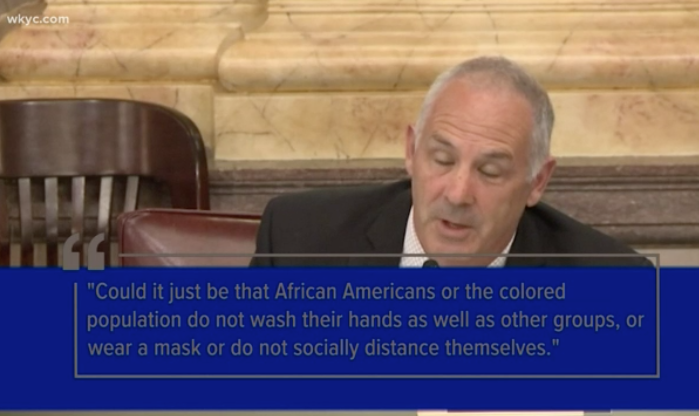
Sen. Stephen Huffman: so wrong... on so many levels

In 1969, my girlfriend Martha and I were driving my VW van through a remote mountainous region of northeastern Morocco, far from the tourist destinations of Marrakech, Fès and Agadir. It was the dangerous bandit-infested, kif-growing Rif region in Al Hoceïma Province near Ketama. We saw 2 American hitchhikers and picked them up, thinking 4 of us would be safer than just the two of us. Once they ascertained we were, like them, from New York City, they almost immediately started telling offensive racist jokes. Just as immediately, Martha signaled she wanted them out of the van. She was far less tolerant of that kind of thing than I was-- and I felt badly about dumping them out in such a dangerous region. She she was adamant. So I told them a racist joke of my own-- except one that was anti-Semitic. They were horrified and demanded I stop the van and let them out. Problem solved.

Yesterday, writing for Bloomberg News, Timothy O'Brien recalled how in 2005 Señor Trumpanzee "proposed producing a season of The Apprentice that would pit white contestants against black contestants. "Trump said on his own syndicated radio show in 2005 that although the idea was 'fairly controversial,' he wanted to host 'a team of successful African-Americans versus a team of successful whites. Whether people like that idea or not, it is somewhat reflective of our very vicious world.' ... [During a Howard Stern show] he also explored the possibility of airing white-against-black competition on The Apprentice... 'And it would be nine blacks against nine whites, all highly educated, very smart, strong, beautiful. Do you like it?' Stern said he did. Stern’s African-American co-host, Robin Quivers, had a different response: 'Well, I think you’re gonna have a riot.'"
“It would be the highest-rated show on television,” Trump replied.

Stern prodded the future president for more information: “Very dark blacks, or light-skinned blacks?”

“Assortment, against whites,” Trump said, adding that he wanted all of the white contestants to be blondes.

“Wouldn’t that set off a racial war?” Stern asked.

“Actually, I don’t think it would,” responded Trump. “I think it would be handled very beautifully by me. Because, as you know, I’m very diplomatic. … Also, I think you’d have 35 million people a night watching.”
Stephen Huffman is a Jewish Republican living in Tipp City, Ohio. The whole idea of Jews being members of fascist and, more recently, neo-fascist organizations has always perplexed me. Maybe I-- like Huffman-- need to stop thinking in terms of ethnic stereotypes. One stereotype about Jews is that they're more intelligent than other groups. Huffman is the personification of the fallacy of that one. A graduate of the University of Toledo and a physician, Huffman is a clod who began his political career as the Miami County Coroner.

Because the Ohio Democratic Party is the very worst Democratic Party in America-- sorry Florida, sorry New Jersey, sorry all of you who make valid cases about how excruciatingly incompetent and venal your state's Democratic Party is, there is literally nothing like Ohio-- Huffman is a state senator in a D+6 district that includes all of Miami and Preble counties and some of Darke and Montgomery counties (including the whole of solidly blue Dayton, where most of the voters live).


Huffman ran for the state House in 2014 when a seat opened up with a retirement. He won a three-way primary with 45% of the vote and 4 years later a state Senate seat for SD-5 opened up the same way and he ran in the more competitive district., The 5th district had been a Democratic stronghold until 2010, as the state party was in the process of disintegrating and Huffman beat Paul Bradley, 53% to 47%.

Huffman's first brush with national notoriety came last year when he "wrote" an OpEd for a local paper, the Sidney Daily News, savaging Medicare-for-All. Huffman became a laughing stock when he was forced to admit it didn't write the OpEd, which was actually penned by a lobbyist Kathleen DeLand who was being paid by a Big PhRMA front group, Partnership for America’s Health Care Future. Huffman was never charged with taking a bribe and was instead made vice chair of the Ohio Senate's Healthcare Committee.

This week, Huffman was back in the news-- with some racial stereotyping that made it into the national news for a racist remark he made on Tuesday about "colored people" getting more COVID-19 because they don't their hands: "Could it just be that African-Americans or the colored population do not wash their hands as well as other groups or wear a mask or do not socially distance themselves? Could that be the explanation of why the higher incidence?"

Two days later, TeamHealth, the crooked firm which employed Huffman as an emergency room doctor, fired him for the remarks and Ohio's Republican governor, Mike DeWine, put out a statement saying Huffman's "words were inappropriate and hurtful to so many Ohioans. Words do matter. So do actions. He is a doctor and is in a unique position because of that to play a significant role in the legislature to work to change this serious health disparity. I hope that he will." Most others hope that he won't. State Senator Hearcel Craig (D-Columbus), a member of the Legislative Black Caucus, called the remarks an example of systemic racism at a time when the COVID-19 pandemic has disproportionately affected African-Americans. "Senator Huffman also needs to understand why 'colored' is offensive. Our nation has faced a painful segregationist history of 'colored only' restrooms and water fountains, just to cite two examples. These practices were reprehensible and so many fought to remove them from our culture." Black Caucus President Stephanie Howse added that "The fact that a well-educated legislator-- a Vice Chair of the Health Committee and a practicing medical doctor-- would, in a public setting, nonchalantly use such antiquated terminology paired with a hurtful, racist stereotype all in one breath reflects how unconscious this problem of racism is for too many."

Trip Gabriel: "Among Ohio’s 38,837 reported coronavirus cases as of Monday, 56.3 percent of patients are white and 27.3 percent are black, according to Cleveland.com, which cited the state health department. Ohio’s population is 82 percent white and 13 percent black. The death rate has more closely tracked the state’s population. Of the deaths in which race was reported, 78.8 percent were white, and 18 percent were black."


Labels: , , , ,

Thursday, March 02, 2017

The Dutch Trump-- Worse Than The Dutch Oven

>


Look, I like a good harira and a sumptuous tagine as much as anyone. But I haven't been to Morocco more than a dozen times because of either. I first visited Morocco early in 1969; it was my first trip to a "non-Western" country. I loved everything about it, but it was the generosity and welcoming nature of the Moroccan people that blew my mind. That's not just why I keep returning but it was in part why I immediately embarked on a 2 year journey that took me through Turkey, Iran, Afghanistan and Pakistan, all Muslim-majority countries (as well as India which has over 170 million Muslims-- considerably more people, of all faiths, that live in Russia or Mexico).

1969 was also the first time I visited Holland, though more briefly than my stay in Morocco. Eventually though, I settled down in Amsterdam, got a job and lived there for almost 4 years. I wasn't happy a couple weeks ago when Dutch Trumpist politician Geert Wilders referred to Moroccan immigrants as "scum" while campaigning among Dutch versions of the Trump voters. What always shocks me about racists like the average Trump supporter and like Wilders is that they feel perfectly comfortable chastising an entire race or ethnic group based on their experience with generally desperate impoverished immigrants.

Campaigning, in his own weird way, is what Wilders is doing now. Even as Putin installs neo-Nazi Marine Le Pen (first round April 23, runoff May 7) as president of France, he has a March 15 general election in Holland to win-- for Wilders. Wilders' party, the far right PVV is on track to electing the most members of the House, doubling its number since the 2012 general election. Is he even worse than Trump? The NY Times described him as wanting "to end immigration from Muslim countries, tax head scarves and ban the Quran... omnipresent on social media but lives as a political phantom under police protection, rarely campaigning in person and reportedly sleeping in a different location every night. He has structured his party so that he is the only official, giving him the liberty to remain, above all things, in complete control, and a provocateur and an uncompromising verbal bomb thrower." It's not likely he'll be able to put a coalition together that makes him prime minister next month but he could exercise effective control over the whatever dysfunctional Dutch government is formed. Like Señor Trumpanzee, he's "unafraid to say things in the most direct, divisive, dismissive, and often disparaging and insulting of ways [and] many of his supporters feel buoyed and relieved that he is giving voice to what they cannot say, or feel they are not supposed to say." Sound familiar?
Geert Wilders, far-right icon, is one of Europe’s unusual politicians, not least because he comes from the Netherlands, one of Europe’s most socially liberal countries, with a centuries-long tradition of promoting religious tolerance and welcoming immigrants.

How he and his party fare in the March 15 elections could well signal how the far right will do in pivotal elections in France, Germany and possibly Italy later this year, and ultimately determine the future of the European Union. Mr. Wilders (pronounced VIL-ders) has promised to demand a “Nexit” referendum on whether the Netherlands should follow Britain’s example and leave the union.

“The Netherlands is kind of a bellwether, a lot of trends manifest themselves here first,” said Hans Anker, a Dutch political strategist who has worked both in the Netherlands and the United States.

“I wouldn’t rule out that Wilders could be prime minister,” he added. “This one is fundamentally unpredictable.”

Remarkably, Mr. Wilders, 53, has managed to build a movement despite his infrequent public appearances. Living under threat since the police discovered plots against him in 2004 has turned him into a politician ahead of his time, using the internet and later social media to talk to voters without the filter of journalists.

It has proved a particularly effective means of reaching disillusioned citizens. Other politicians have followed his lead but almost none have done it as effectively, Dutch experts said.

“He’s the most strategic, smartest politician out there,” said Sarah de Lange, a political science professor at the University of Amsterdam. “He’s very skilled. He’s a very good debater. He has media savvy. Internationally, he’s compared to Trump. But with Wilders every tweet is thought through, calculated. With Trump it’s emotional.”

Right now Mr. Wilders’s party looks set to win more seats than any other or to come in second. However, he has historically polled better before elections than he has performed in them. Still, after pollsters underestimated the likelihood of both Brexit and the victory of Donald Trump last year, no one is relying on predictions.

But whether Mr. Wilders’s party wins the most votes, or enters a government, hardly matters. He has already succeeded in one of his main ambitions-- to push politics in the Netherlands to the right and make possible a conversation about shutting out immigrants and dismantling the European Union that was unthinkable not long ago.


...Wilders describes himself as an outsider. Yet he is the third-longest-sitting member of the Dutch Parliament and has spent his life in politics since he was about 28... He maintains the image of being present through carefully dispensing Twitter posts, videos and television interviews. His rare public appearances guarantee that every time he ventures out he attracts a media circus.

Last week, he suspended his campaign appearances altogether after reports that a member of his police security detail was suspected of leaking his movements to a Dutch-Moroccan criminal gang.

Still, he manages to travel to give speeches outside the Netherlands, including at the Republican convention in Cleveland, where he spoke at the “Milo Yiannopoulos Wake Up Party,” a gathering of [severely mentally ill] lesbians, gays, bisexuals and transgender people for Mr. Trump... He is described by political compatriots as friendly with Benjamin Netanyahu, the right-wing Israeli prime minister... [He] seems to try to outdo himself more for shock value and to grab attention than for practical effect, particularly on immigration.

“In 2012 his position was no new mosques in the Netherlands; now it is ‘close all the mosques,’ ” said Michiel Servaes, a Labor Party member in Parliament who has served with him. “In 2012 it was limit asylum seekers to 1,000 a year; now it’s ‘no new asylum seekers.’”

Yet Mr. Wilders’s stands have brought the mainstream right to advocate strict limits on aid for immigrants and helped spawn new small right-wing parties, all with strong positions against immigration and in support of stricter rules to push immigrants to accept Dutch culture, Mr. Servaes said.

Labels: , , , , ,

Monday, April 06, 2015

Trevor Noah Learns The Hard Way That Joking About Jews Is Strictly Verboten

>


In the late '60s, when I visited Morocco for the first time, most travelers avoided the Rif Mountains of the north. People arriving by boat in Tangier from Spain usually either stayed put or headed south to Fez and Marrakech. Instead, my girlfriend, Martha, and I took a ferry from Spain to Ceuta, a tiny Spanish colony on the Moroccan coast, and headed in the opposite direction from all the other tourists. We went to the blue city of Chefchaouen, the gateway to the Rif badlands. And they really were the badlands back then. The Rif region is where all the local cannabis (kif) grows. Tourists were not encouraged. And we headed right into the heart of it: Ketama, Morocco's "wild west."

Just outside of Chefchaouen we picked up two American hitchhikers. Not just Americans-- Americans from New York, like us. Jewish New Yorkers like us. They were a chatty pair and within just a few minutes were entertaining everyone with comedy. Their repertoire of jokes quickly led to ethnic and racial slurs-- but strictly in good humor. Martha flipped out and whispered to me to get them out of the van. She had zero tolerance for racists. I felt a little queasy about dumping two Americans off in the Rif badlands.

I jumped in with a joke of my own. They had just told a silly Polish joke that had lampooned Poles based on stereotypes. So I told a similar joke about Jews. It wasn't mean-spirited, but it was based on ridiculous stereotypes. No one laughed; instead a thick silence fell over the car. They were confused that someone would ever, ever, ever say such a thing. The concept of a "Jewish joke" was unfathomable to them. They asked me to pull over and drop them off. Martha smiled quietly.

Even when it's ok to "joke around" about race and use ethnic jokes and stereotypes, for many targeting Jews in the same way is one step over the line. No one really cared that Trevor Noah, the newly named host of The Daily Show, made jokes denigrating women or other groups, but that he took aim at Jews... unthinkable! David Draiman, the singer of '90s Chicago heavy metal bad boys Disturbed-- and a libertarian-- flipped out over some old Noah tweets someone dug up to discredit him. He was interviewed by the Voice of Israel and said:
If he wants to go ahead and be a funny guy, go ahead, have me on your show. Go ahead and start spewing anti-Semitic or Jewish jokes while I’m on your show. Somebody’s gonna end up in the hospital and somebody’s gonna end up in jail, and I’ll give you three guesses who that’s going to be... The media continues to spin the State of Israel and Jews as war-mongering, evil people, which we are not. I think that’s it’s become something that, where people used to quickly rise to condemn it, they more and more are being very lackadaisical about it, and it’s becoming something that isn’t offensive to the mass public, which is very, very disturbing.
Appropriately enough, Draiman dug deeper on TwitLonger. In it, he muses that he's "a fan of pushing the envelope when it comes to art, music, film, and even comedy; but given the fact that anti-Semitic hate crimes are so rampant now, more than I have ever seen before in my lifetime, is now really the appropriate time for such 'humor'?" Here's an excerpt:
I am not someone who is easily offended; I’ve got big shoulders. Truth be told, I myself have been critical of the P.C. obsessed mob, those who seem to yearn for, and look for reasons to be offended by, seemingly anything from anywhere (I actually agree with Jim Norton’s piece in Time magazine regarding the Trevor Noah controversy to a certain degree, thank you again for the courteous back and forth Jim).

I am a staunch supporter of free speech and freedom of creative expression, even if the words spoken or manifested creativity is something I do not agree with, I will, as Voltaire said, "fight to the death for your right to say it."

However, many people confuse the right to “free speech” as being a license to say whatever they want without consequence. That simply isn’t reality. Your right to free speech prevents the government from being able to prosecute you for such words, but it does not, and should not, prevent the court of public opinion from then being able to judge you based on those words, to respond accordingly, and potentially even protest those words, in a peaceful/non violent manner. That’s true free speech, it’s a two way street. That’s true freedom.

As Winston Churchill said, “Some people’s idea of free speech is that they are free to say what that they like, but if anyone says anything back, it’s an outrage”. That simply isn’t true. Besides, if speech were suppressed, we may not know who some of the true wolves in sheep’s clothing are out there. People being allowed to speak freely, enables us to find out who they really are, and I would never trade that right for anything.

...Type the word anti-Semitism into your search engine, and see what comes up.

The results will shock you.

The number of anti-Semitic incidents and attacks that have been perpetuated over the past year worldwide is staggering. They are at levels I have not seen in my lifetime, and they are not only directed at “The State of Israel”, or “The Israeli Government”, or even “Israeli’s” in general. They are directed at Jews, all Jews, all over the globe, whether they are of Israeli descent or whether they support the State of Israel or not.

The horrific events of the last Gaza war have enabled sleeping anti-Semites all over the world, who have been relatively subdued for some time, to reveal themselves. Thanks to freedom of speech, we now know who many of them are (all they needed was an open door and an excuse to continue spewing their baseless hatred). I would never take away their right to expose themselves. I like it when people take their masks off. At least I know who is a threat and who isn’t.

So why then did I take such strong issue with the prospective new “Daily Show” host, Trevor Noah’s history of “Jew jokes”? Things like, “Almost bumped a Jewish kid crossing the road. He didn’t look before crossing, but I would have felt so bad in my German car!” or, “Muslims don’t hate Jews, Jews hate Muslims”, or “Behind every successful Rap Billionaire is a double as rich Jewish man” or, “South Africans know how to recycle just like Israel knows how to be peaceful."

Surely these aren’t the worst anti-Semitic slurs/jokes that I have ever heard, why take such offense?

Because I am tired of seeing the “tastemakers” of the world continue to perpetuate the anti-Semitic stereotypes and notions expressed in the “jokes” above. I’m tired of today’s youth thinking that it is “en vogue” to hate on the Jewish people. I’m tired of seeing people frightened, hiding their heritage for fear of anti-Semitic persecution.

Mr. Noah was picked to be the host of a widely watched television show, and with great power/reach also should come at least some responsibility. Many have said that since some of the statements were made years ago, that means they shouldn’t really matter; I wasn’t aware that there was an expiration date on hatred. If these were just “jokes” as everyone is insisting, let him also say publically that he denounces anti-Semitism and baseless hatred in all its forms. He had the right to say those things, he said them, shouldn’t people directly affected by them be able to respond to such statements with justifiable disdain? If you want to say that comedians are comedians, and that creative expression is absolute, and that no apology should be necessary for such statements (although friends sometimes mistakenly push things too far with one another/cross a line, apologize and move on), don’t these statements at the very least merit some explanation and clarification beyond saying that, and I quote Trevor here,

“To reduce my views to a handful of jokes that didn’t land is not a true reflection of my character, nor my evolution as a comedian."

Is that enough? Does that convince anyone that he doesn’t truly believe the things he was implying in those “jokes”?

In this free society that we have created, some have insisted that people’s right to free speech justifies hate speech. Having the freedom to say it, and it being “justified”, are two entirely different things.

The recent rise of global anti-Semitism, people’s general “laissez-faire” attitude towards it, and the liberal Mainstream Media’s virulent anti-Israel narrative and agenda, has enabled it to spread and grow like wildfire. So in this troubling time, perhaps it is more prudent to avoid making “jokes” about it?
Katie Halper is a (Jewish) comedian and a writer. She's not buying into the claims that Noah is anti-Semitic, although she certainly agrees with Draiman that anti-Semitism is a real and growing threat. "When," she wrote, "it comes to themes that spark people’s most irrational, knee-jerk reactions, two stand out: humor and anti-Semitism. But when discussions center on anti-Semitism and humor at the same time, the level of analysis can reach an all-time low." She contends Noah, whose mother is Jewish, is not anti-Semitic. Fox News, of course, is exploiting it for audience share-- and Howard Kurtz has been chiming in as well. 


Labels: , , , ,

Tuesday, August 13, 2013

Social Media-- More Profoundly Impactful Than You Think

>


The worst thing I can think of in terms of the impact of social media on society is portrayed in the short film (above) by Werner Herzog, "From One Second To The Next."

A study by Joseph DiGrazia, Karissa McKelvey, Johan Bollen and Fabio Rojas at the University of Indiana illustrates how Twitter conversations can be used to predict election outcomes, whether they are determiniative or not. Rojas, an associate professor of sociology at Indiana State, explained what they found in an OpEd for the Washington Post on Sunday.
Digital democracy is here. We no longer passively watch our leaders on television and register our opinions on Election Day. Modern politics happens when somebody comments on Twitter or links to a campaign through Facebook. In our hyper-networked world, anyone can say anything, and it can be read by millions.

This new world will undermine the polling industry. For nearly a century, conventional wisdom has argued that we can only truly know what the public thinks about an issue if we survey a random sample of adults. An entire industry is built on this view. Nearly every serious political campaign in the United States spends thousands, even millions, of dollars hiring campaign consultants who conduct these polls and interpret the results.

Digital democracy will put these campaign professionals out of work. New research in computer science, sociology and political science shows that data extracted from social media platforms yield accurate measurements of public opinion. It turns out that what people say on Twitter or Facebook is a very good indicator of how they will vote.

How good? In a paper to be presented Monday, co-authors Joseph DiGrazia, Karissa McKelvey, Johan Bollen and I show that Twitter discussions are an unusually good predictor of U.S. House elections. Using a massive archive of billions of randomly sampled tweets stored at Indiana University, we extracted 542,969 tweets that mention a Democratic or Republican candidate for Congress in 2010. For each congressional district, we computed the percentage of tweets that mentioned these candidates. We found a strong correlation between a candidate’s “tweet share” and the final two-party vote share, especially when we account for a district’s economic, racial and gender profile. In the 2010 data, our Twitter data predicted the winner in 404 out of 406 competitive races.

Why does this happen? We believe that Twitter and other social media reflect the underlying trend in a political race that goes beyond a district’s fundamental geographic and demographic composition. If people must talk about you, even in negative ways, it is a signal that a candidate is on the verge of victory. The attention given to winners creates a situation in which all publicity is good publicity.

This finding is remarkable because it doesn’t depend on exactly what people say or who says it. We measured only the total discussion and estimated each candidate’s share. It is this relative level of discussion that matters for tracking public opinion in electoral contests. Furthermore, social media data mimic what polls measure. For example, in Ohio’s 3rd Congressional District, we found that Republican Mike Turner got 65.4 percent of his district’s tweet share. In the final election, he got 68.1 percent of the two-party vote. The tweet prediction was off by 2.7 percentage points — a figure that is within the margin of error of any poll.

This finding has profound implications for the democratic process. There are many nations that remain mired in poverty and do not have the infrastructure required for extensive polling. Furthermore, these nations often have governments that are suspicious of polling and try to suppress it. For these reasons, it is very hard to monitor elections. In contrast, as long as citizens have access to the Internet, they can talk about their views in a less-restricted manner. The “grassroots” buzz found in social media can be studied, and it will reveal how elections are conducted and if the state is respecting human rights. And as with U.S. elections, even if the people who use social media are not completely representative of the public, the amount of attention paid to an issue is an indicator of what is happening in society. Important events generate scrutiny that can be measured and studied.

Social media analysis is also important for elections in the United States. Polling favors the established candidates because it is relatively expensive. In contrast, social media analysis is cheap. Anyone with programming skills can write a program that will harvest tweets, sort them for content and analyze the results. This can be done with nothing more than a laptop computer.
Please follow the Blue America-endorsed candidates. We have two for governor: Heather Mizeur (D-MD)- @heathermizeur and Barbara Buono (D-NJ)- @BuonoforNJGov and this is the list of congressional candidates we've endorsed so far:

Alan Grayson (D-FL)- @AlanGrayson
Lee Rogers (D-CA)- @LeeCRogers
Nick Ruiz (D-FL)- @NRIII
Carl Sciortino (D-MA)- @carlsciortino
Daylin Leach (D-PA)- @DaylinLeach
Rush Holt (D-NJ)- @RushHolt
Raul Grijalva (D-AZ)- @RepRaulGrijalva
Keith Ellison (D-MN)- @KeithEllison
Brian Schatz (D-HI)- @SenBrianSchatz
Jay Stamper (D-SC)- @Jay_Stamper
Jeff Merkley (D-OR)- @SenJeffMerkley
Ed Markey (D-MA)- @EdMarkey
Al Franken (D-MN)- @AlFranken

And this growing influence of social media on the workings of politics isn't just true in the U.S., of course. Al Jazeera carried a fascinating report about how Twitter forced Mococco's dictator, who calls himself Mohammed VI, to reverse a decision pardoning a child rapist.

The pardoning of a paedophile by Morocco's king last month ignited a public outcry, causing some who had been apolitical to demand radical changes in the country and a serious reform of its justice system.

"This woke up my conscience," said Khalil El Abbadi, a 34-year-old engineer from Casablanca. "Voicing our beliefs has become an obligation and a necessity."

The rare show of outrage came after the release of Daniel Galvan Vina, a Spanish citizen convicted of raping and filming 11 Moroccan children. Moroccans from across the social spectrum, many of whom did not belong to any political movement, publicly voiced their outrage over the pardon, prompting King Mohammed VI to reverse his decision.

Abbadi protested alongside many of his countrymen-- the first time he has dared to openly show his indignation against the ruler. He said that following the news on Twitter exposed him to realities that he was not aware of, that were missing in the traditional media. He empathised with the families of the victims and weighed the damage to the nation's reputation.

"I had a feeling of rage, of humiliation and above all, a sense of being a second-class citizen," he said. "In this country, the dignity of the citizens is not the priority of the state."

The Moroccan king pardoned 48 prisoners on the annual Throne Day in July as a courtesy gesture a few days after the Spanish monarch, King Juan Carlos, visited the North African country. Galvan Vina was among those released. But the Moroccan media, the government and most political parties remained largely silent about the decision, while protests exploded across Morocco.

One demonstration in Rabat, the capital, was violently suppressed by the authorities. But by then, after days of pressure, the king decided to reverse course and revoked the pardon. Galvan Vina was swiftly arrested in Spain and now awaits a decision on extradition proceedings to Morocco.

While the pardon may seem to have been reversed simply to keep the peace, analysts say it signals a significant shift in Morocco's societal values and has shaken the sense of the king's infallibility. This unprecedented direct dialogue between the king and the people in Morocco has also revealed weaknesses in state institutions, a topic that had been completely absent from public debate.

"The king had to release a statement justifying his actions," said Abdellah Tourabi, historian and editor of the monthly magazine Zamane. "This non-structured movement without an ideology, advocating for equality and rejecting authoritarianism, snatched justifications from the king... These people will be watching and already showed their capacity of mobilisation."

The king called the pardon a mistake, and said he did not know a paedophile was among those given clemency. In a statement about the decision, the king hinted that the pardoning procedure would be reformed-- something protesters have been demanding, due to the process' lack of transparency and rumours that pardons may be bought.

...So far, many Moroccans seem prepared to keep pressure on the king and his regime. "I want to live in a country where the interests of the citizens are at the centre of the concerns of the state," said Abbadi, the Casablanca-based engineer.

He is not the only one who will be taking action and watching. Using Twitter, a user named "Lambertiste" wrote: "In the future, I wish good luck to paedophiles and lax judges. Impunity is over. Each case will be followed, closely."

Labels: , , , ,

Monday, December 17, 2012

The Republican Extremist Most Likely To Lose In 2014: Gary Miller

>


I started visiting Morocco in 1969 and I've been there over a dozen times since. At some point it can't just be about laying around Marrakesh, Essaouira, Tangier and Fes. So some years ago I set out across the Atlas Mountains south of Marrakesh and discovered Taroudant, which is kind of what Marrakesh was like in the 1960s... before it became so cosmopolitan. I loved it and kept going back. From there we'd set out for Tiznit and even Sidi Ifni further south and east and then, eventually, for Ouarzazate, Zagora south and west and even Mhamid right at the edge of the Sahara, the last stop before the 2 month camel ride to Timbuktu.

I just saw the Cadillac ad (above) with the driver going through the Atlas Mountains at the Dadès Gorges. We did hire a camel driver and his son to take us out into the Sahara Desert... but not as far as Timbuktu, which we did eventually get to-- in a jeep. As for the curving passes of the High Atlas... oh yes; we did that, several times in fact. But once was a time I'll never forget. We weren't going nearly as fast as the Cadillac in the ad-- nor did we have nearly as good a vehicle-- but we were descending pretty briskly when... no more pavement. The asphalt suddenly gave way-- with no warning-- to gravel.

You know what happens when the asphalt suddenly gives way to gravel? It had never crossed my mind 'til then either. But we spun right out of control and headed for one of those drops you can see in the Cadillac ad. In fact, the bottom of that gorge is filled with cars and trucks that did go over during the years. I'd like to say it was my reflexes and skillful driving that saved us-- and it may have been; who remembers anything but the sheer terror? But I think it was just luck. The car came to a stop an inch for the deadly drop. Within second a dozen old Berber men were swarming all over us, as though they came out of the sides of the rocky crevices. Each one wanted to touch my heart. For luck I guess.

I was delighted to see the DCCC begin blasting away at Republicans who refuse to support low tax rates for all income under $250,000 unless the low rates are also extended for income over $250,000 as well, something the country just can't afford. The ad below is one they did for the single most vulnerable Republican in the whole country, corrupt right-wing extremist Gary Miller, who plays Confederate officers in Civil War reenactments. This cycle he managed to win reelection in a new district, CA-31, only because too many Democrats ran in the crazy new open primary resulting in two Republicans facing off in the general. Obama beat Romney in the district 57.2-40.6%. Miller is the DCCC's #1 target for 2014. Sharper than you thought, huh? But this ad campaign is also targeting 20 other Republicans they see as vulnerable next cycle, including Buck McKeon (R-CA) and Tom Reed (R-NY), two major Blue America targets as well. Nothing to do with Morocco or Cadillacs... just twisted roads and going over cliffs:


Labels: , , ,

Saturday, August 25, 2012

Joey Lieberman Squeezes Another Fancy Vacation Out Of American Taxpayers-- This Time To Morocco

>

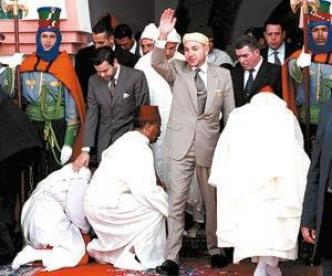
Crown Prince Moulay, M6 & Joe Lieberman (l-r)... royalists

Thursday, Joe Lieberman, who is finally retiring from the Senate, was on a junket to Morocco. I can't blame him-- other than the taxpayer-funded part of it. Morocco is one of my favorite places in the world to visit. I first went there in 1969 and I've been there over a dozen times. A couple years ago I rented a riad right next to the king's personal residence in Marrakech. We were told not to point any cameras from our rooftop lounge towards his rooftop lounge. We never did-- nor did we ever see him while he was in town, although I did write about him, maybe more rudely than I should have. Lieberman, like all conservatives, is a royalist at heart and he wasn't rude at all-- just a fabulist tweeting away about "our" wonderful ally being a reformer.


I just guess that Lieberman doesn't know what the Makhzen is, doesn't have a clue about the predatory nature of the royal family and has no idea he's basically endorsing a kleptocracy with good p.r. skills. Mohammed VI, when you strip away the 21st Century p.r. veneer, is an authoritarian despot, not all that much different from any king or Emperor or sultan or tsar. In fact, one thing I noticed a lot-- and eventually started questioning people about-- is that many Moroccans sounded exactly like pre-Revolutionary Russians believing if only their Little Tsar knew what evil the terrible men around him were perpetrating against his people! Mohammed calls all the shots in the family business, a business that owns at least a piece of almost everything, from the big hotels to the drug trafficking bonanza that a Wikileaks cable from a U.S. diplomat asserts is the only bigger source of income in the kingdom than the tourist industry. And remember, it was the release of wikileaks cables that opened the flood gates against the dictators in Tunisia and Egypt as well.

Even members of the royal family believe Morocco's monarchy can't go unscathed by what swept the rest of North Africa last year. The King's cousin, Prince Moulay Hicham, 3rd in line to the throne and popularly known as the "Red Prince," because of his criticisms of the monarchy, said "the political liberalisation launched in the 1990s after Mohammed succeeded his authoritarian father Hassan II had virtually come to an end, and reviving it while still avoiding radical pressures would be 'a major challenge'." Everyone is counting on the spiritual bond between THE KING and the people, a bond, they hope, makes him different from a grubby usurper like Ben Ali or Mubarak or Algeria's Abdelaziz Bouteflika. On the other hand, dissident journalist Aboubakr Jamai wrote in France's Nouvel Observateur that "If Morocco goes up, the disparities in wealth are such that the rebellion will be much bloodier than in Tunisia."


Afrol News appears to be as anti-monarchial and "down with tyranny" as we are here. While Egypt was exploding, they seemed to try stirring things up a little for Mohammed who, they reported, was off in one of his fabulous palaces... in France, plotting contingencies in case any radicals decided it was time to follow the example of Tunisia and Egypt and throw off the chains of oppression and kleptocracy.
Discontent is ample in Morocco, the poorest, least developed North African nation, and many are inspired by developments in Egypt. Meanwhile, Morocco's King Mohammed VI rests in his French luxury chalet.

Morocco so far has been spared from larger protesting groups as those in Tunisia and Egypt, much thanks to the King's quick reversal of boosting prices for basic foods. The same move proved a good assurance for authorities in neighboring Algeria.

But discontent is very widespread in Morocco. Despite an economic boom over the last years and some careful reforms ordered by King Mohammed VI-- most prominently regarding gender equality and education-- Morocco remains the poorest country in North Africa, with least employment opportunities and the lowest literacy rate.

The King, claiming to descend from the Prophet Mohammed, has an almost divine role in Morocco. Very few dare to criticise him, even in the mildest form.

Among the Arab majority, loyalty to the King is great, while the government-- appointed by the King-- and age-old ruling "Makhzen" class-- controlling the administration, police, army and much of business-- are the popular focus of hatred. In the streets of Casablanca, it is often said that the King is honest and wants to rule the country well, but the Makhzen is corrupting everything.

Minorities, however, to a wider degree dare to blame the King for their mischief. This includes large parts of the indigenous and disadvantaged Berber people. Estimates of the Berber population wary from 20 to 60 percent of the Moroccan total, with official estimates being the lowest. Unemployment is highest among Berber youths, of which many view the Arab King as a foreign imposer.

...As the tourist market in all North Africa now is crumbling-- many travellers fear Morocco could be next-- the kingdom's greatest growth and employment sector could soon be strongly impacted. A sudden growth in unemployment due to falling tourist arrivals could spark revolt.

Blogging from Fes, Matt Schumann is a Fulbright Scholar and English teacher at the S.M. Ben-Abdellah University, a graduate of Rice University and an incredibly well-informed and very perceptive observer of the Moroccan street, far more so than anyone you're going to ever hear on the utterly clueless CNN or the ideologically sociopathic Fox News, not to mention Joe Lieberman's twitter account. Last year, he wrote about being in Morocco and watching the Moroccans watch the developments unfolding in Egypt. His conclusion, though, is that Morocco is immune to the upheavals sweeping the Arab world. I disagree but I want to offer his arguments, since they make a great deal of sense and include important information we'll need to look at when the revolution does, inevitably, come to Morocco.
It's been strange to be in Morocco during all of this. There's no lack of information. When you walk into a cafe, people are watching coverage of Egyptian protesters burning police vehicles or tearing down posters of Hosni Mubarak. But these images and ideas don't seem to be penetrating. A glance through two of the biggest newspapers, As-Sabah and Al-Masa', lead you to believe that the protests are only tangentially relevant to Moroccans. There are no attempts to apply Tunisians' and Egyptians' grievances to a Moroccan context. On Facebook, my students have posted pictures of the Egyptian protesters along with words of support and solidarity, and then proclaim their love for Morocco's King Muhammad VI. How can you identify with the protesters of two revolutions against authoritarian governments and still do that?

Why have the events in Tunisia and Egypt failed to generate the same reaction in Morocco as they have elsewhere in the Arab world?

Reading reports from the past weeks has made it clear to me that life for the average Moroccan is very different than that of a Tunisian or an Egyptian. Yes, Morocco is a poor country with high unemployment. The GDP per capita is significantly lower than Egypt's and nearly half that of Tunisia. Yet, the poverty is not oppressive. Life necessities are cheap in Morocco. People are poor but do not starve. The Moroccan government also tolerates "underground economic activities" which provide money and support for many young, uneducated Moroccans. The most notable of these is the drug trade, which according to WikiLeaks, generates more money than tourism, the largest sector of the Moroccan economy.

A second, key difference, concerns education. As one commentator pointed out, Tunisia is an exception in the Arab world in that it has a large, educated middle class. The middle class' dissatisfaction with the country's economic prospects fueled the protests that eventually led to Ben Ali's downfall. Egyptians, while not nearly as wealthy as Tunisians, are similarly educated. Both countries post literacy rates in the 70s and both protests movements have utilized social (especially Tunisia) and print media (especially Egypt) for organizational purposes. Morocco is a completely different story.

At best, 50% of Moroccans are literate and many well-educated Moroccans are ex-pats living in Europe or North America. While this may seem insignificant, I think it's a huge factor. Moroccans' illiteracy hampers the spread of information in general, and would definitely impede the organization of any type of protest movement. Additionally, the Moroccans who identify the most with Tunisia and Egypt don't live in Morocco. They've already exercised their discontent by leaving the country... [T]here is no credible opposition to the King [inside Morocco].

Morocco is a parliamentary monarchy that has a prime minister, political parties and elections. But in reality, it's something else. Parliament and the lesser bodies of government are where corrupt officials take bribes and appoint their sons- and daughters-in-law to influential posts. This corruption is obvious and derided by the Moroccan people. It's not uncommon for a Moroccan to say that the best way to make money in the country is to get into politics, but that you can only do that if you know the right people.

The King is seen as the only credible member of government despite his overwhelming and unquestionable political powers. And there's good reason for this. Royal initiatives, like infrastructure development and some social reforms, are completed on time and relatively efficiently. In other words, he gets things done when other Moroccan politicians don't. Combine that with the legacy of the Alaouite Dynasty, which has ruled Morocco for nearly four hundred years, and Muhammad VI is seen less as a despot and more as a benevolent and beloved monarch.

Now it's true that the King has the power to end the corruption that plagues parliament, the police and the military. Allowing his political opponents to profit in their subordinate positions decreases their desire for change. Additionally, their corruption draws the ire and attention of the people. So while his policies may leave something to be desired in the eyes of some Moroccans, the alternatives are much much worse.

The commentator who describes Tunisia as an exception in the Middle East may be eating his words in the next few days depending on Egypt's outcome. This doesn't mean Moroccans are happy with the state of affairs in their country. Poverty, unemployment, education, and political freedom are just a few issues that Moroccans feel must be addressed. But for now, the situation does not seem dire.

More than anything, Moroccans love stability. This is why they love the King. They tolerate the political and social status quo because it still meets their needs and because they don't have to worry about what tomorrow will bring. Because of this mindset, I don't think radical change is anything many Moroccans feel is necessary. Speaking to a Moroccan friend he said that while things here are not good, they are getting better. "Maybe five or ten years from now, but not now," he added. As long as this attitude persists, Morocco will stay stable.

Everybody loves stability. But it costs Morocco and awful lot to keep the king-- much more than he's worth, not just in my estimation but in the estimation of more and more people. When Egypt falls and things get ramped up in another country, Mohammed VI is going to be very happy his family's corporation has all the billions of dollars they've stolen from the people of Morocco separate from the state's funds. Like the rest of the kleptocrats, they and their spawn will be living on it for generations-- in other countries. Not everyone agrees with me, of course. Lieberman sure doesn't. Recently Nicolas Pelham did a thought-provoking piece for the NY Review of Books, How Morocco Dodged The Arab Spring, acknowledging the miserable living conditions in Morocco-- the part the Liebermans never see when they visit our glorious ally-- and the all pervasive corruption. Mohammed may have appropriated and tucked away $2.5 billion from the rich country his family and regime cronies have systematically impoverished but... "gave up his claim to divine rights as sovereign, but left him as Commander of the Faithful," which is slightly different and might seem like a monumental step for some. Pelham can't help but acknowledge that even after parliamentary elections and a man of the people, moderate Islamist taking over as prime minister, "Moroccans ask themselves whether their new constitution was merely cosmetic. Most recently, this view has been confirmed in a battle over who gets to make senior government appointments. Unsurprisingly, the King seems to have won."
It is hard to ignore the royal court’s smugness at how they co-opted the Islamists to revive the monarchy’s legitimacy at its weakest hour. On the one-year anniversary of the King’s “historic” March 9 speech ceding powers to a prime minister, the Moroccan state press, which usually commemorates royal anniversaries with religious attention, carefully avoided covering the event. “M6 [as the King is commonly known] was shaken to the core, and gave the biggest speech of his career pledging to open a new page,” says Karim Tazi, a politically-active businessman who initially backed the protestors. “The way he changed his mind when the February 20 movement began to lose its way is shocking."

[Prime Minister] Benkirane insists he has to “work gradually” to assert his new power and counter corruption, but there are increasing demands that he show it now. All but eleven of the government’s thirty-one ministers come from non-Islamist parties, and several served in the previous government, which Benkirane hitherto decried as corrupt. Aziz Akhennouch, a businessman whose wife recently opened the country’s largest and swankiest mall-- replete with Africa’s first Galeriés Lafayette-- is his agriculture minister, with powers to distribute state lands. An editor of an opposition Islamist newspaper, whom I knew a decade ago as one of the makhzen’s more judicious critics, is now the information minister, dutifully banning foreign newspapers deemed to disparage the king.

The legislature is similarly subservient. Under Article 41 of the new constitution, their laws can be overruled by royal dahir, or decree. Moreover, despite his gruff reputation, Benkirane’s justice minister has pledged that the government will not tamper with royal prerogative over religious affairs such as the Sharia. Scripting the Friday sermons, he insists, remains the prerogative of the Commander of the Faithful. Even Benkirane seems belabored with doubts, alternately referring to his election by the people, and his appointment by the King.

While Egypt’s election of an Islamist president has given Benkirane’s followers a recent boost, attempts by old regime security apparati to stage comebacks and harness elected representatives across the Arab world have also emboldened the makhzen. The old forces have resorted to their old ways, censoring and incarcerating critics. Hind Zerrouq, an Islamist activist, disappeared on June 13 minutes after calling her husband to tell him she was held in the basement of a state security cell. (Islamist websites said she had formed a support-group for the relatives of detained members of the banned but non-violent Islamist movement, Justice and Charity.) The same week, a court sentenced a blogger who criticized the King to two years in jail for possessing cannabis, a Moroccan cash crop. Meanwhile, dissident Islamists, fearing waning public interest and further state pummeling, have suspended public protests, though they continue to agitate for change more quietly.

But the King has not been able to resolve Morocco’s economic troubles. In his thirteen years on the throne, he has removed many of the shackles his father placed on modernization. Child mortality has fallen 30 percent in five years, and literacy is sharply up from previous appalling lows. Yet development projects seem mostly aimed at the country’s upper crust and at foreigners, who are feted by hoteliers in Marrakesh. Moroccan trains run on time, the streets are spotless, and motorways are being built across the country, while everyday life for many is staggeringly squalid.

The government’s commitment to purchase a high-speed train network from France has become a symbol of the social disparities. At a cost of $2.8 billion, it is supposed to send TGV locomotives darting through countryside that peasants still plow with oxen. The sum equates to 10 percent of the annual budget, or ten times the government’s Agriculture fund for farmers, who comprise 40 percent of the workforce. The Islamist budget minister, attributing the decision to the previous government and to anxious follow-up visits from the French president and prime minister, told me the decision could not be reversed. “We can’t demolish what has already been built,” he said.

But that is precisely what the authorities have done when it comes to unregulated housing for the poor. After a year in which the makhzen stopped enforcing planning permits lest they provoke a Tunisia-scale uprising, the security forces now feel sufficiently emboldened by the stability of the Benkirane government to strike back. In March, riot police armed with sledgehammers began flattening the first batch of what officials say are 44,000 homes built illegally since the start of the Arab Awakening a year ago. A broken trail of rubble stretches from Tangiers in the north via the hillsides of Benkirane’s Sale constituency to El-Jedida, an old Portuguese fortress town a two-and-a-half hour train ride down the Atlantic.

Lieberman, of course, is visiting-- and getting his information for his tweets from-- people like himself. Here's a lesson for Senator Lieberman:

Labels: , , ,

Thursday, June 23, 2011

Which Way Morocco?

>

The Makhzen, foot soldiers of the Moroccan royal Mafia, will do anything to prevent democracy.

There's only one way for society to deal with the entitled families that style themselves "royal" and behave as though they are entitled to the wealth of their nations. The English Parliament got it exactly right in 1649 when they had Charles I , who insisted he was ordained by God, beheaded. In 1793 the French people did the same thing to the so-called "royal family," and the Russians finally blotted out the despicable Romanov parasites in 1917.

There are still kings in various parts of the world, still stealing the collective wealth of the countries they claim to "own." One of the slickest, greediest and most Mafia-like is the so-called "king" of Morocco, Mohammed VI, who I lived next to last Christmas in Marrakech... and wrote a bit about at the time.

With the Arab Spring awakening the masses across the Arab world and sweeping away tyrants, it was always only a matter of time before Morocco would start catching up with the likes of Tunisia and Egypt... and hopefully not Bahrain and Syria, where hereditary families like Morocco's would rather kill their own people than give up their ability to milk their countries. Last week Mohammed tried offering some superficial "reforms" without giving up any of his ability to plunder the national wealth as his family has been doing for generations. Many in Morocco say it won't work this time, and they want the king and his cronies to loosen their iron grip on the nation. Advised by allies in the West, Mohammed's regime is trying to foment the credible threat of a civil war to keep himself in power.
For four months now, activists have campaigned for the king to transfer powers to elected representatives and reign only as a symbolic head.

In Friday's speech, he announced the constitutional reforms he had promised in March after the first bout of protests.

The most significant proposed change is the boost in the executive powers of the prime minister and the parliament. For instance, the prime minister would appoint and remove ministers as well as dissolve the lower house of parliament in consultation with the king.

The king, however, is not divorced from executive power. The king would choose the prime minister from the party that wins the elections and he could also dissolve the parliament in consultations with the prime minister and members of the new constitutional court, half of whom he would appoint.

The continued presence of the king in the executive branch ignores the key protester demand of separation of powers. He also remains the military and religious head of the country.

While the king is offering a constitutional monarchy, the demand is for a parliamentary monarchy like the United Kingdom. For the activists, the king’s reforms are piecemeal and if they compromise now then the momentum they have generated for comprehensive change will be lost.

They also suspect that the king is trying to rush a referendum on proposed reforms-- he set the vote for July 1-- before mass resistance can be mobilized.

The pro-democracy movement – called February 20 (after the first day of widespread protests in Morocco) – is made up of the web-savvy youth, left-leaning parties, and Islamists.

Peaceful rallies have attracted tens of thousands of people. A few of these demonstrations have been violently dispersed by government forces but not as brutally as protests in much of the Arab world.

Conservatives hope the king's slick, superficial performance Friday will derail the Feb. 20 Movement. But Sunday thousands of Moroccans took to the streets to protest the phony reforms. They recognize that the network of corrupt privilege around the regime has to go if Morocco is ever going to prosper and join the modern world. Americans and Europeans have downplayed the Moroccans' thirst for the end of tyranny and want desperately to see the country as a happy little kingdom just south of Spain where they can go for slightly exotic, inexpensive holidays.

Since I first went there in 1969, I've been to Morocco over a dozen times. Although the royals have made sure illiteracy would remain high-- conservatives always know education is their mortal enemy, whether we're talking about "royal" families, the Taliban or the American GOP and plutocracy-- there is no Arab country I've ever visited better-prepared to take its place in the 21st century. Last week Nick Kristof opined that "Perhaps no Arab ruler responded as wisely to this year’s pro-democracy protests as the king of Morocco-- although that is an exceptionally low bar." He's right-- the bar is exceptionally low... and the P.R. campaign aimed at journalists like Kristof is the best that money can buy.
When other dictators in the Arab world answered protesters with gunfire, King Mohammed VI grudgingly accepted demonstrations, at least when he was in a good mood. His regime claimed that antigovernment activism underscored the country’s openness, and on Friday the king announced constitutional reforms that seem likely to reduce his own role in governing the country.

...It’s troubling that even as the king has been talking about reform, he has engaged in a violent crackdown on peaceful protesters in the last few months. One demonstrator died, apparently from his injuries. But the repression was just harsh enough to inflame protesters, not terrifying enough to scare them into staying home.

“Everybody gets hit,” Aymane Aoudi, a 20-year-old college student and activist, told me. “They even hit women and children.”

Another student, Imad Iddine Habib, proudly told me that he had been arrested three times this spring, and beaten two of those times. But the beatings become badges of honor among young people-- more of an inducement to protest than a deterrent.

The king perhaps realized that he was digging himself deeper, because this month the regime has mostly refrained from beatings. The government now seems at a turning point.

The king can follow Bahrain’s example and use extreme violence to crush protesters. Or he can grit his teeth and put up with them-- but then he will have to endure more criticism and accept more compromises.

If he does embark on wider democratic reform, he could make Morocco-- already a pretty remarkable and wonderful country, where the semi-banned Islamist movement is so mellow that it has a female spokesman who advocates for women’s rights-- even more of a trailblazer. Morocco would show Middle Eastern rulers that they can respond to popular pressure with ballots rather than bullets.

In my conversations with protesters here, I keep noting how much better off they are than those in Syria or Yemen. But they don’t care about that: they keep noting how repressed they are compared with Americans or Europeans.

Labels: , ,

Monday, March 14, 2011

No Fly Zone? Not Really

>


As you can see above, the other day John McCain dusted off the ole tweet machine. Strange bedfellows-- the old coot and the Let's-Drive-Israel-Into-The-Sea-Arab League! But he, Lieberman and, in lieu of M.I.A. Lindsay Graham, John Kerry, have been thundering for weeks for a No Fly Zone to stop Muammar Qaddafi and his brutal Beyoncé/Mariah Carey/Nelly Furtado/Usher-lovin' sons from slaughtering half the country's population while bombing the rest into subjugation. (Thank Heaven Usher didn't bring Justin Bieber along on that one!)

The papers are all abuzz that the Arab League has apparently been told to go ahead and call for the no fly zone, as the Qaddafis mop up the last of the resistance. And Washington is applauding. Less prominent is the news that it's all a fraud. Two resolutions passed, the second-- pushed by teetering Algeria, Syria and our pals the Saudis-- guaranteeing that the first would be toothless. Watch:


In other words, go ahead and declare a No Fly Zone. The Arab Street demands it, even if the ruling elites will never allow it. So... don't even think about enforcing it with anything more convincing than harsh rhetoric.

The New World Order-- sorry-- had to stop the pro-democracy movement somewhere but it got completely out of hand. It's even spread to Wisconsin, Michigan, Ohio and Indiana now! And the Qaddafis are willing to do the wet work. If Libya fell, Morocco and Algeria-- $5.00/gallon gasoline minimum-- would be sure to follow. The primitive, old fashioned tyrants in Libya and Yemen have what it takes and the embarrassed hope is that they'll staunch the flow and keep it from washing over The Kingdom.

Despite my contempt for the Republicans, I've pretty much disagreed with Obama on just about everything he's been up to. Here he's actually probably doing as well as anyone could possibly do. There are so many balls in the air-- even if reelection is primary-- that it probably takes an awful lot of concentration, especially considering the divergent interests that have to be taken into account, from the apocalyptic Israelis to the kleptocratic Saudis. The new Time has an interesting, if somewhat credulous, story on how Morocco's newish king is trying to navigate the mess in a way that will leave him on his throne and in control of his nation's wealth and resources. Still, he's get lots of advice from France and the U.S. to make sure to not come off like Qaddafi or Salah (in nerve-gased Yemen).
Looks like someone's been paying attention. After three weeks of nationwide protests, Morocco's King Mohammed VI unexpectedly went on television on March 9 to announce sweeping constitutional reforms. The changes, which include free parliamentary elections and a drastic reduction in the monarch's power, coincide closely with the demands of activists who have kept up pressure on the government since launching their first demonstrations on Feb. 20. Nevertheless, few among those championing reform in this north African country are persuaded that real change is at hand.

..."On the one hand, it's a 180-degree change," says Aboubakr Jamai, a journalist and founder of political website lakome.com. "It's acknowledgment that he has been leading Morocco down the wrong road. He's objectively recognized that what he has been doing was not democratic. But we have to remember that he's proposed these kinds of things before." Med Bouzidi, political scientist Ifrane's Al Akhawayn University, agrees. "Certainly it's a very positive step. But the devil is in the details." ... His palace elite, called the Makhzen, is much reviled for their behind-the-scenes influence, and Transparency International ranks Morocco as the 85th most corrupt nation in the world, below Saudi Arabia (50) and Tunisia (59).

Which is why many pro-democracy activists in Morocco are skeptical about the announced constitutional reforms. "There are some good points about the measures he announced," says Nizar Bennamate, 25, an activist and organizer of the February 20 movement. "But is the king really going to give up power? If so, why is he appointing the commission, for example, instead of allowing an elected constitutional assembly?"

Observers say they can't help but notice what was left out of the king's speech. "A lot of analysts have been commenting on the fact that there was no mention of corruption," says Haizam Amirah-Fernandez, senior analyst for the Mediterranean and Middle East at the Royal Elcano Institute, a Madrid-based think tank. "And bringing an end to the corruption that has resulted in so much inequality in Morocco is one of the principal demands of this mobilized sector of society. It's also one of the key causes and symptoms of bad government there."

..."The speech was about only partial change. And that's not enough. The Moroccan people want radical change."

By the way, Australia and the E.U. (and NATO)-- despite Britain and France-- aren't sending any planes to enforce any No Fly Zone and it's not likely Obama's going to get stampeded into it by idiots like McCain, Lieberman and Kerry.

Labels: , , ,

Monday, March 07, 2011

Morocco On The Tipping Point?

>

Casablanca

Ever since first falling in love with the country in the summer of 1969, I've been returning to Morocco every few years. My most recent trip was this past December, chronicled at my travel blog. I've been there over a dozen times but my insights into the political situation there aren't really that well informed by personal contact with dissidents. There's been very little talk with Moroccans about politics in all those years. Enough so that once the pro-democracy demonstrations in Tunisia and Egypt started yielding results, I felt confident speculating that it was only a matter of time before Morocco, too, would be swept up in a wave of revulsion against the kleptocrats and tyrants who have basically stolen nearly everything the country produces. You don't see it on CNN yet or read about it in the Times but it's starting to happen.
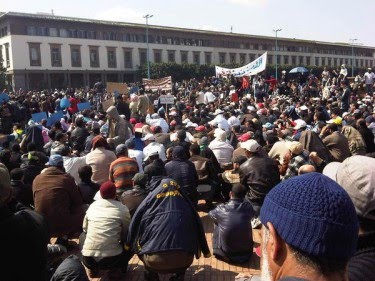
Protests in Casablanca's Mohammed V Square today drew thousands of Moroccans, as evidenced by the many photos and videos being posted online. Participants in the demonstration are demanding government reform and an end to corruption.

Yesterday my friend Melody, who joined us for part of our recent stay in Marrakech asked me "how long I thought it would take for things to explode in Morocco." She offered a hint to help me answer-- an English translation of an analysis by Professor Driss Ben Ali that is essential reading for anyone hoping to understand what's starting to happen in Morocco, as well as in the rest of the Arab world.
Regarding the issue of economic growth, let’s use the example of Tunisia. What happened in Tunisia? The growth rate was fine. Tunisia was mentioned as a model. Its growth rate was around 5%. The Moroccan growth rate is 3.9%. Tunisia was certainly considered the regional model. Suddenly it collapsed. Why is it?

The problem is as follows: Economies are not only about production, distribution is just as important. In Tunisia, production was indeed available. However, as far as distribution, Ben Ali and his family controlled all the wealth. Therefore the real issue is specifically an issue of distribution, regardless of your economic policy and production strength.

This happened several times in history. The last time it happened, it was in Iran. Under the Shah, the growth rate in Iran was 10%. They used to say that the Iranian economy would become the second Japan in Asia, yet, it collapsed! And the Islamic revolution took place. Therefore, when economies reach a strong growth rate, we start noticing social inequality. If our production policy is not accompanied by a policy of distribution, the consequences would be disastrous.

What is the main principle in economics? The principle is that our programs and policies are designed around social coherence, which requires that the inequality gap is not dangerously wide. When we speak of big projects, sure we have some great projects, but Morocco faces two main issues:

One, the legacy of Hassan II. When Hassan II passed away, 60% of Moroccans were illiterate, 5% lived on less than 2 dollars a day, 42% lived in extreme conditions. Therefore, the balance was very negative. During the mid-nineties, the campaign to fight poverty started.

In the last ten years, there were some efforts. Rural areas had better access to water and electricity. Under Hassan II only 12% of rural areas had such access. Today, we have reached 75%. Rural areas now have roads and better access to hospitals. Before, rural areas were completely marginalized, which resulted in rural exodus. Urban areas began to resemble rural areas. So, yes, the nineties witnessed a policy of poverty eradication, in addition to the implementation of the National Initiative for Human Development.

From the outset, this was a good initiative. However, the funds invested in this initiative were not very significant: 10 million, a drop of water in a big ocean.

Second issue: Big infrastructure projects don’t generate immediate returns. In the meantime, if the country does not have a policy of distribution, it will fail. Look at the February 20th protests, which cities encountered violence? Tangiers and Marrakech. These are in fact the two cities that witnessed the highest growth rate. These are also the two cities where the inequality gap is widest. It’s no surprise that the acts of violence happened in these two cities. This is a good indicator to take into account.

To reach a fair distribution of resources, the society has to exert pressure. What is democracy founded upon? Power and counter-power: that is the only way to limit power. Otherwise, look at all these countries that experienced uprisings. Tunisia, Egypt, and Libya: the presidents treated their country’s wealth as their own, because there were no limits. None held them accountable.

In our societies, we have not yet adopted the culture of evaluation. We need to evaluate all the government projects. Not just monitor the projects, but also evaluate their effectiveness. Monitor what is being done, and evaluate the results. This is nonexistent in our societies. Therefore, as soon as individuals are elected to a position and attain some power, they start acting as if power were a property. They begin to put their families and cronies in key positions. We then find ourselves faced with an economy of rent-seekers.

What is an economy of rent seekers? It’s when you have a revenue that doesn’t generate an added value, an economy that is basically non productive.  We are faced with parasites that live on someone else’s account. In our country, some people don’t work, yet they own a few license agreements that generate a good income (licenses to operate cab and bus companies provided by the king on an arbitrary basis). Some enjoy licenses to fish, others are granted licenses to sell alcohol. Who goes out to work in black markets? The ones who don’t have any of the above. At the end of the day, you find yourself in an economy built around parasites.

What a waste! Production is weak. Consumption is high, and each person is looking to take advantage of another. The economy does not generate wealth that benefits everyone. Those who do generate wealth are faced with high taxes. Entrepreneurs are the only ones who pay taxes, others don’t. People working in the black market don’t pay taxes. The black market constitutes 25% of the Moroccan market….and people in power don’t pay taxes either. So how do we create a coherent society? How do we create a strong and large middle class, a fundamental requirement to build a coherent society? How do we ensure political stability? It is not possible to have political stability without a strong large middle class, more transparency and the end of the economy of rent-seekers. This cannot be achieved through advisory councils. No, these are achieved through an authentic social pressure. The government should be held accountable, and the society should be in charge of monitoring. In a democratic society, everyone is held accountable, which explains why democratic societies harbor the most successful economies.

Reading this within the context of Nick Kristof's much-discussed NY Times column from this weekend, a look at Timur Kuran's book, The Long Divergence: How Islamic Law Held Back the Middle East, is a great way to fill in the knowledge gaps about what's happening in that part of the world-- and why speculators are driving your gas prices through the roof. I also recommend following the Global Voices blogger who focused like a laser beam on Morocco. Kristof:
Professor Kuran’s book offers the best explanation yet for why the Middle East has lagged. After poring over ancient business records, Professor Kuran persuasively argues that what held the Middle East back wasn’t Islam as such, or colonialism, but rather various secondary Islamic legal practices that are no longer relevant today.

It’s a sophisticated argument that a column can’t do justice to, but for example, one impediment was inheritance law. Western systems most commonly passed all property intact to the eldest son, thus preserving large estates. In contrast, Islamic law stipulated a much fairer division of assets (including some to daughters), but this meant that large estates fragmented. One upshot was that private capital accumulation faltered and couldn’t support major investments to usher in an industrial revolution.

Professor Kuran also focuses on the Islamic partnership, which tended to be the vehicle for businesses. Islamic partnerships dissolved whenever any member died, and so they tended to include only a few partners-- making it difficult to compete with European industrial and financial corporations backed by hundreds of shareholders.

The emergence of banks in Europe led long-term British interest rates to drop by two-thirds leading up to the Industrial Revolution. No such drop occurred in the Arab world until the colonial period.

These traditional impediments are no longer a problem in the 21st century. Muslim countries now have banks, corporations, and stock and bond markets, and inheritance law now isn’t an obstacle to capital accumulation. So if Professor Kuran’s diagnosis is correct, that should bode well for the region-- and Turkey’s boom in recent years underscores the potential for a renaissance.

Labels: ,