Saturday, November 16, 2019

Neither Mayo Pete Nor Anyone Else Is Going To Win The Democratic Nomination Without Support From African-Americans

>


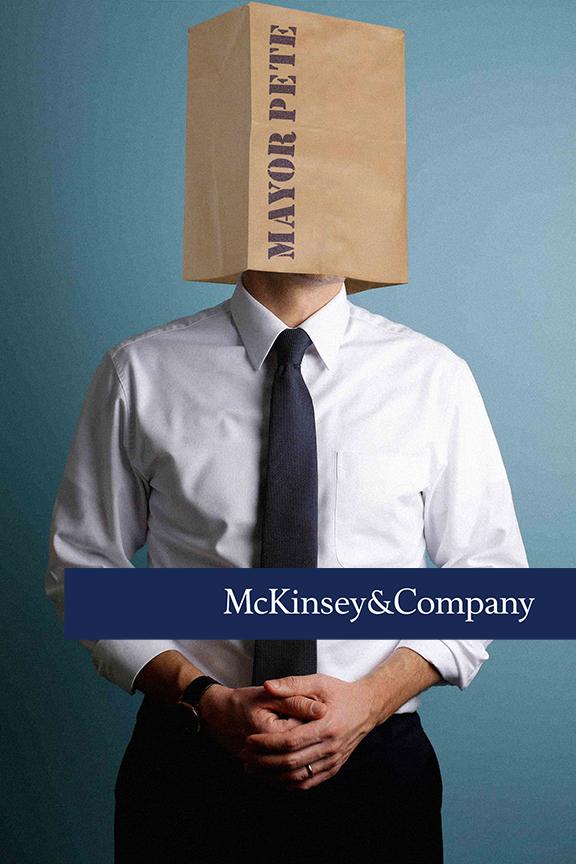
Henry Gomez, reporting for BuzzFeed News, noted yesterday that a pretty major piece of Mayo Pete’s very murky past "remains a mystery to voters. For nearly three years, he worked at McKinsey & Company, an elite management consulting firm with offices around the world. It was work that took him, he has said, to Iraq and Afghanistan. And for years after that, in his early campaigns for public office, Buttigieg held up his stint at McKinsey as a selling point and proof that he was a business-friendly Democrat, while only vaguely describing what he did and never revealing his clients. A deeper understanding of his time there a decade ago would be relevant to evaluating a 37-year-old mayor of South Bend, Indiana, who’s now trying to prove he has the experience to be president. But Buttigieg continues to keep most details a secret, citing a confidentiality agreement. He also now describes the job-- which informed his views on business issues-- as 'not something that I think is essential in my story.'... McKinsey has become known for working with authoritarian regimes and taking on other ethically complicated projects."


Ryan Grim was on Rising with Saagar Enjeti and Krystal Ball yesterday to talk about his exposé of Mayo's latest goof-up with black voters. Background: Mayo's South Carolina Real Clear Politics polling average is 4%, less than Tom Steyer's and Mayor Pete is generally considered to have pushed an agenda antithetical to the interests of minority communities in South Bend. But Mayo claims blacks don't like him because he's gay, a proposition that is actually make many black voters not like him for real.

Grim's exposé at The Internet Friday notes that Mayo "polls close to zero nationally with African Americans, faring no better with that vote in South Carolina, a liability that he knows will thwart his nomination if he can’t turn it around. In July, he released his campaign’s chief piece of policy outreach to black voters, called 'The Douglass Plan: A Comprehensive Investment in the Empowerment of Black America.' The plan covers everything from criminal justice reform to public health care, education, and beyond. It proposes using federal contracting rules to increase the amount of contracts going to minority- and women-owned firms to 25 percent, and offers student loan deferment and forgiveness to Pell Grant recipients who go on to start businesses that employ at least three people." Keep in mind that Grim refers to Mayo as Buttigieg.
Buttigieg has strived mightily to win support among the black community, especially on his home turf. His firing of South Bend’s first black police chief when he entered office in 2012 set off protests at the time, and Buttigieg wrote in his memoir that the controversy “affected my relationship with the African-American community in particular for years to come.” This past June, in the middle of his presidential campaign, Buttigieg returned home after a police officer gunned down a black man in South Bend. An exchange between a black constituent and Buttigieg at a tense demonstration has dogged his campaign ever since.

“You’re running for president, and you want black people to vote for you?” the woman said. “That’s not going to happen.”

“Ma’am, I’m not asking for your vote,” Buttigieg responded.

When pressed on the lack of black support, Buttigieg and his campaign have made repeated references to the Douglass Plan, named for abolitionist Frederick Douglass. “Our response to those who ask what our agenda for black America is, is the Douglass Plan.” Buttigieg said recently on CNN. “It is the most comprehensive vision put forward by a 2020 candidate on the question of how we’re going to tackle systemic racism in this country.”

To build support for the plan, Buttigieg and his staff lobbied prominent black South Carolinians to endorse it in order to strengthen the cause of racial justice. The Washington Post reported on Monday that “Buttigieg persuaded hundreds of prominent black South Carolinians to sign onto the plan even if they are not supporting Buttigieg himself.”

Along with his release of the plan, his campaign directed consultants to convene focus groups with undecided black voters in South Carolina. The resulting research memo, finalized in late July, concluded that Buttigieg’s sexuality was a “barrier” to winning support among black voters. The memo was leaked to the press this fall. Though the campaign has since denied that it was the source of the leak, the initial article about the memo, published on October 22 by McClatchy, includes on-the-record quotes from the Buttigieg campaign-- the type that customarily accompany a story that a campaign cooperates with.

Three days later, the Buttigieg campaign began promoting a list of 400 South Carolinian supporters of his Douglass Plan in emails to reporters and posts on social media.

Buttigieg traveled to South Carolina to spread awareness of the plan. The supporters were rolled out in a press release and open letter published in the HBCU Times-- which focuses on “positive news related to Historically Black Colleges and Universities.” Listed at the top of the press release were three prominent supporters, Columbia City Councilwoman Tameika Devine; Rehoboth Baptist pastor and state Rep. Ivory Thigpen; and Johnnie Cordero, chair of the state party’s Black Caucus.

“There is one presidential candidate who has proven to have intentional policies designed to make a difference in the Black experience, and that’s Pete Buttigieg,” read the open letter released along with the plan. “We are over 400 South Carolinians, including business owners, pastors, community leaders, and students. Together, we endorse his Douglass Plan for Black America, the most comprehensive roadmap for tackling systemic racism offered by a 2020 presidential candidate.”

The blowback came immediately. Devine, who has not endorsed a candidate yet in the presidential election, told The Intercept that she did not intend her support for the plan to be read as an endorsement for Buttigieg’s candidacy, and believes the campaign was “intentionally vague” about the way it was presented.

“Clearly from the number of calls I received about my endorsement, I think the way they put it out there wasn’t clear, that it was an endorsement of the plan, and that may have been intentionally vague. I’m political, I know how that works,” she said. “I do think they probably put it out there thinking people wouldn’t read the fine print or wouldn’t look at the details or even contact the people and say, ‘Hey, you’re endorsing Mayor Pete?’”

Asked if she knew if any of the black supporters of the plan were also supporters of Buttigieg, she said she wasn’t sure. “The only ones I really knew were me and Rep. Thigpen,” she said. “I don’t know many-- actually, now that I think about it, other than the folks working on Mayor Pete’s campaign, I don’t know of any local elected officials who have endorsed him yet.”


Thigpen, meanwhile, has endorsed Sen. Bernie Sanders for president, and was startled when he learned the campaign had not only attached his name to the plan, but also listed him as one of three prominent supporters atop the letter. “How it was rolled out was not an accurate representation of where I stand,” Thigpen told The Intercept. “I didn’t know about its rolling out. Somebody brought it to my attention, and it was alarming to me, because even though I had had conversations with the campaign, it was clear to me, or at least I thought I made it clear to them, that I was a strong Bernie Sanders supporter-- actually co-chair of the state, and I was not seeking to endorse their candidate or the plan. But what I had talked about was potentially giving them a quote of support in continuing the conversation, because I do think it’s a very important conversation.”

Thigpen said he thought rolling out the big list of supporters was intended to show broad support in the black community, despite the reality. The letter was published out of the blue, Thigpen said. “I actually had not circled back to give them a quote, so I was alarmed and very much surprised to see, particularly, the headline as such because I do think it muddies the water, I do think it was a misrepresentation, and it easily could have confused a lot of people as to where I stood. That was, from the very beginning, concerns that I expressed,” he said. Thigpen said he reached out to the Sanders campaign to let them know what had happened, and aides there said they would talk to the Buttigieg campaign.

Johnnie Cordero is no longer listed publicly as a supporter. When The Intercept reached him for comment, he explained that he had never endorsed the plan, nor has he endorsed Buttigieg. “I never endorsed that plan. I don’t know how my name got on there. No, that’s not true: I know how my name got on there,” Cordero began, before explaining that Buttigieg had emailed him the plan and asked for feedback, which began a conversation with Buttigieg’s staff.

“I had some difficulties with it,” Cordero said. “It’s entirely presumptuous,” Cordero went on, before pausing to ask if this reporter is black, gauging how honest to be about the racial dynamics. Told that no, the reporter is white, he nonetheless decided not to spare his feelings: “I’m not going to change what I’m going to say. It’s presumptuous to think you can come up with a plan for black America without hearing from black folk. There’s nothing in there that said black folk had anything to do with the drafting of that plan. Now I like Pete, please don’t get me wrong. I’ll help him in any way I can. I think he’s an honest man, I think he’s a decent man, I think he has integrity. I’d like to see him keep running. But you don’t do that. Those days are over and done with. We’re tired of people telling us what we need. You wanna find out what we need? Come and ask us.”

Cordero said he repeatedly asked Buttigieg’s staff for details on how the plan was developed. “What I was talking back and forth with them about was, who drafted the plan? I know Pete didn’t draft the plan. I’m sure he had his advisers do it. But I wanna know who was involved in this plan such that you can claim that you speak for black America. The long and the short of it was they never sufficiently answered my questions, so I never actually endorsed the plan. They went ahead and used my name,” Cordero said.

He said he did not complain directly to the campaign, but the campaign may have gotten word of his dissatisfaction. “I didn’t bother. Why? I don’t want to get involved in what we calling a pissing contest to be honest,” he said. “I’m a dyed-in-the-wool Democrat, I’m the chair of the Democratic Black Caucus, and I want all candidates to run, I want the biggest field possible, that’s how we get the best leadership. So I’m in a position where I don’t want to look like I’m going after anybody in particular and I didn’t want-- I’m just telling you because you asked.”

Cordero said that he didn’t want to seem like he was targeting Buttigieg. “I’m not gonna make a stink out of it. I don’t want to harm his campaign, and I don’t wanna look like I’m harming his campaign,” he said.

Indeed, he said, he was recently asked to come on CNN and talk about Buttigieg’s sexuality, but said that it was of no concern to voters in South Carolina. “I don’t care what people are telling you, we’re not that small-minded,” he said he told the cable host. “Nobody cares who he’s married to. We wanna know if he’s the kind of person who can carry the message and if he’s going to be an effective president. They got me off in three minutes. They don’t want to hear that. They thought I was gonna come on and trash him. I’m not trashing anybody, I’m sorry.”

Aside from not supporting Buttigieg, many of the South Carolinian signees share another quality, as well: They’re not black.

The campaign hasn’t publicly claimed that every supporter of the plan listed is African American, though it wouldn’t be hard to draw that implication: It was published in the HBCU Times, and the bylines and top-listed supporters are all black. To be sure, a multiracial coalition would be needed to push the Douglass Plan through Congress, but the campaign didn’t say that, either.

After publication, the Buttigieg campaign said it had sent the plan to the list of supporters and asked them to opt out if they did not want their name included on the list. That email also specified that the list was meant to represent “over 400 Black South Carolinians.”
That was a typical McKinsey-type lie that Mayo deploys constantly. Most of the list is white people, not black people and several names are just made up or listed more than once.


Labels: , , , ,

Friday, November 01, 2019

Mayo Pete May Be Better Than Trump, But That Bar Is Far Too Low When Picking The Best Nominee

>


A new poll from Morning Consult has some not so great news for Mayo Pete. Between October 25 and 28, pollsters asked registered voters a number of questions. Some were very standard, like Trump's job approval-- 55% disapprove (43% strongly) and 43% approve, and like who they would vote for if the election was today-- 39% Trump and 52% someone other than Trump. Individual matchups showed both Biden and Bernie beating Trump, but not Buttigieg. That match up looks ominous:
Trump- 35%
Mayo Pete- 29%
undecided- 36%
It was the worst number for any of the Dems who might conceivably face off against Trump. And the next series of questions helps explain why:

1- Do you think America is ready for a president who is gay or lesbian?
Yes, definitely- 19%
Yes, probably- 21%
No, probably not- 21%
No, definitely not- 24%
Don't know- 15%
2- Do you think YOU are ready for a president who is gay or lesbian?
Yes, definitely- 33%
Yes, probably- 17%
No, probably not- 13%
No, definitely not- 24%
Don't know- 13%
So, 50% say they are more or less ready for a gay or lesbian president. (Asked if their neighbor are ready for a gay or lesbian president, only 26% said yes.) These numbers stack up badly when viewed about how voters look at most other groups:
73% are ready for a woman president
65% are ready for a Hispanic president
71% are ready for an unmarried president
45% are ready for an agnostic or nonreligious president
71% are ready for a president who is vegan.
(There was no question about if people or their neighbors are ready for a vegetarian president or a president who believes he has been accosted by interplanetary aliens.)

Morning Consult vice president Tyler Sinclair: Mayo Pete's sexuality "may be an issue for some voters as he remains in contention for the 2020 Democratic presidential nomination. Notably, 58% of Republicans, 32% of independents and 22% of Democrats say they aren’t ready for a gay or lesbian president. The comparative figures not ready for a female president are 36% of Republicans, 15% of independents and 8% of Democrats."


Opposing Mayo Pete because he's gay seems backward and primitive... especially when there are much better reasons to oppose him-- and I'm not even talking about how he spent most of his life living a lie as a closet case. No, I'm talking about another lie he lived: a consultant for McKinsey. Noe that's a reason to keep anyone out of elective office, let alone the presidency. And Team Mayo has finally figured that out and are vigorously trying to put that aspect of his bio back in the closet!

Daniel Strauss, reporting for Politico noted that Mayo Pete doesn't bring up his days at McKinsey the way he used to. Strauss wrote that "For years, Buttigieg’s stint at McKinsey & Company, the international management consulting firm, formed a key part of his political biography-- from selling Hoosiers on his “experience around economics and business” as a green, 28-year-old candidate for Indiana state treasurer to talking earlier this year about the “perspective” he gained as part of the business world. But the resume line has faded from Buttigieg’s stump speech amid revelations about McKinsey’s work with authoritarian governments and growing skepticism of large corporations. It’s unclear exactly what Buttigieg did in those formative years in business before he launched his political career. The South Bend, Indiana mayor has previously said he worked on projects involving renewable energy, “war zone economic development” and grocery prices, but a shroud of confidentiality covers most of McKinsey’s activities. What Buttigieg does say now is that the company has changed from the one he knew."

Mayo will never cop to it, of course, but the McKinsey teaches it's teams of robots is how to lie convincingly with a straight face-- the way Mayo Pete does on the stump. McKinsey is like a cult-- but far more dangerous and invasive than most cults turn out to be.


"I think they've made a lot of poor choices, especially in the last few years," Buttigieg said on the campaign trail in Iowa recently. "I left about 10 years ago, but it's really frustrating as somebody who worked there to see some of the decisions they've made."

Former colleagues at McKinsey saw Buttigieg’s stint at the company as a possible stepping stone a decade ago. One coworker recalled him expressing particular interest about workforce development projects in his home state.

"He was always clear from the beginning that his longer-term aspirations were to work in public policy and government," a former McKinsey colleague said.

The company formed part of his pitch when Buttigieg jumped into his first audacious political campaign: a statewide run in Indiana at the height of the tea party. In 2010, when Buttigieg challenged the Republican state treasurer, Richard Mourdock, he said, "My background fits this office."

"I'm young, but have a lot of experience around economics and business,” Buttigieg told The Times of Frankfort, Indiana.


That same year, in an interview with Indiana’s NPR affiliate, Buttigieg said he was “a professional geek” while at McKinsey where he did “a number of different kinds of analysis.” And seven years later, fresh off a failed run for chairman of the Democratic National Committee, Buttigieg again told David Axelrod, the former Obama strategist who has since become an informal sounding board for Buttigieg’s campaign, about how his McKinsey experience had paid dividends in his political career.

"I had to build a whole database, and that was when I learned about how big data works," Buttigieg said in a podcast interview. "Relational databases, a lot of stuff that's surprisingly-- has served me well as mayor and in the campaign world. And I learned how to work under a huge amount of pressure."

Buttigieg added: "The only reason I couldn't stick with it was I had trouble caring about something ... because it was my job, because I was being paid to care about something. And so even though I loved-- I thought the work was fascinating. I loved my colleagues, certainly paid very well. But I remember a moment in particular when I was working on this client studying, I got up to get a cup of coffee and I thought, I don't care."

More pointed objections to McKinsey and its work came along later. In April, during an interview with the New Yorker’s David Remnick, the magazine editor pressed the candidate on the news that McKinsey advised Purdue Pharma, a pharmaceutical company accused of exacerbating the national opioid crisis, on selling OxyContin.

Buttigieg responded, “The firm needs to be a lot more selective and a lot more thoughtful in the work that it does.” And when interviewed again by Remnick in October, Buttigieg said “it’s infuriating to see the choices that they’ve made” since he left the firm.


Labels: , ,

Saturday, August 03, 2019

Stop Calling Conservatives "Moderates." They're Not

>


Unless you're new here, you know the misuse of the word "moderate" to describe conservatives is a pet peeve of this blog's. I was happy to see someone else tackle the topic this week-- Norman Solomon for Common Dreams: There’s Nothing Moderate About "Moderates." A Primary Example Is Joe Biden. "Biden’s record of words and deeds is 'moderate,'" wrote Solomon, "only if we ignore the extreme harm that he has done on matters ranging from civil rights and mass incarceration to student debt and the credit card industry to militarism and war." I was delighted-- am delighted--to see someone as pissed off as I am by the media cabal's expropriation, some consciously, others unconsciously, of a positive-sounding word like "moderate" to use as a weapon against progressives.
As a practical matter, in the routine lexicon of U.S. mass media, "moderate" actually means pro-corporate and reliably unwilling to disrupt the dominant power structures. "Moderate" is a term of endearment in elite circles, a label conferred on politicians who won't rock establishment boats.

"Moderate" sounds so much nicer than, say, "enmeshed with Wall Street" or "supportive of the military-industrial complex."

In the corporate media environment, we're accustomed to pretty euphemisms that fog up unpretty realities-- and the haze of familiarity brings the opposite of clarity. As George Orwell wrote, language "becomes ugly and inaccurate because our thoughts are foolish, but the slovenliness of our language makes it easier for us to have foolish thoughts."

If Joe Biden is a "moderate," the soothing adjective obscures grim realities. The framing was routine hours after the debate Wednesday night when the front page of the New York Times began its lead story by reporting that Biden "delivered a steadfast defense of his moderate policies in the Democratic primary debate."

But, how are policies really "moderate" when they perpetuate and increase extreme suffering due to vast income inequality? Or when they support U.S. wars causing so much death and incalculable anguish? Or when they refuse to challenge the fossil-fuel industry and only sign onto woefully inadequate measures in response to catastrophic climate change?

Biden's record of words and deeds is "moderate" only if we ignore the extreme harm that he has done on matters ranging from civil rights and mass incarceration to student debt and the credit card industry to militarism and war.

Although Biden again tangled with Kamala Harris during the latest debate, she is ill-positioned to provide a clear critique of his so-called "moderate" policies. Harris has scarcely done more than he has to challenge the systemic injustice of corporate domination. So, she can't get far in trying to provide a sharp contrast to Biden's corporate happy talk on the crucial issue of healthcare.

Harris began this week by releasing what she called "My Plan for Medicare for All." It was promptly eviscerated by single-payer activist Tim Higginbotham, who wrote for Jacobin that her proposal would "further privatize Medicare. . . keep the waste and inefficiency of our current multi-payer system. . . cost families more than Medicare for All. . . continue to deny patients necessary care" and "fall apart before it's implemented."

In keeping with timeworn rhetoric from corporate Democrats, Harris repeatedly said during the debate that she wants to guarantee "access" to healthcare-- using a standard corporate-friendly buzzword that detours around truly guaranteeing healthcare as a human right.

No matter whether journalists call Harris "moderate" or "progressive" (a term elastic enough to be the name of a huge insurance company), her unwillingness to confront the dominance of huge corporations over the economic and political life of the USA is a giveaway.

Whatever their discreet virtues, 18 of the 20 candidates who debated this week have offered no consistent, thoroughgoing challenge to corporate power. Among the contenders for the Democratic presidential nomination, only Bernie Sanders and Elizabeth Warren are providing a coherent analysis and actual challenge to the realities of corporate power and oligarchy that are crushing democracy in the United States.
And let's not leave out the other faux-moderate in the race, Mayo Pete. Wall Street certainly isn't. The guiding hand of Big Money has opened the coffers to the 3 conservative candidates in the primary they judge as possible nominees: Status Quo Joe, Mnuchin's pal Kamala Harris and Mayo, formerly known as McKinsey Pete, McKinsey as in the elitist cult he used to work for and was completely molded by, molded so he knows exactly how to legitimize mass layoffs with an innocent, sympathetic smile on his face. Like Status Quo Joe and Kamala, Mayo will never challenge the status quo. Biden was the only one stupid enough to admit it out loud, but all 3 candidacies are a backup against any kind of fundamental change.


After graduating Oxford, any career path in the world was open to him, and Buttigieg chose McKinsey & Company, the cult-like management consulting firm. Buttigieg writes in his memoir, Shortest Way Home, that he became a consultant because he “wanted to get an education in the real world.” The real world exists in many places on this planet; McKinsey & Company is not one of them. People seek to join the world’s number one consulting behemoth to secure a place in the ranks of the American elite.

In 1993, Fortune magazine put it this way: “These fellows from McKinsey sincerely do believe they are better than everybody else. Like several less purposeful organizations-- Mensa, Bohemian Grove, Skull and Bones, the Banquet of the Golden Plate-- McKinsey is elitist by design.”

The firm has produced at least 70 Fortune 500 CEOs. Buttigieg’s three-year stint is par for the course at an organization that takes pride in “counseling out” 4 in 5 hires before they become partner. They then proudly join what McKinsey calls its “alumni network,” and what Duff McDonald, author of The Firm: The Story of McKinsey and Its Secret Influence on American Business, calls “the McKinsey Mafia.” As they fan out among the world’s C-suites and B-suites, they remain McKinsey loyalists. “There is no McKinsey boneyard, in other words; you’re still McKinsey after you’ve left,” McDonald writes. “Perhaps the only alumni network with more reach and life.

McKinsey’s internal churn fits perfectly with the company’s consulting philosophy. McKinsey, which in 2003 advised 100 of the world’s top 150 firms, “may be the single greatest legitimizer of mass layoffs,” writes McDonald. “Its advice: Identify your bottom 10 percent or 25 percent or 33 percent, and get rid of them as soon as possible.”

McKinsey is also an infamous mercenary for the world’s most unethical corporations and authoritarian governments, from China to Saudi Arabia. McKinsey allegedly advised Purdue Pharma, the progenitor of today’s opioid crisis, on how to “turbocharge” OxyContin sales and keep users hooked.

“We are now living with the consequences of the world McKinsey created,” writes a former McKinsey consultant in an exposé for Current Affairs. “Market fundamentalism is the default mode for businesses and governments the world over.”

So what kind of presidency would the McKinsey mindset produce? Former McKinsey consultant Anand Giridharadas observes, in Winners Take All: The Elite Charade of Changing the World, business consultants ignore how political and economic power actually works. “These elites believe and promote the idea that social change should be pursued principally through the free market and voluntary action,” Giridharadas writes. “And that the biggest beneficiaries of the status quo should play a leading role in the status quo’s reform.”


As McKinsey comes under heavier scrutiny for its role in the crimes of governments and powerful corporations, any “progressive” who worked there and wants to be taken seriously should have a rather critical perspective. Buttigieg has shown no such reflection. Instead, he calls his time at McKinsey his most “intellectually informing experience”; he left only because it “could not furnish that deep level of purpose that I craved.” Buttigieg has said he didn’t follow the story of McKinsey’s OxyContin push. On McKinsey’s Saudi and South African government ties, he said: “I think you have a lot of smart, well-intentioned people who sometimes view the world in a very innocent way. I wrote my thesis on Graham Greene, who said that innocence is like a dumb leper that has lost his bell, wandering the world, meaning no harm.”

This excuse is remarkable. Buttigieg suggests that the savvy Harvard grads who populate McKinsey are childlike innocents who simply don’t notice they’re working for Mohammed bin Salman.

It is not terribly surprising that Wall Street has embraced Buttigieg, a product of their world. But anyone who hopes to be president should have a better-tuned moral sense. They should have no doubt where they stand on that old labor question, “Which side are you on?” Buttigieg’s roots in elite consulting suggest, at best, he doesn’t know; at worst, that he’s chosen poorly.


Labels: , , , , , , ,

Saturday, July 27, 2019

Mayo Pete

>


Last week, someone suggested I switch from using "McKinsey Pete" to "Mayo Pete." Not everyone understood the McKinsey reference and Mayo seems to capture the candidate pretty well. I took the advice and-- BOOM!-- the New York Times was out with their blockbuster report that defined McKinsey really well-- McKinsey Advised Johnson & Johnson On Increasing Opiod Sales. And it isn't just Johnson & Johnson. The now-notorious Purdue Pharma also hired McKinsey to help them figure out how to get more Americans addicted to opioids to help their bottom line. Despite the Times report, no one from Johnson & Johnson, Purdue or McKinsey has been arrested yet. McKinsey hasn't even been sued yet.

On Friday, Kaiser Health New reported that "Court cases over the opioid epidemic are putting an embarrassing spotlight on McKinsey's strategic advice that's usually kept strictly behind a curtain. One lawsuit stated that McKinsey advised a pharmaceutical company to 'get more patients on higher doses of opioids' and study techniques 'for keeping patients on opioids longer.'"

Walt Bogdanich's Times piece informs his readers that "At the global consulting firm McKinsey & Company, the rule is sacrosanct: Never publicly disclose client advice. And for the most part, adherence to that rule has served the company well. But in recent months, as government officials seek to assign blame for the opioid crisis that has strangled large parts of the nation, McKinsey’s advice is surfacing in ways that are deeply embarrassing for the influential firm, whose clients include many of the world’s most admired companies."

I've been trying to make the case that his time at McKinsey is what has made me so distrustful of Pete-- and that's why I gave him that nickname. When I worked at Warner Bros, TimeWarner hired McKinsey to help us improve the business. After a few weeks of being annoyed by their presence and getting complaints from virtually all of my senior management, I kicked them out of the part of the building my company occupied. TimeWarner was angry but I didn't back down and, eventually, they just let it go. As consultants, they were full of shit, manufacturing problems to solve. Everyone I met from the firm was a smooth-talking bullshit artist-- way slicker than Trump will ever be, but equally repulsive.


Michael Sean Winters penned a column for the National Catholic Reporter about a month ago, Buttigieg won't win the nomination, and that's a good thing during which he explains why he doesn't think it would be a good thing for Pete to win the nomination. "What is my biggest reservation about Mayor Pete? At 37, he has an astonishingly full resume: mayor, Rhodes scholar, military service, learning a bunch of languages, playing the piano. More than one person has pointed out to me that being so accomplished at such a young age is characteristic of a certain type of Harvard grad and Rhodes scholar: They believe their principal job is résumé-building. And that is not really a quality we want in a president."
One item on his résumé also will prove very difficult for the Democratic Party primary electorate to swallow: After returning from Oxford, Buttigieg went to work at the McKinsey & Company consulting firm. McKinsey is to early 21st-century capitalism what the Pinkertons were to the late 19th-century iteration. Consulting firms do not do the killing these days, they only provide the information, values-free, that permits their clients to do the killing. Recently they made news for advising Purdue Pharma to "turbocharge" its sales of opioids. The company has long-standing ties with Saudi Arabia, and a report they did may have helped the Saudi government identify dissidents who were subsequently imprisoned or worse. McKinsey makes a great deal of money helping authoritarian governments burnish their image, and the firm was undisturbed about holding its 2018 company retreat four miles from a Chinese internment camp for ethnic Uighurs. The Uighurs can't afford McKinsey's fees, but the Chinese government can.

Buttigieg's time working in the belly of the capitalist beast has not led him to question what could pass for pre-Reaganesque GOP economic policy. His comments about economic policy are mostly platitudinous and conventional, but it is clear he does not share the suspicions of contemporary capitalism held by many of his fellow Democrats. At a CNN town hall last month, when asked about the challenge big corporations pose to the country, he said, "The biggest problem that I have with corporate America is the way that concentrations of wealth and corporate power have turned into concentrations of political power." Is that the "biggest problem?" Isn't it the concentration of wealth and consequent income inequality-- full stop-- that is the problem? Tackle that and you will simultaneously take care of the problem of undue political influence.

...The last thing the Democratic Party needs is another neo-liberal over-achiever who promises to bring the country together... The Democrats, and the country, do not need Buttigieg. They need a candidate who knows Sen. Mitch McConnell is not interested in bringing the country together, that the economy remains structured in ways that trap working class Americans into a series of bad options, with many bad consequences for our democracy and our society, and someone who will fight to change that. Going after Donald Trump with the young, gay, Democratic answer to Jeb Bush is not the way to beat Trump.
Not everyone hates Mayo. The Wall Street banksters see Pete as their guy when Biden self-destructs and they've been giving him beaucoup bucks. "Buttigieg, who led the Democratic fundraising battle in the second quarter with a $24.8 million haul, had some help from Wall Street in hitting that milestone," reported CNBC. "Richard Zinman, an executive director at J.P. Morgan, gave Buttigieg $2,000 in late April. James Mahoney, the head of global communications and public policy at Bank of America, gave the same amount to Buttigieg’s 2020 campaign in June. One former chief at Goldman who has given to all three candidates is Bob Rubin, who worked at the bank for over two decades and later became Treasury secretary under President Bill Clinton. He gave a total of $8,400 to Biden, Buttigieg and Harris."

But it isn't just banksters who like Mayo. The many, many brainless among Hollywood celebs dig him too. Bridget Read, reporting fro New York Magazine, asked "Who is Hollywood’s 2020 Democratic candidate? Is it Rosario Dawson’s bald beau Cory Booker? Is it Marianne Williamson, the Maryam Nassir Zadeh–wearing, self-proclaimed 'bitch for God?' Is it Bernie Sanders, of the Three Sanders Sisters (Shailene Woodley, Susan Sarandon, and Sarah Silverman), beloved also by Ms. Belcalis Marlenis Almanzar? Could it be onetime-Beyoncé-endorsed Beto O’ Rourke, who, if you will recall, was in a band?" And then she answers her own question, not particularly correctly.
No, it’s none of them (and it’s obviously not Bill de Blasio, who has the loyal support of only Steve Buscemi). The celebrities have anointed Pete Buttigieg, the docker-clad, multilingual, gay, ex-military mayor of South Bend, Indiana, who lost steam in the mainstream press after his somewhat prematurely characterized “meteoric rise” earlier in the year, but who has gained momentum among the people who know the least about anything to do with real life. That’s right-- he’s been touched by an angel, and the angel is Gwyneth Paltrow, and by touched I mean she gave him money and invited him over.

Filings released by the 2019 Federal Election Commission this week show that Mayor Pete was in second place this quarter behind only Bernie Sanders, raising $24.9 million from individual donors. GP is chief among them: This quarter she gave him $2,800 dollars, after hosting him for a fundraiser in May with The West Wing’s Bradley Whitford. It is unknown whether she and husband Brad Falchuk toasted Mayor Pete and his husband Chasten with fresh juice and served miniature dumplings made out of cabbage leaves but one can only hope.

In addition, Buttigieg received donations from Anna Wintour ($2,800), Mandy Moore ($3,818.86), Tom Ford ($5,600), Larry and Cazzie David ($2,800 each), Kevin Bacon ($2,800), Michael J. Fox ($2,800), Frances McDormand ($3,000), Matt Bomer ($2,800), Jeffrey Katzenberg ($2,800), Marilyn Katzenberg ($2,800), and John Stamos ($1,000). Other donors include Jennifer Aniston, Sean Hayes, Caroline Kennedy, Ryan Murphy, Ted Danson, Sharon Stone, and George Takei.

Celebs have given to other candidates this quarter too, of course-- Amy Schumer, Rosie O’Donnell, Scarlett Johansson, Ryan Reynolds, Bette Midler, and Shonda Rhimes have all supported Elizabeth Warren; and Rita Wilson, Emma Roberts, Jennifer Garner, Don Cheadle, Lily Tomlin, Leslie Odom Jr., and Cecily Strong gave to Kamala Harris. But Buttigieg’s surge in second quarter cash is surprising given his fairly stagnant poll numbers and his lack of name recognition (the other top contenders are already sitting U.S. senators).

So, why Mayor Pete? It seems like it would make the most sense for Williamson to receive Hollywood’s adoration, just going off her credentials alone: She’s a lifestyle guru who used to live with Laura Dern. Maybe it’s that Williamson is simply too spicy, and they can’t pick one of their own or they would be accused of being unserious, wacky, and out of touch.

Perhaps it’s that Buttigieg has the lack of experience maverick appeal of an outsider that celebrities so desperately crave. They can feel like they’re throwing their weight behind an underdog yet he’s also incredibly palatable, with a cute husband and their dog living in a remodeled Victorian house. But he also served in the military? Fun! He speaks Norwegian? Chic! And he doesn’t talk about how rich people are the problem all the time? Now that is refreshing.

Labels: , , , ,