Friday, March 27, 2020

The Bill, The Bill, The Bill... And, Don't Forget For A Moment That The Bill Will Come Due

>


The House passed the $2.2 trillion Wall Street bailout, filled with goodies for corporate America, by voice vote today-- but not before Trump lost his shit on Twitter this morning when someone told him Thomas Massie (R-KY) had decided to force a roll call vote. Here's a narrative version of Massie's tweet storm after being savaged by Señor Trumpanmzee (above), who is now likely to back Massie's very right-wing primary supporter, Todd McMurtry. "I swore an oath to uphold the constitution, and I take that oath seriously," he began. "In a few moments I will request a vote on the CARES Act which means members of Congress will vote on it by pushing 'yes' or 'no' or 'present.'" Actually, what it means is that every member of the House might have had to go on record as being for it or against it, something both Pelosi and McCarthy wanted to avoid-- and were able to. And it meant that enough members of Congress had to drag their asses back to DC to give leadership a quorum. It's Pelosi's own fault that she refused to pay attention to the Members who have been urging her to institute remote voting during the pandemic. Back to Massie:
The Constitution requires that a quorum of members be present to conduct business in the House. Right now, millions of essential, working-class Americans are still required to go to work during this pandemic such as manufacturing line workers, healthcare professionals, I am not delaying the bill like Nancy Pelosi did last week. The bill that was worked on in the Senate late last week was much better before Speaker Pelosi showed up to destroy it and add days and days to the process. This bill should have been voted on much sooner in both the Senate and House and it shouldn’t be stuffed full of Nancy Pelosi’s pork-- including $25 million for the Kennedy Center, grants for the National Endowment for the Humanities and Arts, and millions more other measures that have no direct relation to the Coronavirus Pandemic. That $25 million, for example, should go directly to purchasing test kits. The number one priority of this bill should have been to expand testing availability and creation of tests so that every American, not just the wealthy and privileged, have access to testing. We have shut down the world’s economy without adequate data. Everyone, even those with no symptoms, needs immediate access to a test. This bill creates even more secrecy around a Federal Reserve that still refuses to be audited. It allows the Federal Reserve to make decisions about who gets what, how much money we’ll print. With no transparency. If getting us into $6 trillion more debt doesn’t matter, then why are we not getting $350 trillion more in debt so that we can give a check of $1 million to every person in the country? This stimulus should go straight to the people rather than being funneled through banks and corporations like this bill is doing. 2 trillion divided by 150 million workers is about $13,333.00 per person. That’s much more than the $1,200 per person check authorized by this bill."
Oh, look-- two mega-rich worthless Wall Street suck-ups agree with each other that Massie is a bad, bad boy:


Massie amigo and fellow Libertarian, Justin Amash, who fled the Trump version of the GOP and became the House's only Independent, defended him in a twitter battle with Trump-worshipping Texas Republican Dan Crenshaw. Amash tweeted "Crenshaw has learned a lot from Donald Trump during his time in Congress. He mischaracterizes a $500 billion corporate welfare fund that will mostly benefit a few large corporations hand-picked by government. Then, when called on it, he changes the topic and calls others liars."


The Washington Post, as always, spoke for the ruling class Establishment: Mike DeBonis with a quintessential Postism: "The scores of lawmakers who rushed back to Washington Friday to secure passage of a $2.2 trillion rescue bill expressed shock and dismay at having to defy the advice of experts and risk their health amid a global pandemic that has already killed more than 1,000 Americans. But many were not surprised at which of their colleagues forced them to do it. During his seven years in Congress, Rep. Thomas Massie (R-KY) has established a reputation as a uniquely irascible congressional gadfly-- one who is frequently at odds with his own party’s leadership, rarely votes for major bills negotiated with Democrats, and, to make an ideological point, is willing to use the House rule book to inconvenience his colleagues. Now, with the coronavirus pandemic threatening the nation, many believe Massie has gone well beyond inconvenience into threatening the health-- and potentially the lives-- of lawmakers and staff. And while Massie’s GOP colleagues have long grumbled about his tactics, he has now attracted the scorn of the most powerful Republican: President Trump. Massie opposes the rescue bill on fiscal and constitutional grounds and threatened ahead of a planned voice vote Friday to require a quorum be present-- 216 members, half the House. Trump called him a 'third-rate Grandstander' on Twitter Friday. 'He just wants the publicity. He can’t stop it, only delay,' he said, calling on voters to 'throw Massie out of Republican Party!'"


Suicide Is Painless


There's disagreement on the left as well. Matt Stoller, writing for The Guardian this past Sunday, said it most clearly-- and most disturbingly: America will be unrecognizable after this pandemic if big corporations walk away with trillions of dollars and no strings attached.
Now, I’m not opposed to supporting industries. This is a crisis, and we do not want a lot of the productive capacity of the United States to fall apart because of a pandemic. But the key to supporting enterprises is to make sure that there are strict conditions, so that power doesn’t consolidate into the hands of monopolists and financiers cherry-picking distressed assets. Otherwise, America will simply be unrecognizable after this pandemic. CNBC personality Jim Cramer, for instance, is worried that after this pandemic America will have just three retailers. And he’s right to be worried about that.


Here’s how we can stop it. There are enough members of Congress to act and prevent what really looks less like a relief package and more a corporate coup. However, the problem is that this group is split into different political parties, and Congressional leadership is taking advantage of that dynamic to jam this through. US Senate majority leader Mitch McConnell wants big business to rule, so he’s playing a trick. He is refusing aid to workers. Democrats are negotiating with him to try to get unemployment assistance and social welfare. McConnell knows Democrats won’t pay attention to corporate bailouts if he takes the public hostage, and Democrats know that they can hand out favors to big business if they just talk about how they got larger checks for workers.
Congressional Progressive Caucus co-chair Pramila Jayapal, in the lead-up to the vote, said she's able to overcome her instincts about the very things Stoller is most worried about. Her own state, Washington "is reeling from the spread of COVID-19, and I have worked tirelessly to ensure the federal government steps up and responds to this crisis."
This bill is an important step forward. It significantly expands unemployment insurance benefits for laid-off and furloughed workers, puts money directly into the pockets of struggling working people and families, provides critical relief in the form of emergency grants and forgivable loans to devastated small businesses and nonprofits, infuses cash into strained local and state governments and health care systems, increases the amounts of personal protective equipment in the Strategic National Stockpile, and supports struggling industries that do right by their employees.

It is not perfect and there is far more Congress must do to do to fully meet our obligation to our constituents. We need to get more money to our health care system, states and localities, guarantee testing and treatment for everyone, expand benefits to those that have been left out and protect the health and safety of people in the criminal justice and immigration detention systems. Congress must also conduct vigorous oversight of industry assistance to ensure taxpayer dollars are used to support workers, not to further inequality.

We are already at work immediately on the next package to ensure it includes provisions we fought for but did not get this time. This is a crisis of epic proportions and we must continue to do everything we can to respond with the scale sufficient to meet the suffering of people across our country. I am proud to represent a district and a state with so much compassion and commitment, and I will continue to fight for all my constituents as we weather this together.
AOC, in the other hand, feels that the House could work a little harder before being stampeded into a bill so foul.


I don't know what to make of these three pictures from a #1 best selling book, The Eyes of Darkness written by Dean Koontz four decades ago and published in 1981. Amazing coincidence... right? CNN has already debunked it as a conspiracy theory. So has Snopes, based on the purported origin of the disease. OK.


Labels: , , , , , , , ,

Sunday, March 22, 2020

Government Must Help People DIRECTLY-- Not Through Grasping Big Business Crooks

>


This morning, Naked Capitalism carried a piece by economist Michael Hudson on the ramifications of the pandemic on the U.S. economy. Hudson explained how to escape from catastrophe by looking at a biblical perspective.
The word “Jubilee” comes from the Hebrew word for “trumpet”-- yobel. In Mosaic Law, it was blown every 50 years to signal the Year of the Lord, in which personal debts were to be canceled. The alternative, the prophet Isaiah warned, was for smallholders to forfeit their lands to creditors: “Woe to you who add house to house and join field to field till no space is left and you live alone in the land.” When Jesus delivered his first sermon, the Gospel of Luke describes him as unrolling the scroll of Isaiah and announcing that he had come to proclaim the Year of the Lord, the Jubilee Year.

Until recently, historians doubted that a debt jubilee would have been possible in practice, or that such proclamations could have been enforced. But Assyriologists have found that from the beginning of recorded history in the Near East, it was normal for new rulers to proclaim a debt amnesty upon taking the throne. Instead of blowing a trumpet, the ruler “raised the sacred torch” to signal the amnesty.

It is now understood that these rulers were not being utopian or idealistic in forgiving debts. The alternative would have been for debtors to fall into bondage. Kingdoms would have lost their labor force, since so many would be working off debts to their creditors. Many debtors would have run away (much as Greeks emigrated en masse after their recent debt crisis), and communities would have been prone to attack from without.


The parallels to the current moment are notable. The U.S. economy has polarized sharply since the 2008 crash. For far too many, their debts leave little income available for consumer spending or spending in the national interest. In a crashing economy, any demand that newly massive debts be paid to a financial class that has already absorbed most of the wealth gained since 2008 will only split our society further.

...In the past, the politically powerful financial sector has blocked a write-down. Until now, the basic ethic of most of us has been that debts must be repaid. But it is time to recognize that most debts now cannot be paid-- through no real fault of the debtors in the face of today’s economic disaster.

The coronavirus outbreak is serving as a mind-expansion exercise, making hitherto unthinkable solutions thinkable. Debts that can’t be paid won’t be. A debt jubilee may be the best way out.


Over the last couple of years, no one has written more cogently than Matt Stoller about the politics of monopoly. His book, Goliath: The 100-Year War Between Monopoly Power and Democracy should be required reading for a literate electorate. Last night, he wrote-- with a sense of urgency-- that "Congressional leaders are likely to put a very ugly deal in front of the American people, and if it passes, America may be unrecognizable after this pandemic. But there is a way to stop it, if people on the populist left and people on the populist right work together." Please pay attention:

You can't filibuster COVID-19

Here's the situation. Mitch McConnell, Chuck Schumer, and the Trump administration is negotiating a bailout package to address the coronavirus crisis. There's been a lot of chatter about the need to support workers as the economy goes into a freeze. This is happening around the world; the British government, for instance, is willing to pay 80% of worker wages during this downturn for those affected by the crisis.

But in the U.S., our leaders seem to be falling prey to what can only be called a corporate frenzy of favor-seeking. “Any time there is a crisis and Washington is in the middle of it is an opportunity for guys like me," said one lobbyist.

Now first I should say that I don’t know exactly what is going to be in the final bill, because the whole process is opaque and being negotiated right now by some untrustworthy political leaders. We will only find out the details at the last minute. So all I have to go off is rumor and reporting. But if we wait until we know the full contours, it will likely be too late to act. I hope I’m wrong, but the list of what lobbyists are asking for is long, and ugly, and often the requests for money or legislative favors are done to cover up mistakes made before the coronavirus hit.

Take Boeing. The aerospace giant of course wants a $60 billion bailout. Financial problems for this corporation predated the crisis, with the mismanagement that led to the 737 Max as well as defense and space products that don't work (I noted last July a bailout was coming). The corporation paid out $65 billion in stock buybacks and dividends over the last ten years, and it was drawing down credit lines before this crisis hit. It is highly politically connected; the board of the corporation includes Caroline Kennedy, Ronald Reagan’s Chief of Staff Ken Duberstein, three Fortune 100 CEOs, a former US Trade Representative, and two Admirals, one of whom is the board’s only engineer. Using the excuse of the coronavirus, Boeing is trying to get the taxpayer to foot the bill for its errors, so it can go back to making more of them.

But that's not all. Defense contractors want their payments sped up, and I've heard they want to widen a giant loophole called 'other transaction authority' to get around restrictions on profiteering. Elon Musk and Jeff Bezo want "$5 billion in grants or loans to keep commercial space company employees on the job and launch facilities open." They also want the IRS to give them cash for R&D tax credits.

CNBC reported that hotels want $150 billion, restaurants want $145 billion, and manufacturers wants $1.4 trillion. And the International Council of Shopping Centers wants a guarantee of up to $1 trillion. The beer industry wants $5B. Candy industry wants $500M. The New York Times reported that "Adidas is seeking support for a long-sought provision allowing people to use pretax money to pay for gym memberships and fitness equipment." Gyms are of course closed. Meatpackers want special visas so they can undercut wages of their workers, and importers want to stop paying duties they incurred for harming domestic industries for illegally dumping products into the U.S.

Now, I'm not opposed to supporting industries. This is a crisis, and we do not want a lot of the productive capacity of the United States to fall apart because of a pandemic. But the key to supporting enterprises is to make sure that there are strict conditions, so that power doesn't consolidate into the hands of monopolists and financiers cherry-picking distressed assets. Otherwise, America will simply be unrecognizable after this pandemic. CNBC personality Jim Cramer, for instance, is worried that after this pandemic America will have just three retailers. And he's right to be worried about that.

Here's how we can stop it. There are enough members of Congress to act and prevent what really looks less like a relief package and more a corporate coup. However, the problem is that this group is split into different political parties, and Congressional leadership is taking advantage of that dynamic to jam this through. Mitch McConnell wants big business to rule, so he's playing a trick. He is refusing aid to workers. Democrats are negotiating with him to try to get unemployment assistance and social welfare. McConnell knows Dems won't pay attention to corporate bailouts if he takes the public hostage, and Democrats know that they can hand out favors to big business if they just talk about how they got larger checks for workers.


So McConnell will put a bill down in front of Nancy Pelosi, with some good stuff like unemployment insurance, but also the really ugly stuff to hand over America to big business. The corporatists in the Democratic Party will tell her "Pass the corporate coup bill, after all we have to do something right now!" And because she doesn't have the votes from within her own caucus because of these corporatists, and because she doesn't particularly care if America is sold off to big business, she will do that. The only hope is to get together a bipartisan group from the right and the left to oppose this charade.

And there's a precedent.

In 2008, when Congress was on the brink of passing a $700 billion bailout to Wall Street, something astonishing happened. A motley bipartisan group of roughly a hundred members, as well as outside experts, formed what was called the "Skeptic's Caucus," and organized enough votes to take down the package. Congressional leaders then attached some minor tweaks, and forced the package through after the stock market crashed. Ultimately, the skeptics failed, and the bailouts ended up shifting power and wealth to an unaccountable elite class.

But for that brief moment, it became clear that opposition to Congressional leadership on corporate subsidies is possible. We will need another Skeptic's caucus, and quickly. And this time, it can succeed. Because this time, no one is fooled by what is happening. We can see it plainly.

So whether you are a Republican or Democrat, join a new Skeptic's caucus. And demand your member of Congress represent YOU, and not just big business. Help the people by dealing with unemployment, rent, mortgages, not big business executives trying to save their cushy positions.


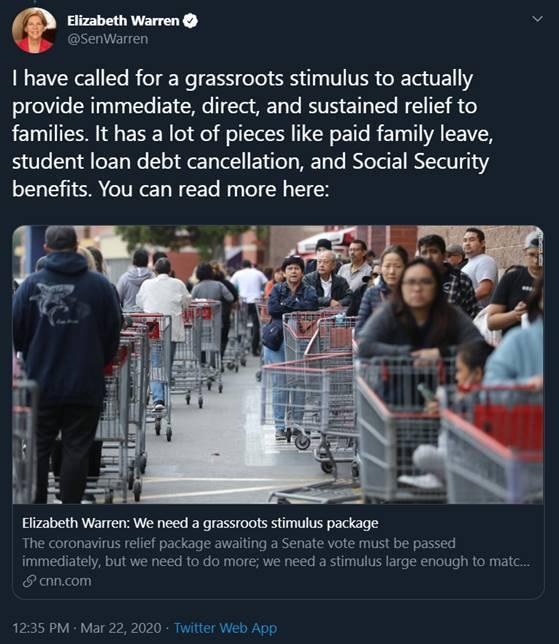
Stoller, who began his Capitol Hill work in Alan Grayson's office, later worked as a Senate staffer for Bernie. As you can see from the just-released video clip above, it certainly looks like Bernie will be one of the senators standing behind his ideas. Another is Elizabeth Warren:


Labels: , , , ,

Tuesday, March 17, 2020

We're On The Verge Of The Deepest Recession Of Our Lifetimes-- Are The Hack Politicians We've Elected To Serve As Our Leaders Up To The Task?

>


Stock markets reacted badly to the Fed's panicky decision to lower U.S. interest rates to zero over the weekend, due, at least in part, to Trump's blustering, threatening, hysterical demands that they do something to save his collapsing presidency. (Too late for that.) Trading was halted immediately after the opening bell yesterday when the Dow Jones crashed by 2,250 points (9.71%). Even before the crash the Financial Times' Rana Foroohar had written a piece, How coronavirus became a corporate credit run, warning that the Fed and other central bankers "are going to have to keep the money taps on."
It was only hours after U.S. president Donald Trump told us, in an address from the Oval Office last week, "this is not a financial crisis," when markets began acting very much as though it was.

Investors dumped assets resulting in the worst trading day since 1987. Bond markets seized up, putting pressure on banks, and the U.S. Federal Reserve swooped in with yet more emergency funding for short-term borrowing markets (known as repurchasing or repo markets), a tactic which suggests we may see quantitative easing to infinity-- and beyond.

So when exactly does a coronavirus-triggered corporate market meltdown officially turn into a full-blown financial crisis? That's a question many market participants, and banks in particular, must be asking themselves.

If there has been any silver lining to the current market shock and the recession that is likely to follow, it is that it hasn't been a 2008-style banking crisis-- of the kind that jumps like a virus between highly leveraged global financial institutions and causes them to bleed dry. The Dodd-Frank and Basel III regulations that followed in the wake of the subprime crisis were designed to mitigate that risk. Banks, required to hold larger quantities of high-quality assets, were made to do less trading, and more traditional lending.

That worked, up to a point. The virus-induced brake on consumer activity and labour markets, which has in turn triggered a corporate credit run, is what caused the market panic this time, rather than risky trading on the part of global banks.

Today, it is not Wall Street financial institutions, but companies in a variety of industries that are stressed, as a simultaneous supply and demand shock means they need to tap credit lines to pay their bills. With flights halted, supply chains disrupted and the consumer economy gutted, companies are trying to stockpile cash, whether they need it immediately or not.

It's one thing for the aircraft manufacturer Boeing to draw down its entire $13.8bn credit line. It's another for multiple big corporations to draw theirs at the same time. Still, as a recent Credit Suisse report pointed out, "we now have a global banking system where all major banks have to pre-fund 30-day outflows" with high-quality liquid asset portfolios. This is one important reason why these corporate funding stresses haven't caused a real time banking crisis in the way that the 2008 subprime crisis did. Another reason is that the Fed is backstopping the banking system with its repo operations, as banks exchange Treasury bills for cash.

All of this underscores a fundamental truth-- regulators usually tend to fight the last war. The dollar deposits that corporations are currently drawing down are one of the highest-quality types of funding for banks, the same kind that the Basel III rules stipulate they should keep on hand.

Nobody assumed that a pandemic would result in huge credit drawdowns by many companies all at once. Losing these deposits so quickly threatens the liquidity profile and regulatory compliance of banks themselves. And that is before we start to see the spike in corporate downgrades and defaults that will create even more funding pressure.

The fact is that the banking system has already been pulled into the corporate credit crisis that many people predicted would be the cause of the next big market downturn. It's all too easy to see how the problems of individual companies-- technology firms, retailers, airlines and insurance companies-- could be passed to individual banks and then to countrywide banking systems. Ultimately, they could spread throughout the global financial system, leaving central bankers once again the lender of last resort, standing between us and another global financial crisis.

That is pretty much what is already happening, and we haven't even seen the next phase of falling dominoes-- the meltdown of passive and algorithmic investing, the unwinding of exchange traded funds, and the sale of even the highest quality assets by people who are desperate to raise cash in the midst of a liquidity crisis. All this means that central bankers will have to keep the money taps on, and probably increase the variety of assets that they are buying or backstopping.

We shouldn't mistake all that easy money for a cure. As Credit Suisse managing director Zoltan Pozsar points out, "QE isn't a vaccine for this outbreak." Even if the Fed can offset pressures within the banking system, that doesn't replace the loss of private-sector spending. What's needed is something more akin to a wartime fiscal stimulus programme, in which the government replaces lost consumer demand, ideally with a major public health spending programme. We might start by bolstering the number of available hospital beds in the U.S., which is woefully behind other developed countries. Sadly, the only wartime reference in Mr Trump's ill-advised speech was to the U.S. "fighting a foreign virus."

Covid-19 is, of course, an equal opportunity pandemic. Being asymptomatic doesn't mean you aren't contagious. The corporate crisis roiling the markets has already infected the banking system.

Whether unlimited central bank injections of liquidity are enough to keep it healthy over the next few weeks and months, as both the pandemic and the market crisis plays out, remains to be seen.
Goliath: The Hundred Year War Between Monopoly Power and Democracy, author Matt Stoller tried making sensing of this for his Twitter followers with a tweet storm I've put in narrative form below. Earlier, after reading the Financial Times piece he had written that "It's clear that a massive Coronavirus Bailout is coming. As Rana Foroohar noted there's significant corporate debt distress. What is the shape of that bailout? What kinds of conditions will the government put on corporate handouts?"
We are going to bail out big corporations not just because of the virus but because Wall Street thinned out their ability to handle risk. That's what the buybacks, mergers, etc were all about. Stripping out resiliency. If we're going to inject public money let's stop that.

There should be five restrictions on any bailout terms. One, no bailouts for shareholders. Two, no stock buybacks. Three, strict exec comp limits. Four, no more lobbying. Five, no mergers or acquisitions for five years.

During the immediate viral transmission period, we may need to hit pause on any corporate bankruptcies and extend an emergency debtor-in-possession financing, which is basically loans to companies in bankruptcy to keep them functioning. After that period, there will be a bunch of corporations on the hook to the government. That's when the restructuring to put these corporations through a quick resolution process should happen.

I have not thought through what it means to cram down equity holders when private equity predators own lots of the debt, so it's critical to put real constraints on the kind of corporate control debt holders get out of the process. No financialization and asset stripping.

Same terms should not apply to small and medium sized businesses, because they have not been subjected to the same load 'em up with debt style financial games. Financialization and private equity is about loading up corporations with hidden risk. We cannot afford that anymore.

Last point. I'm hearing Wall Street analysts talk about how this market downturn is a tremendous buying opportunity. That was true in 2008-2009, and the taxpayers financed it but didn't benefit.

If it's public money doing the buying, let's use our leverage this time.


The other day we made a big point-- as did some of her colleagues-- that Orange County Rep, Katie Porter is one of the sharpest members Congress. Luckily for all of us, she's putting her brain-power behind trying to ameliorate the catastrophe Trump has bumbled into with his non-response to the COVID-19 pandemic, currently overwhelming not just medical treatment centers but financial markets as well. "Many American families are already financially insecure," she said in a quick interview. "We see that in data on 20% of people delaying treatment for a serious medical condition and the estimated 40% of households that could pay deal with a $400 unexpected expense without borrowing. The coronavirus pandemic preys not just on the health of Americans but on their financial wellbeing. Closed schools impose new childcare costs; shuttered businesses mean lost wages. We need to put money immediately (within the next week) into the hands of American workers. I support a $1,000 per worker now, with the potential of more to come as necessary. Note: Mitt Romney supports this too! While many Democratic colleagues are identifying problems with constituents such as concern about utility shut offs or inability to pay rent, the reality is the households know best what bills they need to pay. And if we do not do this cash payment immediately, before the big industry and corporate bailouts start, then families will pile on credit card and predatory debt just to make ends meet. Speaker Nancy Pelosi is talkings about refundable tax credits; that is not nearly immediate enough. It misses the reality of the vast majority of American households, who are facing increased expenses and decreased wages this week. They cannot wait for long appropriations battles about social programs. The Treasury should cut these checks before April 1 when many bills will come due."

Andy Levin (D-MI) has the single best voting record of any member of the House. Yesterday he told us that "Trump made the conscious decision to tie his success to the economy, and more specifically, the stock market. When you own the rise, you own the fall. In more ways than one, the downturn we're faced with now is because of this president's foolishness. While he couldn't prevent the initial outbreak of the coronavirus, President Trump could have done much more to prepare for it. For starters, he should not have fired the White House's pandemic response team in 2018. He also should have taken the threat of the disease seriously instead of misleading the public about its disastrous potential.
But before there was coronavirus, we were still facing a manufacturing recession. Workers' wages weren't going up and wealth inequality continued to balloon out of control. All the while, the president touted a stock market while half of Americans don't even own stock.

Thanks to hardworking medical professionals, the sacrifices made by working people and sincere efforts to practice good public health, I believe we will overcome this pandemic having learned some valuable lessons.  But never forget that many of the billions of dollars lost during the outbreak stem from a president who is able to manage neither a public health crisis nor a just economy."
Tom Winter is a progressive state legislator from western Montana running for the state's at-large congressional seat. "It's clear," he told us, "that the U.S. preparedness and response to this global pandemic has been bumbled from the get-go. Now, due to a complete lack of leadership from the top of our government we are on the verge of at the very least an economic recession, and at the very worst a financial collapse. While the federal government and politicians focus on saving Wall St. and the Big Banks, there's still a vast majority of working families in this country that were already struggling through this great stock-market run. So, my concern in the midst of this pandemic and national emergency lockdown is with the workers that aren't in line for bail outs or massive infusions of capital from the federal government. Yet, they're the ones that are getting laid off from work and still having to pay the bills. That's why, as a state legislator and U.S. Congressional candidate, I will be pushing for proactive protections for working families. Such as suspension of disconnections for non-payment from all utilities, paid sick leave extended to all workers, extension of unemployment benefits to workers laid off, pausing all evictions, making sure insurers follow through with the President's promise to make all COVID-19 testing and treatments free of any out-of-pocket expenses, and anything else that will dampen the effects felt by workers. We can not let the response and recovery of this crisis be like every other in recent memory, with all the focus, attention, and resources going to those with wealth and power."

UPDATE: From Goldman Sachs

Some of this is interesting and some of it is wishful thinking, but it's worth knowing what these big firms are thinking-- even if they're mostly off base. This is from their big investee call yesterday (with 1,500 firms dialing in):
50% of Americans will contract the virus (150 million people, give or take) as it's very communicable. This is on a par with the common cold (Rhinovirus) of which there are about 200 strains and which the majority of Americans will get 2-4 per year.

70% of Germany will contract it (58 million people). This is the next most relevant industrial economy to be effected.

Peak-virus is expected over the next eight weeks, declining thereafter.

The virus appears to be concentrated in a band between 30-50 degrees north latitude, meaning that like the common cold and flu, it prefers cold weather. The coming summer in the northern hemisphere should help. This is to say that the virus is likely seasonal.

Of those impacted 80% will be early-stage, 15% mid-stage and 5% critical-stage. Early-stage symptoms are like the common cold and mid-stage symptoms are like the flu; these are stay at home for two weeks and rest. 5% will be critical and highly weighted towards the elderly. [ASIDE: my doctor-- who has extremely important medical connections in China-- told me yesterday that 61.5% of those in critical care in the best hospitals have died.]

Mortality rate on average of up to 2%, heavily weight towards the elderly and immunocompromised; meaning up to 3 million people. In the US about 3 million/yr die mostly due to old age and disease, those two being highly correlated (as a percent very few from accidents). There will be significant overlap, so this does not mean 3 million new deaths from the virus, it means elderly people dying sooner due to respiratory issues. This may however stress the healthcare system.

There is a debate as to how to address the virus pre-vaccine. The US is tending towards quarantine. The UK is tending towards allowing it to spread so that the population can develop a natural immunity. Quarantine is likely to be ineffective and result in significant economic damage but will slow the rate of transmission giving the healthcare system more time to deal with the case load.

China’s economy has been largely impacted which has affected raw materials and the global supply chain. It may take up to six months for it to recover.

Global GDP growth rate will be the lowest in 30 years at around 2%.

S&P 500 will see a negative growth rate of -15% to -20% for 2020 overall.

There will be economic damage from the virus itself, but the real damage is driven mostly by market psychology. Viruses have been with us forever. Stock markets should fully recover in the 2nd half of the year.

In the past week there has been a conflating of the impact of the virus with the developing oil price war between Saudi Arabia and Russia. While reduced energy prices are generally good for industrial economies, the US is now a large energy exporter, so there has been a negative impact on the valuation of the domestic energy sector. This will continue for some time as the Russians are attempting to economically squeeze the American shale producers and the Saudi’s are caught in the middle and do not want to further cede market share to Russia or the US.

Technically the market generally has been looking for a reason to reset after the longest bull market in history.

There is NO systemic risk. No one is even talking about that. Governments are intervening in the markets to stabilize them, and the private banking sector is very well capitalized. It feels more like 9/11 than it does like 2008.

Labels: , , , ,

Saturday, February 29, 2020

The Numbers Are In: Trump Has Been Bad For The Economy-- Even Before His Stock Market Collapse-- And There Will Be Electoral Consequences

>


Trump's economy is coming apart-- and it's not just the coronavirus' impact on Wall Street. Newsweek reported that since Señor Trumpanzee took office, income growth has slowed significantly compared to the growth rate under Obama. Jessica Good heart wrote that "All but two states saw a decline in growth of real median household income under Trump-- including Pennsylvania, Wisconsin, Michigan, and Florida, four states widely regarded as the key electoral battlegrounds that will likely determine the 2020 presidential election. Middle-class incomes grew at a rate of 2.7 percent from 2016 through 2018, compared to a 5.8 percent growth rate from 2014 through 2016 when accounting for inflation." The states that had it worst-- a decline in real median household income-- were Alaska, West Virginia, South Dakota, and Wyoming, although New Mexico and Connecticut were also hurt badly from Trump's economic policies.
Presidents often claim too much credit and take too much blame for the country's economic performance, economists agree. Indeed, David Cooper, a senior analyst with EPI, who led the analysis of Census data, says that Obama benefited from a prolonged low rate of inflation during the last two years of his presidency. A low inflation rate makes it easier for households to stretch a dollar to cover basic necessities.

But, economists also say Trump has squandered opportunities to support greater gains for middle-class families, and, in some cases, he has backed policies that have worked counter to their interests.

"An infrastructure bill would clearly have [had] a marked impact, especially on middle-level jobs," says Mark Muro, a senior fellow at the Brookings Institute's Metropolitan Policy Project. "Manufacturing is going in the wrong direction. I think there are all kinds of policy opportunities that have not been exploited."

Muro sees some warning signs for 2020, such as the manufacturing recession and uncertainty over trade due to the lingering effects of the trade war and now the coronavirus, which has sickened tens of thousands of people in China and shuttered factories. Factory production in the U.S. shrank by 1.3 percent in the past year, according to the Washington Post.

EPI's Lee argues that Trump has taken steps that have hurt the middle class, including the 2017 Tax Cuts and Jobs Act and the overturning of regulations like overtime protection that shore up workers' paychecks. "The current administration's focus on cutting taxes for the wealthy, expanding tax incentives for outsourcing, and undercutting workers' rights has left ordinary working households in most states barely gaining ground," notes Lee.


But we ain't seen nothing yet. Sane people expect the coronavirus disaster to make the economy far worse. One of those sane people, Matt Stoller, wrote for Wired this week that Covid-19 Will Mark the End of Affluence Politics. For example: "we will, in all likelihood, be locking down travel in some areas of the U.S. for several weeks, as they did in China. People may be advised against gathering in large groups. It's not clear what any of this will mean for campaigning or primary voting, whether most of us will vote by mail or have our votes delayed. Moreover, the coronavirus is going to introduce economic conditions with which few people in modern America are familiar: the prospect of shortages. After 25 years of offshoring and consolidation, we now rely on overseas production for just about everything. Now in the wake of the coronavirus, China has shut down much of its production; South Korea and Italy will shut down as well. Once the final imports from these countries have worked their way through the supply chains and hit our shores, it could be a while before we get more. This coronavirus will reveal, in other words, a crisis of production-- and one that’s coming just in time for a presidential election."
We've been through something like this once before. My book Goliath describes the 1932 campaign for president, one that was carried out at the depths of the Great Depression and during an era when our productive capacity was shut down. Though the crisis at that time was caused by a banking collapse, not a pandemic, the political backdrop was analogous. Eighty-eight years ago, “old order” politicians, as they were known, proved unwilling-- even in the face of crisis-- to have the government apply its power toward the broader public benefit. Their recalcitrance prefigured, in certain ways, the reflexively libertarian thinking of today.


A toxic ideology invited disaster in 1932, as policymakers did little in response to the collapse of thousands of banks and businesses. At the depth of that depression, cotton hit its lowest price in 200 years and steel production fell to 15 percent of capacity. The situation became so desperate that in just one city, Toledo, Ohio, 60,000 of the 300,000 residents stood in bread lines every day. Children were competing with rats for food. And thousands were dying of dysentery. The politics too turned desperate, with one labor leader telling Congress that "if the Congress of the United States and this administration do not do something to meet this situation adequately, next winter it will not be a cry to save the hungry, but it will be a cry to save the government.”

And yet, the old order had no answers. Congress held hearings, but businessmen, academics, and bankers proffered only belt-tightening. Within the Republican establishment, President Herbert Hoover worked 18-hour days, exhorting confidence while refusing to take even basic steps such as having the government guarantee bank deposits. Instead, his administration’s army attacked hungry protesters in Washington, DC, a move that prompted an angry Republican congressman, Fiorello La Guardia of New York, to remind the president: “Soup is cheaper than tear gas bombs.”

Meanwhile on the Democratic side, conservatives and progressives in the party were locked in a bitter battle for the nomination. Many Democrats agreed with Hoover. Maryland governor and presidential candidate Albert Ritchie, for instance, argued that we should rely “less on politics, less on laws, less on government.” Another candidate, Speaker of the House John Nance Garner, claimed the greatest threat was the “tendency toward socialism and communism” and pledged a massive cut in government spending, as well as a sales tax increase. Others turned to extreme racism and xenophobia. Only Franklin Delano Roosevelt, who went on to win a contested convention, campaigned on aggressive government involvement in the economy—or as he put it, a “workable program of reconstruction,” which later became the New Deal.

That era’s political desperation is alien to us for a few reasons. First off, we haven’t faced shortages of such magnitude for a very long time. More importantly, we have for decades lived under a political framework known as affluence, a term popularized by economist John Kenneth Galbraith in the 1950s. As an affluent society, America automatically produces a surfeit of jobs and wealth, and the problem is solely one of distributing the bounty.

Under the siren song of affluence, we began offshoring critical production capacity in the 1960s for geopolitical reasons. In 1971, economist Nicholas Kaldor noted that American financial policies were turning a "a nation of creative producers into a community of rentiers increasingly living on others, seeking gratification in ever more useless consumption, with all the debilitating effects of the bread and circuses of imperial Rome." Still, Bill Clinton and George Bush accelerated this trend throughout the 1990s and 2000s.

Affluence politics is not the politics of being wealthy, though, but rather the politics of not paying attention to what creates wealth in the first place. That is to say, it’s the politics of ignoring our ability to make and distribute the things people need. With the banking collapse in 2008, the election of Trump in 2016 and his mourning of empty factories, and now with Bernie Sanders dominating the early primaries, that era may at last be passing. A pandemic disease outbreak would only hasten this progression and force us back into the politics of production.


With potential shortages of goods, and restrictions on people’s movement, both parties are heading into unknown territory. It is likely Democrats will use this opportunity to further their case for Medicare for All. Pandemic surveillance and medical bureaucracies focused on billing do not mix well-- stories about astronomical out-of-pocket costs for Covid-19 testing are already circulating. Republicans are likely to take a more xenophobic approach, emphasizing restrictions on foreigners and infected Americans. When it comes to managing shortages, however, both parties are split, just as they were in 1932, between their Wall Street factions that assume affluence and the less mature populist factions that seek assertive public power. The Democratic Party primaries certainly echo those of the Great Depression, with candidates from Bernie Sanders to Amy Klobuchar trying to wrap themselves in FDR’s mantle.

Regardless, the end of affluence politics means focusing on whether medicine is on shelves, not bitter disputes over bloated and wasteful hospital and insurance billing departments. It means caring about bureaucratic competence in government, and accuracy in media, not because these are nice things to have but because they are necessary to avoid immense widespread suffering. It means understanding that pharmaceutical mergers that benefit shareholders while laying off scientists are destructive, not just because they are unfair, but because they make us less resilient to disease. (Shareholders, as it turns out, also have lungs.) Finally, it means recognizing that wealth, real wealth, is not defined by accounting games on Wall Street, but the ability to meet the needs of our own people.

We came to these realizations once before in 1932, and created a vibrant democratic state over the following few decades-- one that rapidly expanded our life spans, defeated the Nazis, and helped create Silicon Valley. The convergence of the Covid-19 outbreak and the presidential election will force us to do it once again. We've lived in the world of unreality for far too long.

As Richmond Federal Reserve Bank president Tom Barkin recently put it, “Central banks can’t come up with vaccines.” It's time to get ready for what that implies.
Yesterday, Trump was in South Carolina giving his supporters exactly the kind of information that will kill them. He called the coronavirus the Democrats' "new hoax... The Democrats are politicizing the coronavirus. They're politicizing it. They don't have any clue. They can't even count their votes in Iowa. No, they can't. They can't count their votes. One of my people came up to me and said, 'Mr. President, they tried to beat you on Russia, Russia, Russia.' That did not work out too well. They could not do it. They tried the impeachment hoax." He's literally going to kill his own supporters. Listen to this:


Labels: , , ,

Tuesday, February 18, 2020

The Democrats Completely Control Sacramento-- So Why Is It Such A Cesspool Of Corruption?

>


If the old maxim is true that absolute power corrupts absolutely, then California Democrats have a very real problem. As the power and legitimacy of the GOP has waned, Democrats have seized control of a supermajority in the state, with both hands. With their power now left unchecked by a viable opposition party, the party politics of the left have drifted into corruption, led by party power players like Assembly Speaker Anthony Rendon and Christy Smith, an unaccomplished freshman legislator running for the CA-25 seat abandoned by Katie Hill, as well as a wide cadre of party apparatchiks.

Their goal has been to put their thumbs on the scales of primary elections across the state in order to elect moderate back benchers who will maintain the status quo and not rock the boat for party leadership. The internal party bias has been especially hard on the progressive wing of the party, where the California Democratic party routinely tries to pick the winners of primary races.

The Young Turks recently reported one such story of unethical influence into races that are supposed to be democratic in nature. The story featured Eric Ohlsen who is running for State Assembly in District 36, the Antelope Valley district that is contained within the boundaries of CA-25. According to Ohlsen, he was told at a meeting with Christy Smith that the decision had already been made behind the scenes to support his opponent, Jonathan Ervin, so Ohlsen should just try again in a few years. She also took umbrage with his messaging to get big money out of politics and fight corruption. Ohlsen had said in a speech-- up top-- at the California Democratic Convention, "Democrats have a supermajority in Sacramento and they keep telling us that we need to learn how to compromise. We’re not compromising with Republicans to pass legislation, we’re compromising with industry because they’re donors." Regarding that anti-corruption stance, Ohlsen said, "Christy told me that my anti-corruption messaging was 'personally offensive' to her." Which is probably a good self-assessment because both Smith and Rendon had pushed Ervin from behind the scenes and made sure that opposing candidates did not get any endorsements, which gave Ervin a $121 thousand advantage over everyone else in his race.

Ohlsen confirmed in a follow up interview that during his meeting with Smith, she had noted that both herself and Rendon had endorsed Jonathan Ervin before any primary races had even begun, effectively removing any democracy from the Democratic Primary.

Rendon has a long track record of using his influence with the unions and special interest groups to deny funding and endorsements to any candidates that he does not hand pick. His position as Speaker of the House in the State Assembly gives him leverage over groups that may potentially offer endorsements to candidates. By offering to reduce access to legislators, Rendon can control or eliminate the flow of money to candidates that he does not approve of. Encouraging his membership in the Assembly to direct funds at particular candidates is another tactic that Rendon has used to starve out competition from progressive candidates, and favor ones, like Ervin, who will act as an empty vessel for his agenda.

Threats of the denial of funding have also been used against other progressive candidates such as those who support Cenk Unger. Alaina Brooks, SEIU delegate for California's 36th Assembly District, executive board member for Local 2015, made it very clear to the Ohlsen camp that if he continued to support his fellow progressive candidate that his political future would be in jeopardy.

Goal Thermometer"The amount of pushback that we have gotten is surprising to me," Ohlsen said, "Nearly every Democrat in Sacramento ran on talking points to get money out of politics, but as soon as you ask, 'that sounds great, so where is your bill?' they start working like crazy behind the scenes to block you from competing." With a supermajority of Democratic votes in the California Legislature, passing any anticorruption measures would be a simple task, the problem is that the measures would need the support of people who have spent their careers benefiting from the money in politics.

This is the reason why many states have enacted publicly funded elections, which limit the ability of party elites and special interests to pick and choose the winners of elections before they have even began. It is a proposition that has been supported on the national level by several Presidential candidates including Tom Steyer, who said, "I think the point about publicly funded campaigns means that if you are running, the public will fund a campaign that’s at least comparable to what anyone’s going to spend on their campaign," Steyer told reporters. "And that’s actually I think the easiest way to go about this and the proper way."

Also on the national level, Representative Alexandria Ocasio-Cortez (D-NY) has faced many of the same problems by bucking the party establishment. She rose to prominence by defeating Joseph Crowley, a corporate Democrat who portrayed himself as being a progressive liberal while simultaneously taking money from Goldman Sachs, Facebook, Google, BlackRock, amongst others. AOC has continued to garner criticism from her own Democratic colleagues for holding House Democrat’s feet to the fire regarding financial corruption within the party.


The GOP lost their position as a viable opposition party in the state, but by quashing the voices of opposition within their own ranks, Democrats could undo any gains they have been given. The activities of Rendon and Smith to put their thumbs on the scales of party elections could create a culture of corruption that will bring down their own house. Matt Stoller summed the problem up nicely in a 2019 column for the Washington Post, "For too long, disagreements in the Democratic Party have been kept behind closed doors, and the result was the protection of powerful financial interests. It is time to start talking about this dynamic, so that voters can make a democratic choice about what kind of politics they actually want to build. That, in the end, is why it’s called the Democratic Party."

Labels: , , , , , , ,

Saturday, October 12, 2019

GOLIATH Has Arrived

>


Yesterday I opened a package that arrived at my doorstep and found an old friend's new book, Goliath-- The 100-Year War Between Monopoly Power And Democracy. This is the book that Thomas Frank called "the secret history of economic democracy in America. 'Secret' because it's still a story that will trouble everyone: conservatives, liberals, Silicon Valley and Big Oil." Yep... that's Matt Stoller... who has worked on Capitol Hill both with Alan Grayson in the House and with Bernie in the Senate. One book reviewer wrote that Goliath is a "startling look at how concentrated financial power and consumerism transformed American politics, resulting in the emergence of populism and authoritarianism, the fall of the Democratic Party-- while also providing the steps needed to create a new democracy."
Americans once had a coherent and clear understanding of political tyranny, one crafted by Thomas Jefferson and updated for the industrial age by Louis Brandeis. A concentration of power, whether in the hands of a military dictator or a JP Morgan, was understood as autocratic and dangerous to individual liberty and democracy. This idea stretched back to the country’s founding. In the 1930s, people observed that the Great Depression was caused by financial concentration in the hands of a few whose misuse of their power induced a financial collapse. They drew on this tradition to craft the New Deal.

In Goliath, Matt Stoller explains how authoritarianism and populism have returned to American politics for the first time in eighty years, as the outcome of the 2016 election shook our faith in democratic institutions. It has brought to the fore dangerous forces that many modern Americans never even knew existed. Today’s bitter recriminations and panic represent more than just fear of the future, they reflect a basic confusion about what is happening and the historical backstory that brought us to this moment.

The true effects of populism, a shrinking middle class, and concentrated financial wealth are only just beginning to manifest themselves under the current administrations. The lessons of Stoller’s study will only grow more relevant as time passes. Building upon his viral article in The Atlantic, “How the Democrats Killed Their Populist Soul,” Stoller illustrates in rich detail how we arrived at this tenuous moment, and the steps we must take to create a new democracy.


At the same time the book arrived, the Wall Street Journal published a think piece by Matt that is based on the themes he developed in Goliath, Why U.S. Businesses Want Trustbusting, with a perspective on class war that I hadn't considered much nor felt much sympathy for. "The loudest complaints against today’s monopolies," he wrote, "come not from Occupy Wall Street types but from leaders of firms seeking freedom of commerce."
Trustbusting is back, and it’s a bipartisan effort. Last month, 50 state attorneys general, led by the conservative Republican Ken Paxton of Texas, announced an investigation of Google for anticompetitive conduct. Republican Sen. Josh Hawley of Missouri has been a fierce critic of big tech, as has the Democratic-led House Judiciary Committee, which is probing the sector. Several Democratic presidential candidates have pledged to address the problem of concentrated power not just in tech but in agriculture, defense and media too.

It might seem like both parties and the American public are turning against business creators and investors who put their hard-earned capital to work. But there’s a more optimistic way to see this dynamic. If you listen to the complaints against these large companies, they aren’t coming from Occupy Wall Street-style protesters. They are coming from business leaders who, in most cases, are just seeking the liberty to trade with whomever they wish and feel that they are being blocked.

Take complaints about Alphabet Inc.’s Google, which is such an important marketing platform that it is essentially the home page for every company. Google’s searches once primarily sent people to independent web pages, but the internet has increasingly become Google’s own walled garden. A recent study by the data analytics firm Jumpshot shows that more than half of Google searches now end with snippets from web pages displayed on the search page itself instead of visits to those pages, or else by sending users to Google apps or to sites that paid Google for ads-- instead of to pages outside Google’s sphere. Meanwhile, Google has packed so many ads onto its results page that companies are finding that they have to buy ads even to reach people who search for their product by name.

This would not be such a problem except that Google is essentially a search monopoly, with roughly 90% of the web search market and a dominant share in other segments of the internet, like mapping. (Google counters by defining the market more broadly to include any online service that helps consumers to find something, such as Amazon or Expedia.) One small-business owner told the Wall Street Journal, in an article earlier this year about fake listings in Google maps, that he fears Google far more than the government. “The government will hit me with a fine,” he said. “But if Google suspends my listings, I’m out of a job. Google could make me homeless.”

Facebook has similar power over the advertising market for social networking, which is also critical for anyone with products or services to sell. Facebook can, in essence, impose its own tax on all businesses that have to connect with customers. “In a lot of ways, Facebook is more like a government than a traditional company,” Mark Zuckerberg said in a 2009 interview. Now Mr. Zuckerberg is putting together his own Facebook “Supreme Court,” as he describes it, for content moderation, and attempting to create his own currency with Libra.

Nor are monopolies just appearing in technology. Across the economy, dominant market power is more the norm than the exception. There are concentrated markets in industries as diverse as coffins, syringes, baby formula, mobile-home manufacturing and bank management software. Rabbis recently had to beg the giant Mexican bakery chain Bimbo, which together with Flowers Foods controls roughly three-fifths of branded bread sales in the U.S., to continue baking kosher bread. Fully 97% of missiles and munitions produced for the Pentagon are controlled by just two companies, Raytheon and Lockheed Martin.

Dominant firms not only concentrate power but become the single sources for vital products. In 1997, Boeing and McDonnell Douglass merged, combining nearly all domestic civilian aerospace capacity in one company. While Boeing (as the new entity continued to be called) still faced some competition from Airbus, its market power largely insulated it from the consequences of poor management. The deadly crashes over the past year of two Boeing 737 Max passenger airlines have now begun to reveal the extent of the company’s failings. Because Boeing is the entire U.S. industry, its problems are rippling broadly across it suppliers and the airlines. To take just one example, the scandal has cost General Electric, which sells engines, up to $750 million in cash flow.

The U.S. has been here before. In the early 20th century, Standard Oil, among other industrial trusts, strode across the land as a corporate goliath. Though massively profitable, the company had misallocated capital and centralized the oil industry inefficiently. When the Indiana branch of Standard Oil wanted to invest in the then-crazy notion that oil could be refined into gasoline, the New York headquarters kept saying that the company should stick to kerosene. In 1911, after the company was broken up, the Indiana subsidiary developed the technology behind the gasoline industry. John D. Rockefeller became far richer after the breakup thanks to the stock appreciation of the subsidiaries. ( Teddy Roosevelt later joked, “No wonder that Wall Street’s prayer now is: ‘Oh Merciful Providence, give us another dissolution.’”)

Standard Oil helped to establish the traditional American response to corporate monopolies: Break them up so that other businesses can compete and innovate and investors can profit. During the New Deal, the government broke up giant banks, Hollywood studios, electric utilities, airline and aerospace companies and radio networks. In many cases, as with electric utilities, shareholders, bondholders and ratepayers all profited. Government took an energetic hand in promoting liberty in business, and it worked.

After World War II, Rep. Emanuel Celler, a Democrat from New York, took the lead in investigating domestic monopolies. He noted the pervasive climate of fear in industries where dominant firms could at any point destroy their competitors. “Under our ancient common law, your neighbor must not point a gun at you, even though he has never shot anyone,” Celler wrote in 1950. “Similarly, our antitrust laws were intended to protect businessmen not only from violence but from fear of violence.” That year, Congress passed the Celler-Kefauver Act to bar anticompetitive mergers.

In the 1950s, antitrust was a priority for Republicans too. The Eisenhower administration forced RCA, AT&T and IBM to license their patents to small companies. One of those patents was the electronic transistor, soon manufactured by Texas Instruments and Motorola. Antitrust thus freed American business and led to the creation of Silicon Valley.

Similarly, when the Reagan administration broke up AT&T in 1984, it allowed more businesses to innovate rather than to fight the dominant market player. Stockholders in AT&T and its spinoffs did much better than those who kept IBM shares, a giant that the Reagan administration left alone. One of the results of the AT&T breakup was that customers could easily plug modems into the phone network, which gave rise to the online service provider industry.

Even when the government has stopped short of breaking up a company, as with Microsoft, the results have often been beneficial. In the early 2000s, Microsoft, due in part to fear of antitrust action, refrained from using its power over browsers to keep a scrappy upstart called Google from reaching users. Antitrust oxygenated the market; a lack of antitrust has now allowed Google to turn into the monopolist of today.

It often seems like centralization and concentration in the hands of the best and brightest in business and finance is the American way. But liberty is our true birthright. Louis Brandeis, the patron saint of the antimonopoly tradition, once expressed a fear that America, once a nation of tradespeople, was becoming a nation of clerks. He was right to fear that transformation in his day, just as businesspeople and investors should fear it in ours. Fortunately, we are seeing the resurgence of an old, business-friendly trend: trustbusting. And it couldn’t come soon enough.

Labels: , ,