Wednesday, September 02, 2020

The Trump Swamp Rears Its Ugly Head Again-- Elliott Broidy

>


I believe the first time I heard of Elliott Broidy was when the NY Times revealed him to be working with a very right-wing shady Mercer family SuperPAC, Secure America Now (SAN), which Broidy was using to leverage the Trump regime into filling key positions with individuals favorable to-- meaning, like Broidy himself, bought off by-- the Saudi and UAE governments. Mercer was one of just 4 uber-wealthy far-right and very crooked contributors providing SAN with the millions of dollars it needed for its entirely nefarious projects. The 3 other scumbags besides Mercer funding SAN are top Best Buy freaks Brad Anderson and Richard Schulze plus neo-fascist Estee Lauder heir Ronald Lauder.

Yesterday, Washington Post reporters Matt Zapotosky, Carol Leonnig and Rosalind Helderman wrote how now-- over two years later-- Broidy is finally about to be charged "in connection with efforts to influence the U.S. government on behalf of foreign interests, according to people familiar with the matter, a result of a sprawling, years-long investigation that involved a figure who helped raise millions for Donald Trump’s election and the Republican Party." By "influence the U.S. government," the meaning is clearly using Saudi and Emirati cash to bribe Señor Trumpanzee, who isn't being charged, at least not while he's living at 1600 Pennsylvania Avenue.

In fact this investigation had steered completely clear of Broidy's Saudi and Emerati paymasters-- a deal to protect Trump-- and is instead about Broidy's role as an unregistered lobbyist in "a campaign to persuade high-level Trump administration officials to drop an investigation of Malaysian government corruption, as well as for his attempt to push for the extradition of an outspoken Chinese dissident back to his home country." This gigantic mess is going to resulting a plea deal and, in all likelihood, an informal understanding with Trump that there will eventually be a pardon.
The case has intensified in recent weeks, with prosecutors securing a guilty plea Monday from one of Broidy’s business associates, Nickie Mali Lum Davis, who admitted to taking part in what prosecutors have described in charging documents as a “back-channel lobbying campaign” to end the Malaysian corruption investigation and to return Chinese exile Guo Wengui to his home country.

Guo is a vocal online critic of the Chinese government who was once allied with that country’s government elite but is now wanted by authorities in Beijing on charges of fraud, blackmail and bribery. He has denied those charges and said they are politically motivated.

According to a charging document filed in her case, Davis admitted she aided and abetted the efforts of two others involved in the influence campaigns, identified only as Person A and Person B. People familiar with the matter identified them as Fugees rapper Pras Michel and Broidy, respectively.


During a virtual hearing Monday before a federal judge in Honolulu, where Davis entered her guilty plea, prosecutors told a judge that charges may be filed against additional defendants in the case.

...The investigation puts a renewed focus on efforts by people close to the president to shape the fate of Guo, who has succeeded in remaining in the United States.

In the past few years, the Chinese billionaire has been closely aligned with Stephen K. Bannon, Trump’s former campaign chief and top White House strategist. Bannon was on Guo’s yacht off the coast of Westbrook, Conn., when he was arrested last month for allegedly fleecing donors who supported a group that claimed to be building a wall on the U.S.-Mexico border.


The investigation of Broidy has its roots in a massive probe of theft from a Malaysian government development fund that has come to be known by the shorthand “1MDB.” In previous civil and criminal cases, federal prosecutors have alleged that stolen funds that made their way into the United States were used to buy pricey real estate and even fund the award-winning movie The Wolf of Wall Street. Malaysia’s former prime minister Najib Razak was accused of being involved in the corruption. He was convicted in July and sentenced to 12 years in prison.

At the center of the case is a Malaysian businessman named Low Taek Jho, who was indicted in 2018 and accused of funneling tens of millions of dollars into the United States in part to get the Malaysian corruption investigation dropped. Low, who is facing multiple federal indictments, is believed to be in China, outside the reach of U.S. authorities. He has denied the allegations and said they are politically motivated.

According to court documents filed in association with Davis’s guilty plea this week, Broidy allegedly lobbied to have Guo removed from the United States at the request of Low and a Chinese government official.

Davis admitted that she met with the Chinese official-- who people familiar with the matter identified as Sun Lijun-- and the two people identified as Broidy and Michel in a Hong Kong hotel suite in May 2017, and Broidy soon launched a campaign that reached the top of the administration, court filings show.

According to the documents and people familiar with the matter, Broidy allegedly made various entreaties to people in the administration or close to it, including President Trump’s then-chief of staff, Reince Priebus; his former deputy campaign chairman, Rick Gates; and the president himself.

At one point, Broidy also tried to enlist the help of casino magnate and Trump friend Steve Wynn, according to the documents and the people with knowledge of the case. In August 2017, Broidy and Wynn called Trump from Wynn’s yacht and asked about Guo’s status.

Davis also admitted in court that she connected multiple calls between Wynn and Sun.

Reid Weingarten, an attorney for Wynn, declined to comment but said his client has been cooperating with investigators and continues to do so.

Wynn and Broidy worked closely together to get Trump elected in 2016 while they served as finance chairman and deputy finance chairman of the Republican National Committee.

Wynn made his own attempt to pass a message about Guo directly to Trump from Chinese President Xi Jinping, according to two people with knowledge of the episode. In a private meeting around June 2017, Wynn told Trump why Xi felt so strongly about the United States returning Guo to China, handing Trump two pictures of Guo, the people said.

At the time, Wynn had significant business interests involving China, operating a major casino in Macao.

Trump was eager to extradite Guo, as the Chinese wished, telling aides in an Oval Office meeting that he supported the plan, according to a former administration official familiar with his views.

Priebus passed along the extradition request to the National Security Council, where it was vetted by a senior White House lawyer, John Eisenberg, who conferred with then-White House Counsel Donald McGahn, the official said.

White House lawyers agreed that extradition, which was opposed by the Justice Department, would not be appropriate, according to the official. McGahn later told aides who asked about the status request, “We killed that,” the official said.

McGahn did not response to requests for comment. A White House spokesman referred questions about the episode to the National Security Council. An NSC spokesman declined to comment and referred questions to the Justice Department.

During the 2016 campaign, Broidy, a Los Angeles-based investor, helped corral big donors to support Trump’s campaign. After the election, he was appointed to serve as a national deputy finance chairman for the Republican National Committee.

Broidy resigned from that post in April 2018 in the wake of a report that he had paid a former Playboy model $1.6 million in exchange for her silence about a sexual affair. Trump’s personal attorney Michael Cohen-- another RNC fundraiser-- helped arrange the settlement, Broidy acknowledged at the time.

As part of the Malaysian corruption probe, the U.S. government has previously alleged that Michel and a former Justice Department employee, George Higginbotham, opened U.S. accounts to move Low’s money into the United States and fund the lobbying effort.

Davis acknowledged that she helped route an $8 million retainer to Broidy for the influence campaign and that Low offered to pay a $75 million “success fee” as part of a contract with Broidy’s wife’s law firm if the 1MDB case was resolved within 180 days.

Higginbotham pleaded guilty in November 2018 to illicitly facilitating the transfer of tens of millions of dollars into the United States to finance the lobbying effort.

According to Davis’s criminal information and people familiar with the matter, Broidy met with Trump at the White House in October 2017 and told others that he raised the subject of the 1MDB investigation.

A former attorney for Broidy told the Wall Street Journal in 2018 that at no time did Broidy, his wife, “or anyone acting on their behalf, discuss Mr. Low’s case with President Trump, any member of his staff, or anyone at the U.S. Department of Justice.”

Text messages and emails quoted in Davis’s plea documents show that Broidy messaged Gates, Trump’s former deputy campaign chairman, and Priebus in 2017 about arranging a visit for Malaysia’s prime minister and a possible golf outing with Trump. An attorney for Gates declined to comment.

Priebus responded but was noncommittal, saying the NSC was working on the matter, according to court filings and the people. Priebus declined to comment.

The prime minister did visit, but he did not golf with Trump, according to the court documents. The meeting was meant in part so the Malaysian prime minister could press Trump about ending the 1MDB case, according to the documents.


How many mentions of Saudi Arabia, the United Arab Emirates, and Broidy's business partner (and a repeat child sex abuser and Erik Prince and UAE lobbyist), currently serving a 10 ten year prison term, George Nader in that Post report? How many mentions of Robert Mercer or SAN? Just the Fugees and Malaysia. Back in May of 2018, the Business Insider reported that after Broidy spent a year cultivating a couple of the corrupt princes from Arabian Peninsula, he "thought he was finally close to nailing more than $1 billion in business. He had ingratiated himself with crown princes from Saudi Arabia and the United Arab Emirates, who were seeking to alter US foreign policy and punish Qatar, an archrival in the Gulf that he dubbed 'the snake.' To do that, the California businessman had helped spearhead a secret campaign to influence the White House and Congress, flooding Washington with political donations. Broidy and his business partner, Lebanese-American George Nader, pitched themselves to the crown princes as a backchannel to the White House, passing the princes' praise-- and messaging-- straight to the president's ears... Broidy and Nader sought to get an anti-Qatar bill through Congress while obscuring the source of the money behind their influence campaign... Broidy's campaign to alter US policy in the Middle East and reap a fortune for himself shows that one of the president's top money men found the swamp as navigable as ever with Trump in office.
By December of last year, the partners were riding a wave of success in their campaign to create an anti-Qatar drumbeat in Washington.

Saudi Arabia was finding a new ascendancy following Trump's election. Broidy sought to claim credit for it, emails show, and was keen to collect the first installment of $36 million for an intelligence-gathering contract with the UAE.

It all might have proceeded smoothly save for one factor: the appointment of Robert Mueller as special counsel to look into allegations of Russian interference in the 2016 election.

In many ways, the partnership between Broidy, 60, and Nader, 59, embodies the insider influence that has given contractors in D.C. the nickname "beltway bandits."

Both of their careers were marked by high-rolling success and spectacular falls from grace-- and criminal convictions. The onset of the Trump administration presented an opportunity: a return to glory.

Broidy, who made a fortune in investments, was finance chairman of the Republican National Committee from 2006 to 2008. But when a New York state pension fund decided to invest $250 million with him, investigators found that he had plied state officials with nearly $1 million in illegal gifts while collecting $18 million in management fees.

In 2009, Broidy pleaded guilty to a felony charge of rewarding official misconduct.

"In seeking investments from the New York State Common Retirement Fund, I made payments for the benefit of high-ranking officials at the Office of the New York State Comptroller, who had influence and decision-making authority over investment decisions," Broidy said in his plea and cooperation agreement.

...Mueller's team was interested in two meetings that took place before Donald Trump's inauguration.

One was in the Seychelles, a tropical archipelago in the Indian Ocean, which drew scrutiny because it included Prince, an informal adviser to Trump, and Russian investor Kirill Dmitriev, who has close ties to Russian President Vladimir Putin. The meeting has prompted questions about whether it was an attempt to establish a backchannel between Russia and the incoming Trump administration.

The other meeting was at Trump Tower in New York.

Nader and MBZ were at both.

...In late September, Broidy arranged for the most coveted meeting for any lobbyist in Washington: an audience for himself with the president in the Oval Office.

In advance of the meeting, Nader wrote Broidy a script, an email shows. There were several objectives: to sell the idea for a Muslim fighting force, to keep the president from intervening on Qatar and to arrange a discreet meeting between Trump and the crown prince of Abu Dhabi.

The princes "are counting on you to relate it blunt and straight," Nader wrote.

Nader told Broidy the meeting was potentially historic and to "take advantage of this priceless asset."

And there was one more thing. Nader asked Broidy to tell the president about his connections with the crown princes, using code names for all three.

"Appreciate how you would make sure to bring up my role to Chairman," Nader emailed. "How I work closely with Two Big Friends."

After the Oct. 6 meeting, Broidy reported back to Nader that he had passed along the messages and had urged the president to stay out of the dispute with Qatar. He also said he explained Circinus' plan to build a Muslim fighting force.

"President Trump was extremely enthusiastic," he wrote. Broidy said Trump asked what the next step would be and that he told the president he should meet with the crown prince from the UAE, adding, "President Trump agreed that a meeting with MBZ was a good idea."

...Despite that successful readout, Nader wanted more: He wanted a photo of himself with the president-- a big request for a convicted pedophile.

Broidy was co-hosting a fundraiser for Trump and the Republican National Committee in Dallas on Oct. 25. The Secret Service had said Nader wouldn't be allowed to meet the president. It was not clear if the objections were related to his convictions for sexually abusing children.

Broidy drafted an email to Trump's chief of staff, John Kelly, asking him to intervene on behalf of his friend, whom he oddly called "George Vader"-- a misnomer that appears elsewhere in the emails.

"One of my companies does deep vetting for the US government," he wrote. "We ran all data bases including FBI and Interpol and found no issues with regard to Mr. Vader."

There was another issue. RNC officials had decreed there would be no photos with the president without payment. Broidy suggested that Nader meet the suggested threshold with a donation between $100,000 and $250,000.

It's unclear exactly how the two issues were resolved. Records from the Federal Election Commission show no donations from either George Nader or "George Vader," but on Nov. 30, Broidy gave $189,000 to the RNC-- more than he had given to the RNC in over two decades of Republican fundraising.

The result: a picture of Nader and Trump grinning in front of the American flag.


Broidy met Trump once again on Dec. 2. He reported back to Nader that he'd told Trump the crown princes were "most favorably impressed by his leadership." He offered the crown princes' help in the Middle East peace plan being developed by Jared Kushner. He did not tell Trump that his partner had complete contempt for the plan-- and for the president's son-in-law.

"You have to hear in private my Brother what Principals think of 'Clown prince's' efforts and his plan!" Nader wrote. "Nobody would even waste cup of coffee on him if it wasn't for who he is married to."

Days after Broidy's meeting with Trump, the UAE awarded Broidy the intelligence contract the partners had been seeking for up to $600 million over 5 years, according to a leaked email.

...The FBI raided the premises of Trump's personal lawyer, Michael Cohen, seeking information on hush money paid to porn actress Stormy Daniels, who said she'd had an affair with the president.

Broidy, it turned out, was also a Cohen client. He'd had an affair with Playboy bunny Shera Bechard, who got pregnant and later had an abortion. Broidy agreed to pay her $1.6 million to help her out, so long as she never spoke about it.

"I acknowledge I had a consensual relationship with a Playboy Playmate," Broidy said in a statement the day the news broke. He apologized to his wife and resigned from the RNC. There is no indication Broidy is under investigation by Mueller's team.

In the end, Nader and Broidy's anti-Qatar operation lost its momentum. There has been no traction on the effort to get the base in Qatar moved to the UAE. In late April, Secretary of State Mike Pompeo called for an end to the bickering among Saudi Arabia, the UAE and Qatar during a trip to the Gulf.

Labels: , , , , , , , , , ,

Monday, October 12, 2015

Slave Trafficking, TPP & the 2016 Presidential Contest

>

This could be someone you know and love (source). How aggressively should your presidential candidate work to prevent it?

by Gaius Publius

As many readers know, I'm a fan of what the game of Go calls a "strong move" — very aggressive play when the position is favorable. The position against TPP, the argument against, is beyond favorable, and the position against Malaysia, one of the world's worst participants in the traffic in slaves, is unassailable. In addition, for the 2016 race, progressives have three candidates who have announced their opposition.

In this presidential season, I think progressives have been handed a wonderful opportunity to make a "strong move" against both TPP and slave trafficking — but only if they're willing to take it.

In this piece, I want to look at the slave trade and Malaysia, then at TPP, both pre-vote and post-vote, and last at what a truly committed Democratic candidate might say in one of the coming debates. (To jump to that speech, scroll to the bottom or click here.)

"Human Trafficking" Means the Slave Trade in All Its Forms

The term "human trafficking" is accurate, but almost a white-wash in that it washes off the ears with little penetration of its meaning. Human trafficking is best called "slave trading." What are slaves? Humans used as animals, as things for any purpose, including, but not only:
That list is just a subset. Any Jack Reacher–villain method by which a human, including a child, can be kept powerless for the purpose of abuse is encompassed by the term slave trading. From the Universal Declaration of Human Rights, on the ban against exploitation of humans:
Exploitation shall include, at a minimum, the exploitation of the prostitution of others or other forms of sexual exploitation, forced labour or services, slavery or practices similar to slavery, servitude or the removal, manipulation or implantation of organs;
The "trader" makes his or her money capturing or selling slaves, the way Nestlé, say, makes money "capturing" water from the people of the Pacific Northwest, then selling it back to the people who own it in the first place. Water is a product to profit from. Slaves are a product to profit from. How can we improve the bottom line by improving the "throughput," these profiteers ask?

Imagine your child treated this way, as a profit center and "throughput." Now imagine your anger against it. Now hold that thought as you consider Malaysia and TPP. Malaysia is a nation in which slave trading is a major industry.

In 2014, the State Department Gave Malaysia an "F" for its Extensive Human Trafficking

Back in 2014, before Fast Track and TPP were part of the national discussion, the nation of Malaysia received an "F" from the U.S. State Department (technically, they assigned Malaysia "Tier 3" status) for its extremely lax enforcement of laws against trading in slaves.

The Guardian (my emphasis):
US penalises Malaysia for shameful human trafficking record

Continued failure to curb traffickers prompts US to downgrade Malaysia in its annual Trafficking in Persons report

The US has downgraded Malaysia to the lowest ranking in its annual human trafficking report, relegating the southeast Asian nation to the same category as Zimbabwe, North Korea and Saudi Arabia. The move could result in economic sanctions and loss of development aid.

Malaysia's relegation to tier 3 in the US state department's Trafficking in Persons (TiP) report – published on Friday – indicates that the country has categorically failed to comply with the most basic international requirements to prevent trafficking and protect victims within its borders.

Human rights activists in Malaysia and abroad welcomed the downgrade as proof of the government's lax law enforcement, and lack of political will, in the face of continued NGO and media reports on trafficking and slavery.

"Malaysia is not serious about curbing human trafficking at all," said Aegile Fernandez, director of Tenaganita, a local charity that works directly with trafficking victims.

"The order of the day is profits and corruption. Malaysia protects businesses, employers and agents [not victims] – it is easier to arrest, detain, charge and deport the migrant workers so that you protect employers and businesses."

According to this year's TiP report – which ranks 188 nations according to their willingness and efforts to combat trafficking, and is considered the benchmark index for global anti-trafficking commitments – trafficking victims are thought to comprise the vast majority of Malaysia's estimated 2 million illegal migrant labourers, who are sent to work in the agriculture, construction, sex, textile or domestic labour industries.
Just read the bolded parts again. The government of Malaysia, our TPP partner, is a major participant in the market for slaves. According to our own State Department.

But that was then, before the push to "fast track" trade deals that the most corrupt members of both political parties wanted to give to their richest benefactors. Here's what's happened since.

"Senior Political Staff" in the State Department Recertified Malaysia as Fit for TPP

The State Department issued the above report in 2014. In 2015 Obama and the wealth-serving members of both political parties wanted to pass Fast Track, a law that would make it much more difficult for Congress to reject any "trade" deal, or any deal labeled a trade deal for the next three to six years. One obstacle to passing Fast Track was congressional opposition to the slave trade in Malaysia, one of our TPP "partners."

The pro-TPP forces in and out of government desperately wanted to keep Malaysia in the deal, for a variety of reasons. So "senior political staff" in the State Department conveniently amended the department's 2014 decision.

Reuters (my emphasis):
Special Report: State Department watered down human trafficking report

In the weeks leading up to a critical annual U.S. report on human trafficking that publicly shames the world’s worst offenders, human rights experts at the State Department concluded that trafficking conditions hadn’t improved in Malaysia and Cuba. And in China, they found, things had grown worse.

The State Department’s senior political staff saw it differently — and they prevailed.

A Reuters examination, based on interviews with more than a dozen sources in Washington and foreign capitals, shows that the government office set up to independently grade global efforts to fight human trafficking was repeatedly overruled by senior American diplomats and pressured into inflating assessments of 14 strategically important countries in this year’s Trafficking in Persons report.

In all, analysts in the Office to Monitor and Combat Trafficking in Persons - or J/TIP, as it’s known within the U.S. government — disagreed with U.S. diplomatic bureaus on ratings for 17 countries, the sources said.

The analysts, who are specialists in assessing efforts to combat modern slavery - such as the illegal trade in humans for forced labor or prostitution - won only three of those disputes, the worst ratio in the 15-year history of the unit, according to the sources.

As a result, not only Malaysia, Cuba and China, but countries such as India, Uzbekistan and Mexico, wound up with better grades than the State Department’s human-rights experts wanted to give them, the sources said. (Graphic looking at some of the key decisions here: reut.rs/1gF2Wz5)
Note that the experts in the State Dept. didn't re-evaluate the data. The political forces at State overruled those experts, for reasons you can easily guess. In the case of Malaysia, Reuters says this:
The Malaysian upgrade, which was highly criticized by human rights groups, could smooth the way for an ambitious proposed U.S.-led free-trade deal [TPP] with the Southeast Asian nation and 11 other countries.
Reuters certainly knows how to put two and two together. Will our Democratic political candidates do the same?

Which Presidential Candidate Will Stand Strongest Against TPP & Human Trafficking in Malaysia?

Which brings us to TPP and this political season. One of the big issues for progressives is to elect the most progressive president we can find. Another is to defeat TPP in Congress. A third — have you thought of this? — is to neuter TPP even if it passes Congress and Obama signs it.

After all, TPP is just an "executive agreement." It's not a "treaty" as the Constitution understand the term. It's not ratified by a two-thirds vote of the Senate, but simply signed by the president, often with a concurring vote of Congress. (A Status of Forces Agreement, for example, is "[t]ypically established by executive agreement.") Even our actual treaties, such as the Geneva Convention's prohibition against torture, are often simply ignored. Do we stop fighting a bad deal simply because it was signed? Or do we keep fighting? And what do we expect in that regard from our best candidates?

These three problems — how to elect the most progressive president, how to stop TPP from being passed by Congress, how to prevent TPP from taking effect if it is approved by Congress — come conveniently together in this presidential season, and in particular, in the upcoming. presidential debates.

This is another of my imagined progressive-candidate speeches, laid out as talking points in the candidate's voice. Imagine the horror that millions of human slaves in Malaysia go through every day. Imagine your child as one of them. Then imagine your reaction to a presidential candidate who says this, out loud, in front of millions of TV viewers:
The moderator has asked each of us our views on TPP. Here's what I say to the American people:
  • I know that most Americans, including 87% of Republicans, opposed giving Fast Track authority to the president. I know that almost every labor leader in the country is opposed to TPP, knowing that it would do to jobs what NAFTA did to jobs ... and do a whole lot worse besides, such as putting life-saving cancer drug prices out of reach of most people who need them.
     
  • Therefore, if TPP passes and I'm elected president, I will:

        1. Explore every avenue for "unsigning" — or at the very least, renegotiating — this agreement. Remember, by design this is not a "treaty," but an "executive agreement". Executive agreements, such as agreements to maintain troops in foreign countries, have been changed unilaterally in the past.

        2. Make sure that every side agreement that offers protections to labor and the environment is aggressively enforced against all signing countries. I repeat ... aggressively enforced. Every single one of them. If a signing country is forced out of TPP because they violate these side agreements, so be it.

        These assurances regarding labor and the environment may have been meant cosmetically in the past, but not under my administration. I repeat, if a nation is forced out of TPP because of labor or environmental violations, they will be gone and I will be glad to see them go. The less force TPP has, the better, in my view and in the view of the American people.

        3. Finally — and I take this most seriously — there is strong evidence that the country of Malaysia is a major and deliberate participant in the horrifying practice of human trafficking. I mean horrifying in its most literal sense. Our own State Department, in 2014, certified Malaysia as a participant in the global market for slaves — sexual slaves, workforce slaves, humans who are imprisoned so their organs can be harvested. Men, women, and children.

        One source says, about this report, and I'm quoting here: "trafficking victims are thought to comprise the vast majority of Malaysia's estimated 2 million illegal migrant labourers, who are sent to work in the agriculture, construction, sex, textile or domestic labour industries." This is beyond immoral. It is monstrous. And it must be stopped.

        The U.S. State Department said as much in a report on human trafficking in June of 2014. Yet in late July of 2015, the State Department reversed itself and removed Malaysia from the list of "Tier 3" human traffickers, the worst offenders.

        This allowed Malaysia to remain in the negotiations for TPP. If I am your president, on day one I will order the State Department to immediately review that decision, with an eye to immediately reversing that decision and driving Malaysia from the TPP until it genuinely ... not cosmetically, but genuinely ... changes its laws and cracks down on this most monstrous of practices ... the trafficking in slaves, humans treated like animals, as things to be used.
     
  • Further, I challenge every candidate on this stage, most of whom oppose the TPP, to take these same aggressive stands. If we are strongly opposed to TPP and what it will do to jobs and the American economy — and especially if we are opposed to the slave trade in Malaysia — we must opposed it, not just before it passes, but after it passes, if indeed it does pass.
Consider again our three goals:
  • Elect the most progressive president we can find.
  • Defeat TPP in Congress.
  • Prevent it from taking effect if Congress does pass it.
Now imagine someone you love as a victim of human trafficking in Malaysia.

If you are on board with all three goals — and share the revulsion any human would feel toward a business model that treats humans as things — how would you feel about the presidential candidate who gave the speech above?

But there's more to this "strong move." How would our current trading "partners" feel about TPP if they heard this speech given, ahead of the congressional vote?

GP

Labels: , , , , ,

Friday, May 29, 2015

Why Is Malaysia So Important to TPP? The Strait of Malacca

>

The Strait of Malacca connects the Pacific Ocean to the east with the Indian Ocean to the west (source; click to enlarge)

by Gaius Publius

Because of an excellent catch by Yves Smith at Naked Capitalism, I think we can put the finger on why keeping Malaysia in the TPP is important to its proponents. Which may explain why Obama — after all, the first black president — is willing to turn a blind eye to slavery and the murder of trafficked humans. The Strait of Malacca is one of the most important shipping lanes on the planet.

Reuters (my emphasis throughout):
The 900-km long (550 miles) Malacca Strait, linking Europe and the Middle East with the Asia-Pacific, carries about 40 percent of the world’s trade. More than 50,000 merchant ships ply the waterway every year.

About 3.3 million barrels per day (bpd) of Middle East crude passed through the strait and to Japan last year. Middle East crude accounts for 90 percent of Japan’s total imports. Up to 80 percent of China’s crude imports are delivered via the narrow and congested waterway.

So China and Japan have a stake in keeping the Malacca Strait secure, as does India which has a blue water navy patrolling in the Andaman Sea at the western end of the strait.

The strait is a vital sea lane for the U.S. Navy, which sent warships to Taiwan via the Malacca Strait at a time of heightened tensions between China and Taiwan in 1996.

Although the three littoral states — Indonesia, Malaysia and Singapore — have asserted their sole right to maintain security in the Malacca Strait, Australia, India, Japan, the United States and China have all offered military assistance at various times.
That's quite a list of nations who care about the Malacca Strait. Keep those numbers in mind as you read on — according to Reuters, 40% of world trade, 90% of Japan's total imports, 80% of China's crude oil imports. (Other reports have different numbers, but the importance of the strait is not in doubt.)

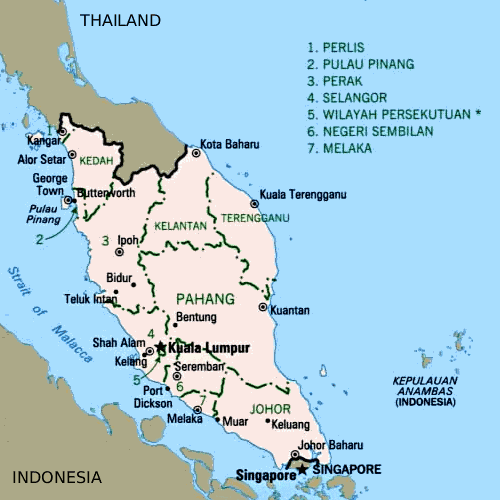
The Strait of Malacca is also a choke point. Peninsular Malaysia shown in pink (source; click to enlarge).

The Strait of Malacca is also a choke point (references deleted; see original for links):
The strait is the main shipping channel between the Indian Ocean and the Pacific Ocean, linking major Asian economies such as India, China, Japan and South Korea. ... In addition, it is also one of the world's most congested shipping choke points because it narrows to only 2.8 km (1.5 nautical miles) wide at the Phillips Channel (close to the south of Singapore).
The strait is important for global shipping, yet it's also vulnerable to piracy, to terrorist attack and, potentially, to international brinksmanship, as you'll read shortly. Control of the strait matters to many in the region and elsewhere.

Who Controls the Strait of Malacca?

Direct control of the strait is shared between Malaysia, Indonesia and the island city-state of Singapore. But control is not shared equally. The size of each nation's navy limits the degree to which that nation can project power into the strait.

The Jakarta [Indonesia] Post:
Indonesia, Malaysia and Singapore are the littoral states of the Malacca Strait, one of the world's busiest shipping lanes. Indonesia controls the majority of the sea lane. Singapore controls the smallest area of the strait, but the city-state enjoys the biggest economic benefit from shipping activities.

Indonesia is often cited as the main source of pirates operating in the Malacca Strait. But it is very firm in its position that all three of the countries are fully responsible for security in the strait.

However, Indonesia lacks the capacity to exercise its duties because its Navy is smaller and not as well equipped as the navies of Malaysia and Singapore.

Other countries -- no matter how vital the security of the strait is for their economies -- can only provide technical assistance to help Indonesia, Malaysia and Singapore ensure safe and secure passage through the 805-kilometer shipping lane.
But:
While we [Jakarta Post editorial writers] fully support the sovereignty of the three countries, we also want to remind them that all stakeholders in the strait have the right to play a role in ensuring the safety of this vital waterway. Major Asian economic powers like Japan and China want more of a role in patrolling the waters, because they depend on the strait for the transportation of commodities like oil and gas....

Indonesia can not simply claim sovereignty and reject any foreign presence in the strait, especially when it remains the main base for pirates there and has so far failed to ensure safe passage through its waters.

It is also difficult simply to dismiss whispers overseas -- although there is no evidence --- that rogue elements of the Indonesian Navy turn a blind eye to activities of pirates for a cut of the profit.

As long as Indonesia remains unable to play a credible and sustainable role in maintaining security and safety in the Malacca Strait, it will remain difficult for other countries with strong economic and political interests in the waterway simply to entrust Indonesia, Malaysia and Singapore to handle security responsibilities.

The three states have every right to maintain their sovereignty over the strait, for their commercial and security interests. They also have the rights to ask for more economic benefits from the foreign parties.

But as long as piracy and other security problems remain a concern, it will be nearly impossible for them to continue rejecting the presence of foreign powers in the strait.
And though it's not mentioned, those foreign powers include the U.S. as well.

"America's First Black President Throwing Slaves Under the Bus"

With that for context, now read Yves Smith at Naked Capitalism:
America's First Black President Throwing Slaves Under the Bus

Huffington Post has reconfirmed its reporting from over the past weekend, namely, that the Administration has a hairball to untangle to get Malaysia to sign the TransPacific Partnership. Basically, Malaysia needs to have an anti-slavery provision that was inserted in the bill in committee watered down. And the reason that that has to happen, as our reader Antifa pointed out in comments, is that Malaysia controls the Straits of Malacca, a critical shipping choke point. One of the major objectives of the pact is to strengthen America’s position in the region relative to China. Thus Malaysia’s location makes it a critically important signatory to the pact.

From the Huffington Post account (emphasis ours):

So the trade promotion authority bill that passed Friday includes the strong anti-slavery language, which the House will now work to take out to ensure that Malaysia (and, potentially, other countries in the future) can be part of the deal.

Observers are left with a deeper question: Why, in the year 2015, is the White House teaming up with Republican leaders essentially to defend the practice of slavery?

Cue Antifa:

Malaysia’s membership in the circle of TPP nations is not vital because Malaysia — it’s vital because of the Malacca Straits, through which virtually all the shipping in that part of the world passes. It’s a bottleneck, a chokepoint, and if Malaysia is “driven into the arms of China” then China can close those Straits to shipping how, when, and as they please.

Which would neuter the US Navy in that part of the world, reducing them to observer status. When people at the Pentagon talk about America’s role as the world’s policeman, they are talking about the Navy’s ability to project overwhelming force wherever and whenever needed. The three little chokepoints world trade and shipping depend on are the Strait of Hormuz, the Straits of Malacca, and the Panama Canal. Taking one of those and giving control of it to China and Friends — or to anyone but the US Navy — puts the world’s policeman in a clown suit.
Smith quotes this, from Andrew Watts, another of her commenters:
Look at a list of member states of TPP and tell me this isn’t an anti-Chinese military alliance or there are alternative shipping lanes. The transportation routes via the Eurasian Silk Road is one way to circumvent this potential naval blockade but shipping via the sea has always been cheaper than shipping by land.

The only reason why business and intellectual property rights is [a part] of the deal is because Obama needs to bribe as many domestic power centers as possible to pass it. This is straight outta his Obamacare playbook. The reason for the secrecy is probably due to the military nature of the pact. in any case nobody wants the perception that this is preparation for some future Sino-American war.

But if I were a Chinese political leader in Beijing I would not trust any assurances to the contrary that come from Washington.
By the way, here's that modern "Eurasian Silk Road" mentioned above, a rail route:

The new Eurasian Silk Road in yellow; dotted line shows shipping via Strait of Malacca (source; click to enlarge)

There is plenty more in the Naked Capitalism piece — a must-read if this stuff, geopolitical brinksmanship, is your topic.

Why Does Obama Want to Be the "Slavery in Asia" President?

I want to touch this just lightly, since motives are less important than done deeds. Motives do count toward legacy points, however, both by adding and subtracting them, so I do want to touch this some. Why does Obama want to do this, to support slavery in Asia as one of his defining late-term achievements?

First I want to stipulate this: I'm over the "he's too stupid or naïve to do things right" defense. That's both demeaning and disrespectful to Obama. After all, the man's an adult, not some child whom progressives need somehow to teach. So I'll offer three explanations, any or all of which could be right.

▪ One explanation is pretty simple. He thinks no one will notice, or if they do, they'll quickly forget. Pretty simple explanation, especially given that his best corporate friends control almost all of the messaging via corporate media.

▪ Another explanation is best expressed by Andrew Watt above. To repeat:
The only reason why business and intellectual property rights is [a part] of the deal is because Obama needs to bribe as many domestic power centers as possible to pass it. This is straight outta his Obamacare playbook.
That's actually very kind to Obama. It says that he's being a responsible president from a military standpoint, and bribing all major U.S. corporations — Nike, for example, corrupt as it is (do click) — to get the deal he needs because of solid national security concerns. As explanations go, this results in higher legacy points than the other ones do.

▪ The final explanation? He's simply cashing out, feathering his future nest, foaming his own landing, getting his meal ticket punched, setting the table for the feast of his next 20 years of life — his post-electoral, Obama Global Initiative legacy-tour life. You can't ride the corporate stratospheric rails to Davos if corporate jet owners don't like you. You can't give speeches for $400,000 each (give or take) if you don't give the check-writers a reason to say thanks.

Maybe Obama's just giving a reason to say thanks, much like this guy did back in 2000:
Bill Clinton's $80 Million Payday

On December 21, 2000, President Bill Clinton signed a bill called the Commodities Futures Modernization Act. This law ensured that derivatives could not be regulated, setting the stage for the financial crisis. Just two months later, on February 5, 2001, Clinton received $125,000 from Morgan Stanley, in the form of a payment for a speech Clinton gave for the company in New York City. A few weeks later, Credit Suisse also hired Clinton for a speech, at a $125,000 speaking fee, also in New York. It turns out, Bill Clinton could make a lot of money, for not very much work.

Today, Clinton is worth something on the order of $80 million [written in 2012] (probably much more, but we don’t really know), and these speeches have become a lucrative and consistent revenue stream for his family. Clinton spends his time offering policy advice, writing books, stumping for political candidates, and running a global foundation. He’s now a vegan. He makes money from books. But the speaking fee money stream keeps coming in, year after year, in larger and larger amounts.

Most activists and political operatives are under a delusion about American politics, which goes as follows. Politicians will do *anything* to get reelected, and they will pander, beg, borrow, lie, cheat and steal, just to stay in office. It’s all about their job.

This is 100% wrong. The dirty secret of American politics is that, for most politicians, getting elected is just not that important. What matters is post-election employment. It’s all about staying in the elite political class, which means being respected in a dense network of corporate-funded think tanks, high-powered law firms, banks, defense contractors, prestigious universities, and corporations. If you run a campaign based on populist themes, that’s a threat to your post-election employment prospects. This is why rising Democratic star and Newark Mayor Corey Booker reacted so strongly against criticism of private equity – he’s looking out for a potential client after his political career is over, or perhaps, during interludes between offices. ...
Not to say he doesn't also believe the "free trade" dominus vobiscum the Bigs are mouthing these days. It's just that he can't afford not to.

In terms of legacy points, that explanation actually subtracts them. Good thing few people are impertinent enough to suggest it. Me, I just keep seeing this:

Obama Legacy Library as envisaged by the Chicago firm HOK; lakefront view. If TPP passes, will Nike find a way to say thanks? (click to enlarge)

And then I wonder how something this grand gets paid for. Does that make me impertinent? Or just practical?

Pragmatically yours,

GP

Labels: , , , , , , , ,