Friday, October 16, 2015

Showdown-- Thurgood Marshall and the Supreme Court Nomination That Changed America By Wil Haygood

>


August 30, 1967 was a very important day in the history of our country. It was the day a reluctant Senate finally confirmed Thurgood Marshall to the Supreme Court. 69 senators voted YES, 11 voted NO, and, crucially, 20 didn't vote. We'll come back to those 20 in a moment. Marshall served on the Court for 24 years, from October, 1976 until October, 1991. He was the first African-American Supreme Court Justice-- and he was no Clarence Thomas (who, hideously, was appointed to his seat by George W. Bush). Marshall was an accomplished attorney for the NAACP with an astounding success rate of arguing cases in front of the Court, including Brown v Board of Education, the 1954 landmark case that discarded "separate but equal" and outlawed segregation in public schools. John Kennedy appointed him to the U.S. Court of Appeals (NY) and then Lyndon Johnson appointed him Solicitor General before appointing him to Tom Clark's Supreme Court seat when he resigned (when his son Ramsey Clark was appointed Attorney General).

So why bring this up now? Not because it's October. Last month Wil Haygood's epic book on the life of Marshall, Showdown-- Thurgood Marshall and the Supreme Court Nomination That Changed America, was published. In his review in the NY Times, David Margolick begins with a showdown between Marshall and 4 racist senators from the Judiciary Committee who were determined to block him from being confirmed to the Supreme Court-- John McClellan (D-AR), Sam Ervin (D-NC), Strom Thurmond (R-SC) and James Eastland (D-MS), the committee chair and the father of Miss Confederacy, 1966. Margolick laments how Marshall's story has been largely forgotten by history, "relegated to the shadow of Martin Luther King Jr.," but is excited that the Haygood book is going to change that. President Johnson:
“Thurgood, I’m nominating you because you’re a lot like me: Bigger than life, and we come from the same kind of people,” he told him. Because there had been no Supreme Court vacancies handy, Johnson, the consummate wheeler-­dealer, fashioned one, naming Ramsey Clark attorney general in order to induce his father, Justice Tom C. Clark, to quit. Johnson could then slide Marshall, solicitor general at the time, into Clark’s slot.

Before that, Marshall had been a federal appeals court judge in New York, begrudgingly named six years earlier by President Kennedy after Marshall had spurned his offer of a seat on the federal trial bench. (“My boiling point is too low for the trial court,” Marshall had explained. “I’d blow my stack and then get reversed.”) That initial offer had come from Robert Kennedy. “You don’t seem to understand,” he warned Marshall. “It’s this or nothing.”  “I do understand,” Marshall lectured him. “You don’t know what it means, but all I’ve had in my life is nothing. It’s not new to me, so goodbye.”

For much of that life, Marshall had been the founder and principal litigator of the NAACP Legal Defense and Educational Fund, fighting, against great odds and at enormous personal risk, to dismantle Jim Crow in Southern schools, courtrooms, lunch counters and voting booths — that is, when he wasn’t struggling frantically to spare individual indigent blacks from the electric chair or the rope. “Folks would come for miles, some of them on muleback or horseback, to see ‘the nigger lawyer’ who stood up in white men’s courtrooms,” an N.A.A.C.P. official would later recall. Not all of Marshall’s beneficiaries, though, were black: By helping to invalidate ­Texas’ whites-only primaries, thereby adding thousands of black voters to the rolls, he helped make Lyndon Johnson a senator.

“He is one of the most distinguished lawyers in the land,” Senator Jacob Javits of New York said in introducing Marshall to the Judiciary Committee. Javits’s words were echoed 24 years later when the first President Bush introduced Marshall’s replacement, Clarence Thomas. But in Marshall’s case, they were true.

In what was really Marshall’s first victory over the segregationist senators, they did not dare challenge his civil rights work. Instead, seeking to exploit concerns about crime — riots in Detroit and elsewhere were taking place during the hearings — they asked him about (and, in effect, blamed him and people like him for) recent Supreme Court decisions expanding the rights of criminal defendants. At one point Senator Ervin, not yet the avuncular figure of the Watergate hearings, complained that the Fifth Amendment was never meant to invalidate “voluntary confessions.”

“Well, Senator, the word ‘voluntary’ gets me in trouble,” Marshall replied. “I tried a case in Oklahoma where the man ‘voluntarily’ confessed after he was beaten up for six days.” The hearings, startlingly unscripted compared with today’s antiseptic proceedings, furnished one of the first debates on originalism-- the idea that the Constitution was frozen in time rather than, as Marshall argued, a “living document”-- and which, in this instance, was the refuge of bigots. They also featured Senator Thurmond trying to trip Marshall up on historical trivia that no one but a specialist, and certainly not Thurmond himself, could possibly have known.

“Are you prejudiced against white people in the South?” Senator Eastland asked Marshall. It was not, as Haygood writes, the “penultimate” question, but it was the ultimate one, and Marshall handled it with aplomb. Shortly thereafter, he was overwhelmingly confirmed, and far more easily than Haygood leads us to expect he would be. Miraculously (though Haygood fails to point it out) only one Republican, Thurmond, voted against him. For all his fears, Lyndon Johnson was famously persuasive (and were Marshall to falter, he even had another black candidate, William Coleman, waiting in the wings). He could also count noses.
An interview with Haygood on KPCC's AirTalk is what drew my attention to the book and to the 20 senators who didn't vote and how that happened. Before Marshall's nomination, no Supreme Court nominee's Judiciary Committee hearing had lasted more than 4 hours. Marshall's was a full 5 days, stretched out for almost 2 weeks. Haygood on how Johnson managed to force the confirmation through the Senate despite the intent of the Southern racists to block it:
Johnson... was a master. These were senators that he had known from his years in the Senate. After Marshall made it out of the Senate Judiciary Committee [the nomination] of course headed to the full Senate. His paperwork sat in limbo for 5 weeks and that was also unheard of at the time. It made a lot of people very upset, but Lyndon Johnson started working the telephones and he convinced 20 Southern segregationists to not vote on the day of the vote for Thurgood Marshall. He twisted arms; he let them know what he would do to them. He would hurt them in their home districts, maybe by making speeches against them or not giving them some pork barrel project. He was being a master politician. And on the day of the vote, 20 Southern segregationist senators opted not to vote against Marshall.
The racists' plan for a filibuster fell apart. Only 1 Republican-- Strom Thurmond-- and 10 Dixiecrats-- Robert Byrd (WV), James Eastland (MS), Allen Ellender (LA), Sam Ervin (NC), Lister Hill (AL), Spessard Holland (FL), Fritz Hollings (SC), Russell B. Long (LA), John Sparkman (AL), and Herman Talmadge (GA) voted NO. But among the 20 senators who stayed away that day less than half were actually Southern segregationists: Harry Byrd, Jr. (D-VA), Paul Fannin (R-AZ, not technically a Southern segregationist but a Southwestern segregationist), Fred Harris (D-OK), B. Everett Jordan (D-NC), John McClellan (D-AR), Richard Russell (D-GA), George Smathers (D-FL), and John Stennis (D-MS). Others who stayed away included non-Southerns and non-racists like Democrats Joseph Montoya (NM), George McGovern (SD), Gaylord Nelson (WI), Vance Hartke (D-IN), Ed Muskie (ME), Ernest Gruening (AK) and Mike Mansfield (MT). Haygood got that wrong.

Labels: , , ,

Thursday, July 16, 2015

Sanders Surge Continues in Iowa & NH; Taking the Fight to Clinton

>

The Sanders surge is about Sanders, not Clinton. Click to enlarge.

by Gaius Publius

We know that Sanders is gaining in many polls, and that some are attributing his rise to a growing "anyone but Clinton" mood among Democrats. Nate Silver at FiveThirtyEight.com disagrees.

Data first, via Silver:
In Iowa, Sanders’s favorability rating has grown from about 35 percent at the start of the year to 60 percent now. And in New Hampshire, it has improved from around 45 percent to 65 percent. Some of that is from improved name recognition, but Sanders’s unfavorable ratings haven’t increased even as he’s become better known, remaining at about 10 percent in each state.
From 35% to 60% in Iowa, from 45% to 65% in New Hampshire, both since February. These are excellent numbers. Now the cause, as Silver sees it. The article begins with the idea he wants to debunk:
“The recent rise of Bernie Sanders,” wrote Vox’s Jonathan Allen last week, “points as much to [Hillary] Clinton’s vulnerability as Sanders’s strength.” Allen went on to argue that Joe Biden should run for president. “The Sanders surge shows that Democratic activists want an alternative to Clinton,” he explained.

We’ve seen this idea before. For at least a year, journalists have been urging, sometimes almost begging, Biden to enter the race. The more elaborate versions of the idea liken the 2016 campaign to 1968, a year in which the incumbent president, Lyndon B. Johnson, withdrew after the liberal, anti-war candidate Eugene McCarthy finished a close second in the New Hampshire primary. The nomination was eventually won by Johnson’s vice president, Hubert Humphrey, after Robert F. Kennedy (who had entered the race after New Hampshire) was assassinated. In the 2016 narrative, Clinton is Johnson, Sanders is McCarthy and Biden is some composite of Kennedy and Humphrey.

But these comparisons suffer from a fatal flaw. Unlike LBJ, who (mostly because of the Vietnam War) had approval ratings only in the mid-50s or low 60s among Democrats during the 1968 campaign, Hillary Clinton is beloved by voters in her party. In national polls, her favorability ratings among Democrats usually exceed 80 percent.
Thus:
The Bernie Sanders surge, in other words, has a lot more to do with Bernie Sanders than with Hillary Clinton. More specifically, it has to do with his left-populist politics. We’re going to break some news here: It turns out that some Democrats are really liberal, and they like a really liberal candidate like Sanders. Right now, Sanders is winning about half the support of white liberal Democrats, but little support from other groups within the party. That works out to around 25 or 30 percent of the vote in Iowa and New Hampshire but more like 15 percent among Democrats nationally.
But Silver's news for Sanders is not all good.

The Dark Side of Silver's Silver Lining

Silver is concerned (on Sanders' behalf) that this result — potential wins in Iowa and New Hampshire, each with a rich lode of white liberal Democrats — may be as good as it gets for him. In other words, that Sanders may win in Iowa and New Hampshire and lose everywhere else.

Here's what that "white liberal Democrat" population looks like, state by state:

Click to enlarge.

From a different FiveThirtyEight piece (the one containing the graphic above), Silver writes this:
Sanders, who has sometimes described himself as a socialist, isn’t likely to do so well with moderate Democrats, of course. That’s a problem for him, since a thin majority of Democrats still identify as moderate or conservative rather than liberal. But Sanders has a few things working in his favor. The share of liberal Democrats is increasing — pretty rapidly, in fact — and those Democrats who turn out to vote in the primaries tend to be more liberal than Democrats overall.

What’s received less attention is that Sanders has so far made very little traction with non-white Democrats. The most recent CNN poll found his support at just 9 percent among non-white Democrats, while the latest Fox News poll had him at only 5 percent among African-American Democrats. (Fox News did not provide crosstabs for Hispanics or other minority groups.)
So Sanders (and Warren) seem to be creating new "liberals" — meaning the Warren kind, not the Obama kind —pretty rapidly. That's good news. But without minority support, he's going to have some trouble. And that's fixable. I've heard from a number of sources that the Sanders camp is aware of this. More as it develops.

In the meantime...

Sanders Takes It to Clinton

This is one way to use the advantage you have — draw clear lines. Two reports, each from The Hill, around the same event, an impromptu Sanders press conference. First (my emphasis):
Sanders uses Clinton visit to draw contrast

Sen. Bernie Sanders (I-Vt.) on Tuesday tried to highlight the differences between himself and fellow presidential candidate Hillary Clinton after she spoke with Senate Democrats during a weekly party lunch.

Sanders, who, like Clinton, is seeking the 2016 Democratic nomination, spoke with reporters at a stakeout normally reserved for leadership from both parties. He used the impromptu press conference to underscore differences the two have on a wide range of issues, including trade, the war on Iraq, climate change and national security.

Pointing to his vote against the North American Free Trade Agreement (NAFTA), Sanders said that he believes the trade deal has "been disastrous for American workers. ...Secretary of State Clinton I believe has a different view on that issue."

He also cited his vote against authorizing the war against Iraq. Clinton, who was a senator at the time, has faced criticism for her vote supporting the war, and she told reporters earlier this year that she "made a mistake."

On climate change, he touted his opposition to the Keystone pipeline adding that "I think Secretary Clinton has not been clear on her views on that issue."
The Hill used that last remark — on Keystone and climate change — for a second piece about that press conference:
Sanders challenges Clinton on Keystone

Democratic presidential candidate Sen. Bernie Sanders challenged his rival Hillary Clinton Tuesday to take a stand against the Keystone XL oil pipeline.

Speaking with reporters in the Capitol, Sanders he took a leadership role in Democrats’ fight against the proposed Canada-to-Texas pipeline, while Clinton has been silent on the project.

“I have helped lead the opposition against the Keystone pipeline,” the Vermont senator said. “I think Secretary Clinton has not been clear on her views on that issue.”

In a later statement, Sanders added that he opposes Keystone “because of concerns about climate change.”...

Clinton’s silence on Keystone has been one of the top sticking points for environmentalists, who have mostly avoided endorsing her.

As secretary of state from 2009 to 2013, Clinton was one of the most senior Obama administration officials responsible for its review of TransCanada Corp.’s application to build the pipeline, a process that has stretched on for more than six years.

In 2010, she said the administration was “inclined” to approve the project. But she has been silent since then.

Sanders, meanwhile, has been actively courting environmentalists, and was ranked by the super PAC Climate Hawks Vote as the best senator on climate in the 2013-2014 session of Congress.
Climate Hawks Vote ranks members of Congress relative to climates issues (visit the page to find out how your senator ranks). More information here.

Bottom Line — There's Plenty of Time

If the Sanders surge lasts through February, when the Iowa caucus and New Hampshire primary are held, he's viable through the start of next year at least. That's a full six months to present the Sanders case to the rest of the Democratic base. So far, so good, though I would think it would be good to start making that case soon.

GP

Labels: , , , , , , , , ,

Wednesday, June 24, 2015

Did You Ever Have Any Doubt That Nixon Was A Traitor To America?

>

He was-- but "traitor" is a more appropriate description

Writing for Common Dreams, Bob Fitrakis and Harvey Wasserman assert what many people long suspected. The first paragraph of their piece has only 5 words: "Richard Nixon was a traitor." Right-wing clown George Will was the source of their information, which also points to Kissinger's complicity.
Nixon's newly revealed records show for certain that in 1968, as a presidential candidate, he ordered Anna Chennault, his liaison to the South Vietnam government, to persuade them to refuse a cease-fire being brokered by President Lyndon Johnson.

Nixon's interference with these negotiations violated President John Adams's 1797 Logan Act, banning private citizens from intruding into official government negotiations with a foreign nation.

Published as the 40th Anniversary of Nixon's resignation approaches, Will's column confirms that Nixon feared public disclosure of his role in sabotaging the 1968 Vietnam peace talks. Will says Nixon established a "plumbers unit" to stop potential leaks of information that might damage him, including documentation that he believed was held by the Brookings Institute, a liberal think tank. The Plumbers' later break-in at the Democratic National Committee led to the Watergate scandal that brought Nixon down.

Nixon's sabotage of the Vietnam peace talks was confirmed by transcripts of FBI wiretaps. On November 2, 1968, LBJ received an FBI report saying Chernnault told the South Vietnamese ambassador that "she had received a message from her boss: saying the Vietnamese should "hold on, we are gonna win."

As Will confirms, Vietnamese did "hold on," the war proceeded and Nixon did win, changing forever the face of American politics-- with the shadow of treason permanently embedded in its DNA.

The treason came in 1968 as the Vietnam War reached a critical turning point. President Lyndon Johnson was desperate for a truce between North and South Vietnam.

LBJ had an ulterior motive: his Vice President, Hubert Humphrey, was in a tight presidential race against Richard Nixon. With demonstrators in the streets, Humphrey desperately needed a cease-fire to get him into the White House.

Johnson had it all but wrapped it. With a combination of gentle and iron-fisted persuasion, he forced the leaders of South Vietnam into an all-but-final agreement with the North. A cease-fire was imminent, and Humphrey’s election seemed assured.

But at the last minute, the South Vietnamese pulled out. LBJ suspected Nixon had intervened to stop them from signing a peace treaty.

In the Price of Power (1983), Seymour Hersh revealed Henry Kissinger-- then Johnson’s adviser on Vietnam peace talks-- secretly alerted Nixon’s staff that a truce was imminent.

According to Hersh, Nixon “was able to get a series of messages to the Thieu government [of South Vietnam] making it clear that a Nixon presidency would have different views on peace negotiations."

Johnson was livid. He even called the Republican Senate Minority Leader, Everett Dirksen, to complain that “they oughtn’t be doing this. This is treason.”

“I know,” was Dirksen’s feeble reply.

...In the four years between the sabotage and what Kissinger termed “peace at hand” just prior to the 1972 election, more than 20,000 US troops died in Vietnam. More than 100,000 were wounded. More than a million Vietnamese were killed.

But in 1973, Kissinger was given the Nobel Peace Prize for negotiating the same settlement he helped sabotage in 1968.

According to Parry, LBJ wanted to go public with Nixon’s treason. But Clark Clifford, an architect of the CIA and a pillar of the Washington establishment, talked Johnson out of it. LBJ’s close confidant warned that the revelation would shake the foundations of the nation.

In particular, Clifford told Johnson (in a taped conversation) that “some elements of the story are so shocking in their nature that I’m wondering whether it would be good for the country to disclose the story and then possibly have [Nixon] elected. It could cast his whole administration under such doubt that I think it would be inimical to our country’s best interests.”

In other words, Clifford told LBJ that the country couldn’t handle the reality that its president was a certifiable traitor, eligible for legal execution.

Fittingly, Clark Clifford’s upper-crust career ended in the disgrace of his entanglement with the crooked Bank of Credit and Commerce (BCCI), which financed the terrorist group Al Qaeda and whose scandalous downfall tainted the Agency he helped found.
Perhaps it was this Nixon maneuver that inspired Ronald Reagan to make almost identically treasonous moves to sabotage the Iran hostage crisis solution President Carter had worked out.

Labels: , , , , , ,

Tuesday, December 30, 2014

Before The Selma March Massacre There Was B. Bumble & The Stingers And... Tchaikovosky

>


With apologies to Ken-- and in recognition of all the work he's done to make sure everyone at DWT knows everything there is to know about The Nutcracker-- I wanted to mention something not many people do remember about the score to that 1892 ballet. First though, by way of a little refresher, this is a performance by the Cologne New Philharmonic Orchestra under the direction of Volker Hartung, filmed in Hamburg, February 1, 2009.


Officially Tchaikovsky's Nutcracker Suite op.71a, it is better known in America as the March of the Toy Soldiers. And there was a 1962 version, "Nut Rocker," by Los Angeles-based session musicians calling themselves B. Bumble & The Stingers (which included the great drummer Earl Palmer whose work you might recognize from albums by Neil Young, Frank Sinatra, Bonnie Raitt, Randy Newman, Sam Cooke, the Beach Boys, Bobby Darin, Tim Buckley and dozens of others). The single went to #23 in the U.S. and #1 in the U.K. Emerson, Lake and Palmer recorded a somewhat overblown version a decade later in 1972, although here they are, in all their glory, live in Switzerland in 1970, doing the song after their first album was released:


In between B. Bumble & The Stingers' version and Emerson, Lake and Palmer's cover, a different march was gripping Americans-- 3 marches that attempted to go from Selma to Montgomery, Alabama in March 1965. The ferocity of the police brutality against the peaceful, non-violent marchers by the racist and fascist beasts led to a national feeling of disgust towards the vicious thugs still dominating The South and, soon after, to the passage of the Civil Rights Act of 1965, apparently not something LBJ was eager to get behind. Listen to him and Alabama's sick, racist governor, George Wallace, discussing the march on the phone:


I was a college freshman during this period and the impact on my soul was tremendous and existential. I still can't not cry when I watch depictions of that march. Everyone I know who has seen Selma is raving about it:


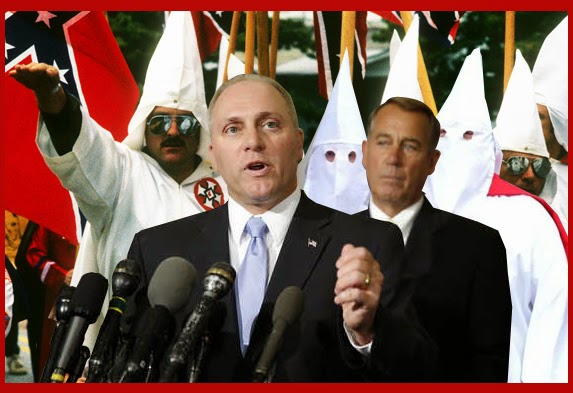
By the way, Louisiana's racist Republican congressman, Steve Scalise, Boehner's Majority Whip, is not accused of forgetting whether or not he spoke at a gay rights convention or of wandering into a conclave advocating economic justice for all Americans. David Duke, whose organization Scalise addressed, was a well-known Republican politician who ran for statewide and local office and served as the state Rep for the Metairie area, near where Scalise lived, an area he later served in the state legislature himself. While there, Duke distinguished himself by espousing neo-Nazi ideology on the floor of the legislature and selling copies of Mein Kampf in the state Capitol. There is no one in Louisiana who didn't know this at the time. And no one who didn't know Duke was the Grand Wizard of the KKK or what the KKK was advocating for blacks, Latinos and Jews. It was on TV, radio and on the front pages of the newspapers. Today, the third-ranking Republican in Congress, Scalise doesn't have what it takes to admit he was wrong and promise to mend his racist ways.

Boehner solemnly accepts Scalise's excuse that he thought he was addressing a bedsheet manufacturers' convention

Labels: , , , , ,

Wednesday, March 19, 2014

More kudos for Bryan Cranston's portrayal of LBJ -- but the "Edith Bunker"-ing of Lady Bird J is no sale

>


No shrinking violet she: Al Kamen reports that former LBJ chief of staff Jim Jones "said there was a scene where Johnson dismissed [Lady Bird] with a curse -- which he said 'would never happen.' "

by Ken

Since I devoted a post last week ("Bryan Cranston as LBJ, according to people who worked with him") to Al Kamen's WaPo "In the Loop" item "Bryan Cranston gets two thumbs up from LBJ staffers" ("Like Walter White’s epic transformation from meek family man to unrepentant meth lord, Bryan Cranston transforms so completely into President Lyndon B. Johnson that for those who actually knew the 36th president Broadway’s Neil Simon Theatre is a time machine"), I feel obliged to pass on an important update, "Getting Lady Bird wrong."

As Al pointed out in the original item, his LBJ-connected sources -- Joe Califano, Doris Kearns Goodman, Lloyd Hand, and Larry Levinson -- were uniformly enthusiastic about "the stunning performance of Bryan Cranston" as LBJ in Robert Schenkkan's play All the Way, now playing on Broadway. And now that Al has seen the play himself, he joins the chorus of praise, declaring, "If you can, you must see Cranston’s performance."

But no sooner did the original piece see print than Al received an emphatic complaint about another portrayal, a complaint with which he "heartily agrees": the play's depiction of First Lady Claudia Taylor "Lady Bird" Johnson.
[W]e got a call the next day from Jim Jones, former House Budget Committee chairman, ambassador to Mexico and Johnson’s last chief of staff. Jones said he had heard from friends who had told him that "the real" Lady Bird Johnson was not "portrayed as she was, that she came off as "too meek and mild." Jones said there was a scene where Johnson dismissed her with a curse -- which he said "would never happen." (Johnson/Cranston tells her at one point to "get the hell out of here.")

Johnson consulted the first lady and "before any major speech or any decision he would ask what did Lady Bird say or think." Jones said "she was very good with words and had an antenna for people, and he really respected that."

Having seen the play, we heartily agree -- as does Califano -- that that particular portrayal is off, way too Edith Bunker. On the other hand, the performances of the other cast members -- playing Martin Luther King Jr. and fellow civil rights leaders Stokely Carmichael, James Farmer, Roger Wilkins and Fannie Lou Hamer, plus aide Walter Jenkins and Sen. Richard Russell (D-Ga.), seemed pretty accurate.
I never met any of these folks, of course, but certainly nothing I've ever heard or read suggested that there was any shrinking violet in Lady Bird, so it's nice to have this expert witness on the subject.


AL ALSO ANNOUNCES A NEW "LOOP" CONTEST:
GUESS THE NUMBER OF OBAMACARE ENROLLEES


Long story short: The new contest invites "In the Loop" readers to guess the actual number of Obamacare signups by the March 31 non-penalty deadline. But since this takes us into the whole area of wholesale lying on the subject by the usual right-wing suspects, I think we should look at this separately tomorrow.

The contest deadline isn't till March 28, so I don't think you'll suffer by waiting a day for the details. And after all this contest doesn't ask you to do anything clever, just come up with a number. Still, if you want to get started today,check it out for yourself.
#

Labels: , ,

Wednesday, March 12, 2014

Bryan Cranston as LBJ, according to people who worked with him

>


Bryan Cranston portrays former President Lyndon B. Johnson on Broadway in Robert Schenkkan’s play All the Way, directed by Bill Rauch

by Ken

Even those of us whose strong memories of Bryan Cranston go back beyond Breaking Bad not just to hilariously bumbling but dangerous dad Hal on Malcolm in the Middle but to his appearances as agenda-driven dentist Tim Whatley on Seinfeld, his post-Breaking Bad incarnation as former President Lyndon B. Johnson is, well, not so much a stretch as a "huh?" Let's do one of our quick show-of-hands polls: Raise your hand if you're keen to see a play about LBJ. No, really raise 'em. Hmm, I thought so.

The Washington Post "In the Loop"-ster Al Kamen has been thinking about the Cranston impersonation from a different angel: verisimilitude. "The critical buzz around Cranston's portrayal of Johnson in All the Way," says Al, "is that the actor is impeccable in the role." He adds that "anyone who watched Cranston in Breaking Bad knows his talent range," but ventures that "only those who knew Johnson can say with authority how fully Cranston embodies Johnson."

"So," says Al, "we reached deep into our Rolodex to find people who worked in the Johnson administration to survey about how well Cranston does." He has already pronounced the overall verdict in his lead: "Like Walter White morphing from meek family man to unrepentant meth lord, Bryan Cranston transforms so completely into Lyndon Johnson that, for those who knew the 36th president, Broadway's Neil Simon Theatre is a time machine."

Here's what Al found.

JOE CALIFANO
"Johnson's top domestic policy aide" -- "saw the show on opening night"
When Cranston shouted a command on stage, that familiar formidable tone shook Califano, transporting him back nearly 50 years. "I'll tell you there were moments when I thought I was actually looking at him or hearing him," Califano said.

It's hard to distinguish whether Cranston "has taken over Johnson or Johnson's taken over him," he said. Cranston "went from ‘Breaking Bad' to breaking good," he added.

For Califano, who reasons he ate more meals with Johnson than his own family in those years, Cranston perfectly captures Johnson's intensity -- his anger, his frustration, his humor, how he'd bark an order while doing five other things simultaneously.

DORIS KEARNS GOODWIN
"a historian who worked in Johnson's administration as a White House fellow, helped the president write his memoirs, and wrote her first of many books about her conservations with him" -- "also saw the show on opening night"
"Thank God LBJ kept those tapes," Goodwin said of the telephone conversations mined to tell the complete story of Johnson's political process in the early years of his presidency.

Johnson "comes alive in this," she added. "When he's on stage," she said of Cranston, "it's just magnetic."

Cranston captures Johnson's mannerisms, such as using physical proximity to intimidate, she said. Much of the play shows Johnson on the phone, "which is exactly the right way to capture him," she said. "The phone was the instrument of his power."

LLOYD HAND
"first worked for Johnson in the Senate and then in the White House"
[H]as yet to see the show, but a cadre of former Johnson officials have planned a reunion in New York to see [the show] together in mid-May.
A "Breaking Bad" fan, Hand initially could not reconcile Walter White -- a character with "no redeeming qualities" -- playing someone Hand held in such esteem.

Hand hopes the play, which focuses on Johnson's domestic achievements, serves to revisit his boss's legacy beyond the Vietnam War.

LARRY LEVINSON
"Johnson's deputy counsel"
[A]lso has yet to see the show, but has heard the same feedback from Johnson alums about Cranston's "unerringly perfect performance."

"The buzz from Austin on this is that it is an enormously helpful portrayal . . . a most accurately interesting portrayal," he said.
#

Labels: ,

Monday, July 30, 2012

Can you imagine Medicare being enacted by a zombified Congress that takes a worthless doodysack like Paul Ryan seriously?

>

July 30, 1965: With former President Harry Truman looking
on, President Lyndon Johnson signs Medicare into law


"After reading Atlas Shrugged, [Paul Ryan] said, 'Wow, I've got to check out this economics thing.' "
-- as told to The New Yorker's Ryan Lizza, this week
in
"Fussbudget: How Paul Ryan captured the G.O.P."

by Ken

We'll come back to the egregious Representative Ryan. First let's pause to ponder the lead story today from history.com's "This Day in History," which my friend Paul kindly passed on: Jul 30, 1965: Johnson signs Medicare into law.
On this day in 1965, President Lyndon B. Johnson signs Medicare, a health insurance program for elderly Americans, into law. At the bill-signing ceremony, which took place at the Truman Library in Independence, Missouri, former President Harry S. Truman was enrolled as Medicare's first beneficiary and received the first Medicare card. Johnson wanted to recognize Truman, who, in 1945, had become the first president to propose national health insurance, an initiative that was opposed at the time by Congress.

The Medicare program, providing hospital and medical insurance for Americans age 65 or older, was signed into law as an amendment to the Social Security Act of 1935. Some 19 million people enrolled in Medicare when it went into effect in 1966. In 1972, eligibility for the program was extended to Americans under 65 with certain disabilities and people of all ages with permanent kidney disease requiring dialysis or transplant. In December 2003, President George W. Bush signed into law the Medicare Modernization Act (MMA), which added outpatient prescription drug benefits to Medicare.

Medicare is funded entirely by the federal government and paid for in part through payroll taxes. Medicare is currently a source of controversy due to the enormous strain it puts on the federal budget. Throughout its history, the program also has been plagued by fraud--committed by patients, doctors and hospitals--that has cost taxpayers billions of dollars.

Medicaid, a state and federally funded program that offers health coverage to certain low-income people, was also signed into law by President Johnson on July 30, 1965, as an amendment to the Social Security Act.

In 1977, the Health Care Financing Administration (HCFA) was created to administer Medicare and work with state governments to administer Medicaid. HCFA, which was later renamed the Centers for Medicare & Medicaid Services (CMS), is part of the Department of Health and Human Services and is headquartered in Baltimore.

As it happens, today is also the day that The New Yorker unleashes on the world an embarrassingly toadying paean to the increasingly egregious Paul Ryan by the increasingly alarming Ryan Lizza. With one or two fleeting exceptions, of which I doubt that Lizza himself grasps the significance, the piece reads as if it came straight out of Frankenryan's PR shop. It's pretty much PRyan's own view of himself and the world he lives in, faithfully transcribed by RyanL as if it were true.

The coincidence of the Medicare anniversary is oddly ironic, because as we all recall from the 2010 election season, Medicare is a program that all the Teabagging cretins managed to forget as they blithered their imbecilic diatribes against government. And the egregious PRyan is one of the more immediate threats in the land to the future of Medicare as well as Social Security.

Early on in RyanL's puff piece, there's a surely unintended glimpse of his status as a made-to-order mark for a self-importantly earnestly geeky self-promoter like PRyan:
Unlike most members of Congress these days, Ryan is relatively accessible to reporters. "The key to understanding me is really simple," he said. "I am not trying to be anybody other than who I actually am." Even his ideological foes comment on his friendliness and good nature. After his sophomore year in high school, back in 1986, he worked the grill at McDonald's. "The manager didn't think I had the social skills to work the counter," he said. "And now I'm in Congress!"

RyanL appears so enthralled by his access to PRyan that he appears to completely miss the chill of that declaration, "And now I'm in Congress!," coming from a man who historically lacks the social skills to work the counter at McDonald's.

We do learn some interesting things about PRyan, like the big-fish-in-a-small-pond world of entitlement he was born into:
Janesville, Wisconsin, where Ryan was born and still lives, is a riverfront city of sixty-four thousand people in the southeast corner of the state, between Madison and Chicago. Three families, the Ryans, the Fitzgeralds, and the Cullens, sometimes called the Irish Mafia, helped develop the town, especially in the postwar era. The Ryans were major road builders, and today Ryan, Inc., started in 1884 by Paul's great-grandfather, is a national construction firm. The historic Courthouse section of Janesville is still thick with members of the Ryan clan. At last count, there were eight other Ryan households within a six-block radius of his house, a large Georgian Revival with six bedrooms and eight bathrooms that is on the National Register of Historic Places.

PRyan makes an enormous effort, and it's completely successful with RyanL, to portray himself as an aw-shucks ordinary feller, a true man of the people. The reality, it appears, is that he has always had an inborn sense of entitlement -- the unearned sense of self of a born princeling.

We learn too that, at age 16, PRyan suffered a trauma from which it seems likely he's never recovered:
[T]he summer of 1986 brought a life-changing event. One night in August, he came home from work well past midnight, and he slept late the following morning. His mother was in Colorado visiting his sister, and his brother, who had a summer job with the Janesville parks department, had left early. Paul answered a frantic phone call from his father's secretary. "Your dad's got clients in here," she said. "Where is he?" Paul walked into his parents' bedroom and thought his father was sleeping. "I went to wake him up," he told me, "and he was dead."

"It was just a big punch in the gut," Ryan said. "I concluded I've got to either sink or swim in life." His mother went back to school, in Madison, and studied interior design; his grandmother, who suffered from Alzheimer's, moved into their home, and Ryan helped care for her. "I grew up really fast," he said.

One can feel sincerely sorry for little PRyan -- though "a big punch in the gut" does seem a curious way of describing it, especially at this remove in time. It suggests that even grown-up PRyan thinks his father's death was all about him. And despite his description of his supposed accelerated growing up, and with all possible allowance for the great stress of those years, it seems more likely that the upshot was that the little brat never did grow up. If you understand him as being emotionally frozen in time at the age of 16, at which point he was apparently a profoundly maladroit social misfit, lacking the social skills for McDonald's counter work, then I think you've got the profile of the adult PRyan. It's a shame no one put him together with the kind of mental help he clearly needed at the time, but that's water under the bridge now.

Naturally that misanthropic loon Ayn Rand makes her appearance:
His father's death also provoked the kind of existential soul-searching that most kids don't undertake until college. "I was, like, ‘What is the meaning?' " he said. "I just did lots of reading, lots of introspection. I read everything I could get my hands on." Like many conservatives, he claims to have been profoundly affected by Ayn Rand. After reading "Atlas Shrugged," he told me, "I said, ‘Wow, I've got to check out this economics thing.' What I liked about her novels was their devastating indictment of the fatal conceit of socialism, of too much government." He dived into Friedrich Hayek, Ludwig von Mises, and Milton Friedman.
My read: He read and read and read, and managed never to get deeper into "this economics thing" than the cartoon world of his beloved Ayn. Howie has written so much here about the breadth and depth of PRyan's economic ignorance that I'm not going to mine that pit here.

Again, there's no indication that RyanL has any clue as to the significance of this next story, set up by PRyan's profession of great hopefulness about developing a good working relationship with the new president, Barack Obama, based on all their similarities. (Well, they're from relatively close parts of the country, and they both like sports, and . . . well, you'll have to read this for yourself.) So imagine his surprise when -- after all those years of savaging Democrats -- poor PRyan finds himself in the president's crosshairs. It's the classic case of an individual with absolutely no insight into or understanding of himself (this is, after all, the man who grew out of the boy who lacked the social skills to work the counter at McDonald's), and doesn't hear a single word that comes out of his ignorant, poisonous mouth.
In mid-April of 2011, in a speech at George Washington University, Obama once again decided to make an example of Ryan. Republicans were finally about to vote on the Path to Prosperity, and the President was eager to offer his opinion. Obama, for nearly the first time in his Presidency, emphasized the ideological divide between the two parties rather than offering bromides about what they shared. The White House invited Ryan to the speech and reserved a V.I.P. seat for him. Obama had personally called Ryan after Republicans won the majority in the House the previous November, and Ryan thought the two might have a rapport. They both liked sports and, because Ryan's district runs along the Illinois border close to Chicago, knew many of the same people. "He's a cerebral guy who likes policy, and he's from my part of the country," Ryan said. "At the beginning, I did have some hope."

Ryan sat in the front row as the President shredded his plan. "I believe it paints a vision of our future that's deeply pessimistic," Obama said. "There's nothing serious about a plan that claims to reduce the deficit by spending a trillion dollars on tax cuts for millionaires and billionaires. And I don't think there's anything courageous about asking for sacrifice from those who can least afford it and don't have any clout on Capitol Hill."

Ryan seemed genuinely shocked. During a radio interview later in the day, he complained that Obama had called him "un-American," and he objected to the charge that he was "pitting children with autism or Down syndrome against millionaires and billionaires" and "ending America as we know it." Ryan told me, "I was expecting some counteroffer of some kind. What we got was the gauntlet of demagoguery."

Alas, poor PRyan, tragic victim of "the gauntlet of demagoguery"!

Finally, there is the one moment when RyanL clearly does see a wee problem with PRyan's self-presentation. Much is made in the piece of PRyan's moving commitment to his home region, and to its bounceback from the devastation of Janesville's abandonment by GM -- no longer as a manufacturing center (nothing is made there now, we're told), but as a distribution center. As we'll see in a moment, even the generally clueless PRyan grasps that such bounceback as Janesville has achieved has been largely attributable to government spending. But . . . .
When I pointed out to Ryan that government spending programs were at the heart of his home town's recovery, he didn't disagree. But he insisted that he has been misunderstood. "Obama is trying to paint us as a caricature," he said. "As if we're some bizarre individualists who are hardcore libertarians. It's a false dichotomy and intellectually lazy." He added, "Of course we believe in government. We think government should do what it does really well, but that it has limits, and obviously within those limits are things like infrastructure, interstate highways, and airports." But independent assessments make clear that Ryan's budget plan, in order to achieve its goals, would drastically reduce the parts of the budget that fund exactly the kinds of projects and research now helping Janesville.
Um, oops!

And this is the man who would at least like to be thought of as the brains, economically speaking, of the House Republican caucus. It's my understanding that PRyan is a lot less popular among House Republicans than RyanL seems to think. Nevertheless, it remains entirely possible, given sufficiently disastrous 2012 election results, that a Republican-controlled White House and Senate as well as House could shove into law some version of PRyan's economic "reforms." If there's anyone who isn't terrified by that possibility, I don't know what it would take.
#

Labels: , , , ,

Tuesday, April 26, 2011

"Liars and their enablers now work hand in glove -- mendocracy is the regime that governs us now" (Rick Perlstein)

>

Postscript: Keith Olbermann's announcement
(see below)


Ronald Reagan laid the groundwork for the Right's official
severing of the country from the reality standard.

"In researching [the '80s], I've been surprised to discover the extent to which Ronald Reagan explicitly built his appeal around the notion that it was time to stop challenging the powerful. A new sort of lie took over: that the villains were not those deceiving the nation, but those exposing the deceit -- those, as Reagan put it in his 1980 acceptance speech, who 'say that the United States has had its day in the sun, that our nation has passed its zenith.' They were just so, so negative. According to the argument Reagan consistently made, Watergate revealed nothing essential about American politicians and institutions -- the conspirators 'were not criminals at heart.'"
-- Rick Perlstein, in "Inside the GOP's Fact-Free
Nation
," in Mother Jones

by Ken

For the benefit of new readers, since the 2008 presidential election campaign, I've been reduced to periodic rants about Republicans and the Right generally having officially gone off the standard, no longer feeling any obligation or indeed connection to reality, so there should be no surprise at my responsiveness to our friend (and favorite working historian) Rick Perlstein's new Mother Jones piece, which tackles this very subject.

Rick, you may recall, after his landmark books Before the Storm: Barry Goldwater and the Unmaking of the American Consensus and Nixonland: The Rise of a President and the Fracturing of America, has been immersed in the next turning point in the conservatizing of America, the Reagan era. And it's hard to look at that period without grappling with the loosening of the bonds of reality.

Reagan himself had a decidedly shaky relation to reality, quite independent of the descent into Alzheimer's. Indeed, while there's a political career's worth of evildoing that the sainted Ronnie has to answer for, I've always thought his most toxic legacy was preaching to an all-too-eager American public the happy-making doctrine that reality is whatever you think it is, whatever you want it to be, whatever makes you feel best. But it wasn't till that 2008 election that I perceived that an entire side of the American political spectrum had abandoned any feeling of responsibility to truth.

It's been hard to think how there could fail to be consequences.

Of course long before 2008 the Bush regime had been hard at work permanently sundering all links between its pronouncements and truth. This is what I found myself pondering as I read -- with Rick's piece already resounding in my head -- today's ThinkProgress Progress Report, "The Neverending Story," which looks into the documentation about the abuses in Guantanamo provided by the latest WikiLeaks cache of more than 700 documents (with a link is to The Guardian's coverage).
THE DETAILS: The Times editorializes today that the documents serve as "a chilling reminder of the legal and moral disaster that President George W. Bush created" at Gitmo and "describe the chaos, lawlessness and incompetence in his administration's system for deciding detainees' guilt or innocence and assessing whether they would be a threat if released." "Innocent men were picked up on the basis of scant or nonexistent evidence and subjected to lengthy detention and often to abuse and torture," the Times editorial notes, adding that suicides there "were regarded only as a public relations p roblem.& quot; The documents show that there were 158 detainees "who did not receive a formal hearing under a system instituted in 2004. Many were assessed to be 'of little intelligence value' with no ties to or significant knowledge about Al Qaeda or the Taliban." The Guardian notes that 212 Afghans at Gitmo were either "entirely innocent," "mere Taliban conscripts" or "had been transferred to Guantanamo with no reason for doing so." Among inmates who proved harmless were an 89-year-old Afghan villager, suffering from senile dementia, and a 14-year-old boy who had been an innocent kidnap victim. The so-called 20th 9/11 hijacker, Mohammed Qahtani, "was leashed like a dog, sexually humiliated and forced to urinate on himself." And U.S. forces held Sami al-Hajj, a Sudanese cameraman for Al-Jazeera, for 6 years before finally letting him go. Hajj had insisted he was just a journalist and he went back to work for Al-Jazeera after his release.

There are, of course, many discussion-worthy aspects to this story, but I bring it up tonight as for its demonstration of the purity of the Bush regime's commitment to untruthfulness. At every step in the process outlined above, it's clear that no consideration of any sort was given to telling the truth about the gathering, treatment, or ultimate disposition of the Guantanamo detainees, any more than such consideration was given to any aspect of our involvement in Afghanistan or Iraq -- with perhaps occasional semi-exceptions where a bit or two of reality may have been judged tactically superior to the best lie that could be concocted.

Of course Republicans didn't invent the concept of government lying. In his swell Mother Jones Rick Perlstein takes us for a stroll down the memory lane of government and media fibbing, going back to the young William Randolph Hearst's tactic of "Just Making Stuff Up" in his eagerness to help foment the Spanish-American War, then jumping to the same feat performed by President Lyndon B. Johnson. [Links and footnotes onsite.]
"Some of our boys are floating around in the water," Lyndon Johnson told congressmen to goad them into passing the Gulf of Tonkin Resolution authorizing war in 1964, after a supposed attack on an American PT boat. "Hell, those dumb stupid sailors were just shooting at flying fish," LBJ observed later, after the deed was done. That resolution inaugurated a decade of official American military activities in Southeast Asia (unofficially, we had been carrying out secret acts of war for years). A full-scale air war began the following February, after the enemy shelled the barracks of 23,000 American "advisers" in a South Vietnamese town called Pleiku. But that was just a pretext. "Pleikus are like streetcars," LBJ's national security adviser, McGeorge Bundy, said—if you miss one, you can always just hop on another. The bombing targets had been in the can for months, even as LBJ was telling voters on the campaign trail, "We are not about to send American boys 9 or 10,000 miles away from home to do what Asian boys ought to be doing for themselves."

It would have been possible all along for some intrepid soul to drop the dime on the whole thing. There were many who knew or suspected the truth, but with a villain as universally feared as communism was during the Cold War years, denying the facts felt like the only patriotic thing to do.

In the course of tracing back the hit to the reality standard engineered by the Nixon administration in the speech Vice President Spiro Agnew was charged with delivering in November 1969, Rick delivers a droll and punishing blow to one of my favorite exemplars of media lying and corruption, George Will.
Agnew's remarks reinforced a mood that had been building since at least the 1968 Democratic National Convention, when many viewers complained about the media images of police beating protesters. By the 1980s the trend was fully apparent: News became fluffier, hosts became airier—less assured of their own moral authority. (Around this same time, TV news lost its exceptional status within the networks—once accepted as a "loss leader" intended to burnish their prestige, it was increasingly subject to bottom-line pressures.)

There evolved a new media definition of civility that privileged "balance" over truth-telling—even when one side was lying. It's a real and profound change—one stunningly obvious when you review a 1973 PBS news panel hosted by Bill Moyers and featuring National Review editor George Will, both excoriating the administration's "Watergate morality." Such a panel today on, say, global warming would not be complete without a complement of conservatives, one of them probably George Will, lambasting the "liberal" contention that scientific facts are facts—and anyone daring to call them out for lying would be instantly censured. It's happened to me more than once—on public radio, no less.

In the same vein, when the Obama administration accused Fox News of not being a legitimate news source, the DC journalism elite rushed to admonish the White House. Granted, they were partly defending Major Garrett, the network's since-departed White House correspondent and a solid journalist—but in the process, few acknowledged that under Roger Ailes, another Nixon veteran, management has enforced an ideological line top to bottom.

Rick concludes:
The protective bubble of the "civility" mandate also seems to extend to the propagandists whose absurdly doctored stories and videos continue to fool the mainstream media. From blogger Pamela Geller, originator of the "Ground Zero mosque" falsehood, to Andrew Breitbart's video attack on Shirley Sherrod -- who lost her job after her anti-discrimination speech was deceptively edited to make her sound like a racist -- to James O'Keefe's fraudulent stingagainst National Public Radio, right-wing ideologues "lie without consequence," as a desperate Vincent Foster put it in his suicide note nearly two decades ago. But they only succeed because they are amplified by "balanced" outlets that frame each smear as just another he-said-she-said "controversy."

And here, in the end, is the difference between the untruths told by William Randolph Hearst and Lyndon Baines Johnson, and the ones inundating us now: Today, it's not just the most powerful men who can lie and get away with it. It's just about anyone -- a congressional back-bencher, an ideology-driven hack, a guy with a video camera -- who can inject deception into the news cycle and the political discourse on a grand scale.

Sure, there will always be liars in positions of influence -- that's stipulated, as the lawyers say. And the media, God knows, have never been ideal watchdogs -- the battleships that crossed the seas to avenge the sinking of the Maine attest to that. What's new is the way the liars and their enablers now work hand in glove. That I call a mendocracy, and it is the regime that governs us now.

I might just add, as I've argued before, that there's a third component to the Lying Triangle: a large segment of the American public that not only is willing to accept wholesale lying but demands it, often violently. Reality is in a heap o' trouble.


POSTSCRIPT: KEITH OLBERMANN INVOKES THE PRACTICE
OF "BALANCING A LIE FOR EVERY TRUTH" (HE'S AGAINST)


"I wanted to go somewhere where I could expand on and enlarge upon the work I'd already done, a place where journalistic integrity and analytical honesty would never be compromised by corporate synergy, a place where no one would ever proclaim the ultimate dishonesty: that balancing a lie for every truth was somehow fair. I found that place in Current TV."
-- Keith Olbermann, announcing the start date, Monday, June 20 (live at 8pm ET/5pm PT, with repeats at 11pm ET/8pm PT and 2am ET/11pm PT), of his new Current TV show, to be called (are you ready for this?) Countdown with Keith Olbermann
#

Labels: , , , ,

Monday, January 17, 2011

Rick Perlstein wants us to remember that Martin Luther King Jr., so casually lionized today, was far from lionized while he was alive

>

Dr. King led this protest outside City Hall in Chicago in 1966.

by Ken

Every Martin Luther King Day, our friend Rick Perlstein bristles at the sanctimonious pro forma tributes to Dr. King, like this from President Obama: "Half a century ago, America was moved by a young preacher who called a generation to action..."

"No, Mr. President," Rick writes, "the preponderance of white Americans, and much of the black establishment, despised him half a century ago." And Rick recalls a pair of posts he wrote in June 2008 -- and even then, he explained at the start of the first post, "The Meaning of Box 722," that "for at least six months now" he had been "planning, and putting off, this post." His hand was finally forced, he wrote, by "the imminent occasion of the first African American major-party nominee."

The post consisted of selected annotated selections from the mass of material he found in "Box 722," a tiny bit of the vast hoard of papers of the late Sen. Paul Douglas housed in what was then known as the Chicago Historical Society, which he perused when he was researching the senator's unsuccessful reelection campaign of 1966 while he was working on Nixonland, his landmark history of the conservative ascendancy that took began taking shape surprisingly quickly after Lyndon Johnson's landslide victory over Barry Goldwater in 1964 -- so "gigantic" that "it appeared to pundits the Republican Party would be forever consigned to the outer darkness if it ever entertained a Goldwater-style conservative law-and-order platform again."

But a startling turnaround was already evident in the '66 midterm elections, when --
most of the new liberal congressmen swept in on LBJ's coattails -- the congressional class that gave us Medicare and Medicaid, the first serious environmental legislation, National Endowments for the Humanities and Arts, Head Start, the Voting Rights Act, the Department of Housing and Urban Development, the end of racist immigration quotas, Legal Aid, and more -- was swept out on a tide of popular reaction.

And an important part of that turnaround, Rick felt, was attributable to white backlash against the civil-rights uprising, most emphatically including the part of it under the leadership of Martin Luther King Jr. "In the summer of 1966," Rick reminded us, "as debate over open housing raged in Congress -- which, if Chicago did, would be a first. It was the most segregated city in the north." What had brought him to Chicago? "[A] teenager answering a job ad walked over the border from Chicago into the all-white city of Cicero, and for that sin and no other was beaten to death."

Box 722 of the Douglas papers contains mail the Senator received that year on the subject of open housing and the King visit to Chicago. Those letters, Rick wrote, "comprise an unmatched emotional history on how the white middle class built by the New Deal learned to vote Republican."

Here's one, written in March 1965, while the Voting Rights Act was being debated:
I am white and am praying that you vote against open housing in the consideration of Equal Rights.

Just because the negro refuses to live among his own race -- that alone should give you the answer.

I was forced to sell my home in Chicago ('Lawndale') at a big loss because of the negroes taking over Lawndale -- their morals are the lowest (and supported financially by Mayor Daley as you well know) -- and the White Race by law.

Please don't take away our bit of peace and freedom to choose our neighbors.

What did Luther King mean when he faced the nation on TV New Year's day -- announcing he will not be satisfied until the wealth of America is more evenly divided?

Sounds like Communism to Americans. 'Freedom for all' -- including the white race, Please!

As he read the letters in Box 722, Rick wrote , "I felt like I was peering into the dark soul of America to a depth I'd never thought possible." Here's another:
Recently we members of the Marquette Park area of Chicago witnessed violence over the so called subject of civil rights. Since the Civil Rights Act Act was passed all we have seen is violence, riots, and general defiance of the laws of our land by the Negro population under the guise of this nebulous term, civil rights. When is the Congress going to wake up to the fact that it cannot legislate morals or love?

"We white people have taken a lot from the Negro. We have been patient, and now find ourselves pushed up against a wall by groups that feel it is their God given right to have our property. We have worked hard and saved to get what we now own. Because we do work hard and wish to maintain our property are we to be denied the right to dispose of our property as we see fit? Is the ultimate aim the same as the Soviet Union when all property was collectivized. . . .

The Civil Rights legislation amendment that which deals with the so-called open occupancy law is disgusting and makes me almost ashamed to admit that it has been proposed in America. All this civil rights legislation is un-American.

There's much more, in this and a follow-up post from 2008. I'm leaving out most of the guts of Rick's argument.

Nevertheless, let me jump to this summation:
Here is the fundamental tragedy of the backlash: Voters like this empowered a party that decided they didn't need protection against predatory subprime mortgage fraud. Didn't need affordable, universal health insurance; made it easier for companies to rape their pensions; kept on going back to the well to destroy their Social Security; worked avidly to shred their union protections. Fought, in fact, every decent and wise social provision that made it possible in the first place for mere factory workers to live in glorious Chicago bungalows, or suburban homes, in the first place.
#

Labels: , , , , ,

Wednesday, September 09, 2009

Let's hope that's not what it takes to break the legislative stranglehold of "Just Say No" R's and right-wing Dems

>


Our pal Al Kamen concludes today's Washington Post "In the Loop" column with this little stroll down memory lane:

WE'VE BEEN HERE BEFORE

Deja vu? A report in the New York Times said: "Tomorrow night, getting right into the thick of the battle," the president would "carry his message to the people in a nationwide television and radio speech" fighting for enactment of his health reform bill, which opponents tagged as "socialized medicine" and "an entering wedge for the takeover of private medicine by the federal government."
The president was John F. Kennedy, the program was Medicare, the Times story was published on May 20, 1962. Despite the speech, the effort failed until passage in 1964.

One thing we'll never know is whether Medicare and the host of other revolutionary social programs enacted in the wake of President Kennedy's assassination, when President Lyndon Johnson parlayed the country's shock and horror into a groundswell of support for many of the initiatives Kennedy had been unable to move through the obstructionist legislative coalition of Republicans and still-"Democratic" Confederates.

#

Labels: , , ,

Tuesday, May 27, 2008

I wish her oh-so-sensitive supporters would explain how this appalling stuff just keeps on coming out of the mouth of the Junior Senator from New York

>

On March 31, 1968, amid growing opposition to the Vietnam War,
and with no end in sight, President Lyndon B. Johnson announced
he would not seek or accept his party's nomination for president.


I'm still trying my darnedest not to say bad things about the junior senator from New York (JSFNY), or to impugn the wisdom of her supporters, without whose votes there is an alarming possibility that the unspeakable McCranky could be elected president -- assuming that this year we're going to revert to the old custom of actually electing a president.

And I feel duly abashed every time the supporters of the JSFNY complain that her enemies (who are, you know, everywhere) always assume the worst about her while assuming the best about, well, apparently everyone else on the planet. Even though my own observations are that this is backwards, that the JSFNY always imputes the most sinister (as well as implausible) motives to all those enemies all around her, while expecting, no demanding a free ride from the stuff that comes out of the mouths of her supporters and herself. And even though the old cries of sexism now ring hollow. Far from being penalized for her gender, the JSFNY now seems to brandish it as a Get Out of Jail Free card -- it excuses every fool thing that comes out of the mouths of the mouths of those supporters and herself.

I hadn't planned to jump into the controversy about the JSFNY's latest gaffe. Okay, it may not be the latest. I could be a gaffe or several behind. I mean the one where, claiming precedent for the continued non-resolution of the Democratic presidential nomination as we head into June, she dragged up 1992, when her husband in fact had the nomination substantially wrapped up by June, and of all years 1968, when Sen. Robert F. Kennedy waited till June to be murdered.

Once again those of us who are staggered by the tastelessness and ignorance of the reference are accused of always imputing the worst motives to the JSFNY. I've tried to come at this from every angle I can think of, and the very best explanation I can come up with is:

She just opens her mouth, and, you know, stuff comes out.

Forget the appalling suggestion that she's waiting to see if Senator Obama is perhaps assassinated too, although I don't see how it's possible to invoke the 1968 race without thinking about it.

Let's even give the JSFNY a pass on her dismissal or sheer ignorance of the expanded electoral calendar, as the Washington Post's Eugene Robinson pointed out in his column today (begun with the ominous question, "If this campaign goes on much longer, what will be left of Hillary Clinton?"):

She cites two election years, 1968 and 1992, as evidence -- but neither is relevant to 2008 because the campaign calendar has been changed.

In 1968, the Democratic race kicked off with the New Hampshire primary on March 12; when Robert Kennedy was killed, the campaign was not quite three months old. In 1992, the first contest was the Iowa caucuses on Feb. 10; by the beginning of June, candidates had been battling for about 3 1/2 months -- and it was clear that Bill Clinton would be the nominee, though he hadn't technically wrapped it up.

This year, the Iowa caucuses were held on Jan. 3, the earliest date ever. Other states scrambled to move their contests up in the calendar as well. When June arrives, the candidates will have been slogging through primaries and caucuses for five full months -- a good deal longer than in those earlier campaign cycles.

No, forget all of that. Just think about the election cycle she's dredged up. 1968.

The election cycle in which a Democratic president, four years after being elected in a historic landslide, but now unwilling to face the futility of the catastrophically wasteful, destructive, and pointless as well as increasingly unpopular war he insisted on continuing to wage, was forced to abandon his hope of being reelected, and when the Democratic Party was so hopelessly split by the war that the unspeakable Republican candidate, one Richard M. Nixon, slithered his way into the White House.

I don't think that's what the JSFNY was thinking of. The trouble is, I can no longer even hazard a guess as to what she might be thinking of.
#

Labels: , ,