"When fascism comes to America, it will be wrapped in the flag and carrying the cross."
-- Sinclair Lewis
Wednesday, October 07, 2020
Trump, Mentally Impaired From COVID-19 Treatments, Orders McConnell And McCarthy To Stop Negotiating With Democrats About A Pandemic Relief Bill
>
Active Shooter by Nancy Ohanian
Yesterday, Democrats on Congress' Joint Economic Committee put out a statement reminding people that "In the early months of the coronavirus crisis, prominent former officials from both Democratic and Republican administrations released a public letter stating that 'saving lives and saving the economy are not in conflict right now; we will hasten the return to robust economic activity by taking steps to stem the spread of the virus and save lives.' A new JEC issue brief explains how America has failed and why full economic recovery remains far off."
Let's face it-- and more and more Americans now "get it," Trump "has done more to spread the coronavirus than to stem it-- telling Americans it isn’t dangerous, refusing to lead efforts to contain it, defying public health experts, discouraging the use of masks, pressuring governors to prematurely lift social distancing guidelines, holding super-spreading political rallies, attempting to restrict testing, and recently telling the public not to fear the virus. Now more than 210,000 Americans are dead and it is projected that the number will reach 400,000 in early January."
The weak economy is a direct result of this failure to contain the coronavirus. There are almost 11 million fewer jobs than there were in February, over 26.5 million workers are receiving unemployment benefits and temporary layoffs are becoming permanent as businesses close for good. Economists predict that the failure to fight the coronavirus will have a serious economic impact well into the future. As Federal Reserve Chair Jerome Powell said recently, “until the public is confident that the disease is contained, a full recovery is unlikely.”
An unheeded message to Congressional Republicans
Yesterday, in a speech to the National Association for Business Economics, Powell urged Congress to move rapidly to inject more stimulus into the economy. "Even if policy actions ultimately prove to be greater than needed, they will not go to waste. The recovery will be stronger and move faster if monetary policy and fiscal policy continue to work side by side to provide support to the economy until it is clearly out of the woods." NPR reported that "He also warned the group that without additional support, the economy could slip into a downward spiral 'as weakness feeds on weakness. A long period of unnecessarily slow progress could continue to exacerbate existing disparities in our economy,' Powell said. 'That would be tragic, especially in light of our country's progress on these issues in the years leading up to the pandemic.'"
Over the weekend, Trump seemed eager for additional relief, tweeting, "OUR GREAT USA WANTS & NEEDS STIMULUS."
But by Tuesday afternoon, the president had changed course, rejecting Democratic House Speaker Nancy Pelosi's call for an additional $2.4 trillion in aid.
"I have instructed my representatives to stop negotiating until after the election when, immediately after I win, we will pass a major Stimulus Bill that focuses on hardworking Americans and Small Business," Trump tweeted.
The president's move sent the stock market tumbling. The Dow Jones Industrial Average and the S&P 500 index, which had been up before Trump's tweet, both closed in the red, with the Dow losing 375 points or 1.3% and the S&P down 1.4%.
Powell credited the "extraordinary" relief measures passed early in the pandemic with helping to avoid a deeper recession and setting the stage for a partial rebound.
But recent indicators have shown the economic recovery is starting to slow as infections continue to spread. The labor market also remains under stress: Almost half the 22 million jobs lost in the spring have not been replaced.
Powell said Tuesday it may be some time before people whose jobs require a lot of in-person contact can safely return to work.
"While the combined effects of fiscal and monetary policy have aided the solid recovery of the labor market so far, there is still a long way to go," the Fed chairman said.
"The right thing to do and the smart thing to do is to continue to support those people as they return to their old jobs or find new jobs in different sectors of the economy," Powell added.
..."The longer it goes on, the more likely there is some lasting damage," Powell said. "For many people, and it's a lot of women, it's winding up being in the home with young children who really should be in school and you would much prefer to be working. So it's a real issue."
Several of the progressive congressional candidates were actually shocked that Republicans are letting this happen. Michigan state Rep. Jon Hoadley is taking on multimillionaire Trump-enabler Fred Upton. He told me this morning that "Upton and his Republican Party have failed to deliver, again, for people across America. At a time when southwest Michigan families need just a little help, Mr. Upton's 34 years in DC can't produce results. Problem not solved."
In a message to her supporters yesterday, Marie Newman wrote that she has "come to expect carelessness and cruelty from the Trump Administration, but this level of disregard for Americans’ pain is truly astounding. Millions are out of work and many more will lose their jobs, and even lose their lives, without the economic relief our country desperately needs and deserves. I’ve spent the past five months meeting with community members, small business owners, and first responders across Illinois’ Third District. They desperately need relief. Now. Working families need additional federal support as they struggle to find work and keep food on the table, small businesses need continued relief to stay afloat and pay their employees, and states and municipalities need immediate assistance to continue providing essential public services. Trump and his allies in Congress see these negotiations as a political game, but in reality, American lives are on the line. I’ve had enough with politicians who ignore the needs of their constituents. Vote them out."
"The decision to postpone a pandemic relief package until after the election is a disaster for thousands of West Virginia families struggling in this economic depression," WV-02 congressional candidate Cathy Kunkel told us this morning. "Congressman Mooney has never been an advocate for relief for working families, voting against the Families First Coronavirus Response Act and expressing more concern about the federal deficit (except when it comes to military spending) than his constituents who have lost jobs or whose small businesses are struggling to survive. The reality is that our economy will not recover as long as this virus continues to impact our daily lives, and working people need monthly economic relief checks to avoid evictions, foreclosures, and utility shutoffs."
Biden Isn't The Only Conservative Democrat Being Embraced By Republicans-- The Chamber Of Commerce Just Pulled The Trigger For Lots Of Blue Dogs And New Dems
>
Last week, we noted that the U.S. Chamber of Commerce was preparing-- with some partisan pushback from the GOP Establishment-- to endorse a gaggle of freshmen Democrats who have records of being sufficiently anti-working class congressional Democrats and who, generally, are part of the Republican wing of the Democratic Party. And now they have now so: 23 Democratic freshmen and 29 Republican freshmen-- all representing the interests of Wall Street and anti-family, corporate governance. Trump-Republican Eric Esshaki-- a sore loser, pissed off that he didn't get the Chamber's endorsement for Michigan's 11th congressional district-- summed it up well when his New Dem opponent Haley Stevens was endorsed. Esshaki dismissed the Chamber as "the swamp lobbyists swimming with Haley Stevens" and said that "Congresswoman Stevens being endorsed by another set of lobbyists in Washington, D.C., is not news. These lobbyists care about backroom deals with Nancy Pelosi. Every lobbyist knows Stevens blindly follows the Nancy Pelosi agenda. Haley Stevens is bad for jobs, bad for working families and bad for health care." Trump won MI-11 in 2016-- 49.7% to 45.3%-- but in 2018, Stevens beat millionaire self-funder Republican Lena Epstein, who had been endorsed by the Chamber, 181,912 (51.8%) to 158,463 (45.2%), winning in both the Wayne and Oakland counties parts of the suburban Detroit district. Epstein had put $1,168,790 of her own money into the race and spent $2,636,898 in all. Stevens was able to out-raise her significantly and spent $4,149,627. The DCCC and it's allies spent around $5.8 million bolstering Stevens and GOP groups only ponied up about $1.3 for Epstein. So far this cycle Stevens has raised $3,858,939 to Esshaki's $418,369, $100,000 of which was self-funded and most of which he has already spent in an ugly primary battle. It doesn't look like any significant outside money will be spent in MI-11 this cycle and that Stevens will breeze to reelection. These are the 23 Democratic freshmen who have been endorsed by the Chamber-- each with their progressive punch first year grade next to their name:
• Anthony Brindisi (Blue Dog-NY)- F • Joe Cunningham (Blue Dog-SC)- F • Abigail Spanberger (Blue Dog-VA)- F • Elaine Luria (New Dem-VA)- F • Kendra Horn (Blue Dog-OK)- F • Cindy Axne (New Dem-IA)- F • Abby Finkenauer (IA)- F • Ben McAdams (Blue Dog-UT)- F • Andy Kim (NJ)- F • Colin Allred (New Dem-TX)- F • Lizzie Fletcher (New Dem-TX)- F • Xochitl Torres Small (Blue Dog-NM)- F • Antonio Delgado (New Dem-NY)- F • Greg Stanton (New Dem-AZ)- D • Josh Harder (New Dem-CA)- F • TJ Cox (New Dem-CA)- F • Harley Rouda (New Dem-CA)- F • Sharice Davids (New Dem-KS)- F • David Trone (New Dem-MD)- F • Haley Stevens (New Dem-MI)- F • Angie Craig (New Dem-MN)- F • ean Phillips (New Dem-MN)- F • Susie Lee (New Dem-NV)- F
The 5 Democrats with the very worse voting records in Congress-- all Blue Dogs-- are also all Chamber of Commerce endorsees. Here's the list, from horrible to worst and the percentage next to each name indicates how often they have voted for anything even vaguely progressive:
• Kendra Horn (OK)- 29.11% • Abigail Spanberger (VA)- 29.11% • Ben McAdams (UT)- 27.85% • Anthony Brindisi (NY)- 25.32% • Joe Cunningham (SC)- 24.05%
For comparison's sake, there are only 8 freshmen with "A" grades, Andy Levin (100%), Joe Neguse (97.47%), Ayanna Pressley (96.20%), Chuy Garcia (94.94%), AOC (94.94%), Rashida Tlaib (94.94%). Lori Trahan (93.67%) and Ilhan Omar (92.41%). Needless to say, the Chamber certainly didn't consider endorsing any of them. In fact, this cycle the Chamber has spent 6-figure amounts against AOC, as well as $200,000 to bolster Blue Dog Henry Cuellar against progressive primary opponent Jessica Cisneros. The Chamber had endorsed and spent money for Blue Dogs and New Dems from the Republican wing of the Democratic Party before, but it's odd this time seeing them working to elect Democrats who they worked hard against in 2018. For example, now they're all for conservative Democrat Sharice Davids but they spent $200,000 against her just two years ago. This year they love conservative Democrat Joe Cunningham; last cycle they endorsed Republican fringe nut Katie Arrington against him. In California's Central Valley, there is a re-match between incumbent TJ Cox and former incumbent David Valadao. In 2018, the Chamber was all for Valadao. This cycle they're backing Cox. On receiving their endorsement, Cox boasted about how frequently he votes with the Republicans against the working class. "Small businesses are the backbone of our Central Valley communities and the work our local Chambers of Commerce have done to help keep Main Street weather the storm of this year is nothing short of a lifesaver,” Cox said of his new best friends. "As a businessman myself, I’m proud to work with anyone and every one to deliver for the Central Valley, which is why I have backed pro-small business legislation that supports shared prosperity through good-paying jobs, even bucking my own party to get results." A scumbag like Cox knows he can count of Democrats to vote blindly for the "D" next to his name, regardless of his shitty voting record and irrespective of his Republican-orientation when it comes to policy. The Fresno Bee also reversed positions. Having backed Cox in 2018, they have now endorsed Valadao, primarily, they wrote, because of his unscrupulous business dealings: "Not paying workers their wages. Not paying taxes. And, with the razor-thin victory two years ago, not a mandate for Cox to represent the 21st." The Fox channel in Oklahoma City seemed delighted for their favorite conservative congresswoman. "Earlier this year, Congresswoman Kendra Horn received the Chamber’s highest bipartisanship score among the Oklahoma congressional delegation. Congresswoman Horn ranks higher with the U.S. Chamber for her legislative record than Oklahoma’s Senator Inhofe, Senator Lankford, Congressman Hern, and Congressman Mullin." Horn, who beat an unfunded progressive Democrat in the primary said she is "honored to have the endorsement of the U.S. Chamber because it means I’ve delivered on my promise to bring both parties together in support of Oklahoma’s businesses and economic opportunity in our state. I fought to save small businesses during the pandemic and hosted a job fair to connect Oklahomans with dozens of local employers. In Congress, I work with business and industry leaders from aerospace to health care to oil and gas to support our diverse economy. My support for pro-growth policies, like USMCA, set our businesses, workers, and families up for success. We don’t have to choose between policies that are good for our people and policies that are good for our pocketbooks." If you'd like to support candidates for Congress who have not ever been endorsed by the U.S. Chamber of Commerce-- or any other Republican front groups-- I've included a thermometer on the right that goes to the Blue America Act Blue page with Democratic congressional candidates whose agendas are in the best interests of working families in their districts, like, for example, Cathy Kunkel in West Virginia. "In our campaign," she told me yesterday, "we are unapologetically for working class West Virginians: Medicare for All universal healthcare, negotiating to bring down prescription drug prices, $15/hour minimum wage and more. We support cutting the military budget and forcing wealthy corporations to pay their fair share in taxes so that we can invest in healthcare, education and infrastructure to combat poverty here at home. Our campaign is not taking any corporate PAC dollars exactly because I'm not going to be the kind of politician who goes to DC and immediately sells out their constituents to wealthy campaign donors."
Europe seems to have gotten through the first phase of the pandemic relatively well-- at least compared to Trumpland. The virus burned through their population pretty early and pretty fast and then mostly died down as people followed social distancing and mask rules to an extent unheard of in most of the U.S. Even including Russia, most of which is part of Asia, Europe has had 3,161,778 cases, compared to America's 5,539,841 cases. Then, about a month ago, as Europe started reopening and people started becoming lax about social distancing, cases started rising again in country after country. New cases in Western Europe Friday ---> Saturday and ---> Sunday:
Europeans may not be quite as idiotic as Americans... but there are plenty of idiots. Over the weekend, in two hot-beds for Wave II-- Madrid and Brussels-- hundreds of anti-mask protestors demonstrated their anger at renewed mask mandates. Spain is back in a full fledged pandemic, so bad that the government has stopped reporting out-of-control statistics. The idiot behavior there could only be compared to the state of Georgia here in the U.S. Hundreds of imbeciles in Madrid, clapping and chanting "freedom" rallied at Plaza de Colón yesterday, holding signs that read "The virus does not exist" and "Masks kill" and "We are not afraid." In Brussels, at least one moron had the sign "It's my body, it's my choice." Only Sweden has more cases per million residents than Spain (7,675) and Belgium (6,754) in Western Europe. Belgium has the most deaths per million, followed by Spain, among European countries.
Here in the U.S., the CDC now reports that "The number and rate of cases in children [ages 0-17] in the United States have been steadily increasing from March to July 2020. The true incidence of SARS-CoV-2 infection in children is not known due to lack of widespread testing and the prioritization of testing for adults and those with severe illness... It is unclear whether children are as susceptible to infection by SARS-CoV-2 compared with adults and whether they can transmit the virus as effectively as adults. Recent evidence suggests that children likely have the same or higher viral loads in their nasopharynx compared with adults and that children can spread the virus effectively in households and camp settings. Due to community mitigation measures and school closures, transmission of SARS-CoV-2 to and among children may have been reduced in the United States during the pandemic in the spring and early summer of 2020. This may explain the low incidence in children compared with adults. Comparing trends in pediatric infections before and after the return to in-person school and other activities may provide additional understanding about infections in children." CNN reported that "In Georgia, where several districts reopened in recent weeks, more than 1,000 students and staff were asked to quarantine following cases of coronavirus or exposures to someone infected. A 15-year-old boy from the Atlanta area became the second-youngest person to die from Covid-19 in the state, according to the Georgia Department of Public Health (GDPH). Earlier this month a 7-year-old boy from Savannah died... More than 7,000 children have tested positive in Alabama, according to the Alabama Department of Public Health website. Three pediatric deaths have been reported in Alabama, Dr. Karen Landers, Area Health Officer for ADPH, told CNN in an email. The deaths were two infants and one teenager, all with underlying health problems." With ideological Trumpist governors eager for genocide-- particularly Brian Kemp (GA), but also Ron DeSantis and Greg Abbott (TX)-- we'll be able to watch as unsafe openings of schools continue to lead to big increases of cases. These are the half dozen Trumpist governors who appear to be working hardest to kill as many people as they can-- reported new cases on Saturday and ---> Sunday (if they can be believed as legitimate; I have my doubts):
• Greg Abbott (TX) +8,058 ---> +2,841 • Ron DeSantis (FL) +6,352 ---> +3,779 • Brian Kemp (GA) +3,273 ---> +1,862 • Bill Lee (TN) +1,289 ---> +1,961 • Kay Ivey (AL) +1,271 ---> +853 • Henry McMaster (SC) +1,041 ---> +615
Trumptards by Chip Proser
Reporter Megan Marples, also reporting for CNN, looked at Pandemic denial: Why some people can't accept Covid-19's realities. And it isn't only because they are Fox-viewing Trumptards with pitifully low IQs. "With so much information available about the severity of the coronavirus and the need to follow guidelines," wrote Marples, "some people still refuse to accept reality. The denial manifests itself in many ways, whether that be refusing to wear a mask or attending large gatherings. Using denial as a coping mechanism is not always a bad choice. Short-term, it gives someone the time to adjust to a situation. When it becomes a long-term crutch and puts others in harm's way, it can be dangerous. There's also a psychology term called rationalism, which people often confuse with denial. It's a defense mechanism where people try to justify unacceptable behavior. With over 30 years of experience in their profession, psychologists Eve and Mark Whitmore have spent recent years studying misinformation and confirmation bias. Eve Whitmore currently works as a clinical psychologist in Stow, Ohio, and Mark Whitmore works as an associate professor in the College of Business Administration at Kent State University in Kent, Ohio."
CNN: Why do some people deny or rationalize? Mark Whitmore: Whether you react to situations with stress and anxiety or you react more positively by figuring out how to deal with them has to do with your sense of control over those situations. When the pandemic was first announced, there was very little information and we didn't know what kinds of precautions we should be taking. Since then, the pandemic has progressed. We've gotten more information about ways to protect ourselves and have some sense of control by the types of behaviors we engage in. But back in March and April, we didn't have that much information and some of the information was contradictory, and that contributed to people's feelings of not being in control. Some people felt a lot of anxiety and stress, and at that point, we have to figure out how to deal with that so we can function. For some, that's creating a myth about the pandemic or simply seeking out information that will reinforce their viewpoint that it's not really as severe as people are saying. CNN: How can being in denial or using rationalization be dangerous? MW: Both denial and rationalization are considered to be maladaptive, meaning they don't help the individual adapt to the source of the threat. It can actually expose them to an even greater chance of whatever that threatening thing is. In the case of the pandemic, you could become ill because if you're in denial, you're rationalizing the severity of the situation. Then you probably won't take the proper necessary precautions to protect yourself. Eve Whitmore: We've observed people saying, "I want to get the virus and just get it over with." There are also people traveling across the United States to different states, even though it's not recommended, because they don't believe Covid-19 is that bad. They can be asymptomatic and bring it back to their own state. We also heard people saying that they thought they were already exposed to the virus because someone in their family was sick with some undiagnosed illness and now they think it was Covid-19, and therefore they think they are fine because they should be immune. CNN: Where do people learn these behaviors? EW: These constructs develop in children and are typically reinforced by parents or guardians. By about the age of 6 or 7, a child is able to make sense of what's fact and what's fiction, but in our culture, fiction is reinforced, often with parents and children. You know that there's a Santa Claus and an Easter Bunny. Some of that is part of development and it helps children with fantasy, and fantasy can be a good thing. But sometimes, we see it can become extreme. MW: The key thing is not so much Santa Claus. It's that as parents, we teach children to face decisions, not with facts but with belief or faith. As parents we did the whole Santa Claus thing, but we also taught our children about how to make decisions based on factual information.
When adults have been raised in an environment where unfounded beliefs were a part of their upbringing, they are much more likely to believe in conspiracy theories and hoaxes. They also tend to make decisions based on hunches and preconceived ideas and biases as opposed to using factual information. CNN: If you have a friend or family member who isn't following proper safety guidelines because they're in denial or rationalizing, how can you help them? MW: This also gets at confirmatory bias, where you create a bubble by surrounding yourself with people who believe what you believe, and you search out information that supports the way you believe. That would help would be for a person to receive contradictory information, things that contradict their viewpoints. A person needs to be forced to face it and do something about it. This is best done in phases. Start out by presenting the individual with contradictory, factual information that's not so threatening along with what they can do to protect themselves. Once they begin to accept it, then you escalate the intensity of the realistic information in stages until they more fully accept it and achieve a greater sense of control. EW: You can also lead by example. They can see that you're wearing a mask washing your hands and keeping social distance. They can also see you following the mandated rules of your state.
Sunday morning, Politico reported that the Trump Regime is planning to cut the military health care by $2.2 billion, "a reduction that some defense officials say could effectively gut the Pentagon’s health care system during a nationwide pandemic... [T]wo senior defense officials say the effort has been rushed and driven by an arbitrary cost-savings goal, and argue that the cuts to the system will imperil the health care of millions of military personnel and their families as the nation grapples with Covid-19 [Trumpist Defense Secretary Mark] Esper and his deputies have argued that America's private health system can pick up the slack." In all likelihood Trump will make a big noisy deal out of stopping that-- until after the election. Since former military officer and current Trump bootlicker Donald J Bacon never breaks with Trump on anything, I asked his Democratic challenger, Kara Eastman, for a comment on the Pentagon plans. "This issue demands more attention and an immediate response from all elected officials," she told me. "By arbitrarily cutting the health care benefits of those who’ve bravely served our country, Esper’s proposal betrays the very values of our nation. It’s unfortunate that Rep. Bacon is silent on this issue while he waits for Trump to give him his talking points."
West Virginia progress Cathy Kunkel, running for the seat occupied by Trump-enabler Alex Mooney pointed out that "Providing health care for military personnel is part of paying for the true cost of war. It is a telling statement of priorities that this administration would push for cutting the Pentagon's healthcare budget, but not for cutting unnecessary military spending. Congress must ensure that this attack on our military personnel and their families does not move forward." "Healthcare, said Texas progressive Julie Oliver, "is the reason I’m running for Congress. And our district has one of the largest populations of veterans in the country. It is critical that we live up to our commitments to veterans and ensure that they get the highest quality care-- and we need someone in Congress who will fight back against any threats to cut healthcare for veterans and active-duty families in the middle of a pandemic. Today, veterans struggle with a host of service-related issues, including rates of unemployment and homelessness that far exceed the national average. Too many veterans suffer quietly from invisible wounds of war like PTSD and traumatic brain injury, and when left untreated, these combat-induced injuries lead to the elevated levels of depression, substance abuse and suicide we’re seeing among today’s veterans. What we don’t need right now is lip service-- we need action, and real Congressional oversight, so that we have accountability and transparency in how veterans and military families get the care they have earned and deserve."
Tomorrow is a big day for Adam Christensen-- a 3-way primary in his race to replace Ted Yoho in north central Florida. Adam is the progressive in the race-- and the favorite to win. "This shouldn’t even be a question," he tole me this morning. "Every single person in the United States should have healthcare especially in a pandemic. If they want to cut something from the budget, let’s try not dropping bombs in Somalia. Or stop ordering new fighter jets that we don’t need. People’s health is what matters, and if you try to take that away from them they will fight with everything that they have. People are tired of politicians that say they care but then don’t do anything. It’s time for Democrats to fight back and not just beg to be treated fairly."
I caught those above two minutes Wednesday night on MSNBC of Ali Velshi interviewing Bernie about his amendment to cut the Pentagon budget by 10% and repurpose the funds for America's most economically hard-pressed communities. What's a mere 10% you might ask and how can that help anyone? How about $74 billion with a "b?" The proposed Pentagon Budget is $740.5 billion and Bernie and his allies in this battle-- Elizabeth Warren (D-MA), Ed Markey (D-MA), Jeff Merkley (R-OR), Ron Wyden (R-OR) and, believe it or not, normally reflexive war-monger Chuck Schumer who may be nervous about a prospective upcoming primary challenge from AOC, in the Senate and Barbara Lee (D-CA), Pramila Jayapal (D-WA) and Mark Pocan (D-WI) in the House-- would like to see that money go towards healthcare, housing and childcare in communities with a poverty rate of over 25%. The amendment is to the National Defense Authorization Act for 2021 by far right Oklahoma Republican Jim Inhofe-- and it's one of over 700 amendments offered in the Senate alone! That includes another one by Bernie-- along with Chuck Grassley (R-IA), Ron Wyden (D-OR) and Mike Lee (R-UT)-- to force a Pentagon audit and one by Bernie, "Reduction in Amount Authorized to be Appropriated for Fiscal Year 2021 by this Act" that would amount to a 14% spending cut across all DoD agencies (excluding personnel, research and healthcare). Most of the 700+ amendments will never be voted on. This one will. In a letter of support from dozens of organizations across the country other members were urged to sign on as cosponsors. "We urge you to co-sponsor Amendment 1788 introduced by Senators Sanders and Markey, and vote in support should it reach the Senate floor."
Our militarism budget is out of control. In 2019, the United States spent more money on our military than the next nine countries combined. The Department of Defense's budget eclipses that of federal courts, education, the State Department, local economic development, public health, and environmental protection combined, yet the Pentagon is incapable of passing a basic audit.
Multiple analyses have determined that U.S. and collective security would not suffer, and in fact would improve by, cutting hundreds of billions of dollars from the runaway Pentagon budget through common-sense steps, like eliminating redundant and unusable weapons systems, ending wars, ceasing reliance on expensive contractors, and rejecting new nuclear weapons development. These overdue steps would instead allow us to properly focus our investments on our most urgent and pressing human needs. Polling demonstrates that this is a popular idea, and most American voters want to see money redirected from the Pentagon to invest in human security. The jarring recent images of police with weapons of war in our streets is a stark reminder of how militarism and white supremacy drive misplaced spending priorities both at home and abroad. Meanwhile, all over the country, millions have lost their jobs and access to healthcare as the novel coronavirus pandemic rages on. The current moment should force us to confront the reality that, for too long, we have invested in the wrong priorities, the wrong tools, and the wrong solutions. As a point of comparison: last year, the Centers for Disease Control budget was $7 billion, just 7 percent of the national policing budget, and less than 1 percent of the Pentagon budget. Those three figures alone tell a tragic story about what and who this country prioritizes and values. We should no longer tolerate unchecked spending on systems that fuel violence and corporate greed at the expense of the basic needs of our people. This amendment is a crucial step toward a federal budget that actually aligns with our values. We strongly urge you to support it.
This amendment is going to be voted on in both houses of Congress by the end of the month. I'll remember to tell you who votes for it and who votes against it. Will you remember to not support Democrats who oppose it? I know Eva Putzova, Cathy Kunkel and Liam O'Mara are, in great part, motivated to run for Congress because of a genuine yearning for peace on earth. I asked each how they feel about the amendment. Eva told me that "It always comes down to the institutionalized, legalized corruption. Those who take money from corporate interests benefiting from the military-industrial complex like my opponent vote for expansion of the DoD budget every single time. Finally, we have a bill that can divert resources from wasteful and inhumane war economy to programs and services we desperately need. I doubt Congressman O'Halleran will have the political courage to do what's right but hope these will be among the last bills he would cast his votes for."
"My opponent, Congressman Mooney, recently cosponsored a bill to claw money back from the CARES Act-- money for low-income legal aid, public transit and the Peace Corps, among others," said West Virginia progressive Cathy Kunkel. "Rather than cutting programs with direct benefit to West Virginians (and millions of other Americans), the real question is what benefit are Americans really deriving from our oversized military budget, especially when the Department of Defense is incapable of passing an audit to even account for these expenditures? If I were in Congress today, I would be supporting efforts to redirect military spending towards basic economic needs, like healthcare and education."
Liam O'Mara, the progressive Democrat running for the last GOP hold in Riverside County, reminded me that "We were warned, repeatedly, and most famously in 1961 by Eisenhower, that the defence establishment gaining influence over Congress would be disastrous for our way of life and system of government. We ignored those warnings, and have sent people back to Congress again and again who are fully bought and paid for by the military-industrial complex. Ken Calvert is one such swamp-creature-- a so-called Representative who refuses to meet his constituents and is 98% funded by corporate interests, the largest share of which are defence contractors. Maybe if we stopped electing people who are there just to serve the stock price of big corporations, and whose loyalty is only to the almighty dollar, we wouldn't be spending such an obscene amount of money on tools of destruction, or using them to bomb eight countries. It's time to wake up, stop shovelling blood and treasure into that yawning void that is the stock market, and get this country working for ordinary people again. And the way to do that is to fire spineless lackeys like Calvert who'll spend any amount of our money to make his owners richer." New must-watch video from Brave New Films:
On Tuesday, Pew released a new poll on the climate crisis which shows that "a majority of Americans continue to say they see the effects of climate change in their own communities and believe that the federal government falls short in its efforts to reduce the impacts of climate change. At a time when partisanship colors most views of policy, broad majorities of the public-- including more than half of Republicans and overwhelming shares of Democrats-- say they would favor a range of initiatives to reduce the impacts of climate change, including large-scale tree planting efforts, tax credits for businesses that capture carbon emissions and tougher fuel efficiency standards for vehicles... Public concern over climate change has been growing in recent years, particularly among Democrats." From the moment it seized control of the executive branch, the Trump Regime has been throwing out regulations on the fossil fuel industry, pushing for more drilling and coal mining and weakening vehicle fuel-efficiency standards. Meanwhile 65% of Americans say the federal government is doing too little to reduce the effects of climate change and majorities also feel the Regime isn't doing enough to protect air and water quality.
Consistent with public concerns over climate and the environment, 79% of Americans say the priority for the country’s energy supply should be developing alternative sources of energy, such as wind and solar; far fewer (20%) give priority to expanding the production of oil, coal and natural gas. To shift consumption patterns toward renewables, a majority of the public (58%) says government regulations will be necessary to encourage businesses and individuals to rely more on renewable energy; fewer (39%) think the private marketplace will ensure this change in habits. Partisans remain far apart on several overarching questions about climate change. Much larger shares of Democrats and those who lean toward the Democratic Party than Republicans and Republican leaners say human activity is contributing a great deal to climate change (72% vs. 22%), that it is impacting their own local community (83% to 37%) and that the government is doing too little to reduce the effects of climate change (89% to 35%). Despite these differences, there is bipartisan support for several policy options to reduce the effects of climate change. This is especially true when it comes to proposals put forth earlier this year by Republican members of Congress, such as large scale tree-plantings to help absorb carbon emissions and offering tax credits to businesses that capture carbon emissions. ...84% of U.S. adults support providing a business tax credit for carbon capture technology that can store carbon emissions before they enter the atmosphere. Large majorities of Democrats (90%) and Republicans (78%) back this proposal, which House Republicans rolled out earlier this year. Most Americans also support tougher restrictions on power plant emissions (80%), taxing corporations based on the amount of carbon emissions they produce (73%) and tougher fuel-efficiency standards for automobiles and trucks (71%). Partisan divides are wider on these three policies, with Democrats much more supportive than Republicans. Still, about half or more of Republicans say they would favor each of these policies, including 64% who back tougher emission standards for power plants. While partisanship remains the predominant dividing line in many views of climate and the environment, there are meaningful differences within party coalitions. In particular, Republicans and Republican leaners who describe their political views as moderate or liberal (roughly a third of all Republicans and leaners) are much more likely than conservative Republicans to see local impacts of climate change, support policies to address it and say the federal government is doing too little in areas of environmental protection. Further, younger generations and women in the GOP tend to be more critical of government action on the environment than their older and male counterparts. Republican women also are more supportive of polices aimed at reducing the impacts of climate change than GOP men. Differences among Democrats and Democratic leaners are more modest. Strong majorities of both moderate or conservative and liberal Democrats believe the federal government is doing too little to reduce climate change and support a range of policies to address its effects on the environment. There are not meaningful differences in these views among Democrats by either gender or generation.
...Majorities of U.S. adults favor each of the five proposals to reduce the effects of climate change included in the survey. The most popular, favored by 90% of Americans, is to plant about a trillion trees to absorb carbon emissions. President Trump announced in this year’s State of the Union that the U.S. would join the World Economic Forum’s One Trillion Trees Initiative. Widespread public support extends to proposals to provide a tax credit to businesses for development of carbon capture and storage capacity (84%) and tougher restrictions on power plant carbon emissions (80%). About seven-in-ten also favor taxing corporations based on their carbon emissions (73%) and adopting tougher fuel efficiency standards for cars and trucks (71%). The Trump administration has taken steps over the past year to roll back regulations on carbon emissions in areas such as fuel-efficiency standards for vehicles and power plants emissions. Support for these policies aligns with how effective the public thinks they would be. A 2018 survey found majorities of Americans believed restrictions on power plant emissions, tax incentives to encourage businesses to reduce carbon emissions and tougher fuel-efficiency standards for cars would all make a difference at reducing climate change.
Most U.S. adults think human activity, such as the burning of fossil fuels, contributes a great deal (49%) or some (32%) to climate change. About two-in-ten (19%) say human activity contributes not too much or not at all to climate change. Views on this question are about the same as they were last fall. Americans continue to be deeply politically divided over how much human activity contributes to climate change. About seven-in-ten Democrats (72%) say human activity contributes a great deal to climate change, compared with roughly two-in-ten Republicans (22%), a difference of 50 percentage points. The difference is even wider among those at the ends of the ideological spectrum. A large majority of liberal Democrats (85%) say human activity contributes a great deal to climate change. Only 14% of conservative Republicans say the same-- 45% of this group says human activity contributes not too much or not at all to climate change. Views about the role of human activity in climate change also vary by education among Democrats, but not among Republicans. Democrats who have graduated from college are more likely to say human activity contributes a great deal to climate change than Democrats without a college degree. For example, 86% of Democrats with a postgraduate degree say human activity contributes a great deal to climate change, compared with a smaller majority (58%) of Democrats with no college experience. Among Republicans, comparably small shares across level of education see human activity as contributing a great deal to climate change. Previous Pew Research Center analyses have found a similar dynamic in views of climate change by level of science knowledge, based on an 11-item index. Among Democrats, those with higher levels of science knowledge are more likely to say human activity influences climate change a great deal than those with lower levels of science knowledge. By contrast, there is no such relationship among Republicans. There also are significant differences in these views among Democrats by race and ethnicity. Overall, 80% of white Democrats and 70% of Hispanic Democrats say human activity contributes a great deal to climate change. By contrast, black Democrats are much less likely to take this view: 49% believe human activity contributes a great deal to climate change. Reducing reliance on carbon-based fuels is viewed by climate advocates as a critical step to preventing the worst impacts of climate change. The survey finds a broad majority of Americans (79%) say the more important priority for the country is to develop alternative sources, such as wind and solar; far fewer (20%) say the more important energy priority is to expand the production of oil, coal and natural gas...
An overwhelming majority of Democrats and Democratic-leaning independents (91%) say that developing alternative sources should be the nation’s energy priority. A smaller majority of Republicans and Republican leaners (65%) also takes this view. Among moderate and liberal Republicans, a large share (81%) say developing alternative sources should be the nation’s energy priority. The views of moderate and liberal Republicans are relatively close to those of Democrats: 88% of moderate and conservative Democrats and a near-unanimous 97% of liberal Democrats say the more important energy priority is developing alternative sources. By contrast, conservative Republicans are much more divided in their views: A narrow majority (54%) gives greater priority to developing alternative energy sources, while 45% say the priority should be expanding the production of oil, coal and natural gas. On balance, a majority of U.S. adults see a role for government in shifting usage patterns toward renewables.
Climate Change Denier-in-Chief by Nancy Ohanian
About six-in-ten Americans (58%) say that government regulations are necessary to encourage businesses and consumers to rely more on renewable energy sources. Fewer (39%) think the private marketplace will encourage the use of renewable energy, without the need for government intervention. Partisans hold opposing views on this question: 77% of Democrats, including those who lean to the Democratic Party, believe that government regulations are necessary to shift the country toward reliance on renewable energy, while 61% of Republicans and Republican leaners say the private marketplace will be enough. Views on this question, and opinion dynamics among partisans, are comparable to what they were when the question was last asked in 2018. Americans’ overall preference to prioritize alternative energy is reflected in views of specific energy source development. Large shares say they would favor developing more solar panel farms (90%) and more wind turbine farms (83%). There is far less support for expanding fossil fuel energy sources. Majorities oppose expanding coal mining (65%), hydraulic fracturing (60%) and offshore oil and gas drilling (58%). A narrow majority of the public (55%) opposes more nuclear power plants in the country, while 43% are in favor. ...There is bipartisan support for expanding solar and wind power, though somewhat smaller majorities of conservative Republicans back these two policies. By contrast, Republicans-- especially conservative Republicans-- are more supportive than Democrats of expanding fossil fuel energy sources and nuclear power. Majorities of conservative Republicans favor expanding offshore drilling (72%), hydraulic fracturing (65%) and coal mining (63%). By contrast, about half or fewer of moderate and liberal Republicans favor expanding these forms of energy development. Democrats broadly oppose these methods, and opposition is particularly widespread among liberal Democrats... [Y]ounger Republicans give more priority to alternative energy development-- and are less supportive of expanding fossil fuel sources-- than older Republicans. ...Majorities of Americans continue to say the federal government is doing too little to protect key aspects of the environment. About two-thirds of Americans say the federal government is doing too little to protect water quality of rivers, lakes and streams (67%), protect air quality (65%) and reduce the effects of climate change (65%). About six-in-ten think the federal government is doing too little to protect animals and their habitats (62%), and a slightly smaller majority say the federal government is doing too little to protect open lands in national parks (54%). These findings come amid a changing federal regulatory landscape. The Trump administration is reversing or seeking to change more than 100 rules and regulations related to carbon dioxide emissions, clean air, water or toxic chemicals. ...Democrats remain far more likely than Republicans to say the government is doing too little to address aspects of the environment. For instance, about nine-in-ten liberal Democrats say the federal government is doing too little to protect air quality (93%) or water quality (91%). By comparison, among conservative Republicans, just 36% say the federal government is doing too little to protect water quality and only 28% say this about air quality. Majorities of conservative Republicans say the federal government is doing the right amount in these areas.
Puerto Rico by Nancy Ohanian
Moderate and liberal Republicans are more critical of government action on the environment than conservative Republicans. Narrow majorities say the government is doing too little to protect water and air quality, wildlife and their habit and to reduce the effects of climate change. Ideological gaps among Democrats are more modest than among Republicans.
One problem with that: the Republican wing of the Democratic Party. The members of Congress from that wing-- corporate Democrats, Blue Dogs, New Dems-- they think like Republicans. I spoke to two candidates who are running for seats occupied by virulent Blue Dogs, both of whom (Kendra Horn of Oklahoma and Tom O'Halleran of Arizona) oppose meaningful climate action. Eva Putzova noted that "In four years, my opponent, Rep. Tom O'Halleran, has done nothing meaningful to address the climate crisis. He is fine with sweeping one of the largest crises that humanity faces under the rug. When I'm in Congress, I'll be the exact opposite. I'll push with other progressives for a Green New Deal to save our planet and retool our economy to be 100% green. We need bold action, not timid baby steps."
Tom Guild is also a Green New Deal advocate, one of the reasons for his candidacy. He told me he favors "bold action on climate change, including using the Green New Deal as a roadmap for future action. Kendra Horn, my primary opponent, does not. I favor planting a trillion trees to absorb carbon emissions; providing tax credits to businesses for developing carbon capture/storage; tougher restrictions on power plant carbon emissions; taxing corporations based on their carbon emissions; and tougher fuel efficiency standards for cars. I have never heard or read anything coming from Horn discussing all these great ideas or any strategy to reverse climate change. Climate change is an existential threat to our planet and humans, according to a consensus of the scientific community. America needs to develop renewable energy sources and transition to a green energy economy very soon. Scientists say that we have as a little as a decade and maybe as much as several decades to seriously deal with climate change before an irreversible decline in our environment leads to the end of planet earth as we have known it. Urgency is the key. Quick action is needed. We cannot fiddle while Rome, Georgia and Rome, Italy and everything in between burns. Of all the issues on the political and economic radar today, climate change is one of the most important, and one we must take very seriously and engage in bold action to quickly address.
Reporting on the poll and a similar one released by Kaiser, the Washington Post's Brady Dennis
noted that "while Americans are increasingly worried about climate change, fewer than 4 in 10 said they believe that tackling the problem will require them to make 'major sacrifices,' ... and most are unwilling to pay for it on a personal level. For example, while nearly half of adults said they would be willing to pay a $2 monthly tax on their electricity bills to help combat climate change, just over a quarter said they are willing to pay $10 extra each month. And while two-thirds support stricter fuel-efficiency standards for the nation’s cars and trucks, increases in the gas tax remained deeply unpopular. Instead, clear majorities say they would prefer that climate initiatives be funded by increasing the taxes on wealthy households and on companies that burn fossil fuels. Whether rising concerns over climate change and its impacts on everyday life will translate to the ballot box this fall remains a question mark. Climate and the environment have emerged as a central issue for Democrats, particularly over the past decade... But for Republicans, it’s just the opposite. Concerns over climate remain among their lower priorities." Progressive Democrat Cathy Kunkel is running for a West Virginia seat occupied by Climate Change denier and Trumpist Republican Alex Mooney. She told me today that "Impacts of the climate crisis are being felt in West Virginia, from recent deadly flooding to impacts on small farms and agriculture. West Virginia needs real political leadership that will fight for federal resources to help revitalize our economy and make sure that no worker is left behind as our country transitions away from fossil fuels and tackles the climate crisis." Needless to say Mooney has failed to provide any kind of constructive leadership, instead just spitting out lies and bullshit about "bringing back" the coal industry.
Audrey Denney is the progressive Democrat running for the largely rural district in northeast California against Climate Change Denier Doug LaMalfa. This morning, she reiterated to me that he "doesn’t believe in climate change. By profession he is a rice farmer. The Growing Climate Solutions Act will help farmers gain access to carbon markets with the carbon they sequester on their farms. That bill is in the Senate now and has broad, bi-partisan support as well as support from large ag companies (i.e. Cargill) and very traditional farming organizations (i.e. the American Farm Bureau). Other than Rep. LaMalfa the rest of the traditional agricultural industry has not only accepted that climate change is real-- but it understands our industry’s role in mitigating it. It is incomprehensible and appauling to me that we have leaders who do not believe in science. Science is not like Santa Claus. Something you can choose to believe in or not. Science is fact. If we want to have a habitable planet, climate change is far and away the most important issue the global community must be confronting."
Republican Concern About Another Ass-Whooping By The Voters Grows
>
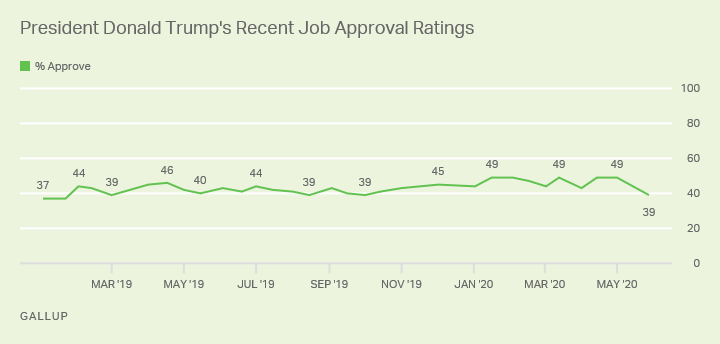
Yesterday, Gallup released a new poll that shows Trump's job approval cratering, down to 39% for the week ending June 4. "His current level of approval," they wrote, "would make another term as president unlikely, given the historical relationship between job approval ratings and incumbent reelection. With five months to go before Election Day, there is still time for those ratings to improve and get back near the 50% level associated with incumbent reelection in the past, but also time for them to get worse and give the president even longer odds of winning a second term."
Just as Gallup was releasing their bad news for Trump, Politico released the latest in-depth Morning Consult survey, which also looks disastrous for an incumbent president. Among registered voters, 39% approve of Trump, while 58% disapprove (47% of them strongly.) Furthermore no one likes the members of two of Trump's key demographics. Only 4% have a favorable opinion of neo-Nazis (81% have an unfavorable view) and just 5% like the most important component of the Trump coalition-- white supremicists-- while 84% have an unfavorable opinion. And compared to other high-profile politicians, Trump looks like a loser. These are the net approval ratings
• Mitch McConnell- minus 25% • Señor Trumpanzee- minus 18% • Republicans in Congress- minus 18% • Nancy Pelosi- 36% (52%) minus 16% • Kevin McCarthy- minus 15% • Chuck Schumer- 26% (40%) minus 14% • Mike Pence- 40% (46%) minus 6% • Democrats in Congress- minus 6% • Elizabeth Warren- minus 1 • Joe Biden- 46-46% (neutral)
This has hurt the notoriously thin-skinned and ratings obsessed Señor T's feelings. So he's suing CNN. He had an attorney for his campaign serve them with a cease and desist order, demanding they retract (and apologize for) a poll with results very much like the two from Gallup and Morning Consult. The CNN poll shows Trump with a 38% approval rating and shows Biden beating him 55-41%. CNN laughed at his cease and desist letter, delighted with the publicity. Republicans in Congress-- especially those up for reelection-- don't find it laughable. Two Washington Post stories in recent days says it all: What Keeps Senate Republicans From Ditching Trump? and Republicans Fear Trump's Weakened Standing Jeopardizes The Party In November. In the latter piece, Bob Costa and Phil Rucker wrote that "there is no sign yet of a mass exodus from the runaway Trump train. If anything, most elected Republicans see themselves as prisoners onboard, calculating that jumping off would lead to almost certain defeat. Conversations at the highest ranks of the party have reached what one veteran operative called the 'acceptance phase of grieving,' where 'there is an understanding that he’s president until at least November, and there is not much we can do about it.' … Strategists over the past week have suggested myriad ways embattled incumbents could tiptoe around Trump’s rolling controversies, as opposed to embracing them." House districts tend to be more polarized than most entire states are and House incumbents are generally thereby rendered safer. But in another huge anti-red wave year, Republicans who are usually unconcerned about what voters think, are nervous now. I asked Mike Siegel, who nearly beat McCaul in 2018 and is back to finish the job, why McCaul should be worried. "When Joe Biden is polling close to even in Texas," he said, "that signals doom down the GOP ballot. For years office holders like McCaul relied on the 'straight ticket'-- an option in Texas where voters could press one button to select one party in every partisan race. In this way, the gubernatorial and presidential candidates meant everything, and if you were luckily enough to win the nomination in the right district with a decent candidate at the top of the ticket, you rode in without much effort. Now, in 2020, we no longer have straight ticket voting (the GOP legislature repealed it, in a move they may regret), and Republicans like McCaul are faced with the twin challenges of building name ID while avoiding the albatross of Trump. It’s an impossible quest in TX-10. McCaul is already sounding the alarm, telling his donors this is a 'toss up' race. The cavalry is not coming-- he hasn’t kissed up sufficiently to the White House, so Trump won’t help, but he’s simultaneously too right wing and Trump-compromised (family separation, impeachment, COVID-19) to earn moderate support. It’s a perfect storm and we are ready to take advantage."
Audrey Denney had similar thoughts about her race in rural northeast California, where Oregon, Nevada and California all meet up. She told me that Trump enabler Doug LaMalfa "is actually running a campaign for the first time in his 18 years of holding elected office. He’s feeling the pressure and we’re feeling good!" After Tuesday confirmed that Cathy Kunkel is the Democratic nominee in West Virginia's least red congressional district she told me that "With Trump's approval down in West Virginia, Alex Mooney may be forced to actually run on his record, instead of relying on the down-ballot effect high Republican turnout for Trump. And his record is not a good one: voting to take away healthcare from tens of thousands of West Virginians in his district by supporting repeal of the Affordable Care Act, voting in favor of tax cuts for the wealthy, and voting against the Families First Coronavirus Relief Act.
Most American Voters-- Regardless Of Party-- See Establishment Corruption As The Key 2020 Issue
>
On Tuesday, a poll by Harris X for The Hill showed that a majority of American voters consider establishment corruption the top issue going into the 2020 election. And, keep in mind, it isn't just about Trump and his family and his Mafia-like regime. Fully half of Republican voters said a corrupt political establishment is a big problem, along with 57% of independent voters and 67% of Democrats. Progressive Democrat Kara Eastman is in a statistically tied race to defeat Trump enabler Donald J. Bacon in Omaha. This afternoon she noted that "When we look at all the political problems in the country, it usually comes down to one thing: money. Money has a corrupting influence on our politics and our politicians. Politicians receive money from certain interests then pass legislation on behalf of those interests. It’s really not too complicated."
Voters view a corrupt political establishment as a bigger problem than both healthcare and gun violence. 58% of registered voters in the May 18-19 survey said a corrupt political establishment is a big problem in the United States, while an addition 27 percent viewed the issue as a moderate problem. I decided to ask some of the congressional candidates who have been campaigning on their opponents' corruption to weigh in. Hector Oseguera, who is running against entrenched Democratic incumbent Albio Sires and the notoriously corrupt New Jersey Democratic machine, told us that "Bipartisan consensus is hard to come by, but on the issue of corruption, right, left, and center all agree. Large majorities of the American people regularly cite corruption as a core concern regarding our federal officials. Few people trust politicians to act in the best interests of the people, and that's a crisis of democracy. This campaign is challenging one of the most entrenched political establishments in the country; and while some doubt the ability of a scrappy Millennial to oust such a powerful machine, supporters have been consistently drawn to my anti-corruption platform. This platform tackles the corrupting influence of money on our elections, takes a sledgehammer to the infrastructure of offshore shell companies that crooks use to hide their illicit funds, and introduces pro-democracy reforms to get people engaged in our democracy once more. Matthew Hale, professor of political science at Seton Hall University, said that if there’s one issue I could run a successful campaign on in New Jersey, it's the issue of corruption."
Cathy Kunkel is up against an equally corrupted West Virginia machine-- this one Republican. "West Virginia Can't Wait (a coalition of more than 90 candidates spearheaded by Stephen Smith for governor)," she told us, "surveyed more than 10,000 voters last summer and fall and found that-- by far-- West Virginia voters also view political corruption as the biggest problem in the state. Just today, ProPublica published an expose of West Virginia governor Jim Justice, a billionaire coal CEO with a long history of failing to pay his workers and fines. Justice, who was elected as a Democrat and then switched to Republican, retains interests and involvement in his businesses as governor. And in West Virginia's 2nd Congressional district, Representative Alex Mooney-- who sits on the House Financial Services Committee-- receives his top campaign contributions from the financial services industry and then votes to eliminate the Consumer Financial Protection Bureau and other bills that serve Wall Street instead of West Virginia. West Virginia Can't Wait candidates-- all of whom have pledged not to take corporate money in our campaigns-- are campaigning against corruption and working to turn out voters who have been turned off by the corruption in both parties." In Texas, progressive candidate Julie Oliver is up against the same kind of sewer politics and corruption has been an important part of her campaign. "The toxicity, gridlock, and hyperpartisanship that we see in Congress," she said, "is a function of the money that has utterly corroded that institution. Ending corruption and getting big money out of our politics is one of my top priorities-- and it is why I have refused all PAC money, so that Texas will never have to worry about my arm being twisted behind closed doors. "I'm running against one of the most corrupt and ineffective career politicians in Washington, who happens to be a Republican. But the corrupting influence of big money in Congress affects Democrats and Republicans. "If we can get big money out of Congress, if we can end gerrymandering, and if we can stop the undue influence of outsize spending on our elections, we will have an institution in Congress that is worthy of the people it's supposed to serve."


 In a message to her supporters yesterday, Marie Newman wrote that she has "come to expect carelessness and cruelty from the Trump Administration, but this level of disregard for Americans’ pain is truly astounding. Millions are out of work and many more will lose their jobs, and even lose their lives, without the economic relief our country desperately needs and deserves. I’ve spent the past five months meeting with community members, small business owners, and first responders across Illinois’ Third District. They desperately need relief. Now. Working families need additional federal support as they struggle to find work and keep food on the table, small businesses need continued relief to stay afloat and pay their employees, and states and municipalities need immediate assistance to continue providing essential public services. Trump and his allies in Congress see these negotiations as a political game, but in reality, American lives are on the line. I’ve had enough with politicians who ignore the needs of their constituents. Vote them out."