Thursday, August 20, 2020

Is The Tent So Big That The Party Has Become Meaningless As Anything MoreThan A Vehicle To Save The Country From Trump?

>
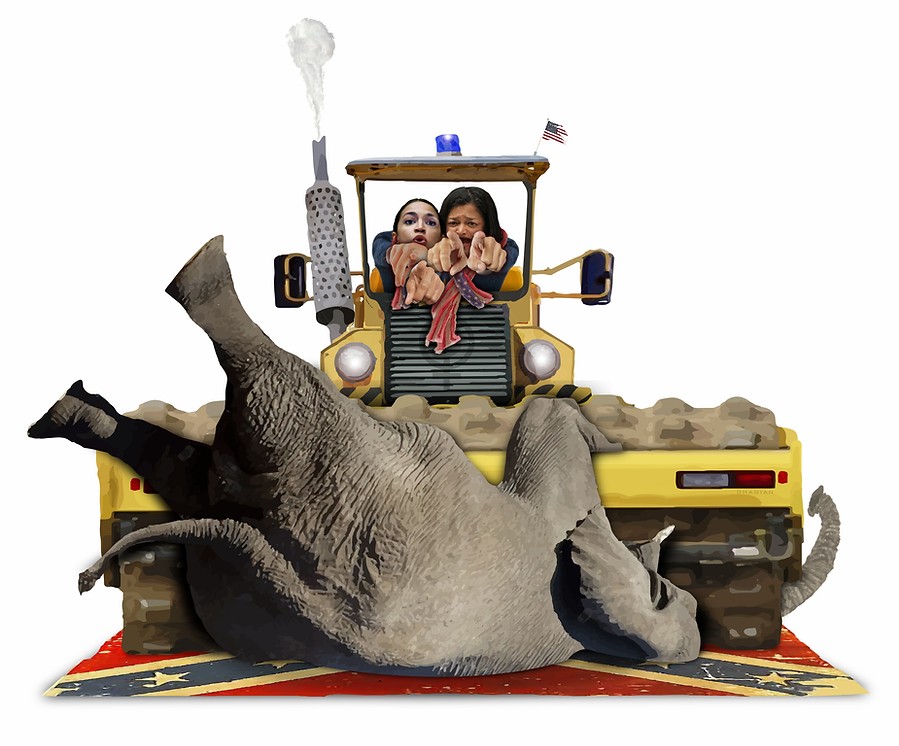
Can you see who's driving the truck in this Nancy Ohanian drawing?

In 1945, when the legislation that finally became Medicare twenty years later in 1965, was first seriously pushed by Harry Truman, it was Medicare for All. It covered all Americans' doctor visits, hospital visits, laboratory services, dental care and nursing services. The Democrats had just won 20 more seats in the House and controlled it 242-191; Sam Rayburn was speaker. The Senate consisted of 58 Democrats (+ one Progressive) and just 37 Republicans. 3 more GOP incumbents had been defeated-- including unabashed fascist Gerald Nye (R-ND). But Medicare failed. Why? The Republican wing of the Democratic Party, which very much controlled the Congress and was always happy to work with the Republicans to stop progressive legislation. It finally passed-- albeit horribly watered down-- in 1965 because the 1964 blue wave gave the Democrats a net of 37 new seats and massive 295 to 140 seat majority. In the Senate, there were 68 Democrats and 32 Republicans. The new President, Lyndon Johnson, used his massive mandate, to push Medicare through, the Republican wing of the party unable to muster the strength to work with the GOP to stop it.

But, unfortunately, the Republican wing of the Democratic Party wasn't dead, just laying low. When Obamacare came to a vote, the filthy, corrupt Blue Dogs and New Dems and fellow travelers were at it again-- killing, for example-- the public option. The Republican wing of the party whines and scratches and kicks and threatens anytime anything remotely progressive is brought up. I've been told by half a dozen congressional Democrats that their conference-- and some mention our country as well-- would be better off if Anthony Brindisi, a detestable whiny Blue Dog from New York, is defeated in November since all he ever does is work against even modestly progressive proposals from inside the party.

The Blue Dogs and New Dems like Brindisi-- there are over 100 of them, though just one or two as bad as him-- continue to crap on the Democratic brand to such an extent that many people don't know what the Democratic Party even stands for any more. Is the future of the party with AOC, Andy Levin and Pramila Jayapal-- who are all sailing to smooth reelections-- or with Brindisi, Joe Cunningham and Kendra Horn, who are all in danger of losing... and in the midst of a massive anti-red wave?

Goal ThermometerThe progressive Democrat, taking on Trumpist yes-man Ken Calvert in Riverside County is Liam O'Mara, a history professor. This morning he told me that "We win elections when we stand for something, not when we stand against something. Hope and belief are what motivate the kind of voters open to our messages. It saddens me that after all the work out there on voter psychology, we still need to scream at establishment Democrats who think fear of Trump is a good election strategy. Should we fear Trump? Absolutely. The man is a menace, and his ideology will finish off this country quicker than any other. But few voters will ever know enough of why they should worry, and most of those are already our voters. To rebuild this country-- to move past not only Trump but Trumpism-- we need to tackle the real issues and win over undecided voters, and that means presenting a positive vision of where we could go as a society. Is the Democratic party a big tent? Sure. Does that mean we roll over for a regressive agenda and stop dreaming? Only if the goal is more Trumps in our future. For myself, I say we get back in the trenches and win the war of ideas. Voters can and will listen if you come at them openly, honestly, and present a compelling vision for their future. Pretending that all we need to do is yell 'Orange Man Bad!' and expect people in the middle to stick with us is the height of hubris. If we want those voters in our corner, we need to tell them why."


"Crooked Ken Calvert," O'Mara continued, "is trying to win his race with two things: money and fear. He's going to suck in as much dirty cash as ever, and spend it to call me a radical hippie commie God-hating son-of-a-bitch terrorist anarchist-- whatever he thinks will stick. I'd rather spend time talking about what we could do if we had a government that gave a crap about human welfare, civil rights, and a thriving economy. I'll continue to show that my policies will save the voters money, raise their standard of living, and drain that damned swamp in DC. And I'm going to hope enough listen so we can keep building a government of the people, by the people, and for the people."

Yesterday, yet another life-long Republican, former Bucks County Congressman Charlie Dent, endorsed Biden, not because he necessarily believes in much of anything that has to do with Democratic values; it's just that he recognizes the existential danger Trump-- and his party-- have put the country in. The current congressman from Dent's old district, Brian Fitzpatrick (R), refuses to say whether he'll vote for Biden or Trump, and not a single current member of the House-- all of whom face the voters in November-- has come out against Trump. All cowards. You want them in the Democratic Party? One big party? No! One big union? Yes! Who do you feel solidarity with? Tonight billionaire Republican Michael Bloomberg addresses the boring, unwatchable Democratic Convention, which will surely cause the already horrifyingly ratings to further plummet.


Also yesterday the Washington Post published a piece by Marc Fisher, William Wan and Jeff Stein noting-- in the midst of a convention where this should be clear-- that some Biden voters are wondering what the party stands for beyond just dumping Trump. They introduced voter in Georgia who "has had it with Trump," but who wants fundamental change and told them she found the convention "very disappointing, a kind of People magazine personal interest story. I’m not voting for a roommate. It’s very easy to show a lot of people’s faces, but that doesn’t tell anybody what you’re going to do for working-class people... [M]aybe I’ll just stay home. Last time, I gritted my teeth and voted for Hillary Clinton, and I really don’t know if I can do that again for another corporate Democrat."
In opinion surveys and dozens of interviews, Democrats see a nation adrift, a people in pain. Together, they yearn for hope and inspiration. They want to be able to trust again-- trust their leaders, institutions and their fellow Americans. Yet like the country as a whole, they fall into sharply divided factions with decidedly different perspectives on what needs to be done and who ought to do it.

...The pandemic, Black Lives Matter and the protests have made it obvious to everyone that we’re in such a tough situation because everyone in the country is not equally protected,” said David Sinaiko, who teaches theater and English at a high school in Marin County north of San Francisco.

Sinaiko has three children in their 20s, and “they’re all dying to see what the future of the Democratic Party will look like,” he said. “So it’s really disappointing that they have their convention and it’s Hillary and Bill Clinton speaking again. The Clintons represent something young people are eager to move on from-- economic policies that created this vast inequality in the country.”

...For the many Americans who don’t follow politics closely, this week is the first major opportunity to see what the Democrats stand for. In Portland, Ore., Andrea Haack hopes the convention will clarify whether the Democratic message is primarily one of relief from Trump or is an assertion that issues such as health care, homelessness, immigration and police reform must be addressed.

Haack, a 45-year-old staffer at Portland State University, grew up believing politics was a tool for change.

“I’m a typical Portland person,” she said. “I wear lots of black. I’m tattooed everywhere. And of course I protest.” She’s been to dozens of marches since high school-- for gay rights, against President George W. Bush, for labor unions.

Haack believes it will be necessary to keep protesting under a Democratic president, to assure that the issues she cares about stay front and center, but she worries that putting too much emphasis on difficult issues during the campaign might backfire.

“The anti-Trump message might work better to pull in right-of-center people, but the policy positions are what are important to people already left-leaning,” Haack said. “How do you thread that needle? I honestly don’t know. Because, to be honest, I don’t know very many Republicans, so I don’t know what would appeal to them.”

Democrats don’t agree on what policies will get the country back on track, but many are united in their craving for a sense of belonging and for a rekindling of the trust they once had in the system and in each other.

Many cited the divide over how to address the coronavirus crisis-- the wildly different attitudes toward wearing masks, opening stores or holding school in-person-- as evidence that too many Americans no longer trust their neighbors, medical and scientific experts or government authorities.

Fifty-seven percent of Americans said in a Pew Research Center poll earlier this year that people mostly look out only for themselves, a number that didn’t vary much according by party affiliation.

Celia Sgroi, a retired city judge in Oswego, NY, near the Canadian border, wants the convention to restore her faith in America. The party’s previous two White House occupants won with messages of hope-- Clinton’s “man from Hope” campaign and Barack Obama’s “hope and change” theme-- and Sgroi now seeks a similar approach from the man who would be the country’s oldest president ever.

“I’m not proud of being American anymore,” she lamented. “I never had the feeling like I do now that people in the world are absolutely disgusted with us. I want a vision for the country, for what I used to think of as America-- a leader in education, science and technology, a country that helps others.”

The country needs an emotional boost, Sgroi said, and so does she.

“I watch MSNBC a couple hours every night, and lately the tone has been ‘We’re all going to die,’ ” she said. “I can’t take much more of that. I don’t want to be hanging black crepe all the time. What I need from the convention is the tiniest sense of hope.”

For three years, Sgroi, 71, has felt as if she were in a waking nightmare.

“I’d like to be able to sleep again,” she said. “I can’t tell you how many times I’ve woken up in the middle of night with my mind racing about Trump policies.” Children in cages, bullying, lying, denigrating nicknames for everyone-- “he’s come to be too much of a negative influence in my life, and he’s everywhere. I want him out of my life.”

...At 15, Dhruvak Mirani is already a veteran of several political campaigns; the junior at Glenelg High School in Howard County, Md., sent tens of thousands of texts on behalf of Sanders before he dropped out of the race.

Mirani shifted his support to Biden, if reluctantly. “Look, Joe Biden is a far better alternative than Trump, but it’s not what a lot of people like me were looking for,” he said.

The teen is casting his eye beyond this fall, hoping that the convention will signal what might come after Biden. “I’m curious how long the progressive wing will be okay supporting mainstream centrist candidates that keep undermining progressive movement,” Mirani said. “The primary goal right now is to get Trump out. But what happens after that?”

Levi Bradford, a third-year student at the University of Florida law school, doesn’t want to wait for his party to change.

“I’m kind of conflicted,” said the 25-year-old from Sarasota. “I want them to send a message that we’re all on the same team, and we’re going to get this guy out of office. But at the same time, I want them to recognize that this is not the ideal ticket for a lot of us. I feel like, once we get Trump out of office, that’s great, we’re taking down a demagogue. But how are they actually planning to really revamp the party so it’s more representative of minority voters?”
Goal ThermometerState Rep. Jon Hoadley is running for the southwest Michigan seat held by Trump bootlick Fred Upton. "From the beginning," Hoadley told me this morning, "my work has been about advocating for people, and that's exactly why I'm running for Congress. I have a reputation as a state legislator as someone who will work with everyone but never lose sight of progressive values. That means making the case for why the old way of doing things isn't working for working people. The real issues facing our families - fighting to get healthy instead of fighting with insurance companies, the ability to trust the water coming out of the faucet, calling out racism and discrimination-- requires leadership. While Congressman Upton may talk the talk on bipartisanship, it's not lost on anyone that during the first two years of Trump's Administration Upton voted for his agenda 96% of the time. We need folks who will take on the challenge of tough policy changes that benefit our communities and working families, and I'm ready to take on that challenge."

Labels: , , , ,

Thursday, September 19, 2019

Is The Democratic Party Tent Too Big To Offer Voters Anything?

>


A new poll done by Change Research-- a very good firm-- found that 60% of voters in rural counties in 9 states-- Colorado, Michigan, Minnesota, Montana, North Dakota, Ohio, Pennsylvania, Wisconsin and West Virginia-- approve of the way Trump is doing his job. Democrats need to work harder in rural districts, which they've largely abandoned. And when they haven't abandoned them, they've left them to right-of-center Blue Dogs, New Dems and other conservaDems who don't represent the Democratic Party and its values at all. These are the only Democrats whose districts are at least 25% rural. Non-conservatives G.K. Butterfield (NC) and Bennie Thompson (MS) represent districts that, though rural, are over 50% African-American. Most of the others oppose Medicare-for-All, the Green New Deal, even a $15 minimum wage. Perhaps that helps explain why Trump does so well in rural areas-- no one to fight back. This list shows what percentage of each district is rural and the grade at the end of each line is how ProgressivePunch rates the congressmember.
Terri Sewell (New Dem-AL)- 29.8%... F
Tom O'Halleran (Blue Dog-AZ)- 52.4%... F
Sanford Bishop (Blue Dog-GA)- 40.95... F
Tulsi Gabbard (D-HI)- 27.6%... F
Cheri Bustos (New Dem-IL)- 42.7%... F
Abby Finkenauer (D-IA)- 47.7%... F
Dave Loebsack (D-IA)- 60.7%... F
Jared Golden (D-ME)- 71.9%... F
Bennie Thompson (D-MS)- 75.3%... D
Ann Kuster (New Dem-NH)- 57.6%... F
Xochitl Torres-Small (Blue Dog-NM)- 73.1%... F
Antonio Delgado (New Dem-NY)- 45.7%... F
Anthony Brindisi (Blue Dog-NY)- 28.9%... F
G.K. Butterfield (D-NC)- 48.6%... F
Peter DeFazio (D-OR)- 36.8%... B
Peter Welch (D-VT)- 69.5%... B
Derek Kilmer (New Dem-WA)- 27.8%... F


And speaking of no one to fight back, Blue Dog Max Rose, represents Staten Island and a substantial chunk of south Brooklyn. A few days ago he wrote an OpEd for the Staten Island Advance on why he opposes an impeachment investigation. It also demonstrates why I oppose supporting Blue Dogs running for office as Democrats. He starts with some whiny "why can't we all just get along" bullshit, seemingly not cognizant of the Republicans impeaching Bill Clinton over nothing at all, Moscow Mitch making refusing to allow a vote of President Obama's Suprme Court nomination, Moscow Mitch allowing the Russians to help Trump steal the 2016 election... little things like that. Even yesterday... Trumpist Cory Lewandowski obstruction at the House Judiciary Committee. As always, Rose follows that up by breaking out his Republican Party talking points and singing them as loud and he can:
For the past decade, the American people have been sending a clear and unmistakable message: End the hyper-partisanship and do your jobs. Yet, both parties have taken electoral victories as mandates to ignore that message to do what they want. It must stop.

Republicans across the country ran on a proactive agenda in 2016: To drain the swamp, rebuild our roads and bridges, and protect Social Security and Medicare. What they did instead was pass a trillion-dollar tax cut for the very companies that created the opioid epidemic. I fear the Democratic Party is now at risk of repeating a similar bait-and-switch mistake by focusing on impeachment instead of infrastructure, healthcare costs, and putting people to work with livable wages and benefits.

Let me be clear, we have made real progress this year, including permanently extending and fully funding the 9/11 Victim Compensation Fund, passing the most sweeping anti-corruption legislation in a generation, and bipartisan gun safety reforms.


This Rose stinks
But there’s far too much work left to be done and we are in danger of losing the trust of the American people if we choose partisan warfare over improving the lives of hardworking families. I made a promise to my constituents to focus on making their lives better, and I won’t break it.

There is no doubt that this Administration is one of the most corrupt in history. From taxpayer dollars propping up Trump Organization properties to the mass exodus of Administration officials who have been forced to resign, are facing serious ethical investigations, or have sped through the revolving door to become federal lobbyists for the same industries they oversaw. It’s clear as day, the swamp is alive and thriving.

But pursuing a partisan impeachment process won’t address any of those serious issues. The truth is impeachment will only tear our country further apart and we will see no progress on the enormous challenges we face as a nation. Impeachment will not fix our roads and bridges or lower the costs of drugs. Impeachment will not keep our kids safe from gun violence or end the opioid epidemic. Impeachment will not improve the lives of the hardworking Staten Islanders and South Brooklynites that I fight for every day.

That’s why I implore my Democratic colleagues to focus on making our case that we are the party that will put the interests of working families first. Because in just over 400 days, men and women across the country will go to the polls and render their judgment on this administration. I have faith in the American people and believe that they will-- and should-- make the final decision as to who will lead this country.


Rose hasn't accomplished a thing since he got to Congress-- unless you call holding back accomplishments accomplishing something. He's been against virtually every progressive initiative proposed. The video above, released this afternoon by the Kina Collins campaign in Chicago, shows a very different end of the Democratic tent, a young woman who has every intention of getting things done for her constituents. The theme of this one is gun violence prevention and Kina is on fire to get it done-- done for real. Kina is running in Chicago, in IL-07 for a seat held by do-nothing incumbent Danny Davis-- and it's a tragedy that there isn't someone like her running against Rose.

Goal Thermometer"We have to go beyond the gun," she said, "to address systemic issues of poverty and neglect. It's time to pursue a bold progressive platform that includes Medicare-for-All, a Green New Deal, criminal justice reform and future free of gun violence... It's time; it's our time." Please consider contributing what you can to Kina's grassroots congressional campaign by clicking on the 2020 Blue America House  thermometer on the right. We desperately need more activist members of Congress like Kina Collins and far fewer like do-nothing reactionaries like Max Rose. This is a time for independent-thinkers like Kina, not for passive follow-the-leader shills like Danny Davis and Max Rose, sitting around and ignoring the urgent issues of the day while they collect their unearned paychecks.


Labels: , , , , , , , ,

Monday, June 03, 2019

Does The Democratic Party Need A Republican Wing?

>


Alabama has a Republican House and a Republican Senate and a Republican governor. When the state government of Alabama decided women in their state can no longer have abortions, it was horrible enough. But two weeks later, the Democratic governor of Louisiana signed another of the extreme anti-abortion bills that Republicans are using to deny women's Choice. And it isn't just happening in the Deep South. Ohio and Missouri have done the same thing. But there's something about Louisiana that irks the most-- a Democratic governor unwilling to stand up for women, to stand up, especially for poor women? Maybe the tent really is too big. If it's big enough for John Bel Edwards to be stinking it up from the inside, why would a normal Democrat even want to be inside it?

Yesterday, speaking before the California Democratic Convention in San Francisco, Elizabeth Warren began her remarks by reminding the enthusiastic delegates that "we have a job to do: Beat Donald Trump. But beating Trump is not enough. We need to win up and down the ticket everywhere. To do that, we need to show what it means to be a Democrat." YES! Do Democrats in Louisiana hear that and say to themselves, "We need to pass stricter anti-Choice laws?" This one doesn't include exceptions for raoe or incest. Will the next one take out the exception for the life of the mother? How long will the prison terms be for women and their doctors?


In the middle of all this, the chair of the DCCC, Cheri Bustos, a virulent conservative who claims to be pro-choice, decided to throw a big-money fundraiser for one of Congress' most anti-Choice members, Blue Dog Dan Lipinski, co-chair of the Congressional Pro-life Caucus. The pressure on Bustos grew so intense, so fast that she finally backed out of attending. But the DCCC will not back away from defending Lipinski, who isn't just anti-Choice but who has an ugly voting record that is anti-LGBTQ, anti-working class, anti-healthcare and pro-NRA. Does he even deserve party loyalty? He didn't demonstrate any in 2018 when he flatly refused to endorse Obama for reelection.

Why does the DCCC cling to these right-wing Democrats and dump millions of dollars into defending them? Many of them-- Lipinski, of course, but also Henry Cuellar (Blue Dog-TX), Luis Correa (Blue Dog-CA), David Scott (Blue Dog-GA), Jim Cooper (Blue Dog-TN), Vicente Gonzalez (Blue Dog-TX), Sanford Bishop (Blue Dog-GA), Filemon Vela (Blue Dog-TX), Brad Schneider (Blue Dog-IL), Ed Case (Blue Dog-HI) and Jim Costa (Blue Dog-CA)-- are in deep blue seats that would as easily make a good home for a moderate or progressive instead of a reactionary.

Blue America has always looked for opponents for these Blue Dogs and we've had some real success in replacing some of them. This year we're continuing and so far we are supporting Marie Newman in her run against Lipinski, Eva Putzova in her run against Tom O'Halleran in Arizona and Michael Owens in his run against David Scott in the suburbs south nd west of Atlanta. There will be others; rest assured of that. We're in the process of vetting some now, to make certain that we will be electing members who will do the right thing in Congress.

Goal ThermometerSometimes the tent really just is too damned big and the party stops having any meaning. When people ask what the Democratic Party stands for on questions like Choice for women or equality for the LGBTQ community, we are in deep trouble. This week, after John Bel Edwards signed the draconian bill banning abortion in Louisiana, Marie Newman told the media, that "This type of legislation is authoritarian and totalitarian. There’s no other way to describe it. Let’s be honest about what it is. It’s taking us back 100 years, and that’s not exaggerating."

Please consider helping these three candidates primarying Blue Dogs right now. Your contribution will send a message to Cheri Bustos and the DCCC that grassroots Democrats adhere to the values and principles that have built the party and-- before Bustos came along-- distinguished it from the Republicans. There are, after all, legitimate differences, whether Dan Lipinski will ever understand that or not. Please click on the Blue America Primary A Blue Dog thermometer above and help make a difference-- for a difference.

Labels: , , , , ,

Friday, May 31, 2019

The Story Can Now Be Told: Cheri Bustos Is The Creature With The Atom Brain

>

Two-headed dog, two-headed dog, I've been working in the Kremlin with a two-headed dog

Good essay this week by Sean McElwee and Tory Gavito for GQ-- The Democratic Party Is Waging a War Against Its Very Own Base. Essentially, their theme is that the tent is too damn big and there are too many Blue Dogs and New Dems in it befouling the core Democratic brand and confusing voters who try to understand what the Democratic Party stands for and what values it holds dear.

Yesterday another dozen innocent Americans were randomly gunned down by some NRA crackpot in Virginia Beach. Last cycle the NRA and other pro-gun groups spent $4,261,760 bribing congressional candidates. Most of those bribes went to Republicans, of course. But not all. There used to be dozens of Democrats taking sewer money from the gun merchants and their lobbyists; in 2018 there are just 13-- 4 in the Senate (2 of whom, Heitkamp and Donnelly, were defeated) and 9 in the House. These are the House members sucking up the blood money, from worst to slightly less terrible:
Collin Peterson (Blue Dog-MN)
Henry Cuellar (Blue Dog-TX)
Sanford Bishop (Blue Dog-GA)
Ron Kind (New Dem-WI)
Kurt Schrader (Blue Dog-OR)
Vicente Gonzalez (Blue Dog-TX)
Jefferson Van Drew (Blue Dog-NJ)
Jason Crow (New Dem-CO)
Colin Allred (New Dem-TX)
McElwee and Gavito began by noting that "At a critical juncture before the 2020 elections, the leadership of the Democratic Party is, perplexingly, abandoning key constituencies of its base, including young people, women, and people of color, as well as the policies that fire them up. In chasing a narrow swath of white swing voters, the leadership has ignored a broader coalition of voters who have delivered blue victories time and time again. Not only that-- at times, it’s actively antagonizing them."
Even though the multiracial coalition that re-elected Obama in 2012 and stayed home in 2016 was large enough to change the outcome of the election, the Democratic leadership has focused on voters who swung from Barack Obama to Donald Trump. Party leaders have also taken to kneecapping up-and-coming progressives. Earlier this year, the DCCC-- the party’s House campaigns arm-- announced that it will blacklist firms that work with primary challengers, despite their delivering exciting new talent, reflective of its base, like congresswomen Alexandria Ocasio-Cortez of New York and Ayanna Pressley of Massachusetts.

Goal ThermometerThis has led them to positions at odds with the values of the Democratic electorate. In the very same week that Alabama passed a full-fledged abortion ban, in what appears to be a coordinated, Republican-led attack on women’s reproductive rights in several states, DCCC chairwoman Cheri Bustos planned a fundraiser for Illinois congressman Dan Lipinski, an anti-choice, anti-LGBT Democrat who opposed the Affordable Care Act and refused to endorse President Barack Obama in 2012. In his safe blue district, he faces a primary challenge from mainstream, pro-choice progressive Marie Newman, who lost many of her consultants after the DCCC announced its blacklist.

The backlash against the fundraiser for Lipinski-- who supports abortion bans—was, predictably, swift and furious. Facing pressure, Bustos dropped out of it, but she had already signaled to the base that she valued incumbency over protecting a woman’s right to choose from the onslaught of right-wing attacks.

Bustos also made it clear that she sees the path to victory for Democrats in white swing voters, rather than in mobilizing the base of young voters and voters of color. She, along with other members in leadership like House Speaker Nancy Pelosi and House Majority Leader Steny Hoyer routinely undermine their colleagues' bold initiatives, such as Medicare for All and the Green New Deal (though this may also be related to their acceptance of fossil-fuel industry donations), despite the popularity of these policies among Democratic voters. Leadership routinely says that they have to hold the “center” and “mainstream.”

Data for Progress, a think tank that studies public opinion and voter file data, analyzed the path forward for the Democratic Party, and the party could make big gains by a strategy that mobilizes progressives, rather than continuously undermining their base.

This orientation toward the middle instead of values and vision is demobilizing... The results of demobilization are devastating. As the chart below shows, in four key states in 2016, there were more progressives who voted in 2012 and then stayed home in 2016 than the margin of victory in each state. Many of these voters are young people of color.


The valuation of white moderate voters-- and so-called "electability"-- —over growing and reliable constituencies seems to have led the party to abandon areas where it could have won. The establishment's hostility toward the Democratic base is not new. This tension was starkly represented by Bill Clinton’s third-way centrism, with legislation like the 1994 crime bill and financial deregulation. And despite that model’s defeat in key 2016 states, its adherents, like Joe Biden, continue to push it as the sole way forward. Biden’s campaign is based around the thesis that good old boys can sit down over beers and pass comprehensive climate legislation. It’s more absurd than anything the left has proposed.

The party’s neglect of the Democratic base is reflected in the rhetoric and strategy that it employs in determining its geographic investments, too. Democrats continue to ignore the south and southwestern states, underinvesting in places where demographics are actually the most advantageous. Take Texas. Ignoring Texas’s 38 electoral votes, especially after Democrat senate candidate Beto O'Rourke lost by a mere 2 points, in 2018, is an old-world view. Democrats lost Texas in 2018 by 200,000 votes in a state with more than 6 million eligible voters—people of color and young people-- not voting concentrated in major cities. Texas is changing and Democrats can take it, if they have the imagination and the will to follow the data.

Instead, they look at past battles lost in Michigan, Pennsylvania, and Ohio. They argue that these are the important states on the path to 270 electoral college votes, insinuating that these populations are moderate and white. But even in the northern states, Democrats don’t get the base math right.

In Michigan, Democrats lost by 10,704 votes while over 4 million voters, counting both eligible registered Democratic and unregistered voters, were up for grabs. In 2016, Democrats failed to recognize that the turf in Michigan no longer looked like it did when Bill Clinton ran his 1996 reelection campaign, setting up field operations in neighborhoods that no longer existed. Consider the following data demonstrating that a multiracial coalition continues to be ignored by campaigns in traditional presidential battleground states, based on Data for Progress analysis of the Cooperative Congressional Election Studies 2016 survey.


In contrast, when Democrats mobilize their base, they win. There is GA-06, which middle-of-the-road Jon Ossoff lost; congresswoman Lucy McBath won there by running a campaign on the issue of gun safety and embracing the new electorate. Or in TX-32, where congressman Colin Allred focused on mobilizing young people and people of color in addition to making the case for his values in the Dallas area, flipping his district for the first time in 15 years.

Stacey Abrams’s gubernatorial campaign in Georgia was an explicit attempt to expand the electorate. That strategy succeeded in bringing a Democrat the closest to victory in a Georgia gubernatorial race since 1998. But the campaign wasn’t starting from scratch. Abrams founded the New Georgia Project in 2014 with the explicit intention of mobilizing the black electorate in Georgia. That long-term work focused on the base will pay off.

Mobilizing the Democratic party base means standing up for progressive values, principles, and policies-- and reaching out to the people it claims to represent. In the Data for Progress and YouGov Blue “What The Hell Happened” survey, we found overwhelming support among 2018 voters for policies like Medicare for All, the Green New Deal, and free college. And, in a recent report, Pew found that Gen X, Millennials, and Gen Z, turning 18 this cycle, are now a bigger voting block than Clinton’s cohort of boomers and older generations-- together they outvoted older generations in the 2018 midterm elections.

The idea that the party needs to focus on the so-called center simply isn’t supported by data. The path forward for the Democratic Party is investing in the electorate of the future, not trying to win a smaller proportion of white voters that voted for Trump. This strategy will pay dividends for decades. Without a sharp pivot, Democrats risk again losing an entire generation of future Democrats who are disengaged and increasingly skeptical of the American political system.
Yes, Cheri Bustos is and has always been... The Evil One. I released that album-- and I know! I've always known. Rest In Peace, Roky, rest in peace... we'll beat those fuckers one day:


Labels: , , , , ,

Friday, October 26, 2018

Is PAYGO The Messaging Pelosi Thinks The Democrats Can Win On?

>


Sometimes a political tent can get so big that it stops having any meaning at all. The messaging coming out of the GOP pup tent is at least clear: they're white nationalists with a fascist bent who want to cut taxes on the rich and end social spending on things they consider wasteful-- Social Security, Medicare, food stamps, environmental protection... you know the old story. These are a few of the things conservatives have vehemently opposed over the years:
the American Revolution
the Bill of Rights
public education
the emancipation of the slaves
women's suffrage
the breakup of monopolies
the abolition of child labor
food safety
rural electrification
land grant colleges
national parks
the weekend
unions
the minimum wage
Social Security
civil rights and voting rights for minorities
clean air and water and consumer safety
Medicare and Medicaid
That's who they are-- and they still think they're right for opposing most of these things. Progressives backed the same list. So where's the business-friendly, careerist-oriented DC Democrats? Somewhere in between and struggling to find an identity-- or not. Messaging this cycle is abysmal. People wonder what the Democrats stand for. Pelosi said PAYGO, an old discarded Republican idea that basically means no real progress can ever get done that involved money. A friend called the other day and asked me to define PAYGO, since it is likely to be on Pelosi's political headstone one day. Here's how wikipedia did:
The PAYGO compels new spending or tax changes not to add to the federal debt. Not to be confused with pay-as-you-go financing, which is when a government saves up money to fund a specific project. Under the PAYGO rules, a new proposal must either be "budget neutral" or offset with savings derived from existing funds. The goal of this is to require those in control of the budget to engage in the diligence of prioritizing expenses and exercising fiscal restraint.
There are far better messages to take to the electorate. Medicare-For-All-- or even just adding dental and vision to Medicare-- Job Guarantee, free state colleges, $15 minimum wage...


Back in March, American Prospect writers Mark Paul, William Darity Jr., and Darrick Hamilton, handed Pelosi and her tent-mates a cohesive platform they should have used for the campaign. Obviously, they didn't. Pelosi was only 4 years old when then-President Franklin Roosevelt "proposed constitutional amendments to guarantee Americans’ fundamental economic rights. It was never adopted-- and today, is more necessary than ever." It's going to take someone-- a big thinker (which she has never been and will never be)-- far more radical than Nancy Pelosi to ever try achieving it but here's what today's version would look like:


In his groundbreaking 1944 State of the Union address, President Franklin Roosevelt called for an expansion of the Bill of Rights to recognize economic rights as well. “Necessitous men,” Roosevelt observed, “are not free men.” Those “who are hungry and out of a job are the stuff of which dictatorships are made.” Moreover, real freedom, freedom to “pursue happiness,” he said, required a “second Bill of Rights under which a new basis of security and prosperity can be established for all.” For Roosevelt, full citizenship demanded more than the political rights designated in the nation’s original Bill of Rights: It required economic rights. Roosevelt outlined those rights-- which sounds very much like the Bernie Sanders platform-- as follows:
1.     The right to a useful and remunerative job in the industries or shops or farms or mines of the nation.
2.     The right to earn enough to provide adequate food and clothing and recreation.
3.     The right of every family to a decent home.
4.     The right to adequate medical care and the opportunity to achieve and enjoy good health.
5.     The right to adequate protection from the economic fears of old age, sickness, accident, and unemployment.
6.     The right to a good education.
We need to rethink public policies, breaking out of the straightjacket that overemphasizes market-based solutions. We have thought big before—but have compromised big as well. During the Great Depression, FDR and liberals made a Faustian bargain with southern segregationists to provide a New Deal and beyond, rewriting the rules of our economy. But only for some of our citizens. Ira Katznelson’s excellent book When Affirmative Action Was White: An Untold History of Racial Inequality in Twentieth-Century America documents how U.S. public policy implicitly and sometimes explicitly excluded black people from opportunity during the so called ‘golden age’ that followed. The racial apartheid that existed under slavery was renewed under another name-- Jim Crow-- for decades. The exclusions from the guarantees of the New Deal contributed to the highly unequal outcomes we observe today.

Today, we must transcend the racial, ethnic, and regional divisions exacerbated by post-Depression and post-World War II-era policies by building universal policies that are cognizant of identities and intersectionality, and inclusive of race, gender, nationality, sexuality, and ability.

The first six rights outlined by FDR above are still all too germane today, but to update these economic rights to facilitate an inclusive economy for the 21st century, we add:
7.     The right to sound banking and financial services.
8.     The right to a safe and clean environment.
9.     The right to a meaningful endowment of resources as a birthright.
The Prospect article goes on to define all 9 planks of what should be the Democratic platform. They're all very much worth reading-- and each would be vehemently opposed by the Republican Party and by the Republican wing of the Democratic Party-- the New Dems and Blue Dogs-- but I'm going to just publish the final three that they added to FDR's list:


The Right to Sound Banking and Financial Services

Wall Street profit incentives are often not aligned with Main Street economic development, and nor are the more conservative Federal Reserve’s financial policies, such as the Fed’s staunch opposition to full employment. We must offer an alternative to the predatory nature of the current system of finance. The financial system has continued to redline opportunity in this country, particularly for financially vulnerable groups who have been deprived from asset-development by the banks’ policies of housing discrimination, limited or high cost basic banking services, last resort exploitive lending practices (such as payday lending), and the pushing of subprime loans even on creditworthy Latino and black borrowers.

Recent estimates indicate that 20 to 40 percent of the U.S. population relies on some form of non-traditional financial services, such as payday lending, which disproportionately preys on vulnerable and low-income Americans. Moreover, 53.6 percent of black households and 46.4 percent of Latino households are unbanked or underbanked, which is likely related to the high costs of banking for low-income individuals and the scarcity of banks operating in black and Latino neighborhoods.

A recent US Postal Service report found that the average underserved household spends almost 10 percent of its income on alternative financial services and interest. Converting one’s paycheck into cash should not bear a penalty, particularly for those with limited resources.

There are currently 53 million “credit invisible” households in the United States-- households that do not frequently participate in forms of financial services that the major private credit bureaus incorporate in credit scores. This “credit invisibility” results in the further marginalization of this group, limiting access to credit and employment, and increasing costs associated with financial services. According to the think tank Demos, while most low-and middle-income white households with credit card debt report good or excellent credit, the opposite is true for African Americans. Further, evidence from the Federal Reserve indicates that less than one quarter of blacks reported prime scores, compared with roughly 65 percent of whites. As a result, blacks are more likely to receive sub-prime mortgages and pay more for accessing other financial products such as car loans. This need not be the case.

A public option for banking and basic financial services could provide all Americans with the right to a minimum, non-exploitative standard of banking and financial services. Like the job guarantee, public banking would generate a floor in the financial sector-- if private banks don’t provide services at least as good as those provided by the public option, we expect consumers to close their accounts at private banks and choose the public banks.

Public banks are not a new idea. In 1910, Republican President William Howard Taft introduced the U.S. Postal Savings System to fight against the predatory-lending practices of the finance industry at the time, providing Americans an alternative that they could trust. This system functioned till 1966, when the banking lobby helped convince lawmakers to end the public option for banking and financial services. One state, North Dakota, still operates its own public bank. The state uses tax revenues to fund the bank, providing high-quality loans to farmers, students, and local businesses. Other countries, including Japan and Germany, currently have more extensive public banking options, and Germany’s municipal banks are a chief source of funding for that nation’s thriving small-and-medium-sized manufacturers.

One approach for public banking is to revive the postal banking option. The US Postal Service already provides alternative financial services via money orders (to the tune of $21 billion in 2014). In a recent white paper, the office of the USPS Inspector General noted that “while banks are closing branches all over the country, mostly in low-income areas in both rural communities and inner cities, the physical postal network is ubiquitous.” A postal bank in the U.S., including workers from the FJG program, can bring banking services to the unbanked while providing an important revenue stream for the USPS.

To provide Americans with access to reasonable financial services, another reform would be to federalize the credit score industry. Credit reports and scores have a direct and growing impact on Americans’ economic security and opportunity. Credit scores, which in theory represent the “credit worthiness” of consumers, are used to govern access for a range of basic economic needs—ranging from a car loan, to a lease on an apartment, to a job. These scores function in part as a gatekeeper to credit, which is central in today’s economy to build wealth and fully participate in the economic system. However, the credit scoring system has long been opaque and deeply flawed. Something as influential as a credit score in determining life outcomes should not be left in the hands of the for-profit, unaccountable private sector.

The Right to a Safe and Clean Environment

The environment is perhaps our greatest inherited collective resource. Yet like income and wealth, this resource—our planet and its environment-- are not shared equally. The link between environmental quality and economic inequality is clear. This was elucidated in a memo by Lawrence Summers, then the chief economist of the World Bank, which stated “the economic logic of dumping a load of toxic waste in the lowest wage country is impeccable and we should face up to that.” The same logic has been applied to the lowest income counties in the United States. We do not accept this logic.

Our environmental policy should protect Americans against this logic, as well as assaults on the environment such as those waged by the Trump administration. As the Federal Water and Pollution Control Act makes clear, water quality should “protect the public health.” Clean water and clean air should not be something Americans need to purchase-- rather they should be rights, provided to all.

 In 1994, President Bill Clinton signed Executive Order 12898, which ordered federal agencies to identify and rectify “disproportionately high and adverse human health or environmental effects of its programs, policies, and activities on minority populations and low-income populations.” Despite this landmark victory, the racial and income-based pollution patterns and health disparities associated with exposure to environmental hazards remain prevalent. Researchers at the Political Economy Research Institute released a report identifying the Toxic 100-- the top corporate air and water polluters across the country. The verdict? The “logic” of dumping on the poor and vulnerable racial/ethnic groups persists.

The ongoing Flint water crisis is only one tragic example. In Flint, decisions made by local and state authorities demonstrated that money and power matter more than public safety and human lives. A right to a clean environment for current and future generations is needed. That requires a rapid transition away from fossil fuels in the face of climate change-- the greatest threat we have faced collectively as a species. The #KeepItInTheGround campaign is just beginning. A clean and safe environment should not be commodified, something we put up for sale to the highest bidder or the one with the most connections. Instead, we need to enshrine a mechanism that provides a clean and safe environment as a basic human right.

The Right to Seed Capital to Build a Lifetime of Asset Economic Security

The reports keep stacking up-- income inequality has been growing rapidly since the late 1970s. The degree to which income is unequally distributed is shocking—yet income is less unequally distributed than wealth. Wealth is a paramount indicator of social well-being. Wealth-- what you own minus what you owe-- is critical to the economic security of Americans. With almost half of all Americans unable to afford an emergency expense amounting to $400, the average household is not resilient to economic shocks.

Recent research by Emmanuel Saez and Gabriel Zucman at Berkeley found that the top one percent of Americans held 42 percent of all wealth in 2012, with the top 0.1 percent holding 22 percent. Disparities are especially pronounced between races. The legacy of chattel slavery, where black people were literally a form of wealth for whites, and the discrimination encouraged and perpetuated through public policies, have left black families with minimal wealth. A report by the Center for Global Policy Solutions, entitled “Beyond Broke: Why Closing the Racial Wealth Gap Is a Priority for National Economic Security,” concludes that “[f]or every dollar in wealth held by whites, African Americans and Latinos held only 5 and 6 cents respectively.” In our in-depth study of The Color of Wealth in the Nation's Capital, we find that white families have 81 times more wealth than black families in Washington, D.C. A new collaborative study from the Samuel DuBois Cook Center on Social Equity and Insight: the Center for Community and Economic Development finds that single older black women with a college degree hold a mere $11,000 in wealth to deal with their retirement, in comparison with similarly educated older white women, who have a median wealth of $394,400.

Conventional explanations of wealth disparities, relying on rhetoric around the dysfunctional behavior of blacks and their lack of education or financial literacy, simply do not hold up. Given the importance of wealth in determining life outcomes, public intervention is needed to address unjustly created distributions. One such solution, “baby bonds” would seed every American at birth with an initial endowment to be held in trust until adulthood. The program would be universal, through which every newborn would receive an account, starting at around $500 for those born into the most affluent families and progressively rising to $50,000 for children born into families with minimal wealth. The accounts would be accessible when the recipient reaches adulthood and used for some asset enhancing endeavor-- a down payment for a home, say, or capital to start a new business. Estimates show that the cost of the program would amount to about 2 percent of federal spending. If the average account is established at around $20,000, the cost to the government would not exceed $90 billion a year inclusive of administration costs. While that may give some sticker shock, keep in mind the relative size of other asset development programs cost much more. Capping the mortgage interest deduction would be much more than sufficient to cover the cost of the new program.

Hey Nancy! Hey Chuck!

Labels: , , ,

Thursday, June 28, 2018

The Tent Is Too Big-- It Makes The Democratic Party Meaningless And Damages The Brand... Stands For Nothing

>


Yesterday, after her astounding victory Tuesday, Alexandria Ocasio-Cortez, was interviewed on CNN, which had ignored her race until now. She said that she is "absolutely proud to be a Democrat but it also means that the Democratic Party is a big tent and there are so many ways to be a Democrat." Like Bernie, she calls herself a Democratic socialist. Remember there are congressional Democrats who are anti-gay, anti-Choice, who don't believe in Medicare-for-All, free public college, or Job Guarantee... some of the most important issues she campaigned on. Let's be real, what does Alexandria have in common with crap DCCC candidates like, for example, Jeff Van Drew (Blue Dog-NJ), Max Rose (Blue Dog, NY), or Anthony Brindisi (Blue Dog-NY) or with members of Congress from the Republican wing of the Democratic Party like Colin Peterson, Kyrsten Sinema, Josh Gottheimer (Blue Dog-NJ), Henry Cuellar (Blue Dog-TX), Stephanie Murphy (Blue Dog-FL) or Jim Costa (Blue Dog-CA). She just finished a campaign against Joe Crowley based, in part, about how terrible he was. There are dozens of Democrats in Congress far more terrible-- and the DCCC is bringing in lots more just as bad.

Beltway pundits look at the moment and can't get beyond imagining more crap. "In the biggest surprise of 2018 so far," wrote Dave Wasserman the morning after the big earthquake, "House Democratic Caucus Chair Joe Crowley (NY-14) lost his primary to 28-year-old former Bernie Sanders organizer Alexandria Ocasio-Cortez, 58 percent to 42 percent. Ocasio-Cortez, a Democratic Socialist who favors abolishing ICE, is now a lock to represent the Queens and Bronx seat. But more broadly, Crowley's loss reshuffles the next generation of House Democratic leadership... Ocasio-Cortez's insurgency from the left had impeccable timing: her grassroots push got her coverage in outlets like Splinter News and The Nation and allowed her to build appeal with a tiny, very liberal primary electorate (barely five percent of the 14th CD's eligible voters cast ballots). But it was late enough to avoid setting off alarm bells among groups who might have rallied to aid Crowley, who once headed the centrist New Democrat Coalition... Because the primary featured so many unique contrasts, don't expect the upset to set off a tsunami of Bernie-crats toppling House Democrats." God forbid.
It's no secret that Crowley had been angling for the Speaker's gavel in the event Democrats took back the House but Minority Leader Nancy Pelosi couldn't wrangle 218 commitments. However, the case for Crowley was already shaky. If Democrats took back the House by the margin of their female victors, could they have justified tossing the first female House Speaker and embracing two white New York men as their House and Senate leaders?

Crowley's exit begins the conversation about the next generation of House Democratic leadership anew. Less senior members likely to receive more attention include Reps. Cheri Bustos (IL-17), Joe Kennedy III (MA-04), Linda Sanchez (CA-38), Katherine Clark (MA-05), Seth Moulton (MA-06), Ruben Gallego (AZ-07) and others. And, any aspirants will need to be on good terms with the party's increasingly dominant progressive base.
Goal ThermometerWhere does he get these names? Bustos in a virulent Blue Dog with a horrible voting record-- much worse than Crowley's. His ProgressivePunch lifetime vote score is 85.75, a "C." Hers is a big fat "F" (50.80), worse than Illinois Blue Dogs' Dan Lipinski's and Brad Schneider's. Just what we need, a rotten right=wing Blue Dog-- and one in a district that is very vulnerable to GOP attack. Trump, in fact, won the district 47.4% to 46.7%. She would be constantly pulling the House Democrats right in order to save her own skin. TERRIBLE idea-- and something only a Beltway pundit could entertain. And all those junior members he also suggests... no one them are realistic. Kennedy is angling for Elizabeth Warren's Senate seat when she runs for vice president under Bernie. Moulton is too right-wing and no one likes him. Linda Sanchez is a joke, Ruben Gallego is probably going to run for McCain's Senate seat and Katherine Clark... interesting, but maybe she should do something first. Ted Lieu is a far better idea than any of them but Beltway pundits have probably never heard of him. This morning one asked me how to spell his name.

Might be difficult but worth the fight

The Washington Post's James Hohmann: was closer to the mark when he wrote about "the Democratic civil war" on Wednesday. "In many ways, Crowley’s defeat is analogous to then-House Majority Leader Eric Cantor’s unexpected fall in a Virginia GOP primary four years ago this month. Republicans fared well in the midterms that year, just as Democrats almost certainly will this November, but Cantor’s downfall was a clear harbinger of the mass disruption to come, including Trump’s takeover of the GOP. Just like loathing of Barack Obama kept Republicans united in 2014, disgust with the president will keep Democrats together going into the fall elections. But make no mistake: The party’s identity crisis will be front and center after November, especially if Nancy Pelosi steps down or gets dislodged as the leader of House Democrats. The internecine conflict could become all-consuming in the free-for-all nominating contest to take on Trump in 2020 and cause a leftward lurch that helps the president win reelection." Or a leftward lurch that helps defeat Trump and clean out even more Republicans in Congress, especially in the Senate. This cycle gives the GOP every advantage. 2020 gives the GOP only one realistic Democratic target-- Doug Jones in Alabama-- but there are plenty of Republican targets: Cory Gardner (CO), Joni Ernst (IA), Mitch McConnell (KY), Susan Collins (ME), and Thom Tillis (NC) for starters.

Bernie/Warren v Trump/Pence may get Beltway pundits' bloomers all in a twist but it's exactly the kind real choice Americans are yearning for. Bernie will kick his ass in states where Hillary came up empty, like Michigan, Wisconsin, Ohio, Pennsylvania, Iowa, Florida, maybe even red bastions like Alaska and Montana. By then headline like this: U.S. cruises toward record-breaking debt on Trump's watchwill have sunk in no matter how many times Trumpanzee yells "socialist" and "Pocahontas."
The nation’s fiscal outlook looks ever bleaker, thanks in part to deficit spending during President Donald Trump’s first term, Congress’ nonpartisan budget scorekeeper projected Tuesday.

Within 16 years, the federal deficit is expected to be the largest in history, outpacing even the fiscal shortfalls that followed World War II, according to Congressional Budget Office estimates.

Congress’ recent tax and spending laws-- along with ballooning costs of programs like Social Security and Medicare-- also are driving up the amount the government pays in interest on money borrowed to make up for the gap in cash coming in and going out.

Indeed, those interest payments will exceed the cost of all Social Security spending within decades, CBO predicts. Interest costs also will be higher than discretionary spending, which amounts to all federal dollars Congress controls.

Debt is projected to reach 78 percent of gross domestic product by the end of this year-- the highest level since about 1950.

At this rate, that debt would actually exceed the size of the economy within a decade, breaking the historic record of 106 percent by 2034.

In drumming up support for their tax overhaul, congressional Republicans have said the new law would spur enough economic growth to offset a loss in revenue over the next decade.
They're lying. That's what they do. Voters are going to be pissed off-- and they'll know who to take it out on... if we still have a democratic form of government. And by the way, which Beltway pundit mentioned Alexandria Ocasio's campaign before Tuesday night? Right, none. Just ignore them.

Labels: , , ,

Thursday, April 27, 2017

Women's Choice Is Not A Cultural Issue Democrats Are Allowed To Compromise Away

>

The less bad anti-Choice candidate in Omaha?

Activist Jodi Jacobson, founder of Rewire, was one of the people who rang the alarm bell on many elements within the Democratic Party for seemingly giving anti-Choicers a wink and a nod recently. There's a lot of misinformation floating around about the Democratic candidate for Omaha mayor, Heath Mello, and the circumstances of the hubbub around his relationship to the party. Yesterday Jodi endeavored to straighten it out and make it all clear and understandably. Let me just reiterate what I've already said: Blue America doesn't endorse anti-Choice candidates and we didn't endorse Mello. "Mayoral candidates also don’t normally draw national headlines," wrote Jodi, "but Mello did, because the endorsements also shed a glaring light on his past anti-choice record. Although he is running as a Democrat and lauded for progressive positions on numerous issues, as a Nebraska state senator, Mello co-sponsored and helped pass some of the worst state-level restrictions on abortion care in the country."
Those laws remain in place, and Mello has neither denounced them nor made clear whether he now understands why they are so damaging. His elevation to a national stage has opened old and new wounds, once again raising the issue of whether the Democratic Party, and progressives writ large, truly understands the intrinsic connections between the most fundamental rights of women and the ostensible goals of a progressive agenda. It underscores the persistent but erroneous idea that abortion rights are just a “cultural issue” that can be subject to “beliefs,” rather than facts, medical evidence, and public health goals. It promotes the notion that you can restrict women’s rights and still be a progressive. It has also posed the question of whether the future leaders of the party will not only protect, but promote women’s health and rights by taking responsibility for repealing existing barriers, some of which they themselves have put in place. The initial answer to the last question seems to be no.

...Criticisms of the party’s embrace of Mello by leaders such as NARAL Pro-Choice America President Ilyse Hogue led to a cycle of mansplaining (“You’re blocking our agenda with your wedge issues!”), misinformation (“Mello’s record isn’t that bad!”), and defensiveness (“But Bernie is pro-choice!”). And Democratic Party leaders demonstrated that after all this time, they can’t seem to grasp that there is no justice without reproductive justice; that women can’t enjoy full citizenship if they can’t decide whether, when, and with whom to have children; that access to abortion is a public health imperative; and that childbearing and childrearing are fundamentally economic activities no matter what tent you are pitching or where you pitch it.

When women’s rights leaders protested, party leaders very quickly trotted out the most common Democratic Party shibboleths-- with the least basis in fact-- to quell the firestorm. Women were schooled about what it takes to win races in “red” states, never mind that time after time, poll after poll, ballot initiative after ballot initiative shows that no matter how they self-identify, voters in states controlled by right-wing legislatures do not desire to rob people of their fundamental rights and routinely vote against abortion restrictions when given the chance (take Colorado, Mississippi, or South Dakota for example). Never mind, either, that throughout the country women are literally running the resistance and fueling the resurgence of grassroots electoral power at the state level.

The first people to effectively tell women to sit down were Sanders and DNC chair Tom Perez-- both of whom should have known better and who later reversed course to publicly support reproductive rights, because, let’s face it, a great deal of PAC money and organizing power is involved. But some of the loudest pushback to women’s rights advocates came from other self-proclaimed progressives, such as D.D. Guttenplan at The Nation, who, though he is not known as an abortion rights expert, decided that we were all complaining too much and that, by the way, we had our facts wrong.

We do not.

Here are the facts.

Mello’s record on abortion rights is very bad. Full stop. As a state senator in 2010, for example, Mello co-sponsored a 20-week abortion ban, one of the first in the nation and the first to rely on the false claims of “fetal pain” cooked up by anti-choice groups to shop this kind of model legislation. In 2011, Mello voted for LB 22, which prohibited insurance coverage of abortion in the state by using a false claim that federal funds in state exchanges were being used to fund abortion. Before passage of the Affordable Care Act, the majority of women with private insurance were covered for abortion care. Thanks in large part to the machinations of former Democratic Nebraska Sen. Ben Nelson (for whom Mello previously worked) and the United States Conference of Catholic Bishops, millions of women lost insurance coverage of abortion care as the states used Nelson’s amendment to justify eliminating it. Mello helped finish his one-time boss’ work.

In 2011, Mello also voted to effectively kill telemedicine abortion in Nebraska via LB 521, which required the physical presence of a doctor for any abortion. This is another tool in the arsenal of the anti-choice playbook to make abortion so difficult to access that patients are faced with forced pregnancy. Such legislation raises the costs of abortion (by requiring office visits and the presence of a doctor even when not necessary and even for a medication abortion), makes it harder for rural women to access abortion (because they have to travel to clinics, of which there are only three in that very large state), and, ironically, results in many abortions taking place later than they might otherwise. This would seem to defeat the purpose of the bills-- but then, the purpose really is to shame women.

In running for mayor, Mello has said he would “never do anything to restrict reproductive health care.”
We'll get back to Jody in a second. I just want to point out, though, that when I interviewed another fake progressive, anti-Choice Democrat, Tom Perriello in 2008, he used the exact same words to lie to me and manipulate me into recommending him for a Blue America endorsement. He took our donors' money, got elected, showed his true colors by running up a ProgressivePunch "F" and then breaking his specific pledge to "never do anything to restrict reproductive health care." He is now the "progressive" choice for the Democratic nomination for governor of Virginia (against an even more conservative Democrat). Jodi handled that pledge from Mello by pointing out two problems: "As mayor, he will need to actively promote access to abortion care by enforcing the FACE Act, ensuring clinics are respected, and taking other steps. More to the point, however, he participated in the substantial and irreparable damage done to abortion rights in his state, and those votes can’t just be excused by votes for child care, Medicaid expansion, education, or other progressive goals. The reason is simple, and it bears repeating: Access to abortion is a public health imperative. It is a medical and individual health imperative. It is a fundamental human right, without which women can’t control their futures or fully participate in societies and communities. Denial of abortion care makes women poorer and less able to achieve their own goals. Access to abortion care improves maternal survival and health and increases infant and child survival."
This is not about “beliefs,” it’s about decades of medical and public health evidence and basic, profound questions of human rights. We’ve all become conditioned to treat abortion as some thing subject to religious dictates at the social level in ways that are not at all dissimilar and only matters of degree different from excuses used to promote female genital mutilation, child marriage, and the sequestering of women as “religious” dictates. We’ve come to treat lies and misinformation about abortion as somehow different than lies and misinformation about climate change. They are no different.

It is true that Mello is running against a Republican who is as bad on abortion rights and far worse on many other issues of concern. It is true that some in Omaha defend Mello based on his broader record and that they are the ones who vote for their representatives. But that does not obviate broader questions. Because it is simultaneously true that others in the state, and throughout the country, are in fact deeply and legitimately concerned about the failure of the party and various leaders to grapple openly and honestly with the implications of sidelining fundamental rights going forward. It is also true that Mello has not, at least publicly, actually come to grips with what his past record suggests and has not, at least publicly, disavowed his actions. Finally, it’s not enough to say that as mayor he won’t do any more bad things, because in a state in which there are three clinics and one-third of the population lives in rural areas, his past actions continue to affect people who need care.

This is not an abstract issue. Under the ACA and with the permission of Democratic leaders we have seen the greatest erosion in abortion rights in this country in over two decades, and that is not just a problem of Republicans. What is at stake here is the future of the party. What is at stake is whether the largely white, largely male-dominated Democratic Party actually means to promote and protect women’s rights from here on after. What is at stake is what it actually means to be “pro-life,” if you are willing to pass legislation that stigmatizes, criminalizes, and makes inaccessible essential reproductive health care.

The question, now, is not only whether Mello understands the damage he is done and is willing to advocate to undo it, but whether the DNC, DCCC, Sanders, and others understand it. The question is what Mello’s supporters will do to push him on these issues as he seeks higher office in the state, because he will. The question is whether the party and leaders like Sanders will dedicate themselves to addressing the harm done to women’s rights by being complicit with the corporate and religiously fundamentalist Republican Party at the national and at the state level under the guise of a so-called big tent that inevitably undermines women’s health and rights, gives cover to the Catholic Bishops and white males, but leaves more than half the population out in the cold.

It can no longer be OK to substitute anti-choice lies and “religious” beliefs for the fundamental rights and health of women. Moreover, anti-choice positions are not necessary to win elections, though that is the least of the issues right now. If the situation with Heath Mello shows anything, it is that this is a conversation that has only just begun.
If Democratic leaders start making it ok for the party's nominees for office to be anti-Choice, how long before it's OK to be anti-LGBT? Xenophobic? Racist? Anti-working family? A Climate Change denier? Where does it end? Really-- where? With the Democratic Party standing for nothing very solid at all other than the careers of the corrupt assholes in elected office? Is that what it's all about? It is for them. Oh, and one more thing, if Mello wins the mayor's race, isn't is better than the Republican winning? Sure-- except the Republican isn't going to wind up tarnishing the Democratic Party brand or one day becoming a Democratic congressman, senator or governor.


Labels: , , , , ,